Blog

  • Rewriting The Oil Stock Story

    Could oil price manipulation have created the rerun of the Great Depression that we are currently enduring?

    Think about it. The doubling of gas prices had a profound effect on disposable income and the affordability of housing, whose subsequent downturn set the stage for economic collapse.

    We now know that Wall Street speculation drove oil from $69 a barrel to nearly $150. But this article purports to explain why.

    Back in early 2004, the nation’s investment banks began making large investments in oil stocks, which became the so-called “story stocks” of the era. The story was obvious. Emerging nations like China and India were driving up demand for oil, and supplies weren’t keeping pace.

    The investment banks had their analysts write papers espousing the profits to be made from oil, and they promoted the commodity itself as an asset class like real estate, stocks, and bonds, suggesting that it was suitable for long-term investment.

    To prove their point, the investment banks began investing in oil in the futures market. But their reason had nothing to do with what they were telling investors. It had to do with the long positions they held in oil stocks, which were certain to appreciate with the rise in the value of oil as a commodity. Exxon-Mobil stock, for example, went from around 40 in the spring of 2004 to a high of 95 on December 24, 2007. Merry Christmas and a Happy New Year!

    It was around this time that the Petroleum Marketers Association, which represents more than 8,000 retail and wholesale home heating oil companies and gas station owners, began getting hate mail. They were being blamed for gouging the public, even though their costs had more than doubled.

    Early in 2008, I received a call from a former stock brokerage client of mine, who is the CEO of a concern with factories and production facilities in China. “Tim, I keep getting these investment letters from the banks telling me how China is slurping up all this oil. But it simply isn’t true. Sure, the country is growing quickly, but no faster than last year, and certainly not enough to double the price of oil in less than a year.”

    Around the same time, Art Rosen, the former president of the National-Committee on U.S.- China Relations, also told me that China could not account for all the price spikes in oil. From what he could tell, there was plenty of product readily available at supply terminals throughout the Middle Kingdom.

    Now we know how this happened. The investment banks went to regulators to obtain permission to increase their leverage from a factor of 12 to a factor of 40 times capital. Much of that leverage was being applied to the already heavily leveraged oil market, where $10,000 controls over $100,000 of product. In the new scenario, $10,000 in the hands of an investment bank controlled $4 million in product.

    The levered effect on the price of oil was such that it began drawing huge amounts of money from stock and bond funds into the commodities markets, and specifically the market for oil. Institutional investors ranging from the Harvard Endowment to sovereign wealth funds got in on the oil action, which rose from $13 billion to over $300 billion in commodities transactions in just three years. At one point the markets were trading 27 barrels of crude oil for each barrel of oil that was actually being consumed in the United States, positions so large that they move the market in the cash commodity. In a single day in the price of oil jumped by more than $25, and yet there were no hurricanes or other supply disruptions that might have accounted for it.

    A report out of the MIT Center for Energy and Environmental Policy Research clearly showed that the dynamics of supply and demand for the cash commodity could not have been responsible for such a run-up in oil prices, which reached its steepest levels during an interval when supply was going up and demand was falling.

    By this time the price of gas was rising to five dollars a gallon. The owner of a $400,000 house who commuted by car suddenly discovered that that the price of gasoline had doubled and his commute was costing more than his mortgage payment. Something had to give and it was his mortgage. Suddenly, the $400,000 houses were worth $200,000, the mortgages were underwater, and the banks were drowning in red ink. The cascade in housing prices was soon mirrored in the price of oil. The money on Wall Street was now pulling out of the oil patch to drive down the bank shares and their mortgage-backed assets, setting the stage for the deepest economic contraction since the Great Depression.

    There’s plenty of blame to go around. But once again (as in Frontrunning and Finance; New Geography.Com), most of it should be borne by the people on Wall Street, best described as a bunch of crumbs held together by dough.

    Tim Koranda is a former stockbroker who now works as a professional speechwriter. He can be reached at koranda@alum.mit.edu.

  • NCR Leaves Dayton for Atlanta

    There was terrible news for Dayton this week as the city’s last Fortune 500 company, NCR, founded locally in 1884, announced it was moving its headquarters to Atlanta. The Dayton Daily News is the place for complete coverage.

    This is bad news not just for Dayton, but for the state of Ohio and the entire Midwest. Firstly, it illustrates the plight of the smaller cities of the Midwest, the ones below one million in metro area population that I usually don’t write much about. These cities, including places like Dayton, Youngstown, and Toledo, are often struggling. Unless they are a state capital and/or home to a major state university, they just don’t seem to have quite the scale necessary to operate in the globalized economy. These cities have special challenges and I won’t profess to have answers for them.

    Secondly, this is further damage to the economic reputation of the Midwest as a whole. Loyal readers know that I’ve been skeptical of cross-regional collaboration as a panacea (though I’ve also written some positive things about it). However, there are clearly issues that affect the Midwest as a whole. It has, for example, a collective reputation as the Rust Belt that probably only Chicago is able to overcome.

    This reputation creates formidable brand headwinds in trying to attract the talent needed to compete in the 21st century. The Atlanta Business Chronicle had an interesting take on the NCR move, with one anonymous source attributing it to talent issues with Dayton. “They [NCR] can’t recruit talent to move to Dayton, Ohio.”

    So what, you might say. It’s Dayton. But my town is way cooler than Dayton. Well, the problem extends well beyond Dayton. Consider Ann Arbor. If any city in the Midwest can claim to be a winner in a the knowledge economy, it has to be the home of U of M, the best public university in the Midwest. But according to an article in the Journal, “Despite Ann Arbor’s educated work force, employers here find Michigan’s reputation as a failing manufacturing economy can deter potential hires from moving to the state.”

    In short, this thing affects everybody. Even the best regional performers will be fighting horrible brand headwinds as long as the region in which they are embedded continues to fail. It’s like a larger version of what I’ve long said about the Hoosier State, that there can’t be a long term prosperous Indianapolis without a prosperous Indiana.

    The lessons of Dayton and NCR are not being lost on people locally and around the state at least. Local blog Dayton Most Metro asks, “Are we ready to wake up yet?

    And a columnist in the Cleveland Plain Dealer chimes in with a call to arms for his city.

    When Ohio cities lose storied corporate birthrights to the likes of Beijing, Calcutta, or even the green fields of Ohio suburbia, I understand potentially insurmountable market forces at work.

    But when we continue to lose to the likes of Georgia, I only recognize underperforming leadership and a criminal failure to anticipate market realities.

    In trying to understand the meaning of it all, we should reflect on the somber and lonely sentiments of a Dayton Daily News editorial that noted Wednesday that the city is now on its own.

    Closer to home, Cuyahoga County continues to inch closer to its civic funeral. Not only do we continue to bleed off population and shutter what is left of our industrial base, we continue to act in a predictable political fashion that hastens our day of reckoning.

    The inability of Cuyahoga County officials to agree on government reform tells the world that Northeast Ohio continues to be no place to do business. Like Dayton, our region remains a corporate cherry-picker’s fantasy.

    Soon there will be nothing left to govern in Cuyahoga County.

    This post originally appeared at The Urbanophile.

  • The Gambler King of Clark Street, the Origin of Chicago’s Political Machine

    Long before Chicago sold off its assets, made plastic cows parade and outlawed goose guts, there was Michael Cassius McDonald, Big Mike. Where the Chicago Machine now grinds the citizen with Progressive idiocies, Mike McDonald and other Machine Mavericks like the Lords of the Levee appeared to actually help people. Vice and Government have gone hand-in-hand since Solon tried to reason with Croesus – Hesiod tells us that political corruption sparks political thought. The life of Michael Cassius McDonald was active and thought-provoking. Big Mike sleeps with counselors and kings a few hundred yards from my raised ranch along the tracks on Rockwell Street in the Morgan Park neighborhood of Chicago.

    Big Mike’s massive mausoleum dominates the entrance to Mount Olivet Catholic Cemetery on 111th street, situated between the railroad tracks that once served the Chicago Stockyards and the ones that connected to the steel mills of Indiana. Chicago workingmen had their pockets looted by Big Mike during the 19th Century, particularly those who were given to vice gambling, booze and broads. More importantly Michael Cassius McDonald was the architect of the Chicago Democratic Machine.

    Chicago journalist, lecturer, author and frequent guest contributor on the History Channel, Richard C. Lindberg has written a wonderful parallel to our current political situation. The Gambler King of Clark Street: Michael C. McDonald and the Rise of Chicago’s Democratic Machine – Southern Illinois University Press studies the life of this remarkable, energetic, romantic and larcenous Chicagoan.

    The flabby accolades and acclimations directed at Jane Addams by the PC crowd are all too tiresomely trumpeted. Socialist Sapphist has her own expressway, but most of Addams’ storied good works are more flatulence than wholesome air. In reality, her arch-nemesis 19th Ward Alderman John Powers did more for starving Greek, Italian, and Jewish families (while taking more than few spondulix for himself) than crop-haired Addams, whom Powers appointed to public office only to have Addams scream for his indictment. It is amazing, that, once one takes the time to read contemporary accounts from the archives, that iconic Harpies like Jane Addams emerge in the flesh. Likewise, traditional villains seem to have the scales of their sins drop like cotton-wood puffs. While doing some research on 1904 Stockyard Strike, I learned that Addams and her crowd seemed to sell out the strikers. Historians can deal with that, I guess. In the mean time Richard Lindberg casts a cold eye on history.

    Richard Lindberg studies Big Mike McDonald in the cold light of historical reality. This from the Amazon Product description:

    “Twenty-five years before Al Capone’s birth, Michael McDonald was building the foundations of the modern Chicago Democratic machine. By marshaling control of and suborning a complex web of precinct workers, ward and county bosses, justices of the peace, police captains, contractors, suppliers, and spoils-men, the undisputed master of the gambling syndicates could elect mayoral candidates, finagle key appointments for political operatives willing to carry out his mandates, and coerce law enforcement and the judiciary. The resulting machine was dedicated to the supremacy of the city’s gambling, vice, and liquor rackets during the waning years of the Gilded Age.

    McDonald was warmly welcomed into the White House by two sitting presidents who recognized him for what he was: the reigning “boss” of Chicago. In a colorful and often riotous life, McDonald seemed to control everything around him—everything that is, except events in his personal life. His first wife, the fiery Mary Noonan McDonald, ran off with a Catholic priest. The second, Dora Feldman, twenty-five years his junior, murdered her teenaged lover in a sensational 1907 scandal that broke Mike’s heart and drove him to an early grave.”

    I had the pleasure of chatting with Mr. Lindberg about his book that traces Illinois political corruption to the Chicago King of Vice in the 19th Century. Richard Lindberg traces the lineage of the modern machine and “boss rule” back to the 1870s – Big Mike was the uncrowned “boss” of the Democratic Party, controlling patronage, the gambling action, the Cook County Board, the neighborhood saloon bosses he anointed to aldermen and a bewildering array of contractors and spoilsmen not unlike the same kind of folks who cut the inside deals today. Rich moves the story forward to the 1890s and early 1900s when Mike relinquished his rule to younger up-and-comers. As the 19th Century rolled over and we move forward into the Cermak-Kelly-Daley years, the names become more familiar to us. After Mike settled in for a bitter and unhappy retirement having to contend with an unfaithful wife who ultimately drove him into the grave, the “impresarios of Democratic graft, clout and patronage” take over – James “Hot Stove” Quinn and Robert Emmet “Bobby” Burke (indicted); Roger C. Sullivan (who tried to ramrod through the Council the Ogden Gas Monopoly in the 1890s); George “Boss” Brennan, who mentored “Pushcart” Tony Cermak; the Pat Nash-Jake Arvey-Ed Kelly triumvirate through Depression and War; continuing on through the Daley Dynasty, the final destruction of Chicago’s Republican Party and the modern day notions of political correctness foisted on us that disguise a mountain of political malfeasance in good ole’ Crook County.

    There’s never been a book-length biography of McDonald written before – and Rich, the author of 14 books about his ‘ole home town, is contemplating making this Volume One of a three-volume history of Machine graft. The story is an eye-opener, but as Rich reminded me, the lakefront liberals who castigated John McCain and the GOP so savagely last Fall, turn a blind eye and say nothing about the 130 years of non-stop corruption in the City of Chicago – most of it perpetrated by the Lords of the Machine, of which Mike McDonald was its founding father. The shady history of the “Copperhead” Democrats of the Civil War, the 27 aldermen indicted since 1970 – none of that counts in this one-party, one-rule town championed by the Chicago Sun-Times (the Obama Times) when you get down to it, and that is the sad and sordid legacy of our past.

    This article is courtesy of the Chicago Daily Observer.

    Pat Hickey is an author, blogger, and regular columnist for the Chicago Daily Observer.

    You can buy Rich Lindberg’s book The Gambler King of Clark Street: Michael C. McDonald and the Rise of Chicago’s Democratic Machine here.

  • Painting the Town White: Technology and Greenhouse Gas Emissions

    “Paint the world white to fight global warming” was the astonishing headline from The Times of London. The paper was referring to a presentation made by United States Secretary of Energy, Dr. Stephen Chu at the St. James Palace Nobel Laureate Symposium last week. Chu was reported as saying that that this approach could have a vast impact. By lightening paved surfaces and roofs to the color of cement, it would be possible to cut carbon emissions by as much as taking all the world’s cars off the roads for 11 years. That would be no small accomplishment.

    Chu makes considerable sense and his underlying approach is wise: emphasizing inexpensive, simple and unobtrusive ways to reduce greenhouse gas (GHG) emissions. This is at the same time that Secretary of Transportation Ray LaHood has suggested “coercing” people out of cars and a bill by Senators Jay Rockefeller and Frank Lautenberg would require annual reductions in per capita driving. Strategies such as these are not inexpensive, they are not simple and they are not unobtrusive. Indeed, given the close association between personal mobility, employment and economic growth, such policies could have serious negative effects.

    The biggest problem with coercive strategies is that they are simply unnecessary. As Secretary Chu has indicated, huge reductions can be achieved in GHG emissions, without interfering in people’s lives or threatening the economy. There’s more to this story than paint.

    The Cascade of Technology

    There is a virtual cascade of technological advances that have been spurred by the widely accepted public policy imperative to reduce GHG emissions. Here are just a few.

    Vehicle Technology

    Some of the most impressive advances are in vehicle technology. GHG emissions from cars are directly related to fuel consumption. Thus, as cars require less fuel, GHG emissions go down at the same rate.

    By now, everyone is aware that the Administration has advanced the 2020 vehicle fuel efficiency (CAFE) standards to 2016, matching the California requirements. These requirements apply to the overall fleet, both cars and light trucks (which are predominantly sport-utility vehicles). Recently published research by Robert Puentes of the Brookings Institution finds that per capita automobile use had fallen off even before gasoline prices exploded, so it seems reasonable to suggest that future vehicle travel will rise at approximately the population growth rate, rather than the robust growth rates previously forecast. At the new 35.5 miles per gallon, the nation could be on a course to reduce GHG emissions from cars and light trucks by more than 20 percent by 2030, despite the increase in driving as population increases.

    This is just the beginning. There are advances well beyond the 35.5 mile per gallon standard. The most efficient hybrid cars now achieve 50 miles per gallon. The European parliament has adopted a nearly 70 mile per gallon standard for 2020. The President has often spoke of his commitment for the nation to develop 150 mile per gallon cars, while Volkswagen has already developed a 235 mile per gallon car.

    A French company plans to market a car powered by compressed air at city traffic speeds, producing almost no GHG emissions, while at higher speeds it uses gasoline to get more than 100 miles per gallon.

    Fuel Technology

    Progress is also being made on alternative fuels and on making present fuels cleaner.

    Technologies are being developed to produce gasoline from carbon dioxide.

    There are even substantial advances in air travel emissions. Air New Zealand has announced tests that show the feasibility of using biofuels based upon the jatropha plant. The airline reports that, gallon for gallon, the biofuel reduced GHG emissions 60 to 65 percent relative to jet fuel. Jatropha is a non-food crop, and therefore its use would have little or no impact on food prices.

    Carbon Neutral Housing

    We have previously reported on the development of a carbon neutral, single story 2,150 square foot suburban house in Japan. The resulting 100 percent reduction in GHG emissions means that there is no reason that such housing cannot continue to be available to those who prefer it.

    Electricity Generation

    One of the most intractable challenges will be producing sufficient supplies of electricity while considerably reducing GHG emissions. Obviously, one approach with great potential is nuclear power, which the environmentally conscious French have successfully used to produce approximately three-quarters of their demand.

    Further, substantial advances are coming in solar power. For example a Massachusetts Institute of Technology team has developed a solar concentrator system that increases power production “by a factor of 40.” The process is now under commercial development.

    Even Buck Rogers seems to be getting into the game. California’s Pacific Gas and Electric Company is partnering with a startup firm to produce solar energy in space and to beam it to earth by microwaves. This process could produce as much as 10 times the energy as ground based solar connectors.

    Further, international efforts continue toward developing nuclear fusion power generation. This non-polluting technology, still largely theoretical, could revolutionize power production in decades to come.

    The Color of Paint

    Some of the technological advances above may not in fact make a substantial contribution to reducing GHG emissions in the longer run. However, these developments and others likely to come underscore the fact that technology, that is human ingenuity, can materially reduce GHG emissions, while permitting people and the economy to go about their business. Serious attempts to force behavior modification backwards to the past seem likely to fail.

    So, there is no reason to retreat to an idealized yesterday to meet the thinly disguised social engineering goals of the few while leaving the many worse off. Secretary Chu has caught the spirit of the right approach. We should be painting the town white with innovation and should reject the coercion that has been embraced by those who naively (or perhaps even purposefully) would paint the future a more somber color. As in the past, human ingenuity appears up to the challenge, if we give it the chance.

    Wendell Cox is a Visiting Professor, Conservatoire National des Arts et Metiers, Paris. He was born in Los Angeles and was appointed to three terms on the Los Angeles County Transportation Commission by Mayor Tom Bradley. He is the author of “War on the Dream: How Anti-Sprawl Policy Threatens the Quality of Life.

  • The Real Mayor of Chicago

    Most Americans living outside the Chicago area identify the city with Oprah, Obama, or Michael Jordan. When the subject of who really runs Chicago comes up, most people would say Mayor Daley. Chicago’s lack of term limits and persistent political machine have kept Mayor Daley in office for over 20 years.

    Those who know Chicago politics know there’s one man who’s more powerful than Mayor Daley, Alderman Ed Burke. Mayor Daley may be the identifiable public face of Chicago’s political system and act as a lightning rod for criticism, but the lower profile Alderman Burke wields the real power.

    Chicago’s City Council recently celebrated Alderman Burke’s record-breaking 40 years in office. No Chicago Alderman has served so long or accumulated so much power. No man represents Chicago’s political system better and all that is wrong with it. Only in a city that is hostile to checks and balances could a politician achieve what Alderman Burke has done. Since joining City Council in 1969, Alderman Burke has amassed a portfolio of positions to be the Machine’s top boss. Alderman Burke not only represents the 14th Ward but also serves as Chairman of the Finance Committee. The city of Chicago’s own website is quite honest about exactly who’s in charge:

    As Chairman of the City Council’s powerful Committee on Finance, Alderman Burke holds the city’s purse strings and is responsible for all legislative matters pertaining to the city’s finances, including municipal bonds, taxes and revenue matters. Alderman Burke became Chairman for the second time in 1989. He previously served from 1983 to 1987. He also serves as a member of the Chicago Plan Commission.

    One of the Finance Committee’s responsibilities is dealing with workers compensation claims. A few years ago, the Chicago Sun-Times explained Chicago’s system: “When city workers get hurt on the job, they usually turn to a handful of lawyers tied to City Hall. And the city often fights back by hiring lawyers with ties to Ald. Edward M. Burke, chairman of the City Council Finance Committee, which has sole authority to settle workers compensation claims against the city.”

    But, Alderman Burke’s control of Chicago’s financial purse strings isn’t his only lever of power. Cook County has the largest unified court system in America. In heavily Democratic Cook County, 100% of all of the judges are Democrats. The Chairman of the Democratic Party Judicial Slating Committee is none other than Alderman Burke.The Chicago Reader astutely observed Burke’s “Seat on the Democratic Party judicial slate-making committee ensures that Cook County judges owe him their jobs.” Alderman Burke’s influence goes beyond the Cook County level: his wife Anne is a justice on the Illinois Supreme Court.

    Along with all of Alderman Burke’s power to control Chicago’s tax code and Cook County’s judicial system comes campaign contributions. Alderman Burke doesn’t represent a wealthy ward, nor has he ever faced a serious political opponent, but he still has amassed an eye popping campaign fund. The Chicago Tribune explains:

    But the state’s richest political family was Ald. Edward Burke (14th) and his wife, Illinois Supreme Court Justice Anne Burke. Together, their political committees held $8.3 million in cash. The Tribune reported Monday that Anne Burke’s campaign was returning a large portion of her cash to donors because she is running unopposed in the Democratic primary.

    Mayor Richard M. Daley, who traditionally ceases fundraising after elections, raised just $43,000 in the last six months, but had $3.1 million in cash on hand.

    In terms of cash at the very least, Burke is already more potent not only than Daley but has more in his coffers than Daley and all 49 Aldermen combined. But, the ever active Alderman Burke is also a businessman, not surprisingly a rather successful one.

    The state of Illinois has rather lax ethics laws, and since being an Alderman is a “part time” job, Alderman Burke has outside employment. Burke runs a successful property tax appeals business. Burke’s latest ethics form filed with the city of Chicago shows his impressive list of clients. Such big corporations as AT&T, American Airlines, Bank of America, Northern Trust, Harris Bank, T Mobile and many others have done at least $5000 in legal business with Alderman Burke’s law firm in the last year. They also – I am sure readers will be shocked – do business with the city of Chicago. WBBM, the local CBS affiliate, even has Alderman Burke handle some of its legal business.

    Occasionally, Alderman Burke’s conflicts get reported on. When Obama ally and Blagojevich influence peddler Tony Rezko was looking to get his taxes cut on a big land deal the Chicago Sun-Times explained:

    Why did Ald. Edward M. Burke vote to approve Tony Rezko’s plans to develop the South Loop’s biggest piece of vacant land even as he was working for Rezko on that same deal?

    Burke says: I forgot to abstain.

    When Rod Blagojevich first decided to run for Governor in 2001, he got important backing from Burke. Blago’s father in law, by the way, is Alderman Dick Mell, a colleague of Alderman Burke’s who got the ball rolling.The Daily Herald unearthed this revealing statement from Alderman Burke in 2001 concerning Blago:

    “I am with Rod 100% because he has what it takes to win – money, message and an army of supporters,” said Burke, referring to a rousing announcement speech given by Blagojevich to a reported throng of 10,000 people on August 12. Burke also mentioned filings with election officials that show Blagojevich with over $3 million in his campaign fund, double the amount of cash on hand of all of his potential Democratic opponents combined.

    In the coming years, as Chicago style politics seeps into America’s mainstream, remember Alderman Burke. Thirty of Burke’s colleagues on Chicago’s City Council went on to become convicted felons since 1970. But Alderman Burke is still standing, and still dominating in the shadows, atop much of what happens in the Windy City.

    Steve Bartin is a resident of Cook County and native who blogs regularly about urban affairs at http://nalert.blogspot.com. He works in Internet sales.

  • The Best Places to Avoid a Recession

    Would you like to avoid recessions altogether?

    You can come close if you live in the right place.

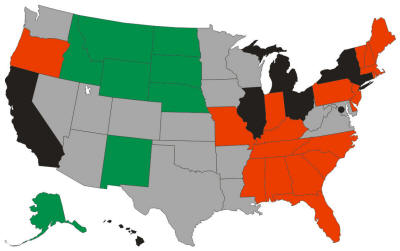
    This report looks at the period January 1991 through April 2009 – a period of 220 months that includes three recessions. Since employment rises and falls monthly because of seasonal trends (school year, holiday retail and more), this report uses 12-month employment growth rates as the measurement criteria – the employment in a given month compared to the employment 12 months earlier. This eliminates seasonality and allows us to compare, if you will, apples with apples.

    The metric in this analysis is the percent of months where the 12-month employment growth rate is positive.

    Using employment growth rates as the measurement criteria:

    Alaska is 99.1% recession-proof since employment was growing for 218 months out of 220.

    Michigan is 51.8% recession-proof since employment was growing for 114 months out of 220.

      All the states are shown in the graphic, color-coded as follows:

    • Green is 90% or more
    • Grey is 80% to 90%
    • Red is 70% to 80%
    • Black is less than 70%

    Some metropolitan areas are also relatively recession-proof:

    Area
    Share of months where 12-month job growth rate is positive
    Grand Junction, CO
    100.00%
    McAllen-Edinburg-Mission, TX
    99.50%
    Olympia, WA
    99.10%
    Bismarck, ND
    98.60%
    Anchorage, AK
    97.70%
    Fargo, ND-MN
    97.70%
    Tyler, TX
    97.30%
    Greeley, CO
    96.80%
    Iowa City, IA
    96.40%
    Sioux Falls, SD
    96.40%
    Cheyenne, WY
    95.90%
    Columbia, MO
    95.90%
    Coeur d’Alene, ID
    95.50%
    College Station-Bryan, TX
    95.50%
    Billings, MT
    95.00%
    Fayetteville-Springdale-Rogers, AR-MO
    94.50%
    Laredo, TX
    94.50%
    Las Cruces, NM
    94.50%
    Valdosta, GA
    94.50%
    Killeen-Temple-Fort Hood, TX
    94.10%
    Rapid City, SD
    94.10%
    Bellingham, WA
    93.60%
    Ogden-Clearfield, UT
    93.60%
    Knoxville, TN
    93.20%
    St. George, UT
    93.20%

    And, unfortunately, some metropolitan areas are not very recession proof:

    Area
    Share of months where 12-month job growth rate is positive
    Baltimore City, MD
    17.70%
    Flint, MI
    28.60%
    Detroit-Livonia-Dearborn, MI Metro
    34.10%
    Philadelphia City, PA
    35.50%
    Dayton, OH
    37.30%
    Mansfield, OH
    38.20%
    Youngstown-Warren-Boardman, OH-PA
    41.80%
    Muncie, IN
    42.70%
    Kingston, NY
    43.60%
    Waterbury, CT NECTA
    45.50%
    Binghamton, NY
    47.30%
    Lima, OH
    47.30%
    Springfield, OH
    48.20%
    Detroit-Warren-Livonia, MI
    49.10%
    Lansing-East Lansing, MI
    50.00%
    Saginaw-Saginaw Township North, MI
    50.50%
    Ann Arbor, MI
    51.40%
    Cleveland-Elyria-Mentor, OH
    52.70%
    Decatur, IL
    52.70%
    Terre Haute, IN
    53.60%
    Canton-Massillon, OH
    54.10%
    Battle Creek, MI
    54.50%
    Jackson, MI
    55.00%
    Niles-Benton Harbor, MI
    55.00%

    You can’t necessarily judge a metropolitan area by its State’s employment growth rates. For example, Georgia is only 73.6% recession-proof yet Valdosta is 94.5%. Indiana is 74.5% yet Indianapolis is 90.0%. Missouri is 72.3% yet Columbia is 95.9%.

    A complete list of states and metropolitan areas is available at http://jobbait.com/a/rpa.htm.

    The data in this report present only part of a recession-proof picture of states and metropolitan areas. Think of them as a long-term picture from 1990 through April 2009. They do not necessarily represent what’s happening today. For example, Olympia WA which is the second-most recession-proof metropolitan area long term has declines in the last two months, March and April 2009. And, this will change next month and the month after.

    This report was written by Mark Hovind, President of JobBait. Mark helps six and seven figure executives find jobs by going directly to the decision-makers most likely to hire them. Mark can be reached through www.JobBait.com or by email at Mark@JobBait.com.

  • Salinas and Self-Governance

    “Man is the only kind of varmint who sets his own trap, baits it, then steps in it.” — John Steinbeck

    Though probably not intended as a political commentary, Steinbeck’s utterance perfectly describes the current California budget crisis. And, given the revenue and service delivery relationship between cities and the state, traps can be set and baited in Sacramento, leaving mayors, city councils and city managers to step in them.

    This is what is happening today in Steinbeck’s hometown of Salinas (his childhood home is pictured), where the city faces a structural deficit of nearly $20 million, out of a $97 million general budget. Given the dramatic scope of the decisions it faces, the city government is taking a unique approach to finding solutions: gathering residents together in a series of facilitated discussions about the budget crisis. I attended one of these workshops in early April, where I watched around a hundred Salinas residents participate in a three-hour dialogue, and learned anew the challenges to self-governance, and its power.

    The first hurdle attendees encountered was informational. From the size of the deficit, to utility users’ tax revenues, to what portion of the budget is spent on cops versus parks, it was evident that most attendees had little understanding about how their city government actually functions. This is not to cast aspersions on Salinas: lack of basic civic knowledge, especially of local government, is a national tragedy, contributing to uninformed discussions that easily turn partisan. Several participants came to the workshop with single-issue views about the police chief’s salary, or the amount spent on maintenance, but when faced with the full budget picture, and other residents with contrary opinions, they soon moderated their judgments.

    Participants were forced to wrestle with the same difficult trade-offs as their elected representatives, and in so doing, learned that governing – even at the local level – is a complex process of moving interlocking levers. Using a program template developed by San Diego’s Viewpoint Learning, participants were presented with a set of three “visions” of Salinas, each with related service and revenue frameworks. A budget cut in a certain area has specific ramifications, as do tax and fee increases, but rarely do any of us participate in conversations where we have to confront such decisions. As Mayor of Salinas Dennis Donohue told me, “The gap between service expectations by the public and the public sector’s inability to deliver those services needs to be bridged.” This can only happen effectively when the public both understands and legitimately weighs its options.

    Finally, as the dialogues reached the final hour, I began to sense a change in the attitude of those hundred or so Salinans gathered in a community college cafeteria. What began as a crash course in local government civics, and moved to the plate-balancing act that is a budget process, concluded with participants taking ownership of their city. A debate at one table about a sales tax increase moved into a discussion of, “What can we do to keep our young people from moving out of Salinas after High School?” When presented to the full group, this thought was echoed, with others extolling “What it is that’s great about Salinas,” wondering how this could be communicated, and what role they might play in improving their community.

    Salinas is one of several cities around California, and around the country, employing this “participatory budgeting” process in response to painful fiscal decisions. Even cities as large as Philadelphia, with its “Tight Times, Tough Choices” project, involved over 4,000 residents in budget deliberations. Each has different elements depending on the size of the city and scope of the budget challenge, but those with the greatest impact do the following: accurately inform the public, engage them in a conversation that involves having to make legitimate trade-offs, and create a space in which residents can not only offer informed opinions, but actually participate in the building of their city.

    It seems that budget deficits are yielding surpluses in local involvement.

    Pete Peterson is Executive Director of Common Sense California, a multi-partisan non-profit organization that supports civic participation around California. He also lectures on civic engagement at Pepperdine’s School of Public Policy.