Blog

  • A Look at the Information Sector

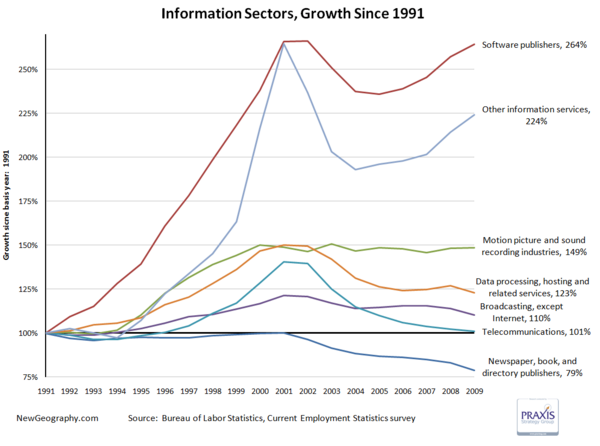
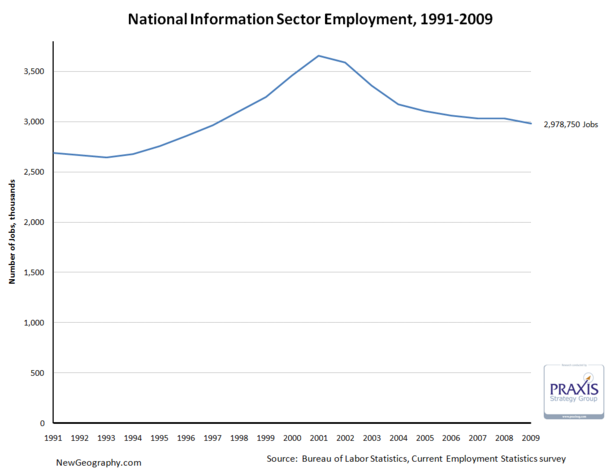
    Between economic development strategies targeting software firms, the deflation of the tech bubble, talk of “broadband,” and recent consternation about failing publishing business models, we seem to hear a lot about the information sector. Recognizing that, it’s interesting that the information sector only comprises about 2.2% of total employment in the US.

    On top of that, after a big decline since the tech bubble peak in 2001, in February the sector has receded to just more than 2.9 million jobs, a level not seen since April 1996.

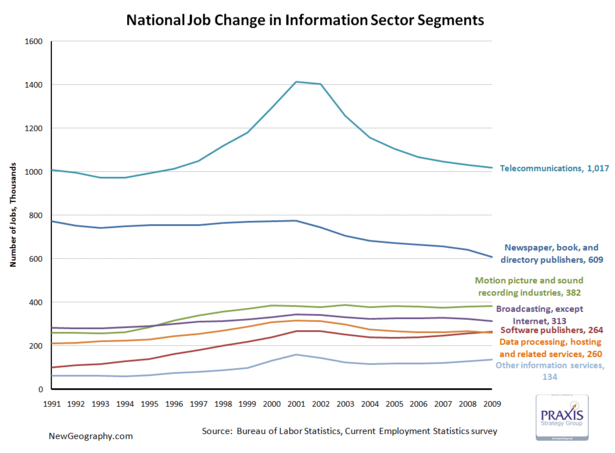
    The telecommunications subsector accounts for just more than 1/3 of information employment, and saw the biggest boom and bust. Publishing has declined since 2000, and motion picture and sound recording industries are larger than either software publishing or data processing.

    Looking at percent change, software has recovered from the tech bust, while the movie business has remained steady since topping off in 2000. Worse off are telecom and data processing, which continue the post bust slide.

    One fifth of the jobs in the publishing industry have vanished since 2001.

    This is not to say technology occupations are not a key part of the nation’s economy and productivity gains over the past decade, but the importance of the information sector itself is overstated. High-tech industries that produce products generally fall into manufacturing sectors while things like systems design, web design, or even custom programming are business services.

    The next post will look at regional shifts in information employment, but until then check out Ross Devol’s more comprehensive study on regional tech poles.

    Other Information services includes: news syndicates, libraries, archives, exclusive Internet publishing and/or broadcasting, and Web Search Portals.

  • $12.8 Trillion Committed to Bailout

    Shortly after I told you that Bloomberg.com is reporting a running total of the money the U.S. government has pledged and spent for bailouts and economic stimulus, reporters Mark Pittman and Bob Ivry updated the totals: So far, $12.8 trillion has been pledged – an additional $1.2 trillion over the earlier report. The total disbursed through March 31, 2009 stands at $4.2 trillion. The Federal Reserve is still committed to providing the largest share at $7.8 trillion, followed by the U.S. Treasury $2.7 trillion and FDIC $2.0 trillion.

    The national debt currently stands at $11.3 trillion — versus an authorized limit of $12.1 trillion. Spending, lending and bailouts by the Federal Reserve are not counted toward the limit.

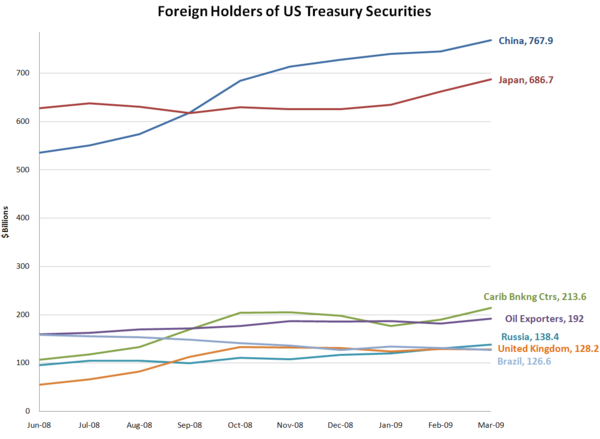
    This week, U.S. Treasury Secretary Timothy Geithner is in China. Mainland China holds $767.9 billion of Treasury securities at the end of March 2009 or about 7 percent of the total national debt. Japan, the second largest major foreign holder, has $686.7 billion.

    Notes: Data from Department of the Treasury. Caribbean Banking Centers (Carib Bnkng Ctrs) include Bahamas, Bermuda, Cayman Islands, Netherlands Antilles, Panama, and British Virgin Islands. Oil exporters include Ecuador, Venezuela, Indonesia, Bahrain, Iran, Iraq, Kuwait, Oman, Qatar, Saudi Arabia, the United Arab Emirates, Algeria, Gabon, Libya, and Nigeria.

    The U.S. bailout commitment of $11.6 trillion equals 89 percent of U.S. 2008 gross domestic product (GDP).

  • North America’s High Tech Economy: The Geography of Knowledge-Based Industries

    Almost ten-years ago, the Milken Institute first released America’s High-Tech Economy which cataloged technology’s central role in propelling economic growth in high-wage jobs and value-added economic activity. Shortly thereafter, the dot-com and high-tech bubbles popped, leading many to conclude that the era of tech-driven economic development was over.

    But the pessimists were wrong. A recovery in high-tech began in 2003 and served as an engine of regional growth through most of 2008. Communities with concentrations of knowledge-based industries – everything from information technology to biopharmaceuticals – have been able to create and retain high-paying jobs. And when economic growth returns, these industries will once again be at the forefront.

    In the full study, we explain the patterns of growth in 19 high tech-categories. In each category, individual metro areas are ranked according to their performance as “tech poles.” The entire study and a complete explanation of our methodology can be found in the full report, downloadable from milkeninstitute.org.

    This time around, we extended the study to include Canada and Mexico, whose economies have become ever more intertwined with that of the United States, including the high-tech sector.

    Top-Performing U.S. and Canadian Metros

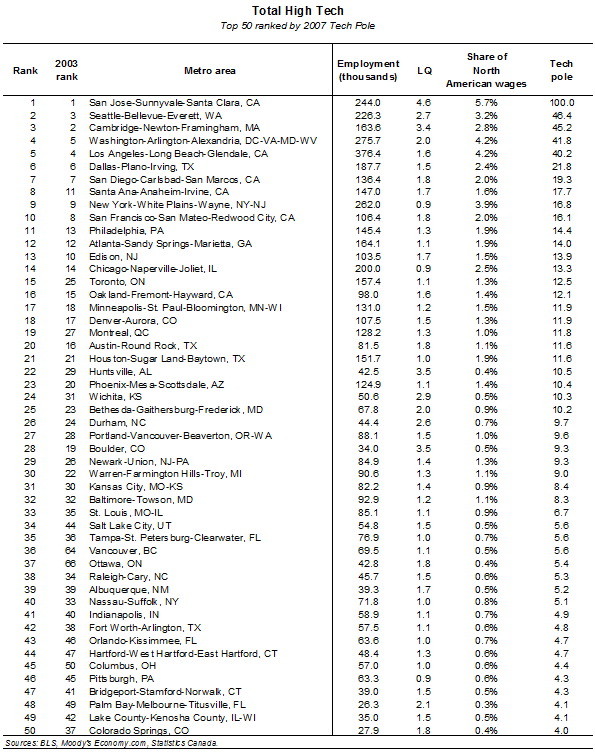
    1. Silicon Valley (the San Jose–Sunnyvale–Santa Clara, California metro area) remains the preeminent high-tech cluster in North America (and the world), although it’s once seemingly enormous lead over other regions has diminished somewhat. Even so, it retains an unrivaled capacity to capture locally generated intellectual property and to convert it into economically viable businesses. Its firms regard R&D as part of their very DNA; they see innovation as their core business mission rather than as a necessity that can be given short shrift when times during recessionary time.

    In recent years, Silicon Valley has had to restructure its operations. Businesses are now more cost-conscious, outsourcing lower value-added functions while retaining the highest-valued and most creative elements. Manufacturing – in particular, manufacturing of heavily commoditized products – have been relocated. Thousands of jobs were lost, considerably more than were recovered over the past ten years.

    The Valley’s famed Sand Hill Road venture capitalists are now more inclined to go abroad to India, China and Israel to fund new enterprises and to seek partners for their portfolios of start-ups. Many foreign-born engineers, software developers and tech-savvy entrepreneurs have left the area to lead a wave of technology entrepreneurship back home. This process is better termed “brain circulation” than brain drain, as these innovators are inclined to retain strong ties to former colleagues in Silicon Valley.

    Still, Silicon Valley still ranks as first or second in six industry categories; it places among the top ten in 12 categories. Overall, its high-tech employment concentration is four-and-a-half times the metro average for North America. The San Jose metro may not dominate the technology landscape as fully as it did ten years ago, but its position is still unique.

    2. Seattle-Bellevue-Everett’s second-place position on the tech pole index should be no surprise. The metro area employed 226,300 high-tech workers in 2007, just 17,700 fewer than San Jose. Seattle owes most of its stellar ranking, of course, to software, mainly Microsoft and its spinoffs, as well as aerospace.

    Microsoft alone employs more than 33,000 workers in the metro, giving it first place on the tech pole index in software publishing. Seattle’s doesn’t just lead in software, it dominates the software landscape with a tech-pole score of 100, five times that of Cambridge. More than 23 percent of wages in North America’s software industry are paid to workers in the metro.

    In addition, although no longer the headquarters town for Boeing, much of the firm’s operations remain in Seattle along with a bevy of aerospace sub-contractors. Altogether, Seattle employed 76,100 in aerospace products and parts manufacturing in 2007. Only Wichita, Kansas, has a higher concentration in aerospace. Seattle also ranks among the top ten tech poles in telecommunications and other information services.

    3. The Massachusetts metro combining Cambridge,Newton and Framingham, is third on the tech pole index. Home to world-class research universities including Harvard and MIT, and the global leader in commercializing and transferring university research to the private sector, the metro area has an ecosystem of technology entrepreneurship that rivals Silicon Valley’s. The research intensity in the area has enabled it to be among the elite in generating and growing biotech start-ups, as well as attracting the research divisions of large pharmaceutical and biotech firms.

    Particularly notable has been the Cambridge metro which stands as the top-ranked tech pole in scientific R&D services, a category that captures much of its biotech research. Scientific R&D employed 26,000 locally in 2007; these activities are nearly eight times more concentrated in the Cambridge area than in North America overall Cambridge also ranks second on the software index, and it makes the top ten in a total of nine categories.

    4. Washington-Arlington-Alexandria is fourth among tech poles. The capital area is the North American leader in high-tech services, placing in the top ten in six out of eight high-tech service categories. Overall, firms in the Washington metro employed 275,700 high-tech workers in 2007, double the average concentration in North America.

    The presence of much of the federal government in DC generates the need for massive data-processing support and attracts defense and aerospace contractors. By no coincidence, the metro Washington leads in computer systems design and related services, where it has more than five times the average concentration found in North America. In this sector it dominates other tech poles, with twice the score of second-place San Jose. The National Institutes of Health (NIH) and its spin-offs in the biotech area aid the metro area’s performance.

    5. Los Angeles–Long Beach–Glendale ranks fifth thanks to its still-vast aerospace footprint and the emergence of the technology-intensive segment of the motion picture industry. The area has a large university research base, with world-class institutions including Cal Tech, UCLA, and USC. They provide great depth in medical research, especially in the biotech area.

    Los Angeles is the top tech pole in navigational, measuring, electromedical and control instruments manufacturing. This sector employed 36,200 local workers in 2007. Los Angeles is the headquarters of Northrop Grumman, and Boeing retains major operations in the area, making it fifth in aerospace products and parts manufacturing, with 38,000 jobs. Clearly, the inclusion of motion picture and video in our definition of high-tech industries boosts LA’s position in the rankings, but this decision makes sense in light of the field’s growing importance as a generator of value-added in high technology. Los Angeles has 32 percent of North American employment in motion pictures.

    6. The Dallas-Plano-Irving, Texas, metro division is sixth on the tech pole index. Its strengths lie in information and communications technology hardware and data processing services. Overall, high tech employed 187,700 workers in 2007, for a concentration 50 percent above the North American average.

    Dallas ranks second in telecom, and places third in communications equipment manufacturing. The metro is renowned for its Dallas-Richardson telecom corridor. And with Texas Instruments as its anchor, the metro places sixth on the semiconductor and other electronic component manufacturing tech pole index. The Dallas campus of the University of Texas has an outstanding engineering program that provides homegrown talent to local industry. Since 2003 Dallas has jumped a spot (to second place) in data processing, hosting and related services. A number of data processing centers are located here, with Electronic Data Systems as the anchor.

    7. San Diego–Carlsbad–San Marcos is home to the world’s most geographically dense biotech cluster, with a strong position in telecom hardware and services and several other fields. San Diego employed 136,400 in high-tech sectors in 2007, 80 percent above the average North American concentration. The metro area placed in the top ten in a total of four high-tech sectors.

    San Diego’s biotech network is anchored by the Scripps Research Institute, the Salk Institute for Biomedical Sciences, the Burnham Institute and the University of California at San Diego as well as dozens of mid-sized biotech firms and uncounted start-ups are located here, too. Qualcomm is the major player in the communication chips, while AT&T gives San Diego a presence in telecommunications.

    8. San Diego’s neighbor to the north, Santa Ana–Anaheim-Irvine (Orange County) is eighth on the tech pole index, a jump of three places since 2003. High tech in the area is driven largely by medical equipment manufacturing, medical and diagnostic labs as well as measuring, electro-medical and control instruments manufacturing. But the presence of Broadcom makes it a key player in communication chips, too. Orange County ranks among the top ten in seven categories and exceeds the North American concentration in a remarkable 16 categories.

    9. Part of the greater New York City area, the metro division of New York–White Plains–Wayne places ninth on the overall tech pole list. While the area is not particularly known for high-technology, it does employ 262,000 high-tech workers – tens of thousands more than Seattle. New York is second only to Los Angeles in motion pictures and video industries. It is also a key location for Internet portals, placing the area third in other information services.

    10. San Francisco–San Mateo–Redwood City just made it the top ten in 2007, slipping from eighth in 2003. The dot-com bust hit San Francisco harder than any other tech-pole. However, the creativity of its entrepreneurs and high-skill level of its workforce give the metro the capacity to constantly reinvent itself. Biotech heavyweight Genentech was initially built around local university research. It ranks fifth among software publishers with major operations of Electronic Arts and Oracle. San Francisco is a major hub of data processing, hosting, and related services, where it ranks seventh. And it ranks just behind the DC metro in high-tech services.

    11. The Philadelphia, Pennsylvania metro area was eleventh on the tech pole index in 2007, up two slots from 2003. The area hosts a number of pharmaceutical companies including Merck, Wyeth, and GlaxoSmithKline, as well as biotech firms including Cephalon. Philadelphia ranked seventh in scientific R&D services, up from 14th in 2003 thanks to biotech’s rising star. Philadelphia is strong in medical devices as well.

    12. Atlanta–Sandy Springs–Marietta’s ranking is due largely from its first-place ranking in telecommunications. AT&T’s Mobility division is the biggest local player in telecom; overall the sector employs 37,900 workers in Atlanta.

    13. Edison, New Jersey, placed third in pharmaceutical and medicine manufacturing, with 16,800 workers. Major players include Bristol-Myers Squibb and Johnson & Johnson. Edison is a top-ten performer in telecommunications as well.

    14. The Chicago, Illinois portion of the Greater Chicago metro ranks among the top ten in telecom and computer systems design and related services. Altogether, some 200,000 local workers were employed in high-tech industries in 2007. The two biggest high-tech firms: Motorola and Abbott Labs.

    15. Toronto is Canada’s highest-ranking tech center, coming in 15th in North America.. And with 157,400 high-tech sector jobs it ranks tenth in terms of absolute size. Private-public research collaborations involving the University of Toronto and McMaster University have propelled the metro’s emergence as an attractive place for biopharmaceutical firms. Major players include GlaxoSmithKline and Apotex. Toronto is Canada’s leading center of computer systems design and related services, a category in which it ranks eighth in North America. The metro area has nurtured a thriving film cluster as well.

    16. Oakland-Fremont-Haywood isn’t in the top ten finish in any of the 19 categories, it exceeds the average high-tech job concentration in 16 of them. Major tech employers include Oracle and Sybase.

    17. Minneapolis–St. Paul–Bloomington owes its position to medical devices giants Medtronics and Boston Scientific. Overall, Minneapolis has a higher than average concentration of high-tech jobs in nine categories.

    18. Denver-Aurora ranking comes in large part to its fourth-place finish in telecom. Qwest Communications is the largest employer in the metro area.

    19. Montréal is Canada’s second metro to make the top twenty, and it’s up eight spots since 2003. Montréal boasts more than 127,000 high-tech jobs, with aerospace as a primary driver. Bombardier is headquartered here, contributing nearly 21,000 aerospace-related jobs, but Pratt & Whitney also has a large presence. Montréal’s aerospace cluster is supported by its formidable research capacity, a mix of four major universities and 197 research centers.

    20. Austin–Round Rock, arguably the quintessential 21st-century knowledge-based community, rounds out the top twenty. Among high-tech industries, its highest concentration is in computer and electronic product manufacturing. Dell is headquartered here. But it is also favored by major presences of IBM, Applied Materials, Advanced Micro Devices, Flextronics and Samsung Austin Semiconductor.

    Mexican States
    To create a set of North American rankings that included Mexico, we had to utilize data at the state level rather than the metro level. Mexican data was only available through 2003, so we include it in the North American rankings only for that year. Note that use of state-level data pushes up total employment and wages, but also reduces the overall concentration of jobs in each sector.

    Baja California, the state that makes up the northern half of the Baja California Peninsula and include the cities of Tijuana, Mexicali and Ensenada, is the top-ranking Mexican state in the tech pole index. Placing 15th in North America (in 2003), it employed 104,000 in high-tech sectors.

    Foreign firms have been attracted by the Maquiladora Decree of 1989 that granted them a variety of incentives to manufacture in border areas for the purposes of export. Most products from these factories are intended for export to the United States or Canada so they are located in zones close to the U.S. border . The region was the top tech pole in audio and video equipment manufacturing.

    Baja’s concentration of employment in electronic components actually exceeds that of San Jose, although it is largely made up of lower-wage production line jobs. This may also be the case in medical equipment and supplies manufacturing, where Baja leads North America in with 22,200 jobs, 16 times the average concentration. Overall, Baja California has more than three times the average North American job concentration in high-tech industries.

    The Distrito Federal or DF which encompasses Mexico City and its immediate surrounding area, was the second-ranking Mexican state, placing 20th overall in North America in 2003. The DF was the top tech pole for telecommunications in North America in 2003, thanks largely to the location of giant Telefónicas de México (Telmex). The concentration of telecommunications in the region is nearly three-and-one-half times greater than average in North America and telecom employment (82,100) was nearly double that of second-ranking Atlanta.

    The DF ranked sixth in pharmaceutical and medicine manufacturing in North America, with 33,700 local workers – 13,000 more than the second-highest ranking North American metro.The ability to export Mexican film and television products to other parts of Latin America as well as a large home market has given the industry cluster around Mexico City a comparative advantage. Employment is actually the third largest of any of the locations on the list. Total high-tech employment in the DF is 17 percent more concentrated than the North American average.
    Ross C. DeVol is Director of Regional Economics and the Center for Health Economics at the Milken Institute. He oversees the Institute’s research efforts on the dynamics of comparative regional growth performance.
  • Is Your City Safe From The Tech Bust?

    A decade ago, the path to a successful future seemed sure. Secure a foothold in the emerging information economy, and your city or region was destined to boom.

    That belief, as it turned out, was misguided.

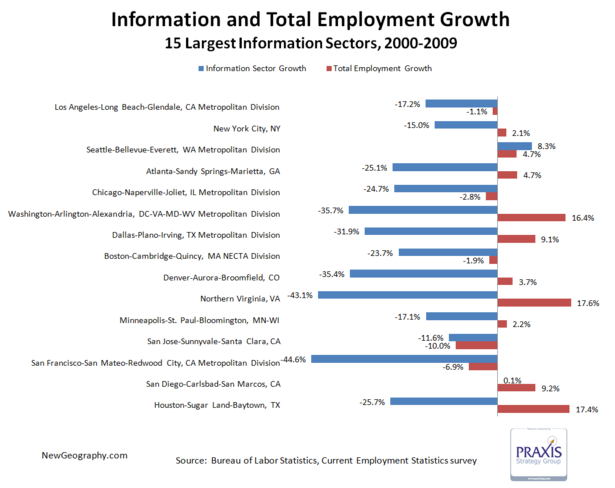
    In the decade between 1997 and 2007, the information sector–which includes jobs in fields from media, publishing and broadcasting to computer programming, data processing, telecommunications and Internet publishing–has barely created a single new net job, while some 16,000,000 were created in other fields.

    The biggest losses have been in the telecommunications sub-field, which has shed 400,000 jobs nationwide since its peak in 2000. Not surprisingly the media and publishing industries have also lost ground, while employment in other arenas such as motion pictures, software and data-processing have remained stagnant for much of the decade.

    Equally critical, it seems clear that simply being a high-tech magnet does not make a region a prodigious job creator. The San Jose metropolitan area, better known as the heart of Silicon Valley, boasted over 960,000 jobs in 1997. Last year, even after the ballyhooed Version 2.0 of the dot-com boom, that number had actually declined–to barely 900,000. According to figures from economic-strategy firm Praxis Strategy Group, other traditionally tech-heavy areas, including San Francisco and Boston, also did poorly in terms of growth through the balance of this decade.

    Perhaps most disturbing, many areas are also losing their share of the information industry. For example, the information-sector job count, notes the Public Policy Institute of New York, has actually been stagnant or in decline in places like New Jersey, Connecticut, Illinois, Massachusetts, Minnesota and New York.

    The same pattern also affects so-called “cool” cities that were supposed to be ideal for high-tech jobs, according to a recent study by my colleagues at Praxis. The biggest declines in information jobs since 2000 have occurred in San Francisco (which lost 31,800 jobs), Northern Virginia (35,200) and Washington, D.C. (40,700).

    Silicon Valley dropped 5,400 positions since 2000, which amounts to 11.6% of all its information-sector jobs. The only bright spot for blue states is in Washington, where growth is driven by big employers Microsoft and Boeing. Los Angeles, buoyed by the relatively stable entertainment sector, has also managed to hold its own.

    Faced with all these cities that are merely struggling not to lose any jobs, just where is the tech-sector growth? It’s in less-celebrated areas of the country, like Idaho, New Mexico, North Carolina, Nevada–and in parts of Florida, South Dakota and South Carolina. By region, the fastest gainers turned out to be places like Orlando, Fla. (with 2,176 new information jobs since 2000), Madison, Wis. (2,400), Boise, Idaho (1,500), Wilmington, N.C. (1,267) and Charleston, S.C. (1,033).

    What distinguish most of these places are factors beyond prominent employers. These could include such prosaic things as tax rates (particularly on incomes), the cost of housing and the overall climate toward business. Information-sector jobs, it turns out, follow the basic rules of economic development seen in other industries.

    Of course, this is not to say tech jobs don’t matter. As the Milken Institute’s Ross DeVol argues in his new study of high-tech centers, technology jobs pay better than most, and their presence can boost other parts of local economies. And although they may not be multiplying fast, in some centers, like Silicon Valley, Boston and Southern California, whatever employment already exists has enough inertia to allow them to remain the largest tech centers in the country.

    Yet the problem is that the information economy, by itself, simply doesn’t reliably spur broader economic growth. That may be due to changes within the sector itself. From the 1980s to the mid-1990s, tech firms largely focused on creating productivity-enhancing products. Many of them also used on-shore manufacturing. Aerospace was a smaller industry, but it was still vital.

    These catalysts helped create dynamic companies that both employed large numbers of people directly and used contractors (whose numbers increased). The Silicon Valley I reported on in the mid-1980s housed an essentially industrial economy with many good jobs for middle- and working-class people. It was both a hotbed for pioneering entrepreneurs and a society that offered and encouraged opportunity.

    Today, however, tech has become increasingly software- and media-oriented. New companies tend to emerge from a small pool, and they are financed by a relative handful of local venture capitalists. Once launched, they may conduct some research and development at home, but marketing and customer service are either off-shored or moved to remote locations like the Great Plains or the “Intermountain West,” between the Cascades and the Rockies.

    As a result, even star companies like Google create a far smaller number of jobs than predecessor firms like Hewlett Packard, Intel or IBM. And even newer companies like venture darling San Francisco-based Twitter may go public, valued at $250 million or more, with only 45 employees.

    This, of course, represents very good news for a select few: investors and a handful of highly educated software engineers. But the Bay region’s broader economy and society isn’t as lucky.

    That’s because most segments of the information sector that do create lots of jobs tend to take place elsewhere. For example, when Intel considers opening a new chip plant, which could open up 7,000 new positions, it won’t build it in the Valley of its birth but rather in farther-flung locales like Oregon, Arizona and New Mexico. California has become too expensive; businesses there are heavily regulated and taxed for most industrial activity.

    So maybe it’s time to unlearn some of the assumptions we developed during the first tech boom. In the 1990s and early 2000s, many held that the information revolution would tame the business cycle, guarantee constant high returns and create widespread prosperity. Now we know better.

    The model of Silicon Valley, as DeVol suggests, cannot be easily duplicated. Another well-promoted formula, linking great universities to up-and-coming hip cities for the so-called “creative class,” has proved very limited when it comes to creating new jobs. And, anyway, trends in tech growth suggest that basic economic conditions like general affordability, taxes and the regulatory environment play an important role.

    Just as troubling may be the class divisions on display in places like Silicon Valley. As manufacturing and middle management jobs have fled, its capital, San Jose, has become more of a backwater. As local blogger Adam Mayer has pointed out, San Jose increasingly serves as a dormitory for the bottom-feeders of the Silicon Valley food chain.

    In contrast, tech power and influence is shifting to those areas that have always been well-to-do and are likely to stay that way–academically-oriented places like Cambridge, Palo Alto and San Francisco. They are becoming ever-more-exclusive reserves for the restless young and those with the greatest talent within the media and software industries. Meanwhile, the service class commutes in from the surrounding periphery to tidy up and run restaurants, while high housing costs and an overall lack of opportunities for other kinds of workers drive away much of the middle class, particularly families.

    In geographic terms, the real losers in this brave new tech world may be the communities on the fringes of those high-end tech areas. Take Lowell, Mass. Lowell, a former mill town widely celebrated for its tech-led revival in the 1980s, has seen little job growth since the late 1990s. But why pick Lowell, when it’s far cheaper and easier to expand in Boise or, even better, Bangalore, India?

    The time has come to let go of vintage fantasies about tech that date from the 1990s. Key regions–and the country as a whole–need to understand that the information sector is best seen not as an end in itself but as an industry that derives its value from how it works with other parts of the economy, such as finance and business services, agriculture, energy, manufacturing, warehousing and engineering. (Manufacturing alone employs 25% of the U.S.’s scientists and 40% of its engineers–and their related technicians.) We have to nurture a broad industrial base so that innovations in this sector do not simply end up boosting off-shore industry.

    Techies won’t save us from the folly of deindustrialization; in essence, we can no longer believe that it’s possible to Google our way to prosperity.

    This article originally appeared at Forbes.

    Joel Kotkin is executive editor of NewGeography.com and is a presidential fellow in urban futures at Chapman University. He is author of The City: A Global History and is finishing a book on the American future.

  • San Jose, California: Bustling Metropolis or Bedroom Community?

    Dionne Warwick posed the question more than 40 years ago, yet most Americans still don’t know ‘The way to San Jose’. Possessing neither the international cachet of San Francisco nor the notoriety of Oakland, San Jose continues to fly under the national radar in comparison to its Bay Area compatriots. Even with its self-proclaimed status as the ‘Heart of Silicon Valley’, many would be hard pressed to locate San Jose on a map of California.

    More well-known American cities may try to gain population by branding themselves as interesting places, but San Jose does not struggle to attract newcomers. Sprawling over 178 square miles, San Jose sits at the southern end of the San Francisco Bay. This year the city exceeded the 1 million population mark for the first time.

    So what makes this city, the 10th-largest in the United States, appealing? Unlike its precious neighbor 50 miles to the north, San Francisco, people move to San Jose primarily for jobs – especially those related to the coveted technology sector. Whereas San Francisco balances its role as playground for the independently wealthy and welfare state for the lumpenproletariat, San Jose remains favored among families and those looking for a safe environment in which to raise children – not to mention, the weather is better.

    San Jose does not stimulate a sense of urban exaltation. Aside from a commercial downtown core with a collection of mediocre high-rises (limited in height due to do downtown’s adjacency to the San Jose Airport), the city is unapologetically suburban in a character.

    San Jose’s pattern of development can be traced back to its origins as an agricultural community supporting early Spanish settlers who chose to settle in the fertile Santa Clara Valley. It remained a modest-size agrarian community until the end of World War II when it underwent a period of rapid expansion-not unlike that of Los Angeles to the south. During the 1950s, with the emergence of semiconductor technology derived from silicon, San Jose and the greater Santa Clara Valley exploded into a center for the evolution of computer technology.

    Today, San Jose can best be understood by its ambivalent relationship with neighboring Silicon Valley cities. Mid-size suburbs such as Cupertino, Sunnyvale, Mountain View and Palo Alto, all located west/northwest of San Jose as one travels up the peninsula towards San Francisco, are very distinct and separate entities. Home to some of Silicon Valley’s heaviest hitters (Cupertino has Apple, Sunnyvale has Yahoo!, Mountain View has Google, Palo Alto has Hewlett-Packard, Facebook and Stanford University), these cities largely define the technology-focused region. To be sure, San Jose’s has its share of big players, including eBay and Adobe as well as the ‘Innovation Triangle’, an industrial area of north San Jose, home to the headquarters of large companies like Cisco Systems and Cypress Semiconductor.

    Yet, despite the presence of these firms, San Jose has become ever more a residential community, with among the worst jobs to housing balances in the region. Furthermore, a whopping 59% of the city’s developed land constitutes residential use – 78% of that being single-family detached housing. In this sense, despite being the largest city, San Jose essentially serves as a ‘bedroom community’ for the rest of Silicon Valley.

    This has been a burden for the city, which, unlike its neighbors, lacks enough large information technology companies to help fill their tax coffers. In contrast job rich ‘green’ cities like Palo Alto have remained staunchly ‘anti-growth’ regarding residential development and consequently have very high housing prices.

    This pattern poses fiscal problems for San Jose. City officials have long been aware of the need to stimulate economic development instead of continuing to lose out to its neighbors but the city seems determined to increase further its role as dormitory for its neighbors. Indeed, amazingly the city’s development agenda has in recent years shifted to a relentless focus on high-density, multi-family residential in the downtown core and along transit corridors. In 2007, 79% of all new housing built in San Jose was multi-family – a staggering deviation from its history of low density development.

    Though well-intentioned, the slant towards densification has yielded a glut of empty condo units throughout the city. Those that have purchased units in new developments often find themselves with underwater mortgages. During a recent visit to one the flashy new downtown condo buildings, The 88, I entered a desolate sales office and was greeted by a skittish sales agent. When asked how sales were, my question was deferred without a direct answer in an act of not-so-quiet desperation.

    Although it’s clear most people in San Jose prefer lower density living, the city government continues hedging tax dollars against a future in which newcomers will want to live in a high-density setting. Outside of downtown, low to mid-rise multi-family housing has been built along the city’s light-rail lines in what are conceived to be ‘transit villages’. The popularity for such a lifestyle is questionable given the high price point and unreasonable HOA dues of these condo units, particularly when single-family detached houses can be purchased at comparable prices.

    Despite these issues, San Jose seems hell-bent on its path towards densification. The city has major plans to develop the area around its Diridon Train Station, just west of downtown, as California High-Speed Rail and BART are projected to make their way to San Jose. Furthermore, the city government is counting on the Oakland A’s baseball team making a move to San Jose.

    From the Champs-Élysées to Tiananmen Square, grand urban visions are what have defined cities historically. As a product of the Silicon Valley ethos as well as an observer of planning trends, I would argue that this is no longer valid – especially for any city with the hopes of a prosperous future. Rather, in democratic societies, it will be the idiosyncrasies of individual actors and the prospect of upward mobility that will define a sense of place.

    Obsessed with density and urban form, planners don’t seem to grasp the chicken and egg conundrum – the notion that lifestyle amenities follow on the heels of economic opportunity. San Jose needs to cast its future on nurturing its entrepreneurs instead of trying to become something it is not yet ready to become.

    Adam Nathaniel Mayer is a native of the San Francisco Bay Area. Raised in the town of Los Gatos, on the edge of Silicon Valley, Adam developed a keen interest in the importance of place within the framework of a highly globalized economy. He currently lives in San Francisco where he works in the architecture profession.

  • Stimulus Alert Stretches From the Center of L.A. to Suburban Atlanta

    The hundreds of millions of dollars in federal stimulus money are working their way through various systems, en route to a city near you.

    Give President Barack Obama credit for acting boldly to pump the funds into the economy – or take him to task for printing up money on the cuff.

    Either way, the time has come to shift your focus from Washington, D.C., and onto State Houses and City Halls throughout our land.

    You’ll need to keep an eye on your local government officials because our civic culture has grown corrupt, and it’s a cancer that’s widespread. Politicians still don’t quite understand that this is now an open secret – although they’ve at least begun to stir in the wake of the recent and resounding “no” that California voters gave to the latest request for a bailout of a sick system of government.

    Meanwhile, the stimulus money is beginning to flow as pundits slice and dice the results from the Golden State, and the federal funds offer the potential to allow local governments to ignore the clear message from voters who are fed up with corruption and waste. Consider that most local governments across the nation have enjoyed a long run of a strong economy with only a few, brief interruptions over the past 25 years. They’re out of shape, all balled up with bad habits. The stimulus money could serve to finance another year or two of bad behavior if the people don’t watch local government like hawks. And another year or two of bad habits will be too much for all of us.

    Any doubts that these bad habits exist can be dispelled by taking a look at a recent deal that had city officials in Los Angeles ready to spend $5.6 million for a small parcel of land to be turned into a park on the 400 block of S. Spring Street. They eventually cut the offer to $5.1 million – a savings of $500,000 that came only after ongoing coverage by the Los Angeles Garment & Citizen – a weekly community newspaper that covers the Downtown area of the city and surrounding districts – shed light on a number of questionable factors in the deal.

    Those questionable factors indicate that it’s time for everyone who is not a city official – the people, in other words – to take a second look at the situation. The recent coverage amounted to more than stories about a park, or even the price of the land. The stories pointed to systemic corruption in the process that city officials use in spending large sums of the public’s money.

    There are no individuals to single out here – not at this point, anyway. No one got caught with a hand in the cookie jar. That’s the main problem – the corruption of our civic culture is pervasive to the point that it’s tough to catch anyone with their hand in the cookie jar. We don’t even keep our cookies in a jar in Los Angeles anymore – they’re left out around City Hall for the taking by politicians and special interests.

    New rules and ethical standards are needed in Los Angeles – and it’s a safe bet that the same is in order for cities across the country. A good place to start would be a new rule to ensure that taxpayers never again see city officials offer to pay millions of dollars based on an appraisal commissioned on behalf of the seller of a piece of land—the very process originally used in the park deal in Los Angeles. There should be some standard that requires city officials to conduct their own appraisals on major purchases. Many cities have such expertise among their employees. If not, it is surely worth a few thousand dollars to hire an appraiser to work for the city’s interests on deals where a 0.1% savings would cover such extra costs, as was the case on the park land.

    The Garment & Citizen’s recent reporting also shed light on the fact that bureaucrats in City Hall currently have great leeway in such matters. Sometimes they order their own appraisal on land purchases—and sometimes they don’t. The decision seems to be left entirely to the discretion of unelected bureaucrats.

    The problem here is basic because the current set-up begs for abuse. Bureaucrats are human beings, after all, and subject to all of the problems and temptations that life brings. It’s also well known that the career bureaucrats in Los Angeles are subject to political pressure from any number of sources. That includes the 15 members of the Los Angeles City Council, who operate their districts much like personal fiefdoms. The City Council members tend to stay out of one another’s business in a pretense of some sort of legislative courtesy. What they’re really doing is withholding their best efforts at internal oversight, a failure that has helped send the people on a sorrowful journey from engaged participants in our democracy to cynics who don’t even bother to vote.

    The lack of standards on appraisals is only one of the problems that cropped up on the recent park deal. There are many more specific to real estate dealings – and you can just imagine how many additional pitfalls can be found in the way the city purchases motor vehicles, or paper products, or telecommunications services. And so on, and so on.
    It’s enough to make you wonder how many city deals could be trimmed by a half-million here or a couple of million there?

    We’re guessing plenty – and that tightening up on these sweetheart deals would go a long way toward solving the current budget crunch while maintaining many of the jobs and services that might be cut to close a looming $500 million deficit in the city’s budget in Los Angeles.

    You can bet there are plenty of similar savings to be had in State Houses and City Halls across the nation, too. Indicators abound in Gwinnett County, Georgia, just outside of Atlanta. Taxpayers in Gwinnett who want to avoid getting fleeced will apparently have to go a step further than a clear standard on appraisals for land deals. That seems to be the only lesson to take from a recent report in the Atlanta Journal-Constitution, which found that elected officials in Gwinnett County commissioned their own appraisal on a piece of land and still voted to pay twice the price.

    Some of the county commissioners in Gwinnett said that they approved the higher price because land appraisals are “all over the board” these days.

    Commissioner Mike Beaudreau opposed the deal, saying that the wide range of appraisals indicated that the matter should be given more study. He stood alone in his opposition, and the people of Gwinnett County are now set up to pay twice the appraised value for the land.

    So here’s the key question to consider: Will stimulus money paper over such deals in State Houses, County Commissions, and City Halls throughout our land?

    Only the people can say for certain.

    Jerry Sullivan is the Editor & Publisher of the Los Angeles Garment & Citizen, a weekly community newspaper that covers Downtown Los Angeles and surrounding districts (www.garmentandcitizen.com)