Blog

  • Lenny Mills to Urban America: Clock Is Ticking for Ranks of ‘New Homeless’

    I always do my best to make time for Lenny Mills because he’s earned that sort of consideration.

    Mills is the fellow who wrote several pieces under the banner of his trademark “7 Rules” outline, where he applies the tricks he learned as a telemarketer to analyses of real estate development, politics, and other matters.

    Mills did an especially fine job on the “7 Rules of Downtown Gentrification,” which appeared in the Garment & Citizen’s issue of April 21, 2006. He laid out a number of reasons – seven, to be exact –to consider the possibility that the residential real estate boom ringing through Downtown Los Angeles back then would eventually turn into a busted bubble.

    Events have certainly borne out Mills’ prediction, so he brought credibility with him on his latest visit to my office.

    Mills waved a recent copy of USA Today at me, saying that he’s worried about the sort of folks who were featured in a recent front-page story in the national publication, a piece that described the circumstances of some of “the new homeless.” These are individuals who worked steadily their whole lives before hitting the skids and losing their homes in the current economic downturn. It’s a trend that has become familiar these days, with homeless encampments cropping up in all sorts of places, including Los Angeles.

    Mills has some added credibility when he speaks about homelessness – he spent a number of years living on the streets. He knows what it means to go through life with a weather-beaten face, watching opportunities slip away for lack of a telephone number to leave behind when seeking work.

    Mills has a place to live now, but he remains determined to inject his warnings about the new homeless into the public debate. The clock it ticking, he says, and the deterioration that comes with life on the streets will make it harder and harder for folks to climb back into mainstream lives. Once the wardrobe starts to fray, he says, the odds against getting back on track grow longer. Once the teeth start to go, he adds, homeless individuals can just about write off any return to the life they once knew. Each bit of deterioration makes it tougher for the homeless individuals – and more likely that they will become permanent burdens to the rest of us in one way or the other.

    Mills is remarkable in a number of ways, including the ability he mustered to retain his social skills during his time on the streets – something that many individuals quickly lose. I disagree with him on some things, but I can’t fault his ability to make fine use of the language to get his points across.

    Mills used such skill during our recent talk, driving home a couple of points about the new homeless: Our society has a narrow window of opportunity to pay for programs to reverse the trend – and a failure to act soon will mean far greater costs in terms of human lives and the public purse.

    Mills can spout chapter and verse on what he sees as the causes of the increases in homelessness over the past 40 years. He can cite demographic trends, economic patterns, and public policies to make a compelling case that a lot of folks were swept into life on the streets by causes beyond their control. He firmly believes that we as a society could have prevented most of the homelessness we have seen over the years had we not lacked the will to do so.

    I wouldn’t describe Mills as a fun guy. He’s a valuable fellow, though, because he’s willing to tell you what you’d rather not hear – and he’s capable of doing so in reasoned tones.

    Give Mills his due for hitting upon something of vital importance now. It’s clear that all the talk we’ve heard about addressing the old homelessness has led to no great progress over the course of decades. What did that latest Blue-Ribbon Public-Private Committee to End Homelessness Forever accomplish besides a photo opportunity, anyway?

    Someone wake the Blue Ribbon brigade and fire all of them.

    We have a whole new homeless problem – and we’re in desperate need of new ideas.

    Jerry Sullivan is the Editor & Publisher of the Los Angeles Garment & Citizen, a weekly community newspaper that covers Downtown Los Angeles and surrounding districts (www.garmentandcitizen.com)

  • Smart Growth? Or Not So Bright Idea?

    Smart Growth and New Urbanism have increasingly merged into a loosely aligned set of ideas. The benefits of this high-density housing viewpoint are fast becoming a ‘given’ to planners and city governments, but studies that promote the advantages often omit the obvious disadvantages. Here are some downsides that show a much different story:

    Smart Growth or Dumb Idea?

    One goal of Smart Growth is to move our society away from dependence on cars, and many Smart Growth plans intentionally make it difficult to drive through the neighborhood, making walking more inviting. Smart Growth planners advocate short blocks in a grid pattern to distribute traffic (vehicular and pedestrian) evenly within a development. These short blocks produce a multitude of 4-way intersections, and add a multitude of those trendy “turnabouts,” to make a bland site plan look more interesting.

    But all of this together destroys “flow”. On the other hand, in a grid planned neighborhood you might drive a straight line with an occasional turn, giving the impression of a much shorter drive than a curved subdivision. But with short blocks, a driver must stop completely, pause, then when safe accelerate through the intersection onto the next intersection, then repeat… multiple times. This scenario uses a tremendous amount of energy; the car eats gas.

    To understand this point clearly, go out and try to push a modern car. All the safety and convenience features, even in the most basic car sold today, add weight. Even a Toyota Prius is just under 3,000 lbs. While a given model may get great mileage the bulk of energy consumed is in getting the thing moving from a full stop. Should a vehicle maintain a constant flow (at any speed), the energy usage plummets, compared to stop-and-go traffic patterns that intentionally force conflicts.

    To make matters worse, the majority of vehicular vs. pedestrian accidents occur at intersections. Smart Growth designs have many more intersections than conventional suburban plans . Even more dangerous, Smart Growth walkways are placed close to the where the cars turns. Check out Traffic by Vanderbilt for an understanding of the psychology of driving.

    One may argue that cars will become more efficient. So what? This stop and go scenario also consumes time.

    Rooting Out Tree Issues

    Nobody can argue against the character of a tree-lined street… no one, that is, except the city Public Works department that must maintain structures being destroyed by trees growing in close confines to concrete walks and curbs. Smart Growth/New Urbanist compact front yard spaces are typically 10 feet or less. This simply cannot provide for enough room for tree growth when there is a 4’ wide walk typically a few feet away from the curb, the area where street trees grow. Without trees to define the street, these solutions have very little organic life to offset the vast volume of paving in front of each porch.

    Now and in the near future there will be a new era of solar heat and power, most of which will be mounted on the roofs of homes. Guess what blocks the sun’s energy? Yep – street trees! High density means that the proximity of trees to roofs will deter the sun’s energy from reaching those solar panels.

    Get Real About Presentations, Porches and People

    Typically, when a high-density development is proposed, the renderings show large green common areas bounded by homes with grand porches. The presentations usually show only a few cars parked along the street, and plenty of residents enjoying the spaces lined by mature trees that have had about 20 years of growth. This misrepresentation helps to win over councils, planning commissions and concerned neighbors. What is not shown in the presentations for approvals are claustrophobic, intense areas, such as the typical street most residents will live on, or perhaps the views down the alleys.

    There may be some neighborhoods that are built as represented, but architectural and land planning consultants are likely to stretch the truth more than a wee bit to gain approvals. Where can we see the original presentation images compared to what actually gets built?

    Those inviting large porches where neighbors sit and gossip in the presentation: Do they ultimately end up as stoops hardly large enough to fit a standing person? Those large mature trees: Are they actually just seedlings? Does the real streetscape have people walking on the typically narrow 4 foot wide walkways? How many people are walking along the roadway instead? Are the streets lined with just a few cars, as the renderings show, or are they packed with unsightly vehicles, while the nice cars are likely stored in the rear garage?

    The Evolution of Pavement

    Suburbs have changed during the last few decades. For example, in Minnesota thirty years ago an average suburban lot would have been 15,000 square feet and 90 to 100 feet wide. Today, 8,000 square feet and 70 feet wide would be more typical. In a conventional suburban plan, there weren’t any alleys, and the front loaded driveways were appropriately tapered. There were few side streets. The lots might have been 20% larger than in a Smart Growth high density plan, but the street layout might have had about 30% less linear feet of street compared to a Smart Growth grid layout. In the south, where the typical suburban lot is about the same size as that high density lot, the numbers favor the conventional layout even more; the total paved surface area could be 50% or more lower. So, the Smart Growth/New Urban plans place a greater burden on the tax payers to municipally maintain (more) paved surfaces.

    A Final Consolation…

    In reality, fire and police departments, as well as traffic engineers, review suburban development plans. And often the original high-density narrow street proposal doesn’t make it all the way to approvals. With or without the popularity of Smart Growth and New Urbanism, a much wider paved section or a compromised width is often the ultimate result.

    Rick Harrison is President of Rick Harrison Site Design Studio and author of Prefurbia: Reinventing The Suburbs From Disdainable To Sustainable. His websites are rhsdplanning and prefurbia.com.

  • Who will win the Car-wars?

    General Motors, the venerable American auto manufacturer is sitting on the cliff’s edge in North America with a recent 3-month loss of $6 billion. However, GM watched its sales in China skyrocket 50% for the month of April, 2009. Ironically, Toyota, the company many Americans now cheer for, has posted a $7.7 billion loss for the first quarter.

    This now proves, without a doubt, that the auto industry – not just in the US – is going through a massive crisis. But it’s clear that American manufacturing has reached a critical, historical turning point. What was once good for General Motors is no longer good for the rest of the nation. The days are gone where an automobile must be designed in the Detroit region and manufactured in the Great Lakes. We have seen a shift in trade and production location from the north to the south. However, geographic arguments are only a small part of the overall challenge to the industry, especially in North America.

    When the dust settles, what will the American auto industry look like?
    Regardless of what some may say, there is no such thing as an “American” vehicle anymore. We are fast shifting into a global economy that requires the sharing and collaboration of multinational resources from across the globe. Consumers demand quality products at very affordable costs. Corporations have no choice but to comply with consumer demand even if it means off-shoring production and even trimming quality in order to save money. In many ways, this is the Wal-Martization of consumer goods.

    The 21st-century automotive industry will be geographically spread throughout North America. Modern technology allows engineers to work from just about any location regardless of population, climate or infrastructure. However, many engineering outfits have found that locating brainpower in dynamic places improves quality and innovation. A dynamic place is a place where the educated and skilled want to work. These includes places like southern California (where most of the design studios are located), Ann Arbor, Austin, and others.

    In the 1980s the Midwest watched the southern states gear up and recruit non-Detroit manufacturers, in large part due to the lack of unions in the land of Dixie. We have seen the southern United States explode in production and manufacturing capability. The two main reasons for this were lack of unions in the South as well as tax-payer funded incentives. However, the idea of receiving incentives from the public coffer can backfire.

    Just about every state offers some form of tax breaks or incentives to corporations looking to construct new facilities. Every large corporation now looks to the state where they can get the most incentives. Everything else, such as skilled workforce, distribution, infrastructure – that all comes secondary. In many ways, this is just an example of robbing Peter to pay Paul. And it doesn’t work. You cannot simply take tax dollars from one area of the state and pour them into another region with the long-shot hope that an industry will grow in that certain region. This is exactly what Tennessee is doing.

    However, the southern states have struggled and will continue to struggle to attract brainpower and engineering talent. What the American public doesn’t realize is that there is a lot more to the creation of a vehicle unit than mere assembly. Besides production, there is fabrication, engineering, design, testing, marketing, legal, and distribution. Even today, much of the world’s automotive intelligence and engineering is located in Southeast Michigan. This fact irks southern powerbrokers who have been so successful at bringing grunt work to their states.

    We will continue to see massive amounts of automotive-related manufacturing relocate to Mexico due to the extremely low cost of production. Many of the Japanese and German manufacturers are already starting to notice the negative consequences of setting up production facilities in the United States. Nissan, Toyota and Honda have all initiated cuts and hiring freezes in their American manufacturing facilities. These companies have also initiated major contact employee programs rather than hire full-time fully-hired help.

    So what happens now in the old auto belt? Certainly, Ohio as well as Michigan must figure out how they can re-deploy their engineering talent. Each seems to graduate a huge number of students year after year but this tends to benefit other places. States such as Wyoming, Arizona, Washington, and others have held job fairs in Michigan in order to gain talent. If there are no jobs in Michigan, why do they keep graduating so many students?

    Even without George Bush and the GOP in power, Texas seems also to be a big beneficiary of this brain drain. But for how much longer can this continue? Remember Texas went bust in the early 1980s with low energy prices. It could happen again.

    Another natural winner in the car-wars could be the southern states, but only once they consolidate their efforts to bring knowledge and engineering to the South. It is much easier to offer incentives for a production facility than to woo an engineering lab.

    Critically, there still seems to be a lack of emphasis on higher education in the south. Even the best universities in the South cannot fully compete with the universities in the Midwest from a technical standpoint. Institutions such as Michigan, Wisconsin, University of Chicago, Michigan State and Indiana are still levels above the universities found in Kentucky, Tennessee and Georgia. The Midwestern schools built their solid knowledge and research background over a period of decades. This cannot easily be duplicated.

    To be sure, the auto-dominated economies of Michigan and Ohio will be shrinking in the future. These states are shedding their manufacturing sectors while reinforcing their knowledge-based sectors. Over time they may find it much easier to morph into a knowledge-based economy by using previous know-how than to build a knowledge economy from scratch. Michigan, for example, may have been hit hard by this global schism in manufacturing, yet it has been left with the know-how and knowledge left over from industry in the form of a strong university system. In contrast, nowhere in the south can we find that.

    In conclusion, some individual Midwestern cities may come out of this crisis better than many expect. Younger workers in the future will look at specific towns such as Madison and Ann Arbor, which offer an excellent quality of life, rather than head off to the sunbelt. This may be particularly true as they enter their 30s and look for a good place to raise their children, hopefully close to grandparents. The Midwest may be down, but not all of it is out – far from it.

    Amy Fritz was born in Cambridge, England during World War II. Her mother was a seamstress and her father a pilot with the RAF. Her uncles worked in various capacities within the British automobile industry and her father became an engineer and professor.

    After studying engineering at Cambridge, Fritz developed an interest in automobiles and went to work for a now defunct automotive supplier. Her occupation took her to Europe, Asia and North America, where she eventually settled as a technical engineering contractor for various auto-related companies. She is now semi-retired and living in the Denver area.

  • Entrepreneurship on the Rise?

    The Kauffman Foundation, the “world’s largest foundation devoted to entrepreneurship,” recently released the 2008 edition of their “Index of Entrepreneurial Activity.”

    The index, which measures the rate of business creation at the individual owner level, reports that despite the recession, “new business formation increased in 2008.” This growth was not present in all sections of the nation, however. According to the Kauffman survey, the Midwest saw a slight decline in business start-ups in 2008. Unfortunately, while entrepreneurship was apparently on the rise, there was a drop in the formation of the “highest-income-potential types of businesses”.

    On a more local level, the states of Georgia, New Mexico, and Montana led the pack, each showing over 500 per 100,000 adults creating businesses each month. Bringing up the rear were West Virginia, Iowa, and Ohio, with the last showing a rate of creation of 190 per 100,000 adults per month.

    In general, 2008 rates of entrepreneurial activity as reported by the Kauffman survey are higher along the west coast and in the Rocky Mountain states, and lower in the midwest and mid-atlantic regions. These findings would seem to have some overlap with the patterns reported by Newgeography’s “2009 Best Cities for Job Growth” rankings, which, in general, showed stronger conditions in the west (outside of California) and pockets of weakness in the midwest and mid-atlantic regions.

  • Can Wind Power be a Reliable Long Term Source of British Power?

    The wind of change is blowing, but for once, that change might be affecting the wind.

    Wind, often championed as a viable alternative-energy source in the United Kingdom, might not be as energy efficient as it was once thought to be. Independent reports of the wind-energy efforts in the UK “have consistently revealed an industry plagued by high construction and maintenance costs, highly volatile reliability and a voracious appetite for taxpayer subsidies.”

    The cost for the energy alternative is sizable. Over the course of fiscal year 2007-2008, UK electricity customers paid a total of over $1 billion to the owners of wind turbines. That number is only expected to rise by 2020 to $6 billion a year as the government builds a national infrastructure of 25 gigawatts of wind capacity.

    Currently, wind produces only 1.3 percent of the U.K.’s energy needs while a 2008 report from Cambridge Energy Research Associates warns that over-reliance on offshore wind farms would only further create supply problems and drive up investor costs.

    Additionally, the average load factor for wind turbines in the UK was about 27.4 percent, meaning a typical 2-megawatt turbine only produced 0.54 megawatt of power on average. Dismissing the fact that low wind days would produce even less, all figures seem to point to poor return on investment.

    Some have suggested the building of cheaper wind farms, but ultimately higher maintenance costs and spare gas turbines to replace broken ones would cancel out any perceived benefits, as gas for the turbines would only add to carbon dioxide emissions.

    At this point, the outlook for wind to be a major source of UK electricity seems grim. Much like the wind itself, the problem just might be uncontrollable.

  • Obama’s Energy Triangulation

    With the possible exception of health care reform, no major issue presents more political opportunities and potential pitfalls for President Barack Obama than energy. A misstep over energy policy could cause serious economic, social and political consequences that could continue over the next decade.

    To succeed in revising American energy policy, the president will need to try to triangulate three different priorities: energy security, environmental protection and the need for economic growth. Right now, the administration would like to think it could have all three, but these concerns often collide more than they align.

    A president should have no higher priority than to ensure that America becomes more independent from foreign producers, particularly those outside North America. This represents a great opportunity to diverge from the failure of the Bush administration to reduce this dependence and encourage conservation.

    Instead, the best course could be called an “all of the above” strategy. This would embrace not only conservation and investment in renewable fuels but also aggressive expansion of the electric grid, the domestic fossil fuel industry and nuclear power. In particular, the country should focus on exploiting our vast reserves of relatively clean natural gas and drive technologies that could also clean up emission from coal, our other large resource.

    Instead of promoting fossil fuel development, environmental lobbyists — and Obama — like to talk about “green jobs.” Although green elements need to be integrated into all walks of economic life, the notion that green jobs can provide economic salvation seems more like a marketing strategy than one based on reality.

    Given current energy prices, large-scale numbers of green jobs can be created only through huge subsidization, the costs of which would, of course, be born by other parts of the economy. At the same time, jobs lost in fossil fuel production and manufacturing because of the high costs associated with renewables would most likely far outweigh any imaginable surge of green jobs.

    A recent study conducted in Spain, another country with a history of strong subsidies for renewable fuels, found that the money invested in green jobs actually cost so much that the overall employment effects were negative. Increasingly, the “green jobs” mantra seems like a story we tell our children to get them to sleep.

    The mantra also obscures the critical fact that the true goal of the environmental lobby is, above all, to shrink the much detested “carbon footprint” of people and communities. People like Obama’s science adviser, John Holdren, do not place much priority on maintaining much of the present American way of life. An acolyte of the many-times-wrong neo-Malthusian Paul Ehrlich, Holdren has promoted the “de-development” of Western societies as a way to lower carbon emissions and redistribute the world’s wealth.

    Such an approach might be popular at academic soirees or even among some investment bankers who see their future in Shanghai as opposed to Saginaw or Sacramento. It may prove a bit less popular among those, particularly in the middle and working class, who might not welcome seeing their families and communities de-developed.

    This should be obvious to the president and the clever political tacticians around him. Recent polls reveal that voters now rate global warming among their 20 least-critical concerns. Not surprisingly, the economy and jobs ranked as the top two.

    There are also serious regional issues to consider. Areas with economies tied to fossil fuels — mainly in Texas, the Great Plains, the Southeast and Appalachia — view the issue differently than do places like Manhattan, San Francisco or Chicago’s Gold Coast, whose residents can afford much higher energy prices and have few ties to traditional productive industries.

    As leader of both the country and his party, the president will have to consider these regional and class divides. The Republicans may be irrelevant, but the swelling ranks of more-pragmatic Democrats from Western, Southern and exurban districts cannot be so easily dismissed.

    In this sense, the possibility of the election next year of Houston Mayor Bill White, a Democrat, to the Senate represents more of a threat to the green lobby than a Republican victory does. White, like many Texas Democrats, has close ties to the energy industry and has already expressed grave misgivings about the administration’s renewables-obsessed carbon emissions policies.

    Given growing opposition in Congress, green groups and their allies in legal circles now argue that the administration can transcend the messy political process by imposing a strict anti-greenhouse-gas policy through the Environmental Protection Agency apparat. This has the virtue of allowing the president to avoid direct confrontation with many congressional Democrats but leaves power firmly in the hands of zealots for whom both energy independence and economic growth are less-than-compelling priorities.

    Ultimately, energy policy is too important to the economy and security to be left in the hands of bureaucratic zealots and their allies. It is up to the president to forge an energy program that, while looking toward renewables in the long run, does not sacrifice the livelihoods of millions of American workers today or leave our country ever more susceptible to the machinations of hostile foreign powers.

    This article originally appeared at Politico.

    Joel Kotkin is executive editor of NewGeography.com and is a presidential fellow in urban futures at Chapman University. He is author of The City: A Global History and is finishing a book on the American future.
  • Austin’s Secrets For Economic Success

    Few places have received more accolades in recent years than Austin, the city that ranked first on our list of the best big cities for jobs. Understanding what makes this attractive, fast-growing city tick can tell us much about what urban growth will look like in the coming decades.

    Austin’s success is not surprising since, in many ways, it starts on third base. Two of its greatest assets result from the luck of the draw; it’s both a state capital and home to a major research university.

    Our ranking of the best cities for job growth includes many college towns–from Fargo, N.D., (home to North Dakota State) to Athens, Ga., (University of Georgia), Durham-Chapel Hill, N.C., (Duke and University of North Carolina) and College Station, Texas (Texas A&M).

    Being a state capital also helps. Baton Rouge, La., home to both the state government and Louisiana State University, ranked seventh on our list of the best medium-sized cities for employment. This confluence of institutions also accounts in large part for the relatively decent rankings of two Midwestern cities, Indianapolis and Columbus, Ohio, in spite of the generally sad situation in that region.

    That’s because colleges and state governments offer stable employment–since they cannot or will not outsource jobs to India or China. These places also tend to be inhabited by reasonably well-educated people whose stable incomes makes them less vulnerable to contractions in competitive industries like finance, manufacturing, construction or information.

    “We’re pretty close to recession-proof,” suggest Chris Bradford, a local attorney and blogger in Austin. “It’s almost anti-cyclical. In bad times, the students want to stay here.”

    There is a third factor, however, that adds to Austin’s special sauce: the fact that it is located in Texas, the one fast-growing mega-state. With low taxes and low regulation at the state level, Austin–no doubt to many locals’ consternation–is a great environment not only for public sector employment but also private sector growth.

    Its success contrasts dramatically with the relatively poor employment status of capitals in business-unfriendly states (such as Sacramento, Calif., which ranked 60th among large cities) as well as other college towns like Ann Arbor, Mich., home to one of the nation’s best public universities, the University of Michigan. (Among medium-sized cities, Ann Arbor came in 93rd.)

    Austin, essentially, reaps the benefits of being a deep blue, Democratic island in a red-state sea. The university and state government employ large numbers of people who might want higher taxes and greater regulation–but they can talk the redistributionist’s game without feeling any of the pain.

    This is not to say that Austin itself–that is, its urban core area–does not try to trot out its blue, and “green,” trimmings. Like every college town, Austin likes smart growth, mass transit and high density.

    But in reality, Austin is not a dense region. In fact, its metropolitan population per acre puts it in the middle of the nation’s largest areas, well behind not only Los Angeles and New York but also Houston and Dallas.

    Even central Austin seems rather spread out and suburban compared to traditional East Coast cities. Smaller, older homes–mainly cottages–dominate neighborhoods close to downtown. Recent attempts to go high-rise have not been notably successful, as the auction signs on the sides of some new towers suggest.

    Yet the urban center increasingly represents less and less of the area’s total employment and houses fewer and fewer of its residences. Today, the city itself is home to well under half the metropolitan population of 1.5 million.

    As in many regions, notes blogger Bradford, over the past decade the strongest growth has occurred in Austin’s periphery. Even as the city itself has enjoyed strong job and population growth, the biggest increases have taken place in suburban outposts outside city limits, like Williamson, Bastrop and Hays counties, as well as parts of Travis, the county that is home to Austin. In fact, Williamson was the nation’s sixth fastest-growing county last year, while Hays ranked 10th.

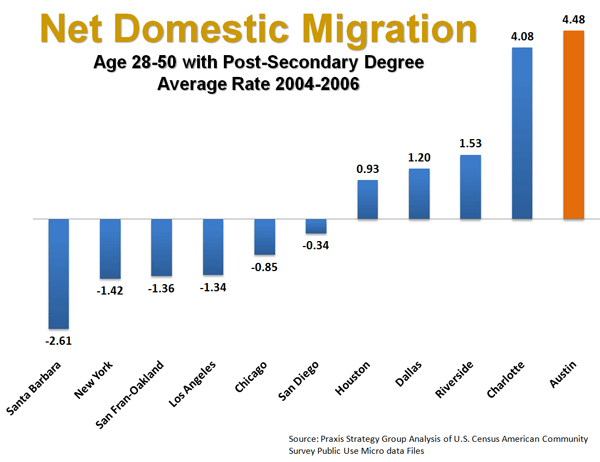
    Surprisingly, these suburban areas are the places most driving Austin’s economic success. Why? Two reasons: affordability and livability. By Texas standards, the city is not cheap. It costs between $350,000 and $400,000 for a nice three- or four-bedroom house in a good school district, say, 20 minutes from downtown. However, a similar place in the ‘burbs of Silicon Valley, San Francisco, Boston or Irvine would run at least twice as much.

    Local Realtor and blogger Shannan Gonyea-Reimer adds that, a bit further away from town, home prices can drop as low as $150,000. “People come from California, and they are shocked,” she says.

    This price structure, along with the human capital attracted to the University of Texas, has in turn propelled the rapid expansion of the non-governmental economy in places like Cedar Creek and Round Rock, home to Dell. A recent Brookings study estimates that central Austin employment grew by almost 13% between 1998 and 2006. The number of jobs more than 10 miles from the central business district increased by 77,523, or 62%, according to the study.

    Austin has seen remarkable overall employment growth–almost 34%–in the last decade. With that figure, it leaves its major hip tech rivals in the dust. Over the same period, for example, San Jose/Silicon Valley has lost 6% of its jobs; San Francisco, around 1.6%. Boston, Austin’s other big high-tech competitor, enjoyed only a 1.2% gain.

    Again, this growth stems in part from the unique combination of both an appealing city center and attractive suburbs. The city’s lively urban core remains a lure for affluent professionals, young singles and, of course, students. However, unlike places like New York, Boston and San Francisco, the sprawling ‘burbs provide an affordable place for people to move to when their hardcore clubbing days are over.

    “California might work well for the apartment-dwelling, single-guy lifestyle person, but when you get married, you can’t afford Los Gatos,” says former Silicon Valley entrepreneur Mike Shultz, the CEO of Infoglide, a software firm headquartered on Austin’s outer ring. “In Austin, the same person can grow up, move into a reasonable house and have a reasonable life.”

    This does much to explain why Austin has enjoyed a migration pattern unlike that of its primary competitors. Its residents may start off hip and cool, but the city also accommodates their often inevitable evolution to Ozzie and Harriet. This allows individuals and companies to plan to stick around. One doesn’t have to have the short-term mentality so common in the Bay Area, L.A., Boston or New York.

    Ultimately, it is this combination of a “cool” downtown culture–with excellent restaurants as well as great music–and a more sedate, affordable periphery that makes Austin a home run.

    “It has a hip cool side to it,” Shultz observes, “but it’s also a great place to raise kids.”

    A caveat to all this: We also have to consider scale. With roughly 1.5 million people, Austin simply offers more convenient choices than a megalopolitan behemoth like Los Angeles, New York or the Bay Area. In Austin, nice, single-family homes within walking distance of cool urban streets are not uncommon or absurdly expensive–and even a larger, more affordable house out in the suburbs is usually less than a half an hour from downtown.

    Additionally, Texas, unlike its main rival California, is not teetering on the edge of bankruptcy and is instead a stable long-term bet in this recession. Rather than haggling with bankers or public employee unions, it is busy building its future: attracting new comers, investing in its university and building new transportation infrastructure.

    “Austin is off the charts livable, but it’s in a state that makes it viable,” says Shultz, the entrepreneur. “You can’t say that about California and many of the other places where our competitors are.”

    This article originally appeared at Forbes.

    Joel Kotkin is executive editor of NewGeography.com and is a presidential fellow in urban futures at Chapman University. He is author of The City: A Global History and is finishing a book on the American future.

  • Cap and Trade: Who Wins, Who Loses

    President Obama recently announced his plan for environmental protection and Congress took up the debate. Called “Cap and Trade” Obama explained it simply in several public appearances. The government puts a limit on the total amount of carbon emissions that are acceptable in the United States. Carbon emissions come, basically, from burning carbon-based fuels – natural gas, petroleum and coal – in the production and use of energy. Users and producers of energy emit carbon dioxide (and other pollutants) into the atmosphere.

    As Richard Ebeling writes at the Mises Institute, under cap and trade “the government will formally nationalize the atmosphere above the United States.” The program bypasses fundamental questions like what is pollution, how much does it take to cause harm, who is harmed by it and linking the causation between pollution and harm. Fear of lawsuits, torts and injunctions (which could provide the answers) keeps the Administration from addressing these questions head-on. Reliance on the same, tired old source for solutions – Wall Street – ensures that those being harmed aren’t necessarily the ones who will benefit.

    Under Cap and Trade, each carbon-emitting entity – cars, power plants, factories, etc. – is allotted some share of that total limit, or Cap, permitted for carbon spewed into the air in the United States. For example, a power plant producing electricity for 50,000 homes and businesses might be allowed to emit 2 tons of carbon per year. That’s their “cap,” the maximum amount of carbon they are allowed to put in the air.

    Now for the “trade”: if that plant finds a cleaner way to produce the electricity needed for 50,000 homes and businesses, say only 1 tons of carbon per year, they can sell the right to emit 1 ton of carbon to a power plant that puts 3 tons of carbon into the air while generating electricity for 50,000 homes and businesses. The plant that buys the right to emit an extra 1 ton of carbon per year is not required to limit their emissions to 2 tons – they bought the right for the extra ton.

    It all sounds very lovely as long as the caps will control the total amount of carbon added to the air from the United States. The money gained by selling the rights for “unused” emissions will provide financial incentives to the makers and users of cars, power plants and factories to pay for the technology to be cleaner. Since the money spent to pay for the more efficient technology can be recovered in the Cap and Trade marketplace, the cost of the cleaner energy shouldn’t require higher costs to consumers of the now cleaner air.

    This is great if you live near a power plant that manages to reduce the carbon emissions into the air you breathe below the maximum cap level. Here’s the problem: what if you live next to the power plant that paid for the right to put an extra ton of carbon into the air? Two things happen. First, you will be paying for the extra carbon because the power company will have to charge more to pay the cleaner power company for the right to produce the extra ton of carbon. That leads to the second problem: the extra ton of carbon is being emitted into the air around your home. That means that you could end up paying more for your electricity, while also breathing more polluted air.

    Cap and Trade is not a solution, it is another money-making scheme cooked up by the “dangerous dreamers” of Wall Street. In the EU they at least have the good grace to call it a “Trading Scheme.” A global carbon trading market already exists. “Pollution rights” have been traded since the 1990s when the Environmental Protection Agency held the first auction of air emission allowances, or pollution rights, at the Chicago Board of Trade. Starting with sulfur dioxide allowances, other pollutants were added in the next ten years to eventually create a complete trading market on the Chicago Climate Exchange. “The right to use water or air is more valuable than food, and we can use the price system to allocate that right,” said Richard Sandor at the 2005 Milken Institute Global Conference (yes, that Milken). The Chicago Mercantile Exchange and the New York Stock Exchange are now prepared to expand the environmental markets for industrial pollution, also known as the carbon markets, into “futures and options on more than 40 U.S. and international indexes [for pollution rights].”

    But, really, do we want the same bunch of guys that gave us junk bonds, mortgage-backed securities and credit default swaps allocating air and water? Globally? Into the future?

    Like sending subprime mortgages throughout the global economy, this scheme will allow pollution rights to be bought and sold by anyone. So, it isn’t just the factory next door to the power generator in Detroit that will be emitting the extra tons of carbon – factories in other countries will be able to sell their carbon emitting rights to power companies in Detroit. It’s a great money-making scheme for a solar powered producer in Costa Rica – but a very bad deal for those breathing the air and paying for power in Detroit.

    The Cap and Trade scheme is being supported by President Obama’s main economic advisor, Larry Summers – who once said we should export pollution to Africa because their per capita figures are too low. “I think the economic logic behind dumping a load of toxic waste in the lowest wage country is impeccable and we should face up to that.”

    Cap and Trade gets the polluters mixed up with the victims of pollution. Shouldn’t the money generated from the sale of pollution rights accumulate to the persons harmed by the pollution? The idea that you can structure economic incentives to produce socially beneficial results really ends up being about creating paper profits for the money-traders at the expense of the people living with the pollution. This does not seem like a fair trade to me.

    Susanne Trimbath, Ph.D. is CEO and Chief Economist of STP Advisory Services. Her training in finance and economics began with editing briefing documents for the Economic Research Department of the Federal Reserve Bank of San Francisco. She worked in operations at depository trust and clearing corporations in San Francisco and New York, including Depository Trust Company, a subsidiary of DTCC; formerly, she was a Senior Research Economist studying capital markets at the Milken Institute. Her PhD in economics is from New York University. In addition to teaching economics and finance at New York University and University of Southern California (Marshall School of Business), Trimbath is co-author of Beyond Junk Bonds: Expanding High Yield Markets.

  • In California, the Canary is Dead

    Canaries were used in early coal mines to detect deadly gases, such as methane and carbon monoxide. If the bird was happy and singing, the miners were safe. If the bird died, the air was not safe, and the miners left. The bird served as an early warning system.

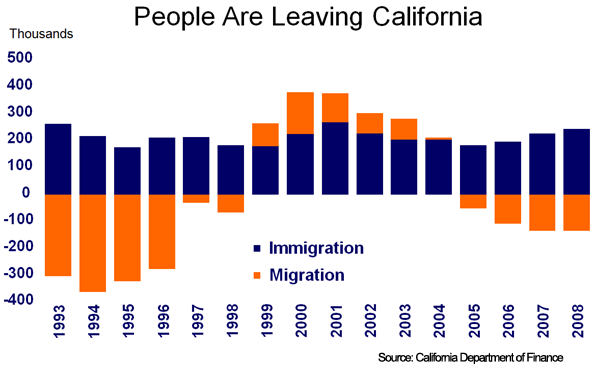
    Domestic migration trends play a similar early warning system for states. California’s dynamism was always reflected by its ability to attract newcomers to the state. But today California’s canary is dead.

    Here’s the logic. If net domestic migration is positive, the state’s economy is reasonably sound. Economic growth, taxes, housing, and amenities are strong enough to keep people where they are and attract others. If net domestic migration is negative, it usually means that lack of economic growth, taxes, quality of life, and housing have deteriorated sufficiently to drive people away. This happens despite the inevitable pain of leaving the security and comfort of family, friends, and familiar surroundings.

    California has been a destination for migrating workers and families since 1849. They came form every state and from around the world. Often the migrants faced tremendous challenges and hardship. Illegal immigrants from Mexico and other developing countries still must leap over such barriers. Often, California’s migrants came in waves. The 1850s, 1930s, and 1950s all saw huge surges tied to huge events – the Gold Rush, the Depression and the post-war boom. But even between these waves, California consistently experienced a steady inflow of new immigrants.

    Immigration has been good for California. The new residents brought ambition, skills, and a willingness to take risks. They found a state with abundant natural resources, from oil to rich soil and ample, if sometimes distant water resources. Together with the people already there, they created an economic powerhouse. They built cities with amenities that rival any other. They fed much of the nation and large numbers overseas. They did this while persevering much of California’s unique endowment: the vast coastline, the Sierra Nevada, and the deserts.

    California, with 12 percent of the United States population, became the world’s sixth largest economy while managing to maintain the aura of paradise at the same time. Opportunity and housing were abundant. California was a great place to have a career and raise a family.

    Most recently, though, this has begun to change. California is no longer a preferred destination, at least for domestic migrants. The state’s economy is limping along considerably worse than that of the nation. Opportunity is limited. Housing is relatively expensive, even after the dramatic deflation of the past two years, except for some very hard-hit and generally less attractive inland areas. Taxes are high and increasing. Regulation is onerous and becoming more so. Many California communities are outright hostile to business.

    Consequently, net domestic migration has been negative for 10 of the past fifteen years. International migration to California remains positive, but that reflects more on the weakness of the economies and the attraction of existing ethnic networks than the intrinsic superiority of California. This represents a sea change: anyone predicting it fifteen years ago would have been laughed out of the room.

    What happened?

    California’s economy was badly hit by the 1990s recession. The State’s aerospace and defense sectors were especially decimated. Middle-class families moved out by the hundreds of thousands.

    The 1990s out migration caused some soul searching in California. There was lots of talk, and a little action on making the State more competitive. Then came the technology and real estate booms. Domestic migration turned positive. The half-hearted efforts to make California more competitive faded as policy makers were lulled into complacency by the strength of California’s resurgence.

    But the problems that bedeviled the state in the 1990s – high housing prices and taxes, cascading regulations and a deteriorated infrastructure – had only been obscured by the boom. By 2005 migration began to turn negative, largely as soaring housing prices discouraged newcomers and encourage many residents to cash out and move to less expensive places. California had priced itself, and the dream, out of competitiveness. Since then, California has seen four consecutive years of increasingly negative domestic migration. The recent net outflow numbers have been smaller than in the 1990s, but it may be because other tradidional California migrant destination economies – like Oregon, Washington, Nevada and Arizona – have become less competitive as well.

    Today, many argue that California will bounce back, but they can’t identify the reason. What sector will lead the resurgence? They seem to think economic growth will come with the sunshine, beaches, and mountains. There was plenty of sunshine in the 80 years between the founding of the first mission and the gold rush, and not much happened. Similarly, the differences between California cities and neighboring Mexican cities show clearly that successful economies need more than good looks and nice climate.

    It’s hard right now to assume California’s future will include the same predominance in technological innovation. Agriculture is running out of water, in large part due to environmental lawsuits, and the state no longer seems willing to invest in new water projects. Even the entertainment industry is increasingly looking outside of California for growth. You have to ask: what does California offer that will overcome the State’s high costs, regulatory environment, and antipathy to business?

    That is the short term. The long term doesn’t look very good either. The public universities, a major source of innovation over the past two decades, are facing increasingly severe budget challenges. It is unlikely that they will be able to maintain their status even as other states – Texas, Colorado, New Mexico – eye further expansion. Even more ominous are gains in countries, such as China and India, who have long sent their best and brightest to the Golden State.

    All this suggests a relative decline in California’s long-term prospects. What should we do? Part of California’s problem is its political process. The state’s chronic inability to do much of anything reinforces stasis. As Dan Walters says, “everyone has a veto on everything.”

    But even improving the political process may not be enough. Much of Coastal California is dominated by rich, aging, baby boomers. The residents of this increasingly geriatric ghetto often don’t worry much about economic opportunity. They may have the money and votes to guarantee that growth does not impinge on their lifestyles. Unless these conditions change, it will be unlikely to see a renewal of strong domestic migration to California in the coming years.

    Bill Watkins, Ph.D. is the Executive Director of the Economic Forecast Project at the University of California, Santa Barbara. He is also a former economist at the Board of Governors of the Federal Reserve System in Washington D.C. in the Monetary Affairs Division.