Blog

  • Unintended Consequences

    Consider the tax credits for alternative fuels such as ethanol and biomass that were rolled into the 2005 Transportation Law to encourage energy independence. At the same time, re-consider the law of unintended consequences, enshrined in Adam Smith’s notion that the unregulated behavior of capitalists gives rise to an invisible hand “to promote an end which was no part of their intention.”

    The tax law included a fifty-cent-a-gallon credit for the use of fuel mixtures that combined “alternative fuel” with a “taxable fuel” such as diesel or gasoline.

    This ill-conceived legislation is now producing an $8 billion windfall for the nation’s paper companies that, in order to qualify for the subsides, began adding diesel fuel to a paper-making process that required none.

    Paper has been produced in basically the same way since the 1930s, when scientists learned how to leach cellulose from wood chemically. The chemical reaction produces a sludge containing lignin, which is so rich in carbon that the paper makers use it as fuel in the process that transforms the pulp into paper. It’s wonderfully efficient, and allows the nation’s paper companies to operate largely without foreign oil. But not, however, with subsides. That’s why the companies added diesel fuel to the lignin, effectively replacing a green technology with one that is dependent on foreign oil.

    The road to hell, as Adam Smith’s contemporary Samuel Johnson ironically observed, is paved with good intentions. But one can arrive there just as easily with bad intentions and bad faith.

  • Unsustainable Transit: New York City

    When it comes to transit, as like many things in the United States, there is no place like New York City. The subways and buses of the New York City Transit Authority (NYCTA) carry more than 40 percent of the nation’s transit rides (unlinked trips). To account for 40 percent of the nation’s ridership is quite an accomplishment inasmuch as the city represents less than 3 percent of the nation’s population.

    Of course, New York City’s ridership domination stems from the evolution of an ideal environment for transit. Most of the ridership comes from the heavily urban boroughs of Manhattan, Brooklyn, Queens and the Bronx, with a much smaller ridership in Staten Island, most of which looks like the second ring adjacent New Jersey suburbs. The four highly urban boroughs have exceedingly high population densities, averaging above 30,000 per square mile. The city of San Francisco, with its reputation for density, is little more than one-half as dense. The four boroughs are nearly as dense as city (23 ku area) of Tokyo, denser than most European core cities and nearly three times as crowded as Amsterdam.

    The most important factor, however, is the concentration of destinations in the central business district, south of 59th Street in Manhattan. This is the world’s second largest central business district and the home of approximately 2,000,000 jobs. Only the geographically larger business district inside Tokyo’s Yamanote Loop has more jobs. The Manhattan business district (really two, Uptown and Lower Manhattan and the area between) has at least four times as many jobs as Chicago’s Loop, the second largest central business district in the nation.

    The share of people commuting to work by transit is far higher than anywhere else in the nation. Approximately 75 percent of the people commuting to jobs in Manhattan get there by transit. Approximately 55 percent of the city’s working population commutes by transit, double the percentage of automobiles. By comparison, other highly urbanized central cities have far smaller transit work trip market shares, with Boston at 34 percent, San Francisco at 33 percent and Chicago at 26 percent. In each of these cities, considerably more people commute by car than by transit.

    Suffice it to say that New York is the penultimate transit city. If transit is the answer anywhere, it is the answer in New York.

    Yet the history of New York City Transit Authority has been one of financial crisis. From the NYCTA’s founding in 1953, transit riders of New York City have been faced by recurring threats of service reductions and fare increases. Over the years, transit fares have risen sharply despite increased subsidies. The financial downturn has generated yet another financial crisis at NYCTA, as well as at many other transit agencies around the country. There may be a financial bail-out from Albany, or there could be significant fare increases or service reductions. But the present financial crisis is by no means the first and it is unlikely to be the last. The problem is that transit is characterized by perverse incentives that keep if from focusing on its principal mission.

    Transit’s mission, as my late Los Angeles County Transportation Commission colleague (and Santa Monica city councilwoman) Christine Reed so eloquently put it, is to serve both riders and taxpayers. Regrettably, however, the riders and taxpayers routinely take a back seat to other more concentrated and powerful groups with a strong interest in getting themselves more money and scant interest in cost efficiency.

    As a result, the story is always the same in New York and elsewhere. Financial crises are characterized as funding crises and the answer to every question is more money. Little or no serious attention is paid to the cost side of the equation. In the present environment, the riders and the taxpayers are unlikely to ever be able to provide enough money to make transit financially sustainable.

    Both labor and management operate in an environment of perverse incentives. Labor unions understandably seek to improve the wages and working conditions of their members. In a competitive environment, there are some limits. But transit remains immune to competitive pressures; it is rather a political environment. Transit board members are appointed by elected officials, many of whom rely heavily on political contributions from labor unions and their often sophisticated get out the vote operations.

    Transit managers must live with this reality and any who become too courageous in their dealings with transit labor can expect to be shown the door. At the same time, transit labor negotiations are often not really conducted between parties across the table from one-another. Indeed, often the table is shoved up against the wall, since the gains that are won by the labor unions are largely duplicated in the pay and benefits packages of transit managers. Thus, costs are higher in transit – whether at NYCTA or at other agencies – than they would be for similar work in the private sector.

    One might expect transit to face frequent crises in Eugene, Madison or even Los Angeles or Seattle. But New York City? Perverse incentives are the problem, but other cities have managed to have successful transit systems without such incentives. In some of the world’s largest cores, such as Tokyo and Hong Kong, transit obtains virtually all of its funds from commercial revenues, principally fares. Without access to the deep pockets of taxpayers, transit is required to live within their means. Serious attention is paid both to funding and costs. It may be too much to ask for transit in New York City to be converted from its heavy subsidies to a profitable operation. But improvements can be made.

    In transit operations, one answer is competitive contracting (competitive tendering), whereby the transit agency seeks competitive bids on bus and rail routes for private operation. The competitive market reduces costs, while the transit agency specifies all aspects of the service. The best example of competitive contracting in the world is the London Transport bus system, which is the largest city bus system in the developed world. Buses are operated by multiple private contractors, under the control of Transport for London, which determines fare levels, routes, schedules and transfer arrangements. To the public, London Transport’s buses look and act like a single system. There is, however, a big difference. Competitive contracting has reduced costs per mile by nearly 40 percent after adjustment for inflation over the past 25 years. The savings have been plowed back into substantial service increases, which have led to strong ridership increases. Subway operating costs have also been reduced through competitive contracting, such as in Stockholm.

    But so long as the focus is on revenues and costs are largely ignored, the only thing sustainable about transit in New York City will be its fiscal crises. Even if there is an eventual financial bailout of NYCTA this time, expect the clock to start ticking towards the next inevitable crisis.

    Wendell Cox is a Visiting Professor, Conservatoire National des Arts et Metiers, Paris. He was born in Los Angeles and was appointed to three terms on the Los Angeles County Transportation Commission by Mayor Tom Bradley. He is the author of “War on the Dream: How Anti-Sprawl Policy Threatens the Quality of Life.

  • Visualizing our 2009 Best Cities for Job Growth Rankings

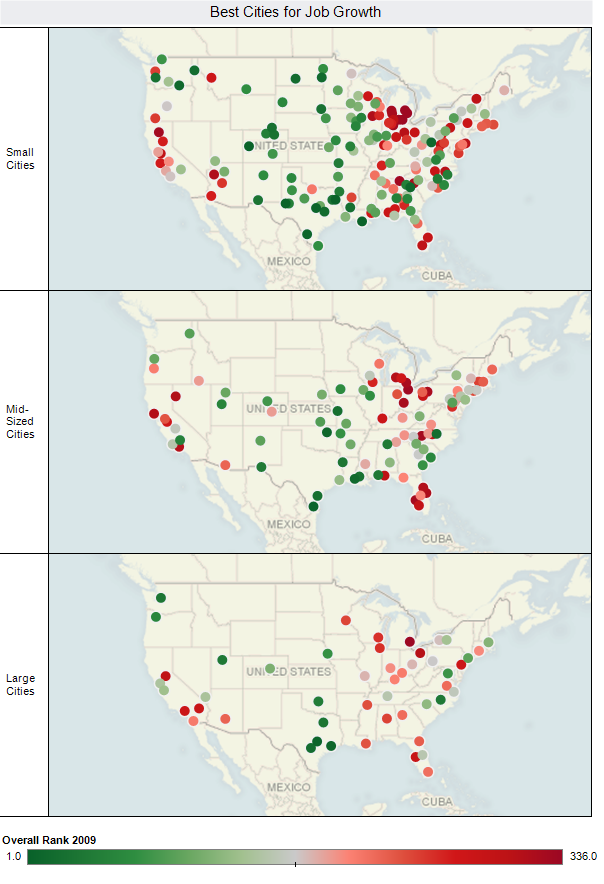
    Here’s some great maps of our annual Best Cities Rankings created by Robert Morton at Tableau Software. Robert used their software tool to plot a color coded point for each city in the rankings by size group, and immediate geographic patterns emerge:

    Check out Robert’s post for a map of the biggest gainers and losers from last year, and a rank change by size scatter plot of each place.

  • Lessons from Chrysler and the Nationalized Economy

    Economists and accountants could very likely have told us six months ago that Chrysler was doomed as a business and that the likely best course of action would be Chapter 11 bankruptcy and restructuring. Doing this in a timely manner would have saved the taxpayers billions of dollars.

    But the politics were not right to permit this to happen at that time. So instead we invested billions of tax dollars to save it, only to find ourselves right back were we started. Except now the clock is striking twelve and it is the right time to reorganize the automaker – politically speaking.

    The politics has worked to “force” Daimler, Cerberus, Banks, UAW and the U.S. taxpayer to forgive nearly $17 billion in debt, and to transfer ownership to a consortium that includes Fiat, U.A.W., and the U.S. and Canadian governments. The same fate may soon await General Motors given the current political atmosphere.

    Government action is not driven so much by economics or accounting as it is by shifts and changes in public opinion and the political winds on Capitol Hill. Regardless of the problem and the consequences of delay, no issue will be dealt with until opinion has been properly shaped around it. This is inefficient by its nature, but government is not a business and cannot fail, so the consequences are never felt by government.

    This means government will often invest in what’s next and ignore what is needed in the present. Why? Because the public likes the new and the novel and grows weary of the old and tried and true. Transportation infrastructure is a great example. It is an accepted fact that our road and bridge infrastructure is failing and will require billions of additional dollars to rebuild and reform into a 21st century, integrated mobility network. Yet there is no political will to address an issue which could seriously undermine our economic competitiveness costing us countless jobs and businesses.

    Politicians know that a solution will require new revenues and very likely a new user fee to augment the current gas tax. Raising taxes is not good for the long term political health of our elected “leaders” because the public does not want to pay for things. So rather than solve a pressing need, government proposes borrowing $8 billion to spend on high speed rail projects like the one to connect Disneyland and Las Vegas. This project works politically because it is filled with perceived benefits and no one really has to pay for them – we can pass it all on to the next generation.

    As we move toward increasing the politicization of our economy where politicians replace CEOs, government becomes a major shareholder in corporations, and the metrics of elections replace standard accounting practices, we should remember the inherent and unintended consequences.

    Businesses succeed or fail based on markets. The government’s attempt to create a false housing market with its affordable housing initiative is arguably one of the major contributing factors to our current recession. They will likely assert their new power in the automobile industry to create “green” cars that may or may not sell. What if consumers choose to buy Japanese, Korean or German label cars made in Mississippi or Alabama, instead of UAW-built cars from Michigan?

    Markets work, and yet they are being ignored. The second most profound economic event of the past year (the collapse of the financial markets being the first) was when the price of gasoline moved above $4.00 a gallon in April of 2008. People drove less. Demand for SUVs plummeted. Ridership of public transportation increased dramatically. Many valued components of American way of life changed almost overnight.

    What is often missed is the fact that government was powerless to do anything about gas prices. Elected leaders looked for scapegoats in speculators and commanded the heads of the Big Oil companies pay homage at their feet. They attacked profits, demanded more drilling, put their environmental agenda on the back burner. The crisis showed them to be feckless on the horns of a dilemma. When prices retreated swiftly in August 2008 and public opinion cooled on the issue, drilling for new energy disappeared from the radar and everything was “green” again. The problem has not disappeared of course, but only public support for a solution. Is this any way to run an economy?

    Businesses concentrate on profit. Elected leaders focus on votes. Bad business decisions are unsustainable in a free market which metes out consequences with failure. Bad political decisions make an elected official unelectable, so it is always better to avoid conflict by putting off the really tough decisions for another day. This is not the way most Americans run their households, but it’s how politicians would run our economy – responding to opinion, not market conditions.

    There are some very difficult decisions as we move through this economic downturn. Do we want more and more of the political processes to be incorporated into our economy on a permanent basis? Banks and financial institutions have already seen first hand the consequences of getting into bed with government. Our automobile industry is next in line. Let’s hope it is the end of the line, but it probably won’t be.

    Dennis M. Powell is president and CEO of Massey Powell an issues management consulting company located in Plymouth Meeting, PA.

  • U-Haul Prices as Migration Indicator

    Austin fared very well on this year’s Best Cities Rankings, and here’s another interesting indicator of the difference in migration between Austin and San Francisco:

    “When comparing California with Texas, U-Haul says it all. To rent a 26-foot truck oneway from San Francisco to Austin, the charge is $3,236, and yet the one-way charge for that same truck from Austin to San Francisco is just $399. Clearly what is happening is that far more people want to move from San Francisco to Austin than vice versa, so U-Haul has to pay its own employees to drive the empty trucks back from Texas.”

    This anecdote comes from a report comparing business environments in Texas to California.

    Here’s a table of the latest domestic migration numbers from US Census for all metropolitan areas of more than 1.5 million total population (rate numbers are per 1,000 population):

    NAME
    Population, 2008
    Net Domesitc Migration Rate, 2008
    Ave. Net Domesic Mig Rate, 2001-2008
    New York-Northern New Jersey-Long Island, NY-NJ-PA 19,006,798 -7.6 -12.0
    Los Angeles-Long Beach-Santa Ana, CA 12,872,808 -9.0 -12.2
    Chicago-Naperville-Joliet, IL-IN-WI 9,569,624 -4.4 -6.8
    Dallas-Fort Worth-Arlington, TX 6,300,006 7.0 5.7
    Philadelphia-Camden-Wilmington, PA-NJ-DE-MD 5,838,471 -3.8 -2.3
    Houston-Sugar Land-Baytown, TX 5,728,143 6.6 4.5
    Miami-Fort Lauderdale-Pompano Beach, FL 5,414,772 -8.7 -5.1
    Atlanta-Sandy Springs-Marietta, GA 5,376,285 8.2 10.2
    Washington-Arlington-Alexandria, DC-VA-MD-WV 5,358,130 -3.4 -2.9
    Boston-Cambridge-Quincy, MA-NH 4,522,858 -1.8 -7.1
    Detroit-Warren-Livonia, MI 4,425,110 -13.9 -9.1
    Phoenix-Mesa-Scottsdale, AZ 4,281,899 12.3 17.9
    San Francisco-Oakland-Fremont, CA 4,274,531 1.3 -10.5
    Riverside-San Bernardino-Ontario, CA 4,115,871 -1.9 16.1
    Seattle-Tacoma-Bellevue, WA 3,344,813 3.6 0.9
    Minneapolis-St. Paul-Bloomington, MN-WI 3,229,878 -1.1 -1.0
    San Diego-Carlsbad-San Marcos, CA 3,001,072 0.1 -4.8
    St. Louis, MO-IL 2,816,710 -2.0 -1.8
    Tampa-St. Petersburg-Clearwater, FL 2,733,761 2.4 12.9
    Baltimore-Towson, MD 2,667,117 -4.6 -1.6
    Denver-Aurora, CO /1 2,506,626 7.3 1.8
    Pittsburgh, PA 2,351,192 -1.0 -2.9
    Portland-Vancouver-Beaverton, OR-WA 2,207,462 8.3 6.2
    Cincinnati-Middletown, OH-KY-IN 2,155,137 -1.7 -1.2
    Sacramento–Arden-Arcade–Roseville, CA 2,109,832 2.2 8.7
    Cleveland-Elyria-Mentor, OH 2,088,291 -7.1 -7.5
    Orlando-Kissimmee, FL 2,054,574 1.6 15.9
    San Antonio, TX 2,031,445 11.5 10.4
    Kansas City, MO-KS 2,002,047 0.7 1.5
    Las Vegas-Paradise, NV 1,865,746 7.9 23.7
    San Jose-Sunnyvale-Santa Clara, CA 1,819,198 -1.5 -16.4
    Columbus, OH 1,773,120 1.4 1.8
    Indianapolis-Carmel, IN 1,715,459 4.0 4.8
    Charlotte-Gastonia-Concord, NC-SC 1,701,799 20.9 18.2
    Virginia Beach-Norfolk-Newport News, VA-NC 1,658,292 -9.4 -0.6
    Austin-Round Rock, TX 1,652,602 22.0 17.2
    Providence-New Bedford-Fall River, RI-MA 1,596,611 -6.6 -3.7
    Nashville-Davidson–Murfreesboro–Franklin, TN 1,550,733 10.9 9.6
    Milwaukee-Waukesha-West Allis, WI 1,549,308 -4.2 -5.9
  • America’s (Sub)Urban Future

    Cities today have more political clout than at any time in a half century. Not only does an urbanite blessed by the Chicago machine sit in the White House, but Congress is now dominated by Democratic politicians hailing from either cities or inner-ring suburbs.

    Perhaps because of this representation, some are calling for the administration and Congress to “bail out” urban America. Yet there’s grave danger in heeding this call. Hope that “the urban president” will solve inner-city problems could end up diverting cities from the kind of radical reforms necessary to thrive in the coming decades.

    Demographics and economics make self-help a necessity. Despite the wishful thinking of urbanophile pundits and policymakers, central cities have little realistic chance to reclaim their pre-1950 role as the dominant arbiters of American life.

    Short of a catastrophic change, the country will remain predominately made up of suburban, exurban and small town residents. Since 2000, more than four-fifths of metropolitan growth has taken place in suburbs and exurbs. Economically, we see a similar pattern. According to a recent Brookings Institution study of 98 large metropolitan areas, only 21% of employees work within three miles of downtown. The report found that only three regions avoided the decentralizing trend.

    The Brookings report and many others decry all these trends as promoting “sprawl,” but name-calling will not assure that urban areas can impose their political hegemony over the long run. The Obama administration may try to boost cities by imposing barriers to suburban growth, but these seem doomed to failure given both the preference of most Americans for lower-density lifestyles and the president’s demonstrated ability to count votes.

    Rather than waiting for Barack, urban boosters should instead take up the New Testament injunction to “heal thyself.” Cities should have a chance to grow based on the roughly 10% to 20% of Americans who tell researchers they would like to live in a dense urban environment. With an extra 100 million Americans coming on line by 2050, cities could look forward to accommodating upwards of 20 million more people in the next few decades. As my grandmother would say, that’s not exactly chopped liver.

    Yet in order to enjoy this repast, cities will need to address three fundamental and inextricably related issues: public safety, business climate and political reform. Of these, public safety is the most critical. From the earliest times, security has represented a critical pre-condition for urban success. The huge surge in urban crime during the 1960s, for example, played an enormous role in the precipitous decline of cities in the ensuing decades.

    Conversely, improvements in public safety after 1990–notably in New York and Los Angeles but also in other large cities–helped slow the out-migration from urban cores and attract new residents, mostly young educated professionals and immigrants. Now urban crime may be on the rise, and could again threaten new growth.

    This is worrying because urban crime rates, notes demographer Wendell Cox, remain still three times higher than those of surrounding suburbs. Almost all the highest crime areas in America can be found in urban settings, while the safest places tend to be in suburban towns.

    Even the president’s much-celebrated hometown of Chicago suffered roughly a murder a day last year. On the city’s MTA trains, robbery soared 77% between 2006 and 2008. Now there’s also more than a stickup a day.

    Hard economic times may exacerbate these problems, with an estimated 250,000 more Chicagoans predicted to fall into poverty by the end of the year. More widely, unemployment among core urban populations–young people, minorities and immigrants–is on the rise, even more than in the general population. Indeed, for the first time since the mid-1990s, the foreign born now suffer a higher rate of joblessness than the native born.

    Yet even in the face of a tough economy, few cities seem to focus on long-term middle-class job creation. Most seem to prefer to indulge in marginally useful taxpayer-subsidized prestige projects like convention centers, arts complexes, ball parks and arenas. Meanwhile, the core issues stifling growth–high taxes, stiff regulatory burdens and sometimes corrupt governments–remain largely ignored.

    Recently while researching the middle class in New York, I met many otherwise committed urbanites considering leaving to less costly, lower-tax and more business-friendly locales. Up until recently, this problem was somewhat obscured by spectacular earnings on Wall Street, which engendered the growth of an extensive “luxury economy” largely insulated from high costs. But even Timothy Geithner won’t be able to bail out this favored segment of the economy ad infinitum.

    Instead cities, including New York, will have to diversify to less gilded industries. Increasingly cities will need to rely on small companies, micro-enterprises and self-employed high-tech artisans to drive their economies. To keep them there, they will need to attend to basic services–education, police and transportation–while managing to curb taxes and regulations.

    This will necessitate confronting the largest source of high city costs: public employee salaries and pensions. This problem is not unique to core cities, but tends to be more severe in urban areas where public employee unions often dominate local politics.

    Finally, cities need to address their educational systems. Despite all the talk of urban educational reform, the urban dropout rate, according to a recent study of the nation’s largest cities by America’s Promise Alliance remains around 50%, roughly 20 points higher than the rate for suburbs. Poor-quality urban schools drive out both the middle class and the most upwardly mobile segment of the working class.

    Even more money from Washington won’t solve this problem. Cleveland, with a 38% graduation rate, spent far more on students per capita than Ohio’s statewide averages. In contrast, the surrounding suburbs enjoyed an 80% graduation rate.

    Are cities capable of changing their governance for the better? In the 1990s, the emergence of tough, reform-minded mayors like New York’s Rudy Giuliani, Indianapolis’ innovative Steven Goldsmith, Richard Riordan in Los Angeles and Houston’s hard-driving Bob Lanier all sparked urban revivals in their cities.

    Today, however, there are few such personages; Houston’s Bill White is one glaring exception. Yet without an infusion of bold new leadership, the future of American cities, although not universally bleak, will not be nearly as bright as it should be. Rather than a constellation of strong, reviving cities, we can envision the emergence of a less promising set of scenarios.

    One archetype will be the Bloombergian “luxury city,” a very expensive urban area dominated by the wealthy and their servants, students and nomadic young workers as well as the poor. The affluent will drive this growth, but only in a relatively few neighborhoods in attractive places like New York, Chicago, Boston, Los Angeles, Seattle, Portland, Denver and Minneapolis.

    San Francisco may presage this urban form. Already middle-class families are becoming scarce in the city by the bay. The place seems increasingly something of a Disneyland for privileged adults, exempting of course the large homeless population. “A cross between Carmel and Calcutta,” jokes California historian and San Francisco native Kevin Starr.

    At the opposite end of the spectrum lie those cities consistently at the bottom of our Worst Cities For Jobs ranking. Despite some zones of gentrification, such once-great cities as Detroit, Cleveland, Memphis, Baltimore and Philadelphia could continue to suffer persistently high rates of poverty, diminished populations and high crime rates.

    Not that this has to be. These areas could stage a real resurgence if their governments determine to throttle criminals, improve basic services and nurture small businesses. Low housing prices, cheap land and, in some cases, strategic locations could attract businesses as well as some of the millions who will be seeking out an urban lifestyle in the coming decades.

    Currently the brightest hopes for America’s urban future lie with newer, “aspirational,” middle-class-oriented cities such as Houston, Dallas, Austin, Phoenix, Raleigh-Durham, Charlotte and Orlando. Although some are now suffering from the recession, these places will benefit from both lower costs and more business-friendly regimes. Primarily suburban in nature, many of these cities have worked to develop attractive dense urban districts, which could expand much further over the next few decades.

    There remains nothing pre-determined about the urban future. Some cities may surprise us by reviving strongly while others may continue to disappoint. Success will depend not on Washington, but on how each city addresses the basics of safety, economics and governance. Grasping this fundamental truth constitutes the first step towards creating a sustainable long-term urban resurgence.

    This article originally appeared at Forbes.

    Joel Kotkin is executive editor of NewGeography.com and is a presidential fellow in urban futures at Chapman University. He is author of The City: A Global History and is finishing a book on the American future.

  • LA is as Safe as 1956, Fact or Political Spin?

    In the weeks leading up to the tepid re-election of Los Angeles Mayor Antonio Villaraigosa last month, Bill Bratton, the statistics-driven chief of the Los Angeles Police Department, appeared on TV in a political advertisement paid for by the Villaraigosa campaign. He cited a seemingly amazing figure about this city’s livability.

    “Crime is down to levels of the 1950s,” said a confident-looking Bratton, who wore a black jacket and dark tie as he sat in an office conference room with downtown views.

    Flashing across the screen as he delivered the line with his heavy Boston accent was a Los Angeles Daily News headline from early 2008 borrowed by the Villaraigosa campaign to further emphasize the chief’s claim. It read in bold, black letters: “Safest streets since ’56.”

    On March 2, 24 hours before Election Day, Villaraigosa and Bratton teamed up again. This time, they appeared together at a morning press conference at the Police Academy in Elysian Park, where a statement from the Mayor’s Office made the rounds and trumpeted a “citywide crime-rate drop to the lowest level since 1956, the total number of homicides fall[ing] to a 38-year low. Gang homicides were down more than 24 percent in 2008.”

    The 1956 number was simply incredible — Los Angeles had time-warped back more than 50 years to the era of the Beat Generation, Elvis Presley and Howdy Doody, when serious crime was still so titillating that murder trials featuring unknown faces were followed like big celebrity events. It wasn’t the first time Bratton made the claim — the chief had also made the bold comparison in 2006 and again in 2008, lugging it out to warn voters that the low crime rate could be jeopardized if they didn’t pass the City Council’s telephone-utility-tax referendum, a phone tax that Villaraigosa and Bratton said was needed for the hiring of more cops.

    The press barely challenged the notion that Los Angeles has somehow been transported back five decades, and some instead focused on Bratton’s widely criticized political endorsement of the mayor — an unsettling and, many people believe, unethical move for a hired hand like a chief of police to engage in. One of the first to criticize Bratton’s claim was long-shot mayoral candidate Walter Moore. Moore couldn’t wrap his mind around the idea that Los Angeles is now as safe as the year that the L.A. Angels played baseball at a now-destroyed civic landmark — the beautiful old Wrigley Field in then-quiet, then-tidy South-Central Los Angeles.

    “I’ve talked to people who grew up here in the 1950s,” Moore argued to nodding heads during a February debate between several mayoral candidates, held in the hilly, suburbanlike community of Sunland-Tujunga (sans Villaraigosa). “And believe me, nobody in L.A. remembers crime in the 1950s being like it is today.”

    Moore isn’t the only one who finds it fishy, and just plain strange, to attempt to paint the city as similar to a time when 2.3 million residents lived in a far more suburban and far less dense metropolis, one in which residents often did not bother to lock their doors.

    “It’s a silly comparison,” Malcolm Klein, professor emeritus of sociology at USC and a gang-crime expert, says bluntly. An author of numerous books on gang crime, Klein says that when Bratton starts publicly comparing crime levels of the 1950s to today, “You’re not listening to a chief of police, you’re listening to a politician.”

    Read the extended version of this piece at LAWeekly.com

  • How Austin’s Rise Became a Tale of Two Cities

    Austin has enjoyed healthy growth during its 150-year history. As a rule of thumb, its population doubles every 20 years, and has done so since it was founded. It continues to grow at a healthy clip: from a population of 345,000 in 1980 to 656,000 in 2000; the Census Bureau estimates it had nearly 750,000 residents in 2008.

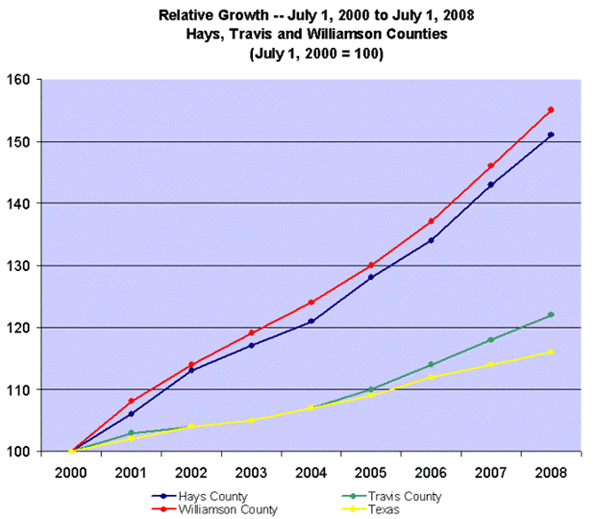
    But if the city of Austin has grown briskly, its suburbs have exploded. Williamson County to its north was the sixth fastest-growing county in the United States between July 1, 2007 and July 1, 2008. Hays County to the south was the tenth.

    This is not a recent development. Williamson and Hays Counties have outpaced Travis County (Austin) and Texas for years:

    The figures for individual suburbs reflect this spectacular growth:

    • Between 1990 and 2007, Round Rock, ten miles north of Austin and home to Dell Computers, tripled from 31,000 to almost 100,000; its population grew by 50% between 2000 and 2007 alone.
    • Pflugerville, just south of Round Rock, grew from a tiny village of 4,000 in 1990 to 34,000 in 2007.
    • Cedar Park and Leander grew tenfold and sevenfold, respectively, between 1990 and 2007.

    The scale of rapid growth is noteworthy, but the distribution of growth is hardly unique. After all, American cities have been suburbanizing for the last 60 years (and in some cities, for much longer). Austin’s suburbanizing growth merely mirrors the national trend.

    But Austin’s growth evinces another pattern. As Austin and its suburbs have grown, families with children have left central Austin for its fringes, ceding central Austin to singles and couples without children.

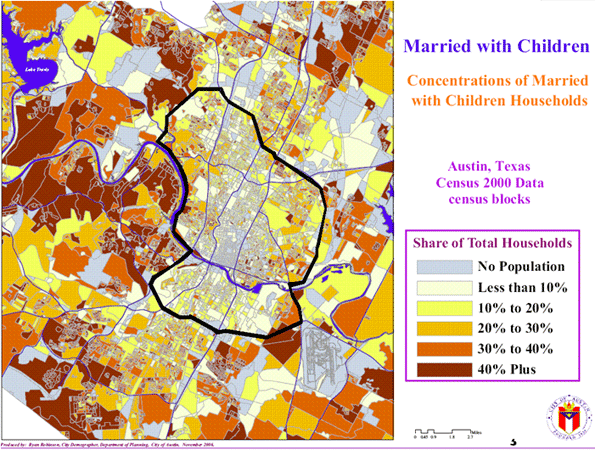
    Central Austin is typically defined as the area urbanized by 1970, delineated by a perimeter of highways and lakes. But there’s an alternative definition: Central Austin is where the families with children are not.

    The map below tells the story. It depicts, using 2000 Census data, the percentage of households consisting of married couples with children. Darkly-tinted regions have a relatively high percentage of such households; lightly-colored regions, relatively few. The area bounded by the heavy, black line – the lightly-tinted region in the center of the map – is central Austin.

    This map excludes the suburbs in Williamson and Hays Counties. Needless to say, these cities would also be colored brown and deep-orange. For example, 45% of Cedar Park’s households in 2000 consisted of married couples with children. In Pflugerville, the figure was 48%. Over the last few decades, Austin has sorted itself into two cities: suburbs populated by families with children, and a central core populated largely by singles and childless couples.

    Why?

    This might seem a trite question at first blush. This pattern has repeated itself in one American city after another for many decades.

    But Austin’s case is interesting because many standard explanations do not hold. Austin’s families have not had to flee the central city to escape crime, or dense, overcrowded neighborhoods, or failing schools, or the pollution and blight of old, abandoned industrial sites. Nor have they had to abandon the central city in search of jobs.

    Austin historically has had a low crime rate with one of the lowest homicide rates in the country. And many of those crimes occur outside the central city. Austin’s slums are not located in central Austin, but in the aging suburbs just north and southeast of the urban core. Central east Austin – where African Americans and Latinos were banished for much of Austin’s history – was, and to some extent remains, an exception. But even that area has gentrified rapidly in recent years. And, in any event, neither east Austin’s problems nor a racist desire to avoid people of color can explain the flight of families from the historically “whiter” parts of town.

    Central Austin certainly has plenty of bad schools. But it also has plenty of good schools, and a liberal transfer policy. Moreover, many of the central schools began to deteriorate after they were abandoned by middle-class families. Thanks to declining populations of children, the Austin school district has been forced to close several small, neighborhood elementary schools, even as it strains to add classrooms to the burgeoning suburbs. Austin includes many of its suburbs – it grows rapidly through annexation – and AISD covers these.

    Families also did not have to flee central Austin to escape dense, overcrowded neighborhoods. The typical central Austin neighborhood is no denser than a typical suburban neighborhood. Most central Austin neighborhoods consist almost entirely of single-family residences. Indeed, in some, nearly 90% of the residential acreage is set aside for single-family housing, with multi-family developments relegated to busy streets. And yard sizes in suburbs are frequently little larger than the yards in the central neighborhoods.

    Nor did families flee central Austin in a quest for green space. Austin’s great parks are concentrated in its core. These include Zilker Park – Austin’s equivalent of central park; Barton Springs, fed by springs bubbling up from the Edwards Aquifer; Lady Bird Lake, neé Town Lake; and more green belts than a die-hard hiker could cover in a summer.

    Central Austin has no pollution or industrial blight. Austin has never been a manufacturing town. Its employment base has always been the University of Texas, the state government and, more recently, high tech.

    The high-tech job growth has blossomed in Austin’s suburbs. Austin styles itself “Silicon Hills,” and virtually all high-tech jobs have spring up in the rolling country west and north of the downtown. But the addition of jobs to the periphery does not explain why families have been abandoning the central city. Austin’s core has not only retained its jobs, it has seen healthy growth. A recent Brookings study estimates that central Austin employment grew by almost 13% between 1998 and 2006 According to the Brookings study, the number of jobs more than 10 miles from the CBD increased by 77,523, or 62%. Obviously, this was incredible growth. But this does not explain why families abandoned the central core when it, too, was adding jobs.

    In the end the key reason people have been moving to the suburbs lies in a mundane reality. Austin families have been moving to the suburbs because the suburbs have bigger, better and cheaper houses.

    Austin’s inner neighborhoods may be packed with single-family housing, but they are small, old and increasingly expensive. The central neighborhoods were built before 1970 and, in most cases, before 1960. The houses are usually no more than 1200 or 1400 square feet. And these houses are expensive (for Austin) and often fixer-uppers to boot.

    By contrast, the suburban stock is much newer and larger. Between 2000 and 2006, for example, the average new home in Circle C, a prominent suburb to the south, had 3,965 square feet; the average new home in Steiner Ranch, a western suburb had 3,915 square feet. And these houses were and are much cheaper than central city houses. One might find a 3,000 square-foot home in the suburbs for $250,000. The same home in central Austin might cost $750,000. Many suburban subdivisions have much smaller homes, of course, but a middle class family only able to afford an 1,800 square foot house in the suburbs is not likely to pay $400,000 for a smaller house in central Austin.

    Families want space, and the central housing stock is either too small or too expensive. This basic reality has transformed Austin into essentially two largely successful cities: a central core left to small households and suburbs that offer either larger housing, or smaller housing at much cheaper prices.

    This trend may have been slower if developers had been allowed to continue replacing small bungalows with larger, more modern houses. But this trend prompted an outcry from central Austin residents, who pushed the city council to enact a “McMansion” ordinance to “protect” central Austin neighborhoods. The title was a clever bit of marketing. The word “McMansion” evokes an enormous, pretentious structure – and who wants that? But Austin’s stringent ordinance takes aim at much more modest homes. Depending on lot size, a home with an attached two-car garage may be limited to 2,000 square feet, smaller than the typical new American home. The ordinance imposes other complicated limitations, turning modest home additions into a complicated, extensive ordeal. A homeowner who wants to add a second story, for example, must ensure that the second story fits within an elaborate “building envelope” – a complicated calculation unless the addition is centered in the lot – and new setback lines calculated as a rolling average of neighboring setbacks. (Incidentally, the new setbacks and square-foot limitations have all but eliminated granny flats.) The only option for adding a significant amount of new space is often the construction of a basement buried completely below grade; basements do not count against the square footage limits.

    Austin’s McMansion ordinance will ensure that its central Austin neighborhoods remain the domain of small, aging bungalows – and people without children – for the foreseeable future. In this way, it will reflect the demographic realities of many prosperous, “hip” cities from San Francisco and Boston to Seattle and Portland.

    Yet there’s an ironic side to this. Alarmed by the decline of families in the city, the same city council that enacted the McMansion ordinance created a new task force a few months later to determine why central Austin has now so few families with children.

    Chris Bradford is a 1992 graduate of the Yale Law School, where he was an Olin Fellow in Law and Economics. He is an attorney at Clark, Thomas and Winters, P.C. in Austin, Texas. Visit Chris’s blog at austincontrarian.com

  • California Natives

    If you are going to San Francisco, be sure to say hello to mom, dad, and maybe your best friend from third grade.

    California has traditionally been a land of migrants from around the country and around the world, but for the first time in the state’s history, the majority of California residents are native-born.

    A study done by researchers at the University of Southern California has determined that more than 70% of those between the ages of 15 and 24 were born in the Golden State. Native-born Californians were also found to be less likely to move out of the state.

    This increase in locally born residents comes with profound implications about the state’s future. For example, more workers will be educated in California, “putting a greater burden on the state’s taxpayers to pay for quality schools.” At the same time, with a greater number of residents staying in-state, a wealth of workers, taxpayers, and home buyers could keep more business from moving.

    Additionally, as more people continue to put down roots, the potential support for investments in such public goods such as transportation networks and public universities could grow as more residents become committed to investing in California’s future.