Blog

  • The Worst Cities for Job Growth

    One of the saddest tasks in the annual survey of the best places to do business I conduct with Pepperdine University’s Michael Shires is examining the cities at the bottom of the list. Yet even in these nether regions there exists considerable diversity: Some places are likely to come back soon, while others have little immediate hope of moving up. (Please also see “Best Cities For Job Growth” for further analysis.)

    The study is based on job growth in 336 regions – called Metropolitan Statistical Areas by the Bureau of Labor Statistics, which provided the data – across the U.S. Our analysis looked not only at job growth in the last year but also at how employment figures have changed since 1996. This is because we are wary of overemphasizing recent data and strive to give a more complete picture of the potential a region has for job-seekers. (For the complete methodology, click here.)

    First let’s deal with the perennial losers, the sad sacks of the American economy. Mostly cities in the nation’s industrial heartland, these places have ranked toward the bottom of our list for much of the past five years. Eleven of the bottom 16 regions on our list are in two states, Ohio and Michigan. In fact, the Wolverine State alone accounts for the bottom four cities: Jackson, Detroit, Saginaw and Flint.

    Unfortunately, there’s not much in the way of short-term – or perhaps even medium- or long-term – hope for a strong rebound in those places. President Obama seems determined to give the automakers, for whom Michigan is home base, far rougher treatment than what he meted out to ailing companies in the financial sector.

    In addition, new environmental regulations may not help auto production, since it necessitates some carbon-spewing and therefore perhaps unacceptable levels of greenhouse gas emission.

    However, not all of Michigan’s problems stem from Washington or the marketplace. Many of the locations at the bottom of the list remain inhospitable to business. To be sure, housing is cheap – in Detroit, property values are fast plummeting toward zero – but running a business can be surprisingly expensive in these hard-pressed places.

    In fact, according to a recent survey by the Tax Foundation, Ohio has an average tax burden roughly similar to New York, California, Massachusetts and Connecticut. But while the others are comparatively high-income states, Ohio residents no longer enjoy that level of affluence.

    Can these places come back? It is un-American to abandon hope, but there needs to be a radical shift in strategy to focus on creating new middle-class jobs. Some Midwestern cities, like Kalamazoo and Indianapolis, have made some successful efforts to diversify their economies, encouraging start-ups and trying to be business-friendly.

    But those are exceptions. Cleveland, one of our worst big cities, could spark a renaissance by revamping its port and nearby industrial hinterland. Once the world economy improves, it could re-emerge – building on the existing knowledge and skills of its production- and design-savvy population – as a hub for manufacturing and exports.

    But right now, Cleveland does not seem to be pursuing such opportunities. As Purdue’s Ed Morrison has pointed out, local leaders there seem to “confuse real estate development with economic development.”

    So Cleveland will focus on inanities such as convention business and tourism, believing we all fantasize about a week enjoying the sights along Lake Erie. Yet even high-profile buildings like the Rock and Roll Hall of Fame and Museum, completed in 1986, have not transformed a gritty old industrial town into a beacon for the hip and cool.

    Old industrial cities like Cleveland are better off focusing on their locational advantages – access to roads, train lines and water routes – while offering a safe, inexpensive and friendly venue for ambitious young families, immigrants and entrepreneurs.

    Meanwhile, cities with formerly robust economies – like Reno, Nev., Las Vegas, Orlando, Fla., Tampa, Fla., Fort Lauderdale, Fla., West Palm Beach, Fla., Jacksonville, Fla., and Phoenix – are more likely to rebound. These areas topped our list for much of the 2000s; their success was driven first by surging population and job growth and later by escalating housing prices.

    But the collapse of the housing bubble and a drop in large-scale migration from other regions has weakened, often dramatically, these perennial successes. “We could rely on 1,000 people a week moving into the area,” notes one longtime official in central Florida. “These people needed services, houses and bought stuff. Now the growth is a 10th of that.”

    Instead of waiting for the real estate bubble to return, these areas should choose to focus on boosting employment in fields like medical services, business services and light manufacturing. In much of Florida and Nevada, there’s also a need to shift away from a reliance on tourism, an industry that pays poorly on average and is always subject to changes in consumer tastes.

    We can even be cautiously optimistic about some of these former superstars. After all, observes Phoenix-based economist Elliot Pollack, the existing reasons for moving to Arizona, Nevada or Florida – warm weather, relatively low taxes and generally pro-business governments – have not disappeared. “There’s no change in the fundamentals,” he argues. “It’s a transition. It’s ugly, and there’s pain, but it’s still a cycle that will turn.”

    Once the economy stabilizes, Pollack says he expects the flow of people and companies from the Northeast and California to Phoenix and other former hot spots will resume, once again lured by inexpensive real estate, better conditions for business and a generally more up-to-date infrastructure.

    The Problem with California
    So what about California? The economic well-being of many metropolitan areas in the Golden State has been sinking precipitously since 2006. This year, three California regions – Oakland, Sacramento and San Bernardino-Riverside – have sunk down into the bottom 10 on the large cities list. That’s a phenomenon we’ve never seen before – and never expected to see.

    Like other Sun Belt communities, California suffered disproportionately from the housing bubble’s bust, which has devastated both employment in construction-related industries as well as much of the finance sector. But some, like economist Esmael Adibi, director of the Anderson Center for Economic Research at Chapman University, where I teach, think a real estate turnaround may be imminent.

    Among the first to predict the potential for a real estate bubble back in 2005, these days Adibi is more upbeat, pointing to rising sales of single-family homes, particularly at the lower end of the market. California’s inventory of unsold homes is now down to about six months’ worth, a figure well below the national average of 9.6 months.

    It seems not everyone is ready to abandon the Golden State – but still, recovery in California may prove weaker than in surrounding states. One forecaster, Bill Watkins, even predicts unemployment could reach 15% next year, up from about 11% today. California, most likely, will see only an anemic recovery in 2010 even if growth picks up elsewhere.

    Much of the problem lies with the state’s notoriously inept government. The enormous budget deficit will almost certainly lead to tax increases, which will fall mostly on the state’s vaunted high-income entrepreneurial residents. Stimulus funds won’t do much good either, Adibi notes, since “the state is grabbing all of the federal stimulus money” to keep itself afloat.

    A draconian regulatory environment also could dim California’s prospects for growth. Despite double-digit unemployment, the state seems determined not only to raise taxes but also to tighten its regulatory stranglehold.

    This is a stark contrast to what happened in the 1990s during the last deep recession. At that time, leaders from both political parties pulled together to reform the state’s regulatory and tax environment. Almost everyone recognized the need to improve the economic climate.

    But an even deeper recession, it seems, hardly troubles today’s dominant players – public employees, environmental activists and gentry liberals who largely live along the coast. The state has recently passed a draconian Assembly bill aimed to offset global warming by capping greenhouse gas emissions – a measure that seems designed to discourage productive industry.

    “This is becoming a horrible place to produce anything,” says Watkins, who is executive director of the Economic Forecast Project at the University of California, Santa Barbara.

    California’s lawyers, though, might stay busy. Attorney General Jerry Brown has threatened to sue anyone who grows their business in unapproved, environment-threatening ways. To be sure, this promise may have relatively little impact on the more affluent, aging coastal communities – but it could wreak havoc on younger, less tony areas in the state’s interior. Many of the local economies there still rely on resource-dependent industries like oil, manufacturing and agriculture.

    It’s sad because California has the capacity to recover more quickly than the rest of the country if the state moderates its spending and stops regulating itself into oblivion. This current round of legislation is so dangerous precisely because it could eviscerate the heart of the economy by slowing down entrepreneurial growth, the state’s greatest asset.

    Even in hard times, there are people with innovative ideas trying to bring them to market – and not just in Hollywood- and Silicon Valley-based industries but in a broad range of fields, from garments to agriculture, aerospace and processed foods. The desire to increase regulation reflects a peculiar narcissism and arrogance of the state’s ruling elites, who believe the genius of San Francisco’s venture capitalists and Los Angeles’ image-makers alone are enough to spark a powerful recovery.

    This is delusional. True, California still has a lead in everything from farm products to films to high-tech manufacturers. But it has been slowly losing ground – to both other states and overseas competitors. CEOs and top management might stay in the Golden State, but they increasingly send outside its borders all jobs that don’t require access to the local market, genius scientists or talented entertainers.

    “There’s a feeling in California that we will come back, no matter what, because we are California,” Watkins says. “The leadership is swallowing Panglossian Kool-aid. Some very smart people, a beautiful climate and nice beaches is not enough to guarantee a strong recovery.”

    This article originally appeared at Forbes.

    Joel Kotkin is executive editor of NewGeography.com and is a presidential fellow in urban futures at Chapman University. He is author of The City: A Global History and is finishing a book on the American future.

  • Illinois: When in Doubt, Jack up Taxes

    The Illinois state budget is on life support, with a $4 billion shortfall projected for this year and even more in 2010. So what’s a state to do?

    In a move that has some scratching their heads, Governor Pat Quinn has proposed an increase on the tax rate for both personal and corporate income tax.

    For a state ranked 48th in overall economic performance and 44th in economic outlook, such a tax hike seems questionable. Corporate and personal income is lagging. According to a recent study, non-farm payroll employment has only risen 3.6 percent and the growth of per capita income ranks 39th in the nation.

    The state’s private sector is largely responsible for fueling a well-funded public sector. Such a tax increase could further suffocate growth, which in turn will impact the public sector as well.

    Along with its persistent corruption, Illinois’ poor economic showing may become yet another embarrassment to an administration whose top leadership comes from the increasingly bedraggled Land of Lincoln.

  • Germany’s Green Energy Goals Are Potentially Unrealistic

    The world looks to Germany to be a leader in Green Energy. There’s been a great deal of hype surrounding Chancellor Angela Merkel’s very ambitious goals of dramatically reducing the county’s emissions by 2020.

    Yet the German experience should also provide some pause to President Obama and others proposing such changes in the United States. It turns out that goals are potentially unrealistic, perhaps even dangerous, for numerous reasons. One reason that makes them so unrealistic is that they are seriously hamstrung by effectively cutting off the single largest source of CO2-free energy available anywhere in the world right now: Nuclear Power.

    This reflects how much Germany has been influenced by green politics. In the years of the Socialist-Green government stretching from 1998 – 2005, nuclear power was considered an anathema. The Green party has its roots in the anti-nuclear power movement of the seventies. One of the most important items on their agenda when they came into power was to completely eliminate Germany’s use of nuclear power in the now infamous Atomaustieg or Nuclear exit which mandated that Germany no longer use nuclear power by the year 2020.

    When Chancellor Merkel took power under the Grand Coalition of Christian Democrats and Social Democrats, this policy remained in place even as the government pledged it would dramatically lower Greenhouse Gases by 2020 as well. Although the Christian Democratic Union (CDU) has been arguing for a repeal of the ban on nuclear power, the coalition continued to eliminate this most effective means of GHG reduction, placing its bets on conservation and renewable energy.

    Ironically Germany remains one of the leading countries when it comes to nuclear technology. Areva, France’s nuclear leviathan has a large R&D facility here in Germany, where I myself once worked as an English language trainer. The German engineers working here in Erlangen are regularly sent abroad to help with the building and maintenance of nuclear plants throughout Europe and the rest of the world. German engineering is being used in Finland, Bulgaria, and Sweden. Some of the engineers have even helped build a high-pressure reactor in Lynchburg, Virginia. I have worked with these people and they include some of the best minds in the field.

    Germany’s desire to reduce greenhouse gases and live without nuclear power has taken some almost absurd turns over the years. For one thing, Germany appears to be turning to its single cheap and abundant supply of energy, albeit a very dirty one, coal. Germany has both some cleaner anthracite and a lot of very dirty bitumen mines. These mines provide an enormous portion of Germany’s electricity and are also one of the reasons why Germany’s lights won’t go off even if all the nuclear plants are turned off. Coal power plants are being built across the country – even the Greens in the Hamburg government have allowed massive plant to be built in the city with some very strict regulations.

    The single most absurd aspect of the Green’s desire to eliminate Germany’s reliance of nuclear power are massive subsidies that it has provided for both solar and wind power generation. Germany, while not the gloomiest country in Europe, is not exactly sunny. It has huge annual amounts of precipitation and dark, grey winters. Subsidies, as well as its renowned industrial prowess, have turned the country into one of the leading producers of solar power.

    Yet this is not an unalloyed advantage – despite the constant claims made about “green jobs“ here in Europe as well as North America. Solar power is enormously expensive and inefficient here, most notably lacking the reliability needed by all major power suppliers. It only produces power when the sun shines, and it is very tricky to store the energy created, especially with photovoltaic sources making it enormously expensive. Some forms of solar power have been able to store off-peak power production; the parabolic-trough plants in Andalusia or the Mojave deserts use molten salts stored en masse to assure 24-hour supply, but these technologies, though provided by German companies, cannot be implemented in Germany itself due to the lack of intense sunshine about 6 months out of the year.

    And then there’s wind. Wind has all of the drawbacks of solar but the advantage that Germany is at least fairly windy. Wind power has taken off here and the Baltic and North Sea coasts are dotted with enormous wind parks. The costs are still enormous and wind or solar power are still far more expensive than standard sources of power. A May 12, 2008 editorial in the Wall Street Journal stated: “For electricity generation, the EIA concludes that solar energy is subsidized to the tune of $24.34 per megawatt hour, wind $23.37 and ‘clean coal’ $29.81. By contrast, normal coal receives 44 cents, natural gas a mere quarter, hydroelectric about 67 cents and nuclear power $1.59.”

    Costs have come down recently due to the explosive growth in the sector over the last few years. The U.S. Energy Information Administration estimates that wind costs $55.80 per MWh, coal at $53.10/MWh and natural gas at $52.50, and the costs for wind fail to take into consideration the costs of owning and operating a conventional power plant to provide energy when the wind is not blowing. Explosive growth over the last few years has allowed companies to exploit the economies of scale created by large-scale production. German wind-turbine producers have been able to maintain a fairly large presence on the market but have been muscled out recently by American and Indian manufacturers. Wind-power will never be able to provide more than 20% of the power mix by most projections. As with solar, there is insufficient storage technology affecting solar; the appropriate areas have been built out. There have been murmurs about the possibility offered by off-sea wind parks but these are also enormously expensive to build and maintain.

    Germany has shunned nuclear and coal in an attempt to use wind and solar. Renewable sources are not only much more expensive but also cannot begin to provide the amount of energy at economical rates. Germans are also big fans of natural gas but the problem is Germany has very little of it. Germany has had to import its natural gas, some from fairly reliable partners like the Netherlands and the United Kingdom but mostly from an increasingly assertive and authoritarian Russia.

    So rather than promote independence in energy, Germany’s green policies are making it ever more dependent on an autocracy. Even under the Soviets, Germany’s wet winters were made more commodious with the pleasant warmth provided by Russian gas. Schroeder and Putin were the best of friends, aided by the fact that Putin spoke fluent German from his time running the KGB station in Dresden, Germany. When Schroeder was fired by the German people he quickly found employment as a lobbyist for Gazprom, the Russian energy titan.

    This leaves Germany with a series of problems with no pleasant solution. It can either lift the ban on nuclear power or extend the lives of its plants as Sweden has already done. It can build a lot more coal-fired power plants, which Vattenfall is now trying to do in Hamburg, or it can opt for conservation, renewable energy and economic stagnation. The latter seems to be the path that Germany has chosen. Economic stagnation or even moderate economic growth or slight contraction might not be so bad for Germany. It has none of the demographic pressures driving dynamism and growth in America. The green ideologues driving German policy argue that renewable and conservation of energy are Germany’s only hope. To them, green principles are well worth the price in demographic and economic stagnation.

    Kirk Rogers resides in Bubenreuth on the outer edges of Nuremberg and teaches languages and Amercan culture at the University of Erlangen-Nuremberg’s Institut für Fremdsprachen und Auslandskunde. He has been living in Germany for about ten years now due to an inexplicable fascination with German culture.

  • How Soon We Forget: Wall Street Wages

    It also wasn’t that long ago that Congress held hearings on the bonuses paid to AIG employees after the bailout. Now, according to New York Times reporter Louise Story Wall Street compensation is rising back to where it was in 2007 – the last year that these firms made oodles of money with investment strategies that turned toxic the next year.

    And, yeah, we get it – there is a theoretic connection between compensation and performance. But we also know that there’s a difference between theory and practice. Too many of the same employees who either perpetrated the events leading to the meltdown or stood idly by while it happened are still in place.

    When AIG finally revealed what they did with the bailout money, we found out that a big chunk of it went overseas. Now, New York Post reporter John Aidan Byrne tells us that the bailout recipients are bailing out – on U.S. workers! Story found that Bank of New York Mellon, Bank of America and Citigroup, all recipients of billions of bailout dollars, are shifting more jobs overseas. The explanation, that nothing in TARP prohibits them from moving jobs out of the US, is so lame I’m surprised Story even bothered to mention it.

    The initial indicators of the current financial meltdown were visible in mid-2007. The deeper, underlying causes were recognized, talked about in Washington and then ignored as far back as 2004. The collective memory is short. Nobody wants to hear the bad news, especially when it’s this bad and it goes on for this long. The morning you wake up and wish the financial meltdown would just go away is your most dangerous moment – wishing won’t make it so.

  • Is That an Economic Light at the End of the Tunnel or an Oncoming Train?

    When it comes to the state of the economy, is the worst behind us or still to come? Informed opinion is all over the map. The optimists are citing such factors as accommodative Federal Reserve Bank policy (massively increased liquidity), bank profitability (and yes, banks are lending, but only quality loans), money velocity (trending up), a positive yield curve (long-term vs. short-term rates), housing starts (surging), favorable financial rule changes (abandonment of mark-to-market accounting, reinstatement of the short uptick rule to prevent naked short-selling), retail sales (recovering), commodity prices (rising due to increased industrial demand), used car prices (firming), and new vehicle sales (rising off their sickening lows).

    Pessimists are pointing to job losses, bankruptcies, business closings, unfunded liabilities, budget deficits as far as the eye can see, potential for high inflation, the debt overhang, and more. They don’t believe any good news is real or sustainable. On housing, for example, they say prices have further to fall, and that new construction is mostly in condominiums, apartments and townhouses, not detached single family residences.

    But that’s disputable. In fact the housing trend has become much more positive. In California, existing home sales have jumped 30% over the past year, taking the inventory from an estimated 16.7 months to less than seven months.

    Nationwide, existing home sales have been on the rise for the last few months, with strongest growth occurring in Sunbelt markets in Arizona, Nevada and Florida, as well as in California. These are the places that experienced some of the greatest surges in prices, but have now seen declines of as much as 50% below peak, allowing new buyers to purchase affordably.

    If there is one iron-clad rule when it comes to the life cycle of recessions, it is that when things get cheap enough, buyers appear.

    In other words, there is a bottom somewhere, if for no other reason than even after the worst disaster, survivors must move ahead with their lives. And we all have to buy the basic staples (even the bare necessities add up to billions of dollars in expenditures). Will we completely change our lifestyles, living in smaller places, driving smaller cars, consuming less, become more frugal, less ostentatious, opting for voluntary simplicity, etc.? Fugetaboutit. I get asked about this during every downturn and I always say the same: only those who already have everything seem to buy into the notion of doing with less. And, as it turns out, they have to spend freely in order to impress themselves that they are living frugally.

    Going socialist?
    Some observers have said that if we continue down the current economic, social and political path, we will become like the social democracies of Western Europe, characterized by slow growth, heavy government involvement in all businesses an industries, high taxes and regulations, and a resultant lower quality of life. Others – say, those who have visited Europe and like what they see – say they would welcome the guaranteed health care, education and pension. If I may offer some personal and professional insight into the argument, as I have lived in, worked in, studied, researched and written about the European system, I would say the model is not transferable to the States, and is likely itself unsustainable even in Europe.

    Europe suffers from consistently slow growth, permanently high unemployment, aging populations, declining birthrates, rising fiscal deficits, and, worst of all, little prospect of change. The labor market is less flexible, regulations are onerous, fewer new businesses are formed, spending on research and development is lower than in the US. With so much regulation and “national champions”, barriers to competition are higher.

    Europeans are less productive, work less and earn less. And no, contrary to Jeremy Rifkin (The European Dream), this represents more than a voluntary choice of more leisure and lifestyle over income. A Federal Reserve Bank of Minneapolis study found that Europe’s higher taxes explain almost all the difference in labor-force participation rates between Europe and the US. When European tax levels were comparable, European work hours were similar. Having lived among the natives in the “café society” I can confirm that when marginal tax rates are confiscatory, the best and brightest will indeed either “go Galt” (withhold their full efforts from the labor market), or seek opportunities elsewhere abroad.
    Entrepreneurs and innovation – not ever expanded government – will save the US economy, but those are in short supply in Europe. We excel in them here, but they require low taxes, low levels of regulation, low barriers to entry and operation, the freedom to hire and fire freely, etc.

    Consumers
    What about consumers and consumer spending, such an important component of economic activity? Optimists point out that most people (upwards of 90%) are still working, earning, making their mortgage and credit card payments – and spending, if at a less frenetic pace. Pessimists see the credit contagion as spreading. They point to devastated domestic balance sheets, due to collapsing home values, declining net worth and reduced financial spending power.

    I can here also offer some personal and professional insight, from my long association with the Institute for Business Cycle Analysis: our own US Consumer Demand Index, the only monthly survey of American consumers which measures actual buying intentions (as opposed to sentiment, confidence or opinion, all of which are of course subjective). We query over 1,000 households a month on their specific spending plans across a broad range of durable and non-durable goods. We don’t ask their opinion of which direction the country is going, or on how good a job they think the President is doing. We ask them, are you, or are you not, in the next three months, going to be buying a car, PC or TV, white goods, home furnishings, kitchenware, toys, etc. In the case of food/groceries and clothing/shoes, we ask whether they are going to be purchasing more, less or the same amount as in the corresponding period of last year. Regarding those durable goods, we also ask, uniquely, if their household has no plans to be buying anything in those categories during the next three months. This gives us some unique insight into real consumer behavior.

    Our March data show a fairly strong upturn (from a very depressed level of -37 to a less depressed level of -11). This is a significant improvement, but we will refrain from calling a bottom or turnaround until we see our three-month moving average in positive territory for three consecutive months. (On the basis of this March report, the three-month moving average improved only one point, from -26 to -25, so there is still a long way to go, but the positive direction and momentum is encouraging.)

    [Feel free to contact me for a copy of the US CDI and subscription information (or feel free to visit www.consumerdemand.com). Our monthly surveys, which have been conducted since February 2001, give a fairly accurate forecast of the strength and direction of the PCE (Personal Consumer Expenditures) and ISM (Institute for Supply Management) indexes 4 to 6 months ahead of official data.]

    So where do I stand? I believe the tide is starting to turn – the rate of decline in most major economic indicators is clearly slowing. The forward looking stock market is well off its lows. In our latest CDI survey, the percentage of consumers declaring themselves on the sidelines decreased from the record high level of 68.4 in February to the still awful 62.2 in March (at least we’re moving in the right direction!).

    So is that flickering light we see the end of the tunnel or an oncoming train? Ask me in two months. I would offer a stronger opinion, but everyone in the “foreseeing” business ought to be properly humble from now on.

    Dr. Roger Selbert is a trend analyst, researcher, writer and speaker. Growth Strategies is his newsletter on economic, social and demographic trends; IntegratedRetailing.com is his web site on retail trends. Roger is US economic analyst for the Institute for Business Cycle Analysis in Copenhagen, and North American agent for its US Consumer Demand Index, a monthly survey of American households’ buying intentions.

  • Mr. Cloghessy Deserves Better – And So Do the Rest of Us

    The role of politicians in the corruption of our civic spirit – a national problem that has led us to the current economic mess – has me thinking a lot about Joe Cloghessy.

    Mr. Cloghessy lived in my childhood neighborhood. He was big and strong and worked hard for a living, like most of the men in the neighborhood. He might have had more money than his neighbors, but that never came up. He did have a pool in his backyard – he built it himself – and that made his house a rarity in those parts.

    Mr. Cloghessy was just as rare as his house. He let every kid on our block swim in his pool between 2 p.m. and 4 p.m. from the day school let out for summer until we went back to classes in the fall.

    Mr. Cloghessy was good with woodworking, too, and the nooks and crannies around his pool were filled with small bridges through garden plots adorned with wind chimes and figurines. It was as close to a country club as I was going to get, and that was just fine with me.

    Then one day I was playing around, doing the sorts of tricks that kids do, and I broke a railing on one of the bridges. I propped up the broken wood so it might pass for undamaged just long enough for me to slink away from the scene.

    Later that day one of my sisters mentioned the mishap, and my mother overheard. She immediately gave me a stern reminder that someone could have gotten hurt if they had counted on that railing to support them as they walked over Mr. Cloghessy’s backyard bridge. She told me that Mr. Cloghessy worked hard for a living – and nearly as hard to craft the handiworks that made his backyard such a special place. She made it clear that our fine neighbor was under no obligation to let every little kid on the block into his yard – into his life – every day of every summer.

    My mother also made it clear to me that it’s wrong to break something and not own up to the damage – especially when it’s something that belongs to someone who’s been good to you. Then she made me walk down the block and tell Mr. Cloghessy about the broken rail. She told me to apologize for breaking the rail – and for having lacked the courage to be forthcoming about the damage I had done.

    I was embarrassed and scared as I approached Mr. Cloghessy in the workshop of his garage that evening. He nearly gave me a pass right off the bat, just because he was that sort of guy. I think he figured out that my mother had sent me down for a lesson, though, so he got serious, telling me to come right to him if it ever happens again. Someone could have gotten hurt on that busted rail, he said.

    All of this makes me think of our current crop of politicians, who have busted more than a few rails but have yet to own up to the damage. It’s almost as though they are children who have misbehaved for a long time. It seems that nobody ever told them that fellows like Joe Cloghessy work hard and deserve better than to see their contributions to the common good left broken by someone who doesn’t even have the courage to admit to the damage.

    This immaturity in our political system has been a long time in coming. Voters helped make the problem – we haven’t done much to hold our child-pols accountable for many years.

    Now is the time for a fresh start – time to tell the politicians that they’ve disappointed us and must face some discipline.

    Many of the politicians will survive – there are some sincere ones out there, after all, and others who have a sufficient store of good deeds to ride out their missteps.

    Some shouldn’t get a pass because they’ve simply gone too far with the pay-for-play and other selfishness.

    In any case, it’s time to realize that the world has changed dramatically in just the last few months. It’s quite clear that none of us are going to get anywhere until our politicians own up to their mistakes and start mending their ways.

    It’s now up to everyone who’s concerned about our country and its civic spirit to call our politicians to account. We’re the only ones who can demand that they stop breaking things – starting with the public trust.

    Jerry Sullivan is the Editor & Publisher of the Los Angeles Garment & Citizen, a weekly community newspaper that covers Downtown Los Angeles and surrounding districts (www.garmentandcitizen.com)

  • Playing With Trains

    The Obama administration appears to have established the development of high speed rail (HSR) as the most important plank of its transportation strategy. The effort may be popular with the media and planners, but it’s being promoted largely on the basis of overstatement and even misinformation.

    I have had considerable experience evaluating high speed rail projects. Most recently, Joe Vranich (a former colleague on the Amtrak Reform Council) and I teamed to produce an extensive report on the subject, California High Speed Rail: A Due Diligence Report. The findings, based on information provided by the HSR promoters reveal the claims of the Administration to be highly questionable.

    Financing: It begins with understanding transportation financing in the United States. The Administration notes that far more money has been spent on highways and airports than on intercity rail. This is not in question. However, virtually all of the money spent to build the nation’s highway system and its major airports has been paid for by users of the system. Highway users have paid for intercity highways with their state and federal fuel taxes. Airport users have paid for the airports and the air traffic control system with taxes on their tickets. Put directly, if you don’t use the highway or airport system, you don’t pay. Indeed, not only do highway users pay for highways, but at the federal level, their funds provide 8 times as much revenue to transit per passenger mile as to highways.

    Passenger rail finance is another matter. Generally, users pay less than one-half the total costs of passenger rail. The rest comes from taxpayers. If passenger rail were financed the same way as highways and airports, it would be largely paid for – both capital and operating costs – by fares and by taxes on tickets. Of course that would not work, because passenger rail is far more costly than the highway and airport competition. Today, Amtrak fares per passenger mile are more than double that of the airlines per passenger mile, and that is before the heavy subsidies received by Amtrak.

    Indeed, the most recent data provided by the Department of Transportation indicates that the federal government made a profit of $1.00 per 1,000 passenger miles on the highway program while subsidizing passenger rail $210 and transit $159 per 1,000 passenger miles.

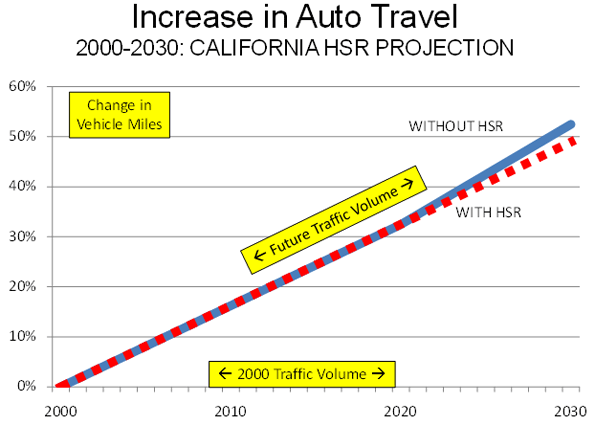
    Ridership and Relieving Congestion: High Speed Rail is also promoted by the Administration, which claims it will reduce traffic congestion. This claim is fraught with difficulty. First, highway traffic congestion is almost exclusively within urban areas, not between the urban areas that HSR would serve. Data from the California promoters indicates that traffic levels would rise nearly as much with HSR as without it. HSR is projected to reduce traffic by less than 3 percent once the system is complete. Without high speed rail, traffic volumes would increase 52 percent and without high speed rail, traffic volumes would increase 49 percent above 2000 levels (See Figure). In either case, things would be far worse in the future than they are today. And if HSR can make so little difference in congested California, it will surely do less in other parts of the country.

    Similarly, HSR will have little or no impact on the need to expand airports. For example, the Bay Area’s regional airport plan noted that high speed rail “would not divert enough passengers to make up for the shortfall in runway capacity.”

    In France and Japan, where travel is far more concentrated due to the linear location of major urban areas and the smaller number of large metropolitan centers, markets that are well served by HSR still have significant airline traffic (Tokyo to Osaka and Paris to Marseille). Also worth noting, both nations boasted pre-existing rail ridership levels that account for much of the HSR volumes. There is no such foundation in the United States. The ridership issue is particularly important, because of the miserable record of transportation ridership projections both in the United States and around the world. A most recent example is the Taiwan high speed rail system, which according to the early projections of promoters was to carry 180,000 passengers per day in its early operations. Yet in its second year of operation (2008), the average daily ridership was less than one-half that projection (84,000, calculated from Taiwan government data). This is telling in a country with notoriously congested traffic and very few major urban centers,

    This strategy of exaggerating ridership claims (and grossly under-estimating costs) is widespread in rail projects and has been extensively documented in Megaprojects and Risks: An Analysis of Ambition, by international scholars Bent Flyvbjerg, Nils Bruzelius and Werner Rothengatter (available from booksellers). The Taiwan and other international experiences suggest a major HSR investment would cost the taxpayers many additional billions and could bankrupt any private investors.

    Greenhouse Gas Emissions: But perhaps the most misleading claims are related to greenhouse gas (GHG) emissions. It starts with the marketing. The Administration’s press release indicates that building all of its routes would reduce GHG emissions by “six billion pounds” annually. This sounds like a big number. It is akin to my characterizing my weight as nearly 100,000 grams, instead of the pounds (200 in my case) that is customary in talking about weight. In GHG emissions, we do not talk about pounds, we talk about metric tons. Six billion pounds is only 2.7 million metric tons (2,205 pounds), which is an infinitesimal share of the GHG emissions from the nation’s passenger transportation. Indeed, given the propensity of the consultants to produce ridership projections less accurate than “Vietnam body counts,” the figure is probably less.

    The Administration falls into the usual trap of assuming that theoretical differences in GHG emissions can be turned into radical changes in travel patterns and behavior. The GHG emissions per passenger mile may be less (at least before the coming improvements in vehicle technology) but that does not mean that enough passenger miles can be moved from cars (and planes) to make a material difference. Our experience in high cost urban rail projects should have taught us this.

    Moreover, a mere reduction in GHG emissions is not sufficient to justify adoption of a strategy. Strategies must be prioritized based upon their effectiveness, and that is measured by cost. On this score, the California HSR system fails to a degree that is incomprehensible. The Intergovernmental Panel on Climate Change (IPCC) has indicated that the cost of GHG emission reduction should be no more than from $20 to $50 per ton. Even that may be too high. For example, Al Gore, Governor Schwarzenegger and Speaker of the House of Representatives Nancy Pelosi studiously buy carbon offsets for the tons of GHG that they produce flying around the country. The current market rate for such offsets is under $15.

    The California High Speed Rail Authority, whose leadership touts its GHG emissions reduction potential constantly, did not even bother to look at the cost of GHG emission removal in its thousands of pages of expensive, taxpayer financed reports. We looked at the issue, using California High Speed Rail Authority and California Air Resources Board assumptions and found that the cost per ton of GHG emission removal would be nearly $2,000, or 40 times the maximum figure used by the IPCC. To illustrate how extravagant a figure that is, if the nation were to reduce its GHG emissions by 80 percent (as proposed by the Administration) at the same rate, the annual cost would be more than 75 percent of the gross domestic product.

    But that assumes all of the rosy cost and ridership projections. The figure could be as high as $10,000 per GHG ton, if the consultants have exaggerated as much in California as elsewhere.

    Conclusion: It is likely that the same arguments can be made even more strongly in other proposed high speed rail markets. Yet, as costly as it is, HSR would be no more objectionable than building a new hardware store if it were paid for by its users. However, when taxpayers are asked to foot the bill, objective analysis of the claims, costs and benefits should at least have some priority. These are issues that an Administration committed to reducing GHG emissions by 80 percent has an interest in addressing. Relying on folklore rather than reality, as seems to be the present case, reflect an abject naivety at the least and incredible foolhardiness at the worst.

    Wendell Cox is a Visiting Professor, Conservatoire National des Arts et Metiers, Paris. He was born in Los Angeles and was appointed to three terms on the Los Angeles County Transportation Commission by Mayor Tom Bradley. He is the author of “War on the Dream: How Anti-Sprawl Policy Threatens the Quality of Life.

  • TARP Criminal Charges Possible

    Of the three monitors established by the legislation that created the Troubled Asset Relief Program (TARP), only one has the authority to prosecute criminals. That is the Office of the Special Inspector General (SIGTARP) whose motto is “Advancing Economic Stability through Transparency, Coordinated Oversight and Robust Enforcement.” The Special Inspector General in charge, Neil Barofsky, told Congress before the recess that he was by-passing the Rogue Treasury to get answers directly from TARP recipients about what they are doing with the bailout money. Now, SIGTARP has set up a hotline (877-SIG2009) for citizens to report fraud or “evidence of violations of criminal and civil laws in connection with TARP.” To date, they have received 200 tips and launched 20 criminal investigations.

    What started out as a bailout costing $750 billion quickly turned into $3 trillion – an amount about equal to the U.S. government’s 2008 budget. This week, SIGTARP released a 250-page report in an attempt to place “the scope and scale [of TARP] into proper context” and to make the program understandable to “the American people.” I can’t recommend that you read a report of that length, or even that you download it (more than 10 megabytes) unless you have broadband internet access. (In fact, I don’t understand what makes them think that the American people are going to understand anything that takes 250 pages to explain… Isn’t over-complicating one of the problems they want to solve?) You can get all the high points in Barofsky’s statement to the Joint Economic Committee, which is only 7 pages and a few hundred kilobytes. If you have more time than patience, you can watch the testimony on C-SPAN.

    I applaud the hard work of the SIGTARP to provide oversight to Treasury even though they are “currently working out of the main Treasury compound.” Let’s hope they can break free of the hazards associated with the self-regulation that got us into this financial mess in the first place.

  • Can Eddie Mac Solve the Housing Crisis?

    Every downturn comes to an end. Recovery has followed every recession including the Great Depression. In 1932, John D. Rockefeller said, “These are days when many are discouraged. In the 93 years of my life, depressions have come and gone. Prosperity has always returned and will again.” The question is not ”IF”, rather it is “WHEN” recovery will begin. The age-old question remains: what can government do to get the nation out of recession?

    Government can act wisely. In the past, it used tax legislation (the mortgage interest deduction) to create the highest home ownership rate in the industrialized world. It can also act stupidly by promoting “Sub-Prime” mortgages, “105%” financing and the “No-Doc” loan that got us into this financial mess. As many as 4.4 million more Americans could lose their homes – unless drastic action is taken to stop the process.

    Much of this was built on good intentions. One example of poor planning can be seen in Department of Housing Development’s “Dollar Homes” program. The HUD website describes this as an altruistic program “to foster housing opportunities for low and moderate income families” by selling homes for $1 after the Federal Housing Authority has been unable to sell them after six months.

    This sounds like a good idea but the program has become consumed by fraud and waste and has delivered little benefit to the parties intended. First, the policy eliminated any ability to sell the properties at market since it is clear that the value will be marked down to $1 in six months. The result was massive losses to the government as previously saleable properties were re-priced to $1. Second, the homes were snatched up by businessmen and the cronies of politicians who knew how to game the system. These homes were then sold on the retail market for huge profits. Very few homes made it to the needy parties intended. This dumb legislation created and fed a lazy, corrupt, bloated, ineffective and expensive bureaucracy.

    In contrast, smart legislation can end the housing crisis that threatens to send our economy reeling into the next Great Depression. A simple but effective governmental action does not have to cost a lot of money and more importantly, does not require a new permanent and expensive bureaucracy. It can be a win-win-win for federal government, local government and working families. This smart legislation is called Eddie Mac, which stands for the Empower Direct Ownership Mortgage Corporation.

    The genesis of Eddie Mac comes from the “good old days” when home prices were high. The most common complaint heard from police, fire, teachers, nurses and municipal workers was that they could not afford to live in the very communities where they worked. The lower wages of these groups forced them onto the freeways to more affordable neighborhoods in distant suburbs. The commute of hundreds of thousands of city workers across the nation clogged our roads, added harmful emissions to our atmosphere and exacerbated our dependence on foreign oil.

    Simply stated, the Eddie Mac program allows local government to buy vacant foreclosed homes from the banks and institutions. Local government then stimulates the local economy by hiring local realtors, appraisers and contracting with local labor to fix up the deteriorated properties. It then leases the properties to police, fire, teachers, nurses and municipal workers who otherwise could not afford to live in their own communities. Local government enters into an “Empower Direct Ownership Lease Option” with their employees so that the employees have the right to purchase the homes in the future using their rental payments to build equity. The Empower Direct Ownership Lease Option allows the employee to acquire the home in five years for the original purchase price plus 50% of the appreciated value.

    Instead of concentrating power in Washington, Eddie Mac empowers local government to solve their own local real estate economy. Eddie would employ local realtors to identify vacant foreclosed properties qualified for the Eddie Mac program. Realtors would earn a 1% fee for identifying and assisting local government with the acquisition. The purchase price would be set by a local appraiser who would also earn an appraisal fee. Use of local appraisers avoids banks profiting unfairly from a government program. The free market system would set the value. The purchase price would include an estimate of costs to bring the home back to local standards, using local workers to fix up these properties. Local government would obtain 100% financing for the acquisition from Eddie Mac bonds that would be sold on Wall Street along side of Fannie Mae, Freddie Mac and Ginnie Mae guaranteed loans.

    A $200,000 home, foreclosed upon, vacant and allowed to deteriorate has likely deteriorated to just $120,000. Its actual value will be determined by appraisal. At $120,000, a 4% guaranteed Eddie Mac mortgage would cost local government just $4,800 per year. Local government would be able to rent that home for $400 per month making it affordable to police, fire, teachers, nurses and municipal workers.

    The Empower Direct Ownership Lease Option allows the employee to acquire the home in five years for the original purchase price plus 50% of the appreciated value. If the baseline value is $120,000 and the home appreciates at 5% per year, it will increase in value $6,000 per year or $33,153 over 5 years. The employee’s Empower Direct Ownership Lease Option allows them to acquire the home in five years for the original purchase price plus 50% of the appreciation or $136,577. The price is $16,577 below market price, creating equity for the home buyer of $16,577 which can be used as the future down payment to acquire the home.

    This is a win-win-win scenario. Stopping the slide in home values by buying up foreclosed homes with federally insured 4% bonds is a low tech, low cost effort to put the brakes on the recession. And it entails no new bureaucracy. The Federal government is the big winner because they would be footing the bill for the bail-out if the economy continued to unravel. Local government wins by solving an age old dilemma of how to house its local work force. The local economy wins as fresh stimulus is put into the economy to locate, appraise, acquire, insure, repair, repaint and refurbish these homes. The city/county/municipal workers win with an opportunity to enjoy the American dream of home ownership in the very communities where they work. The environment wins as we take commuters off the road and lessen the environmental impact of their commute. And, we help reduce our dependence on Middle East oil as the ripple effect of tens of thousands of Eddie Mac homes are leased to local employees who now live and work in their own communities.

    Eddie Mac can become the firebreak to the mortgage crisis, the game changer needed to change market momentum. The hundreds and thousands of vacant foreclosed home sales generated by the implementation of the Eddie Mac program would send a strong signal to the public that the market has bottomed and the recovery has begun. Vacant homes would be acquired, fixed up and occupied by stable, important and long-term members of our communities.

    John D. Rockefeller once stood on the floor of the New York Stock Exchange and quieted the panic by firmly proclaiming; “Buy” in the dark days of the 1929 collapse. Our government can help stop the slide in prices by standing with our local governments and firmly encouraging “Buy” in the local markets. Reckless government got us into this mess. Smart government can get us out.

    Robert J. Cristiano Ph.D. has more than 25 years experience in real estate development in Southern California. He is a resident of Newport Beach, CA.

  • Green Celebrity Hipocracy

    Kudos to the Daily Beast for doing its homework and exposing the blatant hypocrisy behind green-tinged celebrity. People like Gore, Streisand, and Madonna have been filling airwaves with exhortations to pitch in and save the planet while living the good life that is supposedly destroying it. Gore himself has put forth a proposal that Professor William Nordhaus has said would ruin the economy. One way for these Green celebs to reduce their carbon dioxide emissions would be to have them stop blowing so much hot air on the topic. There is also the option of listening to the words of Freeman Dyson and stop viewing this thing as a matter of faith. These people should really look more closely at their own lifestyles before telling us how to live. It would be nice if a little of the vitriol could be removed from the debate and we could have a reasonable look at the possible options. Our world and economy are too important.