Blog

  • Is the Census Now a Target for a GOP War On Science?

    The 2010 Census makes a convenient political target since its findings define so much of where federal aid – now the country’s one true growth industry – is apportioned as well as legislative seats in states and nationally. Yet after an abortive attempt to hijack the Census by narrowly focused Democratic groups, cooler heads have now prevailed in the White House.

    President Obama has nominated Dr. Robert M. Groves – who currently leads one of the most prestigious social science research centers in the country, the University of Michigan’s Survey Research Center, Institute for Social Research – to be Director of the U.S. Census Bureau. Dr. Groves epitomizes the values of non-partisan science and was previously appointed by and served under President George H.W. Bush as an Associate Director at the Census Bureau from 1990–1992. President Obama also has made it clear that Dr. Groves will report to the Secretary of Commerce, Gary Locke, as he should, and not to the overtly partisan White House chief of Staff, Rahm Emanuel.

    Now the danger to the integrity of the Census is coming from the other direction: the right-wing of the Republican Party. Rep. John Boehner, the House Republican Leader, expressed “concern” about the selection of Dr. Groves. Boehner said the nominee “reportedly advocated a scheme to use computer analysis to manipulate Census data, rather than simply conducting an accurate count of the American people.” Boehner was referring to Dr. Groves’ membership on an eleven-member expert panel of senior Census Bureau staff that reviewed the results of a post-census survey, the Post Enumeration Survey (PES), which measured the accuracy of the 1990 census at the request of President Bush’s Census Director, Barbara Bryant. All but two of the panel’s members recommended that the PES results be used to adjust (not replace) the initial census count. Based on the panel’s suggestion, in mid-1991 Dr. Bryant recommended a statistical adjustment of the census to Republican Secretary of Commerce Robert Mosbacher, who promptly rejected the recommendation.

    Other Republicans go much further than Boehner in their criticism of the selection of Dr. Groves. They want to prevent the use of scientifically proven statistical sampling techniques that will insure a complete tabulation of those who are hardest to count, primarily minority populations and immigrants. Rep. Patrick McHenry (R-NC), the Ranking Member on the subcommittee with jurisdiction over the census, said Dr. Groves’ nomination signaled that President Obama “intends to employ the political manipulation of census data for partisan gain. Mr. Groves is a leading advocate for partisan data manipulation.”

    In truth, the party seeking most to gain partisan advantage in the 2010 census count is now Rep. McHenry’s GOP. Secretary Locke has already testified during his Senate confirmation hearing that the 2010 census plan did not include consideration of statistical adjustment for purposes of apportioning each state’s seats in Congress. This conforms to the Supreme Court’s 1999 ruling, but leaves open the possibility of using such techniques to gain valuable insights into the demographic details of America’s population.

    In contrast, leading Democratic interest groups that originally intended to take a partisan stance on the census, have largely acquiesced to the President’s decision. At the same time non-partisan research groups, ranging from the Council of Professional Associations on Federal Statistics to the American Association for Public Opinion Research, have endorsed Dr. Groves’ nomination. These groups, whose professional needs require an accurate census, said Dr. Groves “has demonstrated the scientific capacity and leadership to run the 2010 Census and other programs at the Census Bureau.”

    In this age of technology, it is perhaps not surprising that the methodologies by which we conduct the Census have become something of a political football. But politicians in both parties need to understand that it’s in everyone’s interest to make sure that every person is present and accounted for in America’s decennial civic endeavor, the 2010 census.

    Morley Winograd and Michael D. Hais are fellows of the New Democrat Network and the New Policy Institute and co-authors of Millennial Makeover: MySpace, YouTube, and the Future of American Politics (Rutgers University Press: 2008), named one of the 10 favorite books by the New York Times in 2008.

  • Michigration Revisited

    Only a few months ago, I admonished Michigan for its hysteria about brain drain. Given the recent news coverage concerning the exodus from the recession-plagued state, you might expect I’m ready to eat some crow. On the contrary, I’m here to report that Michigan has learned nothing from its past mistakes.

    Richard Herman, an advocate for increasing rates of immigration to the Rust Belt, posts on his blog the same critique I have aired about how Michigan addresses its talent crisis:

    However, the current focus on “brain drain” as the source of the problem misses the real issue.

    While no doubt the Midwest economy is causing college grads who might otherwise want to stay home to leave, in an ever more mobile society, moving out is a natural part of people’s lives. Indeed, if you read the typical account of how the elite global knowledge worker lives, you often hear about people flitting from place to place to place chasing opportunity.

    The real problem is not that too many people are leaving, but rather that too few are coming. It isn’t an outflow problem, it’s an inflow problem.

    The former urban industrial powerhouses of the United States all suffer from the same malaise. Every city is fixated on its local labor pool, asking institutions of education to staff the “factory.” The great irony is that economic growth doesn’t happen without immigration or domestic in-migration. There is no story of a great metropolis that successfully barred its people from leaving.

    The tortured metaphor for brain drain stems from private enterprise. But even in the arena of human resources, the concept of churn isn’t an anathema:

    The purpose of this article is to open your mind about the silliness of measuring only aggregate turnover. I can think of no better indication of a so-called expert’s lack of true understanding of employee turnover than when I read an article or a book on retention and the author invariably expounds on the need to keep everyone.

    The burgeoning narrative is that churn benefits both employee and employer. The same is true for resident and state. Fear of the outsider prevents all parties from making a rational choice and improving human welfare.

    Michigan should embrace its out-migration and aggressively seek new residents. I further recommend any reference to “retention” be abolished from official policy. Where, and how many, graduates go is largely immaterial. Instead of Cool Cities to keep Michigan talent instate; what would it take to get the next generation of engineers from Colorado schools or Asia to move to the Rust Belt?

  • A California Wedding

    My wife and I attended a wedding on a recent past weekend. It was a beautiful event in a beautiful setting: city of Atascadero, county of San Luis Obispo, on California’s central coast. We drove through spectacularly beautiful wine country to get there. The weather was beautiful. A beautiful young couple exchanged vows in the backyard of the groom’s childhood home, where his mom still lives.

    Beautiful setting, wonderful people
    Two beautiful families became one big extended family. It was a beautiful atmosphere: loving, warm and generous of spirit. Every single person I encountered during the weekend impressed me as a beautiful, wonderful individual, and that’s not just the champagne talking. Even the exes got along beautifully, and that was a good thing, because my god, there were a lot of them.

    Demographics rears its head
    As a demographer I was cognizant of several overlapping trends that were manifesting themselves. The bride is an only child. The bride’s mom (let’s call her “Betty”) is an only child. Two of Betty’s exes were present, including the bride’s father (an only child), as was her current husband (a childless only child). Everyone is seemingly on wonderful terms with ex-spouses, ex-spouses’ intervening and current partners, and everyone else.

    The bride’s father (let’s call him “Jack,” because this is going to get complicated), after his marriage to Betty, was then married for a while to a woman (let’s call her “Jane”), who was also present. One of Jane’s previous husbands was a guy (oh hell, let’s call him “Peter”) who is here by dint of multiple connections, having grown close with the bride as a counselor, and as a former business partner of the bride’s father, Jack.

    Jack and Jane not only married with Peter’s blessing, they got married in Peter’s house, the same house in which he (Peter) and Jane had gotten married ten years previously. They all get along wonderfully as well. Jack is here, by the way, with current partner “Louise,” a lovely person who, for my demographically analytical purposes, is divorced and childless (forgive me Louise, that sounds worse than it should). Betty’s other ex in attendance is, we’ll say, “Randy,” who is here with, oh, “Melody,” also previously divorced. They make a really sweet couple, and are both childless.

    Peter and Jane have an only child we’ll call “Helen.” She was the maid of honor. Also in attendance are the bride’s (married and as yet childless) good friends “Mary” and “Andrew” (an only child).

    Peter is a relationship counselor; this must come in handy. We are all staying at Peter’s serene and beautiful vineyard compound, the grounds of the Center for Reuniting Families, a retreat where he offers individuals, couples and families a place to heal themselves and their relationships. This is coastal California, after all.

    So let’s see:
    “Betty” has two exes here (Jack and Randy);
    “Jack” has two exes here (Betty and Jane);
    “Jane” has two exes here (Jack and Peter);
    “Peter” has two exes here (Jane and “Linda”).

    Who is Linda? Linda lives at the compound, as do a few of her exes and current partner. Linda and her only child run a bakery together and made the spectacular, beautiful wedding cake.

    The groom’s divorced parents are also on wonderful terms, and it showed on the day when it all came together.

    I guess my wife and I are the outliers. We are still in a long-lasted first marriage and have four siblings between us who can say the same. We do have an only child, though; each of our four siblings has two each.

    I am not a native Californian, but my wife is, and her mother and grandmother can claim nine marriages between them.

    We do have an only child, but during the 1970s we did belong to the National Organization for Non-Parents, which promoted the notion it was okay to be childless. The founder also eventually had a child and formed a new organization to promote the notion that single children were okay too. God, we baby boomers.

    Implications, Reflections
    What does it all mean? Well, the first thing that occurs to me is that statistics on marriage, divorce and remarriage don’t really capture the whole picture. Many people believe the divorce rate is 50%, but the divorce rate is not even measured or expressed as a percentage figure; it’s the number of divorces per 1,000 of population in any given year. In 2005, the most recent year for which data are available, the US divorce rate was 3.6, the lowest level since 1970. (The peak was 5.3 in 1981.) And California was not the state with the highest divorce rate; that distinction went to Nevada, at 6.4, followed by Arkansas at 6.3 and Wyoming at 5.3.

    The reason so many people think the divorce rate is 50% is because for any given year of the past many decades, the number of divorces (and hence, the divorce rate) has been about half the number of marriages (and thus half the marriage rate). For example, in 2005 there were about 2.2 million marriages in the US (resulting in a marriage rate of 7.5), and about 1 million divorces (and a divorce rate of 3.6).

    It’s hard to state the percentage of marriages that end in divorce, because there are few longitudinal studies done tracking the same married couples over time, and the percentage which divorce will increase the longer the time frame. But I have read a figure of approximately 33%, which if true would mean that two-thirds of first marriages do not end in divorce. On the other hand, the divorce rate is down because the marriage rate is down, and for the first time in our history, the percentage of households comprised of married couples has fallen below 50% (and thus, no longer a majority of households).

    [The exact 2005 numbers: of the nation’s 111.1 million households, 55.2 million, or 49.7%, were made up of married couples, those with or without children. The rest were single households, unrelated cohabitating households, or other non-traditional households.]

    What about the kids?
    The second thing I can tell you is that the statistics reveal nothing about the level of happiness out there. The people I saw this weekend were about as happy, content and well-adjusted a group as I’ve ever seen. Not that they haven’t gone through their share of heartbreak, difficulty, sorrow, challenge and crisis (no small amount of which relating to children!). Our daughter, in her 20s, tells us she does not know of a single contemporary who is not dealing with one or more “issues” (therapy, medication, psychoanalysis, depression, bipolar disorder, drug use, eating disorders, cutting, to name a few). And if you’re going to say these problems are most prevalent in the populations that can afford them, I’ll agree.

    Still, the incidence of single children and childlessness might be a concern. Demographers Ben Wattenberg and Nicholas Eberstadt have written of a future world of declining fertility and birth rates, leading to eventual declines in population. They’re concerned because population growth is the foundation of modern economies and welfare states, and if populations of the rich, advanced, educated, industrialized, developed countries are not growing (and they are not, except for the notable exception of the US), then who will reproduce and replenish? Increasingly, they fear, people at odds with the modern world.

    And what will be the effect on families in a world where the only biological relatives for many people will be their ancestors?

    Demographer Phillip Longman puts it more bluntly in his book The Empty Cradle. Childbearing has become a sucker’s game, he writes: parents are supposed to provide society with a steady new supply of well-bred individuals (educated, moral, balanced, sober, disciplined, productive citizens), in exchange only for the psychic rewards. No wonder the birthrate is falling. Or was, until 2007. In that recent year there were a record 4.3 million births in the US, the most since 1957 (the middle of the Baby Boom). The fertility rate (the average number of children born to each woman over her lifetime) rose to 2.1 (the level needed to maintain current population size), the highest since 1971.

    Of course by 2050 half of the 400 million Americans projected to be alive will be what are now considered ethnic and racial minorities. That doesn’t bother you, does it?

    But none of it was a concern this particular weekend. Everything, and everyone, was beautiful. Even the traffic on the 101 returning to Los Angeles was not that bad. This doesn’t have the look or feel of decline, but if it is, it’s been a beautiful ride.

    Dr. Roger Selbert is a trend analyst, researcher, writer and speaker. Growth Strategies is his newsletter on economic, social and demographic trends; IntegratedRetailing.com is his web site on retail trends. Roger is US economic analyst for the Institute for Business Cycle Analysis in Copenhagen, and North American agent for its US Consumer Demand Index, a monthly survey of American households’ buying intentions.


  • Mortgage-Backed Securities: 1/3 not backed!

    On April 3, 2009, R. Glen Ayers spoke at the American Bankruptcy Institute in Washington, D.C. Mr. Ayers is a former bankruptcy judge, now with the law firm Langley & Banack in San Antonio, Texas. He spoke on a subject I covered here on March 4 – not all mortgage backed securities are actually backed by mortgages. The rush to write more mortgages and to issue more bonds meant that mistakes were made in the paperwork.

    The Ayers speech is connected to an article he wrote with Judge Samuel L. Bufford, who had the California case I mentioned last month where the mortgage note disappeared after being transferred to Freddie Mac. In the article, “Where’s the Note, Who’s the Holder”, they drop this bombshell: “A lawyer sophisticated in this area has speculated to one of the authors that perhaps a third of the notes ‘securitized’ have been lost or destroyed.” Meaning that 1/3 of the mortgage-backed securities are not backed by mortgages!

    This is the junk that Treasury Secretary Geithner wants to finance the hedge funds to purchase. As of the end of 2008, there was $6,838.7 billion worth of government-backed mortgage bonds outstanding. An additional $178 billion were issued in the first two months of 2009.

    Scary stuff. No wonder the hedge funds are giving Geithner’s Public-Private Investment Partnership “two thumbs-down.”

  • What Does Urban Success Look Like?

    What does urban success look like? Ask people around the country and they’ll probably say it looks something like Chicago.

    Arguably no American city over the past decade has experienced a greater urban core renaissance than Chicago. It is a city totally transformed. The skyline has been radically enhanced as dozens of skyscrapers were added to the greater downtown area. Millennium Park opened as a $475 million community showplace full of cutting edge contemporary architecture and art. There has been an explosion in upscale dining and shopping options, as well as large numbers of new art galleries, hotels, clubs and restaurants.

    But perhaps nothing shows the transformation of Chicago more than the huge condo boom, with thousands of new units coming online every year. This sent development waves rippling out from the Loop and North Lakefront, often into places that just a short time ago were no man’s lands. If you told someone 15 years ago you lived in the South Loop, they would have said, “Huh?” If you had told them you lived by the old Chicago Stadium, they would have thought you had lost your mind. These and other neighborhoods that were once derelict or dangerous, as well as some that were low key ethnic enclaves, have been transformed into bustling yuppie playgrounds for the new “creative class”.

    But there has been a downside to this for Chicago as well. The influx of the educated elite into the city has significantly raised housing prices in large parts of the city, rendering it unaffordable to others. Supporting the amenities demanded by the city’s new residents costs money, so taxes have gone up, doubling the squeeze on the city’s traditional residents, forcing many of them out.

    So in the end, despite its building boom, it is actually losing people. The Census Bureau estimates the city of Chicago’s population declined by about 60,000 people since 2000. That’s not much on a percentage basis, but, considering the urban core boom, it is telling. While Chicago’s metropolitan area continues to grow, it is doing so slower than the national average and has significant domestic out-migration. Chicago’s metropolitan area saw net domestic out-migration of 42,000 in 2008 and 57,000 in 2007. To put this in perspective, the poster child metro for urban decline, Detroit, Michigan, only lost 62,000 and 58,000 people in those years respectively. Only Chicago’s continued appeal as an immigrant magnet kept it from posting large overall migration losses as it had very high international in-migration.

    Chicago is an incredible urban success story, but only for some. International immigrants and the creative class are flocking, but everyone else is leaving.

    But there is another group of cities in the Midwest, much smaller cities, that are often overlooked, but which offer an alternative model. Places like Columbus, Indianapolis, and Kansas City provide a mirror image of Chicago. Their downtowns have resurged, if not from their glory days in the 1950s, then since their nadir in the 1970s. There is also significant condo construction in their cities. But, beyond these superficial similarities, they are nothing like Chicago. They lack the urban energy of that colossus, its huge inventory of swanky shops and high-end fine dining. They haven’t had a skyscraper boom. Most of their downtown development still requires significant tax subsidies. They feature largely vanilla brand images that don’t give them the coolness factor. And they continue to struggle in attracting top talent to live there.

    Yet in many ways these cities show signs of demographic and economic health that Chicago could only dream about. The Columbus, Indy, and KC regions are all growing faster than the national average in population and, unlike the vast bulk of the Midwest, have significant domestic in-migration. They are outperforming the nation in employment. In fact, it can be argued that they have as much in common with the Sun Belt as the Rust Belt. People are voting with their feet to move to these places. Between 2000 and 2005, about 7,000 net people moved from the Chicago metro area to Indianapolis, for example.

    One key to this lies in affordability. For years Indianapolis has been ranked as the least expensive major housing market in America. Blessed with few natural barriers and pro-private sector governments, housing supply in these cities has grown along with population. Yet at the same time the negative impacts of sprawl have been mitigated by their modest – compared say to Dallas, Phoenix or Houston – growth rates and relatively small size. This leaves them attractive, affordable, and offering a very high quality of life to people without elite professional incomes.

    In short, these cities are just as successful as Chicago; they just do it their own way and serve a different market.

    Indeed what we can see is that there are different forms of urban success. In an ever more diverse America, people define the good life differently. Too much urban policy is focused on one size fits all solutions that assume cities should look and function something like Chicago. But America’s cities are very diverse and require tailored policies to suit the local landscape, and the unique local geography, demography, history, culture, and values that our cities bring to the table. Great cities, like great wines, have to express their terroir.

    As with the consumer market, cities too need to recognize our increasingly complex and diverse population, and sharpen their strategic focus to the target segments they best serve. Chicago is tailoring its offerings to where it believes it can most effectively compete – new immigrants and world class talent. Places like Columbus, Indianapolis, and Kansas City are focusing on a broader middle class. Neither way is right or wrong. Both types of places, and others too, can all find success by offering unique places for people to realize their own personal American Dream.

    Aaron M. Renn is an independent writer on urban affairs based in the Midwest. His writings appear at The Urbanophile.

  • Can Sacred Space Revive the American City?

    By Richard Reep

    During most business downturns, nimble private business owners search for countercyclical industries to which they adapt. During this business downturn, the construction industry finds itself frantically looking for anything countercyclical. Private construction, almost completely driven by the credit market, has stopped, and public construction, driven by tax revenue, has also stalled. Religious institutions, however, seem to be continuing incremental growth and building programs, giving evidence to some people’s answers to spiritual questions being asked today.

    Christian congregations surged in the 1990s, building megachurches in mostly suburban neighborhoods throughout the country. In some cities, mostly in the South, the urban megachurch also became common. Fundraising for these followed patterns that made lending a fairly straightforward risk; many were financed by a combination of patron contributions and lending from local or regional banks. By the early part of this decade, the growth of megachurches was a well-established pattern, and had become a sophisticated niche within the booming development and construction industry, as reported by Forbes Magazine in 2003.

    Churches seem to remain one of the few work sectors for construction firms, architects and planners. This comes at a time when there appears to be very little new development, either private or public in Central Florida. Even small private projects that were funded by cash or private equity have been postponed or cancelled, as the money sits on the sidelines. Yet Christian churches continue to expand, forcing them to accommodate the needs of their worshippers.

    Unlike in the past decade, much of this expansion is taking place in smaller congregations, and is funded mostly by donations, pledges, and bequests. “Our church task force is looking at creative ways to raise money for facility expansion,” commented Scott Fetterhoff, President of Salem Lutheran Church. “We have to have faith however that our congregation, and those looking for spiritual growth in a society with eroding values, will support worthwhile causes.”

    Fetterhoff also displays a very worldly sense of pragmatism. ”Our expansion and outreach program will simply adjust to fit the available budget,” he adds. “On the bright side with a construction industry looking for work, that might allow us to do more for less.”

    This is one example of several recent interviews with local church leaders who are considering a construction project, and all are echoing similar themes. Salem’s expansion includes new classroom space which seems part of a growing interest to provide flexible multi-purpose space for church-based education and community use – largely in lieu of public education. No one in Florida can ignore the continuous stream of news reports of its legislature’s continued reduction of funds for Florida’s public education system, and many in Florida are trying to find alternatives for their children.

    Salem’s decision to expand is emblematic of other stories in the region. This incremental growth may signal a consolidation of sacred space into people’s lives, as we cope with the changes in our secular, consumer-driven culture. Salem Lutheran, and others like it, use the general uncertainty of our economic times to re-focus on faith based relationships. This is a true grass-roots trend.

    On a larger scale, the evangelical movement continues to encourage church construction on a more global, top-led basis, in what is termed “church planting” by its leadership. The surge of interest in nontraditional forms of churches in the Western Hemisphere is well-documented and remarkable, as this Christian movement is supplanting traditional denominations, particularly Catholicism. Religion remains formidable in America, but much of it reflects more of a shift from one form of Christianity to another.

    One organization, Capernaum Ministries, is developing a retreat for Christian pastors and ministers to provide leadership training to church leaders. Its founder, Jim Way, sees his mission as creating “a laboratory for building effective relationships between leaders of various denominations and independent ministries.” Way, a minister and founder of Capernaum Ministries, has affiliations with over 3,000 churches. “I see this as an opportunity to study, and solve, the problem of how the decline of the denominational church influence is affecting American culture”.

    As cities have grown in the past several decades, the well-documented lack of sacred space has been notable as governments meticulously avoid any tangible form of religious expression, and mainstream religions find themselves in retreat. While public space in American cities has always been constitutionally secular, sacred space usually evolved with the development of cities, towns and neighborhoods.

    Sadly, this has been missing from private development for some time. Church growth in the suburbs usually occurs after the fact, not as part of a planned community, for developers are loathe to forfeit profits on a choice parcel of land.

    Church building has historically been a narrow niche market avoided by most design and construction professionals who have preferred more lucrative building types, like hotels or hospitals. If one believes in the organic model of city growth and development, this has been a serious deficiency.

    But now, amidst lower costs for construction and more need for their services, some congregations seem to be taking stock, making plans, and acting. Salem Lutheran, like many, has members who come from the design and construction industries. These congregants know how to efficiently deliver a building, and are offering these skills to their congregations, while their regular businesses sit idle.

    Whether global or grass-roots, the development of sacred space will need to overcome the substantial obstacle of financing, difficult in the best of times, using new means and methods. Nontraditional means including volunteer labor, outright donations, in-kind donations, and bartering will bring costs down to more affordable levels. As projects are realized, alternative practices to achieve affordability could result in interesting innovations.

    If the current economic crisis begs some larger spiritual questions in people, then there may be a countercyclical trend towards investment in sacred space. Faced with lowered expectations and a lost sense of prosperity, people naturally long for some aspect of their lives that transcends the material. Church building, however incremental and small, demonstrates that sacred space is important to enough people to do something about it. Their actions speak loudly in these uncertain economic times.

    Richard Reep is an Architect and artist living in Winter Park, Florida. His practice has centered around hospitality-driven mixed use, and has contributed in various capacities to urban mixed-use projects, both nationally and internationally, for the last 25 years.

  • Catching on to Buffett

    More of the so-called “mainstream press,” like the Sacramento Bee, are catching up to what we wrote here about Warren Buffett back on March 16. He supported the bailout because his investments benefited from the handouts.

    It seems obvious that Washington takes policy advice from Buffett because he has lots of money. Newsweek reporter Mark Hirsch uncovered evidence, in fact, that Buffett may have been the one that came up with the original proposal for Treasury to buy the junk bonds off the banks’ balance sheets. Given the direction that Berkshire Hathaway’s own credit rating is going, Buffett may have even more reason to support this plan – his companies will be able to invest in the junk at discounted prices after they sell the junk to the government’s partnership funds at inflated prices!

    Some of the comments at Newsweek.com believe that the article is unfair to Buffett – after all, what company doesn’t support policies that will benefit them? But to the tune of $11.6 trillion, which is what the U.S. government has committed to this bailout? We bet even Karl Marx would find that excessive. We agree with the title of a book by William Black, an economist whose work we referred to in our own research on the Savings & Loan crisis – “The Best Way to Rob a Bank is to Own One.” Professor Black discussed the financial crisis with Bill Moyers on April 3, 2009.

    Berkshire Hathaway has significant ownership stakes in more than one bank. This brings us to an article at the Mises Institute, the libertarian think-tank. The article contains a link to an article from 1948 written by Warren’s dad when he was the U.S. Congressman from Nebraska – “Human Freedom Rests on Gold Redeemable Money.” The younger Buffett has a preference for the freshly printed stuff that Treasury is doling out.

  • Mayor Daley Offers Tips on Fighting Corruption

    Is this a story from the Onion? No. Too Implausible. The Chicago Tribune reports:

    Coming from as far away as Azerbaijan, dozens of corporate executives and government bureaucrats gathered at a downtown hotel Wednesday to hear Mayor Richard Daley share his tips for preventing corruption.

    Absent from his speech at the international event was any talk of city hiring fraud, the Hired Truck program or the myriad other scandals that put Daley aides in federal prison or left them free pending appeals of official misconduct convictions.

    In 2005, The Chicago Sun-Times explained “From an exhaustive Hired Truck investigation to a probe into patronage hiring at City Hall, there’s so much corruption to investigate in the Chicago area, the FBI is adding manpower.” Chicago got a third public corruption squad while New York and L.A. only had two. The Hired Truck scandal was one of the biggest in recent history, where private trucking companies were paid to do nothing. Mayor Daley has yet to explain why a Chicago Mob bookmaker was running the program.

    But, it’s not only Hired Truck. Mayor Daley’s Water Department was described by the Justice Department as a racketeering enterprise for at least 10 years. Just a week ago,the Chicago Democratic Machine’s own Rod Blagojevich was indicted for running a racketeering scheme even before he took office as Governor.

    Blagojevich earned the early endorsement of the Machine in 2001. The Daily Herald reported powerful Alderman Burke’s glowing endorsement, “I am with Rod 100% because he has what it takes to win – money, message and an army of supporters.”

    Mayor Daley’s son and nephew have just hired a prominent criminal lawyer for their questionable business dealings with the city of Chicago.
    Mayor Daley isn’t the only Chicago Democrat lecturing audiences about ethics. Recently, Illinois Supreme Court Justice Anne Burke(wife of Alderman Ed Burke) lectured Illinois state workers on “Ethics in the Workplace” at University of Illinois-Chicago.Anne Burke has been accused by a top FBI informant of corruption.

    Since 1971, 31 Chicago Aldermen have been convicted of felonies. Sometimes you just have to laugh. Or cry.

  • Greenhouse Gas Emissions and Reality: Residential Emissions

    In the quest to sufficiently reduce greenhouse gas (GHG) emissions, it is crucial to “get the numbers right.” Failure to do so would, in all probability, mean that the desired reductions will not be achieved. Regrettably, much of what is being proposed is not based upon any comprehensive quantitative analysis, but is rather rooted in anti-suburban dogma.

    Further, ideologically based approaches carry the risk of severe economic and social disruption, which could make it even more difficult, in a political world, to reach GHG emission reduction objectives. Unconsidered attacks on suburbs could also backfire, setting back more reasonable attempts to reduce emissions over time.

    For example, a recent New York Times blog entitled “The Only Solution is to Move” presumed it a necessity to (1) move from the suburbs to the city, where (2) “you are near everything you need” and to (3) abandon cars, which the author contends “cannot be reformed.” This screed provides an ideal point of reference. We start with the comparative GHG emissions efficiency of suburbs and deal with the other issues in future articles.

    The Need for Comprehensiveness: Any plausible attempt to reduce GHG emissions must start with a comprehensive understanding of the issue, including the comparative GHG intensity of various types of living and mobility patterns.

    This requires a “top down” analysis of GHG emissions by mode and locality. Such an analysis must start with the gross GHG emissions in a nation and allocate each gram to a consuming household. A household allocation is necessary, because businesses emit GHGs only to satisfy the immediate or eventual demand of consumers. “Top down” is required because that is the only way to make sure the analysis includes everything. The typical “bottom up” analysis runs the risk of missing large amounts of emissions as analysts highlight their own “hobby horse” sources, while excluding the inconvenient. This is why we have “double entry” bookkeeping – to make sure that the sums balance.

    “Top down” comprehensiveness has been best developed by the Australian Conservation Foundation (ACF) Consumption Atlas, which is the only study I have found that allocates every gram of GHG emissions in a nation to households. That is a minimum requirement.

    Residential GHG Emissions

    Having reviewed the need for comprehensiveness, the balance of this article will deal with residential GHG emissions. Despite all the airtime – and trees – sacrificed for lengthy columns on GHG emissions, it is clear that the state of the research in the United States remains abysmal.

    GHG Emissions: A Function of House Size: Research has been published that suggests the dominant suburban housing form (the detached single-family dwelling) is more GHG intensive than more urban, multi-unit and high-rise apartment and condominium housing forms. However, the entire supposed city versus suburbs advantage relates to house size. The Department of Energy’s Residential Energy Conservation Survey (RECS) data shows that the energy consumption per square foot is 70 percent higher in residential buildings with five or more units (the largest building size reported upon) than in detached houses. Full disclosure on the part of the anti-suburban crowd would require telling people that their conclusions would mean much smaller house sizes.

    Common Area GHG Emissions: There is, however, a far more fundamental problem. The databases usually relied upon (The Bureau of the Census’s PUMS and the Energy Department’s RCES), as cited in the USDOE 2008 Buildings Energy Data Book, do not provide sufficient information to demonstrate any high-density GHG emissions advantage.

    None of these data sources include the GHG emissions from “common” energy consumption in multi-unit residential buildings. Their information is limited to energy consumption as directly billed to consumers. Thus, in a high-rise building, common energy consumption sources such as elevators, common area lighting, parking lot lighting, swimming pool heating, common heating, common water heating, common air conditioning, etc. are not included. Detached housing generally does not have common energy consumption.

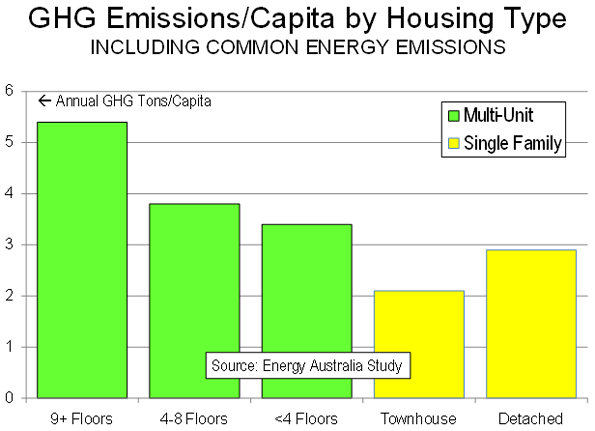
    The “common” consumption omission is serious. Other Australian research indicates how inaccurate consumer based inventories can be. Energy Australia has showed that, in the Sydney area, GHG emissions per capita, including common consumption, in high-rise residential buildings are 85 percent greater than in single family detached dwellings. Other multiple unit buildings are also more GHG intensive, while townhouses (row houses) are the best (see Figure).

    The inclusion of common consumption may be a principal reason why the ACF data associates lower GHG emissions with single family detached housing.

    Construction Materials: There is a further complicating factor. The materials that must be used to construct high-rise residential buildings, chiefly concrete and steel, are far more GHG intensive than the wood used in most single family dwelling construction. A 1997 Netherlands study indicates that the GHG emissions per square foot of high rise construction may be as much as five times that of a detached dwelling. In the newest energy efficient housing, the same study finds that the GHG emissions, over a building’s lifetime, can be greater than the emissions from day to day operation. The report notes that construction materials will become more important in residential GHG emissions, because improvements in routine energy consumption are likely to be more significant than those in building materials production.

    Then there is the issue of the GHG emissions in the construction process. It would not be surprising, for example, if heavy cranes could also tip the balance against high-rise towers.

    Dynamic Rather Than Static Analysis: Anyone who has studied economics understands the importance of “dynamic” versus “static” analysis. Dynamic analysis takes account of likely changes, while static analysis assumes that everything will continue to be as it is today. Much of the research on residential GHG emissions is based upon a static analysis. Yet, the housing stock (like the automobile stock) was largely produced during a time when there was little policy incentive to reduce GHG emissions. We are entering what may well be a very different policy environment. The comparatively recent emphasis on GHG emissions is producing a plethora of ideas, research and solutions. A recent Chicago Tribune article noted a surge in university graduates interested in research to reduce the GHG intensity of energy. The zero emission suburban house is on the horizon, which could take housing form “off the table” as a GHG emission issue and render static research to the internet equivalent of rarely accessed library stacks. Dynamic analysis asks “what can be,” not just “what is.”

    Cost per GHG Ton Reduced: All of this raises a question about how to identify policy strategies. The answer is to compare costs. The Intergovernmental Panel on Climate Change suggests that the maximum costs should be on the order of $20 to $50 per ton. McKinsey has published research indicating that steep reductions can be produced in the United States at less than $50 per ton.

    Yet, the costs of GHG emissions reduction are as absent from much of the present literature as the GHG emissions from elevators in high-rise towers. But costs are important. Economic and social disruption is likely to be greater to the extent that people are forced to change their lives. There is a big difference between requiring people to reduce their emissions where they live versus trying to uproot them – as well as their families and business – to urban cores. The former offers the hope of achieving sufficient GHG emission reductions, while the latter promises to incite a bitter fight between the bulk of the middle class and the regulatory apparatus. All this with a high probability that GHG emissions will not be sufficiently reduced.

    The Bottom Line: Outside some in the urban planning community, there is no lobby for reducing people’s standard of living. At least with respect to residential development and housing form, this does not appear to be necessary. The common area and construction GHG impacts of high-rise condominium buildings could well be greater both per capita and per square foot than those of detached housing. There is no need to force a move into a futuristic Corbusian landscape of skyscrapers. Indeed, it could even make things worse – for households, communities and even the environment.


    Previous posts on this subject:
    Regulating People or Regulating Greenhouse Gases?
    Greenhouse Gas Reduction Policy: From Rhetoric to Reason
    Enough “Cowboy” Greenhouse Gas Reduction Policies