Blog

  • LA Tax

    Residents in Los Angeles with home-based business received letters from the Office of Finance that said, “The following amounts are due and payable immediately: $4,363.81.”

    People who work as independent contractors and had failed to register their businesses with the city’s tax and permit division by Feb. 28 received the letters in March.

    The city calculated the number by estimating $200,000 in gross income for each business over the last three years – the annual average for city business taxes – added interest and late penalties and arrived at the $4,000-plus number.

    The letters arrived at a time when many laid-off employees are working as independent contractors themselves. To add fuel to the fire, many who received the letters might have generated income less than the total amount of the tax.

    Though the city has denied that the letters were any kind of “scare tactic,” the program stems from a 2002 push to identify unregistered businesses using records “disclosed to the city by the California Franchise Tax Board.” The program has added almost 100,000 businesses to the tax roll and generated $107 million in revenue.

    This issue has a particular sting at the moment, particularly given LA’s 10% plus unemployment rates.

  • The Rogue Treasury

    The U.S. Treasury took enormous powers for itself last fall by telling Congress they would use it to “ensure the economic well-being of Americans.” Six months after passage of the Emergency Economic Stabilization Act of 2008 Americans are worse off. Since it was signed into law on October 3, 2008, here are the changes in a few measures of our economic well-being:


    Before TARP

    So Far

    National Unemployment

    7%

    8%

        Lowest state unemployment

    3.3% (WY)

    3.9% (WY)

        Highest state unemployment

    9.3% (MI)

    12% (MI)

    National Foreclosure rate (per 5,000 homes)

    11

    11

        Lowest state foreclosure rate

    < 1 in 7 states

    < 1 in 6 states

        Highest state foreclosure rate        

    68 (NV)

    71 (NV)

    Dow Jones Industrial Average

    10,325

    7,762

    “Before TARP” figures are as close to October 3, 2008 as possible; “So Far” figures are most recent available, which varies by category from February through April. Unemployment and foreclosure rates by state are available at Stateline.org

    The Troubled Asset Relief Program (TARP) was sold to Congress and the American public as an absolute necessity to save the American Dream of homeownership. Once the legislation was passed and the funds were released, however, Treasury decided to give the money to banks with no restrictions on its use – no monitoring, no reporting requirements, no nothing. We are worse off today than we were when the legislation was signed – and are likely to remain so when TARP has its first year birthday later this year.

    Yet, the U.S. government has already paid out $2.9 trillion, with further commitments to raise the total to over $7 trillion – a number that Senator Max Baucus (D-MT) said “is mind-boggling, indeed it is surreal. It’s like having a second government.” The money Treasury is passing out is more than all government spending in 2008. The Senate Finance Committee, of which Baucus is chair, held a hearing on March 31 (TARP Oversight: A Six Month Update). The three parties established as monitors in the 2008 legislation were there to testify. Without exception they “are deeply troubled by the direction in which Treasury has gone.”

    Senator Chuck Grassley (R-IA) suggested [referring to former-Secretary Paulson] that Congress “was awed by a person who comes off of Wall Street, making tens of millions of dollars. … You think he knows all the answers and when it’s all said and done you realize he didn’t know anything more about it than you did.”

    As soon as Treasury got the money they decided to bailout big banks instead of helping homeowners with mortgages bigger than the market value of their homes. Since then, Paulson, Geithner, and Bernanke have refused to comply with demands to produce documents about the TARP recipients’ use of funds.

    Neil Barofsky, Special Inspector General and the one monitor with authority to pursue criminal investigations, directly solicited information from the recipients of TARP funds – all over Treasury’s objections that it couldn’t be done. Barofsky received responses from all 532 recipients. He will be summarizing the findings, but so far knows that some banks used TARP funds to pay off their own debt (including at least one bank that used TARP funds to pay off a loan to another bank that also received TARP funds); some banks made loans they couldn’t otherwise have done. Some banks monitored the funds separately from their other assets; some co-mingled the money with no effort to separate, monitor or control what they did with the TARP bailout money.

    Elizabeth Warren, Chair of the Congressional Oversight Panel, brought up the central issue: once Treasury decided not to bailout homeowners, what was the plan? “What is the strategy that Treasury is pursuing?” she asked. “We have asked this question over and over, with the notion that without a clearly articulated plan and methods to measure progress to goals, we cannot have good oversight.” Warren is still waiting for an answer. She also added that there is no bank in this country that would lend with a policy of “take the money and do what you want with it” – which is exactly what Treasury has done.

    Senator Debbie Stabenow (D-MI) put it bluntly: auto manufacturers get reorganization (through bankruptcy) while banks get subsidization. One side is being held accountable for their past bad decisions and the other side has a total lack of accountability. Her bottom line: “If we don’t make things in this country, we won’t have an economy.”

    Warren laid some of the blame with Congress, who “gave treasury significant discretion” but is unable to get real-time explanations for what is being done with the bailout money. There is no transparency when it comes to Treasury. “Without it, I’m afraid …. Congress and the American people have been cut out of the conversation”, she says. One group in Michigan is being asked to bear enormous pain and another group in New York is not – that’s the way Stabenow sees it and Warren agreed. The alternative offered by Warren is that either Congress manages to “get Treasury to get some religion and put standards in place” or Congress has to step in with new legislation.

    Susanne Trimbath, Ph.D. is CEO and Chief Economist of STP Advisory Services. Her training in finance and economics began with editing briefing documents for the Economic Research Department of the Federal Reserve Bank of San Francisco. She worked in operations at depository trust and clearing corporations in San Francisco and New York, including Depository Trust Company, a subsidiary of DTCC; formerly, she was a Senior Research Economist studying capital markets at the Milken Institute. Her PhD in economics is from New York University. In addition to teaching economics and finance at New York University and University of Southern California (Marshall School of Business), Trimbath is co-author of Beyond Junk Bonds: Expanding High Yield Markets.

  • No Quit in Fargo

    You could hear it in their voices – dejection, resignation and anger. Late last week, the National Weather Service announced a second crest of the Red River of the North, with predictions of a 75 percent chance the Red would crest at 41 feet and a 25 percent chance it will hit 42.8 feet in the second half of April. Not good for a community that through hard work and personal and community sacrifice averted a major disaster by continuing to sandbag, dike and fight an epic flood while not caving to a suggested mandatory evacuation of the community.

    But this community/region is nothing if not resilient, tough and plain old stubborn. As people get back to work in the city (with commerce being shut down for roughly two weeks), they drive past and around semis continuing to dump clay to build and bolster dikes to hold back a projected second crest that could surge higher than the previous high-water mark. Led by an unflappable Mayor, flanked by a trauma physician Deputy Mayor, and supported by a community that cares about where they live, they seem to have put behind them the despair and with a new week comes new vigor and resolve to overcome this new threat.

    This can-do approach and community drive is repeated in communities (Valley City, Olso, Drayton) up and down the valley as they confront record flooding. Starting with record fall rains, an early and deep freeze (prompting fast runoff) and heavy winter snows these communities and this region continue to see record high water levels and the threat of flooding. There have been losses – hundreds of homes reporting flood damage in Cass and Clay counties – and there may be more, but not without a fight.

  • World Urban Areas and Population Projections

    Our colleague and frequent NewGeography contributor Wendell Cox of Demographia.com recently released the latest edition of his World Urban Areas and Population Projections publication.

    This 5th comprehensive edition includes:

    • Ranking of the largest world urban areas (over 2,000,000 population).
    • Population, urban land area and density estimates for all 763 identified urban areas with more than 500,000 population, comprising 49 percent of the world urban population.
    • Population, urban land area and density estimates for 1,370 urban areas of all sizes, comprising 53 percent of the world urban population.
    • Population projections for the world’s largest urban areas in 2025 & 2030 (over 2,000,000 population).
    • Summary of United Nations world population projections and summary by gross domestic product, purchasing power parity (from 4th Edition)
    • Charts on urban density and prosperity (from 2nd Edition)
    • Documentation

    Check it out.

  • The American Suburb Is Bouncing Back

    From the very inception of the current downturn, sprawling places like southeast California’s Inland Empire have been widely portrayed as the heart of darkness. Located on the vast flatlands east of Los Angeles, the region of roughly 3 million people has suffered one of the highest rates of foreclosures and surges in unemployment in the nation.

    Yet now George Guerrero, a top agent at Advantage Real Estate in Chino Hills, says he can see the light, with sales picking up and inventories finally beginning to drop. “There’s been a real surge in sales,” Guerrero says. “The market has come back to where it should be. I think we are ahead of the curve here of the overall recovery.”

    Of course, for the moment, much of this growth is concentrated in foreclosure sales. However, even developers of new properties, such as Brookfield Homes , also report a strong uptick in sales. In his new developments in the Inland Empire, notes Adrian Foley, head of Brookfield’s Los Angeles area office, sales are up 150% since six months ago.

    Although the economy is still hurting, the housing trend has become much more positive. Statewide, existing home sales have jumped 30% over the past year, taking the inventory from an estimated 16.7 months to less than seven months. In Chino Hills, it is down to six months.

    Most encouraging, this activity is taking place exactly where the market was hit hardest in the beginning – in the suburbs and at the lower end of the market, which in the Inland Empire means between $150,00 to $300,000. This could presage the resurgence of the suburbs and the prospects for the middle and working classes once again to purchase their piece of the American dream.

    Nor is this merely a Californian phenomenon. Nationwide, existing home sales – predominately in the suburbs – have been on the rise for the last few months. The strongest growth is occurring in Sunbelt markets in Arizona, Nevada and Florida, as well as in California. These places experienced some of the greatest surges in prices, which forced many buyers to turn to subprime and interest-only loans.

    These loans are largely not available today, Guerrero notes. Instead of financial quackery, lower prices – sometimes as much as 50% below peak – are allowing new buyers to buy affordably. In 2007, Inland Empire median house prices were roughly seven to 10 times the average annual income of potential buyers. Now they are settling close to the historic norm of three times.

    But not everyone will be happy to see life return to the suburban housing tracts. Indeed, for some self-proclaimed urbanists, planners and pundits, this development might seem almost nightmarish.

    Long the Rodney Dangerfield of American geographies, suburbs have never been popular with the country’s intellectuals, academics and planners. The destruction of community, racial segregation, expanding waistlines and a host of environmental sins – from consuming too much gas to helping create global warming – all have been blamed on the suburbs.

    When the mortgage crisis first hit, some urbanists, not surprisingly, were quick to blame the suburbs – instead of Wall Street – for the financial meltdown. With energy prices on the rise, they persuaded themselves and the ever-gullible mainstream media that the long-awaited “back to the city” jubilee was imminent.

    In contrast, the suburbs and exurbs, crowed Brookings’ Chris Leinberger, were soon to become “the new slums.” As the middle classes trudged their way back to Boston and other suitably dense big cities, James Howard Kunstler – the “shock jock” of the new urbanist movement and a leading apostle of the “peak oil” thesis – happily proclaimed, “Let the gloating begin.”

    Yet as George Guerrero could tell them, a dream is not a thing so easily destroyed. The American landscape continues to change, but perhaps not entirely in the ways so eagerly projected by urban boosters and their media claque.

    For one thing, even with the higher energy prices of last year, there seems to be, in fact, no notable shift of population to the urban core. Instead, as demographer Wendell Cox has pointed out, the recession may have slowed migration, but the trend toward the suburbs and sprawling Sunbelt cities has not ended or reversed.

    At the same time, the once-widely ballyhooed market for dense urban living has unraveled. The “gospel of urbanism” may be accepted as such by most of the mainstream press, most notably The New York Times and Atlantic Monthly, but on closer examination the new religion has limited numbers of converts. In many locales – from Massachusetts to Los Angeles – inner-city condominium projects are losing value at least as much or more than suburban single-family houses. In San Diego, for example, condo prices have dropped in some developments by 70% since 2007, twice the decline in the overall market.

    The problem has much to do with timing. In many areas, urban condominium developers continued to build even as the economy soured, largely due to the longer lead times and financing arrangements around such projects. Yet as the prices of houses have dropped many potential condominium dwellers have opted to purchase single-family homes – or are sitting anxiously on the sidelines waiting for prices to drop further.

    As a result, foreclosure rates for condominiums, according to the Federal Deposit Insurace Corp., are on average one-third higher than for single-family residences. You do not have to travel to the outer exurbs to find zones of foreclosures, bankruptcies and the turning of ownership properties to rentals. Towers are either unoccupied or have gone to rental in markets as diverse as Miami, central Atlanta and downtown L.A. Even Chicago, the poster child for urban gentrification, now suffers from abandoned “condo ghost towns.”

    Manhattan, too, which long saw itself as immune to the housing downturn, is now experiencing the most precipitous price decline since 1980. Big urban developers across North America are filing for bankruptcy, including the largest private landowner in downtown Los Angeles, just like suburban builders were last year.

    As someone who lives in – if you consider L.A. a city – and likes cities, I do not greet the urbanization of the housing crisis as an unalloyed positive. Yet one can hope that lower prices and interest rates – as well as the administration’s tax credits for up to $8,000 for first-time buyers – could allow more people to consider an urban option, if that’s what they want.

    However, this will not be where the bulk of the action will take place. Surveys consistently show that between 10% and 20% of people want to live in dense cities. In a country that will gain 100 million people over the next four decades, that’s 20 million, not exactly what you’d call chopped liver.

    But the bulk of growth will continue to be in the ‘burbs. The main reason is simple enough for almost anyone but a planning professor, architect or pundit to comprehend: preference. Virtually every survey reveals that the vast majority of Americans – and around 80% of Californians – prefer single-family homes that generally are affordable only in suburban areas. The fact that jobs have also continued to move inexorably to the periphery – as a newly released Brookings report demonstrates to liberal think tanks’ own undisguised horror – makes living in the ‘burbs even more attractive.

    These trends lead developers like Randall Lewis in Upland, Calif., who has suffered the downturn in the Inland Empire, not to dismiss the suburban future. He takes note of a recent 10% to 20% surge in sales among the 18 projects his company is now working on, all in suburban projects in California and neighboring states.

    “The basics of the suburbs are still there,” Lewis suggests. “Schools are important, but also people like the sense of place. But the basic amenities are children, grandchildren, where people go to church, where their work networks and friends are.”

    Lewis also rightly adds that a somewhat different suburbia will emerge from the crash. It will be a “melting pot,” he suggests, “not just by race, but by ages and lifestyle.” You will see more singles, empty-nesters and retirees as people choose to “age in place” close to where they have settled. There likely will be more smaller-lot, townhouse and other mixed-density developments closer to burgeoning suburban job centers.

    But even as they change, the allure of suburbs – and the single-family house – will not fade and could even grow as they develop more city-like amenities. The fundamental desire to own a place of your own, to possess some private space and a relatively quiet environment has not died. Nor is it likely to without the imposition of a draconian planning regime.

    For right now, it’s all enough to make George Guerrero a born-again optimist. “There’s something healthy just beginning to happen out here,” he says. “This time people with good credit are getting good deals at good prices. It’s a wonderful thing to see.”

    This article originally appeared at Forbes.

    Joel Kotkin is executive editor of NewGeography.com and is a presidential fellow in urban futures at Chapman University. He is author of The City: A Global History and is finishing a book on the American future.

  • Slumdog Entrepreneurship: Entrepreneurship Holds Key for India’s Slums

    The stealth Oscar winner Slumdog Millionaire, the Indian fable of love, heartbreak and overcoming the odds set against the backdrop of one of the world’s biggest urban slums has won fans all over the advanced industrial world – but may be less popular in India.

    One Indian film director who viewed the film at the Toronto Film Festival said flatly “All the Indian[s] hated it. The West loves to see us as a wasteland, filled with horror stories of exploitation and degradation.” One viewer in India claimed the film’s makers simply “cashed in on starvation, genocide, child prostitution, and overwhelming oppression.” Famed novelist Salman Rushdie panned the movie to an audience at Emory University after it won the Best Picture Academy Award for piling on “impossibility onto impossibility” to arrive at a contrived and implausible conclusion.

    The plot line — an “uneducated” slum dweller winning a million dollars on India’s version of the hit program “Who Wants to Be A Millioniare” — may well be unrealistic, but also obscures an important, often misunderstood point: the slums, themselves a product of heavy-handed land regulation and price controls, are centers of entrepreneurial activity and social stability.

    India’s urban slums are not just teeming masses of exploitation and degradation. The slums are populated by people that have real jobs and earn real income. They include white-collar workers, policemen, and even bureaucrats. They include tanneries, restaurants, makeshift pharmacies, tailors, cleaners, and hundreds of other micro businesses and entrepreneurs. Peeking inside one of those huts, typically less than the size of an American child’s bedroom, one will often find a small TV, radio or DVD player, purchased with legitimate income, although powered by illegal taps into the city electrical wires.

    The denizens of these slums are “quality of life poor, not cash poor,” as one World Bank official told me on a tour through Dharavi, perhaps the world’s largest urban slum. And this is where the story of Jamal, an orphan raised in the poverty, exploitation and harsh realities of India’s slums, tells a gripping story about India containing important lessons for the rest of the world.

    Unlike a generation ago, a smart orphan boy now can grow up and get a respectable job. If he (and increasingly she) is clever enough, he can run a business and even become rich. Unfortunately, this story is missing from Slumdog Millionaire.

    Upward mobility is not the first thing that comes to mind flying into Mumbai, India. The hills and gullies are thick with tin and wood shacks, sheltering thousands of men, women, and children. Many slum dwellers are recent immigrants from India’s hinterlands, but some have lived in these shacks for generations. Even an air-conditioned limo can’t keep the bracing poverty away from westerners ferried into the center of India’s most economically vibrant economic capital.

    Indeed, as soon as I left Mumbai’s airport in a local taxi, I was struck by the destitute poverty all around me. It was a visual reminder of the stories my grandmother used to tell of her travels to India as a tourist. She loved this nation and its people, but also recognized the dirt, grime, and poverty.

    But it would be a mistake to dismiss these areas as a “wasteland.”

    The slums also reflect what’s going on right in India in addition to the challenges that great nation still faces.

    Unfortunately, by ignoring the economic dynamism within an illegal city of one million people, the movie missed out on telling India’s truly remarkable story of growth and development.

    Many have heard the story of software giants like Infosys, the 1.5 billion dollar information technology business founded in 1981, or about the scores of U.S. and European firms investing in India. Microsoft not too long ago announced plans to invest $1.7 billion in India and create 3,000 new jobs over four years.

    But the real test of India’s economic rebound lies in the small business community, especially the ones that find their way in the mainstream economy. These small businesses, popping up spontaneously to meet global needs and demand, are the ones that will eventually determine whether India will become the next Asian Tiger.

    Deepak Parekh is the CEO of Sureprep of India and former senior accountant for a multinational corporation. Sureprep prepares U.S. personal income tax returns, processing more than 25,000 each year. Business is booming, and Parekh anticipates annual growth of 40 percent or more.

    “We did a pilot project in 2000,” Mr. Parekh says as he recalls the initial stages of the company’s founding. After all, why should an Indian firm prepare tax returns for Americans? U.S. trained accountants would seem to have a natural comparative advantage. Not so. “We looked hard at the quality numbers,” he says. “We found that Indians were among the top performers and dedicated workers, willing to work 24-7 to get the job done.” American accountants made more errors on average than Indians, but were paid more and expected more time off. Sureprep now employs more than 200 Indian accountants and software engineers.

    Sureprep’s success — and that of India’s service sector — came about in part, oddly enough, due to socialism. Once the poster child for post-World War II socialism in the developing world, India erected one of the most regulated and protected economies in the world.

    Yet this legacy did not impact much of the technology sector – which largely did not exist at the time of Independence — or the largely informal sector that thrives in places like Mumbai’s slums.

    Dharavi, located north of the central business district and east of the airport, squeezes 900,000 people on just 2 square kilometers. That’s ten times more dense than Manhattan. By most estimates, more than half of Bombay’s population lives in ramshackle slums such as Dharavi.

    Yet economic opportunity is thriving in India’s cities. The slums are large enough to have economies internal to themselves — maids, clothing repair, plastic recycling. Few are homeless.

    The lack of housing is evidence of a significant planning failure. Ramakrishan Nallathiga, a housing economist in Bombay, studied land use and regulation in the city’s 20 wards and found density restrictions were the strictest in the most dense parts of the city. This forced non-profit organizations to step in and build the housing themselves after securing special land development privileges from the local government where they could. However, most of the poor scramble for any sliver of land they can find to put together a makeshift home. Since private land is off limits, they settle on public land — parks, open space, railroad right of way.

    Meanwhile, Bombay’s population has skyrocketed 137% since 1975 to 17.1 million according to the United Nations. It’s now about the size of the New York urban area, but Bombay squeezes its metropolitan population onto about 8 percent of the space according to Demographia.com.

    The New York area only grew by 15 percent over the same period. The only U.S. metropolitan area among our top ten that grew near Bombay’s rate over the same period was Atlanta (188%). Miami and Houston, next in line in terms of growth, merely doubled their populations. In each of these cases, though, the metro population is less than one-third Mumbai’s.

    India has a lot further to go in areas other than housing as well. Many traditional industries are still shackled by labor rules that limit their ability to adapt. A World Bank analysis of the business environment found that managers reported spending 16 percent of their time with the bureaucracy in India compared to just 5 percent in Latin American countries and about 10 percent in post-Communist Eastern European countries.

    India’s economic future fundamentally lies in the entrepreneurial attitude of its citizens. A recent popular movie called Swapes, or “Foreign Land,” follows Mohan Bhargava, a young, talented Indian project manager for NASA who returns to rural India to build a hydroelectric power plant that provides electricity reliably 24-7. He uses the technology he developed and uses everyday to build critical infrastructure in some of the most remote areas of his native land. Our bright, talented Indian hero has the knowledge, brains, and technology to build a company in his homeland and compete with the big boys. And India’s making it a better and better place to do that everyday. And more and more Indians are willing to move back to their homeland to take advantage of these opportunities.

    Of course, India still has a long way to go. The Economic Freedom Index of the World published by the Frasier Institute in Canada still ranks India a paltry 67th. To move they will need to change in labor laws to weaken the power of the unions, continue efforts at tax reform, make India even more friendly to foreign investment while reducing regulation much, much more.

    With these changes, Mumbai could become the next Hong Kong or Shanghai. The hardy and remarkably able denizens of Mumbai’s slums do not need Western pity. On the contrary, they need the freedom to build their own lives and fashion economic opportunity out of little more than hard work and a clever turn at a business.

    Westerners need to scratch beyond the surface of the films and superficial criticism. They need to see the real stories of heartbreak, innovation, and perseverance that make these harsh and unbending slums potential incubators of economic dynamism — reflecting the very optimism that made Slumdog Millionaire such an attractive film.

    Samuel R. Staley, Ph.D. is director of urban policy at Reason Foundation (www.reason.org) and co-author of Mobility First: A New Vision for Transportation in a Globally Competitive Twenty-first Century (Rowman & Littlefield, 2008).

  • Borderline Reality

    For years, economic and social observers have taken to redrawing our borders to better define our situation and to attempt to predict the future. Maybe you thought the global financial meltdown has raised anxiety levels in the United States quite enough. But a Russian professor’s decade old prediction of national disintegration suggests much worse on the way.

    Prof. Igor Panarin, a 50-year-old former KGB analyst and a dean of the Russian Foreign Ministry’s academy for future diplomats, estimates there’s a 45-55% chance that the United States will disintegrate like the Soviet Union did sometime in 2010. Mass immigration, economic decline and moral degradation will trigger civil war, the collapse of the dollar and massive social unrest. This in turn will lead to the U.S. breaking into six blocs — with Alaska reverting to Russian control – and other foreign powers grabbing other pieces.

    Panarin’s new map of the United States puts the “Californian Republic” under China’s influence, “the Texas region” under Mexico’s. Hawaii will come under Japanese or Chinese rule, East Coast states will join the European Union, while central northern parts of the US will gradually come under Canada’s influence.

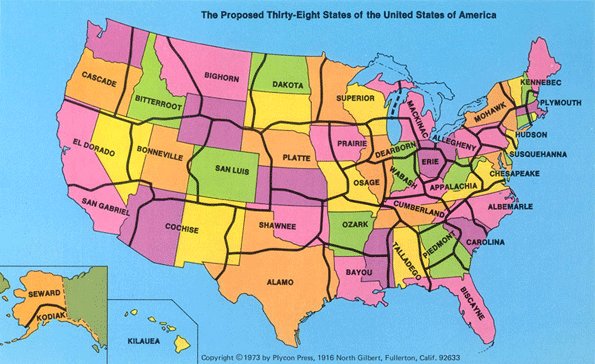
    A less sinister revision of the states that comprise the republic occurred in the 1970s when geography professor C. Etzel Pearcy proposed redrawing the borders of the US states, reducing them from 50 to 38. Pearcy’s framework casts aside the convenience of determining boundaries by using the land’s physical features, such as rivers and mountain ranges, or by the simple usage of latitude and longitude. Instead, his realignment gives high priority to contemporary population density, location of cities, lines of transportation, land relief, and size and shape of individual States.

    In the current fiscal climate some see the new 38 state map as inspired. According to Pearcy, 25% of the expenditures by states can be attributed to the fixed costs associated with the support and maintenance of state governments themselves. For at least some states this kind of savings could be very appealing right now.

    Rethinking, reimagining and then redrawing the borders of maps is by no means a new or even fruitless endeavor. That some if not many borders are where they are for seemingly meaningless or irrational reasons is obvious. Mark Stein’s How the States Got Their Shapes, for example, documents how natural features like rivers come together with the dreams and schemes of people to create today’s jigsaw puzzle of states. Gerrymandering borders for political, economic or religious reasons is both a historical and contemporary reality.

    Any economic planner or strategist worth their salt understands, of course, that borders on a map seldom represent or hold sway over how the real economy operates. Sure there are tangible differences in taxes, regulation and all the things that make up a business environment. But like water, economic activity goes where it wants and finds its own level. This has lead to an increasing amount of policy attention being given to cross-border territories of regions, zones, corridors, clusters, networks and the like.

    North America Re-Imagined
    One of the more reasoned, enduring efforts to make sense of a borderless economic and cultural landscape is Joel Garreau’s landmark work on the The Nine Nations of North America. My 27 year-old copy’s dust jacket asks the reader to forget the traditional map and consider the way North America really works because new realities of power and people are remaking the continent.
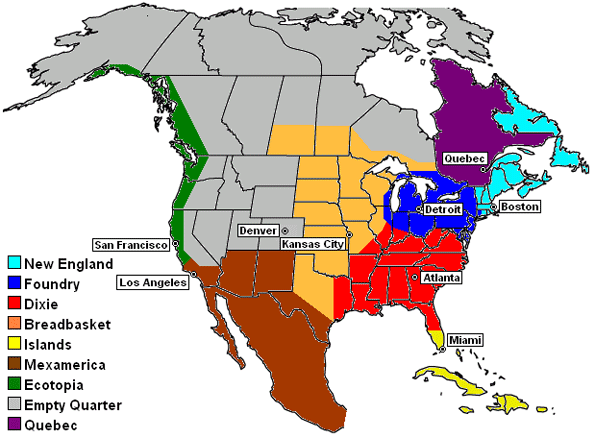

    A recent conference on USA/Canada cross-border economies in the Great Plains confirmed that Garreau’s analysis continues to influence thinking on regionalism. The longevity of his regions lies not only on their basis in actual data but also tied to the distinct “prisms” though which each nation sees the world.

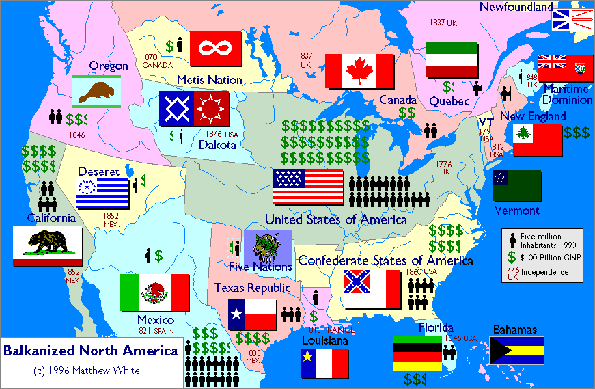
    What could have been in North America, instead of how things really are, is the subject of Matthew White’s 1997 map of a balkanized continent. Here the basic premise is that, in an alternate history beginning in 1787, the westward expansion of the Anglo-American people proceeded pretty much as it did, but the United States government just couldn’t hold the country together against separatists.

    How North America really works and how that is manifested spatially has generated growing interest of late and is reflected in the emergence of cross-border networks and organizations. The government of Canada recently issued an exhaustive report titled The Emergence of Cross-Border Regions Between Canada and the United States: Reaping the Promise and Public Value of Cross-Border Regional Relationships. Here the interest is certainly not on redrawing the borders but on recognizing and building on shared socio-cultural values and furthering relationships between businesses, first and foremost, and universities.

    Mostly a bottom-up phenomenon, these cross-border regional relationships are evidenced by the growth of both informal relationships and formal networks and a rise in cross-border regional co-operative mechanisms. From a policy standpoint the existence of cross-border regions requires new ways of thinking about development, going well beyond our parochial perspective. And this sort of thinking is important because regions – like economic fields of activity – represent the primary theatre in which most activities of international trade and economic integration actually take place.

    Map Forth
    Thematic maps that reconfigure our geography can intrigue and fascinate us. They are really, as some have said, graphic essays that portray spatial variations and interrelationships of geographical distributions. As noted by Norman Joseph William Thrower in Maps and Civilization: Cartography in Culture and Society, thematic maps use the base data of coastlines, boundaries and places, only as point of reference for the phenomenon being explained.

    Sometimes maps can inspire and motivate us by helping to more fully understand the geography of our economic and demographic challenges and opportunities. Perhaps most importantly thematic maps tell a story about places. Some describe the way things really are now while others express a vision of the future. In both cases they can be a graphical point of departure for plans and actions that help us to make the places we inhabit better places to live and work.

    Delore Zimmerman is president and CEO of and publisher of Newgeography.com

  • GHG Emissions by Type of Geography

    The suburbs, generally a haven for luxury SUVs, regimented lawn sprinkling, and keep-up-with-the-Jones purchases, are not often considered the front-runner in environmentally friendly living.

    However, the Australian Conservation Foundation’s 2007 Consumption Atlas published controversial research that suggested that “dense inner-city zones unleash more greenhouse emissions than car-loving fringe suburbs.” Suddenly, car use is not the prime factor in measuring efficient living, nor can incomes tell the whole story. ()

    While it has been generally accepted that high human consumption is worse for the planet than lower consumption, the study’s main controversy is the fact that the ACF gave the problem a specific geography.

    The quote:

    Rural and regional areas tend to have noticeably lower levels of consumption . . . Higher incomes in the inner cities are associated with higher levels of consumption across the board.

    The ACF has not only pointed their finger at their main supporters (inner-city professionals) but have also invited comments from a variety of sources. The Australian study questions the data used in the past to measure where the worst violators are located.

    American consultant Wendell Cox—long an advocate of suburban development—found that the data suggested that “lower GHG emissions were associated with long distance from the (urban) core, detached housing, more automobile use and lower population density.”

    A team from Queensland’s Griffith University Urban Research Program drew an altogether different conclusion that put simply is, “correlation does not establish causality.”

    GHG emissions are a function of overall consumption and consumption based on low-density housing “doesn’t figure prominently in the composition of aggregate consumption.”

    Urban sprawl cannot be used as an argument or attempt to point fingers at the Hummer drivers. Lowering greenhouse gas emissions will require a commitment by city dwellers and suburbanites alike if we are to alter our future carbon footprint.

    While the study itself has prompted much discussion and debate, if the object is to cut down on greenhouse gas emissions, singling out suburbia might not be the first order of business. Spurious data and indeterminate causality make for an argument destined to fail for the lack of a supportable conclusion – unless we wish to overturn logic entirely, which some seem determined to do in furtherance of their long-held anti-suburban agenda.

  • Baby Boomers: The Generation That Lost America

    Tom Brokaw named our parents The Greatest Generation. They came of age during The Great Depression and defeated Fascism, Nazism and Communism. They built the Interstate Highway System and landed a man on the moon. They built the great American middle class with safe communities and public schools that were the envy of the world. They deserve the title of The Greatest Generation. One of their few criticisms is that they spoiled us boomers, adhering to the teaching of Dr. Benjamin Spock.

    I am 59 years old and a child of perhaps the most indulged and impatient generation in history. I fear we may also become known as the generation that lost the American Dream. The Baby Boomers have rejected personal responsibility and exhibited a lack of mental discipline that could have enormous implications for the future.

    The United States House of Representatives, now overwhelmingly controlled by the Boomers, signed a $787 billion legislative “stimulus” package comprised of 1,071 pages and a hefty 8 pounds. Not one legislator read the bill before signing it. Months later, the same House members publicly screamed at the corrupt executives of AIG who received bonuses in 2008 – bonuses specifically allowed in the very legislation they passed without reading.

    This abandonment of personal responsibilities by the Lost Generation took on historic significance on January 20, 1993. That’s when the first President Bush, a member of the Greatest Generation, was replaced with President William Jefferson Clinton, the first Baby-Boomer to reach the Presidency. The Clinton presidency was notorious for its personal indulgence – and not just by introducing oral sex to the Oval Office. During Clinton’s watch, 100,000 Islamic terrorists were trained in camps in Afghanistan while terrorist strikes against American interests went unanswered. Clinton failed to respond to the attack on the USS Cole that killed 17 servicemen. Our enemies grew emboldened believing that America did not take their deadly threats seriously. On September 11th 2,996 American civilians died in part because the government did not see its first priority to be protecting them.

    Also under President Clinton, the Federal Government in 1999 relaxed Fannie Mae and Freddie Mac’s requirements of home mortgages. The decades old formula of 20% down and a 30 year fixed mortgage that allowed the Greatest Generation to lift home ownership to more than 60% was replaced with an array of instruments including sub-prime loans, “no-doc” applications where income was not verified, and teaser rates of 1%. Such tinkering led to unqualified purchasers with 100% financing pushing home values up at 20% per year. The bubble burst in 2007 with disastrous consequences. The heads of Fannie Mae and Freddie Mac made tens of millions in annual salary. Despite the calamitous consequences of their stewardship, no one was fired.

    Another Boomer, George W. Bush followed Clinton and continued the Lost Generation’s abdication of personal responsibility. He also failed to comprehend the extremist Islamic threat. Again, no one was fired. On December 12, 2002, George Tenet, fellow Baby-Boomer and Director of the CIA assured President Bush the case that Saddam Hussein had weapons of mass destruction was a “slam dunk”. President Bush authorized the invasion of a sovereign nation based on that intelligence. No weapons of mass destruction were found. America’s soldiers inherited a broken country and hundreds of billions of responsibilities. No one, including George Tenet, lost their job. In fact, on December 14, 2004, President Bush awarded Tenet the Presidential Medal of Freedom.

    On August 29, 2005, Hurricane Katrina slammed into Louisiana and Mississippi as a Category 3 hurricane. The result was catastrophic. The levees were breached and 1,836 Americans lost their lives. Americans watched in horror as police abandoned their positions, and the National Guard struggled to protect the trapped citizens who could not evacuate. Dead bodies lay uncollected in the streets. No one will forget the scene of 60,000 American refugees at the Louisiana Superdome without food, water or medical care for days. On national television, President Bush proclaimed, “Brownie, you’re doing a heck of a job.” Although three days later, FEMA Director, Michael D. Brown was forced to resign, no one else at FEMA was fired.

    In July 2008, gasoline prices hit a national average of more than $4.00 per gallon as demand outstripped supply pushing oil to $147 barrel. The Lost Generation howled in protest at the oil companies who were profiting from the pain of American citizens. This came as no surprise. The environmental movement had stopped production on both nuclear power plants and gasoline refineries. Congress banned oil exploration off America’s coastline. Congress decided that ANWAR, a barren strip of coastal Alaska the size of Logan Airport in Boston, was off-limits to oil exploration. At $147 barrel, the Western economies were shipping more than $1 trillion dollars per year to the Persian Gulf to nations whose interests were simply not aligned with ours. Once again, our elected officials, dominated by boomers, abdicated their responsibility to keep America safe. Their inaction allowed our nation to become even more vulnerable to the oil weapon.

    In 1973, under President Carter, when the OPEC nations first used oil as a political weapon, America imported 30% of its daily oil quota. Yet not a word is mentioned by the Lost Generation expanding American production of oil to reduce this dependency. Yes, they talk of wind and solar energy – which collectively generate less than one percent of our energy – but no one has yet figured out how to power a car with wind or solar energy. After falling to $30 a barrel, oil has slowly crept back up over $50 a barrel – in a deep recession. When the recovery arrives, does anyone believe oil will not return to $100 barrel? Yet the Lost Generation sleeps with no energy policy in place and once again abdicates its responsibilities to a future generation.

    The same is true of Social Security. The Baby-Boomers are retiring now. The system is broken and there are not enough workers to make the transfers to the retirees. Do you hear anyone in Washington raising the red flag of warning? Once again, the Lost Generation has abdicated its responsibilities and kicked the can down the road.

    In the waning months of the Bush Administration, Treasury Secretary Paulson informed Congress that a $700 billion bail-out of the financial sector was needed to avoid a melt-down of our banking system. TARP, the Troubled Asset Relief Program was passed by the Congress in a matter of days. Only $350 billion was committed, banks were forced to accept TARP funds, and little of those funds made their way to acquire troubled assets. GM and Chrysler received $17 billion even though they had no “troubled assets.” Another $8 billion went to Sheik Mohammed in Dubai. He had no troubled assets either, and $1.6 billion was paid out in bank bonuses. AIG received $165 billion of TARP money and paid out $286 million in bonuses. No one in Congress anticipated the AIG bonuses when they signed the legislation that specifically allowed the payments. It does not end there.

    Franklin Raines, chief executive of Fannie Mae received $91.1 million in compensation from 1998 to 2004. In 1998, Fannie Mae stock was $75 per share. Today, Fannie Mae shares are worth 67 cents. Mr. Raines was not fired – he was simply hired as an economic advisor to President Elect Obama. Raines recently settled a civil lawsuit alleging fraud and stock manipulation for $31.4 million.

    Postmaster General John Potter received compensation of $800,000 in 2008 while the United States Post Office lost $2.8 billion. It is possible his $135,000 bonus was based on future performance. The USPS is projected to loss $6 billion in 2009. Postmaster Potter did not lose his job either.

    Our congressional representatives earn $174,000 per year for this fiscal oversight. Their congressional staff earns another $1.3 million per year plus too many perks to mention like free cars, airfare, and postage stamps.

    The very things that we took for granted as children of the Greatest Generation are now challenged. Home values have fallen dramatically. Our retirement accounts have been decimated. Our public schools are not working. Traditional allies no longer stand with America. Not surprisingly, most Americans fear their children will not be better off. The approval numbers for Congress are at an all-time low. Despite the vast number of problems facing our country in 2009, when Congress passed a Continuing Resolution in March 2009, it contained 8,500 earmarks of pork barrel spending confirming that this Congress is going to maintain business as usual.

    Dr. Spock wrote that our parents should not spank us and they should always bolster our self-esteem. That misguided advice led to the today’s climate of political correctness where the ideal of self-esteem outweighs the importance of performance, success or accomplishment.

    Consequently, the Lost Generation measures itself by its good intentions rather than by its accomplishments. Its good intentions led to policies that prohibited oil exploration off the coastlines. The result was $4.00 gasoline. Its good intentions of teaching all children in their native tongue was a good idea but the cost to do so weakened the overall education system in America. Its good intentions of helping poor families buy homes led to the sub-prime mess that has cost American families trillions in lost equity. In the last twelve months, under the dominant control of the Baby-Boom generation, America has witnessed $11 trillion of home and stock equities disappear.

    The Baby-Boomer’s move into retirement comes none too soon. Let the boomers in Congress retire at 65. We’ll even let them retire on the fat retirement plans they voted for themselves. But let’s get rid of them. The next generation can’t do much worse.

    Robert J. Cristiano Ph.D. has more than 25 years experience in real estate development in Southern California. He is a resident of Newport Beach, CA.

  • Geithner’s Toxic Recycling Plan Nixed by Big Fund

    The success of Treasury Secretary Geithner’s Public-Private Investment Partnership Program depends on getting private investors interested in buying junk bonds off the banks’ balance sheets. Now it seems that at least one hedge fund is giving the plan “two thumbs-down.”

    The New York Post is reporting that Bridgewater Associates, one of the few that might qualify for Treasury’s program, decided that “the numbers just don’t add up.” Besides being a bad investment, the fund’s founder raised questions about conflicts of interest – something we find surprising. Hedge fund managers are supposed to be those free-wheeling, unregulated, we’ll-buy-anything investors – always willing to take a risk and suffer the consequences of the market outcomes.

    Bridgewater’s concern is that Geithner’s junk bond plan includes hiring asset managers – who will also be investors. There are clear conflicts of interest because these managers will “have both the government and the investors to please and because they will get their fees regardless of how these investments turn out,” wrote Bridgewater founder Ray Dalio. Imagine, a hedge fund worried about collusion among asset managers? Maybe it takes one to know one?

    The real question is why Geithner would set up a program putting US taxpayer money in the hands of unregulated hedge funds and then go to Europe a few days later and blame the global financial crisis (at least in part) on hedge funds and their lack of regulation? Dalio is right: it just doesn’t add up.