Blog

  • Kansas City and the Great Plains is a Zone of Sanity

    Over the past year, coverage of the economy appears like a soap opera written by a manic-depressive. Yet once you get away from the coasts – where unemployment is skyrocketing and economies collapsing – you enter what may be best to call the zone of sanity.

    The zone starts somewhere in Texas and goes through much of the Great Plains all the way to the Mexican border. It covers a vast region where unemployment is relatively low, foreclosures still rare and much of the economy centers on the production of basic goods like foodstuffs, specialized equipment and energy.

    People and companies in the zone feel the recession, but they are not, to date, in anything like the tailspin seen in places like the upper Great Lakes auto-manufacturing zone, the Sunbelt boom towns or, increasingly, the finance-dependent Northeast. Last month, for example, New York City’s unemployment experienced the largest jump on record.

    “That whole swath from Texas and North Dakota did not see either the bump or the decline,” notes Dan Whitney, a principal at Landmarketing.com, a real estate research company based in Kansas City, Kan. “People have a more conservative nature here. It’s just saner.”

    The housing market is one indicator of greater sanity. Kansas City housing prices dropped 7% between 2006 and 2008, compared with 10% in Chicago, 15% in San Francisco, 20% in Washington, D.C., and over 30% in Los Angeles. Houston and Dallas, the Southern anchors of the zone, have seen little movement either way in prices.

    One key measurement is affordability. The median multiple for Kansas City housing – that is the number of years of income compared with a median-priced house – has remained remarkably stable at under 3.0. In contrast, notes demographer Wendell Cox, the ratio approached up to 10 in places like Los Angeles and San Francisco, as well as something close to 7 in New York and Miami.

    The result has been that foreclosures – the key driver of many regional economic collapses – have been relatively scarce throughout the zone. This USA Today map reveals how the foreclosures are heavily concentrated in Florida, California, Arizona and Nevada, as well as parts of the old Industrial Belt of the Great Lakes.
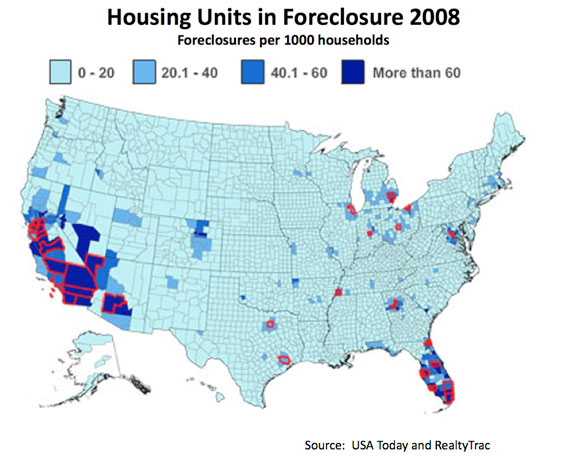
    housing_foreclosure_565.jpg

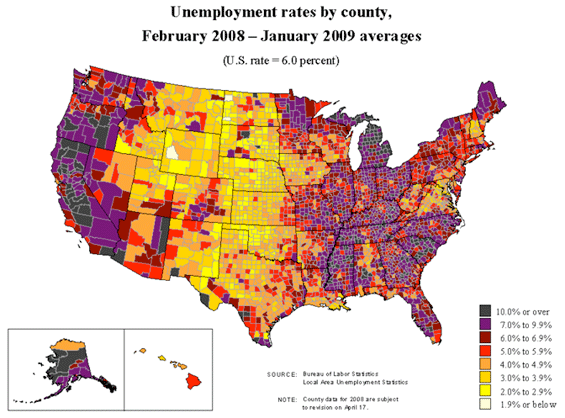
    Analysis by my colleagues at Praxis Strategy Group of the job market’s condition also reveals the divergence between the zone and the rest of the country. Regions from the Northeast, the Great Lakes and the Southeast all have seen significant job losses, and the damage is spreading to the Pacific Northwest, New York and New Jersey. In contrast, the Kansas City area and much of the zone of sanity has experienced only a ratcheting down of its generally steady growth rate. Things are not bustling, but there seem to be few signs of a basic economic collapse.
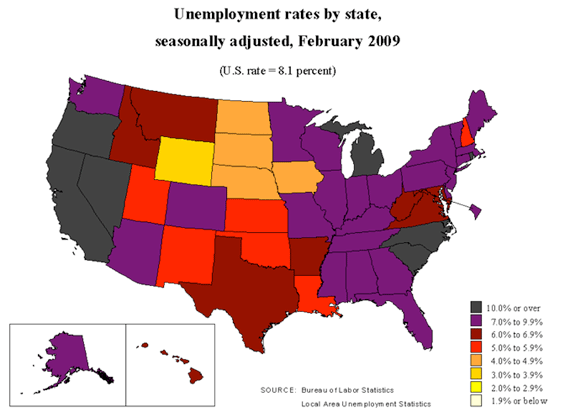
    unemployment_state_565.gif

    unemployment_country_565.gif

    Sanity, as Whitney put it, may constitute a critical part of the equation. If you discuss why people live in a place like Kansas City, people tend to speak about stability, family-friendliness and the basic ease of everyday life. Many executives, notes Phil DeNicola, who runs Strong Suit Relocation, initially resist a transfer to the region but quickly see the advantages.

    “It is attractive to be here,” notes DeNicola. “You don’t get a lot of highs and lows for years. There is stability instead, particularly for families. It all reduces your stress.”

    Of course, not everyone is satisfied with the status quo. As in many second-tier urban centers, many in Kansas City’s leadership crave being something other than pleasant, affordable and stable. Leaders in the city – home to roughly one in four of the region’s 2 million residents – have been particularly exercised to show that KC can be as hip and cool as New York, L.A. or, at the very least, Chicago.

    “There’s a real kind of self-loathing here,” notes Mary Cyr, a Harvard-trained architect, who works on projects throughout the region. “We feel less than what we are. We do not know what we are as a city. We don’t even realize what we have.”

    Hundreds of millions have been poured and continue to pour into the usual monuments favored by urban policymakers and subsidy-hungry developers – a sparkling new arena, plans for an expanded convention center and a massive entertainment complex called the Power and Light District. Yet at the same time, the city’s budget, like many others, is severely strapped, so much so that City Hall is considering not turning on the city’s iconic fountains this spring.

    Even worse, city and regional issues seem to result in plenty of money for new expressions of wannabe grandiosity. One notable example: plans to build a $700 million-plus light-rail line, the kind of thing that has become the sine qua non for the “monkey see, monkey do” school of urban policymakers across the country.

    This project makes little sense in a region with a well-below-average percentage of jobs in its downtown core – roughly around 7% – with one of the lowest shares of transit-riding residents in the nation. The relative lack of traffic makes a rail system less sensible than could be argued for higher-density urban corridors, where it at least can be imagined that many would give up their cars.

    Ultimately, none of this taxpayer largesse is likely to do much more than replicate the same kind of development that can be found in scores of cities – from St. Louis to Dallas – that have tried it. At best, you get a few blocks of activity but very little in terms of urban dynamism.

    “The growth of downtown is not at all organic – it’s kind of forced,” notes architect Cyr. “They build all those projects in there, and you end up with the huge monumental buildings and the Gap.”

    The problem for the downtown crowd is that Kansas City has remained a quintessential American city, most dynamic in places where private initiative leads the way. Typically the bulk of new growth has taken place in the suburban fringes, but there are several successful nodes within the city, particularly around the lovely, 1920s vintage, privately developed Country Club Plaza area, famous for being the world’s first modern shopping center.

    Similarly, the artist-inspired Crossroads district has also evolved – largely without government help – into a genuine bastion of bohemians, with small companies and locally owned restaurants. With its low-cost commercial and residential space, as opposed to government subsidies, many see the area as precisely the kind of grass-roots urban life with a future in a place like Kansas City.

    Such developments in the city, as well as outside, make it possible to project a very bright future for Kansas City – and across the zone of sanity. Unless there is a massive shift in conditions, the zone should see a return to prosperity earlier than places bogged down with excess foreclosures, shuttering industries, soaring taxes and ever-tightening regulation. Dan Whitney, for example, expects the local housing supply to run out soon – with “tremendous pent-up demand” by the end of the year. If credit conditions improve, new construction should resume within the next 18 months.

    This all reflects the essential attractiveness of cites like Kansas City. Overall, in fact, its rate of domestic in-migration has been higher than much-celebrated Seattle and only slightly below that of Denver. Indeed, since 2000, Kansas City’s regional population has grown 8.6%, more than twice as much as New York, Boston, San Francisco or Los Angeles.

    Unlike the national media, which rarely focus on mundane things that drive most people’s lives, some seem to get the appeal of lower prices, affordable housing options and a generally calm environment. Although never a beacon for newcomers, like Phoenix, Atlanta or Dallas, Kansas City has not suffered the massive out-migration seen in such big metropolitan regions as Los Angeles, San Francisco, Chicago or New York.

    In fact, Kansas City has enjoyed a slow but steady in-migration through the past decade. These newcomers could provide the energy, talent and initiative that a region, known for stability, needs to get to the next level. Attracting more of them – not new prestige projects or subsidized developments – remains the key to the region’s future.

    Instead of trying to duplicate growth patterns that are foundering on the coasts and in countless Rust Belt cities, the denizens of the zone of sanity need to learn how to build on their virtues of stability and affordability. Particularly in hard times, such things count for much more than many – both inside and outside the region – might imagine.

    This article originally appeared at Forbes.

    Joel Kotkin is executive editor of NewGeography.com and is a presidential fellow in urban futures at Chapman University. He is author of The City: A Global History and is finishing a book on the American future.

  • Burnin’ Down the House! Part Two: Wall Street has a Weenie Roast With Your 401k

    Last week I wrote about the first part of my talk to the Bellevue Kiwanis Club on why our economy is in the position it is today. It is a story about good intentioned policies – like modifying credit scoring for Americans working in a cash-economy – that were bastardized in the execution – like some Americans using modified credit scoring to lie about their income. Just like there were superstar firms among the original “junk bond” companies, there were also firms like Enron and WorldCom.

    In the first part of my story: banks wrote mortgages, their broker-arms sold them to the public in the form of bonds, they paid fees to Standard & Poor’s and Moody’s to get triple-A credit ratings, and they devised crazy default protection schemes which they also sold in the public capital markets. On top of all that, they screwed up the paper work so there was no relationship between houses and the ultimate financial paper that could be used to cover potential losses.

    That’s when Wall Street staged a weenie-roast over the blazing fire of your 401k plan. They were making so much money in fees and trading profits that they decided to extend the scheme to car loans, credit card debt, and anything else they could package and sell off in capital markets around the world. When new money stopped flowing in and when the value of the underlying assets began the decline, the whole mess came falling down over their – and our – heads.

    In case after case, there are more derivatives than their underlying assets. Here’s an example of just how absurd this is: The market value of Bank of America (BofA) is $32 billion; the contracts that payoff if BofA fails are worth $119 billion. This isn’t rocket science math. It’s worth a lot more to someone to see BofA fail than it is to see them succeed. Here’s a table of some of financial companies and home builders, alongside some countries, to give you an idea of what the potential cost would be of letting them collapse – because the derivatives would have to be paid off if they collapsed. Where the market value of a company’s publicly-traded shares (or the outstanding public debt of a nation) is greater than the derivatives outstanding (a negative number in the difference column), the “market” is probably betting in favor of the company.

    Entity

    Derivatives outstanding

    Market Value or Public debt

    Difference

    BANK OF AMERICA CORPORATION

    118,689,745,334

    31,558,840,000

    87,130,905,334

    GMAC LLC

    83,556,419,908

    4,690,000

    83,551,729,908

    MORGAN STANLEY

    84,271,180,804

    24,186,940,000

    60,084,240,804

    DEUTSCHE BANK AKTIENGESELLSCHAFT

    71,011,177,628

    18,510,000,000

    52,501,177,628

    CITIGROUP INC.

    61,875,137,002

    12,760,000,000

    49,115,137,002

    AMERICAN INTERNATIONAL GROUP (AIG)

    47,393,950,401

    2,230,000,000

    45,163,950,401

    GENERAL MOTORS CORPORATION

    43,373,996,836

    1,540,000,000

    41,833,996,836

    CENTEX CORPORATION

    41,027,349,092

    856,760,000

    40,170,589,092

    LENNAR CORPORATION

    40,426,782,677

    1,260,000,000

    39,166,782,677

    AMBAC ASSURANCE CORPORATION

    36,835,358,941

    189,580,000

    36,645,778,941

    PULTE HOMES, INC.

    38,364,111,999

    2,460,000,000

    35,904,111,999

    FORD MOTOR COMPANY

    39,618,004,718

    5,030,000,000

    34,588,004,718

    THE GOLDMAN SACHS GROUP, INC.

    80,849,691,288

    46,624,340,000

    34,225,351,288

    BARCLAYS BANK PLC

    44,579,007,183

    11,160,000,000

    33,419,007,183

    WHIRLPOOL CORPORATION

    32,665,900,751

    1,850,000,000

    30,815,900,751

    CBS CORPORATION

    32,484,932,800

    2,600,000,000

    29,884,932,800

    SOUTHWEST AIRLINES CO.

    33,766,673,423

    4,090,000,000

    29,676,673,423

    TOLL BROTHERS, INC.

    27,532,256,817

    2,590,000,000

    24,942,256,817

    SPRINT NEXTEL CORPORATION

    33,852,494,934

    10,230,000,000

    23,622,494,934

    AUTOZONE, INC.

    31,489,303,582

    8,700,000,000

    22,789,303,582

    D.R. HORTON, INC.

    19,889,587,401

    2,540,000,000

    17,349,587,401

    ALCOA INC.

    20,554,123,223

    4,620,000,000

    15,934,123,223

    AMERICAN EXPRESS COMPANY

    28,098,626,953

    13,970,000,000

    14,128,626,953

    K. HOVNANIAN ENTERPRISES, INC.

    9,458,710,459

    70,220,000

    9,388,490,459

    AETNA INC.

    15,056,041,259

    9,720,000,000

    5,336,041,259

    TIME WARNER INC.

    33,530,285,093

    29,240,000,000

    4,290,285,093

    WELLS FARGO & COMPANY

    47,902,948,043

    58,060,000,000

    -10,157,051,957

    JPMORGAN CHASE &CO.

    61,250,536,812

    86,770,000,000

    -25,519,463,188

    RUSSIAN FEDERATION

    102,631,256,656

    151,000,000,000

    -48,368,743,344

    ABBOTT LABORATORIES

    5,273,779,532

    68,720,000,000

    -63,446,220,468

    REPUBLIC OF TURKEY

    169,668,377,905

    243,747,000,000

    -74,078,622,095

    REPUBLIC OF ITALY

    157,609,796,730

    248,773,000,000

    -91,163,203,270

    BERKSHIRE HATHAWAY INC.

    18,409,990,929

    126,860,000,000

    -108,450,009,071

    UNITED MEXICAN STATES

    76,677,172,011

    320,334,000,000

    -243,656,827,989

    FEDERATIVE REPUBLIC OF BRAZIL

    113,249,393,554

    814,000,000,000

    -700,750,606,446

    Derivatives outstanding is data made available by the Depository Trust and Clearing Corporation for publicly traded credit default contracts. Market value is for public companies generally in early March 2009; public debt is for countries generally from year-end 2008. Difference is author’s calculation. The average derivatives outstanding for entities with positive differences are 22 times the value of the entity (excluding GMAC as an outlier with a multiplier of 17,816).

    In other words, you could buy all the shares of Lennar for $1.2 billion. However, if they go bankrupt, the payoff will be $40 billion for the holders of the derivative contracts. And at this point, we – the US taxpayers – are in the position of paying off on these contracts if the banks and other “too big” companies fail. This table also tells you that the “markets” think that Bank of America is significantly more likely to fail than, say, Brazil – which is probably true, if for no other reason than the fact that Brazil has an army and Bank of America doesn’t!

    The bottom line is that the government has to continue to bailout these banks and large companies because many of them, including AIG which is now owned about 80% by us, are the same entities that will have to pay off the bets if the other companies fail. There’s really no way out of it now. I remain opposed to the bailouts – they create “moral hazard,” the scenario whereby it is more profitable to fail than to succeed. But: I understand why they are being done and why we have to keep doing it.

    The reason is: it matters to our 401k plans, the pension plans of teachers and firefighters, the retirement benefits of loyal, hard-working Americans. You see, the debt of insurance companies and other triple-A rated credits (AIG had a good credit rating less than 12 months ago) are required investments for money market funds, pension plans, etc. Take a look at the prospectus for any of these investments if you have them and you’ll see what I mean. It is necessary for such funds to make triple-A investments because the funds need to be able to make payments and honor withdrawals, sometimes on short notice. That means they have to hold some very safe, very easily sold investments. Investments like those issued by AIG.

    If the mutual funds holding your 401k and the pension fund supporting the school teachers and all that go broke – well, no one wants to imagine what that America would look like. Despite all the bad economic news, few Americans have run out in the streets in protest and even those who did didn’t vandalize any property, public or private. Nor did we take our CEOs hostage. In fact, I think a little civil unrest may be called for: print this story, wrap it around a hotdog, mail it to the New York Stock Exchange and tell them to enjoy their weenie-roast!

    Here’s why: the time is coming very soon when Wall Street will need us again. Uncle Sam is doling out the bailout money to the financial institutions, but even now they are devising ways to get ordinary investors to come back to the markets – and to use our own money to do it.

    Susanne Trimbath, Ph.D. is CEO and Chief Economist of STP Advisory Services. Her training in finance and economics began with editing briefing documents for the Economic Research Department of the Federal Reserve Bank of San Francisco. She worked in operations at depository trust and clearing corporations in San Francisco and New York, including Depository Trust Company, a subsidiary of DTCC; formerly, she was a Senior Research Economist studying capital markets at the Milken Institute. Her PhD in economics is from New York University. In addition to teaching economics and finance at New York University and University of Southern California (Marshall School of Business), Trimbath is co-author of Beyond Junk Bonds: Expanding High Yield Markets.

  • College Towns Get High Marks for Quality of Life

    It’s hard to find a quality of life ranking that satisfies the preferences and desires of everyone but Bizjournal’s recent ranking of mid-sized metros does highlight and affirm the presence of colleges and universities as an increasingly common and important thread in quality of life analyses.

    The study compared 124 mid-sized metros in 20 statistical categories, using the latest U.S. Census Bureau data. The highest scores went to well-rounded places with healthy economies, light traffic, moderate costs of living, impressive housing stocks and strong educational systems.

    Mid-size places of 100,000 to 1 million residents have experienced strong growth since 2000, exhibiting some of the strongest domestic migration rates among all metropolitan areas regardless of size.

  • GHG-GDP Connection

    The Hadley Center in the UK has recently reported a “correlation between reduced prosperity and reduced greenhouse gas emissions associated with global warming.”

    The report states that since 2000, as greenhouse gasses have risen 2 to 3 percent each year, the world gross domestic product has also risen. The current ½ percent reduction in GDP is therefore correlated with the ½ percent reduction in greenhouse gasses.

    Paul Taylor, of the examiner.com, suggests that the “reductions in greenhouse gases will reduce GDP and punish economic prosperity.”

    President Obama’s $646 billion spending bill on a new carbon trading system to mitigate greenhouse gases would enact a “cap and trade” system that is “in effect a massive new national tax…[that] would impose substantial additional cost on power producers and manufacturing,” according to Taylor.

    The extent to which greenhouse gasses are a direct cause of the world GDP dropping or increasing remains to be seen – a myriad of additional factors should be considered – but these issues will continue to be at the forefront in such volatile times.

  • Whatever Happened to “The Vision Thing?”

    When I was in elementary school, I remember reading about the remarkable transformations that the future would bring: Flying cars, manned colonies on the moon, humanoid robotic servants. Almost half a century later, none of these promises of the future – and many, many more – have come to pass. Yet, in many respects, these visions from the future served their purpose in allowing us to imagine a world far more wondrous than the one we were in at the time, to aspire to something greater.

    I am reminded of these early childhood memories not because I lament the loss of my flying car (although it would come in handy every now-and-again in fighting the Washington, D.C. rush hour gridlock) but because, with all of the rhetoric about change and hope, the Obama Administration has failed to articulate a strong, singular vision for what the future of America and the world can and should be. While some would argue that now is not the time for grand visions for the future but, rather, for hunkering down and muddling through these desperate economic travails, the fact of the matter is that at least part of the cause of continuing economic decline in this country, and in many other developed nations as well, is a lack of confidence in the future.

    I was somewhat hopeful during his address to the joint session of Congress in early February – shortly after the passage of the economic stimulus bill – that President Obama was indeed starting down the path of articulating a new vision for America. He recalled in that speech great innovations that had been spurred by prior economic and other exigencies. In that speech he stated:

    “The weight of this crisis will not determine the destiny of this nation. The answers to our problems don’t lie beyond our reach. They exist in our laboratories and universities; in our fields and our factories; in the imaginations of our entrepreneurs and the pride of the hardest-working people on Earth. Those qualities that have made America the greatest force of progress and prosperity in human history we still possess in ample measure. What is required now is for this country to pull together, confront boldly the challenges we face, and take responsibility for our future once more.”

    And again, later in his address:

    “History reminds us that at every moment of economic upheaval and transformation, this nation has responded with bold action and big ideas. In the midst of civil war, we laid railroad tracks from one coast to another that spurred commerce and industry. From the turmoil of the Industrial Revolution came a system of public high schools that prepared our citizens for a new age. In the wake of war and depression, the GI Bill sent a generation to college and created the largest middle-class in history. And a twilight struggle for freedom led to a nation of highways, an American on the moon, and an explosion of technology that still shapes our world.”

    Bold action and big ideas: Yet the focus of all of the Administration’s efforts have been on specific “solutions” to the problem set with which our economy is now faced. Some are well-intentioned but arguably poorly executed by Congress while are others rolled out for public consumption with less than full baking time—without any suggestion about what our “brighter future” might look like and how these various solutions might be woven together to help realize a brighter and different future.

    We may indeed be on the cusp of something big: It may be tragic or triumphant depending upon how and how quickly we find our way out of the country’s current predicament.

    After Hurricane Katrina ravaged New Orleans and the Gulf Coast, some urban planners, architects, emergency management experts, and others were bold enough to suggest that maybe the Ninth Ward shouldn’t be rebuilt; perhaps nature never intended us to put so many homes and so many people below sea level, in harm’s way. Regrettably, that conversation was preempted as soon as it was started by the hundreds of displaced residents who, having been treated with what appeared to be utter disregard by their local, state, and federal government in the face of that tragedy as it unfolded, insisted that at least they deserved to be returned to their homes. Politics and pragmatics trumped bold and broad thinking that could have conjured a different outcome.

    There is so is so little new and dynamic mainstream discourse about where and how we live as individuals and in communities. There is no modern proxy for flying cars and colonies on the moon. And funding billions of dollars in support of “shovel-ready projects” will certainly do nothing to advance the cause of innovative thought about how we would like to see our current communities – urban, suburban, and exurban, and rural – evolve over the next twenty-five or fifty years. What could life be like in America in 2034 or 2059? We should not have to rely upon science fiction writers, futurists, and block-buster sci-fi movie producers to craft all of our visions of the future.

    So here’s an idea for our new President. Now that everyone is relatively comfortable with the notion of spending billions (and even trillions) of dollars, let’s spend a very small portion of that on our future, rather than focusing exclusively on our near-term economic salvation. Make $10 billion available to fund five pilot projects with $2 billion each. Think of is as the “X Prize” for Innovations in Livability. Invite communities throughout the country, without restriction as to size or location, without constraints on the marketplace of ideas, to bring together their best and brightest to craft implementable proposals for how they plan to evolve their community into an exemplar for the future: Then fund the five best proposals. Take the funding decisions out of the hands of elected officials and policy makers, and place it unfettered in the hands of a blue-ribbon panel of experts from a broad range of disciplines.

    Let all Americans and the world marvel at what will replace the flying cars of the 60s.

    Peter Smirniotopoulos, Vice President – Development of UniDev, LLC, is based in the company’s headquarters in Bethesda, Maryland, and works throughout the U.S. He is on the faculty of the Masters in Science in Real Estate program at Johns Hopkins University. The views expressed herein are solely his own.

  • Talkin’ Baseball – and Sub-Prime Mortgages

    I was thoroughly enjoying the broadcast of the March 23 final game of the recent World Baseball Classic at Dodger Stadium when I thought about steroids and sub-prime mortgages.

    A seemingly odd leap, I’ll grant you – but hang in there on this one.

    The thoughts had first stirred when I attended a semi-final game the prior Saturday, watching a South Korean team that counted just one player who’s on a big league roster here in the U.S. make hash of the Venezuelan squad. The Venezuelan team boasted plenty of players who make in living in the big leagues, including a number of All-Stars.

    Then I tuned in the next night to watch Japan do a similar number on Team USA. More of Japan’s ballplayers have made a mark in our big leagues compared to the South Korean squad, but their team still paled in comparison to the star power of the Americans.

    The Venezuelans and Americans didn’t just get beat in their semi-final games, by the way – they looked slow, lacking in the fundamentals of the game. The South Koreans and Japanese, on the other hand, looked quick and ever-alert. They pitched with heart, hit smartly, and fielded their positions with nimble dedication.

    That set up a South Korea-Japan final that proved to be one of the best ballgames I’ve ever seen, going all the way to extra innings in a performance that highlighted how the game should be played.

    None of the South Korean or Japanese ballplayers looked overly bulky. There were a few big fellas out there – but they were big like Babe Ruth or Frank Howard. They looked like naturally big guys who had learned to play baseball. No forearms that made you think of Popeye. No necklines from ears to shoulders.

    I thought about how the big leagues of the U.S. have only begun to admit to the recent steroid binge. It reminded me how obvious the trend had been. Anyone who couldn’t see the physical indicators in the players should have been able to get a good idea just by looking at the statistics piled up during the Steroid Era.

    Baseball fans looked past all of that, for the most part. So did players and team owners. Home runs are sure fun, after all.

    That’s where my thoughts turned to sub-prime mortgages – because we as a society did pretty much the same thing to our economy. We shot some concocted substance into our economic bloodstream, getting a short-term boost that didn’t require any real dedication to owning a home or building communities. We went for the shortcut – just like those big league ballplayers who decided to get their power from a syringe instead of dedication to the game.

    Folks all over the world joined us by directly or indirectly flexing the fake economic muscles engendered by the sub-prime mortgage mess. Yet a look at the World Baseball Classic shows that not everyone fell for the shortcut offered by steroids. Not everyone turned their backs on sportsmanship and fundamentals at the ball yard.

    So put love of the game alongside genuine community building on the back-to-basics list for our American Culture.

    We might as well make it a thorough housecleaning.

    Jerry Sullivan is the Editor & Publisher of the Los Angeles Garment & Citizen, a weekly community newspaper that covers Downtown Los Angeles and surrounding districts (www.garmentandcitizen.com)

  • Financial Crisis Boosts Local Markets

    By Richard Reep

    The current economic crisis has many mixed impacts, including the shift of grocery customers to low-cost companies like Wal-mart. Yet at the same time we see a shift to local, community markets in an effort to cope with the new economy. While the global players deliver discounts due to their enormous volume, local community markets offer low-priced produce, goods, and services due to their microscopic volume. This common ground between individual efforts and enormous buying machines yields an interesting treasure trove of passion and hope.

    As folks cope with financial turmoil, their choices for purchasing venues seem to be driven by the need for saving, as well as the need for a good experience. The middlemen, such as the regional and national chains, seem to be squeezed in between truly global players like Wal-mart, and the rising tide of localism appearing at a grass-roots level in so many communities.

    The rise of these small, open-air markets is an encouraging sign of authentic social interaction, after so many assaults upon our social network by the forces of the Old Economy. It suggests a new role for local entrepreneurs and for the revival of community spirit. At these local markets, producer and consumer traffic in direct interaction, without the army of marketing consultants, business analysts, merchandisers, industrial psychologists, and the rest of the hangers-on who have transformed the agora into an often dispiriting and uninteresting shopping experience.

    Now, with the Old Economy in shambles, the New Economy appears to be reviving the community element to our American commercial culture. Even a few years ago the Farmer’s Market was considered an anachronism, something found in rural areas and overlooked by cosmopolitan city dwellers. The fact that these are rising up in our urban and suburban culture speaks to our need for freshness, for authenticity, and for some spontaneity.

    In Central Florida, the Winter Park Farmer’s Market is perhaps the grandfather of the Central Florida market scene, having started sometime in the eighties. No one at the City could remember exactly when it started. Ron Moore, Parks and Recreation Assistant Director now manages the market, and he laughed when asked about its success in a recent interview. “Consulting to other municipalities who want to start up their own markets is a part-time job”, said Moore, his latest effort being Eatonville, whose inaugural Community Market was an exciting event.

    Markets on public property are an important trend in our cities, for they signal the revival of public space. All too often public space has been defined by soulless plazas, many of which are deserted most of the time. But, with the rise of the public market, the classic agora has been revived in Winter Park, Maitland, Downtown Orlando’s Lake Eola, Eatonville, and elsewhere in Central Florida.

    Mr. Moore stated that the Winter Park Farmer’s Market’s summer season is typically the slow time, but last summer was their best one ever, and this winter has been the highest attendance ever, with a waiting list of merchants to get in. He is fine-tuning the mix using common sense, watching people flow and traffic flow. This reflects a locally based entrepreneur who is all instinct and good listening skills; he is not a mall merchandiser using industrial psychology and the appeal of sameness to make sales.


    North of Orlando lays the town of Eatonville, America’s oldest African-American incorporated community, and it is sandwiched between the affluent Winter Park and Maitland areas. The Eatonville Market, for its part, is attracting produce, food items, and flowers, and is worth a visit on a Saturday morning. Complete with a stage, shoppers are treated to a vibrant music scene as well as a shopping venue, and as this market takes off, it will attract more and more people to this historically significant community.


    Public open markets are exciting, but perhaps an even more interesting trend is the private-run market. Organizers of private markets can have more authority over the vendors and their merchandise, and can give their markets more style to suit a specific audience. One of the area’s more interesting markets occurs at night – the Wednesday evening Audubon Community Market, occurring at Stardust Video and Coffee. Founded by Emily Rankin, the Community Market strives to bring items produced specifically in Audubon Park.

    This epitomizes the spirit of the new localism. The fact that it occurs at night makes the market scene unique. Ms. Rankin, in an interview, revealed that the Audubon Park Garden District, which she founded, now includes a network of vegetable gardens, and these are showcased at the market. Her cafe, Roots, serves food at this market, and it provides services, locally grown produce, art, music and other handmade items which rotate on a weekly basis.

    There are many advantages to privately run markets. The Winter Park Farmer’s Market has pages and pages of rules and forms. The private Audubon Community Market is direct, paperless, and quick: Ms. Rankin looks at your product and says, you are in or out. Her management of the market has sustained it through a change in location or two, and she is optimistic that the market will grow in popularity as people start looking locally for what they can’t find globally

    During times of financial stability, people often seek to reduce risk and experimentation, clinging to the tried and true. Certainly retail’s global players focus on cold calculation and maintaining shareholder value. Yet at the grassroots, individuals and families also seek a level of comfort and interaction. The consumer response to community markets suggests that there is a widely felt allegiance with these intrepid street vendors who brave the elements for a dollar’s worth of grapefruit. The shifting economy is allowing individual voices to speak and be heard by a wider audience. This is the coarse of true innovation. Those who persevere in the community market scene could well influence our commercial future for decades to come…

    Richard Reep is an Architect and artist living in Winter Park, Florida. His practice has centered around hospitality-driven mixed use, and has contributed in various capacities to urban mixed-use projects, both nationally and internationally, for the last 25 years.

  • Fargo Moorhead Flood Fight: Stand and Defend

    The flood fight is on in Fargo/Moorhead as the cities work to stem the flow of the raging Red River of the North. I was in north Fargo this morning (Friday) where crews continue to haul clay and sandbags to bolster dikes and protect critical infrastructure. Fargo Mayor, Dennis Walaker, said this morning that they “wouldn’t go down without a fight” and these two communities are putting up a herculean fight against all that mother nature can throw at them including record flood levels, a snow storm and continued cold temperatures. The two communities currently are in what they are calling a “stand and defend” position – strengthen and monitor existing dikes and levies and protect as much of their community as possible.

    I went to Fargo with my 17 year-old Nephew who just last night was sandbagging in north Fargo, and had arrived in Grand Forks at 8:00 am this morning. When he heard I was heading to Fargo he asked “do you need help”? The resilience, energy and concern exhibited by this, and many, of the youth and young adults in this fight has been unbelievable and from my perspective, one of the major stories of this struggle. The overwhelming assistance – from junior and senior high students to the several colleges and their students from throughout the region – has been astounding.

    Even former ND Governor and U.S. Secretary of Agriculture Ed Schaefer is driving a dump truck hauling clay. He said he came across a driver who had been driving for 27 hours straight and Ed figured he could use a break.

    The endplay of this flood has yet to be written, but when it is all said and done the residents of Fargo/Moorhead along with an army of students (our best and brightest) will hopefully be able to slap each other on the back and say “job well done”. Stand and defend Fargo … stand and defend.

    Here’s an amateur video on the flood fight making the rounds on youtube:

    Minnesota Public Radio’s Bob Collins has been chronicling the story of a few families in Moorhead fighting to save their homes, even after their neighborhood has been evacuated and they’ve been cut off by a secondary dike.

  • While Fixing Housing, Fix the Regulations

    Everyone knows that subprime mortgages lie at the root of our current financial crisis. Lenders originated too many of them, they were securitized amidst an increasingly complex credit market, and the bubble popped. The rest is painful history.

    Most commentators have explained the source of the problem by pointing either to faulty federal housing policies – such as Fannie Mae’s affordable housing goals, the Fed’s easy money practices, and the Community Reinvestment Act – or to the imprudent zest for gain among investors who miscalculated risk and kept up the demand for bad mortgages. Both views are correct to varying degrees. These perceptions will shape the ongoing policy debate about needed reforms.

    But as this debate advances, we should not lose sight of another consequential, yet mundane, factor in the crisis: the way that regulations raised house prices and created conditions ripe for subprime loans. Regulations may be one of the least debated contributors to the current crisis, and yet their effect on the middle class’s ability to buy homes may arguably have been a key reason why subprime loans flourished in the first place.

    In the heated housing market before 2007, a median income family in the U.S. could only afford 40 percent of homes for sale across the country, compared to more than two-thirds of homes in 1997. Banks got creative and helped ordinary families buy overly expensive homes with risky mortgages. In a hot market, the risks seemed low. People never should have purchased homes they could not afford, but at the same time, rising prices were putting homeownership out of the reach of ordinary families such that unconventional loans seemed a convenient solution.

    Why were housing prices rising so rapidly? Observers have traditionally held that land scarcity drives up prices by preventing supply from meeting demand. But the more likely answer is that regulations on housing overly constricted supply in many parts of the U.S. Through the groundbreaking work of Wendell Cox at Demographia and scholars such as Ed Glaeser at Harvard and Joe Gyourko at the University of Pennsylvania, we have come to see that rules and regulations drive up housing prices much more than we had originally thought. Blaming supply problems on land scarcity has been a convenient excuse for too long for those who see hyper-regulation of housing as a good thing.

    Regulations often limit the number of housing units that can be built on a given lot, or they restrict the number of new home permits that can be issued in a given municipality, making supply a function of rules, not land scarcity. Restrictions to the property itself, such as environmental or design requirements, also raise the cost of construction (see Andres Duany’s thoughtful article on this issue here.).

    Increased regulation on housing has been a quiet, but disquieting, trend. For example, Glaeser has shown that only 50 percent of communities in greater Boston had restrictions on subdivisions in 1975, compared to nearly 100 percent today. Housing prices in the Boston area would have been between 23 and 36 percent lower on the eve of the crisis were it not for burdensome restrictions on housing. While the Boston area’s regulatory impulse may be excessive, it is nonetheless emblematic of a national trend. A recent U.S. Department of Housing and Urban Development has found that more than 90 percent of the subdivisions in a recent national study now have excessive restrictions.

    According to Harvard’s housing research center, the growing cost of regulations has edged smaller builders out of the construction market and increased the market share of the nation’s ten largest builders from 10 to 25 percent since the early 1990s. This doesn’t mean that the larger builders are happy about restrictions. Bob Toll, president of one of the nation’s largest builders, has said that his company quit building “starter homes” for young families years ago because the margins on small homes grew too narrow due to excessive regulations.

    How big is the problem? Most observers have typically agreed that housing regulations account for 15 to 35 percent of a median-priced home in the U.S. These percentages come from a 1991 federal housing commission, and they are likely to have increased considerably since then. If we conservatively use them to calculate the scope of regulations by the time the housing crisis began in earnest in 2007, they suggest that regulations accounted for between $35,850 and $83,650 of a median-priced home. Using the National Association of Homebuilders’ methodology for determining the impact of price increases on home affordability, we can say that regulatory restrictions priced at least 7 million – and as many as 18 million – families out of their local housing markets in 2007. As we have learned, families priced out of their markets still purchased homes – usually with unconventional, risky mortgages.

    Of course, not all housing regulations are bad, and zero regulation would introduce unnecessary risks to homeowners. But the increasing rate of regulation in the U.S. represents one of the nation’s larger assaults on the middle class that defenders of “working families” rarely talk about. Conservatives avoid the issue for federalism reasons, since any effective restraint on land-use planners will likely require the federal government’s involvement. And liberals hide from an honest debate about the effects of regulations for fear that it will derail their environmental agenda that relies up on regulations to limit the kind of housing most people want – such as single family homes.

    Now that there is an over-supply of housing in the U.S., the problem of housing regulations may seem moot. But if we do nothing about this issue, it will trip us up again in the future. While I served in the George W. Bush White House between 2005 and 2007, economists inside and outside the administration offered mixed – and sometimes completely contradictory – assessments of what was happening in the housing sector. We continued to work on our proposed reforms of Fannie and Freddie and the Federal Housing Administration in an effort to reduce the “systemic risk” but approached it more as a theoretical matter than as a perceived, impending crisis. We even had a HUD-based initiative on reducing regulatory barriers that quietly lumbered along but which we never elevated as a major policy issue. We now know that what we were grossly underestimating the scope of a potential crisis. We should have made housing sector reform a front burner issue.

    That is all behind us now, and we can see much more clearly what led to the crisis. We need to look at how rule-makers have for too long been making housing unnecessarily expensive for ordinary families. There is a limit to what the federal government can and should do about local housing regulations, but options exist for President Obama and Congress to consider.

    First of all, just as federal agencies are legally required to analyze the environmental impact of new regulations, Congress could require federal agencies to demonstrate the impact of new federal regulations on the cost of home construction. Federal agencies already have the personnel required for the task, and such a requirement would cost the taxpayer nothing extra. Second, Congress should consider new incentives in existing federal law, from highway construction to affordable housing, that would prompt states and municipalities to reduce burdensome regulations in exchange for federal resources. Third, President Obama could issue an executive order requiring federal agencies to amend regulations that have a negative effect on home construction costs. He could also use the same order to establish a task force whose job would be to identify the chief price-increasing regulations in use around the country to inform the legislative process.

    If we ignore the problem, as the housing market recovers, regulations will once again make housing more expensive than it should be. Unconventional mortgages will no longer be available due to the current crisis, and we will be back in a familiar debate about “affordable housing” in which the federal government is called upon to subsidize housing that others have made too expensive. In other words we return to the status quo in which we once again increase the role of a government that – under both Republican and Democratic administrations – has gotten ever bigger, more expensive and increasingly intrusive.

    Ryan Streeter is Senior Fellow at the London-based Legatum Institute and former special assistant to President George W. Bush for domestic policy.

  • Fargo Flooding: One more night, one more foot

    Late this afternoon the National Weather Service River Forecast Center came out with the announcement that no one in Fargo wanted to hear: the expected crest has risen a foot to 42, and possibly 43 feet. The NWS included the following eerie passage in their official statement:

    “The relative uncertainty in forecast models has increased significantly. Record flows upstream of Fargo have produced unprecedented conditions on the Red River. Given these factors, the river is expected to behave in ways never previously observed.”

    Fargo city commissioners assured the public that dikes were now steady at the 43 foot level, and plans are underway to increase dikes in south Fargo one foot overnight.

    Because of massive traffic gridlock after street closures, sand and clay trucks have been greatly slowed this afternoon. Tonight, the city is asking residents to stay in their homes, leaving it up to individual neighborhoods to band together overnight in the south end to try to add the last foot to save their homes.

    One neighborhood in Fargo and one in Moorhead are under mandatory evacuation, the largest hospital chain is now evacuating patients, and the city has had to make tough choices in placing secondary clay dikes, cutting off a number of neighborhoods should the water rise.

    This battle is not over, and if Fargo and Moorhead can add the last foot and keep the sanitary and storm sewer systems intact they could save the majority of the city. After that, it becomes a problem of maintaining a series of sandbag and temporary dikes over the expected 3 to 5 day high water period.

    Check out local photographer Dave Arntson’s excellent ongoing photo documentary of the flood fight. One thing I learned working for FEMA during our 1997 flood is that photos matter. Inspired photography helps people process and better understand these tense situations, especially since there is no time to think about what is happening while it is happening.