Blog

  • Why Fargo and the Midwest Rocks

    It was eighteen above zero and snow in Fargo this morning. Record high flood forecast on the Red River of the North in the Southern Valley. I went down to Fargo, from Grand Forks (70 miles north), to help my sister’s family empty out their basement. They live in the southern subdivision of Osgood. The blare of heavy equipment resounded throughout the neighborhood as I pulled in, feverishly building an earthen dike as a secondary defense roughly six to eight blocks North of their house. In hurry up mode here, you only move what is irreplaceable – family pictures, cherished belongings of your children when they were young, personal belongings from your life – the rest (TVs, furniture) is just stuff.

    As I was leaving the Osgood neighborhood, a steady stream of volunteers marched into the area to bolster the sandbag dikes. Young and old alike working side-by-side to accomplish a greater good – save their community. But for many it wasn’t even their community. Volunteers from throughout the region came to this community to help in its time of need. There is often no reason to be there other than “I heard they needed help”. No questions, no bitching.

    Heading to North Fargo, my other sister lives about 8 blocks from the river. The secondary dike there is roughly 2 blocks away from her house. She is heavily involved in emergency preparedness through her work at the local hospital and had her basement cleared out. I was dropping off an emergency generator, submersible sump pump and other supplies hoping that they won’t be needed. Parked in their driveway I saw buses filled with volunteers coming down the clay and snow covered street joined by others walking to the area. Don’t impede emergency vehicles and semis loaded with sandbags – other street traffic was at a minimum.

    Why does this region rock? If you saw the resolve of these volunteers, National Guard, Red Cross and emergency personnel and their willingness and ability to work together, help their neighbors and work collaboratively to defend their community you wouldn’t need to ask.

  • Red River Valley Flooding: In Our Backyard

    You may have seen the national media coverage of the flooding in North Dakota and Minnesota. Some of us here at NewGeography.com live right in the middle of it. I parked my car this morning at the base of an earthen dike holding back the Red Red River in Grand Forks, ND. Here in Grand Forks we were wiped out by a similar flood and fire in 1997. We evacuated more than 50,000 people at that time and virtually every property in the area was affected.

    Since 1997, hundreds of homes have been bought out and $400 million was spent on a dike and diversion protection system creating 2,200 acres of green space and more than 20 miles of trails in our little urbanized area of about 70,000.

    This has created a strange feeling – feeling a little useless sitting back and watching the herculean efforts in Fargo while we assemble pieces in the invisible flood wall and listen to officials reassure the public. Many from this area have boarded buses to head down to the Fargo area and help out. Meanwhile, you won’t find a drain plug or generator at a store in town.

    Here’s what’s happened so far:

    In the western part of the state, Bismarck’s situation was alleviated by taking explosives to an ice dam on the Missouri River.

    In western North Dakota, parts of small towns including Linton, Hazen, Zap, and Mott have had problems with overland floods.

    The most concern now is the rising Red River, making up the North Dakota and Minnesota Border. Thousands of volunteers from around the area have converged on Fargo to help, but the situation is now getting serious. Sandbagging takes a lot of effort and sandbag dikes are subject to failure.

    Right now the cities of Fargo and Moorhead are holding strong, but the rural surrounding areas are in trouble.

    Here’s a video report of the Coast Guard rescuing people from their homes in Oxbow, south of Fargo on Wednesday:

    Here’s a time lapse video put together by Minnesota Public Radio of the sandbagging efforts at the Fargodome. What’s interesting is that this is actually a secodary sandbag filling operation, started up after the huge volunteer turnouts:

    And, here’s the direct link to the Fargo river guage, updated about every hour. Fargo successfully defended against a flood just under 40 feet in 1997. 41 feet would be a new record, and the region is scrambling to get the protection systems up to 43 feet.

    Fargo Flood Gauge

    The problem is — it just keeps on snowing and raining and the projected crests keep rising. The Red River flows north. Our colleague Doug just headed down to Fargo to help protect his sister’s house wearing his only possession he has remaining after the Grand Forks floods and fire in 1997: his belt.

    We’ll keep you posted.

  • Rust Belt Outliers

    What kind of migration patterns will emerge as a result of the current economic downturn? The recession is uneven; some places are much worse off than others. Those differences can give labor cause to move. Economic geographer Edward Glaeser thinks cities with marginal manufacturing legacies should attract a lot of people because the well-educated, living in dense urban environments, should get through the crisis relatively unscathed. If Glaeser is correct, then shrinking Rust Belt cities can expect more of the same even after the recovery begins in earnest. Pittsburgh brains should continue to drain.

    Ironically, the latest US Census data indicate that the population decline in the Rust Belt is slowing as a result of less out-migration. A contracting economy has, according to demographer William Frey, helped to stop the bleeding from cities such as “Buffalo, N.Y., Pittsburgh and Cleveland.” One of the cited factors for decreasing geographic mobility is the collapse of the real estate market. Job seekers are stuck in their current place of residence.

    Another pressure to stay put is the economic climate of typical Sun Belt destinations such as Charlotte, NC or Phoenix. Unemployment there might be much worse than what you are seeing in your current location. There is no reason to move because the situation is bad everywhere. The “pull” factors have all but disappeared.

    Of course, evaporating home equity and massive layoffs throughout the country are not mutually exclusive. These two forces could be working in concert to stem the tide from struggling Rust Belt cities and the explanation of the waning migration is quite reasonable. But I’m not so sure it makes sense in the case of Pittsburgh.

    During the mortgage meltdown, the Pittsburgh real estate market has remained remarkably resilient. While foreclosures have decimated Cleveland, Pittsburgh’s prudent financial industry stayed away from bad loans. Pittsburgh is now rated as one of the most stable real estate markets in the entire country. Home ownership isn’t holding back the out-migration of Pittsburghers.

    As for unemployment, the job market is much better in the Pittsburgh region than it is in Charlotte, NC. That’s why solvent financial institutions in Southwestern Pennsylvania are advertising employment opportunities in Pittsburgh South (a.k.a. Charlotte). For those with the ability to relocate, Pittsburgh has a much better job market than Charlotte.

    But if we are talking about Pittsburgh out-migration, we should mention Washington, DC, the #1 destination for those seeking better opportunities than they can find near home. Charlotte is pretty far down that list. Sun Belt economic distress is causing Pittsburghers not to migrate as much to the sunbelt, thus pinpointing the reason for the dramatically falling (from the 2005 peak) net out-migration. In contrast, DC is still a viable job market, with numbers trending towards population gains.

    Are more people moving to Pittsburgh? Few seem to consider the possibility. Perhaps William Frey has access to out-migration data that aren’t public, which is why he lumped Pittsburgh in with Cleveland and Buffalo. But less out-migration doesn’t mean that there isn’t more in-migration. Pittsburgh attracting more talent from other regions would be news.

    Despite the manufacturing legacy that Glaeser details, there are Rust Belt cities that have bucked the population trends. Chattanooga, historically an industrial river city much like Pittsburgh, has begun to grow again after decades of shrinking. Pittsburgh isn’t necessarily doomed to being a shadow of its former self and may well separate even more than it already has from the Rust Belt pack.

    Staying with Glaeser’s observations, the economic geography of Pittsburgh might help us understand why migration fueled growth is possible. Manufacturing cities tend to lack a critical mass of highly educated talent and economic activity is less concentrated. Among Midwestern cities, Pittsburgh’s gains in college attainment since 1970 “have been the most rapid.” Pittsburgh’s human capital assets are much improved. And despite the obvious sprawl, Pittsburgh also enjoys considerable economic density. Its college corridor is just five-miles long, connecting downtown with the University of Pittsburgh and Carnegie Mellon University. Internationally renowned research universities are located in close proximity to the central business district.

    Might the above assets translate into greater in-migration? Perhaps, but the odds are against it. However, something unusual is going on in Pittsburgh. Whether or not that will inform job growth and economic development remains to be seen.

    Read Jim Russell’s Rust Belt writings at Burgh Diaspora.

  • Junk By Any Other Name Would Smell

    The Treasury this week disclosed details of their plan to pump $1 trillion into the financial system by removing “Legacy Assets” from the balance sheets of banks. Wading through the multitude of documents and documents, I’m reminded of a remark by Michael Milken in a conversation with Charlie Rose on October 27, 2008 “Complexity is not innovation.”

    Since its inception, the plan has been sold to Congress and the media as one with potential positive payoffs for the public coffers. To support this idea, proponents point to the experience of the Resolution Trust Company (RTC) in resolving the Savings and Loan (S&L) Crisis. Back then, RTC took over failing S&Ls – some of which were bankrupted by bad real estate loans made worse when they were forced to sell off below-investment grade bond assets – the by-now-well-known Junk Bonds.

    Selling off today’s junk bonds will, I agree, clean up the balance sheets of the banks and make them more attractive to investors and depositors. But the investment in junk bonds now is not going to turn out like the investment in junk bonds then. For starters, the value of the junk bonds then declined as a result of the forced sell-off – Congress prohibited S&Ls from holding junk bonds on their balance sheets. When this supply was dumped on the market, the prices naturally dropped. Selling assets at depressed prices damaged a lot of S&Ls. RTC stepped in near the bottom of those prices to take control of the assets. When credit markets returned to normal, the prices of the junk bonds rose and the investments had positive returns.

    Then, junk bonds paid extraordinary rates of return – 10 percentage points above Treasuries at the peak. At that time, a 30-year U.S. Treasury bond could be paying more than 18% interest.

    Now, we are talking about junk bonds that we all know are junk – no matter fancy labels like “Legacy.” What rate of return could there be on a mortgage bond – no matter how you “slice-and-dice” it – created when mortgage interest rates were 5-6%? Add to that our knowledge of the problems underlying these assets and it is increasingly unlikely that there will be any positive payoff for taxpayers in this plan.

    On March 25, 2009, Mirek Topolanek, President of the European Union, called the U.S. economic plan “the way to hell.” His concern is that we’ll have to finance these trillion dollar bailouts with borrowing and that will ultimately further undermine global financial markets. He’s right, of course. The public-private partnerships will finance the purchase of the “Legacy Assets” by issuing debt. That debt will be guaranteed by the Federal Deposit Insurance Corporation (FDIC), the same agency that guarantees our savings accounts at the local bank. Our guarantee is backed by the payment of insurance premiums to FDIC. The guarantee on the debt used to purchase Legacy Assets will be secured by the Legacy Assets – which will be rated by the same credit rating agencies that gave us triple-A rated subprime mortgage bonds in the first place. How can this possibly turn out well? I’m sure Treasury, Federal Reserve and FDIC have good intentions, but as EU President Topolanek says, they may all end up as pavement on “the way to hell.” As NYTimes columnist Paul Krugman said of the new plan, “What an awful mess.”

  • Geithner is Wall Street’s Lapdog

    Treasury Secretary Tim Geithner is on the cover of the April 2009 issue of Bloomberg Markets magazine. In the lead article, “Man in the Middle,” the authors refer to his time at the New York Federal Reserve Bank (FRB) as “experience as a consensus builder.” This overlooks the fact that it was easy for him to get everyone to agree, to build group solidarity, when he simply gave the banks and broker-dealers everything they wanted.

    The Primary Dealers, those broker-dealers and banks who have a special arrangement with the FRB for trading in treasury securities, agreed when Geithner let them fail to deliver $2.5 trillion of treasury securities for seven weeks in the fall; they agreed when he let them fail to deliver more than $1 trillion two years earlier; they agreed when he let them fail to deliver treasury securities even after Geithner’s own economists told him it was dangerous. By the way, last year the New York FRB’s public information department prevented those economists from speaking on the record about that research with a Bloomberg reporter.

    Now, at a hearing on March 24, 2009 before the House Financial Services Committee, Secretary Geithner and Federal Reserve Chairman Ben Bernanke lectured us on the awesome responsibilities of Treasury and Federal Reserve in the current crisis – without admitting that they had those same responsibilities while the crisis was being created.

    In a joint statement from the Department of the Treasury and the Federal Reserve they offer no explanation for their failure to fulfill their “central role … in preventing and managing financial crises.” Rather, they use the fact of that role to require that we accept whatever plan they put before us today as the best and wisest course. To convince us that their plan is the right one, they can all point to the fact that the stock markets rallied (gaining nearly 7% across the board) led by the shares of financial institutions (Goldman Sachs’ shares went from $97.48 on Friday night to $111.93 on Monday – a gain of about 15%).

    I criticized the “Public Private Partnership” when it was announced in February 2009. Calling Wall Street’s bad investments “Legacy Assets” doesn’t change the fact that they are “junk.” They could call it “the hair of the dog” because they now want to invest taxpayer money into the same junk investments that started the financial snow ball rolling in the first place.

    Just because the stock market rallied doesn’t make this “consensus building” – I call it being Wall Street’s lapdog.

  • SPECIAL REPORT – Domestic Migration Bubble and Widening Dispersion: New Metropolitan Area Estimates

    Returning to Normalcy

    The Bureau of the Census has just released metropolitan and county population estimates for 2008, with estimates of the components of population change, including domestic migration. Consistent with the “mantra” of a perceived return to cities from the suburbs, some analysts have virtually declared the new data as indicating the trend that has been forecast for more than one-half a century. In fact, the new population and domestic migration data merely indicates the end of a domestic migration bubble, coinciding with the end of the housing bubble.

    Metropolitan Area Growth: As usual, the metropolitan areas with more than 1,000,000 population increased above the national rate of 7.8 percent, at 9.2 percent from 2000 to 2008. Smaller metropolitan areas (between 50,000 and 1,000,000 population) grew at the national rate of 7.8 percent. Also continuing a long-standing pattern, areas outside metropolitan areas (including rural areas) grew slower, at only 0.7 percent (Table 1).

    The overall trends, however, mask significant variations. The nation’s two metropolitan areas with more than 10,000,000 population are experiencing growth rates less than one-half the national average. New York grew only 3.6 percent, while Los Angeles – which for decades experienced above average growth, could manage only one-half the national average rate, at 3.8 percent. Indeed, Chicago grew faster, at 5.0 percent. If 2000s growth rates were to continue to 2050, Dallas-Fort Worth, Atlanta and Phoenix would exceed Los Angeles in population, while Houston would pass Los Angeles shortly thereafter. This is not a prediction – population growth in these fast growing areas will likely slow as they get larger – but is merely offered to show how moribund the Los Angeles growth rate has become.
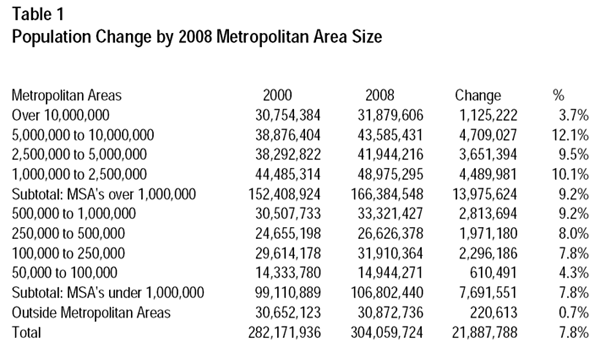
    The strongest growth was among metropolitan areas with between 5,000,000 and 10,000,000 population, which added 12.1 percent to their populations. This was driven by gains of more than 1,000,000 in Dallas-Fort Worth and Atlanta, nearly 1,000,000 in Houston and over 500,000 in Washington (DC). Philadelphia’s growth rate, however, was even less than that of New York or Los Angeles, at 2.7 percent.

    There was also strong growth (9.5%) among the metropolitan areas with between 2,500,000 and 5,000,000 population. This was driven by an increase of more than 1,000,000 in Phoenix and more than 800,000 in Riverside-San Bernardino. San Francisco (3.3 percent) and Boston (2.7 percent) grew at less than one-half the national rate, while Detroit lost population.

    The metropolitan areas with between 1,000,000 and 2,500,000 population also grew more than the national average, at 10.5 percent. The strongest growth was in Las Vegas, which added nearly 475,000 residents. Charlotte, Sacramento and Austin also added more than 300,000. Providence, Milwaukee and Hartford all experienced growth at less than one-half the national rate; while Cleveland, Pittsburgh, Buffalo and Katrina ravaged New Orleans all lost population. Tucson became the nation’s 52nd metropolitan area with more than 1,000,000 population in 2008, having added nearly 20 percent to its population since 2000.

    The largest percentage growth (35.4%) among metropolitan areas over 1,000,000 population was in Raleigh, which added 284,000 new residents (This is not Raleigh-Durham, which the Bureau of the Census calls a combined statistical area, consisting of the Raleigh metropolitan area and the Durham metropolitan area). Raleigh displaced recent perennial growth leader Las Vegas, which experienced slower growth due to the collapse of the housing bubble.

    Domestic Migration

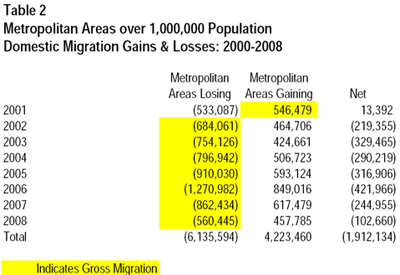
    Much has been made of the apparent recent slow-down in domestic migration (residents moving from one county to another) as indicated in the new data. In fact, however, domestic migration was greater in 2008 than it was in 2001. The slow-down should be more appropriately viewed as a return to more normal conditions.

    This can be illustrated by examining the gross domestic migration between metropolitan areas over 1,000,000 population. In 2008, gross migration in the metropolitan areas of more than 1,000,000 was 560,000. This is slightly more than the 546,000 in 2001. Gross migration increased after 2001, peaking at 1,270,000 in 2006. This fell to 862,000 in 2007 and then to 560,000 in 2008 (Table 2).
    The Domestic Migration Bubble

    The domestic migration bubble that developed from 2000 through 2007 coincided with the domestic housing bubble. This is not surprising, because housing consumes a major part of household expenditures. The differences in housing costs are much greater between metropolitan areas than any other major category of personal expenditure. For example, transportation, clothing and food have similar costs among the nation’s metropolitan areas. During the bubble, however house prices doubled and tripled in some metropolitan areas relative to incomes. The housing bubble appears to have sparked its own domestic migration bubble, as people moved from less affordable areas to more affordable areas.

    This is illustrated by examining domestic migration trends by housing affordability. The more affordable metropolitan areas had Median Multiples at the peak of the housing bubble of 4.0 or less (The “affordable” and “moderately unaffordable” categories from the Demographia International Housing Affordability Survey) and the less affordable metropolitan areas had Median Multiples of 4.1 or above (the “seriously unaffordable” and “severely unaffordable” categories from the Demographia International Housing Affordability Survey).

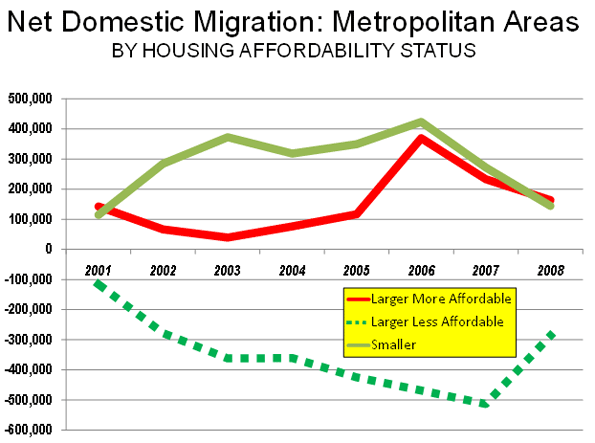
    The less affordable (higher cost) metropolitan areas experienced both the largest house price increases and a spike in net domestic migration losses. Overall, the less affordable metropolitan areas lost 2.8 million domestic migrants from 2000 to 2008 (Table 3 and Figure). This started in 2001 with a modest loss of 116,000, which ballooned to 514,000 by 2007. The loss dropped to 287,000 in 2008, a figure more than 2.5 times the 2001 net domestic migration loss.
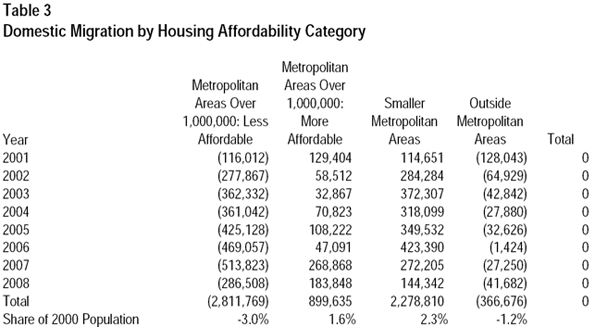
    At the same time, the affordable metropolitan areas experienced substantially lower house price escalation, while gaining nearly 900,000 domestic migrants from 2000 to 2008. In 2001, the more affordable metropolitan areas experienced a net domestic migration gain of nearly 129,000. Domestic migration gains peaked in 2007, at 269,000. Domestic migration gains fell to 184,000 in 2008 in the more affordable metropolitan areas. However, this figure was still far higher than the numbers at the beginning of the decade.

    Suburbs Continue to Gain

    The data also shows that people continue to move to the suburbs and move away from core areas. This can be shown from the county data, which is generally the smallest geographic area for which migration data is produced. One caveat: because many core counties contain suburban areas as well as the historic core cities, a county based migration analysis usually understates the extent of both core losses and suburban gains.

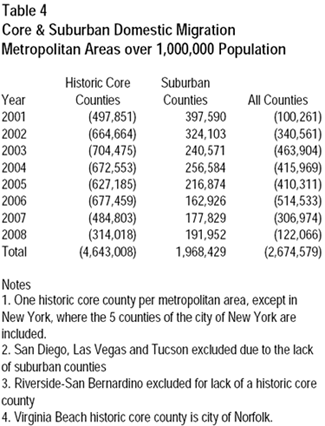
    The core counties improved their domestic migration performance in 2008, but continue to suffer losses. In 2008, the net domestic migration loss in core counties was 314,000, which compares to the 498,000 loss in 2001 and an annual average loss of 580,000 over the decade. Losses of this magnitude can hardly be characterized as a “turnaround.”

    Net domestic migration gains were down to 192,000 in the suburban counties from a 398,000 gain in 2001 and an average gain of 246,000 over the period. However, net suburban migration gains were up in 2008 from 2007 and 2006 (Table 4). Out of the 48 metropolitan areas, suburban counties performed better than core counties in net domestic migration in 42 cases, matching the figure for 2000-2008, the same as in 2007 and up from 38 in 2006. Among the six metropolitan areas where core net migration was greater than in the suburbs, core counties lost fewer domestic migrants than the suburbs (Washington and Virginia Beach), three were areas where the core county typically experiences higher net migration because of its population dominance (Phoenix, Raleigh and San Antonio) and the last was New Orleans, where the core county was much harder hit than the suburban counties by Hurricane Katrina related losses leading to greater gains in domestic migrants as it recovers (Orleans Parish, which is also the city of New Orleans). It is more than “a stretch” to interpret the new data to suggest any move to core areas from suburban areas.
    The 2008 domestic migration data does indicate a slow down or even a reversal in some more distant suburban and exurban areas. This was also to be expected because these areas had experienced a large increase in home ownership and a high volume of high risk sub-prime lending.

    As a result, exurban metropolitan areas like Riverside-San Bernardino, Stockton, Modesto and Merced experienced domestic migration reversals, while distant counties within metropolitan areas (such as Stafford County, Virginia in the Washington area and Pike County, Pennsylvania in the New York area) saw declines in their domestic migration. Much of the growth in such more distant areas occurred because of planning regulations in closer in areas made new development impossible or impossibly expensive. Thus, new housing construction was forced to “leap frog” over developable land, which also imposed higher transportation costs and longer commuting distances on the new home owners.

    At the same time, the better domestic migration performance in some core counties and “closer-in” counties occurred in large part because households no longer had a financial incentive to “cash-out” and move to lower cost areas, since they were often facing negative equity. This removed much of the incentive to move from San Francisco or Los Angeles to Las Vegas, Reno, Phoenix, Tucson or Portland, where prices were considerably lower (though still much higher than before).

    The Real Story: Widening Dispersion

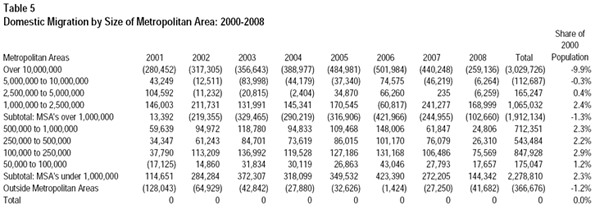
    Not only are people continuing to move from core areas to more suburban areas, but they are also moving from larger metropolitan areas to smaller metropolitan areas (Table 5). Since 2000, approximately 2,275,000 people have moved from large metropolitan areas and non-metropolitan areas to smaller metropolitan areas – those with populations of between 50,000 and 1,000,000. In 2001, the smaller metropolitan areas gained 115,000 domestic migrants. These net migration gains peaked in 2006, at 423,000. Following the national trend, net domestic migration to smaller metropolitan areas fell to 144,000 in 2008, still in excess of the 2001 number. Net domestic migration in the smaller metropolitan areas exceeded that of the larger less affordable metropolitan areas by 5.1 million over the period and exceeded that of the larger more affordable metropolitan areas by 1.4 million.
    Despite these trends, most metropolitan areas continue to add population. The domestic migration losses are more often than not made up by the natural increase in population (births minus deaths) and net international migration gains.

    However, households who already live here continue to exhibit a pattern of dispersion. Both within the same metropolitan area and between metropolitan areas, the latest Bureau of the Census data continues to show a clear trend of wider dispersal – from core counties to suburban counties and from larger metropolitan areas to smaller.
    References:Major Metropolitan Area Population & Domestic Migration 2000-2008: http://www.demographia.com/db-2008met.pdf

    Wendell Cox is a Visiting Professor, Conservatoire National des Arts et Metiers, Paris. He was born in Los Angeles and was appointed to three terms on the Los Angeles County Transportation Commission by Mayor Tom Bradley. He is the author of “War on the Dream: How Anti-Sprawl Policy Threatens the Quality of Life.

  • City of Los Angeles Hits the Bottle

    While San Francisco Mayor Gavin Newsom was recently chided for his water bottle usage, the city of Los Angeles hasn’t been much better.

    It was recently reported that the city of LA spent $184,736 on bottled water in 2008, “despite a mayoral directive that it should not be provided at the city’s expense.”

    City officials are encouraged to use coolers or pitchers of tap water for special events, and those that wish to drink bottled water “can do so at their own expense,” said City Controller Laura Chick.

    Despite a 2005 memo for Mayor Antonio Villaraigosa stating that city funds were not to be used on bottled water, certain city departments continued to spend funds on the plastic bottles.

    The biggest spenders were found to be Public Works ($69,696), Los Angeles World Airports ($31,429), Los Angeles Police Department ($19,708), General Services ($19,508), Transportation ($14,595), and Harbor ($11,993).

    The Department of Water and Power cut their spending down from $31,160 in 2004/05 to $3,419 in 2008, while the departments of Community Development, Commission on Children Youth and Families, Fire, Housing, Library, Neighborhood Empowerment, and Personnel ceased purchases altogether.

    Although spending has been reduced, public employees continue to expect the city to foot the bill for their bottled water. Such blatant non-compliance is hard to swallow.

  • Guessing Which Congressional Seats Change Hands at Census Time

    The next official Census isn’t till 2010, but Election Data Services is already predicting considerable impacts on Congressional representation.

    Things will be getting bigger in Texas, with four added seats, as well as Arizona, with two. Six states—Florida, Georgia, Nevada, Oregon, South Carolina, and Utah—will increase their federal delegations by one district each.

    On the opposite end, Illinois, Iowa, Louisiana, Massachusetts, Michigan, Minnesota, Missouri, New Jersey, New York, and Pennsylvania will all relinquish one seat, with Ohio appearing to lose two.

    While the redistricting process is in the distant future, it should prove interesting to see how the 2010 Census will change the seating arrangement in Washington.

  • Why We Need A New Works Progress Administration

    As the financial bailout fiasco worsens, President Obama may want to consider a do-over of his whole approach towards economic stimulus. Instead of lurching haphazardly in search of a “new” New Deal symphony, perhaps he should adapt parts of the original score.

    Nothing makes more sense, for example, than reviving programs like the Works Progress Administration (WPA), started in the 1935, as well as the Civilian Conservation Corps (CCC), begun in 1933. These programs, focused on employing young people whose families were on relief, completed many important projects – many still in use today – while providing practical training to and instilling discipline in an entire generation.

    Unemployment today may not be as extreme as in the 1930s, but for whole segments of the population – notably young workers under 25 – it is on the rise. Already young workers with college educations suffer a 7.7% jobless rate, while employment is nearly twice that among young workers overall. Hardest hit, in fact, are young people without college educations, whose real earnings already have dropped by almost 30% over the past 30 years, according to one study.

    Tapping the energies of this new “millennial” generation – those now entering their teens and early 20s – would make enormous sense both for economic and social reasons.

    Not only do they need work, but also, as their chroniclers, authors Morley Winograd and Mike Hais have demonstrated, many share an interest in community-building in ways reminiscent of the last “civic generation” in the 1930s.

    In contrast, the current stimulus, rather than inspiring a new generation, has focused on bailing out failed corporations, few of which will generate much employment. Many of the “new” jobs will be going to the already entitled: highly paid, big-pension-collecting, unionized government workers and well-educated people working in federal and university laboratories.

    Also getting short shrift has been the kind of construction projects that drive fundamental economic growth and competitive advantage. These include roads, freight rail, electrical transmission lines and water services that boost productivity in agriculture, manufacturing, high-end business services and technology. The Chinese are currently targeting their spending on precisely the steps that would aid these sectors.

    This is where a New Deal revival would help. The WPA and the CCC were all about building useful, tangible things that made the country stronger and more competitive. Overall, these and other New Deal programs amassed an amazing record – finishing over 22,000 roads, 7,488 educational buildings and over 7,000 sewer, water and other projects.

    These efforts put to work over 3 million workers. (Compare that to the mere 250,000 slated to work in the expanded AmeriCorps program.) Their earnings helped support 10 million dependents. The WPA also employed 125,000 engineers, social workers, accountants, superintendents, supervisors and timekeepers scattered in every state and community. Ultimately, notes political economy professor Jason Scott Smith, the New Deal intimately touched the lives of more than 50 million people – out of a total U.S. population, in 1933, of 125 million. Now that’s stimulus!

    Critically, the WPA and CCC also left behind useful things for the next generation. As historian Gary Breichin has pointed out, we unknowingly walk, drive and ride through many structures built by these agencies.

    These projects did not act as “lures” for the elites, cognitive and otherwise – as so many of our current efforts do – but rather served a broader purpose for the public. The University of Washington’s Richard Morrill notes that the WPA bequeathed “an enduring legacy” around Seattle: bridges and retaining walls and drainage systems, parks and playgrounds, roads and trails, sewers, recreational facilities, airports, streetcars, low-income housing, as well as programs for musicians, artists and writers.

    The WPA and CCC left a similar mark even on the most remote parts of rural “red” America. In places such as Wishek, N.D., notes native Delore Zimmerman, few people recognize that it was the New Deal-sponsored WPA that built the still-used local pool and the community center. Nor do farmers, many of them rock-ribbed Republicans, readily acknowledge that the windbreaks and other conservation projects started by the CCC helped preserve the land from devastating erosion.

    A public works agenda today, of course, would include different things, like expansion of broadband Internet access and a greater emphasis on private financing and skills training. Yet a neo-WPA would still focus on upgrading and expanding our basic infrastructure, which, by all estimates, is generally in sad shape.

    If this is such a good idea, why is no one else promoting it? Among Republicans and conservatives, of course, nothing done by Franklin Roosevelt – except, perhaps, winning the Second World War – could ever hold much merit. They certainly can argue, with some justification, that it was the war, and not the New Deal, that finally got us out of the Great Depression.

    But this is narrow thinking. America’s post-war boom owed much to the work of WPA, CCC and other New Deal programs. Our late 20th-century expansion required travel along their roads and bridges; their energy plants and transmission lines powered our industrial growth, extending it to formerly poor regions like the South. Water and conservation projects undertaken in the agricultural heartland precipitated a revolution in productivity that has fed much of the world.

    More troubling may be why Democrats – often professed admirers of FDR and his work – have not been eager to revive these programs. One factor may be the enormous power of unions representing public employees. The power of organized public-sector workers, notes historian Fred Siegel, was a non-issue in the 1930s and 1940s.

    Today, though, these groups are powerful enough to boost the cost of any government initiative – because often they require high salaries, costly work rules and, most important, pension benefits. The last thing these unions would sanction would be the mass employment of young workers on a temporary basis at living, but not union-scale, wages and benefits.

    Secondly, there are political obstacles. This administration often appears, as one Democratic mayor from central California put it, like “moveon.org run by the Chicago machine.” Its first priority seems to be to reward allies in organizations – whether in “grassroots” groups like ACORN or in the academy – who also share their political agenda.

    Take, for example, the federal government’s proposed expenditure of $500 million to $600 million for “climate change research.” These funds are almost certain to end up in the pockets of high-end government workers and university-based zealots; as a scientific enterprise, it is likely to be as valid as asking the College of Cardinals in Rome to determine the existence of God. The ultimate result will be to provide new grist for Al Gore’s – and the administration’s – friends in the “green” investment banking world and Silicon Valley.

    This green agenda itself may also constitute a third cause itself for WPA avoidance. Much of the environmental movement – committed largely to reducing the carbon footprint of 300 million Americans – doesn’t want new bridges, roads, ports or much of anything that uses greenhouse gas-spewing concrete. They’d prefer to scale back agriculture and grow just enough organic produce to keep Alice Waters clucking happily in her kitchen.

    A similar disconnect can be seen in energy policy. A new WPA could help build transmission lines to connect the energy-rich parts of the country to the major metropolitan areas. This would spur both industrial development in places like the Great Plains – rich in everything from fossil fuels to wind power – while keeping energy prices down for U.S. consumers and firms.

    Yet so far, the energy program seems focused almost exclusively on providing rich contracts to Silicon Valley firms that are close to the administration. So don’t expect a massive expansion of new transmission lines or any expansion of new, “clean” hydropower. The administration’s green agenda seems to revolve not predominately around better or even cleaner energy, but less.

    And, sadly, conservation is one place a new WPA would be most effective. One possible function for a modern WPA would be to go to neighborhoods – particularly poor and working class ones – and insulate houses. This would certainly save money over having government workers or contractors do the same work.

    All this suggests a profound disconnect between the new administration and the real world.

    The post-industrial educated class that now dominates Washington appears, if not scornful, profoundly detached from the problems facing productive industry. These officials also seem blissfully unaware that the public – as opposed to the academy and the elite media – cares more about jobs than about being green; by nearly three to one, according to the most recent Pew poll, they are more worried about the economy than climate change.

    In many ways, this disconnect is inevitable. Products of the “information age,” Obama’s academically oriented backers seem to have trouble distinguishing between words and actual things. Virtually no one in the upper reaches of this administration has been tested by running a private company, manufacturing a product or bringing in a crop. This administration of “experts” from academia and government service appears to possess little tactile knowledge of the real world.

    In this way, Obama’s great strengths – he is a brilliant communicator and image-builder – are also proving to be a source of profound weakness. Right now, he is selling a post-racial kumbaya and a vague confection of ‘hope.” Financing for these good intentions is likely to ebb, however, as a result of a stunning redistribution of wealth from taxpayers to an expanded class of tax-takers.

    Indeed, for all his communication skills, the president has failed to create an attainable vision of a stronger, wealthier America with better jobs, more wealth and improved infrastructure. Roosevelt and even Truman provided inspiration, too, but they backed it up with practical changes that promised improvements in the day-to-day lives of most Americans.

    These hard times require tangible solutions to basic economic problems. Rather than worry about the generally clueless Republicans, the administration should focus on building a legacy as real and long-lasting as the one left behind by the WPA and CCC.

    More than a mere matter of building roads and bridges and increasing access to cheap energy, the WPA was about restoring a collective spirit, a shared stake, in constructing the sinews of a more competitive, prosperous country. Unfortunately, amidst the confused priorities of this administration, such bold initiatives remain but distant possibilities.

    This article originally appeared at Forbes.

    Joel Kotkin is executive editor of NewGeography.com and is a presidential fellow in urban futures at Chapman University. He is author of The City: A Global History and is finishing a book on the American future.

  • Throwing Rocks At History

    My wife and I spent last Saturday afternoon with our three children exploring the famous and exotic art works on display at the LA County Museum of Art. Yet what caught the attention of our twin 10-year-old girls was a grainy oversized poster of two youths on a Berlin street heaving rocks at Russian tanks.

    Why, Lucia and Antonia wanted to know, were they throwing stones? Wouldn’t the tanks fire on them? What happened to the young men in the photo?

    Their questions forced my wife and I into a quick retelling of postwar German history, as we toured the exhibit of “The Art of Two Germanys / Cold War Culture.” Starting with graphic photos of the firebombing of Dresden, our explanations of how Germany came to be divided and how the two nations took such different courses raised many more questions than we could adequately answer.

    The attention span of 10 year-olds being what it is, we eventually moved on to other topics. But later that evening, on a visit to Vroman’s bookstore in Pasadena, the day’s collision with art and politics triggered a difficult conversation with my 12-year-old son.

    Diego is a voracious consumer of fantasy novels, particularly those that feature dragons. It has seemed like a harmless phase; the spellbinding stories and gorgeously rendered natural histories of mythical creatures have enriched both his imagination and vocabulary.

    Having forgotten to bring his own allowance money, Diego turned to me to buy for him A Practical Guide to Dragon Riding. I refused. Thinking of the young men and the tanks, I urged him to look beyond the seductive world of fantasy to the shelves of books on other topics. You’ll be needing a practical guide to the real world, I advised.

    Diego, of course, was looking for a cash advance, not advice. But for me, our filial drama raised the curtain on the global drama coming soon to the theater of our lives. Everyone now knows that our children are going to be adjusting to tough economic times. But few are anticipating the global geopolitical upheaval that the financial crisis will inevitably unleash on their sheltered lives. The Four Horsemen follow in the wake of economic disaster, bringing conquest, war, famine and death.

    I grew up with my parent’s stories of the Depression and World War II. It was impossible to escape the indelible imprint of those global catastrophes. History was not something that happened in books or to other countries – it was a dominant feature in their personal stories.

    Today, only the governments of Iceland and Latvia have collapsed so far, but titanic forces are unmistakably stirring. The sickening roller coaster ride of volatile global markets, the accelerating shrinkage in world trade, and the rising demands of nations to protect their own will inevitably topple political structures with the same shock and severity that is now sweeping through our economic institutions.

    In reality and in metaphor, young people are gathering the stones that will soon be hurled at tanks around the world. To pretend otherwise is to ignore the lessons of history. Parents obviously hope their children will live in a world of stability and prosperity. But our curse is to live in interesting times.

    Neither children nor their parents are prepared for this. Neither my father’s father, nor the father of Anne Frank, nor the fathers of those anonymous Berlin youths could adequately explain to their children what was happening, nor provide them sure-footed guidance in the shadow of forces beyond anyone’s control. Still, parents today have an urgent responsibility to try.

    Character and resilience are the only lasting legacies we can leave our children, and they will need both in the times ahead. As difficult as it will be, we can take heart from the words of Victor Frankl, the renowned thinker and concentration camp survivor. “The world is in a bad state,” he wrote, “but everything will become still worse unless each of us does his best.”

    Rick Cole is the City Manager of Ventura, California, where he has championed smart growth strategies and revitalization of the historic downtown. He previously served as the City Manager of Azusa, and earlier, as mayor of Pasadena. He has been called “one of Southern California’s most visionary planning thinkers” by the LA Times.