Blog

  • Geographies of Inequality

    Joel Kotkin’s new report, “Geographies of Inequality,” is the latest in a series of ahead-of-the-curve, groundbreaking pieces published through Third Way’s NEXT initiative. NEXT is made up of in-depth, commissioned academic research papers that look at trends that will shape policy over the coming decades. In particular, we are aiming to unpack some of the prevailing assumptions that routinely define, and often constrain, Democratic and progressive economic and social policy debates.

    Dowload the .pdf report or read it on the web here.


    EXECUTIVE SUMMARY

    There’s little argument that inequality, and the depressed prospects for the middle class, will be a dominant issue in this year’s election, and beyond. Yet the class divide is not monolithic in its nature, causes, or geography. To paraphrase George Orwell’s Animal Farm, some places are more unequal than others.

    Housing represents a central, if not dominant, factor in the rise of inequality. Although the cost of food, fuel, electricity, and tax burdens vary, the largest variation tends to be in terms of housing prices. Even adjusted for income, the price differentials for houses in places like the San Francisco Bay Area or Los Angeles are commonly two to three times as much as in most of the country, including the prosperous cities of Texas, the mid-south and the Intermountain West.

    These housing differences also apply to rents, which follow the trajectory of home prices. In many markets, particularly along the coast, upwards of 40% of renters and new buyers spend close to half their income on housing. This has a particularly powerful impact on the poor, the working class, younger people, and middle class families, all of whom find their upward trajectory blocked by steadily rising housing costs.

    In response to higher prices, many Americans, now including educated Millennials, are heading to parts of the country where housing is more affordable. Jobs too have been moving to such places, particularly in Texas, the southeast and the Intermountain West. As middle income people head for more affordable places, the high-priced coastal areas are becoming ever more sharply bifurcated, between a well-educated, older, and affluent population and a growing rank of people with little chance to ever buy a house or move solidly into the middle class. 

    Ironically, these divergences are taking place precisely in those places where political rhetoric over inequality is often most heated and strident. Progressive attempts, such as raising minimum wages, attempt to address the problem, but often other policies, notably strict land-use regulation, exacerbate inequality.

    The other major divide is not so much between regions but within them. Even in expensive regions, middle class families tend to cluster in suburban and exurban areas, which are once again growing faster than areas closer to the core. Progressive policies in some states, such as Oregon and California, have been calculated to slow suburban growth and force density onto often unwilling communities. By shutting down the production of family-friendly housing, these areas are driving prices up and, to some extent, driving middle and working class people out of whole regions.

    To address the rise of ever more bifurcated regions, we may need to return to policies reminiscent of President Franklin Roosevelt, but supported by both parties, to encourage dispersion and home ownership. Without allowing for greater options for the middle class and ways to accumulate assets, the country could be headed not toward some imagined social democratic paradise but to something that more accurately prefigures a new feudalism.

    Dowload the .pdf report or read it on the web here.

    Joel Kotkin is executive editor of NewGeography.com. He is the Roger Hobbs Distinguished Fellow in Urban Studies at Chapman University and executive director of the Houston-based Center for Opportunity Urbanism. His newest book, The Human City: Urbanism for the rest of us, will be published in April by Agate. He is also author of The New Class ConflictThe City: A Global History, and The Next Hundred Million: America in 2050. He lives in Orange County, CA.

  • Two Views of West’s Decline

    Summer is usually a time for light reading, and for the most part, I indulged the usual array of historical novels, science fiction as well as my passion for ancient history. But two compelling books out this year led me to more somber thoughts about the prospects for the decline and devolution of western society.

    One, “Submission” by the incendiary French writer Michel Houellebecq, traces the life of a rather dissolute French literature professor as he confronts a rapidly Islamifying France. The main character, Francois, drinks heavily, sleeps with his students and focuses on the writing of the now obscure French writer, J.K. Huysmans. Detached from politics, he watches as his native country divides between Muslims and the traditional French right led by the National Front’s Marine Le Pen.

    Ultimately, fear of Le Pen leads the French left into an alliance with the Muslim Brotherhood, handing power over to an attractive, clever Islamist politician. With all teaching posts requiring conversion to Islam, Francois in the end “submits” to Allah. Francois motives for conversion merge opportunism and attraction, including to the notion that, in an Islamic society, high prestige people like himself get to choose not only one wife, but several, including those barely past puberty.

    The other declinist novel, “The Family Mandible” by Lionel Shriver, is, if anything more dystopic. The author covers a once illustrious family through the projected dismal decades from 2029 to 2047. Like the Muslim tide that overwhelms Francois’ France, the Brooklyn-based Mandibles are overwhelmed in an increasingly Latino-dominated America; due to their higher birthrate and an essentially “open border” policy, “Lats” as they call them, now dominate the political system. The president, Dante Alvarado, is himself an immigrant from Mexico, due to a constitutional amendment — initially pushed to place Arnold Schwarzenegger in the White House — that allows non-natives to assume the White House.

    Collapse is from within

    Some critics have lambasted author Shriver as being something of a Fox style right-wing revisionist while others have labeled Houellebecq as an “Islamophobe.”

    But these books are far more nuanced than orthodox Muslims or progressives might assume. For one thing, neither book blames the newcomers for the crisis of their respective societies. The collapse, they suggest, is largely self-inflicted.

    Read the entire piece at The Orange County Register.

    Joel Kotkin is executive editor of NewGeography.com. He is the Roger Hobbs Distinguished Fellow in Urban Studies at Chapman University and executive director of the Houston-based Center for Opportunity Urbanism. His newest book, The Human City: Urbanism for the rest of us, will be published in April by Agate. He is also author of The New Class ConflictThe City: A Global History, and The Next Hundred Million: America in 2050. He lives in Orange County, CA.

  • Robert Gordon’s Notable History of Economics and Living Standards

    Professor Robert J. Gordon’s The Rise and Fall of American Growth: The U.S. Standard of Living Since the Civil War is a magisterial volume that will benefit any serious student of economics, demographics or history. I took the opportunity of the 28 hours of sunlight on a round trip from Detroit to Shanghai to read it, which was a productive and delightful way to make the time go faster.

    Gordon is the Stanley G. Harris Professor in the Social Sciences and Professor of Economics at Northwestern University, in Evanston, Illinois. This review will summarize the basic thesis of the nearly 800 page book, and refers to Gordon’s comments on urbanization and transport, which are of particular interest to newgeography.com readers.

    The principal value of The Rise and Fall of American Growth, lies in its comprehensive history of the standard of living. Professor Gordon dedicates about 80 percent of the text to this issue, while using the last 20 percent for his prognostications. He uses a passage from Steven Landsberg, the University of Rochester (NY) economist to remind of the substantial and historically recent improvement in the standard of living.

    Modern humans first emerged about 100,000 years ago. For the next 99,800 years or so, nothing happened. Well, not quite nothing. There were wars, political intrigue, the invention of agriculture—but none of that stuff had much effect on the quality of people’s lives. Almost everyone lived on the modern equivalent of $400 to $600 a year, just above the subsistence level…. Then—just a couple of hundred years ago—people started getting richer. And richer and richer still.

    The bad news, according to Gordon, is that most of the real progress in the standard of living took place between 1870 and the early 20th century — sparked by groundbreaking advances, such as electricity, the telephone, improved sanitation, and the internal combustion engine. 

    Progress, productivity and economic growth have been slower since 1970, according to Gordon, in part because subsequent technological improvements have tended to be incremental rather than transformational. For example, Gordon suggests that: "Leaving aside audio, visual, and computer-related equipment…  the only new piece of household equipment introduced after 1950 was the microwave oven."

    Gordon notes that improvements to information technology have not restored the earlier stronger growth rates. He quotes Nobel Prize winning economist, Robert J. Solow, “You can see the computer age everywhere but in the productivity statistics." Gordon laments the fact that primary and secondary education has made large investments in information technology without any evident improvement in test scores: "Colleges spend vast sums on smart classrooms that require ubiquitous handholding by support staff, without any apparent benefit to educational outcomes."

    There are a number of interesting videos on the Internet featuring Gordon. In some he uses an interesting illustration, asking participants what they would rather have the sanitary improvements of the three decades following the Civil War (such as sewers and flush toilets) or the advancements of the Internet and the smart phone? I suspect any choosing information technology over sanitation have not seriously considered what life was like with chamber pots, outhouses, open sewers (if there were sewers at all), water drawn from a remote communal pump and streets covered by horse droppings.

    Suburbs  

    Gordon has his criticisms of post-World War II suburbanization, but graciously points out their advantages without any of the all too familiar polemic.

    The distinction between the city and the suburb can be overdone. Adjectives to describe each exaggerate the differences. Cities can be described as bad (dangerous, polluted, concrete) or good (diverse, dense, stimulating), and so can suburbs (homogeneous, sprawling, and dull vs. safe, healthy, and green).

    Gordon recognizes that:  

    Artists and intellectuals were disdainful of suburbs from the start. They were repulsed by the portrayal of suburbs as “brainless utopias” in the television sitcoms of the 1950s and 1960s. Much of the negativism reflected class divisions—those leaving the cities for the new suburbs of the 1950s were the former working class who were in the process of becoming middle class, including factory workers, retail store employees, and school teachers."  

    Gordon describes the economic advantages of US suburbanization:

    The suburban sprawl in the United States compared to that in Europe has advantages in productivity that help to explain why the core western European countries never caught up to the U.S. productivity level and have been falling behind since 1995.

    One reason for this is that:

    The European land use regulations that contain suburban sprawl and protect inner-city pedestrian districts have substantial costs in reducing economy-wide productivity and real output per capita.

    He also cites a factor often missed in comparing the greater suburbanization of the US compared to Europe: "An important contributor to sprawl was arithmetic—the U.S. population more than doubled between 1950 and 2010, whereas population growth in countries such as Germany, Italy, and the United Kingdom was less than 20 percent.Even so, European suburban growth has dwarfed that of urban core sectors over the past half century.

    He also decries the land use regulations that "create artificial scarcity."

    Urban Transport

    Gordon says that" "Much of the enthusiastic transition away from urban mass transit to automobiles reflected the inherent flexibility of the internal combustion engine—it could take you directly from your origin point to your destination with no need to walk to a streetcar stop, board a streetcar, often change to another streetcar line (which required more waiting), and then walk to your final destination." To this day, this advantage virtually bars any serious increase in transit’s importance in the city. Even a more than doubling of gasoline prices and the largest economic decline since the Great Depression were not enough to attract drivers to transit, with the major metropolitan drive-alone market share rising from 73.2 percent in 2000 to 73.6 percent in 2013.

    Gordon quotes automobile historian James J. Flink on the benefits of automobility, such as "an antiseptic city, the end of rural isolation, improved roads, better medical care, consolidated schools, expanded recreational opportunities, the decentralization of business and residential patterns, a suburban real estate boom, and the creation of a standardized middle-class national culture."

    Further, he says that "One of the benefits of the automobile … was the freedom it gave to farmers and small-town residents to escape the monopoly grip of the local merchant and travel to the nearest large town or small city." This appropriately stresses the point that the standard of living is not based rising incomes alone, but also requires keeping the prices of goods and services   low through competitive pressures.

    The Future?

    The only really controversial part of the book concentrates on the future. Here, Gordon indicates the likelihood that future growth will be more modest. George Mason University economist Tyler Cowen is more optimistic in  a Foreign Affairs review. Yet of his standard of living history, Cowan says, “Gordon’s analysis here is mostly correct, extremely important, and at times brilliant—the book is worth buying and reading for this part alone."

    Gordon also suggests policies he thinks would help spur additional growth, such as raising the minimum wage. Harvard economist Edward Glaeser disagrees on the minimum wage, but is less critical than Cowan about Gordon’s view of the economic future.

    The latest data (2014) shows real median household incomes to be lower than 1998 and economic growth to be glacial. My fear is that history might be on Gordon’s side.

    Wendell Cox is principal of Demographia, an international pubilc policy and demographics firm. He is a Senior Fellow of the Center for Opportunity Urbanism (US), Senior Fellow for Housing Affordability and Municipal Policy for the Frontier Centre for Public Policy (Canada), and a member of the Board of Advisors of the Center for Demographics and Policy at Chapman University (California). He is co-author of the "Demographia International Housing Affordability Survey" and author of "Demographia World Urban Areas" and "War on the Dream: How Anti-Sprawl Policy Threatens the Quality of Life." He was appointed to three terms on the Los Angeles County Transportation Commission, where he served with the leading city and county leadership as the only non-elected member. He served as a visiting professor at the Conservatoire National des Arts et Metiers, a national university in Paris.

    Photo: The Rise and Fall of American Growth: The U.S. Standard of Living Since the Civil War(http://press.princeton.edu/images/k10544.gif)

  • Why Most Cities Will Never Be All They Used to Be

    Recently I published a piece on my Forbes site that discusses the disparate impact that demographic and social shifts had on larger, older U.S. cities over the second half of the 20th century.  Basically, the smaller American household size, generated by later marriages, rising divorce rates, lower fertility rates and rising life expectancy, among other things, has meant that unless cities were adding housing, they simply weren’t growing.  Yeah, I know I’m quoting myself, but here’s a sample:

    “Most people intuitively understand the economic underpinnings of urban decline, and the economic advantages that have led to their rebound. The loss of manufacturing destroyed the economic base; the spread of globalization and the new economy has created new opportunity in cities. But far less well understood are the far-reaching cultural and social changes that impacted the demographic makeup of cities — and would have caused population loss, even without economic restructuring.”

    I encourage you to check it out.

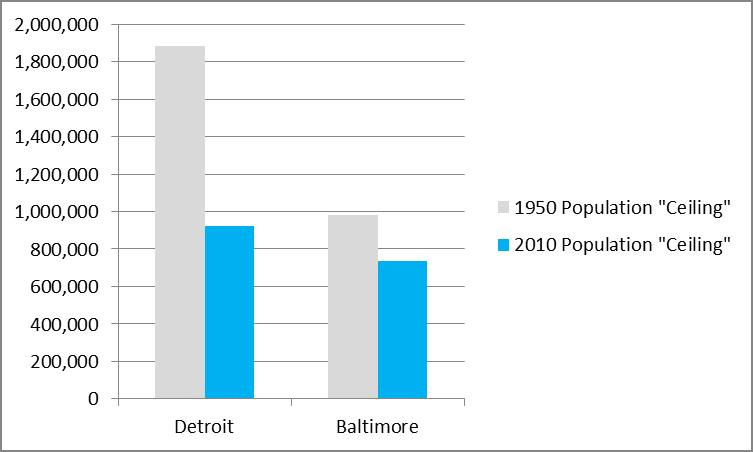
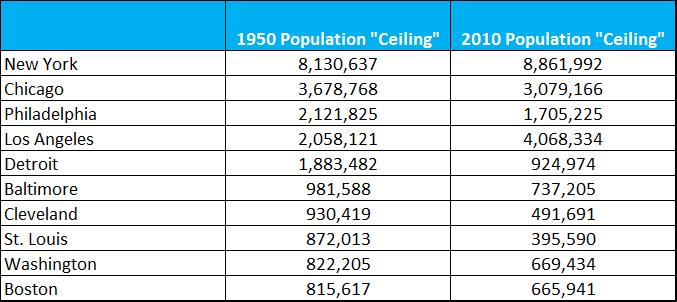
    I go on to suggest that population loss was inevitable for the most of the largest cities of mid-century America, and point out that today’s cities may never reach their previous population peaks.  I put together a cool table that demonstrates this:

    However, in putting this piece together I left quite a bit on the table, both in terms of graphics and additional content.  So consider this an addendum to the Forbes piece.

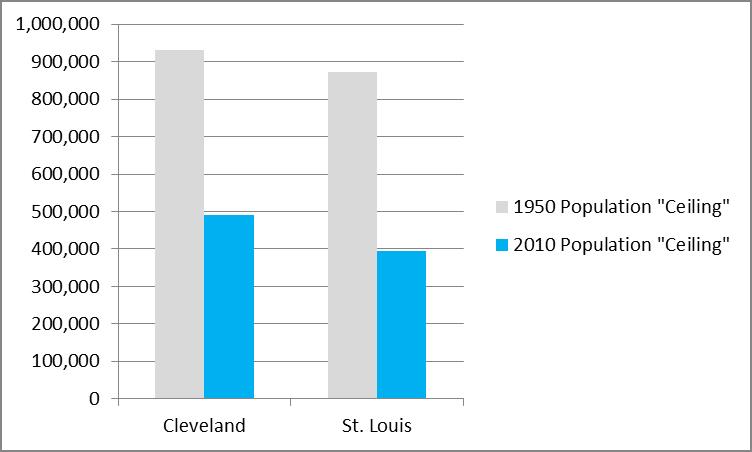
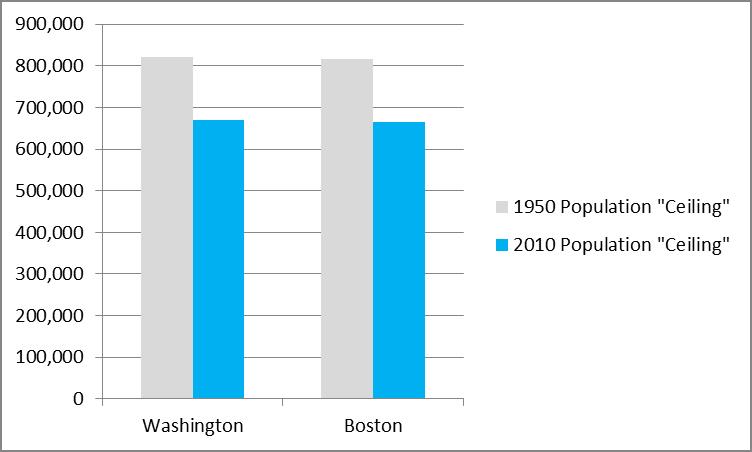
    First, I think it’s stunning to see a visual that illustrates the differences in a 1950 and 2010 population ceiling for the ten cities examined.  Check these out, shown two cities at a time:

    I think it is absolutely stunning to see that cities like Cleveland, Detroit and St. Louis could at best (at least right now) attain maybe half of their population in 1950.  And a case could be made that smaller household size may be the most significant factor in their decline.

    Three points I was unable to expand on in the Forbes piece.  First, now that the pendulum is swinging back in favor of cities, their influence is ascending faster than their population growth.  Cities are leading discussions now the economy, on infrastructure, on energy, on housing.  For the latter third of the 20th century the suburbs led that discussion.  But today, cities have reclaimed that role.  Their actual size, in terms of population, matters less today than it did 60 years ago.  

    Second, the American preference for new over old has nearly as much to do with this shift as shrinking household size.  For nearly 50 years the suburbs (and by extension, the Sun Belt) was new, and that was a main feature of their attraction.  But there’s also that saying, “everything old is new again.”  Cities are the new thing, and while they’re not everyone’s cup of tea, they are doing better than at any time in the last 50 years.

    Third, it’s conceivable that many suburbs and/or Sun Belt cities may find themselves impacted by emerging demographic or social shifts.  Having a huge inventory of single family homes in a world that is asking for multifamily options?  A strong auto-oriented landscape when more people are looking for walkable environments?  

    I’m not suggesting that all older cities are ascendant, and the suburbs and Sun Belt are doomed.  But staying ahead of trends may be the lesson all need to heed.

    Pete Saunders is a Detroit native who has worked as a public and private sector urban planner in the Chicago area for more than twenty years.  He is also the author of “The Corner Side Yard,” an urban planning blog that focuses on the redevelopment and revitalization of Rust Belt cities.

    Top photo: Vacant homes in Philadelphia, awaiting their revitalization.  Source: smartgrowthamerica.org

  • Eastern Europe Heads For A Brave Old World

    Will a unified Europe survive Britain’s vote on Brexit? The referendum of last June pointed the country out of the European Union. Will France or Italy follow suit? If so, it could doom the structure that began in the 1950s as a customs union, if not an uneasy economic alliance to keep Germany from rearming and dominating central Europe. And will a consequence of Brexit be the re-emergence of Russia as the dominant power in Eastern Europe? Or will the European Union last long enough to bring prosperity to the forgotten countries of Eastern Europe?

    I thought about these questions when I recently boarded a night train in Zurich. Switzerland has never been a member of the European Union, but it coexists with the EU through a series of bilateral agreements, similar to those that Britain will now seek. I was heading east on a series of sleepers that took me through Austria, Slovakia, Hungary, Serbia, and Bulgaria, precisely those countries that a unified Europe had aimed to lift into prosperity.

    I expected to find an absence of trade barriers, and see lands benefiting from the common currency, the euro, which is used by nineteen of the twenty-eight EU members. Instead, I felt as thought I was descending into a Brave Old World, that of a Europe with guarded borders and separate currencies, a land best imagined as lying on the far side of an economic Iron Curtain rather than a political one. Here’s the view from the train window:

    Austria: Along with its capital city, Vienna, Austria has been an EU winner. Into the 1980s Vienna was a cul-du-sac of the Cold War; the dead end, final stop of Western European laissez-faire economic polices that nestled against the dragon teeth and barbed wire of the Soviet sphere of influence.

    After the wall fell, Vienna became a glittering capital of central Europe, the ideal city for both corporate headquarters and long weekends at the opera. Its banks and companies flourished, and much trade with the new countries of the East began and ended in the Austrian capital, which lies on the western edge of the great Hungarian plains.

    Without the EU, however, Austria would be at risk of becoming a more dynamic Slovenia.

    Slovakia: A stepchild of the Soviet dissolution, Slovakia is the rump state to the east of the Czech Republic, the other half of divided Czechoslovakia. Its capital is in Bratislava, which is something of a Viennese suburb. The rest of the country, surrounded by Poland, Hungary, and Ukraine, is best understood as a heavy machine shop of collectivization, where there is now more demand for imported jeans than for Comecon turbines.

    An EU member in the Eurozone — that is, a member that uses the euro as its currency — Slovakia is betting its economic future on the basis of its low-costs and proximity to Austria, which has attracted a number of Western car companies, including Jaguar. A nice hotel room is €45.

    Conversely, Western consumers are indifferent to Slovakian products, goods, and services, which has positioned Turkey as one of the country’s leading trade partners.

    I spent an evening with a Slovakian who is fixing up his house. His solution wasn’t to order British or French fixtures from within the EU, but to import a container full from Istanbul, complete — so he implied — with Turkish workers to hitch up the low-cost appliances and lighting.

    Hungary: In the go-go years of European expansion, Hungary was the France of Eastern Europe, a proud civilization that dates back more than a thousand years. Its capital city, Budapest, is a place of grace and sophistication.

    London bankers invested their bonuses in Pest apartment flats, and discount airlines flooded the Buda hills with wandering tourists.

    In the soon-to-be-reordered European Union, Hungary could become neither here nor there. Its nationalist, right wing parties (70 percent of the recent election) dream of a Hungarian greatness that was lost at Trianon after World War I and in Transylvania. But the Hungarians have no idea whether its salvation lies in turning east toward Russia, north toward Germany, or west toward a fragmented EU.

    Without a lodestone that inspires optimism, Hungary finds it easier to blame its problems on gays, immigrants, Viennese bankers, and the EU, not to mention the protocols of the elders of Zion.

    Serbia: My overnight train from Budapest to Belgrade was covered with graffiti, giving it the air of a wayward New York City subway train from the 1970s, although one with couchettes and without break dancers.

    NATO bombed Belgrade in spring 1999, in support of Kosovo’s independence. Legally, Kosovo is an autonomous region of Serbia, but in practicality it is a NATO protectorate, the love child of Madeline Albright’s and Richard Holbrooke’s air campaign.

    Among the casualties of that air war was Serbian enthusiasm for all things American and European. The isolated, rump republic of 11 million Serbs has become an orphanage of disaffected Europeans who remain locked away from Western prosperity with a stillborn economy.

    In theory, Serbia, the nearby republics of Macedonia and Montenegro, and perhaps even a new republic in Kosovo were to rise into the middle class through membership in the European Union. In reality, the EU has no more appetite for Serbia’s tottering banks or pig farms than it does for more Greek debentures.

    Bulgaria: Sofia, the capital, is 225 miles from Belgrade, the same distance as Boston is from New York City, but my meandering sleeper took twelve hours to make the overnight trip, which included several hours at dawn on the Serbian-Bulgarian border, the site of many Balkan wars.

    Carved from the Ottoman Empire at the 1878 Treaty of Berlin, Bulgaria could rightfully claim to be both the last piece on the European chess board and the best barometer of EU efficacy in the twenty-first century. Some polls say it is the most unhappy EU member. As a city, Sofia is a pleasant combination of socialist realism, Balkan impressionism, and a few modern glass towers.

    I first visited it in summer 1976, when Bulgaria was hewing the Marxist line with Stalinist devotion. Now, in summer 2016, the oppression comes from a hybrid form of capitalism that mixes Leninist sympathies with mafia business practices. No wonder the EU isn’t in any rush to bring the euro to Bulgaria, although the country is a member of the confederation.

    Bulgaria’s political dilemma is that its gas is a hostage to fortunes in Russia and Ukraine (where all the pipelines originate), while its subsidies and regulations come from Brussels.

    ***

    Sadly, I doubt the EU will last much longer. Brexit marks the ebb tide of European optimism, and part of the reason the British voted themselves out is a wish to send home Hungarian, Slovak, and Bulgarian immigrants who despair of making a living in their own countries.

    Brexit is also a diplomatic move in the increasing cold war between Western Europe and Islam, whose fault lines run precisely through Bosnia, Albania, Bulgaria, Macedonia, and Turkey.

    When the Brexit vote took place, Europe was in the midst of a terror spree that had Muslim fanatics opening fire on shoppers in a Munich mall and driving a truck through a Nice street fair on Bastille Day. Is it any wonder that Britain, staring at refugees camped out in Calais, would raise the draw bridge?

    Brexit is also a victory for Putin’s Russia and its gangster capitalism. Until the invasions of Crimea and Ukraine, Russia felt encircled by NATO in Turkey and by the EU in the Baltic States. Now, however, Europe has the look of what diplomatic histories used to call a “dead letter,” leaving much of Eastern Europe vulnerable to a modern Russian Risorgimento.

    In the EU, only Germany is earning any money, and it is only a matter of time before Angela Merkel is voted out of office. A new leader there — appealing to nationalist sentiments — will ask German voters, “Why are you working for 4.5 years, on average, to pay the subsidies that are handed out to lazy Spaniards, Greeks, and Italians?”

    As someone who admired the European Union, riding trains from Zurich to Sofia reminded me of the downside of old Europe. I hated changing money in train stations, and being woken up by border guards at forlorn crossings like Dimitrograd (Serbia) or Kalotina (Bulgaria). More disturbing was to see, in Belgrade parks or along rail lines, Syrian refugees living like cattle that is drifting north across an arid plain.

    The EU was created to embrace free trade and freedom of movement across a continent of 400 million that, in the past, has failed to compensate for overlapping national claims by adjusting borders.

    Brexit is one overt expression of dissatisfaction with Europe. But EU failures can also be seen across countries that have changed little since Bismarck, an early Pan-European, said the Balkans were not “worth the bones” of a single Prussian grenadier.

    Matthew Stevenson, a contributing editor of Harper’s Magazine, is the author of, among other books Remembering the Twentieth Century Limited, and Whistle-Stopping America. His next book, Reading the Rails, is due out in August. He lives in Switzerland.

    Flickr photo by sbrrmk: Rhodope Mountains, Bulgaria
  • Welcome To Y’all Street: The Cities Challenging New York For Financial Supremacy

    From the earliest days of the Republic, banking and finance has largely been the purview of what one historian calls the “Yankee Empire.” Based largely in New York and Boston, later on financial centers grew along the main route of Yankee migration to Chicago and San Francisco.

    Yet, if you look at where financial jobs are now headed, perhaps it’s time, as the Dallas Morning News cheekily suggested recently, to substitute Y’all Street for Wall Street. Finance, increasingly conducted electronically, is no longer tethered to its traditional centers. Large global financial companies like UBSDeutsche Bank Morgan Stanley and Goldman Sachs are all committed to relocating operations to less expensive locations.

    In the U.S., this has benefited the South the most. This year’s list of the metro areas that are increasing employment in financial services at the fastest rate is led by first-place Nashville-Davidson-Murfreesboro-Franklin, Tenn., No. 2 Dallas-Plano-Irving, Texas, No. 4 Austin-Round Rock, Texas, and No. 5 Charlotte-Concord-Gastonia N.C.-S.C.

    Financial service employment is important, particularly since the recovery from the 2008 financial meltdown. The industry is second in the U.S. only to the professional and business services sector in terms of the number of people it employs in high-paying jobs (average salary: $62,860), and its recent growth has been spread across the country. Of the 70 large metro areas we studied, only three have lost financial jobs since 2010.

    Methodology

    To generate our ranking, we looked at employment growth in the 366 metropolitan statistical areas for which BLS has complete data going back to 2005, weighting growth over the short-, medium- and long-term in that span, and factoring in momentum — whether growth is slowing or accelerating. (For a detailed description of our methodology, click here.)

    The South Rises Again

    The shift to the South seems to be based on several factors: lower costs (including for housing), less regulation and expanding markets, driven by rapid population growth. As population has shifted to the South, most notably low-tax states like Tennessee and Texas, it has clearly increased local demand for financial services. But there’s also another factor: the migration of financial jobs from traditional centers such as New York, Chicago and Los Angeles.

    Our top emerging financial superstar, Nashville, has all these characteristics.

    Since 2010, the area’s financial workforce has expanded 24.5 percent to 60,900. Population growth and in-migration rates have been spectacular.

    Between 2010 and 2014, in-migration accounted for 65.4 percent of local population growth, the fifth highest proportion among the nation’s top 25 metro areas that added more than 100,000 people, while the overall population soared 10 percent.  Since the recession ended in 2009, employment has grown 21 percent while per capita income has risen 4 percent. Financial sector growth has come from firms with U.S. headquarters in the New York area, such as Switzerland-based UBS, as well as from locally based financial firms, like the investment bank Avondale Partners.

    But the biggest raw job gains, as we also found in professional and business services, are in No. 2 Dallas-Plano-Irving, where financial employment has expanded 23.2 percent since 2010 to 226,100 jobs, making the metro area the third-biggest financial services hub in the nation behind New York and Chicago. If the adjacent Ft. Worth area is added in, the region boasts a total of 282,000 financial job, behind only New York. Unlike Houston, slowed by the oil industry downturn, Dallas is on a super-sized roll.

    The Big D’s drive to become “y’all street” also stems from the recipe of large-scale population growth, low taxes, affordable housing and business friendliness. Large corporate relocations, such as Toyota from California, creates new demand both from business and consumers.

    To be sure, a New Yorker could scoff at the idea of Dallas replacing Manhattan as a financial center as something akin to the old Texas insult: all hat and no cattle. Yet it might behoove uppity Gothamites to pay more attention to the big Texas metroplex. The area’s dispersed financial institutions may not look like those associated with Manhattan, but they are growing more quickly, and in a place where middle managers can thrive on modest salaries. Then there’s the advantages of its central location, one of the things that led Comerica to move its headquarters to Dallas in 2007. More recently, State Farm and Liberty Mutual have opened large operations in the northern suburbs.

    But it’s not just Texas and Tennessee that are dominating the dispersion of financial services jobs. Before the recession, No. 5 Charlotte, N.C., had risen to become the second-largest financial center in the country, home to Bank of America and Wachovia. Wachovia fell hard in the financial crisis, and was swallowed by Wells Fargo, but BofA soldiers on, and the area clearly has recovered from the recession doldrums. Since 2010, the metro area’s financial workforce has grown 14.2 percent to 86,100 jobs, with 5 percent growth last year alone.

    The Rise Of The Mormon Belt?

    Outside the south, the other big growth area for financial services lies in the Intermountain West, the vast region between California’s Sierras and the Rockies. Two metro areas stand out in terms of financial growth: No. 3 Salt Lake City area and No. 6 Phoenix. Like the Texas cities, these metro areas offer middle managers a huge housing advantage; home prices, adjusted for incomes, are roughly half those in New York, Los Angeles and San Francisco.

    Salt Lake City’s financial services job count has grown 19.9 percent since 2010 to 55,200 jobs, with 6.2 percent growth last year alone. The Utah capital has gained particular renown as Goldman Sachs’fourth-largest global hub, and is slated to keep growing. Particularly attractive for Goldman is the language skills of returning Mormon missionaries.

    Rapid financial growth is now common across the “Mormon belt” that stretches from Arizona to Idaho. Among mid-sized metro areas (those with less than 450,000 nonfarm jobs),  Boise ranks second for financial services job growth, followed byProvo-Orem, Utah, and No. 5 Clearfield-Ogden. With young and well-educated workforce, and relatively low (particularly compared to California) housing prices, these areas are creating a whole new archipelago of financial centers.

    At the southern end of the Mormon belt sits Phoenix. Like the southern financial boom towns, the Valley of the Sun is booming both demographically and in terms of jobs; financial positions are up 19.7 percent since 2010.

    Much of this follows the movement of people from other parts of the country, notably California and the Midwest. Financial companies, too, are migrating south such as Chicago-based Northern Trust, which moved 1,000 jobs last year to Tempe, a close in Phoenix suburb. Growth in financial services has helped bring some life back to the long torpid office market, attracting new investors.

    The Big Boys

    Despite the growth in the top cities on our list, the central position of New York remains unassailable. After hard times amid the financial crisis, employment has risen a modest 6.3 percent since 2010 to 461,500, over 200,000 more than second-place Chicago, and salaries are on the rise again.

    What has changed is where the challenges may come from. Its onetime main rivals, 56th place Chicago-Naperville- Arlington Heights and Los Angeles (57th) are not even keeping pace, and seem destined to fall even further behind. Similarly,  other likely financial rivals, like No. 21 San Francisco-Redwood City-South San Francisco, No. 39 Boston-Cambridge-Newton or No. 49 Seattle-Bellevue-Everett aren’t growing fast enough to mount a major challenge.

    If New York’s supremacy is to be challenged, it will instead likely be from the lower-cost places that dominate our list in the South and Intermountain West. With the exception of Dallas, no single one of these metro areas could conceivably grow to be big enough to threaten Gotham’s leadership, but over time they could in aggregate weaken its predominance, spreading financial power to what are largely relatively youthful financial centers.

    This piece originally appeared in Forbes.

    Joel Kotkin is executive editor of NewGeography.com. He is the Roger Hobbs Distinguished Fellow in Urban Studies at Chapman University and executive director of the Houston-based Center for Opportunity Urbanism. His newest book, The Human City: Urbanism for the rest of us, will be published in April by Agate. He is also author of The New Class ConflictThe City: A Global History, and The Next Hundred Million: America in 2050. He lives in Orange County, CA.

    Michael Shires, Ph.D. is a professor at Pepperdine University School of Public Policy.

  • All Cities Financial Services Jobs – 2016 Best Cities Rankings

    Read about how we selected the 2016 Best Cities for Job Growth.

    2016 MSA Financial Activities Overall Ranking Area 2016 Fin Activities Weighted INDEX 2015 Financial Activities   Emplmt (1000s) Total Financial Activities Emplmt Growth Rate 2014-2015 2016 MSA Size Group 2015 MSA Financial Activities Overall Ranking 2016 FA Ranking Change from 2015 –
    All MSAs
    1 Pensacola-Ferry Pass-Brent, FL 98.2     11.8 6.61% M 5 4
    2 Nashville-Davidson-Murfreesboro-Franklin, TN 96.2     60.9 4.88% L 13 11
    3 Boise City, ID 94.8     16.7 5.70% M 16 13
    4 Dallas-Plano-Irving, TX Metro Div 94.8   226.1 5.28% L 26 22
    5 St. George, UT 94.6       2.3 9.52% S 38 33
    6 Tyler, TX 94.6       4.9 6.52% S 70 64
    7 Sherman-Denison, TX 94.2       3.4 10.87% S 56 49
    8 Provo-Orem, UT 92.8       7.4 4.72% M 117 109
    9 Salt Lake City, UT 92.2     55.2 6.22% L 50 41
    10 Fort Collins, CO 92.2       6.6 4.21% M 22 12
    11 Ogden-Clearfield, UT 92.1       9.8 6.93% M 81 70
    12 Yuma, AZ 91.8       1.9 7.55% S 262 250
    13 Trenton, NJ 90.6     19.4 5.23% M 96 83
    14 Jackson, TN 90.3       2.1 8.47% S 69 55
    15 Austin-Round Rock, TX 89.9     54.3 3.17% L 23 8
    16 Florence-Muscle Shoals, AL 89.1       2.4 4.35% S 58 42
    17 Portsmouth, NH-ME NECTA 88.7       6.1 7.65% S 24 7
    18 Sheboygan, WI 88.3       2.8 11.84% S 55 37
    19 Charlotte-Concord-Gastonia, NC-SC 87.9     86.1 5.00% L 41 22
    20 Phoenix-Mesa-Scottsdale, AZ 87.8   171.2 4.50% L 33 13
    21 Charleston-North Charleston, SC 87.7     14.2 2.16% M 44 23
    22 San Antonio-New Braunfels, TX 87.6     84.5 2.63% L 6 (16)
    23 Fargo, ND-MN 87.4     10.9 1.88% S 8 (15)
    24 Clarksville, TN-KY 87.1       3.2 3.19% S 61 37
    25 St. Cloud, MN 86.3       5.0 5.63% S 53 28
    26 Louisville/Jefferson County, KY-IN 86.1     47.3 3.50% L 36 10
    27 Macon, GA 85.7     10.0 2.38% S 29 2
    28 Naples-Immokalee-Marco Island, FL 85.6       8.1 3.39% S 12 (16)
    29 Bellingham, WA 85.6       3.4 5.15% S 4 (25)
    30 Logan, UT-ID 84.6       2.0 3.45% S 35 5
    31 Myrtle Beach-Conway-North Myrtle Beach, SC-NC 84.6       8.8 7.29% M 25 (6)
    32 Pittsfield, MA NECTA 84.5       2.1 6.78% S 93 61
    33 Richmond, VA 81.8     51.3 3.57% L 71 38
    34 Chico, CA 81.2       3.5 2.94% S 112 78
    35 Charlottesville, VA 81.1       4.6 4.55% S 59 24
    36 Miami-Miami Beach-Kendall, FL Metro Div 80.7     79.5 2.85% L 7 (29)
    37 Corpus Christi, TX 80.6       8.6 0.78% M 9 (28)
    38 Columbus, OH 80.2     80.7 3.42% L 158 120
    39 Sebastian-Vero Beach, FL 78.9       2.7 5.19% S 115 76
    40 Denver-Aurora-Lakewood, CO 78.7   104.4 4.30% L 76 36
    41 Wilmington, DE-MD-NJ Metro Div 78.3     43.4 1.96% M 43 2
    42 Oshkosh-Neenah, WI 77.8       4.2 2.44% S 39 (3)
    43 Owensboro, KY 77.7       3.7 0.00% S 11 (32)
    44 Raleigh, NC 77.7     29.5 4.36% L 229 185
    45 Tacoma-Lakewood, WA Metro Div 77.1     14.2 4.41% M 15 (30)
    46 Kahului-Wailuku-Lahaina, HI 77.0       2.9 3.57% S 46 0
    47 Kansas City, KS 76.0     35.3 2.42% L 72 25
    48 Ithaca, NY 75.3       1.8 3.92% S 57 9
    49 Tucson, AZ 75.2     18.8 7.21% M 184 135
    50 Tampa-St. Petersburg-Clearwater, FL 75.2   106.2 3.38% L 37 (13)
    51 Pocatello, ID 74.8       2.3 0.00% S 3 (48)
    52 Tuscaloosa, AL 74.5       4.2 4.13% S 126 74
    53 Spartanburg, SC 74.3       4.8 2.13% S 67 14
    54 Des Moines-West Des Moines, IA 74.0     55.6 4.71% M 111 57
    55 Savannah, GA 73.6       6.7 5.79% M 154 99
    56 Reno, NV 72.8     10.2 5.17% M 88 32
    57 Bangor, ME NECTA 72.7       2.2 4.69% S 204 147
    58 Houston-The Woodlands-Sugar Land, TX 72.4   152.4 1.65% L 99 41
    59 Bloomington, IN 71.8       2.8 -1.16% S 28 (31)
    60 Greeley, CO 71.6       4.6 2.24% S 124 64
    61 Gainesville, FL 71.2       6.6 2.60% S 177 116
    62 Cincinnati, OH-KY-IN 70.1     69.4 2.51% L 74 12
    63 Kennewick-Richland, WA 69.5       4.0 3.42% S 17 (46)
    64 Eugene, OR 69.0       7.9 5.33% M 237 173
    65 Deltona-Daytona Beach-Ormond Beach, FL 69.0       8.8 3.14% M 127 62
    66 Lakeland-Winter Haven, FL 69.0     12.5 5.35% M 195 129
    67 Kalamazoo-Portage, MI 68.8       8.3 3.75% S 244 177
    68 Warren-Troy-Farmington Hills, MI Metro Div 68.3     74.9 3.98% L 90 22
    69 Lansing-East Lansing, MI 68.1     15.6 1.74% M 52 (17)
    70 Durham-Chapel Hill, NC 67.9     13.9 -0.95% M 49 (21)
    71 Greenville-Anderson-Mauldin, SC 67.9     16.7 2.03% M 42 (29)
    72 Delaware County, PA 67.5     16.1 1.47% M 19 (53)
    73 Greenville, NC 67.2       2.8 1.20% S 31 (42)
    74 Lubbock, TX 66.9       7.7 1.32% S 51 (23)
    75 Grand Rapids-Wyoming, MI 66.8     25.2 1.34% L 64 (11)
    76 Beaumont-Port Arthur, TX 66.4       5.9 3.51% M 213 137
    77 Detroit-Dearborn-Livonia, MI Metro Div 66.3     34.6 5.49% L 80 3
    78 San Francisco-Redwood City-South San Francisco, CA Metro Div 66.2     74.1 3.30% L 68 (10)
    79 Santa Cruz-Watsonville, CA 65.8       3.6 3.85% S 83 4
    80 Las Cruces, NM 65.5       2.7 -1.23% S 40 (40)
    81 Dover-Durham, NH-ME NECTA 65.2       4.2 2.46% S 196 115
    82 Odessa, TX 65.1       3.5 -7.96% S 2 (80)
    83 West Palm Beach-Boca Raton-Delray Beach, FL Metro Div 64.9     40.1 2.56% L 47 (36)
    84 Albany, OR 64.9       1.5 2.27% S 20 (64)
    85 Visalia-Porterville, CA 64.9       4.1 4.20% S 169 84
    86 Buffalo-Cheektowaga-Niagara Falls, NY 64.8     34.1 2.71% L 107 21
    87 Wichita, KS 64.4     11.6 2.66% M 186 99
    88 Lafayette-West Lafayette, IN 64.0       3.6 1.89% S 162 74
    89 Coeur d’Alene, ID 63.9       3.3 2.06% S 119 30
    90 Northern Virginia, VA 63.7     71.0 2.85% L 136 46
    91 El Paso, TX 63.6     12.5 5.95% M 292 201
    92 San Angelo, TX 63.6       2.4 -2.70% S 77 (15)
    93 Fort Lauderdale-Pompano Beach-Deerfield Beach, FL Metro Div 63.5     58.5 4.22% L 108 15
    94 Punta Gorda, FL 63.4       2.0 5.26% S 281 187
    95 Portland-Vancouver-Hillsboro, OR-WA 63.4     67.3 3.54% L 121 26
    96 Napa, CA 62.9       2.4 4.35% S 266 170
    97 Crestview-Fort Walton Beach-Destin, FL 62.6       6.2 6.32% S 89 (8)
    98 Olympia-Tumwater, WA 62.2       4.1 0.82% S 27 (71)
    99 Orlando-Kissimmee-Sanford, FL 62.1     71.9 0.47% L 48 (51)
    100 Wilmington, NC 61.6       5.3 0.64% S 30 (70)
    101 Cape Coral-Fort Myers, FL 61.4     12.2 1.96% M 60 (41)
    102 Jacksonville, FL 61.2     62.6 2.57% L 95 (7)
    103 Lincoln, NE 61.0     14.6 1.16% M 78 (25)
    104 Oklahoma City, OK 60.9     33.5 -0.30% L 103 (1)
    105 Cedar Rapids, IA 60.8     10.8 0.93% S 109 4
    106 Colorado Springs, CO 60.6     17.1 3.23% M 203 97
    107 New York City, NY 60.5   461.5 1.73% L 114 7
    108 Atlanta-Sandy Springs-Roswell, GA 60.4   163.6 2.14% L 45 (63)
    109 Bend-Redmond, OR 60.3       4.5 4.65% S 155 46
    110 Albany-Schenectady-Troy, NY 60.3     26.2 2.88% L 171 61
    111 Little Rock-North Little Rock-Conway, AR 60.0     20.7 1.64% M 91 (20)
    112 Victoria, TX 59.9       2.1 -10.00% S 14 (98)
    113 Dayton, OH 59.9     17.9 2.48% M 140 27
    114 McAllen-Edinburg-Mission, TX 59.5       9.1 0.00% M 128 14
    115 Akron, OH 59.5     13.9 3.72% M 243 128
    116 St. Louis, MO-IL 59.4     86.1 0.98% L 134 18
    117 Portland-South Portland, ME NECTA 59.2     15.4 2.66% M 178 61
    118 San Jose-Sunnyvale-Santa Clara, CA 59.1     35.3 1.44% L 34 (84)
    119 Corvallis, OR 59.1       1.4 7.69% S 285 166
    120 Indianapolis-Carmel-Anderson, IN 58.9     63.4 2.59% L 92 (28)
    121 Auburn-Opelika, AL 58.9       1.9 0.00% S 123 2
    122 Omaha-Council Bluffs, NE-IA 58.6     42.7 2.15% L 146 24
    123 Washington-Arlington-Alexandria, DC-VA-MD-WV Metro Div 58.5   115.7 1.88% L 165 42
    124 Amarillo, TX 58.5       6.5 3.74% S 286 162
    125 Johnson City, TN 58.4       4.0 2.56% S 230 105
    126 Anaheim-Santa Ana-Irvine, CA Metro Div 58.3   117.6 2.35% L 65 (61)
    127 Green Bay, WI 58.3     12.0 -0.55% M 98 (29)
    128 Idaho Falls, ID 58.0       2.3 0.00% S 62 (66)
    129 Flagstaff, AZ 57.6       1.3 5.41% S 291 162
    130 La Crosse-Onalaska, WI-MN 57.4       3.9 1.75% S 147 17
    131 Columbus, GA-AL 57.1     13.4 -0.25% S 63 (68)
    132 Boston-Cambridge-Newton, MA NECTA Div 56.9   152.2 2.79% L 199 67
    133 Anniston-Oxford-Jacksonville, AL 56.6       1.4 0.00% S 32 (101)
    134 Manchester, NH NECTA 56.6       7.7 3.11% S 54 (80)
    135 Cheyenne, WY 56.2       2.3 0.00% S 106 (29)
    136 Killeen-Temple, TX 56.1       6.7 -8.22% S 1 (135)
    137 Topeka, KS 56.1       7.5 0.90% S 75 (62)
    138 Grand Junction, CO 55.8       3.2 1.06% S 145 7
    139 Providence-Warwick, RI-MA NECTA 55.8     35.8 2.38% L 152 13
    140 Sacramento-Roseville-Arden-Arcade, CA 55.7     51.5 3.55% L 219 79
    141 Columbia, SC 55.4     29.8 0.22% M 143 2
    142 Lake Havasu City-Kingman, AZ 55.3       1.7 2.00% S 294 152
    143 Knoxville, TN 54.9     18.6 0.18% M 228 85
    144 Minneapolis-St. Paul-Bloomington, MN-WI 54.8   148.1 2.07% L 174 30
    145 Niles-Benton Harbor, MI 54.8       2.3 4.55% S 265 120
    146 Sierra Vista-Douglas, AZ 54.7       1.0 3.45% S 327 181
    147 Scranton-Wilkes-Barre-Hazleton, PA 54.6     12.6 1.88% M 231 84
    148 Yuba City, CA 54.6       1.4 5.00% S 161 13
    149 Barnstable Town, MA NECTA 54.5       3.8 2.73% S 216 67
    150 Bay City, MI 54.0       1.4 7.69% S 336 186
    151 Baton Rouge, LA 53.9     18.4 0.00% M 176 25
    152 Santa Rosa, CA 53.8       8.1 3.42% M 144 (8)
    153 Midland, TX 53.3       4.0 -11.76% S 10 (143)
    154 Fort Worth-Arlington, TX Metro Div 53.1     56.3 0.78% L 129 (25)
    155 Hanford-Corcoran, CA 53.0       1.0 0.00% S 280 125
    156 San Diego-Carlsbad, CA 52.9     72.5 3.97% L 209 53
    157 Asheville, NC 52.4       6.0 0.00% M 110 (47)
    158 Springfield, MO 52.2     12.1 1.12% M 212 54
    159 Columbus, IN 52.1       1.4 0.00% S 86 (73)
    160 Altoona, PA 52.0       1.6 6.67% S 181 21
    161 Framingham, MA NECTA Div 51.9       5.8 1.16% M 18 (143)
    162 Grand Forks, ND-MN 51.6       1.8 0.00% S 122 (40)
    163 New Orleans-Metairie, LA 51.6     28.2 -1.40% L 125 (38)
    164 San Luis Obispo-Paso Robles-Arroyo Grande, CA 51.2       4.2 2.44% S 250 86
    165 Urban Honolulu, HI 50.8     21.4 2.07% L 139 (26)
    166 Battle Creek, MI 50.8       1.3 8.33% S 318 152
    167 Riverside-San Bernardino-Ontario, CA 50.7     43.4 1.64% L 100 (67)
    168 Las Vegas-Henderson-Paradise, NV 50.7     44.6 0.15% L 130 (38)
    169 North Port-Sarasota-Bradenton, FL 50.3     14.9 1.59% M 193 24
    170 Appleton, WI 50.1       7.2 2.37% S 215 45
    171 Bloomington, IL 49.5     20.2 3.41% S 321 150
    172 College Station-Bryan, TX 49.4       3.8 -0.87% S 104 (68)
    173 Kingston, NY 49.2       2.3 4.55% S 330 157
    174 Montgomery, AL 49.0       7.6 1.34% M 208 34
    175 Madera, CA 48.7       0.8 0.00% S 85 (90)
    176 Springfield, MA-CT NECTA 48.7     17.2 0.78% M 133 (43)
    177 Redding, CA 48.6       2.6 1.30% S 188 11
    178 Salisbury, MD-DE 48.4       6.5 7.18% M 293 115
    179 Seattle-Bellevue-Everett, WA Metro Div 48.1     83.2 2.63% L 73 (106)
    180 Fort Wayne, IN 47.9     11.7 2.64% M 211 31
    181 Nashua, NH-MA NECTA Div 47.8       7.7 5.45% S 298 117
    182 Huntsville, AL 47.5       6.3 0.53% M 225 43
    183 Kankakee, IL 47.3       2.0 0.00% S 270 87
    184 Prescott, AZ 47.1       1.9 0.00% S 163 (21)
    185 New Haven, CT NECTA 47.0     12.7 1.60% M 116 (69)
    186 Montgomery County-Bucks County-Chester County, PA Metro Div 46.9     78.5 1.55% L 191 5
    187 Madison, WI 46.7     23.4 0.57% M 168 (19)
    188 Kansas City, MO 46.5     40.0 0.76% L 190 2
    189 Chattanooga, TN-GA 46.3     15.5 3.34% M 305 116
    190 Walla Walla, WA 46.1       1.0 11.11% S 274 84
    191 Sioux Falls, SD 46.0     16.1 0.62% M 246 55
    192 Laredo, TX 46.0       3.9 0.00% S 254 62
    193 Tulsa, OK 45.9     23.5 2.32% M 249 56
    194 Charleston, WV 45.9       8.9 -1.12% S 135 (59)
    195 Bismarck, ND 45.9       3.4 0.00% S 253 58
    196 Hickory-Lenoir-Morganton, NC 45.8       3.3 1.02% S 271 75
    197 Birmingham-Hoover, AL 45.7     42.2 0.08% L 94 (103)
    198 Longview, TX 45.3       4.0 -1.64% S 151 (47)
    199 Medford, OR 44.3       3.8 3.64% S 105 (94)
    200 Hagerstown-Martinsburg, MD-WV 44.0       8.3 -2.35% S 170 (30)
    201 Winston-Salem, NC 43.7     13.1 0.77% M 241 40
    202 New Bedford, MA NECTA 43.6       1.9 1.75% S 131 (71)
    203 Fayetteville-Springdale-Rogers, AR-MO 43.4       6.9 1.98% M 187 (16)
    204 Philadelphia City, PA 43.4     42.7 1.67% L 167 (37)
    205 Virginia Beach-Norfolk-Newport News, VA-NC 42.9     37.7 0.09% L 189 (16)
    206 Lake County-Kenosha County, IL-WI Metro Div 42.9     20.8 2.12% M 232 26
    207 Worcester, MA-CT NECTA 42.7     15.2 -0.44% M 120 (87)
    208 Albuquerque, NM 42.7     18.2 1.87% M 248 40
    209 Canton-Massillon, OH 42.4       8.2 1.23% M 172 (37)
    210 Ann Arbor, MI 42.4       7.2 -1.36% M 118 (92)
    211 Burlington, NC 42.1       1.9 0.00% S 101 (110)
    212 Spokane-Spokane Valley, WA 41.9     13.1 -0.76% M 21 (191)
    213 Grants Pass, OR 41.5       1.3 0.00% S 222 9
    214 Panama City, FL 41.3       4.4 0.77% S 142 (72)
    215 Nassau County-Suffolk County, NY Metro Div 41.2     73.6 0.09% L 257 42
    216 Norwich-New London-Westerly, CT-RI NECTA 40.8       3.1 3.33% S 313 97
    217 Fresno, CA 40.4     13.2 2.33% M 234 17
    218 Chicago-Naperville-Arlington Heights, IL Metro Div 39.9   253.4 1.23% L 242 24
    219 Casper, WY 39.8       2.0 -4.76% S 82 (137)
    220 Los Angeles-Long Beach-Glendale, CA Metro Div 39.6   215.9 1.55% L 239 19
    221 Eau Claire, WI 39.6       3.7 2.78% S 247 26
    222 Roanoke, VA 39.6       8.4 0.00% M 180 (42)
    223 Bakersfield, CA 39.4       8.5 -1.16% M 159 (64)
    224 Lancaster, PA 39.0       8.7 0.00% M 192 (32)
    225 Elgin, IL Metro Div 38.7     10.8 -1.52% M 206 (19)
    226 Glens Falls, NY 38.7       1.9 0.00% S 223 (3)
    227 Memphis, TN-MS-AR 38.6     28.0 2.07% L 258 31
    228 Jackson, MI 38.5       1.8 0.00% S 97 (131)
    229 Anchorage, AK 38.4       8.1 1.67% M 138 (91)
    230 Rapid City, SD 38.0       3.9 -5.60% S 102 (128)
    231 Ocala, FL 37.8       4.2 2.44% S 296 65
    232 Jackson, MS 37.8     15.4 1.31% M 289 57
    233 Muskegon, MI 37.3       1.8 1.89% S 252 19
    234 Dover, DE 37.2       1.7 2.04% S 201 (33)
    235 Bergen-Hudson-Passaic, NJ 37.2     68.6 2.95% L 331 96
    236 Erie, PA 37.1       6.2 0.00% S 66 (170)
    237 Abilene, TX 36.9       3.6 -0.92% S 260 23
    238 Kokomo, IN 36.4       1.1 3.03% S 304 66
    239 Pittsburgh, PA 35.9     69.1 -1.05% L 264 25
    240 Rockford, IL 35.8       5.6 0.60% M 148 (92)
    241 Boulder, CO 35.6       7.2 0.00% M 149 (92)
    242 Cleveland-Elyria, OH 35.5     65.1 0.72% L 160 (82)
    243 Camden, NJ Metro Div 35.2     28.8 2.13% L 322 79
    244 Springfield, OH 34.9       3.9 -11.28% S 132 (112)
    245 Janesville-Beloit, WI 34.6       1.8 0.00% S 164 (81)
    246 Cleveland, TN 34.2       1.4 0.00% S 288 42
    247 Rochester, NY 34.0     21.0 -3.38% L 175 (72)
    248 Evansville, IN-KY 33.5       4.8 -1.37% M 200 (48)
    249 Michigan City-La Porte, IN 33.4       1.2 -2.70% S 113 (136)
    250 Toledo, OH 33.3     10.4 0.97% M 214 (36)
    251 Lexington-Fayette, KY 33.2       9.7 1.40% M 299 48
    252 Fond du Lac, WI 33.0       1.8 0.00% S 301 49
    253 Allentown-Bethlehem-Easton, PA-NJ 32.9     14.9 -0.22% M 157 (96)
    254 Bridgeport-Stamford-Norwalk, CT NECTA 31.9     41.0 -0.16% M 308 54
    255 Muncie, IN 31.9       2.4 0.00% S 323 68
    256 Duluth, MN-WI 31.9       5.6 -2.87% S 295 39
    257 Brownsville-Harlingen, TX 31.8       5.1 -1.29% S 224 (33)
    258 Wichita Falls, TX 31.6       2.6 0.00% S 278 20
    259 Dothan, AL 31.6       2.0 1.69% S 333 74
    260 Salinas, CA 31.6       4.1 1.67% S 314 54
    261 Terre Haute, IN 31.6       2.5 -2.60% S 238 (23)
    262 Middlesex-Monmouth-Ocean, NJ 31.6     41.5 0.00% L 269 7
    263 Peoria, IL 31.3       7.4 -0.90% M 173 (90)
    264 Peabody-Salem-Beverly, MA NECTA Div 31.1       4.3 0.00% S 251 (13)
    265 Burlington-South Burlington, VT NECTA 30.6       4.7 -1.40% S 156 (109)
    266 Lewiston, ID-WA 30.5       1.6 0.00% S 194 (72)
    267 Newark, NJ-PA Metro Div 30.3     80.6 1.81% L 197 (70)
    268 Wausau, WI 30.1       5.0 0.67% S 284 16
    269 Orange-Rockland-Westchester, NY 29.7     37.1 -0.54% L 259 (10)
    270 Silver Spring-Frederick-Rockville, MD Metro Div 29.7     39.0 0.69% L 337 67
    271 Hartford-West Hartford-East Hartford, CT NECTA 28.8     57.4 1.18% L 317 46
    272 Waco, TX 28.5       6.2 -1.07% S 221 (51)
    273 Gary, IN Metro Div 28.4       8.6 0.00% M 235 (38)
    274 Augusta-Richmond County, GA-SC 27.9       7.7 0.87% M 79 (195)
    275 Lynchburg, VA 27.5       4.7 -2.08% S 141 (134)
    276 South Bend-Mishawaka, IN-MI 27.4       5.4 1.90% S 279 3
    277 Oakland-Hayward-Berkeley, CA Metro Div 27.0     48.9 -1.08% L 220 (57)
    278 Vallejo-Fairfield, CA 26.7       4.9 2.08% S 300 22
    279 Reading, PA 26.4       6.1 2.25% M 338 59
    280 Lawrence-Methuen Town-Salem, MA-NH NECTA Div 26.2       2.2 0.00% S 340 60
    281 York-Hanover, PA 26.0       5.1 -0.65% M 137 (144)
    282 Atlantic City-Hammonton, NJ 25.8       3.9 0.87% S 297 15
    283 Gadsden, AL 25.7       1.3 0.00% S 287 4
    284 Kingsport-Bristol-Bristol, TN-VA 25.6       3.6 0.93% S 344 60
    285 El Centro, CA 25.0       1.3 -4.88% S 166 (119)
    286 Texarkana, TX-AR 24.8       2.3 0.00% S 275 (11)
    287 Palm Bay-Melbourne-Titusville, FL 24.8       7.2 0.93% M 240 (47)
    288 Elmira, NY 24.6       1.4 -6.67% S 198 (90)
    289 Champaign-Urbana, IL 24.5       4.2 -1.57% S 179 (110)
    290 Gulfport-Biloxi-Pascagoula, MS 24.4       5.2 0.00% M 339 49
    291 Lowell-Billerica-Chelmsford, MA-NH NECTA Div 24.4       3.7 0.91% S 324 33
    292 Leominster-Gardner, MA NECTA 24.1       1.6 2.13% S 290 (2)
    293 Decatur, AL 23.8       2.0 -1.67% S 153 (140)
    294 Johnstown, PA 23.7       2.7 0.00% S 226 (68)
    295 Salem, OR 23.5       6.9 -1.44% M 183 (112)
    296 Waterbury, CT NECTA 23.2       2.0 0.00% S 263 (33)
    297 Rochester, MN 23.1       2.7 0.00% S 218 (79)
    298 Fayetteville, NC 23.0       3.8 -0.86% S 261 (37)
    299 Waterloo-Cedar Falls, IA 22.8       4.8 -2.70% S 283 (16)
    300 Harrisburg-Carlisle, PA 22.6     22.0 -2.37% M 87 (213)
    301 Huntington-Ashland, WV-KY-OH 22.6       6.9 -0.48% S 303 2
    302 Baltimore City, MD 22.4     17.6 -0.19% M 273 (29)
    303 Modesto, CA 22.1       5.2 0.65% M 217 (86)
    304 Shreveport-Bossier City, LA 21.9       7.4 -2.64% M 236 (68)
    305 Danville, IL 21.9       1.3 0.00% S 329 24
    306 Fairbanks, AK 21.5       1.2 0.00% S 328 22
    307 Calvert-Charles-Prince George’s, MD 21.4     13.4 0.50% M 335 28
    308 Utica-Rome, NY 21.0       7.0 -1.41% S 233 (75)
    309 Port St. Lucie, FL 20.6       5.2 -0.63% S 205 (104)
    310 Santa Maria-Santa Barbara, CA 20.6       6.3 -0.52% M 210 (100)
    311 Milwaukee-Waukesha-West Allis, WI 20.2     50.6 -2.51% L 182 (129)
    312 Merced, CA 20.1       1.5 -4.26% S 268 (44)
    313 Tallahassee, FL 19.7       7.0 0.48% M 245 (68)
    314 Stockton-Lodi, CA 19.7       7.3 -1.35% M 256 (58)
    315 Saginaw, MI 19.6       3.6 -0.91% S 302 (13)
    316 Flint, MI 19.5       6.2 -1.06% S 282 (34)
    317 Santa Fe, NM 18.8       2.5 -1.33% S 276 (41)
    318 Greensboro-High Point, NC 18.7     17.8 1.33% M 325 7
    319 Morristown, TN 18.5       1.0 0.00% S 227 (92)
    320 Brockton-Bridgewater-Easton, MA NECTA Div 18.4       2.2 -8.33% S 207 (113)
    321 Taunton-Middleborough-Norton, MA NECTA Div 18.4       1.8 1.89% S 341 20
    322 Lawton, OK 18.2       2.2 -4.35% S 334 12
    323 Binghamton, NY 18.1       3.5 0.00% S 316 (7)
    324 Syracuse, NY 17.1     15.5 -1.90% M 310 (14)
    325 Elkhart-Goshen, IN 17.0       2.7 0.00% S 326 1
    326 Mobile, AL 16.8       8.1 -1.22% M 319 (7)
    327 Fort Smith, AR-OK 16.6       3.7 -3.45% S 267 (60)
    328 Watertown-Fort Drum, NY 16.3       1.2 0.00% S 342 14
    329 Haverhill-Newburyport-Amesbury Town, MA-NH NECTA Div 15.0       2.0 -4.76% S 306 (23)
    330 Springfield, IL 14.1       6.7 -3.37% S 311 (19)
    331 Lynn-Saugus-Marblehead, MA NECTA Div 14.0       1.9 -1.72% S 150 (181)
    332 Dutchess County-Putnam County, NY Metro Div 13.2       4.8 -0.69% S 332 0
    333 Lewiston-Auburn, ME NECTA 12.9       2.2 -4.35% S 84 (249)
    334 Decatur, IL 12.6       1.8 -5.26% S 255 (79)
    335 Youngstown-Warren-Boardman, OH-PA 12.3       7.3 -1.35% M 315 (20)
    336 Lafayette, LA 12.2     10.8 -9.97% M 202 (134)
    337 Pueblo, CO 10.8       1.8 -5.36% S 185 (152)
    338 Davenport-Moline-Rock Island, IA-IL 10.7       7.3 -1.36% M 277 (61)
    339 Oxnard-Thousand Oaks-Ventura, CA 9.0     17.6 -3.83% M 312 (27)
    340 San Rafael, CA Metro Div 8.8       6.3 -4.06% S 307 (33)
    341 Monroe, MI 8.5       1.0 -3.23% S 320 (21)
    342 Mansfield, OH 4.6       1.4 -6.67% S 272 (70)
    343 Vineland-Bridgeton, NJ 3.5       1.3 -7.14% S 309 (34)
    344 Racine, WI 3.3       2.3 -5.41% S 343 (1)
  • Large Cities Financial Services Jobs – 2016 Best Cities Rankings

    Read about how we selected the 2016 Best Cities for Job Growth.

    2016  Financial Activities Ranking – Large MSAs Area 2016 Fin Activities Weighted INDEX 2015 Financial Activities   Emplmt (1000s) Total Financial Activities Emplmt Growth Rate 2014-2015 2015  Financial Activities Ranking – Large MSAs 2016 FA Ranking Change from 2015 –
    Large MSAs
    1 Nashville-Davidson-Murfreesboro-Franklin, TN 96.2     60.9 4.88% 3 2
    2 Dallas-Plano-Irving, TX Metro Div 94.8   226.1 5.28% 5 3
    3 Salt Lake City, UT 92.2     55.2 6.22% 14 11
    4 Austin-Round Rock, TX 89.9     54.3 3.17% 4 0
    5 Charlotte-Concord-Gastonia, NC-SC 87.9     86.1 5.00% 10 5
    6 Phoenix-Mesa-Scottsdale, AZ 87.8   171.2 4.50% 6 0
    7 San Antonio-New Braunfels, TX 87.6     84.5 2.63% 1 (6)
    8 Louisville/Jefferson County, KY-IN 86.1     47.3 3.50% 8 0
    9 Richmond, VA 81.8     51.3 3.57% 18 9
    10 Miami-Miami Beach-Kendall, FL Metro Div 80.7     79.5 2.85% 2 (8)
    11 Columbus, OH 80.2     80.7 3.42% 43 32
    12 Denver-Aurora-Lakewood, CO 78.7   104.4 4.30% 22 10
    13 Raleigh, NC 77.7     29.5 4.36% 59 46
    14 Kansas City, KS 76.0     35.3 2.42% 19 5
    15 Tampa-St. Petersburg-Clearwater, FL 75.2   106.2 3.38% 9 (6)
    16 Houston-The Woodlands-Sugar Land, TX 72.4   152.4 1.65% 28 12
    17 Cincinnati, OH-KY-IN 70.1     69.4 2.51% 21 4
    18 Warren-Troy-Farmington Hills, MI Metro Div 68.3     74.9 3.98% 24 6
    19 Grand Rapids-Wyoming, MI 66.8     25.2 1.34% 15 (4)
    20 Detroit-Dearborn-Livonia, MI Metro Div 66.3     34.6 5.49% 23 3
    21 San Francisco-Redwood City-South San Francisco, CA Metro Div 66.2     74.1 3.30% 17 (4)
    22 West Palm Beach-Boca Raton-Delray Beach, FL Metro Div 64.9     40.1 2.56% 12 (10)
    23 Buffalo-Cheektowaga-Niagara Falls, NY 64.8     34.1 2.71% 31 8
    24 Northern Virginia, VA 63.7     71.0 2.85% 39 15
    25 Fort Lauderdale-Pompano Beach-Deerfield Beach, FL Metro Div 63.5     58.5 4.22% 32 7
    26 Portland-Vancouver-Hillsboro, OR-WA 63.4     67.3 3.54% 34 8
    27 Orlando-Kissimmee-Sanford, FL 62.1     71.9 0.47% 13 (14)
    28 Jacksonville, FL 61.2     62.6 2.57% 27 (1)
    29 Oklahoma City, OK 60.9     33.5 -0.30% 30 1
    30 New York City, NY 60.5   461.5 1.73% 33 3
    31 Atlanta-Sandy Springs-Roswell, GA 60.4   163.6 2.14% 11 (20)
    32 Albany-Schenectady-Troy, NY 60.3     26.2 2.88% 47 15
    33 St. Louis, MO-IL 59.4     86.1 0.98% 38 5
    34 San Jose-Sunnyvale-Santa Clara, CA 59.1     35.3 1.44% 7 (27)
    35 Indianapolis-Carmel-Anderson, IN 58.9     63.4 2.59% 25 (10)
    36 Omaha-Council Bluffs, NE-IA 58.6     42.7 2.15% 41 5
    37 Washington-Arlington-Alexandria, DC-VA-MD-WV Metro Div 58.5   115.7 1.88% 45 8
    38 Anaheim-Santa Ana-Irvine, CA Metro Div 58.3   117.6 2.35% 16 (22)
    39 Boston-Cambridge-Newton, MA NECTA Div 56.9   152.2 2.79% 55 16
    40 Providence-Warwick, RI-MA NECTA 55.8     35.8 2.38% 42 2
    41 Sacramento-Roseville-Arden-Arcade, CA 55.7     51.5 3.55% 57 16
    42 Minneapolis-St. Paul-Bloomington, MN-WI 54.8   148.1 2.07% 48 6
    43 Fort Worth-Arlington, TX Metro Div 53.1     56.3 0.78% 36 (7)
    44 San Diego-Carlsbad, CA 52.9     72.5 3.97% 56 12
    45 New Orleans-Metairie, LA 51.6     28.2 -1.40% 35 (10)
    46 Urban Honolulu, HI 50.8     21.4 2.07% 40 (6)
    47 Riverside-San Bernardino-Ontario, CA 50.7     43.4 1.64% 29 (18)
    48 Las Vegas-Henderson-Paradise, NV 50.7     44.6 0.15% 37 (11)
    49 Seattle-Bellevue-Everett, WA Metro Div 48.1     83.2 2.63% 20 (29)
    50 Montgomery County-Bucks County-Chester County, PA Metro Div 46.9     78.5 1.55% 53 3
    51 Kansas City, MO 46.5     40.0 0.76% 52 1
    52 Birmingham-Hoover, AL 45.7     42.2 0.08% 26 (26)
    53 Philadelphia City, PA 43.4     42.7 1.67% 46 (7)
    54 Virginia Beach-Norfolk-Newport News, VA-NC 42.9     37.7 0.09% 51 (3)
    55 Nassau County-Suffolk County, NY Metro Div 41.2     73.6 0.09% 62 7
    56 Chicago-Naperville-Arlington Heights, IL Metro Div 39.9   253.4 1.23% 61 5
    57 Los Angeles-Long Beach-Glendale, CA Metro Div 39.6   215.9 1.55% 60 3
    58 Memphis, TN-MS-AR 38.6     28.0 2.07% 63 5
    59 Bergen-Hudson-Passaic, NJ 37.2     68.6 2.95% 69 10
    60 Pittsburgh, PA 35.9     69.1 -1.05% 65 5
    61 Cleveland-Elyria, OH 35.5     65.1 0.72% 44 (17)
    62 Camden, NJ Metro Div 35.2     28.8 2.13% 68 6
    63 Rochester, NY 34.0     21.0 -3.38% 49 (14)
    64 Middlesex-Monmouth-Ocean, NJ 31.6     41.5 0.00% 66 2
    65 Newark, NJ-PA Metro Div 30.3     80.6 1.81% 54 (11)
    66 Orange-Rockland-Westchester, NY 29.7     37.1 -0.54% 64 (2)
    67 Silver Spring-Frederick-Rockville, MD Metro Div 29.7     39.0 0.69% 70 3
    68 Hartford-West Hartford-East Hartford, CT NECTA 28.8     57.4 1.18% 67 (1)
    69 Oakland-Hayward-Berkeley, CA Metro Div 27.0     48.9 -1.08% 58 (11)
    70 Milwaukee-Waukesha-West Allis, WI 20.2     50.6 -2.51% 50 (20)
  • Mid Sized Cities Financial Services Jobs – 2016 Best Cities Rankings

    Read about how we selected the 2016 Best Cities for Job Growth.

    2016  Financial Activities Ranking – Midsized MSAs Area 2016 Fin Activities Weighted INDEX 2015 Financial Activities   Emplmt (1000s) Total Financial Activities Emplmt Growth Rate 2014-2015 2015  Financial Activities Ranking – Midsized MSAs 2016 FA Ranking Change from 2015 –
    Midsized MSAs
    1 Pensacola-Ferry Pass-Brent, FL 98.2     11.8 6.61% 1 0
    2 Boise City, ID 94.8     16.7 5.70% 4 2
    3 Provo-Orem, UT 92.8       7.4 4.72% 25 22
    4 Fort Collins, CO 92.2       6.6 4.21% 8 4
    5 Ogden-Clearfield, UT 92.1       9.8 6.93% 16 11
    6 Trenton, NJ 90.6     19.4 5.23% 20 14
    7 Charleston-North Charleston, SC 87.7     14.2 2.16% 10 3
    8 Myrtle Beach-Conway-North Myrtle Beach, SC-NC 84.6       8.8 7.29% 8 0
    9 Corpus Christi, TX 80.6       8.6 0.78% 2 (7)
    10 Wilmington, DE-MD-NJ Metro Div 78.3     43.4 1.96% 9 (1)
    11 Tacoma-Lakewood, WA Metro Div 77.1     14.2 4.41% 3 (8)
    12 Tucson, AZ 75.2     18.8 7.21% 48 36
    13 Des Moines-West Des Moines, IA 74.0     55.6 4.71% 23 10
    14 Savannah, GA 73.6       6.7 5.79% 38 24
    15 Reno, NV 72.8     10.2 5.17% 18 3
    16 Eugene, OR 69.0       7.9 5.33% 72 56
    17 Deltona-Daytona Beach-Ormond Beach, FL 69.0       8.8 3.14% 28 11
    18 Lakeland-Winter Haven, FL 69.0     12.5 5.35% 53 35
    19 Lansing-East Lansing, MI 68.1     15.6 1.74% 12 (7)
    20 Durham-Chapel Hill, NC 67.9     13.9 -0.95% 11 (9)
    21 Greenville-Anderson-Mauldin, SC 67.9     16.7 2.03% 8 (13)
    22 Delaware County, PA 67.5     16.1 1.47% 6 (16)
    23 Beaumont-Port Arthur, TX 66.4       5.9 3.51% 62 39
    24 Wichita, KS 64.4     11.6 2.66% 49 25
    25 El Paso, TX 63.6     12.5 5.95% 82 57
    26 Cape Coral-Fort Myers, FL 61.4     12.2 1.96% 13 (13)
    27 Lincoln, NE 61.0     14.6 1.16% 14 (13)
    28 Colorado Springs, CO 60.6     17.1 3.23% 56 28
    29 Little Rock-North Little Rock-Conway, AR 60.0     20.7 1.64% 19 (10)
    30 Dayton, OH 59.9     17.9 2.48% 33 3
    31 McAllen-Edinburg-Mission, TX 59.5       9.1 0.00% 29 (2)
    32 Akron, OH 59.5     13.9 3.72% 74 42
    33 Portland-South Portland, ME NECTA 59.2     15.4 2.66% 45 12
    34 Green Bay, WI 58.3     12.0 -0.55% 21 (13)
    35 Columbia, SC 55.4     29.8 0.22% 34 (1)
    36 Knoxville, TN 54.9     18.6 0.18% 66 30
    37 Scranton-Wilkes-Barre-Hazleton, PA 54.6     12.6 1.88% 67 30
    38 Baton Rouge, LA 53.9     18.4 0.00% 44 6
    39 Santa Rosa, CA 53.8       8.1 3.42% 35 (4)
    40 Asheville, NC 52.4       6.0 0.00% 22 (18)
    41 Springfield, MO 52.2     12.1 1.12% 61 20
    42 Framingham, MA NECTA Div 51.9       5.8 1.16% 5 (37)
    43 North Port-Sarasota-Bradenton, FL 50.3     14.9 1.59% 52 9
    44 Montgomery, AL 49.0       7.6 1.34% 58 14
    45 Springfield, MA-CT NECTA 48.7     17.2 0.78% 30 (15)
    46 Salisbury, MD-DE 48.4       6.5 7.18% 83 37
    47 Fort Wayne, IN 47.9     11.7 2.64% 60 13
    48 Huntsville, AL 47.5       6.3 0.53% 65 17
    49 New Haven, CT NECTA 47.0     12.7 1.60% 24 (25)
    50 Madison, WI 46.7     23.4 0.57% 41 (9)
    51 Chattanooga, TN-GA 46.3     15.5 3.34% 84 33
    52 Sioux Falls, SD 46.0     16.1 0.62% 76 24
    53 Tulsa, OK 45.9     23.5 2.32% 77 24
    54 Winston-Salem, NC 43.7     13.1 0.77% 73 19
    55 Fayetteville-Springdale-Rogers, AR-MO 43.4       6.9 1.98% 50 (5)
    56 Lake County-Kenosha County, IL-WI Metro Div 42.9     20.8 2.12% 68 12
    57 Worcester, MA-CT NECTA 42.7     15.2 -0.44% 27 (30)
    58 Albuquerque, NM 42.7     18.2 1.87% 76 18
    59 Canton-Massillon, OH 42.4       8.2 1.23% 42 (17)
    60 Ann Arbor, MI 42.4       7.2 -1.36% 26 (34)
    61 Spokane-Spokane Valley, WA 41.9     13.1 -0.76% 7 (54)
    62 Fresno, CA 40.4     13.2 2.33% 69 7
    63 Roanoke, VA 39.6       8.4 0.00% 46 (17)
    64 Bakersfield, CA 39.4       8.5 -1.16% 40 (24)
    65 Lancaster, PA 39.0       8.7 0.00% 51 (14)
    66 Elgin, IL Metro Div 38.7     10.8 -1.52% 57 (9)
    67 Anchorage, AK 38.4       8.1 1.67% 32 (35)
    68 Jackson, MS 37.8     15.4 1.31% 81 13
    69 Rockford, IL 35.8       5.6 0.60% 36 (33)
    70 Boulder, CO 35.6       7.2 0.00% 37 (33)
    71 Evansville, IN-KY 33.5       4.8 -1.37% 54 (17)
    72 Toledo, OH 33.3     10.4 0.97% 63 (9)
    73 Lexington-Fayette, KY 33.2       9.7 1.40% 83 10
    74 Allentown-Bethlehem-Easton, PA-NJ 32.9     14.9 -0.22% 39 (35)
    75 Bridgeport-Stamford-Norwalk, CT NECTA 31.9     41.0 -0.16% 85 10
    76 Peoria, IL 31.3       7.4 -0.90% 43 (33)
    77 Gary, IN Metro Div 28.4       8.6 0.00% 70 (7)
    78 Augusta-Richmond County, GA-SC 27.9       7.7 0.87% 15 (63)
    79 Reading, PA 26.4       6.1 2.25% 92 13
    80 York-Hanover, PA 26.0       5.1 -0.65% 31 (49)
    81 Palm Bay-Melbourne-Titusville, FL 24.8       7.2 0.93% 72 (9)
    82 Gulfport-Biloxi-Pascagoula, MS 24.4       5.2 0.00% 93 11
    83 Salem, OR 23.5       6.9 -1.44% 47 (36)
    84 Harrisburg-Carlisle, PA 22.6     22.0 -2.37% 17 (67)
    85 Baltimore City, MD 22.4     17.6 -0.19% 79 (6)
    86 Modesto, CA 22.1       5.2 0.65% 64 (22)
    87 Shreveport-Bossier City, LA 21.9       7.4 -2.64% 71 (16)
    88 Calvert-Charles-Prince George’s, MD 21.4     13.4 0.50% 91 3
    89 Santa Maria-Santa Barbara, CA 20.6       6.3 -0.52% 59 (30)
    90 Tallahassee, FL 19.7       7.0 0.48% 75 (15)
    91 Stockton-Lodi, CA 19.7       7.3 -1.35% 78 (13)
    92 Greensboro-High Point, NC 18.7     17.8 1.33% 90 (2)
    93 Syracuse, NY 17.1     15.5 -1.90% 86 (7)
    94 Mobile, AL 16.8       8.1 -1.22% 89 (5)
    95 Youngstown-Warren-Boardman, OH-PA 12.3       7.3 -1.35% 88 (7)
    96 Lafayette, LA 12.2     10.8 -9.97% 55 (41)
    97 Davenport-Moline-Rock Island, IA-IL 10.7       7.3 -1.36% 80 (17)
    98 Oxnard-Thousand Oaks-Ventura, CA 9.0     17.6 -3.83% 87 (11)
  • Small Cities Financial Services Jobs – 2016 Best Cities Rankings

    Read about how we selected the 2016 Best Cities for Job Growth.

    2016  Financial Activities Ranking – Small MSAs Area 2016 Fin Activities Weighted INDEX 2015 Financial Activities   Emplmt (1000s) Total Financial Activities Emplmt Growth Rate 2014-2015 2015  Financial Activities Ranking – Small MSAs 2016 FA Ranking Change from 2015 –
    Small MSAs
    1 St. George, UT 94.6       2.3 9.52% 22 21
    2 Tyler, TX 94.6       4.9 6.52% 40 38
    3 Sherman-Denison, TX 94.2       3.4 10.87% 30 27
    4 Yuma, AZ 91.8       1.9 7.55% 120 116
    5 Jackson, TN 90.3       2.1 8.47% 39 34
    6 Florence-Muscle Shoals, AL 89.1       2.4 4.35% 32 26
    7 Portsmouth, NH-ME NECTA 88.7       6.1 7.65% 13 6
    8 Sheboygan, WI 88.3       2.8 11.84% 29 21
    9 Fargo, ND-MN 87.4    10.9 1.88% 5 (4)
    10 Clarksville, TN-KY 87.1       3.2 3.19% 34 24
    11 St. Cloud, MN 86.3       5.0 5.63% 27 16
    12 Macon, GA 85.7    10.0 2.38% 17 5
    13 Naples-Immokalee-Marco Island, FL 85.6       8.1 3.39% 8 (5)
    14 Bellingham, WA 85.6       3.4 5.15% 4 (10)
    15 Logan, UT-ID 84.6       2.0 3.45% 21 6
    16 Pittsfield, MA NECTA 84.5       2.1 6.78% 49 33
    17 Chico, CA 81.2       3.5 2.94% 57 40
    18 Charlottesville, VA 81.1       4.6 4.55% 33 15
    19 Sebastian-Vero Beach, FL 78.9       2.7 5.19% 59 40
    20 Oshkosh-Neenah, WI 77.8       4.2 2.44% 23 3
    21 Owensboro, KY 77.7       3.7 0.00% 7 (14)
    22 Kahului-Wailuku-Lahaina, HI 77.0       2.9 3.57% 25 3
    23 Ithaca, NY 75.3       1.8 3.92% 31 8
    24 Pocatello, ID 74.8       2.3 0.00% 3 (21)
    25 Tuscaloosa, AL 74.5       4.2 4.13% 64 39
    26 Spartanburg, SC 74.3       4.8 2.13% 38 12
    27 Bangor, ME NECTA 72.7       2.2 4.69% 93 66
    28 Bloomington, IN 71.8       2.8 -1.16% 16 (12)
    29 Greeley, CO 71.6       4.6 2.24% 63 34
    30 Gainesville, FL 71.2       6.6 2.60% 84 54
    31 Kennewick-Richland, WA 69.5       4.0 3.42% 10 (21)
    32 Kalamazoo-Portage, MI 68.8       8.3 3.75% 109 77
    33 Greenville, NC 67.2       2.8 1.20% 19 (14)
    34 Lubbock, TX 66.9       7.7 1.32% 26 (8)
    35 Santa Cruz-Watsonville, CA 65.8       3.6 3.85% 44 9
    36 Las Cruces, NM 65.5       2.7 -1.23% 24 (12)
    37 Dover-Durham, NH-ME NECTA 65.2       4.2 2.46% 90 53
    38 Odessa, TX 65.1       3.5 -7.96% 2 (36)
    39 Albany, OR 64.9       1.5 2.27% 11 (28)
    40 Visalia-Porterville, CA 64.9       4.1 4.20% 82 42
    41 Lafayette-West Lafayette, IN 64.0       3.6 1.89% 78 37
    42 Coeur d’Alene, ID 63.9       3.3 2.06% 60 18
    43 San Angelo, TX 63.6       2.4 -2.70% 42 (1)
    44 Punta Gorda, FL 63.4       2.0 5.26% 135 91
    45 Napa, CA 62.9       2.4 4.35% 123 78
    46 Crestview-Fort Walton Beach-Destin, FL 62.6       6.2 6.32% 48 2
    47 Olympia-Tumwater, WA 62.2       4.1 0.82% 15 (32)
    48 Wilmington, NC 61.6       5.3 0.64% 18 (30)
    49 Cedar Rapids, IA 60.8    10.8 0.93% 56 7
    50 Bend-Redmond, OR 60.3       4.5 4.65% 75 25
    51 Victoria, TX 59.9       2.1 -10.00% 9 (42)
    52 Corvallis, OR 59.1       1.4 7.69% 139 87
    53 Auburn-Opelika, AL 58.9       1.9 0.00% 62 9
    54 Amarillo, TX 58.5       6.5 3.74% 140 86
    55 Johnson City, TN 58.4       4.0 2.56% 105 50
    56 Idaho Falls, ID 58.0       2.3 0.00% 35 (21)
    57 Flagstaff, AZ 57.6       1.3 5.41% 144 87
    58 La Crosse-Onalaska, WI-MN 57.4       3.9 1.75% 71 13
    59 Columbus, GA-AL 57.1    13.4 -0.25% 36 (23)
    60 Anniston-Oxford-Jacksonville, AL 56.6       1.4 0.00% 20 (40)
    61 Manchester, NH NECTA 56.6       7.7 3.11% 28 (33)
    62 Cheyenne, WY 56.2       2.3 0.00% 55 (7)
    63 Killeen-Temple, TX 56.1       6.7 -8.22% 1 (62)
    64 Topeka, KS 56.1       7.5 0.90% 41 (23)
    65 Grand Junction, CO 55.8       3.2 1.06% 70 5
    66 Lake Havasu City-Kingman, AZ 55.3       1.7 2.00% 146 80
    67 Niles-Benton Harbor, MI 54.8       2.3 4.55% 122 55
    68 Sierra Vista-Douglas, AZ 54.7       1.0 3.45% 169 101
    69 Yuba City, CA 54.6       1.4 5.00% 77 8
    70 Barnstable Town, MA NECTA 54.5       3.8 2.73% 97 27
    71 Bay City, MI 54.0       1.4 7.69% 176 105
    72 Midland, TX 53.3       4.0 -11.76% 6 (66)
    73 Hanford-Corcoran, CA 53.0       1.0 0.00% 134 61
    74 Columbus, IN 52.1       1.4 0.00% 47 (27)
    75 Altoona, PA 52.0       1.6 6.67% 86 11
    76 Grand Forks, ND-MN 51.6       1.8 0.00% 61 (15)
    77 San Luis Obispo-Paso Robles-Arroyo Grande, CA 51.2       4.2 2.44% 112 35
    78 Battle Creek, MI 50.8       1.3 8.33% 163 85
    79 Appleton, WI 50.1       7.2 2.37% 96 17
    80 Bloomington, IL 49.5    20.2 3.41% 165 85
    81 College Station-Bryan, TX 49.4       3.8 -0.87% 53 (28)
    82 Kingston, NY 49.2       2.3 4.55% 172 90
    83 Madera, CA 48.7       0.8 0.00% 46 (37)
    84 Redding, CA 48.6       2.6 1.30% 88 4
    85 Nashua, NH-MA NECTA Div 47.8       7.7 5.45% 150 65
    86 Kankakee, IL 47.3       2.0 0.00% 126 40
    87 Prescott, AZ 47.1       1.9 0.00% 79 (8)
    88 Walla Walla, WA 46.1       1.0 11.11% 129 41
    89 Laredo, TX 46.0       3.9 0.00% 116 27
    90 Charleston, WV 45.9       8.9 -1.12% 67 (23)
    91 Bismarck, ND 45.9       3.4 0.00% 115 24
    92 Hickory-Lenoir-Morganton, NC 45.8       3.3 1.02% 127 35
    93 Longview, TX 45.3       4.0 -1.64% 73 (20)
    94 Medford, OR 44.3       3.8 3.64% 54 (40)
    95 Hagerstown-Martinsburg, MD-WV 44.0       8.3 -2.35% 83 (12)
    96 New Bedford, MA NECTA 43.6       1.9 1.75% 65 (31)
    97 Burlington, NC 42.1       1.9 0.00% 51 (46)
    98 Grants Pass, OR 41.5       1.3 0.00% 100 2
    99 Panama City, FL 41.3       4.4 0.77% 69 (30)
    100 Norwich-New London-Westerly, CT-RI NECTA 40.8       3.1 3.33% 160 60
    101 Casper, WY 39.8       2.0 -4.76% 43 (58)
    102 Eau Claire, WI 39.6       3.7 2.78% 111 9
    103 Glens Falls, NY 38.7       1.9 0.00% 101 (2)
    104 Jackson, MI 38.5       1.8 0.00% 50 (54)
    105 Rapid City, SD 38.0       3.9 -5.60% 52 (53)
    106 Ocala, FL 37.8       4.2 2.44% 148 42
    107 Muskegon, MI 37.3       1.8 1.89% 114 7
    108 Dover, DE 37.2       1.7 2.04% 92 (16)
    109 Erie, PA 37.1       6.2 0.00% 37 (72)
    110 Abilene, TX 36.9       3.6 -0.92% 118 8
    111 Kokomo, IN 36.4       1.1 3.03% 155 44
    112 Springfield, OH 34.9       3.9 -11.28% 66 (46)
    113 Janesville-Beloit, WI 34.6       1.8 0.00% 80 (33)
    114 Cleveland, TN 34.2       1.4 0.00% 142 28
    115 Michigan City-La Porte, IN 33.4       1.2 -2.70% 58 (57)
    116 Fond du Lac, WI 33.0       1.8 0.00% 152 36
    117 Muncie, IN 31.9       2.4 0.00% 166 49
    118 Duluth, MN-WI 31.9       5.6 -2.87% 147 29
    119 Brownsville-Harlingen, TX 31.8       5.1 -1.29% 102 (17)
    120 Wichita Falls, TX 31.6       2.6 0.00% 132 12
    121 Dothan, AL 31.6       2.0 1.69% 174 53
    122 Salinas, CA 31.6       4.1 1.67% 161 39
    123 Terre Haute, IN 31.6       2.5 -2.60% 108 (15)
    124 Peabody-Salem-Beverly, MA NECTA Div 31.1       4.3 0.00% 113 (11)
    125 Burlington-South Burlington, VT NECTA 30.6       4.7 -1.40% 76 (49)
    126 Lewiston, ID-WA 30.5       1.6 0.00% 89 (37)
    127 Wausau, WI 30.1       5.0 0.67% 138 11
    128 Waco, TX 28.5       6.2 -1.07% 99 (29)
    129 Lynchburg, VA 27.5       4.7 -2.08% 68 (61)
    130 South Bend-Mishawaka, IN-MI 27.4       5.4 1.90% 133 3
    131 Vallejo-Fairfield, CA 26.7       4.9 2.08% 151 20
    132 Lawrence-Methuen Town-Salem, MA-NH NECTA Div 26.2       2.2 0.00% 177 45
    133 Atlantic City-Hammonton, NJ 25.8       3.9 0.87% 149 16
    134 Gadsden, AL 25.7       1.3 0.00% 141 7
    135 Kingsport-Bristol-Bristol, TN-VA 25.6       3.6 0.93% 181 46
    136 El Centro, CA 25.0       1.3 -4.88% 81 (55)
    137 Texarkana, TX-AR 24.8       2.3 0.00% 130 (7)
    138 Elmira, NY 24.6       1.4 -6.67% 91 (47)
    139 Champaign-Urbana, IL 24.5       4.2 -1.57% 85 (54)
    140 Lowell-Billerica-Chelmsford, MA-NH NECTA Div 24.4       3.7 0.91% 167 27
    141 Leominster-Gardner, MA NECTA 24.1       1.6 2.13% 143 2
    142 Decatur, AL 23.8       2.0 -1.67% 74 (68)
    143 Johnstown, PA 23.7       2.7 0.00% 103 (40)
    144 Waterbury, CT NECTA 23.2       2.0 0.00% 121 (23)
    145 Rochester, MN 23.1       2.7 0.00% 98 (47)
    146 Fayetteville, NC 23.0       3.8 -0.86% 119 (27)
    147 Waterloo-Cedar Falls, IA 22.8       4.8 -2.70% 137 (10)
    148 Huntington-Ashland, WV-KY-OH 22.6       6.9 -0.48% 154 6
    149 Danville, IL 21.9       1.3 0.00% 171 22
    150 Fairbanks, AK 21.5       1.2 0.00% 170 20
    151 Utica-Rome, NY 21.0       7.0 -1.41% 106 (45)
    152 Port St. Lucie, FL 20.6       5.2 -0.63% 94 (58)
    153 Merced, CA 20.1       1.5 -4.26% 125 (28)
    154 Saginaw, MI 19.6       3.6 -0.91% 153 (1)
    155 Flint, MI 19.5       6.2 -1.06% 136 (19)
    156 Santa Fe, NM 18.8       2.5 -1.33% 131 (25)
    157 Morristown, TN 18.5       1.0 0.00% 104 (53)
    158 Brockton-Bridgewater-Easton, MA NECTA Div 18.4       2.2 -8.33% 95 (63)
    159 Taunton-Middleborough-Norton, MA NECTA Div 18.4       1.8 1.89% 178 19
    160 Lawton, OK 18.2       2.2 -4.35% 175 15
    161 Binghamton, NY 18.1       3.5 0.00% 162 1
    162 Elkhart-Goshen, IN 17.0       2.7 0.00% 168 6
    163 Fort Smith, AR-OK 16.6       3.7 -3.45% 124 (39)
    164 Watertown-Fort Drum, NY 16.3       1.2 0.00% 179 15
    165 Haverhill-Newburyport-Amesbury Town, MA-NH NECTA Div 15.0       2.0 -4.76% 156 (9)
    166 Springfield, IL 14.1       6.7 -3.37% 159 (7)
    167 Lynn-Saugus-Marblehead, MA NECTA Div 14.0       1.9 -1.72% 72 (95)
    168 Dutchess County-Putnam County, NY Metro Div 13.2       4.8 -0.69% 173 5
    169 Lewiston-Auburn, ME NECTA 12.9       2.2 -4.35% 45 (124)
    170 Decatur, IL 12.6       1.8 -5.26% 117 (53)
    171 Pueblo, CO 10.8       1.8 -5.36% 87 (84)
    172 San Rafael, CA Metro Div 8.8       6.3 -4.06% 157 (15)
    173 Monroe, MI 8.5       1.0 -3.23% 164 (9)
    174 Mansfield, OH 4.6       1.4 -6.67% 128 (46)
    175 Vineland-Bridgeton, NJ 3.5       1.3 -7.14% 158 (17)
    176 Racine, WI 3.3       2.3 -5.41% 180 4