Blog

  • The Former East Germany: Is It Time for Red Nostalgia?

    2009 marks the 20th anniversary of the reunification of East and West Germany into one country. Germany was divided into two separate nations with competing economic and political ideologies. Now it’s time to reassess the results of this melding of two very different systems and the impact on the urban environment.

    Emerging from the ashes as one of the world’s most powerful economies, Germany may be the quintessential example of the triumph of capitalism over communism. Yet now with Frankfurt’s powerful banking sector reeling from the global economic meltdown, reticent Marxists may well be coming out of the woods to proclaim the death of capitalism.

    The sentiment for a bygone communist dream still exists for a small minority of those living in the former German Democratic Republic (GDR), where the unemployment rate has hovered around 18% since reunification. After a recent trip, it seems clear economic growth has stagnated. Job opportunities remain very limited. Rather than attract people with its lower costs and new opportunities, the region continues to see a strong outflow, particularly among the young.

    Yet all is not hopeless in the area comprising the former GDR. The crumbling of the wall and subsequent mass exodus of East Berliners to the west may remain the most vivid symbol of reunification, but the story remains decidedly mixed in Leipzig – the second largest city in the former GDR after Berlin.
    Leipzig can be considered the birthplace of the anti-communist revolution. On October 9th, 1989, in what is known as the “Monday Demonstrations”, protests in Leipzig (pronounced lipe-tsig) came to a head. In what some feared at the time would become another Tiananmen Square nightmare, 70,000 demonstrators peacefully took to the streets chanting, “We are the people”. The Monday Demonstrations served as a turning point in the quest towards reunification. Having witnessed the courage of the citizens of Leipzig, others trapped in the GDR came out and made their voices heard. One month after the Monday Demonstrations, the Berlin Wall came down.

    With just over 500,000 residents, Leipzig is the largest city in the German state of Saxony. Roughly 90 miles south of Berlin, the city lives in the shadow of the much more “sexy” and culturally apt German capital.

    The city has a considerable history, even prior to the events following World War II. Leipzig residents included such notable individuals as the mathematician Gottfried Leibniz and composers Johann Sebastian Bach, Richard Wagner, and Felix Mendelssohn. The playwright Goethe attended the University of Leipzig and referred to the city as ‘little Paris’ in his seminal work Faust. In 1813, Napoleon Bonaparte and his troops were dealt a strategic defeat there in what became known as ‘The Battle of Nations’. More recently, Carl Friedrich Goerdeler, the Mayor of Leipzig from 1930 to 1937, is remembered as being one of the staunchest opponents of the Nazi regime.

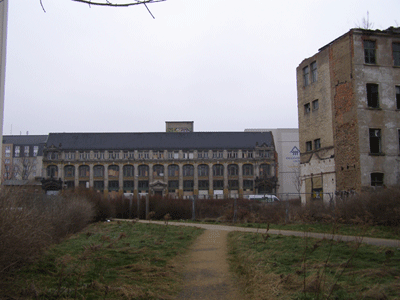
    It is difficult to imagine the breadth of this history while traversing the streets of Leipzig today. The city still certainly has its share of old and beautiful architecture, but much of this is now abandoned, with many structures adjacent to the central core covered in graffiti. In this regard, Leipzig looks like the German equivalent of a decaying American rust-belt city.
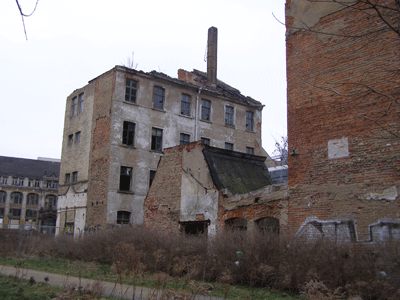
    The derelict atmosphere that a new visitor may sense upon arriving in Leipzig is at least partly due to the fact that many long-time residents still live in Soviet-style communist housing blocks at the peripheral edges of the city. Known as Plattenbau, or “plate buildings”, these ubiquitous and dehumanizing structures were communism’s answer to the issue of quickly re-housing East German citizens displaced by the ravages of war. Building these massive housing structures far outside the center also had the advantage of locating workers closer to places of industry.

    Taking into account Leipzig’s urban planning policies under communism, it is no wonder that neighborhoods near the city center appear neglected. Yet, stepping into the pedestrian-only heart of the city also tells a much more encouraging story. Unlike the often failed policies of many American cities to spur a “downtown renaissance”, Leipzig has had considerably more success at revitalizing its once thriving core.

    This is apparent by the number of construction sites around Leipzig’s central core. The city still has the advantage of possessing a significant stock of aesthetically appealing buildings, ranging in style from Baroque to Neoclassical. Furthermore, the University of Leipzig, one of Germany’s oldest, has taken the lead in making the city center a destination by consolidating its operations there. Currently, the University is constructing a new main building off of the city’s main square, Augustusplatz (formerly known as Karl-Marx-platz during the GDR).
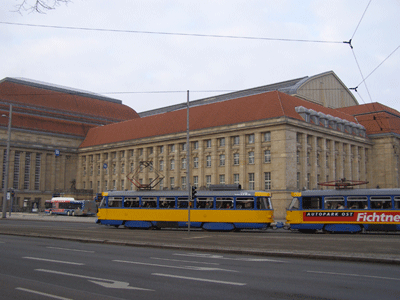
    Public transportation is also a bright spot for Leipzig. Modern streetcars ride above ground to the outer limits of this concentrically laid out city. The efficiency of the streetcar system would turn any American public-transportation proponent green with envy. Moreover, the construction of an ambitious underground metro system is slated to be completed next year, further easing mobility for Leipzigers.

    Leipzig’s location in the central-north portion of continental Europe also has its advantages. As a node for the transport of goods and people through central Europe, the city serves as a bridge between Germany and the once burgeoning but now suffering Eastern European nations. Even so, over time it would be in the city’s best interest to further capitalize on this asset.

    Adding clout to Leipzig’s location as a transportation hub is the city’s central train station – one of Europe’s largest and most historically significant. Grand in scale, Leipzig’s Hauptbahnhof not only sees a great deal of rail traffic from all over Germany, the station doubles as a shopping center for those living in the city. Practically a second “downtown”, the central station boasts everything from a constantly busy grocery store to clothing boutiques, numerous cafes and even two McDonald’s franchises.

    Despite its inspiring history, famous university and state-of-the-art transportation, Leipzig still faces tremendous challenges ahead. The city is not only struggling to attract newcomers but to retain a new generation of Germans born to parents who still remember what it was like to live in the GDR. Economically speaking, Leipzig stands little chance competing with other German cities in the west such as Frankfurt, Cologne or Munich where there are many more job opportunities. Aside from a plant that assembles Porsche’s struggling Cayenne line of SUVs – itself now threatened for both economic and environmental reason – industrial activity in Leipzig is limited. And with the Bohemian behemoth of Berlin not far away, Leipzig would be hard pressed to realize a full renaissance of its status as a prime destination for arts and culture.

    What does this mean for the future? In a sense, Leipzig’s problem is the same problem facing the entire region that comprises the former German Democratic Republic. The issues have been hotly debated in Germany since reunification. Some in the western parts of the country regard cities in the east as a lost cause. Contributing to the contentiousness of the debate is the ‘Solidarity Tax’ instituted to aid in the reunification process. At a rate of 5.5% of annual income tax, many Germans feel their tax dollars are being squandered on frivolous projects in the former GDR – projects that will have little to no impact on those living in the west.

    The renovation of the city center and the construction of the new Leipzig underground metro are examples of projects that benefit from funding from the Solidarity Tax. The key issue now is to see if the eastern cities themselves can use the generous government support and newfound infrastructure to stimulate economic activity and create jobs that will keep people from leaving for good. If this is not addressed immediately, the future of the former GDR looks bleak. The last thing Germany needs, especially in these times of global economic turmoil, is for those living in the east to become nostalgic for the days before the fall of the Iron Curtain.

    Adam Nathaniel Mayer is a native of the San Francisco Bay Area. Raised in the town of Los Gatos, on the edge of Silicon Valley, Adam developed a keen interest in the importance of place within the framework of a highly globalized economy. He currently lives in San Francisco where he works in the architecture profession.
  • The New Business Ethos

    My only post-graduate employment lasted 3 months. I worked for a small political consulting firm drafting online strategy for a well-funded land-use initiative. After the success of the measure, the firm’s founder sat me down, told me he loved my work but that the firm was not interested in continuing its web-based consulting. He had to let me go. It was in that same meeting that I decided to start – and pitched to my boss – my own business.

    Without a business degree, experience, funding or family support I started WebRoots Campaigns. It seems insane in retrospect. But at the time, the process was so thrilling, so life-changing, that I would not trade those initial months for all the know-how in the world.

    Being in consulting, I’ve encountered entrepreneurs from a broad array of industries. Some were as expected: those who wanted money and would do anything for it. Less expected however was the number of business owners who worked to a different beat – running their companies for wildly different reasons – all less motivated by the bottom line.

    This group for the most part hailed from the ranks of new, young business owners. Some started their business fresh out of school, not even dipping into the employment pot for a taste of the promised land. Others, like myself, had a taste, spat it out, and went on to create our own soup.

    While the intrigue of entrepreneurship is nothing new, the current economic and cultural climate has fostered a wave of young, untraditional businessmen (and women) never seen before.

    The New Business
    The emerging business class recognizes various motivations for their work and builds their companies to reflect these motivations.

    This new business is in part a reaction to the shortfalls of traditional business epitomized by disregard for the environment, social equality and family. Once widely viewed as intelligent, lean and mobile, the corporation of the past century maneuvered unquestioned through our economic, cultural and political landscapes.

    The new business reaction to this is to view business not as an end unto itself, but as a means toward something greater. Such a model does not insist that profits are bad, or that one requires world-changing ambition to succeed.

    Profits are celebrated if the business creates value beyond the bottom line. A boutique furniture company which employs locals at good wages, buys from ethically sound foresters, and re-invests some capital back into the community is an exemplary model.

    The entrepreneur may have founded the store because of love for his craft, to be near his family, or because he wanted to support his community. In any of these motivations, the pursuit of profit is inherent and accepted, but is balanced against other factors. It is only when the pursuit of capital becomes exclusionary, when it becomes absolute, that business begins to degrade the quality of both our environment and our lives.

    The new model recognizes various practices, motivations and responsibilities throughout the business process. Such factors as the environment, social mobility, cooperation, community and family are not simply strewn aside in a dash for quick profits, but are strategically considered throughout the life of the business.

    An Emptying Promise
    An additional factor in the emergence of the young entrepreneur is the emptying promise of the traditional employment path, both economically and psychologically.

    Forty years ago, relative wages were higher, health insurance more accessible, and mobility more lubricated; it was not uncommon to stay with a company for one’s entire professional life. However, real wages have been stagnant since the 1970s, while average working hours have increased over the same period.

    Young Americans’ wages were already in retreat before the downturn. They appear to be suffering more since they lack seniority, contacts and, in part, because older Americans – their nest eggs now cracked – cannot retire and not make room for newer workers.

    The young American psyche has also become weary of the traditional path. We are accused of laziness, of unwillingness to pay our dues. But when our dues lead only to more hours in a cubicle in an insatiable rat race to increase corporate profits for an illusionary beneficiary…well, the repulsion becomes understandable.

    The emptiness of such a path has been understood by many over the years. Many have chosen to be musicians, artists, or activists. But as this realization spreads – not just to potential entrepreneurs but to consumers who are also increasingly weary of traditional business – the notion of “rebelling” against business through business itself is becoming a real option. A critical mass is being reached, both as a consumer base large enough to support this new business ethos, and as new entrepreneurs seeking to work with the “untraditional” businessmen.

    The New Business as a Response to the Recession
    The current economic crisis is obviously hurting traditional business and entrepreneurship. However, it will have a mixed effect on the emergence of new business.

    On the down side, business loans or other investments are more difficult to obtain, consumer spending has plummeted, and the majority of all industries have stripped to their bare necessities in an attempt to weather the storm.

    On the up side, the new business ethos provides a model that becomes a response to the roaring chaos. Many are losing their jobs after years of hard work for large enterprises. They are not only venturing out on their own out of economic necessity, but because of newfound realizations of the hollow promises of old business.

    In many ways, the new business ethos is better suited for tough times than the old inflated, dog-eat-dog system because it recognizes the value of cooperation and remains more flexible than older models. In the face of a recession, those who are starting new companies are finding supportive communities where expertise, connections and even business is shared.

    Consumers are also increasingly aware of the difficulties that smaller, local business are facing and are adjusting their behavior to help these local business stay afloat throughout the recession.

    The risks are higher than ever, but the recession may provide a wakeup call for many Americans, and a crucial shift in how business is started and run.

    Much praise has been given to new business models centered on community, philanthropy, environmental sustainability and cooperation. But we are only on the crest of the wave. Scan any business district and it becomes clear that old business still very much dominates the scene. MANY old companies are launching expensive PR campaigns to align themselves with the wave, but they still remain fundamentally flawed.

    As consumers become increasingly sophisticated in this respect, opportunities will arise for business to be built on this new model. More likely than not, these businesses will be built not by the businessmen of the past, but by a new generation, with new rules, and hopefully new results.

    Ilie Mitaru is the founder and director of WebRoots Campaigns, based in Portland, OR, the company offers web and New Media strategy solutions to non-profits, political campaigns and market-driven clients.

  • Fantasy Default Scenarios

    Imagine the following scenario. John, Paul, Ringo and George are the only members of a society and each has amassed a pile of currency over his lifetime. John and Paul each have 100 utils, Ringo has 300 utils and George has 500 utils. All told, the size of the entire system is 1000 utils.

    John and Paul decide to enter into a private contract. Under the terms of their agreement and in exchange for an apartment on the ultra-hip Upper West Side, John will pay Paul 40 utils up-front, 1 util a month for 5 years, and 1,000 utils in a lump sum at year 5. While the insanity of such a contract is undisputed, there are two approaches for a government to take once the impossibility of its satisfaction becomes clear.

    The first, simpler and more sane approach allows the two parties to work out an eventual default between themselves. In fact, most economic systems, like ours, anticipate these types of failures and have time-honored methodologies for dealing with them once they occur.

    Approach two — the one that seems to be favored by our government at every turn — turns on the printing press, prints enough additional money and hands it to Paul (the non-defaulting party) in satisfaction of John’s (the defaulting party) obligation. While the second approach appears charitable and seems noble enough, it has ramifications throughout the entire society. John and Paul might both be satisfied that their contract can be completed. Ringo and George, however, will each have their share of the society’s resources seriously diluted by the government’s action.

    By virtue of the government’s actions in our little story, George’s ownership of the society’s resources falls by half from 500 of 1000 utilts at the beginning of our story to 500 of 2000 utils at the end — all by virtue of the bad behavior of other societal actors and the government’s choice of response.

    I bet that, upon reflection, George might favor of the first approach!

  • Many Investors Have More to Gain by Letting Your Mortgage or Company Fail

    I hate to say “I told you so” but… I told you so. The holders of the credit default swaps (CDS) have more to gain from the failure of the borrower than from accepting payments.

    Bloomberg is reporting a strategy at Citigroup, Inc. to do just that. In one example, they can buy up Six Flags bonds at 20.5 cents on the dollar, pay a small premium to get the CDS and then collect the full face value of the bonds when Six Flags files for bankruptcy – which the CDS holder can be sure happens.

    Normally, before a company goes into bankruptcy, they would meet with the debt holders to try to re-negotiate their debt. Debt holders will usually do this because they have more to gain from the company remaining in operation than otherwise. Sometimes, the company may even get them to exchange their debt for equity, provided there is a good business model that has the potential for future earnings.

    Now, as I’ve described repeatedly, the CDS holders have more to gain from the bankruptcy because they will get their entire investment paid back, with interest, not from the company that issued the debt but from another company that issued the CDS – some company like, for example, AIG!

    Speaking of AIG, there was very little coverage of the Senate Committee hearing Thursday (3/5/2009): “American International Group: Examining what went wrong, government intervention, and implications for future regulation.” It was a stunner! Bottom line? Senator Jim Bunning (R-KY) told the panelists that if they asked for another dime for AIG, “You will get the biggest ‘no’” ever heard. The entire committee was incredulous that Federal Reserve Vice Chairman Donald Kohn point-blank refused to tell them 1) who is benefiting from the AIG payouts on CDS and 2) how much more is it going to cost to bailout AIG.

    Stand by, because home foreclosures are on the same course as Six Flags: homeowners attempting to re-negotiate their debt will find that somewhere in the background, a CDS holder has more to gain from the foreclosure because they will get their entire investment paid back, with interest, not from the homeowners but from some company that issue CDS – some company like, for example, AIG!

  • One Fundamental Problem: Too Many People Own Homes

    Ben Bernanke made the following statement as he attempted to justify bailing out bad borrowers:

    “…from a policy point of view, the large amount of foreclosures are detrimental not just to the borrower and lender but to the broader system. In many of these situations we have to trade off the moral hazard issue against the greater good.” – Ben Bernanke, February 25, 2009

    I think he is wrong on this, and the moral hazard issue is only a small part of my objections.

    One of the fundamental problems we have right now is that too many people own homes. It sounds harsh, but please bear with me a few sentences. I think we can agree that 100 percent home ownership is not possible, or even desirable. Most of us can remember a time when our income and our jobs were such that home ownership was a bad idea. Home ownership is a commitment that requires a significant amount of stability and discipline. Not everyone is so stable or has the discipline to keep up with the payments.

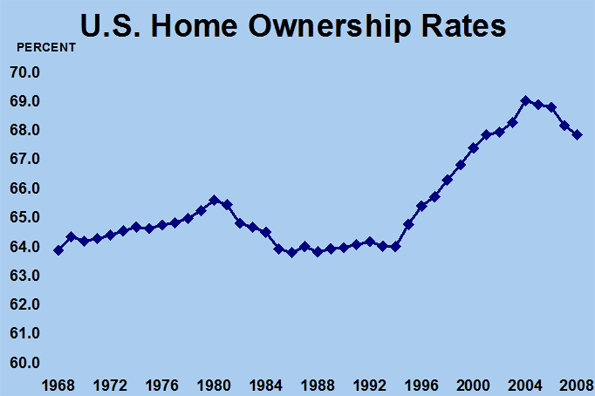
    What is an appropriate national homeownership rate? Theory gives us no answer. We look to the data for a clue. Here’s a chart of home ownership rates since 1968:

    It seems pretty clear that a homeownership rate between 63 percent and 65 percent works pretty well. When we get above that range, problems seem to crop up. This was true in 1980 – the worst recession of the past 30 years – and it is true now.

    In light of these data, let’s think about what Bernanke is saying. He’s arguing that to execute the foreclosures required to move the rate back to that 63 percent to 65 percent range are bad for the economy. So bad in fact, that we’re better off not going there.

    The problem with that argument lies in a lack of historic understanding of the proper levels of homeownership. Financial and real estate markets can’t stabilize until we get closer to that equilibrium. Until we lower the home ownership rate, financial institutions will have a cloud around them, and residential real estate markets will be lifeless. It may not be politically popular, but those are the realities.

    This is a critical issue. For years, economists have believed that the failure of banks to recognize and remove bad assets contributed to Japan’s long period of economic malaise. I agree. Forbearance on bad real estate loans here in the states constitutes much the same thing. Our financial institutions are holding a bunch of bad assets; these are homes that are owned by people who can not afford them – never did, and likely never will. Until the financial institutions recognize those bad assets and get them off their books, our financial institutions won’t have the resources to fund, stabilize and then drive a broader economic recovery.

    What we need is not more mindless beneficence to everyone from Wall Street to Detroit and Main Street. The more we bailout failed financial institutions, automobile manufactures, or any business, the longer we postpone our recovery.

    Recessions are periods when assets are reallocated from less productive to more productive uses. That requires processes like repossession, foreclosure, mergers, and bankruptcy. These processes have been developed over centuries. They are the most efficient methods to restore an economy.

    Why are we suddenly abandoning these processes that have proved themselves in many business cycles? I suppose part of it is the desire to eliminate the business cycle. This is the same thinking that had many – including conservatives – arguing that stocks could not fall during the dot.com bubble or that housing prices would also move up.

    In reality the business cycle can not be eliminated. It can’t be done and it is pure hubris to try. One of the fundamental insights to come out of Real Business Cycle research is that recessions constitute the most efficient response to a negative shock.

    We need to stop wasting resources trying to stem the tide. Instead, let us allow the recession to work for us. In the meantime we can provide a backstop through unemployment benefits and some reasonable fiscal stimulus. But we have to experience some pain and let our processes and institutions work for us. The sooner we get these foreclosures, repossessions, mergers, and bankruptcies behind us, the sooner we will see a return to the only sure cure for a sick economy: real economic growth.

    Bill Watkins, Ph.D. is the Executive Director of the Economic Forecast Project at the University of California, Santa Barbara. He is also a former economist at the Board of Governors of the Federal Reserve System in Washington D.C. in the Monetary Affairs Division.

  • Sunbelt Indianapolis

    For decades, the overwhelming majority of population and economic growth has occurred in the Sun Belt – the nation’s South and West as defined by the United States Bureau of the Census. This broadly-defined area stretches south from the Washington-Baltimore area to the entire West, including anything but sunny Seattle and Portland. Any list of population growth or employment growth among the major metropolitan areas will tend to show the Sun Belt metropolitan areas bunched at the top and the Frost Belt areas (the Northeast and Midwest regions) bunched at the bottom. Since World War II, no state has experienced the growth that has occurred in California.

    However, the trends in the last decade indicate a shift, certainly away from California, which has experienced a net domestic migration (people moving to other parts of the nation). The overall loss reaches over 1.2 million people; the state’s overall population growth rate is now only little more than average. Some metropolitan areas in the Frost Belt have begun to perform better in population and domestic migration, but most continue to experience growth that is well below that of the Sun Belt.

    The exception to this is Indianapolis, which has developed growth rates that would put it right in the middle of Sun Belt metropolitan areas, if it were not in the Frost Belt.

    Indianapolis is a metropolitan area of 1.7 million population. Indianapolis added nearly 11 percent to its population between 2000 and 2007 (latest data available) and ranks 19th in population growth among the 50 metropolitan areas with more than 1,000,000 population (New Orleans has been excluded from this analysis because of the hurricane related population losses). Indianapolis is growing faster than Washington, DC or Seattle and nearly as fast as Portland or Denver. Its population growth rate has been double that of San Diego, triple that of Los Angeles or San Jose and more than six times that of San Francisco, which has seen its growth slow to a rate no better than that of Italy. Overall Indianapolis would rank 18th out of the 32 largest US Sun Belt metropolitan areas in total population growth. It is the fastest growing of the 18 largest Frost Belt metropolitan areas.

    Between 2000 and 2007, the Indianapolis metropolitan area added 55,000 domestic migrants, equal to 3.6 percent of its 2000 population. No other Frost Belt metropolitan area comes close. Columbus and Kansas City had domestic migration gains, at 1.2 percent of their population. All other Frost Belt metropolitan areas lost domestic migrants. Indianapolis, however, would have ranked 17th out of the 32 largest Sun Belt metropolitan areas trailing Portland, but leading Seattle and Denver.

    The distribution of domestic migration within the Indianapolis metropolitan area is also significant. For one-half century various analysts have predicted the decline of the suburbs. Indianapolis, like most metropolitan areas around the country, shows exactly the opposite: the suburbs continue to attract central city residents and have yet to fall into this seemingly inevitable decline.

    While the Indianapolis metropolitan area gained 55,000 domestic migrants from 2000 to 2007, Marion County, the central county which is nearly co-existent with the central city of Indianapolis, lost 46,500 domestic migrants. All of the domestic migration growth was in the suburbs, which attracted 101,800 new residents from Indianapolis/Marion County and the rest of the nation.

    What is it that has allowed Indianapolis to experience Sun Belt growth despite being in the Frost Belt? This is not the place for a full attempt to identify all of the causes, but some observations can be made.

    Perhaps it is most important to understand what is not the cause of the superior growth in Indianapolis. It is not the city’s “unigov” governance structure. In the early 1970s, to the great fanfare of urban planners, Indianapolis merged with most of Marion County, increasing the city’s population by approximately 50 percent. Proponents of local government consolidations often (and speciously) suggest that these consolidations will make metropolitan areas more attractive (this issue is discussed in detail in our Pennsylvania report on local government consolidation). Yet, Indianapolis, one of the nation’s largest consolidated local governments, is losing residents to the suburbs. It is also worthy of note that state taxpayers provided a $1 billion pension bailout to the city last year.

    One factor that clearly makes Indianapolis attractive is its housing affordability, which is the best among metropolitan areas with more than 1,000,000 residents in six nations. According to our 5th Annual Demographia International Housing Affordability Survey, Indianapolis had a Median Multiple (median house price divided by median household income) of 2.2 in the third quarter of 2008, well below the historic norm of 3.0. Indianapolis has been ranked near the top in each of the preceding four editions as well. In recent years, new suburban starter houses of 1,500 square feet have been advertised at less than $110,000, less than the price of land for a house in many metropolitan areas.

    Superior housing affordability constitutes a critical important attractor. At the height of the housing bubble, a household living in the median priced house in Indianapolis would have saved more than $1,000,000 in down payment and mortgage payments over 30 years, compared to San Diego.

    Indianapolis also has the advantage of a comfortable lifestyle. Commuters spend 2 minutes less per day than the national average getting to work, according to the 2007 United States Bureau of the Census American Community Survey. The Texas Transportation Institute indicates that traffic congestion is less severe in Indianapolis than average and that it has become better in the last 10 years. Indicating its usual irrelevance to traffic congestion, Indianapolis has the smallest transit market share of any urban area over 1,000,000 in the nation, at approximately 0.2 percent. This compares to 11 percent in New York, 5 percent in San Francisco and 2 percent in Los Angeles and Portland.

    Where does Indianapolis go from here? So far, Indianapolis has shown resiliency in the current economic crisis. The December 2009 unemployment rate was 6.7 percent, which is below the 7.2 percent national rate. Other parts of Indiana are not doing nearly as well, especially in smaller metropolitan areas that rely to a greater extent on manufacturing. For example, unemployment has reached 15 percent in Elkhart.

    To some extent, the metropolitan area’s huge advantage in housing affordability has been eroded by the collapse of prices in the most expensive Sun Belt metropolitan areas, such as in California and Florida. Yet, Indianapolis remains far more affordable, even after these losses.

    Indianapolis also has an advantages for business. In the State Business Tax Climate Index, Indiana is ranked highly, at 14th in the nation. With the prospect of higher taxes, both at the federal level and in many states, this should help Indianapolis retain an impressive advantage and continue to perform as if it were a Sun Belt metropolitan area, but without the problems associated with the housing bubble, massive congestions and growing social inequality.

    Wendell Cox is a Visiting Professor, Conservatoire National des Arts et Metiers, Paris. He was born in Los Angeles and was appointed to three terms on the Los Angeles County Transportation Commission by Mayor Tom Bradley. He is the author of “War on the Dream: How Anti-Sprawl Policy Threatens the Quality of Life.

  • Want to Foreclose? Show Me the Paper!

    Since October 2008 I’ve been writing here about problems in mortgage backed securities (MBS). There is more evidence surfacing in bankruptcy courts that the paperwork for the underlying mortgages wasn’t provided correctly for the new bond holders, leading to delayed or denied foreclosure proceedings.

    New York Times’ Gretchen Morgenson is reporting new successes in cases from Florida and California. A judgment on a home in Miami-Dade County (FL) was set aside on February 11 when the new mortgage holder could not produce evidence that the original mortgage lien had been assigned. In one of the California cases, the lender tried for foreclose on a mortgage that had previously been transferred to Freddie Mac!

    The earliest decision I’ve seen is from Judge Christopher A. Boyko in Cleveland. Plaintiff Deutsche Bank’s attorney argued, “Judge, you just don’t understand how things work.” In his October 31, 2007 decision to dismiss a foreclosure complaint, Boyko responded that this “argument reveals a condescending mindset and quasi-monopolistic system” established by financial institutions to the disadvantage of homeowners. The Masters of the Universe were anxious to pump out mortgages into MBS so they could continue to earn fees – making money at any cost.

    One element of the newest Homeowner Bailout program is to allow bankruptcy court judges to modify mortgage loans. If the types of cases decided in OH, FL and CA continue to spread, that may not be necessary. The first question in any foreclosure procedure will become: can you prove a lien?

    This raises further questions about those “toxic assets” that Geithner and Bernanke are so anxious to buy up at taxpayer expense. According to the Morgenson article, some MBS holders are trying to force the mortgage originator to take back the paper. However, many of the worst offenders are already defunct.

  • The bailouts payments mount, the budget expands, the deficit widens, the national debt increases. How high is up?

    How far can the totals go? Federal Reserve Chairman Ben Bernanke testified before the Senate Budget Committee on March 3, 2009. He believes that the markets will be “quite able” to absorb the debt issued by the US government over the next couple of years to cover all the bailout and stimulus payments “if there is confidence that the US will get it [the economy] under control.” When Senator Lindsey Graham (R-SC) suggested an “outer limit” at which the national debt was three times gross domestic product, Bernanke said that “it wouldn’t happen because things would break down before that.” They’ll be lending to homeowners who have higher debt ratios than that. Frankly, I’d rather lend to the US government at that ratio, and I suspect a lot of investors – both domestic and foreign – feel the same way.

    On the one hand, Bernanke spoke like a “Master of the Universe” when he told the Senators that he wasn’t worried that printing all this extra money would generate future inflation. He said that when the economy begins to grow again, the Federal Reserve is “very comfortable” they will be able to deflate their bloated balance sheet. On the other hand, he did not sound like a Federal Reserve Chairman when Bernanke said “We don’t know for sure what the future will bring.” Of the two Bernankes I like the second one better: no one knows exactly what the future will bring. Why pretend that you know what the best action to take three years from now will be – or what impact it will have. I find it disconcerting, to say the least.

    There are a few things we can watch for in the coming weeks and months. The President’s budget came out yesterday and will go through Congress now for approval. Don’t get too distracted by it though – virtually everything in it can change. Instead, work with what you know. The stimulus package was passed and the states are getting details now on how much and for what they can expect money from Washington. Focus on where that money is going. The best way to minimize the damage being done by the Federal Reserve’s printing presses is to be sure that money is spent in the real economy. That means roads, bridges, schools, sewer systems – and not research and development on sources of alternative fuel or studies on global warming. We are in the middle of a crisis. This is not the time to spend on wishes and dreams. If the money is spent on real infrastructure projects, it can help to mitigate the potential inflationary effects later.

    The Treasury and the Federal Reserve have no choice but to keep their foot planted fully on the accelerator. Setting infrastructure in place now means we’ll get good traction later when the economy starts moving forward.

  • Paris Mayor Sides with Cars

    Paris Mayor Bertrand Delanoë has spent much of his first term in implementing measures to restrict car use. Delanoë took many lanes of road traffic away from cars and turned them into exclusive bus and taxi lanes. This had virtually no effect on public transport use, according to University of Paris researchers who also found as a result that traffic congestion worsened, greenhouse gas emissions increased and overall cost to the Paris economy of more than $1 billion annually.

    Now the Mayor is establishing a car hire program that will make electric cars available throughout the ville de Paris at electric charging stations. Initially 4,000 cars will be involved in the “Autolib” program. London Mayor Boris Johnson has announced plans for a similar program. These are healthy developments and a further reflection that preferred lifestyles can continue, while still reducing greenhouse gas emissions.