Blog

  • Don’t Mess With Census 2010

    The announcement last week that Congressional Black Caucus members plan to press President Obama to keep the 2010 census under White House supervision, even if the former Democratic Governor of Washington, Gary Locke, is confirmed as Commerce Secretary, brought back memories of a movie I’d seen before — a bad movie.

    The statement came from Rep. William Lacy Clay, D-Mo., the caucus’ leading voice on the census, and chairman of the House Oversight and Government Reform panel, which has jurisdiction over the decennial count. His assertion that the White House needs “to be hands-on, very much involved in selecting the new census director as well as being actively involved and interested in the full and accurate count,” suggests that the partisan gap about what the census should accomplish is no closer to being closed than it was ten years ago when we last undertook the constitutionally mandated exercise in counting everyone living in America. The gap was so big last time that it helped bring about the complete shutdown of the United States government.

    When Newt Gingrich became speaker of the House he decided, in his own paranoid way, that Bill Clinton and the Democrats would use their executive authority to produce a biased census whose over-count of minorities would shift, in his opinion, twenty-four House seats from the Republicans to the Democrats after the 2000 census. Of course, it was ludicrous to think such an outcome would occur, since legislative boundaries are drawn by the party in power in each state. Whatever numbers the census produces in our decennial exercise can be manipulated to produce any outcome each state’s ruling party desires, as Congressman Tom DeLay and his Texas Republican cronies proved a few years ago. Nevertheless, Gingrich was determined to use the Congressional appropriations process to undercut any attempt by the Democrats to overstate minority populations in the several states.

    The method by which this nefarious plot was to be carried out, in the Republican party’s opinion, was by the use of a large sample of Americans to be surveyed at the same time as the actual count, or enumeration, required by the Constitution was taking place. In response to concerns about previous census inaccuracies — both overcounts and undercounts — the National Academy of Sciences had recommended that the Census Bureau use survey sampling techniques to validate not just the overall count but the individual demographic sub-groups that the census’s enumeration process would identify. But this was a hugely expensive undertaking. To gain statistical accuracy, about 1.3 million Americans would have to respond to a lengthy survey that would cost about a half a billion dollars to execute. And it was this expenditure that Gingrich refused to appropriate. When he and Clinton came to the ultimate showdown on funding the government Gingrich blinked.

    As part of the budget settlement that reopened the government after the shutdown, Clinton forced him to reinstate funding for the sample survey. But despite having established the primacy of the White House in the conduct of the census, matters actually got worse for awhile. When I became Director of the National Partnership for Reinventing Government (NPR) under Vice President Al Gore, I was asked to monitor the implementation of the census to be sure it was done as effectively and as efficiently as possible. But the first idea on how to accomplish that came straight out of the same White House partisan playbook that is now being invoked by the Congressional Black Caucus.

    In order to assure that the process was “bi-partisan,” it was suggested that a commission be established made up of equal numbers of Republicans and Democrats who would oversee the activity on behalf of the Congress. Since the commission was to be equally divided, the Clinton White House wanted to make sure that only the most partisan Democrats — those who would never concede an inch to their Republican counterparts on issues such as funding and methodology — were selected. Names like Harold Ickes, Supervisor Gloria Molina, and Congresswoman Maxine Waters were discussed as representative of the type of Democrat who would make sure the use of sampling to confirm the accuracy of the count was preserved. Fortunately, thanks to the eloquence of Rob Shapiro, the Undersecretary for the Department of Commerce who had the actual authority to supervise the Census, cooler heads in the Vice President’s office were able to prevail over their White House counterparts, and the Commission notion was abandoned.

    But that didn’t stop the two parties from continuing their warfare over the value of a sample supplemented census vs. a straight enumeration. Republicans sued the Census Bureau in federal court, demanding that only the actual count of residents as provided in the Constitution be used for any Congressional redistricting by the states. The Federal Appeals court dismissed the Republican lawsuit as none of the Court’s business. Foreshadowing the outcome of Gore v. Bush in 2000, the Supreme Court surprisingly took up the case and overturned the Appeals court ruling. As a result, all subsequent redistricting efforts have used only the enumeration count from the 2000 census. On the other hand, formulas used to allocate federal funds based on population characteristics were unaffected by the ruling and could have used the sampling process, had it not met an untimely and unnecessary death.

    As soon as George W. Bush was elected and the incredibly professional Director of the Census Bureau, Ken Prewitt, was removed from office, the Commerce Department’s new partisan Secretary, Donald Evans, determined that the sample that had been prepared over the strong objections of Congressional Republicans was not useable. Sampling, as originally conceived, was never implemented, and the country ended up relying on a very strong effort to count households and those living in them for its 2000 census. This method tends to overcount families with two houses, who respond to the census form at both of their addresses, and college students who generally answer the form from their dorm room while their parents report them as still in their household back home. And, of course, it tends to undercount less affluent populations with fewer physical ties to a specific dwelling, particularly Native Americans, and to some degree Hispanics and African Americans.

    Despite these problems, a sampling approach could not be used to help correct inaccuracies in this year’s census, even if Rahm Emanuel himself were to oversee it. We are too far along in the process to recreate it. There is, however, a substitute available that should alleviate the concerns of all but the most stubborn partisans on both sides of the issue. Under the Gore reinvention initiative, the Census Bureau conceived of a concept now known as the American Community Survey. It was designed to survey a vast quantity of households over time to acquire the kind of detailed demographic data that was usually obtained from the subset of the population, about one in ten, who were asked to complete the “long form” of the census questionnaire every ten years. Republicans hated this form and the type of questions it asked; they saw it as an unlawful intrusion on the privacy of families by the federal government. Those of us in charge of reinventing the federal government thought the ACS could be a much more scientific and efficient way of collecting this essential data, but our challenge was to keep it from becoming a political football in the partisan warfare over the census.

    Finally, it was agreed that the Clinton administration budget proposals would include a continuing increase in funds for the ACS. In order to garner Republican support, ACS would be justified as a way to eliminate the long form by 2010. The budget request was forwarded by the head of ACS directly to the Vice President’s office, which made it a priority each year, but which never publicly acknowledged any interest in the concept. The ruse worked and the project became a reality. The long form will not be used in the upcoming census because the ACS has gathered, over time, sufficient data on the demographic details of America’s population as to make it unnecessary.

    Given the existence of the ACS, those now waging a battle over sampling vs. enumeration are truly guilty of fighting today’s war with yesterday’s weapons. In this new era, those who have a legitimate interest in as complete and accurate a census as possible should instead direct their efforts to the neighborhoods where the accuracy of the count will actually be determined. During the last count, the Census Bureau formed hundreds of thousands of partnerships with community groups interested in making sure that everyone they knew got counted. Today, these programs, as well as projects such as former Detroit Mayor Dennis Archer’s “Nosy Neighbors” campaign, are the best way to ensure an accurate outcome.

    The responsibility for America’s next census does not and should not rest with the White House. But President Obama’s experience does offer some direction: neighborhood organizing is key. Let’s hope that community leaders will follow the advice to ‘pick yourself up and dust yourself off’… and undertake the huge task of ensuring that every person is present and accounted for in America’s next census.

    Morley Winograd is co-author, with Michael D. Hais of Millennial Makeover: MySpace, YouTube, and the Future of American Politics, now available in paperback. Both of them are fellows with NDN, a progressive think tank, which is also home to his blog.

  • Bernanke: Junkmeister Hides the Truth

    Federal Reserve Chairman Ben Bernanke testified before the Senate Budget Committee on Tuesday (March 3, 2009), the day after it was announced that AIG would be back at the federal teat for another $30 billion. The generally subdued Senate was nonetheless forceful in getting Bernanke to admit several things:

    • The Fed and Treasury are using the same three rating agencies to help them select triple-A collateral for bailout lending as were used to get triple-A credit ratings for junk mortgage bonds;
    • Neither the Fed nor the Treasury will tell us all the companies that are getting bailout money;
    • There is no “outer limit” to how much money the US government can print;
    • No one knows the “outer limit” of how much money the US government can borrow;
    • The “too big to fail” policy is a bigger problem than anyone thought it could be;
    • No one was in charge of AIG – not bank regulators, insurance regulators or capital market regulators.

    When asked about AIG several times, Bernanke replied that it’s “uncomfortable for me, too.” Through some hole in the regulations, the insurance regulators had no authority to monitor the financial products activities of AIG. Explained simply and bluntly, the world’s largest insurance company sold credit default swaps (CDS, insurance against default) on the junk bonds issued from mortgages and consumer purchases. Many of those mortgages and consumer purchases were made foolishly – when the borrowers failed to repay the loans the bonds also failed. The people and companies that bought CDS on those bonds did not look too closely at AIG to see what would happen if the bonds failed. As it turns out, they didn’t have to worry about AIG failing – AIG was deemed too big to fail.

    When the bonds defaulted and the buyers of CDS protection (“counterparties”) turned to AIG for payment, AIG turned to the federal government for help. The AIG bailout has cost $180 billion so far for which the US government owns 80 percent of a company that lost $61.7 billion in three months (for a total of $99.29 billion in 2008, an amount equal to all of their profits back to about 1990).

    Here’s a tough question: Why won’t the Fed disclose who is benefitting from the CDS payoffs? Bernanke made a comparison between your grandmother and AIG: like the owners of life insurance policies, the purchasers of financial insurance “made legal legitimate financial transactions. They have a right to privacy about their financial condition.” In other words, no one should know how much life insurance your grandmother has. That’s why the Fed won’t tell us who bought the CDS insurance on junk bonds! Senator Ron Wyden (D-OR) asked him to “come clean.” Senator Bernard Sanders (I-VT) asked point blank: tell us who got the $2.2 trillion loaned by the Fed. He got a one word response for his troubles: “no.”

    Bernanke said, “AIG made me angry…This was a hedge fund attached to an insurance company. We had to step in, we really had no choice. It’s a terrible situation, but we aren’t doing this to bailout AIG, we’re doing it to protect the broader economy.”

    Here’s how you connect the dots from AIG to main street: AIG is an insurance company and insurance companies are among the “safe” investments that money market mutual funds are allowed to invest their cash in – in fact most funds are required to keep some portion of their assets in these supposedly risk-free investments.

    Basically, this requirement is there to make sure that cash will be available to meet the withdrawal requests from investors. Now, money market mutual funds and mutual funds are a favorite investment for retirement money, including the 401k plans that many people have through their employers. But also, your employer’s retirement plan money is likely also invested in these funds. Pensions can hold stocks and bond directly, but as the size of these plans gets bigger and bigger, it becomes increasingly difficult for one or a few investment managers to handle everything. The California State Teachers Retirement System and the California Public Employees Retirement System (Cal STRS and Cal PRS, for short), the largest pension funds in the world, have $160 billion and $180 billion in assets to invest. So, propping up AIG means that the investments made in the stocks, commercial paper, policies, etc. issued by AIG will not collapse and take with them the retirement assets of many millions of Americans.

    In the final round of questions, Senators Warner (D-VA) and Wyden (D-OR) were especially clear on the point of finding out who is benefitting from the bailout of AIG. AIG was a good insurance company, Warner said, but their London-based financial products division started selling CDS into Europe. Now, American taxpayers are being asked to pick up the tab. Why does AIG continue to make the payouts when they require federal money to continue to exist? The Senators suggested that, at a minimum, Americans deserve to know who is benefitting from the CDS payouts. “It’s time for some sunlight.”

    Susanne Trimbath, Ph.D. is CEO and Chief Economist of STP Advisory Services. Her training in finance and economics began with editing briefing documents for the Economic Research Department of the Federal Reserve Bank of San Francisco. She worked in operations at depository trust and clearing corporations in San Francisco and New York, including Depository Trust Company, a subsidiary of DTCC; formerly, she was a Senior Research Economist studying capital markets at the Milken Institute. Her PhD in economics is from New York University. In addition to teaching economics and finance at New York University and University of Southern California (Marshall School of Business), Trimbath is co-author of Beyond Junk Bonds: Expanding High Yield Markets.

  • Urban Inequality Could Get Worse

    President Obama’s stated objective to reduce inequality, as laid out in public addresses and budget plans, is a noble one. The growing income gap – not only between rich and poor, but also between the ultra-affluent and the middle class – poses a threat both to the economy and the long-term viability of our republic.

    But ironically, what seems to be the administration’s core proposal, ratcheting up the burden on “rich” taxpayers earning over $250,000, could have unintended consequences. For one thing, it would place undue stress on the very places that have been Obama’s strongest supports, while providing an unintended boost to those regions that most oppose him.

    At the heart of the matter is the age-old debate about who is “rich.” If you define wealthy as $250,000 a year for a family of four, that means different things in different places. America is a vast country, and the cost of living varies widely. What seems a princely sum in, say, red state Oklahoma City is barely enough to eke out a basic middle-class life in blue bastions like New York, Los Angeles or San Francisco.

    In the recent study on the New York middle class that I conducted with Jonathan Bowles at the Center for an Urban Future, we compared the cost of a “middle class” standard of living in New York and other cities. The report found that Manhattan is by far the most expensive urban area in the country, with a cost of living that’s more than twice the national average. (This is according to a cost of living index developed by the ACCRA, a research group formerly known as the American Chamber of Commerce Researchers Association.)

    But even Queens, the city’s middle-class haven and the only other borough included in the ACCRA analysis, suffers the eighth highest cost of living in the country.

    What does that mean? An individual from Houston who earns $50,000 would have to make $115,769 in Manhattan and $81,695 in Queens to live at the same level of comfort. Similarly, earning $50,000 in Atlanta is the equivalent of earning $106,198 in Manhattan and $74,941 in Queens. (See “New York Should End Its Obsession With Manhattan.”)

    The cost of housing constitutes one critical part of the difference. Average monthly rent in New York was $2,720 in the fourth quarter of 2007, by far the top in the nation. That total was both 55% higher than the second place city, San Francisco, where average effective rents are $1,760, and nearly triple the national average of $975.

    Even in relative boom times, such high costs have been driving many out of New York, and now it could get worse. During tough times, people’s incomes drop, so they are less able to absorb high costs and taxes, which are rising in many blue cities and states. Imposing more taxes on some label-rich New Yorkers or Angelenos, who earn $250,000 a year, won’t make them more likely to stay.

    Perhaps even worse, higher taxes probably won’t help the inequality issue. True, historically and to this day, the greatest levels of inequality occur in low-tax areas like the Mississippi Delta, the Rio Grande Valley and Appalachia. But, increasingly, this unsavory distinction is shared by big cities like New York, Los Angeles and Chicago. In contrast, the most egalitarian states are generally deep red places – such as the Dakotas, Alaska, Nebraska and Wyoming.

    Higher costs – manifested in everyday expenses like sales taxes and energy bills – now contribute in a large way to growing inequality even in the richest, most elite cities. When housing and other costs are factored in, notes researcher Deborah Reed of the left-leaning Public Policy Institute of California, deep-blue mainstays Los Angeles and San Francisco rank among the top 10 counties in America with respect to the percentage of people in poverty. Only New York and Washington, D.C., do worse.

    Worst of all, the rise of inequality in these high-cost blue cities seems to be connected to policy decisions. High taxes and strict regulations have expelled relatively well-paying blue collar jobs in manufacturing and warehousing from expensive urban areas. Without them, an extremely bifurcated economy and society forms because no traditional ladders for upward mobility remain; they are critical to a successful urbanity.

    Back in the 1960s, Jane Jacobs predicted that Latino immigrants to New York, mainly from Puerto Rico, would inevitably make “a fine middle class.” Yet four decades later, in the Bronx, the city’s most heavily Latino county, roughly one in three households lives in poverty – the highest rate of any urban county in the nation.

    At the other extreme, in Manhattan, where the rich are concentrated, the disparities between socioeconomic classes have been rising steadily. In 1980, the borough ranked 17th among the nation’s counties for social inequality; today it ranks first, with the top fifth of wage earners earning 52 times that of the lowest fifth, a disparity roughly comparable to that of Namibia.

    To an old-fashioned Truman Democrat like me, this is bad news. But some modern-day “progressives,” like Richard Florida, celebrate the concentration of rich people. They see them as guarantors that places like New York will be the winners of the post-crash economy. The losers? Goods-producing regions of the Great Plains, the industrial Midwest and, of course, those unenlightened, suburban middle-class people.

    Yet it seems more and more likely that raising taxes for urban middle-income workers will, over the long term, add to the flood of people fleeing to less costly locales with lower taxes. This will be particularly true for the growing ranks of information economy “artisans” who might find critical write-offs for home offices and other business expenses cut from their next tax return.

    None of this is necessary. The “creative destruction” resulting from the downturn might actually prove a boon to these big cities – by making them more affordable for the urban middle class. This help would be accelerated if city governments – as in Los Angeles, New York, Houston and even San Francisco during the early 1990s – nurture local businesses.

    But “growth” – a word not widely embraced in this greenest of administrations – does not seem to be a priority in either Washington or in most city halls. There are murmurs that investment in high-cost, subsidized alternative energy will create vast numbers of new jobs, but this is likely just wishful thinking for everyone but Al Gore’s business partners.

    This is not to say cities’ policies need to return to Bush-style Republicanism. Tax breaks for big-time investors and real estate speculators do not make a sustainable urban policy either. What’s needed is something closer to lunch-bucket liberalism, which focuses on productivity-enhancing initiatives and sparking entrepreneurial growth. America – its cities in particular – could do with more private-sector stimulation and a lot less high-minded social engineering.

    With policies geared toward the latter at the expense of the former, one of the great ironies of the Obama era will continue to unfold.

    By targeting the urban middle class to pay for its deficit and new social programs, the president’s plan could end up draining wealth – and boosting inequality – from our nation’s great cities, where he currently draws overwhelming support, to its hinterlands. Not exactly what the White House had in mind, no doubt, but, sadly, it’s a distinct possibility.

    This article originally appeared at Forbes.

    Joel Kotkin is executive editor of NewGeography.com and is a presidential fellow in urban futures at Chapman University. He is author of The City: A Global History and is finishing a book on the American future.
  • The Aging of Paradise in Ventura County California

    You could say that Ventura County, just north of Los Angeles, represents what is best about California. Some people believe that its amenities – beaches, gorgeous interior valleys and parks – assure perpetual economic growth for Ventura County and California. They are wrong. There is trouble in paradise.

    Ventura County has changed, and not for the better. It is aging, losing its demographic as well as economic vitality. This represents a relatively new phenomenon, the slow decline of even formerly healthy suburban areas.

    The current recession illustrates the change. In the past Ventura County suffered mild recessions even as the country and the region suffered mightily. The County saw no annual net job losses in the 2001 recession. The early 1990s recession was more painful, but Ventura County did far better than California as a whole.

    All of that has changed with the current recession. Ventura County has recently been losing jobs at a faster pace than California. In 2007, the County lost jobs while California gained jobs.

    The picture is even worse when Ventura County’s economy is compared to the Los Angeles County economy. In 2008, Ventura County’s economy shrank at a rate about five times faster than did Los Angeles’s economy.

    What is going on here? In the past, Ventura County has been buffered by its twin giants, Amgen and Countrywide. Amgen’s Ventura County growth has slowed. Countrywide has done much worse than Amgen, and its demise has been well documented.

    But you can’t blame all of Ventura County’s weakness on Countrywide. It has contributed, but it is not Ventura County’s sole source of economic weakness. The weakness is quite general, spanning the construction sector, non-durable manufacturing, retail trade and other services. Each lost over 1,000 jobs in 2008. By contrast, the finance, insurance, and real estate sectors, where Countrywide resides, lost just fewer than 900 jobs, accounting for about 4 percent of the job losses.

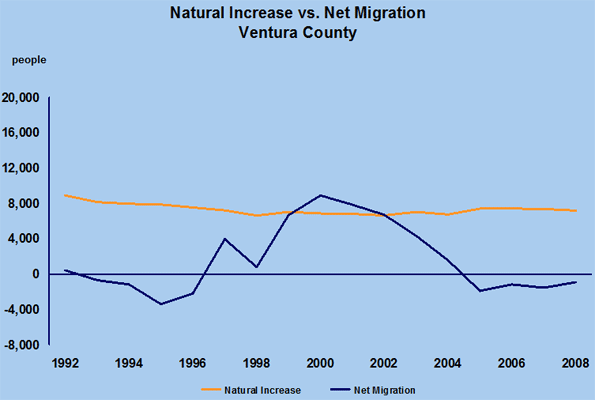
    My sense is the real underlying problem is demographic, and this may not go away even if the economy recovers. One clue is that more people have been leaving Ventura County than moving in from all sources, and this has been happening long enough to be a trend. It reflects still-high housing costs and limited opportunity. It implies a weak future.

    This chart shows that in exactly half of the past 16 years, migration has been negative. That is total migration, not just domestic migration.

    Think about this for a moment. More people are leaving Ventura County than are moving in. That is certainly counter to what has happened in most of the past 150 years.

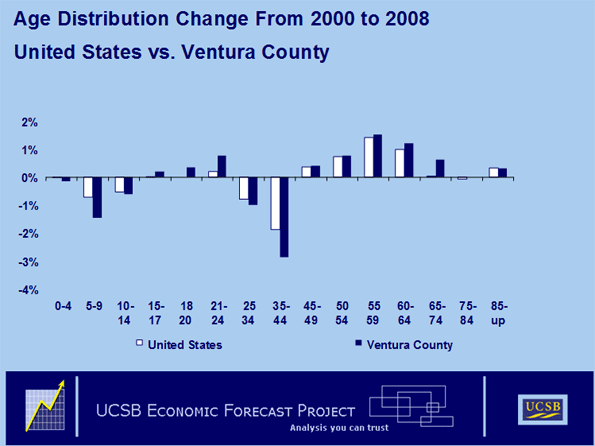
    Ventura County’s net out migration has impacts beyond its effect on the size of the population. The composition of the county is also changing, away from working age people and families and towards people either close to retirement or already there.

    The above chart compares relative changes, by age cohort, in Ventura County’s population since the 2000 census with changes in the United States population since the 2000 census. The County’s population between 25 and 44 years of age and their children has been collapsing. At the same time, the County’s populations of both young adults and people over 45 have been growing as a percentage of the total population. The bulk of that growth has occurred in the over 55 cohort.

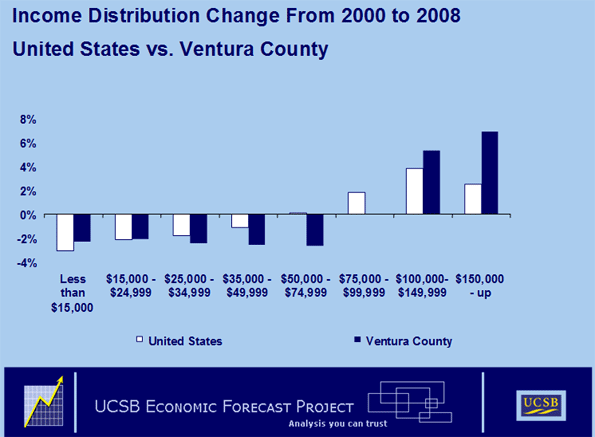
    The migration out of Ventura County has also resulted in changes to the County’s income distribution. The following chart compares changes in the County’s income distribution to changes in the United States income distribution since the 2000 census:

    The comparisons are telling. The County has been losing very-low-income people at a slower pace than has the United States. At the same time, the growth in population with incomes over $100,000 has been spectacular. The local population with incomes between $25,000 and $75,000 has fallen far more rapidly than that of the United States. The County’s population with incomes between $75,000 and $100,000 is relatively unchanged, while that of the United States has shown significant growth.

    People – particularly in the late 20s and early 30s – aren’t leaving Ventura County because amenities have suddenly disappeared. They are leaving because of a deficit in opportunity. Their leaving has consequences. Ventura County’s population is aging more rapidly than it otherwise would. The net result of these demographic changes is that Ventura County’s median real per-capita income is declining, while the County’s median age is rising. Real per-capita personal income has fallen almost $1,000 in only eight years, to $32,718 (Constant 2000 dollars) from $33,797 in 2000.

    Ventura County’s demographic changes can be easily summarized. It is losing its middle class and becoming bi-modal. The young families that provide a community’s vigor and future have been leaving. There is no reason to believe that the trend will reverse itself. Ventura County home prices are still relatively high, while opportunity is declining.

    The County is left with an aging and increasingly wealthy population along with the lower-income people that service the wealthy aged and the very-low-income farm workers. In a sense, it now resembles what we see in many expensive city cores – even if it is on the periphery!

    This creates enormous risks. Most amenities are luxury goods. Poor people don’t invest in luxury goods. Generally, the lower-income population does not have the resources to provide leadership or invest in a community’s future. They have their hands full just taking care of their families, particularly in an expensive place like Ventura County. Their children will likely join the middle class, but in someplace more affordable like Texas, Arizona, or Nevada.

    High concentrations of older people and declining incomes are often associated with deteriorating schools, amenities and increasing crime. The aged wealthy are not in Ventura County to invest in its future. They are there to consume it. They will not invest in the future – particularly if their children and relatives have gone elsewhere.

    Ventura County is not unique. It is fairly representative of Coastal California. Communities like Ventura, Goleta, and San Luis Obispo used to be middle-class communities that valued opportunity. Things are even more extreme in California’s elite playgrounds: Monterey, Malibu, and Santa Barbara. Populations in Monterey and Santa Barbara have actually declined over the past several years. Similar phenomena may be noticeable in other formerly elite suburbs within our most favored metropolitan areas.

    These changes present serious challenges to California’s workers, businesses, and those policy makers who still care about something other than greenhouse gases and public employee pensions. Something needs to be done, and quickly. But the immediate prognosis is less than encouraging. Like Ventura County, California is suffering its worst recession in decades, and policy makers don’t seem to be focusing on policies that may help the area return to its previous status as a region of opportunity.

    Portions of this essay have previously appeared in a UCSB-EFP Ventura County Forecast.

    Bill Watkins, Ph.D. is the Executive Director of the Economic Forecast Project at the University of California, Santa Barbara. He is also a former economist at the Board of Governors of the Federal Reserve System in Washington D.C. in the Monetary Affairs Division.

  • Democrats Could Face an Internal Civil War as Gentry and Populist Factions Square Off

    This is the Democratic Party’s moment, its power now greater than any time since the mid-1960s. But do not expect smooth sailing. The party is a fractious group divided by competing interests, factions and constituencies that could explode into a civil war, especially when it comes to energy and the environment.

    Broadly speaking, there is a long-standing conflict inside the Democratic Party between gentry liberals and populists. This division is not the same as in the 1960s, when the major conflicts revolved around culture and race as well as on foreign policy. Today the emerging fault-lines follow mostly regional, geographical and, most importantly, class differences.

    Gentry liberals cluster largely in cities, wealthy suburbs and college towns. They include disproportionately those with graduate educations and people living on the coasts. Populists tend to be located more in middle- and working-class suburbs, the Great Plains and industrial Midwest. They include a wider spectrum of Americans, including many whose political views are somewhat changeable and less subject to ideological rigor.

    In the post-World War II era, the gentry’s model candidate was a man such as Adlai Stevenson, the Democratic presidential nominee who lost twice to Dwight D. Eisenhower. Stevenson was a svelte intellectual who, like Barack Obama, was backed by the brute power of the Chicago machine. After Stevenson, the gentry supported candidates such as John Kennedy – who did appeal to Catholic working class voters – but also men with limited appeal outside the gentry class, including Eugene McCarthy, George McGovern, Gary Hart, Bill Bradley, Paul Tsongas and John Kerry.

    Hubert Humphrey, a populist heir to the lunch-pail liberalism of Harry Truman (and who was despised by gentry intellectuals) missed the presidency by a hair in 1968. But populists in the party later backed lackluster candidates such as Walter Mondale and Dick Gephardt.

    Bill Clinton revived the lunch-pail Democratic tradition; and the final stages of last year’s presidential primaries represented yet another classic gentry versus populist conflict. Hillary Clinton could not match Barack Obama’s appeal to the gentry. Driven to desperation, she ended up running a spirited populist campaign.

    Although peace now reigns between the Clintons and the new president, the broader gentry-populist split seems certain to fester at both the congressional and local levels – and President Obama will be hard-pressed to negotiate this divide. Gentry liberals are very “progressive” when it comes to issues such as affirmative action, gay rights, the environment and energy policy, but are not generally well disposed to protectionism or auto-industry bailouts, which appeal to populists. Populists, meanwhile, hated the initial bailout of Wall Street – despite its endorsement by Mr. Obama and the congressional leadership.

    Geography is clearly a determining factor here. Standout antifinancial bailout senators included Sens. Byron Dorgan of North Dakota, Tim Johnson of South Dakota, and Jon Tester of Montana. On the House side, the antibailout faction came largely from places like the Great Plains and Appalachia, as well as from the suburbs and exurbs, including places like Arizona and interior California.

    Gentry liberals, despite occasional tut-tutting, fell lockstep for the bailout. Not one Northeastern or California Democratic senator opposed it. In the House, “progressives” such as Nancy Pelosi and Barney Frank who supported the financial bailout represent districts with a large concentration of affluent liberals, venture capitalists and other financial interests for whom the bailout was very much a matter of preserving accumulated (and often inherited) wealth.

    Energy and the environment are potentially even more explosive issues. Gentry politicians tend to favor developing only alternative fuels and oppose expanding coal, oil or nuclear energy. Populists represent areas, such as the Great Lakes region, where manufacturing still plays a critical role and remains heavily dependent on coal-based electricity. They also tend to have ties to economies, such as in the Great Plains, Appalachia and the Intermountain West, where smacking down all new fossil-fuel production threatens lots of jobs – and where a single-minded focus on alternative fuels may drive up total energy costs on the farm, make life miserable again for truckers, and put American industrial firms at even greater disadvantage against foreign competitors.

    In the coming years, Mr. Obama’s “green agenda” may be a key fault line. Unlike his notably mainstream appointments in foreign policy and economics, he’s tilted fairly far afield on the environment with individuals such as John Holdren, a longtime acolyte of the discredited neo-Malthusian Paul Ehrlich, and Carol Browner, who was Bill Clinton’s hard-line EPA administrator.

    These appointments could presage an environmental jihad throughout the regulatory apparat. Early examples could mean such things as strict restrictions on greenhouse gases, including bans on new drilling and higher prices through carbon taxes or a cap-and-trade regime.

    Another critical front, not well understood by the public, could develop on land use – with the adoption of policies that favor dense cities over suburbs and small towns. This trend can be observed most obviously in California, but also in states such as Oregon where suburban growth has long been frowned upon. Emboldened greens in government could use their new power to drive infrastructure spending away from badly needed projects such as new roads, bridges and port facilities, and toward projects such as light rail lines. These lines are sometimes useful, but largely impractical outside a few heavily traveled urban corridors. Essentially it means a transfer of subsidies from those who must drive cars to the relative handful for whom mass transit remains a viable alternative.

    Priorities such as these may win plaudits in urban enclaves in New York, Boston and San Francisco – bastions of the gentry class and of under-35, childless professionals – but they might not be so widely appreciated in the car- and truck-driving Great Plains and the vast suburban archipelago, where half the nation’s population lives.

    If he wishes to enhance his power and keep the Democrats together, Mr. Obama will have to figure out how to placate both his gentry base and those Democrats who still see their party’s mission in terms that Harry Truman would have understood.

    This article originally appeared at Wall Street Journal.

    Joel Kotkin is executive editor of NewGeography.com and is a presidential fellow in urban futures at Chapman University. He is author of The City: A Global History and is finishing a book on the American future.
  • How About a Betty Ford Bottled Water Rehab Clinic in San Francisco?

    From late-night refrigerator raids to splurging on a new wardrobe, everyone is prone to the occasional overindulgence. For San Francisco Mayor, Gavin Newsom, that overindulgence meant nothing more than a plastic water bottle.

    In June 2007, the mayor “issued an executive order directing city government to no longer purchase bottled water,” to cut down on waste in the city landfill and to utilize the pristine Sierra Nevada reservoir’s resources.

    Last year, Newsom also called on restaurants to stop selling bottled water to customers and has generally declined bottled water at most events.

    In something better suited to cushy celebrity gossip rags, an empty case of Crystal Geyser Alpine Spring Water was discovered in the mayor’s trunk of his car.

    While a spokesman for the mayor has assured the public that the water was for the mayor’s security detail, the Newsom camp also issued a statement that would be better suited for rehab-bound celebrity.

    “The mayor will be the first to admit that he occasionally indulges in bottled water,” said his spokesperson. “It’s not something he’s proud of.”

    During these bleak economic times, the public’s hyper-vigilant scrutiny of politicians seems zeroed in on busting them on seemingly inevitable examples of hypocrisy.

    Needless to say, Newsom will think twice before purchasing bottled water again.

  • Why Homeownership Is Falling – Despite Lower Prices: Look to the Job Market

    By Susanne Trimbath and Juan Montoya

    There’s something about “Housing Affordability” that makes it very popular: Presidents past and present set goals around it. The popularity of this perennial policy goal rests on the feel-good idea that everyone would live in a home that they own if only they could afford it. Owning your own home is declared near and far to be the American Dream.

    Recently, however, it seems that Americans’ aren’t all having the same dream. Despite improving conditions of affordability, home sales continue to decline. Affordability is balanced on a tripod of prices, incomes and interest rates. As incomes become unstable because of mounting job losses, housing falls further out of balance – no change in price or mortgage interest rates will be enough to rebalance the tripod within the next twelve to eighteen months,

    In a new study on Homeownership Affordability we identify two anomalies in the data: home sales are falling as housing affordability is rising; and the rate of homeownership since 2004 has fallen despite the apparent “boom” in housing.

    Rising Affordability with Falling Sales

    In the last three years, the average mortgage interest rate was 6.14%. Such historically low rates should improve affordability compared to, say, the time of the 1990s credit crunch when mortgage rates averaged 9.3%. Leading up to 2007, median income in the US rose by 0.6% and median home prices fell by 3.1% – also a positive indicator for affordability. The mortgage payment to income ratio at the median has fallen to about 23%. Compared to 32% in 2002 and even 40% in 1988, just before the 1990s credit crunch, this should be a very positive indicator for homeowner affordability. Yet, new home sales have plummeted from a rate of about 1.4 million per year in the summer of 2005 to less than 500,000 by the end of 2008.

    In 2007, for every 1% improvement in affordability, home prices fell by 2%. There clearly has been a breakdown in the fundamental relationship between supply and demand. Why? It appears potential buyers are concerned that homes are over-priced and, worse yet, that home price declines will increase in the future. There are indications that some households think that homes are over-priced regardless of affordability and, furthermore, not everyone who can afford a home is interested in buying one. Some communities, some jobs and some lifestyles are better suited to renting.

    Ownership Policies with Falling Ownership

    All this has occurred in the face of conscious federal policy. Expanding homeownership opportunities, especially for minorities, was a fundamental aim of the Bush Administration’s housing policy – one strongly supported by Democrats in Congress. In June 2002, HUD announced a new goal to increase minority homeownership by 5.5 million by the end 2010. Hispanics were the only minorities to have clear gains in homeownership through 2008: a 4.1 percentage point increase compared to the end of the last decade. The gains in homeownership for black Americans was about the same as for the nation as a whole. Yet the ownership rate for the nation as a whole declined by almost 1 percent during the more recent “housing bust” years.

    Some regions saw bigger losses in homeownership than others, especially those outside the urban areas and particularly in the Midwest.

    Where do we go from here?

    We believe the analytical focus needs to shift to employment when analyzing housing for individual states, regions or cities. The accompanying table shows where, at the state level, the workforce is shrinking as unemployment is rising. These are the areas, much like Southern California at the end of the Cold War or Houston after the 1980s bust in oil prices, that will suffer potentially devastating drops in home prices as a result of forced sales by departing labor.

    Supply, demand and pricing, the cost of financing, household income and home prices – all are critical factors in the equation of homeownership. But more than anything we believe that mounting job losses, in addition to a declining stock market, will now play the critical role. Over time, the current credit crisis will not only make funds more scarce – which must eventually drive up the price of credit – but also drive up the risk premium demanded by lenders. Growing job uncertainty will increase the price of credit even further.

    These factors alone will negatively impact affordability in the future. Keeping mortgage rates artificially low (for example, as the Federal Reserve buys up mortgage-backed securities as proposed in Congress) will create upward pressure on prices, which in turn will hurt affordability. Additionally, we see continued imbalances in the supply-demand equation as foreclosures add inventory to the market.

    In the coming 12 to 18 months, we believe that interest rates will rise and incomes will, at best, remain flat in the face of the global recession. More importantly, as job losses mount, “affordability” will be less important and “maintainability” – the ability of homeowners to keep their homes in the face of unemployment – will emerge as a major factor. In the meantime, housing affordability will hang precariously out of balance due to falling incomes and decreasing jobs as well as surging real interest rates.

    State Change in Total Workforce and Unemployed
    State
    %change in number of workforce
    %change in number of unemployed
    Unemployment rate as of Dec. 2008
    Michigan -1.9% 39.7% 10.6%
    Rhode Island -1.8% 88.1% 10.0%
    Alabama -1.8% 75.3% 6.7%
    Illinois -1.5% 40.3% 7.6%
    West Virginia -1.3% 4.6% 4.9%
    Mississippi -1.1% 25.6% 8.0%
    Missouri -0.8% 37.6% 7.3%
    Tennessee -0.4% 59.4% 7.9%
    Ohio -0.3% 33.8% 7.8%
    Arkansas -0.1% 12.7% 6.2%
    New Hampshire -0.1% 33.6% 4.6%
    Utah -0.1% 51.8% 4.3%
    Delaware 0.0% 75.3% 6.2%
    Wisconsin 0.1% 27.8% 6.2%
    Maryland 0.1% 63.4% 5.8%
    Kentucky 0.3% 48.4% 7.8%
    Iowa 0.3% 20.7% 4.6%
    Massachusetts 0.4% 61.1% 6.9%
    Idaho 0.4% 142.6% 6.4%
    Colorado 0.4% 53.8% 6.1%
    Georgia 0.5% 78.3% 8.1%
    Montana 0.5% 68.9% 5.4%
    Maine 0.6% 44.5% 7.0%
    Minnesota 0.6% 47.6% 6.9%
    South Dakota 0.6% 35.4% 3.9%
    North Carolina 0.7% 87.4% 8.7%
    Indiana 0.7% 86.0% 8.2%
    Connecticut 0.7% 48.0% 7.1%
    Florida 0.8% 80.9% 8.1%
    New York 1.0% 51.9% 7.0%
    North Dakota 1.0% 8.5% 3.5%
    Vermont 1.1% 66.9% 6.4%
    Nebraska 1.2% 46.0% 4.0%
    Wyoming 1.3% 12.4% 3.4%
    New York City 1.4% 47.2% 7.4%
    Kansas 1.5% 27.4% 5.2%
    South Carolina 1.6% 55.3% 9.5%
    California 1.8% 60.4% 9.3%
    Virginia 1.8% 69.2% 5.4%
    New Jersey 1.9% 72.8% 7.1%
    Hawaii 2.0% 82.9% 5.5%
    Oklahoma 2.1% 21.7% 4.9%
    Louisiana 2.2% 52.6% 5.9%
    New Mexico 2.2% 56.2% 4.9%
    Alaska 2.4% 22.4% 7.5%
    Pennsylvania 2.4% 55.7% 6.7%
    Washington 2.6% 60.0% 7.1%
    Texas 2.6% 45.9% 6.0%
    Oregon 2.8% 70.4% 9.0%
    Arizona 3.4% 72.0% 6.9%
    Nevada 4.9% 84.6% 9.1%
    Average 0.8% 53.2% 6.7%
    Median 0.7% 52.6% 6.9%

    Dr. Trimbath is a former manager of depository trust and clearing corporations in San Francisco and New York. She is co-author of Beyond Junk Bonds: Expanding High Yield Markets (Oxford University Press, 2003), a review of the post-Drexel world of non-investment grade bond markets. Dr. Trimbath is also co-editor of and a contributor to The Savings and Loan Crisis: Lessons from a Regulatory Failure (Kluwer Academic Press, 2004)

    Mr. Montoya obtained his MBA from Babson College (Wellesley, MA) and is a former research analyst at the Milken Institute (Santa Monica, CA) where he coauthored Housing Affordability in Three Dimensions with Dr. Trimbath. He currently works in the foodservice industry.

  • Oh, Canada? A Safe-Haven for Banking Investments

    Looking for a safe haven for your banking investments? The Royal Bank of Canada is about three times the size of Citigroup, Royal Bank of Scotland or Deutsche Bank – and they haven’t cut their dividend in more than 70 years. Although Canadian banking profits declined double-digits last year, they actually had profits. Pretty much the rest of the world’s banks are reporting massive losses.

    It seems the folks above the 49th parallel have been fiscally responsible. According to a story on Bloomberg.com “not one government penny” has been needed to support any Canadian bank “from British Columbia to Quebec” since the financial meltdown began in 2007. Not that the Canadian government left them out in the cold, either. A $C218 billion fund was set up last October – ostensibly to be sure Canadian banks could compete in international markets with all the government-backed banks in the rest of the world – but none of the banks took any of it.

    According to Bloomberg, European governments “committed more than 1.2 trillion Euros ($1.5 trillion) to save their banking systems from collapse.” As close as I can tell, between the Federal Reserve and Treasury, the US has poured over $3 trillion down the drain of financial institutions.

    (To understand the complications in calculating an exact U.S. amount, see my earlier articles for more information on how the Federal Reserve Bank of New York, under now-Secretary of the Treasury Tim Geithner, funneled money through Delaware limited liability companies to non-bank entities.)

    Only 7 banks in the world have triple-A credit ratings – 2 of them are Canadian. While the rest of the developed, industrial nations are pouring hundreds of billions each down the black hole that is their financial systems, our Neighbors to the North were engaging in “solid funding and conservative consumer lending.”

    Canada is the only member of the G-7 to have balanced their budget 11 years in a row. Immigrating to Canada is looking like a better idea all the time.