Blog

  • Generating Gasoline From CO2 Emissions

    For some time it has been assumed that reducing greenhouse gas (GHG) emissions will require a shift to cars that do not use petroleum and to power plants that do not use coal, because of the emissions from these sources. All of this may be a false alarm.

    Two recent articles indicate that there may be no need to reduce petroleum use in cars to reduce greenhouse gas emissions (GHG). The first story from USA Today describes a new process for producing gasoline from CO2. If implemented, this could materially reduce GHG emissions from coal fired electricity plants – a principal source of GHG emissions in the United States and in many other nations, including China and India. Another story in The New York Times, indicates the potential of technology that could capture CO2 emissions from cars, to be later refined into gasoline. All of this is further evidence that technology is the answer with respect to reducing GHG emissions.

  • Chevy Chase Circle Fountain: A Call To Rededicate A Memorial To Racism

    On the 200th anniversary of the birth of Abraham Lincoln, C-SPAN watchers nationwide saw an especially poignant symbolic moment. Assembled on the floor of the Capitol Rotunda, along with House and Senate members, were hundreds of guests. Behind every speaker stood the marble statue of Abraham Lincoln, bending benignly, holding in his outstretched hand a folded Emancipation Proclamation.

    When the speaker’s spot was taken by the current occupant of Lincoln’s office — a black man, an African-American — President Obama spoke in honor of the Great Emancipator. The fruition of Lincoln’s sacrifice stood, proven and achieved, before the statue of the murdered President.

    Symbols — statues, plaques — matter. Sprinkled about our cities, they come into being as the result of contemporary interests and priorities. But who can tell, as time flows on, whether history will welcome their enduring presence, or wish to wipe them out?

    One such memorial that ought to be wiped out is a monument to a man who stood against everything Lincoln stood for. It is a memorial that disgraces the City of Washington, the capitol of the nation: A memorial fountain that honors the perniciously racist U.S. Senator Francis G. Newlands. The current Majority Leader of the Senate, Harry Reid – who was on the speaker’s platform at the celebration, and who spoke after President Obama did – holds the seat that Newlands once held.

    The fountain, built and dedicated in the mid-1930s, is not located in some obscure spot where few stumble upon it. No, it is positioned at one of the major commuter entrances to the City, right at the border, on Connecticut Avenue at Chevy Chase Circle. I live not far away, and I know that every day, tens of thousands of people see it; not only commuters, but those who come into the city from Interstate 95 and the Beltway.

    The circle is an urban design whose symbolic function is to create a visual focal-point. Those entering or leaving the City must make-way, defer, bend aside to accommodate whatever the planners of the city choose to place there. This particular circle is one of only four circular entrances into the Capital. One of those circles honors Lincoln. Another honors Robert F. Kennedy. A third is vacant. And the fourth honors the racist Newlands.

    Newlands was a U.S. Senator who died in office in 1917. He openly called, as late as 1912, for amending the constitution to strip the vote from African-Americans. His segregated land development plans established a precedent for segregated suburbs that spread across America. He openly called for African-American education to be limited to education for domestic and menial work. A leading contemporary African-American newspaper editor put Newlands on the same lowest level of dishonor as “Pitchfork” Ben Tillman of South Carolina and “Great White Chief” Jim Vardeman of Mississippi. But Newlands, who as a young man started his career in California and was elected from Nevada, could not even make the feeble excuse, as they might have, of being the product of a people historically conditioned to race prejudice.

    Newlands’ race bigotry was the product of greed and ambition, not upbringing, and it encompassed animosity towards Asians and everyone else not of the white race. He saw racism as a means of winning votes, and of making money. Lots of money.

    Anyone who looks at urban residential patterns sees the de facto racial segregation of neighborhoods. But only students of the history of urban and suburban development recognize that these segregated patterns were not the result of mere happenstance.

    In the decades after the Civil War, the newly-freed slaves may nominally have held legal rights, but whites still held all the money and all the land. Before Newlands began his political career, he was the manager and trustee of a vast fortune made by his wife’s family in western gold and silver, and he used that fortune to buy vast tracts of what is now the northwest section of Washington D.C.

    In the 1880s and 1890s, Rock Creek Park was set-aside, nominally as a region of recreation, but also as a barrier to racial integration. East of the park might be integrated, but not West. From Florida Avenue north, Connecticut Avenue and the neighborhoods surrounding it are all Newlands’ creation, all the way past the District Line several miles into Maryland. Newlands instituted racist policies over all this land, including at the fancy Chevy Chase Club which he founded and of which he was the first President. (Chief Justice Roberts recently joined that racially-insensitive institution, and I see it as a telling “freudian slip” that Roberts would strike the one false note at the historic inauguration’s key moment.)

    The Newlands’ land extended west all the way to Wisconsin Avenue. Today, anyone can log-on to Google Earth and see the line of expensive shops along the east side of Wisconsin Avenue, north of Western Avenue. Those shops – promoted by the still-operating company that Newlands founded, the Chevy Chase Land Company – call themselves the “Rodeo Drive” of the East Coast.

    The land under every single one of those shops would be owned by African-Americans, and not by Newlands’ legacy company, were it not for Newlands’ racism. In 1909, when Newlands discovered that the sub-developer to whom he had sold the land intended to develop it as residences for African-Americans, Newlands sued the developer for fraud and got the land back. Rather than let African-Americans live near whites, the company left the land largely unused for almost 100 years.

    Newlands’ segregated approach became a model for racist land development nationwide. White Americans who look with fear on the poverty and danger of many African-American urban neighborhoods can blame developers like Newlands and his progeny, who, by creating white enclaves, necessarily also created black enclaves.

    The fountain at Chevy Chase Circle is the legacy of Newlands’ land development efforts. His widow paid for it, and her friends lobbied for it. It was not the work of anyone from Nevada who might have wanted to honor their Senator. It was merely an effort to beautify a suburban development. No one knew in the mid-1930s that Connecticut Avenue would become a major thoroughfare into the City.

    To honor Lincoln and Robert Kennedy, city planners may justly ask the citizens to “bend aside” at a traffic circle, but not to honor Newlands. We are fortunate that the memorial is not a statue, but a fountain. A statue cannot be renamed; it looks like the person it originally honored. But a fountain can be renamed with the stroke of a pen and the replacement of a plaque. The Chevy Chase Circle fountain instead should honor one or more notable and historically significant African-Americans whose lives stand for the achievement of equal rights and for human dignity for all.

    The matter should ultimately be in the hands of the people’s elected officials. But I have proposed that a woman born enslaved in the District, who attained a college degree and became a leading educator – Fanny Muriel Jackson Coppin – should be one person honored. Another should be, not the obvious choice of Frederick Douglass (who is already honored in several places), but his oldest son, Lewis Henry Douglass, who was a heroic sergeant in the Colored Troops who fought in the battle immortalized in the motion picture Glory, and who, as a legislator for the District during the short-lived period of Reconstruction, authored the District’s first anti-discrimination law.

    When Congress restructured the District government and abolished the seat Lewis Douglass once held, the new government conveniently “forgot” Douglass’ anti-discrimination law, by leaving it out of the statute-books. But in the 1950s a diligent researcher re-discovered the law. The DC prosecutor applied it, and the Supreme Court affirmed it.

    The racism of Newlands, however conveniently hidden, has also been rediscovered. A people that has just elected the first African-American US President should no longer need to suffer this embarrassment. Action is necessary to strike Senator Francis G. Newlands from the roster of Americans honored in our capital city.

    Edward Hawkins Sisson is a Washington D.C.-based attorney. See The Chevy Chase Fountain for an album of photographs and documents. Selected Sisson papers available at the Social Science Research Network (SSRN).

  • Not Everyone is Playing the TARP Game

    Banks in Connecticut, once interested in accepting funds from the Trouble Asset Relief Program, are now “questioning whether it’s worth participating in the program.”

    Concerns over the undefined terms and changing conditions imposed on those accessing TARP money has made the banks uneasy about such long-term commitments.

    President and CEO of Connecticut River Community Bank, William Attridge, said that the fundamental problem with the program is its open-endedness and the reliance on total-compliance from the banks regardless of any future changes.

    President Obama and members of Congress “are under public pressure to toughen conditions on the TARP money in order to improve the poor public image.”

    The TARP program was originally created with the intent to “revive bank lending” according to Treasury officials. However, with the obscure terms and conditions currently associated with the program, some argue we’ve lost sight of TARP’s original purpose.

    With approximately $293.7 billion in TARP funds distributed as of Jan. 23, undefined regulation doesn’t have all banks protesting.

    Some smaller bank feel that increased capital will help the banks “continue to steal market shares from larger banks and help offset inevitable weaknesses among borrowers due to the recession.”

    It remains to be seen whether or not the Connecticut bankers will take TARP money, but too many unknowns and perceived risks will certainly be factors in its approval.

  • The Panic of 2008: How Bad Is It?

    Just how bad is the current economic downturn? It is frequently claimed that the crash of 2008 is the worst economic downturn since the Great Depression. There is plenty of reason to accept this characterization, though we clearly are not suffering the widespread hardship of the Depression era. Looking principally at historical household wealth data from the Federal Reserve Board’s Flow of Funds Accounts of the United States, summarized in our Value of Household Residences, Stocks & Mutual Funds: 1952-2008, we can conclude it’s pretty bad, but nothing yet like the early 1930s.

    But this Panic of 2008 is no picnic. And in some key areas, notably housing, it could be even worse than what was experienced in the Great Depression.

    Housing: It all started with the housing bubble that saw prices in some markets rise to unheard of levels, principally in California, Florida, Phoenix, Las Vegas and the Washington, DC area. Mortgage lenders, unable to withstand the intensity of losses in these markets caused by declining prices, collapsed like a house of cards. This precipitated the Lehman Brothers bankruptcy on Meltdown Monday (September 15, 2008) and a far broader economic crisis since that time.

    Before the bubble, housing had been a stable store of wealth (equity or savings) for Americans. According to federal data, the value of the US owned housing stock increased in every year since 1935. The bursting of the housing bubble, however, brought declines in both 2007 and 2008, the longest period of housing value decline since between 1929 and 1933. The value of the housing stock was down 20 percent from its peak at the end of 2008. In some markets the losses amounted to more than double this amount. By comparison, the 1929 to 1933 house value decline was 27 percent. However, only one Great Depression year (1932) had a larger single-year decrease than 2008.

    Indeed, between 1952 and 2006, the value of the housing stock never declined for more than a three month period. The bubble changed all that. The value of the housing stock has now fallen eight straight quarters. An investment that has been safe for most middle class Americans – the house in the suburbs – suddenly experienced the price volatility usually associated with the stock market, as is indicated in the chart below.
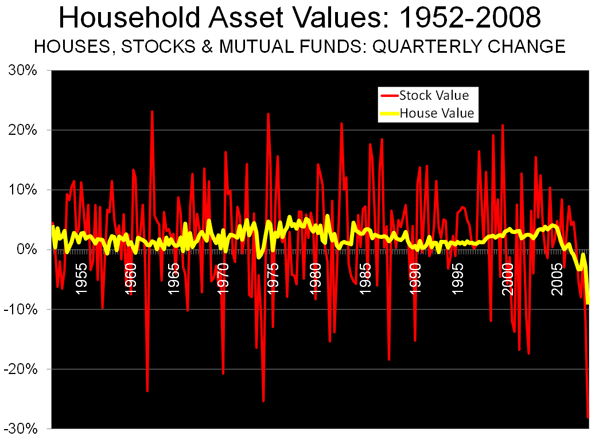
    The resulting losses have been substantial. By the end of 2008, the value of the housing stock has fallen $4.5 trillion. In Phase I of the housing downturn, before Meltdown Monday, the largest losses were concentrated in the markets with the biggest “bubbles,”. But since that time the market has entered a Phase II decline, while a more general decline has characterized housing markets around the country in the fourth quarter of 2008. The decline continues.

    California, the largest of all the states, has been particularly hard hit. New data for both the San Francisco and Los Angeles areas show price drops of approximately 10 percent in January, 2009 alone, as prices fall like the value of a tin-pot dictatorship’s currency. This decline, it should be noted, has spread from the outer ring of these areas – places like the much maligned Inland Empire region and the Central Valley – into the formerly more stable, and established, areas closer to the larger urban cores, which some imagined would be safe from such declines.

    Sadly, there may well be some time before house price stability can be achieved. To restore the historic relationship between house prices and household incomes to a Median Multiple (median house price divided by median household income) of 3.0 would require another $3 trillion in losses, equating to a more than 15 percent additional loss. Losses are likely to be greater, however, not only in the “ground zero” markets of California and Florida but also other hugely over-valued markets, such as Portland, Seattle, New York and Boston. Of course, these are not normal times, and an intransigent economic downturn could lead to even lower house values than the historical norm would suggest.

    Stocks and Mutual Funds: As noted above, stocks and mutual funds have been inherently more volatile than housing values. According to Federal Reserve data, the value of these holdings fell 24 percent over the year ended September 30. Based upon later data from the World Federation of Exchanges, we estimate that the value declined sharply after September 15, and at December 31 stood at 45 percent below the peak.

    The household value of stocks and mutual funds has declined for five consecutive quarters, as of December 2008. There was a more sustained drop over six quarters in 1969-1970, although the decline in value was less than the present loss, at 37 percent. A larger decline (47 percent) was associated with the four quarter decline of 1973-1974. Comparable data is not available for household stocks and mutual fund holdings before 1952. The less complete data available indicates that the gross value of common and preferred stocks fell 45 percent from 1929 to 1933. As late as 1939, a decade after the crash, the loss had risen to 46 percent, indicating both the depth and length of the Great Depression.

    The present downturn seems on course at a minimum to break the post-depression loss record with an overall decline at 55 percent as of February 20. This would correspond to a household loss of $8 trillion from the peak.

    Consumer Confidence: The Conference Board’s Consumer Confidence Index reached an all time low of 25.0 in February, down a full one-third in a month. Even with its gasoline rationing, the mid-1970s downturn saw a minimum Consumer Confidence Index of 43.2. Normal would be 100; as late as August of 2007, consumer confidence was above 100. Consumer confidence is important. Where it is low, as it is today, there is fear and even people with financial resources are disinclined to spend. Confidence is a major contributor to economic downturns, which is why they used to be called “panics.” Restoring confidence is a requirement for recovery.

    Government Confidence: If there were a federal government index of confidence, it would probably be near zero. This is demonstrated by the trillions that both parties in Washington have or intend to throw at banks, private companies and distressed home owners to stop the downturn. Never since the Great Depression have things become so bad that Washington has opened taxpayer’s checkbooks for massive financial bailouts.

    How Much Wealth has been Lost: The net worth of all US households peaked at $64.6 trillion in the third quarter of 2007, according to the Federal Reserve Board. Since that time, it seems likely that the housing, stock and mutual fund losses by the nation’s households could be as high as $12 trillion – $4 trillion in housing and $8 trillion in stocks and mutual funds. This is a major loss and is unlikely to be recovered soon. Yet it makes sense to consider these losses in context. Unemployment is far lower than in the 1930s, when it reached 25 percent, and the Dust Bowl is not emptying into California (indeed, more than 1,000,000 people have migrated from California to other states this decade).

    Born Yesterday Jeremiahs: It is fashionable to suggest that the current economic crisis is the result of over-consumption and an unsustainable lifestyle. The narrative goes that the supposed excesses of the 1980s and 1990s have finally caught up with us. In fact, however, even with the huge losses, the net worth of the average household is no lower than in 2003 and stands at 70 percent above the 1980 figure (inflation adjusted). This may be a surprise to “born yesterday” economic analysts.

    The reality is that the country achieved astounding economic and social progress since World War II. The reality remains that even after the losses we are not, objectively speaking, experiencing Depression-like conditions. Critically, the answer to the question, “Are you better off today?” in 1950, 1960, 1970, 1980, 1990 and even 2000 is “yes”. This is a critical difference with the situation in the 1930s when the country overall was much poorer, and far less able to withstand such punishing losses.

    Beware the Panglossians: Even so, it seems premature to predict that the economy will turn around soon. Some Panglossian analysts predict recovery later in the year or in 2010 seem likely to miss the mark by years. Remember analysts – particularly those tied to both the real estate and stock sectors – who have discredited themselves with their past cheerleading. In addition, the international breadth and depth of this crisis cannot possibly be fully comprehended at this time. Last week the Federal Reserve predicted a declining economy over the next year.

    And even when the recovery starts, it is likely to be slow because of the public debt run up to stop the bleeding. When the recovery begins, the nation and the world will have to repay the many trillions in bailouts one way or the other. This can take the form of higher taxes, inflation, rising real interest rates or, if you can imagine, all three.

    How Bad Is It? Bad Enough. The present downturn is not as serious as the Great Depression. Nonetheless, the Panic of 2008 is without question, the most serious economic downturn since the Great Depression. The real question is whether the government will react as ineffectively as it did back then, and prolong the downturn well into the next decade.

    Wendell Cox is a Visiting Professor, Conservatoire National des Arts et Metiers, Paris. He was born in Los Angeles and was appointed to three terms on the Los Angeles County Transportation Commission by Mayor Tom Bradley. He is the author of “War on the Dream: How Anti-Sprawl Policy Threatens the Quality of Life.

  • We Sneezed, They Got Pneumonia

    Don’t worry about China taking over the US economy. Despite what all the talking heads on TV and the radio talk shows are saying, there isn’t another country out there that hasn’t been hammered at least as badly as we have by the financial meltdown. The problem with any other country attacking the US dollar, for example, is that they are all holding a lot of US dollars. You probably remember last year they were worried about the fact that we import so many goods that we have big “trade imbalances” – meaning that we buy more of their goods than they buy of ours.

    Now remember this: we pay for those imports with dollars. So, again, if the dollar is worth less (or worthless) then they are not going to be getting as much for their imports. Raising the price of their goods, that is, simply charging more dollars won’t do them any good either. We’re in a recession, and Americans are tightening their belts. Demand for imported goods, like demand for all goods except luxury goods, is price sensitive. The more they charge, the less we buy. According to an article on CNN.com, our belt tightening has ended the “Road to riches for 20 million Chinese poor.”

    Furthermore, it’s in the best interest of countries around the world that the US dollar stays strong. The door does swing both ways. According to Jack Willoughby at Barrons.com, “European banks provided three-quarters of the $4.7 trillion in cross-border loans to the Baltic countries, Eastern Europe, Latin America and emerging Asia. Their emerging-markets exposure exceeds that of U.S lenders to all subprime loans.”

    To support all of that exposure, the European Central Bank has been obtaining dollars from the U.S. Federal Reserve in currency swaps. The value of these swaps, where dollars are exchanged for other currency at a fixed and renewable exchange rate, went from $0 to $560 billion this year.

    And the Federal Reserve printing presses keep rolling along.

  • Case-Shiller Housing Price Index Chart, December 2008 – The Free Fall Continues

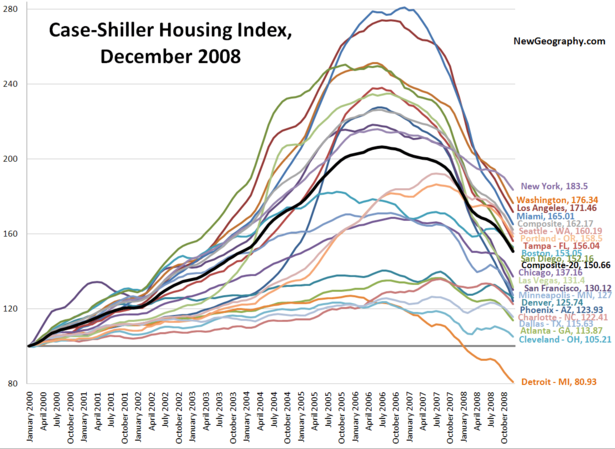
    S&P released the December Case-Shiller Housing Price Index data this morning: no market has been spared from the free fall. Steep price declines continue in ultra-bubble regions Las Vegas, Miami, San Diego, Phoenix, and Las Vegas. Even the relatively healthy markets of Charlotte, Dallas, and Atlanta have been sliding since mid-2008. Here’s the line chart:

    Cleveland is seeing the slowest decline, but that isn’t saying much. My pick for healthiest markets? Denver, where prices are still up 25% from the 2000 baseline but still down 5.2% from the most recent upswing in July 2008. And Dallas, down 6.1% from the July 2008 peak and down 8.6% from June 2007. Dallas is up 22.9% since the Jan 2000 baseline.

    Follow this link for a bigger version of the chart.

  • The Decline of Los Angeles

    Next week, Antonio Villaraigosa will be overwhelmingly re-elected mayor of Los Angeles. Do not, however, take the size of his margin – he faces no significant opposition – as evidence that all is well in the city of angels.

    Whatever His Honor says to the media, the sad reality remains that Los Angeles has fallen into a serious secular decline. This constitutes one of the most rapid – and largely unnecessary – municipal reversals in fortune in American urban history.

    A century ago, when L.A. had barely 100,000 souls, railway magnate Henry Huntington predicted that the place was “destined to become the most important city in this country, if not the world.” Long run by ambitious, often ruthless boosters, the city lured waves of newcomers with its pro-business climate, perfect weather and spectacular topography.

    These newcomers – first largely from the Midwest and East Coast, and then from around the world – energized L.A. into an unmatched hub of innovation and economic diversity.

    As a result, L.A. surged toward civic greatness. By the end of the 20th century, it stood not only as the epicenter for the world’s entertainment industry, but also North America’s largest port, garment manufacturer and industrial center. The region also spawned two important presidents – Richard Nixon and Ronald Reagan – and nurtured a host of political and social movements spanning the ideological spectrum.

    Now L.A. seems to be fading rapidly toward irrelevancy. Its economy has tanked faster than that of the nation, with unemployment now close to 10%. The port appears in decline, the roads in awful shape and the once potent industrial base continues to shrink.

    Job growth in the area, notes a forecast by the University of California at Santa Barbara, dropped 0.6% last year and is expected to plunge far more rapidly this year. Roughly one-fifth of the population depends on public assistance or benefits to survive.

    Once a primary destination for Americans, L.A. – along with places like Detroit, New York and Chicago – now suffers among the highest rates of out-migration in the country. Particularly hard hit has been its base of middle-class families, which continues to shrink. This is painfully evident in places like the San Fernando Valley, where I live, long a middle-class outpost for L.A., much like Queens and Staten Island are for New York.

    In such a context, Villaraigosa’s upcoming coronation seems hard to comprehend. By most accounts, he has been at best a mediocre mayor, with few real accomplishments besides keeping police chief Bill Bratton, a man appointed by his predecessor. So far, Bratton has managed to keep the lid on crime, a testament both to his skills and to the demographic aging of much of the city.

    Besides this, virtually every major initiative from Villaraigosa has been a dismal failure; from a poorly executed program to plant more trees to a subsidized drive to refashion downtown Los Angeles into a mini-Manhattan. Instead of reforming a generally miserable business climate, Villaraigosa has fixated on fostering “elegant density” through massive new residential construction. This gambit has failed miserably, with downtown property values plunging at least 35% since their peak. Many “luxury” condominiums there, as well as elsewhere in the city, remain largely unoccupied or have turned into rentals.

    More recently the mayor has presided over a widely ridiculed scheme to hand over the solar business in Los Angeles to a city agency, the Department of Water and Power (DWP), whose workers are among the best paid and most coddled of any municipal agency anywhere. Most solar plans by utilities focus more on competitive bidding by outside contractors. Villaraigosa’s plan, which recent estimates suggests will cost L.A. ratepayers upward of $3.6 billion, would grant a powerful, well-heeled union control of the city’s solar program.

    This has occurred despite years of overruns on previous DWP “clean energy” projects. Not surprisingly, the plan was widely blasted – by the city’s largest newspaper, the rapidly shrinking Los Angeles Times, the feistier LA Weekly and the last independent voice at City Hall, outgoing City Controller Laura Chick, who proclaimed that the whole scheme “stinks.” Yet despite the criticism, a ballot measure endorsing the plan – opponents have little money to stop it – seems likely to be approved next week.

    With his firm grip on political power, Villaraigosa likes to think of himself as a West Coast version of New York’s Michael Bloomberg or Chicago’s Richard Daley. Yet at least they have demonstrated a modicum of seriousness about the job.

    In contrast, Villaraigosa, according to a devastating recent report in the LA Weekly, spends remarkably little time – about 11% – actually doing his job. The bulk of his 16-hour or so days are spent politicking, preening for the cameras and in other forms of relentless self-promotion.

    So how is this person about to be re-elected with only token opposition? Rick Caruso, the developer of luxury shopping center The Grove and one of L.A.’s last private sector power brokers, ascribes this to a growing sense of powerlessness, even among the city’s most important business leaders.

    “People feel it’s kind of hopeless. It’s a dysfunctional city,” Caruso, who once considered a run against Villaraigosa, told me the other day. “They don’t think there’s anything to do.”

    Certainly, odds against changing the current political system seem long to an extreme. The once-powerful business community has devolved into a weak plaintive lobby who rarely challenge our homegrown Putin or his allies in our municipal Duma.

    Of course, entrepreneurial Angelenos still find opportunities, but largely by working at home or in one of the city’s surrounding communities. They tend to flock to locales like Ontario, Burbank, Glendale or Culver City, all of which, according to the recent Kosmont-Rose Institute Cost of Doing Business Survey, are less expensive and easier to do business in than L.A.

    “It’s extremely difficult to do business in Los Angeles,” observes Eastside retail developer Jose de Jesus Legaspi. “The regulations are difficult to manage. … Everyone has to kiss the rings of the [City Hall politicians].”

    Legaspi, like many here, still regards Southern California as an appealing place to work, but takes pains to avoid anything within the purview of City Hall. As the economy recovers, I would bet the smaller cities around L.A. and even the hard-hit periphery rebounds first.

    The only immediate chance of relief for us Angelenos is if Villaraigosa (who will soon face term limits) takes off to run for governor. As the sole southern Californian and Latino candidate, he could prevail in a crowded Democratic primary. But the idea of this empty suit running the once great state of California – not exactly a paragon of good governance – may be enough to push even more people to the exits or, at very least, think about taking a very strong sedative.

    This article originally appeared at Forbes.

    Joel Kotkin is executive editor of NewGeography.com and is a presidential fellow in urban futures at Chapman University. He is author of The City: A Global History and is finishing a book on the American future.

  • Ten Year loss in the S&P 500 on Par with the Great Depression

    In the ten-year stretch from Sept. 1929 to Sept. 1939, spanning the worst years of the Great Depression, the stock market dropped a full 50%, adjusted for inflation. Look out, the current decade (Feb. 17, 1999 to Feb. 17, 2009) appears to yield the same decrease: the Standard & Poor’s 500 stock index is down roughly 50%, also adjusted for inflation.

    But this difficult period has not been all skull and cross-bones: six-month certificates of deposit “have yielded a real total return of roughly 12%” and the value of residential homes in large cities has increased 30% over the same period, according to Business Week’s Michael Mandel.

    With many investors’ savings sitting in once-promising equities, the question of whether to stay in stocks or bail out is on many people’s minds.

    Staying in stocks could decrease the value of your investments to the point that they “may never reach their original value, much less show a profit.”

    On the flipside, bailing out and going into safer assets says “you are giving up on any potential of an upside” if the market has a big rebound.

    The market will always fluctuate and whether your glass is half-empty or half-full, and long term history says more growth is ahead. But as they say on TV, “past returns are no guarantee for future performance.” How much are you willing to bet on the long-term future of the US economy?