Blog

  • Housing Downturn Moves Into Phase II

    The great housing turndown, which started as early as 2007, has entered a second and more difficult phase. We can trace this to Monday, September 15, 2008 just as October 29, 1929 – “Black Tuesday” – marked the start of the Great Depression. September 15 does not yet have a name and the name “Black Monday” has already been taken by the 1987 stock market crash. The 1987 crash looks in historical perspective like a slight downturn compared to what the world faces today.

    On September 15 – let’s call it “Meltdown Monday” – the housing downturn ended its Phase I and burst into financial markets leading to the most serious global recession since the Great Depression. Indeed, International Monetary Fund head Dominique Strauss-Kahn now classifies it a depression.

    Phase I claimed its own share of victims; Phase II seems likely to hit many more.

    Phase I of the Housing Downturn

    Whether in depression or recession, parts of the United States housing market were already in a deep downturn well before September 15. Phase I of the housing downturn started when house prices reached an unprecedented peak in some markets and began fell into decline. By September of 2008, house prices in the “ground zero” markets of California, Florida Las Vegas, Phoenix and Washington, DC had dropped from 25 percent to 45 percent from their peaks. These markets represented 75 percent of the overall lost value among the major metropolitan areas (those with more than 1,000,000 population).

    The Varieties of House Price Escalation Experience: In Phase I, the house price escalation and subsequent losses were far less severe in other major metropolitan areas. This depended in large part to the degree of land use controls – such as land rationing (urban growth boundaries and urban service limits), building moratoria, large lot zoning and other restrictions on building routinely – that helped drive prices up to unsustainable levels. This effect, cited by a number of the world’s most respected economists, was exacerbated by the easy money policies adopted by mortgage lenders.

    On the other hand, in the “responsive” land use regulation areas, the market (people’s preferences) was allowed to determine where and what kind of housing could be built. In these areas housing prices rose far less during the housing bubble and fell far less during Phase I of the housing downturn.

    Leading to the International Financial Crisis: These radically differing house price trends set up world financial markets for ”Meltdown Monday.” The easy money led to a strong increase in foreclosure rates, an inevitable consequence of households having sought or been enticed into mortgage loans that they simply could not afford. Yet it was not foreclosure rates that doomed the market. It was rather the unprecedented intensity of those losses in particular markets.

    Foreclosures were not the problem: Foreclosures happened all over. Foreclosure rates rose drastically in California and the prescriptive markets, but had relatively less impact in the responsive markets of the South and Midwest, where house prices changed little relative to incomes.

    Intensity of the losses was the problem. The problem lay largely in the scale of house value losses in some markets, particularly the most prescriptive ones. Lenders faced foreclosure and short sales losses on houses that had lost an average of $170,000 in value in the ground zero markets. In the responsive markets, on the other hand, average house value losses were less than one-tenth that, at $12,000 per house (http://www.demographia.com/db-hloss.pdf).

    By the end of Phase I of the housing downturn, house value losses in the prescriptive markets had reached nearly $2.3 trillion, accounting for 94 percent of the total losses in major metropolitan markets (those with more than 1,000,000 population). If the market had been allowed to operate in these markets, the losses in the prescriptive markets could easily have been one-fifth this amount. Most likely the mortgage industry and the international economy might have been able to handle such losses, sparing the world the current deep financial crisis.

    True, the housing bust would not have happened without the easy money. Neither easy money nor prescriptive land use regulation were sufficient in themselves to send the world economy into a tailspin. But together they conspired to create the conditions for “Meltdown Monday”.

    Phase II of the Housing Downturn

    The Panic of 2008: By September 15, the “die had been cast.” The holders of mortgage debt could no longer sustain the losses that were occurring in the ground zero markets. This led to the Lehman Brothers bankruptcy and then to a financial sector that seems to be accelerating faster than the taxpayers can pick up the pieces. The ensuing “panic” – a 19th century synonym for a severe economic downturn – has led to millions of layoffs, decreases in demand across the economy and taxpayer financed bailouts around the world. Many have seen their retirement funds wiped out. Others have lost their jobs. American icons, such as General Motors and Bank of America have been relegated to begging on Washington’s K Street.

    Housing Downturn Broadens and Deepens: The panic has now brought about a new phase in the housing downturn – what I label Phase II. In Phase II, a deteriorating economy starts to kick the bottom out of the rest of the housing market. With evaporating confidence in the economy and the drying up of demand, house prices have begun a free-fall in virtually all markets, regardless of the extent to which their prices had bloated.

    Our analysis of National Association of Realtors data shows this. In almost all markets house price declines accelerated during the fourth quarter of 2008 (the first quarter following Meltdown Monday). In just three months, median house prices fell an average of more than 12 percent in the major metropolitan markets. In the ground zero markets, house prices dropped 14 percent, with the average loss from the peak exceeding 40 percent. In the responsive markets, prices fell 11 percent, approximately double the previous reduction from the peak (See Table).

    Thus, the difference is that in Phase I, house price declines were in proportion to the previous price escalation. In Phase II, the percentage declines are generally similar without regard to the house price increases.

    House Price Deflation from Peak
    By Phase of the Housing Downturn
    PRESCRIPTIVE LAND USE MARKETS
    RESPONSIVE LAND USE MARKETS
    Factor
    Ground Zero
    Other
    All
    ALL MARKETS
       
    Prices: To Phase I
    -31.70%
    -11.10%
    -20.80%
    -5.90%
    -17.90%
    Prices: To Phase II
    -41.40%
    -21.40%
    -30.80%
    -16.60%
    -28.00%
     
    Prices in Phase II
    -14.20%
    -11.60%
    -12.60%
    -12.40%
    -14.20%
     
    Loss per House: To Phase I
    ($193,800)
    ($42,400)
    ($96,300)
    ($12,200)
    ($66,900)
    Loss per House: To Phase II
    ($253,000)
    ($81,800)
    ($142,700)
    ($34,200)
    ($104,800)
     
    Loss per House in Phase II
    ($59,200)
    ($39,400)
    ($46,400)
    ($37,900)
    ($59,200)
     
    Gross Losses (Trillions): To Phase I
    ($1.82)
    ($0.46)
    ($2.29)
    ($0.16)
    ($2.44)
    Gross Losses (Trillions): To Phase II
    ($2.40)
    ($0.99)
    ($3.39)
    ($0.44)
    ($3.82)
     
    Gross Losses (Trillions): in Phase II
    ($0.58)
    ($0.52)
    ($1.10)
    ($0.28)
    ($1.38)
       
    Phase I: To September 2008          
    Phase II: To December 2008          
    Major Metropolitan Markets (over 1,000,000 population)      
    For markets by classification see: http://www.demographia.com/db-hloss.pdf    

    Recession or Depression?

    It’s critical to note that the decline is by no means as deep as in the 1930s. On the other hand, there is no indication that conditions are going to improve markedly in the short run. Millions of households who saw their retirement accounts devastated are likely to curb consumption for years to come. The key question is whether we are in the equivalent of 1933, in the pit of the downturn, or in the equivalent of the late 1930s, soon to begin a long, slow climb out.

    For housing though, this is a depression. Never before over the last half-century have house prices fallen as they have in the prescriptive markets during Phase I of the housing downturn. And since the bust, during Phase II, overall price declines are on a par with the worst years of the Great Depression. “Meltdown Monday” has incited a downward spiral whose course will be the topic of future commentaries on this site.

    The classifications of the major metropolitan markets and price declines for each market are shown in http://www.demographia.com/db-hloss.pdf.

    Also see: Mortgage Meltdown Graphic: http://www.demographia.com/db-meltdowngraphic.pdf

    Wendell Cox is a Visiting Professor, Conservatoire National des Arts et Metiers, Paris. He was born in Los Angeles and was appointed to three terms on the Los Angeles County Transportation Commission by Mayor Tom Bradley. He is the author of “War on the Dream: How Anti-Sprawl Policy Threatens the Quality of Life.

  • Nation Has $445 Billion in Unfunded Health Care Benefits, Nebraska Has None

    Nebraska was the 37th State to join the Union, is home to the “Cornhuskers,” and currently has a $3.5 billion budget and a $563 million cash reserve.

    In this time of economic hardship, the Cornhusker state has no debt, shunning all long-term financial commitments including retirement benefits.

    A recent USA Today survey of state financial reports found that the other 49 states combined “have an unfunded obligation of $445 billion” owed for the medical care of retired government workers.

    The formula accountants use to compute the financial health of a state government includes medical benefits, debt and pension liability. Medical benefits represent the Pandora’s Box of the three, with civil servants often retiring before Medicare benefits kick in at 65.

    In contrast, Nebraska is the “only state that doesn’t subsidize the medical care of retired government employees.”

    Other states and local governments have debts that range anywhere from New York City’s $60 billion obligation to Los Angeles’ $544 million sum.

    Some state and local governments have begun setting aside money to prepare to pay retiree medical costs. Some plan to pay nearly the entire cost, other will contribute a fixed amount, such as “$200 a month or 50% of the health insurance premium.”

    In defending Nebraska’s nonexistent retiree health care coverage, Senator Dave Pankonin distills his state’s approach simply: “Nebraska is a fiscally conservative, pay-as-you-go state, and that’s the biggest reason we don’t have this benefit.” Or, he might have added, deficit.

  • Oregon Fail: With Hard Times Ahead for Business and Real Estate, It’s Time to Look Small

    There is something about Oregon that ignites something close to poetic inspiration, even among the most level-headed types. When I asked Hank Hoell recently about the state, he waxed on about hiking the spectacular Cascades, the dreamy coastal towns and the rich farmlands of the green Willamette Valley.

    “Oregon,” enthused Hoell, president of LibertyBank, the state’s largest privately owned bank, from his office in Eugene, “is America’s best-kept secret. If quality of life matters at all, Oregon has it in spades. It is as good as it gets. It’s just superb.”

    As developer Shelly Klapper, a rare skeptic in the Beaver State, reminded me: “This is a state that buys its own hype.”

    Hype or not, however, Oregon is hurting – something that’s clear to even the most self-respecting narcissist. Over the past year, Oregon’s economy has fallen off a cliff just about as fast as any state in the union.

    A year ago, things seemed very different. Sunbelt boom states like California, Arizona and Nevada were already heading into deep recession, but green Oregon seemed oddly golden. Both its small cites and one big town, Portland, were outperforming the national norms. Oregonians saw their state as better – not only in terms of green and good, but also in terms of basic job growth.

    But since last winter, Oregon’s unemployment rate has soared from barely 5.5% to well over 8%, the sixth worst in the nation. Indeed, according to a recent projection by the University of California at Santa Barbara (UCSB), Oregon’s jobless rate could reach close to 10% by the end of the year.

    Well into 2010, Oregon’s overall economy will shrink more rapidly than the nation’s as a whole, notes UCSB forecaster Bill Watkins. He traces a sharp downturn there to many factors, including one of the toughest regulatory regimes in North America.

    In tough times, companies generally expand in localities that are friendly to commerce – say, states like Texas or nearby Idaho. Few would rate Oregon highly in that regard.

    “Oregon is mostly a place that focuses on the enjoyment of its space, and that makes [it] very vulnerable in these conditions,” Watkins says.

    The other big problem has to do with a lack of economic diversity. Oregon has been through tough times before. For much of its history, the state’s economy depended largely on harvesting its vast forests. Then, in the 1980s, the state developed a green bug, and decided it shouldn’t chop down Mother Nature for a living.

    In the ensuing decade, Oregon pioneered tough land-use regulations, curbing industries that relied on forest products and declaring war on suburban sprawl. Its main city, Portland, became the poster child of the “smart growth” movement by forcing up density, building an extensive light-rail system and restoring its urban core.

    Although widely praised, these stringent regulations also drove up land prices and, ironically, prompted many middle-class residents to move away, including across the border into Washington. Businesses, rather than cluster in the state’s core, continued to migrate to the outer rings; in the relatively healthy year of 2005, for example, barely 10% of Portland’s office space growth took place in the central district.

    “We give lip service to the economy here,” admits Klapper, a longtime Portland entrepreneur and a former official with the Port of Portland. “But, really, business is not a priority here.”

    For a while, Klapper notes, the tech sector seemed to offer the solution. In the ’80s and ’90s, chip makers fleeing even higher costs in California flooded into Oregon, which was proudly dubbed the “Silicon Forest.” In an unusual move, the state provided tax breaks to the chip makers, which helped. The state’s suburbs also proved attractive to tech workers who could afford a far better quality of life there, in terms of schools and housing, than they could in the Golden State.

    But as regulations tightened and costs to businesses and families increased, even the high-tech industry began to fade. Always a political bellwether state, Oregon has moved inexorably left, increasingly dominated by both its public sector and the particularly strong green movement. Semiconductor expansion soon started to go south – or in this case, further east (to Idaho) or across the Pacific to Asia.

    Only one thing remained to drive the economy: housing. A torrent of Californians were heading north – cashing out of the overpriced Bay Area, Sacramento and Los Angeles – and buying new homes in Oregon. Some sophistos sashayed their way into trendy places like Portland’s Pearl District, but many others looked to the charming smaller towns of the Willamette Valley and central Oregon.

    “When all else failed, it was people moving here that kept us going,” says Klapper, who was a major investor in the Pearl District renaissance. “California became our biggest industry.”

    This dependence turned into a debilitating addiction. When in 2007, the great California housing bubble collapsed, the inflow of people and dollars dropped off. Meanwhile, the remnants of lumber industry fell victim to the housing bust.

    Nowhere are the effects of this clearer than in Bend, a spectacular town of 75,000 located amid volcanic peaks in the center of the state. Californians had considered Bend a favorite spot for second homes and relocation. About a year ago, notes real estate appraiser Steve Pistole, prices were rising 2% a month, while those in Portland were “only” rising 8% a year.

    But to visit Bend now is to be in the eye of the housing hurricane, with nearly deserted housing tracts, woefully empty hotels and residential second-home developments. Unemployment in the housing arena, according to the UCSB, could reach 15% next year.

    We can also expect a further slide in housing prices. Oregon’s bubble, notes analyst Wendell Cox, inflated later than California’s, so prices, which have dropped more than 10% in the last year, could fall by that much or more in the next.

    Yet despite all these problems, many Oregonians remain optimistic. Some of this seems, at least fundamentally, a reflection of ideology. The inevitable huge surge of “green jobs” promised by the Obama administration has long been an article of faith in the state; it seems something like a story we’d tell our children to put them to sleep. State officials, for example, speak wistfully of replacing a recently shuttered Korean-owned Hynix chip plant with a facility to make solar panels.

    The bad news is this: 49 other states – some of which don’t pose such strong regulatory challenges – also hope to bring home some of these green jobs. So if business logic applies, the new factories that manufacture wind turbines, propellers or solar panels will end up in states like North Dakota or Texas, which have been the most successful, thus far, at attracting other manufacturing jobs.

    So what trail should Oregon blaze now? Pistole, the real estate appraiser, says it may be time to think small. Places like Bend, he notes, already attract former Silicon Valley veterans who like living close to trout streams, hiking trails and golf courses.

    “There is no magic bullet for Oregon,” says Pistole, who himself moved from California just three years ago. “But there could be lots of onesies, twosies, mom-and-pops. People still want to live here. We have to make it synergistic to live where you want and still make money. That’s the way we need to go.”

    Some entrepreneurs, like 38-year-old Michael Taus, are already setting up such small shops, some of them in their homes. A recent arrival from Los Angeles, Taus made it big as one of the founders of Rent.com, which was sold to eBay in 2005. He’s only lived in Bend for a few months, but he has already launched his own start-up and consults for several other local firms.

    Taus believes others of his generation will want to establish businesses in Oregon, lured by both its lifestyle and affordability. Some of the new business may be in software, Taus says, but others could sprout in specialty agriculture, wood products and other industries.

    “People are here for a reason. There’s a good amount of talent, and you can get more here,” he says earnestly. “There’s a great potential. We just have to get down to business.”

    This article originally appeared at Forbes.

    Joel Kotkin is executive editor of NewGeography.com and is a presidential fellow in urban futures at Chapman University. He is author of The City: A Global History and is finishing a book on the American future.
  • Does a low number of home staters mean everyone has left?

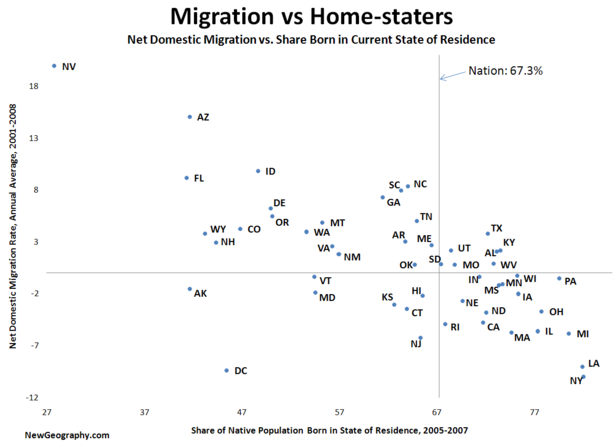
    Last week I took a look at the share of US born residents in each state born in their current state of residence. Some on other blogs wondered if a low share of native born in a state meant that everyone has left or if instead that state is a big lure to out-of-staters. Aside from a few outliers, it seems to be the latter. Take a look at this quick analysis: states with a low share of native born tend to have high net inmigration and states with many born in state tend to have high outmigration.

    It makes sense that in tougher times (evidenced by net outmigration) those with deeper roots find a reason to stick around – or maybe they are just tied down.

    High net inmigration, low native born states tend to be high in natural amenities (read: mountains) or recent boom states in the west – many of which may have capitalized on the exodus from California. Note that North and South Carolina, Georgia, and Tennessee have similar numbers.

    Most interesting is the grouping towards the upper right: states with both above average number of those born in state and positive or near positive migration. Could this signal a return of the diaspora to states like Texas, Kentucky, Alabama, Utah, or even Wisconsin and Pennsylvania?

  • The Recession: Fuzzy Thinking Delays A Recovery

    I keep hearing how the current recession will end in 2010 because the average United States recession from 1854 to 2001 has been 17 months. This is silly for a variety of reasons.

    One reason is that there is no average recession. Post-World War II recessions have lasted from a minimum of six months to a maximum of only 16 months. If we were to apply the “average recession” logic to post World War II recessions, the current recession, which the NBER — the National Bureau of Economic Research — says started December 2007, would have ended 10 months later, last October.

    Another reason is that few previous recessions have been accompanied by the financial sector collapse that we witnessed in September. Worldwide experience indicates that recessions associated with financial sector panics tend to be longer than those without panics.

    Since 1854, five United States recessions have been accompanied by financial panics. These are the recessions of 1857, 1873, 1893, 1907, and 1929. The average duration of these recessions was 31 months. The 1907 recession was the shortest, at only 13 months. The 1873 recession was the longest, at 65 months. For comparison, the 1929 recession was 43 months. Interestingly enough, J.P. Morgan was instrumental in ending the financial panics of the two shortest recessions, 1893 and 1907.

    If we were to engage in the same sort of fuzzy thinking as the “average recession” analysis applied to “financial Panic” recessions, and assuming we use the NBER recession start date of December ‘07, the current recession could be expected to end 31 months later in July 2010. Is that too long for you? You could use the average 20th Century recession accompanied by a financial panic length. That is 28 months, so maybe the recession will end in April 2010.

    Maybe we should look at foreign data? The point is that if you play this game long enough, you can find a date you like.

    Finally, the method of dating recessions changed with the 2001 recession. The new method is much more likely to declare an economy in recession. If the old method had been used — if previous criteria were applied to the current situation — I believe the recession would have commenced no sooner than July 2008. Recent data revisions increase my confidence that the NBER was wrong when they said the recession commenced in December 2007. If you have the wrong start date, any “average recession” method will be wrong.

    The facts are that we have a serious recession accompanied by a financial panic and continuing massive job losses. The correct way to analyze the current recession is to recognize that it was accompanied by financial panic, and that means we had a regime shift from a good equilibrium to a bad equilibrium.

    Game theory tells us that we can have multiple Nash Equilibria to certain games. A Nash Equilibrium is one where knowing your opponent’s decision you would not change your decision.

    Bank runs provide an excellent example. Suppose you have a bank that does not have deposit insurance. Most of the time things plug along. People make deposits, borrow, and the like. Everybody is happy with their decisions. Call this the good equilibrium. However, in the event of a bank run, everyone wants to participate in the run, because those who do not end up loosing. Call this the bad equilibrium. Furthermore, nothing real has to change. We can switch from the good equilibrium to the bad equilibrium on unfounded rumors.

    The financial panic we witnessed last September was exactly like a bank run. In an amazingly short time, we switched from a good equilibrium to a bad equilibrium. The bad news is that we have no idea how to switch from a bad equilibrium to a good equilibrium. It will surely happen, but we don’t know how to cause it. We don’t know what will cause it. We can’t predict when it will happen.

    We do know that a lot of assets need to change hands. These include financial assets, auto factories, and homes. Recessions are periods when assets are reallocated to better uses.

    Current policy, with its obsessive pursuit of bailouts, seems to be focused on delaying those reallocations. That will delay the recovery. So-proposed government efforts to limit the impact will be ineffective, if not counterproductive. That is why I don’t see any reason to expect a recovery in 2009.

    Bill Watkins, Ph.D. is the Executive Director of the Economic Forecast Project at the University of California, Santa Barbara. He is also a former economist at the Board of Governors of the Federal Reserve System in Washington D.C. in the Monetary Affairs Division. All recession dating data in this article is from the NBER website.

  • Business Journalists Blew the Story on the Economy

    The business sections of newspapers have become doomsayers for the nation. Sensationalistic journalism decries of the failings and crises that have done our economy irreparable harm.

    Rewind to a couple of years ago, and the print media was content with profiles of personable CEOs and pages upon pages devoted to the kitschy Mergers and Acquisitions. Where was the hard-hitting reporting that could’ve opened the public’s eyes to the failing economy much sooner?

    “I’ll attest that business journalists as a rule are as smart, sophisticated, and plugged-in as they seem”, notes former Wall Street Journal reporter Dean Starkman in a recent article for Mother Jones. And yet that army of professional business reporters – an estimated 9,000 or so nationwide in print alone – for all practical purposes missed the biggest story on the beat. Why?”

    Starkman suggests the print industry’s own declining financial health may play a role. In the last decade alone, the New York Times profit margins have fallen from 24 percent to a meager 8.5.The newspaper industry’s failing has also resulted in a 25 percent loss of jobs in the business reporting field alone.

    He adds that business journalism’s insistence on clinging to outdated formulas could play a role. The focus on consumer-pleasing and personality-driven stories – “not deconstructing balance sheets or figuring out risks” – seems part of the problem.

  • Dubai, Mumbai, Shanghai : Destiny or Hype?

    The assonant phrase “Dubai, Mumbai, Shanghai or Goodbye” was credited to Andrew Ross Sorkin of the New York Times in late 2007 at the beginning of the financial crisis on Wall Street. For years, New York, London and Tokyo held sway as the world’s financial capitals. Then the tectonic plates of the financial world began to move and these new cities were going to be the prime beneficiaries.

    Global shifts of financial power are not uncommon in history but they are dramatic. In the 15th Century, we saw the rise of Western Civilization. In the 19th Century, we experienced the emergence of the United States of America, followed by the rise first of Russia, Germany and Japan, and then China and India.

    The question now: has the time of London, New York and Tokyo come to an end? The basis for this assertion certainly exists. In 2008, the United States trade deficit with China topped $246 billion. In this new century, just eight years old, the United States trade deficit sent $1.4 trillion to China. This pattern alone would seem to secure Shanghai’s future preeminence.

    So it would also seem for Dubai. Crude oil hit $147/barrel in July, 2008. At that level, western democracies were sending $1 trillion per year to the Persian Gulf in exchange for 20 million barrels of oil. Dubai claimed possession of the tallest building in the world when the Burj Dubai topped 165 floors. This title, along with the world’s largest airport, world’s tallest hotel, and world’s tallest apartment are just a few of the superlatives used to describe Dubai.

    India’s trade surplus with the United States grew to $80 billion in 2008 as their economy exploded. An Indian car company shocked the world by purchasing legendary marquees Jaguar and Land Rover from Ford Motor Company. Mumbai was working towards becoming a true contender.

    At the beginning of the financial crisis “Dubai, Mumbai, Shanghai or Goodbye” did seem to identify the future locus of job openings in the financial world. Look at some of the records once owned by United States companies and who owns them today:

    • Tallest building : Dubai
    • Largest publicly traded company : China
    • Largest passenger airplane : Europe
    • Largest investment fund : Abu Dhabi
    • Largest movie industry : India
    • Largest casino : Macao
    • Largest shopping mall : Dubai

    So it looked in 2008. It is now early 2009. Lehman Brothers is gone. Wachovia was swallowed by Wells Fargo. Merrill Lynch was eaten by Bank of America. Citicorp lost 90% of its equity and struggles for its own survival. The Fed has pumped $700 billion to rescue the system and fears it may take $2 trillion to finish the job. The CEOs of General Motors and Chrysler publically beg Congress for a bailout as their share prices hit 60-year lows. Wall Street has lost 40% of its value in less than six months.

    London is no better off. The British pound has hit a 23 year low. The Royal Bank of Scotland required a $142 billion bailout to stave off collapse. Lloyds Banking Groups slid 42% in value to its lowest levels since the 80s. Jim Rogers, chairman of Singapore-based Rogers Holdings, said in an interview with Bloomberg Television, “I would urge you to sell any sterling you might have. It’s finished. I hate to say it, but I would not put any money in the U.K.”

    Tokyo fell from financial power in the 1990s and never recovered. They steered clear of the subprime fiasco, holding just $8 billion of the world’s $1 trillion subprime portfolio. Yet Japan has not been immune: Toyota suffered its first operating loss in 71 years. Its export-centered economy is now reeling.

    Yet if the old standbys are reeling, it now seems that the new guys are not as ready for prime time as was widely believed. The price of crude oil tumbled from $147/barrel in July 2008 to $32/barrel in December and the global economy was rocked. The loss of revenue had differing impacts worldwide.

    Suddenly the new players in the game seemed weaker. Russia, whose cost of production in the frozen tundra of Siberia is more than $60/barrel, lost its swagger. Prime Minister Putin became silent and Russia’s Backfire bombers stopped flying sorties to the American coastline. Russia is effectively bankrupt.

    But the biggest impact was in the Middle East. The drop in oil prices eliminated $839 billion per year from the income ledgers of the Persian Gulf alone. Some in the Middle East can tolerate the temporary loss of revenue. The Abu Dhabi sovereign wealth fund, for example, already held $850 billion in surplus and the cost of producing a barrel of oil remains just $4/barrel.

    But what of the new financial center of the Middle East? Dubai has seen its global market of new condominium buyers evaporate. Prices have collapsed and there is no end in sight. Price declines of 40% have been reported in the last two months. The mighty Burj Dubai, proud symbol of Dubai, has seen its values plummet 50% in the last two months. Sales in Dubai have simply come to a halt. More than half of the construction projects in the United Arab Emirates – worth $582 billion – were put on hold in 2008 according to the Dubai Chronicle. Look for further weakening in 2009.

    The impact on China has been arguably the most dramatic. More than 10,000,000 Chinese have been thrown out of work in the last 90 days. This is a new phenomenon in China, which has experienced 9% growth for years. Thousands of factories have been closed and civil unrest is rising. China has raised 400,000,000 people out of poverty in just one generation by moving them from villages into the cities. There are 24 million new workers added to the labor market each year. A slowdown in their export-driven industry will have a disastrous effect on these new workers.

    India has not been as adversely impacted as the western economies. Like Japan, India was not a player in the subprime mess. But this economic immunity did not protect the people of Mumbai from terrorist attack. Its global importance made it an attractive target to Islamic terrorists. On November 26th, 2008, eighty innocent people were killed in a series of coordinated attacks on Mumbai.

    So will the tectonic plates keep shifting? Will the financial power return to New York, London and Tokyo? Or will new financial power centers emerge? As of now the financial crisis has humbled everyone. Who will emerge when the bleeding stops is something we still cannot predict.

    Robert J. Cristiano Ph.D. has more than 25 years experience in real estate development in Southern California. He obtained financing from the Middle East following the collapse of the savings & loan industry in the early 90s and has become an expert on that region. He is a resident of Newport Beach, CA.