Blog

  • Life Is Beautiful in America When You’re Paul Krugman

    I live on the Upper West Side in New York and love it. But when Paul Krugman wrote a blog post using the UWS an example of what’s right in America – “If you want to feel good about the state of America, you could do a lot worse than what I did this morning: take a run in Riverside Park” –  I had to respond.  Not only is the UWS obviously unrepresentative of America, but many people see its prosperity as purchased at least in part at their expense.

    My piece “Paul Krugman’s Bubble” is now online at City Journal:

    Most Americans have never heard of gorgeous Riverside Park. In fact, they may have only a vague idea about the Upper West Side of Manhattan, the neighborhood where Riverside Park is located. But they understand that life on the Upper West Side—and places like it—is fabulous for the people who live there. Such places have boomed thanks to changes in the economy, but also from deliberate government policies designed to make them prosper. Wall Street, unlike Main Street, got bailed out during the financial crash. Most Americans may not be able to tell you what TARP stands for, or what quantitative easing is, but they have a good understanding of who profited the most from them—and that such people often take morning jogs in places like Riverside Park.

    Click through to read the whole thing.

    Aaron M. Renn is a senior fellow at the Manhattan Institute, a contributing editor of City Journal, and an economic development columnist for Governing magazine. He focuses on ways to help America’s cities thrive in an ever more complex, competitive, globalized, and diverse twenty-first century. During Renn’s 15-year career in management and technology consulting, he was a partner at Accenture and held several technology strategy roles and directed multimillion-dollar global technology implementations. He has contributed to The Guardian, Forbes.com, and numerous other publications. Renn holds a B.S. from Indiana University, where he coauthored an early social-networking platform in 1991.

    The Upper West Side of New York – Image via City Journal

  • California for Whom?

    “Old in error,” writes historian Kevin Starr, “California remains an American hope.” Historically, our state has been a beacon to outsiders seeking a main chance: from gold miners and former Confederates to Midwesterners displaced by hardship, Jews seeking opportunity denied elsewhere, African Americans escaping southern apartheid, Asians fleeing communism and societal repression, Mexicans looking for a way out of poverty, counter-culture émigrés looking for a place where creation can overcome repression.

    Yet, this notion of California as a land of outsiders is being turned on its head, our state’s dream repackaged — often with the approval of its ruling hegemons — as something more like a medieval city, expelling the poor and the young, while keeping the state’s blessings to the well-educated, well-heeled, and generally older population.

    Some boosters of the current order, such Gov. Jerry Brown, contend that the affluent and the educated are still coming, while the less educated and well-heeled, are leaving. They cite this as evidence that the “declinists” are wrong. Yet, the reality remains that California is losing its allure as a place of opportunity for most.

    COMING AND GOING

    California has been “bleeding” people to other states for more than two decades. Even after the state’s “comeback,” net domestic out-migration since 2010 has exceeded 250,000. Moreover, the latest Internal Revenue Service migration data, for 2013-2014, does not support the view that those who leave are so dominated by the flight of younger and poorer people. Of course, younger people tend to move more than older people, and people seeking better job opportunities are more likely to move than those who have made it. But, according to the IRS, nearly 60,000 more Californians left the state than moved in between 2013 and 2014. In each of the seven income categories and each of the five age categories, the IRS found California lost net domestic migrants.

    Nor, viewed over the long term, is California getting “smarter” than its rivals. Since 2000, California’s cache of 25- to 34-year-olds with college, postgraduate and professional degrees grew by 36 percent, below the national average of 42 percent, and Texas’ 47 percent. If we look at the metropolitan regions, the growth of 25- to 34-year-olds with college degrees since 2000 has been more than 1.5 to nearly 3 times as fast in Houston and Austin as in Silicon Valley, Los Angeles, or San Francisco. Even New York, with its high costs, is doing better.

    In fact, the only large California metropolitan area which has seen anything like Texas growth has been the most unlikely, the Inland Empire. The coastal areas, so alluring to the media and venture capitalists, are losing out in terms of growing their educated workforces, most likely a product of high housing prices and, outside of the Bay Area, weak high-wage job growth.

    The location of migrants tells us something about where the allure of California remains the strongest, and where it has been supplanted. Almost all of the leading states sending net migrants here are also high-tax, high-regulation places that have been losing domestic migrants for years — New York, Illinois, Michigan and New Jersey. In contrast, the net outflow has been largely to lower-cost states, notably Texas, as well as neighboring Western states, all of which have lower housing prices.

    And, finally, there is the issue of age. Historically, California has been a youth magnet, but that appeal is fading. In 2014, according to the IRS data, more than two-thirds of the net domestic out-migrants were reported on returns filed by persons aged from 35 to 64. These are the people who are most likely to be in the workforce and be parents.

    CLASS AND ETHNIC PATTERNS

    Upward mobility has long been a signature of California society. Yet, 22 of the state’s large metro areas have seen a decline in their middle class, according to a recent Pew Research Center study. Los Angeles, in particular, has suffered among the largest hollowing out of the middle-income population in the country. In places like the Bay Area, there’s a growing upper class, while in less glamorous places like Sacramento, it’s the low end that is expanding at the expense of the middle echelons.

    The economy, too, has been tending toward ever more bifurcation, with some growth in tech and business services, largely in the Bay Area. Elsewhere, the overwhelming majority of jobs created since 2007 have come from lower-paying professions, such as health and education and hospitality, or, recently, from real estate-related activities. Overall, traditional, higher-paying, blue-collar jobs – such as construction and durable goods manufacturing – have continued to lose ground. Most California metropolitan areas, most notably Los Angeles, lag most key national competitors — including Texas metro areas, Phoenix, Nashville, Tenn., Charlotte, N.C., and Orlando, Fla. — in higher-paid new jobs in business services and finance.

    But the biggest losers of egalitarian aspirations have been the constituencies most loudly embraced by the state’s progressive establishment: black and brown Californians. Nowhere is this disparity greater than in home ownership, the signature measure of upward mobility and entrance into the middle class. Overall, Latino homeownership in California is 41.9 percent; nationally, it’s 45 percent, and in Texas it’s 55 percent. Similarly, among African Americans, homeownership is down to 34 percent in California, compared to 41 percent nationally and 40.8 percent in Texas. In Los Angeles, which has the lowest overall homeownership percentage among the nation’s largest metro areas, only 37 percent of Hispanics own their own homes, compared to 50 percent in Dallas-Fort Worth.

    CALIFORNIA’S ROAD FORWARD

    One popular progressive theory for how to address the economy lies in trying to emulate places like Massachusetts, a state whose per-capita income ranks among the highest in the country. Yet, this approach fails to confront the huge demographic differences between the states.

    Let’s start with ethnicity. Eighty percent of Massachusetts’ population is comprised of non-Hispanic whites or Asians, who traditionally have higher incomes, while in California whites and Asians constitute only 52 percent. Some 80 percent of the Boston metropolitan area is non-Hispanic white or Asian, compared to only 46 percent the population in the Los Angeles-Orange County area, and 40 percent in the Inland Empire. California has a poverty rate, adjusted for housing costs, of 23.4 percent, while Massachusetts, with its lower share of more heavily disadvantaged minority populations, registers just 13.8 percent.

    California could only resemble Massachusetts if it successfully unloaded much of its disadvantaged minority and working-class population. Although some might celebrate the movement of poorer people out of the state, our poverty rate is unlikely to decrease, since historically disadvantaged ethnicities (African Americans and Hispanics) account for 58 percent of the under-18 population in California, and only 25 percent in Massachusetts.

    Simply put, California faces a gargantuan challenge of generating a better standard of living for a huge proportion of its population. To be sure, both the San Francisco and San Jose metropolitan areas can thrive, like Massachusetts, in a highly education-driven economy. But states like California, Texas and Florida are too diverse, in class and race, to follow the “Massachusetts model.” We need good blue-collar and white-collar, middle-income jobs to keep a more diverse, and somewhat less well-educated, population adequately housed and fed.

    This should be the primary concern of our state. But the governor and legislators seem more interested today in re-engineering our way of life than improving outcomes. True, if you drive up housing and energy prices, some of the poor will leave, but so, too, will young people, the future middle class. Though our largest coastal metropolitan counties — Los Angeles, Orange, San Diego, Alameda, Contra Costa, San Mateo and San Francisco — have long been younger than the rest of country, soon they will be more gray than the nation.

    The demographic future of California seems increasingly at odds with the broad “dream” that Starr and others evoke so powerfully. We are headed ever more toward a state of divided realities, of poorer, downwardly mobile people, largely in the interior and in inner-city Los Angeles or Oakland, and a rapidly aging, wealthier, whiter enclave hugging the coast. For those with the right education, inheritance and a large enough salary, the California dream still shines bright, but for the majority it seems like a dying light.

    This piece first appeared in the Los Angeles Daily News.

    Joel Kotkin is executive editor of NewGeography.com. He is the Roger Hobbs Distinguished Fellow in Urban Studies at Chapman University and executive director of the Houston-based Center for Opportunity Urbanism. His newest book, The Human City: Urbanism for the rest of us, will be published in April by Agate. He is also author of The New Class ConflictThe City: A Global History, and The Next Hundred Million: America in 2050. He lives in Orange County, CA.

    Wendell Cox is principal of Demographia, an international pubilc policy and demographics firm. He is a Senior Fellow of the Center for Opportunity Urbanism (US), Senior Fellow for Housing Affordability and Municipal Policy for the Frontier Centre for Public Policy (Canada), and a member of the Board of Advisors of the Center for Demographics and Policy at Chapman University (California). He is co-author of the “Demographia International Housing Affordability Survey” and author of “Demographia World Urban Areas” and “War on the Dream: How Anti-Sprawl Policy Threatens the Quality of Life.” He was appointed to three terms on the Los Angeles County Transportation Commission, where he served with the leading city and county leadership as the only non-elected member. He served as a visiting professor at the Conservatoire National des Arts et Metiers, a national university in Paris.

    Photograph: Great Seal of the State of California by Zscout370 at en.wikipedia [CC BY-SA 3.0],from Wikimedia Commons

  • Today’s Tech Oligarchs Are Worse Than the Robber Barons

    Yes, Jay Gould was a bad guy. But at least he helped build societal wealth. Not so our Silicon Valley overlords. And they have our politicians in their pockets.

    A decade ago these guys—and they are mostly guys—were folk heroes, and for many people, they remain so. They represented everything traditional business, from Wall Street and Hollywood to the auto industry, in their pursuit of sure profits and golden parachutes, was not—hip, daring, risk-taking folk seeking to change the world for the better.

    Now from San Francisco to Washington and Brussels, the tech oligarchs are something less attractive: a fearsome threat whose ambitions to control our future politics, media, and commerce seem without limits. Amazon, Google, Facebook, Netflix, and Uber may be improving our lives in many ways, but they also are disrupting old industries—and the lives of the many thousands of people employed by them. And as the tech boom has expanded, these individuals and companies have gathered economic resources to match their ambitions.

    And as their fortunes have ballooned, so has their hubris. They see themselves as somehow better than the scum of Wall Street or the trolls in Houston or Detroit. It’s their intelligence, not just their money, that makes them the proper global rulers. In their contempt for the less cognitively gifted, they are waging what The Atlantic recently called “a war on stupid people.”

    I had friends of mine who attended MIT back in the 1970s  tell me they used to call themselves “tools,” which told us us something about how they regarded themselves and were regarded. Technologists were clearly bright people whom others used to solve problems or make money. Divorced from any mystical value, their technical innovations, in the words of the French sociologist Marcel Mauss, constituted “a traditional action made effective.” Their skills could be applied to agriculture, metallurgy, commerce, and energy.

    In recent years, like Skynet in the Terminator, the tools have achieved consciousness, imbuing themselves with something of a society-altering mission. To a large extent, they have created what the sociologist Alvin Gouldner called “the new class” of highly educated professionals who would remake society. Initially they made life better—making spaceflight possible, creating advanced medical devices and improving communications (the internet); they built machines that were more efficient and created great research tools for both business and individuals. Yet they did not seek to disrupt all industries—such as energy, food, automobiles—that still employed millions of people. They remained “tools” rather than rulers.

    With the massive wealth they have now acquired, the tools at the top now aim to dominate those they used to serve. Netflix is gradually undermining Hollywood, just as iTunes essentially murdered the music industry. Uber is wiping out the old order of cabbies, and Google, Facebook, and the social media people are gradually supplanting newspapers. Amazon has already undermined the book industry and is seeking to do the same to apparel, supermarkets, and electronics.

    Past economic revolutions—from the steam engine to the jet engine and the internet—created in their wake a productivity revolution. To be sure, as brute force or slower technologies lost out, so did some companies and classes of people. But generally the economy got stronger and more productive. People got places sooner, information flows quickened, and new jobs were created, many of them paying middle- and working-class people a living wage.

    This is largely not the case today. As numerous scholars including Robert Gordon have pointed out, the new social-media based technologies have had little positive impact on economic productivity, now growing at far lower rates than during past industrial booms, including the 1990s internet revolution.

    Much of the problem, notes MIT Technology Review editor David Rotman, is that most information investment no longer serves primarily the basic industries that still drive most of the economy, providing a wide array of jobs for middle- and working-class Americans. This slowdown in productivity, notes Chad Syverson, an economist at the University of Chicago Booth School of Business, has decreased gross domestic product by $2.7 trillion in 2015—about $8,400 for every American. “If you think Silicon Valley is going to fuel growing prosperity, you are likely to be disappointed,” suggests Rotman.

    One reason may be the nature of “social media,” which is largely a replacement for technology that already exists, or in many cases, is simply a diversion, even a source oftime-wasting addiction for many. Having millions of millennials spend endless hours on Facebook is no more valuable than binging on television shows, except that TV actually employs people.

    At their best, the social media firms have supplanted the old advertising model, essentially undermining the old agencies and archaic forms like newspapers, books, and magazines. But overall information employment has barely increased. It’s up 70,000 jobs since 2010, but this is after losing 700,000 jobs in the first decade of the 21st century.

    Tech firms had once been prodigious employers of American workers. But now, many depend on either workers abroad of imported under H-1B visa program. These are essentially indentured servants whom they can hire for cheap and prevent from switching jobs. Tens of thousands of jobs in Silicon Valley, and many corporate IT departments elsewhere, rent these “technocoolies,” often replacing longstanding U.S. workers.

    Expanding H-1Bs, not surprisingly, has become a priority issue for oligarchs such as Bill Gates, Mark Zuckerberg, and a host of tech firms, including Yahoo, Cisco Systems, NetApp, Hewlett-Packard, and Intel, firms that in some cases have been laying off thousands of American workers. Most of the bought-and-paid-for GOP presidential contenders, as well as the money-grubbing Hillary Clinton, embrace the program, with some advocating expansion. The only opposition came from two candidates disdained by the oligarchs, Bernie Sanders and Donald Trump.

    Now cab drivers, retail clerks, and even food service workers face technology-driven extinction. Some of this may be positive in the long run, certainly in the case of Uber and Lyft, to the benefit of consumers. But losing the single mom waitress at Denny’s to an iPad does not seem to be a major advance toward social justice or a civilized society—nor much of a boost for our society’s economic competitiveness. Wiping out cab drivers, many of them immigrants, for part-time workers driving Ubers provides opportunity for some, but it does threaten what has long been one of the traditional ladders to upward mobility.

    Then there is the extraordinary geographical concentration of the new tech wave. Previous waves were much more highly dispersed. But not now. Social media and search, the drivers of the current tech boom, are heavily concentrated in the Bay Area, which has a remarkable 40 percent of all jobs in the software publishing and search field. In contrast, previous tech waves created jobs in numerous locales.

    This concentration has been two-edged sword, even in its Bay Area heartland. The massive infusions of wealth and new jobs has created enormous tensions in San Francisco and its environs. Many San Franciscans, for example, feel like second class citizens in their own city. Others oppose tax measures in San Francisco that are favorable to tech companies like Twitter. There is now a movement on to reverse course and apply “tech taxes” on these firms, in part to fund affordable housing and homeless services. Further down in the Valley, there is also widespread opposition to plans to increase the density of the largely suburban areas in order to house the tech workforce. Rather than being happy with the tech boom, many in the Bay Area see their quality of life slipping and upwards of a third are now considering a move elsewhere.

    Once, we hoped that the technology revolution would create ever more dispersion of wealth and power. This dream has been squashed. Rather than an effusion of start-ups we see the downturn in new businesses. Information Technology, notes The Economist, is now the most heavily concentrated of all large economic sectors, with four firms accounting for close to 50 percent of all revenues. Although the tech boom has created some very good jobs for skilled workers, half of all jobs being created today are in low-wage services like retail and restaurants—at least until they are replaced by iPads and robots.

    What kind of world do these disrupters see for us? One vision, from Singularity University, co-founded by Google’s genius technologist Ray Kurzweil, envisions robots running everything; humans, outside the programmers, would become somewhat irrelevant. I saw this mentality for myself at a Wall Street Journal conference on the environment when a prominent venture capitalist did not see any problem with diminishing birthrates among middle-class Americans since the Valley planned to make the hoi polloi redundant.

    Once somewhat inept about politics, the oligarchs now know how to press their agenda. Much of the Valley’s elite–venture capitalist John Doerr, Kleiner Perkins, Vinod Khosla, and Google—routinely use the political system to cash in on subsidies, particularly for renewable energy, including such dodgy projects as California’s Ivanpah solar energy plant. Arguably the most visionary of the oligarchs, Elon Musk, has built his business empire largely through subsidies and grants.

    Musk also has allegedly skirted labor laws to fill out his expanded car factory in Fremont, with $5-an-hour Eastern European labor; even when blue-collar opportunities do arise, rarely enough, the oligarchs seem ready to fill them with foreigners, either abroad or under dodgy visa schemes. Progressive rhetoric once used to attack oil or agribusiness firms does not seem to work against the tech elite. They can exploit labor laws and engage in monopoly practices with little threat of investigation by progressive Obama regulators.

    In the short term, the oligarchs can expect an even more pliable regime under our likely next president, Hillary Clinton. The fundraiser extraordinaire has been raising money from the oligarchs like Musk and companies such as Facebook. Each may vie to supplant Google, the company with the best access to the Obama administration, over the past seven years.

    What can we expect from the next tech-dominated administration? We can expect moves, backed also by corporate Republicans, to expand H-1B visas, and increased mandates and subsidies for favored sectors like electric cars and renewable energy. Little will be done to protect our privacy—firms like Facebook are determined to limit restrictions on their profitable “sharing” of personal information. But with regard to efforts to break down encryption systems key to corporate sovereignty, they will defend privacy, as seen in Apple’s resistance to sharing information on terrorist iPhones. Not cooperating against murderers of Americans is something of fashion now among the entire hoodie-wearing programmer culture.

    One can certainly make the case that tech firms are upping the national game; certain cab companies have failed by being less efficient and responsive as well as more costly. Not so, however, the decision of the oligarchs–desperate to appease their progressive constituents–to periodically censor and curate information flows, as we have seen at Twitter and Facebook. Much of this has been directed against politically incorrect conservatives, such as the sometimes outrageous gay provocateur Milo Yiannopoulos.

    There is a rising tide of concern, including from such progressive icons as former Labor Secretary Robert Reich, about the extraordinary market, political, and culture power of the tech oligarchy. But so far, the oligarchs have played a brilliant double game. They have bought off the progressives with contributions and by endorsing their social liberal and environmental agenda. As for the establishment right, they are too accustomed to genuflecting at mammon to push back against anyone with a 10-digit net worth. This has left much of the opposition at the extremes of right and left, greatly weakening it.

    Yet over time grassroots Americans may lose their childish awe of the tech establishment. They could recognize that, without some restrictions, they are signing away control of their culture, politics, and economic prospects to the empowered “tools.” They might understand that technology itself is no panacea; it is either a tool to be used to benefit society, increase opportunity, and expand human freedom, or it is nothing more than a new means of oppression.

    This piece first appeared in The Daily Beast.

    Joel Kotkin is executive editor of NewGeography.com. He is the Roger Hobbs Distinguished Fellow in Urban Studies at Chapman University and executive director of the Houston-based Center for Opportunity Urbanism. His newest book, The Human City: Urbanism for the rest of us, will be published in April by Agate. He is also author of The New Class ConflictThe City: A Global History, and The Next Hundred Million: America in 2050. He lives in Orange County, CA.

    Official White House Photo by Pete Souza.
  • Still Migrating to Texas and Florida: 2013-2014 IRS Data

    The Internal Revenue Service (IRS) has released its 2013 to 2014 migration data. This data provides estimates of residential movement between counties and states based on the number of claimed exemptions on IRS income tax forms. According to IRS, this "approximates the number of individuals" who moved between jurisdictions. Of course, not all people are covered by filed income tax returns, yet this covers   approximately 80 percent of the population, and unlike Census Bureau annual data, this is counts of actual people (and incomes). As such, the IRS data is probably the best approximation of domestic migration available. This article outlines data relating to state to state (and District of Columbia) domestic migration.

    Net Domestic Migration: Gainers

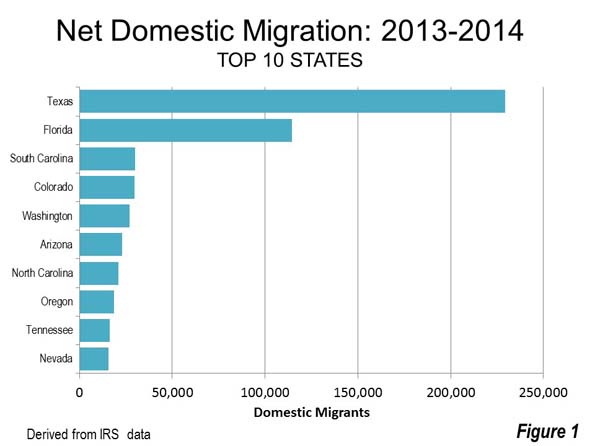
    Net domestic migration, calculated by subtracting the number of people moving out of state from the number of people moving into a state, was by far the greatest in Texas and Florida. This is not surprising, since these states have routinely been at the top of the domestic migration league tables for virtually all of the new century. The once exception was for a brief period during the housing bubble when the Florida numbers were depressed. During that period, Florida’s reached levels only exceeded by California but have since been moderated. That, plus a severe local recession, were associated with the drop in net domestic migration.

    This year’s champion was Texas. The Lone Star State had net domestic migration of 229,300. This is more than double the net domestic migration of second ranking Florida and exceeds the total net domestic migration of the other 16 states that gained. The District of Columbia and 30 states experienced net domestic losses between 2013 and 2014.

    Florida added 114,400 net domestic migrants, which is nearly 4 times as large as third ranking South Carolina (30,100). Colorado followed closely, at 29,500 net domestic migrants, with Washington placing fifth (Figure 1)

    Net Domestic Migration: Losers

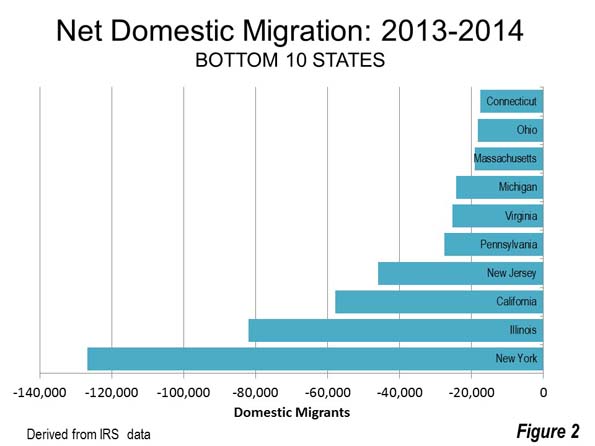
    The states with the largest net domestic migration losses are no surprise. New York, which has led net domestic out-migration in most recent years, did so again, with the loss of 126,800. Illinois lost the second greatest number of domestic migrants at 82,000. California ranked third, with a loss of 57,900. New Jersey had the fourth largest loss at 46,000, followed by Pennsylvania at 27,500 (Figure 2).


    State Attraction Ratio

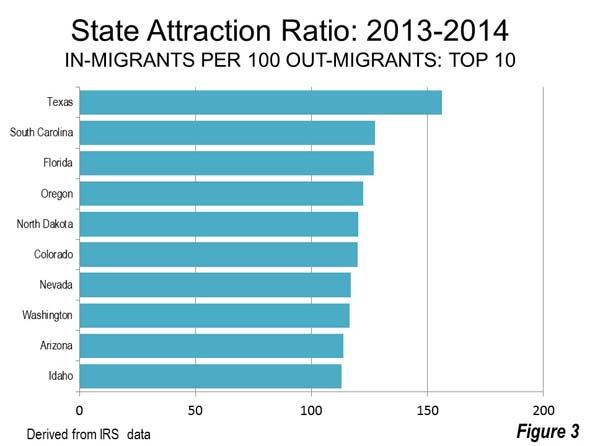
    A state attraction ratio was developed, by dividing out-migration by in-migration (stated in out-migrants per 100 in-migrants). Not surprisingly, the highest state attraction ratio was in Texas, at 156.3, South Carolina ranked second, with 127.3 in-migrants per 100 out-migrants, with Florida close behind at 126.7. The fourth and fifth highest state attraction rates were in Oregon, at 122.3 and North Dakota at 120.2 (Figure 3).

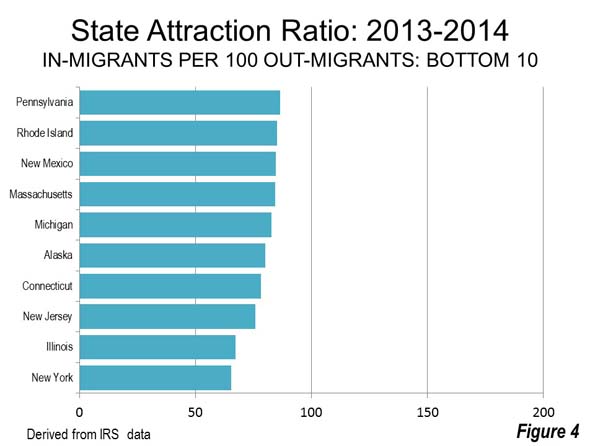
    The lowest state attractions ratio — those places were leavers most outpaced in-migrants — was in New York, where 65.4 people moved into the state for every 100 who moved out. Illinois was close behind at 67.1. In New Jersey, the ratio was 75.9, in Connecticut 78.3 and Alaska had the fifth lowest state attraction ratio at 80.1 (Figure 4)


    Income per Capita: In-migrants

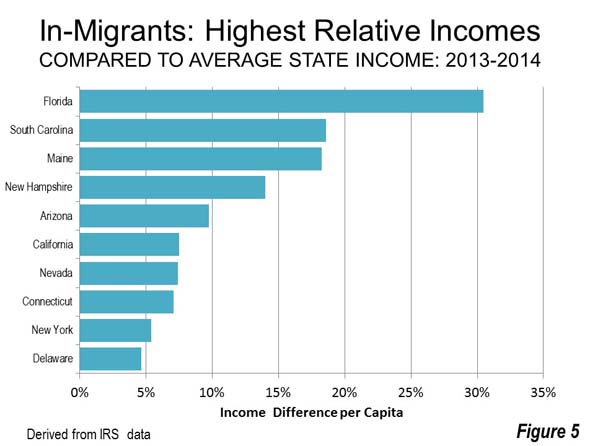
    In 17 states, the per capita income of people moving from other states exceeded that of their new state’s overall average income. The biggest differences was in Florida, where in-migrant incomes were 30.5 percent higher than average. Migrants to South Carolina averaged 18.6 percent more than the state average income, while migrants to Maine had 18.3 percent higher incomes. The top five was rounded out by New Hampshire, where in-migrants had average incomes 14.0 percent greater than average and Arizona where the differential was 9.8 percent (Figure 5)

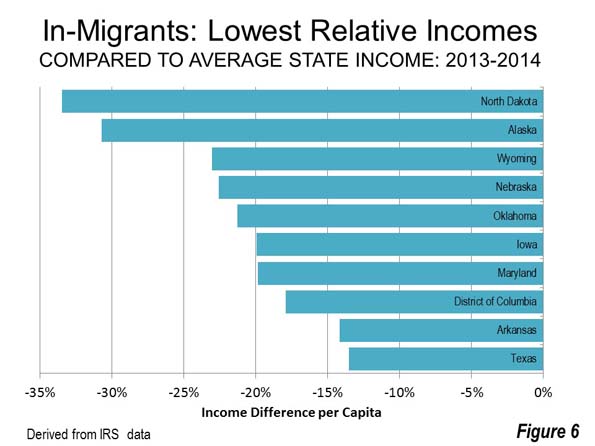
    The lowest in-migrant incomes relative to state averages were in states with large resource industries. The biggest difference was in North Dakota, where the average new resident had an income 33.5 percent below average. In Alaska, the difference was 30.7 percent, while in Wyoming it was 23.0 percent. Newcomers to Nebraska averaged 22.6 percent below the state average, while the fifth lowest figure was registered in Oklahoma at -21.3 percent (Figure 6)


    Income per Capita: Out-migrants

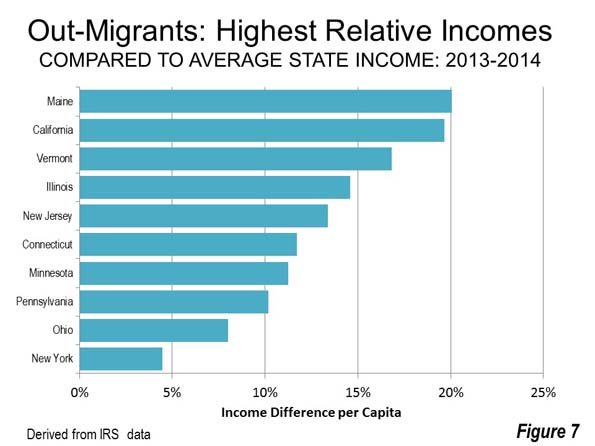
    In 17 states, people heading for other states had higher incomes per capita than the average in their former states. The biggest differential was in Maine, where out-migrants had average incomes 20.1 percent higher than the overall state average. The second largest differential was in California where out-migrants had 19.7 percent higher incomes than California residents who remained, followed by Connecticut at 16.8 percent. The average income of people leaving was 14.6 percent greater than the Illinois average. In New Jersey, the average income of levers was 13.4 percent greater than the state average (Figure 7).

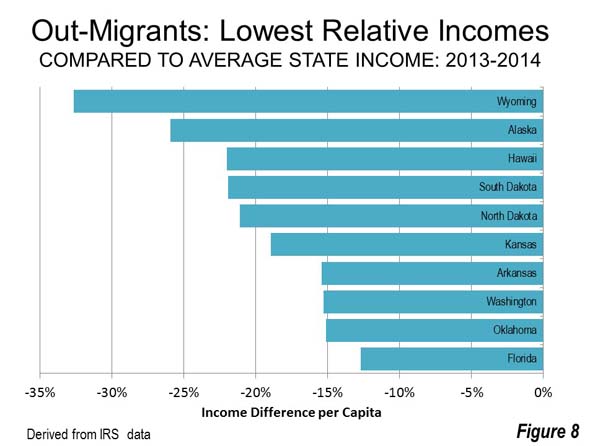
    Wyoming residents had the largest income differential relative to newcomers, at 32.6 percent. In Alaska, new migrants had average incomes 25.9 percent below the state average and in Hawaii, new migrants had average incomes 22.0 percent below the state average. The fourth and fifth lowest newcomer incomes were in South Dakota, 21.9 percent below the state average and North Dakota, 21.1 percent below the state average (Figure 8)


    New Results Track Old

    There is a striking similarity between the domestic migration results for 2013-4 and those reported by the Census Bureau population estimates program from 2000 to 2013 (no data for 2010). Among the top 10 gainers in net domestic migration in 2013 to 2014, nine were also among the top 10 gainers between 2000 and 2013. These included Texas, Florida, South Carolina, Colorado, Washington, Arizona, North Carolina, Oregon and Nevada. Georgia was replaced by Oregon in the IRS 2013 to 2014 list.

    However in the earlier period, Florida was the leading importer of people, while Texas, now number one, ranked second. However, Florida could challenge Texas in the future, if that state’s in-migration numbers suffer substantially from the oil bust. Net domestic migration continues to focus on the South and West, with each region accounting for five of the top 10 states.

    There is also similarity among the largest exporters of people, though somewhat less so. Among the top five domestic migrant exporters, four ranked in the top five between 2000 and 2013. New York, California, Illinois and New Jersey appeared in both lists, while Pennsylvania replaced Texas in the 2013-2014 IRS data.

    Among the 10 greatest losers in net domestic migration, five were in the Northeast, three were in the Midwest, one was in the South and one in the West.

    RESIDENTS & DOMESTIC MIGRANTS: ANNUAL INCOME: 2014
    State  All Out-Migrants In-Migrants Net Domestic Migration State Attraction Ratio (In-migrants per 100 out-migrants)
    Alabama $26.0 $23.3 $23.1           (3,800)                     96.1
    Alaska $35.8 $26.5 $24.8           (7,800)                     80.1
    Arizona $28.7 $28.3 $31.4          22,900                   113.8
    Arkansas $26.0 $22.0 $22.3           (4,400)                     93.2
    California $36.1 $43.2 $38.8         (57,900)                     88.5
    Colorado $36.0 $32.7 $33.3          29,500                   119.9
    Connecticut $50.1 $56.0 $53.7         (17,500)                     78.3
    Delaware $32.9 $33.9 $34.4            1,700                   106.2
    District of Columbia $56.9 $53.9 $46.7           (4,400)                     89.7
    Florida $32.9 $28.7 $42.9        114,400                   126.7
    Georgia $28.0 $25.4 $25.2          13,900                   105.6
    Hawaii $31.0 $24.1 $27.8           (4,000)                     93.0
    Idaho $25.3 $22.1 $25.3            6,000                   112.8
    Illinois $34.8 $39.8 $34.3         (82,000)                     67.2
    Indiana $27.3 $27.1 $25.0           (6,000)                     94.8
    Iowa $30.5 $27.4 $24.4           (2,500)                     95.7
    Kansas $31.1 $25.2 $27.1         (11,000)                     87.3
    Kentucky $26.1 $24.3 $23.2           (7,800)                     91.5
    Louisiana $28.9 $25.8 $25.2           (8,000)                     90.9
    Maine $29.6 $35.5 $35.0            1,500                   106.3
    Maryland $38.9 $38.5 $31.2           (3,000)                     98.0
    Massachusetts $46.3 $45.3 $45.7         (19,200)                     84.3
    Michigan $29.9 $30.8 $30.8         (24,200)                     82.6
    Minnesota $35.8 $39.8 $32.0           (9,000)                     89.9
    Mississippi $23.0 $20.8 $20.3           (8,200)                     87.6
    Missouri $29.4 $27.5 $26.7           (7,200)                     94.2
    Montana $29.5 $26.0 $28.8            3,300                   111.9
    Nebraska $30.6 $28.0 $23.7           (2,400)                     94.2
    Nevada $30.9 $27.6 $33.2          15,700                   117.0
    New Hampshire $38.0 $38.2 $43.3            1,000                   102.9
    New Jersey $42.6 $48.3 $42.0         (46,000)                     75.9
    New Mexico $25.9 $25.4 $25.7           (9,800)                     84.6
    New York $42.7 $44.6 $45.0       (126,800)                     65.4
    North Carolina $28.1 $26.4 $29.3          20,900                   108.9
    North Dakota $38.8 $30.6 $25.8            5,600                   120.2
    Ohio $29.9 $32.3 $28.8         (18,300)                     89.2
    Oklahoma $29.1 $24.7 $22.9            3,300                   104.1
    Oregon $31.2 $28.7 $30.4          18,700                   122.3
    Pennsylvania $33.7 $37.2 $34.1         (27,500)                     86.4
    Rhode Island $34.8 $35.5 $34.5           (3,900)                     85.1
    South Carolina $26.8 $24.9 $31.8          30,100                   127.3
    South Dakota $31.5 $24.6 $28.3              (400)                     98.5
    Tennessee $27.5 $25.0 $27.9          16,400                   111.2
    Texas $31.7 $30.6 $27.4        229,300                   156.3
    Utah $26.4 $23.2 $27.1           (2,800)                     96.1
    Vermont $32.2 $37.6 $33.6           (1,200)                     92.4
    Virginia $37.0 $34.4 $32.5         (25,300)                     90.1
    Washington $36.0 $30.5 $32.6          27,000                   116.4
    West Virginia $25.6 $24.8 $23.7           (3,700)                     90.0
    Wisconsin $31.5 $32.0 $29.8         (10,300)                     88.6
    Wyoming $40.2 $27.1 $30.9           (1,400)                     94.9
    United States $33.4 $33.0 $32.4
    Income in 000s
    Data from IRS Gross Migration File (https://www.irs.gov/uac/soi-tax-stats-migration-data-2013-2014)

    Wendell Cox is principal of Demographia, an international pubilc policy and demographics firm. He is a Senior Fellow of the Center for Opportunity Urbanism (US), Senior Fellow for Housing Affordability and Municipal Policy for the Frontier Centre for Public Policy (Canada), and a member of the Board of Advisors of the Center for Demographics and Policy at Chapman University (California). He is co-author of the “Demographia International Housing Affordability Survey” and author of “Demographia World Urban Areas” and “War on the Dream: How Anti-Sprawl Policy Threatens the Quality of Life.” He was appointed to three terms on the Los Angeles County Transportation Commission, where he served with the leading city and county leadership as the only non-elected member. He served as a visiting professor at the Conservatoire National des Arts et Metiers, a national university in Paris.

  • Notes From An Upzoning Heretic

    I recently got into a discussion on Twitter about the soundness of upzoning, or the increase in the allowance of residential units in cities, as a rational and reasonable response to the lack of affordable housing in our nation’s large cities.  Anyone who’s been reading my writing knows that I’ve disagreed with this for quite some time, and tried many ways to articulate my views and reach some understanding. From the discussion I learned two things: 1) Twitter is a really poor vehicle for debate when nuance is critical (OK, I really knew that already), and 2) the orthodoxy of the upzoners is so strong that my views on this might put me on the pariah end of the urbanism spectrum. 

    It started innocently enough.  Ramsin Canon suggested upzoning major streets in Chicago for more residential units.  That brought several supporters, including City Observatory writer and fellow Chicago blogger Daniel Kay Hertz, who (gracefully, I might add) noted my objections.  I then chimed in, and shortly thereafter I found myself swimming against the tide of upzoners hoping to prove that upzoning helps improve housing affordability. 

    Look, upzoners, I understand the problem and the sentiment.  I understand the desire to find the right policy response to address the issue.  But I remain unconvinced that upzoning will help any more than a handful of American cities.  Here’s why.

    An Abstract Argument

    Surely a big part of the appeal of upzoning is its abstract simplicity.  Increasing the supply of housing units in extremely tight housing markets can unleash market forces that drive home prices and rents downward, making cities more affordable to affluent and poor alike.  And in housing markets that have an almost even distribution of high priced housing within them, like San Francisco or New York, this makes sense.  Allowing more units will have the effect of bringing prices down.  (I’d also add parenthetically that the tightest and most expensive housing markets nationally also tend to be the most geographically constrained, by either water or mountains, and that constraint does not hold for all cities nationwide.  This escapes many people.)

    The reality, however, is that nationally gentrification is just a pittance compared to the expansion of urban poverty.  As Carol Coletta of the Knight Foundation put it in a speech last month at the Congress of the New Urbanism:

    “In 1970, about eleven hundred urban Census tracts were classified as high poverty.

    By 2010—40 years later—the number of high poverty Census tracts in urban America had increased from 1100 to more than 3,000. (3165)

    The number of people living in those high poverty Census tracts had increased from 5 million to almost 11 million. And the number of poor people in high poverty Census tracts had increased from 2 million to more than 4 million.

    So over a 40-year period, the number of high poverty Census tracts in America’s core cities had tripled, their population had doubled, and the number of poor people in those neighborhoods had doubled.

    Given that record, I’ll bet a lot of people are hoping for a little gentrification– if gentrification means new investment, new housing, new shops without displacement.

    The idea that places might benefit from gentrification runs against the popular narrative. But here’s the really startling fact: only 105 of the eleven hundred Census tracts that were high poverty in 1970 had rebounded to below poverty status by 2010. That’s only ten percent! Over 40 years!”

    Most American cities are not like San Francisco or New York, where the high prices and rents cannot be avoided and the return-to-the-city demand remains very high.  Most cities have greater variance in prices and rents, from very high to very low.  This takes away the first layer of abstraction for prices and rents and allows those with money to rationally widen their consideration when choosing to live in cities.  On the surface this sounds great. 

    But — and this is where the second layer of abstraction is shed — people don’t make housing decisions or neighborhood decisions rationally.  They take in all sorts of information and put it to subjective use, and justify its rationality later.  Historical perceptions of neighborhoods linger far longer than their reality.  Media perceptions can distort the reality of neighborhoods.  Egos can get involved and people select neighborhoods that have a certain cache or brand.  For urban neighborhoods in most cities, we find that affluence clusters in certain areas and moves outward slowly.  Poverty expands quickly, as those who have the ability to escape it do so, and further destabilize a neighborhood in the process.  The end result, again for cities that do not have the same strong return-to-the-city demand or the uniformly high home prices and rents, is affluent enclaves surrounded by expansive and increasingly impoverished neighborhoods.

    Upzoning can accelerate this process.  If a major city undergoes an upzoning process and allows a substantial increase in the number of housing units, what do you think the development community’s response to that will be?  My guess is that they will work hard to fulfill the market demand where the demand is strongest — in the most desirable neighborhoods or in the areas immediately adjacent to them.  Only after that demand is tapped out will developers move into other areas, and most will elect to build in areas that are adjacent to the newly saturated neighborhood.  Those who live in the path of development will see prices and rents remain high; those away from the path of development will likely see  prices and rents crater, and lament the lack of investment in their community. 

    The Need for Investment

    TAt one point in the Twitter discussion.  Daniel Kay Hertz asked me, “Would there be more or fewer Latinos in Logan Square if there was more new housing in Lincoln Park?”  For non-Chicagoans, Logan Square is the rapidly gentrifying neighborhood immediately west of the quite-gentrified Lincoln Park neighborhood on the lakefront.  My response was that Logan Square would indeed have more Latinos in that scenario and that it would have no discernible impact on other neighborhoods outside of the “hot zone” as well.  But that sets up the scenario I cite above — an affluent neighborhood next to an eternally poor/working class one, possibly lamenting the lack of investment in their midst.  And the further one’s home or neighborhood is from the “hot zone”, the more that lament turns into angst, frustration and resentment.

    It’s worth bringing back a portion of the quote above from Carol Coletta:

    Given that record, I’ll bet a lot of people are hoping for a little gentrification– if gentrification means new investment, new housing, new shops without displacement.The idea that places might benefit from gentrification runs against the popular narrative.

    Despite the growing problems of affordability in select neighborhoods in major cities across the nation, there are many more neighborhoods that wish they had that problem.  Many people rue the fact that maybe one-quarter or one-third of a city is priced beyond their means.  That leaves two-thirds to three-quarters of a city to explore and find a place worthy of investment.  Upzoning can have the impact of further concentrating development within the “hot zone” and drive a deeper inequality wedge between urban haves and have-nots.

    Upzoners are not doing cities a favor more broadly by addressing an issue that helps them directly.

    Ultimately I see high prices and rents as being demand-driven and not supply-driven.  Prices and rents are high because there are too many people focusing on too few neighborhoods — and squandering the opportunity to take some of that investment to other neighborhoods that could use it.

    Pete Saunders is a Detroit native who has worked as a public and private sector urban planner in the Chicago area for more than twenty years.  He is also the author of “The Corner Side Yard,” an urban planning blog that focuses on the redevelopment and revitalization of Rust Belt cities.

  • Intellectuals Are Freaks

    Intellectuals — a category that includes academics, opinion journalists, and think tank experts — are freaks. I do not mean that in a disrespectful way. I myself have spent most of my life in one of the three roles mentioned above. I have even been accused of being a “public intellectual,” which sounds too much like “public nuisance” or even “public enemy” for my taste.

    My point is that people who specialize in the life of ideas tend to be extremely atypical of their societies. They — we — are freaks in a statistical sense. For generations, populists of various kinds have argued that intellectuals are unworldly individuals out of touch with the experiences and values of most of  their fellow citizens. While anti-intellectual populists have often been wrong about the gold standard or the single tax or other issues, by and large they have been right about intellectuals.

    The terms “intellectual” and “intelligentsia” arose around the same time in the 19th century. Before the industrial revolution, the few people in advanced civilizations paid to read, write, and debate were mostly either clerics like medieval Christian priests, monks, or secular scribes like Confucian mandarins who worked for kings or aristocrats, or, as in the city-states of ancient Greece, teachers whose students were mostly young men of the upper classes.

    The replacement of agrarian civilization by industrial capitalism created two new homes for thinkers, both funded directly or indirectly by the newly enriched capitalist elite. One was the nonprofit sector — the university and the nonprofit think tank — founded chiefly by gifts from the tycoons who lent these institutions their names:  Stanford University, the Ford Foundation. Then there was bohemia, populated largely by the downwardly-mobile sons and daughters of the rich, spending down inherited bourgeois family fortunes while dabbling in the arts and philosophy and politics and denouncing the evils of the bourgeoisie.

    Whether they are institutionalized professors and policy wonks or free-spirited bohemians, the intellectuals of the industrial era are as different from the mass of people in contemporary industrial societies as the clerics, scribes, mandarins, and itinerant philosophers of old were from the peasant or slave majorities in their societies.

    To begin with, there is the matter of higher education. Only about 30 percent of American adults have a four-year undergraduate degree. The number of those with advanced graduate or professional degrees is around one in ten. As a BA is a minimal requirement for employment in most intellectual occupations, the pool from which scholars, writers, and policy experts is drawn is already a small one. It is even more exclusive in practice, because the children of the rich and affluent are over-represented among those who go to college.

    Then there is location. There have only been a few world capitals of bohemia, generally in big, expensive cities that appeal to bohemian rich kids, like the Left Bank of the Seine and Greenwich Village and Haight-Ashbury. In the U.S., the geographic options for think tank scholars also tend to be limited to a few expensive cities, like Washington, D.C. and New York. Of the different breeds of the American intellectual, professors have the most diverse habitat, given the number and geographic distribution of universities across the American continent.

    Whether they are professors, journalists, or technocratic experts, contemporary intellectuals are unlikely to live and work in the places where they are born.  In contrast, the average American lives about 18 miles from his or her mother. Like college education, geographic mobility in the service of personal career ambitions is common only within a highly atypical social and economic elite.

    In their lifestyles, too, intellectuals tend to be unusually individualistic, by the standards of the larger society. I am aware of no studies of this sensitive topic, but to judge from my experience the number of single individuals and childless married couples among what might be called the American intelligentsia appears to be much higher than in the population at large. The postponement of marriage in order to accumulate credentials or job experience, the willingness to move to further career goals, and — in the case of bohemians — the willingness to accept incomes too low to support children in order to be an avant-garde writer or artist or revolutionary sets intellectuals and other elite professionals apart from the working-class majority whose education ends with high school and who rely on extended family networks for economic support and child care.

    The fact that we members of the intellectual professions are quite atypical of the societies in which we live tends to distort our judgment, when we forget that we belong to a tiny and rather bizarre minority. This is not a problem with the hard sciences.  But in the social sciences, intellectuals — be they professors, pundits, or policy wonks — tend to be both biased and unaware of their own bias.

    This can be seen in the cosmopolitanism of the average intellectual. I was the guest of honor at an Ivy League law school dinner some years ago, when, in response to my question, the academics present — U.S. citizens, except for one — unanimously said they did not consider themselves American patriots, but rather “citizens of the world.”  The only patriot present, apart from yours truly, was an Israeli visiting professor.

    Paranoid populists no doubt would see this as confirmation of their fear intellectuals are part of a global conspiracy directed by the UN or the Bilderbergers.  I see it rather as a deformation professionelle.  Scholarship, by its nature, is borderless.  The mere phrases “Aryan science” and “Jewish science” or “socialist scholarship” and “bourgeois scholarship” should send chills down the spine. Furthermore,  many successful academics study, teach, and live in different countries in the course of their careers.

    So it is natural for academics to view a borderless world as the moral and political ideal — natural, but still stupid and lazy. Make-believe cosmopolitanism is particularly stupid and lazy in the case of academics who fancy themselves progressives. In the absence of a global government that could raise taxes to fund a global welfare state, the free movement of people among countries would overburden and destroy existing national welfare states, or else empower right-wing populists to defend welfare states for natives against immigrants, as is happening both in the U.S. and Europe.

    The views of intellectuals about social reform tend to be warped by professional and personal biases, as well. In the U.S. the default prescription for inequality and other social problems among professors, pundits, and policy wonks alike tends to be:  More education! Successful intellectuals get where they are by being good at taking tests and by going to good schools. It is only natural for them to generalize from their own highly atypical life experiences and propose that society would be better off if everyone went to college — natural, but still stupid and lazy. Most of the jobs in advanced economies — a majority of them in the service sector — do not require higher education beyond a little vocational training. Notwithstanding automation, for the foreseeable future janitors will vastly outnumber professors, and if the wages of janitors are too low then other methods — unionization, the restriction of low-wage immigration, a higher minimum wage — make much more sense than enabling janitors to acquire BAs, much less MAs and Ph.Ds.

    The social isolation of intellectuals, I think, is worsened by their concentration in a few big metro areas close to individual and institutional donors like New York, San Francisco, and Washington, D.C. (where I live) or in equally atypical college towns. It was never possible for Chinese mandarins or medieval Christian monks in Europe to imagine that their lifestyles could be adopted by the highly visible peasantry that surrounded them. But it is possible for people to go from upper middle class suburbs to selective schools to big-city bohemias or campuses with only the vaguest idea of how the 70 percent of their fellow citizens whose education ends with high school actually live.

    Universal national service would be a bad idea; the working class majority is hard-pressed enough without being required to perform unpaid labor. But it might not hurt if every professor, opinion journalist, and foundation expert, as a condition of career advancement, had to spend a year or two working in a shopping mall, hotel, hospital, or warehouse. Our out-of-touch intelligentsia might learn some lessons that cannot be obtained from books and seminars alone.

    This piece first appeared at The Smart Set, an online magazine covering culture and ideas.

    Michael Lind is a contributing writer of The Smart Set, a fellow at New America in Washington, D.C., and author of Land of Promise: An Economic History of the United States.

    Image courtesy of  simpleinsomnia via Flickr (Creative Commons).

  • Resurrecting the New York Subway

    The subway is crucial to mobility in the city of New York. Over the last 10 years, ridership increases on the subway have been more than that of all other transit services in the United States combined. It was not always this way.

    In  New York Post article entitled "How Bratton’s NYPD Saved the Subway System,"the Manhattan Institute’s Nicole Gelinas describes the depths of the problem in 1990, when there were 26 homicides on the subway. Of course, there is nothing more important to civil society than order, and the threat to life and limb on the subway led to a significant ridership loss after 1980.

    Gelinas notes that the murder of a Utah youth that year "would help propel Rudy Giuliani into the mayor’s office three years later, as Democratic voters turned to a Republican prosecutor to get a seemingly ungovernable city under control." Gelinas tells the story of how new transit police chief William Bratton brought the subway under control and helped to make possible the highest ridership levels since World War II. Gelninas notes that " Policing played a huge role in making Gotham’s subways safe, as it did in reducing crime throughout the city. In fact, the New York crime turnaround began in the subways, and what the police discovered about violence underground would prove essential to the broader battle for the city’s streets."

    Bratton played an important role in this city-wide progress, after he was appointed as New York City’s police commissioner by Mayor Rudy Giuliani. His success and is widely considered to have been influencial in the more effective policing strategies that have been, at least in part, credited with much lower urban crime rates in the last century. Indeed, the urban core (downtown) residential renaissance evident in many cities would not have been possible otherwise.

  • A Partnership-Driven Process to Promote Entrepreneurship in Ghana

    In Ghana, about 80 percent of the working-age population is self-employed in an economy of improvisation and self-reliance where the quest to make a living is played out daily. The complexity of operating in the business environment — characterized sometimes as fetching water with a basket — has deterred many entrepreneurs from upgrading their business skills, raising capital and taking risks to grow. So many remain in the informal sector — a fluctuating medley of businesses that are agile enough to navigate the ever-changing jumble of economic headwinds but unable to scale up in any meaningful way.

    The hope and promise of local development is that people will be empowered to achieve a higher standard of living in terms of economic prosperity and quality of life. With the advent of Ghana’s formal decentralization policy, the nation’s 216 district assemblies are now the designated champions of local development, which depends considerably on strengthening small and medium-sized enterprises by improving local competitiveness.

    In May, 300 representatives of Ghana’s metro and rural districts assembled in Kumasi, a sprawling city of more than 2 million people, for the second annual Conference on Local Government. Praxis Africa organized the conference on behalf of the Ministry of Local Government and Rural Development, which focused on the United Nations sustainable development goals. Agreed to by 193 countries to mark out a roadmap for global prosperity, the SDGs have a goal of 7 percent growth per year in the world’s least developed countries. Ghanaian President John Mahama has been appointed co-chair of a group of SDG advocates by UN Secretary-General Ban Ki-moon, making the SDGs a prominent dimension of Ghana’s development plans.

    Ghana’s ministers of Local Government and Rural Development, Chieftaincy and Traditional Affairs, and Fisheries and Aquaculture Development, plus the deputy minister of Communication and the regional Ashanti minister all highlighted the need for sustainable, inclusive growth that creates employment and prosperity. Multi-stakeholder partnerships involving government, the private sector and civil society were hailed as the glue that holds the development process together. Collins Dauda, minister of Local Government and Rural Development, affirmed that public/private partnerships are a new way of dealing with the traditional Ghanaian way of doing things, which is known as the “do-and-share” principle.

    Partnership-driven development is essential in an age where many successful enterprises are less the product of an individual entrepreneur than of the assembled resources, knowledge, and other inputs and capabilities that can be mobilized in a local entrepreneurial ecosystem. In Ghana, formalization and growth of micro, small and medium-sized enterprises is essential for development. There is wide agreement that lack of access to finance and markets, low levels of education, poor business skills and an absence of suitable mentors are among the biggest obstacles that entrepreneurs face. Praxis Africa’s guidance to the districts in working with entrepreneurs is to help them by:

    • Understanding the area’s economic advantages and opportunities.
    • Connecting with the business and financial resources that are available locally, regionally and nationally.
    • Navigating the local business environment, including permitting and regulations.
    • Championing infrastructure development that is essential for conducting business.

    Decentralization of economic development is not unique to Ghana, as a confluence of potent forces is creating an era of localism and decentralization across the planet — driven in part by increasing global connectedness. There is no single formula for success for any community in the 21st century. Nonetheless, to foster and sustain a robust local economy, a community must take full advantage of its unique combination of resources, culture, infrastructure, core competencies in industry and agriculture and the skills of entrepreneurs and workers. 

    Delore Zimmerman, president of Praxis Strategy Group in Fargo, N.D., and co-founder of Praxis Africa.

    Photo: a panel discussion as part of the second annual Conference on Local Government, held in may in Kumasi, Ghana. IMAGE: PRAXIS AFRICA

  • California: The Economics of Delusion

    In Sacramento, and much of the media, California is enjoying a “comeback” that puts a lie to the argument that regulations and high taxes actually matter. The hero of this recovery, Gov. Jerry Brown, in Bill Maher’s assessment, “took a broken state and fixed it.”

    Yet, if you look at the long-term employment trends, housing affordability, inequality and the state’s long-term fiscal health, the comeback seems far less miraculous. Silicon Valley flacks may insist that the “landscape now has been altered,” so prosperity is now permanent, but this view is both not sustainable and deeply flawed.

    Jobs: The long view

    Since 2010, California has begun to generate jobs at a rate somewhat faster than the nation, but this still has just barely made up for the deep recession in 2007. The celebratory notion that true-blue California is outperforming red states like Texas is valid only in a very short-term perspective. Indeed, even since 2010, the job growth in Austin and Dallas has been higher than that in the Bay Area, while Los Angeles has lagged well behind.

    If you go back to 2000, the gap is even more marked. Between 2000 and 2015, Austin has increased its jobs by 50 percent, while Raleigh, Houston, San Antonio, Dallas, Nashville, Orlando, Charlotte, Phoenix and Salt Lake City – all in lower-tax, regulation-light states – have seen job growth of 24 percent or above. In contrast, since 2000, Los Angeles and San Francisco expanded jobs by barely 10 percent. San Jose, the home of Silicon Valley, has seen only a 6 percent expansion over that period.

    Regional concentration

    As Chapman University economist and forecaster Jim Doti recently suggested, the California boom is exceedingly concentrated in one region. “It’s not a California miracle, but really should be called a Silicon Valley miracle,” Doti noted in his latest forecast. “The rest of the state really isn’t doing well.”

    Read the entire piece at The Orange County Register.

    Joel Kotkin is executive editor of NewGeography.com. He is the Roger Hobbs Distinguished Fellow in Urban Studies at Chapman University and executive director of the Houston-based Center for Opportunity Urbanism. His newest book, The Human City: Urbanism for the rest of us, will be published in April by Agate. He is also author of The New Class ConflictThe City: A Global History, and The Next Hundred Million: America in 2050. He lives in Orange County, CA.

    Bill Watkins is a professor at California Lutheran University and runs the Center for Economic Research and Forecasting, which can be found at clucerf.org.

  • Shanghai to Manchuria and Central China by Train

    There is no better way to see China than by train. This is especially true because foreigners are not allowed to drive rental cars without first obtaining a Chinese drivers license. China has developed the world’s largest high-speed rail system, which includes one of only three profitable routes in the world, along with Tokyo to Osaka and Paris to Lyon.

    Travel by train in China is now more convenient for people who do not speak Mandarin. Tickets may now be purchased over the internet. Details of the trains and ticketing are provided at the end of the article.

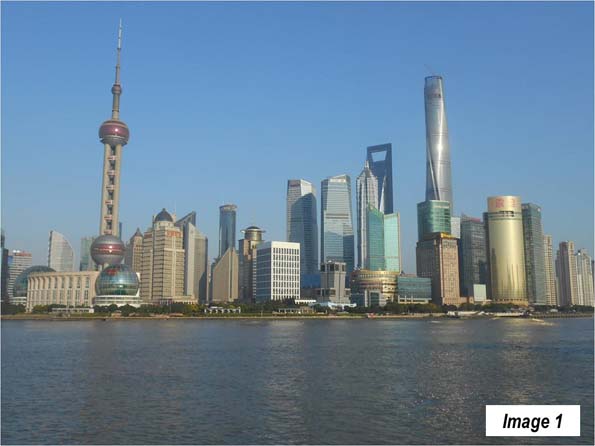
    Last month I traveled from Shanghai (Image 1 from a previous trip) to Changchun and Jilin, in Manchuria’s Jilin Province (Manchuria includes the northeastern provinces of Liaoning, Jilin and Heliongjiang, and is called the "Dong Bei" or the "east north") and then to Beijing and on to Nanchang, in Jiangxi Province, finally returning to Shanghai.

    Shanghai is China’s largest urban area, with 22.7 million residents (Note). I started out from Shanghai’s Hongqiao Railway Station, which is one of the most important rail hubs in the country. It is located across the runways from Hongqiao International Airport, from which most domestic flights operate. Most international flights operate from Pudong International Airport, which is 34 miles (55 kilometers) to the east.

    The train used the main Shanghai to Beijing line as far as Tianjin, where the train continues along Bohai Bay toward Manchuria, while the main line turns left toward Beijing.

    It is not long before the train reaches speeds above 300 kilometers per hour (186 miles per hour). For at least the first 135 miles (220 kilometers), to the far edge of Changzhou, there is a mix of primarily urban development with some rural development. There are also many high-rise residential developments and "peri-urban" developments, with rural areas transitioning to urbanization.

    The train travels west through Kunshan, an urban area of 1.9 million residents, part of Suzhou municipality, which also contains the Suzhou urban area (5.4 million). There are particularly good views of the Grand Canal in Suzhou (Image 2, from a previous visit). The Grand Canal was completed approximately 1,400 years ago and for centuries has provided a means for water transport between Hangzhou, to the south of Shanghai, across the Yangtze River and to Tianjin, near Beijing. It is the longest canal in the world, at 1,100 miles (1,800 kilometers).

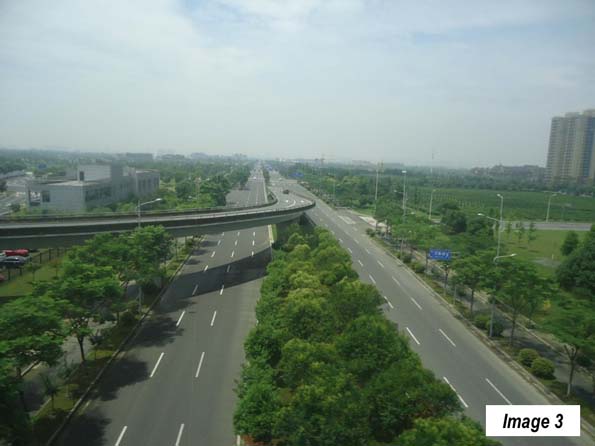
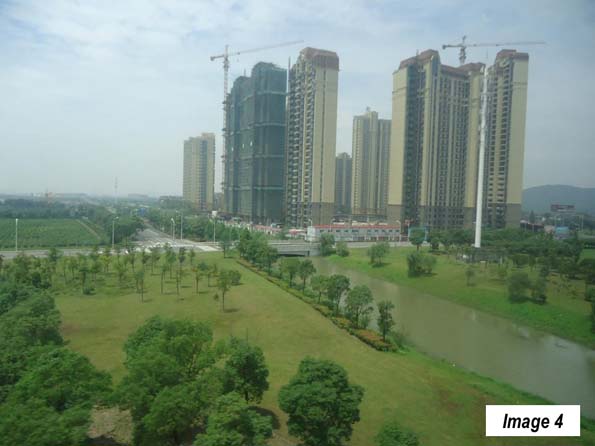
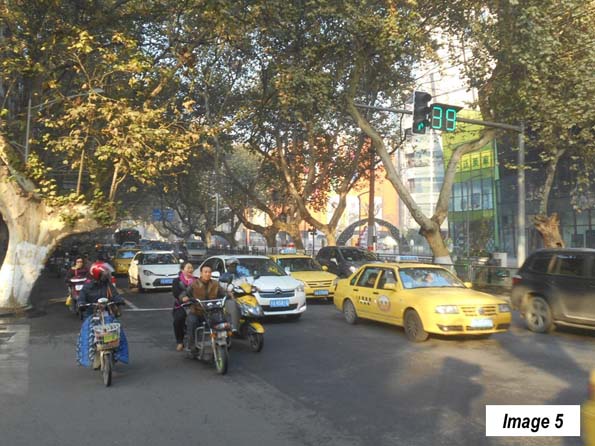
    From Suzhou, the train continues into Wuxi, an urban area of 3.7 million population (Images 3 and 4). The route continues into Changzhou (urban area population 3.7 million). Finally, is some open country, as the main route travels through a valley to the south of Zhenjiang to Nanjing, an urban area of 6.4 million population, which serves as the capital of Jiangsu. Nanjing was the former capital of China and its streets are lined and cooled in the summer by its "French trees" (Image 5, from a previous visit).

    Leaving Nanjing, the train crosses the Yangtze River and travel through largely agricultural country. It passes through the smaller Suzhou (Anhui province) of Nobel Literature Prize winner Pearl S. Buck, and then through Xuzhou, Jiangsu (1.3 million). In Xuzhou, I noted the elevated connections for the new rail line to Zhengzhou (and also saw them in Zhengzhou). Service will begin in September, cutting three hours off the Shanghai to Zhengzhou travel time, and placing historic tourist attraction Xi’an, with its Terracotta Army, within seven hours of Shanghai.

    The farmland continues to Jinan (3.9 million), the capital of Shandong province, which largely consists of the peninsula of the same name that forms the southern boundary of Bohai Bay. Just north of Jinan, the train crosses the second of China’s great rivers, the Yellow River (Image 6), which is again crossed north of Zhengzhou (below).

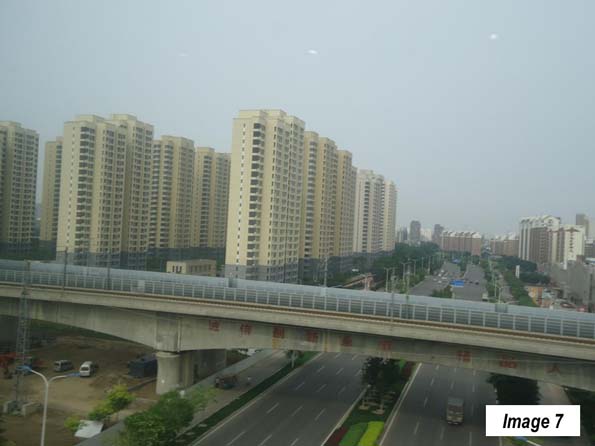
    Then there follows the longest stretch of agriculture between Shanghai and Beijing, most of the way to Tianjin (Image 7), an urban area of 11.3 million residents and is now the fastest growing large municipality in China, at more than four percent per year. Soon, we passed through Tangshan (2.4 million) which suffered a disastrous earthquake in 1976 but has been rebuilt (Image 8).

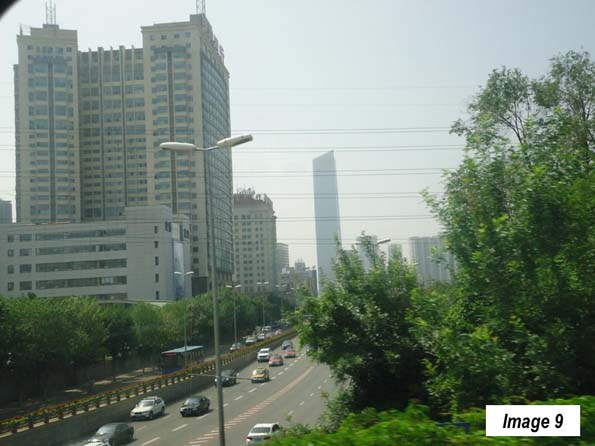
    The train continued northward to Shenyang (3.4 million), the capital of Liaoning (Image 9). Finally, the train reached the destination of Changchun Railway Station (Image 10), 1,500 miles (2,400 kilometers) and 11 hours from Shanghai. Changchun (Image 11) is the capital of Jilin province and has 3.4 million residents.

    Changchun is called the "automobile city," because the government placed the first automobile manufacturing plant here in the late 1950s. This was where the Red Flag limousine was built, favorite of government ministers and which carried President Richard Nixon around Beijing in his 1972 visit. My hotel in Ordos had a classic Red Flag on exhibition (Image 12). Now, automobile manufacturing is spread around the country and includes virtually all of the world’s leading brands. Last year, Chinese bought 21.1 million cars, compared to 17.5 million in the United States, both records.

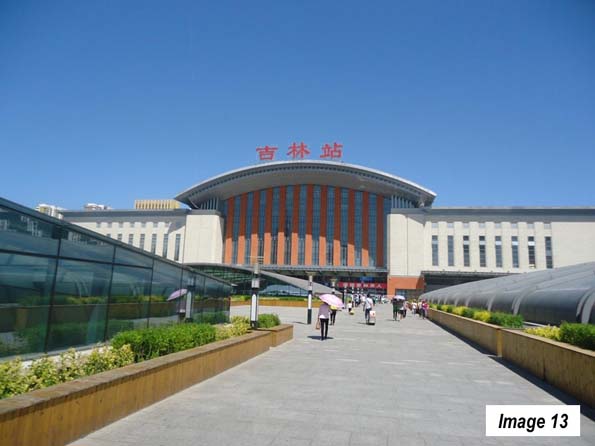
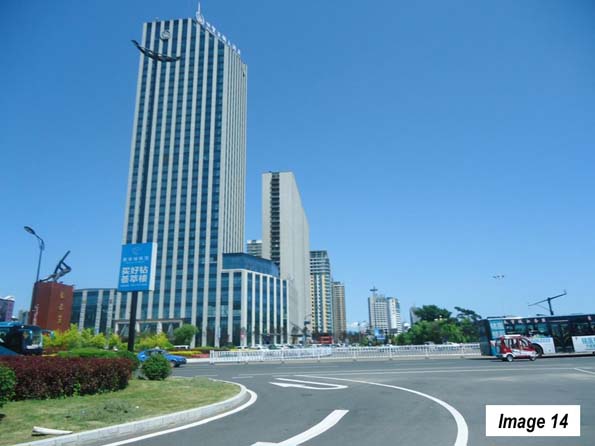
    Jilin, an urban area with 1.7 million residents,(Images 13, Jilin Railway Station & 14) is only 45 minutes away by train, separated by picturesque rolling agricultural country from Changchun (Images 15 & 16). The corn looks at least as good in Jilin as it does now in Illinois.

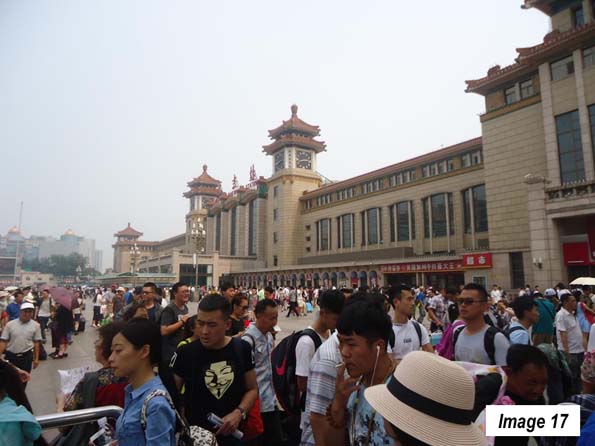
    A few days later I took the train from Changchun to Beijing South Railway Station (Image 17) to connect for the flight to Ordos, Inner Mongolia (See: Surprising Ordos: The Evolving Urban Form). Beijing is the nation’s second largest urban area, with 20.4 million residents.

    Flying back from Ordos, my next train trip was from Beijing West Railway Station. I could have traveled by subway, but since the view underground is not as good, traveled by taxi. Early Sunday morning, the traffic on the Third Ring Road from my hotel near the CCTV Tower (across town) was horrific.

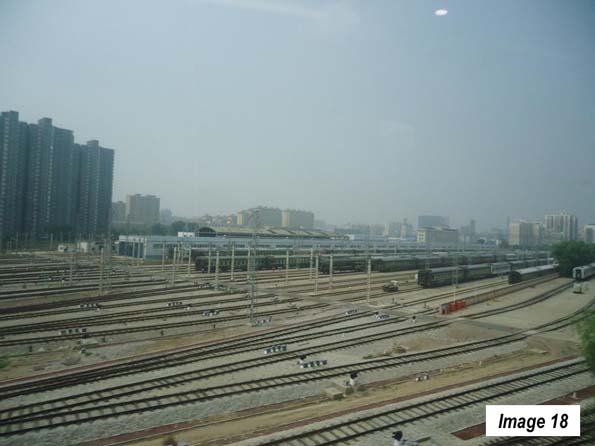
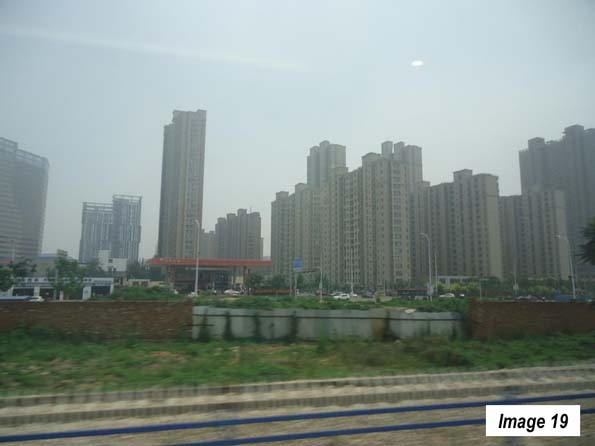
    The next train ride was to Nanchang, along the Beijing to Guangzhou line. This is the other principal north-south route though its traffic appears to be light compared to the Shanghai to Being route. The train traveled (Image 18) toward, Shijiazhuang, an urban area of 3.5 million residents and the capital of Hebei province (Images 19 and 20).

    Parts of these first three trips coursed through the planned Jin-Jing-Ji megacity, which will better integrate the urban areas between Beijing, Tangshan, Tianjin and Shijiazhuang.

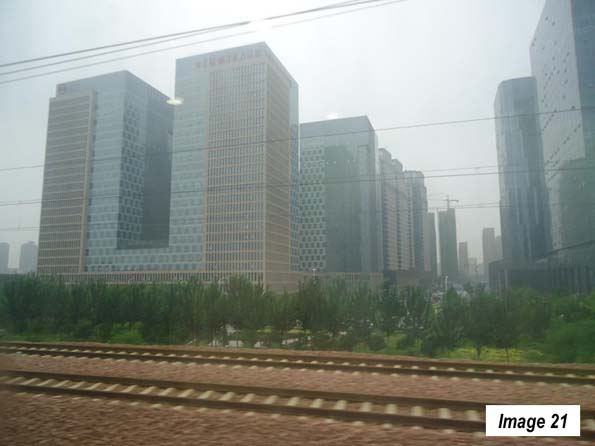
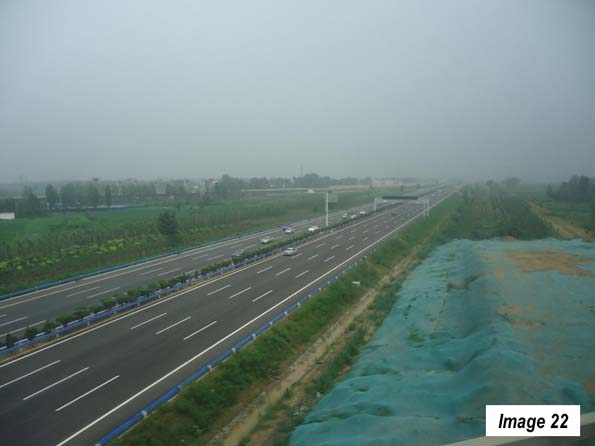
    Continuing south, the train stopped at Zhengzhou, the capital of Henan (5.8 million), with its impressive extension of the Zhengzhou new area and the new railway station (Images 21 & 22). The train then headed south toward Wuhan, (7.6 million residents), the capital of Hubei and  a heavy industrial area that is been called the "Chicago" of China. Before reaching Wuhan, there was attractive rolling scenery in northern Hubei (Image 23), then the Yangtze River crossing in Wuhan (Image 24). Just a few miles upriver (the direction of the camera shot), Chairman Mao, at 72 years old, is reputed to have swam across the Yangtze in 1966.

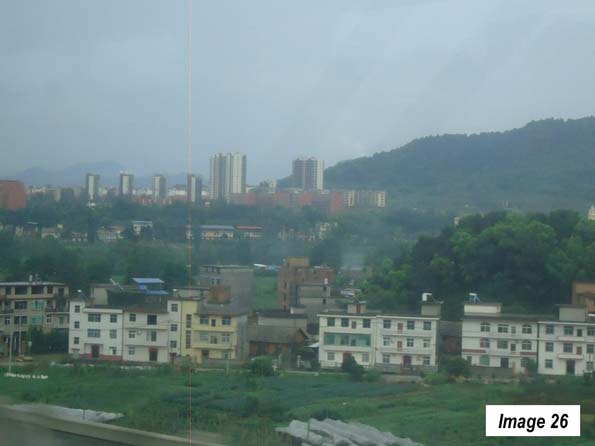
    The July greenery of central China was impressive. It continued into northern Hunan province (Image 25) and its capital of Changsha, an urban area of 3.8 million. In Changsha, the train diverted from the Beijing to Guangzhou line and turned eastward toward Nanchang. Along the way, the "peri-urban" development seemed to get more intense (Image 26). 

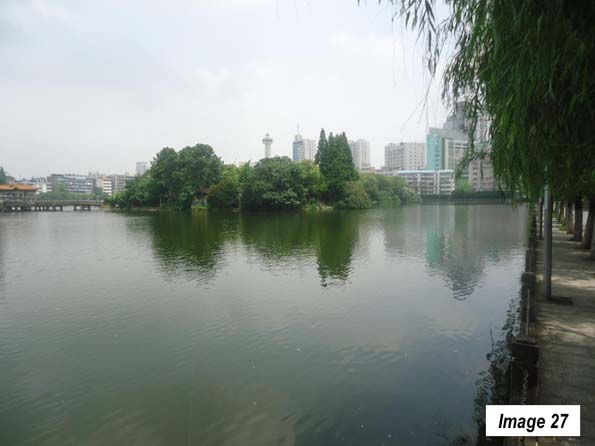
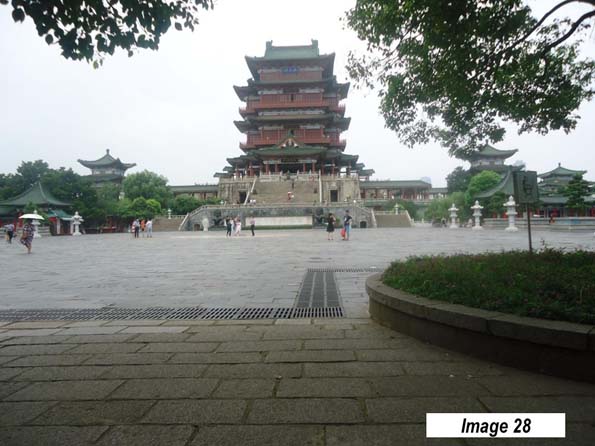
    The Nanchang urban area (Image 27) has a population of 2.8 million and sits on the Gan River, which eventually flows into the Yangtze, to the north. It is home of the Pavilion of Prince Teng, on the older east bank city, across from the newer development on the west bank (Image 28).

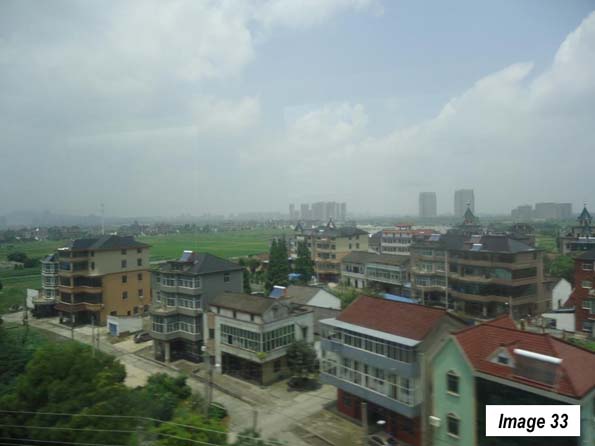
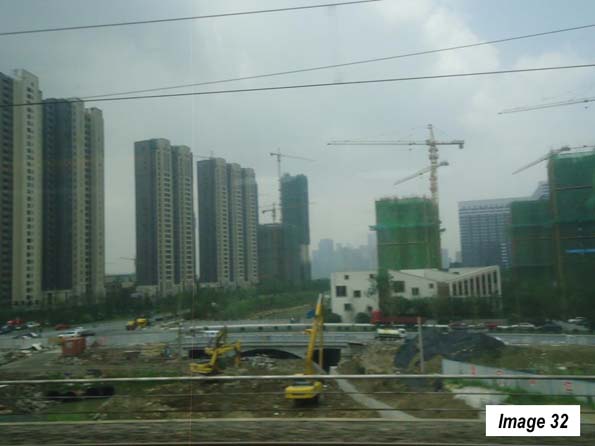
    A few days later, the last leg of the trip from Nanchang to Shanghai Hongqiao took less than four hours. Between Nanchang and Hangzhou, (7.6 million), the capital of Zhejiang, there was more greenery, rolling and mountain country and intense peri-urban development (Images 29-31). Hangzhou has been undergoing a huge construction boom (Image 32). It was less than one hour to Shanghai, and the peri-urban development continued to intensify (Image 33).

    All in all, the five train trips had covered more than 3,700 miles (6,000 kilometers) and passed through 14 provincial level jurisdictions.

    Trains

    The best trains in China are the "G" trains, the "D" trains, and the "C" trains, all of which are of European high-speed rail quality. The "G" trains have a top speed of more than 300 kilometers per hour. The "D" trains have a top speed of 250 kilometers per hour, while the "C" trains are shuttles, such as those operating between Tianjin and Beijing or Changchun and Jilin and tend to operate at 250 kilometers per hour or more.

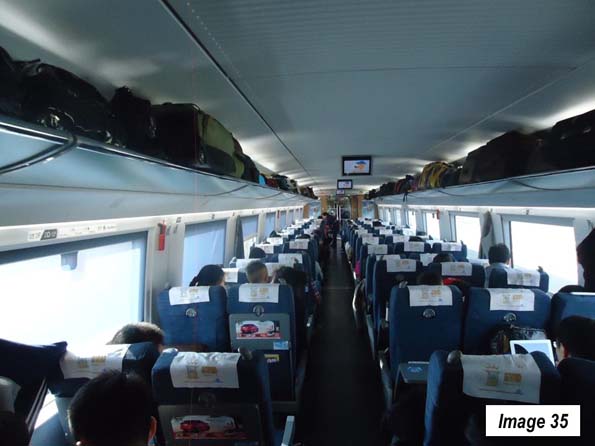
    All of these trains use similar equipment (Image 34). Image 35 is the inside of a 2nd class coach, which have with reclining seats and snack service. All of the trains have information displays in each car indicating train speed, time, etc. (Image 36). Stations may be central as in Tianjin or near-airport distances from the urban core, as in Jilin and Wuhan.

    Tickets

    Ticket purchase has become simple. Tickets can now be booked from virtually anywhere and paid for by credit card. US residents will pay a service fee of up to $6 per ticket. Confirmation documents are provided over the internet and can be presented at any station in China to receive the tickets all at once. My ticket pickup took no more than 10 minutes at the downtown Shanghai Railway Station.

    I would recommend using a travel agency that is located in China, has a toll-free 24 hour number from one’s home country, has agents with good English skills, and a local China number for use when there. I was very happy with travelchinaguide (https://www.travelchinaguide.com/), which meets this description. Train schedules can be accessed at https://www.travelchinaguide.com/china-trains/.

    Note: The urban area populations are as estimated in 2016, taken from Demographia World Urban Areas: 12th Annual Edition (2016).

    Wendell Cox is principal of Demographia, an international pubilc policy and demographics firm. He is a Senior Fellow of the Center for Opportunity Urbanism (US), Senior Fellow for Housing Affordability and Municipal Policy for the Frontier Centre for Public Policy (Canada), and a member of the Board of Advisors of the Center for Demographics and Policy at Chapman University (California). He is co-author of the "Demographia International Housing Affordability Survey" and author of "Demographia World Urban Areas" and "War on the Dream: How Anti-Sprawl Policy Threatens the Quality of Life." He was appointed to three terms on the Los Angeles County Transportation Commission, where he served with the leading city and county leadership as the only non-elected member. He served as a visiting professor at the Conservatoire National des Arts et Metiers, a national university in Paris.

    Photo: Changchun, Jilin, China: urban core (by author)