Blog

  • Why Clinton Could Lose the Working Class in Ohio

    In the latest Quinnipiac poll, Hillary Clinton and Donald Trump are tied in battleground Ohio. This suggests a very close race in Ohio in the fall. Economic issues, especially trade, led many former Democrats to cross party lines to support Trump in the Republican primaries. Many who hadn’t voted in recent elections joined them. We’re likely to see a repeat of this in November unless Democrats change their trade policies. None of this should surprise Democrats, especially those in Ohio.

    As a professor of labor studies and co-director of the Center for Working-Class Studies at Youngstown State University for more than 30 years, I had many opportunities to talk politics with workers there. In 2000, many told me that, after voting for Democrats all their lives, they were choosing guns, gays and God over Al Gore, who had been a primary spokesman for the North American Free Trade Agreement (NAFTA) seven years earlier. In 2002, Northeast Ohio Democrats threw out eight-term congressman Tom Sawyer on the basis of his support for NAFTA, despite Sawyer having a 90 percent voting record on labor issues.

    Since the passage of NAFTA, Ohio Republicans have controlled state government save for a brief interlude caused by Republican corruption in 2006. At the same time, two Democrats — Sen. Sherrod Brown and Rep. Tim Ryan, who replaced Sawyer — have been elected and re-elected in no small part due to their opposition to NAFTA and the pending Trans-Pacific Partnership (TPP). Clearly, trade policy poses a problem for Democrats and their presumptive candidate. Clinton has been tied to former President Bill Clinton’s NAFTA legislation and its Wall Street proponents. While she has stated that she is against TPP at this time, many Ohioans hear that as weasel words that only contribute to their distrust of Clinton.

    It is widely speculated that the Obama administration will push for TPP acceptance in the lame-duck session following the 2016 general election. According to a tweet from CNN’s Dan Merica, Clinton says she will not lobby Congress on the issue. But this will only undermine her credibility and provide Trump with an incentive to continue to demagogue the issue.

    In Ohio, about 60 percent of voters in 2012 did not have a college degree, one of the most commonly used (though problematic) proxies for identifying working-class voters. Slightly more than half of them voted for Obama, according to CNN exit polls. But while Obama won a majority of working-class votes in Ohio, he lost among whites, winning only 41 percent of their votes. This suggests that a significant portion of Obama’s working-class support in 2012 came from Ohio voters of color, not white voters. Four years later, the combination of white working-class support for Trump, as we saw in the primary, and expected lower African-American turnout — Clinton is unlikely to inspire the enthusiasm that Obama generated — may swing Ohio’s prized electoral votes to the presumptive Republican nominee.

    Clinton needs the support of working-class Ohioans – the very people who have been hurt the most by trade policy. To do that, she needs to stop insisting that trade is good. Her current stance is similar to wooing West Virginia coal miners by touting the benefits of non-carbon fuels. Similarly, she should stop talking about retraining and promising high-tech jobs, which only reminds voters of how hollow such programs have been in the past.

    Instead, Clinton should acknowledge that we have lost the trade war and pledge to use every legal means at her disposal to protect American workers and industries from the continued onslaught of imports. This would include initiating trade cases against countries that target American industries by subsidizing their exports, exploiting workers, manipulating their currencies, and polluting the environment.

    She should threaten to impose tariffs on every imported product from countries that refuse to implement the same U.S. Occupational Safety and Health Administration and U.S. Environmental Protection Agency regulations and federal, state and local tax requirements that are imposed on American businesses.

    At the very least, Clinton should do more than promise to build a strong infrastructure program. Such a program would put the skills, materials and physical strength of working-class Ohioans to work and improve Ohio’s competitive economic environment. Clinton has identified specific programs but she needs to do more to explain how she will pay for them. Otherwise, her campaign platform will sound too much like an echo of past hollow campaign promises.

    Clinton should also stress making college affordable for the working class and those living in poverty. Not everyone wants a desk job in front of a computer, and older workers may not be interested in retraining for high-tech jobs. But they do want more education and training for their kids.

    Finally, working people worry about how they will fare economically after retirement. They know that Wall Street oversold 401(k) plans and that traditional pensions are disappearing. Clinton needs to reject Wall Street’s calls for changes in Social Security and offer a specific program to maintain private pension plans without cutting benefits.

    If Clinton does not develop a strong and believable working-class agenda, I predict that the Democrats will lose Ohio in November, and that would open the door to a Trump victory nationally.

    This piece first appeared in the Plain Dealer on June 26,2016, and was re-posted at Working Class Studies blog.

    John Russo is a visiting fellow at Kalmanovitz Initiative for Labor and Working Poor at Georgetown University and at the Metropolitan Institute at Virginia Tech. He is the co-author with Sherry Linkon of Steeltown U.S.A.: Work and Memory in Youngstown (8th printing).

    Photo by Gage Skidmore from Peoria, AZ, United States of America – Hillary ClintonCC BY-SA 2.0

  • The Future of Latino Politics

    The sad decline in race relations has focused, almost exclusively, on the age-old, and sadly growing, chasm between black and white. Yet this divide may prove far less important, particularly in this election, than the direction of the Latino community.

    This may be the first election where Latinos, now the nation’s largest minority group, may directly alter the result, courtesy of the race baiting by GOP nominee Donald Trump. If the GOP chooses to follow his nativist pattern, it may be time to write off the Republican Party nationally, much as has already occurred in California.

    Today, Latinos represent 17 percent of the nation’s population; by 2050, they will account for roughly one in four Americans. Their voting power, as the GOP is likely to learn, to its regret this year, is also growing steadily, to 12 percent of eligible voters this year, and an estimated 18 percent by 2028.

    Political geography may prove as critical here as rising numbers. African Americans, for historic reason, are heavily concentrated in deep blue cities, simply padding already existing Democratic supermajorities, or in the deep red South, where they are overwhelmed by a conservative white majority. In contrast, Latinos represent a growing constituency in critical swing states such as Florida, where they constitute one-fifth of the electorate, as well Virginia, Nevada, Colorado and, thanks to the genius of Donald Trump, perhaps even Arizona.

    Read the entire piece at The Orange County Register.

    Joel Kotkin is executive editor of NewGeography.com. He is the Roger Hobbs Distinguished Fellow in Urban Studies at Chapman University and executive director of the Houston-based Center for Opportunity Urbanism. His newest book, The Human City: Urbanism for the rest of us, will be published in April by Agate. He is also author of The New Class ConflictThe City: A Global History, and The Next Hundred Million: America in 2050. He lives in Orange County, CA.

    Photo by chadlewis76

  • Surprising Ordos: The Evolving Urban Form

    Ordos, in China’s Autonomous Region of Inner Mongolia (equivalent to a province) has received international notoriety as a "ghost city." I had already visited one other ghost city and found the reports considerably exaggerated (The Zhengzhou New Area in Henan, a commercial and residential district). But Ordos has received by far the most publicity.

    It turns out that in reality the people far outnumber the ghosts, something I should have recognized when it was difficult to find a hotel room six months before my visit. Ghosts do not generally need hotel rooms.   But the ghost city label is an exaggeration.

    Defining Ordos

    What is Ordos? Ordos (E’erduosi) is one of the more than 300 municipality level jurisdictions that constitute China and cover virtually all of its land area. Like other municipalities, Ordos is divided into districts which are translated broadly as county level jurisdictions. China has about 2,900 county level jurisdictions, compared to the 3,100 county level jurisdictions in the United States. There is an important difference, however. In the United States, with a few exceptions, municipalities are within counties and there may be many municipalities within counties. In China, counties are within municipalities.

    Ordos is one of 12 municipalities in Inner Mongolia. Ordos is composed of eight districts. The Ordos metropolitan area is located in the urban district of Dongsheng and the "banner" (Inner Mongolian title for county) of Ejin Horo (the urbanized part of which is Azhen). The Kangbashi new area, to which the ghost city stories refer, is split between Dongsheng and Ejin Horo.

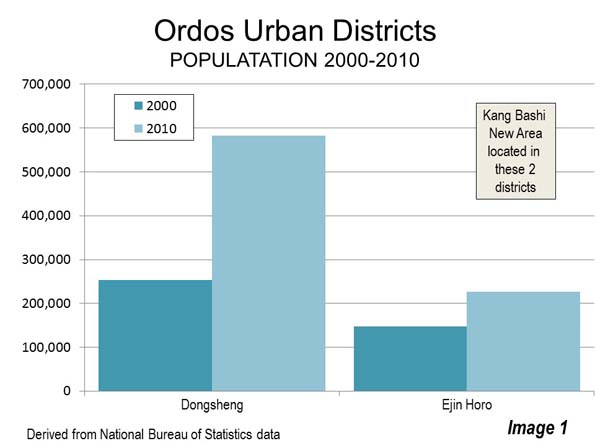
    Contrary to the “ghost city” meme, population growth has been strong in these two districts. In Dongsheng, the 2010 census counted approximately 580,000 residents, an increase of 130 percent over the 2000 census. The population of Ejin Horo rose 53 percent to approximately 225,000 residents. Overall, these two adjacent districts represent a labor market (metropolitan area) of nearly 810,000 residents, which grew more than 100 percent between 2000 and 2010 (Image 1).

    Ordos is located in the northern half of the Ordos Loop of the Yellow River, which with the Yangtze is one of China’s two great rivers. After passing Lanzhou (capital of Gansu), the eastward flowing river takes a sharp left turn to the north for approximately 600 kilometers (375 miles), then a sharp right turn back to the east for 300 kilometers (200 miles), turning south for 600 kilometers and finally turning east toward the Yellow Sea.
    Overall, the population of Ordos was approximately 1.94 million in the 2000 census and had grown 42 percent since 2000. As a result, Ordos was by far the fastest growing of the 12 municipalities in Inner Mongolia. The municipality grew at more than double the rate of the capital, Hohhot (Huhehaote), and approximately seven times the overall rate of Inner Mongolia. The growth rate of Ordos was also five times China’s national 10 year growth rate of 7.8 percent.

    The municipality covers a land area of 87,000 square kilometers, somewhat larger than Austria. Ordos Most of the population is in the more rural districts.

    Genghis Khan

    Genghis Kahn, founder of the Mongol empire (13th century), history’s largest contiguous empire plays importantly in the history of Ordos. Genghis Kahn is reputed to have been so impressed by Ordos that he wanted his personal effects buried here. The effects are buried at a mausoleum approximately 10 miles (25 kilometers) south of Kangbashi. The actual burial place of Genghis Kahn is not known, and consistent with Mongol tradition, is secret.

    The So-Called "Ghost City:" Kangbashi New Area

    The part of Ordos to which the "Ghost City" stories have referred is the Kangbashi New Area. It is adjacent to and north of the urbanization of Azhen in Ejin Horo. The Kangbashi new area covers approximately 350 square kilometers (135 square miles) in the Dongsheng and Ejin Horo districts at the time of the 2010 census. Thus, a census population count is not readily available. Informal estimates placed the population at under 30,000 in 2010. A more recent informal estimate by an Ordos municipal official indicated that the registered population had reached 72,000 in 2012 and would soon rise to 100,000. 

    Development of the Kangbashi New Area

    Ordos is one of the most affluent municipalities of China. It is comparatively new wealth, which is the result of vast coal reserves that have been increasingly called upon since 2000 to support China’s spectacular growth.  . According to People’s Daily, by 2012 the gross domestic product per capita of Ordos exceeded that of both Spain and South Korea.

    With the huge natural resource revenue gains, municipal officials decided to build a new city approximately 16 miles (25 kilometers) south of the municipal seat in Dongsheng. In 2006, the municipal seat was moved from Dongsheng to the Kangbashi new area. Both the Kangbashi New Area and Ejin Horo are within commuting distance of much larger Dongsheng, via the Dongsheng Expressway. As of 2012, the municipality indicated that at least one half of the municipal functions had been moved to Kangbashi.

    The Ordos Ceremonial Mall

    Some national governments in the world have built new capital cities or districts and taken the opportunity to order them around what might be called ceremonial malls — government buildings, monuments and cultural institutions arranged around a central axis. Governments that build new capital cities have unique opportunities to build ceremonial malls. Perhaps the first of these was Washington, with its Capitol Mall (The Supreme Court to the Lincoln Memorial) and the later developed mall from the White House to the Jefferson Memorial.

    Other particularly notable examples are Delhi, Canberra and Brasília. Perhaps the most famous such mall, though without the adjacent buildings and memorials, which had already been built elsewhere, is The Mall, running from Buckingham Palace to Trafalgar Square in London. This mall is somewhat different than the others, because it was built after most of the government buildings, which are located elsewhere.

    Ceremonial malls can be built by local governments as well, and Ordos has built one of world-class dimensions. The table below compares the Ordos mall with other representative government malls. With a length of 2.7 miles (4.3 kilometers), the Ordos mall is approximately the equal of Washington’s Capitol Mall and Canberra’s middle mall, (Federation Mall/ANZAC Parade). The Ordos mall is somewhat shorter than the Delhi mall and less than one half the length of the Brasília mall, parts of which remain undeveloped. The Ordos mall is more than twice as long as The Mall in London.

    The Ordos mall is more extensive, for example, than what may be the largest local government mall in the United States, in Los Angeles. This mall is shared by the city and the county of Los Angeles, with more than five times as many residents. In fact, the Ordos mall is of sufficient expanse and design to be mistaken for the centerpiece of a newly built national capital.

    In short, the Ordos mall is world class and already attracting tourists, principally from around China. As with the rest of China, international tourism is in its infancy and holds great potential for growth.

    Selected Ceremonial Malls
    Dimensions (KM) Dimensions (Miles)
    Location Length Axis Width Length Axis Width Government Population (Millions)
    Brasilia 9.7 0.21 6.0 0.13 National 195
    Delhi 5.2 0.24 3.2 0.15 National 1225
    Washington (Capitol Mall) 4.3 0.50 2.7 0.31 National 310
    Ordos 4.3 0.18 2.7 0.11 Local 2
    Canberra (Federation Mall/ANZAC Parade) 4.3 0.03 2.7 0.02 National 22
    London (The Mall) 1.3 0.06 0.8 0.04 National 62
    Los Angeles 1.1 0.08 0.7 0.05 Local 10
    Axis width is minimum central area around which buildings and monuments are organized
    Canberra & Washington have more than one mall
    Some of Brasilia mall is undeveloped

    Touring the Ordos Mall

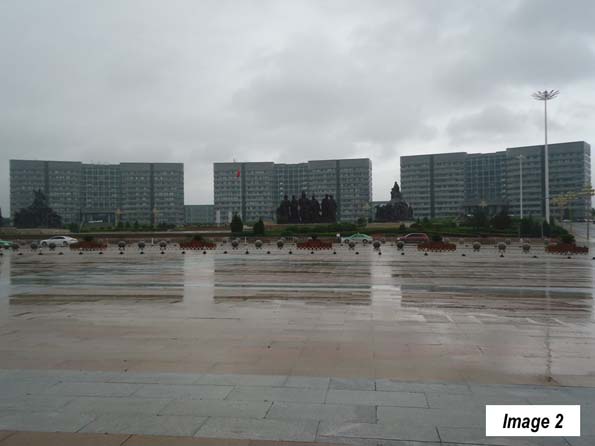
    The core of the mall is an axis, one large block wide, composed of greenery and statues (Images 2-13).

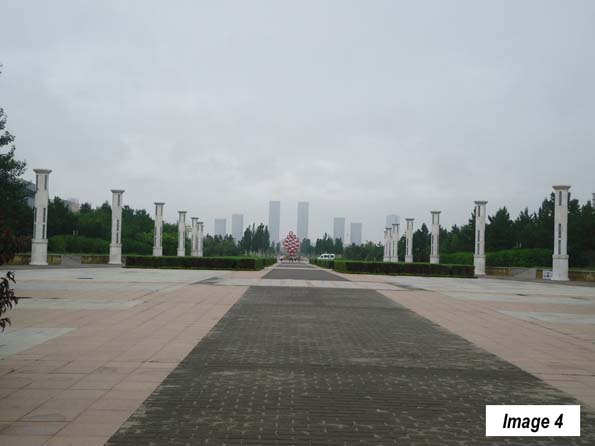
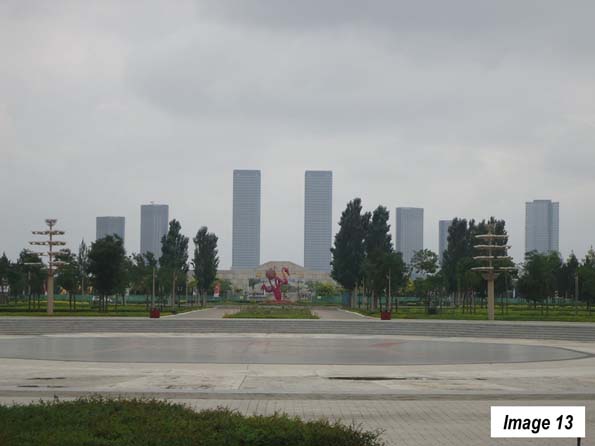
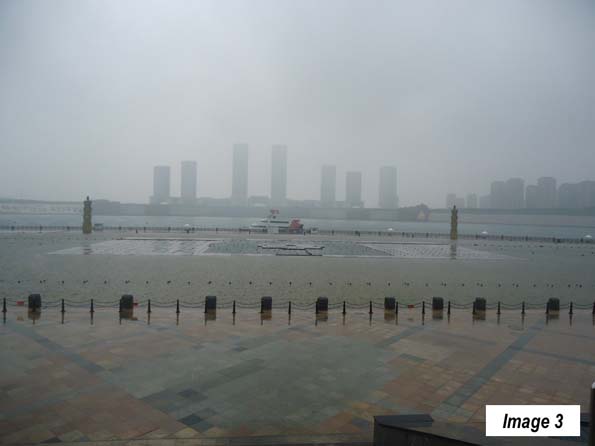
    The mall stretches from municipal buildings at the north (Image 2) to a lake (Image 3), across which are skyscrapers, anchoring the mall on the south (Images 4 and 13). This interruption by a lake is similar to the Canberra mall described above

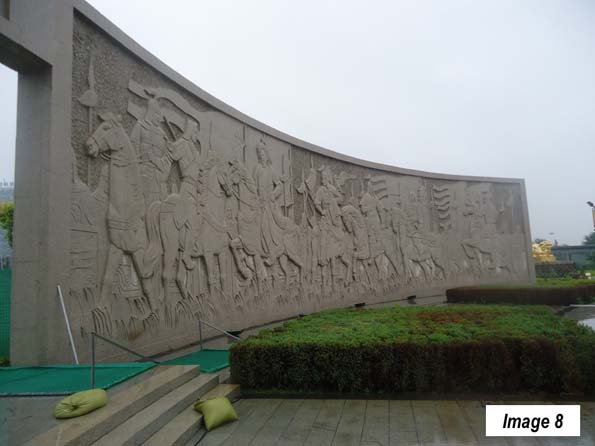
    Near the north end of the mall is the Genghis Khan statue (Image 5).

    The two horse’s statue is in the square to the south of the Genghis Khan statue (Image 6).

    Each side of the mall is defined by one-way streets that are four lanes wide.

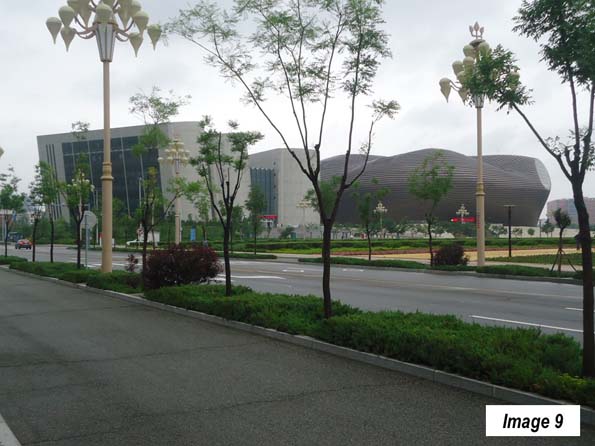
    Among the two most important government buildings on the mall are the Library of Ordos and the Ordos Museum (to the left and right, respectively, in Image 9). Neither of these buildings will be pleasing to aficionados of traditional architecture, including the author. I agree with Chinese President Xi, who suggested that China needed no more weird buildings, referring to the CCTV Tower in Beijing, which local taxi drivers told me is referred to as the  "underpants" building. Of course, architecture is a matter of taste.

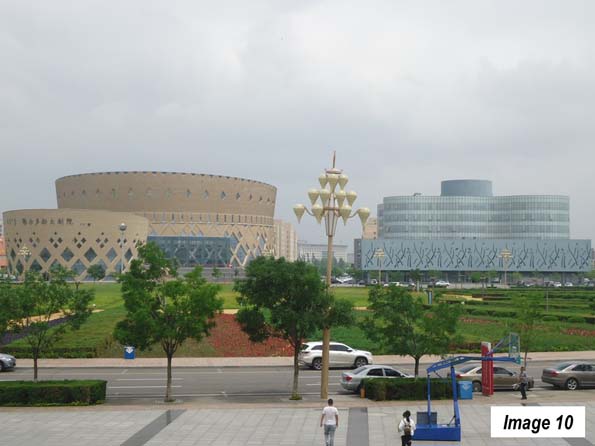
    Across the mall is the Ordos National Theatre and the Ordos Culture and Arts Center (Image 10, left and right). The circular and curved lines of these buildings offer a welcome refuge from the more courageous architecture of the Library and Museum, in the author’s view.

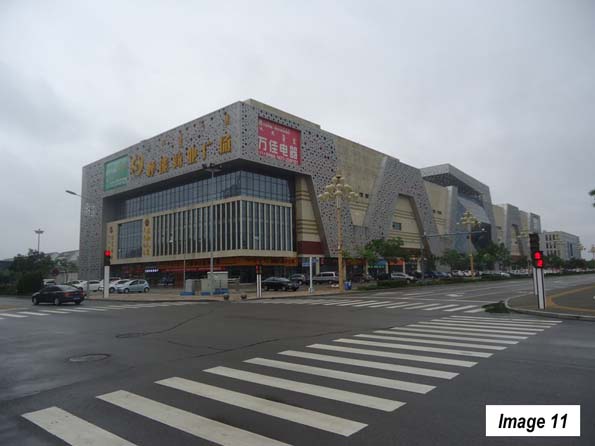
    The mall also includes commercial buildings (Image 11). These buildings include a wide array of retail stores, such as large electronic and home appliance outlets, banks and other facilities. Within a one block walk of my hotel there were at least seven restaurants from which to choose. Generally, ghosts do not require this density of eating establishments.
    Residential Areas

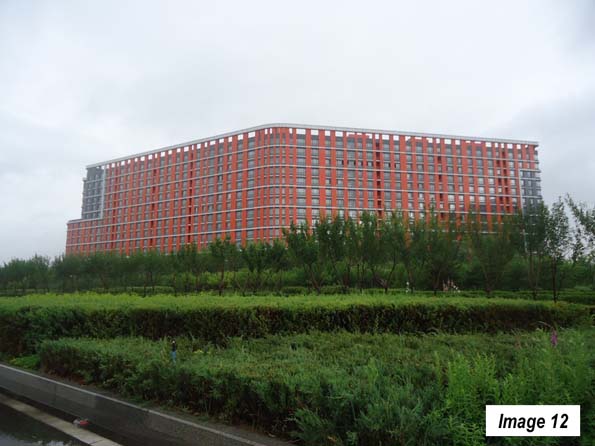
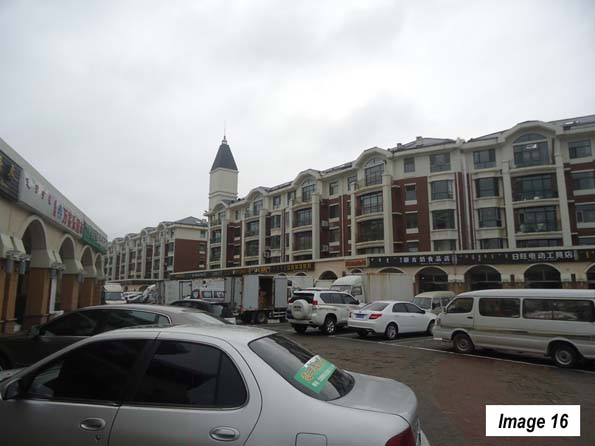
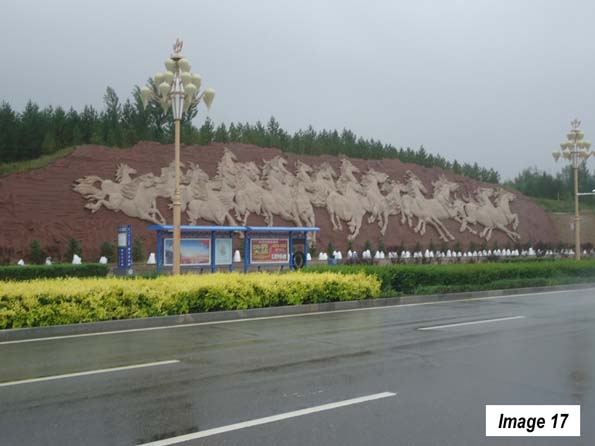
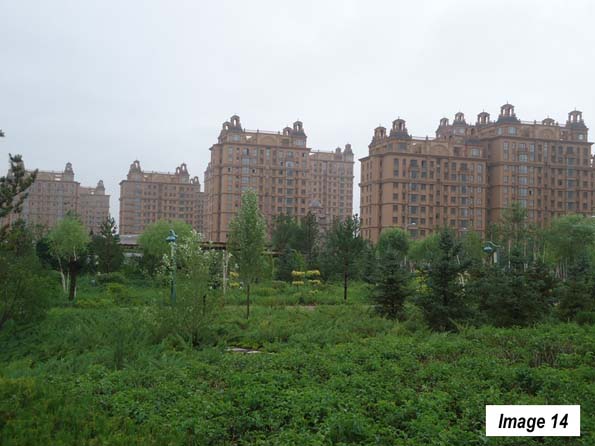
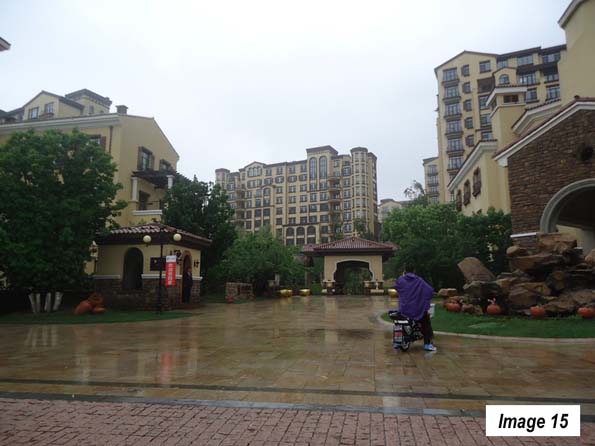
    There are a variety of residential areas surrounding the mall on three sides (the south end of the mall is bordered by the urbanization of Ejin Horo). The residential buildings tend to be from 5 to 12 floors (Images 14 – 16), and include the equivalent of strip malls (Image 16) that are close at hand for residents and can have full parking lots. The residential areas also include some monumental treatments (Image 17).
    Outside the Built-Up Urban Area

    The built-up area of Kangbashi is relatively small, covering less than 10 square miles (25 square kilometers), or less than 10 percent of the Kangbashi new area.

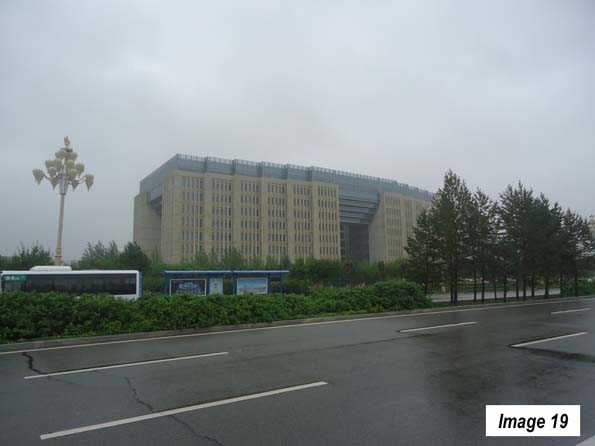
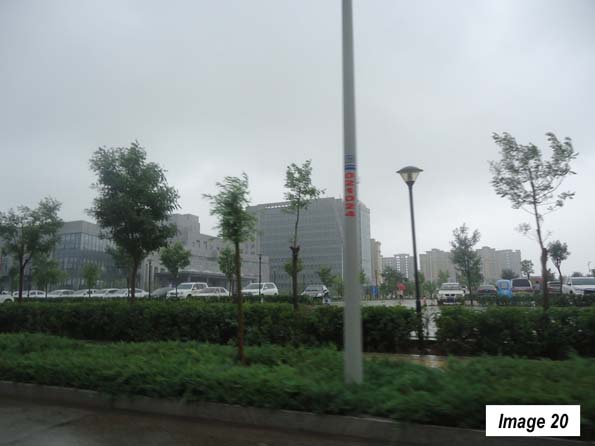
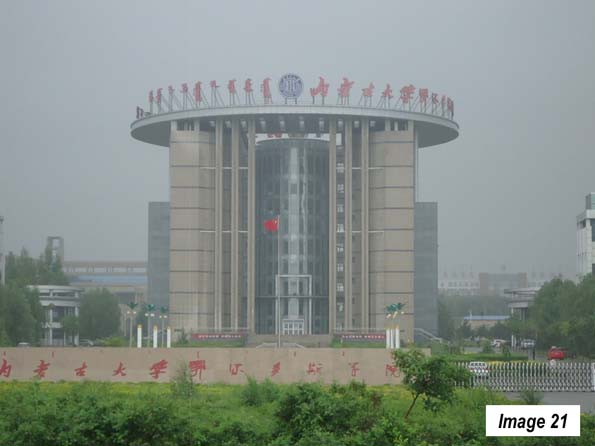
    Most of the "Ghost City" articles to limit their coverage to the small developed area. With the exception of a major roadway skeleton (along which there is virtually no development in many areas), much of the Kangbashi New Area is not a city at all. There are some small pockets of residential development spread throughout the area and a number of government buildings similarly dispersed beyond the built-up area (Images 18-24). At the same time, the parking lots were far from empty.

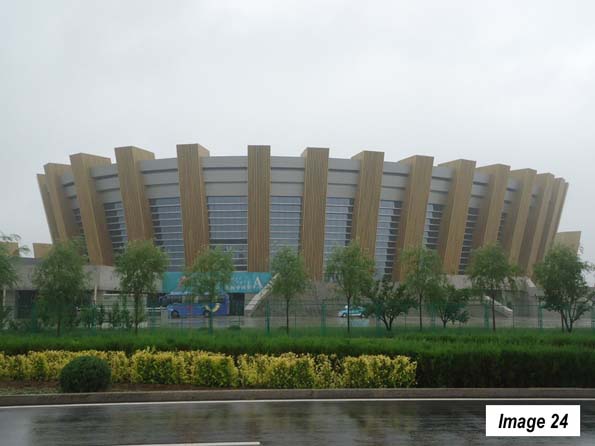
    There are also a number of religious sites outside the built up urban area (Images 22 & 23) and three similarly designed sports facilities (Image 24).

    The traffic volumes are well below the capacity of the more than ample arterial street system. But this is not unusual for newer suburban areas in China, where eight lane streets can be the rule.


    What About the People?

    Much of the ghost city coverage has been based on an assumption that   few if any residents have arrived. A number of articles point out that the present development has been built for 300,000 residents and that the population is much less (above). Yet, the municipality indicates that the 300,000 resident projection is for 2020. Whether or not Ordos will reach that population by 2020 cannot yet be known.

    Some of the ghost city articles have claimed that the Kangbashi new area was projected to have 1 million residents. However, the municipality’s website indicates that the 1,000,000 vision was for a much larger area than the Kangbashi new area. It also included Dongsheng, which alone already has nearly 600,000 residents as well as the urbanization of Ejin Horo. In other words, under the plan the area was already well on its way to achieving the eventual projection.

    Other articles point out that there are few people walking on the streets. But, as Chai Jiliang, chief publicity officer of Kangbashi told China Daily in 2012: "So, why do local residents who mostly own private cars and have convenient public transportation have to walk on the streets if there are no major public events?" There is further evidence of people, the establishment of a campus of the Beijing Normal University in the Kangbashi new area. Indeed a recent article in The New York Times Style Magazine, by Jody Rosen,   reported not only that there were people in the Kangbashi new area, but that they were generally happy with their city.

    Ejin Horo

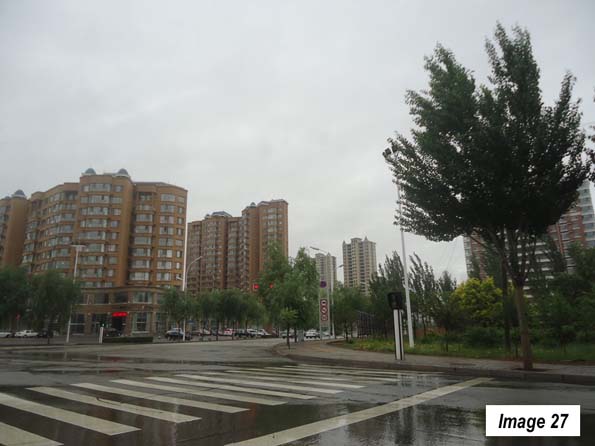
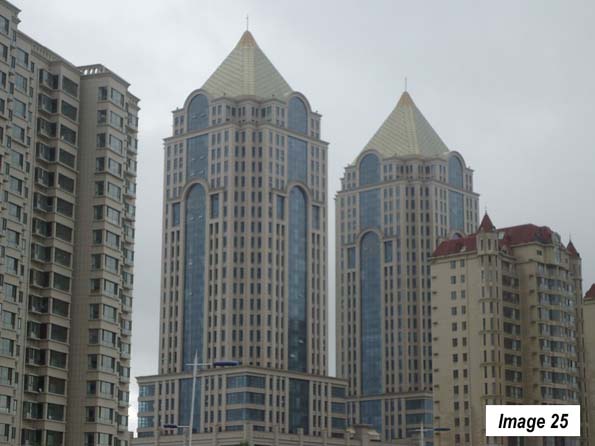
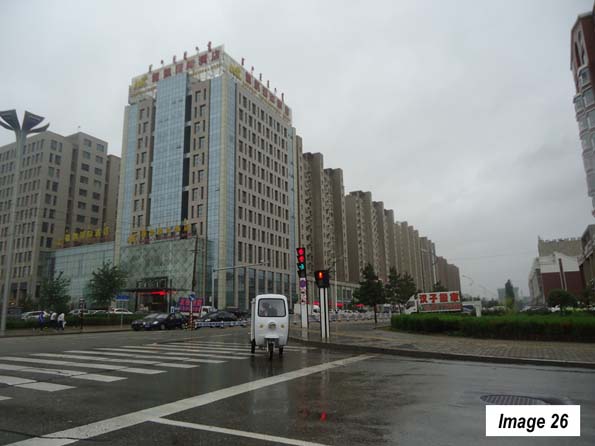
    Perhaps the biggest surprise was the Ejin Horo urbanization (Azhen), immediately to the south of the Kangbashi New Area (Images 25-27). The tallest buildings are here and some of the most impressive commercial architecture. Just across the principal bridge from the Kangbashi New Area are two buildings resembling the One World Wide Tower on Eighth Avenue in New York (Image 25). Ejin Horo also has many condominium towers that are often taller than those in the Kangbashi New Area. Unlike the Kangbashi New Area, Ejin Horo appears to have grown more organically in response to market demand. The area’s international airport is also located in Ejin Horo.
    Big Dreams, Big Challenges

    The Kangbashi new area  does face some problems. Like the rest of China, there are a number of uncompleted building projects, as the economy is not growing nearly as quickly as before. Though, again, I expected many more based on the negative published reports.

    There has been a severe reduction in house prices, as the Chinese economy has gotten worse. There are reports that many of the apartments and condominiums are empty, though no information was found on the extent of unsold houses or the number that have been purchased simply as investments to hold (and have no residents). It is not unusual for Chinese buyers to invest in additional properties, leaving them empty, a situation that is also been reported in central Vancouver. However, there was no lack of cars in the parking lots of the residential districts.

    Peoples Daily reports that coal extraction volumes are down significantly, which when combined with substantially lower coal prices in recent years has cut severely into the revenues of the Ordos municipality. The municipality is seeking additional revenue enhancing strategies, such as tourism (there are 9 million tourists annually), automobile manufacturing and solar power facilities.

    Liu Qiang, a People’s Daily columnist noted that "There are worries that Ordos, with its huge debts and years of mismanagement, will repeat Detroit’s road to bankruptcy," While noting that Chinese municipalities are not permitted to file bankruptcy, the columnist suggests that " China’s local government debt, if not being better managed, might potentially pose a systematic risk greater than in Detroit."

    Big dreams are not limited to cities in China. Ordos may have built civic monuments and infrastructure beyond its means. Only time will tell whether such visions can be sustained. The reality, however, is that Ordos, including the Kangbashi new area, is surprisingly vibrant and functioning with real people.

    Note 1: Inner Mongolia is a part of China. Mongolia (often called "Outer Mongolia) is an independent nation located between China and Russia.

    Note 2: The Evolving Urban Form is a newgeography.com metropolitan and urban area profiles from around the world. The more than 50 articles on in the series can be accessed here.

    Photo: Genghis Kahn Mausoleum, Ordos, Inner Mongolia, China by Fanghong (Own work) [CC BY-SA 3.0 or GFDL], via Wikimedia Commons

    Wendell Cox is principal of Demographia, an international pubilc policy and demographics firm. He is a Senior Fellow of the Center for Opportunity Urbanism (US), Senior Fellow for Housing Affordability and Municipal Policy for the Frontier Centre for Public Policy (Canada), and a member of the Board of Advisors of the Center for Demographics and Policy at Chapman University (California). He is co-author of the “Demographia International Housing Affordability Survey” and author of “Demographia World Urban Areas” and “War on the Dream: How Anti-Sprawl Policy Threatens the Quality of Life.” He was appointed to three terms on the Los Angeles County Transportation Commission, where he served with the leading city and county leadership as the only non-elected member. He served as a visiting professor at the Conservatoire National des Arts et Metiers, a national university in Paris.
  • Expo Line Expansion Fails to Stem L.A. Transit Loss

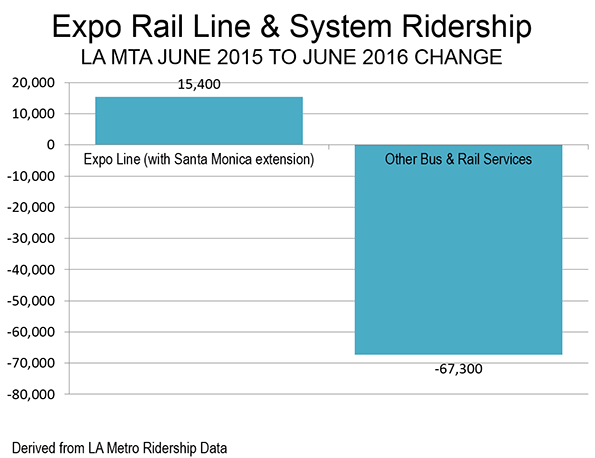
    The long awaited and highly touted Santa Monica extension brought an approximately 50 percent increase in ridership of the Los Angeles Expo light rail line between June 2016 and June 2015. The extension opened in mid May 2016. In its first full month of operation, June 2016, the line carried approximately 45,900 weekday boardings (Note), up from 30,600 in June 2015, according to Los Angeles Metropolitan Transportation Authority (MTA) ridership statistics.

    However MTA ridership continued to decline, with a 51,900 loss overall. Bus and rail services other than the Expo line experienced a reduction of 67,300 boardings (Figure).

    Between June 2015 and June 2016, rail boardings rose 30,500, while bus boardings declined 82,400. In other words there was a loss of 2.7 bus riders for every new rail rider over the past year. Los Angeles transit riders have considerably lower median earnings than in the cities with higher ridership, and lower than the major metropolitan average (see the analysis by former Southern California Rapid Transit District Chief Financial Officer Tom Rubin and "Just How Much has Los Angeles Transit Ridership Fallen?" and ) here and here).

    Note: A passenger is counted as a boarding each time a transit vehicle is entered. Thus, if more than one transit vehicle is required to make a trip, there can be multiple boardings between the trip origin and destination. Because the addition of rail services, as in Los Angeles, can result in forcing bus riders to transfer because their services can be truncated at rail stations, the use of boardings as an indicator of ridership can result in exaggeration, as the number of boardings per passenger trip is increased. This may have produced a decline of as much as 30 percent in actual passenger trips since 1985, as a number of rail lines have been opened in Los Angeles. 

  • The U.S. Cities Creating The Most White-Collar Jobs, 2016

    The information sector may have glamour and manufacturing, nostalgia appeal, but the real action in high-wage job growth in the United States is in the vast realm of professional and business services. This is not only the largest high-wage part of the economy, employing just under 20 million people at an average salary of $30 an hour, it’s also one the few high-wage sectors in which employment has expanded steadily since 2010, at more than 3% a year, adding nearly 3 million white-collar jobs.

    In many ways, the business and professional service sector may be the best indicator of future U.S. economic growth. It is not nearly as vulnerable to disruption as energy, manufacturing or information employment, and more deeply integrated into the economy, including professions like administrative services and management, legal services, scientific research, and computer systems and design.  In a pattern we have seen in other sectors, much of the growth is concentrated in two very different kinds of places: tech-rich metro areas and those that offer lower costs, and often more business-friendly atmospheres.

    To generate our rankings of the best places for business services jobs, we looked at employment growth in the 366 metropolitan statistical areas for which BLS has complete data going back to 2005, weighting growth over the short-, medium- and long-term in that span, and factoring in momentum — whether growth is slowing or accelerating. (For a detailed description of our methodology, click here.)

    Tech Strikes Again

    There is a growing confluence between technology and business services, as more companies use the Internet to conduct commerce.

    This can be seen in several of our top-ranked large cities. Business service employment in the San Francisco-Redwood City-South San Francisco MSA has grown a remarkable 45% since 2010, placing it second on our list, slightly faster than third-ranked Austin-Round Rock, which clocked 42% growth over the same span, and No. 4 San Jose-Sunnyvale-Santa Clara, where business services employment expanded 36%.

    It’s questionable whether this pattern will continue, particularly in the high-cost Bay Area. There are signs of a slowdown in Silicon Valley and San Francisco, with more space being subleased and property prices seeming to have peaked, albeit at extraordinary high levels. In contrast the future for less expensive areas — increasingly attractive to millennials as well as companies — may be far brighter, as companies shift employment to places their employees can live decently.

    Resurgence In Middle America

    This pattern can be seen in the balance of our top-performing regions. It starts with our top-ranked metro area, Nashville, Tenn., which has seen business service employment grow 47.2% since 2010 to 152,700 jobs, with 7.7% growth last year alone. Some of this comes from the establishment of branch offices of Silicon Valley companies like Lyft and Everbright, as well as the expansion of the area’s strong health care and entertainment industries.

    Nashville’s appeal to millennials is unsurpassed, with the strongest growth rate in net migration of college-educated people aged 25-34 of any metro area in the country, and the reasons are not hard to find. It’s a charming city located in a temperate part of the country, with both excellent, and affordable, urban and suburban options.

    But if Nashville is the belle of the business service ball, fifth-ranked Dallas-Ft. Worth is now the beast. The Texas powerhouse’s business services workforce has expanded 28.9% since 2010 to 458,200. The Dallas-Ft. Worth area has plenty of appeal to big companies with a large cohort of middle-income managers, as a paper to be published this fall by Southern Methodist University’s Klaus Desmet and Cullum Clark well describes. These jobs pay well enough to live well in Dallas’ nicer suburbs, such as Plano and Frisco, but not remotely enough to buy a house, or even a condo, in Los Angeles, San Francisco or New York.

    This accounts, in part, for the relocation of Toyota America’s headquarters from Torrance, Calif., to the north Dallas suburbs, and likely plays a role in the plans of Jacobs Engineering, a longtime fixture in Pasadena, to relocate its headquarters to downtown Dallas.

    In many ways, argues urban analyst Aaron Renn, Dallas is becoming the new Chicago. It is anchored by a large airport, a diverse economy and a location in the middle of country. Even as downtown Chicago has attracted some notable new corporate headquarters in recent years, these generally employ relatively few people, while companies that need access to a large white-collar workforce, like Toyota and Jacobs, have been gravitating to the Big D.

    How About The Big Boys?

    As manufacturing has declined in our largest cities, professional and business services have become the prime generator of high-end jobs. Yet among the country’s largest business service centers there is a growing divergence between the winners and laggards.

    The most impressive performance among metro areas with over 500,000 business and professional service jobs has been New York. With 714,000 business service jobs, the Big Apple is without question the leader in the field, but more importantly it continues to grow. Since 2010, New York has grown its professional and business service employment by an impressive 22%, helping it rank 14th on our list. This reflects the city’s continued preeminence in such fields as law, design, marketing, public relations and advertising.

    But the other traditional business service leaders have not fared nearly as well. Gotham’s traditional rival, Chicago-Naperville-Arlington Heights, still has 673,000 business service jobs but has seen only a modest growth just under 15%, ranking 43rd. Whatever may have been gained in generally small scale “executive headquarters” has not been enough to make the vast Chicagoland region a big winner.

    Things are even less positive in 60th place Los Angeles-Long Beach-Glendale, the third largest business service area. Since 2010, its 13.8% growth is well below the national average. Nor is the slack in the Southland being picked up by the area’s sprawling suburbs, with Santa Ana-Anaheim-Irvine ranking a modest 39th and San Bernardino-Riverside clocking in at 52nd. The Bay Area business services world may be still booming, but south of the Tehachapi, progress is slow.

    Will Business Services Continue To Disperse?

    Those who suggest dense concentrations have efficiencies that overcome higher costs can take some solace from our numbers, but not too much. Many of the fastest growing business service centers are hardly paragons of dense urbanism, including No. 7 Orlando-Kissimmee-Sanford, Fla., and No. 8 Richmond, Va., where employment jumped 10% last year. Even sprawling Atlanta, which has lost some of its ‘90s era luster, is now growing its business service sector at a faster pace than New York and light years ahead of much denser Chicago and Los Angeles. It ranks 13th.

    The shift to less expensive places seems certain to continue, in part due to the growing role of Internet communications, which breaks down formerly insurmountable distance barriers. Looking at the full list of the 366 metro areas we examined, the fastest-growers include many smaller communities, led by overall No. 1 New Bedford, Mass., where business services employment has grown 58.5% since 2010 to 6,200 jobs, as well as No. 3 Monroe, Mich., No. 4 Lake Charles, La., and No. 6 Lawton, Okla.

    Essentially business service growth seems destined to break down into three types: (1) large and expensive metro areas — San Francisco-Silicon Valley and New York — whose economic dynamism is strong enough to counter high costs; (2) less expensive, but still large metros such as Nashville, Dallas-Ft. Worth, Richmond and a host of Florida cities that can be expected to garner a lion’s share of the new growth; and (3) smaller communities where business service sector jobs, particularly at the lower end, may be increasingly attracted as employers pursue an affordable quality of life. While the short term has favored the largest cities, the long term is pointing toward more migration to midsized and smaller destinations.

    This piece first appeared at Forbes.

    Joel Kotkin is executive editor of NewGeography.com. He is the Roger Hobbs Distinguished Fellow in Urban Studies at Chapman University and executive director of the Houston-based Center for Opportunity Urbanism. His newest book, The Human City: Urbanism for the rest of us, will be published in April by Agate. He is also author of The New Class ConflictThe City: A Global History, and The Next Hundred Million: America in 2050. He lives in Orange County, CA.

    Michael Shires, Ph.D. is a professor at Pepperdine University School of Public Policy.

    Photograph: Downtown Nashville from BigStockPhoto.com

  • All Cities Business Services Jobs – 2016 Best Cities Rankings

    Read about how we selected the 2016 Best Cities for Job Growth

    2016 MSA Prof & Bus Svcs  – Overall Ranking Area 2016 Prof & Bus Svcs Weighted INDEX 2015 Prof and Business Services Emplmt (1000s) Total Prof and Business Services Emplmt Growth Rate 2014-2015 2016 MSA Size Group 2015 MSA Prof & Bus Svcs Overall Ranking Overall Rank Change
    2014-2015
    1 New Bedford, MA NECTA 97.1            6.2 58.5% S 5 4
    2 Nashville-Davidson–Murfreesboro–Franklin, TN 96.9       152.7 47.2% L 38 36
    3 Monroe, MI 95.0            4.9 44.6% S 12 9
    4 Lake Charles, LA 94.8            9.7 44.6% S 99 95
    5 San Francisco-Redwood City-South San Francisco, CA Metro Div 93.1       270.5 45.7% L 15 10
    6 Lawton, OK 92.6            4.9 37.4% S 288 282
    7 Elizabethtown-Fort Knox, KY 92.3            6.9 35.5% S 111 104
    8 Austin-Round Rock, TX 91.1       165.6 42.3% L 44 36
    9 Janesville-Beloit, WI 90.3            6.5 44.8% S 7 (2)
    10 Jackson, TN 89.9            6.7 39.3% S 4 (6)
    11 Sioux Falls, SD 89.0         15.5 33.2% M 250 239
    12 St. George, UT 88.8            4.7 34.6% S 183 171
    13 College Station-Bryan, TX 88.5            8.3 38.3% S 53 40
    14 San Jose-Sunnyvale-Santa Clara, CA 88.5       223.0 36.4% L 13 (1)
    15 Trenton, NJ 88.2         45.0 25.1% M 269 254
    16 Fayetteville-Springdale-Rogers, AR-MO 87.5         48.1 38.2% M 26 10
    17 Napa, CA 86.6            6.9 34.2% S 94 77
    18 Provo-Orem, UT 85.7         29.6 34.3% M 9 (9)
    19 Cape Coral-Fort Myers, FL 84.8         34.1 38.4% M 41 22
    20 Springfield, OH 83.4            5.0 20.8% S 23 3
    21 Dallas-Plano-Irving, TX Metro Div 82.8       458.2 28.9% L 45 24
    22 Raleigh, NC 81.2       113.5 27.9% L 22 0
    23 Laredo, TX 80.9            8.6 31.5% S 66 43
    24 Deltona-Daytona Beach-Ormond Beach, FL 80.4         22.7 33.7% M 35 11
    25 Charlottesville, VA 80.3         15.1 24.5% S 76 51
    26 Orlando-Kissimmee-Sanford, FL 80.3       201.2 26.8% L 143 117
    27 Waco, TX 80.1         11.5 36.5% S 10 (17)
    28 Richmond, VA 80.1       112.3 18.9% L 260 232
    29 Charlotte-Concord-Gastonia, NC-SC 79.8       188.2 25.3% L 62 33
    30 Portland-Vancouver-Hillsboro, OR-WA 79.4       172.9 24.9% L 81 51
    31 Stockton-Lodi, CA 79.1         20.5 35.2% M 194 163
    32 Bend-Redmond, OR 79.0            8.2 26.3% S 47 15
    33 Greeley, CO 78.1            9.9 38.3% S 18 (15)
    34 Tampa-St. Petersburg-Clearwater, FL 77.9       226.3 26.3% L 154 120
    35 Morgantown, WV 77.8            6.6 25.2% S 30 (5)
    36 Louisville/Jefferson County, KY-IN 77.7         88.4 21.9% L 86 50
    37 Salisbury, MD-DE 77.7         12.5 24.2% M 128 91
    38 Des Moines-West Des Moines, IA 77.2         47.4 24.2% M 69 31
    39 Bismarck, ND 76.9            8.4 29.1% S 82 43
    40 Greenville-Anderson-Mauldin, SC 76.6         71.4 23.8% M 65 25
    41 Fargo, ND-MN 76.6         16.7 25.6% S 139 98
    42 Tuscaloosa, AL 76.5         11.2 40.2% S 2 (40)
    43 Atlanta-Sandy Springs-Roswell, GA 76.2       485.1 23.9% L 67 24
    44 New York City, NY 76.0       714.0 22.0% L 120 76
    45 Auburn-Opelika, AL 76.0            7.4 37.7% S 1 (44)
    46 Greensboro-High Point, NC 74.7         53.6 19.4% M 57 11
    47 Kansas City, MO 73.9         90.4 18.3% L 204 157
    48 Redding, CA 73.8            6.4 33.3% S 31 (17)
    49 Flagstaff, AZ 73.7            3.3 35.6% S 42 (7)
    50 Gadsden, AL 73.5            4.4 37.5% S 28 (22)
    51 Denver-Aurora-Lakewood, CO 73.3       254.1 23.4% L 145 94
    52 Chambersburg-Waynesboro, PA 73.1            5.8 17.7% S 132 80
    53 Pueblo, CO 73.0            7.1 20.2% S 104 51
    54 Manchester, NH NECTA 72.9         16.4 20.2% S 46 (8)
    55 Las Vegas-Henderson-Paradise, NV 72.9       126.1 25.0% L 97 42
    56 Ogden-Clearfield, UT 72.5         28.4 31.3% M 36 (20)
    57 Asheville, NC 72.4         18.4 20.8% M 152 95
    58 Seattle-Bellevue-Everett, WA Metro Div 72.2       244.4 22.1% L 125 67
    59 Chattanooga, TN-GA 71.8         29.6 29.9% M 173 114
    60 Corvallis, OR 71.7            4.3 15.0% S 73 13
    61 Memphis, TN-MS-AR 71.6         99.9 25.5% L 80 19
    62 Knoxville, TN 71.5         63.2 15.8% M 79 17
    63 Fort Lauderdale-Pompano Beach-Deerfield Beach, FL Metro Div 71.3       144.0 21.6% L 109 46
    64 Port St. Lucie, FL 71.3         16.6 29.7% S 6 (58)
    65 Bowling Green, KY 71.3            9.1 20.7% S 211 146
    66 San Luis Obispo-Paso Robles-Arroyo Grande, CA 71.1         12.4 24.7% S 108 42
    67 Fond du Lac, WI 70.8            2.9 24.3% S 72 5
    68 Reading, PA 70.5         23.9 21.1% M 21 (47)
    69 Prescott, AZ 70.5            4.4 42.4% S 71 2
    70 Indianapolis-Carmel-Anderson, IN 69.8       162.5 26.2% L 103 33
    71 Spokane-Spokane Valley, WA 69.8         25.5 17.7% M 199 128
    72 Gainesville, FL 69.7         13.1 22.1% S 34 (38)
    73 Burlington-South Burlington, VT NECTA 69.7         14.2 18.9% S 107 34
    74 West Palm Beach-Boca Raton-Delray Beach, FL Metro Div 69.2       108.3 28.2% L 51 (23)
    75 North Port-Sarasota-Bradenton, FL 69.2         41.4 40.7% M 17 (58)
    76 Dover, DE 69.0            4.7 16.7% S 310 234
    77 Springfield, MO 68.8         25.2 27.3% M 49 (28)
    78 Haverhill-Newburyport-Amesbury Town, MA-NH NECTA Div 68.5            5.6 17.6% S 278 200
    79 Baton Rouge, LA 68.5         49.7 19.5% M 142 63
    80 Macon, GA 68.3         12.9 24.0% S 52 (28)
    81 Olympia-Tumwater, WA 68.2         10.3 32.2% S 129 48
    82 Hartford-West Hartford-East Hartford, CT NECTA 67.6         73.1 19.2% L 92 10
    83 Ann Arbor, MI 67.3         29.9 16.2% M 165 82
    84 Salt Lake City, UT 66.8       118.5 23.8% L 102 18
    85 Lubbock, TX 66.8         12.1 15.6% S 241 156
    86 Framingham, MA NECTA Division 66.7         36.9 15.3% M 215 129
    87 Saginaw, MI 66.0         11.9 18.5% S 61 (26)
    88 Burlington, NC 65.7            5.7 21.4% S 11 (77)
    89 Winston-Salem, NC 65.6         35.3 18.4% M 146 57
    90 Yuba City, CA 65.6            3.2 26.3% S 37 (53)
    91 Salinas, CA 65.5         13.6 15.9% S 29 (62)
    92 Columbus, IN 65.4            5.4 27.6% S 20 (72)
    93 Reno, NV 65.3         29.8 21.5% M 246 153
    94 Salem, OR 65.2         13.5 25.5% M 177 83
    95 Tacoma-Lakewood, WA Metro Div 64.8         27.5 16.2% M 186 91
    96 Athens-Clarke County, GA 64.7            7.8 19.5% S 208 112
    97 San Antonio-New Braunfels, TX 64.7       125.3 20.4% L 117 20
    98 Jacksonville, FL 64.6       102.8 19.9% L 93 (5)
    99 Elkhart-Goshen, IN 64.3         10.0 36.2% S 19 (80)
    100 Middlesex-Monmouth-Ocean, NJ 64.3       152.0 16.6% L 244 144
    101 Phoenix-Mesa-Scottsdale, AZ 64.1       336.7 21.9% L 151 50
    102 Panama City, FL 64.1         10.3 29.3% S 96 (6)
    103 Madison, WI 63.7         49.8 18.7% M 136 33
    104 Crestview-Fort Walton Beach-Destin, FL 63.3         14.3 14.1% S 265 161
    105 Harrisburg-Carlisle, PA 63.1         47.5 15.7% M 236 131
    106 Miami-Miami Beach-Kendall, FL Metro Div 63.1       162.5 24.4% L 77 (29)
    107 Lexington-Fayette, KY 62.6         40.3 33.9% M 55 (52)
    108 Oakland-Hayward-Berkeley, CA Metro Div 62.6       182.9 18.6% L 105 (3)
    109 Brownsville-Harlingen, TX 62.5         12.0 17.3% S 153 44
    110 Santa Rosa, CA 62.4         21.7 16.5% M 188 78
    111 Wausau, WI 62.2            5.3 22.1% S 58 (53)
    112 Portsmouth, NH-ME NECTA 62.2         11.8 10.9% S 307 195
    113 Naples-Immokalee-Marco Island, FL 62.1         14.9 25.5% S 24 (89)
    114 Savannah, GA 62.0         20.2 15.2% M 85 (29)
    115 Providence-Warwick, RI-MA NECTA 62.0         70.1 19.3% L 112 (3)
    116 Charleston-North Charleston, SC 60.7         49.4 15.0% M 114 (2)
    117 Punta Gorda, FL 60.7            4.6 27.8% S 118 1
    118 Taunton-Middleborough-Norton, MA NECTA Division 60.5            6.4 11.7% S 268 150
    119 Texarkana, TX-AR 60.1            4.4 -1.5% S 362 243
    120 Boston-Cambridge-Newton, MA NECTA Division 60.1       340.4 16.7% L 190 70
    121 Springfield, IL 59.7         11.9 -3.3% S 352 231
    122 Columbus, OH 59.6       178.8 20.1% L 89 (33)
    123 Wilmington, NC 59.3         15.1 15.3% S 137 14
    124 Scranton–Wilkes-Barre–Hazleton, PA 59.1         30.2 17.2% M 252 128
    125 Camden, NJ Metro Div 58.9         78.8 11.0% L 140 15
    126 Warren-Troy-Farmington Hills, MI Metro Div 58.3       267.4 24.7% L 141 15
    127 Houston-The Woodlands-Sugar Land, TX 58.3       465.4 21.7% L 100 (27)
    128 Omaha-Council Bluffs, NE-IA 58.3         74.6 15.6% L 232 104
    129 Topeka, KS 58.2         12.8 22.3% S 48 (81)
    130 Delaware County, PA 57.6         32.4 13.7% M 209 79
    131 Rockford, IL 57.6         17.0 12.8% M 83 (48)
    132 Grants Pass, OR 57.3            2.1 26.5% S 3 (129)
    133 Yuma, AZ 57.0            6.7 14.3% S 337 204
    134 Logan, UT-ID 56.7            6.0 8.4% S 291 157
    135 Kansas City, KS 56.4         93.5 19.6% L 78 (57)
    136 Lakeland-Winter Haven, FL 56.3         29.3 18.0% M 182 46
    137 Ithaca, NY 55.6            3.4 9.7% S 75 (62)
    138 Waterloo-Cedar Falls, IA 55.4            7.7 19.7% S 88 (50)
    139 State College, PA 55.4            6.2 12.0% S 167 28
    140 Yakima, WA 55.2            4.2 7.6% S 339 199
    141 Wichita, KS 55.1         33.5 13.8% M 113 (28)
    142 Eugene, OR 55.1         17.0 15.9% M 303 161
    143 Springfield, MA-CT NECTA 55.0         26.8 14.6% M 161 18
    144 Kalamazoo-Portage, MI 54.6         16.5 16.4% S 84 (60)
    145 Huntsville, AL 54.5         52.4 6.9% M 311 166
    146 Bellingham, WA 54.1            7.9 13.9% S 159 13
    147 Dover-Durham, NH-ME NECTA 54.1            4.0 14.4% S 193 46
    148 Nashua, NH-MA NECTA Division 54.0         15.1 16.2% S 235 87
    149 Pensacola-Ferry Pass-Brent, FL 53.9         22.8 14.2% M 149 0
    150 Roanoke, VA 53.9         22.7 10.6% M 301 151
    151 Modesto, CA 53.4         14.4 18.7% M 70 (81)
    152 Owensboro, KY 53.2            3.9 12.4% S 304 152
    153 Kahului-Wailuku-Lahaina, HI 53.1            7.2 12.0% S 156 3
    154 South Bend-Mishawaka, IN-MI 53.0         13.6 13.4% S 119 (35)
    155 York-Hanover, PA 52.4         20.8 14.9% M 98 (57)
    156 Pocatello, ID 52.4            4.0 27.7% S 133 (23)
    157 Myrtle Beach-Conway-North Myrtle Beach, SC-NC 52.3         12.7 18.3% M 91 (66)
    158 Killeen-Temple, TX 52.2            9.9 4.6% S 346 188
    159 Muskegon, MI 52.0            3.8 27.0% S 90 (69)
    160 Amarillo, TX 51.9            9.6 14.2% S 281 121
    161 Lima, OH 51.9            4.9 24.4% S 243 82
    162 Bangor, ME NECTA 51.9            6.5 14.8% S 87 (75)
    163 Midland, TX 51.6            9.4 19.5% S 101 (62)
    164 Lincoln, NE 51.5         19.6 12.2% M 316 152
    165 Bay City, MI 51.3            3.5 12.8% S 60 (105)
    166 New Haven, CT NECTA 51.1         30.2 15.5% M 172 6
    167 Durham-Chapel Hill, NC 51.1         38.9 9.2% M 290 123
    168 Iowa City, IA 51.1            6.9 15.7% S 59 (109)
    169 Anaheim-Santa Ana-Irvine, CA Metro Div 50.8       288.3 16.1% L 121 (48)
    170 Clarksville, TN-KY 50.8            9.1 11.9% S 150 (20)
    171 Chico, CA 50.5            5.8 16.0% S 122 (49)
    172 Leominster-Gardner, MA NECTA 50.4            3.8 10.8% S 216 44
    173 Victoria, TX 50.3            2.6 4.0% S 64 (109)
    174 Lewiston-Auburn, ME NECTA 50.0            7.0 11.6% S 203 29
    175 Pittsburgh, PA 49.8       178.1 10.6% L 267 92
    176 Montgomery Co-Bucks Co-Chester Co, PA Metro Div 49.7       198.7 10.1% L 262 86
    177 Jackson, MS 49.6         33.1 16.0% M 180 3
    178 Washington-Arlington-Alexandria, DC-VA-MD-WV Metro Div 49.5       604.6 7.7% L 300 122
    179 Columbia, SC 49.0         49.7 21.9% M 231 52
    180 Corpus Christi, TX 48.6         17.2 10.0% M 324 144
    181 Kingston, NY 48.5            4.6 15.8% S 225 44
    182 Atlantic City-Hammonton, NJ 48.4         10.0 4.9% S 223 41
    183 Santa Cruz-Watsonville, CA 48.3         10.0 8.3% S 318 135
    184 Spartanburg, SC 48.2         16.0 12.9% S 163 (21)
    185 Calvert-Charles-Prince George’s, MD 48.1         49.6 5.8% M 247 62
    186 Kankakee, IL 47.9            3.4 6.2% S 39 (147)
    187 Chicago-Naperville-Arlington Heights, IL Metro Div 47.8       672.7 14.9% L 162 (25)
    188 Urban Honolulu, HI 47.8         67.9 15.1% L 191 3
    189 Madera, CA 47.6            2.9 7.5% S 226 37
    190 San Diego-Carlsbad, CA 47.5       234.4 12.7% L 160 (30)
    191 Portland-South Portland, ME NECTA 47.5         26.8 9.2% M 270 79
    192 El Paso, TX 47.2         33.1 5.5% M 323 131
    193 Sacramento–Roseville–Arden-Arcade, CA 46.9       120.0 17.5% L 116 (77)
    194 Colorado Springs, CO 46.6         43.3 8.4% M 289 95
    195 Northern Virginia, VA 46.5       387.2 4.5% L 325 130
    196 Danbury, CT NECTA 46.4            9.3 14.3% S 124 (72)
    197 Walla Walla, WA 46.4            1.0 11.1% S 313 116
    198 Minneapolis-St. Paul-Bloomington, MN-WI 46.1       303.7 12.0% L 174 (24)
    199 Hagerstown-Martinsburg, MD-WV 46.1            9.4 15.0% S 184 (15)
    200 Philadelphia City, PA 46.0         91.2 9.9% L 237 37
    201 Bloomsburg-Berwick, PA 45.6            4.2 17.8% S 198 (3)
    202 Augusta-Richmond County, GA-SC 45.6         33.8 8.0% M 218 16
    203 Boulder, CO 45.6         32.9 14.0% M 205 2
    204 Tucson, AZ 45.4         52.2 12.2% M 292 88
    205 St. Louis, MO-IL 45.1       206.8 9.9% L 200 (5)
    206 New Orleans-Metairie, LA 44.9         74.7 9.6% L 242 36
    207 McAllen-Edinburg-Mission, TX 44.6         16.1 10.6% M 258 51
    208 Idaho Falls, ID 44.5         12.7 -1.8% S 297 89
    209 Riverside-San Bernardino-Ontario, CA 44.1       145.2 14.9% L 54 (155)
    210 Peoria, IL 44.1         22.4 -0.4% M 351 141
    211 Fort Collins, CO 44.0         19.3 10.5% M 238 27
    212 Orange-Rockland-Westchester, NY 43.5         87.7 11.6% L 234 22
    213 Detroit-Dearborn-Livonia, MI Metro Div 43.4       126.4 14.8% L 196 (17)
    214 Dayton, OH 43.3         51.0 10.9% M 213 (1)
    215 Beaumont-Port Arthur, TX 43.2         14.8 6.7% M 40 (175)
    216 Fresno, CA 43.1         30.9 16.3% M 27 (189)
    217 San Rafael, CA Metro Div 43.0         19.1 6.9% S 341 124
    218 Barnstable Town, MA NECTA 42.9            8.6 9.8% S 95 (123)
    219 Fort Worth-Arlington, TX Metro Div 42.8       111.0 13.8% L 131 (88)
    220 Brockton-Bridgewater-Easton, MA NECTA Division 42.6            7.4 -0.9% S 130 (90)
    221 Toledo, OH 42.6         37.1 16.3% M 263 42
    222 Lafayette-West Lafayette, IN 42.2            7.5 10.8% S 16 (206)
    223 Fort Wayne, IN 41.9         21.6 1.7% M 254 31
    224 Newark, NJ-PA Metro Div 41.6       221.2 6.7% L 306 82
    225 Milwaukee-Waukesha-West Allis, WI 41.4       125.2 10.3% L 229 4
    226 Vallejo-Fairfield, CA 41.0            9.8 12.7% S 272 46
    227 St. Cloud, MN 41.0            8.8 6.0% S 344 117
    228 Kennewick-Richland, WA 40.9         21.4 -15.9% S 333 105
    229 Akron, OH 40.9         52.3 6.3% M 285 56
    230 East Stroudsburg, PA 40.6            3.5 -4.6% S 329 99
    231 Nassau County-Suffolk County, NY Metro Div 40.3       171.1 11.0% L 256 25
    232 Oshkosh-Neenah, WI 40.2         11.3 12.2% S 157 (75)
    233 Abilene, TX 40.2            5.6 0.6% S 170 (63)
    234 Morristown, TN 40.1            3.4 14.8% S 178 (56)
    235 Glens Falls, NY 39.8            5.8 11.5% S 212 (23)
    236 Fort Smith, AR-OK 39.8         11.9 8.8% S 214 (22)
    237 Kingsport-Bristol-Bristol, TN-VA 39.8         10.1 4.5% S 127 (110)
    238 Little Rock-North Little Rock-Conway, AR 39.7         46.2 6.0% M 319 81
    239 Oklahoma City, OK 39.4         80.6 7.2% L 144 (95)
    240 Sebastian-Vero Beach, FL 38.9            5.1 7.8% S 166 (74)
    241 Cleveland, TN 38.7            8.4 178.9% S 33 (208)
    242 Eau Claire, WI 38.6            9.1 -1.8% S 282 40
    243 Los Angeles-Long Beach-Glendale, CA Metro Div 38.5       609.6 13.8% L 181 (62)
    244 Birmingham-Hoover, AL 38.2         64.9 9.6% L 192 (52)
    245 Lansing-East Lansing, MI 38.2         22.0 7.3% M 273 28
    246 Niles-Benton Harbor, MI 37.9            5.6 -5.1% S 271 25
    247 Davenport-Moline-Rock Island, IA-IL 37.9         24.4 10.9% M 274 27
    248 Lancaster, PA 37.6         22.8 13.6% M 50 (198)
    249 Wilmington, DE-MD-NJ Metro Div 37.3         55.6 12.6% M 228 (21)
    250 Appleton, WI 37.3         13.3 6.4% S 158 (92)
    251 Cincinnati, OH-KY-IN 37.2       167.0 11.1% L 147 (104)
    252 Albany, OR 36.7            3.3 6.5% S 230 (22)
    253 Michigan City-La Porte, IN 36.7            2.8 10.4% S 56 (197)
    254 Bergen-Hudson-Passaic, NJ 36.1       142.3 8.2% L 275 21
    255 Lake Havasu City-Kingman, AZ 36.0            3.5 -1.9% S 25 (230)
    256 Monroe, LA 35.6            7.9 7.3% S 221 (35)
    257 Santa Fe, NM 35.6            4.6 2.2% S 348 91
    258 Visalia-Porterville, CA 35.3            9.8 7.3% S 338 80
    259 Baltimore City, MD 35.3         46.3 20.4% M 155 (104)
    260 Lake County-Kenosha County, IL-WI Metro Div 34.9         67.3 13.0% M 202 (58)
    261 Rapid City, SD 34.8            5.0 4.2% S 276 15
    262 Elmira, NY 34.8            2.7 5.3% S 123 (139)
    263 Tallahassee, FL 34.6         19.3 5.5% M 195 (68)
    264 Battle Creek, MI 34.4            6.2 -1.6% S 106 (158)
    265 Longview, TX 34.3            8.9 1.5% S 197 (68)
    266 Ocala, FL 34.3            9.3 17.2% S 63 (203)
    267 Mobile, AL 34.3         22.5 -1.5% M 335 68
    268 Grand Forks, ND-MN 34.2            3.0 -2.2% S 207 (61)
    269 Grand Rapids-Wyoming, MI 34.0         74.2 9.9% L 68 (201)
    270 Johnson City, TN 33.8            8.2 -1.2% S 189 (81)
    271 Huntington-Ashland, WV-KY-OH 33.8         12.1 5.5% S 164 (107)
    272 Boise City, ID 33.3         41.1 8.3% M 308 36
    273 Great Falls, MT 32.5            3.1 -4.1% S 347 74
    274 Altoona, PA 32.2            5.5 8.6% S 175 (99)
    275 Peabody-Salem-Beverly, MA NECTA Division 31.7            9.9 8.8% S 296 21
    276 Danville, IL 31.7            2.0 -4.8% S 305 29
    277 Cleveland-Elyria, OH 31.6       147.2 10.1% L 220 (57)
    278 Columbus, GA-AL 31.6         13.2 0.8% S 342 64
    279 Virginia Beach-Norfolk-Newport News, VA-NC 31.6       103.9 5.9% L 264 (15)
    280 Fairbanks, AK 30.8            2.2 -5.6% S 298 18
    281 Dalton, GA 30.7            6.1 -10.2% S 185 (96)
    282 Medford, OR 30.6            7.0 6.1% S 148 (134)
    283 Lafayette, LA 30.5         21.7 6.9% M 283 0
    284 Rochester, NY 30.4         66.0 6.5% L 286 2
    285 Pittsfield, MA NECTA 30.4            3.8 5.6% S 317 32
    286 Greenville, NC 30.2            6.8 10.9% S 110 (176)
    287 Grand Junction, CO 30.0            5.3 6.7% S 251 (36)
    288 Fayetteville, NC 29.9         12.5 -9.0% S 349 61
    289 Weirton-Steubenville, WV-OH 29.6            1.9 1.8% S 261 (28)
    290 Gary, IN Metro Div 29.6         22.3 9.3% M 126 (164)
    291 Elgin, IL Metro Div 29.3         34.9 18.4% M 138 (153)
    292 Evansville, IN-KY 29.0         18.1 1.5% M 179 (113)
    293 Santa Maria-Santa Barbara, CA 29.0         22.4 5.7% M 222 (71)
    294 Decatur, IL 28.2            3.2 -17.4% S 361 67
    295 Cedar Rapids, IA 28.1         13.6 0.5% S 353 58
    296 Terre Haute, IN 28.0            5.5 2.5% S 343 47
    297 Johnstown, PA 27.6            5.7 1.2% S 253 (44)
    298 Erie, PA 27.2         10.1 -5.0% S 201 (97)
    299 Tyler, TX 27.1            8.5 -3.0% S 171 (128)
    300 Silver Spring-Frederick-Rockville, MD Metro Div 27.0       124.3 -0.5% L 336 36
    301 Hanford-Corcoran, CA 27.0            1.3 5.4% S 233 (68)
    302 Allentown-Bethlehem-Easton, PA-NJ 26.9         47.5 4.6% M 245 (57)
    303 Jackson, MI 26.9            4.1 8.0% S 345 42
    304 Bremerton-Silverdale, WA 26.9            7.1 -4.5% S 321 17
    305 Bakersfield, CA 26.8         25.4 4.1% M 299 (6)
    306 Albany-Schenectady-Troy, NY 26.7         52.3 3.2% L 332 26
    307 Charleston, WV 26.7         14.4 2.1% S 302 (5)
    308 Duluth, MN-WI 26.4            8.0 0.4% S 248 (60)
    309 Lynn-Saugus-Marblehead, MA NECTA Division 26.3            2.7 8.1% S 8 (301)
    310 Lowell-Billerica-Chelmsford, MA-NH NECTA Division 26.0         20.8 -2.8% S 240 (70)
    311 Flint, MI 26.0         15.5 4.0% S 134 (177)
    312 Rocky Mount, NC 25.6            5.5 -13.2% S 334 22
    313 Montgomery, AL 25.5         20.5 1.0% M 169 (144)
    314 Norwich-New London-Westerly, CT-RI NECTA 25.3            8.9 -2.9% S 279 (35)
    315 Racine, WI 25.1            6.4 1.1% S 287 (28)
    316 Hickory-Lenoir-Morganton, NC 24.8         13.2 3.9% S 32 (284)
    317 Palm Bay-Melbourne-Titusville, FL 24.8         29.5 -8.6% M 280 (37)
    318 Albuquerque, NM 24.3         57.6 -0.9% M 312 (6)
    319 Canton-Massillon, OH 23.9         14.1 2.2% M 168 (151)
    320 Anchorage, AK 23.6         20.0 0.5% M 340 20
    321 Lawrence-Methuen Town-Salem, MA-NH NECTA Division 23.4         10.1 -2.6% S 331 10
    322 Las Cruces, NM 23.4            7.0 -6.3% S 315 (7)
    323 Tulsa, OK 23.3         57.5 6.1% M 219 (104)
    324 San Angelo, TX 23.3            3.8 6.5% S 239 (85)
    325 El Centro, CA 23.1            2.2 -13.2% S 356 31
    326 Sheboygan, WI 23.0            4.3 4.0% S 277 (49)
    327 Waterbury, CT NECTA 22.8            5.2 9.1% S 115 (212)
    328 Lawrence, KS 22.7            5.2 6.9% S 74 (254)
    329 Florence-Muscle Shoals, AL 22.4            4.0 -11.2% S 328 (1)
    330 Watertown-Fort Drum, NY 22.1            2.2 -3.0% S 358 28
    331 Sherman-Denison, TX 22.0            2.9 4.8% S 14 (317)
    332 Bridgeport-Stamford-Norwalk, CT NECTA 22.0         64.9 2.7% M 294 (38)
    333 Green Bay, WI 21.7         20.0 1.5% M 320 (13)
    334 Youngstown-Warren-Boardman, OH-PA 21.6         21.9 3.6% M 259 (75)
    335 Odessa, TX 21.3            4.2 -1.6% S 43 (292)
    336 Rochester, MN 21.3            5.5 8.5% S 224 (112)
    337 Missoula, MT 21.2            6.2 -11.5% S 255 (82)
    338 Vineland-Bridgeton, NJ 20.4            3.6 1.9% S 364 26
    339 Champaign-Urbana, IL 20.1            7.8 1.7% S 266 (73)
    340 Oxnard-Thousand Oaks-Ventura, CA 19.6         34.5 3.5% M 309 (31)
    341 Decatur, AL 19.2            5.4 3.2% S 284 (57)
    342 Casper, WY 19.2            2.9 3.6% S 227 (115)
    343 Worcester, MA-CT NECTA 18.4         25.9 -2.3% M 249 (94)
    344 Cheyenne, WY 18.2            3.2 2.2% S 135 (209)
    345 Buffalo-Cheektowaga-Niagara Falls, NY 17.9         69.0 -2.8% L 330 (15)
    346 Dothan, AL 17.8            4.3 -12.2% S 176 (170)
    347 Mansfield, OH 17.0            5.1 -9.4% S 187 (160)
    348 Lewiston, ID-WA 16.8            1.3 -11.6% S 360 12
    349 Binghamton, NY 16.8            9.2 3.4% S 210 (139)
    350 Coeur d’Alene, ID 16.7            6.0 -6.3% S 206 (144)
    351 Shreveport-Bossier City, LA 16.3         17.0 -5.4% M 257 (94)
    352 Dutchess County-Putnam County, NY Metro Div 16.1         11.5 -7.0% S 350 (2)
    353 Utica-Rome, NY 16.1            8.2 -7.2% S 363 10
    354 Lynchburg, VA 16.1         11.9 -7.0% S 295 (59)
    355 Sioux City, IA-NE-SD 16.0            7.8 -12.4% S 355 0
    356 Carson City, NV 11.6            1.9 -5.1% S 217 (139)
    357 Wichita Falls, TX 11.6            3.7 -13.4% S 326 (31)
    358 La Crosse-Onalaska, WI-MN 11.0            6.0 -6.7% S 314 (44)
    359 Bloomington, IL 10.4            9.7 -11.3% S 357 (2)
    360 Bloomington, IN 10.2            4.4 -26.4% S 366 6
    361 Sierra Vista-Douglas, AZ 10.2            3.8 -32.4% S 293 (68)
    362 Gulfport-Biloxi-Pascagoula, MS 10.0         14.9 -14.2% M 359 (3)
    363 Billings, MT 10.0            8.2 -6.8% S 327 (36)
    364 Syracuse, NY 9.4         31.1 -6.3% M 322 (42)
    365 Merced, CA 8.1            3.5 -15.2% S 354 (11)
    366 Anniston-Oxford-Jacksonville, AL 7.0            4.4 -21.3% S 365 (1)
  • Large Cities Business Services Jobs – 2016 Best Cities Rankings

    Read about how we selected the 2016 Best Cities for Job Growth

    2016 MSA Prof & Bus Svcs Ranking among Large MSAs Area 2016 Prof & Bus Svcs Weighted INDEX 2015 Prof and Business Services Emplmt (1000s) Total Prof and Business Services Emplmt Growth Rate 2014-2015 2015 MSA Prof & Bus Svcs Ranking among Small MSAs Overall Rank Change
    2014-2015
    1 Nashville-Davidson–Murfreesboro–Franklin, TN 96.9       152.7 47.2% 4 3
    2 San Francisco-Redwood City-South San Francisco, CA Metro Div 93.1       270.5 45.7% 2 0
    3 Austin-Round Rock, TX 91.1       165.6 42.3% 5 2
    4 San Jose-Sunnyvale-Santa Clara, CA 88.5       223.0 36.4% 1 (3)
    5 Dallas-Plano-Irving, TX Metro Div 82.8       458.2 28.9% 6 1
    6 Raleigh, NC 81.2       113.5 27.9% 3 (3)
    7 Orlando-Kissimmee-Sanford, FL 80.3       201.2 26.8% 35 28
    8 Richmond, VA 80.1       112.3 18.9% 59 51
    9 Charlotte-Concord-Gastonia, NC-SC 79.8       188.2 25.3% 9 0
    10 Portland-Vancouver-Hillsboro, OR-WA 79.4       172.9 24.9% 15 5
    11 Tampa-St. Petersburg-Clearwater, FL 77.9       226.3 26.3% 40 29
    12 Louisville/Jefferson County, KY-IN 77.7         88.4 21.9% 16 4
    13 Atlanta-Sandy Springs-Roswell, GA 76.2       485.1 23.9% 10 (3)
    14 New York City, NY 76.0       714.0 22.0% 29 15
    15 Kansas City, MO 73.9         90.4 18.3% 50 35
    16 Denver-Aurora-Lakewood, CO 73.3       254.1 23.4% 37 21
    17 Las Vegas-Henderson-Paradise, NV 72.9       126.1 25.0% 20 3
    18 Seattle-Bellevue-Everett, WA Metro Div 72.2       244.4 22.1% 31 13
    19 Memphis, TN-MS-AR 71.6         99.9 25.5% 14 (5)
    20 Fort Lauderdale-Pompano Beach-Deerfield Beach, FL Metro Div 71.3       144.0 21.6% 25 5
    21 Indianapolis-Carmel-Anderson, IN 69.8       162.5 26.2% 23 2
    22 West Palm Beach-Boca Raton-Delray Beach, FL Metro Div 69.2       108.3 28.2% 7 (15)
    23 Hartford-West Hartford-East Hartford, CT NECTA 67.6         73.1 19.2% 18 (5)
    24 Salt Lake City, UT 66.8       118.5 23.8% 22 (2)
    25 San Antonio-New Braunfels, TX 64.7       125.3 20.4% 28 3
    26 Jacksonville, FL 64.6       102.8 19.9% 19 (7)
    27 Middlesex-Monmouth-Ocean, NJ 64.3       152.0 16.6% 57 30
    28 Phoenix-Mesa-Scottsdale, AZ 64.1       336.7 21.9% 39 11
    29 Miami-Miami Beach-Kendall, FL Metro Div 63.1       162.5 24.4% 12 (17)
    30 Oakland-Hayward-Berkeley, CA Metro Div 62.6       182.9 18.6% 24 (6)
    31 Providence-Warwick, RI-MA NECTA 62.0         70.1 19.3% 26 (5)
    32 Boston-Cambridge-Newton, MA NECTA Division 60.1       340.4 16.7% 45 13
    33 Columbus, OH 59.6       178.8 20.1% 17 (16)
    34 Camden, NJ Metro Div 58.9         78.8 11.0% 33 (1)
    35 Warren-Troy-Farmington Hills, MI Metro Div 58.3       267.4 24.7% 34 (1)
    36 Houston-The Woodlands-Sugar Land, TX 58.3       465.4 21.7% 21 (15)
    37 Omaha-Council Bluffs, NE-IA 58.3         74.6 15.6% 53 16
    38 Kansas City, KS 56.4         93.5 19.6% 13 (25)
    39 Anaheim-Santa Ana-Irvine, CA Metro Div 50.8       288.3 16.1% 30 (9)
    40 Pittsburgh, PA 49.8       178.1 10.6% 62 22
    41 Montgomery Cnty-Bucks Cnty-Chester Cnty, PA Metro Div 49.7       198.7 10.1% 60 19
    42 Washington-Arlington-Alexandria, DC-VA-MD-WV Metro Div 49.5       604.6 7.7% 65 23
    43 Chicago-Naperville-Arlington Heights, IL Metro Div 47.8       672.7 14.9% 42 (1)
    44 Urban Honolulu, HI 47.8         67.9 15.1% 46 2
    45 San Diego-Carlsbad, CA 47.5       234.4 12.7% 41 (4)
    46 Sacramento–Roseville–Arden-Arcade, CA 46.9       120.0 17.5% 27 (19)
    47 Northern Virginia, VA 46.5       387.2 4.5% 67 20
    48 Minneapolis-St. Paul-Bloomington, MN-WI 46.1       303.7 12.0% 43 (5)
    49 Philadelphia City, PA 46.0         91.2 9.9% 55 6
    50 St. Louis, MO-IL 45.1       206.8 9.9% 49 (1)
    51 New Orleans-Metairie, LA 44.9         74.7 9.6% 56 5
    52 Riverside-San Bernardino-Ontario, CA 44.1       145.2 14.9% 8 (44)
    53 Orange-Rockland-Westchester, NY 43.5         87.7 11.6% 54 1
    54 Detroit-Dearborn-Livonia, MI Metro Div 43.4       126.4 14.8% 48 (6)
    55 Fort Worth-Arlington, TX Metro Div 42.8       111.0 13.8% 32 (23)
    56 Newark, NJ-PA Metro Div 41.6       221.2 6.7% 66 10
    57 Milwaukee-Waukesha-West Allis, WI 41.4       125.2 10.3% 52 (5)
    58 Nassau County-Suffolk County, NY Metro Div 40.3       171.1 11.0% 58 0
    59 Oklahoma City, OK 39.4         80.6 7.2% 36 (23)
    60 Los Angeles-Long Beach-Glendale, CA Metro Div 38.5       609.6 13.8% 44 (16)
    61 Birmingham-Hoover, AL 38.2         64.9 9.6% 47 (14)
    62 Cincinnati, OH-KY-IN 37.2       167.0 11.1% 38 (24)
    63 Bergen-Hudson-Passaic, NJ 36.1       142.3 8.2% 63 0
    64 Grand Rapids-Wyoming, MI 34.0         74.2 9.9% 11 (53)
    65 Cleveland-Elyria, OH 31.6       147.2 10.1% 51 (14)
    66 Virginia Beach-Norfolk-Newport News, VA-NC 31.6       103.9 5.9% 61 (5)
    67 Rochester, NY 30.4         66.0 6.5% 64 (3)
    68 Silver Spring-Frederick-Rockville, MD Metro Div 27.0       124.3 -0.5% 70 2
    69 Albany-Schenectady-Troy, NY 26.7         52.3 3.2% 69 0
    70 Buffalo-Cheektowaga-Niagara Falls, NY 17.9         69.0 -2.8% 68 (2)
  • Mid Sized Cities Business Services Jobs – 2016 Best Cities Rankings

    Read about how we selected the 2016 Best Cities for Job Growth

    2016 MSA Prof & Bus Svcs Ranking among Midsized MSAs Area 2016 Prof & Bus Svcs Weighted INDEX 2015 Prof and Business Services Emplmt (1000s) Total Prof and Business Services Emplmt Growth Rate 2014-2015 2015 MSA Prof & Bus Svcs Ranking among Small MSAs Overall Rank Change
    2014-2015
    1 Sioux Falls, SD 89.0         15.5 33.2% 61 60
    2 Trenton, NJ 88.2         45.0 25.1% 67 65
    3 Fayetteville-Springdale-Rogers, AR-MO 87.5         48.1 38.2% 4 1
    4 Provo-Orem, UT 85.7         29.6 34.3% 1 (3)
    5 Cape Coral-Fort Myers, FL 84.8         34.1 38.4% 9 4
    6 Deltona-Daytona Beach-Ormond Beach, FL 80.4         22.7 33.7% 6 0
    7 Stockton-Lodi, CA 79.1         20.5 35.2% 43 36
    8 Salisbury, MD-DE 77.7         12.5 24.2% 24 16
    9 Des Moines-West Des Moines, IA 77.2         47.4 24.2% 15 6
    10 Greenville-Anderson-Mauldin, SC 76.6         71.4 23.8% 14 4
    11 Greensboro-High Point, NC 74.7         53.6 19.4% 13 2
    12 Ogden-Clearfield, UT 72.5         28.4 31.3% 7 (5)
    13 Asheville, NC 72.4         18.4 20.8% 29 16
    14 Chattanooga, TN-GA 71.8         29.6 29.9% 36 22
    15 Knoxville, TN 71.5         63.2 15.8% 17 2
    16 Reading, PA 70.5         23.9 21.1% 3 (13)
    17 Spokane-Spokane Valley, WA 69.8         25.5 17.7% 45 28
    18 North Port-Sarasota-Bradenton, FL 69.2         41.4 40.7% 2 (16)
    19 Springfield, MO 68.8         25.2 27.3% 10 (9)
    20 Baton Rouge, LA 68.5         49.7 19.5% 26 6
    21 Ann Arbor, MI 67.3         29.9 16.2% 32 11
    22 Framingham, MA NECTA Division 66.7         36.9 15.3% 50 28
    23 Winston-Salem, NC 65.6         35.3 18.4% 27 4
    24 Reno, NV 65.3         29.8 21.5% 58 34
    25 Salem, OR 65.2         13.5 25.5% 37 12
    26 Tacoma-Lakewood, WA Metro Div 64.8         27.5 16.2% 41 15
    27 Madison, WI 63.7         49.8 18.7% 24 (3)
    28 Harrisburg-Carlisle, PA 63.1         47.5 15.7% 56 28
    29 Lexington-Fayette, KY 62.6         40.3 33.9% 12 (17)
    30 Santa Rosa, CA 62.4         21.7 16.5% 42 12
    31 Savannah, GA 62.0         20.2 15.2% 19 (12)
    32 Charleston-North Charleston, SC 60.7         49.4 15.0% 22 (10)
    33 Scranton–Wilkes-Barre–Hazleton, PA 59.1         30.2 17.2% 61 28
    34 Delaware County, PA 57.6         32.4 13.7% 48 14
    35 Rockford, IL 57.6         17.0 12.8% 18 (17)
    36 Lakeland-Winter Haven, FL 56.3         29.3 18.0% 40 4
    37 Wichita, KS 55.1         33.5 13.8% 21 (16)
    38 Eugene, OR 55.1         17.0 15.9% 80 42
    39 Springfield, MA-CT NECTA 55.0         26.8 14.6% 31 (8)
    40 Huntsville, AL 54.5         52.4 6.9% 82 42
    41 Pensacola-Ferry Pass-Brent, FL 53.9         22.8 14.2% 28 (13)
    42 Roanoke, VA 53.9         22.7 10.6% 79 37
    43 Modesto, CA 53.4         14.4 18.7% 16 (27)
    44 York-Hanover, PA 52.4         20.8 14.9% 20 (24)
    45 Myrtle Beach-Conway-North Myrtle Beach, SC-NC 52.3         12.7 18.3% 20 (25)
    46 Lincoln, NE 51.5         19.6 12.2% 84 38
    47 New Haven, CT NECTA 51.1         30.2 15.5% 35 (12)
    48 Durham-Chapel Hill, NC 51.1         38.9 9.2% 75 27
    49 Jackson, MS 49.6         33.1 16.0% 39 (10)
    50 Columbia, SC 49.0         49.7 21.9% 55 5
    51 Corpus Christi, TX 48.6         17.2 10.0% 89 38
    52 Calvert-Charles-Prince George’s, MD 48.1         49.6 5.8% 59 7
    53 Portland-South Portland, ME NECTA 47.5         26.8 9.2% 68 15
    54 El Paso, TX 47.2         33.1 5.5% 88 34
    55 Colorado Springs, CO 46.6         43.3 8.4% 74 19
    56 Augusta-Richmond County, GA-SC 45.6         33.8 8.0% 51 (5)
    57 Boulder, CO 45.6         32.9 14.0% 47 (10)
    58 Tucson, AZ 45.4         52.2 12.2% 76 18
    59 McAllen-Edinburg-Mission, TX 44.6         16.1 10.6% 64 5
    60 Peoria, IL 44.1         22.4 -0.4% 92 32
    61 Fort Collins, CO 44.0         19.3 10.5% 57 (4)
    62 Dayton, OH 43.3         51.0 10.9% 49 (13)
    63 Beaumont-Port Arthur, TX 43.2         14.8 6.7% 8 (55)
    64 Fresno, CA 43.1         30.9 16.3% 5 (59)
    65 Toledo, OH 42.6         37.1 16.3% 66 1
    66 Fort Wayne, IN 41.9         21.6 1.7% 62 (4)
    67 Akron, OH 40.9         52.3 6.3% 73 6
    68 Little Rock-North Little Rock-Conway, AR 39.7         46.2 6.0% 85 17
    69 Lansing-East Lansing, MI 38.2         22.0 7.3% 69 0
    70 Davenport-Moline-Rock Island, IA-IL 37.9         24.4 10.9% 70 0
    71 Lancaster, PA 37.6         22.8 13.6% 11 (60)
    72 Wilmington, DE-MD-NJ Metro Div 37.3         55.6 12.6% 54 (18)
    73 Baltimore City, MD 35.3         46.3 20.4% 30 (43)
    74 Lake County-Kenosha County, IL-WI Metro Div 34.9         67.3 13.0% 46 (28)
    75 Tallahassee, FL 34.6         19.3 5.5% 44 (31)
    76 Mobile, AL 34.3         22.5 -1.5% 90 14
    77 Boise City, ID 33.3         41.1 8.3% 80 3
    78 Lafayette, LA 30.5         21.7 6.9% 72 (6)
    79 Gary, IN Metro Div 29.6         22.3 9.3% 23 (56)
    80 Elgin, IL Metro Div 29.3         34.9 18.4% 25 (55)
    81 Evansville, IN-KY 29.0         18.1 1.5% 38 (43)
    82 Santa Maria-Santa Barbara, CA 29.0         22.4 5.7% 53 (29)
    83 Allentown-Bethlehem-Easton, PA-NJ 26.9         47.5 4.6% 57 (26)
    84 Bakersfield, CA 26.8         25.4 4.1% 78 (6)
    85 Montgomery, AL 25.5         20.5 1.0% 34 (51)
    86 Palm Bay-Melbourne-Titusville, FL 24.8         29.5 -8.6% 71 (15)
    87 Albuquerque, NM 24.3         57.6 -0.9% 83 (4)
    88 Canton-Massillon, OH 23.9         14.1 2.2% 33 (55)
    89 Anchorage, AK 23.6         20.0 0.5% 91 2
    90 Tulsa, OK 23.3         57.5 6.1% 52 (38)
    91 Bridgeport-Stamford-Norwalk, CT NECTA 22.0         64.9 2.7% 77 (14)
    92 Green Bay, WI 21.7         20.0 1.5% 86 (6)
    93 Youngstown-Warren-Boardman, OH-PA 21.6         21.9 3.6% 65 (28)
    94 Oxnard-Thousand Oaks-Ventura, CA 19.6         34.5 3.5% 81 (13)
    95 Worcester, MA-CT NECTA 18.4         25.9 -2.3% 60 (35)
    96 Shreveport-Bossier City, LA 16.3         17.0 -5.4% 63 (33)
    97 Gulfport-Biloxi-Pascagoula, MS 10.0         14.9 -14.2% 93 (4)
    98 Syracuse, NY 9.4         31.1 -6.3% 87 (11)
  • Small Cities Business Services Jobs – 2016 Best Cities Rankings

    Read about how we selected the 2016 Best Cities for Job Growth

    2016 MSA Prof & Bus Svcs Ranking among Small MSAs Area 2016 Prof & Bus Svcs Weighted INDEX 2015 Prof and Business Services Emplmt (1000s) Total Prof and Business Services Emplmt Growth Rate 2014-2015 2015 MSA Prof & Bus Svcs Ranking among Small MSAs Overall Rank Change
    2014-2015
    1 New Bedford, MA NECTA 97.1          6.2 6.3% 5 4
    2 Monroe, MI 95.0          4.9 11.5% 11 9
    3 Lake Charles, LA 94.8          9.7 5.8% 59 56
    4 Lawton, OK 92.6          4.9 8.9% 151 147
    5 Elizabethtown-Fort Knox, KY 92.3          6.9 10.8% 66 61
    6 Janesville-Beloit, WI 90.3          6.5 9.0% 7 1
    7 Jackson, TN 89.9          6.7 4.1% 4 (3)
    8 St. George, UT 88.8          4.7 10.2% 99 91
    9 College Station-Bryan, TX 88.5          8.3 6.0% 35 26
    10 Napa, CA 86.6          6.9 3.5% 56 46
    11 Springfield, OH 83.4          5.0 8.6% 17 6
    12 Laredo, TX 80.9          8.6 5.3% 43 31
    13 Charlottesville, VA 80.3        15.1 5.9% 49 36
    14 Waco, TX 80.1        11.5 -4.4% 9 (5)
    15 Bend-Redmond, OR 79.0          8.2 5.6% 32 17
    16 Greeley, CO 78.1          9.9 -0.3% 14 (2)
    17 Morgantown, WV 77.8          6.6 2.1% 22 5
    18 Bismarck, ND 76.9          8.4 3.3% 50 32
    19 Fargo, ND-MN 76.6        16.7 5.0% 82 63
    20 Tuscaloosa, AL 76.5        11.2 -2.0% 2 (18)
    21 Auburn-Opelika, AL 76.0          7.4 -1.8% 1 (20)
    22 Redding, CA 73.8          6.4 9.1% 23 1
    23 Flagstaff, AZ 73.7          3.3 10.0% 29 6
    24 Gadsden, AL 73.5          4.4 6.5% 20 (4)
    25 Chambersburg-Waynesboro, PA 73.1          5.8 0.6% 77 52
    26 Pueblo, CO 73.0          7.1 3.4% 61 35
    27 Manchester, NH NECTA 72.9        16.4 2.7% 31 4
    28 Corvallis, OR 71.7          4.3 4.0% 46 18
    29 Port St. Lucie, FL 71.3        16.6 2.5% 6 (23)
    30 Bowling Green, KY 71.3          9.1 4.6% 113 83
    31 San Luis Obispo-Paso Robles-Arroyo Grande, CA 71.1        12.4 3.0% 64 33
    32 Fond du Lac, WI 70.8          2.9 4.8% 45 13
    33 Prescott, AZ 70.5          4.4 14.9% 44 11
    34 Gainesville, FL 69.7        13.1 3.2% 26 (8)
    35 Burlington-South Burlington, VT NECTA 69.7        14.2 4.1% 63 28
    36 Dover, DE 69.0          4.7 8.5% 163 127
    37 Haverhill-Newburyport-Amesbury Town, MA-NH NECTA Division 68.5          5.6 4.4% 145 108
    38 Macon, GA 68.3        12.9 7.5% 34 (4)
    39 Olympia-Tumwater, WA 68.2        10.3 0.3% 75 36
    40 Lubbock, TX 66.8        12.1 8.7% 130 90
    41 Saginaw, MI 66.0        11.9 3.5% 40 (1)
    42 Burlington, NC 65.7          5.7 2.4% 10 (32)
    43 Yuba City, CA 65.6          3.2 12.9% 27 (16)
    44 Salinas, CA 65.5        13.6 14.2% 21 (23)
    45 Columbus, IN 65.4          5.4 0.6% 16 (29)
    46 Athens-Clarke County, GA 64.7          7.8 4.0% 111 65
    47 Elkhart-Goshen, IN 64.3        10.0 2.0% 15 (32)
    48 Panama City, FL 64.1        10.3 -1.9% 58 10
    49 Crestview-Fort Walton Beach-Destin, FL 63.3        14.3 5.7% 138 89
    50 Brownsville-Harlingen, TX 62.5        12.0 5.9% 85 35
    51 Wausau, WI 62.2          5.3 1.3% 37 (14)
    52 Portsmouth, NH-ME NECTA 62.2        11.8 4.7% 162 110
    53 Naples-Immokalee-Marco Island, FL 62.1        14.9 0.9% 18 (35)
    54 Punta Gorda, FL 60.7          4.6 2.2% 68 14
    55 Taunton-Middleborough-Norton, MA NECTA Division 60.5          6.4 1.6% 140 85
    56 Texarkana, TX-AR 60.1          4.4 5.6% 199 143
    57 Springfield, IL 59.7        11.9 6.6% 190 133
    58 Wilmington, NC 59.3        15.1 2.7% 81 23
    59 Topeka, KS 58.2        12.8 -2.0% 33 (26)
    60 Grants Pass, OR 57.3          2.1 0.0% 3 (57)
    61 Yuma, AZ 57.0          6.7 -3.4% 177 116
    62 Logan, UT-ID 56.7          6.0 7.1% 152 90
    63 Ithaca, NY 55.6          3.4 0.0% 48 (15)
    64 Waterloo-Cedar Falls, IA 55.4          7.7 1.3% 53 (11)
    65 State College, PA 55.4          6.2 5.1% 93 28
    66 Yakima, WA 55.2          4.2 16.5% 179 113
    67 Kalamazoo-Portage, MI 54.6        16.5 3.3% 51 (16)
    68 Bellingham, WA 54.1          7.9 -0.4% 89 21
    69 Dover-Durham, NH-ME NECTA 54.1          4.0 3.5% 104 35
    70 Nashua, NH-MA NECTA Division 54.0        15.1 -1.3% 126 56
    71 Owensboro, KY 53.2          3.9 2.6% 160 89
    72 Kahului-Wailuku-Lahaina, HI 53.1          7.2 2.9% 86 14
    73 South Bend-Mishawaka, IN-MI 53.0        13.6 4.1% 69 (4)
    74 Pocatello, ID 52.4          4.0 5.3% 78 4
    75 Killeen-Temple, TX 52.2          9.9 4.9% 185 110
    76 Muskegon, MI 52.0          3.8 0.0% 54 (22)
    77 Amarillo, TX 51.9          9.6 2.1% 147 70
    78 Lima, OH 51.9          4.9 2.8% 131 53
    79 Bangor, ME NECTA 51.9          6.5 0.5% 52 (27)
    80 Midland, TX 51.6          9.4 -7.8% 60 (20)
    81 Bay City, MI 51.3          3.5 7.1% 39 (42)
    82 Iowa City, IA 51.1          6.9 -2.4% 38 (44)
    83 Clarksville, TN-KY 50.8          9.1 1.5% 84 1
    84 Chico, CA 50.5          5.8 7.4% 70 (14)
    85 Leominster-Gardner, MA NECTA 50.4          3.8 4.6% 116 31
    86 Victoria, TX 50.3          2.6 0.0% 42 (44)
    87 Lewiston-Auburn, ME NECTA 50.0          7.0 0.0% 108 21
    88 Kingston, NY 48.5          4.6 6.9% 121 33
    89 Atlantic City-Hammonton, NJ 48.4        10.0 5.6% 119 30
    90 Santa Cruz-Watsonville, CA 48.3        10.0 4.9% 168 78
    91 Spartanburg, SC 48.2        16.0 4.3% 90 (1)
    92 Kankakee, IL 47.9          3.4 10.8% 28 (64)
    93 Madera, CA 47.6          2.9 3.6% 122 29
    94 Danbury, CT NECTA 46.4          9.3 3.0% 72 (22)
    95 Walla Walla, WA 46.4          1.0 0.0% 164 69
    96 Hagerstown-Martinsburg, MD-WV 46.1          9.4 -1.7% 100 4
    97 Bloomsburg-Berwick, PA 45.6          4.2 0.0% 106 9
    98 Idaho Falls, ID 44.5        12.7 9.8% 156 58
    99 San Rafael, CA Metropolitan Division 43.0        19.1 5.9% 180 81
    100 Barnstable Town, MA NECTA 42.9          8.6 3.6% 57 (43)
    101 Brockton-Bridgewater-Easton, MA NECTA Division 42.6          7.4 11.6% 76 (25)
    102 Lafayette-West Lafayette, IN 42.2          7.5 -10.7% 13 (89)
    103 Vallejo-Fairfield, CA 41.0          9.8 1.4% 142 39
    104 St. Cloud, MN 41.0          8.8 4.3% 183 79
    105 Kennewick-Richland, WA 40.9        21.4 2.9% 175 70
    106 East Stroudsburg, PA 40.6          3.5 6.1% 173 67
    107 Oshkosh-Neenah, WI 40.2        11.3 0.3% 87 (20)
    108 Abilene, TX 40.2          5.6 -3.5% 94 (14)
    109 Morristown, TN 40.1          3.4 3.1% 98 (11)
    110 Glens Falls, NY 39.8          5.8 -3.3% 114 4
    111 Fort Smith, AR-OK 39.8        11.9 -0.3% 115 4
    112 Kingsport-Bristol-Bristol, TN-VA 39.8        10.1 4.1% 73 (39)
    113 Sebastian-Vero Beach, FL 38.9          5.1 1.3% 92 (21)
    114 Cleveland, TN 38.7          8.4 -8.4% 25 (89)
    115 Eau Claire, WI 38.6          9.1 1.9% 148 33
    116 Niles-Benton Harbor, MI 37.9          5.6 0.0% 141 25
    117 Appleton, WI 37.3        13.3 -0.7% 88 (29)
    118 Albany, OR 36.7          3.3 4.2% 124 6
    119 Michigan City-La Porte, IN 36.7          2.8 0.0% 36 (83)
    120 Lake Havasu City-Kingman, AZ 36.0          3.5 9.4% 19 (101)
    121 Monroe, LA 35.6          7.9 -0.4% 118 (3)
    122 Santa Fe, NM 35.6          4.6 3.7% 187 65
    123 Visalia-Porterville, CA 35.3          9.8 0.0% 178 55
    124 Rapid City, SD 34.8          5.0 -0.7% 143 19
    125 Elmira, NY 34.8          2.7 -1.2% 71 (54)
    126 Battle Creek, MI 34.4          6.2 -0.5% 62 (64)
    127 Longview, TX 34.3          8.9 -6.9% 105 (22)
    128 Ocala, FL 34.3          9.3 -1.4% 41 (87)
    129 Grand Forks, ND-MN 34.2          3.0 4.6% 110 (19)
    130 Johnson City, TN 33.8          8.2 3.8% 103 (27)
    131 Huntington-Ashland, WV-KY-OH 33.8        12.1 -4.0% 91 (40)
    132 Great Falls, MT 32.5          3.1 -1.1% 186 54
    133 Altoona, PA 32.2          5.5 -1.2% 96 (37)
    134 Peabody-Salem-Beverly, MA NECTA Division 31.7          9.9 1.0% 155 21
    135 Danville, IL 31.7          2.0 -10.4% 161 26
    136 Columbus, GA-AL 31.6        13.2 3.1% 181 45
    137 Fairbanks, AK 30.8          2.2 0.0% 157 20
    138 Dalton, GA 30.7          6.1 2.2% 101 (37)
    139 Medford, OR 30.6          7.0 -1.9% 83 (56)
    140 Pittsfield, MA NECTA 30.4          3.8 0.9% 167 27
    141 Greenville, NC 30.2          6.8 -2.4% 65 (76)
    142 Grand Junction, CO 30.0          5.3 -5.9% 134 (8)
    143 Fayetteville, NC 29.9        12.5 2.5% 188 45
    144 Weirton-Steubenville, WV-OH 29.6          1.9 0.0% 137 (7)
    145 Decatur, IL 28.2          3.2 6.7% 198 53
    146 Cedar Rapids, IA 28.1        13.6 -3.1% 191 45
    147 Terre Haute, IN 28.0          5.5 0.0% 182 35
    148 Johnstown, PA 27.6          5.7 0.0% 135 (13)
    149 Erie, PA 27.2        10.1 -0.3% 107 (42)
    150 Tyler, TX 27.1          8.5 -3.4% 95 (55)
    151 Hanford-Corcoran, CA 27.0          1.3 -2.5% 125 (26)
    152 Jackson, MI 26.9          4.1 0.0% 184 32
    153 Bremerton-Silverdale, WA 26.9          7.1 4.9% 169 16
    154 Charleston, WV 26.7        14.4 -5.1% 158 4
    155 Duluth, MN-WI 26.4          8.0 -4.7% 132 (23)
    156 Lynn-Saugus-Marblehead, MA NECTA Division 26.3          2.7 -9.1% 8 (148)
    157 Lowell-Billerica-Chelmsford, MA-NH NECTA Division 26.0        20.8 -2.2% 129 (28)
    158 Flint, MI 26.0        15.5 -2.1% 79 (79)
    159 Rocky Mount, NC 25.6          5.5 1.9% 176 17
    160 Norwich-New London-Westerly, CT-RI NECTA 25.3          8.9 2.7% 146 (14)
    161 Racine, WI 25.1          6.4 0.5% 150 (11)
    162 Hickory-Lenoir-Morganton, NC 24.8        13.2 1.3% 24 (138)
    163 Lawrence-Methuen Town-Salem, MA-NH NECTA Division 23.4        10.1 -2.3% 174 11
    164 Las Cruces, NM 23.4          7.0 -3.2% 166 2
    165 San Angelo, TX 23.3          3.8 -0.9% 128 (37)
    166 El Centro, CA 23.1          2.2 -5.7% 194 28
    167 Sheboygan, WI 23.0          4.3 0.8% 144 (23)
    168 Waterbury, CT NECTA 22.8          5.2 -3.7% 67 (101)
    169 Lawrence, KS 22.7          5.2 -12.4% 47 (122)
    170 Florence-Muscle Shoals, AL 22.4          4.0 0.0% 172 2
    171 Watertown-Fort Drum, NY 22.1          2.2 3.2% 196 25
    172 Sherman-Denison, TX 22.0          2.9 -7.4% 12 (160)
    173 Odessa, TX 21.3          4.2 -9.3% 30 (143)
    174 Rochester, MN 21.3          5.5 -2.9% 120 (54)
    175 Missoula, MT 21.2          6.2 -3.6% 136 (39)
    176 Vineland-Bridgeton, NJ 20.4          3.6 1.9% 201 25
    177 Champaign-Urbana, IL 20.1          7.8 -1.3% 139 (38)
    178 Decatur, AL 19.2          5.4 -5.8% 149 (29)
    179 Casper, WY 19.2          2.9 -3.4% 123 (56)
    180 Cheyenne, WY 18.2          3.2 -3.1% 80 (100)
    181 Dothan, AL 17.8          4.3 -0.8% 97 (84)
    182 Mansfield, OH 17.0          5.1 -1.9% 102 (80)
    183 Lewiston, ID-WA 16.8          1.3 -2.6% 197 14
    184 Binghamton, NY 16.8          9.2 -4.2% 112 (72)
    185 Coeur d’Alene, ID 16.7          6.0 -5.3% 109 (76)
    186 Dutchess County-Putnam County, NY Metropolitan Division 16.1        11.5 0.0% 189 3
    187 Utica-Rome, NY 16.1          8.2 -0.8% 200 13
    188 Lynchburg, VA 16.1        11.9 -1.1% 154 (34)
    189 Sioux City, IA-NE-SD 16.0          7.8 -2.1% 193 4
    190 Carson City, NV 11.6          1.9 -3.4% 117 (73)
    191 Wichita Falls, TX 11.6          3.7 -2.7% 170 (21)
    192 La Crosse-Onalaska, WI-MN 11.0          6.0 -3.7% 165 (27)
    193 Bloomington, IL 10.4          9.7 -3.3% 195 2
    194 Bloomington, IN 10.2          4.4 -5.1% 203 9
    195 Sierra Vista-Douglas, AZ 10.2          3.8 -10.9% 153 (42)
    196 Billings, MT 10.0          8.2 -6.5% 171 (25)
    197 Merced, CA 8.1          3.5 -2.8% 192 (5)
    198 Anniston-Oxford-Jacksonville, AL 7.0          4.4 -3.6% 202 4
  • So You Want a Revolution

    You say you want a revolution
    Well you know
    We’d all want to change the world.____ The Beatles (1968)

    Apparently not. Not any more. Not everyone wants to change the world. To the Beatles in 1968, when young people aged less than 30 added up to 52% of the US population, it might have looked like everyone wanted a revolution and that a nascent movement had a deep reserve of younger cohorts ready to push for change. But the percentage of the population aged less than 30 today is only 39% and falling. If 39% vs. 52% does not look like a big difference, consider that 13% of the US population is equivalent to 42 million additional young people who would be among us, if the percentage was the same as in 1968. A quarter to a third (10 to 14 million) would be in their 20s.

    At the same time, because older more conservative generations would weigh less in the total population mix, their moderating influence would be less effective at deterring the young. This shift in the age distribution of the population explains why the youth revolt gained traction in 1968 but more recent attempts such as Occupy Wall Street turned to farce and fizzled out.

    Meanwhile the over-45 age bracket now accounts for 41% of the US population (vs. 31% in 1968), its highest level ever and a level that explains the elevation of the two oldest presidential nominees in US history, Hillary Clinton and Donald Trump. It also helps explain why the nostalgia-powered Trump is still a contender while the youth-oriented Bernie Sanders has withdrawn. At this stage of the process in 1970, Sanders would have been the nominee while Clinton and Trump would have already left the scene.

    Speaking of revolutions, a recent op-ed in the Wall Street Journal draws an analogy between Iran in 1979 and Turkey today in the immediate aftermath of the aborted Turkish coup d’etat. Writes the author:

    Revolutions don’t require majorities, but rather angry and excited minorities that are willing to act violently to take power.

    Undoubtedly true, but they also require a critical mass of young people combined with fairly dismal economic conditions which Turkey does not have now to the same extent as Iran in 1979. In 1979 in Iran, the under 30 accounted for a huge 71% of the population and Iranian GDP per capita on a PPP basis was about $2,000 (in 2013 dollars). By contrast, in Turkey today, the under 30 are only 50% and GDP per capita is in excess of $10,000. That is enough young people to shake things up as the young did in the West in 1968 but probably not enough to impose a lasting change as the young did in Iran in 1979.

    A general hypothesis therefore is that the danger of civil unrest grows when per capita GDP is low and the population is young. Looking at successful uprisings in Algeria (1962), China (1949), Cuba (1952) and Iran (1979), we note that the under 30 numbered more than 60% in every case. Meanwhile revolts failed in Hungary (1956) and Czechoslovakia (1968) where the under 30 were less than 50% of total population. Of course, this is not a comprehensive list and there may be examples that refute the hypothesis. In addition, foreign interference as in Hungary and Czechoslovakia renders the age distribution less relevant to the outcome of a revolt. But it is a fair bet that a larger young population in a lower-income country heightens the risk of unrest.

    The graph below shows for each country the per capita GDP in 2014 dollars and the percentage of people aged less than 30. The US is shown in red. The cutoff levels are set at $5000 for GDP per capita and at 60% for population aged under 30. Countries in the upper left quadrant are wealthier and have fewer young people and are as a result at lower risk of civil unrest. Countries in the lower right are younger and poorer and have in theory a higher risk of civil unrest. Iran in 1979 was clearly in the lower right high-risk quadrant. Turkey today is in the upper left lower-risk quadrant.

    GDPvsCivilUnrest


    Readers of this site may be familiar with this graph from a previous post discussing the relationship of fertility and national income. It is worth revisiting the earlier post to understand why some countries are outliers on the graph.

    So what are the countries that fall in the lower right quadrant? These countries have an under 30 population of 60% or more of total, and a GDP per capita of $5,000 or less. Here is the list.

    Screen Shot 2016-07-18 at 2.08.05 PM (2)


    At the other extreme, if we look at Brexit and the nomination of Donald Trump as examples of a new form of revolt that we may call ‘older age populism’, here are the countries that are exposed to it, using as cutoffs $20,000 for GDP per capita and 40% for population aged less than 30. Not surprisingly, most of these countries are part of the West and most enjoyed a significant demographic dividend in the three decades 1975-2005.

    Screen Shot 2016-07-18 at 2.26.03 PM (2)


    Of course, most revolutions end badly, and many end very badly. On the revolution train, idealists sit in the front and present in the early days the benign and seductive case for change. Radicals bide their time while sitting in the back and later take over with their nefarious plans. The Beatles knew it:

    But when you talk about destruction
    Don’t you know that you can count me out

    Full lyrics here.

    Read more about why Occupy Wall Street failed.

    Sami Karam is the founder and editor of populyst.net and the creator of the populyst index™. populyst is about innovation, demography and society. Before populyst, he was the founder and manager of the Seven Global funds and a fund manager at leading asset managers in Boston and New York. In addition to a finance MBA from the Wharton School, he holds a Master’s in Civil Engineering from Cornell and a Bachelor of Architecture from UT Austin.