Blog

  • A Different Approach to Redevelopment

    As part of a thought experiment I examined one specific neighborhood in a typical small city in Georgia. I’m using this town not because it’s unique, but because it’s absolutely normative. I could do the same analysis on the town where my mom, sisters, and brother live in southern New Jersey and it would be nearly identical. This is Everytown, USA.


    Screen Shot 2016-07-11 at 1.25.14 AMGoogle

    This particular neighborhood is halfway between the historic town center and the newer suburbs. It’s been completely skipped over and neglected in recent decades. What might be possible given the prevailing political and economic reality? The goal here is to improve the quality of life for existing residents, attract new residents, increase employment and economic activity, raise property values, and expand the tax base. The trick is to do all these things while keeping public spending and infrastructure to an absolute minimum and not use subsidies or tax abatements. I’ve rejected all the usual suspects that take too long, cost too much, and often make things worse.

    Screen Shot 2016-07-06 at 2.33.05 AMGoogle

    Screen Shot 2016-07-11 at 1.34.55 AMGoogle

    This neighborhood can’t compete with newer suburbs for folks looking for the usual quiet leafy environment. It shouldn’t even try. Instead it could offer the one thing the new suburbs don’t – a walkable human scaled place with some modicum of vitality and street life. There’s pent up market demand for such places and almost no supply. My first suggestion is for this business district to turn its back on the main road. Call it what it is – a sewer for cars. It serves its purpose and keeps things flowing, but no one wants to sit and watch the material drift by. Ignore it.

    Instead, the parallel secondary street should become the focus of attention. That’s the more appropriate Main Street location. Next, sort out local businesses that are “in” or “out.” The national chains won’t be interested. Let them continue doing what they do. Many of the independent merchants and landlords may not be so inclined either. That’s fine. Work with the folks who are. Baby steps.

    Screen Shot 2016-06-24 at 9.06.53 AMGoogle

    Screen Shot 2016-06-24 at 8.17.07 AM

    Screen Shot 2016-07-11 at 11.29.13 AM

    Here’s an interstitial space formed by the back of a generic aging strip mall and an adjacent one story professional building. It’s a parking lot that doesn’t appear to get much use, but it’s an excellent outdoor room with good proportions that faces a quiet side street. If the city regulators and fire marshal could see their way to make it legal this is an ideal spot for a great gathering space.

    Screen Shot 2016-07-06 at 10.11.40 AM

    Screen Shot 2016-07-06 at 10.14.03 AM

    Screen Shot 2016-07-12 at 1.02.23 AM

    Screen Shot 2016-07-06 at 10.14.15 AM

    Plants, inexpensive outdoor furniture, and simple food and drink (most likely served by existing merchants from the rear of their shops) would be a fast cheap method of making the area worth frequenting. Only the locals know exactly what would provide the best draw. Coffee? Beer? Ice cream? Barbecue? Or maybe this is the perfect spot for outdoor movies served with popcorn and lemonade on weekend nights. Total cost to the city? Some paperwork. Total cost to the property owners? Lawn furniture, plants, and Christmas lights. The “product” on offer is spontaneous conviviality. Effective management is more powerful than pouring concrete and laying asphalt.


    Screen Shot 2016-07-11 at 11.29.25 AM

    Screen Shot 2016-06-24 at 8.38.04 AM

    Screen Shot 2016-06-24 at 8.51.49 AM

    The professional building appears to be vacant or less productive than it could be. The property owner may be happy with the current arrangement, but if not this could be a fantastic live/work space. There are a lot of people who find this sort of place appealing since it’s a blank slate and extremely flexible. It’s no doubt illegal to live in a commercial space due to zoning regulations. But those rules could be changed or quietly ignored by the authorities. Who’s to say what happens behind those brick walls? Live/work is the perfect in-between use for a building that sits halfway between a busy road and a calm residential street.

    Screen Shot 2016-07-06 at 2.49.45 AMGoogle

    Screen Shot 2016-07-11 at 11.30.17 AM

    Screen Shot 2016-06-25 at 8.19.44 AM

    Screen Shot 2016-06-25 at 8.20.30 AM

    All the ice cream parlors, outdoor cafes, and beer gardens in the world won’t help if there aren’t enough people nearby to fill the seats. This building appears to be some kind of Class C office building. I walked around in the middle of the afternoon on a weekday and didn’t see a soul. I didn’t even hear the hum of an air conditioner. It may be a thriving hub of business activity for all I know, but it looks like a storage facility for old paperwork. I could see someone from a local neighborhood improvement organization brokering a deal between the landlord and the local orchestra, film and video school, or art museum to convert this place into studio space.

    Screen Shot 2016-03-07 at 5.05.26 PM

    Screen Shot 2016-03-07 at 5.03.25 PM

    Screen Shot 2016-03-03 at 3.40.33 PM

    Actually, I’d love to see it as residential space for such people. It’s probably hard to practice the French horn in a garden apartment complex without people complaining. If the building were populated with a self selecting group of folks with an established affinity it might be a value added proposition.

    If you’re horrified by the idea of living in a place like this… Great! You’ve self selected out. Perfect. Now move over and make room for the people who love it. The Mad Men era architecture could be celebrated just as it is. Howard Johnson’s meets Denny’s with a hint of 1960’s car wash. A little turquoise and orange paint and some Malibu lighting would work wonders.

    Screen Shot 2016-07-11 at 1.16.49 AM

    Screen Shot 2016-07-11 at 1.17.18 AM

    Screen Shot 2016-07-11 at 1.13.23 AM

    Screen Shot 2016-06-25 at 8.06.20 AM

    Screen Shot 2016-06-25 at 8.07.23 AM

    Screen Shot 2016-07-11 at 1.18.56 AM

    There’s an abundance of commercial buildings that are simply not performing as intended. There’s no market demand for this kind of space in this location – and it’s been this way for a very long time.

    Screen Shot 2016-01-31 at 2.34.04 AM

    Screen Shot 2016-01-31 at 2.34.57 AM

    Screen Shot 2016-01-31 at 2.34.36 AM

    Why not make these living spaces? Again, I need to belabor the point. This isn’t about attracting suburban families. Instead, these places are perfect for a subset of the population that actually likes cheap ugly spaces. Cheap and ugly are the primary amenities for some people. They value other things and enjoy the freedom that comes with such accommodations.

    Screen Shot 2016-07-08 at 4.27.16 PM

    Screen Shot 2016-07-08 at 5.20.08 PM

    Screen Shot 2016-07-08 at 1.27.57 PM

    This is the secondary street that’s more suited to humans than the primary road full of vehicular traffic. It’s lifeless at the moment, but it could be transformed on the cheap with weekly pop up events organized around food trucks and a farmers market.

    Screen Shot 2016-07-12 at 12.24.08 AM

    Screen Shot 2016-07-12 at 12.24.33 AM

    Screen Shot 2016-07-12 at 12.23.53 AM

    Screen Shot 2016-07-12 at 12.22.40 AM

    Screen Shot 2016-07-12 at 12.27.16 AM

    Screen Shot 2016-07-12 at 12.26.45 AM

    Over time the empty parking lots and food trucks could mature with brick and mortar infill development that make the arrangement permanent. The food trucks are incubators for small scale entrepreneurs on a tight budget. You need a million dollars to open a franchise doughnut shop. A food truck comes at a much lower price point.

    Screen Shot 2016-07-03 at 2.57.15 PMGoogle

    Screen Shot 2016-07-11 at 5.42.57 PMGoogle

    Screen Shot 2016-07-02 at 4.31.19 AM

    Screen Shot 2016-06-25 at 8.14.03 AM

    Screen Shot 2016-07-03 at 5.50.29 PM

    Screen Shot 2016-07-03 at 5.51.16 PM

    Screen Shot 2016-07-03 at 5.51.35 PM

    Here’s a dead strip mall on the other side of the neighborhood that’s facing another busy commuter road. Again, the sweet spot is in the back that faces the residential side streets. Both the shops and the homes have seen better days. What can be done with this space?

    Screen Shot 2016-03-02 at 1.02.53 PM

    Screen Shot 2016-06-28 at 12.41.51 AM

    Screen Shot 2016-06-28 at 12.41.30 AM

    Screen Shot 2016-07-11 at 2.12.00 PM

    Screen Shot 2016-07-11 at 2.11.46 PM

    Screen Shot 2016-03-02 at 1.06.22 PM

    Screen Shot 2016-03-02 at 1.05.07 PM

    Screen Shot 2016-03-02 at 1.04.08 PM

    Screen Shot 2016-03-02 at 1.06.48 PM

    This is an example of a non profit organization that specializes in the often neglected industrial arts. Welding, glass blowing, carpentry, neon arts, enameling, stone cutting, fashion, ceramics, and so on. Thousands of people – particularly young people – are trained in useful skills each year. People rent space and pay a modest tuition for instruction. This isn’t a government facility. It was established and continues to be maintained by locals who are passionate about the place. This is the kind of thing that could draw in precisely the variety of people who might look favorably on living in one of the fantastically affordable nearby homes. And they’d actually have the skills to fix them up.

    Screen Shot 2016-06-25 at 8.13.39 AM

    I’m well aware of the arguments against this sort of thing. It will attract the wrong element. People will cook meth in spaces like that. People will have wild parties all night long and disturb the peace. This is just a bunch of Hipster nonsense.We can’t have people drinking beer outdoors near a church or school. I totally understand. From my perspective there are ways of managing those concerns, but I personally won’t invest ten minutes of my time attempting to change anyone’s opinion. Instead I’ll wait another ten or fifteen years for the current decline to continue. This place may not be ripe for reinvention yet. The local culture may not be receptive. Honestly, the neighborhood may not be miserable enough just yet. Let’s wait until these places start to burn down one by one. Or let them be bulldozed to make room for more parking or a heavily subsidized garden apartment complex next to the newly widened commuter road. That’s absolutely an option.

    John Sanphillippo lives in San Francisco and blogs about urbanism, adaptation, and resilience at granolashotgun.com. He’s a member of the Congress for New Urbanism, films videos for faircompanies.com, and is a regular contributor to Strongtowns.org. He earns his living by buying, renovating, and renting undervalued properties in places that have good long term prospects. He is a graduate of Rutgers University.
  • Silicon Valley and the Logic of the Globalized Economy

    The technology driven global economy is brutally competitive and has put enormous stress on businesses to adapt or die.

    I lived through this at Accenture. When I started the firm was a partnership that did almost entirely consulting, mostly in an on-shore, on-site model with bespoke solutions.  By the time I left, the company had become a publicly traded corporation that pulled in huge revenues from completely new businesses like long-term outsourcing contracts, delivered contracts through blended on-shore/off-shore model that was heavily delivery center based, and tried to sell standardized solutions. The company’s name had even changed. It was a far more competitive business at the end of my tenure than it was at the beginning.

    Having lived through it, this wasn’t pleasant. It involved radical cultural change. Candidly, I don’t know anyone who came from the “before” era who really liked the “after” one, even if they thrived in both.

    With the exception of the IPO, which was arguably a partner cash out, all of these actions were more or less forced on Accenture by the global marketplace.  Had the company not made changes, it might easily have would up another has-been. I’m assuming there’s been further major change since I left, since that’s just the nature of the economy today.

    To see the ultimate logic of the global economy we need only to look at Silicon Valley. The following passages in a recent New York Times magazine piece on Netflix caught my eye:

    There is another underappreciated aspect of Netflix that Hastings views as a competitive advantage: what he calls its “high performance” culture. The company seeks out and rewards star performers while unapologetically pushing out the rest.

    One person who helped Hastings create that culture is a woman named Patty McCord. The former head of human resources at Pure Software, she was also Hastings’s neighbor in Santa Cruz. She car-pooled to work with him and socialized with his family on weekends. “I thought the idea for Netflix was kind of stupid,” she told me. But she trusted Hastings’s instincts and wanted to keep working with him. Her title was chief talent officer.

    The origins of the Netflix culture date to October 2001. The internet bubble burst the year before, and Netflix, once flush with venture capital, was running out of money. Netflix had to lay off roughly 50 employees, shrinking the staff by a third. “It was Reed’s first layoffs,” McCord says. “It was painful.”

    The remaining 100 or so employees, despite working harder than before, enjoyed their jobs more. McCord and Hastings concluded that the reason was that they had held onto the self-motivated employees who assumed responsibility naturally. Office politics virtually disappeared; nobody had the time or the patience. “There was unusual clarity,” McCord says. “It was our survival. It was either make this work or we’re dead.” McCord says Hastings told her, “This is what a great company feels like.”

    ….

    For those who fit in, Netflix was a great place to work — empowering and rational. There are no performance reviews, no limits on vacation time or maternity leave in the first year and a one-sentence expense policy: Do what is in the company’s best interest. But those who could not adapt found that their tenure at Netflix was stressful and short-lived. There was pressure on newcomers to show that they had what it took to make it at Netflix; those who didn’t were let go. “Reed would say, ‘Why are we coming up with performance plans for people who are not going to work out?’ ” McCord says. Instead, Netflix simply wrote them a check and parted ways.

    In 2004, the culture was codified enough for Netflix to put it on a sequence of slides, which it posted on its corporate website five years later. It is an extraordinary document, 124 slides in all, covering everything from its salaries (it pays employees what it believes a competitor trying to poach them would) to why it rejects “brilliant jerks” (“cost to effective teamwork is too high”). The key concept is summed up in the 23rd slide. “We’re a team, not a family,” it reads. “Netflix leaders hire, develop and cut smartly, so we have stars in every position.”

    One of my last interviews at Netflix was with Tawni Cranz, the company’s current chief talent officer, who started under Patty McCord in 2007. Five years later, McCord, her mentor, left. When I asked her why, she visibly flinched. She wouldn’t explain, but I learned later that Hastings had let her go.

    You may recall a similar take on Silicon Valley corporate culture from the Times on Amazon. Journalism, a field that has been squeezed hard by technology and economic change, seems to look very askance at the Silicon Valley model.

    What we see here is the “superstar” model, where firms are looking to hire all “A players” who are willing to be ridiculously committed to work, in a strong common culture, where there’s tremendous focus on performance – “high performance” in the case of Netflix (and Accenture – whose tag line is “High Performance. Delivered.”)

    Because Silicon Valley has largely gotten a pass from the rules and norms that apply to every other industry in America, they’ve been able to take this to the next level, so we see it in the purest form. The results in Silicon Valley speak for themselves.

    You can say that this is inhumane, but look at how many sectors in tech have become de facto winner take all. Netflix has serious competition out there, and it’s not at all clear they will be the long term winner. Their focus on being that winner is not at all misplaced according to the rules of the marketplace.

    In short, this remorseless, amoral, brutal global economy is producing a sort of superstar talent economy in the developed world, whereby if you want to succeed, you need to be not just good but the best and utterly devoted to success.

    Reality might not be quite that bleak, but this is clearly a force that’s been at work.

    Most of us have probably had some experience with this kind of increasingly competitive and demanding environment. I know I have. You have to be a lot tougher coming out of school today than when I did.

    Now consider that most of you reading me probably have an IQ of 115+.  And we are all still feeling the heat, although some of us surely thrive on it at some level.  Imagine what it’s like for people who have a below average IQ, which is by definition half the population.

    If we proceed on with the superstar economy, where enormous value can be delivered with relatively small teams of ultra top players, what does that mean for the social environment?  It’s worth pondering what the future would look like if the Netflix/Amazon models of personnel became more standard.  The nature of technology and global competition seems to be pushing things in that direction.

    Aaron M. Renn is a senior fellow at the Manhattan Institute, a contributing editor of City Journal, and an economic development columnist for Governing magazine. He focuses on ways to help America’s cities thrive in an ever more complex, competitive, globalized, and diverse twenty-first century. During Renn’s 15-year career in management and technology consulting, he was a partner at Accenture and held several technology strategy roles and directed multimillion-dollar global technology implementations. He has contributed to The Guardian, Forbes.com, and numerous other publications. Renn holds a B.S. from Indiana University, where he coauthored an early social-networking platform in 1991.

  • How Demographics Explain the World

    Demographics may not be destiny, but they do play a huge role in driving the fortunes of society and the economy. Sami Karam of Populyst joined me for a podcast on demographic trends around the world. The conversation ranged from the rise of China to the fall of Japan – and even why Occupy Wall Street failed to achieve lift-off.

    Topics include:

    • 0:00 Introduction and overview of Sami Karam’s work
    • 2:20 Why Occupy Wall Street didn’t take off
    • 3:15 Demographics on the problems of the Japanese economy
    • 3:50 What does demographics tell us about the rise of China?
    • 7:49 What is the demographic future of Africa?
    • 12:45 How will declining European and booming African population interact?
    • 17:30 An overview of the Populyst Index
    • 21:32 Is the demographic dividend a Faustian bargain?

    If the embed doesn’t display for you, click over to listen on Soundcloud.

    Subscribe to podcast via iTunes | Soundcloud.

  • Election 2016: Peak Transformation

    Barack Obama came to office with a promise of “fundamentally transforming the United States.” Through what one admirer calls “a profound course correction engineered by relentless government activism,” Obama has, indeed, transformed the country and shifted it to what now passes for the Left agenda on America’s role in the world, the environment, gender issues, labor rights and untrammeled executive power over both Congress and local governments.

    As he leaves office, Obama is already being consecrated as a great president whose direction will naturally be followed by his successor. Given his greater popularity – his rankings have been rising for months – the far less popular Hillary Clinton’s pitch will be to portray herself as something like “Obama-plus.” The transformation is about to hit its peak.

    This progressive triumph is occurring despite mediocre economic growth, rising inequality and diminished global status. But it’s a record that can’t be successfully challenged by a GOP that has seen fit to nominate such a noxious candidate. With Trump at the top of the ticket, the Republican Party could also lose the Senate, and thus the Supreme Court, losing the last restraints on “the full monty” of the progressive agenda.

    Trump’s ugly presence is sure to swell the Democratic base – minorities, millennials, unmarried women, highly educated professionals – even as the unstable billionaire captures a larger share of older, working-class, white voters. Hillary, as the American Prospect has argued, inherits a party dedicated to microtargeting its voter base, rather than seeking to reach out to a perceived dying white suburban and small-town middle America. Harold Meyerson, the incisive editor of the Prospect, calls this “the first post-middle-class election.”

    A diminished white middle class is OK for a Democratic Party made up of college-for-free “Bernie bros,” urban hipsters, greens, racial minorities, feminists, public employees and gay activists. These groups won’t really challenge the real winners of the Obama years – the Wall Street and Silicon Valley oligarchs, who are willing to genuflect to the green and social agenda of the party, but can be even more sure, under the many-times-purchased Hillary, that their path to unreasonable, even dangerous, wealth and power will continue unimpeded.

    Read the entire piece at The Orange County Register.

    Joel Kotkin is executive editor of NewGeography.com. He is the Roger Hobbs Distinguished Fellow in Urban Studies at Chapman University and executive director of the Houston-based Center for Opportunity Urbanism. His newest book, The Human City: Urbanism for the rest of us, will be published in April by Agate. He is also author of The New Class ConflictThe City: A Global History, and The Next Hundred Million: America in 2050. He lives in Orange County, CA.

    Barack Obama photo by Bigstock.

  • The Shorter Commutes in American Suburbs and Exurbs

    An examination of American Community Survey (ACS) data in the major metropolitan areas of the United States shows that suburbs and exurbs have the shortest one-way work trip travel times for the largest number of people. The analysis covers metropolitan areas with more than 1,000,000 population in 2012, from the 2010-2014 ACS (2012 average data) using the City Sector Model.

    The City Sector Model

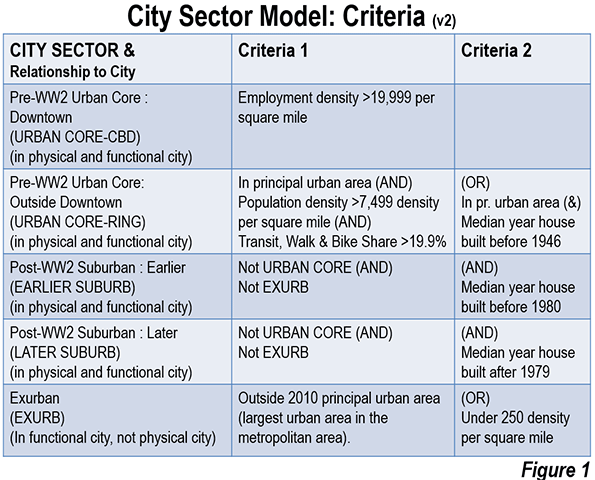
    The City Sector Model classifies small areas (zip codes) of major metropolitan areas by their urban function (lifestyle). The City Sector Model includes five sectors (Figure 1). The first two are labeled as “urban core,” (Urban Core: CBD and Urban Core: Ring) replicating the urban densities and travel patterns of pre-World War II US cities, although these likely fall short of densities and travel behavior changes sought by contemporary urban planning (such as Plan Bay Area). There are two suburban sectors, the Earlier Suburbs and Later Suburbs. The fifth sector is the Exurbs, which is outside the built-up urban area. The principle purpose of the City Sector Model is to categorize metropolitan neighborhoods based on their intensity of urbanization, regardless of whether they are located within or outside the boundaries of the historical core municipality (Note 1).

    One Way Commute Times by Urban Sector

    The commuting data excludes employees who work at home, whose commute times would be zero.

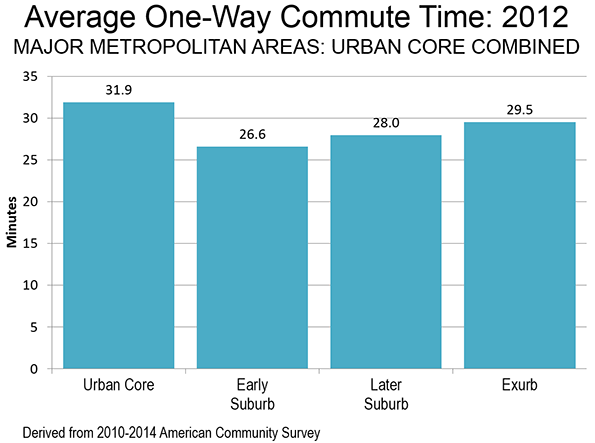
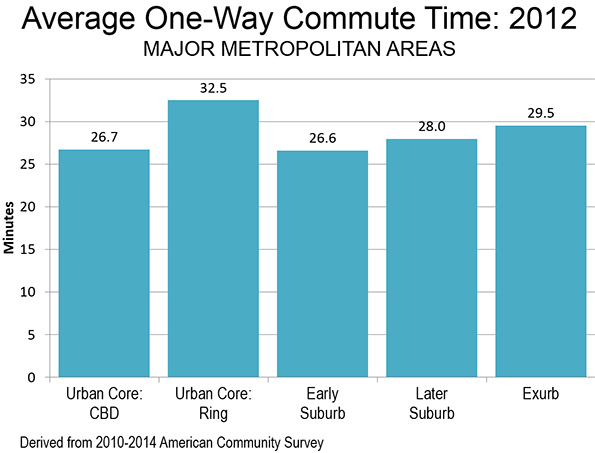
    The shortest one-way commute times are experienced by residents of the Earlier Suburbs, with a 26.6 minute travel time. This is nearly equalled for residents of the central business districts (Urban Core: CBD), with an average commute of 26.7 minutes. Commuters living in the Later Suburbs had a somewhat longer commute, at 28.0 minutes, while commuters living in the Exurbs had an average one-way commute of 29.5 minutes. The longest commute times were experienced by residents of the Urban Core: Ring (32.5 minutes), which is the part of the urban core that excludes the central business district, (Figure 2) and is characterized by high densities and lower levels of automobile use than in the suburbs and exurbs.

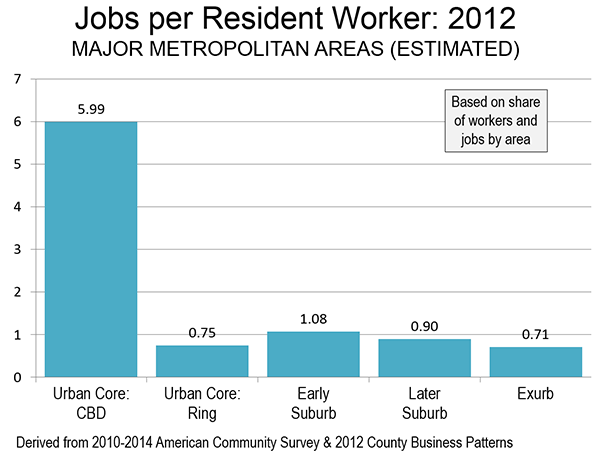
    The functional city sectors with the shortest commutes had more jobs than resident workers. The Earlier Suburbs possess 1.08 jobs for every resident worker (Note 2). The ratio was much higher in the Urban Core: CBD, where there were nearly 5.99 jobs for every resident worker. Such an imbalance could not be replicated throughout a metropolitan area, because by definition, a labor market has a ratio of jobs to resident workers of approximately 1.00. To replicate the national CBD ratio throughout the metropolitan area would require, for example, that the New York metropolitan area have  54 million jobs for its 9 million workers.   

    Not surprisingly, with such a surplus jobs relative to workers, the Urban Core: CBD, the chances of finding suitable employment nearby is far greater. However, this advantage can, by definition, be available only to a very few, as is indicated by the fact that the Urban Core: CBD’s are home to only 1.5 percent of the resident workers in the major metropolitan areas. In the broader context of the urban core (including both the CBD and the Ring), this advantage is offset and average travel times are greater (below).

    In the Later Suburbs, there were 0.90 jobs per resident worker, which matches that sector’s ranking in work trip travel time (third). The  ring around the urban core (Urban Core: Ring) , had the longest average work trip travel time. The Exurbs had the lowest ratio of jobs to resident workers, at 0.71, yet had an average travel time that was shorter than that of the Urban Core: Ring (Figure 3).

    Pre-World War II and Post-War Urban Form

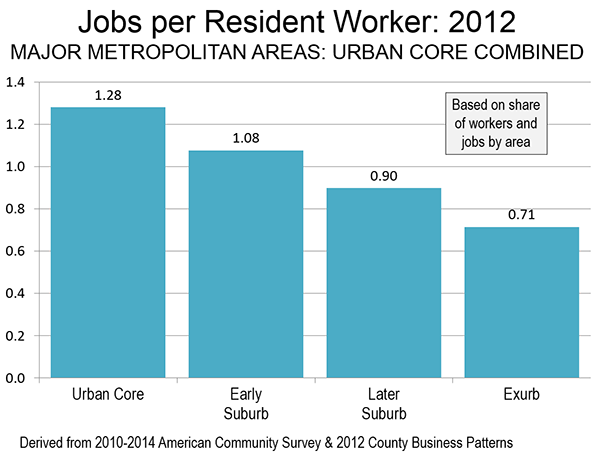
    The two combined urban core sectors are defined in the City Sector Model to replicate what remains of the pre-World War II city that was characterized by far higher densities and less reliance on automobile transportation, as opposed to the suburban and exurban sectors that have dominated urban growth for seven decades. If the two urban core sectors are combined (Urban Core: CBD and Urban Core: Ring), the number of jobs per resident worker is 1.28. This healthy ratio, however, is not sufficient to preserve any travel time advantage for residents of the combined urban core. In the combined urban core sectors, the average one-way travel time of 31.9 minutes, well above each of the other three functional sectors (Figures 4 and 5). The Urban Core: Ring has nearly nine times as many resident workers as the Urban Core: CBD.

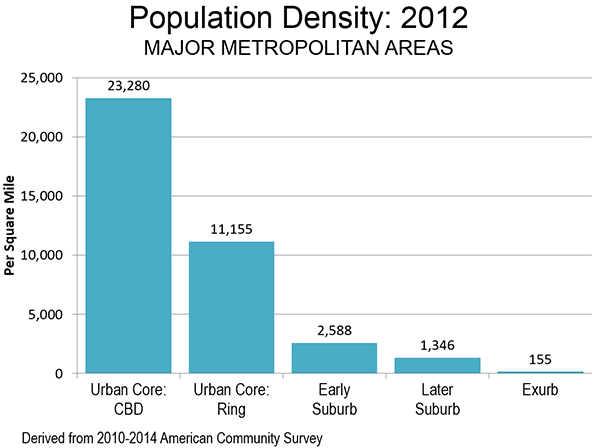
    The Pre-War urban form has considerably higher population densities than those of the post-war urban form. For example, the Urban Core: CBD has a population density exceeding 23,000 per square mile (9,000 per square kilometer), more than 80 percent of the New York City population density level. The Urban Core: Ring has a population density exceeding 11,000 per square mile. The combined area population density of the two Urban Core sectors is 11,500 per square mile, or 4,400 per square kilometer (Figure 6).

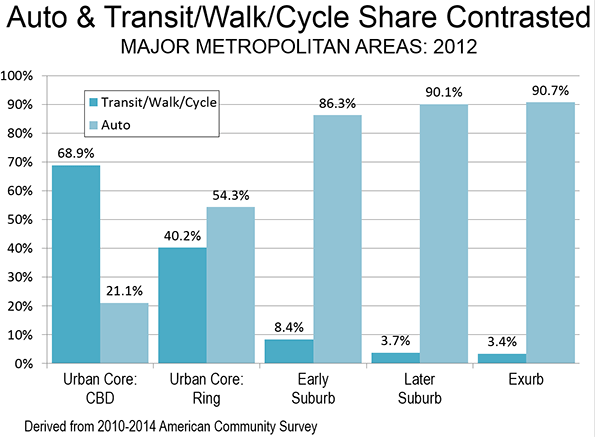
    The two Urban Core sectors largely rely on commuting modes currently favored by urban planning policy, transit, cycling and walking. In contrast, the suburban and exurban sectors rely on commuting modes discouraged by urban planning policy, automobiles and car and van pools (Figure 7).

    The combined urban core sectors have more than four times the density of the Earlier Suburbs and nearly nine times the density of the Later Suburbs. With these much higher densities and their reliance on the favored transport strategies, it might be expected that they would enjoy the best commute times. However, as noted above, when the two urban core sectors are combined, their average travel time is longer than the suburban and exurban sectors. This is despite the far lower densities of the two suburban sectors and the often world densities of the exurban sector.

    The Key: Lower Densities & Job Dispersion

    These results are likely to be surprising to many in the press as well as planners who often equate residential distance from central business districts as resulting in longer commutes. The reality, however, is that central business districts account for only 8 percent of employment in major US metropolitan areas, and reach the highest at 22 percent in New York, 50 percent above second place San Francisco (14.4 percent) and nearly 10 times that of Los Angeles (2.4 percent).

    Generally speaking, employment is dispersed throughout the metropolitan area. When combined with the generally lower density urbanization within metropolitan areas, the result is shorter commutes for residents  in the suburbs and exurbs. As it turns out the data shows that higher employment densities in the urban core are associated with longer, not shorter commutes, as is commonly assumed.

    Note 1: In some cases the functional urban core extends beyond the boundaries of the historical core municipality (such as in New York and Boston). In other cases, there is virtually no functional urban core (such as in San Jose or Phoenix). Functional urban cores accounted for 14.7 percent of the major metropolitan area population in 2012. By comparison, the jurisdictional urban cores (historical core municipalities) had 26.6 percent of the major metropolitan population, many of which have large tracts of functional suburban development.

    Note 2: Estimated by dividing the percentage of jobs in each sector by the percentage of resident workers. Working at home is excluded.

    Wendell Cox is principal of Demographia, an international pubilc policy and demographics firm. He is a Senior Fellow of the Center for Opportunity Urbanism (US), Senior Fellow for Housing Affordability and Municipal Policy for the Frontier Centre for Public Policy (Canada), and a member of the Board of Advisors of the Center for Demographics and Policy at Chapman University (California). He is co-author of the "Demographia International Housing Affordability Survey" and author of "Demographia World Urban Areas" and "War on the Dream: How Anti-Sprawl Policy Threatens the Quality of Life." He was appointed to three terms on the Los Angeles County Transportation Commission, where he served with the leading city and county leadership as the only non-elected member. He served as a visiting professor at the Conservatoire National des Arts et Metiers, a national university in Paris.

  • Population Change, 2015: Not Very Good News for Those Angry White Men

    Data on population growth from 2010 to 2015 show a continuing concentration of people in metropolitan areas, especially in the large areas with over a million people, where presumably traditional values are most challenged.  I show an amazing table, in which I have disaggregated population change by type of settlement, from the million-metro areas to the purely rural counties, comparing growth amounts and rates, plus noting how these areas actually voted in 2012. From the title, the news that growth is greatest in the biggest places seems bad for Republican prospects, but the accompanying maps also show that the greatest growth may well be in more Republican parts of metropolitan America – a story of geography vs. demographics.

    The data from the table are dramatic. Note that 275 million, or 86%, live in census-defined metropolitan areas (with urban agglomerations over 50,000), and 55.5% in just the 58 metro areas of over 1,000,000.  The biggest metro areas (but not the super large New York, Los Angeles, and Chicago) grew by 9.4 million, or 5.5%, the smaller metro areas by 3.4 million, or at 3.3 %, while non-metropolitan America dropped from 46.3 million to 46.1 million, down to 14% of the total population. 

    The final column of the table shows how these areas voted in the 2012 presidential election. Obama won the big metro areas of over one million by taking 57.6 percent of the 2 person vote, which enabled him to get almost 52% of the total US vote while winning the three megacities – New York, Los Angeles and Chicago – by an even wider margin. This meant that despite LOSING all other settlement categories – 48% in smaller metro areas, only 41% in micropolitan areas, and a pathetic 40 percent in rural small town America, the President still won handily.

    Population Change by Settlement Type, 2010 2015
      # Counties 2010 Pop 2015 Pop Change % Chg % of Pop 2015 % Obama, 2012
    Million Metro Center Counties          255   156,143    164,749      8,606 5.5% 51.3%
    Million Metro Outlying Counties          179     13,661      14,416         749 5.5% 4.5%
    Total Million Metros          434   169,804    179,165     9,355 5.5% 55.7% 57.6
    Other Metro Center Counties          473     85,634      89,005      3,371 3.9% 27.7%
    Other Metro Outlying Counties          259       7,025         7,086           61 0.9% 2.2%
    Total Other Metros          732     92,659      96,091     3,432 3.7% 29.9% 48.3
    Micro Center Counties          559     26,422      26,533         111 0.4% 8.3%
    Micro outly            92       1,080         1,070          (10) -0.9% 0.3%
    Total Micropolitan Areas          651     27,502      27,603         101 0.4% 8.6% 41.4
    Rural Sm Town          727     14,058      13,899       (159) -1.1% 4.3%
    Rural Sm Town          598       4,731         4,663          (68) -1.4% 1.5%
    Total Non-metro Counties      1,325     18,789      18,462       (327) -1.7% 5.7% 40
    ALL      3,142   308,774    321,435   12,664 4.1% 100.0% 52


    So the good news for the Democrats is that the greatest population growth occurred in larger cities where Obama did best in and fell in areas he did poorest in.

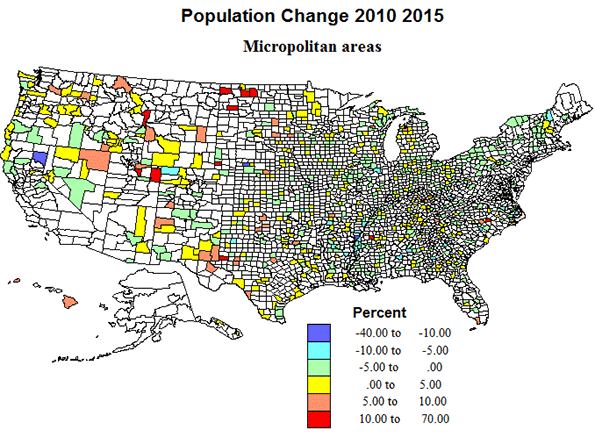
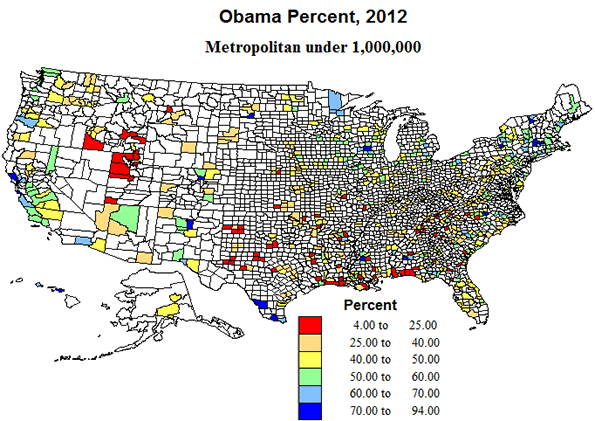
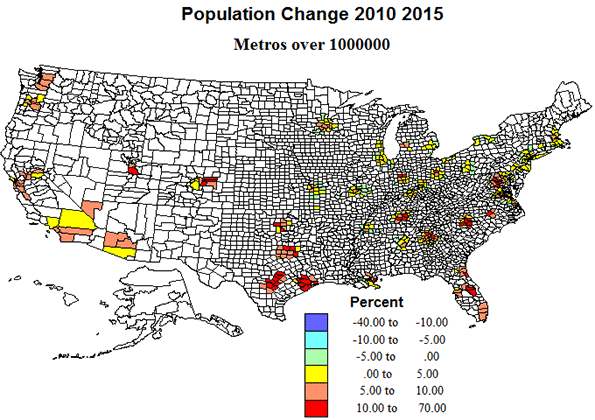
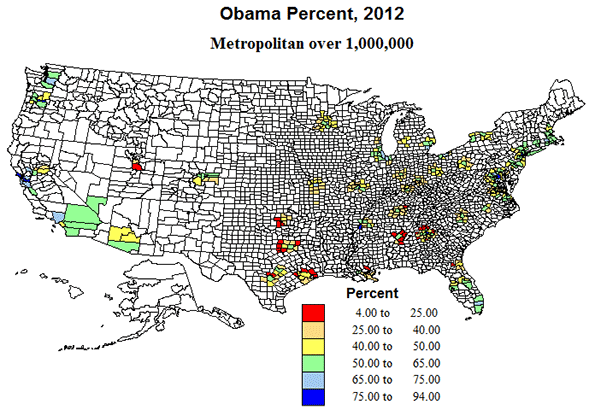
    But the story gets complicated once you get beyond the metro level. I now show maps, first of the pattern of population change by type of settlement, and then show how well Obama did in 2012 by these same settlement types. First we have a general map of population change for all US counties, in which I can display both the absolute change by symbol size and the percent change by color. Most apparent are the dominance of growth in metropolitan areas, especially in suburbs, and notably in the South and West. Note that quite a few of the growing counties appear to be in areas where Obama was not that strong (in maps to follow).

    Population Change by Settlement Type

    Rural and rural-small town areas include about 40% of counties and of the territory, but now hold under 6 percent of the population. Modest population loss is most common, especially across the eastern half of the country, while the pattern of change is more complex in the western half, with pockets of gain in areas of energy development, as in ND-MT, and TX-OK, undoubtedly temporary, and scattered areas of growth in environmental amenity areas farther west. The greatest extent of rurality is still from west Texas, north through Oklahoma, Kansas, Nebraska, South and North Dakota  and Montana.

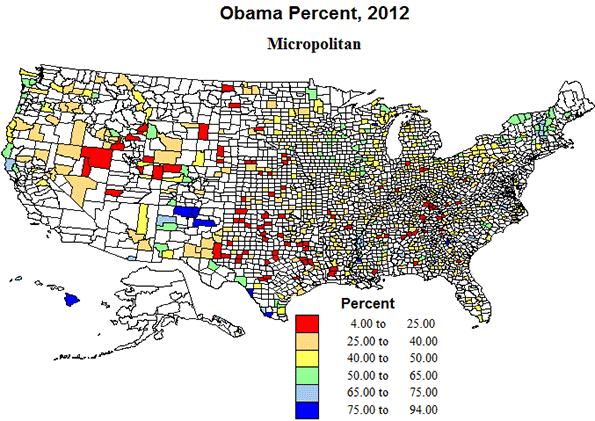
    Politically, Republican Romney swept most rural, small town territory over sizeable contiguous areas in the high plains, as well as the Mormon realm, but Democrats did win in majority Black counties in the south, Latino counties in Texas, and in Native American Indian counties in the far west. In sum, not a story to comfort Republican hopes.

    Micropolitan areas now include about 20 percent of counties and of territory, and house almost nine percent of the population. They experienced only modest population growth from, 2010 to 2015. They are quite widely dispersed across the country, with the exception of most of California.  Just as with rural small-town territory, a pattern of modest loss prevails over the eastern half of the country and a more mixed pattern in the west, echoing the higher growth in areas of energy development, and in parts of the Mountain states and far west, including some environmentally attractive areas.

    Politically, the micropolitan areas, with urban agglomerations between 10 and 50 thousand were almost as supportive of Republican Romney as the more rural areas, and in essentially the same geographic areas, in southern Appalachia, the high plains from Texas to North Dakota and in the Mormon realm, and with the same Democratic outliers in majority minority areas. Again, a pattern not too comforting for Republican prospects.

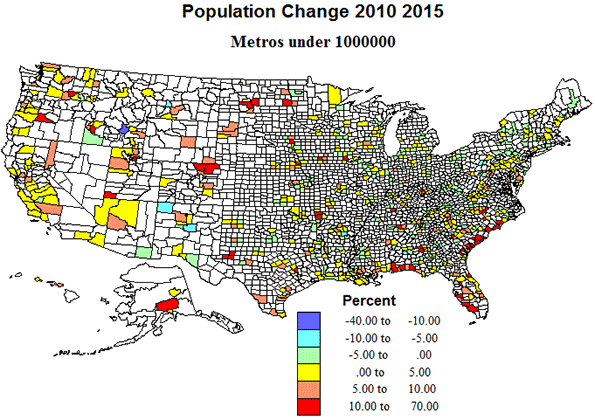
    Metropolitan areas under 1 million  represent what could be called middle, compromise America, with about one-fourth of US counties, and with 30% of the population. Their geographic pattern is one of broad distribution in the interior of the country, but with a marked coastal concentration in the Gulf and South Atlantic.  Similarly, growth was modest or losses occurred in most of the interior eastern US,  but big gains in southeastern coastal areas, and across most of the far west.

    Politically, too, these areas are intermediate, with Obama receiving 48% of the vote in 2012.  The outlying smaller metropolitan counties are indeed often quite rural.  Some of the growing areas were tilted  more  Republican, as on the Gulf coast and especially in the Mormon west, but in the Atlantic coastal states, and Pacific coast states, Obama did much better.  

    Metro areas over 1 million.  Okay, these are the behemoths, one-seventh of counties with over half the population, and three-quarters of the growth.  But the fastest growth was across the south and in the west, with moderate growth and even modest losses in the north. The biggest metros – NY, Chicago and LA — grew well below national averages. Also, contrary to the perception of the death of suburbia, the outlying counties of this set experienced very high growth. 

    Politically, these suburban areas around the big metros may prove decisive, with the voting eligibility and inclinations of a diverse population critical to outcomes of the presidency and of Congress. Those suburban counties in the South appear to vote Republican, while those in the north and west became modestly Democratic. Size may benefit Democrats, but growth tilts Republican. Ultimately whichever proves most decisive may determine the election.

    Richard Morrill is Professor Emeritus of Geography and Environmental Studies, University of Washington. His research interests include: political geography (voting behavior, redistricting, local governance), population/demography/settlement/migration, urban geography and planning, urban transportation (i.e., old fashioned generalist).

  • Challenging Nordic Myths

    Hillary Clinton, Bernie Sanders and numerous other American politicians want to increase taxes, regulate businesses and create a society where government takes responsibility for many aspects of daily life. If you are sick, the public sector should pay for your treatment and give you sick leave benefits. If you quit your job, taxpayers should support you. If you have a low income, the government should transfer money from your neighbor who has a better job.

    The ideal is a society in which the state makes sure that those who work and those who don’t have a similar living standard. These are classical socialist ideas, or as Bernie Sanders himself would explain, the core ideas of social democracy.

    Social democracy is becoming increasingly popular among Leftists in the United States. An important reason is that positive role models exist. In fact, a number of countries with social democratic policies — namely, the Nordic nations — have seemingly become everything that the Left would like America to be: prosperous yet equal, and with good social outcomes. Bernie Sanders has said, “I think we should look to countries like Denmark, like Sweden and Norway and learn from what they have accomplished for their working people.”

    At first glance, it is not difficult to understand the Left’s admiration for Nordic-style democratic socialism. These countries combine relatively high living standards with low poverty, long life spans and equal income distribution — everything the Left would like America to have. The Left, however, is simply failing to understand the reasons why Nordic societies are so successful. The reason is not large welfare states, but rather a unique culture.

    Debunking Utopia – Exposing the myth of Nordic socialism, my new book, details the situation. Many people seem to forget that Nordic countries have not always had large welfare states. During the latter half of the nineteenth century and the first half of the twentieth century, these places were shining examples of small government systems that combined open trade policies with free labor markets and a dynamic market system.

    Today, Denmark, for example, stands out as having the highest tax rate among developed nations. But in 1960 the tax rate in the country was merely 25 per cent, lower than 27 percent in the US at the time. In Sweden, the rate was 29 percent, only slightly higher than the US.

    During this time, the Nordic countries had already developed equal income distributions, long life spans, low child mortality rates, and high levels of prosperity. The reason is simple. In order to survive the harsh Nordic climate, the people in this part of the world adapted a rigorous work ethic. The Protestant norms of hard work and individual responsibility combined with a system that emphasized protection of private property, limited government and openness to global markets. Income equality grew and poverty was pushed back, thanks to the wealth creating force of markets.

    In 1960, well before large welfare states had been created in Nordic countries, Swedes lived 3.2 years longer than Americans, while Norwegians lived 3.8 years longer. After the Nordic countries introduced universal health care, the difference shrunk: today, it is 2.9 years in Sweden and 2.6 years in Norway.

    This fact might surprise those who believe that large welfare states lead to longer life spans. Once we study the issue in depth, however, it becomes clear that the explanation is cultural. Nordic people eat healthy diets, run in forests, and avoid the unhealthy lifestyles of many Americans.

    In late 2015, a PBS story entitled “What Can The US Learn From Denmark?” stated, “Danes were excited this week to see their calm and prosperous country thrust into the spotlight of the U.S. presidential race when Democratic hopefuls Bernie Sanders and Hillary Clinton sparred over whether there’s something Americans can learn from Denmark’s social model.” The story continued, “Danes get free or heavily subsidized health care” and “compensation when they’re unemployed, out sick from work or on parental leave,” adding that they have longer life spans than Americans.

    Now, all these statements are certainly true. The only problem is that the story gives the impression that these facts are directly related. Danes have universal healthcare and government compensation when sick. Correspondingly, they live longer than Americans. So, for the US to raise its life expectancy rates, perhaps a Danish model should be adapted? After all, what kind of heartless monster would oppose policies that increase life spans?

    Well, as it turns out, Danes lived 2.4 years longer than Americans in 1960 — when Denmark had lower taxes than the US. Today, the difference has shrunk to 1.5 years. Denmark no longer ranks among the top ten countries in the world in terms of lifespan.

    Iceland, the Nordic country with the smallest welfare state, has far surpassed Denmark and the other Nordic countries in terms of life span. The explanation for this success is clearly not a large welfare state. Nor is it that the Icelandic people inhabit a pleasant country. Iceland is cold and dark. It has large, barren, volcanic fields which look much like the fictional Mordor of Lord of the Rings. But the Icelandic people enjoy going out in nature. Also, they eat a healthy diet based to a large extent on fish. The lesson is quite simple: Nordic culture, rather than Nordic-style social democracy, explain the social successes in this part of the world.

    The American Left has an idealized, and fully unrealistic, vision of social democracy; a belief that if the US adapts a large welfare state it will magically succeed in this way. There is little if any merit to this viewpoint. Today, Nordic-Americans actually outstrip their cousins in the Nordics both in prosperity and social outcomes.

    If we look at another broad measure of social success, child mortality, again we find that yes, Nordic countries indeed do have among the lowest levels in the world. But this too was already the case when these countries had small public sectors. As Sweden, Denmark and Norway introduced large welfare states, if anything they fell somewhat in global ranking. Iceland, on the other hand, climbed the ranking.

    The conclusion is clear: Nordic social success pre-dates the modern welfare state, and was if anything more pronounced during the small-government era. Perhaps equally interesting is that while Nordic-style democratic socialism is all the rage among Leftist ideologues in the US, the same policies are to a large degree rejected by the people of the Nordic countries themselves.

    After seeing his country held up as an example by in the Democratic presidential debate, the Danish prime minister, Lars Løkke, Rasmussen, objected to the skewed image of socialism in his country. In a speech at Harvard’s Kennedy School of Government, he told students, “I know that some people in the US associate the Nordic model with some sort of socialism. Therefore I would like to make one thing clear. Denmark is far from a socialist planned economy. Denmark is a market economy.”

    The remark comes as no surprise. While some US liberals believe that democratic socialism is a flattering label, in the Nordics many are distancing themselves from socialist ideas, pointing out that they, too, embrace the market. In many regards, the Danish government interferes less in the economy than the American government does.

    While Denmark does have high taxes and generous welfare policies, today even the Danish Social Democratic Party acknowledges that these policies are slowly eroding responsibility norms, trapping people in welfare dependency and reducing the level of prosperity.

    Out of the five Nordic countries, four currently have center-right governments. The only exception is Sweden, in which the Social Democratic Party – which holds the seat of power – has never in its modern history polled as weakly as it does today. Most Swedes vote either for the center-right coalition which wants to reduce the scope of government, or for the right-wing anti-immigration party.

    Perhaps these facts are worth pointing out to Bernie Sanders, Hillary Clinton, the journalists at PBS and numerous other Americans who believe that Nordic-style social democracy will transform America to Shangri-La.

    Nima Sanandaji is president of the European Centre for Policy Reform and Entrepreneurship. His latest book is Debunking Utopia – Exposing the myth of Nordic socialism.

    Copenhagen Harbor Water Bus by Jacob Surland

  • Learning from Medellín with Alejandro Echeverri

    “I think, if you want to write a new narrative at some specific moment in the story of a city, it is important that you have to feel the transformation and see the transformation. So the physical transformation is important but always there is more a spiritual thing, as happens with emotional connections and inspirational things.” ______Architect Alejandro Echeverri.

    If you have an interest in Latin America or in urban matters, you will have read by now that the city of Medellín, Colombia has undergone a startling transformation in the past fifteen years. In the 1980s and 1990s, the name of Medellín evoked fearsome drug cartels, violence and terrorism.

    But in the 2000s, Medellín took a dramatic turn for the better. In 2012, it was selected from 200 contenders as Innovative City of the Year in a survey organized by the Wall Street Journal and the Urban Land Institute. Today, it features regularly among lists of forward-looking cities and must-see destinations.

    EcheverriPhoto

    One of the most important actors in this giant leap is the Medellín architect Alejandro Echeverri. With the inspired leadership of Mayor Sergio Fajardo and a team of architects, engineers, communicators and social workers, Echeverri in his post as Medellín’s Director of Urban Projects set out to bring real improvements through a strategy of “social urbanism” which included large and small projects in the most troubled parts of the city.

    Echeverri who is currently a 2016 Loeb Fellow at Harvard’s Graduate School of Design shared his thoughts with Sami Karam in this 50 minute podcast. A few highlights are transcribed below.

    On giving value to local conditions: “It is better to add than to erase.”

    From the start, Echeverri and his team avoided the top-down approach favored by past urban planners and worked to develop what he describes as a holistic collaboration between architects, community representatives, social workers, city administrators and the private sector.

    At another time in another city, planners might have decided to clear existing low-income settlements and to restart with a clean slate, for example by building high-rise apartments in a parklike setting. Many such projects in the US and Europe are seen today as expensive failures where traditional relations of community and family break down and where crime and vandalism are chronic problems.

    An important differentiator in Medellín was to leave existing homes and communities in place. Echeverri explains:

    “First came respect and [the idea] to give value to the local conditions, give value to the memories. There is a lot of value. Sometimes because you have some different preconceptions and you belong to a different world, it is difficult for you to see the value of these things. I am talking not only about the value of the physical environment. I am talking about the value of the social engagement, the economy, most of it informal, but they have a lot of solidarity, networks and so on… The process of Medellín, the singularity is some special sensibility about local conditions and houses and thinking that it is better to add than to erase.”

    “These projects don’t just have the goal of increasing the quality of life for people, but also to increase their pride and self-esteem.”

    On gondolas, transit stations and library parks

    Among the most visible physical improvements was the introduction of metro cable cars or gondolas that connect poor areas on the hillsides (the barrios) to the subway in the city below. The new transport system facilitated the commute to work, school etc. but as importantly, it created nodes of communal activity around the transit stations.

    800px-Metrocable_de_Medellín,_Colombia

    Metrocable and Biblioteca Espana. Photo via Wikimedia Commons by Ben Bowes.

    Echeverri says:

    “We wanted to do a holistic intervention around each station, combining physical transformation and programs of education, innovation, entrepreneurship and so on. So we used each station as a magnet to develop a public space. We focused as well on the itineraries of the common people, how the people use the barrios, from the houses to the schools to the stations and how to improve that condition and give them more public services and public spaces and new cultural facilities.  So, working with the community, and thinking that big infrastructures are important but the same importance is given to the small details, small interventions. And the intervention has to be with the people as well.”

    In addition to the gondolas, as many as nine library parks designed by Colombian architects were built in poorer areas and stand today as symbols of a fresh approach to education and culture. One of the them, the Parque Biblioteca España is shown in the photo above.

    How do you measure success?

    With a decline in violence, all of Colombia has enjoyed a resurgence in investment and tourism. In 2011-15, foreign direct investment was over three times what it had been a decade earlier (source: colombiareports.com). In 2015, the number of foreign visitors, 76% of whom were vacationers, was over 2.5x higher than in 2005 (source:colombiareports.com). Bogota was the number one destination with 45% of visitors, followed closely by Medellín with 39%.

    pui-fotos-04

    Photo from Proyecto Urbano Integral / Alejandro Echeverri + Valencia Arquitectos.

    Echeverri sees vindication and success in these figures and adds the following:

    “The externalities that happened after we recovered the confidence and spirit of society permitted many other interests to start to see Medellín as an opportunity. International companies started to appear. Medellín started to be again one of the main cities for events in Latin America. A lot of researchers and universities were interested again to have partnerships with different institutions of Medellín. So, it is like a virtual cycle but we still have a structural problem. The challenge is big.”

    “The main [way we measure success] is how the quotidianity [the daily life] happens today in our city. I am talking about the quotidianity, about the every day life in different parts of the city, mostly in some of the problematic areas, where the kids and the  people and the mothers could be out and move and have facilities of education and could spend half of the time in the public transport system going to work. When the kids go out of the houses or the schools, they don’t see the informal armies, the paramilitaries, that used to be in charge of the public space. So they have different opportunities. We still have problems and so on but the every day life changed a lot. Change the priority because the city today is thinking of education and innovation and not of violence and security.”

    Can some lessons be applied to other cities?

    With urbanization increasing all over the world, most cities face considerable challenges in infrastructure, housing and security. Echeverri believes that some ideas can be borrowed from Medellín’s experience.

    “Every city has some singularity and some local conditions. But always, you find everybody is in agreement on what are the problematic issues and problematic areas of the city, but the political decision to solve those problematic areas and issues doesn’t happen. So focus on problematic areas, be strategic and continuous. Work with ethics, it is important. I strongly believe in the connection with the local conditions, the connection of the public policy and urban transformation with where the people live and where the people have an identity, where the life of the city is happening. I am talking about barrios and neighborhoods.

    “To develop a holistic intervention in strategic areas is not easy but it is very powerful if you can combine simultaneously a package of actions: physical transformations, I am talking about public transport systems, public spaces, spaces for culture, education etc., a programmatic package in relation with innovation, local economies.”

    To be sure, Echeverri is not declaring victory. He says that there remains much work ahead to cement and prolong the city’s achievements of recent years. He stresses the necessity of having a suitable organizational structure and institutional partnerships between the municipality, the private sector and academia. Other topics covered in the podcast include funding issues and the need for political continuity.

    “You cannot change the story of a city in eight years or ten years.  I believe that the process of transformation of Medellín started and was very consistent because some processes happened in a good way but it needs continuity, more years to develop. You improve some specific conditions in some areas but you cannot transform and recover all the problems. For example, the housing problem which is still there.”

    There is much more in the podcast. Listen to the whole thing.

    TO HEAR THE PODCAST, CLICK HERE OR ON THE TIMELINE BELOW:

    Sami Karam is the founder and editor of populyst.net and the creator of the populyst index™. populyst is about innovation, demography and society. Before populyst, he was the founder and manager of the Seven Global funds and a fund manager at leading asset managers in Boston and New York. In addition to a finance MBA from the Wharton School, he holds a Master’s in Civil Engineering from Cornell and a Bachelor of Architecture from UT Austin.

    Top photo by User: (WT-shared) CONOCER at wts wikivoyage (Own work) [Public domain], via Wikimedia Commons

  • Chicago’s Advantages

    When I wrote that Chicago is the duck-billed platypus of American cities, I noted that there were a lot things about Chicago that were unique – both good and bad – putting it in a class of its own and making it hard to compare Chicago with other cities.

    Today I want to put together a starter list of some of the positive distinguishing factors about Chicago. This doesn’t include things like a downtown construction boom because lots of places have one of those. If Chicago’s boom is big, well, it’s a big city. I only want to put something on the list if it is truly distinguishing, or perhaps something limited to only one or two other places.

    I’ll create a starter list. Feel free to share yours in the comments.

    • Cheap – least expensive major urban center in America. A middle management level couple can afford a very nice condo in Chicago.
    • Only globally important financial exchange in America outside NYC (the CME Group)
    • Only full slate of globally renowned cultural institutions outside NYC
    • Only large scale, transit oriented central business district outside NYC – and with a skyline to match
    • Fantastic architecture
    • Not only does Chicago have great skyline, it’s got great vistas of the skyline even from within the city (something missing in NYC inside Manhattan)
    • It’s the alley capital of America
    • Improv capital of the world, and one of only three major training locations for comedy in the US (with NYC and LA)
    • Incredible lakefront park system
    • Most car friendly urban big city in America (traffic is bad, but much of housing stock comes with a parking spot, and there are plenty of stores you can drive to – great for families)

    There are probably some things like food and music scene were you can rate Chicago as in a league above most cities, but it’s tougher to make that case since you can get great food everywhere now, etc.

    Share your thoughts in the comments because I don’t want to leave anything out.

    Aaron M. Renn is a senior fellow at the Manhattan Institute, a contributing editor of City Journal, and an economic development columnist for Governing magazine. He focuses on ways to help America’s cities thrive in an ever more complex, competitive, globalized, and diverse twenty-first century. During Renn’s 15-year career in management and technology consulting, he was a partner at Accenture and held several technology strategy roles and directed multimillion-dollar global technology implementations. He has contributed to The Guardian, Forbes.com, and numerous other publications. Renn holds a B.S. from Indiana University, where he coauthored an early social-networking platform in 1991.

    Photo by Doug Siefken

  • Adding Space to Suburbia

    Space has value. Even the mere perception of space has value. As land becomes more scarce, space becomes more valuable, and has a direct impact on housing costs and a developer’s profit (or loss). Both developers and the New Urbanists who preach that dense cities are good places know this, even as they pressure town councils and planning commissions to authorize reduced lot sizes. Where they have succeeded, the resulting compressed lots sacrifice quality organic space — green space — to the point of oblivion.

    Less than a half century ago, Phoenix was a sleepy retirement town with vast openness and desert character. A few years ago, my wife Adrienne and I visited the city. Today’s Phoenix, like Las Vegas, Albuquerque, etc., is a blanket of rooftop and pavement with a few strip malls spattered about. We met with developers to demonstrate a new way to design that increases lot size (value), while reducing infrastructure (costs). Without exception, developers responded: “People move to Phoenix to have a smaller lot. They do not want space.” So we visited the new, compressed developments, and asked residents about their new homes. Without exception, all the residents we interviewed loved their new places, but wished they had more space, especially between themselves and their neighbors.

    Simply put, a larger lot with more space is likely to be more valuable to residents, but builders are interested more in selling ‘product’ — homes. The more, the better.

    A buyer will pay more for a large home than a small one; for a large lot than a small one. They will pay a premium for a home with a view of space over that what they would pay for a view into a neighbor’s adjacent yard.

    Space has value, and value translates to an increased tax base.

    The social engineer will argue that it’s OK to sacrifice space because there will be a small park a five or ten minute ‘walk’ away. Reality check: A very small percentage of residents will actually walk to that park, but the homes that can view that space will be priced at a premium, costing well above the homes in a sardine-like placement far from the park. In denser suburbs or new urban communities, the haves will enjoy space; the have-nots, not so much.

    If space does not have value, as the proponents of dense neighborhoods claim, then why is it so heavily featured in home builders’ sales and marketing materials? When a home builder uses a marketing photograph, it is taken at a wide angle to make the lot appear larger than it actually is. When a builder uses a rendering on their web site or sales materials, it’s never shown with adjacent homes compressing the visual space.

    How can we feed the hunger for space? The conventional design methods that have been used since the dawn of civilization can’t work. To achieve increased space while preserving a higher density standard, the housing industry needs to take an approach that incorporates innovation and attractive value.

    That begins with the recognition that space is something that you feel, even though it is limited by non-transparent objects that form a physical barrier in our three dimensional world. When we are inside a structure, it’s the walls around us in reference to the flat floor; when we are outside, it’s the distance we perceive between homes. We might estimate a distance as longer or shorter, depending on whether the terrain was hilly or flat.

    Does five acres within a neighborhood park constitute open space? It sounds like it will, but if it’s along steep slopes or thickly wooded land with natural underbrush it won’t feel open. If it’s a park that residents must stroll to from their homes, the space has less value than if it can be viewed through their windows.

    As for conventional interior space, the perimeter of a home is often determined by the lot size, depending on local zoning. In the case of a Phoenix lot that is 50 feet wide by 100 feet deep, with a 5 foot side yard setback and a 20 foot front and rear yard setback, the home would be allowed to be 40 feet wide and 60 feet deep. Assuming a 20 foot by 20 foot garage and 6 inch exterior wall, that leaves 1,880 square feet of living space within the home.

    But— that only would result if the home were expanded to the largest possible perimeter. Included in that perimeter would be 145 feet of side yard, the entry door, and two car spaces in the garage, leaving only 55 feet for possible window locations that would overlook the front and rear yards. Within that footprint, the architect must lay out the bedrooms, closets, bathrooms, kitchen, living and family rooms, and any other living space.

    A great architect will make the resident ‘feel’ the most of the available space. A bad designer will make the home feel smaller than it actually is. Neither the good nor the bad architect (especially when the project is created by production builders) will consider the views from within the home, because, simply put, with New Urban and suburban cookie cutter subdividing, there are none. In most southern cities the rear view overlooks a wall or fence 20 feet away, and the next house structure is at a 40 foot distance. The front view (if any windows exist at all from front-placed living space) will be the garage door across the street, 90 feet away, along with driveways, the street, and parked cars. This is why modern home living spaces are rear, not front, oriented. Not much to look at. That is, unless you pay more – much more – to be in a neighborhood with larger lots.

    Conventional exterior space is also dictated by city regulations. Local zoning ordinances determine the allowed width and depth, to limit density with the promise of more space and a larger home footprint. In conventionally subdivided developments, side yard space is not a quality area, since the sides of homes typically are void of windows, and even if there were views, those windows would look directly into the neighboring wall just 10 to 20 feet in the distance.

    The image below shows two streets:


    The left one has a 90 foot wide lot; the right one has a 60’ foot wide lot. Both use the same 25 foot front yard setback. From a ‘human’ perspective, looking down the street, both have the same 100 foot wide swath of open space, yet the smaller lot achieves 33 percent more homes with the exact same infrastructure (street) expense. Because the street covers the same land area in both cases, the actual density gain on the smaller lot would be about 25 percent, while providing the very same ‘feel’ of space as the larger lot. Assuming that the intention of suburban zoning is to set both space and value, the typical ordinance does a terrible job on providing extra actual perceived space.

    Considering that space has real value, educators at colleges, and at design conferences, and all teachers of architecture and of urban and/or suburban design, should be concentrating more on how interior and exterior spaces can merge in more meaningful ways than on the trim of a front porch. Craftsman trim on a porch railing may add a wee bit of value, but living spaces coordinated with views of open space add a huge increase in value. A park may add overall neighborhood value, but living on a street that has park-like space adds tremendous value.

    Cookie-cutter Computer Aided Drafting (CAD) plans generated specifically to build to the regulatory minimums will never satisfy the hunger for space. These two videos demonstrate my solutions. Along with other innovative approaches that merge planning and architecture, they show the paths we need to follow if we are to achieve sustainable housing, and sustainable zoning.

    Rick Harrison is President of Rick Harrison Site Design Studio and Neighborhood Innovations, LLC. He is author of Prefurbia: Reinventing The Suburbs From Disdainable To Sustainable and creator of LandMentor. His websites are rhsdplanning.com and LandMentor.com.

    Flickr photo by Joan of cat in a suburban yard