Blog

  • Australia: Mad As Hell And Not Gonna Take It?

    The result of Australia’s recent Federal election remains unclear, as the count has continued — as of this writing — for days. What is clear is that the major parties suffered a rebuff. One in four Australians voted for an alternative to the traditional mainstream parties, a historic record. Even if incumbent Prime Minister Malcolm Turnbull can win enough seats to control the lower house (nearly tossing out a first term Prime Minister is another first for this election), the Senate is well beyond reach of a majority. As psephologists — those who study elections — digest the details, it is looking increasingly as if the losses can be related to a suburban and regional community disgruntled with the attitudes and indulgences of inner urban elites.

    The values of these elites, including the Prime Minister, seem increasingly at odds with the wider community in everything from economic opportunity to housing, transit, access to education, cost of living concerns, immigration policy, the environment, and more. That divergence made itself felt with a tectonic shift in the latest ballot result.

    First, a crash course in Australian politics. Australia operates a Westminster style democracy. Every person aged 18 and over is required to vote (yes, it’s compulsory). They vote for geographic representatives in the lower house (the House of Representatives), and also for State representatives in the upper house, the Senate — a house of review. Each lower house seat represents approximately 150,000 people. Some electoral districts, given our sparse population density in rural and remote areas, can be larger than Texas in area. Most, however are metropolitan, given that 80 percent of Australians live in just five major cities. Each State elects 12 Senators, plus two for each Territory — being the Australian Capital Territory and the Northern Territory. There are 150 Members of the House of Representative and there are 78 Senators.

    Voting is by a preferential system. Imagine a lower house seat with five candidates representing various political parties. Voters are required to number their ballots in order of preference, and to number each box. The candidate with the least votes is eliminated, but the second preference flows to the candidate numbered next on a given ballot. This process continues until only two candidates remain, the one with the most votes being declared the winner. The same happens in the Senate for each State. Because the Senate typically attracts a wide field of candidates and parties (we even had a Pirate Party this time), the Senate Ballot paper can be over three feet wide. Fortunately, voters only need to number their top six choices of party ‘above the line’ for the Senate. Suckers for punishment can number every single box.

    The main political parties in Australia are the Labor Party (akin to the Democrats); the Liberal Party (akin to Republicans); the National Party (mainly rural conservatives); and The Greens (left wing environmentalists). The party that wins a majority of seats in the House of Representatives forms the government. There is usually a range of smaller fringe parties that record little support, but in this election, One Nation (resembling the Tea Party movement), The Nick Xenophon Party (a populist party), various Christian groups and others combined to achieve 5 seats in the lower house and around 11 in the Senate. Forming a majority in the lower house is now looking difficult, and there is no chance of a majority in the upper house.

    It is unlike the American system in that there is no Presidential vote, although our politics have become Presidential in campaign style. Our Prime Minister (from the conservative Liberal Party, although many in the party dispute his conservatism), is elected by the party’s Members of Parliament only. In other words, the only people who actually get to vote for our current (for the time being) Prime Minister are the voters of Wentworth, his electorate. The rest of the country votes locally for their own candidates. PMs rely on the support of their party room. This is how we manage to have Prime Ministers who can be tossed out not by popular vote, but by party room vote. It makes life interesting, especially in recent years, when we seem to be averaging a new PM each year without the need for an election. The PM forms a Cabinet of their own choosing, drawn from elected party members. This cabinet includes members of both upper and lower houses, but the PM is drawn from the lower house.

    So what happened? In a word: rebellion. Prime Minister Malcolm Turnbull, a graduate of Oxford University and a former barrister, is independently wealthy, living in a multimillion dollar Sydney harbour-side home. Having millionaire leaders might be familiar to Americans, but for Australians it’s unusual. His wife is Lucy Turnbull, a former Lord Mayor of Sydney (which represents only the downtown and immediately adjacent areas), and a prominent urbanist, who also chairs the Greater Sydney Commission. Together, they proudly champion the agenda of the inner urban elites: light rail projects, mass transit projects, increasing urban density, ‘knowledge workers’ as the future of industry, and so on. In the election campaign, Labor Opposition Leader Bill Shorten was happy to be pictured in his campaign bus, actively touring disadvantaged outer-urban and regional areas, while Turnbull was happy to be pictured riding in a Sydney train.

    One of Turnbull’s first acts as Prime Minister, after unseating his conservative predecessor Tony Abbott in a party room coup, was to form a ‘Cities Ministry’ which later released a Smart Cities Plan, much to the adulation of the elites who claimed that without a dedicated Minister for Cities, Australia’s future prosperity was in jeopardy. “Great cities attract, retain and develop increasingly mobile talent and organisations, encouraging them to innovate, create jobs and support growth,” the PM said. The statement was received with wide applause from fawning urban industry groups, media, academics, planners, and left leaning think tanks.

    This wasn’t a focus of the election campaign, but it does perhaps provide an insight into how the politics of a mainstream party and incumbent government, still in its first term, diverged from mainstream Australia. Australia may be among the world’s most highly urbanised nations, but our urbanism is largely suburban by nature. The concerns of suburban and regional electorates focus on cost of living pressures, low wage growth, unaffordable housing, evaporating job opportunities and the casualization of work towards contract positions. For these voters, the importance of inner city light rail projects designed to improve commuting opportunities for a minority of high income, inner-urban dwellers just doesn’t rate on the scale of essential public policy investment. Analysis of the voting patterns of the latest election show that some of the greatest swings against the government came from those middle and outer urban electorates, along with disadvantaged regional communities.

    Neither can the Labor opposition take much comfort from the result. The swing resulted in only a small pickup for them— insufficient to win government — and failed to win enough support from their traditional base, which abandoned the mainstream left for alternative minor parties. Both Liberals and Labor had fallen for the politically correct, left leaning, inner urban policy kool-aid that has increasingly come to represent orthodox establishment views.

    In the same way that the UK ‘Brexit’ Leave vote was supported by communities that did not share in the benefits enjoyed by inner-London elites, many Australians also cast a vote of rebellion, turning their backs on the advice and views of the many inner-urban experts who have talked down to them for years.

    For many, the recent Australian election resembled an opportunity to re-enact the speech of Howard Beale (played by an Australian, Peter Finch) in the film Network: “Things have got to change. But first, you’ve gotta get mad!… You’ve got to say, ‘I’m as mad as hell, and I’m not going to take this anymore!’”

    Ross Elliott has more than twenty years experience in property and public policy. His past roles have included stints in urban economics, national and state roles with the Property Council, and in destination marketing. He has written extensively on a range of public policy issues centering around urban issues, and continues to maintain his recreational interest in public policy through ongoing contributions such as this or via his monthly blog, The Pulse.

    Flickr photo by Pedro Szekely: cloudy skies over the Sydney Opera House.
  • Compactness and Canadians

    The May, 2016 New Geography feature, Are Compact Cities More Affordable? questioned whether the Vancouver region supplies evidence that Housing-Plus-Transportation (H+T) creates affordable living climates. Todd Litman responded with a critique; here’s a partial response to Todd Litman’s comments, which are rich in assertions and advice but poor on science. Our full response can be viewed in the attached pdf. The central issue of whether there is evidence that the Vancouver Region as a whole offers the advantage of H+T affordability to its residents is bypassed. Hence, there is no research news.

    Litman’s criticism centers on issues that undermine his thesis or on speculative data that would prove a point, if available, for example, bias in our data. Almost certainly, the data is “managed,” incomplete, erroneous and biased — but at the source: the Metro Vancouver report that advocates H+T affordability. A missed observation? The absence of figures on compactness makes it impossible to draw the sought-after correlation between affordability and density, the indispensable evidence for H+T. Yet the critique ventures to do exactly that.

    Attempts to “prove” an association rest entirely on incidental observations of certain sub-regional districts based on personal “knowledge” of them without including density numbers, and by dismissing some as outliers or “special cases,” an unproductive attempt at science.

    A track to demonstrate how alternative data could show that homeowners are not as well off as they seem leads to the unusual idea of limiting the sample to an improbable and undefinable set. Curiously, the source data is arbitrarily curtailed in a similar manner. Another missed observation?

    Litman has previously cited as evidence the subject correlation for US metro-regions produced by scholars, a clear, scientific result. The sub-regional level correlation remains an open research task; incidental observations cannot fill that gap. New research windows open in our full response, which can be viewed in the attached pdf

  • The Meaning of the Baby Bust

    With a stronger economy and a growing number of women of child-bearing age, Americans should be producing offspring at a healthy clip. But the most recent data suggest that this is not happening, as the birthrate in 2015 dropped to a historic low. A new study from the University of New Hampshire suggests that these trends have resulted in 3.4 million fewer births since 2008, based on the pre-recession fertility rate, or roughly 15 percent fewer births than would have occurred at the 2007 birth rate.

    Once an exception to demographic decline, our country may be falling into the dismal pattern that is now common in other high-income countries, notably in East Asia and Europe. Europe’s demographic crisis is one reason European Union officials, particularly in Germany, opened the floodgates to mass migration from the Middle East and other unstable areas. In many parts of Europe, more people are dying than are being born.

    Now America may be joining the downward fertility spiral. Since the recession, the number of new children has plummeted, and it’s dropped the most precipitously for new mothers. The number of households with their own children in 2014 was 33 million, down from 35 million in 2005, even as the total number of households has shot up by nearly 6 million. By comparison, there are about 43 million households with dogs, according to the ASPCA’s low-end estimate.

    Shifts in child bearing will profoundly affect our geography, politics and economic future. Children, after all, define our future society, and provide the primary motivation for parents and grandparents. Without a strong familial structure, we will be facing a rather grim future, as an expanding older population grows ever more dependent on a shrinking base of young working-age people. Demographer Sami Karam notes that the 1980s Reagan boom benefited from demographics of that period, with a rising proportion of working people to retirees. With trends headed the opposite way, he suggests, no such expansion may even be possible today.

    To some, of course, an increasingly childless future represents something of an ideal. Many greens regard offspring as unwanted additional emitters of carbon, and historically have proposed limiting families. It also provides manna to those high-density developers who no longer will have to worry about renters seeking to establish themselves in homes best suited for raising children.

    Read the entire piece at The Orange County Register.

    Joel Kotkin is executive editor of NewGeography.com. He is the Roger Hobbs Distinguished Fellow in Urban Studies at Chapman University and executive director of the Houston-based Center for Opportunity Urbanism. His newest book, The Human City: Urbanism for the rest of us, will be published in April by Agate. He is also author of The New Class ConflictThe City: A Global History, and The Next Hundred Million: America in 2050. He lives in Orange County, CA.

  • Urban Future: The Revolt Against Central Planning

    In Milton Keynes, perhaps the most radical of Britain’s post-Second World War “New Towns,” the battle over Brexit and the culture war that it represents is raging hard. There, the consequences of EU immigration policy, of planning instituted by national authority, and of the grassroots yearning to preserve local character have clashed together to shape a platform that may set a precedent for whether central planners or local residents will determine the urban future.

    Milton Keynes is unusual for planned cities. Founded in 1967 and having matured in the last few decades, it defies virtually every tenet of contemporary planning orthodoxy. In its day it was a product of Britain’s national planners; despite that, today Milton Keynes drives the country’s national planners crazy. Instead of a mixed-use, dense, transit-oriented bastion of urbanism – the predictable and commonly reiterated goals of many British town planning leaders today – Milton Keynes is exactly the opposite, intentionally.

    A modernist experiment, Milton Keynes was planned to be low-density. It was also planned to be auto-oriented, and suburban. Its houses are large, its buildings do not front streets, and its transportation modes are separated by grade: that is, they are at different heights, with different means of transport often moving at different speeds. This is the antithesis of the now-favored idea of “complete” streets. The town’s downtown shopping enclave is an inward-facing mall – the largest in Britain – with downtown as a whole designed as a business and commercial center rather than a mixed-use playground. Mixed-use development is clustered in the city’s low-density neighborhoods and villages, all on a grid, rather than scattered with the UK’s more favored randomness.

    Milton Keynes was designed to be livable and functional, family-friendly, job-friendly and conducive to convenient mobility. The daily grind, by design, was to bear a closer resemblance to a rural experience than to an urban one. Original advertisements promoted a healthy, carefree lifestyle sheathed in nature, away from the nuisances of the big city. Even the logic of its location, equidistant from Britain’s other large cities, sought convenience over traditional planning rationales.

    To those with a one-track view of what a city should be, Milton Keynes is unrecognizable. To these people, the city is bland, sterile, and without the day-to-day vibrancy that defines cities. In many planning texts it has been written off as a failure, and to many residents of Britain, Milton Keynes is not a preferred destination.

    But in many of the most important metrics that define urban success, Milton Keynes shines. It has virtually no traffic, it attracts lots of families, and it has the highest job growth in the country. Its population has swelled over 20 percent since 2001, over twice the national average, to 255,000 , and its residents ardently defend it. It has built out nearly identically to the original vision, with its millions of trees and lush, anti-urban character earning it the affectionate moniker “Urban Eden”.

    Today, however, Milton Keynes faces ever-mounting threats to the integrity of its original character. Thanks to the consequences of EU immigration policy, which spurred population growth in the UK to a level that exceeded housing construction to the tune of 70,000 units a year, or roughly 50 percent, cities like Milton Keynes are under fire to take up their “fair share” of the difference. Although Milton Keynes was originally developed independently through a long-range loan to the Milton Keynes Development Corporation, the nation’s housing issue led Britain’s deputy prime minister to effectively lift the city’s self-rule in 2004 in a sweeping authoritarian central takeover.

    That move transferred planning authority from local government to a national regeneration authority. The authority promptly set a housing quota for the city based on national targets, and began the task of systematically increasing density, narrowing roads, reducing unit sizes, instilling a transit-oriented ethos, discontinuing the grid, and concocting plans to build new development that directly fronted the street, all at odds with the city’s original masterplan.

    The new ideas reflect tenets frequently promoted by the Royal Town Planning Institute, Britain’s central planning body. The moves reflect what has become a familiar narrative of planner as a high-minded savior and opposition as selfish NIMBY (“not in my backyard”) residents, who lack regard for the broader picture. That Milton Keynes’ defenders are arguing on behalf of a thoughtful vision – one shaped decades ago and misaligned with contemporary planners’ aspirations – is a complicating wrinkle. In contrast to the narrative that the suburbs were an unfortunate accident that have destroyed communities, Milton Keynes’ defenders are trying to save a city that was planned to be suburban and that is successful today, and are defending it by citing affection for its character and sense of community.

    Because of Milton Keynes’ unusual design, traditional NIMBY dynamics have been inverted. In a rare twist on the oft-repeated Jane Jacobs narrative of residents against the planners, Milton Keynes’ defenders are fighting for the planned suburban character of their town: a primary complaint is that the central planners promoting density and mixed-use development lack creativity or an understanding of the bigger picture vision that shapes their sense of place, even though the tactics the planners are employing are often advocated using the same argument in reverse. Far from being ad-hoc selfish obstructionists, the Milton Keynes defenders are well-organized and thoughtful: a group called “Urban Eden” offers a well-composed six-point vision as the baseline for alternatives to the central plans.

    Milton Keynes belies the narrative of a lack of intentionality as a disqualifier for suburbia. More importantly, its future will tell us much about whether creativity and self-determination can continue to exist in Britain at the local scale, and whether the forces that induced Brexit can topple an internal bureaucracy, in addition to an external one.

    While local freedoms may ultimately help cities like Milton Keynes preserve their unique character, additional bureaucracy in the UK must be lifted to solve the larger national issue of housing affordability. In particular, Britain should free the private land development market, which has been effectively nationalized since 1947. Britain’s self-imposed shortage of developable land is the primary reason British housing production is well under half what it was when Milton Keyes was originally conceived. In an ironic twist, if it maintains such strict centralized planning strategies, Britain may continue to choke the character of its cities over the issue of housing production, wielding a national-scale bully pulpit to try to solve a crisis that could perhaps best be solved by eliminating the nationalization of property development altogether.

    Brexit offers a lesson to planners world-wide, with Milton Keynes a creative case study of an alternative to the hegemony of contemporary urban planning. While many planners loathe Milton Keynes, many residents like it, and its demonstrable successes suggest it should be a worthy case study. So many planning bodies are dominated by a singular ideology. Instead, a new era of open-mindedness to local creativity should be embraced… lest Britain and the world rise up to circumvent the planners behind a movement with a nickname as catchy as Brexit.

    Roger Weber is a city planner specializing in global urban and industrial strategy, urban design, zoning, and real estate. He holds a Master’s degree from the Harvard Graduate School of Design. Research interests include fiscal policy, demographics, architecture, housing, and land use.

    Flickr photo by Sarah Joy: Double Rainbow, Milton Keynes

  • Fastest Metropolitan Area Growth Continues in Prairie Provinces

    The latest Statistics Canada population estimates indicate that much of the nation’s growth continues to be in the census metropolitan areas (CMAs) of the Greater Golden Horseshoe, centered on Toronto, and in the Prairie Provinces of Alberta, Saskatchewan and Manitoba.

    In addition to Toronto, the Greater Golden Horseshoe includes Hamilton, Kitchener-Waterloo, Oshawa, Brantford, Barrie, Peterborough St. Catherine’s-Niagara and Guelph census metropolitan areas. The Prairie Provinces metropolitan areas are Calgary, Edmonton, Winnipeg, Saskatoon and Regina.

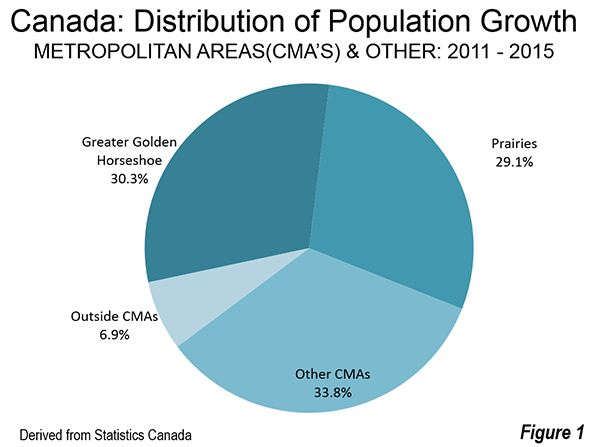
    Between the 2011 census and 2015, the Greater Golden Horseshoe accounted for 30.3 percent of the national population increase (Figure 1). The five Prairie Province metropolitan areas had 29.1 percent of the growth.

    Growth in the Greater Golden Horseshoe was above its national share of the population of 25 percent. The Prairie Province CMA growth was more than 2.5 times its population share, which was less than 11 percent in 2011.

    The CMAs outside the Greater Golden Horseshoe and the Prairie Provinces accounted for approximately 34 percent of the growth, somewhat more than their 30 percent share of the population. Areas outside the CMA’s accounted for only seven percent of the growth, a fraction of their 34 percent population share. This is a continuing indication that the metropolitan areas continue to draw more of the population growth.

    Changing Distribution of Growth

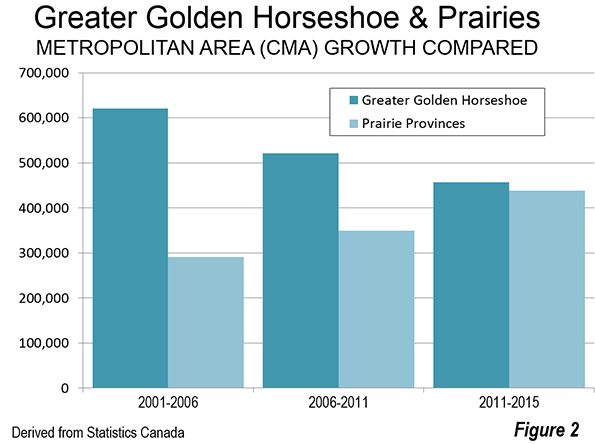
    The last decade and a half has seen substantial changes in the distribution of CMA growth. Between 2001 and 2006, the Golden Horseshoe metropolitan areas welcomed 40 percent of Canada’s population growth, well above the 30 percent over 2011 to 2015. At the same time, the Greater Golden Horseshoe reduction in the share of growth has been compensated by the gain in the Prairie Province metropolitan areas. Between 2001 and 2006, the share of national growth was 19 percent, which rose to 29 percent over 2011 to 2015.

    The population growth rate has slowed considerably in the Greater Golden Horseshoe metropolitan areas, from 1.7 percent annually between 2001 and 2006 to 1.1 percent between 2011 and 2015. Growth has risen considerably in the Prairie Province metropolitan areas, from 1.2 percent annually between 2001 and 2006 to 2.8 percent between 2011 and 2015. Numerically, the Prairie Province metropolitan area growth is now challenging that of the Greater Golden Horseshoe, despite the latter’s more than twice as many residents (Figure 2).

    Winnipeg’s would pass Québec in population by the 2021 census, if the growth rates of the last four years continue and would become the 7th largest metropolitan area.

    Fastest Growing Metropolitan Areas

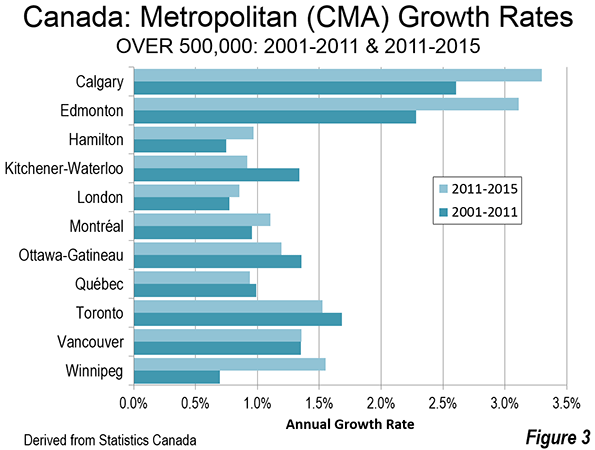
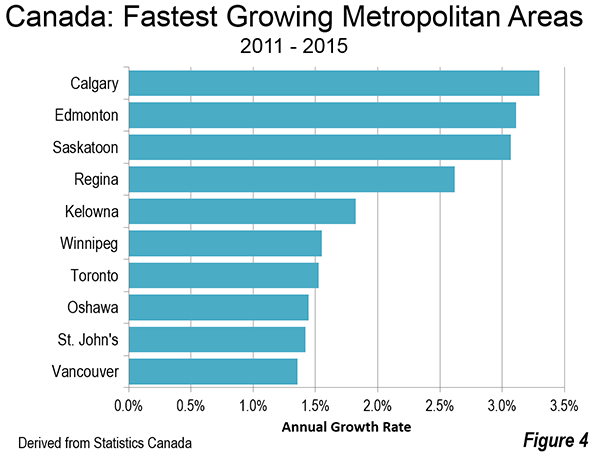
    Five of the six fastest growing metropolitan areas between 2011 and 2015 were in the Prairie Provinces. Calgary, Edmonton and Saskatoon topped the list, growing more than three percent annually (Figure 3). This is an extraordinary rate, better than three times the national growth rate. Regina grew 2.5 percent annually. Over this period, Calgary and Edmonton have both grown larger than Ottawa-Gatineau, which had been the fourth largest CMA for at least 40 years. One can expect growth in the two Alberta cities to slow with the decline in energy prices,  while the other prairie metropolitan areas, less oil dependent, though resource dependent, should do better.  

    Winnipeg, which was the nation’s fourth largest metropolitan area until 1961 and nearly as large as Vancouver as late as 1931, has begun once again  to grow more quickly, after decades of lackluster growth. Having slipped to 8th largest by 2001, Winnipeg ranked sixth in growth since 2011, trailing only the four other Prairie Province metropolitan areas and fast growing Kelowna, BC (1.8 percent annual growth). Unusually, Winnipeg’s growth rate exceeded that of Toronto between 2011 and 2015. Winnipeg’s annual growth rate was 1.6 percent, more than double its 2001-2011 growth (0.7 percent). Should Winnipeg’s growth continue at the most recent rate through the 2021 census, it could exceed the population of the Québec CMA and would trail only the six metropolitan areas with more than 1,000,000 population.

    The changing growth rates of the largest CMAs is indicated in Figure 4, which indicates the rising growth rates in the Prairie province metropolitan areas, with more mixed performance among the other larger CMAs.

    Largest Metropolitan Areas

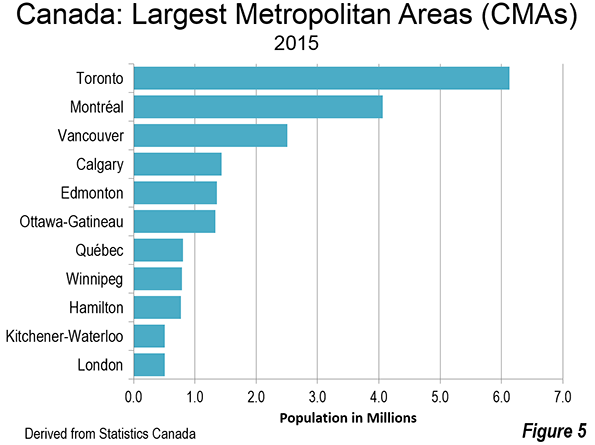
    Canada has eleven metropolitan areas with more than 500,000 residents. Toronto remains by far the largest, at more than 6 million and seems unlikely to be challenged in the foreseeable future. Montréal is closing in on 4.1 million, while Vancouver has just passed 2.5 million (Figure 5).

    The Future

    Canada’s fastest growing metropolitan areas also face the greatest growth challenges. The energy downturn has been particularly rough on Calgary and Edmonton, exacerbated by the disastrous Fort McMurray fire. There was a noticeable downturn in growth between 2014 and 2015 in both CMAs, yet only Kelowna grew faster in the last year. Other Prairie province metropolitan areas, less impacted by the energy decline, have seen their population growth rates fall. The growth rate was one third less than the 2011 to 2015 rate in Saskatoon and about 30 percent less in Regina between 2014 and 2015. Winnipeg fared best, maintaining 90 percent of its 2011-2015 growth rate.

    Other metropolitan areas face challenges every bit as complex. The economic dynamo of Toronto should continue to grow, though has faced strong domestic out-migration between 2004 and  2014, as the population disperses to outer metropolitan areas in the Greater Golden Horseshoe and outside Ontario altogether (See: "Moving from Canada’s Biggest Cities"). Montréal also experienced strong domestic migration losses, with half moving to other parts of Québec and half to other provinces. Vancouver, despite its incomparable attractiveness is also losing net domestic migrants. In all three metropolitan areas, the rising cost of living seems likely to be a major factor in the losses, with "tanking" housing affordability the apparent cause. Vancouver now ranks as the third least affordable major metropolitan area among 87 in the nine nations covered by the Demographia International Housing Affordability Survey, while Toronto’s house prices have risen at more than four times average household incomes since 2001 (see the Frontier Centre policy report: "Canada’s Middle-Income Housing Affordability Crisis"). House prices escalated almost as much in Montréal.

    With the outcomes of these conflicting influences unclear, Canada’s metropolitan area growth could go in different directions. This could range from growth patterns that are similar in the coming years, to the continued discovery by households of smaller metropolitan areas, a higher quality of life is possible because of the lower cost of living. This, has already been evident in the smaller metropolitan areas of Ontario and Québec, as households have been exiting Toronto and Montréal. Meanwhile, Canada is in the midst of its every five year census for 2016, the results of which should be available in seven months (February 2017).

    Photo: North Saskatchewan River from Edmonton central business district (by author).

    Wendell Cox is principal of Demographia, an international pubilc policy and demographics firm. He is a Senior Fellow of the Center for Opportunity Urbanism (US), Senior Fellow for Housing Affordability and Municipal Policy for the Frontier Centre for Public Policy (Canada), and a member of the Board of Advisors of the Center for Demographics and Policy at Chapman University (California). He is co-author of the "Demographia International Housing Affordability Survey" and author of "Demographia World Urban Areas" and "War on the Dream: How Anti-Sprawl Policy Threatens the Quality of Life." He was appointed to three terms on the Los Angeles County Transportation Commission, where he served with the leading city and county leadership as the only non-elected member. He served as a visiting professor at the Conservatoire National des Arts et Metiers, a national university in Paris.

  • Which Countries Would Fit Inside of Texas?

    Everyone knows that Texas is big. In the self-storage world, Texas would be a 10×30 storage unit, the biggest of the bunch. But many people (namely, Yankees and Europeans) may not realize just how massive the Lone Star State really is. How that at 261,231 square miles of land, Texas would be the 39th-largest country by land area in the world, coming in just behind Zambia and ahead of Myanmar. Since there are, give-or-take, roughly 200 countries in the world, that means that most of them are in fact smaller than Texas. In order to truly convey Texas’s size, we came up with a zany hypothetical scenario: if Texas were a storage unit, what countries could fit inside?

    Of course, using maps to illustrate size is a tricky matter, since most 2D map projections distort size in favor of shape. This includes the Mercator Projection used by Google Maps. Fortunately, we found thetruesize.com, a tool which runs on top of Google Maps and accounts for these distortions, allowing for accurate size comparisons. Now you can see exactly how these countries would fit inside of your Texas storage unit.

  • Why the World Is Rebelling Against ‘Experts’

    An unconventional, sometimes incoherent, resistance arises to the elites who keep explaining why changes that hurt the middle class are actually for its own good.

    The Great Rebellion is on and where it leads nobody knows.

    Its expressions range from Brexit to the Trump phenomena and includes neo-nationalist and unconventional insurgent movement around the world. It shares no single leader, party or ideology. Its very incoherence, combined with the blindness of its elite opposition, has made it hard for the established parties across what’s left of the democratic world to contain it.

    What holds the rebels together is a single idea: the rejection of the neo-liberal crony capitalist order that has arisen since the fall of the Soviet Union. For two decades, this new ruling class could boast of great successes: rising living standards, limited warfare, rapid technological change and an optimism about the future spread of liberal democracy. Now, that’s all fading or failing.

    Living standards are stagnating, vicious wars raging, poverty-stricken migrants pouring across borders and class chasms growing. Amidst this, the crony capitalists and their bureaucratic allies have only grown more arrogant and demanding. But the failures of those who occupy what Lenin called “the commanding heights” are obvious to most of the citizens on whose behalf they claim to speak and act.

    The Great Rebellion draws on five disparate and sometimes contradictory causes that find common ground in frustration with the steady bureaucratic erosion of democratic self-governance: class resentment, racial concerns, geographic disparities, nationalism, cultural identity. Each of these strains appeals to different constituencies, but together they are creating a political Molotov cocktail.

    Class Conflict

    The Brexit vote reflected the class aspect of the Rebellion. The London Times post-election analysis , notes socialist author James Heartfield, found the upper classes 57 percent for remain, the upper middle class fairly divided, while everyone below them went roughly two-thirds for leave. It doesn’t get much plainer than that.

    This dissent reflect the consequences of the globalization celebrated by elites in both parties. Britain’s industrial workforce, once the wonder of the world, is half as large as it was as just two decades ago. The social status of the British worker, even among the Labour grandees who pay them lip service, has been greatly diminished, notes scholar Dick Hobbs, himself a product of blue collar east London. “There are parts of London,” he writes, “where the pubs are the only economy.”

    As labor has struggled, writes Heartfield, “the Labour Party became more distant, metropolitan and elitist. It sought to re-write the party’s policy to mirror its own concerns, and also to diminish working people’s aspirations for social democratic reform in their favour. “

    A similar scenario has emerged here in America, where corporations—especially those making consumer goods—have grown fat on access to Chinese, Mexican and other foreign labor. Like their British counterparts, the U.S. working class is falling into social chaos, with declining marriage and church attendance rates, growing drug addiction, poor school performance and even declining life expectancy. Even during the primary campaign, as both Sanders and Trump railed against globalization United Technologies saw fit to announce the movement of a large plant form Indianapolis, where about 1,500 jobs were lost, to Monterrey.

    And much as the leave wave crested in just those parts of the U.K. where trade with Europe is highest, so is Trump support highest in the Southern states that now dominate what remains of American manufacturing.

    Race and Ethnicity

    Ethnic minorities and immigrants have now become core constituents of progressive parties in many countries—the Socialists in France, the British Labour Party and the Democratic Party here in America. In Britain, it never occurred to party’s leaders that most new jobs created during the Blair and Brown regimes went to newcomers. One can admire the pluck of Polish plumbers, Latvian barmaids, Greek waiters and French technicians and still note that many of these jobs could have gone to native born British. This includes the children of the mostly non-white commonwealth immigrants who are now part of the country’s national culture.

     The parallels in America—a much larger, richer and more diverse country—are striking. Silicon Valley and corporate America loves to bring in glorified indentured servants from abroad, earning the assent of Hillary Clinton and the corporate shill wing of the GOP. Only Trump and Sanders have attacked this program, which has cost even trained American workers their jobs.

     As tends to occur when race and ethnicity intrude, ugliness here seeps into the Great Rebellion. Trump has consciously and irresponsibly stoked ethnic resentments tied to immigration. Anti-EU continental Europeans— notably in eastern Europe but also France’s Marine Le Pen— often outdo our TV billionaire’s provocations.

    Geographic Disparities

    The Brexit vote also revealed a chasm between the metropolitan core and the rest of the country. The urban centers of London, Manchester and Liverpool all voted Remain. Central London has benefited from being where the world’s super rich park their money. The devastation of the industrial economy in the periphery has hardly touched the posh precincts of the premier global city.

     In contrast the more distant, often working class, suburbs of London and other cities voted to Leave. Small towns followed suit. The Brexit vote, suggests analyst Aaron Renn, demonstrated that arrogant urbanites, seeing themselves as the exclusive centers of civilization, ignore those who live outside the “glamour zone” at their own peril.

    Similar voting patterns can be seen in the US. The countryside, except for retirement havens of the rich, has gone way to the right. The suburbs are tilting that way, and could become more rebellious as aggressive “disparate impact” policies force communities to reshape themselves to meet HUD’s social engineering standards —for example if they are too middle class or too white—even if there is no proof of actual discrimination.

    Needless to say, such policies could enhance the geographic base of the Great Rebellion, including among middle=class minorities who are now responsible for much of our current suburban growth. Already the small towns and outer suburbs have signed up with Trump; if he can make clear the threat to suburbia from the planners, he could, despite his boorish ugliness, win these areas and the election.

    Nationalism and Cultural Identity

    Nationalism gets a bad rap in Europe, for historically sound reasons. Yet these national cultures also have produced much of the world’s great literature and music, and the world’s most beautiful cities. Yet in contemporary Europe, these national cultures are diminishing. Instead the crony capitalist regime gives us Rem Koolhaas’ repetitiousgeneric city, often as stultifying as the most mindless suburban mall.

    Not just buildings, but historic values are also being undermined, as universities and even grade schools seek to replace cherished values with post-modernist, politically correct formulations. English students at Yale protest having to read Chaucer, Shakespeare or Milton, the foundation writers of the world’s common language whose greatest sin, it appears, was to be both English and male.

    Of course, cultural and political nationalism often shows an ugly side. But everyone who shouts for the British national soccer team or chants USA at the Olympics is not a fascist; they are just people who love their country. Yet academia, the shaper of the young and impressionable, now sometimes regard any positive assessment of America as the land of opportunity or even the American flag as “micro-aggressions.” Brits and Americans have much to be ashamed about in their history, but their glorious achievements remain inspirational to many, who find attempts to replace them with some tortured global syncretism foolish and counterproductive.

    Governance and Localism

    When Brits told pollsters why they had voted to leave the EU, notes James Heartfield, immigration and national identity ranked high but democracy and self-governance was at the top of the list. In contrast, classes who supported remain—the mainstream media, academia, the legal and financial establishments—increasingly see themselves as rightful rulers, the benighted masses be damned.

    This anti-EU rebellion is hardly limited to Britain. Since 2005 FrenchDanish and Dutchvoters have voted against closer EU ties. Hostility to the EU, as recorded by Pew, is actually stronger in many key European countries, including France, than it is in Britain. And after the Brexit vote, there are already moves for similar exit referenda in several European countries.

    But like Washington bureaucrats who can’t be bothered to pay much attention to the views of the underlings of the Heartland, the Eurocrats want to double down. But like Washington bureaucrats who can’t be bothered to pay much attention to the views of the underlings of the Heartland, the Eurocrats want to double down. The Germans, the effective rulers of Europe, have reacted to Brexit with talk about ways to “deepen” the EU, creating the basis for what some have argued would be essentially “a superstate”. This policy approach seems about as brilliant as that of Lord North, whose response to American agitation was to further tighten London’s screws. That certainly worked well.

    — bringing to mind Lord North, who responded to colonial agitation by further tightening London’s screws.

    This arrogance, in part, stems froms what one writer at the Atlantic has called the war on the stupid. In this formulation, those with elite degrees, including the hegemons on Wall Street and Silicon Valley, dismiss local control as rule by the Yahoos. The progressive ideal of government by experts—sometimes seen as “the technocracy”—may sounds good in Palo Alto or London, but often promise a dim future for the middle class. Expert regulation, often with green goals in mind, take hard-earned gains like car and home ownership and cheap air travel all but out of reach for the middle class, while keeping them around for the globe-trotting elites.

    Where does this go

    The Great Rebellion is, if nothing else, politically incoherent.

    Some conservatives hail it as a harbinger of the decline of progressivism. Traditional leftists hope for the return of state socialism, directed from national capitals. Racists see a vindication for their world view. Libertarians hail de-regulation while others, on the nationalist right, embrace the authoritarian nationalism of Vladimir Putin.

    Yet for all its divergent views, the Great Rebellion has accomplished this: the first serious blow to the relentless ascendency of neo-liberal crony capitalism. The revels have put the issue of the super-state and the cause of returning power closer to the people back on the agenda. The Great Rebellion allows localities relief from overweening regulations, cities to be as urban as they want, and the periphery choose how they wish to develop.

    The Rebellion also allows us to move beyond enforced standards of racial “balance” and reparations , replacing the chaos of unenforced borders and enforced “diversity” with something more gradual and organic in nature. Our hope on race and ethnicity lies not in rule-making from above , but in allowing the multiculturalism of the streets to occur, as is rapidly does, in suburban schoolyards, soccer pitches and Main Streets across the Western world.

    National cultures do not need to be annihilated but allowed to evolve. In Texas, California, and across the southwestern, Spanish phraseology, Mexican food and music are already very mainstream. Without lectures from the White House or preening professors, African-American strains will continue to define our national culture, particularly in the south. In Europe, few object to couscous on bistro menus, falafel on the streets and, in Britain, the obligatory curry at the pub.

    The Great Rebellion is much more than the triumph of nativism, stupidity and crudeness widely denounced in the mainstream media. Ethnic integration and even globalization will continue, but shaped by the wishes of democratic peoples, not corporate hegemons or bureaucratic know-it-alls. We can now once again aspire to a better world—better because it will be one that people, not autocrats, have decided to make.

    This piece originally appeared in The Daily Beast.

  • Homesteading Detroit

    I was in Detroit recently for the Congress for New Urbanism, the Strong Towns gathering, and a Small Developers Workshop. I used Airbnb instead of the corporate hotel option while in town.


    c5c26459-7aac-4bb9-8551-4f32bbe3ee04

    IMG_3272 (1024x683)

    3d8901d3-8940-41c7-b3ee-3f1ab363ef85

    dc613c34-9a0e-4703-a6b2-f617c096ad49

    e295af4c-4a56-4511-8a36-f51d779bff0a

    66b0716b-00d9-4a6c-bff8-248ad7e70d50

    dff01bb7-2176-4b01-8a4c-60199b81f376

    IMG_3340 (1024x683)

    This is what $13,000 buys you in Detroit. Well… $13,000 and four years of blood, sweat, and tears. Detroit allows people with the right attitude to substitute personal effort for money. This solid brick century old duplex is within bicycle distance of downtown and it came with the adjacent vacant lots. This young couple paid cash from savings and is homesteading in the city. They live upstairs and rent out the downstairs to visitors like me.

    IMG_3251 (1024x683)

    IMG_3261 (1024x683)

    IMG_3132 (1024x683)

    IMG_3188 (1024x683)

    When people have a spacious comfortable place to live with no rent or mortgage they have time to pursue their real interests. Gardening, woodworking, metalworking, fashion, painting…

    IMG_3087 (1024x683) (2)

    87333c7d-b83c-488e-942c-0de9c1ac2d9d

    58e21315-c170-4107-b1ac-9a446e914272

    IMG_3229 (1024x683)

    IMG_3203 (1024x683)

    Instead of taking jobs that would chain them to someone else’s schedule and values the couple continuously cultivates small ventures from their home. The internet allows them to reach out to a global customer base with their Frontier Industry.

    IMG_4695 (1024x683)

    IMG_4702 (1024x683)

    IMG_4795 (1024x683)

    IMG_4782 (1024x683)

    IMG_4709 (1024x683)

    I’ve said this before. I’ll say it again. If you’re tired of spending $1,000 a month for your share of a rented two bedroom apartment with five room mates in Brooklyn or San Francisco… do what Americans have always done. Hitch up your Conestoga wagon and head out to the territories. It’s a big country. Be a pioneer.

    John Sanphillippo lives in San Francisco and blogs about urbanism, adaptation, and resilience at granolashotgun.com. He’s a member of the Congress for New Urbanism, films videos for faircompanies.com, and is a regular contributor to Strongtowns.org. He earns his living by buying, renovating, and renting undervalued properties in places that have good long term prospects. He is a graduate of Rutgers University.

  • European GDP: What Went Wrong

    First the two world wars, then a decline in the birth rate.

    Newspapers these days are full of stories on World War I which started 100 years ago. They are also full of stories on today’s anemic European economy, as for example with Italy’s negative growth rate in the second quarter and France’s struggle to reach 1% GDP growth this year. At first blush, these two sets of stories are unrelated. But on closer look, it is apparent that the economy today is a distant echo of the war a century ago. And it all comes down to Europe’s demographics.

    In my view, there are essentially three main catalysts of economic growth: innovation, demographics, and a favorable institutional framework. To illustrate this, imagine that a firm develops the best smartphone in the world but that there is only a potential market of 1 million buyers. Clearly, the wealth created by this innovation would be far smaller than if the potential market was 100 million buyers. Thus the importance of demographics.

    Now imagine that there is a market of 1 billion people but that there is no innovation of any kind. In this case, wealth creation would be greatly stunted and, with few new assets being created, wealth would become essentially a game of trading existing resources. Thus the importance of innovation. Finally, imagine a country where institutions are weak, where contract law is weak, where access to capital is difficult, where the government is corrupt and political risk is high. Here again there would not be much innovation because there would not be much capital or much incentive to innovate. Thus the importance of a favorable institutional framework.

    Too many deaths

    So going back to Europe, we could say that it has some innovation and that it has a favorable institutional framework, though in both cases to a lesser extent than the United States. What Europe lacks most is a strong demographic driver. It is enlightening in this regard to look at the sizes of European populations in the year 1900 vs. today:

     Population (millions)  1900 2014 Growth CAGR  TFR 
    France 38 66 74% 0.5%  1.98
    Germany 56 81 45% 0.3%  1.42
    Italy 32 61 91% 0.6%  1.48
    Russia 85 146 72% 0.5%  1.53
    Spain 20.7 46.6 125% 0.7%  1.50
    United Kingdom 38 64 68% 0.5%  1.88
    Brazil 17 203 1094% 2.2%  1.80
    China 415 1370 230% 1.1%  1.66
    Egypt 8 87 988% 2.1%  2.79
    India* 271 1653 510% 1.6%  2.50
    Indonesia 45.5 252 454% 1.5%  2.35
    Japan 42 127 202% 1.0%  1.41
    Mexico 12 120 900% 2.0%  2.20
    Nigeria 16 179 1019% 2.1%  6.00
    Philippines 8 100 1150% 2.2%  3.07
    United States 76 318 318% 1.3%  1.97

    * includes India, Pakistan, Bangladesh and Burma.

    Source: Various, United Nations. Data may include errors. Estimates vary due to shifting borders and uneven reporting.

    Two important points stand out:

    First, in 1900, European countries were not only the world’s economic and military powers. They were also among the most populous countries in the world. By contrast today, Russia is the only country in the top 10 most populous. Then Germany is 16th and France is 20th. More importantly, some of the new demographic powers, India, Nigeria, Egypt, Mexico, the Philippines and Indonesia, are growing at a healthy clip, as can be seen from their Total Fertility Ratios (TFR, see table) whereas European countries are growing very slowly at TFRs that will ensure stagnation or shrinkage in the sizes of their population. A ranking ten or twenty years from now may show no European countries in the top 20 most populous countries.

    Second, comparing European population sizes in 2014 vs. 1900 reveals a very slow annual increase in the 114 year period. And this is where the effects of the two World Wars, of the Spanish Influenza and of communism can be seen. Populations have grown with a CAGR of less than 1% per year for the last 114 years.

    The United States had fewer casualties in the two World Wars, more immigration and a strong post-war baby boom, resulting in a healthy 1.3% population CAGR and a near quadrupling of the population over the past 114 years. However, as I wrote previously, the US faces slower, sub 1% population growth in the next few decades.

    Here is the tally of deaths for some countries in the two World Wars:

     Millions of deaths  WW1 % of pop WW2 % of pop
     France    1.7 4.3%   0.6 1.4%
     Germany    2.8 4.3%   8.0 10.0%
     Italy    1.2 3.3%   0.5 1.0%
     Soviet Union    3.1 1.8% 22.0 14.0%
     UnitedKingdom    1.0 2.0%   0.5 0.9%
     United States    0.1 0.1%   0.4 0.3%

    Source: Various. Estimates vary widely and may include errors.

    Estimates of deaths from the Spanish Influenza of 1918-19 vary widely from 20 to 50 million people worldwide. And Stalin’s purges are estimated to have killed over 20 million. Tens of millions of people and a larger number of descendants would have been added to today’s European population had these events not occurred. I made the case last year that Europe’s economies and markets suffer from weak domestic demand and have for a long time been driven by events outside of Europe itself.

    Too few births

    In general, a large number of countries are facing a more challenging demographic period in the next fifty years compared to the last fifty. Since the 1970s, there had been a steady decline in the dependency ratios (the sum of people under 14 and over 65 divided by the number of people aged 15 to 64) of the US, Western Europe, China and others. This decline is explained by a lower birth rate and was accelerated by large numbers of women joining the work force in several countries. There were fewer dependents and more bread winners than in previous decades.

    In future years, dependency ratios are expected to rise due to the aging of the population in most countries and a decline in the number of workers per dependent. In the United States for example, baby boomers are swelling the number of dependents who rely on younger generations to support them in retirement (whether through taxes or through buoyant economy and stock market). But because boomers had fewer children than their parents, the burden on these children will be that much greater than it was on the boomers themselves.

    In effect, our demographics have pulled forward prosperity from future years. Had there been more children in the West in the 1970-2000 period, there would have been less overall prosperity during that time, but we would now look forward to stronger domestic demand and a stronger economy going forward.

    Note in the table below that the dependency ratio of Japan bottomed around 1990 which is the year when its stock market reached its all-time high; and that the dependency ratios in Europe and the US bottomed a few years ago around the time when stock markets reached their 2007 highs. The fact that several stock indices are now at higher peaks than in 2007 can be largely credited to America’s faster pace of innovation and to near-zero interest rates. Case in point: Apple’s market value has more than tripled since 2007.

    DependencyRatios

    India will soon be the most populous country in the world but because its dependency ratio is still declining, its growth profile may improve in future years. The same is true of Subsaharan Africa where the fertility rate is still high but declining steadily thanks to improved health care for women and declining infant mortality. As such both India and Subsaharan Africa could see faster economic growth than elsewhere, provided the institutional framework can be improved towards less corruption and more efficiency.

    Europe is in a bind in the sense that, even if it had the wherewithal to do so, it cannot now raise its birth rate without making its demographic situation worse in the near term (by raising its dependency ratio faster). For the foreseeable future, its economy will become even more dependent on exports towards the United States and emerging markets. The new frontier for European exports may well be in the old colonies of the Indian subcontinent and of Subsaharan Africa.

    Sami Karam is the founder and editor of populyst.net and the creator of the populyst index™. populyst is about innovation, demography and society. Before populyst, he was the founder and manager of the Seven Global funds and a fund manager at leading asset managers in Boston and New York. In addition to a finance MBA from the Wharton School, he holds a Master’s in Civil Engineering from Cornell and a Bachelor of Architecture from UT Austin.

    Lead photo 4 August 1914 (via Wikipedia)

  • Trump’s Racial Firebombs Weaken U.S.

    The issue of race has scarred the entirety of U.S. history. Although sometimes overshadowed by the arguably more deep-seated issue of class, the racial divide is a festering wound that decent Americans, including politicians, genuinely want to heal.

    Decency and politics have a tenuous relationship, but this year, one candidate has exacerbated racial tensions in a way not seen since the days of segregationist George Wallace and Richard Nixon’s polarizing vice president, Spiro Agnew. Donald Trump, through his outbursts and incendiary rhetoric, opened the door to a new period of even greater racial antagonism.

    Trump promises to “make America great again,” but his divisive approach leaves us both weaker and even more afflicted with racial identity politics. Just as neo-Nazis and old-style racists have rallied to his cause, Trump’s intemperance also has energized ethnic nationalists, particularly in Hispanic communities. Among America’s growing Muslim population, perhaps no one has served as a better recruiter for Islamists, who agree with him that their religion and culture is anathema to America. The triumph of Brexit — in part driven by immigration — may encourage this further.

    Not all the blame for America’s racial discord falls to Trump, of course. Well before his rise to political prominence, Americans had grown pessimistic about race relations, which constitutes something of a failure by an administration that once promised greater racial unity. The president and Hillary Clinton, who have used racial politics to motivate minorities against the perceived racism of middle and working class whites, share responsibility for the deterioration. And liberal media, academics and elected officials can’t be particularly proud of their records of promoting tolerance and multiculturalism.

    White America Betrayed?

    In recent years, large swaths of working whites, like their British counterparts,have seen their jobs disappear and old social orders upended, fueling anger and a general sense of loss, reflected in rapidly rising morbidity and suicide rates. AsPittsburgh psychologist Kenneth Thompson puts it: “Their social habitat is strained, and the strain is showing up in a looming body count.”

    Trump has exploited their anger by turning it on immigrants, characterizing Mexicans as rapists and calling for border walls, immigration bans and tougher trade deals. However cruel and misguided, Trump’s racial divisiveness resonates with these blue-collar whites, as well as among some more affluent middle-class whites.

    In reality, Trump is not a classic racist, but rather an ugly opportunist willing to use ethnic divides for his own benefit. He’s been compared to Adolph Hitler, a monster whose philosophy revolved around race, but Trump has no real theory that extends beyond self-glorification, resentment, and attracting the fetching female; “The Art of the Deal” is not “Mein Kampf.”

    Trump will play the race card as a way to satisfy his narcissistic need for enthusiastic admirers. This does not mean his approach does not echo the racism of the past. His claim of bias by a U.S.-born judge of Mexican descent, as well as his suggestions that Muslim jurists are incapable of ruling independently, recall the worst of the pre-Civil Rights South. His proposals to ban Muslim immigrants in general recall approaches in the late 19th and early 20th centuries which targeted Chinese, Japanese and, ultimately eastern and southern Europeans.

    Other Negative Forces

    Progressives – including the media claque and academic elites — have shown little sympathy for the white working class and have been dismissive of its embrace of Trump’s candidacy, as characterized by Salon’s recent description: “White America’s sad last stand.”

    Instead of trying to understand the deep frustrations of the white middle class, it’s not unusual for progressives to express solidarity with racial minorities and condemn white privilege.

    Clinton takes it a step further, stoking minority fear-mongers to generate badly need enthusiasm. Accused of using “dog whistles” to attract racists against candidate Obama in 2008, Clinton now courts racial nationalists, including some in the Black Lives Matter movement, race-baiter supremo Al Sharpton, and La Raza.

    Interestingly, the fury against white “racism” is most fully throated and often mostviolent in white, deep-blue bastions such as Portland, Seattle, San Francisco andBoston. It’s in these cities, ironically, where minorities increasingly are victims of gentrification, forced out of their neighborhoods to make way for affluent whites.

    At the same time, liberal cities’ planning, energy and environmental policies do not improve life for the working- and middle-class populations, including many minorities. Yet while more highly paid blue-collar jobs disappear, working-class communities frequently are the ones absorbing large numbers of undocumented immigrants. The affluent, “enlightened” liberals in places like Chicago’s Gold Coast, west Los Angeles and the upper east side of Manhattan may get their servants from these populations, but rarely are they neighbors or competitors in the job market.

    These are fruits of America’s failed immigration system, an issue that even Latinos in this country are eager to resolve. Had Trump not crossed so many lines of decency, he might have seized the day and turned immigration policy into a huge plus, earning the support of the solid majority of Americans who agree that the border needs to be tightened.

    But by painting Latinos as drug dealers and criminals and suggesting that Muslims, per se, represent a security danger, Trump has made himself the issue and squandered the opportunity.

    Trump’s willingness to “tell it like it is” may have won over some segments of the population, but it’s fanciful to believe, as some right-wingers do, that it can carry him to the White House. His assaults on issues such as illegal immigration and the need to closely monitor potential terrorists may resonate, but his stridency, and lack of respect for basic decencies, have alienated much of the population.

    Multiculturalism of the Streets

    The good news is that while race seems to have paralyzed politics, society is becoming more integrated. Once lily-white suburbs are increasingly multi-racial, even as some core cities become less diverse. What the Mexican journalist Sergio Munoz once called “the multiculturalism of the streets” is thriving, even as politicians promote division.

    A key indicator is the rising rate of racial intermarriage. Pew surveys show that mixed-race couples account for 15 percent of marriages, including nearly 10 percent of white marriages, 17 percent of black, 26 percent of Hispanic and 28 percent of Asian marriages. This is sure to blur racial distinctions in the decades ahead. If you live in a diverse region like Southern California, you see this mixed-race reality all the time — at grade school graduations, Angels games, in restaurants and Fourth of July parades. This is the new America.

    This 21st century nation-of-immigrants picture is unlikely to stir the soul of the celebrity billionaire with a taste for 24-karat gold plating on everything from his seat belts to his sinks. Trump is in it only to win, because winning is everything to him. The problem is Trump’s vanity campaign will probably cost Republicans the White House, leaving America bluer, more regulated and less responsive to the needs of white workers. In this sense, Trumpism represents something akin to Marx’s “opium of the masses,” an emotional balm that only provides temporary relief.

    Clinton’s embrace of racial nationalists, on the other hand, forces her to lead from a position that is fundamentally partisan and mean-spirited. But it is Trump who threatens racial progress more directly, in a more irresponsible and inflammatory fashion. In this case, at least, the despicable is far preferable to the dangerous.

    The best hope here is that, once this awful and dangerous lout is dismissed from the national scene, our racial wounds will be allowed again to heal. The spark for this will not come from the venal political and media class, but through day-to-day interactions in the communities we increasingly share.

    This piece first appeared at Real Clear Politics.

    Joel Kotkin is executive editor of NewGeography.com. He is the Roger Hobbs Distinguished Fellow in Urban Studies at Chapman University and executive director of the Houston-based Center for Opportunity Urbanism. His newest book, The Human City: Urbanism for the rest of us, will be published in April by Agate. He is also author of The New Class ConflictThe City: A Global History, and The Next Hundred Million: America in 2050. He lives in Orange County, CA.

    Trump protest photo by i threw a guitar at him. (https://www.flickr.com/photos/becc/26879649373/) [CC BY 2.0], via Wikimedia Commons