Blog

  • Outer California: Sacramento Sends Jobs (and People) to Nashville

    A reader comment on a feature by John Sanphillipo (“Finally! Great New Affordable Bay Area Housing! Caught my eye.”). The comment ("You shouldn’t have to go to Nashville") expressed an understandable frustration about the sad reality that firms leaving coastal California often skip right over the Central Valley “where the housing costs are reasonable, there are some lovely old homes on tree lined streets, the humidity is less, the mountains are nearby, and you can drive there in 2-3 hours rather than fly.”

    Would that it were true. In fact, as this article will show, housing costs are anything but reasonable, given the median income, in the Central Valley, which along with the rest of the non-coastal portion of the state, will be referred to as Outer California in this article.

    California Housing Affordability: Into the Abyss

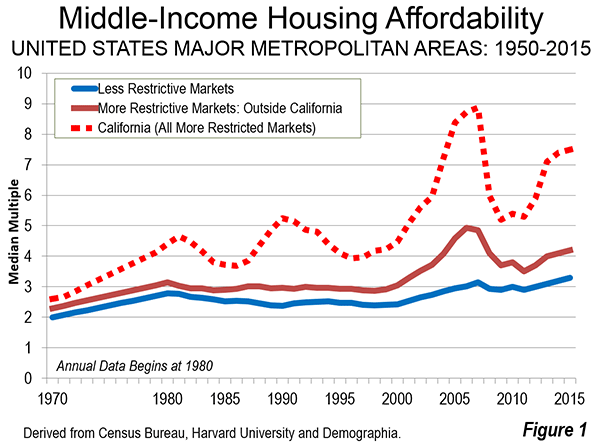
    California’s severely unaffordable housing is legendary, having escalated from approximately the average national price to income ratio in 1970. This is most evident in the four largest coastal metropolitan areas, Los Angeles, San Francisco, San Diego and San Jose. Out of the 87 major markets (over 1 million population) in nine nations, these markets ranked fourth, seventh and in a ninth place tie for the least affordable 8n the 12th Annual Demographia International Housing Affordability Survey. Their median multiples (median house price divided by median household income) required from 8.1 to 9.8 years income to purchase the median priced house. This compares to the affordability of these and other California markets which had median multiples of approximately 3.0 or less in 1970 and in prior years (Figure 1).
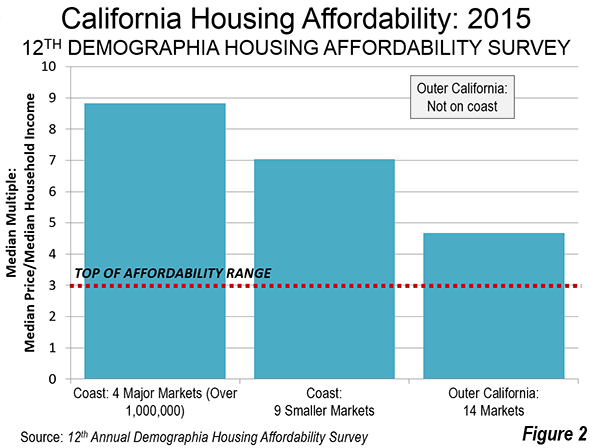
    The housing unaffordability of these markets, with an average median multiple of 8.8 is rivaled by the smaller coastal markets (such as Monterey County, San Luis Obispo, Santa Barbara and Ventura County), with their median multiple of 7.0. Both market categories are rated as severely unaffordable. But housing has become seriously unaffordable even in Outer California, where the average median multiple is 4.7(Figure 2). House prices have been escalating relative to incomes in Outer California since the housing bust, before which their housing affordability was even worse than now (below).
    Housing Affordability in Outer California

    A few examples will make the point. Riverside-San Bernardino, and exurban metropolitan area adjacent to Los Angeles had a severely unaffordable median multiple of 5.2 in 2015. Sacramento, had a seriously unaffordable median multiple of 4.7. Both of these major metropolitan areas reached far higher median multiples in the run-up to the housing bust, with Riverside San Bernardino reaching 7.6 and Sacramento reaching 6.6.

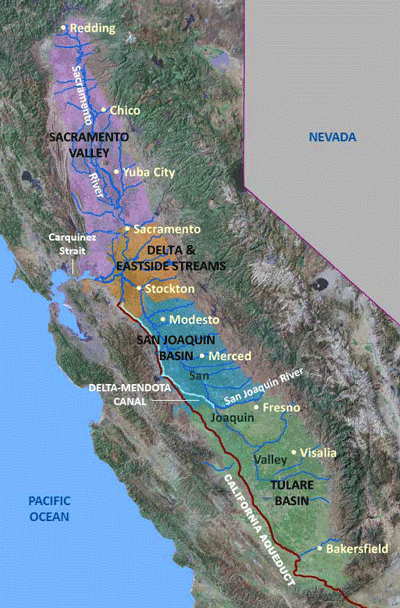
    But the problem is by no means limited to the largest metropolitan areas. Stockton, now officially a part of the larger San Jose-San Francisco combined statistical area as a result of a housing cost driven exodus of commuters from the Bay Area has a severely unaffordable median multiple of 5.3. Things were much worse in the run-up to the bust, at 8.6. Even long depressed Fresno, far from either the Bay Area or Los Angeles, is nearing severe unaffordability, with a median multiple of 5.0 and reached 7.2 during the bubble. More remote Chico, one of the smallest US markets in the Demographia survey also has a median multiple of 5.0 (see Central Valley map at the top).

    Modesto, a 2020 candidate for addition to the San Jose – San Francisco combined statistical area due to the overspill of households seeking houses they can afford, also has a seriously unaffordable median multiple of 4.5. Modesto reached 7.6 during the bubble.

    Among the 29 markets rated in California, the most affordable was Bakersfield, which in a few years is likely to follow Fresno into the over 1 million category. During the bubble, Bakersfield reached a median multiple of 6.6. Small town Visalia, nestled against the Sierra foothills, tied Bakersfield’s most affordable 4.3 median multiple, and reached an astounding 5.8 during the bubble. Hanford also tied for the most affordable.

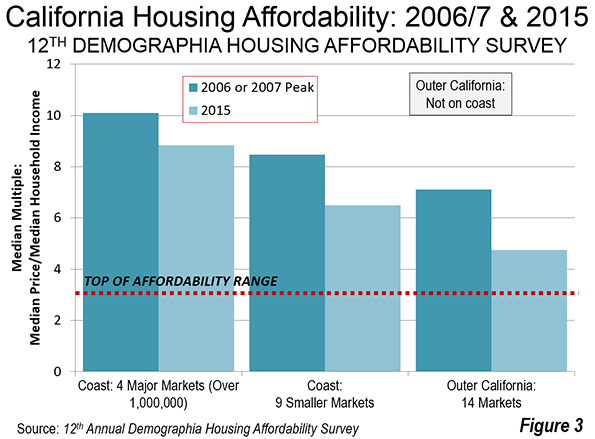
    The comparison to the bubble peaks is particularly important because it illustrates the volatility of housing markets. Even in small markets, house prices are prone to explode when demand exceeds supply, due in large part to land use regulatory and environmental law structure that restricts housing even in more remote areas,   driving prices up (See William A. Fischel, Regulatory Takings). Figure 3 shows that California house prices in each of the three geographic categories were even more unaffordable during the bubble than today.
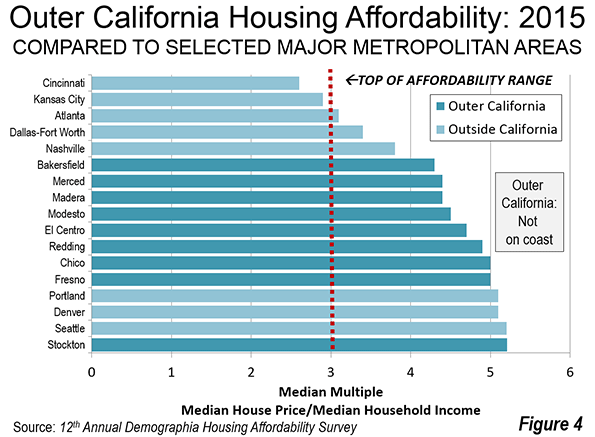
    Even at their current housing affordability levels, the housing markets of Outer California are considerably overpriced. This is indicated by Figure 2, which compares the median multiples in Stockton, Fresno, Bakersfield, Modesto, Redding, Chico, Merced, Madera and the Imperial Valley’s El Centro with severely unaffordable and overregulated Portland, Seattle and Denver, as well as Nashville and other major markets that are more affordable than any in California (Figure 4).

    Indeed, out of the 231 US markets in the Demographia International Housing Affordability Survey, the 27 California markets represent nearly half of the 58 most expensive.
    Meanwhile, a recent report by Zumper indicated among the 50 largest municipalities in the nation, four of the most expensive seven are also in California, with the city of San Francisco ranked number one, followed   San Jose at third, the city of Oakland at fifth and the city of Los Angeles at seventh. Eight of the most expensive municipalities out of the 100 largest are also in California, such as Palo Alto in the Bay Area, Coronado in the San Diego area and Santa Monica in the Los Angeles area.

    As if the regulatory and legal structure that combined with the artificially higher demand from loose lending policies were not enough, barely a decade later California is in the process of implementing one of the most radical land-use regulatory structure in a liberal democracy. It will be far more difficult in many areas to build the detached housing that is been the mainstay of the state, which already has the highest urban population density in the nation (see: “California declares war on suburbia"). This suggests that housing affordability is likely to worsen further.

    There is good reason for a both companies and middle income households to stay away from or leave California.

    More than Housing Affordability

    But people and businesses are moving to places like Nashville for reasons other than housing affordability. The state could hardly make it more clear that most business is not welcome. For at least 10 years, CEO Magazine has rated California as having the least favorable business climate. With competition like Illinois, Connecticut and New Jersey, to be ranked 50th with such regularity is a notable underachievement.

    Data recently released by the California Manufacturers & Technology Association (CMTA) indicated that California ranked last among the states in per capita attraction of manufacturing investments in 2015. Corporate relocation specialist Joseph Vranich continues to add to a long but for California unfortunate list of companies and jobs that have recently left the state (see: "California companies had for greatness – out of California).

    Of course, California is a beautiful place with one of the best climates in the world. But   millions of people and many companies have found greener pastures in Nashville, Austin, Dallas-Fort Worth, Houston, Charlotte, Atlanta and elsewhere. People will continue to visit, but the exodus is likely to continue.

    Wendell Cox is principal of Demographia, an international pubilc policy and demographics firm. He is a Senior Fellow of the Center for Opportunity Urbanism (US), Senior Fellow for Housing Affordability and Municipal Policy for the Frontier Centre for Public Policy (Canada), and a member of the Board of Advisors of the Center for Demographics and Policy at Chapman University (California). He is co-author of the “Demographia International Housing Affordability Survey” and author of “Demographia World Urban Areas” and “War on the Dream: How Anti-Sprawl Policy Threatens the Quality of Life.” He was appointed to three terms on the Los Angeles County Transportation Commission, where he served with the leading city and county leadership as the only non-elected member. He served as a visiting professor at the Conservatoire National des Arts et Metiers, a national university in Paris.

    Photo: Map of Central Valley (Sacramento Valley to the north, San Joaquin Valley to the south) courtesy of the U.S. Geological Survey
  • Orlando: Shrines in the Urban Space

    Orlando is now a place where suffering may finally catalyze a response to social violence. The spontaneous outpouring of grief and reconciliation by its people shows that public space lives, and has a useful function in our digital age. In multiple places around the city remembrances of the victims of the Pulse nightclub shooting, and of musician and Voice contestant Christina Grimmie who was shot the previous day, are poignant, tangible evidence of the human spirit that one cannot ignore.

    In the aftermath of the cascading tragedies of early June, the city had lain grieving and stunned under merciless heat and a tropical storm. But vigils and public gatherings ignored the weather to show solidarity with the victims and their families and loved ones. Last week’s cool, dry, spring-like weather broke the city’s sickened fever. Gatherings at multiple sites gained momentum and size.

    Since ancient times, the plaza in front of a city’s political seat has held civic importance, and Orlando is no exception. The plaza at City Hall is sculpted into a multilevel maze with fountains and public art, so Orlando’s community adopted the much more open city block across South Orange Avenue as a gathering place — it’s a blank slate more adaptable to self-expression. In a synchronicity of events, its owner had recently demolished the 1960s architecture on this block to make way for future development. It is here that President Obama and Vice President Biden laid flowers for the victims of the Pulse nightclub shooting.

    South of downtown, Pulse nightclub itself had been quickly fenced off in black fabric, but beyond the fence and at nearby Orlando Regional Medical Center additional shrines spontaneously blossomed. By a week later, groups were still using them to stage vigils and gather to grieve, to struggle to understand, and to cleanse together in public. This function is so powerful, and so overriding, that the normally rigid traffic and parking regime has been adapted to allow people the space that they need.

    Throughout the twentieth century, public property in cities shrank while private property grew. Malls replaced Main Street. Large condominium complexes, primarily accessed from off-street garages, replaced brownstones that fronted sidewalks. In modern urban patterns, little remains of the old village green, the Italian piazza, or Greek agora. These spaces seemed to be relics, even burdens on the public realm that required upkeep and worry. Orlando’s open space is emblematic of this transition.

    Many think the death knell of these spaces has been the internet, with social media replacing the sidewalk as a forum for casual contact. Social media is all privately owned, so if this were true, it would mean that even more of life was spent on someone else’s private property. Photos of people lounging on sidewalks while staring at tiny screens seem to illustrate this point. Public space, some have claimed, is truly dead to the world, with little function other than as the pathway to private real estate development.

    Much has been written about this so-called collapse of the public realm, tying it to the extinction of civility and the twilight of civilization. It is fashionable to favor greedy selfishness to the exclusion of the common good, and private interests have little use for garbage-strewn plazas, broken-down town squares, or creaky old Main Streets. Private space is where it’s at, and the public is drowned out by amoral monologues of personal righteousness.

    Yet the urge to gather publicly continues, and in Orlando it happened on a scale large enough to be noticed. People still need their open space. Orlando’s famously tolerant and progressive community has come together in a heartbeat of vigils, religious ceremonies, speeches, spiritual gatherings, and memorial services, and it has done so out in the open.

    These are not orchestrated or premeditated gatherings. For those, people are renting halls or churches. Instead, these spontaneous gatherings are express an effort to right the wrongs suffered in our city. Ignoring the public/private boundaries, Orlandoans are using their open space for its most important function of all. Privatization of open space, it turns out, is little help in the face of the destruction that happened here.

    In the most personal of such shrines, the Plaza Theater, where young singer Christina Grimmie was senselessly shot, has received masses of flowers, candles, and testimonials. A steady stream of visitors spend a few moments in quiet prayer before moving on. At the theater’s narrow sidewalk the singer’s life was taken away, but her memory remains with us all.

    The block across from City Hall has five separate memorials constructed of flowers, posters, and banners, and is visited in steady, large numbers. Families, friends, and children pass by, moving quietly and slowly with few words to say. The tropical rains that come and go do not diminish the crowd: umbrellas come up and go down, but the elegiac procession continues.

    If Orlando has multiple hearts, the more formal of them is the regular rectangle between City Hall and the Dr. Phillips Performing Arts Center. The city’s other public space of any size is Lake Eola Park, a 16-block rectangle on downtown Orlando’s eastern edge, filled mostly with, well, Lake Eola. On the park’s western edge, facing downtown’s denser core, stands the Lake Eola amphitheater, the site of Orlando’s larger public gatherings.

    The amphitheater’s 200-odd seats were insufficient to hold the Sunday night crowd of 50,000 strong that gathered despite rain. People spilled onto nearby Rosalind Avenue, enlarging the public space of this corner of the park, to city-sized proportions. In this huge outpouring of grief, with chants of “One Orlando United” and “We Remember,” the names of the dead rang through the city streets and gave voice to our citizens’ grief as an actual rainbow emerged from the cloudy sky just at sunset.

    In times when the polarization of our country feels unbridgeable, and the dialectic seems to be reaching a crescendo, Orlando’s voice has said “one love.” LGBTWQ acceptance has always been available here, and replacing the acronym with “one love” in the face of violence has been Orlando’s mantra, both before and after our darkest weekend. More broadly, the unhealthy, antisocial violence that sparked two shooters to destroy so many lives has met with a startling voice of solidarity and purpose in Orlando. The blackness of our worst week is behind us, and the city’s emergence as a voice of tolerance is now just beginning.

    Richard Reep is an architect with VOA Associates, Inc. who has designed award-winning urban mixed-use and hospitality projects. His work has been featured domestically and internationally for the last thirty years. An Adjunct Professor for the Environmental and Growth Studies Department at Rollins College, he teaches urban design and sustainable development; he is also president of the Orlando Foundation for Architecture. Reep resides in Winter Park, Florida with his family.

    Photo by the author: Downtown Orlando at City Hall

  • Brits Opt Out

    The famous shot heard “’round the world” this time came from the other side of the Atlantic, but its longtime impact could be equally profound. By voting to leave the European Union and its intrusive bureaucracy, the British people have also risen up against a regime of crony capitalism that has encumbered and perverted democracy across the entire Western world.

    The implications, of course, are greatest for Britain and Europe, but they will affect politics here in North America. The Brexit raises to first priority the more general debate about the trajectory of global capitalism which, for all its many accomplishments, has grown to resemble, in its haughtiness and inbreeding, the very statist despotisms that it was supposed to overturn.

    Brexit also represents a shot across the bow to all the elites, not only in Brussels, but also in Westminster, both left and right, much as the Sen. Bernie Sanders and Donald Trump campaigns have been here in the U.S. The EU pushed policies aimed at the mundane pleasures of the middle class, such as affordable electricity, cheap air travel, cars and single-family housing. Those who opposed the edicts were often excoriated as unenlightened and even racist. The “betters” behind the “Remain” campaign waged a kind of class struggle against the British grassroots – and lost in shocking fashion.

    The Revolt of the Masses

    As the American author Fred Siegel has suggested, at the root of this rebellion lie the attitudes of our cognitive betters. Over the past half-century, he argues in his book “Revolt Against the Masses,” progressivism has become increasingly haughty and dictatorial, reaching its apex in the Obama administration and its penchant for ruling by decree.

    James Heartfield, a powerful thinker on Britain’s old left, described the vote as “a popular reaction against the elite.” The EU did not help its cause by failing to bring a long-promised prosperity to Europe. The recovery that did emerge somewhat in Britain largely benefited the asset-owning property and financial classes, the political base of David Cameron and his high-minded, politically correct brand of Toryism.

    Read the entire piece at The Orange County Register.

    Joel Kotkin is executive editor of NewGeography.com. He is the Roger Hobbs Distinguished Fellow in Urban Studies at Chapman University and executive director of the Houston-based Center for Opportunity Urbanism. His newest book, The Human City: Urbanism for the rest of us, will be published in April by Agate. He is also author of The New Class ConflictThe City: A Global History, and The Next Hundred Million: America in 2050. He lives in Orange County, CA.

    Map by Mirrorme22Nilfanion: English and Scottish council areas TUBS: Welsh council areas Sting: Gibraltar [CC BY-SA 3.0], via Wikimedia Commons

  • A Working-Class Brexit

    I woke up Friday morning to the news that my country decided that it no longer wants to be part of the European Union. With a large turnout of 72% of the eligible electorate, the vote went 51.9% in favour of leaving against 48.1% for remaining – 17.4 million against 16.1 million, in case you wondered. As a result, the clock has begun to tick down on 43 years of British EU membership, creating huge levels of uncertainty. This morning the pound sterling lost 10% of its value against the dollar – the biggest one day decline since 1985 – and a massive £200 billion was wiped off the stock market.

    But what was behind this result, which seemed until the eve of poll to be heading towards remaining in the EU? Class was one of the biggest factors. Let me explain. Early analysis of the results shows that if you had a college degree or were young, you were more likely to vote to remain. Geographically, England and Wales voted for Brexit, except for London. Scotland, however, voted overwhelmingly to remain, opening up a very real prospect of another independence referendum and the disintegration of the UK. Many places in England and Wales outside London, often but not exclusively Labour Party traditional heartlands, were amongst the strongest supporters of leaving. This seems to have resulted from a cocktail of resentments against ‘them’, the ‘elite’, the ‘establishment’ or simply the ‘experts’. This resentment has been simmering in these Labour heartlands for decades and predates the banking crash of 2008. Resignation, despair, and political apathy have been present in many former industrial regions since the wholesale deindustrialisation of the British economy in the 1980s and 1990. The election of the Blair -led Labour administration of 1997 masked the anger felt in these areas as traditional labour supporters and their needs were often ignored, while traditional Labour supporters were used as voting fodder. Over the thirteen years of Labour power, that support ebbed away, first as a simple decline in votes, but gradually turning into active hostility to the Labour party. Many embraced the UK Independence Party (UKIP).

    This opposition, so skillfully drawn on by the leave campaign, is in part a working class reaction not only to six years of austerity but also to a long and deep seated sense of injustice and marginalisation. Most of the remain side, which was a cross party grouping, didn’t seem to understand this before the referendum and, even more depressingly, doesn’t seem to understand it fully now. A stock characterisation of working-class people who intended to vote leave was to label them as unable understanding the issues, easily manipulated, or worse, racist ‘little Englanders’.

    A number of commentators have understood the class resentment underlying the referendum. In his thoughtful video blogs preceding the vote, Guardian journalist John Harris travelled away from the ‘Westminster village’ to the more marginal, often over looked parts of the UK. What he observed was precisely this class demographic of voting intentions, people who were in effect members of what sociologist Guy Standing has called the precariat. Fellow Guardian columnist Ian Jack wrote a similarly powerfully reflective piece linking the working-class vote with deindustrialisation. Both Harris and Jack emphasize the point that for unskilled workers with only a secondary school education, three decades or more of neo-liberalism has left deep scars socially, politically, and culturally, with little hope or expectation that anything would change for the better. In avox pop radio interview the day before the referendum, a person stopped for their views simply said, ‘The working class is going to get screwed whether we stay or leave, so we might as well leave’.

    This sense of ‘them’ versus ‘us’ was heightened by the long line of establishment figures from the world of politics, business, and finance who were trotted out to warn the voters that Brexit would mean Armageddon. Far from helping the remain side, these interventions from the likes of Christine Lagarde, managing director of the International Monetary Fund, Bank of England Governor Mark Carney, and even President Obama merely exaggerated the distance between working-class voters and those who wanted them to vote to remain. Speaking after the official result was announced, UKIP leader Nigel Farage explicitly used the language of class in his celebratory speech, saying that this was a vote of ‘Real people, ordinary people, decent people against the big merchant banks, big business and big politics’.

    Many on the progressive left have seen this Brexit result coming and have linked it to a far wider set of issues than those of the immediate problems of the EU. In a video blog two days before polling, Owen Jones linked the marginalisation and alienation felt by many working-class voters and support for populists like Donald Trump, Bernie Sanders, and other non-mainstream political movements in Europe. What this all points to is a real rejection of the hegemony of what veteran left-winger Tariq Ali has called the ‘extreme centre’ that has promoted globalisation and neo-liberalism. In the narrative of the extreme centre, there is no place for those left behind, damaged by the collapse of industries and forced to face the brunt of never ending austerity. Faced with what are viewed as out of touch elites telling an angry electorate that they must vote to remain, there is little wonder that many working-class people opted to vote out. It’s hard to predict what will happen next, over the short, medium, and long term. But one thing is clear: class will play a big role.

    This piece first appeared at Working Class Perspectives.

  • Vote For Brexit Explodes the Myth of the Global City-State

    The UK has voted to leave the European Union.

    The Brexit campaign was revealing because it was based on the exact opposite of the urban triumphalist vision that so often dominates the discourse.

    Globalization doesn’t respect borders we’re told. Cities, not provinces or nation-states, are the real actors in the global economy.  Some have fantasized about the Singapore model of the city-state as ideal.  Virtually all mayors express great dissatisfaction about their national governance arrangements. Benjamin Barber even wrote that mayors should rule the world.

    The ultimate vision of this would be an independent, polyglot London, arguably the world’s most truly global city, bestriding the global economy like a colossus.

    Yet most of the London establishment – and 60% of Londoners themselves in the vote – strongly supported the Remain option. They warned of disaster for London if it lost access to the EU single market.

    This more or less demolishes the arguments for the city-state. If London, the world’s ultimate global city, can’t thrive without access to a continental scale de facto state in the EU, there’s little prospect anyone else can either.

    It’s telling that so many city leaders hate their state or national governments, but love supra-national governments like the EU.  The shows that their real desire isn’t to go it alone in the marketplace, but to create replacement governance structures that are more amenable to their way of thinking, that constitutionally enshrine their preferences, and are insulated from democratic accountability.

    What’s more, if London suffers because it loses access to the single market, it shows that borders to matter to globalization, and that states and quasi-states like the EU very much can exert control on global flows. They are not simply helpless in the face of the global marketplace.

    Of course when I say these arguments are destroyed, I only mean that the people advancing them don’t really believe them themselves. We will find out in a real life test to what extent those ideas are actually valid. Will London’s unparalleled global orientation, talent concentrations, unique and specialized functions enable it to thrive outside the EU? Or will it take a permanent hit? (This assumes, of course, that Brexit actually does happen).

    If London does actually continue thriving in the long term, then that would actually back up the city-state idea to some extent, as London will have gone from being part of a gigantic state to a much smaller one. That might suggest that a further devolution to a greater London city-state might be viable after all, if highly unlikely.

    But if London can’t recover from the inevitable turbulence around Brexit, this would show that not only do cities need to be part of states, they need to be part of very large and powerful ones.

    If you think about it, history suggests that is the case to some extent. London is London because it was the capital of the British Empire. Dittos for Paris and Moscow, both imperial capitals. New York isn’t New York just because of its own characteristics – though those do play a role – but because it is the most important city in the world’s most important country. Shanghai and Beijing are coming on strong because they are in China.

    In any event, the city-state theory is going to get something of a trial run, if an imperfect one. Ironically, that real life trial will come over the objections of the city itself, and much of the urbanist class who otherwise preach urban independence.

    Aaron M. Renn is a senior fellow at the Manhattan Institute, a contributing editor of City Journal, and an economic development columnist for Governing magazine. He focuses on ways to help America’s cities thrive in an ever more complex, competitive, globalized, and diverse twenty-first century. During Renn’s 15-year career in management and technology consulting, he was a partner at Accenture and held several technology strategy roles and directed multimillion-dollar global technology implementations. He has contributed to The Guardian, Forbes.com, and numerous other publications. Renn holds a B.S. from Indiana University, where he coauthored an early social-networking platform in 1991.

    Image via Shutterstock

  • Breaking News: End of the World Avoided (Brexit)

    June 24, 2016 14:30 CDT

    Thanks to modern technology, I have had the pleasure of spending nearly all of the last 18 hours with the United Kingdom’s cable news network, Sky News, watching the election returns and aftermath [of the successful British European Union referendum (Brexit). Four weeks, the "Remain" campaign has been explaining that leaving the EU would result in huge economic and market disruption.

    When, contrary to expectation, it became clear fairly early in the evening that Brexit would pass, there were frequent reminders of these predictions. The value of the pound sterling dropped from $1.50 to $1.32 as the votes continue to be counted and there was never the slightest indication of a turnaround.

    When the markets opened, there were indeed losses. And, a number of the financial experts, political consultants and members of Parliament interviewed were quick to point out that the predictions were correct. For most of the day following the election, watching Sky News gave the impression that there had been a disastrous financial meltdown. However, now, more than 12 hours after the final declaration at Manchester City Hall, Sky News is beginning to suggest that the financial losses may have been modest.

    The leading stock market index in London, the FTSE 100 experienced an 8.7 percent drop in early trading. However by the close of trading, the decline had fallen to only 3.15 percent, the largest drop in five months. Five months? Perhaps most amazingly, today’s close was higher  by two percent than Monday’s opening. The day’s loss would have needed to be 75 percent higher to have been among the 10 worst in history. Yes, this was a big loss, but must have surely been disappointing to the analysts who were basking in their own exaggerations earlier in the day. By the end of the day, the pound had recovered to $1.37.

    Nor did the London stocks do worse than those on the continent. French and German stock prices were down more than twice as much as the FTSE 100, as well as in Tokyo. Stocks in Spain and Italy were down four times as much.

    Of course it is far too early to predict the economic impact of Brexit. But it was humorous watching the "spin doctors" whose narrative seemed to be "we told you so." I think there is much more to this than that SW1 is out of touch with the people, "SW1" is the postal code prefix for Parliament in Westminster and has the same connotation of separation from the people as "inside the beltway," as applied to Washington.

    It may be that the insiders have lost credibility with too many voters. One former Labor consultant, who was as effective in missing the point as any other, poignantly suggested that perhaps too many of the voters had not participated in the post-recession recovery. Hear! Hear!

  • Working Class British Voters Led the European Union Rejection

    On Thursday night the first results from Britain’s referendum on pulling out of the European Union came in.

    A small clue to the way things were going last night was the vote in the North East.

    People in Newcastle are known locally as ‘takems’ (said with a short a, like tack um); those in Sunderland are called ‘makems’. It means that people in Sunderland make things and people in Newcastle take them. Sunderland is solidly industrial, while Newcastle, also a big industrial centre, is a market town. Newcastle voted to remain, but by the tiniest of margins. Sunderland voted to leave, 60-40. That was when we began to think that – not for the first time – the polls had got it wrong.

    As the night wore on the results came in, defying the pollster’s determination that the people would reject the referendum question and stick with the European Union.

    Of London Boroughs, Barking voted to leave, too. It was historically a ‘white flight’ borough, but today it is thronging with Poles and Africans. It is very working class. Islington, by contrast, was overwhelmingly for stay. Islington has working class wards, though these are mostly demoralised, and the borough deserves its reputation for being dominated by a precociously radical middle class.

    Most of all the vote is a popular reaction against the elite. Their view that the European Union is not for them is right. I have taken students to the Brussels Parliament, which is a bit like visiting the offices of the IMF. The only people that you see hanging around outside and waiting to see someone, are themselves very haut bourgeois. By contrast, if you go to the Palace of Westminster, you will see large crowds of school children, nurses, veterans, and ethnic minorities. Parliament is often very bad in its decisions and its cliquishness, but the people do look to it in a way that they will never look on Brussels. That law making should have passed so silently and sneakily off to the European Commission is not something that ordinary British people approve of, and they are right.

    The British Labour movement protested against the Maastricht Treaty back in 1991 that created the EU, and had already been committed to a position of withdrawing from the preceding EEC. Labour’s heartlands were in agreement. Over time, though, the temptation of the ‘European Social Chapter’, and the trade union leaders’ resentment at the Tories opt-out of that did tempt some labour leaders (though not their members) to support the EU. That in itself is a symptom of the unions’ loss of influence in their own right; they hoped that their European friends would offer them what their own campaigning could not.

    As the Labour Party became more distant, metropolitan and elitist, it sought to re-write the party’s policy to mirror its own concerns, and also to diminish working people’s aspirations for social democratic reform in their favour. They got rid of the socialist clause in the party’s constitution, Clause 4, diminished union leaders’ say so in making party policy, and, symbolically, they changed the party’s position on Europe from withdrawal to positive support. For younger graduates in London who were the party’s activists, that all seemed to make sense, but a chasm was opening up between the party and its working class redoubts in the Midlands and the North of England.

    There are many facets to this disaffection. People are angry about the NHS. Some of the mood of hostility towards Blair’s government was attached to the Iraq War.

    Latterly, the question of immigration became one that the labour voters came to distrust the Labour leadership on. In private the Cabinet did indeed talk about encouraging wide scale immigration, with the ambition of making the Conservative Party unelectable, by creating a ‘multicultural’ country. In a telling moment in the 2010 election Gordon Brown was caught by a radio mike complaining about a voter whom he had been introduced to. ‘That bigoted woman’, he called her. Suddenly everyone could hear the snobbery in his prissy voice. ‘Bigoted’ here was code for common, uneducated, or perhaps even ‘unwashed’.

    The EU issue was initially raised by the United Kingdom Independence Party (UKIP), which is to say the grassroots of the Conservative Party, peeling away from David Cameron’s leadership. UKIP in that way are a mirror image of the disaffection of the Labour vote. In time, UKIP candidates got some support in Labour constituencies. That was a clue that the disaffection of the Labour vote was about to form itself up around the referendum.

    Asked by pollsters why they had voted to leave the EU, some said it was immigration. But more said that it was the question of democracy. This is a word that seems to mean very little to the academics, government officials, constitutional lawyers and politicians, and yet, strangely, means a great deal to those whose access to it is most limited – the greater mass of the British public.

    Depressingly, the sulking metropolitans and ‘opinion formers’ (Ha!) dismissed this revolt of the lower orders as nothing more than race prejudice. But that says more about those that say it than those that it is said of. To them almost every expression of popular sentiment feels like fascism. They see fascism in the support for the English football team, and lurking in the bad tempered rants of ‘white van man’ as he makes his deliveries. An old drunk on a bus says something mean about immigrants and he is pilloried on YouTube and Facebook as the latest sign of incipient fascism.

    What they usually mean is that the common people have spoken, and spoken clumsily, without the tortuous manners of the intersectional left. But by and large the exiters were not angry with migrants so much as they were angry with the established order.

    A tipping point was the publication of a letter on the front page of the Times, signed by leading businessmen demanding ‘remain’. This came hot on the heels of the claims that all economists (the same ones who had told us that there was no danger of an economic meltdown in 2008) were for remain. Before that the leaders of all the major parties lined up to say that remain was the only viable result.

    Elsewhere in Europe we have seen this kind of consensus form up. The last time was around the proposed EU Constitution in 2004/5. As every respectable voice made it plain that the Constitution effectively making the EU into a superstate was needed, the ordinary people revolted. In referenda in France and Denmark it was rejected. The project was in tatters. The very solidity of the establishment behind the EU Constitution was the thing that sunk it. If this shower are for it, thought the mass of the people, then it must be rubbish. So it was with the EU referendum in Britain on 23 June. The solidity of the establishment case for staying was probably what decided the majority to leave.

    The ‘out’ decision leaves many questions. The traders have attacked the pound – well, they had made it clear that they did not like exit, so we can expect them to try to punish the voters. We will weather it, and the economy’s underlying strength will make them come back for sterling later on.  Shame on them.

    It is by no means clear that the vote to leave will lead to an actual ‘exit’. The prolonged process of leaving set out in the EU Treaty is effectively a ‘cooling off’ period, and a confident political leader – perhaps Boris Johnson, the star of the exit campaign – might well be tempted by some reforms. The EU itself will be shaken by the vote, and there are already signs that its leaders are moving away from the Federal structure of the Union in favour of a looser, intergovernmental agreement, that would allow greater sovereignty for its member states. That much is just an obvious attempt to accommodate what is already a groundswell of opposition to the Union that is much wider than Britain, taking in France, Spain, Greece and Portugal.

    One thing is for sure:  the vote shows that very few of the experts, the academics, the media, lawyers and politicians have any insight into the will of the people, or even understand the meaning of the words sovereignty and democracy.

    James Heartfield is author of The European Union and the End of Politics and an historian and political scientist based in London.

    Photo by flickr user Diamond Geezer licensed under Creative Commons.

  • Downtowns Dominate New Zealand Transit Commuting

    The statistical authorities of various nations survey commuting behavior of their citizens in periodic population censuses and related surveys. Most of this data relates to the residential location of workers, but not to the work location. Both sets of data are important for understanding the dynamics of mobility within urban areas. However, in some countries, like Canada and the United States work location is not readily available. As a result, items of analysis such as how people get to work and the density of employment in parts of urban areas can be difficult, if not impossible to obtain. For example, based on the last two censuses, we have produced reports estimating the shares of employment in the downtown areas of major metropolitan areas.

    New Zealand has a model program that provides detailed information both on residential location and work location. The work location data is not only important as a model for other statistical authorities, but also reveals trends which the more limited data in other countries suggest. This article will describe the commuting data in the three largest metropolitan areas in New Zealand (Note). The analysis focuses on the 2013 census, which was postponed from 2011 as a result of the disastrous Christchurch earthquakes. As will be shown below, these events had major implications in the commuting data for New Zealand’s second largest metropolitan area.

    Auckland

    Auckland has by far the largest metropolitan area in New Zealand, with approximately 1.6 million residents. As a result of the recent local government consolidation, Auckland has emerged as the only entire metropolitan area in the high income world of more than 1 million population that is administered by a single local government. It will soon be followed by Honolulu, which has a single local government, and which is soon to pass 1 million population.

    Auckland houses about one third of New Zealand’s population. As a result, Auckland is dominates New Zealand. By comparison, the New York metropolitan area, in its most liberal definition (combined statistical area) represents only seven percent of the US population.

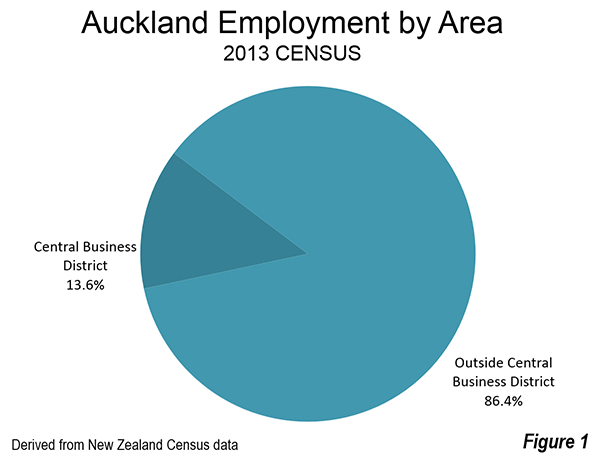
    The Statistics New Zealand data indicates that the Auckland central business district (CBD or downtown area) has approximately 13.6 percent of the jobs (Figure 1) in the metropolitan area (the city of Auckland, or the Auckland Regional Council). This is nearly double the US average for major metropolitan areas (over 1 million population), which is 7.0 percent, but well below New York’s 22.0 percent. It is about the same as that of Canada’s major metropolitan area average, and that of Canada’s largest metropolitan area, Toronto. It also duplicates the Sydney CBD share of metropolitan employment.

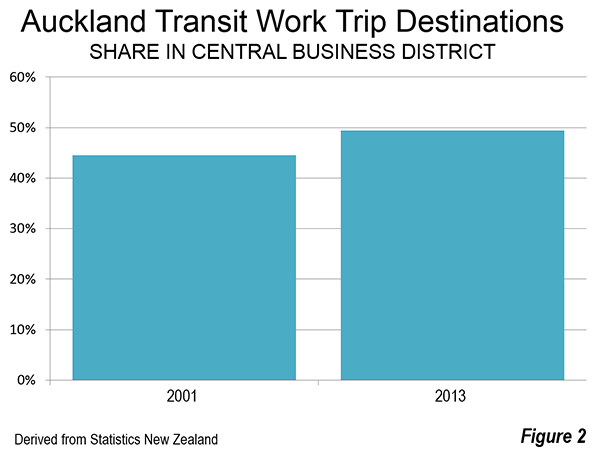
    As is typical of large, more centrally oriented metropolitan areas, transit commuting is focused on the CBD in Auckland. In 2013, approximately 47 percent of all job locations accessed by transit in the metropolitan area   were in the CBD. This was up from 45 percent in 2001 (Figure 2). More than one-half of the new transit commuters between 2001 and 2013 work in the CBD. This is despite the fact that the CBD represents only one percent of the built-up urban area.

    Between the 2001 and 2013 censuses, Auckland experienced an increase in its transit work trip market share from 6.1 percent to 7.7 percent. However, as is typical of transit market shares, there was considerable variation. Transit carried 26.7 percent of the work trips to the CBD as designated by Statistics New Zealand. In the rest of the metropolitan area only 4.7 percent of the jobs were accessed by transit. Overall, transit carries 7,7 percent of work trips in Auckland (among commuters providing information), which is up from 6,1 percent in 2001. While this is a modest work trip market share, it is at least a full percentage point above that of urban planning model Portland.

    Wellington

    Wellington is the national capital and third largest metropolitan area with nearly 500,000 residents. But despite its smaller population, Wellington has the nation’s largest CBD, by a whisker and by far the largest transit commute share in the nation.

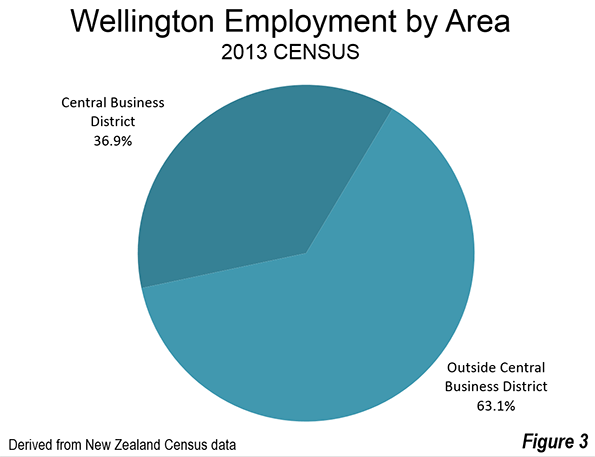
    In 2013, Wellington’s Statistics New Zealand designated CBD had approximately 80,000 jobs. This represents a very high 37 percent of the employment in the metropolitan area (Figure 3). While there are no comprehensive international CBD employment data, the anecdotal information indicates that this level of CBD employment is well above that of all major metropolitan areas in the United States, Canada and Australia, and two-thirds above New York, which has the highest CBD share of any major metropolitan area in these nations.

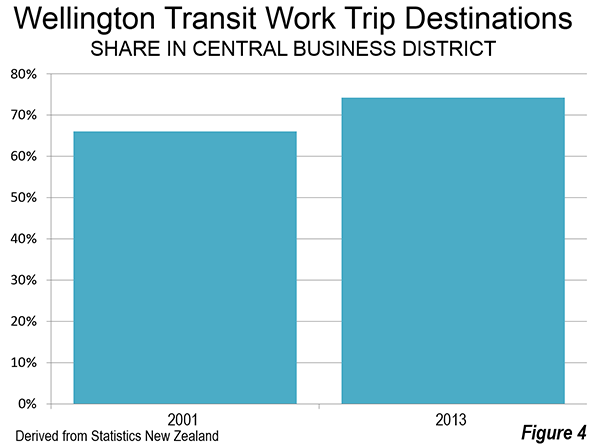
    The dominance of the CBD in transit destinations is even more apparent in Wellington than in Auckland. In 2001, the CBD accounted for 66 percent of the transit commuting locations in the metropolitan area. By 2013 this increased to 74 percent. In fact all of the increase in transit work trips was to CBD locations, as commuting to other locations declined (Figure 4).

    In 2013, transit carried 33.6 percent of employees to the CBD, up from 28.6 percent in 2001. Transit carried 6.2 percent of the travel to jobs outside the CBD. Overall, transit carried 15.7 percent of work trips in the metropolitan area, up from 14.7 percent in 2001. This is a sizeable transit market share, which would place Wellington ahead of all US metropolitan areas in the United States except New York and San Francisco.

    Christchurch

    Christchurch is New Zealand’s second largest metropolitan area, with nearly 600,000 residents.

    Christchurch is a special case, due to the devastating earthquakes that hit the area in 2010 and 2011. Because of the disruption, the New Zealand government postponed the 2011 census to 2013.

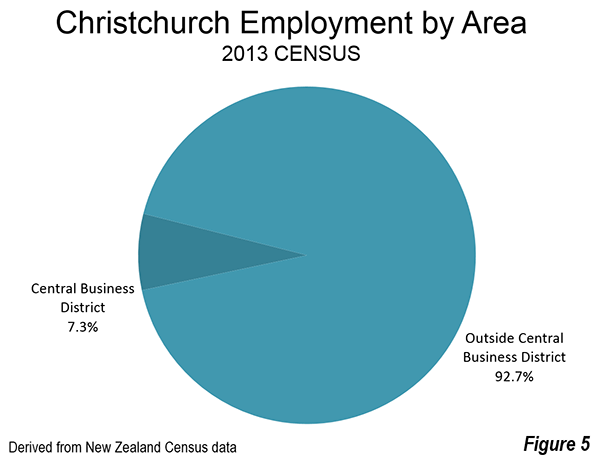
    The core of Christchurch, Cathedral Square suffered particular damage, ruining the city’s historic cathedral, the remains of which were demolished. The Statistics New Zealand designated CBD experienced a more than 50 percent loss in employment from the previous census (2006). In 2001, a very respectable 16.1 percent of employment was in the CBD. By 2013, that figure had declined to 7.3 percent (Figure 5).

    Christchurch has not had the strength of transit ridership of Wellington or Auckland. In 2013, only 5.9 percent of CBD commuters used transit. Overall, transit carries approximately 2.3 percent of work trips in the Christchurch metropolitan area in 2013.

    Transit is About Downtown

    New Zealand’s strongest CBD and transit markets provide further evidence that "transit is about downtown." Both Auckland and Wellington experienced comparatively strong increases in transit work trip ridership between 2001 and 2013. Yet most of the additional work transit work trip destinations were concentrated in the CBD in Auckland, and all of the new trips had CBD destinations in Wellington.

    This is similar to the situation in the United States. In the US, 55 percent of transit commuting destinations are in the six municipalities (as opposed to metropolitan areas) that have the largest CBDs, measured by employment. Transit commuting is also heavily skewed toward the CBDs in Canada and Australia.

    Wendell Cox is principal of Demographia, an international pubilc policy and demographics firm. He is a Senior Fellow of the Center for Opportunity Urbanism (US), Senior Fellow for Housing Affordability and Municipal Policy for the Frontier Centre for Public Policy (Canada), and a member of the Board of Advisors of the Center for Demographics and Policy at Chapman University (California). He is co-author of the “Demographia International Housing Affordability Survey” and author of “Demographia World Urban Areas” and “War on the Dream: How Anti-Sprawl Policy Threatens the Quality of Life.” He was appointed to three terms on the Los Angeles County Transportation Commission, where he served with the leading city and county leadership as the only non-elected member. He served as a visiting professor at the Conservatoire National des Arts et Metiers, a national university in Paris.

    Photograph: Downtown Auckland (by author)

  • Brexit Will Be Britain’s Fourth of July

    The campaign to take the United Kingdom out of the European Union, widely known as “Brexit,” is potentially on the verge of a huge victory Thursday despite overwhelming opposition in the media and among the corporate and political establishment. The outcome matters not just as an expression of arcane British insularity, but as evidence of a growing rebellion against the ever greater consolidation and concentration of power now occurring across all of Europe, as well as here in the United States.

    In many ways, this rebellion’s antecedents include our own revolution, which sought to overturn a distant, and largely unaccountable, bureaucracy. Like Lord North, George III’s prime minister, today’s Eurocratic elites spoke of obligations and fealty to the wisdom of the central imperium. What shocked the centralizers then, and once again today, was the temerity of the governed to challenge the precepts of their betters.

    None of this suggests that Brexit will win this time around, given the massive odds of overcoming so much concentrated establishment power, and the reaction to the brutal slaying of a prominent, pro-EU Labor MP by a deranged neo-Nazi (is there any other kind?). But the fact that the anti-EU rebels have gotten this far (after the Brexiters had surged ahead, polls now show the country evenly split) suggests a growing desire to overturn hyper-centralization with a return to self-government and local control.

    Given the grisly history of internecine warfare on the old continent , the idea of European integration initially had a certain appealing logic. And indeed the early years of integration promised much: greater prosperity, adherence to democracy and even a guarantee that Europe would retain a powerful voice in the world economy and politics. That promise has faded, as Europe remains locked in what appears a more or less permanent cycle of secular decline and stagnation.

    Over the past decade, the EU has lagged in terms of both growth and innovation even by our mediocre standards. The EU’s poor performance is recognized well beyond Britain’s borders. Today more than 60 per cent of French voters now hold an unfavorable view of the Union while almost half the electorate in Germany, Spain and the Netherlands have also become Euroskeptic, notes a recent Pew study. In all, these countries’ rejection of the “European project” is even greater than in the UK’s.

    Rather than embrace a greater Europe bolstered by millions of newcomers, most Europeans now reject such demographic engineering. This sentiment has been rising, most portentously, among Europe’s diminished youth.

    These sentiments help explain the rise in support for Brexit. Much of Britain’s hard-pressed middle and working classes are disturbed by the current record immigration, much of it from other EU countries, which has occurred despite Prime Minister David Cameron’s repeated promises to reduce its growth.

    To this phenomena, one has to consider the recent EU sanctioned mass migration from the Middle East. This can be seen as not just an economic threat, but one that could undermine the hard-won rights achieved women and gays. The language spoken by the Eurocrats may seem liberal and progressive, but their effects on the ground seem profoundly both illiberal and authoritarian, as societies are forced to adapt to the quasi-medieval codes of the newcomers, notably in such matters as separating men and women in public pools.

    In terms of immigration, populist anger is most powerful in the poorer countries, such as in Eastern Europe, and among the already beleaguered working class in the more prosperous north. Despite Labour’s support for both large scale immigration and the EU, a recent YouGov poll finds the majority of working-class Brits favor leaving.

    This growing opposition also stems from growing resentment of an unaccountable, and often haughty, bureaucracy that seeks to impose regulation on everything from the borders to the schools, planning, environment policy, and, perhaps most insulting of all, laws that control the production and distribution of such critical European products as alcohol and cheese. Climate change regulations imposed from Brussels also threaten to further weaken the middle class, even making car ownership too expensive for most drivers.

    The European and British rebellions have clear parallels here in the United States. If there is any consistent theme to the current Administration, it has been implicit embrace of the European model. This includes the massive expansion both of executive branch regulatory power and a relentless, ever growing assault on the traditional rights of states and local communities to control their own fates.

    President Obama’s use of executive orders, much in the image of the EU bureaucracy, has enhanced federal power into many areas once was the purview of localities, such as public education and transportation, land use and, most absurdly, the regulation of bathroom access. Ultimately, every state, city or town may find—as is already the case in Europe—that their future lies in the hands of distant bureaucracies , in this case HUD, the EPA, and other federal agencies.

    As is increasingly true in Europe, the vaunting of the leviathan does not reflect popular will. According to numerous surveys, Americans now fear their own government more than they do than outside threats. In contrast, some 72 percent of Americans, according to Gallup, trust their local governments more than their state institutions. Even millennials, who maintain liberal positions on issues such as immigration and gay marriage, generally favor of community-based, local solutions to key problems. “Millennials are on a completely different page than most politicians in Washington, DC,” notes pollster John Della Volpe. “This is a more cynical generation when it comes to political institutions.”

    This rebellion against ever increasingly centralized power—what might be called “fashionable fascism”—is just beginning. It does not reside solely on the far right. Many on the left embrace the ideal of localism as a reaction against globalization and domination by large corporations. Grassroots progressives often embrace the idea of purchasing from local merchants and relying on locally produced agricultural products as an environmental win, and a form of resistance to ever-greater centralized big business control.

    Of course, prevailing progressive opinion on both sides of the Atlantic embraces central control, often in the form of favor of a “technocracy” determining energy, economic and land use policies. If the technocrats get their way, we can expect policies aimed at limiting the mundane pleasures of the middle class such as affordable electricity, cheap air travel, cars, and single-family housing.

    One might hope that progressives who favor the concentration of power when their side is in power might rethink matters if central power were invested in the likes of Ted Cruz, Donald Trump, or France’s Marine Le Pen. After all, Vladimir Putin is an elected leader who has shown how power can be in profoundly illiberal ways.

    So let’s hear it for Brexit, or at least the spirit that animates it: a desire to regain control of our lives, families and communities. What we need —- as the British increasingly demand —- is tolerance for diverse forms of expression and governance, allowing people, as much as is feasible, to choose how to live. As even the French, who invented modern centralization, increasingly recognize: vive la difference!

    This piece first appeared at The Daily Beast.

    Joel Kotkin is executive editor of NewGeography.com. He is the Roger Hobbs Distinguished Fellow in Urban Studies at Chapman University and executive director of the Houston-based Center for Opportunity Urbanism. His newest book, The Human City: Urbanism for the rest of us, will be published in April by Agate. He is also author of The New Class ConflictThe City: A Global History, and The Next Hundred Million: America in 2050. He lives in Orange County, CA.

    Photo by Xavier Häpe – http://www.flickr.com/photos/vier/192493917/CC BY 2.0

  • The U.S. Cities Where Manufacturing Is Thriving

    Perhaps no sector in the U.S. economy generates more angst than manufacturing. Over the past quarter century, manufacturing has hemorrhaged over 5 million jobs. The devastation of many regional economies, particularly in the Midwest, is testament to this decline. If the information sector has been the golden child of the media, manufacturing has been the offspring that we pity but can’t comfortably embrace.

    Yet manufacturing remains critically important. Over the period from 1997 to 2012, labor productivity growth in manufacturing—3.3% per year—was a third higher than the rest of the economy. Clearly manufacturing is no technological laggard, accounting in 2012 for 68.9% of all R&D expenditures by U.S. businesses and employing 36% of the nation’s scientists and engineers, the largest share of any industry.

    So even as employment has declined or stagnated, the impact of manufacturing on local economies remains profound. Manufacturing has the highest multiplier effect of any sector of the economy. According to the Commerce Department, a dollar of final demand for manufacturing generates $1.33 in output from other sectors of the economy, considerably higher than the multiplier for information ($0.80) and more than twice as high as such fields as retail trade ($0.66) and business services ($0.61). Other estimates place this impact far higher.

    The Midwest Revival

    Our list of the fastest-growing manufacturing regions differs considerably from our rankings of the best cities for jobs overall, and of the strongest information economies. To avoid the distortions and wild swings that can occur in economies with few industrial jobs, we focused on the 48 metropolitan statistical areas with at least 50,000 manufacturing positions.

    As with our other rankings in this series, the list is based on employment growth in the sector over the short-, medium- and long-term, going back to 2005, and we factor in momentum — whether growth is slowing or accelerating. (For a detailed description of our methodology, click here.)

    Manufacturing has enjoyed something of a renaissance since 2009 — after 12 years of declines, it has gained back 828,000 jobs. But like everything in economics, or life, the resurgence has not been equally distributed. In sharp contrast to other areas of the economy, the industrial heartland has some real winners.

    Grand Rapids-Wyoming, Mich., has boosted its industrial workforce by 29% since 2010 to 110,800 workers, with 5.4% job growth last year alone, placing it first on our list. This growth has been very diversified, with many specialty firms engaged not only in auto parts, but also food, aerospace and defense. The metro area seems to be breaking all the shibboleths ascribed to the “Rust Belt” — unemployment dropped to 3.3% this year, population growth and the birthrate are now well above the national average. For most of our strongest manufacturing economies, however, the real driver has been the recent resurgence in automobile sales, which are now at record levels. Despite all the talk of “peak car” a few years ago, with oil prices in the dumps and the population now once again headed to lower-density areas, driving hit a new peak in 2015 in terms of total vehicle miles traveled.

    The next four fastest-growing industrial areas are all auto-dependent, led by second-ranked Elkhart-Goshen, Ind., where the big business is the highly cyclical recreational vehicle industry. Since 2010, industrial employment has grown 37% in the area to 60,500 jobs.

    In No. 3 Louisville/Jefferson County, which abuts the border of Indiana and Kentucky, the industrial workforce has expanded 25.6% since 2010 to 60,500 jobs. Like Grand Rapids, its base is widely diversified. The largest industrial employers include Ford, which makes pickup trucks and SUVs at two plants in the area; GE Appliances, whose sale to China’s Haier was just completed; Publishers Printing and spirits maker Brown-Forman Corp.

    But the big story, and the big numbers, are in the greater Detroit area, where there are roughly 240,000 manufacturing jobs. About 149,000 of them are in suburban Warren-Troy-Farmington Hills, also known as “automation alley,” where the area’s industrial workforce has expanded by 30.6% since 2010, helping it to a fifth-place showing on our list. In fourth place is Detroit-Dearborn-Livonia, where industrial employment surged 27% since 2010.

    High-Tech Centers Rebound

    Although their growth rates are roughly half those of the auto stars that dominate the top of the list, there has been a healthy recovery in manufacturing jobs in traditional high-tech and aerospace-dominated economies, mostly in the west. No. 6 San Diego-Carlsbad, which, like most metro areas, has lost industrial employment over the past decade, has seen a bit of a rebound since 2010, with an 11.5% expansion to 106,700 jobs concentrated mostly in aerospace and nondurable goods.

    No. 7 Denver-Aurora-Lakewood’s industrial workforce has grown 12.7% since 2010 and 3.7% last year alone, while No. 10 Portland-Vancouver-Hillsboro, Ore.-Wash., where Intel recently completed an expansion, has posted industrial job growth of 12.4% since 2010. A $3 billion plant in suburban Hillsboro has spurred a migration of suppliers as well.

    Despite concerns about the loss of electronics manufacturing to Asia, there has even been a small surge in industrial employment in high-cost, highly regulated Silicon Valley. After losing tens of thousands of manufacturing jobs in the wake of the bursting of the dot.com bubble in 2000, No. 19 San Jose-Sunnyvale-Santa Clara has seen a modest 5.9% upsurge in industrial employment since 2010, helped by the growth of electric vehicle maker Tesla, which now employs about 15,000. The Valley will likely never be the industrial powerhouse it was in decades past (today’s manufacturing employment of 161,900 is still 38% lower than the peak in 2000), but, as firms seek to marry digital technology into the “internet of things,” the area may still continue to produce some real goods, likely before any mass production phase, for the foreseeable future.

    The Big Losers: Los Angeles And Chicago

    A large number of manufacturing-rich areas are continuing to lose industrial jobs, often at a rapid rate. Nearly a third of the 100 largest manufacturing metro areas registered declines in employment in the last two years. This year’s worst performer is Newark, N.J., where manufacturing employment is off almost 4% since 2013 and more than 6% since 2010.

    Perhaps even more disturbing has been the decline of the nation’s two largest agglomerations of industrial jobs, No. 43 Chicago-Naperville-Arlington Heights and No. 27 Los Angeles-Long Beach. Chicago’s decline can be traced, at least in part, to the decline of its traditional industries, such as steel and metal fabrication. For decades, many of these jobs have disappeared, moved south or abroad, and the decline continues,  with  jobs down nearly 1.7% since 2010. Since 1990, the area has lost a remarkable 45% of its industrial jobs.

    But if Chicago’s loss can be attributed to the overall decline of the old industrial base, Los Angeles’ steady losses have come from a more modern mix of aerospace, design and specialty manufacturing. Since 2010 — despite the rapid growth in many manufacturing areas — Los Angeles has managed to lose an additional 3.37% of its industrial jobs. Over the past 25 years, the Big Orange has seen its once thriving industrial base fall from 785,400 to 356,100 jobs—a decline of almost 55%. In both Chicago and Los Angeles, the decline of manufacturing has accompanied demographic stagnation, high rates of poverty and mediocre overall job growth.

    Does Manufacturing Actually Matter?

    In many ways, the answer to that question depends on who you are and the structure of your local economy. To be sure, the San Francisco metro area (San Francisco-Redwood City-South San Francisco), despite a mere 35,500 industrial jobs, too few to even make our list, has transformed its economy so dramatically that the loss of industry seems to have had little impact. New York, once a manufacturing mecca, makes the list at No. 30, but now has barely 78,900 industrial jobs. Yet the city continues to outperform most other large metro areas in terms of overall job growth.

    In places where other sectors such as information or business services have picked up the slack, the overall impact has not led to regional decline. The old blue collar workforce may have suffered, but the shift to a post-industrial future has not been disastrous for the overall economy.

    But few places are as glamorous or alluring as New York or San Francisco, with their appeal to the highly educated, foreign capital and millennial workers. As we can see in Los Angeles and Chicago, as well as many places in the middle of the country, manufacturing still matters, and its decline, or resurgence, remains an issue of paramount importance.

    This piece first appeared at Forbes.

    Joel Kotkin is executive editor of NewGeography.com. He is the Roger Hobbs Distinguished Fellow in Urban Studies at Chapman University and executive director of the Houston-based Center for Opportunity Urbanism. His newest book, The Human City: Urbanism for the rest of us, will be published in April by Agate. He is also author of The New Class ConflictThe City: A Global History, and The Next Hundred Million: America in 2050. He lives in Orange County, CA.

    Michael Shires, Ph.D. is a professor at Pepperdine University School of Public Policy.