Blog

  • Small Cities Manufacturing Jobs – 2016 Best Cities Rankings

    Read about how we selected the 2016 Best Cities for Job Growth

    2016 Mfg Ranking within Small MSAs Area Weighted INDEX 2015 Mfg Emplmt (1000s) Total Mfg Emplmt Growth Rate 2014-2015 2015 Mfg Ranking within Small MSAs Overall Rank Change
    2014-2015
    1 San Rafael, CA Metro Div 99.4       4.2 13.64% 4 3
    2 Portsmouth, NH-ME NECTA 95.7       8.2 9.38% 32 30
    3 Lake Charles, LA 95.6     10.8 7.64% 83 80
    4 Idaho Falls, ID 95.6       4.2 5.83% 15 11
    5 Bremerton-Silverdale, WA 95.2       2.4 10.77% 89 84
    6 Vallejo-Fairfield, CA 94.1     11.9 5.93% 25 19
    7 Lewiston, ID-WA 93.8       4.4 6.50% 9 2
    8 Greeley, CO 90.9     13.0 4.01% 47 39
    9 Elizabethtown-Fort Knox, KY 90.1       8.1 12.56% 11 2
    10 Columbus, IN 88.4     19.5 2.27% 12 2
    11 St. George, UT 87.6       3.1 5.68% 30 19
    12 Naples-Immokalee-Marco Island, FL 86.0       3.5 3.96% 2 (10)
    13 Bowling Green, KY 85.4     11.6 6.77% 50 37
    14 Tuscaloosa, AL 85.0     15.8 4.19% 33 19
    15 Punta Gorda, FL 84.4       0.8 13.64% 76 61
    16 Florence-Muscle Shoals, AL 84.0       9.7 4.66% 49 33
    17 Coeur d’Alene, ID 84.0       5.2 7.53% 63 46
    18 Wenatchee, WA 82.9       2.6 5.33% 61 43
    19 Cleveland, TN 82.7       9.8 9.70% 109 90
    20 Elkhart-Goshen, IN 82.3     60.5 2.54% 19 (1)
    21 Muskegon, MI 81.6     13.9 3.48% 36 15
    22 Merced, CA 81.5       9.8 13.95% 8 (14)
    23 Bend-Redmond, OR 81.2       5.0 6.43% 18 (5)
    24 Kokomo, IN 81.1     12.2 3.98% 16 (8)
    25 Morgantown, WV 81.0       4.6 1.47% 41 16
    26 Medford, OR 80.6       7.7 3.59% 23 (3)
    27 Napa, CA 79.3     11.9 4.08% 22 (5)
    28 Flagstaff, AZ 77.1       4.4 3.13% 113 85
    29 Mount Vernon-Anacortes, WA 76.3       5.9 1.71% 14 (15)
    30 Port St. Lucie, FL 75.2       6.3 2.73% 37 7
    31 Spartanburg, SC 74.7     29.3 3.78% 42 11
    32 Bellingham, WA 74.4       9.5 3.65% 55 23
    33 San Luis Obispo-Paso Robles-Arroyo Grande, CA 74.3       7.0 0.48% 38 5
    34 Waco, TX 74.1     16.4 4.23% 169 135
    35 Hanford-Corcoran, CA 74.0       4.5 3.85% 100 65
    36 Battle Creek, MI 73.1     12.1 4.01% 62 26
    37 Santa Cruz-Watsonville, CA 73.1       6.5 3.70% 20 (17)
    38 Panama City, FL 73.0       3.8 3.64% 48 10
    39 Lima, OH 73.0       9.3 4.51% 43 4
    40 Lafayette-West Lafayette, IN 72.9     17.6 1.54% 28 (12)
    41 Haverhill-Newburyport-Amesbury Town, MA-NH NECTA Div 72.8       9.5 1.78% 96 55
    42 Grants Pass, OR 72.3       3.0 2.27% 6 (36)
    43 Visalia-Porterville, CA 72.2     12.3 1.65% 65 22
    44 Bay City, MI 71.2       4.4 9.02% 188 144
    45 Ocala, FL 70.7       7.7 5.96% 40 (5)
    46 Saginaw, MI 68.9     12.5 5.04% 75 29
    47 Jackson, MI 68.8       9.7 0.69% 24 (23)
    48 Gadsden, AL 68.8       5.6 4.35% 79 31
    49 Wausau, WI 68.7     16.5 4.21% 74 25
    50 Kennewick-Richland, WA 67.9       7.4 2.79% 31 (19)
    51 Grand Forks, ND-MN 67.2       4.0 1.71% 35 (16)
    52 Yakima, WA 65.8       8.5 5.83% 54 2
    53 Auburn-Opelika, AL 64.6       6.7 0.00% 13 (40)
    54 Prescott, AZ 64.5       3.4 3.03% 26 (28)
    55 Kalamazoo-Portage, MI 63.9     20.9 2.11% 51 (4)
    56 Dover-Durham, NH-ME NECTA 63.1       5.4 3.85% 99 43
    57 Madera, CA 62.4       3.7 -0.89% 1 (56)
    58 Abilene, TX 62.2       2.9 2.33% 102 44
    59 Walla Walla, WA 62.1       3.6 1.87% 103 44
    60 Watertown-Fort Drum, NY 62.0       2.5 2.78% 92 32
    61 Appleton, WI 61.7     23.8 -0.56% 46 (15)
    62 Barnstable Town, MA NECTA 60.9       3.2 0.00% 82 20
    63 Santa Fe, NM 60.7       0.9 0.00% 60 (3)
    64 Midland, TX 60.6       3.6 -11.48% 5 (59)
    65 Topeka, KS 59.3       7.4 2.76% 146 81
    66 Norwich-New London-Westerly, CT-RI NECTA 58.8     16.0 6.68% 153 87
    67 East Stroudsburg, PA 58.8       4.9 4.23% 172 105
    68 Grand Junction, CO 58.6       2.9 3.61% 81 13
    69 Dover, DE 58.3       4.8 1.40% 115 46
    70 Sherman-Denison, TX 58.0       5.7 5.56% 123 53
    71 College Station-Bryan, TX 57.5       5.4 0.62% 10 (61)
    72 Logan, UT-ID 57.3     11.4 0.59% 106 34
    73 Muncie, IN 57.3       4.4 3.15% 120 47
    74 Pittsfield, MA NECTA 57.0       4.0 5.26% 85 11
    75 Pueblo, CO 56.5       4.5 -2.86% 7 (68)
    76 Janesville-Beloit, WI 55.4       9.6 1.41% 56 (20)
    77 Tyler, TX 55.4       6.4 9.66% 156 79
    78 Vineland-Bridgeton, NJ 55.1       8.7 3.57% 144 66
    79 San Angelo, TX 55.0       3.4 0.99% 108 29
    80 Fond du Lac, WI 54.7     10.7 -1.54% 44 (36)
    81 Sioux City, IA-NE-SD 54.6     15.1 -0.88% 119 38
    82 Morristown, TN 54.3     10.9 4.79% 112 30
    83 Brownsville-Harlingen, TX 54.2       6.0 1.13% 126 43
    84 Niles-Benton Harbor, MI 54.1     13.1 0.26% 39 (45)
    85 South Bend-Mishawaka, IN-MI 53.8     17.5 3.14% 91 6
    86 Gainesville, FL 53.7       4.5 5.47% 181 95
    87 Gettysburg, PA 53.5       6.9 1.48% 52 (35)
    88 Dalton, GA 52.7     23.7 4.10% 73 (15)
    89 Bloomington, IN 52.6       8.7 0.77% 164 75
    90 Sheboygan, WI 52.5     20.4 0.00% 59 (31)
    91 Lake Havasu City-Kingman, AZ 52.4       3.0 3.49% 122 31
    92 Kankakee, IL 52.3       5.6 -4.02% 45 (47)
    93 Albany, OR 52.3       7.2 1.41% 104 11
    94 Racine, WI 51.8     18.6 -2.27% 87 (7)
    95 Olympia-Tumwater, WA 51.6       3.2 -4.90% 71 (24)
    96 Lewiston-Auburn, ME NECTA 51.5       5.3 1.27% 94 (2)
    97 Jackson, TN 51.3     10.1 3.05% 134 37
    98 Monroe, MI 51.1       5.5 1.23% 21 (77)
    99 Rome, GA 50.6       6.1 4.00% 147 48
    100 Flint, MI 50.3     12.0 -1.90% 34 (66)
    101 Salinas, CA 50.1       5.5 2.50% 179 78
    102 Charlottesville, VA 49.9       3.9 -0.84% 95 (7)
    103 Chambersburg-Waynesboro, PA 49.7       9.4 -4.10% 29 (74)
    104 Rocky Mount, NC 49.7     11.2 4.04% 178 74
    105 Fargo, ND-MN 49.5       9.9 -3.90% 69 (36)
    106 Altoona, PA 49.3       7.7 1.32% 157 51
    107 Kahului-Wailuku-Lahaina, HI 48.8       1.2 0.00% 53 (54)
    108 Yuba City, CA 47.4       2.1 0.00% 132 24
    109 Lowell-Billerica-Chelmsford, MA-NH NECTA Div 47.4     22.6 0.30% 136 27
    110 Clarksville, TN-KY 47.3     10.4 0.00% 90 (20)
    111 Danville, IL 46.7       5.1 -2.53% 57 (54)
    112 Burlington, NC 46.6       9.0 1.51% 98 (14)
    113 Pocatello, ID 46.5       1.9 18.75% 209 96
    114 Owensboro, KY 46.3       8.4 0.00% 114 0
    115 Cedar Rapids, IA 46.2     20.3 0.16% 150 35
    116 Mansfield, OH 46.1       9.7 2.11% 110 (6)
    117 Springfield, OH 45.6       6.7 -0.50% 78 (39)
    118 Bismarck, ND 45.3       2.0 -1.67% 72 (46)
    119 Charleston, WV 45.3       3.5 0.00% 145 26
    120 Yuma, AZ 44.8       2.2 -1.47% 67 (53)
    121 Oshkosh-Neenah, WI 44.6     22.6 2.57% 194 73
    122 Odessa, TX 44.4       4.8 -19.89% 17 (105)
    123 Erie, PA 43.9     22.0 -1.64% 111 (12)
    124 Elmira, NY 43.7       5.3 1.91% 195 71
    125 Hickory-Lenoir-Morganton, NC 43.1     39.7 0.51% 97 (28)
    126 Utica-Rome, NY 42.7     11.3 2.10% 155 29
    127 Longview, WA 42.7       6.4 -1.55% 70 (57)
    128 Eau Claire, WI 42.3     10.4 -0.63% 130 2
    129 Hattiesburg, MS 41.6       4.1 0.82% 190 61
    130 Hagerstown-Martinsburg, MD-WV 41.3       7.9 3.48% 183 53
    131 Decatur, AL 41.0     12.0 0.56% 160 29
    132 Cheyenne, WY 40.5       1.4 2.50% 149 17
    133 Champaign-Urbana, IL 40.3       8.2 0.00% 143 10
    134 Michigan City-La Porte, IN 39.6       7.7 0.43% 128 (6)
    135 Anniston-Oxford-Jacksonville, AL 39.4       5.9 0.00% 135 0
    136 New Bedford, MA NECTA 39.2       7.9 0.42% 141 5
    137 Lubbock, TX 39.1       4.9 -2.00% 137 0
    138 Kingsport-Bristol-Bristol, TN-VA 39.1     21.5 -0.15% 127 (11)
    139 Huntington-Ashland, WV-KY-OH 38.8     11.0 -1.79% 88 (51)
    140 Ithaca, NY 38.8       3.4 -1.94% 64 (76)
    141 Redding, CA 38.2       2.3 0.00% 86 (55)
    142 Decatur, IL 37.9     10.1 -1.30% 175 33
    143 Lawrence-Methuen Town-Salem, MA-NH NECTA Div 37.9       9.6 0.00% 148 5
    144 Sumter, SC 37.6       6.5 -2.00% 68 (76)
    145 St. Cloud, MN 37.6     14.9 -2.40% 101 (44)
    146 Amarillo, TX 36.6     12.8 -2.30% 162 16
    147 State College, PA 36.2       4.0 -1.64% 163 16
    148 Glens Falls, NY 36.2       6.0 0.56% 180 32
    149 Joplin, MO 35.9     13.0 -0.26% 158 9
    150 La Crosse-Onalaska, WI-MN 35.7       8.4 -1.57% 138 (12)
    151 Killeen-Temple, TX 35.6       7.3 -1.80% 121 (30)
    152 Brockton-Bridgewater-Easton, MA NECTA Div 34.2       5.5 0.00% 129 (23)
    153 Chico, CA 33.4       3.4 -12.07% 66 (87)
    154 Waterloo-Cedar Falls, IA 33.3     16.0 -5.15% 125 (29)
    155 Rapid City, SD 32.6       2.8 -6.74% 105 (50)
    156 Lebanon, PA 32.3       8.6 -1.15% 173 17
    157 Rochester, MN 31.8     10.8 0.31% 177 20
    158 Johnson City, TN 31.2       7.6 0.88% 140 (18)
    159 Leominster-Gardner, MA NECTA 31.1       6.3 0.53% 176 17
    160 Terre Haute, IN 31.0     10.8 -2.40% 170 10
    161 Lynn-Saugus-Marblehead, MA NECTA Div 30.9       4.6 0.00% 196 35
    162 Greenville, NC 30.6       6.1 -3.17% 84 (78)
    163 Fairbanks, AK 30.6       0.6 -5.56% 197 34
    164 Lynchburg, VA 30.2     14.5 0.93% 151 (13)
    165 Albany, GA 29.5       4.3 0.00% 166 1
    166 Texarkana, TX-AR 29.1       5.3 -0.63% 152 (14)
    167 Waterbury, CT NECTA 28.5       7.6 0.00% 187 20
    168 Nashua, NH-MA NECTA Div 28.3     19.6 -0.34% 174 6
    169 Johnstown, PA 28.2       3.9 -0.84% 193 24
    170 Carson City, NV 28.0       2.6 -3.70% 161 (9)
    171 Atlantic City-Hammonton, NJ 27.1       2.1 0.00% 185 14
    172 Kingston, NY 27.1       3.4 0.00% 116 (56)
    173 Bangor, ME NECTA 27.0       2.4 0.00% 203 30
    174 Victoria, TX 26.5       2.5 -5.13% 165 (9)
    175 Springfield, IL 26.2       2.9 -4.35% 171 (4)
    176 Burlington-South Burlington, VT NECTA 25.7     13.2 -2.46% 191 15
    177 Lawton, OK 24.9       3.5 -3.64% 133 (44)
    178 Columbus, GA-AL 24.6     10.2 -5.85% 93 (85)
    179 Wilmington, NC 24.1       5.7 -1.72% 198 19
    180 Sierra Vista-Douglas, AZ 23.5       0.5 0.00% 189 9
    181 Casper, WY 23.4       1.6 -11.11% 117 (64)
    182 Williamsport, PA 22.9       7.9 0.42% 182 0
    183 Monroe, LA 22.5       6.6 -2.96% 124 (59)
    184 Dutchess County-Putnam County, NY Metro Div 22.4     10.7 1.26% 202 18
    185 Sebastian-Vero Beach, FL 21.8       1.8 -16.92% 3 (182)
    186 Taunton-Middleborough-Norton, MA NECTA Div 21.3       5.8 -5.46% 118 (68)
    187 Duluth, MN-WI 21.0       6.7 -9.87% 159 (28)
    188 Bloomsburg-Berwick, PA 19.4       5.4 -4.68% 168 (20)
    189 Fort Smith, AR-OK 19.1     17.7 -2.74% 131 (58)
    190 Weirton-Steubenville, WV-OH 17.9       5.4 0.00% 192 2
    191 Wichita Falls, TX 17.1       5.0 -4.46% 186 (5)
    192 Longview, TX 17.0       9.6 -10.87% 107 (85)
    193 Wheeling, WV-OH 15.8       3.0 -2.15% 200 7
    194 Manchester, NH NECTA 15.7       7.5 -3.86% 167 (27)
    195 Corvallis, OR 15.5       2.9 -3.33% 184 (11)
    196 Bloomington, IL 14.8       4.3 -10.42% 142 (54)
    197 Binghamton, NY 13.0     11.4 -1.16% 208 11
    198 Fayetteville, NC 12.3       7.7 -2.53% 204 6
    199 Crestview-Fort Walton Beach-Destin, FL 12.0       3.5 0.00% 206 7
    200 Dothan, AL 11.0       4.3 -3.03% 205 5
    201 Peabody-Salem-Beverly, MA NECTA Div 10.3       7.1 -8.19% 154 (47)
    202 Laredo, TX 8.2       0.7 -8.70% 201 (1)
    203 Parkersburg-Vienna, WV 8.0       2.7 -8.99% 199 (4)
    204 El Centro, CA 7.6       1.0 -3.23% 210 6
    205 Las Cruces, NM 7.0       2.3 -6.67% 207 2
  • Mid Sized Cities Manufacturing Jobs – 2016 Best Cities Rankings

    Read about how we selected the 2016 Best Cities for Job Growth

    2016 Mfg Ranking within Midsized MSAs Area Weighted INDEX 2015 Mfg Emplmt (1000s) Total Mfg Emplmt Growth Rate 2014-2015 2015 Mfg Ranking within Midsized MSAs Overall Rank Change
    2014-2015
    1 Savannah, GA 96.7    18.0 6.31% 2 1
    2 Fort Collins, CO 86.1    13.2 6.15% 3 1
    3 Charleston-North Charleston, SC 85.4    26.1 3.57% 10 7
    4 Mobile, AL 85.3    19.8 2.06% 23 19
    5 Columbia, SC 83.4    32.7 6.05% 8 3
    6 Ogden-Clearfield, UT 82.4    31.7 5.31% 14 8
    7 Deltona-Daytona Beach-Ormond Beach, FL 79.3    11.1 5.40% 13 6
    8 Beaumont-Port Arthur, TX 78.5    23.2 -0.43% 20 12
    9 Santa Maria-Santa Barbara, CA 76.1    13.2 6.45% 31 22
    10 Cape Coral-Fort Myers, FL 75.8      5.5 5.13% 4 (6)
    11 Lansing-East Lansing, MI 74.1    20.0 5.63% 11 0
    12 Baton Rouge, LA 73.4    29.5 1.37% 3 (9)
    13 Toledo, OH 71.8    44.2 2.95% 1 (12)
    14 North Port-Sarasota-Bradenton, FL 71.4    16.5 3.77% 17 3
    15 Stockton-Lodi, CA 71.4    19.3 6.45% 15 0
    16 Fresno, CA 67.3    25.2 4.72% 60 44
    17 Salem, OR 66.7    12.5 4.17% 32 15
    18 Jackson, MS 64.9    19.2 4.36% 28 10
    19 Asheville, NC 64.8    20.0 2.56% 52 33
    20 Greenville-Anderson-Mauldin, SC 64.7    55.1 1.10% 27 7
    21 Madison, WI 64.6    33.8 3.79% 12 (9)
    22 Reno, NV 64.2    13.0 2.89% 9 (13)
    23 Santa Rosa, CA 64.2    21.5 2.54% 57 34
    24 Montgomery, AL 61.4    19.0 2.51% 41 17
    25 Boise City, ID 61.3    25.6 3.92% 43 18
    26 Rockford, IL 61.2    32.1 0.31% 37 11
    27 Palm Bay-Melbourne-Titusville, FL 60.7    21.3 5.61% 76 49
    28 Lake County-Kenosha County, IL-WI Metro Div 60.3    59.9 1.07% 42 14
    29 Reading, PA 60.0    30.9 1.53% 44 15
    30 Lakeland-Winter Haven, FL 59.2    16.7 1.83% 21 (9)
    31 Fort Wayne, IN 58.0    35.2 1.25% 34 3
    32 Boulder, CO 57.9    17.6 0.00% 24 (8)
    33 Des Moines-West Des Moines, IA 57.0    19.9 0.34% 33 0
    34 Sioux Falls, SD 56.9    13.5 -1.70% 24 (10)
    35 Winston-Salem, NC 55.3    32.2 2.87% 30 (5)
    36 Green Bay, WI 54.7    29.4 0.69% 49 13
    37 Provo-Orem, UT 54.2    18.2 -1.62% 16 (21)
    38 Lincoln, NE 53.7    13.9 1.22% 29 (9)
    39 Pensacola-Ferry Pass-Brent, FL 53.2      6.1 1.11% 19 (20)
    40 Wilmington, DE-MD-NJ Metro Div 52.3    19.6 3.34% 83 43
    41 Dayton, OH 51.6    40.5 2.44% 40 (1)
    42 Allentown-Bethlehem-Easton, PA-NJ 51.3    36.4 1.67% 56 14
    43 Knoxville, TN 51.2    36.4 2.92% 50 7
    44 Harrisburg-Carlisle, PA 50.7    21.3 -0.47% 36 (8)
    45 Canton-Massillon, OH 50.2    27.8 -2.00% 26 (19)
    46 Lexington-Fayette, KY 50.0    30.9 0.22% 46 0
    47 Eugene, OR 49.7    13.3 2.57% 39 (8)
    48 Chattanooga, TN-GA 49.3    31.1 1.19% 47 (1)
    49 Elgin, IL Metro Div 49.2    35.3 1.15% 53 4
    50 Ann Arbor, MI 48.7    14.9 4.20% 64 14
    51 McAllen-Edinburg-Mission, TX 48.1      6.6 2.58% 79 28
    52 Greensboro-High Point, NC 48.0    54.6 1.55% 55 3
    53 Bakersfield, CA 47.0    13.8 -3.94% 5 (48)
    54 Modesto, CA 45.7    19.9 -0.50% 86 32
    55 Gary, IN Metro Div 45.6    36.2 -1.99% 38 (17)
    56 Roanoke, VA 45.3    16.6 1.84% 48 (8)
    57 Portland-South Portland, ME NECTA 44.6    12.6 2.16% 81 24
    58 Evansville, IN-KY 44.0    22.6 -0.73% 35 (23)
    59 Springfield, MO 42.5    14.3 -4.45% 6 (53)
    60 Akron, OH 42.3    40.3 0.00% 61 1
    61 Tulsa, OK 41.9    47.4 -9.66% 22 (39)
    62 Huntsville, AL 41.4    23.6 1.29% 74 12
    63 Little Rock-North Little Rock-Conway, AR 41.1    20.4 0.49% 58 (5)
    64 Tacoma-Lakewood, WA Metro Div 41.0    17.0 -0.20% 51 (13)
    65 Spokane-Spokane Valley, WA 40.6    16.6 -1.77% 45 (20)
    66 Lafayette, LA 39.8    16.7 -16.19% 7 (59)
    67 Lancaster, PA 39.7    36.3 0.83% 65 (2)
    68 Tucson, AZ 38.9    23.0 2.83% 85 17
    69 Augusta-Richmond County, GA-SC 38.8    20.5 0.66% 68 (1)
    70 Wichita, KS 38.3    52.5 0.32% 77 7
    71 Anchorage, AK 37.8      2.0 -10.29% 18 (53)
    72 Worcester, MA-CT NECTA 37.3    27.6 0.73% 72 0
    73 Davenport-Moline-Rock Island, IA-IL 36.9    23.4 -2.36% 54 (19)
    74 Gulfport-Biloxi-Pascagoula, MS 36.8    19.0 -1.73% 71 (3)
    75 York-Hanover, PA 34.6    31.2 0.54% 82 7
    76 Syracuse, NY 33.7    24.9 1.91% 73 (3)
    77 Calvert-Charles-Prince George’s, MD 32.6      8.3 2.06% 92 15
    78 Myrtle Beach-Conway-North Myrtle Beach, SC-NC 32.2      4.4 -0.76% 36 (42)
    79 Oxnard-Thousand Oaks-Ventura, CA 32.2    30.3 -0.55% 69 (10)
    80 Salisbury, MD-DE 31.0    13.9 -2.34% 64 (16)
    81 Scranton–Wilkes-Barre–Hazleton, PA 29.3    27.1 -0.25% 70 (11)
    82 Colorado Springs, CO 28.8    11.7 -1.40% 62 (20)
    83 Corpus Christi, TX 28.6      9.2 -3.15% 59 (24)
    84 El Paso, TX 28.0    17.0 0.20% 78 (6)
    85 Shreveport-Bossier City, LA 26.2    10.8 -1.52% 67 (18)
    86 Fayetteville-Springdale-Rogers, AR-MO 23.8    26.5 -2.81% 63 (23)
    87 Framingham, MA NECTA Division 23.2    24.6 -3.91% 80 (7)
    88 Youngstown-Warren-Boardman, OH-PA 22.6    29.7 -3.99% 39 (49)
    89 Springfield, MA-CT NECTA 21.3    28.9 -0.91% 90 1
    90 Tallahassee, FL 20.0      3.0 -1.11% 93 3
    91 Peoria, IL 20.0    24.2 -9.13% 75 (16)
    92 Durham-Chapel Hill, NC 20.0    28.8 -3.89% 66 (26)
    93 Trenton, NJ 19.6      7.8 -3.69% 25 (68)
    94 New Haven, CT NECTA 18.8    24.1 -1.77% 87 (7)
    95 Bridgeport-Stamford-Norwalk, CT NECTA 18.2    31.2 -1.89% 89 (6)
    96 Albuquerque, NM 17.3    16.1 -1.43% 88 (8)
    97 Delaware County, PA 15.1    14.2 -5.11% 91 (6)
    98 Baltimore City, MD 9.3    10.7 -5.03% 84 (14)
  • Large Cities Manufacturing Jobs – 2016 Best Cities Rankings

    Read about how we selected the 2016 Best Cities for Job Growth

    2016 Mfg Ranking within Large MSAs Area Weighted INDEX 2015 Mfg Emplmt (1000s) Total Mfg Emplmt Growth Rate 2014-2015 2015 Mfg Ranking within Large MSAs Overall Rank Change
    2014-2015
    1 Grand Rapids-Wyoming, MI 84.1    110.8 5.4% 3 2
    2 Albany-Schenectady-Troy, NY 83.9      25.8 5.0% 5 3
    3 Louisville/Jefferson County, KY-IN 75.6      78.2 3.3% 7 4
    4 Kansas City, MO 73.1      44.3 4.9% 8 4
    5 Orlando-Kissimmee-Sanford, FL 72.6      42.7 6.7% 16 11
    6 Detroit-Dearborn-Livonia, MI Metro Div 71.1      90.4 1.5% 1 (5)
    7 Warren-Troy-Farmington Hills, MI Metro Div 70.8    149.0 1.5% 2 (5)
    8 San Diego-Carlsbad, CA 70.2    106.7 3.0% 36 28
    9 Denver-Aurora-Lakewood, CO 70.2      69.2 3.7% 13 4
    10 Oakland-Hayward-Berkeley, CA Metro Div 67.0      87.8 3.1% 26 16
    11 Cincinnati, OH-KY-IN 66.9    115.2 3.3% 25 14
    12 Portland-Vancouver-Hillsboro, OR-WA 66.0    122.0 2.0% 10 (2)
    13 Nashville-Davidson–Murfreesboro–Franklin, TN 65.8      80.8 2.5% 4 (9)
    14 Raleigh, NC 65.7      33.9 1.1% 21 7
    15 Atlanta-Sandy Springs-Roswell, GA 63.9    160.9 3.8% 23 8
    16 Fort Lauderdale-Pompano Beach-Deerfield Beach, FL Metro Div 63.4      28.3 3.3% 14 (2)
    17 West Palm Beach-Boca Raton-Delray Beach, FL Metro Div 63.3      17.6 3.7% 11 (6)
    18 Seattle-Bellevue-Everett, WA Metro Div 60.2    169.3 -0.6% 34 16
    19 Riverside-San Bernardino-Ontario, CA 60.0      96.5 3.1% 18 (1)
    20 Salt Lake City, UT 59.8      55.1 1.7% 49 29
    21 Jacksonville, FL 59.6      29.8 3.5% 47 26
    22 Charlotte-Concord-Gastonia, NC-SC 59.6    104.2 2.1% 24 2
    23 San Jose-Sunnyvale-Santa Clara, CA 58.9    161.9 1.8% 15 (8)
    24 Minneapolis-St. Paul-Bloomington, MN-WI 56.8    194.0 0.8% 12 (12)
    25 Kansas City, KS 55.6      31.6 3.5% 50 25
    26 Las Vegas-Henderson-Paradise, NV 54.6      21.8 2.0% 29 3
    27 Omaha-Council Bluffs, NE-IA 54.2      32.9 0.7% 48 21
    28 Sacramento–Roseville–Arden-Arcade, CA 54.1      36.2 1.5% 19 (9)
    29 Oklahoma City, OK 53.1      36.9 -3.7% 6 (23)
    30 Phoenix-Mesa-Scottsdale, AZ 53.1    121.1 2.0% 44 14
    31 San Antonio-New Braunfels, TX 53.1      47.1 0.5% 52 21
    32 Columbus, OH 52.2      71.6 0.7% 39 7
    33 Miami-Miami Beach-Kendall, FL Metro Div 51.3      39.1 1.9% 22 (11)
    34 Milwaukee-Waukesha-West Allis, WI 49.0    121.0 0.4% 33 (1)
    35 Houston-The Woodlands-Sugar Land, TX 47.3    238.0 -8.8% 9 (26)
    36 Washington-Arlington-Alexandria, DC-VA-MD-WV Metro Div 47.1      36.1 3.6% 67 31
    37 Fort Worth-Arlington, TX Metro Div 46.6      94.5 -3.2% 17 (20)
    38 Silver Spring-Frederick-Rockville, MD Metro Div 46.0      17.1 0.8% 54 16
    39 Austin-Round Rock, TX 45.2      57.1 -0.3% 31 (8)
    40 Urban Honolulu, HI 44.8      11.0 -1.8% 41 1
    41 Indianapolis-Carmel-Anderson, IN 44.1      89.8 -0.1% 20 (21)
    42 Camden, NJ Metro Div 42.9      36.6 4.0% 58 16
    43 Tampa-St. Petersburg-Clearwater, FL 42.8      62.0 1.1% 32 (11)
    44 Northern Virginia, VA 40.3      24.4 2.2% 51 7
    45 New York City, NY 40.0      78.9 2.2% 62 17
    46 San Francisco-Redwood City-South San Francisco, CA Metro Div 39.9      35.5 -1.7% 28 (18)
    47 Providence-Warwick, RI-MA NECTA 39.1      52.5 1.5% 30 (17)
    48 Middlesex-Monmouth-Ocean, NJ 38.8      44.3 0.8% 45 (3)
    49 Memphis, TN-MS-AR 38.1      44.9 0.2% 56 7
    50 Cleveland-Elyria, OH 37.8    123.9 -1.0% 40 (10)
    51 Anaheim-Santa Ana-Irvine, CA Metro Div 37.6    156.3 -0.5% 35 (16)
    52 Hartford-West Hartford-East Hartford, CT NECTA 36.3      55.5 0.3% 65 13
    53 St. Louis, MO-IL 36.2    112.3 -0.9% 27 (26)
    54 Dallas-Plano-Irving, TX Metro Div 36.1    166.2 -0.2% 55 1
    55 Birmingham-Hoover, AL 36.1      37.3 -4.0% 37 (18)
    56 Buffalo-Cheektowaga-Niagara Falls, NY 36.0      51.8 -0.6% 38 (18)
    57 Nassau County-Suffolk County, NY Metro Div 33.8      72.1 0.8% 64 7
    58 Virginia Beach-Norfolk-Newport News, VA-NC 33.4      52.6 -2.9% 46 (12)
    59 Boston-Cambridge-Newton, MA NECTA Division 33.4      81.7 0.0% 57 (2)
    60 Montgomery County-Bucks County-Chester County, PA Metro Div 31.8      90.1 -0.6% 43 (17)
    61 Chicago-Naperville-Arlington Heights, IL Metro Div 31.5    281.5 -0.2% 60 (1)
    62 Rochester, NY 28.1      58.9 0.3% 61 (1)
    63 Bergen-Hudson-Passaic, NJ 27.8      58.3 0.6% 66 3
    64 Pittsburgh, PA 27.2      85.6 -3.2% 42 (22)
    65 Richmond, VA 27.1      30.7 -0.4% 53 (12)
    66 New Orleans-Metairie, LA 25.6      30.5 -0.7% 70 4
    67 Los Angeles-Long Beach-Glendale, CA Metro Div 22.6    356.1 -1.7% 59 (8)
    68 Newark, NJ-PA Metro Div 21.6      75.9 0.0% 63 (5)
    69 Orange-Rockland-Westchester, NY 20.2      29.5 -2.5% 69 0
    70 Philadelphia City, PA 16.1      20.9 -2.3% 68 (2)
  • All Cities Manufacturing Jobs – 2016 Best Cities Rankings

    Read about how we selected the 2016 Best Cities for Job Growth

    2016 Overall Mfg Rank Area Weighted INDEX 2015 Mfg  Emplmt (1000s) Total Mfg Emplmt Growth Rate 2014-2015 2016 Nonfarm MSA Size Group 2015 Overall Mfg Rank Overall Rank Change
    2014-2015
    1 San Rafael, CA Metro Div 99.4       4.2 13.6% S 4 3
    2 Savannah, GA 96.7     18.0 6.3% M 26 24
    3 Portsmouth, NH-ME NECTA 95.7       8.2 9.4% S 38 35
    4 Lake Charles, LA 95.6     10.8 7.6% S 140 136
    5 Idaho Falls, ID 95.6       4.2 5.8% S 15 10
    6 Bremerton-Silverdale, WA 95.2       2.4 10.8% S 153 147
    7 Vallejo-Fairfield, CA 94.1     11.9 5.9% S 29 22
    8 Lewiston, ID-WA 93.8       4.4 6.5% S 9 1
    9 Greeley, CO 90.9     13.0 4.0% S 65 56
    10 Elizabethtown-Fort Knox, KY 90.1       8.1 12.6% S 11 1
    11 Columbus, IN 88.4     19.5 2.3% S 12 1
    12 St. George, UT 87.6       3.1 5.7% S 36 24
    13 Fort Collins, CO 86.1     13.2 6.1% M 31 18
    14 Naples-Immokalee-Marco Island, FL 86.0       3.5 4.0% S 2 (12)
    15 Charleston-North Charleston, SC 85.4     26.1 3.6% M 55 40
    16 Bowling Green, KY 85.4     11.6 6.8% S 71 55
    17 Mobile, AL 85.3     19.8 2.1% M 89 72
    18 Tuscaloosa, AL 85.0     15.8 4.2% S 39 21
    19 Punta Gorda, FL 84.4       0.8 13.6% S 119 100
    20 Grand Rapids-Wyoming, MI 84.1   110.8 5.4% L 40 20
    21 Florence-Muscle Shoals, AL 84.0       9.7 4.7% S 70 49
    22 Coeur d’Alene, ID 84.0       5.2 7.5% S 99 77
    23 Albany-Schenectady-Troy, NY 83.9     25.8 5.0% L 66 43
    24 Columbia, SC 83.4     32.7 6.1% M 50 26
    25 Wenatchee, WA 82.9       2.6 5.3% S 97 72
    26 Cleveland, TN 82.7       9.8 9.7% S 182 156
    27 Ogden-Clearfield, UT 82.4     31.7 5.3% M 60 33
    28 Elkhart-Goshen, IN 82.3     60.5 2.5% S 22 (6)
    29 Muskegon, MI 81.6     13.9 3.5% S 44 15
    30 Merced, CA 81.5       9.8 14.0% S 8 (22)
    31 Bend-Redmond, OR 81.2       5.0 6.4% S 21 (10)
    32 Kokomo, IN 81.1     12.2 4.0% S 17 (15)
    33 Morgantown, WV 81.0       4.6 1.5% S 54 21
    34 Medford, OR 80.6       7.7 3.6% S 27 (7)
    35 Deltona-Daytona Beach-Ormond Beach, FL 79.3     11.1 5.4% M 58 23
    36 Napa, CA 79.3     11.9 4.1% S 25 (11)
    37 Beaumont-Port Arthur, TX 78.5     23.2 -0.4% M 81 44
    38 Flagstaff, AZ 77.1       4.4 3.1% S 189 151
    39 Mount Vernon-Anacortes, WA 76.3       5.9 1.7% S 14 (25)
    40 Santa Maria-Santa Barbara, CA 76.1     13.2 6.5% M 113 73
    41 Cape Coral-Fort Myers, FL 75.8       5.5 5.1% M 35 (6)
    42 Louisville/Jefferson County, KY-IN 75.6     78.2 3.3% L 78 36
    43 Port St. Lucie, FL 75.2       6.3 2.7% S 45 2
    44 Spartanburg, SC 74.7     29.3 3.8% S 59 15
    45 Bellingham, WA 74.4       9.5 3.6% S 82 37
    46 San Luis Obispo-Paso Robles-Arroyo Grande, CA 74.3       7.0 0.5% S 47 1
    47 Lansing-East Lansing, MI 74.1     20.0 5.6% M 56 9
    48 Waco, TX 74.1     16.4 4.2% S 304 256
    49 Hanford-Corcoran, CA 74.0       4.5 3.8% S 170 121
    50 Baton Rouge, LA 73.4     29.5 1.4% M 33 (17)
    51 Kansas City, MO 73.1     44.3 4.9% L 85 34
    52 Battle Creek, MI 73.1     12.1 4.0% S 98 46
    53 Santa Cruz-Watsonville, CA 73.1       6.5 3.7% S 23 (30)
    54 Panama City, FL 73.0       3.8 3.6% S 67 13
    55 Lima, OH 73.0       9.3 4.5% S 61 6
    56 Lafayette-West Lafayette, IN 72.9     17.6 1.5% S 32 (24)
    57 Haverhill-Newburyport-Amesbury Town, MA-NH NECTA Div 72.8       9.5 1.8% S 163 106
    58 Orlando-Kissimmee-Sanford, FL 72.6     42.7 6.7% L 139 81
    59 Grants Pass, OR 72.3       3.0 2.3% S 6 (53)
    60 Visalia-Porterville, CA 72.2     12.3 1.7% S 101 41
    61 Toledo, OH 71.8     44.2 3.0% M 19 (42)
    62 North Port-Sarasota-Bradenton, FL 71.4     16.5 3.8% M 73 11
    63 Stockton-Lodi, CA 71.4     19.3 6.4% M 69 6
    64 Bay City, MI 71.2       4.4 9.0% S 342 278
    65 Detroit-Dearborn-Livonia, MI Metro Div 71.1     90.4 1.5% L 16 (49)
    66 Warren-Troy-Farmington Hills, MI Metro Div 70.8   149.0 1.5% L 20 (46)
    67 Ocala, FL 70.7       7.7 6.0% S 53 (14)
    68 San Diego-Carlsbad, CA 70.2   106.7 3.0% L 210 142
    69 Denver-Aurora-Lakewood, CO 70.2     69.2 3.7% L 131 62
    70 Saginaw, MI 68.9     12.5 5.0% S 117 47
    71 Jackson, MI 68.8       9.7 0.7% S 28 (43)
    72 Gadsden, AL 68.8       5.6 4.3% S 126 54
    73 Wausau, WI 68.7     16.5 4.2% S 116 43
    74 Kennewick-Richland, WA 67.9       7.4 2.8% S 37 (37)
    75 Fresno, CA 67.3     25.2 4.7% M 223 148
    76 Grand Forks, ND-MN 67.2       4.0 1.7% S 43 (33)
    77 Oakland-Hayward-Berkeley, CA Metro Div 67.0     87.8 3.1% L 175 98
    78 Cincinnati, OH-KY-IN 66.9   115.2 3.3% L 169 91
    79 Salem, OR 66.7     12.5 4.2% M 114 35
    80 Portland-Vancouver-Hillsboro, OR-WA 66.0   122.0 2.0% L 103 23
    81 Yakima, WA 65.8       8.5 5.8% S 79 (2)
    82 Nashville-Davidson–Murfreesboro–Franklin, TN 65.8     80.8 2.5% L 46 (36)
    83 Raleigh, NC 65.7     33.9 1.1% L 155 72
    84 Jackson, MS 64.9     19.2 4.4% M 106 22
    85 Asheville, NC 64.8     20.0 2.6% M 203 118
    86 Greenville-Anderson-Mauldin, SC 64.7     55.1 1.1% M 96 10
    87 Madison, WI 64.6     33.8 3.8% M 57 (30)
    88 Auburn-Opelika, AL 64.6       6.7 0.0% S 13 (75)
    89 Prescott, AZ 64.5       3.4 3.0% S 30 (59)
    90 Reno, NV 64.2     13.0 2.9% M 52 (38)
    91 Santa Rosa, CA 64.2     21.5 2.5% M 214 123
    92 Atlanta-Sandy Springs-Roswell, GA 63.9   160.9 3.8% L 166 74
    93 Kalamazoo-Portage, MI 63.9     20.9 2.1% S 74 (19)
    94 Fort Lauderdale-Pompano Beach-Deerfield Beach, FL MtDiv 63.4     28.3 3.3% L 132 38
    95 West Palm Beach-Boca Raton-Delray Beach, FL Metro Div 63.3     17.6 3.7% L 128 33
    96 Dover-Durham, NH-ME NECTA 63.1       5.4 3.8% S 168 72
    97 Madera, CA 62.4       3.7 -0.9% S 1 (96)
    98 Abilene, TX 62.2       2.9 2.3% S 173 75
    99 Walla Walla, WA 62.1       3.6 1.9% S 174 75
    100 Watertown-Fort Drum, NY 62.0       2.5 2.8% S 158 58
    101 Appleton, WI 61.7     23.8 -0.6% S 64 (37)
    102 Montgomery, AL 61.4     19.0 2.5% M 137 35
    103 Boise City, ID 61.3     25.6 3.9% M 146 43
    104 Rockford, IL 61.2     32.1 0.3% M 125 21
    105 Barnstable Town, MA NECTA 60.9       3.2 0.0% S 138 33
    106 Palm Bay-Melbourne-Titusville, FL 60.7     21.3 5.6% M 303 197
    107 Santa Fe, NM 60.7       0.9 0.0% S 94 (13)
    108 Midland, TX 60.6       3.6 -11.5% S 5 (103)
    109 Lake County-Kenosha County, IL-WI Metro Div 60.3     59.9 1.1% M 141 32
    110 Seattle-Bellevue-Everett, WA Metro Div 60.2   169.3 -0.6% L 202 92
    111 Riverside-San Bernardino-Ontario, CA 60.0     96.5 3.1% L 145 34
    112 Reading, PA 60.0     30.9 1.5% M 151 39
    113 Salt Lake City, UT 59.8     55.1 1.7% L 257 144
    114 Jacksonville, FL 59.6     29.8 3.5% L 250 136
    115 Charlotte-Concord-Gastonia, NC-SC 59.6   104.2 2.1% L 167 52
    116 Topeka, KS 59.3       7.4 2.8% S 264 148
    117 Lakeland-Winter Haven, FL 59.2     16.7 1.8% M 83 (34)
    118 San Jose-Sunnyvale-Santa Clara, CA 58.9   161.9 1.8% L 135 17
    119 Norwich-New London-Westerly, CT-RI NECTA 58.8     16.0 6.7% S 279 160
    120 East Stroudsburg, PA 58.8       4.9 4.2% S 309 189
    121 Grand Junction, CO 58.6       2.9 3.6% S 134 13
    122 Dover, DE 58.3       4.8 1.4% S 195 73
    123 Fort Wayne, IN 58.0     35.2 1.2% M 120 (3)
    124 Sherman-Denison, TX 58.0       5.7 5.6% S 221 97
    125 Boulder, CO 57.9     17.6 0.0% M 91 (34)
    126 College Station-Bryan, TX 57.5       5.4 0.6% S 10 (116)
    127 Logan, UT-ID 57.3     11.4 0.6% S 178 51
    128 Muncie, IN 57.3       4.4 3.1% S 212 84
    129 Pittsfield, MA NECTA 57.0       4.0 5.3% S 143 14
    130 Des Moines-West Des Moines, IA 57.0     19.9 0.3% M 118 (12)
    131 Sioux Falls, SD 56.9     13.5 -1.7% M 90 (41)
    132 Minneapolis-St. Paul-Bloomington, MN-WI 56.8   194.0 0.8% L 130 (2)
    133 Pueblo, CO 56.5       4.5 -2.9% S 7 (126)
    134 Kansas City, KS 55.6     31.6 3.5% L 260 126
    135 Janesville-Beloit, WI 55.4       9.6 1.4% S 86 (49)
    136 Tyler, TX 55.4       6.4 9.7% S 283 147
    137 Winston-Salem, NC 55.3     32.2 2.9% M 108 (29)
    138 Vineland-Bridgeton, NJ 55.1       8.7 3.6% S 259 121
    139 San Angelo, TX 55.0       3.4 1.0% S 181 42
    140 Fond du Lac, WI 54.7     10.7 -1.5% S 62 (78)
    141 Green Bay, WI 54.7     29.4 0.7% M 190 49
    142 Sioux City, IA-NE-SD 54.6     15.1 -0.9% S 206 64
    143 Las Vegas-Henderson-Paradise, NV 54.6     21.8 2.0% L 191 48
    144 Morristown, TN 54.3     10.9 4.8% S 187 43
    145 Omaha-Council Bluffs, NE-IA 54.2     32.9 0.7% L 252 107
    146 Brownsville-Harlingen, TX 54.2       6.0 1.1% S 225 79
    147 Provo-Orem, UT 54.2     18.2 -1.6% M 72 (75)
    148 Sacramento–Roseville–Arden-Arcade, CA 54.1     36.2 1.5% L 147 (1)
    149 Niles-Benton Harbor, MI 54.1     13.1 0.3% S 51 (98)
    150 South Bend-Mishawaka, IN-MI 53.8     17.5 3.1% S 157 7
    151 Lincoln, NE 53.7     13.9 1.2% M 107 (44)
    152 Gainesville, FL 53.7       4.5 5.5% S 330 178
    153 Gettysburg, PA 53.5       6.9 1.5% S 75 (78)
    154 Pensacola-Ferry Pass-Brent, FL 53.2       6.1 1.1% M 80 (74)
    155 Oklahoma City, OK 53.1     36.9 -3.7% L 68 (87)
    156 Phoenix-Mesa-Scottsdale, AZ 53.1   121.1 2.0% L 244 88
    157 San Antonio-New Braunfels, TX 53.1     47.1 0.5% L 266 109
    158 Dalton, GA 52.7     23.7 4.1% S 115 (43)
    159 Bloomington, IN 52.6       8.7 0.8% S 296 137
    160 Sheboygan, WI 52.5     20.4 0.0% S 92 (68)
    161 Lake Havasu City-Kingman, AZ 52.4       3.0 3.5% S 219 58
    162 Kankakee, IL 52.3       5.6 -4.0% S 63 (99)
    163 Albany, OR 52.3       7.2 1.4% S 176 13
    164 Wilmington, DE-MD-NJ Metro Div 52.3     19.6 3.3% M 328 164
    165 Columbus, OH 52.2     71.6 0.7% L 218 53
    166 Racine, WI 51.8     18.6 -2.3% S 149 (17)
    167 Olympia-Tumwater, WA 51.6       3.2 -4.9% S 111 (56)
    168 Dayton, OH 51.6     40.5 2.4% M 136 (32)
    169 Lewiston-Auburn, ME NECTA 51.5       5.3 1.3% S 161 (8)
    170 Jackson, TN 51.3     10.1 3.1% S 239 69
    171 Allentown-Bethlehem-Easton, PA-NJ 51.3     36.4 1.7% M 213 42
    172 Miami-Miami Beach-Kendall, FL Metro Div 51.3     39.1 1.9% L 156 (16)
    173 Knoxville, TN 51.2     36.4 2.9% M 198 25
    174 Monroe, MI 51.1       5.5 1.2% S 24 (150)
    175 Harrisburg-Carlisle, PA 50.7     21.3 -0.5% M 123 (52)
    176 Rome, GA 50.6       6.1 4.0% S 265 89
    177 Flint, MI 50.3     12.0 -1.9% S 42 (135)
    178 Canton-Massillon, OH 50.2     27.8 -2.0% M 95 (83)
    179 Salinas, CA 50.1       5.5 2.5% S 325 146
    180 Lexington-Fayette, KY 50.0     30.9 0.2% M 172 (8)
    181 Charlottesville, VA 49.9       3.9 -0.8% S 162 (19)
    182 Chambersburg-Waynesboro, PA 49.7       9.4 -4.1% S 34 (148)
    183 Eugene, OR 49.7     13.3 2.6% M 129 (54)
    184 Rocky Mount, NC 49.7     11.2 4.0% S 323 139
    185 Fargo, ND-MN 49.5       9.9 -3.9% S 109 (76)
    186 Chattanooga, TN-GA 49.3     31.1 1.2% M 186 0
    187 Altoona, PA 49.3       7.7 1.3% S 284 97
    188 Elgin, IL Metro Div 49.2     35.3 1.1% M 204 16
    189 Milwaukee-Waukesha-West Allis, WI 49.0   121.0 0.4% L 200 11
    190 Kahului-Wailuku-Lahaina, HI 48.8       1.2 0.0% S 76 (114)
    191 Ann Arbor, MI 48.7     14.9 4.2% M 253 62
    192 McAllen-Edinburg-Mission, TX 48.1       6.6 2.6% M 313 121
    193 Greensboro-High Point, NC 48.0     54.6 1.5% M 209 16
    194 Yuba City, CA 47.4       2.1 0.0% S 236 42
    195 Lowell-Billerica-Chelmsford, MA-NH NECTA Division 47.4     22.6 0.3% S 241 46
    196 Clarksville, TN-KY 47.3     10.4 0.0% S 154 (42)
    197 Houston-The Woodlands-Sugar Land, TX 47.3   238.0 -8.8% L 87 (110)
    198 Washington-Arlington-Alexandria, DC-VA-MD-WV Metro Div 47.1     36.1 3.6% L 334 136
    199 Bakersfield, CA 47.0     13.8 -3.9% M 41 (158)
    200 Danville, IL 46.7       5.1 -2.5% S 88 (112)
    201 Burlington, NC 46.6       9.0 1.5% S 165 (36)
    202 Fort Worth-Arlington, TX Metro Div 46.6     94.5 -3.2% L 144 (58)
    203 Pocatello, ID 46.5       1.9 18.8% S 372 169
    204 Owensboro, KY 46.3       8.4 0.0% S 194 (10)
    205 Cedar Rapids, IA 46.2     20.3 0.2% S 276 71
    206 Mansfield, OH 46.1       9.7 2.1% S 184 (22)
    207 Silver Spring-Frederick-Rockville, MD Metro Div 46.0     17.1 0.8% L 268 61
    208 Modesto, CA 45.7     19.9 -0.5% M 341 133
    209 Gary, IN Metro Div 45.6     36.2 -2.0% M 127 (82)
    210 Springfield, OH 45.6       6.7 -0.5% S 124 (86)
    211 Bismarck, ND 45.3       2.0 -1.7% S 112 (99)
    212 Roanoke, VA 45.3     16.6 1.8% M 188 (24)
    213 Charleston, WV 45.3       3.5 0.0% S 261 48
    214 Austin-Round Rock, TX 45.2     57.1 -0.3% L 193 (21)
    215 Urban Honolulu, HI 44.8     11.0 -1.8% L 232 17
    216 Yuma, AZ 44.8       2.2 -1.5% S 104 (112)
    217 Portland-South Portland, ME NECTA 44.6     12.6 2.2% M 319 102
    218 Oshkosh-Neenah, WI 44.6     22.6 2.6% S 352 134
    219 Odessa, TX 44.4       4.8 -19.9% S 18 (201)
    220 Indianapolis-Carmel-Anderson, IN 44.1     89.8 -0.1% L 150 (70)
    221 Evansville, IN-KY 44.0     22.6 -0.7% M 121 (100)
    222 Erie, PA 43.9     22.0 -1.6% S 185 (37)
    223 Elmira, NY 43.7       5.3 1.9% S 354 131
    224 Hickory-Lenoir-Morganton, NC 43.1     39.7 0.5% S 164 (60)
    225 Camden, NJ Metro Div 42.9     36.6 4.0% L 299 74
    226 Tampa-St. Petersburg-Clearwater, FL 42.8     62.0 1.1% L 196 (30)
    227 Utica-Rome, NY 42.7     11.3 2.1% S 282 55
    228 Longview, WA 42.7       6.4 -1.5% S 110 (118)
    229 Springfield, MO 42.5     14.3 -4.5% M 48 (181)
    230 Eau Claire, WI 42.3     10.4 -0.6% S 229 (1)
    231 Akron, OH 42.3     40.3 0.0% M 231 0
    232 Tulsa, OK 41.9     47.4 -9.7% M 84 (148)
    233 Hattiesburg, MS 41.6       4.1 0.8% S 345 112
    234 Huntsville, AL 41.4     23.6 1.3% M 292 58
    235 Hagerstown-Martinsburg, MD-WV 41.3       7.9 3.5% S 332 97
    236 Little Rock-North Little Rock-Conway, AR 41.1     20.4 0.5% M 217 (19)
    237 Decatur, AL 41.0     12.0 0.6% S 287 50
    238 Tacoma-Lakewood, WA Metro Div 41.0     17.0 -0.2% M 199 (39)
    239 Spokane-Spokane Valley, WA 40.6     16.6 -1.8% M 160 (79)
    240 Cheyenne, WY 40.5       1.4 2.5% S 275 35
    241 Northern Virginia, VA 40.3     24.4 2.2% L 263 22
    242 Champaign-Urbana, IL 40.3       8.2 0.0% S 256 14
    243 New York City, NY 40.0     78.9 2.2% L 317 74
    244 San Francisco-Redwood City-South San Fran, CA Metro Div 39.9     35.5 -1.7% L 183 (61)
    245 Lafayette, LA 39.8     16.7 -16.2% M 49 (196)
    246 Lancaster, PA 39.7     36.3 0.8% M 255 9
    247 Michigan City-La Porte, IN 39.6       7.7 0.4% S 227 (20)
    248 Anniston-Oxford-Jacksonville, AL 39.4       5.9 0.0% S 240 (8)
    249 New Bedford, MA NECTA 39.2       7.9 0.4% S 251 2
    250 Lubbock, TX 39.1       4.9 -2.0% S 243 (7)
    251 Kingsport-Bristol-Bristol, TN-VA 39.1     21.5 -0.2% S 226 (25)
    252 Providence-Warwick, RI-MA NECTA 39.1     52.5 1.5% L 192 (60)
    253 Tucson, AZ 38.9     23.0 2.8% M 337 84
    254 Huntington-Ashland, WV-KY-OH 38.8     11.0 -1.8% S 152 (102)
    255 Ithaca, NY 38.8       3.4 -1.9% S 100 (155)
    256 Augusta-Richmond County, GA-SC 38.8     20.5 0.7% M 270 14
    257 Middlesex-Monmouth-Ocean, NJ 38.8     44.3 0.8% L 246 (11)
    258 Wichita, KS 38.3     52.5 0.3% M 308 50
    259 Redding, CA 38.2       2.3 0.0% S 148 (111)
    260 Memphis, TN-MS-AR 38.1     44.9 0.2% L 274 14
    261 Decatur, IL 37.9     10.1 -1.3% S 315 54
    262 Lawrence-Methuen Town-Salem, MA-NH NECTA Division 37.9       9.6 0.0% S 273 11
    263 Cleveland-Elyria, OH 37.8   123.9 -1.0% L 230 (33)
    264 Anchorage, AK 37.8       2.0 -10.3% M 77 (187)
    265 Anaheim-Santa Ana-Irvine, CA Metro Div 37.6   156.3 -0.5% L 207 (58)
    266 Sumter, SC 37.6       6.5 -2.0% S 105 (161)
    267 St. Cloud, MN 37.6     14.9 -2.4% S 171 (96)
    268 Worcester, MA-CT NECTA 37.3     27.6 0.7% M 290 22
    269 Davenport-Moline-Rock Island, IA-IL 36.9     23.4 -2.4% M 208 (61)
    270 Gulfport-Biloxi-Pascagoula, MS 36.8     19.0 -1.7% M 280 10
    271 Amarillo, TX 36.6     12.8 -2.3% S 294 23
    272 Hartford-West Hartford-East Hartford, CT NECTA 36.3     55.5 0.3% L 324 52
    273 St. Louis, MO-IL 36.2   112.3 -0.9% L 179 (94)
    274 State College, PA 36.2       4.0 -1.6% S 295 21
    275 Glens Falls, NY 36.2       6.0 0.6% S 329 54
    276 Dallas-Plano-Irving, TX Metro Div 36.1   166.2 -0.2% L 269 (7)
    277 Birmingham-Hoover, AL 36.1     37.3 -4.0% L 211 (66)
    278 Buffalo-Cheektowaga-Niagara Falls, NY 36.0     51.8 -0.6% L 215 (63)
    279 Joplin, MO 35.9     13.0 -0.3% S 285 6
    280 La Crosse-Onalaska, WI-MN 35.7       8.4 -1.6% S 245 (35)
    281 Killeen-Temple, TX 35.6       7.3 -1.8% S 216 (65)
    282 York-Hanover, PA 34.6     31.2 0.5% M 326 44
    283 Brockton-Bridgewater-Easton, MA NECTA Division 34.2       5.5 0.0% S 228 (55)
    284 Nassau County-Suffolk County, NY Metro Div 33.8     72.1 0.8% L 322 38
    285 Syracuse, NY 33.7     24.9 1.9% M 291 6
    286 Virginia Beach-Norfolk-Newport News, VA-NC 33.4     52.6 -2.9% L 247 (39)
    287 Boston-Cambridge-Newton, MA NECTA Division 33.4     81.7 0.0% L 288 1
    288 Chico, CA 33.4       3.4 -12.1% S 102 (186)
    289 Waterloo-Cedar Falls, IA 33.3     16.0 -5.1% S 224 (65)
    290 Calvert-Charles-Prince George’s, MD 32.6       8.3 2.1% M 357 67
    291 Rapid City, SD 32.6       2.8 -6.7% S 177 (114)
    292 Lebanon, PA 32.3       8.6 -1.1% S 311 19
    293 Myrtle Beach-Conway-North Myrtle Beach, SC-NC 32.2       4.4 -0.8% M 122 (171)
    294 Oxnard-Thousand Oaks-Ventura, CA 32.2     30.3 -0.5% M 271 (23)
    295 Montgomery Co-Bucks Co-Chester Co, PA Metro Div 31.8     90.1 -0.6% L 242 (53)
    296 Rochester, MN 31.8     10.8 0.3% S 321 25
    297 Chicago-Naperville-Arlington Heights, IL Metro Div 31.5   281.5 -0.2% L 305 8
    298 Johnson City, TN 31.2       7.6 0.9% S 249 (49)
    299 Leominster-Gardner, MA NECTA 31.1       6.3 0.5% S 318 19
    300 Terre Haute, IN 31.0     10.8 -2.4% S 306 6
    301 Salisbury, MD-DE 31.0     13.9 -2.3% M 248 (53)
    302 Lynn-Saugus-Marblehead, MA NECTA Division 30.9       4.6 0.0% S 356 54
    303 Greenville, NC 30.6       6.1 -3.2% S 142 (161)
    304 Fairbanks, AK 30.6       0.6 -5.6% S 358 54
    305 Lynchburg, VA 30.2     14.5 0.9% S 277 (28)
    306 Albany, GA 29.5       4.3 0.0% S 298 (8)
    307 Scranton–Wilkes-Barre–Hazleton, PA 29.3     27.1 -0.2% M 272 (35)
    308 Texarkana, TX-AR 29.1       5.3 -0.6% S 278 (30)
    309 Colorado Springs, CO 28.8     11.7 -1.4% M 233 (76)
    310 Corpus Christi, TX 28.6       9.2 -3.1% M 220 (90)
    311 Waterbury, CT NECTA 28.5       7.6 0.0% S 340 29
    312 Nashua, NH-MA NECTA Division 28.3     19.6 -0.3% S 314 2
    313 Johnstown, PA 28.2       3.9 -0.8% S 350 37
    314 Rochester, NY 28.1     58.9 0.3% L 312 (2)
    315 El Paso, TX 28.0     17.0 0.2% M 310 (5)
    316 Carson City, NV 28.0       2.6 -3.7% S 289 (27)
    317 Bergen-Hudson-Passaic, NJ 27.8     58.3 0.6% L 327 10
    318 Pittsburgh, PA 27.2     85.6 -3.2% L 234 (84)
    319 Atlantic City-Hammonton, NJ 27.1       2.1 0.0% S 338 19
    320 Richmond, VA 27.1     30.7 -0.4% L 267 (53)
    321 Kingston, NY 27.1       3.4 0.0% S 197 (124)
    322 Bangor, ME NECTA 27.0       2.4 0.0% S 366 44
    323 Victoria, TX 26.5       2.5 -5.1% S 297 (26)
    324 Shreveport-Bossier City, LA 26.2     10.8 -1.5% M 262 (62)
    325 Springfield, IL 26.2       2.9 -4.3% S 307 (18)
    326 Burlington-South Burlington, VT NECTA 25.7     13.2 -2.5% S 346 20
    327 New Orleans-Metairie, LA 25.6     30.5 -0.7% L 361 34
    328 Lawton, OK 24.9       3.5 -3.6% S 238 (90)
    329 Columbus, GA-AL 24.6     10.2 -5.8% S 159 (170)
    330 Wilmington, NC 24.1       5.7 -1.7% S 359 29
    331 Fayetteville-Springdale-Rogers, AR-MO 23.8     26.5 -2.8% M 237 (94)
    332 Sierra Vista-Douglas, AZ 23.5       0.5 0.0% S 343 11
    333 Casper, WY 23.4       1.6 -11.1% S 201 (132)
    334 Framingham, MA NECTA Division 23.2     24.6 -3.9% M 316 (18)
    335 Williamsport, PA 22.9       7.9 0.4% S 331 (4)
    336 Youngstown-Warren-Boardman, OH-PA 22.6     29.7 -4.0% M 133 (203)
    337 Los Angeles-Long Beach-Glendale, CA Metro Div 22.6   356.1 -1.7% L 300 (37)
    338 Monroe, LA 22.5       6.6 -3.0% S 222 (116)
    339 Dutchess County-Putnam County, NY Metro Div 22.4     10.7 1.3% S 365 26
    340 Sebastian-Vero Beach, FL 21.8       1.8 -16.9% S 3 (337)
    341 Newark, NJ-PA Metro Div 21.6     75.9 0.0% L 320 (21)
    342 Springfield, MA-CT NECTA 21.3     28.9 -0.9% M 351 9
    343 Taunton-Middleborough-Norton, MA NECTA Division 21.3       5.8 -5.5% S 205 (138)
    344 Duluth, MN-WI 21.0       6.7 -9.9% S 286 (58)
    345 Orange-Rockland-Westchester, NY 20.2     29.5 -2.5% L 355 10
    346 Tallahassee, FL 20.0       3.0 -1.1% M 362 16
    347 Peoria, IL 20.0     24.2 -9.1% M 293 (54)
    348 Durham-Chapel Hill, NC 20.0     28.8 -3.9% M 258 (90)
    349 Trenton, NJ 19.6       7.8 -3.7% M 93 (256)
    350 Bloomsburg-Berwick, PA 19.4       5.4 -4.7% S 302 (48)
    351 Fort Smith, AR-OK 19.1     17.7 -2.7% S 235 (116)
    352 New Haven, CT NECTA 18.8     24.1 -1.8% M 344 (8)
    353 Bridgeport-Stamford-Norwalk, CT NECTA 18.2     31.2 -1.9% M 349 (4)
    354 Weirton-Steubenville, WV-OH 17.9       5.4 0.0% S 348 (6)
    355 Albuquerque, NM 17.3     16.1 -1.4% M 347 (8)
    356 Wichita Falls, TX 17.1       5.0 -4.5% S 339 (17)
    357 Longview, TX 17.0       9.6 -10.9% S 180 (177)
    358 Philadelphia City, PA 16.1     20.9 -2.3% L 336 (22)
    359 Wheeling, WV-OH 15.8       3.0 -2.2% S 363 4
    360 Manchester, NH NECTA 15.7       7.5 -3.9% S 301 (59)
    361 Corvallis, OR 15.5       2.9 -3.3% S 333 (28)
    362 Delaware County, PA 15.1     14.2 -5.1% M 353 (9)
    363 Bloomington, IL 14.8       4.3 -10.4% S 254 (109)
    364 Binghamton, NY 13.0     11.4 -1.2% S 371 7
    365 Fayetteville, NC 12.3       7.7 -2.5% S 367 2
    366 Crestview-Fort Walton Beach-Destin, FL 12.0       3.5 0.0% S 369 3
    367 Dothan, AL 11.0       4.3 -3.0% S 368 1
    368 Peabody-Salem-Beverly, MA NECTA Division 10.3       7.1 -8.2% S 281 (87)
    369 Baltimore City, MD 9.3     10.7 -5.0% M 335 (34)
    370 Laredo, TX 8.2       0.7 -8.7% S 364 (6)
    371 Parkersburg-Vienna, WV 8.0       2.7 -9.0% S 360 (11)
    372 El Centro, CA 7.6       1.0 -3.2% S 373 1
    373 Las Cruces, NM 7.0       2.3 -6.7% S 370 (3)
  • Brexit: Why the Brits Will Stay… Or Go

    On June 23, Britain votes on whether to remain in the European Union or to leave it. Either way, the point has been made and registered around the European continent that the British have more faith in the white rabbits of political fairy tales than they do in the sinkhole of Brussels and its economic policies.

    Even though the vote is mostly a creature of English party politics — Prime Minister David Cameron chose to have a showdown with the noisome “Eurosceptics” who make up half of his fox-hunting party — the negative consequences of the vote both for Europe and for Great Britain will exceed any advantages that he wrings from the party’s recalcitrant right wing.

    Punters, who in Britain predict outcomes more successfully than pundits do, have been giving a slight advantage at the polls to the so-called Leavers. But the senseless killing by a Neo-Nazi of the well-liked Labour Minister of Parliament Jo Cox, who was campaigning in Yorkshire for Britain to stay in Europe, casts a pall on the Leave position. With more than thirteen percent of the electorate undecided and unlikely to make up their minds before they vote, the referendum on Britain and Europe could still tilt in favor of the Union.

    Who wants Britain out of Europe? The main constituencies for leaving the EU are working class Labourites tired of losing their jobs to Slovenian immigrants, and right-wing nativists. Leave supporters include UKIP, the British Independence Party, which sees all good things British (David Beckham’s right foot. . . David Beckham’s left foot. . .) going up in the smoke of endless regulations from Brussels, or being overrun by a long line of immigrants who have ‘clogged up’ local social services.

    That the French city of Calais has become a Syrian refugee waiting room for those on their way to England is another reason some Britons would like to retreat to their “island fortress.” “We want our country back” is the typical refrain of Leavers.

    In economic terms, Britain sends the EU about $20 billion a year, and gets back (directly) about $7 billion. Thus the English contribute about $13 billion to the Union, which, depending on how you look at it, buys them either continent-wide peace and prosperity, or welfare payments to Greek civil servants retiring at age 52.

    But it would be naïve to assume that Britain gets nothing more from the European Union than some milk subsidies. For starters, even though the country kept the British pound instead of adapting the Euro, the financial center of Europe remains in London. Banks, brokerage firms, and other financial intermediaries trade more Euro-based investments in the city than in any other EU capital.

    Compared to London, Paris, where they still take long lunches, has the feel of a prosperous regional market, and Frankfurt has the air of twentieth century Cincinnati, a well-to-do merchant city on a river.

    As EU members, British companies — to a degree that is difficult to quantify — also enjoy a huge competitive advantage for their sales into Europe.

    Nevertheless, some British workers only see the negative influence of the EU on their job security and paychecks. Large ships are now more likely to be built in Gdansk than Glasgow, much the way Airbuses are pieced together around the continent rather than in United Kingdom hangars. Officially, Labour is opposing Brexit, but that party itself is fractured on the question.

    In voting to leave the European Union, the skeptics believe that Britain can maintain its positive trade relations with Europe and its global financial position, while still booting out Bulgarian émigrés living on the English dole. They also believe they would save $13 billion in subsidies to Italian vintners (et al.) who knock off for lunch not long after the their third morning coffee.

    But how forgiving would Europe be with bilateralism if it were trashed by Brexit isolationists?

    Politically, the historical arguments are lost on the iPhone generation. For them, the European militarism that has been a fixture since the Thirty Years War in the seventeenth century (if not before), and the Franco-Prussian wars of the nineteenth and twentieth century, are as distant as formal tea service on the job at 4 PM.

    If Britain does decide to exit the common market, chances are good that a Doomsday scenario in Europe could unfold as follows:

    —With Britain out of the European Union, the Scottish Nationalist Party — the most dominant party in Scotland — would likely call for another referendum on Scottish independence, which this time would pass, just before Scotland applied for membership in the EU.

    —Britain’s exit from the EU would also strengthen the far right in France’s next presidential election in spring 2017, as the French would see themselves as the only counterweight in Europe to German dominance, which is never a good idea.

    —Brexit would also be a huge victory for Russian President Vladimir Putin, who is no fan of David Cameron, Barack Obama, or NATO policies that have pushed the borders of the European community into the Baltic States and close to Ukraine.

    —Putin would be likely to view Britain’s exit from the community as clear evidence that the United States has little influence in Europe. He could use the moment to menace Latvia, Georgia, Ukraine or Moldova.

    —Finally, Brexit could hasten debt default not just in Greece, but in other Mediterranean countries that for the moment enjoy the full faith and credit of all major European countries. If the backstop is reduced to Angela Merkel’s Christian Democratic Union party, the chances are good that her government would fall to parties on the right, and her successor would probably be less keen on having Berlin backstop all the questionable loans in southern Europe.

    If you want to criticize the EU, do so because it did not spend much time, if any, on the question of dissolution when drafting the articles of incorporation. That’s made it easy for one country, in this case Britain, to have a simple yes or no vote on membership, almost sixty years into the experiment on common economic polices.

    In retrospect, the EU could have demanded a two-thirds voting majority or a confirmation vote in the European parliament. Or it could have mandated that the exit period take place over ten years or so.

    Instead, on June 23rd, Britain votes on the future of Europe, and those holding the keys are, among others, unemployed fisherman on the North Sea coast, where EU membership is a license for Dutch or German trawlers to fish in the local waters.

    Ironically, among those most supportive of the EU are London millennials, for whom Europe remains “cool.” The problem with this bloc of voters, according to press reports, is that few of them know when the vote will be held or have registered to cast a ballot (“…whatever. . .”).

    In many respects, Leavers are the spiritual heirs of appeasement, the belief by Prime Minister Neville Chamberlain and others that there was no reason for England to become entangled in European affairs. As he put it when Hitler wanted the Czechoslovak Sudetenland in 1938: “How horrible, fantastic, incredible it is that we should be digging trenches and trying on gas-masks here because of a quarrel in a far away country between people of whom we know nothing.”

    In response, Winston Churchill (never to be confused with the Leavers) scoffed that the British ruling class liked “…to take its weekends in the country while Hitler takes his countries in the weekends.” Alas, Brexit is this generation’s Munich, and with Europe in the midst of the wettest spring in 100 years, there are umbrellas in the air.

    Matthew Stevenson, a contributing editor of Harper’s Magazine, is the author, most recently, of Remembering the Twentieth Century Limited, a collection of historical travel essays, and Whistle-Stopping America. His next book, Reading the Rails, will be published in 2016. He lives in Switzerland.
    Flickr photo by Paul Loyd: Brexit

  • California’s State Religion

    In a state ruled by a former Jesuit, perhaps we should not be shocked to find ourselves in the grip of an incipient state religion. Of course, this religion is not actually Christianity, or even anything close to the dogma of Catholicism, but something that increasingly resembles the former Soviet Union, or present-day Iran and Saudi Arabia, than the supposed world center of free, untrammeled expression.

    Two pieces of legislation introduced in the Legislature last session, but not yet enacted, show the power of the new religion. One is Senate Bill 1146, which seeks to limit the historically broad exemptions the state and federal governments have provided religious schools to, well, be religious.

    Under the rubric of official “tolerance,” the bill would only allow religiously focused schools to deviate from the secular orthodoxy required at nonreligious schools, including support for transgender bathrooms or limitations on expressions of faith by students and even Christian university presidents, in a much narrower range of educational activity than ever before. Many schools believe the bill would needlessly risk their mission and funding to “solve” gender and social equity problems on their campuses that currently don’t exist.

    The second piece of legislation, thankfully temporarily tabled, Senate Bill 1161, the Orwellian-named “California Climate Science Truth and Accountability Act of 2016,” would have dramatically extended the period of time that state officials could prosecute anyone who dared challenge the climate orthodoxy, including statements made decades ago. It would have sought “redress for unfair competition practices committed by entities that have deceived, confused or misled the public on the risks of climate change or financially supported activities that have deceived, confused or misled the public on those risks.”

    Although advocates tended to focus on the hated energy companies, the law could conceivably also extend to skeptics who may either reject the prevailing notions of man-made climate change, or might believe that policies concocted to “arrest” the phenomena may be themselves less than cost-effective or even not effective at all. So, fellow Californians, sign onto Gov. Torquemada’s program or face possible prosecution and the fires of hell.

    Read the entire piece at The Orange County Register.

    Joel Kotkin is executive editor of NewGeography.com. He is the Roger Hobbs Distinguished Fellow in Urban Studies at Chapman University and executive director of the Houston-based Center for Opportunity Urbanism. His newest book, The Human City: Urbanism for the rest of us, will be published in April by Agate. He is also author of The New Class ConflictThe City: A Global History, and The Next Hundred Million: America in 2050. He lives in Orange County, CA.

    Photo: Troy Holden

  • Bye-Bye Big Apple!

    Central Park jogs and carriage rides, Broadway shows, world-class museums and restaurants, the allure of Times Square: these are the things that make downtown New York City so appealing… for tourists. But for those who aren’t just visiting — for the millions who live and work in this bustling, densely populated area — the relationship with the core of the Big Apple can be equal parts love and hate.

    New York City life isn’t for everyone, and if you’re among the folks who feel like their dreams of thriving have been reduced to hopes of surviving, take a look at these benefits of moving away from central New York City:

    Better Weather — New York City has nice weather… on occasion. Take this past winter: In January, Winter Storm Jonas was the heaviest snowstorm on record in New York City with 27.5 inches of snow, according to the National Oceanic Atmospheric Administration. If nothing else, moving out of the city can put you in a better climate. According to How Money Walks, between 2000 and 2010, 600,000 people left NYC for states with better weather, such as Florida, North Carolina and California.

    More Transportation Options — Sure, the notion of not needing a car to get around the city seems like a perk. But being subject to the times and route limitations of a mass transit system that is seldom running correctly is no picnic either. Fortune rated Brooklyn, Queens and Manhattan first, second and fourth in their worst places for driving, thanks to massive traffic during all hours of the day and nowhere to park. Transporting stuff around town can also be a nightmare. Grocery shopping is limited to how much you can carry into your apartment, which can lead you to more expensive and seamless ways to get meals, like take-out and delivery. Moving out of the city will allow you to enjoy the benefits of driving a car.

    Affordable Housing — It’s no secret that New York City is one of the least affordable places to live, and in the heart of the city, astronomical rents for even the tiniest of apartments are the norm. For many, the only way to afford living in NYC is to have multiple roommates and work more than one job. Moving out of the city will open up a whole new world of affordable housing, where terms like ‘plenty of space,’ ‘quiet neighborhood,’ and ‘convenient and safe location’ add a new dimension of quality to your life. Especially for those that are beginning to raise a family with the dream of buying a house or apartment, it’s something to consider. In addition, all of New York state has a high tax burden compared with other states. NYC is trying to combat those leaving the city with government programs such as START-UP NY, which gives new businesses the opportunity to operate tax-free for ten years through partnerships with universities. But taxes, on top of high rents and living expenses like entertainment, groceries and transportation, add up.

    Friendlier People — Put over eight million people in a concrete jungle where they need to work hard every day just to make ends meet and you’ve got a recipe for rudeness. The stereotypically blunt, pushy, stubborn New Yorker portrayed in movies is often exaggerated, but the fact remains that people are too busy fighting the crowds and rushing to and from work to take time for social pleasantries. And in a town that never sleeps, where people work all hours of the day, it can be hard to establish real social connections. Moving out of New York City to a less densely populated area where people live at a slightly slower pace won’t guarantee that you’ll meet friendlier people. But it will definitely increase the odds. Plus, you’ll have fewer tourists to deal with.

    More Opportunities for Recreation — Getting out of the city by car, train, plane or bus can be exhausting. It takes real planning to find a recreational area that’s not too far away or too crowded. Plus, animal lovers will notice that living with a dog outside of NYC is much more doable. NYC has a lot to offer, but for the typical resident, there’s never enough time or money to enjoy it.

    Moving away from New York City to a suburb that offers nearby outdoor recreational activities is great for the mind, body and spirit. And once in your new location, you can visit New York and enjoy it in the best way possible — as a tourist.

    Cary Teller is an Oregon native with a flair for fashion and organic gardening. She’s passionate about writing, and enjoys hiking, reading, cooking, and playing with her rescue pit bull, Mazie.

    Flickr photo by Kevin Case: Sixth Avenue in midtown New York City.

  • Southern California Still Best place to Get Creative

    Over the past decade, Southern California has lagged well behind its chief rivals – New York and the Bay Area, as well as the fast-growing cities of the Sun Belt – in everything from job creation to tech growth. Yet, in what the late economist Jack Kyser dubbed “the creative industries,” this region remains an impressive superpower.

    By creative industries, we mean not just Hollywood’s film and television complex, which remains foundational, but those serving a host of other lifestyle-oriented activities, from fashion and product design to engineering theme parks, games and food. We may be lagging Silicon Valley in technology and New York in finance or news media, but when it comes to entertaining people, and defining lifestyle, the Southland remains a powerful, even primal, force.

    Overall, according to the Los Angeles County Economic Development Corp., creative industries employ more than 418,000 people in L.A. and Orange counties. This is larger than second-place New York, and more than five times larger than the San Francisco and Seattle regions. Orange County and Los Angeles account for 80 percent of statewide employment in entertainment and fashion. In toys, L.A. and O.C. account for over two-thirds of statewide jobs.

    As a whole, visual- and performing-arts providers have done best in percentage terms, growing by 23.8 percent, followed closely by fine arts and performing-arts schools, with 23.2 percent growth. The SoCal creative economy took a big hit during the recession, when overall employment decreased 14.5 percent, compared with 8 percent for all other industries. But recent trends speak to the resiliency of the region’s creative industries. From 2009-14, employment finally began to grow, even as the rest of L.A.’s economy was still shrinking.

    As other local industries fade, the creative ones become more important, making up a growing share of the regional economy. New research by Chapman University’s Marshall Toplansky and Nate Kaspi found Orange and Los Angeles counties boast among the highest per capita employment in these creative fields of any major region in the country.

    Read the entire piece at The Orange County Register.

    Joel Kotkin is executive editor of NewGeography.com. He is the Roger Hobbs Distinguished Fellow in Urban Studies at Chapman University and executive director of the Houston-based Center for Opportunity Urbanism. His newest book, The Human City: Urbanism for the rest of us, will be published in April by Agate. He is also author of The New Class ConflictThe City: A Global History, and The Next Hundred Million: America in 2050. He lives in Orange County, CA.

    Charlie Stephens is a researcher and MBA candidate at Chapman University’s Argyros School of Business and Economics; he is founder of substrand.com.

  • Dublin Facing Another Housing Bubble?

    In a recent column in the Sunday Independent, Ireland’s largest weekend newspaper, one of Ireland’s leading economists, Colm McCarthy of University College (Dublin) raised the prospect another housing bubble in Dublin, Ireland’s leading weekend newspaper. Dublin is the nation’s capital and home to approximately 40% of the population. This is a potentially serious concern, given the economic devastation that the previous Dublin housing bubble contributed to across Ireland during 2006-2010.

    The Housing and Economic Bust in Ireland

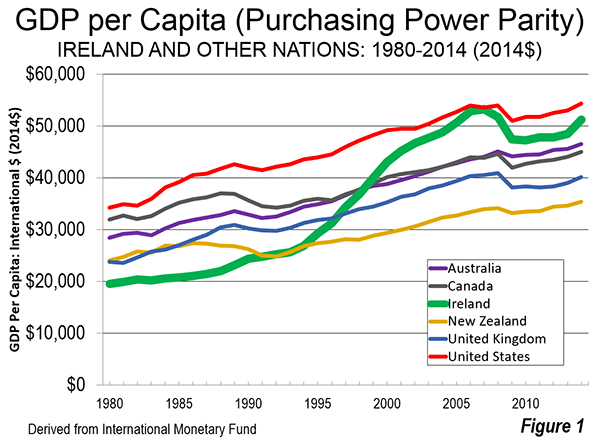
    Ireland suffered one of the worst economic reversals of any nation during the Great Financial Crisis. This had been preceded by Ireland’s impressive economic advance, which had the nation registering a higher gross domestic product per capita-purchasing power parity (GDP-PPP) than even its former colonial overlord, the United Kingdom. Anyone who had predicted in 1960 that Ireland would be more prosperous than the United Kingdom would have been summarily dismissed.

    But the Great Financial Crisis brought an 11.3 percent reduction in GDP-PPP to Ireland between 2006 and 2010. This was nearly double the reduction in the United Kingdom (6.0 percent). The loss was nearly three times the peak to trough decline in the United States (4.0 percent). Unemployment reached above 15 percent and Ireland required bail-out loans totaling €67.5 billion ($75 billion or C$95 billion) from the European Union and the International Monetary Fund.

    Happily, however, Ireland has struggled back and now has nearly reached its peak 2006 GDP-PPP. But as in the United States and elsewhere, restoration of previous levels of prosperity at the national level has not made whole many of the individual victims of the downturn (Figure 1).

    Urban Containment Policy and Higher House Prices

    In a previous Sunday Independent commentary, McCarthy noted asserted  Ireland’s land use regulations had been an important contributor to the housing bubble (see: “Urban Containment and the Housing Bubble in Ireland”).

    Ireland’s planning regulations have been copied and imported from the British Town and Country Planning Act of 1947, which have been largely responsible for the continuing and worsening housing crisis in the United Kingdom. In Ireland, as in the United Kingdom, these regulations deny planning permission to suburban locations. McCarthy attributes the "dysfunctionality of the housing market" in Dublin to such land use restrictions, which are called "urban containment” as well as other terms (such as growth management, smart growth, livability, compact city policy, etc.).

    McCarthy notes that the housing shortage in Dublin is not caused by a lack of housing so much as it is by restrictions imposed by planners (planning permission), which slows the pace of home building. This policy environment drives house prices up, which reduces household discretionary incomes and results in a lower standard of living than would have occurred without urban containment.

    Urban Growth Boundaries

    As elsewhere, Ireland’s urban containment policies seek to minimize the urban footprint (urban land area) by rationing land for housing development, often by urban growth boundaries. Urban growth boundaries come in various forms, such as lines around cities that forbid new urban residential development on the outside, euphemistic "growth areas," usually small and  inadequate, outside of which building is not permitted. This includes the apparent intention very difficult to build new detached housing on the urban fringes in California metropolitan areas, with a strong policy preference for high density, transit oriented development. Urban growth boundaries may be urban containment’s "killer app."

    The problem is that restricting the supply of any good or service (such as land for housing) leads to higher prices as demand swamps supply (other things being equal). A similar relationship between supply restrictions and higher prices can be seen in the fluctuating price of oil, based especially on OPEC production decisions, the large increases in banana prices in Australia, when periodic cyclones produce shortates by devastating crops.

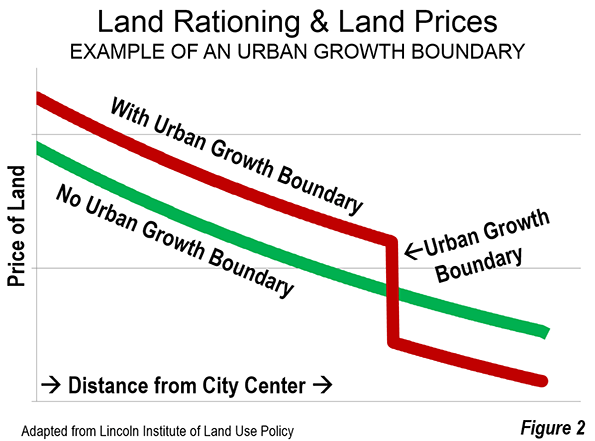
    Urban growth boundaries and related land rationing strategies are associated with huge price differentials between land that may or may not be developed. In Auckland and Portland, virtual “across the street” land values vary on average by 10 or more times at the urban growth boundary. In the United Kingdom, differences of hundreds of times have been cited in the UK by London School of Economics researchers Paul Cheshire, Max Nathan and Henry Overman. The impact of urban growth boundaries on land within a metropolitan area is illustrated in Figure 2. The theoretical economic relationship is that land prices are forced higher within the urban growth boundary, while declining to the outside, where development is severely restricted (other things being equal, with the assumption that the urban growth boundary is “binding,” or strongly enforced).

    Not surprisingly, urban growth boundaries are the most common feature of the severely unaffordable housing markets (where the median multiple exceeds 5,0) in the 12 annual editions of the Demographia International Housing Affordability Survey.

    The Next Housing Bubble?

    McCarthy details rising land and house prices in the Dublin area that have largely driven first time home buyers out of the Dublin area. Many are being forced to buy housing that is affordable 70 to 80 kilometers (35 to 40 miles) away. This requires “a daily commute of up to two hours through the vacant countryside. “McCarthy refers to the "huge rolling prairies of land that can be found north and west of the ring road” (The M-50 belt route) on which new housing could be built as close as 10 to 12 km from the city center (6 to 7 miles).

    The locations McCarthy refers to could easily shelter households in less expensive housing, without the necessity of long commutes, producing, ironically, perhaps  less of the dreaded “sprawl”.

    Not surprisingly, rents in Dublin are now reported to be higher than at the peak of the property bubble. Further, the problem is spreading to other parts of the country. In Cork, with its burgeoning information technology growth, with firms like Apple and Pay Pal, there are concerns that the shortage of housing could limit further business expansion.

    Needed Reform

    A Dublin and an Ireland interested in not repeating the devastating economics of a decade ago would be wise to heed economist McCarthy’s advice. He calls for cheaper housing, which requires “the zoning for residential development of the very large volume of derelict and undeveloped land in the Dublin area.” Ireland’s middle-class needs more jobs, but it also needs lower house prices to maintain its affluence.

    Photograph: Dublin by Barcex (Own work) [CC BY-SA 3.0], via Wikimedia Commons

    Wendell Cox is principal of Demographia, an international pubilc policy and demographics firm. He is a Senior Fellow of the Center for Opportunity Urbanism (US), Senior Fellow for Housing Affordability and Municipal Policy for the Frontier Centre for Public Policy (Canada), and a member of the Board of Advisors of the Center for Demographics and Policy at Chapman University (California). He is co-author of the “Demographia International Housing Affordability Survey” and author of “Demographia World Urban Areas” and “War on the Dream: How Anti-Sprawl Policy Threatens the Quality of Life.” He was appointed to three terms on the Los Angeles County Transportation Commission, where he served with the leading city and county leadership as the only non-elected member. He served as a visiting professor at the Conservatoire National des Arts et Metiers, a national university in Paris.

  • Health and Class

    Late last year, economists Anne Case and Angus Deaton published a paper in the Proceedings of the National Academy of Science documenting the rising morbidity and mortality in mid-life white men and women in America, especially for those with a high school degree or less.  They attributed this increase, a reversal of historic trends, to an epidemic of alcoholism, other drug use disorders, and suicide. Their findings are a wake up call for the US. Not only is something seriously wrong — it’s getting worse.

    As a community psychiatrist (that is, one who works in the community providing publicly funded care) in Pittsburgh, I was not at all shocked to read the paper and the several others that followed and found essentially the same thing.  Working both in inner city black Pittsburgh and the more racially mixed Mon Valley, the primary site of Pittsburgh’s once vaunted steel mills, I have seen twenty years of increasing psychiatric burden and disability with what seemed to be a marked increase in mortality — all linked to increasingly fragmented, chaotic families, extraordinary work instability, trauma, violence, and alcohol and substance use.  While human services and health care were clearly in the picture in the lives of many (health care increasingly so with the Affordable Care Act), other critical institutions — steady work, solid education, high qualify day care, stable housing, organized communities – seemed to be less present, casualties of deindustrialization and neighborhood decline.  With the economic collapse of 2008 and the rise of the opiate epidemic, conditions have felt like they are in free fall, with tattered individuals and the remnants of families struggling to hang on.

    My day-to-day job is to do what I can to help people find ways to overcome their distress and rediscover their capacities and capabilities to find a way forward. Of course, I don’t do this alone. It requires a team effort to help suffering people recover and manage their illnesses and organize the resources they need to put a life together.  We have some resources to do this, such as the ACA’s expansion of Medicaid in Pennsylvania.  But still the observation of Julian Tudor Hart, a renowned British physician working among the miners in Wales, rings true: the people with the greatest need generally have the least access to resources. Hart called this the “Inverse Care Law.”

    For a long time and to this day, this has been the American approach to health care, though the ACA does a bit to address it.  Given this, some Americans may assume that the recent increase in mortality among white folks reflects a lack of access to needed care.

    The work of two other Brits, Thomas McKeown and Michael Marmot reveals the inadequacy of this belief.  McKeown made the trenchant observation that it wasn’t health care that made people healthy, but rather the conditions in which they lived. Marmot pressed this observation and, in a series of famous studies of civil servants in the British Government, found that health status was tied in a step-wise fashion with class.  Poor working-class people had worse health then their middle-class colleagues who in turn were less healthy than the highly paid executives.  These findings created a fire storm around the world, but some thirty years later, the idea has finally begun to find its way to the US in the form a focus on the “social determinants of health.” Where people live, their income, the resources available to them, the web of social relationships they experience, all come under this rubric. Health isn’t just about people’s lifestyle — whether they smoke or drink — or about their access to health care. It is fundamentally about the kinds of lives people live and how they are socially structured. Health is profoundly ecological– it reflects the social habitat and physical environment people live in.

    This new focus permits us to say that what’s happening to the health and well-being of poor white folks is clear evidence that the life worlds and social circumstances of their lives are falling apart.  Their social habitat is strained, and the strain is showing up in a looming body count.

    We could do more to make it easier for people to access the resources they need beyond health care and by tapping into their capabilities and capacities to find ways to flourish.  Steps in this direction include concepts like the “medical home”, an expanded version of accessible team- based primary health care that focuses on people’s well-being over the life course, providing preventive and clinical services, promoting health and connecting people to the resources needed for healthy living. In psychiatry, the recognition that people with psychiatric challenges have untapped capacities to recover — to find meaningful ways to live — is reshaping clinical approaches so they connect with and build on those capabilities. These innovations are all good, but they are woefully insufficient given the scale and scope of what the nation faces.

    To achieve what we need to achieve, our society needs to move the conversation about health and well-being upstream, away from a focus on health care alone, and link health and health care with general social policy.  The moves towards “the social determinants and processes of health,” “health in all policy,” “population health,” and “health impact assessments,” backed by a politics of social inclusion, are the ways forward to achieve health and social equity.

    The country we create determines the patterns of life and death of the people who live here. It’s not a job just for doctors and other health care providers. We are all stewards of the health of the people of this country. Increasing numbers of people won’t thrive and will die young until we fully embrace this responsibility.

    This piece first appeared in Working Class Perspectives.

    Kenneth S. Thompson MD is a public service community psychiatrist in Pittsburgh whose career has been focused on improving psychiatric care and achieving health equity.

    Ambulance photo CC BY-SA 2.5, https://commons.wikimedia.org/w/index.php?curid=678067