Blog

  • Toward a Science of Cities: “The Atlas of Urban Expansion”

    New York University Professor Shlomo Angel and his colleagues (Alejandro M. Blei, Jason Parent, Patrick Lamson-Hall, and Nicolás Galarza Sánchez, with Daniel L. Civco, Rachel Qian Lei, and Kevin Thom) have produced the Atlas of Urban Expansion: 2016 edition, which represents the most detailed available spatial analysis of world urbanization, relying on a sample of 200 urban areas. It was published jointly United Nations Habitat, New York University, and the Lincoln Institute of Land Policy and released in conjunction with the Habitat III conference in Quito. The Atlas follows the publication of Angel’s Planet of Cities, published by the Lincoln Institute of Land Policy which was reviewed in New Geography in A Planet of People: Angel’s Planet of Cities.

    In his Foreword, Joan Clos, Under-Secretary-General, United Nations and UN-Habitat Executive Director Joan Clos describes the Atlas findings as “quite shocking.” Indeed, for urban planners and others who have been misled into believing that the cities of the world are becoming denser as they grow larger, the message of the Atlas should be a “wake-up call.”

    In his Foreword, Professor Angel notes that: “The anti-sprawl agenda—decrying unplanned, low density, fragmented and non-compact urban expansion—has been guiding city planners for decades and we now find that the majority of cities have adopted land use plans that seek to contain their outward expansion in one form or another.” The clear message is an inconvenient truth that despite such planning, urban areas have continued to expand spatially faster than they had added population. Worldwide urban densities continue to drop virtually without regard their relative affluence or poverty.

    Under-Secretary-General Clos describes the purpose of the Atlas as: “to provide informed analyses to policy makers, public officials, research administrators, and scientists for use in their decision-making processes. In this sense, the Atlas of Urban Expansion is part of the emerging ‘science of policy’ that is dedicated to the production of knowledge that best serves the public interest.” Obviously, that is a laudable goal and improving cities — which at a minimum requires both improving affluence and reducing poverty — should design their policies to achieve these objectives.

    The Atlas shows that the densities of urban areas have been dropping 1.5 percent annually over the past 25 years in more developed countries. The decline in density has been even greater, 2.1 percent, in less developed countries, which is where the vast majority of urban growth is taking place. The Atlas predicts that this trend will generally continue.

    These trends are likely to continue in one form or another. Between 2015 and 2050, urban extents in more developed countries can be expected to increase by a factor of 1.9 at the current rate of increase in land consumption, by a factor of 1.5 at half the current rate, and by a factor of 1.1 if land consumption per capita remains constant over time. During this period, urban extents in less developed countries will increase by a factor of 3.7 at the current rate of increase in land consumption, by a factor of 2.5 at half the current rate, and by a factor of 1.8 if land consumption remains constant.

    The Atlas has data that will not be found anywhere else, as it delves deep into the fabric of the urban area sample. There is data for each of the urban areas on each of these measures (too detailed for examination here): fragmentation, compactness, infill development and “leap frog” development.

    Some of the individual urban area density trends over the past 25 years are particularly shocking. For example:

          • Guangzhou, China (which includes the urbanization of huge Foshan) is now 10 times its 1990       population, yet has experienced an urban density decline of about 75 percent.

          • Seoul has added more than a third to its population, yet its urban density has dropped by       more than 50 percent.

          • Bangkok‘s urban population density dropped by one-third, even as the population more than       doubled.

          • Budapest and Warsaw have seen their urban densities decline by more than 40 percent.

          • Tokyo, Paris, Tehran, and New York have experienced urban density reductions of at least 20       percent.

          • Mumbai, still the fourth highest urban density in the sample, has dropped more than 10       percent, as have Santiago, Chile and Buenos Aires. Since the 1947 census, virtually all       population growth in Buenos Aires has been suburban (outside the core city of Buenos Aires).

          • Curitiba, Brazil, which has received at least as much international acclaim from urban       planners for its model policies as Portland, has seen its population density drop one third in the       last 25 years. Still, Curitiba’s urban density is nearly triple that of sprawling Portland (which       ranks 189 the out of 200 in urban density, see Note 1).

    One of the exceptions to the falling density “rule of thumb” is Dhaka, which the Atlas shows as having the highest density of any urban area (Note 2). Dhaka’s urban density has risen three percent over the last 25 years, as much of the additional population has been housed in low-rise, unhealthful shantytowns (see: The Evolving Urban Form: Dhaka), where densities are reported to be as high as 2.5 million per square mile or 1 million per square kilometer (photograph above). This is 35 times the 70,000 per square mile density of Manhattan (27,000 per square kilometer) in 2010.

    As the Atlas puts it: “When cities grow in population and wealth they expand. As cities expand, they need to convert and prepare lands for urban use. Stated as a broad policy goal, cities need adequate lands to accommodate their growing populations and these lands need to be affordable, properly serviced, and accessible to jobs to be of optimum use to their inhabitants.” The concern of the Atlas is that this urban expansion be well managed.

    Regrettably, this would be at considerable odds with the distortion of land markets and destruction of housing affordability (and the standard of living) associated with urban containment policy. The favored planning approach flies in the face of economic reality (See: People Rather than Places: Ends Rather than Means: LSE Economists on Urban Containment and A Question of Values: Middle – Income Housing Affordability and Urban Containment Policy).

    As The Economist has pointed out, suburbanization (pejoratively called urban sprawl) can be stopped only forcibly, “But the consequences of doing that are severe.” Urban residents can only hope for a future of policies fashioned from reality rather than dogma.

    Note 1: Portland’s urban density lower than that of 94 of the 200 urban areas in the Atlas sample. This is nearly the same as its the ranking in Demographia World Urban Areas, where Portland’s urban density is lower than that of 93 percent out of more than 1000. Demographia World Urban Areas provides population, urban land area and urban population density for the more than 1000 identified with 500,000 or more population.

    Note 2: Dhaka is also shown to be the highest density urban area in Demographia World Urban Areas, which provides population, urban land area and urban population density for the more than 1000 identified with 500,000 or more population.

    Wendell Cox is principal of Demographia, an international public policy and demographics firm. He is a Senior Fellow of the Center for Opportunity Urbanism (US), Senior Fellow for Housing Affordability and Municipal Policy for the Frontier Centre for Public Policy (Canada), and a member of the Board of Advisors of the Center for Demographics and Policy at Chapman University (California). He is co-author of the “Demographia International Housing Affordability Survey” and author of “Demographia World Urban Areas” and “War on the Dream: How Anti-Sprawl Policy Threatens the Quality of Life.” He was appointed to three terms on the Los Angeles County Transportation Commission, where he served with the leading city and county leadership as the only non-elected member. He served as a visiting professor at the Conservatoire National des Arts et Metiers, a national university in Paris.

    Photograph: In a Dhaka shantytown (by author).
  • Millennials Yesterday and Today

    Every generation seems to be lionized by the press with the observation that the values of the new group are not that of their parents, thank goodness. They don’t have the serious hunger for possessions, the terrible acquisitiveness for material things that define their parents’ generation. Rather, as seen by the reporter, they have loftier views of society, generally the views of the reporter or the views that the reporter wishes to have us believe they hold. One recalls how the baby boomers were “not like us”. They were going to live on the land somewhere in the high sierras making sandals and candles. Some years later when it was revealed that the Pentagon was paying two thousand dollars for special toilet seats, the question among boomers was in what colors were they available.

    Today much has been made of the sharply varying characteristics of the Millennial generation. During the recession and its prolonged twilight recovery we had to keep asking: “is it really a structural change we are seeing or just cyclical?” We have found in most cases when some see harbingers of dramatic changes in societal values it is often just economic realities at work. Wait for the data is a great admonition in such cases.

    A recent Current Population Report from the Census Bureau sheds considerable light on the topic. The powerful tool employed compares young adults in 1975 to those in 2016 roughly 40 years apart. The overarching observation is that the younger working age generation today appears to place more emphasis on two of the four markers of adulthood – education and a job – before the other recognized attributes of adulthood such as living separate from parents and family formation. Economic security appears to be the dominant driver of behavior. Given that they were exposed to a weaker economy than their forebears– wealth lost, jobs lost, college debt, home values and investments declining – it seems a very realistic strategy.

    Some of the contrasts with the past are stark:

    • Of the four markers of adulthood 45% of the young adults in 1975 had those attributes; by 2016 it had fallen to 24%. In 2005 those markers were the predominant living arrangement in 35 states; by 2015 only a decade later, post-recession, the number of states with most of young living independently dropped to just 6.

    • More young adults today, 18 to 34, are living with parents than with a spouse.

    • More than half of younger millennials, 18-24, live in their parent’s home.

    • Fewer than two-thirds of older millennials, 25-34, live independently.

    • One in four of the 25-34 group are neither in school nor working.

    Many of these attributes seem to be cases of full societal participation delayed, rather than dismissed. The report finds marriage levels are about the same by age 40 between the current and the past 1975 generation. The difference is, if you will, delayed adolescence. About 80% of young persons were married by the age of 30 in 1975 the same percentage today isn’t reached until age 45.

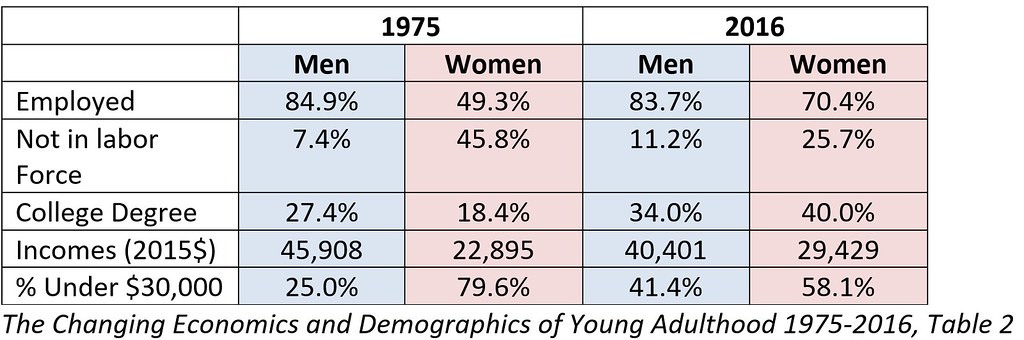
    What is dramatically revealed in the document are the sharp divergences between the trends among men and women in the period. Young women are seeing significant economic gains today in contrast to 1975 while men have experienced limited progress, or even decline. Some of the contrasting experiences are summarized in the table below:

    Characteristics of Young Adults Aged 25-34

    There are really three stories here: the rising circumstances of women; the very limited improvements, if any, among men; and the dramatic contrasts between the groups over time.

    • Women out of the labor force have declined from 46% to 26%. Men out of the labor force have grown from 7% to 11%.

    • Women have risen from about 50% participation in the labor force to almost 75%, with 40% with college degrees today vs 18% in 1975, and with incomes shifting out of the lowest income categories and overall incomes rising significantly.

    • Among young men, aged 25 to 34, in 1975, 25% had incomes below $30,000 per year, in 2016 dollars, rising to 41% below $30,000 in 2016. The percentage of men with college degrees has risen somewhat from 27% to 34%, but most significantly, incomes on a constant dollar basis have declined about 10%. Note also that women in the age group now have a greater share with college degrees than men; 40% vs 34%.

    • Importantly, a substantial share of women has left the lowest income group while a similarly significant share of men has joined it.

    • With all these gains, women’s incomes are still below men’s, substantially because women have moved from lower into middle income categories but not yet joined the higher income levels.

    Are these changes economically based or values driven? The massive economic pressures on young males would have immense explanatory power. Their delayed ownership of vehicles, the postponement of separate living seems a rational response to their circumstances. Maybe rather than criticizing them, they should be appreciated today for exercising good judgment.

    At the same time, the value changes recognized in the Census study seem to say that the measure of adulthood today emphasizes having completed one’s education and having obtained some degree of job security. These appear to come first, driven perhaps by the harsh realities of the last decade’s job environment which explains the delays in two factors historically linked to adulthood: living separately from parents; and marriage. These are now pushed into secondary, later stages in the life cycle.

    Going forward the societal implications of these new patterns may be more significant than reporters ever estimated. Delayed job experience and exposure to the work environment may affect the job prospects of many and generate societal losses in skilled workers crucial to national productivity. As mates and parents their delayed relationships will be different than their parents’ world with impacts we can only guess at in terms of their relationships to each other, their children, and the greater society.

    Alan E. Pisarski is the author of the long running Commuting in America series. A consultant in travel behavior issues and public policy, he frequently testifies before the Houses of the Congress and advises States on their investment and policy requirements.

    Photo: ITU Pictures, via Flickr, using CC License.

  • Columbus, Ohio Is Stuck in Branding Neutral

    Columbus, Ohio is a Midwest city that has really turned it on in the last few years. It is a big economic and demographic success story in the region. Having recently crossed over to reach the two million threshold in population, the region is expecting as many as another million people by 2050. The city is basically rocking and rolling by Midwest standards.

    The Columbus Dispatch has been doing a major, multi-month series on Columbus’ future called CbusNEXT. One of the featured pieces was a look at Columbus’ brand called “Does Columbus have an identity crisis?

    For better or for worse, Columbus has had its share of reputations. It’s known for being the seat of state power, the capital city where Ohio’s legislative sausage is made. And, of course, much of Columbus’ notoriety comes from that little university of more than 66,000 students and its powerhouse football team. There’s been some name-calling through the years, too. Columbus has been called a “Cowtown” on more than one occasion. Meh, sticks and stones.

    But other than its status as a capital city and the home of Ohio State University, Columbus “has not developed a persistent and consistent identity” over the years, said Ed Lentz, local historian and executive director of the Columbus Landmarks Foundation.

    Columbus has been seen as neither good nor bad, according to studies conducted over the past two decades, said Amy Tillinghast, vice president of marketing for Experience Columbus. “We heard it all the time,” she said. ”‘Oh, it’s vanilla. It’s neither good nor bad. Just very bland.’” But city leaders, tourism officials and economic development proponents have been working to shed that vanilla image, to spread the word about what they think makes Columbus great.

    The Dispatch also has a revealing 15 minute podcast on the topic.

    What I find most telling about this is that an article written in 2017 is basically the same as one from the New York Times in 2010.

    Quick, what do you think about when you hear the words “Columbus, Ohio”? Still waiting. … And that’s the problem that civic leaders here hope to solve.

    This capital city in the middle of a state better known, fairly or not, for cornfields and rusting factories has a low cost of living, easy traffic and a comparatively robust economy. It variously has been pronounced to have the nation’s best zoo, best science museum and best public library. For sports fans, “Ohio State Buckeyes” says it all.

    What Columbus does not have, to the despair of its leaders, is an image. As home to major research centers, it has long outgrown its 1960s self-concept as a cow town, and its distinction as the birthplace of the Wendy’s hamburger chain does not quite do the trick these days. The city lacks a shorthand way to sell itself — a signature like the Big Apple or an intriguing tagline like Austin’s “Live Music Capital of the World.”

    In other words, Columbus has made no progress in understanding its identity or creating a marketplace brand in the last seven years.

    A few points jump out at me from the latest Dispatch piece that hit on things I’ve addressed before:

    • The Dispatch didn’t speak to a single person outside of Columbus. They allowed the heads of various local agencies to effectively filter the marketplace perspective on their city. For all its talk about being “smart and open”, this lack of any outside perspective reveals an insular mindset.

    • They are ashamed of historic identity markers such as Ohio State football and “Cowtown” even though these are the seeds of their most powerful potential identity in the market (cf: Nashville and country music).

    • They are playing buzzword bingo with how they want to be perceived in the marketplace: optimism, collaboration, art scene, research, LBGT, immigrants, beer, etc. The people saying these things don’t seem to realize that they are basically commodities today, at least in terms of civic self-perception. You’re not likely to get too many people from cities similar in size to Columbus to agree that Columbus is so much better on these points, certainly not as a package. They are all basically trying to pitch themselves to the market using virtually identical language.

    • They are afraid to take a stand in the marketplace. I was very pleased to see at least one person who was self-aware about this, saying, “It’s a very scary thing for a city to put a stake in the ground. It takes real vision to put a stake in the ground. You have to see past election cycles and those people that you alienate.”

    Until these points are addressed, I would not expect the city to make any progress on branding and identity. The fact that they haven’t done this in the last seven years prompts an important question:

    Does the city really want to have a strong identity in the market?

    Maybe not. That’s something to consider.

    The premise that Columbus lacks an identity seems suspect to me. It might not have a well-articulated identity, but it has one. The civic feel is radically different from Cleveland and Cincinnati. The differences are like a cold bucket of water in the face. I feel the differences even vs. somewhat similar cities like Indianapolis. So the identity is there. Maybe people just don’t want to face up to what it is.

    What’s more, it’s working in the marketplace. Whatever Columbus is and is doing, it’s working. So that’s great. So another question I might ask:

    Does Columbus actually need to articulate its brand or identity in order to succeed?

    Maybe not.

    It may well be that the city’s DNA is just not ideal for this kind of branding exercise. And it’s not like the city hasn’t gotten real input on this. I have written about this multiple times in the past, going back to 2010. See here, here, and here. I’ve also spoken to large audiences as the Columbus Metropolitan Club twice on this topic. The first one was in 2010. And here’s my talk from last year. If the video doesn’t display for you, click over to watch on You Tube.

    But the city isn’t doing anything with it, neither with my insights nor anyone else’s. In this, Columbus’ profile is similar to other Midwest cities, which embrace trends when they are rendered safe to do so. Perhaps this is one reason why it’s the nation’s leading test market. If Columbus embraces it, then it’s ready for the mass market. Otherwise, nope.

    Again, I’m bullish in Columbus and its future. I’ve been writing positive things about it since at least 2009. But when you’ve been trying to make progress on your identity and branding for seven years and are spinning your wheels, maybe its time to take a serious gut check on the project and make some changes.

    This piece originally appeared on Urbanophile.

    Aaron M. Renn is a senior fellow at the Manhattan Institute, a contributing editor of City Journal, and an economic development columnist for Governing magazine. He focuses on ways to help America’s cities thrive in an ever more complex, competitive, globalized, and diverse twenty-first century. During Renn’s 15-year career in management and technology consulting, he was a partner at Accenture and held several technology strategy roles and directed multimillion-dollar global technology implementations. He has contributed to The Guardian, Forbes.com, and numerous other publications. Renn holds a B.S. from Indiana University, where he coauthored an early social-networking platform in 1991.

    Photo: Stephen Wolfe, via Flickr, using CC License.

  • California Politicians Not Serious About Fixing Housing Crisis

    California’s political leaders, having ignored and even abetted our housing shortage, now pretend that they will “solve it.” Don’t bet on it.

    Their big ideas include a $4 billion housing subsidy bond and the stripping away of local control over zoning, and mandating densification of already developed areas. None of these steps addresses the fundamental causes for California’s housing crisis. Today, barely 29 percent of California households, notes the California Association of Realtors, can afford a median-priced house; in 2012, it was 56 percent.

    At the heart of the problem lie “urban containment” policies that impose “urban growth boundaries” to restrict — or even prohibit — new suburban detached housing tracts from being built on greenfield land. Given the strong demand for single-family homes, it is no surprise that prices have soared.

    Before these policies were widely adopted, housing prices in California had about the same relationship to incomes as in other parts of the country. Today, prices in places like Los Angeles, the Bay Area and Orange County are two to three times as high, adjusted for incomes, as in less-regulated states. Even in the once affordable Inland Empire, housing prices are nearing double that of most other areas, closing off one of the last remaining alternatives for middle- and working-class families.

    How did we get here?

    Largely in response to regulatory constraints, the state has been underproducing housing since the 1970s. So far this year, Los Angeles, the nation’s second-largest metropolitan region, has produced fewer homes than much smaller areas like Dallas-Fort Worth, Houston and Atlanta.

    The California Environmental Quality Act and other laws and restrictions have helped to make building the number of houses needed by California’s middle-income families unattainable. The state’s more recent draconian climate change policies are also making the building of more affordable homes, usually on the fringe of urban areas, almost impossible.

    Some developers and planners blame much of the problem on NIMBYs, or “not in my backyard” activists, who oppose high-density development in their communities. NIMBYism, often aligned with green policies, is part of the problem, but high-density housing is expensive, and there are not enough people looking for “micro-apartments” to solve the affordability crisis.

    Indeed, housing in buildings of more than five stories requires rents approximately two-and-a-half times those from the development of garden apartments, notes Gerard Mildner, academic director of the Center for Real Estate at Portland State University. In the San Francisco Bay Area, the cost of townhouse development per square foot can double that of detached houses (excluding land costs), and units in high-rise condominium buildings can cost up to seven-and-a-half times as much.

    Longtime San Francisco journalist Tim Redmond points out that luxury apartments tend to replace the often more affordable older buildings in urban neighborhoods. There’s been a gusher of high-rises built in places like San Francisco or Los Angeles, but these are generally very expensive, and have not discernibly lowered prices.

    Read the entire piece at The Orange County Register.

    Joel Kotkin is executive editor of NewGeography.com. He is the Roger Hobbs Distinguished Fellow in Urban Studies at Chapman University and executive director of the Houston-based Center for Opportunity Urbanism. His newest book is The Human City: Urbanism for the rest of us. He is also author of The New Class ConflictThe City: A Global History, and The Next Hundred Million: America in 2050. He lives in Orange County, CA.

    Wendell Cox is principal of Demographia, an international public policy and demographics firm. He is a Senior Fellow of the Center for Opportunity Urbanism (US), Senior Fellow for Housing Affordability and Municipal Policy for the Frontier Centre for Public Policy (Canada), and a member of the Board of Advisors of the Center for Demographics and Policy at Chapman University (California). He is co-author of the “Demographia International Housing Affordability Survey” and author of “Demographia World Urban Areas” and “War on the Dream: How Anti-Sprawl Policy Threatens the Quality of Life.” He was appointed to three terms on the Los Angeles County Transportation Commission, where he served with the leading city and county leadership as the only non-elected member. He served as a visiting professor at the Conservatoire National des Arts et Metiers, a national university in Paris.

    Photo credit: refundrealestate.com

  • The South’s Big Cities Moment

    August’s tragic events in Charlottesville kickstarted a somber debate about the appropriate way to commemorate the war that gave all Americans their freedom. It also triggered a conversation about whether the south’s legacy of rebellion and independence – with slavery a painful and regretful part of its past – is a legacy worth remembering.

    These discomforting conversations are a reminder that the south’s antebellum past continues to affect it in the present. Beyond civil rights, these impacts are profoundly felt in the south’s continuing urbanization, which is among the most rapid in the country despite occurring largely within the frameworks of cities whose prewar, pre-industrial bones were never suited for the “big city” qualities filled by their northern cousins. Today’s globally-connected southern cities grew largely from antebellum-era towns that were not the commercial or industrial powerhouses of the past, and yet they are growing dramatically anyway.

    The result is a murmuring culture war about the future of southern cities. The media may be fixated on statues, but the real issue is how these cities – thanks to a variety of historical and developmental factors that differentiate them from those in the north – are growing in ways that may not appeal to many planners and local boosters.

    Many of the south’s transformations have been enviable and measurable: between 2000 and 2012 most large southern metro grew by at least 20 percent, with some like Charlotte and Austin growing at more than twice that rate. Since air conditioning became a norm rather than an exception, growth has trended toward warmer climates, with half of America’s population growth in the last 50 years going to the eight states with the warmest climates. Southern cities have been particularly successful in attracting black families, a declining demographic in nearly every large northern city. They have by and large remained affordable, and continue to be attractive relocation destinations for big companies: metro Atlanta, for instance, is now home to more Fortune 1000 companies than vaunted San Francisco.

    The result is a set of increasingly economically significant and connected large cities with ever-larger suburbs and de-centralized economic gravity. Compared to northern cities, southern ones are less urban, less clustered, and less tall, on average with about half the number of skyscrapers per capita as major northern cities, based on data available from Emporis.com. This dispersion reflects their expanding ethnic diversity. Counties that were once entirely rural are now increasingly suburban, and attractive to minorities and immigrants. Georgia’s recent 6th District election in 2017 and Hillary Clinton’s victory in Fort Bend outside Houston reflects this unpredictable new southern political world.

    Planners have celebrated the urban revitalization in many large existing cities in the north, but largely have been less enthusiastic about this continued growth of sprawling cities in the south. In turn, they have sought increasingly to steer their growth in a more traditional northern pattern. Foremost among the goals of these planners is to densify and re-orient these cities around downtowns that have generally never embodied a strong urban character. This has created a number of awkward dualities: the push for walkability in places that have never before been walkable; the push for rail in cities where the density doesn’t support it; and the push for outdoor living in cities where being outside is uncomfortable for much of the year. This push for glassy Chicago-style downtowns does not always come naturally to cities whose strongest urban legacy is that of sleepy tree-lined Georgian mansions, and it has forced cities from Charlotte to Charleston to contemplate what kind of cities they want to be in the future.

    Conventional urban planning is simply not well-suited to the south’s dynamic new urban environments. New urbanism, for instance, while influential in the south, has made its name through quaint town making largely in the suburbs. Typical urban approaches like the repurposing of downtowns back into modern reinventions of what they once were – do not reflect the development, demographic, infrastructural, or character-driven challenges of cites without urban or industrial legacies.

    Now, the south has begun inventing its own new brand of experimental urban development, often heavily fueled by the private sector. In Atlanta, for instance, the public-private development of the Battery and Sun Trust Park is a public-private typology virtually unimaginable in the north. Boldly, the Atlanta Braves major league baseball team uprooted from its perfectly acceptable downtown home to move closer to its suburban fan base; a county without a discernible center delivered on much of the financing, and worked with the Braves to develop, from scratch, an entire new ballpark-oriented urban district to compete with downtown Atlanta and help fund both the cultural evolution and the cash flows needed to sustain the ballpark.

    The Battery was a form of urbanization and regional re-positioning delivered through a single project. Rather than a renewed focus on the urban core through adaptive reuse and infill, all gospel to planners in the north, metro Atlanta has shaped its own new downtown at a convenient juncture in the sprawl. These kinds of large-format development projects that create their own energy and introduce their own anchors are a hallmark of southern city-making, and build upon the “edge cities” idea first extensively written about by Joel Garreau in the early 1990s.

    The most impressive forms of project-driven development have been those where private developers have taken on urbanization efforts too massive for governments. In Florida and Texas, for instance, private developers are trying to implement high-speed rail lines by leveraging potential profits from real estate development around stations as part of the funding package. And Sandy Springs, Georgia received abundant attention in 2012 when it became a “contract city”, the ultimate privatization experiment when it bid out nearly all of its city services to outside contractors. By relying on private industry to take on these kinds of complex development and governance projects, southern cities are trying to avoid the government boondoggles as well as budget and debt ceiling shortfalls many northern cities face. In turn, however, those delivering on the projects have tremendous power over the formation of these cities, while urbanization is rarely happening according to plan.

    Acknowledging the power of these leaps and bounds innovations, some cities are trying to better channel the urbanization through example projects designed to inspire the private sector to develop in a more organized way. In Raleigh, for instance, the development market has been slow to deliver on high-quality urban projects, so in response the City is taking on the challenge itself: its own new City Hall campus may end up being the most powerful piece of modern architecture in the city. In turn, it is hoped to have catalytic potential to induce dramatic change across a downtown smattered with low-rise buildings. In many such cities, there is an underlying belief that channeling the pent-up private development market toward areas where land values are already the highest will maximize tax revenues and fiscal stability, and improve those cities’ urban qualities. Whether it’s a strategy with staying power is yet to be seen.

    There is no rulebook for how urban change is occurring in the south, but there is no doubt it is occurring more rapidly there. The universal themes in southern city-making today are diversification and creativity, ideas imbuing innovation that would be unlikely if they borrowed conventional approaches verbatim from the north. This new creativity on behalf of big steps and bold visions belies many recommendations from nationally-focused planners toward government consolidation and the belief that all new good things must happen through incremental steps in traditional downtowns. Perhaps this new form of southern rebellion will have staying power; much better, and better for its citizens, than the last one.

    Roger Weber is a city planner specializing in global urban and industrial strategies, urban design, zoning, and real estate. He leads the Urban Policy Practice Area for Skidmore, Owings & Merrill’s City Design Practice and holds a Master’s degree from the Harvard Graduate School of Design. Research interests include urban finance, demographics, architecture, housing, and land use.

    Photo: Thomson200 [CC0], via Wikimedia Commons

  • Amazon’s HQ2 Is a Golden Opportunity for the Heartland

    The Wall Street Journal is reporting that Amazon is seeking bids for a second headquarters location that will be equal in size to its current Seattle base. (You can read their RFP here). It would ultimately employ 50,000 people in eight million square feet of office space at an average salary of over $100,000.

    This is going to be the feeding frenzy of the century.

    This seems to suggest that Amazon thinks they are about capped out in Seattle. To give a sense of Amazon’s place in Seattle, the Seattle Times recently labeled it “America’s biggest company town.” The company has over eight million square feet of office space and accounts for nearly 20% of the city’s total office space. They have a graphic that illustrates this. The next biggest footprint of any user in any city is Citi in New York with only about 3.7 million square feet. (Interestingly, Columbus, Ohio is in second place when it comes to being dominated by a single office user; Nationwide Insurance has 16% of the total market. It looks like these may be city, not regional totals).

    The impact of Amazon on Seattle has been huge. The pressure Amazon growth has put on things like housing availability and pricing is tough to measure, but surely huge. Amazon appears to have concluded that the city can’t take anymore.

    Seattle is the 15th largest metropolitan area in the US, with 3.8 million people. It’s also a highly attractive region with no trouble luring people to move there. So while Amazon says that they are open to metro areas of over a million people, realistically, if you want to be as big as Amazon is in Seattle toady, you probably need to be in a market as big as Seattle or bigger.

    50,000 is a huge number of workers, especially when they are high skill white collar ones. Very few cities could easily supply that labor force. Which ones might? Let’s game this out.

    Well, the usual coastal suspects probably can. But they have the problem of already having very high costs and hot labor markets for exactly the skills Amazon is seeking – and building restrictions that make growth hard. The Bay Area would be an obvious choice for an HQ, but can they really accommodate it? (A better question might be, do they want to)? I would suggest similar questions apply to Boston.

    Los Angeles/SoCal, New York, and Washington could accommodate an employer that big. Again, high costs, etc. But especially LA and NYC are so huge, they can do things other cities can’t. Washington is by its DNA a government town. It’s high tech, but a lot of that tech is government related.

    One intriguing option for Amazon would be Hudson Yards. Amazon is putting a huge premium on real estate in this RFP, and assuming they want an urban location, this is one that’s nearly pre-baked. Right now it’s only planned for six million square feet of office, with some of that already leased. But I would guess changes could be made and/or other real estate in the area added to the mix. Newark might be a dark horse here.

    What then are the other cities that could potentially compete. I see four strong contenders: Chicago, Dallas, Philadelphia, and Atlanta. (Houston is very energy focused and dealing with bigger problems right now. Miami and Phoenix are big enough, but could they attract the quantity of tech workers needed?) All of these are large markets with good air service. Chicago and Philly have genuine urban options with genuine urban transit. (I should note Amazon hasn’t ruled out a suburban location). All of them would surely clear the decks of any obstacles to construction, etc. All of them have much more affordable housing than coastal cities. All have an ability to draw college grads from a large footprint.

    I would expect these cities to bid aggressively. Dallas and Atlanta really don’t need Amazon, though they would surely want it. For Chicago and Philly this represents a transformational opportunity.

    Rahm Emanuel in Chicago says he’s already had conversations with Bezos. If I were making the choice, Chicago would be at the top of my list. It’s an established urban center a reasonably flight distance from Seattle (cf Boeing decision), with transit, a huge airline, etc. It’s also a slam dunk draw for every Big Ten school. You can bet that Illinois political dysfunction would mysteriously disappear to get a deal done here. One person says Amazon’s staunchly anti-union stance rules out Chicago. We’ll see, but Seattle has strong unions too, and unions are less applicable to a while collar workforce. Chicago has been looking for a transformational event, and this could be it.

    Possibly Amazon could also take a chance on scaling some smaller places, like Denver or Minneapolis. I expect everybody to be all over this. And yes, there will be huge government money on the table. Not even the most ardent anti-subsidy person out there is going to take a pass on this.

    To me this is a big test of the thesis that the coasts are capped out, which will force growth into the interior. If Amazon picks a big, established, high cost coastal center, that will tend to undercut it. We will see.

    This piece originally appeared on Urbanophile.

    Aaron M. Renn is a senior fellow at the Manhattan Institute, a contributing editor of City Journal, and an economic development columnist for Governing magazine. He focuses on ways to help America’s cities thrive in an ever more complex, competitive, globalized, and diverse twenty-first century. During Renn’s 15-year career in management and technology consulting, he was a partner at Accenture and held several technology strategy roles and directed multimillion-dollar global technology implementations. He has contributed to The Guardian, Forbes.com, and numerous other publications. Renn holds a B.S. from Indiana University, where he coauthored an early social-networking platform in 1991.

    Photo: Rober Scoble, CC BY 2.0

  • Hurricanes Don’t Kill Cities – People Do

    Cities that believe in themselves are hard to kill. In the aftermath of Hurricane Harvey many pundits have urged Houston to abandon many of the traits that have made it a dynamic, growing metropolis, including key elements of its light-handed, pro-business regulatory regime.

    Houston, we are told, should retrench and reduce its sprawl; Slate recommends New Orleans’ post-Katrina shrinkage as a model. This goes against the best of urban tradition. Great cities generally do not shrink themselves.

    Many cities have rebounded and even improved after far more lethal devastation, including London, Berlin, Tokyo and New York. After the Great Chicago Fire of 1871, the city ultimately constructed a downtown that may well be the world’s most beautiful. San Francisco famously rebuilt itself after the 1906 earthquake and fire into “a new and improved city” that has evolved into an integral part of the world’s dominant tech hub.

    In contrast cities that destroy themselves from within, like Detroit after the 1968 riots, and New Orleans before Katrina, can decline for decades.

    Urban resiliency requires two things: an ability to learn from experience and, per Northeastern University’s resiliency expert Daniel Aldrich, a commitment on the part of its residents to improve their city.

    Should Houston downsize?

    Unlike New York or New Orleans, Houston is not celebrated by the mainstream press or intellectuals; its residents have been portrayed as hypocritical religious fanatics and even neo-Nazis, despite living in what may well be America’s most diverse city.

    To many pundits, Houston’s problems are due to a lack of zoning and too much unregulated growth. Days after Hurricane Harvey hit, Quartz opined that “Houston’s flooding shows what happens when you ignore science and let developers run rampant.” The Guardian’s climate columnist George Monbiot even portrayed the event as a kind of payback for being the world capital of planet-destroying climate change.

    Few Houstonians are likely to embrace this interpretation of natural forces, or their own culpability. Longtime residents know that the Bayou City always has been prone to serious hurricanes and flooding due to its location along the Gulf, and Houston has shown an ability to deal with it.

    A 1935 flood caused proportionally much more severe damage on a much smaller city. Tropical storm Allison in 2001 led to significant hardening of infrastructure. Unlike New Orleans at the time of Katrina, many services in Houston, including police and fire, were ready for Harvey. Flood control, although clearly not up to the standards required by such a huge weather event, has been much improved. New developments are required to show how they can make up for the absorption lost, often with sophisticated drainage and storage techniques.

    Much blame for Harvey has been linked to development on the fringe, a major component of the region’s growth. Over an 18-year period, Houston lost about 25,000 acres of wetlands, which took away about 4 billion gallons of storm water detention capacity. In contrast Harvey dumped about 1 trillion gallons, meaning those wetlands could have only absorbed about 0.4% of Harvey’s deluge. Many flooded roads were consciously designed to hold storm water temporarily when there is nowhere for it to drain.

    To succeed, Houston, like any city, must adapt and bolster its defenses, particularly if such events become more common. This does not mean, as many suggest, that the region abandon its development-friendly policies. In contrast to claims of “wild west” regulation, many developments after Allison are required have better systems to handle downpours than older areas closer to the center. One friend notes that his 10 suburban shopping centers employed the most advanced methods for handling excess water and survived.

    Most of his projects’ first line of defense is made up of catch basins and stormwater lines in the parking lot which flow to a retention pond. The second line of defense is the retention pond. In the event the pond reaches capacity, the third line of defense is storm water backing up into storm drainage lines and ultimately ponding in the parking lot. These three defenses are very typical in newer developments, and many withstood the biblical flooding intact.

    Many others, either not up to code or built well before the new regulations, did not do so well. But on the whole, rather than prove the inadequacy of Houston model, as the New York Times Bret Stephens correctly noted, the region managed to survive a crisis with minimal, albeit tragic losses, that in other places would have cost thousands of lives.

    In the coming years, Houston surely will have to find ways to grow with less peril. But as both MIT’s Alan Berger and Houston’s Mayor Sylvester Tuner have noted, Harvey did not “punish” Houston for lax development. Houston has a planning system that is not the “wild west” but simply less bureaucratic and politicized. Its suburbs, notes the planning blog Strong towns, “are largely indistinguishable from the suburbs of any American city.” As Mayor Sylvester rejoined, if Houston had zoning, he would be presiding instead over a “flooded zoned city.”

    The zoning argument is, simply put, bogus. Cities in the area that were heavily zoned, like West University, or intensely planned like Sugarland, got hit as hard as more haphazard areas. Harvey, it turns out, was an equal opportunity devastator. Similarly, Sandy dropped barely one-third the rain from Harvey, yet overwhelmed a dense and very zoned area. New Orleans before Katrina was dense and zoned; a lot of good it did them.

    Nor, as many commentators suggest, can Houston’s supposedly enormous “sprawl” be the prime culprit. As demographer Wendell Cox points out the Houston urban area density at 3,000 per square mile, is 20 percent above metropolitan Boston (2,200), and Philadelphia (2,700) and not much less dense than that mecca of smart growth, Portland. Overall Houston ranks 18th in urban population density among the 53 metropolitan areas with more than a million residents, according to Census date.

    In contrast to its image as a paved over dystopia, Houston has more parkland and green space than most any other large city in America and ranks third overall to San Diego and Dallas in park acreage per capita. Rather than focus on urban form, Berger, himself a landscape architect who is co-director MIT’s Center for Advanced Urbanism, says this region really needs better and stricter building codes, such as the ones that saved my friend’s shopping centers. Others, like Rich Campanella at Tulane, suggests the best strategy for the Gulf cities should be to focus on building barrier islands along the coast, and improving often aged drainage systems.

    In the end, it’s the civic culture

    As we know from experience, storms, violent conquest and, in the case of Hiroshima, even nuclear weapons, cannot kill a city — only residents can do that. I saw this in Los Angeles, which in the early 1990s suffered a Pharaonic series of disasters — riots, fires, floods and a huge earthquake in 1994. The city rebuilt smartly after all of them, but only one, the 1992 riots, left a residual toll on the civic spirit, or led to an exodus of residents. Los Angeles may look spiffier than it did before the riots, but its enterprising spirit, and its allure to newcomers, never recovered fully.

    Internal collapse, the lack of a civic spirit, occurs most often when a city’s elite and its population no longer see a common future. Detroit’s 1967 riots created a morass that devastated the city for the next half century. Earlier on conflict between Boston Brahmins and the Irish under Mayor James Curley ushered in a period of stagnation that went from the 1920s to the late 1950s.

    More recently, Katrina revealed how a collapsed civic culture can make a disaster worse. Corrupt politicians, an ineffective business community and poor emergency services turned a Harvey-like natural disaster into a massive human one, with much greater loss of life. Some blame the city’s entrenched, often multi-generational lower-income population but perhaps more critical to failure was the city’s often elegantly appointed and comfortable upper echelon.

    In the decades before Katrina, as southern cities like Houston and Atlanta were burgeoning, New Orleans stagnated. Joel Garreau in his Nine Nations of North America described the Crescent City as a “marvelous collection of sleaziness and peeling paint.” The aristocracy enjoyed the city’s unparalleled culture while many ambitious people from its neighborhoods migrated elsewhere. Without a strong, engaged business community and middle class, there was little attempt to fix the infrastructure. This weak civic culture has left a city with huge economic challenges that a regenerated local business community is now gamely trying to address.

    Houston performed very differently during Harvey. Mayor Turner and the Harris County Judge, Ed Emmett, epitomized level-headed leadership. Gov. Abbot, unlike Louisiana’s dithering Gov. Kathleen Blanco, swung immediately to action. Local volunteers pitched in, so much so, notes Houston-based analyst Tory Gattis, that many found themselves unable to participate because each Facebook call for help spurred more volunteers than could be accommodated. Houston can also count on something New Orleans lacked: a strong, and philanthropically inclined business establishment who are pouring millions into recovery efforts.

    Houston will come back, albeit with some modifications, not because it’s a charity case, but because its people want to stay and rebuild their neighborhoods. They have been putting their shoulders to the wheel personally, with special emphasis on those most in need; rather than rugged individualists they are, in the words of one prominent Houston businessperson “rugged communitarians.”

    In the coming months, Houstonians will seek aid from Washington, as all hard-hit areas do, but most understand that the challenge is basically for them to solve, whether through mutual self-help, or new infrastructure; their city is an engineering marvel that needs a new upgrade.

    Ultimately, the power of human agency at the grassroots level remains the “secret sauce” overcoming almost any disaster, whether it’s London, New York or Houston. Great cities are not about buildings but great people. By that standard, Houston will likely come back better than before, a testament to the greatness of the urban ideal.

    This piece originally appeared on Forbes.com.

    Joel Kotkin is executive editor of NewGeography.com. He is the Roger Hobbs Distinguished Fellow in Urban Studies at Chapman University and executive director of the Houston-based Center for Opportunity Urbanism. His newest book is The Human City: Urbanism for the rest of us. He is also author of The New Class ConflictThe City: A Global History, and The Next Hundred Million: America in 2050. He lives in Orange County, CA.

    Photo: Jill Carlson (jillcarlson.org) from Roman Forest, Texas, USA (Hurricane Harvey Flooding and Damage) [CC BY 2.0], via Wikimedia Commons

  • Spotlight on Infrastructure After Harvey

    The recent tragic events in Houston and across the Gulf Coast once again demonstrated the woeful inadequacy of our infrastructure. Hopefully, some good will come of Hurricane Harvey. Hopefully, it will jump-start the long-awaited Trump initiative on infrastructure, which may be the one issue that could unite this country.

    Northeastern University’s post-disaster resiliency expert Daniel Aldrich notes the need for better storm water drainage systems and for fortifying existing infrastructure — and not just in Houston. Helping promote such investments represents perhaps the last best chance for creating a significant Trump legacy.

    Once a leader in world infrastructure, the United States now ranks 11th in the overall quality of its infrastructure, according to the latest World Economic Forum Global Competitiveness Index. This decline has consequences. In California, for example, the lack of investment in water storage both worsened the recent drought and reduced the state’s ability to take advantage of heavy rains when they arrived.

    A concerted effort to restore our nation’s bridges, roads, harbors and other critical infrastructure would also mark a significant break from the Obama era stimulus which focused more on propping up renewable energy and often underused mass transit systems. Meanwhile, our overall infrastructure continued to deteriorate during the Great Recession, even with the stimulus, with spending in decline from over $300 billion in 2008 to under $250 billion in 2013.

    Spending Smartly

    “Efficiency is doing things right,” legendary management guru Peter F. Drucker once proclaimed. “Effectiveness is doing the right things.” In the context of infrastructure, being effective means placing our bets on things that are really needed, and could reward our society with greater productivity, wealth and new employment.

    At Newgeography.com, where I serve as executive editor, we recently carried a report from the Houston-based Center for Opportunity Urbanism,Doing the Right Things Right,” which lays out what an infrastructure strategy would look like given current budget constraints. The United States faces a national debt of $20 trillion, while the federal government deficit was projected to reach $693 billion for fiscal year 2017.

    A strong U.S. transportation infrastructure system facilitates economic growth, job creation, a better standard of living and less poverty by minimizing travel times and improving labor market efficiency. Yet, as “Doing the Right Things Right” makes clear, not all investments are the same, or should receive federal subsidies, whether for direct expenditures or to issue infrastructure bonds to support private investment. There have been too many examples of spending on lower priority infrastructure because politicians were more interested in securing pork, or votes, than accelerating economic growth or reducing constituents’ travel times.

    To be sure, America’s infrastructure has performed well enough to provide the highest standard of living for the largest number of people in the world. The legacy of earlier infrastructure decisions, such as the completion of the interstate highway system, is still evident. Overall, the amount of time America’s commuters spend in peak period traffic congestion is generally better than that of international competitors.

    Yet traffic problems are increasing in the nation’s largest metropolitan areas. A recent study found that traffic congestion imposed $132 billion in excess fuel and time costs for automobile drivers and $28 billion in freight costs annually — all ultimately absorbed by consumers.

    The key question is how we meet these challenges. One proposed solution is to increase spending on traditional mass transit. This works well largely in “legacy cities” such as Washington, Chicago, Boston, Philadelphia, San Francisco and New York. The city of New York alone represents a remarkable 36 percent of all U.S. transit commuting, yet has only 3 percent of the jobs. Outside of these cities, the new transit projects, principally rail lines, have done little or nothing, as a recent report on transit from Chapman University demonstrates, to slow congestion or attract significant ridership.

    Among 19 metropolitan areas that added high-capacity transit systems since 1980, both bus and rail, transit’s market share has fallen from 4.7 to 4.6 percent compared to the last data before the systems opened. Transit has not, on balance, reduced solo driving, which increased from an average of 73.0 percent to 76.6 percent.

    The cities with rail systems opening after the 1990 Census experienced a modest decline in transit work trip market share, from 3.8 percent in 1990 to 3.7 percent in 2013.

    Take the absurd example of Los Angeles, which has spent over $15 billion trying to become what some mass transit enthusiasts call the “next great transit city.” Yet, Los Angeles County Metropolitan Transportation Authority system ridership stands at least 15 percent below 1985 levels, when there was only bus service, at a time when the population of Los Angeles County was 20 percent lower. Since 1990, transit’s work trip market share in the Los Angeles metropolitan area has dropped from 5.6 percent to 5.1 percent. No surprise, then, that according to a recent USC study, the new lines have done little or nothing to lessen congestion.

    Doing Your Homework

    The irony is that billions are being spent on these ineffective systems, when the places that depend on transit, like New York and Washington, are seeing their systems become less reliable and even dangerous. We are dumping money in some locations that don’t work all that well, but can’t find funds to fix systems that remain essential to “legacy cities” with large downtowns ideal for transit ridership.

    With the expense and ineffectiveness of new rail systems, it seems that the time has arrived for transit services that focus on less expensive bus systems, including those run by private companies, which can carry so many more riders for so much less in taxpayer subsidies. There are also opportunities to make lightly used but highly subsidized services more cost-effective by adding ride-hailing systems, like Uber and Lyft, cited as a factor in recent ridership declines in Los Angeles and even New York. In suburban San Francisco, a local transit operator has established a pilot program to extend service through ride-hailing and cancelled a lightly patronized bus route, reducing costs while providing quicker door-to-door service.

    One of the most promising alternatives, virtually ignored by transit advocates, is to encourage options for working at home. In many metropolitan areas, more people already telecommute than take transit. Since 1980, the number of people working at home has grown three times that of transit riders. All this, at virtually no cost to taxpayers.

    In the future, rapidly evolving autonomous technologies could make our present transit systems archaic in most cities. Under any circumstance, these advances seem likely to further weaken conventional transit. Given these trends, why base our transit policy on 19th century technologies when we are about to enter the third decade of the 21st?

    Back to the Gulf: Resiliency, not Hysteria

    “Smart growth” advocates have been quick to argue that Hurricane Harvey’s unprecedented damage can be traced to Houston’s freewheeling, free-market approach to real estate development. Sure, the area got 50 inches of rain, but it fell both on communities that eschew strict zoning and those which embrace it. They somehow forget that a lesser storm, Hurricane Sandy, devastated the highly planned communities of greater New York just a few years ago, causing $19 billion in damage in the city alone – and with far less rain.

    Rather than imitate Portland or San Francisco, Houston and other Gulf communities need to maintain policies that have allowed it to avoid the kind of insane price hikes one sees on the West Coast and some Northeastern housing markets. To force Houston to act like San Francisco would kill its economy. If Texas real estate prices approach California’s, people will simply move elsewhere, where prices are lower.

    Some changes may be necessary, including “coastal restoration” efforts that limit the impact of storms like Harvey. Major engineering challenges, like building more water storage facilities and improved drainage, need to be imposed, as well.

    What Houston needs, and would naturally adopt, is a kind of enlightened free market approach. After the devastation of Galveston in 1900 hurricane, Houston famously built a ship channel while Galveston built an elaborate sea wall; Houston is no less a creation of private innovation and government than New York or Los Angeles. Like America itself, Houston thrives by combining good public investment with a maximum of economic flexibility.

    The more these decisions are made locally, by people who are directly impacted, the better. My colleague Tory Gattis, based in Houston, suggests that new developments and older ones “should be required to have adequate rainwater retention, either with ponds, tanks, or permeable surfaces.” There are already examples of some of this kind of planning, particularly in exurban communities such as the Woodlands. This may mitigate the ill effects of such storms, but not likely to prevent disasters like Harvey from inflicting huge damage.

    These policies could mean, over time, that Houston and other Gulf communities might build an infrastructure more reminiscent of Frank Lloyd Wright’s Broadacre City, scattered communities with ample open land around them. But the vision must be a localized one, not drawn from example of generally slower-growing, older regions facing very different natural challenges. The benefits to customizing local infrastructure is go beyond economic reality and even disaster mitigation. With enough focus on local needs, we need not wait for natural disasters to witness the heartwarming sights of multi-cultural first responders – and ordinary citizens – all pulling together. “Social networks and cohesion are an important part of recovery and survival,” professor Aldrich suggests. “Houston should be investing in bringing neighborhoods together.”

    This is the real secret sauce for resiliency, as Houston has been showing throughout this crisis. The more that people who are impacted control the till, whether repairing levees, imposing regulations or planning transit systems, the better. Rather than let Leviathan rule and impose conformity, we should let regions — whether in Texas or elsewhere — figure out how to meet infrastructure challenges that effect every community differently.

    This piece originally appeared on Real Clear Politics.com.

    Joel Kotkin is executive editor of NewGeography.com. He is the Roger Hobbs Distinguished Fellow in Urban Studies at Chapman University and executive director of the Houston-based Center for Opportunity Urbanism. His newest book is The Human City: Urbanism for the rest of us. He is also author of The New Class ConflictThe City: A Global History, and The Next Hundred Million: America in 2050. He lives in Orange County, CA.

    Wendell Cox is principal of Demographia, an international public policy and demographics firm. He is a Senior Fellow of the Center for Opportunity Urbanism (US), Senior Fellow for Housing Affordability and Municipal Policy for the Frontier Centre for Public Policy (Canada), and a member of the Board of Advisors of the Center for Demographics and Policy at Chapman University (California). He is co-author of the “Demographia International Housing Affordability Survey” and author of “Demographia World Urban Areas” and “War on the Dream: How Anti-Sprawl Policy Threatens the Quality of Life.” He was appointed to three terms on the Los Angeles County Transportation Commission, where he served with the leading city and county leadership as the only non-elected member. He served as a visiting professor at the Conservatoire National des Arts et Metiers, a national university in Paris.

    Photo: Hurricane Harvey flooding by Jill Carlson, via Flickr, using CC License.

  • Trump Must Go, But the Disruption Must Stay

    The great disrupter is rapidly becoming a great disaster — for the country, his party and even his own political base. In order to save anything from his landmark 2016 victory, President Donald Trump must go — the sooner, the better.

    Trump is leading us into a political climate that more resembles Lebanon or Weimar Germany or the United States in the run-up to the Civil War. Not all blame for the current lunacy belongs to The Donald, however. Much of it stems from an increasingly unhinged progressive culture. Yet, even granting that, Trump has made bad things worse, as even some of his supporters note, with unconsidered utterances, poorly masked appeals to xenophobes — and even racists — and his churlish persona.

    With declining ratings, most critically among independents, Trump has squandered, as the Chinese would put it, “the mandate of heaven,” and should be nudged out, hopefully under his own power. Impeachment, in contrast, would seem to his supporters to be something of a coup d’état, as former President Barack Obama’s political consigliere, David Axelrod, has suggested.

    A necessary disruption

    Although I always thought him too thin-skinned and profoundly ignorant to be president, Trump successfully disrupted a dysfunctional political system that needed to be disrupted. Before Trump, politicians might appeal to populist sentiments, but they remained the prisoners of K Street lobbyists. Like Sen. Bernie Sanders, Trump ran — and won — against the D.C. oligarchy, creating a populist standard that could well spell the demise of the neoliberal era.

    Trump’s election represented a necessary challenge to the coastal-dominated Democratic Party, as well as to the establishment GOP, who regard his “Made in America” program as too banal for their sophisticated, and well-compensated, tastes. These people, as liberal journalist Thomas Frank has noted, flourished under both Obama and George W. Bush, while the middle class and minorities saw little improvement in their incomes or quality of life.

    Trump’s challenge to various neoliberal policies — open borders, “free trade,” and ever more intrusive managerial rule from Washington — has threatened those who, to be frank, needed to be called to account. It is critical to recall that both the political and corporate establishments, including Wall Street, largely opposed Trump’s populist nationalism as much as they hated Sanders’ socialist politics.

    Read the entire piece at The Orange County Register.

    Joel Kotkin is executive editor of NewGeography.com. He is the Roger Hobbs Distinguished Fellow in Urban Studies at Chapman University and executive director of the Houston-based Center for Opportunity Urbanism. His newest book is The Human City: Urbanism for the rest of us. He is also author of The New Class ConflictThe City: A Global History, and The Next Hundred Million: America in 2050. He lives in Orange County, CA.

    Photo: By Michael Vadon (Own work) [CC BY-SA 4.0], via Wikimedia Commons

  • The Changing World of Aviation

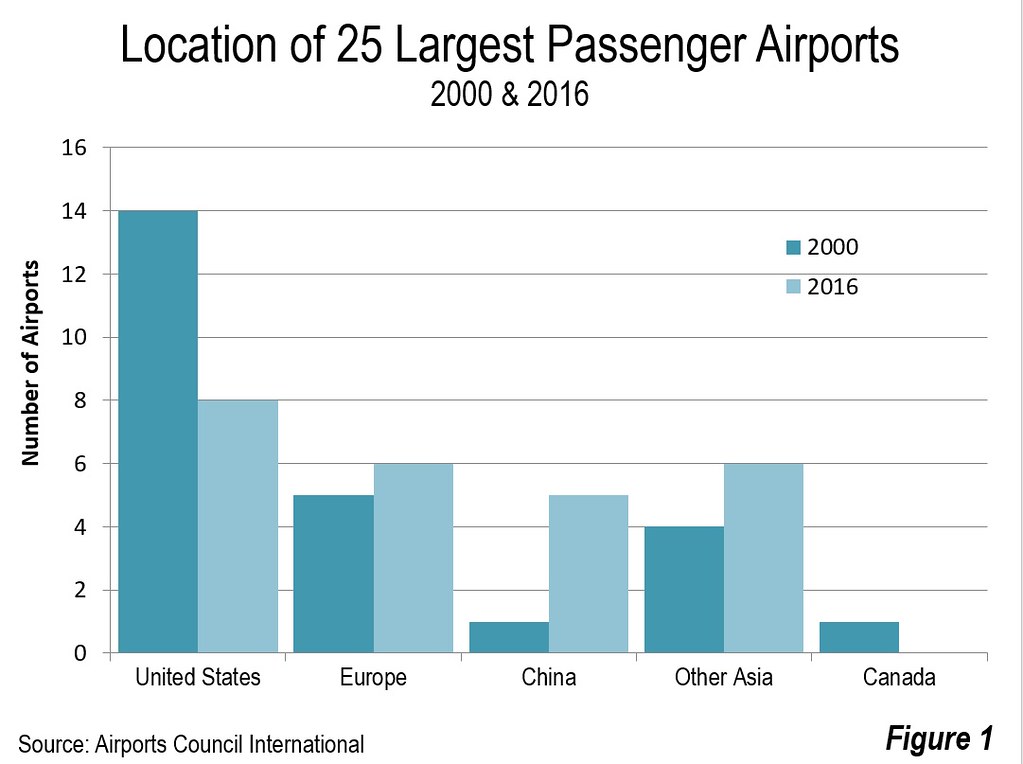
    Perhaps nothing more illustrates the shifts in the global economy than the geography of the largest airports. In 2000, world air passenger statistics were dominated by high income world economies. Among the 25 busiest passenger airports, 14 were in the United States, five in Europe and five in Asia and one in Canada, according to data from the Airports Council International and the Port Authority of New York and New Jersey.

    Among the largest airports in 2000, all but Bangkok were in a high income economies. Things have changed significantly. Today, only eight of the largest airports are in the United States, six in Europe, and five in China and six in Asia outside China. Airports in middle income countries — largely not on the list in 2000 — come from Beijing, Shanghai, Guangzhou and Chengdu in China, Kuala Lumpur in Malaysia, and Turkey’s Istanbul (Figure 1).

    The Largest Airports

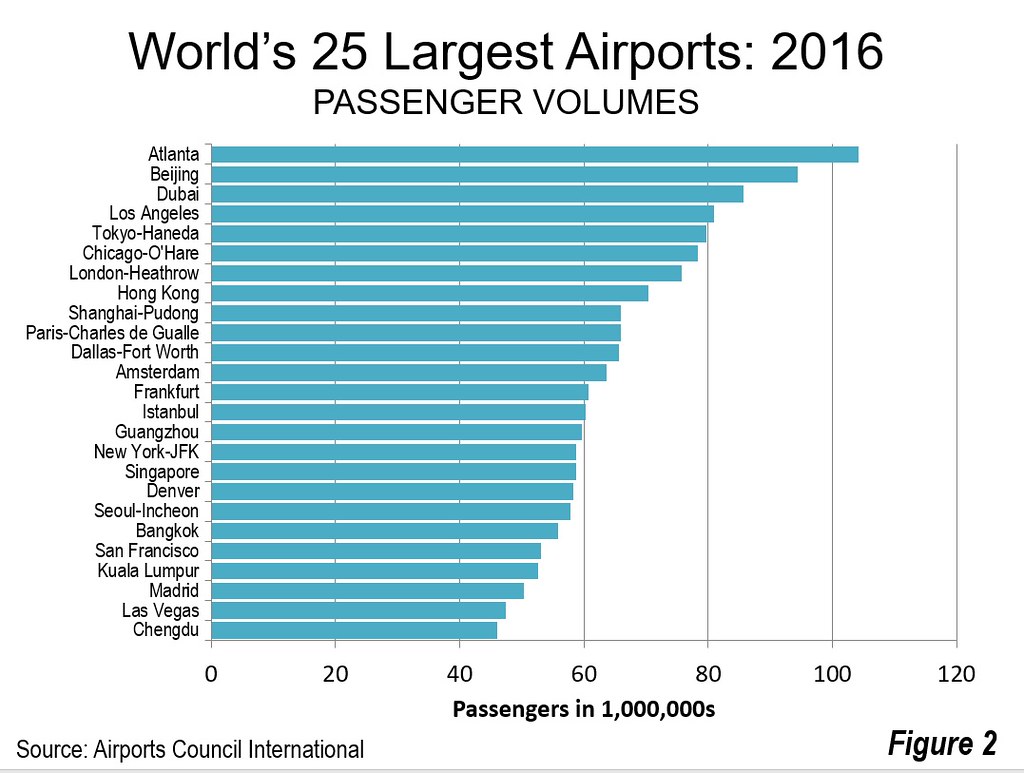
    Since 1998, Hartsfield-Jackson International Airport has been the busiest passenger airport in the world, after it replaced Chicago’s O’Hare International. In 2016, the airport handled nearly 104.2 million annual passengers. This is quite an accomplishment for an urban area that is only the 81st largest in the world. Since 2000, Atlanta’s passenger count has increased 30 percent.

    Yet, Atlanta has been challenged in recent years by Beijing Capital City International Airport, which was substantially remodeled and enlarged for the 2008 Olympics. Beijing handled 94.4 million passengers in 2016. In 2000, Beijing Capital City International was not among the world’s 25 largest airports but has experienced a 335 percent increase in passenger use. Capital City could pass Atlanta in the next few years, but will soon thereafter split air traffic with the Beijing-Daxing International Airport, due to open in 2019, probably making any number one ranking temporary. In the long run, local officials expect Beijing-Daxing to be the busiest in the world.

    The new airport will be located south of the city and far better situated for access from the entire Jin-Jing-Ji megacity complex, around which many of the current functions of Beijing are being dispersed. Jin-Jing-Ji includes Beijing, Tianjin and much of the northern part of Hebei province. Construction progress can be viewed at this location on Google Earth: 39°30′52″N 116°24′25″E (copy into the Search box or a “’Google” search will bring up the location on Google maps).

    Dubai International Airport, the world’s third largest airport, has seen its passenger traffic growth much faster than even Beijing Capital City International. Dubai saw nearly 600 percent growth from 2000 to 85.7 million passengers. In 2000, Dubai International was not among the world’s 25 largest airports.

    Los Angeles International is the world’s fourth busiest airport. LAX handled 80.9 million annual passengers, up 22 percent from 2000.

    Tokyo’s centrally located Haneda International Airport ranked fifth, with 79.7 million annual passengers. Haneda has grown strongly, up 42 percent since 2000, when it ranked 6th. During that time, Japan’s regulators have allowed a considerable increase in international flights. Haneda’s overall volume is approximately twice that of far more remote Narita International Airport, which handles most international flights.

    Chicago’s O’Hare International Airport was the world’s busiest as late as 1997, but has fallen to sixth most patronized. O’Hare handled 78.3 million passengers in 2016, with its strong United Airlines and American Airlines hubs. However, O’Hare’s growth has been modest, adding only 8 percent to its 2000 volume, when it ranked 2nd to Atlanta (see photo above).

    London’s Heathrow Airport ranked 7th in the world, with 75.7 million annual passengers. Growth was also somewhat muted, Heathrow’s volume grew 17 percent from 2000 to 2016.

    Hong Kong has experienced considerable growth after having closed its obsolete Kai Tak airport in the late 1990s. Hong Kong International has experienced a 115 percent increase in passengers since 2000 and handled 70.6 million passengers in 2016. In 2000, Hong Kong was the 22nd busiest airport in the world, compared to its 8th ranking in 2016.

    Shanghai’s Pudong International Airport experienced the largest handled 66.0 million passengers in 2016 and was not among the top 25 in 2000. The world’s 9th ranked airport opened in 1999 and is served by the world’s fastest train, a Mag-Lev (magnetic levitation) that carries passengers 19 miles (30.4 kilometers) to the Longyang Road station at a top speed of 268 miles per hour (431 kilometers per hour) during weekday peak periods. By comparison, the fastest high speed rail trains in the world will operate at up to 218 miles per hour (350 kilometers per hour) between Shanghai Hongqiao Station and Beijing starting this month. From Longyang Road station travelers can transfer to taxis or Metro Line 2 to complete the final 7 miles (12 kilometers) to People’s Park in the central business district, or to other locations in the area.

    Charles de Gualle International Airport in Paris ranks 10th, handling slightly fewer passengers than Pudong International (65.95 million). CDG’s volume is up 37 percent since 2000, when it ranked 8th in the world.

    The 11th through 16th positions include Dallas-Fort Worth, Amsterdam, Frankfurt, Istanbul and Guangzhou. Istanbul has seen its passenger volume increase more than 300 percent since 2000, while Guangzhou has exceeded 360 percent.

    The next five (16th through 20th) include New York’s JFK, Singapore, Denver, Seoul’s new Incheon Airport, and Bangkok, also a relatively new facility. Singapore has had the greatest growth, at 105 percent.

    The final five of the top 25 include San Francisco, Kuala Lumpur, Madrid, Las Vegas and Chengdu. Kuala Lumpur’s growth was more than 250 percent, while Chengdu posted the largest gain, at more than 730 percent (Figure 2).

    A number of US airports that were among the top 25 in 2000 dropped out over the next 16 years. These include Seattle, Miami, Phoenix, New York La Guardia, Orlando, Houston, Newark, Minneapolis-St. Paul, Boston, Detroit and St. Louis. All of them experienced passenger increases, with the exception of St. Louis, where traffic was down more than 50 percent, with the demise of the American Airlines (former TWA) hub. Toronto’s Pearson International also dropped out of the top 25.

    More and More Flying

    The world is flying more and more, According to World Bank data, the volume of air passengers increased 120 percent between 2000 and 2016, with a nearly 7 percent increase between 2015 and 2016. As airline use increases, significant airport construction is underway. Istanbul is building an airport intended to have the highest passenger capacity in the world (41°15′39.97″N 28°44′32.54″E), claims mirrored by Beijing-Daxing and expanding Dubai World Central-Al Maktoum International (24°55′06″N 55°10′32″E). Mexico City will replace aging Benito Juarez International (19.5°N 98.9975°W construction not yet evident), while two cities in China are also building new airports. Dalian is constructing an off-shore facility (39°06′32″N 121°36′56″E) while Qingdao (36°21′43″N 120°5′18″E)is building one in the exurbs, which will be reached from the central business districts with a trip over the Jiaozhou Bay Bridge, the world’s longest over-water bridge (25 miles or 41 kilometers). Berlin’s notoriously behind schedule Brandenburg (Willy Brandt Airport) continues to struggle toward completion (52°22′00″N 013°30′12″E). Meanwhile, with the exploding volume of passengers in Chengdu, construction is starting on a new airport more than 30 miles (50 kilometers) away (30.319°N 104.445°E).

    The rise in air traffic suggests rising affluence, particularly in developing countries, as progress continues to be made in reducing poverty. It seems likely that by 2030, the list of the largest airports will include fewer from today’s most affluent economies and many more from emerging economies.

    Wendell Cox is principal of Demographia, an international public policy and demographics firm. He is a Senior Fellow of the Center for Opportunity Urbanism (US), Senior Fellow for Housing Affordability and Municipal Policy for the Frontier Centre for Public Policy (Canada), and a member of the Board of Advisors of the Center for Demographics and Policy at Chapman University (California). He is co-author of the “Demographia International Housing Affordability Survey” and author of “Demographia World Urban Areas” and “War on the Dream: How Anti-Sprawl Policy Threatens the Quality of Life.” He was appointed to three terms on the Los Angeles County Transportation Commission, where he served with the leading city and county leadership as the only non-elected member. He served as a visiting professor at the Conservatoire National des Arts et Metiers, a national university in Paris.

    Photograph: O’Hare International Airport, by Author