Blog

  • A Berning Rift Growing Among Democrats

    The mainstream media are having a field day, and rightfully so, chronicling the meltdown of the once-formidable Republican Party. Less focus has been placed on what may be equally, or greater, divisions emerging among Democrats, both in California and around the country.

    The largest gap within the party was revealed recently in Orange County, where Bernie Sanders denounced the Walt Disney Co. for paying “starvation wages” to most of its workers while rewarding the CEO with $46 million this year. To Sanders supporters, Disney is a clear “class enemy,” but to Hillary Clinton, the Disney brass represent a source of campaign cash, part of the fairly uniform support for her among establishment Democrats across the board.

    Increasingly, the Democratic Party is divided between two elements of its coalition – an oligarchy that supports Clinton and a base of workers, many of them younger, who favor Sanders. To the Clintonites, her positions on gay rights, the environment and feminism make her an acceptable progressive. However, to those who back Bernie, her embrace of, and by, the oligarchs, amid rising economic inequality, represents a glaring contradiction with someone supposedly leading “the party of the people.”

    Corporate Liberalism vs. Social Democracy

    Clinton’s ascendency reflects the gentrification of the Democratic Party. Since the 1990s, argues historian Michael Lind, the Democrats have evolved from the party of the people to become, increasingly, an instrument of those in media, technology, entertainment and finance who dominate our post-industrial economy. In contrast, Republicans, increasingly isolated from these rising corporate powers, are being forced, often unwillingly, to become the party of populist American nationalism.

    Certainly, Clinton, more than any other candidate in modern times, symbolizes the convergence of economic and political power. She enjoys across-the-board support from Hollywood, Silicon Valley, Washington’s K Street lobbyists and Wall Street. Clinton also personally collected a cool $21 million in speaking fees from a host of powerful Wall Street financial and other big corporate interests during 2013-15. She certainly appears like a future president bought and paid for.

    Read the entire piece at the Orange County Register.

    Joel Kotkin is executive editor of NewGeography.com. He is the Roger Hobbs Distinguished Fellow in Urban Studies at Chapman University and executive director of the Houston-based Center for Opportunity Urbanism. His newest book, The Human City: Urbanism for the rest of us, will be published in April by Agate. He is also author of The New Class ConflictThe City: A Global History, and The Next Hundred Million: America in 2050. He lives in Orange County, CA.

    Photo by Michael Vadon (Own work) [CC BY-SA 4.0], via Wikimedia Commons

  • Six Nova Scotia Municipalities Reject Amalgamation

    For years, some provincial governments in Canada have been either forcing municipal amalgamations or offering incentives for municipalities to merge. This has included municipalities from the largest (Toronto), which was forced into a merger over voter disapproval in 1998 in an advisory election to rural municipalities with fewer than 1,000 in Manitoba, forced to merge by the recently defeated provincial government.

    A heated debate has ensued for decades over the issue. Those who believe amalgamations are beneficial claim that costs will drop along with taxes. They claim amalgamations reduce duplication of services. Those who believe that amalgamations tend to be harmful (in most situations, this writer), note that merging the cost structures and political cultures of even adjacent municipalities is likely to raise costs and taxes and note that the duplication of services claim ignores the fact that municipalities have exclusive service areas that preclude such a result.

    Besides the disagreements over the quantitative evidence, the local opponents invariably rely on their own interest in keeping government close to home, not believing that bigger government routinely produces greater efficiencies.

    The pressure to amalgamate continues in Canada. Recently, six Pictou County, Nova Scotia municipalities began to consider amalgamating. Two dropped out, but the remaining four took advantage of a provincial government program to study amalgamation and then place the question before voters.

    The province offered $27 million for infrastructure costs, operating costs and transitional costs, in the event that the amalgamation took place. On May 28, the voters soundly rejected the amalgamation, by a nearly two to one margin. Residents in New Glasgow supported the amalgamation strongly, residents in Pictou narrowly defeated it, while residents of Stellarton and the municipality of Pictou County opposed the measure by three to one margins. According to The News, only four wards or districts approved the plan out of the 21 in the four municipalities. The Newsarticle includes a detailed chronology of the events leading up to the rejection.

    According to CTV News, The Nova Scotia Utility and Review Board had projected the merger would produce annual savings of $500,000 annually, which pales by comparison to more than 50 times higher provincial offer of $27 million as an incentive to amalgamate. Further, as has been shown in Toronto and elsewhere, higher costs can result, even where substantial savings have been projected.

  • Luxury Urban Housing, Built on a Myth, Is About to Take a Big Hit

    From steamy Miami to the thriving cores of cities from New York, San Francisco, Houston and Chicago, swank towers, some of them pencil thin and all richly appointed. This surge in the luxury apartment construction has often been seen as validation of the purported massive shift of population, notably of the retired wealthy, to the inner cities. Indeed with the exception of a brief period right after the Great Recession, there was slightly greater growth in core cities than the suburbs and exurbs. It was said that we were in the midst of a massive “return to the city.”

    Yet in reality the movement to the inner core has been much less spectacular than that. Indeed by 2014, growth once again was faster not only in traditional suburbs but also in the exurban areas that were broadly predicted to be the most doomed. At the same time, the fastest city growth, notes economist Jed Kolko, occurred largely in the most “suburbanized” cities, like Phoenix, San Antonio, and San Diego.

    One major meme for the luxury developers had to do with well-off retirees—the one domestic population with the money to afford such housing. Newspapers have been crammed with anecdotal stories about this “trend.” Yet analysis of Census trends among seniors shows that the senior percentage share in both the inner core and older suburbs dropped between 2000 and 2010 while growing substantially in the newer suburbs and exurbs. The most recent data show these patterns continue. Since 2010 the senior population in core cities has risen by 621,000 while the numbers in suburbia have surged by 2.6 million.

    So who’s buying them? It’s wealthy foreign nationals, largely as investments. In many cases these units are not really residences but pieds-a-terres for the world’s wealthy; in some markets, as many as 60 percent of units are not primary residences. But such sales are susceptible to changes in foreign economies. And today, many of these buyers must contend with slowing economies at home.     

    Perhaps most damaging has been the decline in many countries, such as Russia, Brazil, Argentina, Canada and some countries of the Middle East, that have been hit hard by the commodity slowdown. Most critical in many markets, particularly in California, has been the economic slow-down in China, now the largest foreign investor in U.S. real estate. In some markets, like Irvine and in Bay Area suburbs, Chinese investors have accounted for upwards of 30 percent of all buyers.

    Realtors in Southern California, long a favored destination for Asian investors, report a significant slowdown in investment , particularly along the coast. In some developments, roughly half the Chinese buyers paid cash, often well over $1 million per unit. This in markets where barely 10 to 20 percent of the houses are affordable to the median income family.

    Perhaps nowhere in urban America better epitomizes the relationship between foreign capital and high-end real estate than Miami. From 2004 to 2008, Miami enjoyed a massive luxury housing boom, with over 20,000 new units constructed—only to see many go them vacant for years.

    The last five years have seen a resurgence once again. As  fortunes were being minted, foreign money tended to end up invested in Miami’s luxury towers.

    Now this dependence on foreign investment may wreak havoc. Some sources of investment, such as  Russia, are drying up as low oil prices dissipate the wealth of that country’s free-spending oligarchs, and now must cope with sanctions over the annexation of the Crimea. In 2013, Russian buyers accounted for 23 percent of Miami luxury condo buyers; in 2014 they accounted for just 7 percent.

    But in Miami, the big story has been the Latin Americans. Like the Russians, the major Latin American investors have been hard hit by declining oil and other commodity prices. In 2014, luxury developer Gil Gezer thanked Brazilians, for turning around the Miami high-end condo market; now they seem to be driving the market down.  In the fourth quarter of 2015 the number of Miami Beach condo transactions declined nearly 20 percent from a year earlier, while inventory jumped by nearly a third, according to a report from appraisal firm Miller Samuel Inc. The median sales price slipped 6.6 percent. As prices drop and sales slow, more than half a dozen projects have been cancelled.

    South Florida may be the ultimate mecca for luxury developers, but it’s hardly alone in facing a high-end property crash. Over the past decade, New York has been inundated with ultra-expensive high-rise real estate. The new towers have affirmed the city’s fundamental attraction to the ultra rich. In Lower Manhattan, 31 towers with over 5,000 apartments are sprouting up, with a median price for condos of $2.43 million, a 70 per cent increase since 2013. The overall Manhattan condo market has shot up “only” 54% to $1.84 million.

    As in Florida, some of the problem stems from the retreat of foreign investors. Analyst Sami Karan suggests that rather than a massive demographic evidence of a “return to the city” by the ultra-rich, the luxury surge  seems to be mostly a matter of investment strategies that can change more quickly than shifting one’s long-time domicile.

    Not surprising then that some developments are being stalled across Manhattan. Property Markets Group and JDS Development Group, developers of the 111 West 57th Street, a 60-unit tower have announced that the once-imminent sales launch at the 60-unit tower would be pushed back for at least a year. In other cases, once ballyhooed  conversions of office towers to condos—notably the famous “Chippendale” Sony/ATT building located at 550 Madison Avenue—have been shelved, signaling that some well-fed rats may be deserting the luxury yacht before the fall. The city faces what new analysis by the consultancy Miller Samuel could be a glutted luxury market for the next five years.

    But over the past few years, no luxury market has been more over-heated than San Francisco. As occurred in the 1990s, the city’s luxury market has ridden the current tech bubble to unprecedented heights—in the process creating what may be one of the most severe real estate bubbles in the country. In the city proper, the median value of homes has skyrocketed, from $670,000 at the beginning of 2012 to $1.12 million today, a gain of more than 67 percent, according to Zillow.com.

    Now there  are signs that this boom is about to slow. This stems from two factors—the inability of consumers to afford this housing and the gradual slowdown of the tech bubble. The 87 tech IPOs over the past two years are trading 80 percent below their IPO price, and not surprisingly, venture capitalists are become more wary. Many key firms—Twitter, Hewlett Packard, Yahoo—are all laying workers off.

    All this suggests that, as in Miami and New York, San Francisco property owners face stagnant or even declining prices. The market could be further weakened as  tech workers and  companies head to more affordable markets  elsewhere. 

    Right now the decline in the luxury market has not yet turned into a full-on crash in multi-family housing. But there are some worrisome warning signs, such as rising apartment vacancy rates. Already some markets, such as Houston, seem to be overbuilt, particulary given weakness in the area’s critical energy sector. Other urban cores  threatened by overbuilding include such disparate cities as Indianapolis, Raleigh-Durham, Denver and Atlanta. According to the consultancy firm Costar, vacancies in downtown areas are  reaching double digits in such attractive markets as Boston, Charlotte and Philadelphia.

    In some areas like San Francisco and New York, a rollback of multi-family prices could be beneficial, because high prices are driving young, educated people out to other regions. Since 2010 educated millennials have been headed increasingly to more affordable regions such as Nashville, Orlando, New Orleans, Houston, Dallas-Fort Worth, Pittsburgh, and Columbus. Even Cleveland and California’s exurban Inland Empire, which still has relatively reasonable housing prices, at least by California standards, aregrowing their millennial workforces faster than places like New York or San Francisco.

    Young people may also benefit as units shift  from condo to rental.  Of course, the weakening market won’t be too good for the investors, developers and landlords, many of whom embraced the “back to the city” mantra with religious zeal and now will have to confront demographic reality.

    But other trends suggest that this decline may be more painful than many suspect. We may be entering a phase where we have reached  “peak urban millennials” as they head into their 30s, get  married and move  to the suburbs.  The idea that investing in the urban core, and in luxurious density, guarantees a happy result has now lapsed into mythology. It needs to be replaced with something that more accurately effects not what developers hope (or planners decree) but what people need, and can afford.

    This piece originally appeared at The Daily Beast.

    Joel Kotkin is executive editor of NewGeography.com. He is the Roger Hobbs Distinguished Fellow in Urban Studies at Chapman University and executive director of the Houston-based Center for Opportunity Urbanism. His newest book, The Human City: Urbanism for the rest of us, will be published in April by Agate. He is also author of The New Class ConflictThe City: A Global History, and The Next Hundred Million: America in 2050. He lives in Orange County, CA.

    Wendell Cox is principal of Demographia, an international pubilc policy and demographics firm. He is a Senior Fellow of the Center for Opportunity Urbanism (US), Senior Fellow for Housing Affordability and Municipal Policy for the Frontier Centre for Public Policy (Canada), and a member of the Board of Advisors of the Center for Demographics and Policy at Chapman University (California). He is co-author of the “Demographia International Housing Affordability Survey” and author of “Demographia World Urban Areas” and “War on the Dream: How Anti-Sprawl Policy Threatens the Quality of Life.” He was appointed to three terms on the Los Angeles County Transportation Commission, where he served with the leading city and county leadership as the only non-elected member. He served as a visiting professor at the Conservatoire National des Arts et Metiers, a national university in Paris.

    Photo by Marc Averette (Own work) [CC BY 3.0], via Wikimedia Commons

  • Finally! Great New Affordable Bay Area Housing!

    These are highly educated well paid workers at a San Francisco tech company. They’re mostly young. Some are single. Some are newly coupled. Some are married with young children. There are exceptions, but they tend to want to live in a vibrant urban neighborhood with a short commute rather than a distant suburb.


    Screen Shot 2016-05-27 at 11.08.39 PM

    Screen Shot 2016-05-27 at 11.07.30 PM

    Screen Shot 2016-05-27 at 11.08.07 PM

    Screen Shot 2016-05-27 at 10.51.05 PM

    Screen Shot 2016-05-28 at 1.45.52 AM

    Screen Shot 2016-05-28 at 1.46.17 AM

    Screen Shot 2016-05-28 at 12.17.05 AM

    Some enjoy living in a rented apartment above a trendy wine bar right on the edge of the downtown core. They can effortlessly pop down for a drink or a bite to eat with friends. When the weather is good they can ride a bicycle to work and skip the traffic congestion for a healthy commute.

    Screen Shot 2016-05-28 at 1.42.07 AM

    Screen Shot 2016-05-27 at 10.51.21 PM

    Screen Shot 2016-05-28 at 12.01.20 AM

    Screen Shot 2016-05-28 at 12.15.42 AM

    Others choose to own a loft style condo above shops. They can step outside their door and immediately find good food, good company, clothes, groceries, a hairdresser… most daily needs are close at hand.

    Screen Shot 2016-05-27 at 11.47.16 PM

    Screen Shot 2016-05-27 at 11.49.00 PM

    Screen Shot 2016-05-27 at 11.48.28 PM

    Screen Shot 2016-05-27 at 11.48.44 PM

    Screen Shot 2016-05-27 at 11.51.15 PM

    Still others love a little detached cottage in a courtyard with shared garden space. This arrangement provides all the benefits of a traditional home on a smaller scale.

    Screen Shot 2016-05-27 at 11.47.41 PM

    Screen Shot 2016-05-27 at 10.58.08 PM

    Screen Shot 2016-05-27 at 10.58.38 PM

    Screen Shot 2016-05-27 at 10.58.24 PM

    Then there are those who gravitate toward a regular stand alone single family home – of various styles, sizes, and price points.

    IMG_0794 (1024x694)

    Screen Shot 2016-05-27 at 10.59.59 PM

    Screen Shot 2016-05-28 at 1.44.50 AM

    Screen Shot 2016-05-28 at 12.06.05 AM

    Screen Shot 2016-05-27 at 10.56.40 PM

    Screen Shot 2016-05-27 at 10.52.34 PM

    In this new development all of these options are available on a single block just a ten minute bike ride from downtown. This is exactly what San Franciscans desperately want and someone has finally figured out how to build it at a price people can afford…
    Screen Shot 2016-05-28 at 12.16.10 AM

    Screen Shot 2016-05-28 at 2.17.00 AM

    Screen Shot 2016-05-28 at 2.21.31 AM

    Screen Shot 2016-05-28 at 2.21.04 AM

    Screen Shot 2016-05-28 at 2.20.38 AM

    Screen Shot 2016-05-28 at 2.20.21 AM

    …in Nashville. Uber, Lyft, Eventbright, and many other tech companies that began in San Francisco have all opened branch offices in Nashville. The standard offer is simple. Relocate to Tennessee, take a 30% pay cut, and enjoy a much higher quality of life with much more cash left over at the end of each month. Go ahead. Soak up the complimentary affordable home ownership.

    John Sanphillippo lives in San Francisco and blogs about urbanism, adaptation, and resilience at granolashotgun.com. He’s a member of the Congress for New Urbanism, films videos for faircompanies.com, and is a regular contributor to Strongtowns.org. He earns his living by buying, renovating, and renting undervalued properties in places that have good long term prospects. He is a graduate of Rutgers University.

  • Best World Cities for Traffic: Dallas-Fort Worth, Kansas City, Indianapolis and Richmond

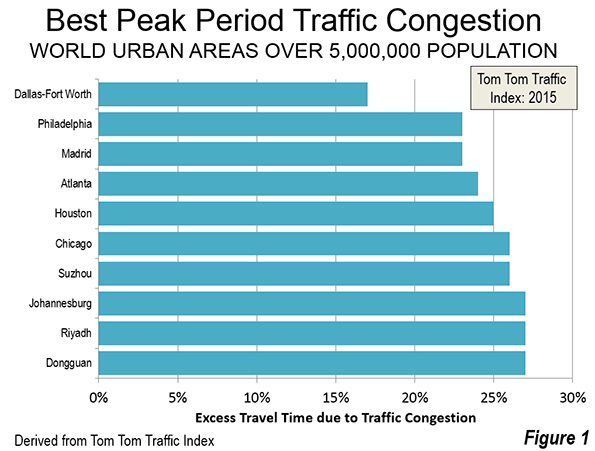
    The 2015 Tom Tom Traffic Index shows that Dallas-Fort Worth has the least overall congestion among world (urban areas) with more than 5,000,000 population. The Tom Tom Traffic Index for Dallas-Fort Worth is 17, which means that, on average, it takes 17 percent longer to travel in the urban area because of traffic congestion.

    The Tom Tom Traffic Index rates traffic congestion in nearly 300 world cities. This article examines overall traffic congestion levels in two categories of cities, those with more than 5,000,000 population and those with between 1,000,000 and 5,000,000 population.

    Over 5,000,000 Population

    Tom Tom rated traffic congestion in 38 urban areas with more than 5,000,000 population. Five of the 10 least congested cities are in the United States, including five of the top seven. China placed two cities in the top 10 (Figure 1).

    With its Tom Tom Traffic Index of 17, Dallas-Fort Worth was far ahead of Philadelphia and Madrid, which tied for second at 23. This gap of six points is the largest among the 38 cities except for the seven that separate number 36 Istanbul and number 37 Bangkok.

    Atlanta ranked fourth, with a Traffic Index of 24, followed by Houston at 25. Suzhou achieved China’s best traffic congestion, with a Traffic Index of 26 and was tied for sixth best with Chicago. There was a three way tie for eighth.

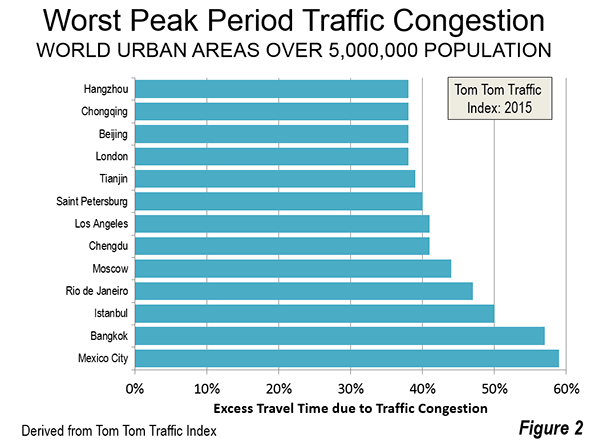
    Because of a four way tie for 10th place, the bottom 10 in traffic congestion among the more than 5 million population included 13 cities (Figure 2). The greatest traffic congestion was in Mexico City, with a Travel Index of 59. This means that a 30 minute trip can generally be expected to take 48 minutes, 18 minutes more than without congestion. Bangkok, which is often suggested as one of the most congested cities in the world, ranked second worst with a Traffic Index of 57.

    Rio de Janeiro had the fifth worst traffic congestion with a Traffic Index of 47, while Moscow’s legendary traffic congestion rated a 44. Los Angeles, long the most congested city in the United States, had a Traffic Index of 41, and ranked seventh worst. Chengdu in China tied Los Angeles. The eighth and ninth most congested cities were St. Petersburg, at 40 and Tianjin at 39. London and three cities in China, Beijing, Chongqing, and Hangzhou tied for 10th worst traffic, at 38.

    1,000,000 to 5,000,000

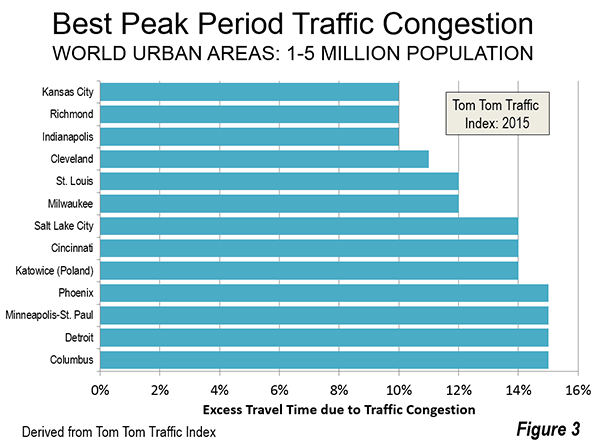
    Generally traffic congestion is less severe in smaller cities, all things being equal. This is illustrated among the cities with between 1 million and 5 million population (Figure 3). Three United States cities tied for the best traffic congestion, Kansas City, Indianapolis and Richmond, Virginia, each possessed  a Traffic Index of 10. Because of a four way tie for 10th place, 13 cities are included in the top 10 and only one of these 13 cities is outside the United States.

    Cleveland ranks fourth, with a Traffic Index of 13, followed by St. Louis, Milwaukee, which are tied at fifth with a traffic index of 14. The conurbation (urban areas that have grown together, in this case Katowice, Gliwice and Tychy) Katowice, Poland had a Traffic Index of 14 and   Salt Lake City and Cincinnati for the seventh best traffic congestion.

    The three cities tying for 10th best traffic congestion all had a Traffic Index of 15 and were Minneapolis-St. Paul, Phoenix, Detroit and Columbus.

    Four other cities ranked above much larger Dallas-Fort Worth, with a Traffic Index of 16. These included Charlotte, Jacksonville, Memphis and Raleigh. Louisville tied Dallas-Fort Worth, at 17. Dallas-Fort Worth is approximately twice the population of the largest cities in the 1 million to 5 million classification, Detroit and Minneapolis-St. Paul and more than three times the population of Katowice.

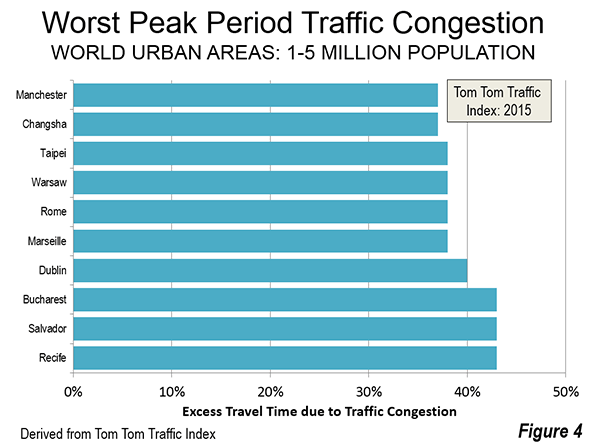
    Three cities were tied for the worst traffic congestion in the 1 million to 5 million category with a Traffic Index of 43, Recife and Salvador in Brazil and Bucharest in Romania. Five of the bottom ten cities were in Europe, with Dublin, one of the smaller cities having a particularly high Traffic Index 40, nearly as bad as much larger Los Angeles (Figure 4).

    Overall Rankings

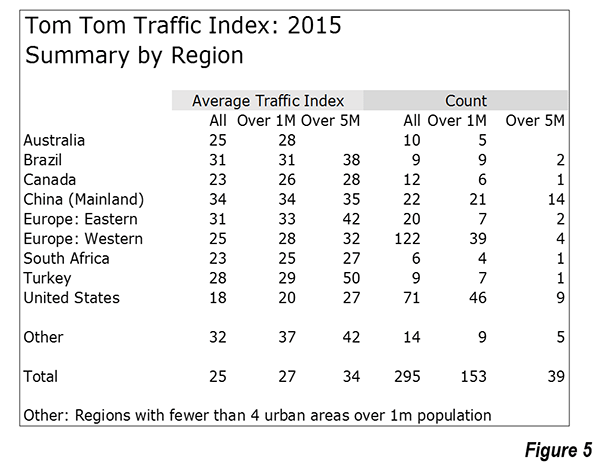
    Confirming the ratings above, the United States had the overall best traffic conditions (Figure 5), in all three population categories (under 1 million, 1 million to 5 million and over 5 million), though South Africa tied the United States in the over 5 million category.

    Progress

    Every year, it seems like more cities are added to the international traffic comparisons. This year’s addition of Bangkok, with its dreadful reputation for traffic was a huge step in the right direction. Bangkok, of course has bad traffic for decades, but was edged out by Mexico City. I still wonder whether the prize does not belong to Jakarta (as it did for the “start-stop” index a few years ago), and I hope that data on India’s huge cities and the cities of Japan will soon be available.

    Wendell Cox is principal of Demographia, an international pubilc policy and demographics firm. He is a Senior Fellow of the Center for Opportunity Urbanism (US), Senior Fellow for Housing Affordability and Municipal Policy for the Frontier Centre for Public Policy (Canada), and a member of the Board of Advisors of the Center for Demographics and Policy at Chapman University (California). He is co-author of the “Demographia International Housing Affordability Survey” and author of “Demographia World Urban Areas” and “War on the Dream: How Anti-Sprawl Policy Threatens the Quality of Life.” He was appointed to three terms on the Los Angeles County Transportation Commission, where he served with the leading city and county leadership as the only non-elected member. He served as a visiting professor at the Conservatoire National des Arts et Metiers, a national university in Paris.

    Photo: Bangkok: not the worst traffic congestion (photo by author)

  • Trump’s Industrial Belt Appeal

    In his still improbable path to the White House, Donald Trump has an opening, right through the middle of the country. From the Appalachians to the Rockies, much of the American heartland is experiencing a steady decline in its fortunes, with growing fears about its prospects in a Democratic-dominated future. This could prove the road to victory for Trump.

    The media  like to explain Trump’s appeal by focusing on the racial and nationalistic sentiments of his primarily white supporters in places like the Midwest and in small towns. Perhaps more determinative are the mounting economic challenges facing voters in that part of the country. Much of this has to do with an industrial structure facing growing challenges from a high dollar, decreasing commodity prices and a pending tsunami of environmental regulation.

    Unlike the Democrats’ coastal strongholds, which depend increasingly on such professions as media, software, finance, and high-end business services, the middle swath of the country depends far more on manufacturing, resource extraction, and agriculture. All these so-called “tangible” industries are facing serious declines, which in a close election could swing some critical states such as Ohio, Colorado, Wisconsin, Indiana, Michigan, and Iowa into the Republican column. Seven of the 10 most manufacturing-dependent metro areas in America are in the Midwest battleground states. Another lies in yet another purple state, North Carolina. 

    Economic Slowdown in Mid-America

    When President Obama ran for re-election in 2012, the tangible economy was on a roll. Super-charged by the federal bailout, the car industry was roaring back, restoring jobs and confidence in the country’s midsection. The president was even described by The Washington Post as a “man on a mission” to save American manufacturing. And the two states then with the fastest declines in unemployment since the onset of the Great Recession—Ohio and Michigan—are in the Midwest.

    At the same time, Obama benefited from the resurgence of domestic oil and gas production that   stimulated growth in steel, heavy equipment, and industrial sector employment. This fortunate confluence was fortuitous for the Democrats, who carried most of the states outside the South buoyed by this nascent industrial rebirth. Good times in coal country helped the president in parts of Virginia; the energy boom helped lock up Colorado for him.

    Hillary Clinton likely will not enjoy a similar tailwind this year. Manufacturing indexes have tended downward over the past year, and the energy sector has been in full-scale retreat. This not only impacts oil patch bastions Texas, Louisiana, and Oklahoma, which are unlikely to vote Democratic anyway, but also the battlegrounds states Pennsylvania and Ohio. Agricultural economies in the midsection are also reeling.

    Clinton will argue that job growth is on the rise nearly everywhere, but more than half of the increase has come in low-wage sectors such as retail and food service, which is one key reason  for persistently weak income growth.

    The damage is not yet universal, but can be seen clearly in many areas. Many Rust Belt and Appalachian regions are once again hemorrhaging residents. In a recent survey of metropolitan economies for Forbes, economist Michael Shires and I traced the job growth in communities across the country. The bottom 10 among the 70 largest metropolitan areas reads like a stroll down Rust Belt Lane: Hartford, Conn., Milwaukee, Detroit, Albany, N.Y., Newport News, Va., Birmingham, Ala., Cleveland, Newark, N.J., Pittsburgh, Buffalo and — in last place — Rochester, once one of the beacons of industrial innovation in the country and now part of New York’s upstate disaster area.

    Last year, amid some decent employment growth nationally, almost all these areas suffered sub-1 percent job declines after enjoying growth rates well above that in previous years. More grievously affected are a host of smaller communities, many of them in the Midwest and industrial Northeast, several already seeing negative job growth. At the bottom of the list are places like Johnstown, Pa., and Elmira, N.Y., where the Democrats’ “hope and change” promise has failed to reverse dismal local economies.

    Enter Trump 

    Throughout his divisive campaign, Donald Trump has fattened up on these voters, winning by landslides in places like upstate New Yorkcentral and western Pennsylvania, the industrial suburbs of Detroit, northern Indiana and the resource-dependent parts of Colorado. In hard-hit Erie County, N.Y., home to Buffalo, Trump won two-thirds of the primary vote.

    Also appealing to similar populist sentiment, Bernie Sanders has won some of the same areas, often decisively. For his part, Trump’s only serious Rust Belt setbacks occurred in Ohio (where John Kasich ran as a virtual favorite son candidate), Iowa (where evangelicals still wield outsized influence) and Minnesota, which is arguably the most post-industrial of the central states. Recent announcements by such large companies as Ford and United Technologies  to move jobs to Mexico have reinforced Trump’s appeal.

    Trump’s support, as Nate Silver has shown, is not comprised only of knuckle-dragging Neanderthals. On average, they earn above-average incomes and boast education levels that also exceed the national average. Some are professionals and merchants on Main Street, who acutely ride the ups and downs of the tangible economy. These voters may also be susceptible to rants about Mexican “rapists” and certainly would not favor a massive incursion of Muslim refugees. But their primary concerns are economic, not social. If they really favored regressive social policies, Ted Cruz was their man.

    The trajectory of the Democratic race—as well as that of the economy—could help Trump expand his appeal to such voters. Hillary Clinton once tended to be supportive of industrial and energy development; her State Department gave tacit approval to the Keystone XL Pipeline. Now, under pressure from Bernie Sanders’ left-wing legions, she has backed away from support for this organized-labor-backed project. The divisions between the public sector unions and those in the industrial sector could boost Trump’s turnout in states where manufacturing and energy still matter.

    To make matters more difficult, Clinton may be saddled at the convention with a ban on fracking. This stance warms the hearts of bicoastal enviros, but is unpopular in large parts of the nation’s heartland. Likewise, the Obama administration’s all-out assault on fossil fuels has already cost Clinton any shot at formerly Democratic-leaning West Virginia, and is likely to hurt her across  theAppalachian belt, which includes portions of Pennsylvania, North Carolina, Virginia and Ohio. Even if oil and gas prices rise, the Obama proposals for higher taxes and regulation of energy seem destined to slow any recovery in this high-paying, largely blue-collar industry.

    In addition, Trump is showing unanticipated strength in several key states dependent on coal-fired electricity. He’s currently running even with Clinton in Ohio and Pennsylvania, both of which twice went for Obama. This should be enough to keep Clinton’s advisers, who are planning to deploy massive resources to these states, awake at night.      

    In this respect, Clinton faces a difficult situation. Ever more dependent on her party’s post-industrial urban core, she will be hard-pressed to moderate her stance on environmental issues.  Her predecessor and her husband were able to finesse this ground by feinting toward the moderate middle in campaign years, but such ideological contortionism is getting harder to pull off.

    Megabuck donors like San Francisco’s Tom Steyer are committed to forcing Clinton to embrace   progressive green orthodoxy. This will leave many mid-America workers and businesspeople feeling abandoned and, thus, potentially more receptive to Trump’s pitch. Ultimately, suggests historian Michael Lind, Trump could presage the transformation of the GOP into a middle-class populist party, with a strong Midwestern as well as Southern base, while the Democrats rest their hopes on an unlikely coalition of the coastal gentry, the hyper-educated, minorities, and the poor.

    So far, the crass New York billionaire has played brilliantly on middle-American resentments, many of them well-founded. He promises repeatedly to cut a “better deal” for them. If he can convincingly make his case, Donald Trump also might yet close the most successful real estate deal of his lifetime: occupancy of the White House.

    This piece originally appeared at Real Clear Politics.

    Joel Kotkin is executive editor of NewGeography.com. He is the Roger Hobbs Distinguished Fellow in Urban Studies at Chapman University and executive director of the Houston-based Center for Opportunity Urbanism. His newest book, The Human City: Urbanism for the rest of us, will be published in April by Agate. He is also author of The New Class ConflictThe City: A Global History, and The Next Hundred Million: America in 2050. He lives in Orange County, CA.

  • Extending the Reach of Smart Cities

    What distinguishes a ‘smart city’ from one that merely possesses smart technology? At the basic level, ‘smart’ implies a threshold level of technology uptake. Cities with fast internet, straddling buses, and driverless police cars could be considered smart. However, if technology is the only prerequisite, smart is neither revolutionary nor interesting. It is time to move towards a more enlightened understanding of what makes a city smart.

    Most smart city definitions fail to articulate how disparate technologies mutually support goals beyond efficiency. If policies are holistic and integrated, technologies should be as well. Integration is not the final objective, though: it represents only the starting point for developing broader strategies to equitably distribute technology benefits and raise living standards. As such, the fundamental question for planners and policymakers is not how to optimize components of the system, but how to ensure that the overall system delivers on the promise of its potential.

    In 2014, I introduced what I called a constraint theory of governance. Based on the concept of throughput optimization in the field of operations management, constraint theory posits that efforts to maximize the speed or capacity of individual production stages do little to improve the speed of systemic throughput. This is more colloquially known as the weak-link phenomenon. The concept describes a common management folly that prioritizes efficiency at one stage of production while inventories accumulate at other stages and overall progress stagnates.

    So it is with governance. The improvement of a single policy stage (e.g. consultation, design, or implementation) is fully realized only when other stages are proportionately reformed. In an interlinked policy system, achieving complementarity among stages is crucial for improving throughput – as measured by the delivery speed and durability of policy initiatives. More broadly, according to the constraint theory of governance, reforms applied across rather than within functional areas are the only means to generate transformative progress in outcomes.

    The constraint theory of governance applies also to smart city systems, in which output is neither a product, as in business, nor a policy, as in governance. Rather, outputs can be seen more broadly as outcomes defined by political, social, and economic progress. Technology is only one component of this complex system; it is the butter, not the bread. Operating within the broader context of a dynamic society and body politic, the power of smart city technology is dependent on strategic and functional integration of urban systems. In other words, technology is only as effective as the governance priorities and capabilities underlying it.

    Seemingly disparate technological capabilities can become increasingly interdependent over time. According to the late scientist John Henry Holland, complex adaptive systems are characterized by the presence of components that learn through interaction. This is a useful metaphor for the potential of smart city systems. While much focus has been given to individual components, technological convergence requires a systems perspective. Benefitting from both network growth and scientific progress, smart city systems can shape the collective capabilities of once silo-bound technologies into a continuously evolving whole. This self-correcting mechanism is valuable in environments where policy and planning systems are encumbered by persistent bugbears like political patronage and ideological territoriality.

    In smart cities, order is needed for planners to channel technological capabilities productively, while chaos provides a dynamic and flexible space for business and social innovation to ‘breathe.’ The sterile and the organic exist in paradoxical equilibrium. However, even politically progressive cities are sometimes unable to hold this balance, as in the recent controversy about rideshare services Uber and Lyft in Austin, Texas. Such cases are evidence that deeper thinking is needed about how to anticipate and manage the disruptive effects of smart city systems.

    Appreciating the complex and paradoxical dimensions of smart cities can help improve human welfare, particularly when leaders and citizens look beyond efficiency. Rather than optimizing discrete goals, the new architecture of smart cities should be oriented towards broader social and political outcomes. Planner and academic Murtaza H. Baxamusa recently stated, “To be effective, urban planning needs to dig deeper than obscure code, pretty pictures and jumbling data. It needs to make a difference in the lives of all people.”

    Smart cities have focused long enough on finding cool ways to do the same old things. Lest they be relegated to the garbage heap of worthless miracles, new generations of urban technologies can earn their keep with lower costs, faster delivery, and improved services, all indicators of efficiency. However, as I recently wrote, “All that computes is not progress.” While technology improves certain aspects of business and governance, its broader potential should not be undersold. The new ‘smart’ implies extension of opportunities to the disadvantaged, broadening of political participation, and enabling of social forces to shape urban space for the greater good.

    Kris Hartley (www.krishartley.com) is a Visiting Research Fellow at the University of the Philippines Diliman, and a PhD candidate at the National University of Singapore, Lee Kuan Yew School of Public Policy.

    Flickr photo by Nicolas Nova: Smart City Infrastructure

  • A ‘Diet’ to Give California Drivers Indigestion

    In the past, it was other people’s governments that would seek to make your life more difficult. But increasingly in California, the most effective war being waged is one the state has aimed at ourselves.

    The Jerry Brown administration’s obsession with becoming a global model for reducing greenhouse gases is leading to an unprecedented drive to completely reshape how Californians live. Rather than focus on more pragmatic, affordable steps to reduce greenhouse gases – more efficient cars, rooftop solar systems and promoting home-based work – the goal increasingly seems like social engineering designed to force Californians to adopt the high-density, transit-oriented future preferred by Brown’s green priesthood.

    The newest outrage comes from the Governor’s Office of Planning and Research in the form of a proposed “road diet.” This would essentially halt attempts to expand or improve our roads, even when improvements have been approved by voters. This strategy can only make life worse for most Californians, since nearly 85 percent of us use a car to get to work. This in a state that already has among the worst-maintained roads in the country, with two-thirds of them in poor or mediocre condition.

    The OPR move reflects the increasingly self-righteous extremism animating the former Jesuit’s underlings. Ironically, the governor’s proposals to impose this road diet rest partly on expanding the California Environmental Quality Act, which Brown, in a more insightful moment, described as a “vampire” that needs a “stake through the heart.” Now, instead, the inquisitors seize on vague legislative language and push it to what the Southern California Leadership Council has dubbed “an undesirable and unmanageable extreme.”

    In essence, the notion animating the “road diet” is to make congestion so terrible that people will be forced out of their cars and onto transit. It’s not planning for how to make the ways people live today more sustainable. It has, in fact, more in common with Soviet-style social engineering, which was based similarly on a particular notion of “science” and progressive values.

    Read the entire piece at The Orange County Register.

    Joel Kotkin is executive editor of NewGeography.com. He is the Roger Hobbs Distinguished Fellow in Urban Studies at Chapman University and executive director of the Houston-based Center for Opportunity Urbanism. His newest book, The Human City: Urbanism for the rest of us, will be published in April by Agate. He is also author of The New Class ConflictThe City: A Global History, and The Next Hundred Million: America in 2050. He lives in Orange County, CA.

  • Chicago Is the Duck-Billed Platypus of American Cities

    Census results last week show Chicago as the only one of the twenty largest cities in America to lose population. The freaking out over a tiny loss isn’t really warranted. The comparison to Houston is bogus. Etc, etc. Yet Chicago’s leaders have refused to grapple with the real and severe structural and cultural challenges that face the city. That’s something they need to do if they want it to succeed over the longer term.

    I wrote about this in my latest City Journal web piece, “The Duck-Billed Platypus of Cities“:

    When it comes to population estimates, municipal-level data is largely irrelevant, especially when comparing cities with one another. That Houston may soon outpace Chicago in municipal population doesn’t mean that much—the city of Houston includes vast tracts of suburbia, making for an apples-to-oranges comparison. Chicago’s metro area is much larger than Houston’s and will remain the third-largest in the country for years to come. Similarly, while Chicago has the most murders in America, its murder rate is lower than other major cities like St. Louis, Baltimore, and Detroit. Comparisons with Detroit, with its hollowed-out economy, particularly infuriate Chicagoans, who reside in what remains a major economic center. And Detroit’s population loss far exceeds Chicago’s.

    But just because Chicago shouldn’t be compared to Detroit doesn’t mean that it should be compared with San Francisco.

    Click through to read the whole thing.

    Aaron M. Renn is a senior fellow at the Manhattan Institute, a contributing editor of City Journal, and an economic development columnist for Governing magazine. He focuses on ways to help America’s cities thrive in an ever more complex, competitive, globalized, and diverse twenty-first century. During Renn’s 15-year career in management and technology consulting, he was a partner at Accenture and held several technology strategy roles and directed multimillion-dollar global technology implementations. He has contributed to The Guardian, Forbes.com, and numerous other publications. Renn holds a B.S. from Indiana University, where he coauthored an early social-networking platform in 1991.

    Chicago photo by Bigstock.

  • SF Vs LA: Different Strokes In Urban Development

    Book Review: “The Rise and Fall of Urban Economies: Lessons from San Francisco and Los Angeles.” Michael Storper, Thomas Kemeny, Naji P. Makarem and Taner Osman; Stanford University Press, 2015.

    How and why do places differ in their pace of economic development? Why do some flourish while others lag? These are among the most profound questions in economics and related fields. Are explanations found in geography, culture, institutions, or fortune?

    In “The Rise and Fall of Urban Economies: Lessons from San Francisco and Los Angeles,” Michael Storper, Thomas Kemeny, Naji P. Makarem and Taner Osman consider these questions for two great cities. Storper, Kemeny, Makarem and Osman (hereafter SKMO) direct their attention to the Los Angeles and San Francisco “extended metropolitan regions” — the Census Bureau’s Consolidated Statistical Areas (CSAs) — in the post-1970 years. SKMO claim to have a plausible story about LA/SF divergence, which they do a fine job of presenting in this clearly written and well documented volume.

    Both areas were established centers in high-amenity coastal California settings with similar levels of economic success in base-year 1970. But their fortunes have diverged ever since, with San Francisco taking a significant lead.

    What happened?

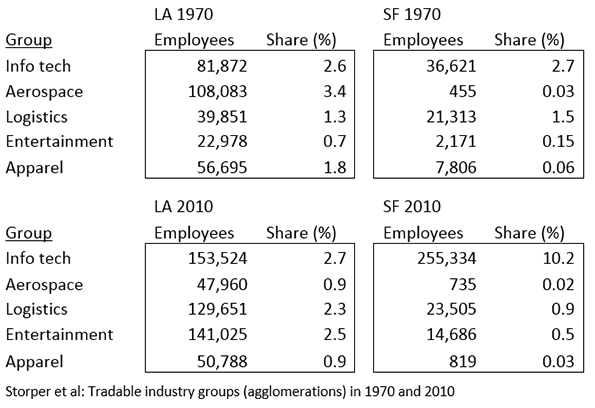
    Much of SKMO’s story springs from employment trends summarized in their table, below, which shows jobs data by major sector for their beginning and ending years for each region. Looking at employment shares, both areas had a similarly sized IT sector in 1970, but the Bay Area’s grew spectacularly while LA’s stayed about where it was. LA was specialized in aerospace and defense but, as is well known, that sector declined as the Cold War ended. Both geographic areas started almost equally in share of logistics jobs, but SF’s specialization in that sector subsided, while LA’s grew. LA’s lead in entertainment grew. Both areas lost jobs in apparel, but this hit LA harder, as the region had been more specialized in that sector.

    The LA area was long recognized for its leadership in the entertainment industry, just as the San Francisco area was for its leadership in tech. Yet “Hollywood” has been emulated in many places, including India, South Korea, China, and several European countries, while Silicon Valley’s would-be emulators, though numerous, have been far less auspicious.

    The post-1970s success of the SF region owes much to Silicon Valley, and SKMO note that, on average, SF’s tech sector salaries were higher than those in LA’s entertainment sector. Lots has been written about the unique culture of innovation and entrepreneurialism found in The Valley. There are real and aspiring ‘techno-hubs” practically all over the world. But the Holy Grail — to identify and bottle some kind of formula to spawn another Silicon culture — has not been discovered.

    SKMO note various Silicon Valley pre-1970s events: how the electronics industry had its roots in radio hobbyists, and the 1960s convergence of hippies and techies. The authors identify eleven historical “critical turning points.” Some are private business choices (“Hollywood’s creation of a new project-based organizational structure in the 1950s and 1960s”); some are more in the realm of public policy (“Los Angeles’ Alameda Corridor Project in the 1980s and 1990s”). Others (Steve Jobs liked The Whole Earth Catalog) also make the list, but without any clear direction for today’s planners.

    The authors devote a chapter to what local governments in each of the two regions spent and prioritized. Bay Area government spending was greater in the 1990s, as well as in the first decade of the 2000s. While Bay Area public transit spending was much greater, SKMO admit that both areas suffer bad traffic congestion, and back away from concluding the extra Bay Area public spending had payoffs. They end up concluding that we simply do not know enough about the programs that were funded to make strong statements about how spending might have (or should have) been re-allocated among programs.

    The key chapter of the book addresses what the authors call ‘Beliefs and Worldviews in Economic Development’: “We will see … how the Los Angeles Economic Roundtable and Chamber of Commerce generated very different narratives from those of the Bay Area Council and Joint Venture Silicon Valley… Bay Area leadership has had a more focused and time-consistent perception of its regional economy as a new knowledge economy. Greater Los Angeles leadership beliefs and worldviews have been inconsistent over time, with fleeting conceptions of the New Economy subsequently crowded out by the perception of Greater Los Angeles mainly as a gateway to international trade and logistics and specialized manufacturing.”

    We have to be careful here. The sequence of events is significant: Did important policy choices pre-date the good (SF) or the bad (LA) events the authors document? The unique entrepreneurial and innovative culture bred in Silicon Valley has no discernible starting date. Did the view of Bay Area elites of a new knowledge economy lead the way, or simply acknowledge facts on the ground?

    In their study of LA and SF, SKMO say little about how both areas have failed to reign in housing costs. By failing to contain the rising costs of most households’ single largest expenditure, both regions have failed. Labor markets cannot do their job when many people’s location choices are restricted. In all of their talk of the best regional development strategy, this essential one is not touched on in the study.

    But, caveats aside, “The Rise and Fall of Urban Economies” is data-rich, wide-ranging and provocative. Anyone interested in the American West’s two premier cities should read this important book.

    Peter Gordon is an Emeritus Professor, Price School of Public Policy at the University of Southern California. He now teaches each summer at Zhejian University in Hangzhou, China, and is currently at work on a book that explores how modern cities contribute to economic growth. He blogs at petergordonsblog.com.