Blog

  • Can Southland be a ‘New York by the Pacific’?

    Throughout the recession and the decidedly uneven recovery, Southern California has tended to lag behind, particularly in comparison to the Bay Area and other booming regions outside the state. Once the creator of a dispersed, multipolar urban model – “the original in the Xerox machine” as one observer suggested – this region seems to have lost confidence in itself, and its sense of direction.

    In response, some people, notably Los Angeles Mayor Eric Garcetti, favor creating a future in historical reverse, marching back toward becoming a more conventional, central core and transit-dominated region – a kind of New York by the Pacific. Eastern media breathlessly envision our region transforming itself from “car-addicted, polluted and lacking in public transit” into a model of new-urbanist excellence.

    Here’s a basic problem. Their L.A. of the future – the one that wins plaudits from places like GQ magazine – essentially negates the region’s traditional appeal, offering the middle and even working classes, a suburban-like lifestyle in one of the world’s great global cities.

    Vive la difference

    UCLA’s Michael Storper correctly notes how far the Southland has fallen behind its traditional in-state rival, the San Francisco Bay Area. Storper correctly traces much of this gap to the domination of the Los Angeles tech sector by aerospace firms and the fact that this area also had a broad base of nontech-oriented manufacturing.

    Can we become a second San Francisco? Regions, like people, do not easily transform themselves into something else. For one thing, the Los Angeles area’s diverse industrial legacy tended to attract a larger share of historically poorer blacks and Hispanics than the Bay Area, whose population is 33 percent black and Hispanic. In contrast, 55 percent of the five-county Southland area’s population has either Hispanic or African American backgrounds, according to data from the 2014 American Community Survey.

    Read the entire piece at The Orange County Register.

    Joel Kotkin is executive editor of NewGeography.com. He is the Roger Hobbs Distinguished Fellow in Urban Studies at Chapman University and executive director of the Houston-based Center for Opportunity Urbanism. His newest book, The Human City: Urbanism for the rest of us, will be published in April by Agate. He is also author of The New Class ConflictThe City: A Global History, and The Next Hundred Million: America in 2050. He lives in Orange County, CA.

  • The Cost of NOT Housing: A New Report

    This is the introduction to an new report "The Cost of NOT Housing" authored by Joel Kotkin for the National CORE Symposium on Affordability of Housing. Download the entire report (pdf) here.

    It is a commonplace view that housing does not contribute to the overall fiscal and economic condition of cities. Recent trends—both nationally and here in California—suggest that this is not the case. New housing, including affordable units, provide some direct stimulation through construction jobs, but also allow people, particularly young families, to stay, work and shop locally. Lack of affordable housing ultimately drives people, particularly the entry level and young educated, out of regions where their labor would be coveted by local companies.

    Some in the real estate industry, seeing ever higher prices, do not see a crisis here. Yet the current real estate “bubble” is not a durable replacement for a strong, sustainable economy. Older owners, and land speculators with a hold on scarce developable parcel, may do well under such conditions, but draining household finances for rents depresses retail sales, and makes saving for a home purchase ever more difficult.

    The problems are particularly relevant to areas like the Inland Empire and the Central Valley, whose economies depend on the migration of middle and working class families seeking more affordable housing. Yet developing such houses—critical to future economic growth—has been greatly constrained by a regulatory regime that works to reduce housing growth, particularly for single family houses, in the periphery. The result has been steadily escalating rents and house prices across the state.

    To meet the needs of its increasingly diverse population, and particularly the next generation, California needs to reform its regulations to more fully reflect the needs and preferences of its citizens. Once the home of the peculiarly optimistic “California Dream”, our state is in danger of becoming a place good for the wealthy and well-established but offering little to the vast majority of its citizens who wish to live affordably and comfortably in this most blessed of states.

    Download the entire report (pdf) here.

    Joel Kotkin is executive editor of NewGeography.com. He is the Roger Hobbs Distinguished Fellow in Urban Studies at Chapman University and executive director of the Houston-based Center for Opportunity Urbanism. His newest book, The Human City: Urbanism for the rest of us, will be published in April by Agate. He is also author of The New Class ConflictThe City: A Global History, and The Next Hundred Million: America in 2050. He lives in Orange County, CA.

  • Problems in the Orange County Grand Jury Light Rail Report

    Earlier this month (May 9, 2016) the Orange County (California) Grand Jury issued a report entitled: “Light Rail: Is Orange County on the Right Track,” which is on the Grand Jury website here. The report largely concludes that it is not and that there is a need for a light rail system in Orange County. On page 7, the 2016 Grand Jury report says: “No Grand Jury has reported on development of light rail systems in Orange County.”

    In fact, there was a previous report, at: http://www.ocgrandjury.org/pdfs/GJLtRail.pdf, which is a 1999 report of the Orange County Grand Jury entitled: “Orange County Transportation Authority and Light Rail Planning.” Both the 1999 and 2016 reports are on the Orange County Grand Jury website as of May 25, 2016. The 1999 report reached fundamentally different conclusions than the 2016 report. Obviously, the 2016 report makes no attempt to reconcile its findings or analysis with the 1999 report.

    Inappropriate Density Comparison

    There are additional problems with the 2016 Grand Jury Report. In making the case for light rail in Orange County, the 2016 Grand Jury put considerable emphasis on the fact that Orange County’s population density is higher than that of Los Angeles County. The reason for Orange County’s population density advantage is the fact that much of Los Angeles County is in the largely undevelopable Transverse Ranges (including the San Gabriel Mountains), with a considerable amount of rural (not urban) desert. The difference is that Orange County’s land area is approximately two-thirds urban, while Los Angeles County’s land area is about one-third urban. This renders the overall density comparison for urban transportation planning meaningless.

    Indeed, the urban density of Los Angeles County is substantially higher than that of Orange County. According to the United States Census Bureau, the population density of the urban areas in Los Angeles County was 6,859 per square mile in 2010, well above Orange County’s 5,738. Los Angeles County’s densest census tract is nearly 2.5 times the density of any census tract in Orange County.

    Transit is About Downtown

    Even so, urban rail ridership bears little relationship to overall urban population density (otherwise the San Jose urban area would be a better environment for rail than the New York urban area). In 2010, San Jose’s density was about 5,820, while New York’s was 5,319 (Los Angeles was 6,999, including the most dense parts of Los Angeles and Orange County and part of San Bernardino County).

    One of the most important keys to transit ridership is the concentration of work destinations in a dense central business district (CBD), to which nearly all high capacity and frequent transit services converge. In the United States, 55 percent of all transit commuting destinations are in the six largest municipalities (such as the city of New York or the city of San Francisco, as opposed to metropolitan areas) with the largest central business districts. This is dominated by New York with about 2,000,000 employees in its CBD. On the other hand, San Jose has one of the smallest central business districts of any major metropolitan area and a correspondingly smaller transit market share than the national average. Orange County, with an urban form far more like San Jose than New York or San Francisco, has little potential to materially increase transit ridership with light rail.

    The record of new urban rail in the United States is less than stellar, evaluated on the most important metric. Generally, new urban rail has resulted in only minor increases in transit’s miniscule market share and in some cases there have been declines.

    In the case of Los Angeles, on which the Grand Jury relies for its conclusion favoring light rail development, three one-half cent sales taxes and spending that has amounted to more than $16 billion on development of new rail lines. Yet, transit ridership has fallen, as reported in the Los Angeles Times (see: “Just How Much has Los Angeles Transit Ridership Fallen”). Former SCRTD (predecessor to the MTA) Chief Financial Officer Thomas A. Rubin has also suggested that the MTA ridership decline may be greater if adjusted for the increased number of transfers that have occurred in the bus-rail system compared to the previous bus system (For example, a person traveling from home to work who starts on a bus, transfers to rail and finished the trip on a bus, counts as three, not one).

    Required Responses:

    The Grand Jury report notes:

    “The California Penal Code Section 933 requires the governing body of any public agency which the Grand Jury has reviewed, and about which it has issued a final report, to comment to the Presiding Judge of the Superior Court on the findings and recommendations pertaining to matters under the control of the governing body. Such comment shall be made no later than 90 days after the Grand Jury publishes its report (filed with the Clerk of the Court).”

    This would apparently require a response by August 9, 2016

    Permission Granted to Cite or Quote this Article or the Linked Documents

    Any respondent is hereby granted permission to cite or quote from this article or the linked documents.

  • Suburbs (Continue to) Dominate Jobs and Job Growth

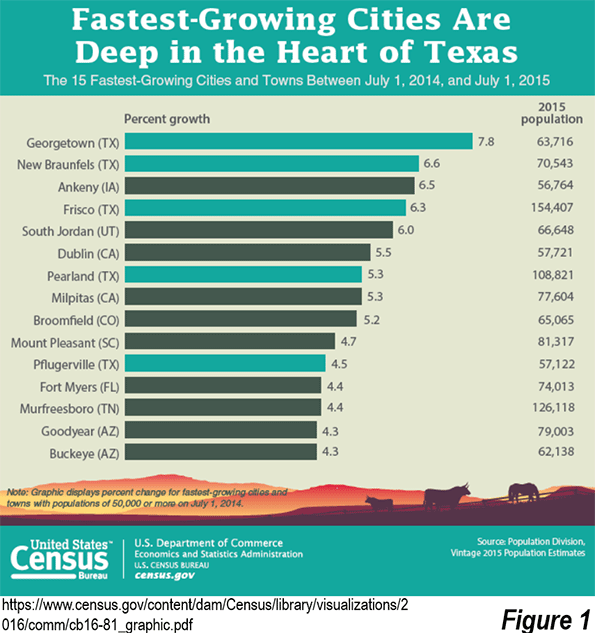
    Data released by the federal government last week provided additional evidence that the suburbs continue to dominate metropolitan area population growth and that the biggest cities are capturing less of the growth than they did at the beginning of the decade. The new 2015 municipality population estimates from the Census Bureau indicated that virtually all of the 15 fastest growing municipalities with more than 50,000 residents were suburbs, and five were in Texas (See Census Bureau poster, Figure 1). Further, in the major metropolitan areas (more than 1,000,000 population), nearly 75 percent of the population growth was in outside the historical core municipalities (the suburbs as defined by municipal jurisdiction).

    But that’s only half of the story. The suburbs and exurbs also continue to dominate employment and employment growth, according to the annual County Business Patterns data. County Business Patterns is a particularly effective measure of genuine job location preferences (both employers and employees), since it largely provides data for private employment.

    Analysis of the data using the City Sector Model indicates that both over the longer and shorter term, the outer reaches of US metropolitan have been more than holding their own in employment growth.

    The City Sector Model

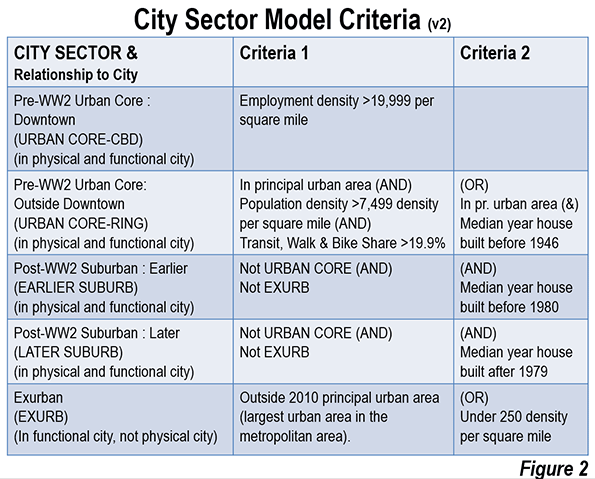
    The City Sector Model classifies small areas (zip codes) of major metropolitan areas by their urban function (lifestyle). The City Sector Model includes five sectors (Figure 2). The first two are labelled as “urban core,” replicating the urban densities and travel patterns of pre-World War II US cities, although these likely fall short of densities and travel behavior changes sought by contemporary urban planning (such as Plan Bay Area). There are two suburban sectors, earlier and later. The fifth sector is the exurbs, outside the built-up urban area. The principle purpose of the City Sector Model is to categorize metropolitan neighborhoods based on their intensity of urbanization, regardless of whether they are located within or outside the boundaries of the historical core municipality (Note).

    Most Jobs are Outside the Urban Core

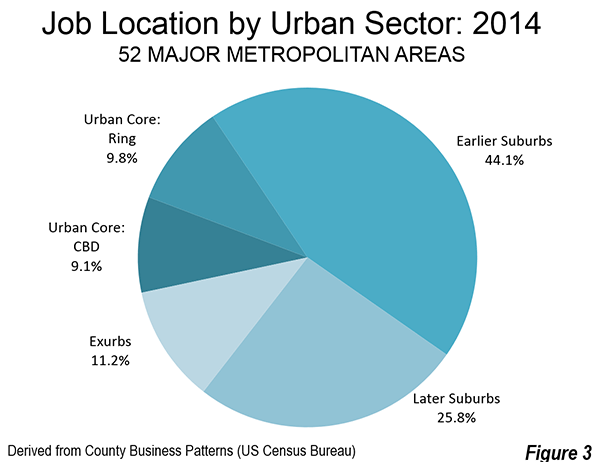
    The 2014 data indicates that more than 80 percent of employment in the nation’s major metropolitan areas is in functionally suburban or exurban areas (Figure 3). The earlier suburbs have the largest share of employment, at 44 percent. The later suburbs and exurbs combined have 37.0 percent, while the urban cores have 18.9 percent, including the 9.1 percent in the downtown areas (central business districts, or CBDs).

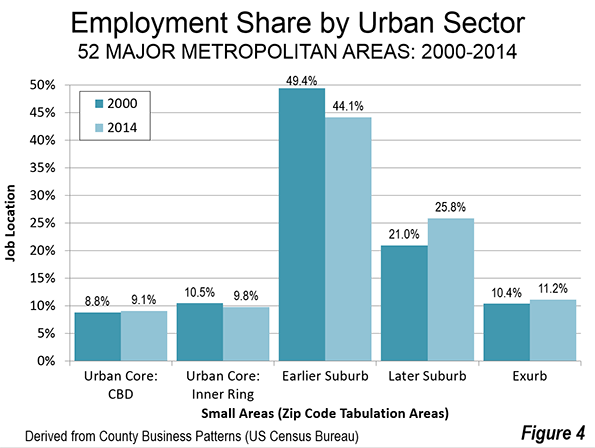
    These numbers reveal dispersion since 2000. Then, the earlier suburbs had even more of the jobs, at 49.4 percent, 5.3 percentage points higher than in 2014. Virtually all of the lost share of jobs in the earlier suburbs was transferred to the later suburbs and exurbs, which combined grew from 31.4 percent in 2000 to 37.0 percent in 2014. The urban cores had 19.4 percent of the jobs (8.8 percent in the CBDs), slightly more than the 18.9 percent in 2014 (Figure 4).

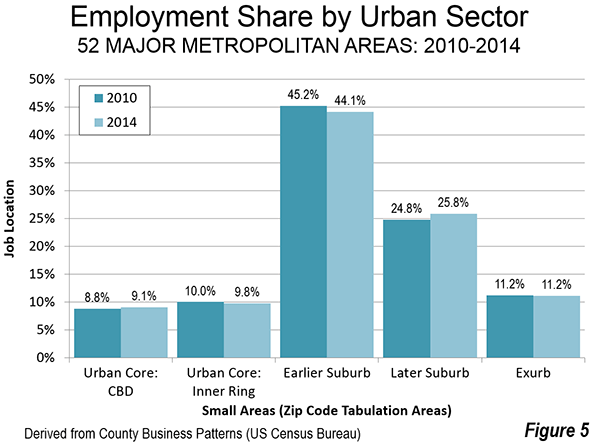
    Things have been much more stable since 2010, with a small loss in the earlier suburbs (-1.1 percentage points), a small gain in the urban core (plus 0.1 percentage points), which includes a 0.3 percentage point gain in the CBDs. The later suburbs gained 1.0 percentage points, while the exurbs held the same share as in 2010 (Figure 5).

    Most Jobs Growth Since 2010 has been Outside the Urban Core

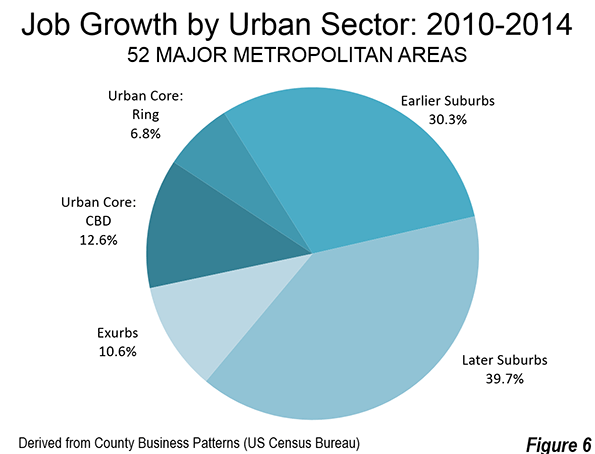
    Between 2010 and 2014, more than 80 percent of the employment growth was in the suburbs and exurbs (Figure 6), approximately the same figure as their overall combined share of employment. The later suburbs have added more than their employment share since 2010 (39.7 percent compare to 24.8 percent), while the earlier suburbs and the exurbs have added a smaller percentage compared to their 2010 share of jobs (30.8 percent versus 45.2 percent and 10.6 percent versus 11.2 percent, respectively).

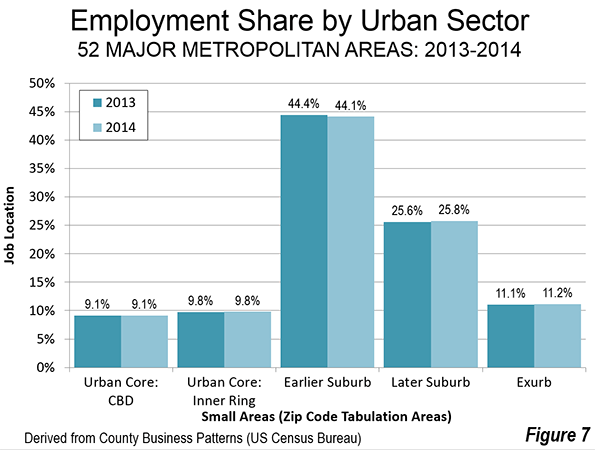
    In the last year (2013 to 2014), the data has remained similar, with smaller changes in the same direction as before (Figure 7). The earlier suburbs experienced a small loss (0.3 percentage points), while the later suburbs gained 0.2 percentage points, the exurbs gained 0.1 percentage points and the urban cores remained constant (including no change in the CBDs).

    Where the Jobs are By Urban Sector

    There is substantial variation in the distribution of jobs within metropolitan areas.

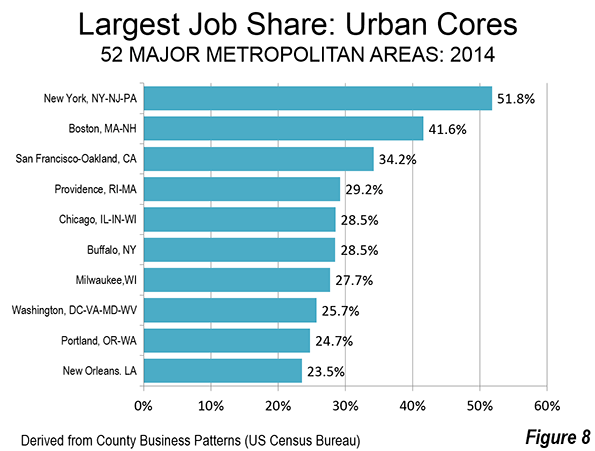
    Not surprisingly, the largest urban core job concentrations are in the metropolitan areas with older and larger core municipalities. Nearly 52 percent of the employment in the New York metropolitan area is in the urban core, which includes the nation’s largest central business district. Chicago, Washington, Boston and San Francisco, with the next four largest CBDs (though all small compared to New York) also rank among the 10 metropolitan areas with the greatest employment share in their urban cores (Figure 8). Only 16 of the 52 major metropolitan areas had more than 20 percent of their employment in urban cores (36 had 80 percent or more of their employment in the suburbs or exurbs).

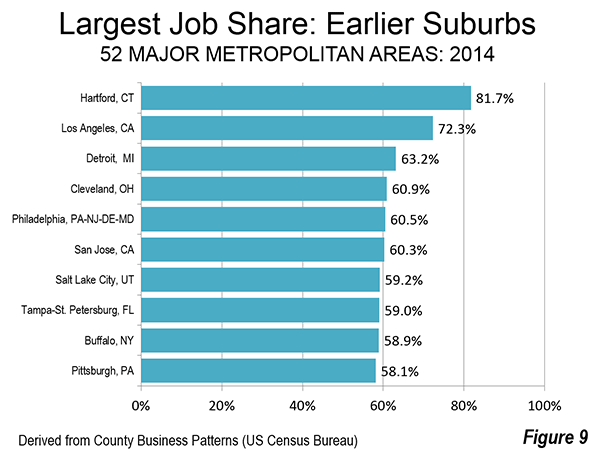
    The metropolitan areas with greater job concentration in the earlier suburbs typically experienced more of their growth in the decades immediately following World War II. Hartford has the largest share of employment in the earlier suburbs, at 81.7 percent (Figure 9). Los Angeles, perhaps the original polycentric city, ranks second, at 72.3 percent. This list also includes Rust Belt metropolitan areas that have either grown little or lost population (Detroit, Cleveland, Pittsburgh and Buffalo).

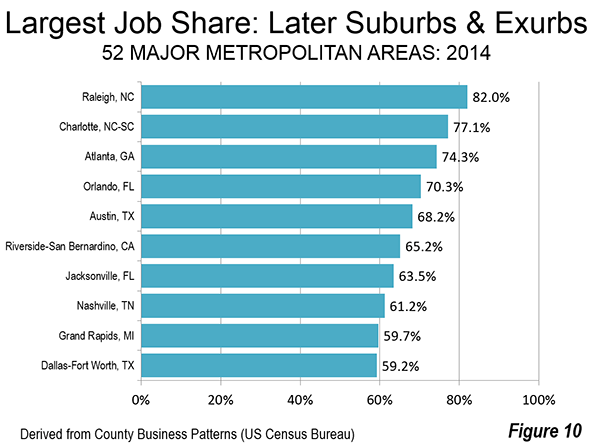
    The metropolitan areas that have had the greatest recent population growth dominate in later suburban and exurban employment (Figure 10). More than 82 percent of Raleigh’s employment is in the later suburbs and exurbs. All but one of the 10 metropolitan areas with the largest job share in the later suburbs and exurbs were among the 15 fastest growing in terms of overall population between 1980 and 2010. The one exception is Grand Rapids, which ranked 27th in growth from 1980 to 2010.

    Balanced Metropolitan Areas

    The meme that people were moving back to the city (urban core) has been with us for decades. For just as long, there have been virtually no reality to the narrative. . The overwhelming share of the population lives and works the suburbs and exurbs. This is where both population growth continues and job growth is concentrated. One fortunate result is metropolitan areas with remarkable balances between home and employment locations, and among the shortest work trip travel times in the world.

    ——

    Note: In some cases the functional urban core extends beyond the boundaries of the historical core municipality (such as in New York and Boston). In other cases, there is virtually no functional urban core (such as in San Jose or Phoenix). Functional urban cores accounted for 14.7 percent of the major metropolitan area population in 2012. By comparison, the jurisdictional urban cores (historical core municipalities) had 26.6 percent of the major metropolitan population, many consisting of large tracts of functional suburban development.

    Wendell Cox is principal of Demographia, an international pubilc policy and demographics firm. He is a Senior Fellow of the Center for Opportunity Urbanism (US), Senior Fellow for Housing Affordability and Municipal Policy for the Frontier Centre for Public Policy (Canada), and a member of the Board of Advisors of the Center for Demographics and Policy at Chapman University (California). He is co-author of the "Demographia International Housing Affordability Survey" and author of "Demographia World Urban Areas" and "War on the Dream: How Anti-Sprawl Policy Threatens the Quality of Life." He was appointed to three terms on the Los Angeles County Transportation Commission, where he served with the leading city and county leadership as the only non-elected member. He served as a visiting professor at the Conservatoire National des Arts et Metiers, a national university in Paris.

    Photograph: Suburban fringe, St. Louis (by author)

  • So Much for Peak Driving (VMT)

    So much for peak VMT. The planners and analysts who watched vehicle miles traveled (VMT) trends seemingly peak are no doubt anxious as the preliminary 2015 VMT numbers produced by the U.S. Department of Transportation showed new record total VMT well ahead of the 2007 number that many had hoped signaled peak U.S. VMT. Perhaps even more disconcerting was the sharp increase in per capita VMT, up approximately 2.6 percent for 2015. While not surpassing the prior peak per capita travel levels of the past decade of over 10,000 miles per year per person, per capita VMT nonetheless showed substantial growth during a time when the economy was far from robust. Figure 1 shows the upward sloping total and per capita VMT trends.

    While individuals, perhaps someone who bought one of those 17.34 million autos sold in the U.S. 2015 (also a new record) and had a reliable vehicle to travel cross country to visit grandma, celebrate the sub $2.00 gas and the chance to travel more, others, anxious about the congestion, energy use, or emissions of more travel, may be rethinking premature obituaries for auto travel.

    Source: Federal Reserve Bank of St. Louis

    After exhaustive speculation, one can compile a list of causal factors for the upward spike:

    • The millennial who bought many of those new cars and the used ones they replaced must be accumulating mileage as they hunt for affordable homes in the suburbs.
    • That army of Uber drivers must be racking up the miles as their predatory rates attract bike, walk, transit, and taxi travelers to the car—say nothing of the deadhead miles between rides.
    • Amazon Prime shoppers with their quick delivery preferences are filling the roads with delivery vehicles.
    • The flood of illegal immigrants undocumented aliens, many of whom get driver licenses, must be the cause.
    • Google and the myriad of driverless vehicle developers must be tripping traffic counters as they test driverless vehicles.

    Or maybe not. While current data on individual travel behavior changes is not available, even the aggregate data can shed some light on the trends. The change in VMT in rural areas increased 3.86 percent versus 3.37 percent for urban roads suggesting long distance and freight travel growth. Urban travel constitutes 69 percent of total VMT. Truck VMT data will be available later and data on VMT for commercial vehicles, public vehicles, and utility vehicles can only be guesstimated. Freight and these uses of non-household vehicles collectively constitute 24 percent of all roadway travel, hence deserve attention when interpreting trends.

    The reduction in fuel price is reasonably hypothesized as a contributor to VMT growth. Historically travel elasticity to fuel cost has been estimated to be around -0.02 to -0.04 in the short term and considerably larger in the long term. The pronounced decline in fuel prices, with average 2015 prices 30 percent below the 2013 average and with current prices 47 percent below the 2013 average price, could explain part of the VMT increase. 

    Another way to think about the impact of lower fuel prices is to consider that the average household has an estimated $1000-$1500 more in discretionary income annually as a result of the lower gas prices relative to 2013. Data from the National Household Travel Survey show travel goes up approximately 100 miles per capita annually per $1000 in household income for low and moderate income households (see Figure 2). Coupled with 2.5 million additional persons in the workforce and some wage growth, the VMT growth is understandable. 

    Perhaps most important will be understanding how VMT will trend going forward. Many of the considerations that contributed to the slowdown in VMT growth in the early part of this century are still relevant as argued in The Case for Moderate Growth in Vehicle Miles of Travel: A Critical Juncture in U.S. Travel Behavior Trends, Center for Urban Transportation Research, University of South Florida, April 2006). The role of technology in moderating travel demand is still at work with e-commerce, distance learning, telecommuting, and improved travel logistics dampening demand. And those urban millennials may be contributing to moderated demand even if not to the extent hyped by advocates of declining VMT. But the desire to travel to pursue personal opportunity and pleasure remains potent. For a large share of the population, total travel demand is governed by resource constraints, both time and money, not a diminished desire to participate in activities – many that require travel. While few desire to commute farther and may not relish accumulating VMT for routine errands, the always present and growing interest in accumulating life experiences rather than possessions may create more VMT for personal experiences and longer distance social and recreational travel counteracting the savings from greater urbanization, communications substitution for travel, or taking advantage of alternatives to personal vehicles for daily household serving travel. 

    In any case the verdict is still out. It will be interesting to watch as trends in the economy, demographics, technology, culture, values, and maybe even urban and transportation planning and investments influence future vehicle travel demand.

    The opinions are those of the author—or maybe not—but are intended to provoke reflection and do not reflect the policy positions of any associated entities or clients.

    This piece first appeared at Planetizen.

    Dr. Polzin is the director of mobility policy research at the Center for Urban Transportation Research at the University of South Florida and is responsible for coordinating the Center’s involvement in the University’s educational program. Dr. Polzin carries out research in mobility analysis, public transportation, travel behavior, planning process development, and transportation decision-making. Dr. Polzin is on the editorial board of the Journal of Public Transportation and serves on several Transportation Research Board and APTA Committees. The opinions are those of the author—or maybe not—but are intended to provoke reflection and do not reflect the policy positions of any associated entities or clients.

  • Are Compact Cities More Affordable?

    Housing affordability has been a tenacious and intractable urban problem for as long as stats have been kept. Several cities recently declared it a crisis. But what kind of problem is it? Opinions vary widely. An economic problem, or a social one? A land resource issue? Or, as traded wisdom would have it, the result of reliance on the wrong urban form? Proposed solutions vary accordingly. Now, new evidence rules out one potential source of unaffordable housing: clearly, it is not an urban form problem. The widely-believed theory that a city’s lack of affordable housing can be fixed with increased compactness — when combined with public transit — is apparently wrong.

    In a recent article we questioned a publicized correlation between a compactness index level (i.e., urban form) and housing affordability. The argument supporting compactness is that it enables the use of public transit and active mobility modes, which reduce transport expenses sufficiently to eclipse the higher cost of housing prevalent in compact districts. We challenged that assumption, and found that data from eighteen US regional metro regions showed no such effect. Even if it were at all present, it would not be sufficiently pronounced to be an effective solution. Those conclusions were based on a regional look at the problem.

    While the aggregate regional data undermined the urban form theory of affordability, what do sub-regional level data show? At this finer level, could the housing-plus-transportation burden work to the advantage of households? To answer this question, we used data from 18 districts of the Metro Vancouver (BC) region. In this case, the official data exclude certain types of households — a critical limitation. But, given that such disaggregated data are rare, an effort at deciphering their meaning is warranted.

    The two subject groups were Working Homeowners and Working Renters. First, we looked at whether or not the working homeowners could find accommodation that suited their income without stretching themselves thin.

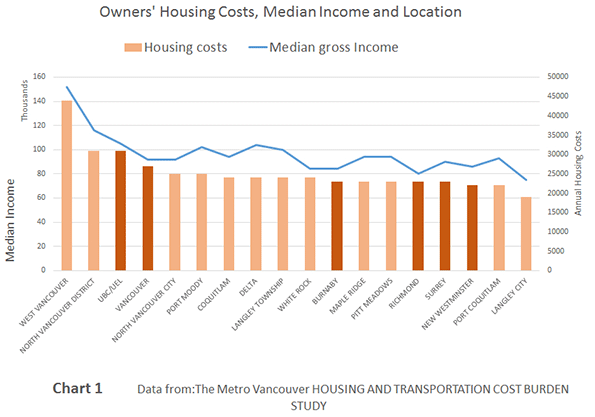
    Chart #1 shows the progression of housing costs in each sub-regional district, and the corresponding household median income. The in-step slopes of the two data sets suggest that working home-owning households have housing costs in tune with their earnings. This implication is further confirmed by the strong correlation (R2= 0.8598) between their income and their housing expenses.

    Housing costs that are proportional with income are a positive sign, but can these homeowners actually make their mortgage payments without financial stress? The data says yes, they can. This group’s average ratio of housing payments to income is 26%. It never exceeds 30%, the accepted threshold of financial strain.

    Instructively, from an urban form perspective, the highest ratios occur in the central, compact district; a confirmatory finding. Equally expected are that the lowest cost-to-income ratios occur in districts furthest from the center; these districts are either suburban or exurban.

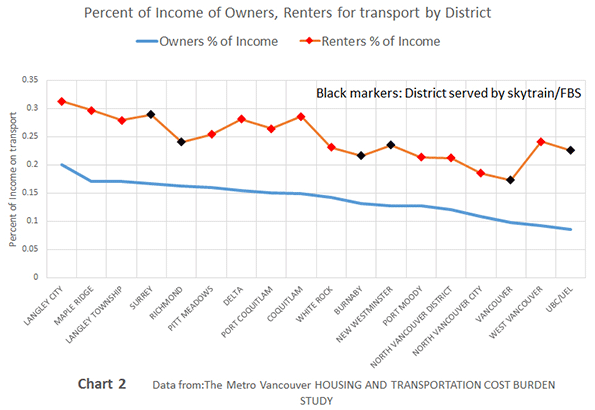
    But are any of these home-owning households disadvantaged by excessive transportation costs due to their location? The data show a normal, average transportation expense of 14% of income and a range from about 8% to 20%. The ratios do increase with distance, but bear no significant correlation with income (R2= 0.0178).

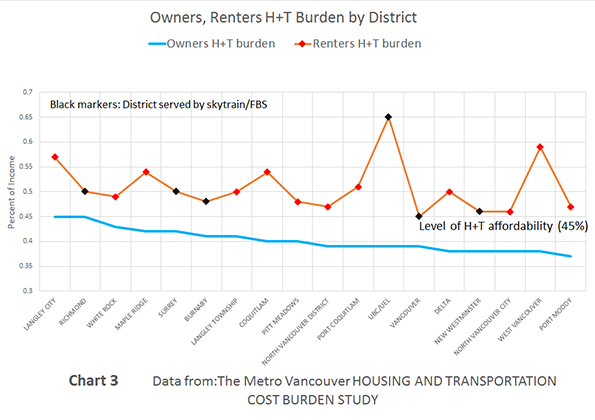
    When choosing the place of residence, do homeowners consider housing costs, but disregard transportation costs? If so, could this lead to an affordability problem as measured by the combined costs? Apparently not. Chart #3 graphs (blue line) this group’s cost burden for combined housing and transportation (H+T) expenses, which never exceed the recognized affordability threshold: 45% of income.

    Conclusion? Metro Vancouver’s 305,000 households of working homeowners with mortgages aren’t experiencing financial strain due to their housing costs, no matter what their preferred housing form, location or transportation arrangements. The urban and suburban locations of the city structure fully satisfy their housing and transport needs. Neither compactness nor its absence has a negative impact on their finances.

    The data paints an entirely different picture for the 224,000 working households that rent their accommodations. Their average H+T burden (Chart #3; orange line) is 51% of their median income, and it ranges from the 45% threshold of affordability to an extreme of 65%.

    This picture, however, is not the result of high housing costs; rents register in the affordable range in all locations but two. The average working renter’s housing cost is 26%, which mimics that of a homeowner, and the range is below the stress level of 30%, with only two outliers (out of 18 districts) at 35% and 45% of income. For renters, as is the case for homeowners, the highest housing costs occur in the more compact districts. The outliers are found in elite social cluster districts — highly desirable neighborhoods — entirely unrelated to urban form.

    Given that rent costs are within the affordable range in all but two locations, we may infer that the Metro Region provides a sufficient range of housing costs for this group in its current urban/suburban structure.

    These findings are reinforced by the proportionality of incomes and housing expenses for both homeowners and renters. The incomes of renter households range from 45% to 63% of homeowners by location, and their rent costs are from 45% to 65%, an almost identical range.

    It would seem, then, that the excessive H+T burden renters face can be attributed partially to the transportation costs of this group. However, contrary to expectations, of the six districts that have rapid rail service (sky-train; black markers on Chart #3), not one manages to have a total burden below the affordability threshold. That even goes for the two suburban districts that offer the lowest rents.

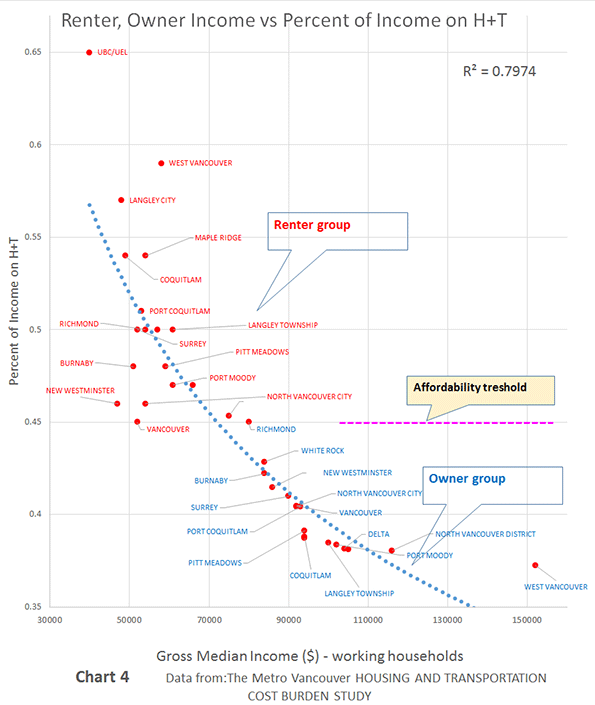
    Chart #4 clearly shows the division between the earnings of owners and renters, and the affordability threshold that separates them. The belief that a compact urban form provides a path to solving housing affordability problems appears untenable.

    Overall, the data shows that for working homeowners there are no locations in the Metro Vancouver Region, whether urban, suburban or exurban, that push housing costs or the combined costs of housing and transportation above the affordability threshold. Urban form is not affecting budgets in these households.

    For working renters, rents are affordable in 16 of the 18 districts, whether urban, suburban or exurban. However, when transportation costs are added to their housing costs, the new sum puts them in financial stress, even in districts served by rapid rail transit.

    This sub-regional, limited analysis confirms the findings of our earlier regional look: compactness and access to transit do not produce the affordability benefits that have been claimed. The compact urban form does not equal more affordable living, particularly for the less affluent.

    Fanis Grammenos heads Urban Pattern Associates (UPA), a planning consultancy. UPA researches and promotes sustainable planning practices including the implementation of the Fused Grid, a new urban network model. He is a regular columnist for the Canadian Home Builder magazine, and author of Remaking the City Street Grid: A model for urban and suburban development. Reach him at fanis.grammenos at gmail.com.

    Flickr photo by Nick Kenrick: The Neighbourhood of East Van

  • Murbanism (Mormon Urbanism)

    I coined the portmanteau murbanism some years ago on a trip to Salt Lake. Mormon urbanism is shorthand for a theory I have about adaptation and resilience. The term connotes a place that has all the qualities that should result in long term failure, but will probably thrive because of the local culture. Murbanism doesn’t necessarily have to involve a single Mormon. Let me explain…

    Screen Shot 2016-04-21 at 1.15.34 AM

    Screen Shot 2016-04-21 at 1.43.25 AM

    Screen Shot 2016-04-21 at 1.15.17 AM

    Screen Shot 2016-04-21 at 1.00.34 AM

    Let’s say you have two nearly identical towns. Picture typical late twentieth century auto oriented strip mall and tract home blah, blah, blah nowhere near anything. They could be physically beautiful places. They could be comfortable and affordable. They could even be prestigious and exclusive. But they’re entirely dependent on daily deliveries of refrigerated food and a steady trickle of fuel and water from some remote supply chain involving elaborate pumps and pipelines. The primary sources of revenue for these towns come in the form of pension checks, work that requires a forty five minute commute, and massive but hidden subsidies from the state and federal government.

    Screen Shot 2016-04-21 at 1.42.23 AM

    Screen Shot 2016-04-21 at 1.44.40 AM

    Screen Shot 2016-04-21 at 1.44.15 AM

    One town is populated by a motley assortment of unaffiliated residents who drifted in a few years ago from New Jersey, Iowa, California, and Illinois. They were  looking for relatively affordable houses, low taxes, and sun in winter. They’re not “joiners.” They like their privacy. The gated community and homeowners association do most of the heavy lifting in terms of public engagement. If anyone wants to be around other people they can drive to the mall.

    Screen Shot 2016-04-21 at 1.46.42 AM

    Screen Shot 2016-04-21 at 1.53.28 AM

    The other town is predominantly Mormon and organized in a single stake. Which town is likely to hold up better over time? Which is probably better able to respond in a rational and organized fashion in a crisis? Which town can we expect to reexamine its fundamentals and thoughtfully redirect its collective energy if circumstances were to compel serious change?

    Here’s another example. Which place has better keeping qualities? Israel or Dubai? Spot the difference?

    Murbanism isn’t about the physical form of the town, or any of the buildings, or the town’s location. It’s about how the people who live there relate to each other and how well they can function together in good times and bad.

    I’m not a Mormon. In fact I’m the opposite of a Mormon if such a thing exists. But I recognize a resilient and durable culture when I see it. I think we can all learn a great deal from the Mormon experience and adapt those lessons to our own particular circumstances.

    John Sanphillippo lives in San Francisco and blogs about urbanism, adaptation, and resilience at granolashotgun.com. He’s a member of the Congress for New Urbanism, films videos for faircompanies.com, and is a regular contributor to Strongtowns.org. He earns his living by buying, renovating, and renting undervalued properties in places that have good long term prospects. He is a graduate of Rutgers University.

  • The Best Small And Medium-Size Cities For Jobs 2016

    When we look at how the U.S. economy is performing, we usually focus on the largest metropolitan areas. But some 29% of non-farm jobs in the U.S. are in small and midsize metro areas. And since they tend to be less economically diverse and more volatile, these metro areas often are where we can more clearly see the fissures in the economy — the sectors that are growing, and which are shrinking.

    In this year’s edition of our Best Cities For Jobs survey, 13 of the 20 metro areas with the fastest job growth are small (under 150,000 total nonfarm jobs) and medium-sized (between 150,000 and 450,000 total nonfarm jobs).

    Many of the smaller places creating jobs at the fastest pace are located in booming regions like the Intermountain West, near college towns and in regions with attractive natural amenities. Meanwhile, times are turning tougher in West Texas and other energy-dependent areas.

    The winners and losers also reflect demographic trends, notably the tsunami of downshifting boomers, that will shape our society and economy for years to come.

    The Utah Superstars

    As is the case with larger areas, it usually helps if a smaller region has more than one economic pillar. This is certainly true for our No. 1 city overall, St. George, Utah. The job count in this metro area has grown a remarkable 32 percent since 2010. Last year St. George’s job growth rate was 7 percent, roughly 3.5 times faster than the national rate, and one reason the area leaped 30 places in our overall rankings from last year.

    Located in the scenic southwestern part of the state near the Arizona border, and a magnet for retirees and tourists, St. George has had a remarkable population boom, growing from fewer than 100,000 residents in 2000 to 155,600 people as of 2015.

    This demographic surge can be seen where you would expect it, with rapid growth in construction sector jobs – up over 50 percent since 2010 — as well as leisure and hospitality, where employment expanded 37.8 percent over the same span.

    Yet this is not just a sleepy retirement and tourist town. The metro area has a median age of 32, three years older than the Utah average, but well below the national average of 37.2. Despite this younger demographic, job growth has occurred in sectors that tend to employ older workers, such as manufacturing, up 40.9 percent since 2010, and professional business services, up 34.6 percent.

    Not surprisingly if you want to find other local economies that reflect this kind of dynamic, the best place to look is elsewhere in the Beehive State. Our second-ranked area nationally, Provo-Orem has also achieved rapid job growth, with employment expanding 27.4 percent since 2010. Like St. George, this metro area has enjoyed strong growth in construction and hospitality, but also in higher-wage fields, including information, which has expanded employment 43.9 percent since 2010, and professional business services, up 34.3 percent.

    Home to Brigham Young University, the Harvard of Mormondom, the metro area is among the youngest in the nation, largely due to large Mormon families. It’s also, according to Gallup, the most religious as well as one of the best educated: almost 40 percent of its population over 25 holds bachelor’s degrees and almost 5 percent have advanced degrees, just ahead of San Jose, Calif., and Nashville, Tenn.

    Also placing highly from Utah is No. 15 Ogden-Clearfield, which rose 25 notches over last year. Employment has expanded 16.2 percent since 2010. Like St. George and Provo-Orem, this region has experienced strong expansion in its construction and hospitality sectors, but also boasts great economic diversity. Since 2010, manufacturing employment has grown 10.4 percent while professional business service jobs have expanded a healthy 31.3 percent.

    The Amenity Regions

    Of course, you don’t have to be a Latter Day Saint to have a successful small city. But it helps a great deal if you happen to be in a place that has standout natural and cultural amenities. This trend may be greatly enhanced by the movement of seniors, particularly affluent ones, to what may be called “amenity regions” throughout the country. Contrary to the urban mythology pressed by the mainstream media, Census data shows that seniors are not moving “back to the city” in great numbers but generally to smaller, less dense regions, if they move at all.

    Being in a nice place, of course, is an asset for any city; after all, entrepreneurs and young families also like to live somewhere good times beckon. At the same time, some of these areas also benefit from a strong hospitality and second home market. Another critical advantage belongs to college towns which, by their very nature, usually offer more by way of arts, restaurants and entertainment than other places.

    The highest ranked of these metro areas this year is Fayetteville-Springdale-Rogers, AR-MO, which comes in sixth on our overall list. It enjoys the benefits of being home to the University of Arkansas as well as close to the Ozark Mountains, one of the premier recreation areas in middle America. Since 2010, employment in the metro area has jumped 19.6 percent, or 40,000 jobs, with a 4.7 percent expansion last year. Like other top small cities, the areas has enjoyed strong growth in construction and hospitality jobs, up 37.2 percent since 2010, but also professional and business services, which expanded 38.2 percent over the same time period.

    Some other of the fastest-growing areas metro are tourism and retirement destinations on the tech-rich West Coast. Five years ago, Napa, Calif., and Bend-Redmond, Wash., were mired toward the bottom of our ranking in 344th and 36rd place, respectively. But as the coastal tech economies have surged, so have they, rising to 13th and 14th place this year. Hospitality and construction have been the big job gainers for both, with some jobs added in professional services as well.

    Losing Ground In The Oil Patch

    As tech-linked areas ascend, many energy-producing towns are slipping, with oil and gas prices in the dumps and the coal industry racked by the government-guided transition to cleaner forms of power production.

    West Virginia’s metropolitan areas have all suffered major declines on our list, with Wheeling dropping 54 places from last year’s survey to 396th on a 0.7 percent contraction in employment on the year. In Charleston, W.V., which has fallen to five spots from the bottom of our list, mining and natural resources employment declined 9.8 percent last year and is off 31.5 percent since 2010. Big job losses have occurred also in Wyoming, a major coal producing area, where Cheyenne dropped 82 places to 206th as mining and natural resources employment contracted 6.2 percent last year.

    Many once red-hot areas in the oil patch have taken devastating hits. Former high-flyer Victoria, Texas, dropped from 24th place last year to 115th. But no place reflects the flagging fortunes of the West Texas energy economy more than Midland, which, just last year ranked first on our list; this year it’s at 139th after losing 14.7 percent of its natural resources jobs and 6.9 percent of its jobs overall. Odessa fell from third last year to 173rd this year on the back of an 8.8 percent contraction in employment, and 20.4 percent in the natural resources sector.

    Several Louisiana metro areas have suffered steep job losses, including Houma-Thibodaux, down 183 places on our list to 325th after an 8 percent contraction in employment. Several smaller Oklahoma communities have taken serious hits, including Tulsa, which dropped to 222nd. Bismarck, N.D., a prime beneficiary of the Bakken oil boom, dropped 67 places from last year to 102nd as 6.8 percent of its natural resources jobs evaporated, while Bakersfield, Calif., one of the country’s largest oil producing areas dropped 70 places to 109th as natural resources employment contracted 11.5 percent.

    The Rust Belt: Is The Bounce Back Over?

    The picture is less uniform in the industrial sector than in energy. Some manufacturing-oriented areas are booming, such as No. 4 Gainesville, Ga., and No. 10 Columbus, Ind., home to Cummins. Nationwide manufacturing employment grew a paltry 0.3 percent last year, with some local declines that devastated the affected economies.

    In the Midwest, the big losers include Midland, Mich., which dropped 75 places to 245th, Green Bay, Wisc., which fell 83 places to 286th, and Fond du Lac, Wisc., which lost 173 places to 293rd. In Pennsylvania, Scranton-Wilkes Barre-Hazelton fell 97 places to 373rd and Williamsport dropped an astounding 212 places since last year to 383rd, with manufacturing employment off 13.2 percent since 2010 and overall employment down 3.5% last year. And then there’s Johnson, Pa., in last place at 421st.

    Like the energy economies, the industrially oriented metro areas are likely to stagnate for the time being as declines in global markets, the high dollar as well as lower demand from the energy sector take their toll. The International Monetary Fund predicts a modest 3.2 percent global growth rate for 2016, held down in significant part by a faltering Chinese economy. At the same time, OPEC overproduction and the addition of Iranian oil to global markets will likely keep the price below the $70-$80 per barrel range that energy producers need to start expanding energy investments again.

    This means, for the time being at least, the strongest smaller cities will be those which attract people and companies from bigger places by offering better amenities, cheaper housing, better schools, growing populations and, in many cases, college campuses—all offering a better quality of life but in a smaller, usually more affordable place.

    This piece first appeared at Forbes.

    Joel Kotkin is executive editor of NewGeography.com. He is the Roger Hobbs Distinguished Fellow in Urban Studies at Chapman University and executive director of the Houston-based Center for Opportunity Urbanism. His newest book, The Human City: Urbanism for the rest of us, will be published in April by Agate. He is also author of The New Class ConflictThe City: A Global History, and The Next Hundred Million: America in 2050. He lives in Orange County, CA.

    Michael Shires, Ph.D. is a professor at Pepperdine University School of Public Policy.

    By UtahStizzle (Own work) [Public domain], via Wikimedia Commons
  • Honolulu Rail: It Just Keeps Getting Worse

    There seems to be no end to the difficulties facing Honolulu’s urban rail project. In an editorial, Honolulu’s Civil Beat noted that federal officials fear the project cost may reach $8.1 billion, which is more than 50 percent above the “original estimate” of $5.2 billion. The cost blowout of nearly $3 billion would be far more than state consultants suggested in a 2010 report. That report, by the Infrastructure Management Group (IMG) in conjunction with the Land Use and Economic Management Group of CB Richard Ellis and Thomas A. Rubin estimated a “most likely scenario” in which the rail cost overrun would have been $909 million (Note).

    This is, however, a particular concern to local citizens, since it has been suggested that no rail project has cost more in relation to its population base in US history. If the the project costs $8.1 billion, the IMG et al report estimate will have turned out to be far too conservative, less than one-third the overrun. At $2.9 billion this extra cost is nearly $3,000 for every man, woman and child in Honolulu. It is more than $8,500 per household.

    The Civil Beat editorial is here.

    Note: Thomas A. Rubin’s more recent analysis of rail and transit ridership in Los Angeles is here.

  • New York’s Incredible Subway

    The New York subway is unlike any other transit system in the United States. This system extends for 230 miles (375 kilometers) with approximately 420 stations. It serves the four highly  dense boroughs of the city (Manhattan, Brooklyn, Queens and the Bronx), each of which is 20 percent or more denser than any municipality large municipality in the United States or Canada. Much of the fifth borough, Staten Island, looks very much like suburban New Jersey and has no subway service, though has a more modest system, the Staten Island Railway.

    Overall, the older Metros (Note 1), New York’s subway, along with London’s Underground and the Paris Metro dominated the world’s urban rail systems for decades. Until the recent emergence of Chinese urban areas (Beijing and Shanghai), London had the longest extent of track in the world, followed by New York.

    As one of the original Metros in the world, it might be thought that the New York City Subway’s best days are over. That would be a mistake. It is true that ridership reached a peak in the late 1940s and dropped by more than half between the late 1970s and the early 1990s. However, since that time ridership has more than doubled, according to American Public Transportation Association data. And it is not inconceivable that new records may be set in the years to come.

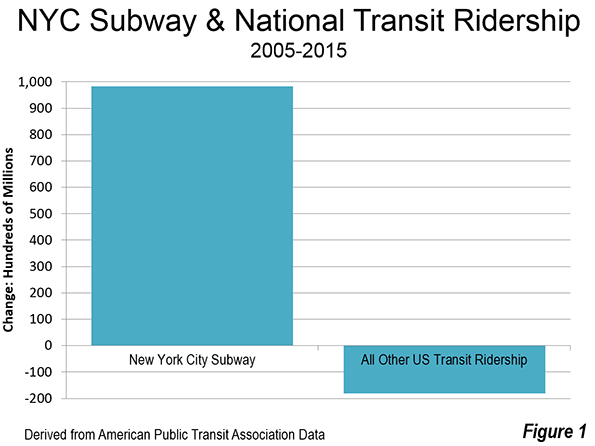
    Perhaps the most incredible thing about the New York City Subway has been its utter dominance of the well-publicized national transit ridership increases of the last decade. According to annual data published by the American Public Transportation Association (APTA), ridership on the New York City Subway accounts for all of the transit increase since 2005. Between 2005 and 2015, ridership on the New York City Subway increased nearly 1 billion trips. By contrast, all of the transit services in the United States, including the New York City Subway, increased only 800 million over the same period. On services outside the New York City subway, three was a loss of nearly 200 million riders between 2005 and 2015 (Figure 1).

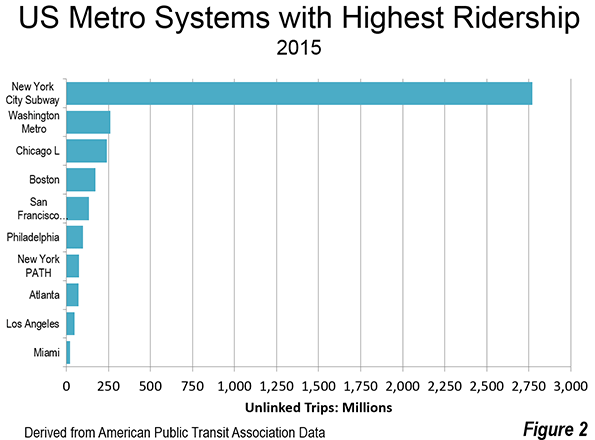
    The New York City subway accounts carries nearly 2.5 times the annual ridership of the other nine largest metro systems in the nation combined (Figure 2). This is 10 times that of Washington’s Metro, which is losing ridership despite strong population growth , probably partly due to safety concerns (see America’s Subway: America’s Embarrassment?). Things have gotten so bad in Washington that the federal government has threatened to close the system (See: Feds Forced to Set Priorities for Washington Subway).

    The New York City subway carries more than 11 times the ridership of the Chicago “L”, though like in New York, the ridership trend on the “L” has increased impressively in recent years. The New York City subway carries and more than 50 times the Los Angeles subway ridership, where MTA (and SCRTD) bus and rail ridership has declined over the past 30 years despite an aggressive rail program (See: Just How Much has Los Angeles Transit Ridership Fallen?).

    With these gains, the New York City Subway’s share of national transit ridership has risen from less than one of each five riders (18 percent) in 2005 to more than one in four (26 percent) in 2015. This drove the New York City metropolitan areas share of all national transit ridership from 30 percent in 2005 to over 37 percent in 2015.

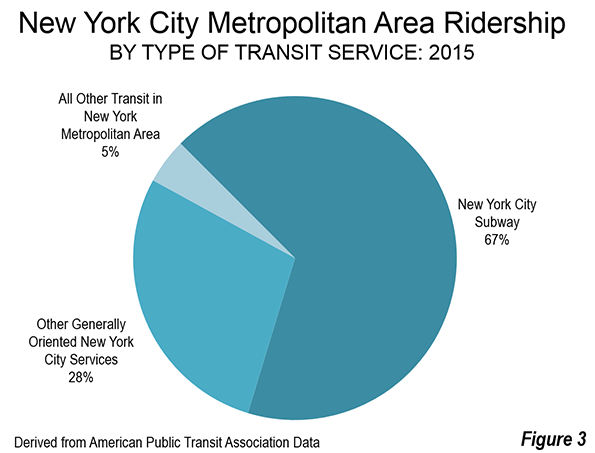
    Subway ridership dominates transit in the New York City metropolitan area as well, at 67 percent. Other New York City oriented transit services, including services that operate within the city exclusively and those that principally carry commuters in and out of the city account for 28 percent of the ridership. This includes the commuter rail systems (Long Island Railroad, Metro-North Railroad and New Jersey Transit) and the Metro from New Jersey (PATH) have experienced ridership increases of approximately 15 percent over last decade (Note 2).

    Other transit services, those not oriented to New York City, account for five percent of the metropolitan area’s transit ridership (Figure 3). By comparison, approximately 58 percent of the population lives outside the city of New York. The small transit ridership share not oriented to New York City illustrates a very strong automobile component in suburban mobility even in the most well-served transit market in the country.

    Last year (2014), APTA announced that the nation’s transit ridership had reached the highest in modern history, having not been higher since 1957. In fact, the ridership boom that produced the record can be attributed wholly to the New York City Subway. If New York City Subway ridership had remained at its 2005 level, overall transit ridership would have decreased from 9.8 billion in 2005 to 9.6 billion in 2015. The modern record of 10.7 billion rides would never have been approached.

    Thus, transit in the United States is not only a "New York Story," but it has also been strongly dependent on the New York Subway in recent years. After decades of decline, the revival of the New York subway is a welcome development.

    Note 1: “Metro” is the international generic term for grade separated rapid transit systems. In the United States, the Federal Transit Administration refers to this transit mode as "heavy rail."

    Note 2: Separate data is not available in the APTA reports on the for-profit commuter bus operators serving the city of New York from New Jersey.

    Wendell Cox is principal of Demographia, an international pubilc policy and demographics firm. He is a Senior Fellow of the Center for Opportunity Urbanism (US), Senior Fellow for Housing Affordability and Municipal Policy for the Frontier Centre for Public Policy (Canada), and a member of the Board of Advisors of the Center for Demographics and Policy at Chapman University (California). He is co-author of the “Demographia International Housing Affordability Survey” and author of “Demographia World Urban Areas” and “War on the Dream: How Anti-Sprawl Policy Threatens the Quality of Life.” He was appointed to three terms on the Los Angeles County Transportation Commission, where he served with the leading city and county leadership as the only non-elected member. He served as a visiting professor at the Conservatoire National des Arts et Metiers, a national university in Paris.

    Photo: New York City Subway diagram by CountZ at English Wikipedia, CC BY-SA 3.0