Blog

  • Hillary Clinton vs. Donald Trump? The Winner Is…the Oligarchy

    The real winners in election 2016 are going to be the new-economy oligarchs who are among Clinton’s biggest donors.

    This presidential election may have been driven by populist fever in both parties, but at the end, the campaign has left the nation’s oligarchs in better position than ever. As Bernie Sanders now marches to his own inevitable defeat, leaving the real winners those oligarchs—notably in tech, media, urban real estate and on Wall Street—who are among Hillary Clinton’s most reliable supporters.

    With either Ted Cruz, or , more likely, Donald Trump, as the GOP nominee, the emerging post-industrial ruling class will have little to no reason to even consider breaking with the Democrats. It’s already clear that companies such as Facebook consider it their duty to stop Trump, and there is a growing tendency among social media firms, including Twitter, to censor unpopular right-wing views.

    Clinton, by outlasting Sanders, has done the oligarchs’ dirty work for them. As Greg Ferenstein, who has been surveying Internet billionaires in the Bay Area notes, the tech elite—much like media and Wall Street—have no sympathy for Sanders’s social democracy. After all, it’s much harder to become a mega-billionaire if tax rates for the wealthy soar; much better to show your commitment to things like gender equality, gay rights, climate change from the comfort of San Francisco or Manhattan luxury apartments or soaking in the hot tub in Malibu, Boulder, the Hamptons, or Los Altos hills.

    Clinton occasionally apes Sanders’s revolutionary rhetoric in decrying Wall Street and inequality, but this is hard to take too seriously. She and her husband, notes The Guardian, take advantage of the same Delaware tax shelters favored by the ultra rich, including Donald Trump.

    Clinton angrily denounced the use of tax shelters revealed in the Panama Papers as “outrageous.” Yet the papers revealed that many key supporters of the Clinton Foundation—including Canadian mining magnate Frank Giusta and financier Sandy Weill—have all indulged in the much-dissed practice of hiding money overseas.

    For decades, the Clintons have built their family political enterprise on contributions from the global ultra-rich; between their campaigns and the foundations, the couple has raised, according to The Washington Post, a cool $3 billion, at least a small portion of it coming from Donald Trump. The outrageous foundation fundraising, not to mention her famous Wall Street 20-minute-for-$250,000 speeches, should dissuade anyone from believing Clinton stands as a traditional populist.

    A look at Clinton’s finances should tell us all we need to know. When Sanders attacked her for her Wall Street backers, she made a point of saying she had gotten more support from the teacher’s unions (who are arguably less heinous). Her campaign has now received more money (barely) from individuals in the securities and investment industry than in unionized teachers; the finance sector has forked over $21 million to the former Secretary the State, making it the largest source of her donations.

    And this gap will likely grow as financiers reject Cruz, whose right-wing gold standard views can’t be popular on Wall Street, and Trump, who is totally unpredictable, something big money people generally do not like. With Jeb Bush out of the race, Clinton has emerged as the clear favorite of the financial moguls, with the exception of outliers like Carl Icahn, who have lined up behind Trump.

    Clinton’s biggest individual backers also include a lot of entertainment and media figures. NBC Universal, News Corporation, Turner Broadcasting and Thomson Reuters are amongmore than a dozen media organizations that have made charitable contributions to the Clinton Foundation in recent years, the foundation’s records show.

    Overall, four of her top 10 supporters in terms of contributions come from entertainment: Haim Saban, Jeffrey Katzenberg, Steven Spielberg, J.J. Abrams—while seven of the top 20 come from the world of hedge funds and investment banks. In April she raised a cool $15 million at two parties, one in San Francisco, the other in Los Angeles, hosted by George and Amal Clooney.

    Clinton’s support base parallels the very changes in wealth accumulation that I spelled out recently in the Beast. Over the last three decades, an increasing share of billionaires have come from finance, tech and media. Oil, agribusiness and manufacturing may be backing the GOP, but these are all losing their market share of the nation’s billionaires.

    Of course many younger people in entertainment have preferred Sanders by a huge margin, but some of their pop heroines—Lena Dunham, Demi Lovato, Katy Petty—have dutifully performed for Clinton, reflecting her stranglehold over the Hollywood establishment.

    But the most important players in Clinton’s new gentry come from the tech world. Bill Clinton opened this spigot up in 1992, impressing such longtime Republicans as Hewlett Packard’s John Young and then-Apple President John Sculley enough to get their endorsements.

    President Obama has deepened these ties, raising $2.4 million for his 2008 campaign and nearly $3.5 million dollars in his 2012 campaign. Tech companies, notably Google, have enjoyed extraordinary influence under Obama, particularly on crucial regulatory issues on telecommunication.

    As in entertainment, many rank and file tech workers prefer Sanders, but Clinton has almost universal support among their bosses. Virtually all the leading tech titans—Google’s Eric Schmidt , Facebook’s Sheryl Sandberg, venture capitalist John Doerr, Qualcomm founder Irwin Jacobs, Box CEO Aaron Levie, and Tesla founder Elon Musk and Salesforce.com’s Marc Benioff—have embraced Clinton.

    What does all this money mean? Rather than act an avatar of change, like Sanders or even the unpredictable Trump, Clinton will likely govern as the emissary of our new economic elite. She seems certain to side, more than even President Obama, with patrons such as Google and Apple. For all her hawkish image, Clinton has not sided with the FBI or many senators in both parties in trying to rein in the tech firms’ reluctance to help in the investigation of the San Bernardino Islamist shooters.

    The new oligarchy also does not have to worry much about too much financial scrutiny under a Hillary regime. After all, Bill Clinton pushed financial deregulation as much as any free-market Republican, and it was under him that Wall Street began to get chummier with the progressives. The late-in-the-day reforms on executive pay recently advanced by the Obama Administration will likely be subject to some delay or obfuscation. Capital gains rates—arguably among the biggest drivers of inequality and particularly tech fortunes—and tax shelters will likely remain untouched.

    Clinton’s progressivism will be strongest on issues around gender, race and sexual orientation—that conveniently don’t threaten the financial interests of oligarchy. Green politics also works fine with many moguls, both in Silicon Valley and Wall Street, as subsidies and incentives for renewable fuels have provided pathways to even greater wealth.

    Progressive reforms on immigration—likely imposed by executive order—will further help the tech oligarchs, who increasingly depend on H-1B visa holders, while filling the tap with a reliable supply of cheap service workers. As long as cheap technocoolies are included in reforms, Hillary, who has studiously avoided the H-1B issue, will seek to please both the oligarchs and the minority advocacy groups.

    Less well served, one can assume, will be the very middle- and working-class voters who have tended toward both Trump and Sanders. Indeed they will find themselves with little protections against the “gig” economy, notably Uber, which has already gained close ties to the party by hiring top Obama aides, including former campaign manager David Plouffe. Cab drivers and hotel workers who may see their jobs threatened by the “gig” tech firms should not expect as much help from a Clinton Administration as they might have gotten from Sanders.

    Even worse off will be those who work in energy development. Clinton has already crowedabout wiping out coal jobs, perhaps sensing that places like West Virginia, Wyoming, and Montana appear permanently lost to the Democrats.

    The confluence of power that underpins Clinton’s campaign should worry Americans of all political persuasions. The merging of the White House with fund-raising mania of Clintons threatens the integrity of all our institutions. Marrying media and money power should be particularly troubling. As the progressive site Common Dreams asks : “You May Hate Donald Trump. But Do You Want Facebook to Rig the Election Against Him?”

    Of course, it is conceivable that Trump or Cruz could still pull an upset, but given their horrific negatives, even worse than Hillary’s, this seems unlikely. Instead next January will likely see a melding of influence, money and power not seen in the past century, as Clinton consolidates both near unanimous support of our emergent ruling class, and the media that they largely control. Rather than a right or left wing upheaval, this election will end up less a celebration of populism than the ultimate triumph of oligarchy.

    This piece first appeared in The Daily Beast.

    Joel Kotkin is executive editor of NewGeography.com. He is the Roger Hobbs Distinguished Fellow in Urban Studies at Chapman University and executive director of the Houston-based Center for Opportunity Urbanism. His newest book, The Human City: Urbanism for the rest of us, will be published in April by Agate. He is also author of The New Class ConflictThe City: A Global History, and The Next Hundred Million: America in 2050. He lives in Orange County, CA.

    Top image by DonkeyHotey (Hillary Clinton vs. Donald Trump – Caricatures) [CC BY-SA 2.0], via Wikimedia Commons


  • Confronting the Inevitability of Hillary

    With her massive win last month in New York, followed up with several other triumphal processions through the Northeast, Hillary Clinton has, for all intents and purposes, captured the Democratic nomination. And given the abject weaknesses of her two most likely opponents, Donald Trump and Ted Cruz, she seems likely to capture the White House this fall as well.

    So the question now becomes: How does Hillary govern? She may win a decisive victory over a divided, dispirited Republican Party, but she will not return to the White House with much of the aura that surrounded President Obama. As feminist writer Camille Paglia has pointed out, she is widely distrusted by the majority of Americans, including younger women. Older feminists may worship her as the incipient queen, Paglia notes, but few others seem ready to kowtow.

    Instead, Clinton will enter the presidency more disliked and distrusted than any incoming executive in history. Her trajectory, notes Paglia, has more in common with that of Richard Nixon, whose persistent scheming and ample intellect allowed him to win in 1968, another year marked by intense political divisions.

    Alternative one: Obama third term

    When Bill Clinton entered the White House in 1992, he did so as the standard-bearer for “New Democrats” of the Democratic Leadership Council, a pro-business, pro-individual responsibility faction that captured control of the party from its labor and grievance industry old guard. When I worked for the Progressive Policy Institute, the DLC’s think tank, in the early Clinton years, many powerful interests – greens, feminists, minority advocates, trade unions – opposed many of the Arkansan’s policy innovations, ranging from welfare reform to NAFTA.

    Read the entire piece at the Orange County Register.

    Joel Kotkin is executive editor of NewGeography.com. He is the Roger Hobbs Distinguished Fellow in Urban Studies at Chapman University and executive director of the Houston-based Center for Opportunity Urbanism. His newest book, The Human City: Urbanism for the rest of us, will be published in April by Agate. He is also author of The New Class ConflictThe City: A Global History, and The Next Hundred Million: America in 2050. He lives in Orange County, CA.

    Photo by Gage Skidmore from Peoria, AZ, United States of America – Hillary Clinton, CC BY-SA 2.0

  • DIY Urbanism

    Over the years I’ve belonged to a variety of different organizations that had the ostensible goal of accomplishing X or Y. At a certain point I would realize that all anyone was doing was exercising their fears and frustrations. Most of all they were trying to stop other people from doing things they didn’t like.

    I’m impatient. I want to get on with the business of actually doing something tangible. Waiting for someone else to come along and accomplish your goals for you is a really bad plan. Trying to change government policy is endless. Expecting “the market” to magically solve problems isn’t realistic. So where does that leave any of us?

    Screen Shot 2016-03-02 at 3.04.03 PM

    Screen Shot 2016-03-02 at 3.16.44 PM

    Screen Shot 2016-03-02 at 3.20.59 PM

    Enter the Incremental Development Alliance. Let’s say you have a problem in your neighborhood. It needs a grocery store. It needs bike infrastructure. It needs more public gathering spaces. It’s in decline and needs new investment. It’s in the process of being gentrified and people are being squeezed out. Whatever. Why not be the person who brings the desired change? You. Right now. Go do it.

    Screen Shot 2016-03-03 at 6.30.36 PM

    Screen Shot 2016-03-02 at 3.20.37 PM

    Screen Shot 2016-03-10 at 10.23.43 PM

    Easier said than done, right? This isn’t easy stuff. There are zoning regulations, building codes, financing obstacles, bureaucratic landmines… The red tape is endless. So you need help understanding the big picture. You need people who have already successfully done similar things. You need to know which projects are most likely to be approved and which ones are probably doomed from the start. You need to understand how things are paid for – or not. You need a sherpa guide to building civilization.

    Screen Shot 2016-03-02 at 3.18.50 PM

    Screen Shot 2016-03-02 at 3.19.34 PM

    Screen Shot 2016-03-02 at 3.25.31 PM

    Incremental development isn’t about large scale production builders. It isn’t about procuring government grants for pet projects. It isn’t about wooing a big company into your town to save things. It’s about an army of individual people, families, and small groups of friends and neighbors sorting things out on their own – very often in spite of “helpful” institutions that actually make positive change more difficult and expensive than it needs to be. Check it out. You might just become the agent of change you’ve been waiting for.

    John Sanphillippo lives in San Francisco and blogs about urbanism, adaptation, and resilience at granolashotgun.com. He’s a member of the Congress for New Urbanism, films videos for faircompanies.com, and is a regular contributor to Strongtowns.org. He earns his living by buying, renovating, and renting undervalued properties in places that have good long term prospects. He is a graduate of Rutgers University.

  • America’s Subway: America’s Embarrassment?

    Washington’s Metro (subway), often called "America’s subway," may well be America’s embarrassment. As a feature article by Robert McCartney and Paul Duggan in the Washington Post put it: “’America’s subway,’ which opened in 1976 to great acclaim — promoted as a marvel of modern transit technology and design — has been reduced to an embarrassment, scorned and ridiculed from station platforms to the halls of Congress. Balky and unreliable on its best days, and hazardous, even deadly, on its worst, Metrorail is in crisis, losing riders and revenue and exhausting public confidence." (emphasis by author.)

    The Post article started out by saying: "Metro’s failure-prone subway — once considered a transportation jewel — is mired in disrepair because the transit agency neglected to heed warnings that its aging equipment and poor safety culture would someday lead to chronic breakdowns and calamities." Moreover, according to the Post, there had been plenty of warnings over the nearly half-century the trains have been operated that maintenance and safety were not receiving sufficient attention. The article notes that the transit agency has lacked a robust safety culture and "it is maintenance regime was close to negligent."

    Indeed, things have gotten so bad that the new general manager Paul J. Wiedefeld ordered a one day system shutdown to make emergency repairs out of fear that a fault that killed one passenger a year ago might have recurred. The problem was considered so serious by Mr. Weidefeld that little more than 12 hours notice was provided: "Scores of passengers were sickened, one fatally, in a smoke-filled tunnel; a fire in a Metro power plant slowed and canceled trains for weeks; major stretches of the system were paralyzed for hours by a derailment stemming from a track defect that should have been fixed long before; and, on March 16, in an unprecedented workday aggravation for every Metro straphanger, the entire subway was shut down for 24 hours for urgent safety repairs."

    Things are so bad that Metro officials have warned it may be necessary to shut entire subway lines for up to six months to perform necessary maintenance.

    The feature length article, at nearly 5000 words, could well add to the Washington Post’s impressive list of Pulitzer Prizes.

    If there were an anti-Pulitzer Prize, it might well go to James Surowiecki of The New Yorkerwho opined: "Today, the Metro is in such a state that fixing it may require shutting whole lines for months at a time. It’s yet again an example for the nation, but now it’s an example of how underinvestment and political dysfunction have left America with infrastructure that’s failing and often downright dangerous."

    It is hard to imagine a more inappropriate characterization. Metro’s problem has nothing to do with any national infrastructure crisis. It is a crisis of competence — the failure of its governance system to competently manage the system.

    When is the last time that the entire New York subway was closed with 12 hours notice to make repairs critical to the safety of the system? Or when was the last such shutdown of the London Underground, the Paris Metro, or for that matter the Kolkata Metro or the Caracas Metro, much less the threat of closing lines for months at a time?

    How many of America’s many light rail systems have shut down as a result of their having failed to sufficiently maintain their safety? There is plenty to criticize about the many new urban rail systems in the United States. They may not carry the number of passengers projected, and often have cost far more than taxpayers were told and they may not have reduced traffic congestion. But they have managed to provide safe transportation to their riders. Only one of America’s rail systems has failed so abjectly in the most fundamental of its responsibilities: America’s subway in Washington.

    My one criticism of the Washington Post story is its preoccupation with finding new sources of funding. Funding levels do not excuse this failure. No one was forcing the powers that be in the Washington area to continue to expand a subway well into the hinterlands while the core was deteriorating. It was the responsibility of the governance structure of the Washington Metropolitan Area Transportation Authority (WMATA), which owns and operates Metro to put the safety of its customers first. If the priorities had been right and the system had not been built out faster than the funding would have prudently permitted, we would not be having this discussion.

    Perhaps the most important lesson to be learned from the Washington Metro failure is that we need to learn the lessons. As the Post article indicates, there are multiple reasons that have contributed to Metro’s failure over decades and a number of WMATA administrations. Certainly no single board of directors or manager bears principal responsibility. It is important to learn exactly what went wrong, and examinations by organizations such as the Government Accountability Office, the Congressional Research Service, the Department of Transportation Inspector General and others would be appropriate. It is important to recognize that Metro is not the typical transit agency that has fallen into financial difficulties. This is a very special case and needs to be treated as the serious governance and management failure that it is. Answers are needed before any new money should be allowed to flow for Metro. For its part, WMATA needs to figure out what it can competently do with the money that is available.

    Wendell Cox is principal of Demographia, an international pubilc policy and demographics firm. He is a Senior Fellow of the Center for Opportunity Urbanism (US), Senior Fellow for Housing Affordability and Municipal Policy for the Frontier Centre for Public Policy (Canada), and a member of the Board of Advisors of the Center for Demographics and Policy at Chapman University (California). He is co-author of the “Demographia International Housing Affordability Survey” and author of “Demographia World Urban Areas” and “War on the Dream: How Anti-Sprawl Policy Threatens the Quality of Life.” He was appointed to three terms on the Los Angeles County Transportation Commission, where he served with the leading city and county leadership as the only non-elected member. He served as a visiting professor at the Conservatoire National des Arts et Metiers, a national university in Paris.

    Washington Metro photo by Ben Schumin. SchuminWeb assumed (based on copyright claims). Own work assumed (based on copyright claims)., April 28, 2016

  • There Are No Writers Here

    I’ve long noted that the civic identity or culture of many places seems to be a cipher. What is our identity as a city? is a question frequently asked. And one that needs to be. Cities will succeed best when they undertake policies that are true to the place. To most successfully build or rebuild a place, it’s important to articulate that civic identity and work with it, not against it.

    Of course some of that happens by the very fact that the people who live in a place are steeped in its culture. But a lack of self-awareness can be a big liability. As the Greek oracle noted, the first call is to “Know Thyself.”

    But this is hard to do, both for people and places. It’s hard to give a succinct description of the culture of say Cleveland, Columbus, or Cincinnati, but visitors to those cities will be instantly struck by how starkly different they are.

    To unearth and understand the culture and identity of a place requires going on an anthropological or archeological mission deep into the soil of a city, with a proper balance of affection and detachment.  This takes time to do, and a lot of my own writing on various places would certainly be much better if I had time to embed in them and understand them more deeply.

    One big advantage larger cities have is that they have a much larger supply of journalists and writers than smaller ones, and these are the very people who are most likely to investigate, unearth, and articulate that culture.

    New York in an embarrassment of riches in this regard. Practically every day someone is writing something interesting about the city. Just today, for example, City Journal published a piece about the layers of New York history represented in Straus Park. And Urban Omnibus had one about finding New York in West Side Story.

    Back when the mega-bookstore chains were still going strong, I always liked to visit one when I came to a city, and go to the “local interest” section. In too many places, the titles on offer were pathetic. A number of large cities don’t even seem to have one high quality history on offer.

    The biggest cities, by contrast, had sections that were disproportionately large even relative to their larger population. There have been a massive number of great books written about Chicago, for example, and the Chicago section in the old downtown Borders was correspondingly huge.

    You can learn a lot about a city just by taking a look at the local interest section in a bookstore.

    Unfortunately, just when this kind of writing is greatly needed, the number of people who might be writing it have been shrinking.  Nieman Lab just published an article talking about the increasing concentration of media in New York, DC, and Los Angeles, noting, “[T]he increase in concentration is unmistakable. Journalism jobs are leaving the middle of the country and heading for the coasts.”

    What reporting remains is often done by inexperienced reporters with little tie to a community. Chains like Gannett seem to deliberately practice rotating reporters and even columnists from city to city, preventing them from really getting a place. Few of them have any real knowledge of even fairly recent history.

    Perhaps unsurprisingly, when you do go looking for books about smaller (but often still sizable) places, you can sometimes find books that are collections of pieces from long gone columnists.

    There has been a ton of money and effort poured in supporting artists and other “creative class” type endeavors in cities, but remarkably little financing of high quality writing about cities, their past, and their culture.

    By its very nature this work is often very time consuming and with limited, highly localized market appeal. It can require a ton of research. Unsurprisingly, a lot of the best of it is produced by writers who take it on as a side project while doing their “day job.”  Writers are often almost compelled to write, after all. For example, my colleague Stephen Eide typically writes studies about municipal finance, but also wrote an essay about the Lorelei fountain commemorating Heinrich Heine in the Bronx.

    Cities without a large resident base of writers are at a disdvantage here. And it appears to be growing by the day, yet another example of the bifurcation of society.

    This particularly local concern that is highly unlikely to be produced by the market is one local philanthropists will need to take on if they wish to fill this gap.  It is perhaps hyperbole so that that there are no more writers in these cities, but there certainly aren’t enough of them.

    This piece first appeared at Urbanophile.com.

    Aaron M. Renn is a senior fellow at the Manhattan Institute, a contributing editor of City Journal, and an economic development columnist for Governing magazine. He focuses on ways to help America’s cities thrive in an ever more complex, competitive, globalized, and diverse twenty-first century. During Renn’s 15-year career in management and technology consulting, he was a partner at Accenture and held several technology strategy roles and directed multimillion-dollar global technology implementations. He has contributed to The Guardian, Forbes.com, and numerous other publications. Renn holds a B.S. from Indiana University, where he coauthored an early social-networking platform in 1991.

  • Heart Attack Death Risk Greater on Higher Floors

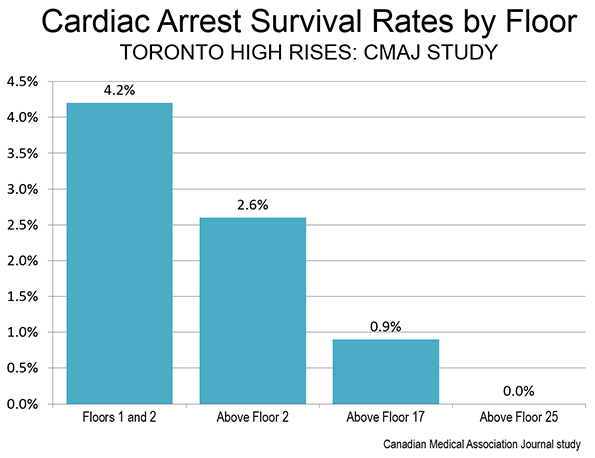
    A study in the Canadian Medical Association Journal (CMAJ) indicates that the survival rates of cardiac arrest (heart attack) is considerably worse at higher floors. Survival rates were compared by residential floor in Toronto. The article implied that the longer time necessary to reach patients after having arrived on the scene was likely a factor. Further, it was suggested that the longer time required to reach the hospital from the higher floors could be a factor, since cardiopulmonary resuscitation (CPR) is suboptimal until the patient is in the hospital.

    The study examined “911” response calls to high rise residential buildings in Toronto and found that the best survival rates were on the first and second floors (4.2 percent). Above the second floor, the survival rate was 40 percent less, at 2.6 percent. Above the 16th floor, the survival rate dropped 80 percent from the first and second floor (0.9 percent). There were no survivors above the 25th floor (Figure).

    The study concluded: “With continuing construction of high-rise buildings, it is important to understand the potential effect of vertical height on patient outcomes after out-of-hospital cardiac arrest.”

  • Paris: Are the Banlieues Still Burning?

    Press coverage of the recent European violence often draws a line from the Arab slums around Paris to the violence that has recently engulfed Brussels and Paris. According to this theory, Arab refugees from Morocco and Algeria, and, more recently, Syria, who have settled on the impoverished outskirts of Paris, are to blame for the terrorist attacks because France and Belgium have been reluctant to assimilate Arabs into their European cultures. And youth unemployment rates in the banlieues — suburbs — of Paris and Brussels are, indeed, more than fifty percent in some districts. Is it any wonder, the thinking goes, that disaffected Arabs have taken to fitting themselves with suicide vests, or spraying AK-47 bullets into crowded cafés?

    Living on the Swiss border with France, and spending many days each year in France, I have long heard these urban-decay theories of political violence. I decided to investigate the link between unassimilated Arabs in the banlieues and the violence that has shaken Europe.

    I made the trip in March with my bicycle, so that I could easily get around such notorious suburban ghettos as Clichy-sous-Bois and Le Blanc-Mesnil.

    I couldn’t see every street or every crumbling apartment complex in the banlieues, obviously, but I did cover a wide swath of the Paris exurbs. And I tracked a course that, at least during the 2005 riots, would have followed the smoke of burning tires.

    I include the above qualifier because many friends (most, I would say, have never explored the suburbs on a bike) don’t believe my conclusions, which are that the banlieues are not nearly as desperate on the ground as they are on television reports.

    Especially after a terrorist incident, local media will invariably show pictures of dilapidated high-rise apartment buildings on the edges of Paris, and action shots of the police dragging suspected terrorists from these underworlds. The causes and effects would seem clear. But my observations led to conclusions that question that French connection.

    Setting out from the Chelles train station, I had expected to come across 1970s-era South Bronx-like slums, only with an Arab motif. But as I rode through many Islamic neighborhoods, what surprised me is how different the banlieues are from the violent shadows on the evening news.

    In those dispatches, the suburbs might well be an Arabic Calcutta.

    Instead I found the these areas to be in the midst of urban renewal. Where ten years ago there were overturned cars and burning tires, I came across rows of working class houses (most well kept) and some new strip malls. On many corners there were the outlets of national franchises—as many McDonalds as mosques.

    Clearly, France has spent millions in the banlieues; think of the construction that went on in American cities after the urban riots of the 1960s. The French government has replaced some of the post-war, high-rise towers of despair with smaller scale apartment buildings, what American city planners call “scatter-site housing.” Clearly, the sociologists have come to have more sway than the civil engineers.

    Not every street I went down in places like Sevran or Aulnay-sous-Bois looked like a contemporary planner’s urban-renewal model. But more than I expected did.

    So why has the violence moved from the halal shops in Clichy-sous-Bois to the Boulevard Voltaire in Paris?

    Most articles about terrorist violence in France and Belgium make the point that Arab immigrants have yet to be integrated into local culture. Social isolation remains one of the possible causes of the new urban wars, and it is well documented in many descriptions of Arab culture in Europe.

    Left out of these explanations for the Paris or Brussels violence is the extent to which an existing criminal underclass has committed itself to Islam, and not the other way around.

    According to some candidates in the American presidential election, the European bombers and attackers are the kamikaze of a new religious order, taking their orders from the ISIS central command in Raqqa in the east Syrian desert.

    It is true that many of the attackers have had the support of military planners, such as those from Saddam’s Baathist officer caste, who were ostracized when the US invaded Iraq.

    But the aspect of the attackers that never gets on the evening news is the extent to which many of the bombers embraced Islam only after lives of petty crime, if not debauchery, in the same clubs they are now attacking.

    The killers failed at school, in after-school programs, and at various low-level jobs, only to find the warm embrace of a prison imam speaking of injustices done to co-religionists on the Syrian frontier.

    These rebels finally had a cause, however distant it was from their lives of street crimes. Their route to eternity, however, only passed through Raqqa by chance and convenience, not by providential design.

    While I was in Paris, I made it a point to bicycle over to all of the sites that were attacked on November 13, and to the site of the earlier shootings at the magazine Charlie Hebdo.

    I thought that by riding the stations of such a sad cross I might get some insight into what had motivated the killers.

    The editorial offices of Charlie Hebdo have moved from the location of the attack. But on the side of the old building, a portrait of the slain editor, Stéphane Charbonnier, has been drawn. Of earlier threats he said: “I would rather die standing than live kneeling.”

    The mournful side street near the center of the Paris gives no clue as to how the French rank the importance of press and religion in the hierarchy of its political freedoms. Would France feel the same about Charlie Hebdo if it had attacked Judaism as it did Islam?

    Around the corner is the Bataclan nightclub, where almost 100 young French concertgoers were shot down in cold blood. Some flowers were propped against the closed doors. Otherwise, the pagoda-shaped building had the look of a failed theater, down and out in the latest economic depression.

    Standing in front of the killing zone, I envisioned the Bataclan assassins less as holy warriors—jihadis on their way to martyrdom—and more as street thugs or contract hitmen.

    Looking at the bullet holes in the plate glass windows of the nightclub, plus at some nearby cafés, I saw the gunmen as absent of any ideas or ideals. I thought more about Baby Face Nelson and the Dillinger gang (sometimes called the Terror Gang), with their running boards and machine guns, than I did about what candidate Ted Cruz calls “radical Islamic terrorism.”

    I grant you that the killers were Muslim and that many had roots in the Paris suburbs, but I don’t think the poverty of the banlieues alone explains why anyone would attack a nightclub with automatic weapons, any more than crop failures in Sicily or Catholicism explain the violent rubouts committed by the mafia in the last 100 years.

    Matthew Stevenson, a contributing editor of Harper’s Magazine, is the author, most recently, of Remembering the Twentieth Century Limited, a collection of historical travel essays, and Whistle-Stopping America. His next book is Reading the Rails. He lives in Switzerland.

    Photo of the Bataclan nightclub in Paris by the author.

  • Where Millionaires Are Moving

    In this oligarchic era, dominated as never before in modern history by the ultra-rich, their movements are far more than grist for gossip columns. They are critical to the health of city economies around the world.

    recent study by the consultancy New World Wealth traces this movement globally, identifying the big winners and losers in millionaire migration. It defines millionaires as those with net assets of at least $1 million outside their personal residence – generally, people with sizable investment capital or their own businesses.

    Among the countries that saw the largest outflows in 2015 are two where property rights are not the most secure: Russia and China. China ranks second in net outflows (-9,000) and Russia sixth (-2,000).

    Another big factor: public safety. France lost an estimated 10,000 net affluents last year, many of them after the terrorist attacks, the largest outflow of any country, according to New World Wealth. Other big losers were struggling economies, including hard-hit Italy and Greece. In fourth place is India, a country that has exported its wealthy around the world for generations.

    The country that was the biggest landing pad for the wealthy last year was Australia, gaining a net 8,000 millionaires. The country is popular most notably with Chinese investors as well as those from other Asian countries. In second place was the United States (7,000), followed by Canada (5,000) and, surprisingly, Israel (4,000). The United Arab Emirates (3,000) and New Zealand (2,000) round out the top six.

    Favorite Cities Of The Affluent

    Zooming in to the city level, the flows are a bit more surprising. The biggest winners are not the elite global cities, like New York or London, but ones that are comfortable, and boast pretty settings and world-class amenities. The leading millionaire magnets in 2015 were Sydney and Melbourne, gaining 4,000 and 3,000 millionaires, respectively, many from China. In third place is Tel Aviv, a burgeoning high-tech center which is attracting Jews fleeing Europe, notably from France.

    Dubai ranks fourth, luring many Middle Easterners seeking a safer, cleaner business locale. Then comes a series of some of the most attractive cities on the planet, including Seattle (seventh) and Perth (eighth). In many cases these cities are gaining from “flight capital” from Asia and the Middle East.

    London, long considered a primary haven for the mobile rich, actually lost a net 500 millionaires in 2015. Many, according to the study, are moving to other parts of the United Kingdom, often the countryside, or to other English-speaking countries.

    But the biggest losers by far were declining first-world cities, many of which have never fully recovered from the 2007 financial crisis. These include Paris, which saw a net outflow of 7,000 millionaires, the most in the world. Not surprisingly, many of the exiting Parisians are Jewish, and many are headed to Israel. There are widespread reports that more of that city’s estimated 350,000 Jews may also be considering an exit. Overall migration from France to Israel rose in 2015, with 7,469 leaving for the Jewish State, up from 6,658 in 2014 and 3,263 in 2013.

    Elsewhere in Europe, Rome lost 5,000 and Athens 2,000 amid poor economic conditions and perilous fiscal situations in their countries.

    Chicago lost 3,000 millionaires in 2015. Although the city continues to attract top-drawer corporate headquarters and luxury housing, the city’s economy is far from thriving, and there is growing concern about a rise in crime rates and growing racial tensions. Unlike other exiting millionaires, who often change countries, most of those leaving Chicago headed to other parts of the U.S.

    Why It Matters

    The movement of wealthy people matters increasingly in globalized societies, which allow money and ideas to relocate with relative ease. Investors, entrepreneurs and innovators are extraordinarily mobile by nature. They also bring with them capital, connections and tax revenues that are then lost to their former host countries and cities. There is also an employment impact. New World Wealth estimates that 30% to 40% of the millionaires they have tracked are business owners.

    Keeping the rich and luring more is a priority now widely embraced by many urban developers and politicians. Former New York Mayor Michael Bloomberg has suggested that today a successful city must be primarily “a luxury product,” a place that focuses on the very wealthy whose surplus can underwrite the rest of the population. “If we can find a bunch of billionaires around the world to move here, that would be a godsend,” Bloomberg, himself a multi-billionaire, said toward the end of his final term. “Because that’s where the revenue comes to take care of everybody else.”

    This reliance on the rich, notes a Citigroup study, reshapes urban economies, not always for the best. Their presence creates an urban employment structure based on “plutonomy,” an economy and society driven largely by the wealthy classes’ investment and spending. A 2014 Brookings report found that virtually all the most unequal U.S. metropolitan areas – with the exception of Atlanta and Miami — areas are luxury-oriented cities including San Francisco, Boston, Washington D.C., New York, Chicago and Los Angeles. Although the number of high-wage jobs has increased in these places, much of the new employment has been in low wage service jobs. As urban studies author Stephen J.K. Walters notes, these cities tend to develop highly bifurcated economies, divided between an elite sector and large service class. “This,” he notes, “is the opposite of [Jane] Jacobs vision of cities that as places that are “constantly transforming many poor people into middle class people.’ ”

    One clear effect is on housing prices, which have shot up precisely in those places now favored by the rich. Perhaps the most obvious case is Vancouver, where the inflow of predominately Chinese investors has helped make the Canadian city among the most unaffordable in the world, with median home prices breaking the million-dollar mark.

    Yet if the presence of the rich creates more inequality, their departure could also have some nasty effects. The movement for example of one billionaire — hedge fund manager David Tepper — from New Jersey to Florida could leave the Garden State with a $140 million hole just from his change of address. Overall New Jersey depends for 40 percent of its revenue of income taxes, one-third of which is paid by the top 1 percent of the population.

    Such movements could become more common, as affluent people look for more relaxed and less heavily taxed communities to settle in. A 2016 study by Phoenix Marketing International found that the fastest-growing millionaire populations in the country are not in big luxury cities but smaller towns like Mount Airy, N.C.; Cookeville, Tenn.; and Kalispell and Bozeman, Mont.

    Despite this year’s campaign rhetoric, the influence of affluent migration is likely to become greater in the years ahead. The number of American households with assets of $1 million or more, not including their primary residence, increased 3 percent last year to 10.4 million, according to Spectrem Group, a market research and consulting firm. Meanwhile, the number of American households worth $25 million or more has grown 73 percent since 2008, compared with growth of 54 percent for millionaire households.

    For communities around the world the choice is increasingly a Hobbesian one. Attract more of the wealthy to town, and see housing prices soar beyond the reach of the middle class, or push the rich away, and live with the likely loss of jobs, tax revenues and businesses. In a world dominated by oligarchy, these are the realities which countries and cities now have to confront.

    This piece first appeared in Forbes.

    Joel Kotkin is executive editor of NewGeography.com. He is the Roger Hobbs Distinguished Fellow in Urban Studies at Chapman University and executive director of the Houston-based Center for Opportunity Urbanism. His newest book, The Human City: Urbanism for the rest of us, will be published in April by Agate. He is also author of The New Class ConflictThe City: A Global History, and The Next Hundred Million: America in 2050. He lives in Orange County, CA.

    Sydney photo by Christopher Schoenbohm.

  • Coastal California Getting Older, Not Bolder

    For the better part of a century, Southern California has been seen as the land of surfers, hipsters and youthful innovators. Yet the land of sun and sea is becoming, like its East Coast counterpart Florida, increasingly geriatric.

    This, of course, is a global and national phenomenon. From 2015-25, the number of senior-headed U.S. households, according to the Joint Center on Housing Studies at Harvard University, will grow by 10.7 million, compared with 2.5 million households headed by people ages 35-44.

    After some delay, this aging process is accelerating in California. Large-scale immigration, which supplied a younger population for decades, is slowing markedly. Once considerably younger than the country, the state appears to be heading toward the national median age. Since 2000, the senior population in Southern California has grown by 24 percent compared with 18 percent nationally. Unless immigration or domestic migration pick up soon, this aging trend should accelerate.

    At the same time, our analysis shows that some areas – notably along the Orange County coast – are rapidly becoming virtual retirement communities, with a diminishing number of children and young families. For those sitting in their houses in affluenza-afflicted enclaves of Southern California, this may seem good news: “aging in place” while their homes increase in value. But this trend is less a boon for younger people, particularly families, as well as for companies seeking to launch and expand here.

    Read the entire piece at The Orange County Register.

    Joel Kotkin is executive editor of NewGeography.com. He is the Roger Hobbs Distinguished Fellow in Urban Studies at Chapman University and executive director of the Houston-based Center for Opportunity Urbanism. His newest book, The Human City: Urbanism for the rest of us, will be published in April by Agate. He is also author of The New Class ConflictThe City: A Global History, and The Next Hundred Million: America in 2050. He lives in Orange County, CA.

    Wendell Cox is principal of Demographia, an international pubilc policy and demographics firm. He is a Senior Fellow of the Center for Opportunity Urbanism (US), Senior Fellow for Housing Affordability and Municipal Policy for the Frontier Centre for Public Policy (Canada), and a member of the Board of Advisors of the Center for Demographics and Policy at Chapman University (California). He is co-author of the “Demographia International Housing Affordability Survey” and author of “Demographia World Urban Areas” and “War on the Dream: How Anti-Sprawl Policy Threatens the Quality of Life.” He was appointed to three terms on the Los Angeles County Transportation Commission, where he served with the leading city and county leadership as the only non-elected member. He served as a visiting professor at the Conservatoire National des Arts et Metiers, a national university in Paris.

    “Senior Citizens Crossing” photo by Flickr user auntjojo.

  • Would Reaganomics Work Today?

    The key drivers that propelled the Reagan economy are now tapped out or out of favor.

    The name of Ronald Reagan is frequently evoked by the current contenders to the GOP nomination. Donald Trump speaks admiringly of the 40th President of the United States and uses a truncated version of his 1980 campaign slogan “Let’s Make America Great Again”. Ted Cruz promises to implement Reagan’s solution of lower taxes, lower regulation and a stronger military. Before he bowed out recently, Marco Rubio was equal in his praise. And John Kasich stakes an even more tangible claim by reminding us that he is the only candidate who actually worked with Reagan.

    But if Reagan’s economy is something we can reproduce, we should first understand the most important drivers of that economy. Arthur Laffer, the father of supply-side economics, said in 2006 that the four pillars of Reaganomics were sound money, low taxes, low regulation and free trade. In addition to these four, we add our own two which are more contextual enablers than proactive policies: demographics and innovation. It is our contention that the first four would not have succeeded without the last two.

    Demographics: Reagan’s time in office coincided with powerful demographic tailwinds, namely a strong decline in the dependency ratio (DR), an accelerated rise in the American work force, and a rich demographic dividend. The dependency ratio (red line in the first chart below) is the ratio of dependents to workers, calculated as the sum of people aged less than 20 and over 64 divided by the number of people aged 20-64. When the US total fertility rate (TFR, the average number of children per woman) declined from 3.5 children per woman in 1960 to less than 2 in 1975, the dependency ratio followed with a lag, falling from 0.9 in 1970 to 0.76 in 1980, 0.70 in 1990 and 0.66 in 2010.

    Under the right conditions when the dependency ratio falls, the economy can reap a demographic dividend. With fewer dependents, households are able to divert more of their income toward discretionary spending, savings and investments, helping create more innovative companies that in turn boost the incomes of households. That is more or less the dynamic that propelled the US economy during the 1980s and 1990s.

    Screen Shot 2016-03-10 at 2.58.14 PM

    Looking at the future now, the dependency ratio bottomed in 2010 and is set to rise again from 0.66 in 2010 to 0.71 in 2020 to 0.83 in 2035. This increase is due mainly to the aging of the population and the increased number of dependents aged 65 or over. It is essentially a reversal of the powerful dynamic that benefited the economy in the 1980s and 1990s. The demographic tailwinds seen during the Reagan presidency have turned into headwinds.

    Screen Shot 2016-03-10 at 2.58.14 PM (1)

    In the second chart, we can see that the size of the US population aged 20-64 (red line) rose strongly from 1970 to 2015 and will level off and rise more slowly from here on. The population aged 30-59 (blue line), arguably the most productive and highest-earning and highest-spending segment, rose strongly starting in 1980 and flattened out around 2010. So here again, the two Reagan terms benefited from a rapid increase in the size of the work force. Clearly the most favorable period, the one with the highest acceleration, was from around 1983 to 2000, matching the economic boom of the Reagan to Clinton years.

    Note in passing that a similar chart for Europe, America’s top trading partner, shows an even more troubling picture. Excluding eastern Europe and Russia (red line below), the population aged 20-64 will fall from a peak of 267 million in 2010 to an estimated 232 million in 2050. Including eastern Europe and Russia, it will fall from 459 million to 370 million.

    Screen Shot 2016-03-14 at 4.57.43 PM

    (the charts above were derived by populyst from data produced by the UN Population Division).

    Innovation: Reagan came to office at a time of great innovations in computer technology. Innovation was then and remains now one of the most potent drivers of the economy. We have every reason to hope that America will remain as innovative as it was in the past. But the rate of innovation will certainly suffer if skilled foreign professionals are unable or unwilling to come and work in the United States because of more restrictive visa or residency policies.

    Interest Rates: Reagan started his first term with very high inflation and interest rates. Both started to decline during his presidency, helping stabilize and grow the economy and boosting the stock market. But we now face the risk of deflation. And interest rates are at rock bottom. As shown in the chart below from Goldman Sachs, the 10-year US Treasury yield was near 16% when Reagan took office and it is now at 2%, near all-time historic lows. Real rates are still negative and the Federal Reserve has few options left in its efforts to stimulate the economy through monetary policy.

    Screen Shot 2016-03-13 at 7.46.05 AM
    (click image to enlarge)

    Taxes: It is true that President Reagan enacted important tax cuts but these cuts came at a time when the marginal income tax rate was much higher than it is today. The chart below from the Tax Foundation shows that the top rate in 1980 was 70% and is now 39.6%.

    Screen Shot 2016-03-13 at 7.26.58 AM

    The top corporate income tax rate was 46% in 1981 vs. 35% today. And the top rate for long-term capital gains was 28% vs. 20% today (plus a 3.8% Medicare tax since 2013).

    Reagan’s tax cuts came at a time when spending on entitlement was relatively small compared to what it will be in the years ahead. Even at current levels of taxation, the federal budget deficit is expected to start rising again due to additional spending on old-age entitlements. The Congressional Budget Office predicts an expansion in the deficit from $439 billion in 2015 to $810 billion in 2020 and $1,226 billion in 2025. (see pages 147-149 of this CBO publication.)

    And as shown in the chart below from the St. Louis Fed, the federal debt is now much higher at over 100% of GDP, vs. 31% when Reagan took office.

    Screen Shot 2016-03-14 at 10.43.38 AM (2)

    It seems clear therefore that there is not as much scope for cutting taxes in the current environment as there was in the early 1980s. Unless accompanied by other changes, implementation of a flat tax or general cuts in tax rates are likely to increase the debt and deficit beyond the already high projections.

    Free Trade: Opening new markets and lowering trade barriers were cornerstones of US policy in the 1980s and 1990s. If today European demand is slackening and China is entering a slower period, there could be new markets for US exports in the Asian and African frontier markets that are experiencing a demographic boom. Expanding trade to these new markets would spur new demand for American goods.

    But free trade is now under attack from parties who argue that too many American jobs have gone abroad to China, Mexico and others. The presidential primaries have shown so far that a non negligible segment of the American electorate has been receptive to this argument. This means that the openness of free trade could in coming years be slowed or indeed reversed.

    Adding it all up, the table summarizes the scope for success of Reaganomics today vs. in 1981.

    Screen Shot 2016-03-15 at 10.55.18 AM

    Hoping for a replay of the Reagan years through action on the same economic levers will most likely result in disappointment. Leading 2016 candidates have expressed hostility towards free trade and have called for restrictions on all forms of immigration. In addition, the underlying context is now less conducive to growth than it was in 1981.

    Nonetheless, another component of the Reagan formula was a healthy dose of optimism. Economic prospects seemed insurmountable in 1981 but the ensuing boom surpassed expectations. The US economy remains flexible and innovative and will find a way to muddle through until contextual factors improve and higher growth returns.

    Sami Karam is the founder and editor of populyst.net and the creator of the populyst index™. populyst is about innovation, demography and society. Before populyst, he was the founder and manager of the Seven Global funds and a fund manager at leading asset managers in Boston and New York. In addition to a finance MBA from the Wharton School, he holds a Master’s in Civil Engineering from Cornell and a Bachelor of Architecture from UT Austin.

    Photo by White House Photographic Office – National Archives and Records Administration