Blog

  • Even as They Retire, it’s Still About the Boomers

    America’s baby boomers, even as they increasingly enter retirement, continue to dominate our political economy in ways no previous group of elderly has done. Sadly, their impact has also proven toxic, presenting our beleaguered electorate a likely Hobbesian presidential choice between a disliked, and distrusted, political veteran and a billionaire agitator most Americans find scary.

    Throughout the campaign, boomers have provided the bedrock of support for both Hillary Clinton and Donald Trump. Bernie Sanders may have devastated Clinton among millennial voters, by almost 3-1, but she has more than offset that gap by winning overwhelming support from older voters.

    In the South, it was older African Americans, particularly women, who sealed Clinton’s big wins. But older voters of all races have supercharged her campaign elsewhere; she won older voters by 39 percentage points in Missouri and 54 points in Ohio. She also captured upward of 73 percent of their votes in critical states like Virginia.

    No surprise that she also did well in Arizona and Florida, states that are major retirement havens. Four of the five areas with the most retirees per capita are located in these two states.

    But it’s Donald Trump who arguably was the biggest winner in the boomer wars. He has thrived most in states with aging white populations, notably Nevada, Arizona, Florida, Massachusetts, New Hampshire and South Carolina. He has consistently run five to 15 points better with the boomer generation than among younger GOP primary voters.

    Some of this preference is attributable to racist and xenophobic sentiments among older people, who are, for example, typically far less favorable toward inter-racial dating than younger cohorts. Similarly, boomers are far more likely than millennials to harbor patriotic sentiments; only a third of them believe America is the greatest country in the world, compared with half of boomers. Trump’s appeal to “Make America great again” may connect with boomers, but not so much with their offspring.

    Read the entire piece at The Orange County Register.

    Joel Kotkin is executive editor of NewGeography.com. He is the Roger Hobbs Distinguished Fellow in Urban Studies at Chapman University and executive director of the Houston-based Center for Opportunity Urbanism. His newest book, The Human City: Urbanism for the rest of us, will be published in April by Agate. He is also author of The New Class ConflictThe City: A Global History, and The Next Hundred Million: America in 2050. He lives in Orange County, CA.

  • The Relationship Between Fertility and National Income

    We all heard that “demography is destiny”. But how many of us truly believe it? If demography was destiny, the world would look very different today. The two demographic giants China and India would be uncontested economic and military powers. The United States would be a regional power struggling to keep up. Larger European nations such as Britain, France and Germany would barely register on the economic map, while smaller ones such as Switzerland and Finland would be invisible. Nigeria and DR Congo would be African powerhouses. Brazil, Indonesia and the Philippines would be the shining stars of their continents.

    None of this is true because demography is not destiny. Population size alone does not set a country on a predictable course. Still, demography is, among other factors, an important determinant of destiny. While the rate of demographic growth (or decline) is important, what is more important is the age distribution of the population. Too many old people means an elevated dependency ratio and less income available for spending and investing. Too many young people means an overburdened education system and high unemployment.

    The chart below shows for each country the percentage of the population that is aged 0-29 vs. per capita GDP based on purchasing power parity (PPP). The correlation is undeniable.

    Screen Shot 2016-02-02 at 4.56.14 PM

    Countries with a smaller percentage of young people have higher GDP per capita. Many of these countries and regions, including the United States, Europe and China, have benefited from a demographic dividend while their birth rates declined in recent decades.

    Conversely, countries with more young people have lower GDP per capita. Most of them are in Asia and Africa.

    We can argue about causality. Are countries poorer because they have more children? Or do they have more children because they are poorer? Or are they both poorer and have more children because of a third factor?

    Nothing is simple and all three are true. Countries are poorer because they have too many children, mothers have no time to educate themselves, and there is little or no disposable income to save or invest. But countries also have more children in part because they are poorer, have inadequate health services and suffer from high child mortality. And many countries are poorer and more fertile because female literacy is low and gender inequality is high.

    What is known is that countries that experience a decline in their birth rate sometimes realize a demographic dividend, an economic boost that can last years or even decades. Improving health care and boosting literacy have been shown to break the cycle of extreme poverty and extreme fertility.

    Meanwhile, this is the world that we face in the next few decades: rich countries that are getting older and poor countries that are very young. Working-age populations are shrinking in the rich countries while in poor countries, they are booming beyond those countries’ abilities to educate them, shelter them and employ them.

    The chart above shows that there are many outliers, countries that are either poor despite being relatively older, or richer despite being relatively younger. When we looked to see if the outliers have anything in common, it turned out that they do.

    The first group (old and poor) are shown in red and are the countries that are former or current communist states. The second group (rich and young) are shown in black and are the leading oil and gas-producing nations. The yellow data points are the nations that are (or were) both communist and wealthy from energy resources.

    Communism may be considered an “unusual” way of managing an economy since it conflicts with strong human instincts for creativity and innovation. Likewise, the huge accidental wealth that comes from finding oneself living on top of vast underground resources may also be deemed “unusual” (or certainly lucky) since it is probably rare, or perhaps even unprecedented, in several millennia of human experience.

    If we remove the outlying red and black data points, we end up with the chart below with a much better regression and trend line and an r-squared of 0.78, a large improvement from 0.37 when all the data is included. The trend line is curved because the y-axis is on a log scale.

    This reinforces the idea that in a large majority of countries, young populations tend to be far poorer. At first, this statement may ring intuitively true and uncontroversial, because young people have had less time to accumulate wealth, until one examines the magnitude of the wealth gap. The GDP per capita of the very youngest nations is less than 5% that of the oldest. The Central African Republic’s is 1% of Switzerland’s.

    Screen Shot 2016-02-02 at 5.02.29 PM

    This is a constantly changing dynamic. And it remains to be seen whether the rich countries of the West can weather the aging of their populations and maintain their GDP per capita at current levels.

    They may struggle to do so and we may find that over the long term, demography reasserts itself every so often, even if temporarily, as the leading driver of our destiny.

    Sami Karam is the founder and editor of populyst.net and the creator of the populyst index™. populyst is about innovation, demography and society. Before populyst, he was the founder and manager of the Seven Global funds and a fund manager at leading asset managers in Boston and New York. In addition to a finance MBA from the Wharton School, he holds a Master’s in Civil Engineering from Cornell and a Bachelor of Architecture from UT Austin.

    Baby photo by Bigstock.

  • “Texas Keeps Getting Bigger” The New Metropolitan Area Estimates

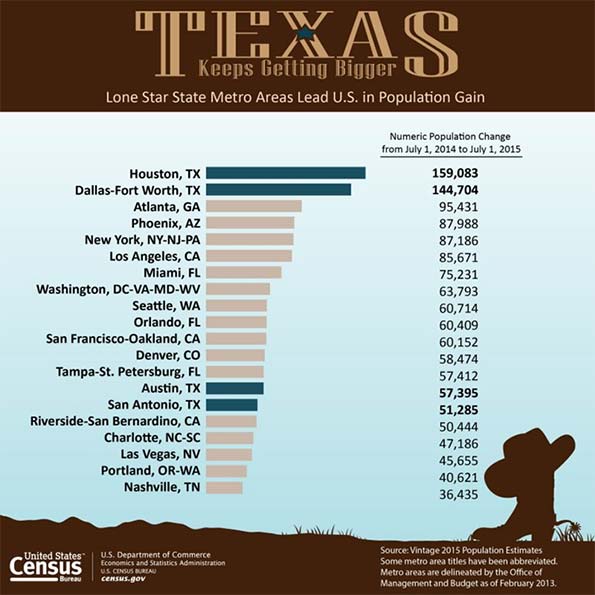
    The United States Census Bureau has just released its 2015 population estimates for metropolitan areas and counties. Again, the story is Texas, with the Bureau’s news release headline reading: Four Texas Metro Areas Collectively Add More Than 400,000 People in the Last Year. The Census Bureau heralded the accomplishment with a ”Texas Keeps Getting Bigger” poster, which is shown below. The detailed data is in the table at the bottom of the article.

    Fastest Growing

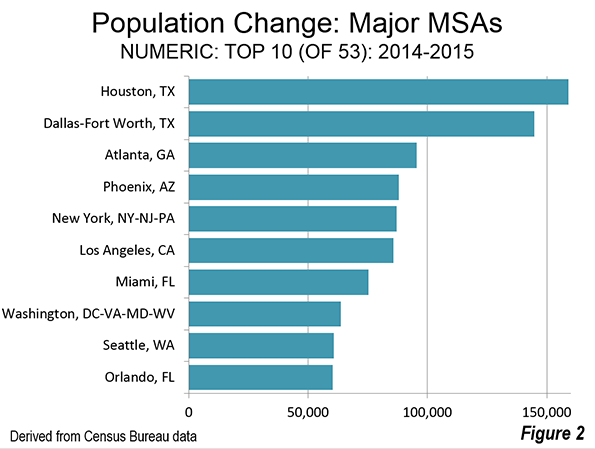
    Texas has four of the nation’s major metropolitan areas (over 1,000,000 population), and all of them ranked in the top 20 (out of 53) in population gain between 2014 and 2015. Houston again was number one, with a gain of 159,000, Dallas-Fort Worth followed in second place, gaining 145,000. The gap between Dallas-Fort Worth and Houston was small, only 10 percent. However, the gap between the third largest city (Atlanta) and Dallas-Fort Worth was more than 50 percent

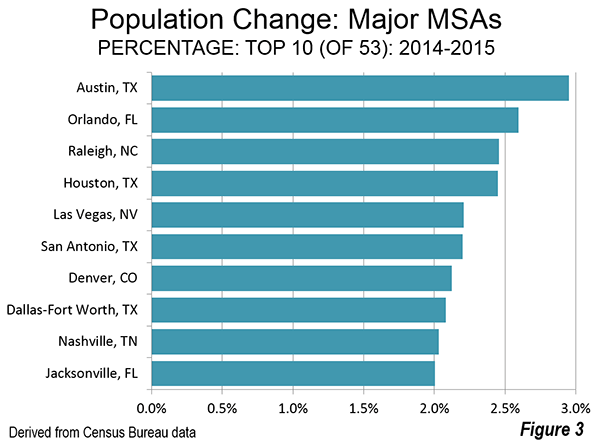
    Austin and San Antonio were also in the top 20. Austin gained 57,000 residents, and again was the fastest growing major metropolitan area in the nation (3.0 percent). San Antonio added 51,000.

    This represents something of a return to pre-Great Recession normalcy, with Atlanta adding the third most population (95,000) and Phoenix adding 88,000. These two metropolitan areas were hard hit in the housing bust, but are seeing a return of substantial growth. New York, which is far larger than any of the top four, took fifth place, adding 87,000 (Figure 2).

    On a percentage gain basis, all four Texas metropolitan areas were in the top 10. Austin was again the fastest growing. Houston was 4th, San Antonio 6th and Dallas-Fort Worth 8th. Two other of the national best performers in percentage population growth were also high on the list, including #3 Raleigh and #5 Las Vegas. Las Vegas was the fastest growing major metropolitan area through most of the 2000s. When Las Vegas stumbled late in the 2000s, Raleigh assumed the top position. Denver ranked 7th, the only non-southern metropolitan area in the top 10 (Figure 3).

    Slowest Growing (or Losing)

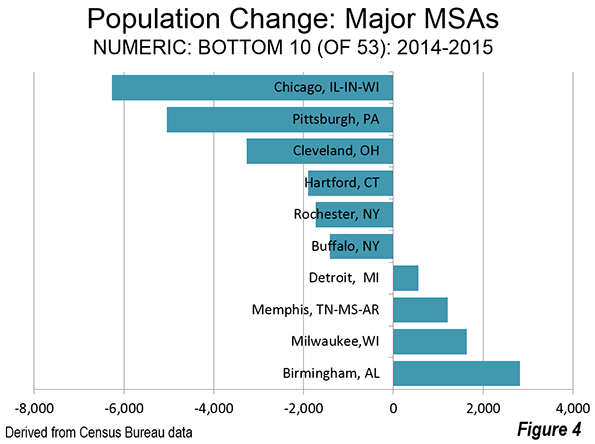
    The Chicago metropolitan area had the largest population loss, at 6,000. This was the second straight year of losses for Chicago, though last year’s was much smaller. Chicago, at 9.55 million residents will need to reverse this performance if it is ever to add the 450,000 people necessary to make it a megacity of over 10 million. Chicago’s weather is not the most inviting and the state of Illinois’ dismal fiscal position (rated by one source as the second worst run in the nation) is not likely to attract the job creating investment necessary to population growth.

    Five other metropolitan areas experienced losses, including Pittsburgh, Cleveland, Hartford, Rochester and Buffalo. Not all of the South is growing either with both Memphis and Birmingham residing in the bottom 10 (Figure 4).

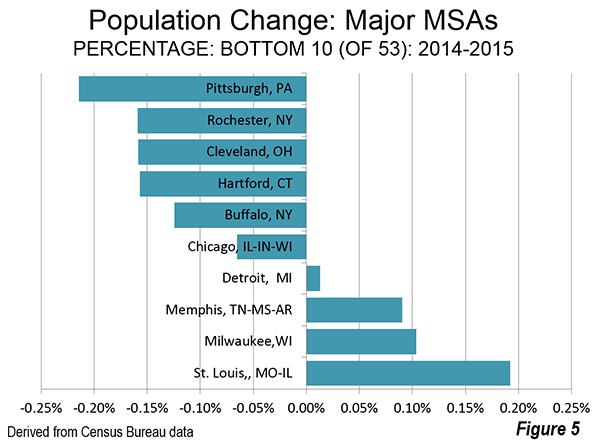
    Pittsburgh lost the largest percentage of its population, followed by Rochester, Cleveland, Hartford, Buffalo and Chicago (Figure 5).

    Domestic Migration: Top 10

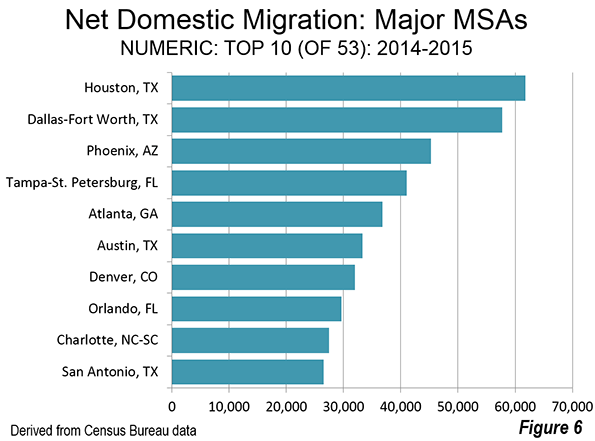
    The four Texas cities all showed up on the top 10 in numeric net domestic migration gain as well. Houston added 62,000 net domestic migrants, followed by Dallas-Fort Worth and 58,000. Phoenix ranked third, Tampa St. Petersburg ranked fourth and Atlanta ranked fifth. Austin was sixth in net domestic migration and the other Texas City, San Antonio, ranked 10th (Figure 6).

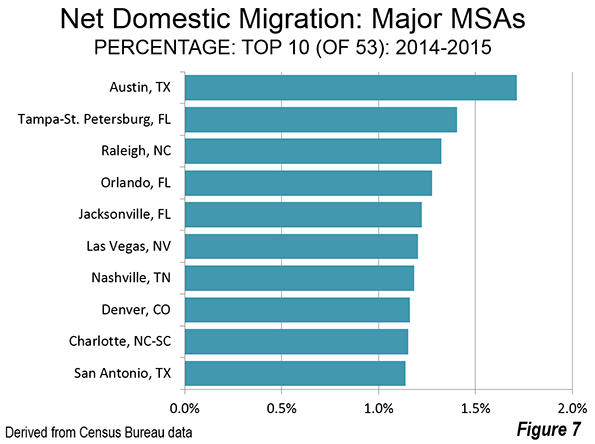
    Austin led the nation in the percentage of population growth from net domestic migration, at approximately 1.7 percent. Tampa St. Petersburg ranked second, followed by Raleigh, Orlando and Jacksonville (Figure 7).

    Domestic Migration: Bottom 10

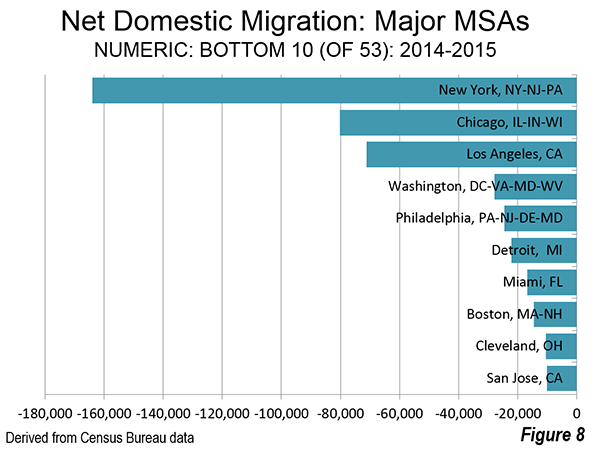
    By far the largest net domestic migration loser was New York, which lost 164,000. Chicago lost 80,000, and Los Angeles lost 71,000. It was a substantial drop to the fourth largest loser, Washington at 28,000,   closely followed by Philadelphia at 24,000 and Detroit at 22,000 (Figure 8).

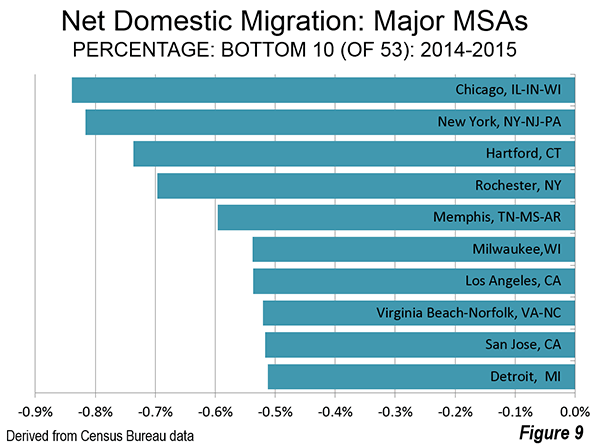
    Chicago had the largest percentage loss of any major metropolitan area from net domestic migration, at 0.83 percent, slightly more than New York’s 0.82 percent. Hartford, Rochester and Memphis ranks from 3rd to 5th, all losing 0.6 percent from net domestic migration or more. Milwaukee, Los Angeles, Virginia Beach, San Jose, Detroit and Cleveland all lost between 0.5 percent and 0.6 percent to net domestic migration (Figure 9).

    Ranking Changes

    There were a few changes in the rankings this year. Washington passed Philadelphia to assume the sixth largest position. Philadelphia, which was the fourth largest metropolitan area in the nation in the early 2000’s has fallen to seventh, having also been passed by both Dallas-Fort Worth and Houston. Denver overtook St. Louis, to assume the 19th position. Orlando passed both San Antonio and Pittsburgh to become the 24th largest metropolitan area. Even while falling behind Orlando, San Antonio past Pittsburgh. Las Vegas overtook Kansas City and became the 29th largest metropolitan area. Austin passed both Indianapolis and San Jose.

    Milestones were also set by Miami, which rose to above 6 million population, while Columbus and Austin grew to more than 2 million. Perhaps the bigger surprise was a milestone not reached. Had recent trends continued, Honolulu would have become the 54th metropolitan area to reach 1 million population. However, Honolulu fell short by 1300 residents.

    Return to the City: The Elusive Illusion

    Despite the popular lore one hears at a Starbucks in Manhattan or reads in some ever-hopeful core city-centric news outlets, people are still moving to the suburbs. There is no doubt that urban cores, especially close to downtown areas (central business districts) are doing better than before, in no small measure because crime rates have fallen so much (Thank you, Rudi Giuliani).

    In all, 22 core counties out of 53 added net domestic migrants. But only y seven added more domestic migrants than the corresponding suburbs. Of these, only one is dominated by high density urbanization, the District of Columbia (Washington). Another, New Orleans, continues its recovery from the huge hurricane population losses. The other five core counties are functionally more suburban than urban (Phoenix, Raleigh, Richmond, Sacramento and San Antonio).

    But, overall, domestic migration continues from the core cities to the suburbs. That has been the case even in the worst year for suburban growth (2010-2011) and continued in 2014-2015. Core counties last year lost a net 185,000 domestic migrants, while the suburban counties gained 187,000.

    Conclusion

    With the release of 2015 population estimate data, halfway between the 2010 and 2010 census, the nation is settling back into a pattern of suburban southern and western growth.

    Major Metropolitan Area Population Estimates: 2015
    Population 2014-2015
    Rank Metropolitan Area 2010 2014 2015 % Change 2014-2015 Net Domestic Migration Rank: Domestic Migration
    1 New York, NY-NJ-PA     19,601     20,095     20,182 0.43% -0.82%           52
    2 Los Angeles, CA     12,844     13,254     13,340 0.65% -0.54%           47
    3 Chicago, IL-IN-WI       9,471       9,557       9,551 -0.07% -0.84%           53
    4 Dallas-Fort Worth, TX       6,453       6,958       7,103 2.08% 0.83%           14
    5 Houston, TX       5,948       6,498       6,657 2.45% 0.95%           12
    6 Washington, DC-VA-MD-WV       5,667       6,034       6,098 1.06% -0.46%           42
    7 Philadelphia, PA-NJ-DE-MD       5,971       6,054       6,070 0.27% -0.40%           40
    8 Miami, FL       5,586       5,937       6,012 1.27% -0.28%           36
    9 Atlanta, GA       5,304       5,615       5,711 1.70% 0.66%           16
    10 Boston, MA-NH       4,565       4,739       4,774 0.74% -0.31%           38
    11 San Francisco-Oakland, CA       4,345       4,596       4,656 1.31% 0.19%           22
    12 Phoenix, AZ       4,205       4,487       4,575 1.96% 1.01%           11
    13 Riverside-San Bernardino, CA       4,244       4,439       4,489 1.14% 0.16%           23
    14 Detroit,  MI       4,291       4,301       4,302 0.01% -0.51%           44
    15 Seattle, WA       3,449       3,673       3,734 1.65% 0.43%           17
    16 Minneapolis-St. Paul, MN-WI       3,356       3,496       3,525 0.83% -0.23%           32
    17 San Diego, CA       3,104       3,266       3,300 1.04% -0.29%           37
    18 Tampa-St. Petersburg, FL       2,789       2,918       2,975 1.97% 1.41%             2
    19 Denver, CO       2,554       2,756       2,814 2.12% 1.16%             8
    20 St. Louis,, MO-IL       2,790       2,806       2,812 0.19% -0.27%           33
    21 Baltimore, MD       2,716       2,787       2,797 0.38% -0.31%           39
    22 Charlotte, NC-SC       2,224       2,379       2,426 1.98% 1.15%             9
    23 Portland, OR-WA       2,232       2,349       2,389 1.73% 0.91%           13
    24 Orlando, FL       2,140       2,327       2,387 2.60% 1.28%             4
    25 San Antonio, TX       2,153       2,333       2,384 2.20% 1.14%           10
    26 Pittsburgh, PA       2,357       2,358       2,353 -0.21% -0.28%           35
    27 Sacramento, CA       2,155       2,245       2,274 1.31% 0.41%           18
    28 Cincinnati, OH-KY-IN       2,118       2,148       2,158 0.43% -0.12%           31
    29 Las Vegas, NV       1,953       2,069       2,115 2.21% 1.20%             6
    30 Kansas City, MO-KS       2,014       2,071       2,087 0.78% 0.04%           26
    31 Cleveland, OH       2,076       2,064       2,061 -0.16% -0.51%           43
    32 Columbus, OH       1,906       1,997       2,022 1.22% 0.26%           19
    33 Austin, TX       1,728       1,943       2,001 2.95% 1.71%             1
    34 Indianapolis. IN       1,893       1,972       1,989 0.86% 0.05%           25
    35 San Jose, CA       1,842       1,954       1,977 1.15% -0.52%           45
    36 Nashville, TN       1,676       1,794       1,830 2.03% 1.18%             7
    37 Virginia Beach-Norfolk, VA-NC       1,680       1,718       1,725 0.41% -0.52%           46
    38 Providence, RI-MA       1,602       1,610       1,613 0.22% -0.28%           34
    39 Milwaukee,WI       1,557       1,574       1,576 0.10% -0.54%           48
    40 Jacksonville, FL       1,349       1,421       1,449 2.00% 1.22%             5
    41 Oklahoma City, OK       1,258       1,338       1,358 1.56% 0.66%           15
    42 Memphis, TN-MS-AR       1,326       1,343       1,344 0.09% -0.60%           49
    43 Louisville, KY-IN       1,238       1,271       1,278 0.57% 0.02%           28
    44 Raleigh, NC       1,137       1,243       1,274 2.46% 1.32%             3
    45 Richmond, VA       1,210       1,260       1,271 0.92% 0.19%           21
    46 New Orleans. LA       1,196       1,252       1,263 0.87% 0.19%           20
    47 Hartford, CT       1,214       1,213       1,211 -0.16% -0.74%           51
    48 Salt Lake City, UT       1,092       1,155       1,170 1.36% -0.04%           29
    49 Birmingham, AL       1,129       1,143       1,146 0.25% -0.09%           30
    50 Buffalo, NY       1,136       1,137       1,135 -0.12% -0.46%           41
    51 Rochester, NY       1,080       1,084       1,082 -0.16% -0.70%           50
    52 Grand Rapids, MI          990       1,029       1,039 0.94% 0.09%           24
    53 Tucson, AZ          982       1,004       1,010 0.58% 0.02%           27
    Total   170,895   178,063   179,875 1.02% -0.52%
    In 000s
    Data from Census Bureau


    Wendell Cox is principal of Demographia, an international pubilc policy and demographics firm. He is a Senior Fellow of the Center for Opportunity Urbanism (US), Senior Fellow for Housing Affordability and Municipal Policy for the Frontier Centre for Public Policy (Canada), and a member of the Board of Advisors of the Center for Demographics and Policy at Chapman University (California). He is co-author of the "Demographia International Housing Affordability Survey" and author of "Demographia World Urban Areas" and "War on the Dream: How Anti-Sprawl Policy Threatens the Quality of Life." He was appointed to three terms on the Los Angeles County Transportation Commission, where he served with the leading city and county leadership as the only non-elected member. He served as a visiting professor at the Conservatoire National des Arts et Metiers, a national university in Paris.

    Cover picture: Census Bureau ”Texas Keeps Getting Bigger” poster (poster is used at the top and also as the first figure)

  • Why You Should Think Twice Before Building a Rail Transit System

    The Washington Metro system was shut down completely for a day recently to allow crews to inspect all of the power cables in the system. They found 26 cables and connectors in need of immediate repair.

    This is just the latest in a series of safety problems and breakdowns that have plagued the system.

    Metro has a large unfunded maintenance liability. This doesn’t surprise us because we expect American transit systems to have a backlog.

    The difference is that unlike NYC, Chicago, Boston, etc., which have systems a century old, the Washington Metro system is actually new.

    The oldest part of the Metro opened in 1976. That means Metro is 40 years old – max. Much of it is actually newer than that.

    Forty years after opening, Metro already faces a maintenance crisis.

    This should give other regions pause when it comes to building a rail transit system. My colleague Alex Armlovich points out that NYC has more or less been on a 40 year refresh cycle, with two rounds of major system investment since the subways opened. This doesn’t seem out of line as a capital life heuristic to me.

    So cities need to keep in mind that if they build a rail system, they not only have to pay to build it, they pretty much have to pay to rebuild it every 40 years. This is a challenge because as we see it’s easier to muster the will to build something new than to maintain something you already have.

    Given the huge permanent capital outlays implied by rail transit, you only want to build it where there’s sufficient value to justify it. Washington unquestionably achieves this. It simply hasn’t been able to capture the value into a maintenance revenue stream, plus Metro (like many systems) has been badly mismanaged.

    The problem comes in for cities that aren’t NYC, Chicago, Boston, Philly, DC, and San Francisco. Once you get below that group, the value starts becoming more debatable.

    Exhibit A is Los Angeles, which has spent untold billions on a huge rail system as ridership actually declined.  LA is continuing to build more and more rail.

    But what happens when this system is old?

    LA’s Red Line opened in 1993, so is 23 years old.  By the time LA finishes its current rail build out, it’s likely that the original parts of the system will be coming into the zone for a major capital refresh.

    Thus shortly LA will find itself in a perpetual capital catchup cycle starting in only a couple decades. This possibly may not happen, but it has happened everywhere else, so why should LA be different?

    Given the ridership levels we’ve seen so far, will the value added from rail vs. the old bus approach be there? It’s not looking good. And if the case in LA is looking weak, certainly smaller and less dense places are even more speculative.

    All these smaller cities investing billions into rail had better hope their projections of massive benefits come true, because all too soon the rebuild bill will start coming due.

    If you don’t believe me, just ask Washington.

    Aaron M. Renn is a senior fellow at the Manhattan Institute, a contributing editor of City Journal, and an economic development columnist for Governing magazine. He focuses on ways to help America’s cities thrive in an ever more complex, competitive, globalized, and diverse twenty-first century. During Renn’s 15-year career in management and technology consulting, he was a partner at Accenture and held several technology strategy roles and directed multimillion-dollar global technology implementations. He has contributed to The Guardian, Forbes.com, and numerous other publications. Renn holds a B.S. from Indiana University, where he coauthored an early social-networking platform in 1991.

    Photo Credit: Ben Schumin – CC BY-SA 3.0

  • Trumpism: America’s Berlusconi Moment

    Trump envisioned and created today’s city of white boxes for rootless new money types, who dominate the city even as they leave little mark here.

    An old joke—that in heaven, the Italians do the cooking; in hell, they run the government—feels a lot darker now that American politics are taking an Italian turn.

    Since the fall of Il Duce, Italy has had a staggering 62 governments, and while American doesn’t have that problem yet, our political system is showing all the signs of decline—an inability to come to any consensus, the increased vulgarity of discourse, the utter incompetence of an impenetrable bureaucracy and the growth of extra-constitutional fascist and Mob-like “familial” —run modes of governance—with which Italians have long and unhappy familiarity.

    Let’s start with Donald Trump, who the American left now routinely deems an American fascist in the mold of Benito Mussolini. Like Trump, Mussolini (a former journalist) rose rapidly to power as his country was disintegrating from within. Then, too, nationalist resentments were reaching a fever pitch as a large part of the populace—and especially the middle and working classes—lost its remaining faith in the system as economic conditions decayed.

    In 1919, for example, there were “cost of living” riots throughout the peninsula as the old governing class lost its grip on the state. Fascism, as Mussolini himself suggested, was predicated on strength—on the use and threat of violence. The disruptive hooliganism of Trump supporters at his rallies evokes the frenzied, violent environment in which Il Duce claimed power in the 1922 “March on Rome,” and held it he was finally ousted and arrested in 1943.

    As the Financial Times’  Martin Wolff wrote, Trump follows a pattern that “embodies how great republics meet their end.”

    But past results, as the fine print says, are no indicator of future ones and the comparisons between Trump and Mussolini seem overdrawn. Take a breath and recall that Ronald Reagan and George W. Bush, too, were widely dismissed as “fascists” or even Nazis in their time.

    Trump clearly has an authoritarian personality , and he appeals to those with that bent, but he’s hardly a true heir to Mussolini. For one thing, Mussolini, like Hitler, was not born into money; they emerged from the life-or-death struggles of the Great War. Unlike those two, Trump does not boast an organized paramilitary black or brown shirt movement.  

    It is in the nature of his appeal where Trump does resemble the fascist leaders. His followers, like theirs, are people who feel left out of the calculations of the political class in both parties.

    In this sense, he shares much with the nationalist parties on the rise across Europe, drawing support from the middle class disgusted by politicians kowtowing to identity and radical green politics, from voters who feel the ruling parties serve not their interests but their donors and well-heeled interests, and who, despite their protestations of comity with their concerns, actually hold their electorate in various shades of contempt.tired of being told that changes they can feel hurting them, are actually helping them, tired of electing politicians who then ask them: “Who are you going to be believe: Me or your lying eyes?”

    Members of America’s white working and middle classes, argues Michael Lind, have become an outsiders, even pariahs in their own county: “Lacking any establishment advocates and sympathetic intellectuals, on left, right or center, many white working class Americans have therefore turned to demagogic outsiders like Trump. Where else are they to go?”

    The Donald speaks not only to the their fears haunting the middle class, but also their pride: he wants them to be proud of the country’s past. Some insist the real Italian model may not Mussolini but a more contemporary figure, former Prime Minister Silvio Berlusconi. Like Trump Berlusconi was a successful entrepreneur and  also  a loudmouth.   who appealed to Italians by denouncing “political correctness” as well as the weakness and corruption endemic to the Italian state.   

    If so, there’s some room for hope. Unlike Mussolini, Berlusconi never succeeded in overturning the constitutional order.

    Whichever comparison is more apt, there’s little doubt that iIn the run-up to the seemingly inevitable, horribly depressing face-off with Trump, we can count on Hillary Clinton and her reliable press minions to keep raising these Italianesque models. Trump will be dressed as a fascist, or even a Nazi, for breaking with the politically correct consensus. Like Berlusconi, he will be investigated for his numerous moral lapses—both personal and business—and, by November, will be about as attractive to much of the electorate as Mitt Romney without his noblesse oblige or respectability.

    American Donna

    If Trump is tarnished, that’s a good thing. But ihis political demise would sadly t’s one that opens the door to another ugly Italian model, the less public but arguably more effective one followed by Hillary Clinton and much of the Democratic Party.

    Clinton, notes journalist Jamelle Bouie  reflects  a machine model, with  control of the party itself as a goal.  Rather than an ideological figure, she “appeals to stalwarts and interest groups (like banks and industry) far more than voters who choose on ideology and belief.”

    This approach approximates, more than anything, the structure—though not the actual violence—of the Mafia, with “families.” .These groups that represent distinct, sometimes interlocking, interests, each functioning with almost total dominion over its respective turf but able to process competing demands through a central “commission” like the New York based one founded in 1931—when organized crime, incidentally, was under assault by fascist Italy.

    Under a second President Clinton, the Democrats will operate under a similar system, with Wall Street, tech oligarchs, greens, feminists, gays, African-Americans, public sector unions, universities, Latinos,  urban land speculators sitting around the table and her as il capo di tutti capi.

    She won’t have much patience for legal niceties, having already pledged to circumvent Congress if they won’t do her bidding. What drives progressives crazy.  about the former Secretary of State is not centralism – they generally supported Barack Obama’s rule by decree – but the very pragmatism that grows naturally  out of this kind of familial structure.

    These “families” have already played a critical role in helping bankroll the Clinton machine, both in the form of the family Foundation, whose donations have reached close to $3 billion,  and her campaign. Raising money from the oligarchy, as Bernie Sanders has noted,  makes it much less likely she will challenge their vital interests in a concertedfashion.go after their influence.

    Under a Hillary Clinton Administration, the Commission will be far more important than either under her husband or Barack Obama. Unlike these two articulate and charismatic leaders, Clinton inspires little loyalty outside of the “families.” She will not, for example, tackle entrenched interests like the teachers’ unions, which, to his credit, President Obama has been willing to do.   

    To be sure, a Commission-style government may not seem as scary as one run by an unpredictable and vulgar billionaire. Yet it could prove, in its own way, even more effectively authoritarian. Already critical Democratic “families” such as the universities, the tech world  and even the media have become centers of  censorship and ideological conformity.  Their cultural influence, already pervasive, is likely to become even greater.

    And in choosing a Mafia model, Clinton is adopting a system that lasted longer than thefascisti and thrived through  systematic intimidation of its rivals.  A Clinton Commission  may not cause sleepless nights, as a prospective Trump Administration might , but it hardly represents an edifying future for this most, at least to date, successful of republics.

    This piece first appeared in The Daily Beast.

    Joel Kotkin is executive editor of NewGeography.com. He is the Roger Hobbs Distinguished Fellow in Urban Studies at Chapman University and executive director of the Houston-based Center for Opportunity Urbanism. His newest book, The Human City: Urbanism for the rest of us, will be published in April by Agate. He is also author of The New Class ConflictThe City: A Global History, and The Next Hundred Million: America in 2050. He lives in Orange County, CA.

    Berluscony photo by alessio85 (flickr) [CC BY 2.0], via Wikimedia Commons

  • Rise of the Mixed-Use Monoliths

    Density rules new development. From Florida to Texas to points west, city boosters herald a mixture of apartments and shops as an improvement on local ‘density’. Dense development can be well designed, and can contribute to the form of a city, but the new density’s formulaic style is a crossbreed of strip shopping centers joined with 1980s apartment complexes. Instead of a newly walkable urban environment, we are spawning more traffic than ever, in uninspired, pricey, new trophy projects that adorn our busy highways and replace quirky, individualistic neighborhoods with soulless, mock historic monoliths.

    The official name for the form of these developments is “urban mixed use,” but they are a far cry from city-center urbanity. Each new development is a variation on beige stucco and predictable planning. A mixed-use development is not a bad thing in and of itself; for every 200-unit mixed use development in the works, 200 acres of Florida’s wilderness is kept for future generations. Their repetitive nature, however, is depressing. Nowhere is this more evident than along the ten-mile Central Florida strip called US 17-92, where five of these developments are in various stages of life.

    US highways 17 and 92 combine south of Orlando to create a six-lane artery running north through several towns before splitting up once again, 17 going northwest and 92 going northeast. One response to the highway is the eccentric, prosperous community of Maitland, with 17-92 as its main street.

    Premodern Maitland still exists, from the unpainted vernacular architecture of the Holly Anna orange grove store all the way up to the last vestiges of Parker’s Lumber, a railside lumberyard that dates from the 1920s. Both signal an era when Maitland actually produced something. The town’s rather elegant, light brick church tower and the angled, delicate columns of Maitland Plaza, an office complex, indicate Maitland’s midcentury phase, that once-hopeful era when architecture smiled at tailfins and speed.

    Maitland, however, bought big into the new density storyline. At 17-92 and Lake Avenue the first in its collection was Victorian flavored, with a foil-lined particleboard tower thrust high over the empty storefronts lining the narrow sidewalk. Chunky columns rest between the storefronts, and thin-skinned apartments perch above whizzing cars.

    That development sits across from the venerable Lake Maitland Terrace, a 1960s era resort-style campus sensibly buffered from the roar of traffic by green trees and a lawn. Lake Maitland Terrace has a waiting list, and is memorably well detailed in precast concrete, built to last. But living over a busy commercial strip is in vogue today, so we can’t seem to produce any more Lake Maitland Terraces. Instead, we have the empty mixed-use hulk across the street, harbinger of more to come.

    And more have arrived, indeed. Maitland’s newer mixed-use experiments are beige neoclassical foam and stucco, looking vaguely like excrescences of Mediterranean and Victorian-town villages. The newest development-in-process promises “gathering… entertainment… living… swimming…” under the baleful stare of city hall’s recent stucco-and-foam tower looming in the background.

    Enthusiasm for these places has worn off among long-time Central Floridians, and reality has set in. Each one resembles the last more and more, as developers fine-tune the machine that pumps out mixed-use developments with alarming regularity. The public is already suspicious of them, pointing to more congested traffic, rising prices, and the banishment of individual businesses in favor of the chain stores. Gone are entrepreneurs building businesses, replaced by minimum-wage clerks and a store manager working for the somewhere-out-of- state home office.

    The design formula appears to mix a little bit of stacked stone (for authenticity’s sake), beige stucco smeared liberally over large, puffy columns, and a shopping-center canopy facing a parking lot. A narrow concrete sidewalk turns depressingly nasty when it gets to the apartment complex, where the outdoor entry corridor inevitably takes over – a no-man’s land of trash cans, aluminum mailboxes, and iron bar security gates. Apartment floor plans still have a couple variations on the one and two bedroom schemes, with living rooms that don’t quite fit the furniture found in Ikea.

    Maitland, in particular, has succumbed to a mock-historical design aesthetic of boxy architecture, carriage lanterns, and scrolled gewgaws. This city, when left to its own design aesthetic, commissions monuments along US 17-92 that nicely reference its own original architecture, a 1930s art colony built in a fantasy Mayan style. Originality, however, is out with the builders of the new density.

    Further north lies Altamonte Springs. Here, the developers went for an early Soviet Union period style, Floridified, with giant, pyramid-hatted apartments. These overlook Crane’s Roost, a pretty lake that is now over-engineered with parking along its banks. Planned with good intentions, the architecture falls apart upon closer inspection, its chief design innovation being a dark red three-story stucco wall along the sidewalk, perfect for absorbing the hot Florida sun. It almost makes me nostalgic for my 1980-vintage apartment complex with its slanted redwood siding and river-rock balcony.

    What unites all of these developments is their earnest puffery. Each is styled with gaudy mascara and rouge to look like something it is not. This is the DNA inherited from their ancestor, the shopping center. They all have large fat columns, thickened corners, and Neanderthal eyebrows to give them a sense of heaviness. But if you watch them under construction, you will see lots of metal or wood studs: they are hollow inside.

    Grafted onto this mask is an apartment block, but not one like the brownstones of old. These have no connection whatsoever to the street – no stoop or entry door on the sidewalk. Brownstones had architectural scale and character made famous by Ada Louise Huxtable; for example, she could date one by the lintels over the windows. No such luck here. The only decoration that adorns the exterior façade is a stucco control joint pattern.

    It’s as if every movie has to have blockbuster special effects, and can’t just tell a good story with actors anymore. By contrast, these developments replace a midcentury minimalism of architecture with a now- lost delicacy. Lake Maitland Terrace wasn’t special before the rise of mixed-use properties along the highway, but it was about itself, and nothing else: it didn’t pretend to be a Victorian main street or a Mediterranean hill town. With no special effects budget, it simply offered good views and workable, decent floor plans.

    I don’t believe that the hollowness marking the current taste in commercial development reflects the taste of everyone who actually uses it. Many of these places are vacant, a wave of retail space crashing upon us just in time for the online shopping trend. Welcome to the new America.

    What can we, as local users, do to combat this? Humanize them, renovate them, and add our own local color as they get older. Steer them closer to our own specific pathways. A certain sidewalk here might get a sun shade or a trellis added to shade it, converting it from an oven to a lovely pocket park.

    The spaces that we love in our town grew that way over time. We cannot let these hollow, mixed-use monoliths defeat or dispirit us. They are here to stay, and more are coming, so our job is now to take ownership of these buildings and start individualizing them. The sooner we can inflict the spirit of place upon them, they will cease being monstrosities, and become members of our own community of buildings.

    Richard Reep is an architect with VOA Associates, Inc. who has designed award-winning urban mixed-use and hospitality projects. His work has been featured domestically and internationally for the last thirty years. An Adjunct Professor for the Environmental and Growth Studies Department at Rollins College, he teaches urban design and sustainable development; he is also president of the Orlando Foundation for Architecture. Reep resides in Winter Park, Florida with his family.

    Photo of Maitland by the author

  • Farewell, Grand Old Party

    The increased likelihood of Donald Trump as the GOP presidential nominee, as evidenced by his win in Florida and other states last week, spells the end of the Republican Party as we have known it. Successful political parties unite interests under a broadly shared policy agenda. The Clinton Democrats may seem ethically challenged, condescending and bordering on dictatorial, but they share basic positions on many core issues and a unifying belief in federal power as the favored instrument for change.

    In contrast, the Republican Party consists of interest groups that so broadly dislike each other that they share little common ground.

    GOP libertarians want more social freedoms; social conservatives want less. Neocons hunger for war, while most other Republicans, both libertarian and constitutionalist conservatives, reject Bushian interventionism. The rising populist wave now inundating the party and driving the Trump juggernaut both detests, and is detested by, the party’s media, corporate and intellectual establishment.

    Some “movement” conservatives are returning the favor, essentially blaming the white working class for their own failures. Among some on the right, it appears, capitalism and the law of the jungle are always noble, and those who fail to make the grade clearly are not. No surprise, then, that the new generation of voters seems more ready for socialism than for laissez faire.

    Against weak and squabbling opposition, Trump has employed his crude persona, and equally crude politics, to dominate the primaries to date. But in the process he has broken not only the party structure, but also its spirit. Indeed, some of the party’s most promising emerging leaders, such as Nebraska U.S. Sen. Ben Sasse, have made it clear they cannot support a candidate who seems to have little respect for the Constitution, or any other cherished principle.

    Read the entire piece at The Orange County Register.

    Joel Kotkin is executive editor of NewGeography.com. He is the Roger Hobbs Distinguished Fellow in Urban Studies at Chapman University and executive director of the Houston-based Center for Opportunity Urbanism. His newest book, The Human City: Urbanism for the rest of us, will be published in April by Agate. He is also author of The New Class ConflictThe City: A 

    Photo by Gage Skidmore [CC BY-SA 3.0], via Wikimedia Commons

  • Rethinking America’s Cities’ Success Strategy

    This piece is reprinted from a Kauffman Foundation series focusing on the role of cities in a new entrepreneurial growth agenda. Read the entire cities series here.

    Most cities are economically weak actors with limited ability to affect the critical forces driving their economies. Furthermore, changes in the structure of the economy often have changed the composition of urban leadership in ways that break the link between personal and community success and create an additional bias in favor of subsidized real estate development as a civic strategy. Less dependent on the local market, this local leadership increasingly identifies with a global community and its concerns in ways that have lowered the civic priority placed on inclusive economic development and entrepreneurship. To change these trends, local leadership should focus on inclusive local economic success first and make policies that reflect that priority and address areas where local government can make an impact. Creating an entrepreneur- and business-friendly local regulatory environment is a key piece of this effort, and the delivery of high-quality basic public services is vital.

    Cities as economically weak actors

    One of the most important preliminary steps to designing and implementing policies that promote entrepreneurial growth is understanding the economic and competitive context within which such policies are made. The STEEP (Social, Technological, Economic, Environmental, and Political) forces model is one method of inventorying and categorizing a business’s or community’s external context. The table below summarizes some of the key STEEP forces that create both challenges and opportunities for communities today.


    This list includes quite an array of profound and powerful forces that are difficult to understand and even more challenging to address. They are also primarily large macro forces that cities are not in a position to influence in a significant way, leaving most cities in a weak market position. Generally, local governments are weak actors and are more often market takers than market makers; they typically have limited scope for fundamentally transformative actions. Local policymakers must undertake efforts that respond to the economic context where there is a possibility of making an impact with the tools available.

    Ramsin Canon, a progressive political commentator in Chicago, describes this challenge and Chicago’s lack of pricing power in an article about his city, titled, “Entrepreneur-in-Chief: The New Model City:”1

    Why not raise property or luxury taxes, or institute a city income tax, to make up the deficit? Why not divert money from the TIF districts? …. Chicago is no longer a political community, it is an economic entity that is in competition with other cities in the region, in the state, across the world. In that mental framework, tax is cost, or price. You raise prices, you drive away your clients. In the case of the neoliberal city, the client is the developer, the investor, the employer. The federal government and the state are not going to give the city any real money; they are not investing in infrastructure, or education, or social welfare in any real way, the way they did up through the late 1970s and 1980s. The name of the game is “growth” through enticement of capital.— Ramsin Canon

    While one may not agree with Canon’s politics, his economic analysis insightfully illustrates how even many large cities today have become structurally weak players in the economic market.

    Most of the STEEP forces above have been discussed extensively elsewhere, but there are two under-appreciated and related items that deserve more consideration because of the impact they’ve had on local leadership: (1) the change in composition of local leadership resulting from the nationalization of the industrial base, and (2) the elite identification with global rather than local concerns.

    Changes in local leadership resulting from the nationalization of industry

    While talk of globalization is ubiquitous, less appreciated is the intermediate nationalization of many industries. Up until the 1980s, most cities’ commercial activities were conducted by local entities across a wide range of industries. In banking, for example, local banks dominated each city because state laws heavily restricted expansion. These banks were all independently owned, restricted to their home markets by branch banking rules, and limited in their activities by the Glass-Steagall Act. Similarly, most electric and gas utilities were local concerns due to restrictions from the Public Utilities Holding Company Act. And local and regional retailers, particularly department stores, were prominent and, often, dominant.

    This industrial structure produced a class of leaders whose business and personal successes were tied closely to the economic success of the local community. The only way to make more loans or sell more electricity, for example, was to grow the local market. There was, therefore, a high degree of alignment between business leadership and community interest.

    Beginning in the 1980s and especially the 1990s, however, deregulation and a wave of industrial rollups created a very different landscape ruled in many places by national players. The four largest banks in the country now hold about 45 percent of total national banking assets.2 There also has been significant utility consolidation. And, in retail and other industries, we have seen consolidation into a de facto “two towers” model, in which there are two large, national, primary players (e.g., Wal-Mart and Target, Home Depot and Lowe’s, Walgreens and CVS, and AT&T and Verizon).

    As a result, there is no longer local ownership over these key businesses in most markets, and the executives running local markets are effectively branch managers. Even where local firms survived, they did so largely by becoming larger national or global entities themselves. There is now, therefore, less overlap between the interests of business leadership and community economic growth; the nationalization of industry weakened the linkage between personal success and community success for local civic leadership.

    This broken link is exacerbated by the imbalance it created in the mindset of local business leadership. In the past, the business leadership was made up of a significant number of executives of operational-type businesses, such as banks and utilities, whose successes were tied closely to the success of the local market. Today, however, the businesses that continue to operate at the local level are primarily transactional businesses, including law firms (which are currently in early-stage consolidation), construction firms, architects, developers, and the “business” of politics. There are significant differences between operational and transactional businesses and their relationships to the community. While banks make money on the spread between what they pay for funding and what they charge for loans, lawyers, by contrast, get paid by the hour for work on specific matters. Bankers are making money while they are playing golf in the afternoon. Lawyers are only making money on the golf course if they are closing deals. Transactional business leaders’ interests are less closely aligned with the success of their communities.

    Lawyers and other local transactional business leaders always have been very influential, but there are no longer as many powerful bankers and other operating industry executives to balance their perspective. This imbalance has led to a transactional growth mindset among local leaders, which leads to a theory of change for the local economies that favors real estate development. The change from an operational to a transactional mindset, in other words, has introduced an additional bias in favor of publicly subsidized real estate projects as a strategy for growth. These projects satisfy the needs of a large segment of the transactional leadership class of the community, as well as the politicians who love cranes and ribbon cuttings. More broadly, real estate development is now seen as economic development.

    To be sure, major downtown development-type real estate projects, such as stadiums, malls, and convention centers, long have been popular for cities and may even be seen as populist projects. Mayors are under pressure to be seen as taking action to create jobs and growth, and, as this type of land development is within local control, it always will retain some popularity. Increasingly, however, these projects appear to be more pure play cronyism, with enormous subsidies bringing dubious public benefit. Cincinnati’s NFL stadium deal, for example, was described by The Wall Street Journal in a news (not editorial) item as “one of the worst professional sports deals ever struck by a local government.”3

    Identification of local elites with global, rather than local, interests

    In addition to weakening the link between the success of business leaders and that of their broader communities, the consolidation and globalization we’ve seen in many industries has resulted in a new affinity between the local elite and those who hold similar positions throughout the world. As business leaders and other elites are no longer as invested in their communities and have fewer economic ties to them, they identify primarily with their global class and have more loyalty to their global brethren in other places than to those who live in the same local region.

    Saskia Sassen, a pioneer in research on what are now called “global cities,” identified this trend in her description of the bifurcation of these regions. The global city, in this view, is a kind of city within a city. Richard Longworth at the Chicago Council on Global Affairs noted a similar trend: “Globalization is disconnecting a city from its hinterland.”4 The global city of the Chicago Loop and North Side, for example, exists in an almost parallel universe to those left behind in the South and West Sides.

    The term “elite” may seem inherently pejorative, but all systems have a group of leaders and agenda setters. At the local level, the elite includes prominent business, political, civic, academic, religious, and philanthropic leadership, as well as members of the media and cultural communities. The most educated strata of the community, or, more broadly, the upper middle class, also may be included. This group has best adapted to new economic realities and represents roughly the top 10 percent to15 percent of most communities, though higher in the largest urban centers.

    While this elite group is now more disconnected from the rest of a community, attracting and retaining this stratum is now often seen as critical to a region’s success. Richard Florida’s “creative class” theory maintains the importance of this group to local economic growth. Similarly, CEOs for Cities, an urbanist organization, released a report called “The Young and the Restless,” which suggests that the youth portion of this group is fickle, demanding, and highly mobile. A failure to cater to their desires, the report indicates, might harm a city’s economic future severely.5 This phenomenon is the human capital side of Canon’s description of the city as an economic entity.

    In this worldview, servicing the needs of the community’s elite and attracting more people like them is paramount to a particularly desired form of economic success. This strategy is not necessarily rooted in elitism or snobbery. Rather, communities facing enormous pressure from the STEEP forces above are looking to replicate models of success and finding their models in places like New York and San Francisco. While gentrification has been criticized, one can point to plenty of places where it has happened successfully. Meanwhile, there is little track record of success turning around non-elite portions of post-industrial cities. No wonder, then, that cities look to strategies that appear to offer the prospect of success, with the added benefit of some glamour, instead of going against the grain and trying to tackle problems that are much harder and lack obvious solutions.

    The consequence of this worldview, however, is that local leadership prefers to implement policies that show that their city belongs in the global club, rather than focusing on primarily local concerns. The priorities of the global community are set in the world’s major cities, including London, New York, San Francisco, Paris, and Hong Kong, among many others. These communities are very different from workaday American cities. It’s difficult to see how the same policies would suit such diverse places as Los Angeles, Buffalo, Oklahoma City, and Portland equally. While there is a clear need to spend more money on transit in New York City, for example, spending large sums to attempt to retrofit smaller and entirely auto-oriented cities to transit makes little sense.

    Furthermore, these major cities have, to some extent, market-making power, at least to a far greater degree than smaller localities do. A place like New York, for example, can implement the tactics that Canon says even Chicago cannot. It is no surprise that New York has far higher taxes than Chicago does, since New York has more marketplace leverage.

    Following a global, rather than a local, piper works well in many cases. For example, most local tech startups around the country are following the same script that appears to be effective, including open collaboration, co-working, meetups and events, angel investors, local venture capital funds, and local marketing groups. Similarly, aspirational locals opening top-quality coffee shops and microbreweries legitimately enhance their communities.

    This strategy can cause problems, however, as smaller cities may see quite different results when they try to prove their global bona fides by implementing the policies and priorities of global cities, especially those related to economic regulation and those that do not align with local needs. For example, America’s coastal cities are adopting very high minimum wages, and local progressives in cities with far less leverage than San Francisco often want to implement the same policy. Furthermore, it should be noted that global cities themselves are not without challenges, including growing inequality, which is an enormous problem in these places. In Chicago, we saw the juxtaposition of the opening of a gorgeous Riverwalk downtown on a Memorial Day weekend in which fifty-six people were shot and twelve of them killed.6

    Perhaps the greatest disconnect between the elites’ concerns and the localities’ needs is in the area of climate change. The quintessential global problem, climate change is particularly ill-suited to be addressed at the local level. No city alone could make a material impact on climate change, even if it eliminated all of its carbon emissions. Nonetheless, climate change is a core concern of the global class, and the fact that this issue drives policy and regulatory mandates in many cities is a powerful illustration of city elites’ global identification. These policies don’t align well with many smaller cities’ weak market power, and, more importantly, these smaller cities are poorly positioned to thrive under these policies.

    Even the global cities, in fact, have very particular economic structures and participate in specific global networks. Although globalization has produced a type of surface homogeneity among cities, Sassen points out that each city is truly unique. Similarly, Berkeley economist Enrico Moretti has identified a “great divergence” between cities.7 America’s cities are said to all look basically the same, but there are many different typologies, and each place has its own particular characteristics.

    Ultimately, the identification of community elites with global communities rather than local communities leads policymakers to imitate other localities’ efforts instead of thinking about the unique policy priorities for a particular city that are based on its own indigenous history, economy, culture, demographics, and geography. Civic policy at the local level is dominated by “school solutions” that promote the same characteristics everywhere, often as a way of signaling that a city belongs in the “club.” While companies try very hard to convince their audiences that they are different and better than other companies in their industries,8 most cities try to look exactly the same as other cities that are considered cool, including offering bike lanes, coffee shops, microbreweries, a creative class, a food scene, and a startup culture. Even most cluster analysis seems to produce primarily a collection of the same five basic focus areas in every region (high tech, life sciences, green industry, advanced manufacturing, and logistics). Instead, local thinking should play a critical role in policy setting. Copying some good attributes can be helpful, but it’s hard to be successful with a collection of borrowed ideas. Cities need locally tailored policies and unique, indigenous thinking based on the cities’ singular histories, economies, cultures, demographics, and geographies.

    How to think about local entrepreneurship and economic growth

    In light of all these factors, it is unsurprising that economic results have been meager in the aggregate, but good in select high-end sectors. To improve results throughout the country, I propose that local governments should apply the guidelines listed below to their economic development policies.

    1. Local civic priorities should favor building a successful and inclusive local economy, including entrepreneurship, over global concerns and real estate development.
    2. Policies should be made considering the totality of the environmental context (STEEP).
    3. Policies should be oriented toward areas in which local governments can have the most impact, given the contextual constraints that have been identified.
    4. Policies should be designed to fit each city’s unique situation.

    Because cities are all distinct, there is no one-size-fits-all solution. Some focus areas, however, do appear to be broadly applicable. For example, local communities can’t do much to affect global trade policy, but they largely can control local regulations and zoning. Reducing red tape is frequently discussed, but seldom accomplished to any significant degree. Rather than solely focusing on cutting regulations, local governments should make sure the operations of the regulatory structure are clear, predictable, transparent in their operations (not politicized), and timely. The most important factor of production in almost any business is management time and attention; owners and managers want to be able to get through compliance quickly so that they can focus on—or even simply start—their businesses.

    Local governments also are directly responsible for delivering an array of basic and critical services, including parks, libraries, policing, and streets, among many others. Getting these basics right throughout a city or region, rather than simply having a few select world-class districts, is important to inclusive success. These core services provide the basic platform on which businesses operate and are the actual business of local government. They must be performed well.

    There may be other appropriate actions, depending on each city’s particular local needs and opportunities. The key is to determine what policies and actions to undertake with a high priority on inclusive economic success for the local community based on where the best opportunities are for local actors to make a difference.

    The most important shift that needs to occur in cities is one of mindset. The civic elite and upper middle class of our cities need to see their communities as the places where they live, not see themselves primarily as part of a community of their peers in other cities and around the world. They must ask themselves the oldest questions: Who is my brother? Who is my neighbor? And, local leadership needs to see all of the people of their community, not just the upscale portion of them, as those to whom they owe first allegiance.

    Aaron M. Renn is a senior fellow at the Manhattan Institute, a contributing editor of City Journal, and an economic development columnist for Governing magazine. He focuses on ways to help America’s cities thrive in an ever more complex, competitive, globalized, and diverse twenty-first century. During Renn’s 15-year career in management and technology consulting, he was a partner at Accenture and held several technology strategy roles and directed multimillion-dollar global technology implementations. He has contributed to The Guardian, Forbes.com, and numerous other publications. Renn holds a B.S. from Indiana University, where he coauthored an early social-networking platform in 1991.

    Endnotes

    1. Canon, Ramsin. “Entrepreneur-in-Chief: The New Model City.” Gapers Block. January 4, 2013.
    2. Federal Deposit Insurance Corporation. 2012. FDIC Community Banking Study.
    3. Albergotti, Reed, and Cameron McWhirter. “A Stadium’s Costly Legacy Throws Taxpayers for a Loss.” The Wall Street Journal, July 12, 2011.
    4. Longworth, Richard. Caught in the Middle: America’s Heartland in the Age of Globalism.
    5. Coletta, Carol, and Joseph Cortright. “Wanted: The Young and Restless.” The Washington Post, February 13, 2006.
    6. http://www.chicagotribune.com.htmlhttp://chicago.curbed.com.php.
    7. Moretti, Enrico. The New Geography of Jobs.
    8. Apple, for example, once had an ad campaign called “Think Different.”

    Photo by caruba

  • Mass Transit Expansion Goes Off The Rails In Many U.S. Cities

    Journalists in older cities like New York, Boston or San Francisco may see the role of rail transit as critical to a functioning modern city. In reality, rail transit has been a financial and policy failure outside of a handful of cities.

    In 23 metropolitan areas that have built new rail systems since 1970, transit’s share of commuting — including all forms, such as buses and ferries — has actually slipped a bit, from an average of 5.0 percent before the rail systems opened to 4.6 percent in 2013. The ranks of those driving alone continue to grow, having increased 14.4 million daily one-way trips since 2000, nearly double transit’s overall daily total of 7.6 million, according to Census Bureau data.

    Virtually all the actual increase in rail commuting has occurred in the “legacy cities”: New York, Boston, San Francisco, Washington, Chicago and Philadelphia. These are older cities built around well-defined cores that were developed mostly before the automobile. Together the core cities of these metro areas, excluding the suburbs, accounted for 55% of all transit work trips in the nation in 2014, according to the latest American Community Survey data. Overall, transit’s work trip market share in these six metropolitan areas rose from 17 percent to 20 percent between 2000 and 2014. In the entire balance of the country, where most of the new rail systems have been built, transit’s market share is only 2.2 percent, up a scant 0.2 percentage points since 2000, according to Census Bureau data.

    Manhattan alone, in fact, accounts for more than 40 percent of all rail commuters in the nation. New York is the only U.S. city where more than 20 percent of workers labor in the central business district (downtown). In most cities, the percentage is less than half of that, and in many others, even smaller. In Los Angeles, less than 3 percent of employment is downtown. In Dallas only 2 percent of metropolitan employment is downtown. In Houston, where numerous large companies maintain headquarters, it’s still only 6.4 percent.

    For transit to work effectively, employment needs to be concentrated. This explains why between 2013 and 2014, New York accounted for a remarkable 88 percent of the total increase in train commuting. But what works for Brooklynites headed to Union Square does not generally work so well for people living in our increasingly dispersed metropolitan areas. Indeed in most cities — Dallas-Fort Worth, Houston, San Diego, and even the new urbanist mecca of Portland, according to 2015 American Community Survey data, where new transit lines have been put in, it has failed to increase the share of commuters who take public transportation, and in some cases the actual ridership has dropped.

    It has even failed where cities are booming and their downtowns flourishing. Houston’s light rail system opened in 2004, but has done little to change the car-dominated commuting pattern of America’s energy capital. Between 2003 and 2014, Harris County’s population grew 23 percent, but transit ridership decreased 12%, according to American Public Transportation Association data. This means that the average Houstonian took 30 percent fewer trips on the combined bus and light rail system in 2014 than on the bus-only system in 2003.

    The Next Great Transit City

    Nowhere is the transit mania more profound than in Los Angeles, a city progressive blogger Matt Yglesias describes as “the next great transit city.”

    There seems to be a conscious strategy of making auto commuting in Los Angeles and the rest of California so unpleasant as to force people into transit. Mayor Eric Garcetti has made bold predictions that commuting times will drop in half, largely by people moving from cars to trains. Of course this is folly, since transit commuting generally takes considerably longer than commuting by car. The Governor’s Office of Planning and Research has called for putting all California on “a road diet,” meaning that traffic will simply continue to worsen. This in a state which has among the worst roads in the country – 68 percent of which are in poor or mediocre condition.

    Can rail solve or mitigate congestion? L.A. has already spent over $15 billion on rail yet this has proven less than effective in either boosting transit ridership or lessening congestion.

    Since 1980 before the rail expansion the percentage of Los Angeles County commuters who take transit has actually dropped from 7.0 to 6.9 percent while the transit share of the combined statistical area has dropped from 5.1 to 4.7 percent. Even the total numbers of riders is heading down. Recently the transit booster Los Angeles Times published statistics that showed that there were now 10 percent fewer boardings on the Los Angeles MTA system than in 2006, and that the decline was accelerating.

    One reason for the poor performance is that much of the train ridership turns out to have been former bus travelers in the first place, which limits actual gains there. Taxpayers, however, should be screaming about this switchero; the subsidy for new L.A. new bus riders, who tend to be the poorest of the poor, cost taxpayers $1.40 while the cost for a new rail rider was $25.82 over the period of 1994 to 2007. If you believe in transit as public good, clearly building more trains makes less sense than expanding bus operations.

    But it’s not just a cost issue. Los Angeles is a vast and dispersed metropolis in which only one in five residents even lives within the city limits, and even much of the city — notably the San Fernando Valley — is essentially suburban in form. Transit travel takes much more time to get to work than the car, even on the region’s miserable roads and overcrowded freeways. With downtown only a minor employment center, people increasingly travel there for cultural events, sports or even a restaurant, not for work.

    Other factors also seem to be contributing to the decline. One is the trend toward working at home; in 2014, the number of Angelinos working at home surpassed the number taking transit. Although this saves more energy, and produces less carbon than transit ridership, there is virtually no government support for this innovative approach to traffic reduction from the climate-obsessed state government.

    Finally, there are now other options such as Uber and Lyft, which provide reasonably priced door to service, always available, often on short notice. Down the road, the path for transit looks even bleaker with the development of self-driving cars, which will make even long suburban commutes easier. Looked at objectively, the drive for a traditional transit dominated Los Angeles is on a collision course with reality.

     Taking Stock and Changing our Approach

    In the alternative world that dominates our transit planners and retro-urbanists, nothing succeeds like failure. Some urban experts still predict that the Sun Belt cities are ripe for a huge infusion of rail transit, despite all evidence to the contrary.

    Given what we know about the share of commuters using transit in most cities, pumping money into this form of transportation seems doubly wrong while other needs such as roads, schools, sewers and parks are neglected. Rather than try to fit all cities, and all parts of metropolitan areas, into a 19thcentury technology, maybe we should look to encourage 21st century innovation.

    Clearly some of this is already with us, notably in the rise of services like Uber and Lyft which, for many, seems a far more effective way of getting around with your own car. Ride-sharing and services like Zipcar also provide new alternatives. And other innovations could be developed, with expanding shuttle and dial-a-ride services. In many big cities dedicated commuter buses, connecting the dispersed employment centers, would make great sense in cities such as Houston, which has many large employment centers, notes my Center for Opportunity Urbanism fellow, Tory Gattis.

    But it’s changing work patterns that may provide the most promising opportunities to reduce traffic and reduce greenhouse gases. In the U.S., working at home, not transit, was the principal commuting alternative to the automobile in 39 of the 53 major metropolitan areas with populations over 1 million as of 2014, according to Census Bureau data. The share of work access accounted for by home workers rose by more than a third between 2000 and 2014, from 3.3 percent to 4.5 percent

    Many of the most striking work at home share gains are taking place in the country’s leading technology regions, including Austin, Raleigh, the San Francisco Bay Area, Denver, Portland and San Diego. Millennials in particular, notes a recent Ernst and Young study, embrace telecommuting and flexible schedules more than previous generations did, in large part due to concerns about finding balance between work and family life.

    All this suggests we need to revamp our ideas of transit, particularly in the newer, fast-growing cities. Trains may elicit a nostalgic smile about the good old days, but most Americans, and the vast majority of our cities, need to live not in the past but in an increasingly dispersed, and choice-filled reality. Time to embrace that future.

    Joel Kotkin is executive editor of NewGeography.com. He is the Roger Hobbs Distinguished Fellow in Urban Studies at Chapman University and executive director of the Houston-based Center for Opportunity Urbanism. His newest book, The Human City: Urbanism for the rest of us, will be published in April by Agate. He is also author of The New Class ConflictThe City: A Global History, and The Next Hundred Million: America in 2050. He lives in Orange County, CA.

    Photo: Atlanta MARTA train by RTABus (Own work) [CC-BY-SA-3.0], via Wikimedia Commons

  • The Foreclosure Crisis: At the Movies

    If you haven’t seen The Big Short, the movie version of Michael Lewis’s fascinating book about the explosion of the housing bubble, you should see it for the entertainment value alone. The film tells an important story with humor, relative accuracy and strong acting.  It is so good that it has been nominated for an Academy Award for best picture. But the film largely ignores the experiences of the homeowners who signed notes and mortgages that backed the securities and derivatives that the film describes.  A decade later, millions of working-class homeowners are still suffering from results of the greed and recklessness so well documented by the movie.

    Another recent film about the housing crisis, 99 Homes, released last spring to far less acclaim, details the pain and humiliation many suffered as their lives unraveled trying to make the payments on the predatory mortgage loans that backed those bonds. Payments on loans that never made sense became even more unsustainable when the Wall Street bubble caused housing values to crash, leaving many people with “under water” mortgages in which they owe more on their homes than they were now worth In my law practice, I try to help under water borrowers as they painstakingly work to piece their financial lives back together, stabilize their housing situation, and create a better future for their families.

    The next time you walk your dog around the block in Las Vegas, Cleveland, Chicago, Daytona Beach, Toledo, or Jacksonville, keep in mind that it’s likely that the owner of every fourth house you pass probably owes more than the house is worth. Realty Trac reports that, as of the third quarter of 2015, 6,917,673 American homeowners owners are under water. In the Cleveland area, where I live and practice law, 27.2% of homes are worth less than the balance of the mortgage, the third highest rate in the U.S.  Nationally, among homes in the foreclosure process, over 50% of distressed and delinquent properties are significantly under water. With wages stagnant (the Economic Policy Institute pegs wage rate increase at 1.8% since 2000) and no home equity, many homeowners who are not already in default are just one furnace repair or roof replacement away from foreclosure.

    Ironically, federal government policymakers have contributed to the lingering problem of under water mortgages. The Federal Housing Finance Agency (which was created by Congress to regulate Fannie Mae and Freddie Mac after taxpayers bailed them out) still prohibits those two quasi-governmental agencies, which hold many of these mortgages, from reducing principal when they modify delinquent loans. Principal reductions are also prohibited on loans insured by the Federal Housing Agency (FHA), a division of the Department of Housing and Urban Development, or those insured by the Veterans Administration or the United States Department of Agriculture. If homeowners can’t renegotiate these loans as the value of their houses decreases, they are even more likely to end out under water.

    The Federal Government’s latest solution is to allow Fannie Mae, Freddie Mac, and FHA to sell pools of seriously defaulted loans to hedge funds at a discount. While the new policy would allow the hedge funds to reduce the principal on loans that they acquire, the servicers working for these investors have shown little enthusiasm for these potentially lucrative but logistically challenging loan modifications.  Instead, they have insisted on liquidating the properties that secure the mortgages.

    Working-class homeowners seeking to modify their home loans have been further impaired by the shift of loan servicing rights from the major banks who agreed to clean up their business practices in the 2012 National Mortgage Settlement to smaller hedge fund backed loan servicers like Ocwen, Nationstar, Selene Finance, Fay Servicing, BSI, and others. These mortgage loan servicers operate on smaller margins with an often under-trained offshore workforce who fail miserably at properly re-underwriting distressed loans.

    New regulations to the Real Estate Settlement Procedures Act ( RESPA and the Truth in Lending Act (TILA) promulgated by the Consumer Finance Protection Bureau set standards for mortgage loan servicing and create a private right of action for homeowners, and these policies may force servicers to become more responsive.  So far, though, there’s little evidence that servicers will change their practices. Rather, the industry seems to treat the prospect of paying money to persistent homeowners and their lawyers just a cost of doing business.

    For those who have been forced from their homes by foreclosure over the past decade, the prospect of being pursued for a deficiency judgment remains. Reuters reported in 2014 that Fannie Mae was among the most aggressive investors in suing former homeowners for the difference between the balance on their loans and the price obtained by selling the property at auction.

    The bottom line for working-class homeowners is that the real life consequences of the Wall Street fraud and avarice exposed in the Big Short and poignantly portrayed in 99 Homes will be with us for years to come.

    Marc Dann is Managing Partner of the Dann Law Firm. He specializes in representing clients who have been harmed by banks, debt buyers, debt collectors, and other financial predators,  including a case that he recently argued before the Ohio Supreme Court. He has fought for the rights of thousands of consumers and brought class action lawsuits in both private practice and as Ohio’s Attorney General.