Blog

  • America’s Senior Moment: The Most Rapidly Aging Cities

    In the coming decades, the United States is going to look a lot greyer. By 2050, the number of Americans over 65 will almost double to 81.7 million, with their share of the overall population rising to 21 percent from roughly 15 percent now, according to Census projections. More than 10,000 baby boomers are turning 65 every day.

    Virtually every part of America will become more senior-dominated, but some more than others.

    To determine where seniors are most heavily clustered, we examined 2014 American Community Survey data for the country’s 53 largest metropolitan statistical areas and looked at which areas have the highest percentages of seniors. In many ways these areas are already experiencing what most of the country will in the coming decades.

    The most aged regions come largely in two forms. Retirement metro areas are older in large part due to longstanding patterns of senior migration. First on our list of most aged places is Tampa-St. Petersburg, Fla., where 18.7 percent of the population is over 65, well above the national average of 13.3 percent. Tucson, in dry and warm Arizona, ranks third at 17.7 percent while Miami is fourth, with 17 percent.

    But many of America’s oldest metro areas have little in common with arid Arizona or steamy Florida. Many of the most senior-heavy areas are in the Rust Belt, which has been losing residents to other places for generations, particularly the young. This includes America’s second most senior-dominated metro area, Pittsburgh, where a remarkable 18.3 percent of the population is over 65, 26 percent higher than the national average. Other Rust Belt towns that are heavily grey include No. 5 Buffalo (16.7 percent senior); No. 6 Cleveland (16.5 percent); No. 7 Rochester, N.Y. (16.0 percent); No. 8 Providence, R.I. (15.8 percent), No. 9 Hartford (15.7 percent); and No. 10 St. Louis (14.9 percent). No. 11 Birmingham, Ala. (14.7 percent), although located in the South, has a long history as a heavy manufacturing center.

    And where are seniors still relatively thin on the ground? Mostly in the booming sections of the Sun Belt, places that have long enjoyed considerable positive in-migration from both other states and abroad. Three of the five least senior-dominated places are in Texas, including Austin (9.4 percent), Houston (9.8 percent) and Dallas-Ft. Worth (10.2 percent). The other two include Salt Lake City, the family friendly Mormon capital where only 9.6 percent of residents are over 65 and high-tech capital Raleigh (10.6 percent).

    Biggest Senior Gains

    The picture is very different when we begin to look at where the share of seniors in the population has been growing the fastest. This reflects not so much better weather, per se, or the prevalence of older, declining industries, but the biggest migration pattern of the past 40 years: the movement of massive numbers of people to lower-cost, usually growing states.

    Now many of these same people are reaching 65, and more will soon. Typical of areas that are still young but are now aging rapidly is Atlanta – the senior share of its population grew 20 percent between 2010 and 2014. This is well above the increase of 11.3 percent across all the 53 largest metropolitan areas. Other areas that combine overall migration gains with rapid rates of aging include Raleigh, where the senior share grew 18.1 percent over the time span we examined; Las Vegas, a major magnet for migrants for a generation, saw its share grow by 17.7 percent.

    Some of the fastest-growing senior areas are also places that have been youth magnets, particularly in recent years. Take for example Portland, Ore., which is sometimes described as the “place young people go to retire.” Now more of the Rose City’s residents are actually retirees or heading in that direction; the share of seniors in Portland’s population grew by 17.4 percent from 2010 to 2014, the fourth-highest rate of any major metropolitan area. Other youth magnets, such as Austin, Denver and Charlotte, have also experienced higher than average senior share growth. All of these metropolitan areas ranked in the top third in domestic migration over the same period.

    Why is this happening? Certainly in some places it’s a function of lower prices in these cities; seniors who can cash out of California or New York can feather their nest eggs by moving elsewhere and buying a cheaper home. For those who do not require nonstop sunshine, relocating to Austin, or such North Carolina burgs as Raleigh and Charlotte, does not require a commitment to shoveling snow. Even high-cost Portland and Denver are bargains compared to California and New York.

    Another explanation may be that many parents are following their migrating children (and more importantly grandchildren) to these areas. A recent study ranks this among the biggest reason seniors move. Similarly, as many as one in four millennials have moved to be closer to their parents, often to enjoy life in more affordable communities and get help with raising their kids.

    Back To The City?

    The movement to Sun Belt cities, which tend to be more suburban with more dispersed employment, contradicts one of the favorite urban legends — that millions of aging boomers, now relieved of their children, have been leaving their suburban homes for core city apartments. Some assert that suburbs, being car oriented, will become impossible for seniors as they get older, although eventually autonomous vehicles could allow boomers to drive as long as they can live independently.

    Yet as in so many demographic issues, the “back to the city” meme conflicts with both preferences and actual behavior of most seniors. The most recent decennial Census, for example, shows that the senior percentage share in both the inner core and older suburbs dropped between 2000 and 2010 while growing substantially in the newer suburbs and exurbs. The most recent data show these patterns continue. Since 2010 the senior population in core cities has risen by 621,000 while the numbers in suburbia have surged by 2.6 million.

    “The back to the city” meme appeals to urban boosters and reporters but in reality the numbers behind it are quite small. A 2011 survey by the real estate advisory firm RCLCO found that among affluent empty nesters, 65% planned to stay in their current home, 14% expected to look for a resort-type residence, and only 3 percent would opt for a condominium in the core city. Most of those surveyed preferred living spaces of 2,000 square feet or more. RCLCO concluded that the empty nester “back to the city” condominium demand was 250,000 households nationwide, a lucrative but small market out of the 4.5 million empty nester households in the metropolitan areas studied.

    Rather than move into the city, most boomers, if they move, head towards the periphery or out of town completely. A 2012 National Association of Realtors survey found that the vast majority of buyers over 65 years old looked in suburban areas, followed by rural locales. In contrast, relatively few seniors are likely to give up their homes for condos in the city center; a study by the Research Institute for Housing America suggested that barely 2 percent of all “empty nesters” seek an urban locale.

    Looking Ahead

    Where seniors move will do much to shape America’s future geography. In some places, notably in the Rust Belt, an aging population may suffer from the lack of young people to generate new wealth, pay taxes or provide them with services. In many others, notably in the Sun Belt, areas now built around youthful migration will have to prepare to accommodate many more aging people. And perhaps the biggest challenges will be felt by suburbs that, built for young families, now have to accommodate a growing senior population.

    In the past we always associated change with the movements and desires of the young. But in the 21stcentury, it may well be the seniors, not the kids, who will be forging new paths in how American communities fare.

    No. 1: Atlanta

    Growth In Senior Share Of Population, 2010-14: 20.3%

    Senior Share Of Population (over 65), 2014: 10.8%

    Rank Among Major U.S. Cities By Pop. Share: 48th

    No. 2: Raleigh

    Growth In Senior Share Of Population, 2010-14: 18.1%

    Senior Share Of Population (over 65), 2014: 10.6%

    Rank Among Major U.S. Cities By Pop. Share: 49th

    No. 3: Las Vegas

    Growth In Senior Share Of Population, 2010-14: 17.7%

    Senior Share Of Population (over 65), 2014: 13.3%

    Rank Among Major U.S. Cities By Pop. Share: 27th

    No. 4: Portland

    Growth In Senior Share Of Population, 2010-14: 17.4%

    Senior Share Of Population (over 65), 2014: 13.3%

    Rank Among Major U.S. Cities By Pop. Share: 27th

    No. 5: Jacksonville

    Growth In Senior Share Of Population, 2010-14: 17.1%

    Senior Share Of Population (over 65), 2014: 14.2%

    Rank Among Major U.S. Cities By Pop. Share: 16th

    No. 6: Denver

    Growth In Senior Share Of Population, 2010-14: 16.4%

    Senior Share Of Population (over 65), 2014: 11.7%

    Rank Among Major U.S. Cities By Pop. Share: 46th

    No. 7: Austin

    Growth In Senior Share Of Population, 2010-14: 16.3%

    Senior Share Of Population (over 65), 2014: 9.4%

    Rank Among Major U.S. Cities By Pop. Share: 53rd

    No. 8: Phoenix

    Growth In Senior Share Of Population, 2010-14: 15.7%

    Senior Share Of Population (over 65), 2014: 14.2%

    Rank Among Major U.S. Cities By Pop. Share: 16th

    No. 9: Sacramento

    Growth In Senior Share Of Population, 2010-14: 15.6%

    Senior Share Of Population (over 65), 2014: 13.9%

    Rank Among Major U.S. Cities By Pop. Share: 21st

    No. 10: Tucson

    Growth In Senior Share Of Population, 2010-14: 14.7%

    Senior Share Of Population (over 65), 2014: 17.7%

    Rank Among Major U.S. Cities By Pop. Share: 3rd

    Joel Kotkin is executive editor of NewGeography.com. He is the Roger Hobbs Distinguished Fellow in Urban Studies at Chapman University and executive director of the Houston-based Center for Opportunity Urbanism. His newest book, The Human City: Urbanism for the rest of us, will be published in April by Agate. He is also author of The New Class ConflictThe City: A Global History, and The Next Hundred Million: America in 2050. He lives in Orange County, CA.

    Wendell Cox is Chair, Housing Affordability and Municipal Policy for the Frontier Centre for Public Policy (Canada), is a Senior Fellow of the Center for Opportunity Urbanism (US), a member of the Board of Advisors of the Center for Demographics and Policy at Chapman University (California) and principal of Demographia, an international public policy and demographics firm. He is co-author of the “Demographia International Housing Affordability Survey” and author of “Demographia World Urban Areas” and “War on the Dream: How Anti-Sprawl Policy Threatens the Quality of Life.” He was appointed to three terms on the Los Angeles County Transportation Commission, where he served with the leading city and county leadership as the only non-elected member. He served as a visiting professor at the Conservatoire National des Arts et Metiers, a national university in Paris.

    “Senior Citizens Crossing” photo by Flickr user auntjojo.
  • Black Homes Matter: The Fate of Affordable Housing in Pittsburgh

    “I live here.  I’m from here.  My whole family is here.   We try to stay close together.  This is America.  I’m a Marine, I went to war three times.  I served my country.  It feels crazy not to be able to live in my own area where I grew up,” writes an East Liberty resident in Black Homes Matter, a booklet describing alternative approaches to neighborhood revitalization in the city of Pittsburgh. Since the Reagan-era shut-down of funding for public housing projects, the lack of decent affordable housing for low-income people has become a crisis in many cities.  San Francisco and Seattle are notorious for pushing out poor and working-class residents, but mid-sized cities like Pittsburgh will be following suit unless city governments have the courage to implement equitable development.

    Pittsburgh has been designated the “most livable city” in the US several times in the past decade.  It gets points for its parks and rivers, excellent universities and hospitals, low crime rate, strong family-centered neighborhoods, expanding high-tech economy, and fine dining.  Of course, The Economist and Forbes magazine do not consider how the city’s livability is distributed unequally across lines of race and class.  The facts that we have among the steepest bus fares in the nation, the lowest minimum wages, and high infant mortality among African Americans do not figure in rankings designed to attract tourists and new businesses to the city.

    Housing is one of the sharpest of these class-race fault lines, as gentrification accelerates in desirable neighborhoods.  In a city already segregated by race, affordable housing is rapidly being replaced by high-end units for young professionals attracted by the city’s hi-tech reinvention of itself after the decline of steel and other industries.  The former Nabisco factory in East Liberty now houses a Google hub in the Bakery Square mall and “village,” with an LA Fitness gym, Anthropologie store, and high-priced coffee shops.   Its developer received major public funding because the project borders a “blighted” neighborhood, whose mostly black residents have hardly benefitted from the action.  Few local residents are employed by the new businesses in their neighborhood.

    East Liberty is also the site of a nearly completed Transit-Oriented Development project along the Port Authority’s east bus-way.  Residents of the 360 new apartments, built by private developers with infrastructure provided by the city, will be able to get downtown in twelve minutes.  Rents in the transit center buildings start at $1,100 a month for a studio apartment.   No units have been reserved for tenants whose income is below the city’s median income, which in Pittsburgh is $37,161 overall, and $21,790 for black residents.  Calculating housing expenses at 30% of income, maximum rents would be $929 and $545 respectively.  In the absence of inclusionary zoning, or other enforcement for equity, there is no room in the attractive new development for even the average city resident, let alone those getting by on much lower incomes.  Ironically, these are traditionally the primary users of public transit.  Pittsburgh is on a course to follow Washington DC, where a recent Washington Post study found that neighborhoods with Metro stops are now majority white, and “the Metrorail system is becoming more inaccessible to minority workers.”

    Throughout what was a predominantly black neighborhood, residents are being forced out either through direct eviction from public housing that is being demolished for re-development or because rents have risen beyond their means. In the Pittsburgh Post-GazetteDiana Nelson Jones writes, “Many who are leaving East Liberty can’t find rental housing under $800. Many are having to accept living without adequate services, including transit, outside city neighborhoods where they have earned a sense of belonging. The vast majority are our elders, lifelong laborers and the working poor. Nobody should get sick with stress in the struggle to pay their expenses, then get sent off to the fringes.”  But that is the current reality.  One resident quoted in Black Homes Matter says, “We wasted six months looking for something affordable around here so we finally moved out to Millvale.  I had to buy a car to commute back here to my job and then I had to take another job to pay for the car. I get very little sleep.  And I miss my neighborhood.”

    As a white middle-class resident of a neighborhood bordering East Liberty, I have benefited from the area’s revitalization.  I shop at Trader Joes and Home Depot and eat at Chipotle and Whole Foods.  I have a choice of three nearby yoga studios.  The house I bought twenty years ago for $50K, with help from the Urban Redevelopment Authority because it was in a “transitional” neighborhood, is now worth upwards of $300K.  My street, which was mixed-race back then, now appears to be entirely white, despite being majority rental.   There’s a deep injustice in the fact that many residents who lived through the period of “blight” in the neighborhood are not here to share in its renewal or in the wealth being generated.  Some residents who stay no longer feel at home: “There are people looking at me like ‘what are you doing here?’  I had my first kiss on that street.”

    Along with its “most livable” designation, Pittsburgh is also credited these days for its progressive city administration.  Mayor Bill Peduto, in office since 2014, is listed alongside New York’s Bill De Blasio as a leader willing to tackle structural inequality in his city.  Bakery Square and the East Liberty TOD were initiated before Peduto’s term, and he has recently set up an Affordable Housing Task Force.  A test case will come with the development of the “28 acres,” a vast parking lot between downtown and the largely black Hill District.  This was the site in the 1960s of one of Pittsburgh’s most brutal acts of “urban renewal” – or “negro removal” as activists call it.  8,000 people were displaced and their homes and businesses razed to make way for an arena and parking for the Pittsburgh Penguins hockey team.  The arena has been demolished and the Penguins have relocated, but they still own the land and they refuse to include more than 12% of affordable housing on the site.  With “affordable” defined as 80% of the market rate, even those few homes will be out of reach for descendants of the families that used to live in what was a thriving community.

    It doesn’t have to be this way.  On Pittsburgh’s North Side we have a counter-example: a strong tenant council prevented the eviction of more than 300 low-income families from Section 8 housing slated for redevelopment.  Working with the URA and other agencies, Northside Coalition for Fair Housing acquired properties and used a “rehab for resale” strategy to keep people in their homes.  “The result has been higher-quality housing, safer and more attractive neighborhoods, and increased tenant incomes,” according to the Pittsburgh Fair Development Action Group, which produced Black Homes Matter.  The group advocates a range of strategies to resist displacement and support resident control in neighborhoods threatened by gentrification: inclusionary zoning, community land trusts, rent stabilization, tenant ownership schemes.

    There is no shortage of successful models from around the country.  In Pittsburgh and other cities, we need the political will to hold private property developers accountable to equitable standards and to include residents in determining plans for improvement of their communities.  Affordable housing and accessible transit are essential to neighborhoods that are “livable” for all.

    This essay was first published by the Working-Class Perspectives blog, which offers weekly commentaries on current issues related to working-class people and communities.

    Nicholas Coles holds BA and MA degrees from Oxford University and MA and PhD degrees from SUNY, Buffalo, and has been a member of Pitt’s English Department at the University of Pittsburgh since 1980. Coles is a past-president of the Working-Class Studies Association, and is a founding member of the Pittsburgh Collaborative for Working-Class Studies, a new multi-campus interdisciplinary organization.

    Image of Eastside III development courtesy of mosites.net.

  • Just How Much has Los Angeles Transit Ridership Fallen?

    Los Angeles transit ridership has fallen even more than a recent Los Angeles Times front page story indicated, according to Thomas A. Rubin, who served as Chief Financial Officer (auditor/controller) of the Southern California Rapid Transit District (SCRTD) from 1989 until 1993, SCRTD merged with the Los Angeles County Transportation Commission (LACTC) after the first new rail line was opened in the early 1990s (I served as a city of Los Angeles appointee to the board of LACTC).

    It is not that the Times misreported the story, but rather that the official data it used does not fully account for important underlying ridership data.

    Rubin’s analysis, (available here), responds to a commentary by Ethan Elkind who criticized the Los Angeles Times article for providing a misleadingly pessimistic ridership picture. Rubin shows that, in fact, a closer look at the data suggests things are even worse that suggested by the Times.

    Rubin provides compelling evidence refuting the Elkind commentary (discussed below), as well as more detailed ridership issues that require deeper analysis. Tom Rubin is among the nation’s most knowledgeable transit advocates) and his commentary provides far more information than is summarized in this article. Rubin’s commentary is necessary reading for anyone seriously interested in the history of transit in the new rail era (since 1980).

    Passenger Journeys v. Linked Trips

    Transit ridership statistics in the United States nearly exclusively rely on the concept of unlinked trips. An unlinked trip occurs every time a passenger enters a transit vehicle. Thus, if a rider takes one bus and then transfers to another bus to complete a trip, this single passenger journey counts as two unlink trips. Or, if a passenger starts the journey on the bus, transfers to a rail line, then transfers to another rail line and finally to a bus, this single passenger journey will count as four unlinked trips. So, when comparing transit ridership in the United States, it is important to keep in mind that unlinked trips, rather than passenger journeys are being counted.

    It is worth noting, that in some other countries, officials have found it relatively easy to count passenger journeys. For example, most large European transit systems count passenger journeys and thus do not report the inflated ridership figures that occur as a result of countingtransfers on a single trip.

    As Rubin points out, transfer ratios vary significantly between systems. Further, transfer ratios tend to increase as transit agencies open rail systems. As new rail lines are opened, bus routes are often truncated as agencies attempt to force more ridership on to the rail system. This means that the number of transfers increases. Data that Rubin provides indicates that the linked trip to passenger journey ratio on the former SCRTD/MTA transit system has risen from 1.66 linked trips per passenger journey in the early 1990s to 2.25 in the most recent surveys . Rubin also notes that some surveys have shown even higher transfer ratios in recent years. He uses the 2.25 transfer ratio to obtain the most conservative possible estimate of 2015 passenger journeys.

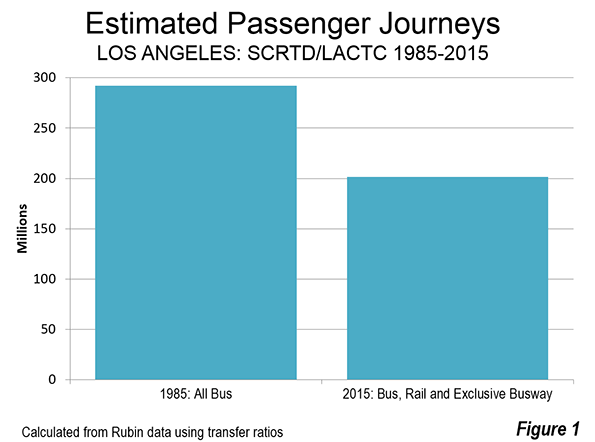
    According to the unlinked trips data reported by the Los Angeles Times, transit ridership on the SCRTD/MTA transit system declined nearly 10 percent from 1985 to 2015, despite the addition of billions of dollars worth of new rail lines. Taking Rubin’s estimate of passenger journeys based on the change in transfer rate (from 1.66 to 2.25 unlinked trips per passenger journey), the drop would be even greater, at a loss of more than 30 percent. Passenger journeys, using these ratios, would have been approximately 290 million in 1985 and 200 million in 2015 (Figure 1).

    Billions for What?
    Rubin has provided important research in his analysis of rail construction costs. Over the past 30 years. Rubin estimates that approximately $16.4 billion dollars (2016$) has been spent to build the routes that are already in service (including the Orange Line busway, but not the Silver Line busway, which he does not include) Elkind implies that this is not enough to see a “true return” on investment.

    With all the huzzahs about the rail system having made transit “the next great mass-transit city,” and the near universal praise for the rail system among the “powers that be” in Los Angeles, the Times is to be commended for courageously revealing the billions that have been spent while millions have abandoned transit, as SCRTD/MTA have placed a priority on expanding the rail services. Rubin also shows that another $9.0 billion is expected to be spent on new lines that will be opened by 2023.

    How Much is a Rail Rider Worth?

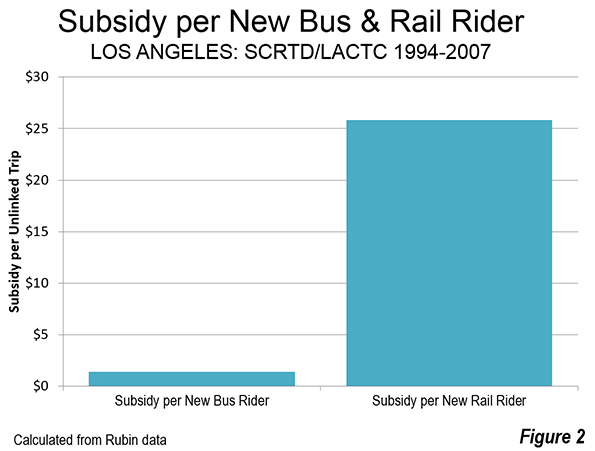
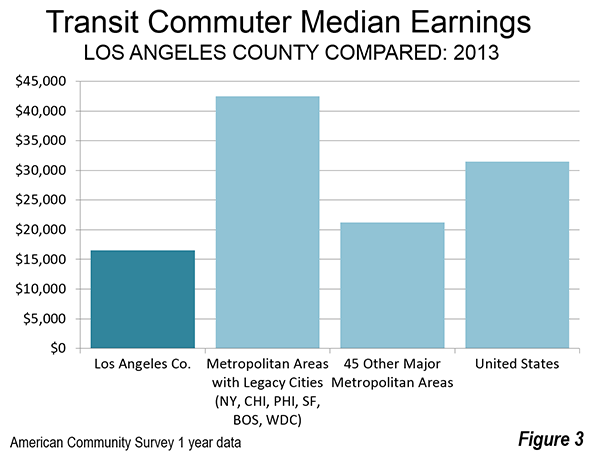
    Rubin was a principal actor in a civil rights lawsuit that forced MTA to reduce its rail spending and increase in spending on buses and lower fares after ridership had fallen about 120 million from its 1985 peak. During the period that the court oversaw MTA, was forced to add more bus service and lower bus pass prices. Rubin shows that during the period of rising ridership, from 1994 to 2007, unlinked trips nearly recovered to the 1985 peak. The ridership increase required a subsidy of $1.40 to add each new bus rider and $25.82 for each new rail rider (Figure 2). This suggests that a new rail rider is valued at nearly 20 times that of a new bus rider. This illustrates that it is far less expensive to increase ridership in Los Angeles with lower bus fares than with rail lines. It is also far more helpful to, Los Angeles transit riders, whose median income is well below that of transit riders nationally, and who need better access to jobs for the higher standard of living they seek (Figure 3).

    What About the Base Year

    Elkind suggests that the Los Angeles Times was unfair in comparing 2015 ridership to the peak year of 1985. Rubin does not accept this argument and for good reason. The principal purpose of the rail system was to increase ridership and any other outcome was, frankly, beyond the pale. The opening of 10 new rail and busway corridors is more than sufficient to have a significant increased ridership, which, as both Rubin and the Times shows, they have not (Note).

    As author of the rail funding amendment to Proposition A in 1980 that provided virtually all of the local funding for the rail system for a decade, these results fall far short of expectations. If I had doubted the ability of a large rail system to significantly increase transit ridership, I would not have offered the amendment (the only other similar amendment offered that day had already been rejected).

    Further, never in my succeeding five years on LACTC including the two years I served on the Rail Transit Committee did I ever hear another member of the Commission or a member of staff imply that there was any possibility that lower ridership could be the result. Had such a view become dominant, the “plug would probably have been pulled,” and the bus system maintained and improved. If so,  transit would be carrying many more people today, while delivering value for taxpayers.

    Photograph: John Ferraro Building, which hosted LACTC board meetings during my tenure. Los Angeles City Council President John Ferraro was the first chair of LACTC.

    Note: Each downtown oriented corridor counts as one (so that, for example, the Gold Line, which enters downtown from two directions is counted as two). Lines that do not reach downtown are counted as one.

    Wendell Cox was appointed to three terms on the Los Angeles County Transportation Commission by Los Angeles Mayor Tom Bradley. The LACTC board consisted of the Mayors of Los Angeles and Long Beach, two smaller city majors, the five county supervisors (county commissioners) and two other appointees of the Mayor of Los Angeles. Mayor Bradley routinely appointed the City Council President to fill one of these two seats as well as a private citizen (Wendell Cox). Wendell Cox chaired the Service Coordination Committee and also served on the Rail Transit and Finance Review Committees.

  • We Now Join the U.S. Class War Already in Progress

    Neither Trump nor Sanders started the nation’s current class war—the biggest fight over class since the New Deal—but both candidates, as different as they are, have benefited.

    Class is back. Arguably, for the first time since the New Deal, class is the dominant political issue. Virtually every candidate has tried appealing to class concerns, particularly those in the stressed middle and lower income groups. But the clear beneficiaries have been Trump on the right and Sanders on the left.

    Class has risen to prominence as the prospects for middle and working class Americans have declined. Even amidst a recovery, most Americans remain pessimistic about their future prospects, and, even more seriously, doubt a bright future (PDF) for the next generation. Most show little confidence in the federal government, although many look for succor from that very source.

    To understand class in America today, one has to look beyond such memes as “the one percent” or even the concept of “working families.” As Marx understood in the 19thcentury, classes are often fragmented, with even the rich and powerful divided by their economic interest and world view. In our complex 21st century politics, there’s a big divergence among everyone from the oligarchic classes to those who inhabit, or fear they will soon inhabit, the economic basement.

    The Fragmented OligarchiesThe Techies versus the Tangibles

    This confounding election stems, as much as anything, from the growing divisions among America’s business elite. These divisions have existed in some form in the past, but may never have been so gaping as today.

    On one side, we have the tangible industries—manufacturing, homebuilding, agriculture, logistics and especially energy—which often find themselves on the bad side of progressive regulation. Once these industries split their political contributions between the two major parties, but increasingly they are heading into the GOP camp.

    This is particularly notable in the energy industry. With progressives clamoring for the virtual destruction of the fossil fuel industry as soon as possible, executives feel compelled to back the GOP. They know that as the green movement ups its demands, their heads are on the collective chopping block. In 1990, energy firms gave almost as much to Democrats as Republicans; in 2014 they gave over three times as much to the GOP. Other tangible sectors, including agriculturehomebuilding and chemical manufacturing, which depends on cheap energy, seem also be leaning to the GOP.

    These corporate interests used to dominate fund-raising, but they are increasing out-gunned and out-spent by the rising tech and media sectors. This is where the big money is: In America , the media-tech sector in 2014 accounted for five of the top ten wealthiest people. And just this year, the fortune of the poster boy of social media, Mark Zuckerberg,exceeded that of the Koch brothers, the much demonized scions of the old economy.

    And these new style oligarchs are, for the most part, much younger than their tangible industry rivals. Indeed, virtually all self-made billionaires under 40 are techies. And where once tech folk supported middle of the road candidates, there has been a steady “leftward” drift for the last 15 years. In 2000, the communications and electronics sector was basically even in its donations; by 2012, it was better than two to one Democratic. Microsoft, Apple, and Google—not to mention entertainment companies—all overwhelmingly lean to the Democrats with their donations.

    This shift has occurred as the tech industry has moved away from its roots in aerospace and manufacturing to software and media. This realignment has relieved Silicon Valley of many traditional concerns with labor, energy prices, and basic infrastructure. When you are moving bits and bytes instead of building machines and circuits, you have less pressing interest in maintaining roads and having access to cheap energy. When virtually all your employees have degrees from elite colleges, or are imported technocoolies from India, you worry less about the cost of living or managing unions.

    The Obama years have solidified these ties. Many former Obama aides now work for firms such as Uber, AirBnB, Google, Twitter, and Amazon. Tech also leans strongly towards cultural progressivism—support for gay marriage, abortion rights and unrestricted immigration—and sympathy for the administration’s initiatives on climate change. They are not too concerned about higher energy prices for the middle and working classes, or their negative impact on basi cindustries. Climate change politics not only allows Silicon Valley and its Wall Street supports to feel better about themselves. It has also allowedventure firms and tech companies to profiteer on subsidies.

    But class issues muck up this alliance of manna and idealism. Despite their hip and cool image, the tech oligarchs remain very much ruthless capitalists when it comes to preserving and expanding their wealth. Although Bernie Sanders rarely attacks the tech oligarchs directly, they recognize him as a threat. “They don’t like [Bernie] Sanders at all,” notes San Francisco-based researcher Greg Ferenstein, who has been polling internet company founders for an upcoming book. “He’s an egalitarian liberal,” Ferenstein explains. “These people are tech liberals. Equality is a non-issue in Silicon Valley.”

    Sanders seems not to get the memo—he prefers to demonize Wall Street—butThe Washington Post, owned by super-oligarch Jeff Bezos, has taken particular pains to cut the Vermont socialist down to size. No surprise here, given the controversy over labor relations at Amazon, which, unlike Facebook or Google, actually has to employ blue collar workers.

    Most gentry and “tech liberals” appear to be aligning their vessels with Hillary Clinton’s now listing “armada” of well-heeled tech, financial, and other cronies. Some of these same people have also donated quite generously to the ethically challenged Clinton Foundation.

    And what about Wall Street, the biggest and most deserving target for class rage? Of course, the masters of the universe don’t like Bernie, the one candidate sure to oppose their interests. They are more than ready for Hillary, who, as Sanders repeatedly points out, has been taking their money in gigantic gobs. Security firms, for example, are thelargest donors to Clinton’s super-pak, lagging behind only Jeb Bush in terms of money from this detested part of our economy.

    Yet the more Wall Street money dominates the race in both parties, the less voters seem willing to listen. Their GOP favorites have either lost or are on the way out, including Marco Rubio, who seemed poised to win Wall Street support with his confounding proposal—amidst concern with inequality and rapacious profiteering—advocating a zero capital gains rate. Unable to unite, they are now facing the real, unnerving possibility of Donald Trump or Ted Cruz as the party standard-bearer.

    The Divided Middle Orders: The Yeomanry vs. the Clerisy

    Big contributors may determine who stays in a race, and sometimes who wins, but most elections are settled by the middle class, which constitutes something close to half the population, and likely more of the electorate. Yet like the oligarchs, the middle class is also deeply divided between competing factions and interests.

    The largest section of the middle class consists of what I call the yeomanry. This includes some 28 million small business owners, many of whom employ one of more family members. Spread across a variety of fields, this sector constitutes the class most opposed to the Obama program. In fact, according to Gallup, in 2012 three-fifths of all small business owners opposed Obama’s policies.

    The reasons for this opposition are obvious. Progressive policies like higher minimum wages and stricter environmental and labor laws hit small businesses harder than bigger firms, which have the staff and resources to adapt to the regulatory vise. Once seen as the leading, creative edge of the economy, small business has not done well under Obama: for the first time in modern history, more firms (PDF) are going out of business than staying solvent.

    But there’s another, more ascendant part of the middle class—highly educated professionals, government workers, and teachers—who have done far better under President Obama. In 2012, professionals generally approved of his regime, according to Gallup,by a 52 to 43 percent margin. These voters have become a critical part of the democratic coalition; indeed eight of the nation’s ten wealthiest counties—including Westchester County in New York, Morris County in New Jersey, and Marin County in California—all went Democratic in 2012.

    These middle income workers increasingly do not work for the private economy; they occupy quasi-public jobs dependent on public dollars than private markets. Universities, a core Democratic constituency have been hiring like mad: between 1987 and 2011, they added 517,636 administrators and professional employees, or an average of 87 every working day.

    This educated and often well credentialed middle class tends towards progressive politics; in fact, university professors have become ever more leftist, outnumbering conservatives six to one. Indeed, those voters with advanced degrees were the only group of whites by education to support Obama in 2012.

    In modern America, these people serve largely as a clerisy, hectoring the public and instructing them how to live. A bigger state is not a threat to them, but a boon. No surprise that public unions and academics have emerged as among the largest and most loyal donors to Democrats.

    The Democratic race is a largely a battle over securing the loyalty this class. Clinton tends to dominate the already established clerisy—most notably the teachers unions and gay and feminist lobbies—and among older progressives. But the leaders are being deserted by the followers: Sanders won a decisive 56 percent of college educated primary voters in New Hampshire.

    The Lower Classes: The Precariat and the Traditional Lower Class

    More Americans see themselves as belonging to the lower classes today than ever in recent times. In 2000 some 63 of Americans, according to Gallup, considered themselves middle class, while only 33 percent identified as working or lower class. In 2015, only 51 percent of Americans call themselves middle class while the percentage identifying with the lower classes rose to 48 percent.

    The bulk of this population belongs to what some social scientists call the “precariat,” people who face diminished prospects of achieving middle class status—a good job, homeownership, some decent retirement. The precariat is made up of a broad variety of jobs that include adjunct professors, freelancers, substitute teachers—essentially any worker without long-term job stability. According to one estimate, at least one-third of the U.S. workforce falls into this category. By 2020, a separate study estimates, more than 40 percent of the Americans, or 60 million people, will be independent workers—freelancers, contractors, and temporary employees.

    This constituency—notably the white majority—is angry, and with good cause. Between 1998 and 2013, white Americans have seen declines in both their incomes and their life expectancy, with large spikes in suicide and fatalities related to alcohol and drug abuse.They have, as one writer notes, “lost the narrative of their lives,” while being widely regarded as a dying species by a media that views them with contempt and ridicule.

    In this sense, the flocking by stressed working class whites to the Trump banner—the New York billionaire won 45 percent of New Hampshire Republican voters who did not attend college—represents a blowback from an increasingly stressed group that tends to attend church less and follow less conventional morality, which is perhaps one reason they prefer the looser Trump to the bible thumping Cruz, not to mention the failing Ben Carson.

    Many Trump supporters are modern day “Reagan Democrats.” Half of Trump’s supporters, according to a YouGov survey, stopped their education in high school or before. Trump’s message appeals to these voters in part by preserving social security and other entitlements. He appeals to populist rather than the usual GOP free market sentiment, and decisively won all voters making under $50,000 a year. Tellingly, among Iowa Republican voters who called themselves “moderate or liberal,” Trump trounced Cruz, and duplicated the feat again in New Hampshire.

    Conservative intellectuals dismiss Trump as both too radical and not conservative enough. He offends pundits in both parties by pushing things verboten in polite circles, such as trade with China, which has been responsible for the bulk of U.S. manufacturing losses. He also has embraced curbs on immigration, something that rankles the established leaders in both parties.. “There’s a silent majority out there,” Trump says. “We’re tired of being pushed around, kicked around, and being led by stupid people.”

    But if older, white Trumpians reflect the precariat’s past, young people flocking to Sanders’s camp may represent its future. Sanders destroyed Clinton among those under 30, winning their votes in both the Iowa caucuses and New Hampshire by six to one. These young voters may differ from generally older and whiter Trump voters on many key issues, but they also face a precarious future and diminished prospects. Over the past 40 years, few groups (PDF) have seen their incomes drop more than people under 30.

    In a decade, these millennials will dominate our electorate and as early as 2024 outnumber boomers at the polls. They may be liberal on many social issues, but their primary concerns, like most Americans, are economic, notably jobs and college debt . Fully half, notes a recent Harvard study (PDF), already believe “the American dream” is dead.

    For many millennials, Clinton style incrementalism is less than enough. A recentyougov.com poll found some 36 percent of people 18 to 29 favor socialism compared to barely 39 percent for capitalism, making them a lot redder than earlier generations. No surprise that Sanders beat Clinton among younger voters. As one student, a Sanders backer, recently asked me, “Why should I support her. How is she going to make my life better?”

    Below the precariat lie the traditional lower classes. Almost 15 percent of Americans live in poverty (PDF), and the trend over time has gotten worse. More than 10 million millennials are outside the system, neither in the labor force or education. This is just the cutting edge of a bigger problem: a labor participation rate which is among the lowest in modern history.

    The low-income voters are helping both Trump and Sanders. The Vermont socialist won an astounding 70 percent of the votes among people making less than $30,000 a year. Trump’s largest margins were among both these voters and those making under $50,000 annually, who together accounted for 27 percent of GOP primary voters.

    Class as the New Defining Issue

    We are now experiencing a growth in class-based politics not seen since the New Deal. During the long period of generally sustained prosperity from the ’50s to 2007, class issues remained, but were increasingly subsumed by social issues—civil and gay rights, feminism, environment—that often cut across class lines. Democrats employed liberal social issues to build a wide-ranging coalition that spanned the ghettos and barrios as well as the elite neighborhoods of the big cities. Similarly, Republicans cobbled together their coalition by stressing conservative social ideas, free market economics, and a focus on national defense; this cemented the country club wing with the culturally conservative suburban and exurban masses.

    The chaos and constant surprises of this campaign represent the beginning of a new political era shaped largely by class. In November Trump hopes to ride the concerns of the white working class to victory in the rustbelt to overcome Hillary Clinton’s coastal edge. Close to 20 percent of Democrats, according to Mercury Analytics surveys, plan to support Trump as their champion. In the coming months, the donor class, politicians, and pundits will be forced to address the needs of Trump’s supporters, as well as those of Sanders’ youth precariat in ways mainstream politicians have avoided for years.

    As class politics reshape American politics, we are entering territory not explored for at least a half century. Our political culture is being rocked in ways few would have anticipated just a few months ago.

    Joel Kotkin is executive editor of NewGeography.com. He is the Roger Hobbs Distinguished Fellow in Urban Studies at Chapman University and executive director of the Houston-based Center for Opportunity Urbanism. His newest book, The Human City: Urbanism for the rest of us, will be published in April by Agate. He is also author of The New Class ConflictThe City: A Global History, and The Next Hundred Million: America in 2050. He lives in Orange County, CA.

    Photo by Max Goldberg from USA (Bernie @ ISU) [CC BY 2.0], via Wikimedia Commons

  • The Religious Right is Being Left Behind

    The religious right, once a major power in American politics, is entering an uncomfortable dotage. Although numerous and well-organized enough to push Ted Cruz over the top in Iowa, the social conservative base, two-thirds of them born-again Christians, was of little use in New Hampshire, one of the most secular states in the Union. In the Granite State, Cruz did best among evangelicals but still slightly trailed Donald Trump among this one-quarter of New Hampshire Republicans.

    More importantly, Cruz’s religious strategy might not be enough to allow the Texan to vault past his main rivals, even in the “Bible Belt” states like South Carolina, where Real Clear Politics polls last week showed Donald Trump more than 16 points ahead. This, along with the total collapse of Ben Carson’s religiously based campaign, reflects, in part, slowing growth on the religious right. Evangelicals, who are the cutting edge of the movement, are gaining market share among Christians only because of sharper declines among mainstream Protestants and Catholics. Overall, notes Pew, 68 percent of Americans now believe religion is losing influence in society.

    In contrast, momentum is shifting to the religiously unaffiliated, whose numbers are rising rapidly, from 37.6 million in 2007 to 57 million in 2014. This process is particularly marked among millennials, a large portion of whom appear to have little interest in organized religion. Even if people remain spiritually inclined – and most Americans still are – the lack of church attendance makes mobilization of the faithful ever more difficult.

    Most importantly, some 34 percent of millennials profess to having no religion, compared with 23 percent of the overall population.

    Read the entire piece at The Orange County Register.

    Joel Kotkin is executive editor of NewGeography.com. He is the Roger Hobbs Distinguished Fellow in Urban Studies at Chapman University and executive director of the Houston-based Center for Opportunity Urbanism. His newest book, The Human City: Urbanism for the rest of us, will be published in April by Agate. He is also author of The New Class ConflictThe City: A Global History, and The Next Hundred Million: America in 2050. He lives in Orange County, CA.

    Ted Cruz photo by Michael Vadon (Own work) [CC BY-SA 4.0], via Wikimedia Commons

  • Education and Economic Growth

    It is an article of faith among California’s political class that insufficient higher educational opportunities are a constraint on California’s economic and job growth.  Just about every California economic development document includes a discussion of California’s desperate need for more college graduates.

    Unfortunately, the facts disagree with the faith.  California is educating far more people than it is creating jobs for them to take.  In the past 10 years, California’s public higher education system alone issued 2,455,421 degrees.  Over the same period, the state saw a net increase of only 1,136,642 jobs.

    That’s right.  California granted more than twice as many post-high-school degrees as net new jobs.

    We can quibble about the numbers, but the conclusion does not change. The number of degrees includes 871,922 community college degrees, including a conservative estimate of 94,000 in 2015, because data are not yet available.

    If we exclude community college degrees, California’s university and state college systems still granted 1,583,499 degrees, a much greater number than new jobs.  Some of those represent one person earning multiple degrees, but more than 28 percent of students would have to have earned multiple degrees for the number of college graduates to be less than the number of net new jobs.

    These numbers don’t include California’s private colleges and universities, of which there are many.  The University of Southern California, for example, granted 14,633 degrees in June 2015.

    You cannot escape the conclusion that California job growth lags the rate at which the state creates college degrees.  College graduates are a significant California export.

    Of course, not all of California’s new jobs require college degrees.  For example, almost 31 percent (351,926) of California’s net new jobs over the past 10 years were in the Leisure and Hospitality sector.  Very few of those jobs require a college degree.

    So, why is everybody saying that higher education is a constraint on California’s growth?

    Part of the reason is that education ranks with motherhood and “tolerance” on California’s pantheon of virtues, particularly among the highly educated political class, and education — notably the teachers’ unions — has a powerful lobby, perhaps the most powerful in California.

    Part of it is a poor understanding of statistics.  People observe that, on average, college graduates earn far more than non-graduates and conclude that education creates higher income, completely ignoring the self-selection bias: The lowest-ability student in your high school didn’t go to college, because he was the lowest-ability student. The highest-ability student went to college because she would have been bored beyond measure holding up a “slow” sign in a construction zone.  Repeat after me: correlation does not imply causation.

    Then, even after all this pumping out of graduates, there remain persistent shortages of qualified Californians to fill some jobs. Of course there are.  Nobody expects San Jose to produce all the geniuses that drive Silicon Valley’s innovation. Why should we expect them to all come from California?  These are very special jobs requiring very special skills. In this situation, large numbers work to employers’ advantage.  If the entire world is your source of these special workers, you have a much better chance of finding exactly who you need, or pay what you prefer.

    The forecasting industry is a big part of the problem. It is easy to find forecasts such as this Georgetown University report that says by 2020, a whopping 65 percent of all U.S. jobs will require post-secondary education. It is just as easy to find forecasts that robots will take away all of our jobs— including in the so-called “knowledge” sector.

    Long-term forecasts are extraordinarily unreliable. Long-run forecasts of necessary skill sets for future jobs are even more unreliable. They are completely dependent on assumptions that frequently prove wrong. Famously bad long-term forecasts include Time Magazine 1966 statement that “Remote shopping, while entirely feasible, will flop.” and Western Union rejecting the telephone in 1876 as having “… too many shortcomings to be seriously considered as a means of communication.”

    Forecasts of increasing demand for educated workers seems to be contrary to observation. Because of computers, a McDonalds’ worker doesn’t need to know how to make change, or the price of any product. All they need to know is what a product looks like and how to push a button.

    What we appear to be seeing is what my colleague Dan Hamilton calls a “hollowing out of the middle.”  Technology has increased demand for very-high-skilled people, as we see in the Silicon Valley, and it’s increased the demand for low-skilled people, as in the McDonalds example. It’s also reduced demand for many people in between, that is, the middle class.

    Focusing excessively on higher education creates problems while doing no good. It is ridiculous to attempt to give 65 percent of young people a college degree. You cannot achieve that goal without reducing the quality of the graduates, which reduces the value of the degree for the better students.  This would be repeating what California has done with high school diplomas. Graduation requirements have been reduced to the point that the degree is meaningless for almost all purposes. 

    Increasing supply at any educational level will not make new jobs appear; in fact, many of those workers are likely to go to where there are jobs and basic costs, particularly housing, are more reasonable.  A recent study by Cleveland State University documents the ongoing migration of educated Millennials from high-cost places with few opportunities to places with lower costs of living. 

    Yet rather than into look how to create better paying jobs across the board, the education lobby — including many now at universities — have a perfect motivation to support more spending on, well, they and their friends. If we did achieve a 65 percent college graduate rate, we’d hear the policy wonks calling for more advanced degrees.

    So, we ask, why we are creating so many more college graduates than jobs for college graduates?  I think it’s because we’ve promised our young people an education to match their abilities. That’s fair.  Government is providing a service for citizens. If it provides an educated workforce for Arizona and Texas, well that’s an unintended consequence.

    We also need to ask, why is California not creating jobs for our educated young people? That’s another discussion, with lots of reasons. But, creating more college graduates is not among the answers to that question. Focusing on it diverts energy and resources from the real challenges to California’s economic growth.

    Bill Watkins is a professor at California Lutheran University and runs the Center for Economic Research and Forecasting, which can be found at clucerf.org.

  • MENA Economies: Trouble Ahead

    The economies of the Middle East and North Africa (MENA) are ill prepared for the coming population boom.

    War, terrorism, repression and poverty are all common features in much of today’s Middle East and North Africa (MENA). How are the region’s demographics changing in the next few decades? And what is the prognosis for improved living conditions?

    It is difficult to look at the UN 2015 report and believe that the future will play out as outlined by the numbers. Even under the UN’s ‘medium variant’, which assumes a steady decline in total fertility ratios (TFR = average children per woman), the projected population growth would add significant stress on nations that are ill prepared to feed, educate and provide the needed jobs of the future.

    Note in the first table that TFRs have been falling for decades and are expected to continue trending towards the 2.1 replacement level, or indeed lower in many cases. Except for Egypt, the North African countries are already near replacement and will dip lower by 2050. And all the Western Asia countries, with the notable exception of Iraq, will be near or below replacement by 2050.

    (click to enlarge.)

    Screen Shot 2016-01-08 at 9.54.57 AM

    Yet between now and 2050, the MENA population will still grow significantly. Every country will have more people by 2050 than today. Lebanon stands out as the sole exception but this is explained by the fact that its population recently bulged by 20% or more due to the influx of Syrian refugees. In due time, a number of these refugees will return to Syria or emigrate to a third country.

    (click to enlarge.)

    Screen Shot 2016-01-08 at 9.54.51 AM

    In thirty five short years, Egypt is seen adding 60 million people to its current 91 million. The people of Iraq, Yemen and Sudan would double and those of Somalia nearly triple. The relatively richer Iran and Turkey (technically not in the MENA region but added here for comparison) will grow more modestly, as will oil-rich Kuwait, Saudi Arabia, the UAE and Qatar. In all, there will be nearly 300 million more people in the MENA, a worrying prospect given the current condition of the region’s economies.

    (click to enlarge.)

    Screen Shot 2016-01-08 at 9.54.38 AM

    Under the right conditions, a growing population could be an encouraging sign and a potent contributor to economic growth. But these conditions include a falling dependency ratio (the number of children + elderly, divided by the number workers). In this case, as shown in the table, the dependency ratio is expected to rise in half the MENA countries. An encouraging sign is the fact that it will be falling in the countries with the fastest growing populations, though perhaps not sufficiently to create the opportunity for a strong demographic dividend.

    In Egypt for example, the DR would fall from 62.3 to 56.5, not a large decline. And in Iraq, it would go from 78.7 to a still high 63.7. Yemen and Syria stand out for faster declines in their DRs but these figures may be less reliable given the current turmoil they suffer.

    (click to enlarge.)

    Screen Shot 2016-01-08 at 9.54.21 AM

    The MENA region therefore faces a long-term challenge to absorb the large rise in its working-age populations. As shown in this table, there will be, within 35 years, 40 million more Egyptians and 30 million more Iraqis seeking employment and improved living standards. In the entire MENA, there would be 180 million more people of working age. Optimism dictates that from the current travails will emerge a model that meets the needs of these rising populations.

    Some economic figures

    Compared to the years 2001-05 and 2006-10, the most recent five year period has seen a marked slowdown in Egypt, Jordan, Oman, Lebanon and Qatar, and continued strong growth in Saudi Arabia, the UAE and Iraq (to the extent that these figures can be trusted). The IMF’s estimates for 2015 and 2016, shown in the table, may prove too optimistic if energy prices remain low.

    (click to enlarge.)

    Screen Shot 2016-01-12 at 5.21.32 PM

    Screen Shot 2016-01-12 at 5.19.25 PM

    Per capita GDP shows a clear divide between on one side the oil rich countries Saudi Arabia, Qatar, Kuwait and the UAE, and on the other side poor or mismanaged countries. In theory, Iraq’s and Libya’s oil wealth should position them to join the club of the wealthy. But with the price of oil down from over $100 per barrel in 2014 to about $30 today, there will be contraction in the GDP figures of the richer countries with repercussions across the entire MENA region.

    (Note: Per UN appellation and data in this article, State of Palestine encompasses the West Bank and Gaza.)

    Sami Karam is the founder and editor of populyst.net and the creator of the populyst index™. populyst is about innovation, demography and society. Before populyst, he was the founder and manager of the Seven Global funds and a fund manager at leading asset managers in Boston and New York. In addition to a finance MBA from the Wharton School, he holds a Master’s in Civil Engineering from Cornell and a Bachelor of Architecture from UT Austin.

    MENA country map by DanPMKOwn work adapted from Africa in the World (grey).svg by TUBS, CC BY-SA 3.0, .


  • Best Baseball Towns

    Indulge me please as I tried to write my first sports column. No, I have no intention of applying for the job of newgeography.com’s sports editor and others have been far more prolific on this issue. I have been falling out of love with sports for decades now.  

    That does not mean, however, that I ignore the sporting world. I may be withdrawing from spectator sports    but I am interested in statistics they produce. Attendance figures have always intrigued me. It is impressive that more than 100,000 fans routinely fill stadiums in Ann Arbor, Columbus, Tuscaloosa, Baton Rouge, College Station, State College, Austin, and Knoxville.  Even so the largest crowds no longer occur, such as Notre Dame, Navy and USC, which drew the largest college football crows in history, at Chicago’s Soldier Field when its capacity was 165,000 (capacity source: 1929 World Almanac). Baseball’s record was more than 115,000 at a Los Angeles Coliseum exhibition game in 2008, celebrating 50 years since the Dodgers moved from Brooklyn.

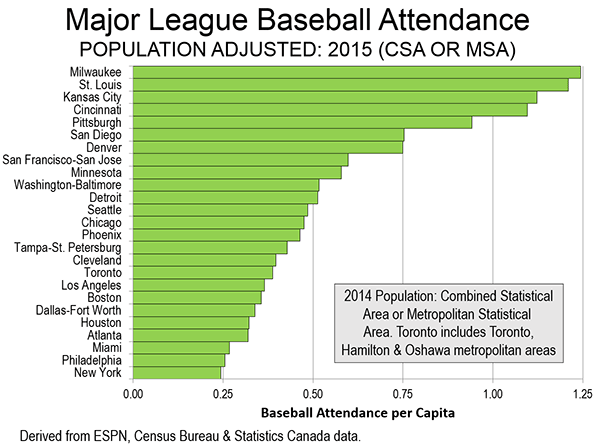
    Recently, major league baseball announced its annual attendance figures. Living in St. Louis, a middle-sized market that has usually drawn large market crowds, it struck me that it might be interesting to compare attendance figures to the population in the commuting sheds of the major league markets. By commuting sheds, I mean the combined statistical areas or where they do not exist, the metropolitan statistical areas.

    So I did a simple calculation of the major league attendance in each market compared to the population. The attendance data is readily available on the ESPN website for any wanting a more in-depth look.  Obviously, the market with the highest annual fans per capita would be the best baseball town. I frankly expected that it would be St. Louis. It was not .  The figure below shows the results.

    The Top 5

    The five best baseball towns are all on inland waters, on the Great Lakes and the other four on the Mississippi River and its tributaries. .

    #1: Milwaukee

    Milwaukee, the Great Lakes (Lake Michigan) entry, is number one. In 2015, the Brewers attracted the equivalent of 1.24 trips to the stadium per capita. This may be surprising, because the Brewers are nowhere near the top in terms of their capacity used during games (approximately 75%) or in their average attendance of 31,000, one-third short of the major league baseball leading Los Angeles Dodgers (46,000).

    #2: St. Louis

    The expected leader, river-city St. Louis came in second, attracting 1.21 visits per capita. However St. Louis drew many more people than Milwaukee, with an average crowd of more than 44,000. Even if I had wanted to go to a game (I have been to at least one in three decades), it could have been hard to find a seat. The Cardinals filled 98.8% of their seats in 2015. However, they had to settle for second place on this indicator as well, as the San Francisco Giants were number one with 99.4% of their seats filled each game (The timing of this article is purely coincidental with the announced move of the National Football League Rams from St. Louis to Los Angeles: See Note 1)..

    #3: Kansas City

    The state of Missouri’s other team — also on a river — ranked third. Kansas City drew 1.12 fans per capita in 2015. The Royals had an average crowd of 33,000 and filled a creditable 89% of the stadium on average.

    #4: Cincinnati

    The Cincinnati Reds placed fourth, with an average of 1.09 fans per capita. The Reds, however, had an average crowd of 30,000 and filled only 70% of their seats each game on the banks of the Ohio River.

    #5: Pittsburgh

    Pittsburgh, also a river city, was in fifth place, with 0.94 fans annual per capita. Pittsburgh’s average attendance was 31,000 and did a bit better in filling its capacity, at 80%.

    The Bottom Five

    The average fans per capita falls off dramatically among 2015’s bottom five baseball towns.

    Last: New York

    New York, of course, has two teams, the Yankees in the Mets. The New York fans per capita figure is calculated by adding the attendance figure for its two teams, as is also the case in Los Angeles and Chicago with their two teams. But with a commuting shed of 24 million residents, even filling every seat would not have been enough to grant New York an exit pass from the bottom 5. The Yankees attracted 80% capacity crowds, while the Mets averaged 75%. Overall, New York averaged 0.24 fans per capita, approximately one-fifth that of baseball’s best town in 2015, Milwaukee.

    2nd to Last: Philadelphia

    Philadelphia ranked second to last, with approximately 0.26 fans per capita. Philadelphia average 23,000 per game, which is only 53% of capacity.

    Third to Last: Miami

    Miami was third to last, averaging 0.27 fans per capita, with an average crowd of 22,000, which took up 57% of capacity.

    Fourth to Last: Atlanta

    Atlanta ranked fourth to last, averaging 0.32 trips to the ballpark per capita. The average crowd was 25,000, which represented only 50% of capacity.

    Fifth to Last: Houston

    Houston ranked fifth to last, slightly above Atlanta at 0.32 fans per capita. The Astros drew 27,000 per game and filled 65% of capacity.

    Honorable Mentions and others

    As the figure indicates, attendance per capita falls off significantly after fifth ranking Pittsburgh. San Diego and Denver attract approximately 0.75 fans per capita. The Denver is particularly significant, since the Rockies averaged 55,000 per game in 1993, before moving to their specially built stadium. Last year, the best the Rockies could muster was an average crowd of 31,000, filling only 62% of their capacity. The Rockies holds the record of 4.5 million annual attendees in a season, though the New York Yankees have drawn more than 4 million fans in four years. Their best attendance was 4.3 million.

    The Toronto Blue Jays (Note 2) are another team that drew more than 4 million fans twice in its heyday and averaged 50,000 fans in 1992. Toronto had been the first team to draw more than 4 million fans, in 1991. The New York Mets also drew more than 4 million fans in 2008, the same year the Yankees drew their largest figure.

    As is indicated above, the Los Angeles Dodgers led major league baseball in attendance in 2015. However, just down the road, the Los Angeles Angels— who play in Anaheim (Orange County) —  ranked fifth in total attendance, giving Los Angeles a combined total of 84,000 between the two teams. The New York Yankees and Mets had a total combined attendance of 70,000. The Chicago Cubs and White Sox drew a combined attendance of 58,000.

    Tampa-St. Petersburg put the “if you build it they will come” slogan to the test, in building a domed baseball stadium that opened in 1990. It took major league baseball eight years to come (that is not a record, San Antonio’s Alamo Dome has been waiting for nearly a quarter century for an NFL team). And, at least in 2015, not that many fans came. The Tampa Bay Devil Rays drew the smallest average crowd in the major leagues (15,000) and filled only 45 percent of its seats. Tampa-St. Petersburg did much better in fans per capita, at 0.43, for a ranking of 15th.

    My Career as a Baseball Spectator

    As may be obvious, I have not been to many baseball games. My first game was on a cross-country Trailways bus trip after high school when I spent my only night in New York at Yankee Stadium. But my most memorable game was in 1978, on the night the Dodgers set the then all-time attendance record (at least then) of 3,000,000 fans in a season. I don’t remember who they played or if the Dodgers won.

    Note 1: The off and on again musical chairs game of franchise moves continues with the Cleveland/Los Angeles/St. Louis Rams, which have now become the Cleveland/Los Angeles/St. Louis/Los Angeles Rams. Soon perhaps the Los Angeles/San Diego Chargers will become the Los Angeles/San Diego/Los Angeles Chargers or perhaps the Oakland/Los Angeles/Oakland Raiders will become the Oakland/Los Angeles/Oakland/Los Angeles Raiders?

    Note 2: The Toronto commuting shed includes the Toronto, Hamilton and Oshawa metropolitan areas, which Statistics Canada has indicated would be the combined statistical area if they were to designate one.

    Wendell Cox is Chair, Housing Affordability and Municipal Policy for the Frontier Centre for Public Policy (Canada), is a Senior Fellow of the Center for Opportunity Urbanism (US), a member of the Board of Advisors of the Center for Demographics and Policy at Chapman University (California) and principal of Demographia, an international public policy and demographics firm. He is co-author of the “Demographia International Housing Affordability Survey” and author of “Demographia World Urban Areas” and “War on the Dream: How Anti-Sprawl Policy Threatens the Quality of Life.” He was appointed to three terms on the Los Angeles County Transportation Commission, where he served with the leading city and county leadership as the only non-elected member. He served as a visiting professor at the Conservatoire National des Arts et Metiers, a national university in Paris.

    Photo:  Best Baseball Town: Milwaukee (2015)

    by Greg Hume (Own work) [CC BY-SA 3.0], via Wikimedia Commons

  • Intercity Buses: 2015 Was A Smooth Ride

    As a former airline pricing analyst who once viewed the intercity bus as an inconsequential player in major markets, I am perhaps an unlikely champion of this mode’s potential. But since Megabus made its US debut just blocks from my Chicago office in 2006, I have become intrigued with this increasingly popular mode of intercity transportation. I now collect data and write a year-in-review report that summarizes the notable happenings in the sector.

    Ever since I began this research, there have been remarkable developments. In 2015, the trend was for fast-growing brands such as BoltBus, Greyhound Express, and megabus.com to pivot from investing in new routes to investing in conveniences for quality-minded travelers, in a bid to woo them from cars and planes. Another major surprise has been the resurgence of Chinatown lines, some of which had been written off as dead after federal safety crackdowns several years ago.

    The intercity bus industry’s shift from added routes to investments that improve passenger experience stems from three factors.

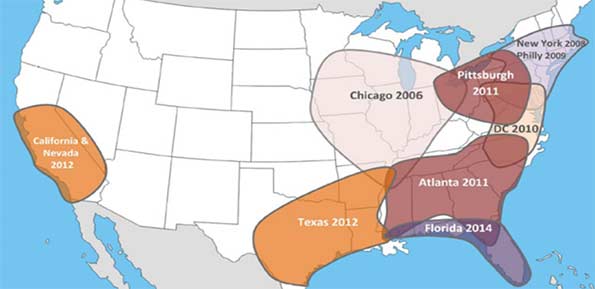
    First, major lines need to allow consumer markets to catch up with previous expansion, which has pushed bus service to regions in which product awareness is relatively low (it often takes three to five years for new service to achieve financial self-sufficiency). The map below illustrates the expansion of hubs by Megabus since it began its US service in 2006 and continued with Florida additions in 2014.


    Development of hubs by Megabus with approximate geographic range of service. Chaddick Institute

    Secondly, as the map shows, many of the most lucrative markets have already been tapped, giving carriers little choice but to focus their efforts on broadening their appeal among the large segment of the public that has been reluctant to give bus travel a try.

    Third, plummeting fuel prices have greatly intensified competition from private vehicles. Average gasoline prices across the US fell from $3.68 a gallon in July 2014 to just over $2 last month, negating some advantages of fuel-efficient modes. Double-decker buses with heavy loads can easily achieve 200 passenger miles per gallon. On a 250 mile round-trip, these falling prices have reduced the relative cost of driving by about $25 per passenger. That’s a big change to overcome!

    Carriers retained momentum by working to make coach travel more appealing. Greyhound introduced OnTouch©, allowing passengers to surf for information about tourist attractions, theatrical events, and ridesharing services at their destination using the bus’ Wi-Fi system. The carrier also launched BusTracker, which provides updates every one to four minutes on a bus’s location and expected arrival time.

    Megabus created a reserved seating program that allows passengers to select particular seats — including table spots — when buying tickets, generally for $5 or less. As recently as a decade ago, almost all US bus passengers were denied even having a guaranteed seat, much less a particular seat, on a selected departure. This uncertainty compelled many to arrive at the station at least an hour ahead to stand in line. Now, passengers can arrive at the last moment with their preferred seat awaiting them.

    New business-class services, meanwhile, popped up, linking New York City to Ithaca (on both Chaddick Institute for Metropolitan Development and Professor of Public Service at DePaul University in Chicago.

    Flickr Photo by Richard Masoner / Cyclelicious

  • This Is Why You Can’t Afford a House

    The rising cost of housing is one of the greatest burdens on the American middle class. So why hasn’t it become a key issue in the presidential primaries?

    There’s little argument that inequality, and the depressed prospects for the middle class, will be a dominant issue this year’s election. Yet the most powerful force shaping this reality—the rising cost of housing—has barely emerged as political issue.

    As demonstrated in a recent report (PDF) from Chapman University’s Center for Demographics and Policy, housing now takes the largest share of family costs, while expenditures on food, apparel, and transportation have dropped or stayed about the same. In 2015, the rise in housing costs essentially swallowed savings gains made elsewhere, notably, savings on the cost of energy. The real estate consultancy Zillow predicts housing inflation will only worsen this year.

    Driven in part by potential buyers being forced into the apartment market, rents have risen to a point that they now compose the largest share of income in modern U.S. history. Since 1990, renters’ income has been stagnant, while inflation-adjusted rents have soared 14.7 percent. Given the large shortfall in housing production—down not only since the 2007 recession but also by almost a quarter between 2011 and 2015—the trend toward ever higher prices and greater levels of unaffordability seems all but inevitable.

    The connection between growing inequality and rising property prices is fairly direct. Thomas Piketty, the French economist, recently described the extent to which inequality in 20 nations has ramped up in recent decades, erasing the hard-earned progress of previous years in the earlier part of the 20th century. After examining Piketty’s groundbreaking research, Matthew Rognlie of MIT concluded (PDF) that much of the observed inequality is from redistribution of housing wealth away from the middle class.

    Rognlie concluded that much of this was due to land regulation, and suggested the need to expand the housing supply and reexamine the land-use regulation that he associates with the loss of middle-class wealth. Yet in much of the country, housing has become so expensive as to cap upward mobility, forcing many people to give up on buying a house and driving many—particularly young families—to leave high-priced coastal regions for less expensive, usually less regulated markets in the country’s interior.

    The Rise of the Exclusionary Region

    The regions with the deepest declines in housing affordability, notes William Fischel, an economist at Dartmouth College, tend to employ stringent land-use regulations, a notion recently seconded by Jason Furman, chairman of President Obama’s Council of Economic Advisors. In 1970, for example, housing costs adjusted for income were similar in coastal California and the rest of the country. Today house prices in places like San Francisco and Los Angeles are three or more times higher, when adjusted for income, than most other metropolitan areas. For most new buyers, such areas are becoming what Fischel calls “exclusionary regions” for all but the most well-heeled new buyers.

    The biggest impact from regulation has been to diminish the supply of housing, particularly single-family homes. In a recent examination of permits across the nation from 2011 to 2014 for Forbes, we found that California regions lag well behind the national average in terms of new housing production, both multi-family and single family. Houston and Dallas-Fort Worth, areas with less draconian regulations, have issued three times as many permits per capita last year. Overall California’s rate of new permits is 2.2 per 1000 while across the Lone Star state the rate was nearly three times higher.

    In the “exclusionary regions” along both coasts, high land prices have made it all but impossible to build much of anything except luxury units. In Manhattan this has taken the form of high-rise towers that have been gobbled by the rich, including many foreigners, but this new construction has done little to make New York affordable for most residents. Between 2010 and 2015, Gotham rents increased 50 percent, while incomes for renters between ages 25 and 44 grew by just 8 percent.

    Making of Two Americas

    Real estate inflation is redefining American politics and could eventually transform the nature of our society. In the dense, increasingly “kiddie-free zones” around our Central Business Districts (CBDs), according to 2011 Census figures, children between ages 5 and 14 constituted about 7 percent of the population, less than half the level seen in newer suburbs and exurbs. The common habitués of these high-cost, high-density urban areas—singles and childless couples—have emerged, according to Democratic pollster Stan Greenberg, as key elements of the progressive coalition.

    The bluer the city, generally, the fewer the children. For example, the highest percentage of U.S. women over age 40 without children—a remarkable 70 percent—can be found in Washington, D.C. In Manhattan, singles make up half of all households. In some central neighborhoods of major metropolitan areas such as New York, San Francisco, and Seattle, less than 10 percent of the population is made up of children under 18.Perhaps the ultimate primary example of the new child-free city is San Francisco, home now to 80,000 more dogs than children, and where the percentage of children has dropped 40 percent since 1970.

    In contrast, familial America clusters largely in newer suburbs and exurbs, and increasingly in the lower-cost cities in the South, the Intermountain West, and especially in Texas. Overall—and contrary to the bold predictions of many urbanists—suburban areas are once again, after a brief slowdown, growing faster than the urban cores.

    America remains a suburban nation. Overall, 44 million Americans live in the core cities of America’s 51 major metropolitan areas, while nearly 122 million Americans live in the suburbs. And this does not include the more than half of the core city population that live in districts, particularly in the Sunbelt, that are functionally suburban or exurban, with low density and high automobile use.

    The Geography of Inequality

    Inequality may be a big issue among urban pundits, but, ironically, inequality is consistently more pronounced in larger, denser cities, including New York, Los Angeles, and San Francisco. Manhattan, the densest and most influential urban environment in North America, exhibits the most profound level of inequality and the most bifurcated class structure in the U.S. If it were a country, New York City overall would have the 15th-highest inequality level of 134 countries, according to James Parrott of the Fiscal Policy Institute, landing between Chile and Honduras.

    In our core cities in particular, we are seeing something reminiscent of the Victorian era, when a huge proportion of workers labored in the servile class. Social historian Pamela Cox has explained that in 1901 one in four people, mostly women, were domestic servants. But is this—the world portrayed in shows such as Downton Abbey and Upstairs Downstairs—the social norm we wish most to promote?

    In contrast, research by the University of Washington’s Richard Morrill shows that suburban areas tend to have “generally less inequality” than the denser areas. For example, in California, Riverside-San Bernardino is far less unequal than Los Angeles, and Sacramento less so than San Francisco. Within the 51 metropolitan areas with more than 1 million in population, notes demographer Wendell Cox, suburban areas were less unequal (measured by the Gini coefficient) than the core cities in 46 cases. And overall the poverty rate for cities is close to 20 percent, almost twice that of suburban areas.

    The differential of housing cost accounts for much of this disparity. High housing prices tend to stunt upward mobility, particularly for minorities. One reason: The house remains the last great asset of the middle class. Homes represent only 9.4 percent of the wealth of the top 1 percent, but 30 percent for those in the upper 20 percent and, for the 60 percent of the population in the middle, roughly 60 percent. The decline in property ownership threatens to turn much of the middle class into a class of rental serfs, effectively wiping out the social gains of the past half-century.

    The Geographic Shift

    High housing prices are also rapidly remaking America’s regional geography. Even areas with strong economies but ultra-high prices are not attracting new domestic migrants. One reason is soaring rents: According to Zillow, for workers between 22 and 34, rent costs claim upwards of 45 percent of income in Los Angeles, San Francisco, New York, and Miami compared to less than 30 percent of income in cities like Dallas and Houston. The costs of purchasing a house are even more lopsided: In Los Angeles and the Bay Area, a monthly mortgage takes, on average, close to 40 percent of income, compared to 15 percent nationally.

    This is leading to a renewed shift even among educated millennials to such lower-cost regions as Atlanta, Orlando, New Orleans, Houston, Dallas-Fort Worth, Pittsburgh, Columbus, and even Cleveland. As millennials enter their 30s and seek to buy houses, these changes are likely to accelerate.

    Millennials may be staying in the city longer than previous generations, but their long-term aspirations remain fixed on buying a single-family house. This trend will accelerate in the next few years, suggests economist Jed Kolko, as the peak of the millennial population turns 30. Faced with a huge student debt load, a weaker job market, and often high housing prices, millennials face tougher challenges than some previous generations, but retain remarkably similar aspirations.

    Bringing Back Levittown

    Clearly America needs a new approach to housing. Democrats may enjoy their strongest base in the cities, but many of their young constituents likely will end up in the suburbs, or will continue to move to smaller, less reflexively progressive cities. Finding ways to make suburbs more sustainable, both environmentally and for families, will have more long-term appeal than trying to eliminate their preferred way of life.

    Some attempts to force developers to build low-income units have, if anything, worsened the situation by discouraging new production while actually boosting prices for the vast majority. In some cases, as in New York City, the forced construction of low-income units in otherwise market-rate buildings has resulted in such absurdities as the so-called “poor door,” through which low-income residents, who are denied most of the amenities offered to wealthier residents, must enter.

    Republicans too may need to change their tune. As suburbs become more multi-cultural, and dominated by millennials, the GOP will have to embrace some of the environmental and social priorities of the new residents. They also have to realize that middle-class homeowners do not always share the same interests as Wall Street investors. Under the current regulatory regime, slavish adherence to the ambitions of big investors could undermine the dispersed ownership culture, replacing it with one primarily rental-based, even in single-family homes. Essentially this could transform large areas, including suburbs, into far less socially stable areas, particularly for families.

    One potential solution would be to draw on the successful policies enacted after World War II. At that time, the nation suffered a severe housing crisis as servicemen returned from the war. The solution combined governmental activism—through such things as the GI Bill and mortgage interest deductions—with less regulatory control over development. The result was a massive expansion of the country’s housing stock, and a dramatic increase in the level of homeownership.

    Bringing back the Levittown approach would require jettisoning ideological baggage that now accompanies the contemporary discussion about housing. Libertarians tend to favor loosened regulations—something welcome indeed—but seem to have less than passionate interest in addressing the housing interests of working- and middle-class Americans. As we saw in the late ’40s, at least some government support for affordable housing is critical to expanding ownership.

    But increasingly the worst influence on housing stems from the proclivities of contemporary progressivism. Whereas earlier Democratic presidents, from Roosevelt and Truman to Johnson and Clinton, strongly supported suburban single-family growth, contemporary progressives display an almost cultish bias toward the very dense, urban environment. The fact that perhaps at most 10 to 20 percent of Americans prefer this option almost guarantees that this approach would be unacceptable to the vast majority.

    How we deal with the housing crisis will shape our future, and will largely determine what kind of nation we will become. Although some developers outside the coastal areas are trying to revive smaller “starter homes,” at least in more reasonably priced markets, this may prove all but impossible to accomplish in “exclusionary regions” unless there is serious change.

    Following our current path, we can expect our society—particularly in deep blue states—to move ever more toward a kind of feudalism where only a few own property while everyone else devolves into rent serfs. The middle class will have little chance to acquire any assets for their retirement and increasingly few will choose to have children. Imagine, then, a high-tech Middle Ages with vast chasms between the upper classes and the poor, with growing dependence—even among what once would have been middle-class households—on handouts to pay rent. Imagine too, over time, Japanese-style depopulation and an ever more rapidly aging society.

    Yet none of this is necessary. This is not a small country with limited land and meager prospects. A bold new approach to housing, including the reform of out of control regulations, could restore the fading American dream for tens of millions of families. It would provide the basis for a greater spread of assets and perhaps a less divided—and less angry—country. Rather than waste their time on symbolic issues or serving their financial overlords, candidates in both parties need to address policies that are now undermining the very basis of middle-class democracy.

    This piece originally appeared at The Daily Beast.

    Joel Kotkin is executive editor of NewGeography.com. He is the Roger Hobbs Distinguished Fellow in Urban Studies at Chapman University and executive director of the Houston-based Center for Opportunity Urbanism. His newest book, The Human City: Urbanism for the rest of us, will be published in April by Agate. He is also author of The New Class Conflict, The City: A Global History,
    and The Next Hundred Million: America in 2050. He lives in Orange County, CA.

    Photo by cinderellasg.