Blog

  • What Does It Mean to Bring Buffalo Back?

    Prior to the holidays City Journal published  my major essay on Buffalo in their fall issue.  Here’s an excerpt:

    Local planner Chuck Banas observes that while Buffalo’s regional population today is roughly the same as it was in 1950, the urbanized footprint of the region has tripled. “Same number of people, three times as much stuff to pay for” is the quip—and it’s true. Physical capital must either be maintained at great cost in perpetuity or ignored and allowed to become a drag on the city. Between 1980 and 2011, according to the University of Buffalo Regional Institute, Buffalo-area governments issued permits for almost 60,000 new single-family homes—while regional population declined. Given the gargantuan scale of state aid to the region, this is clearly not market-rate development.

    While Buffalo’s urban advocates agree that investing in sprawl is misguided, they’re less critical about new construction in the urban center. The city’s $550 million light-rail line was an epic civic folly, yet Buffalo is currently reconstructing a downtown station on the line. More ill-conceived spending lies ahead. The region’s long-range transportation plan projects a need for an additional $100 million in capital expenditures through 2040, just to keep the existing line running—plus more operating subsidies every year. Seen in this light, neither cranes on the skyline nor bulldozers paving the countryside are necessarily good signs for Buffalo.

    I learned a lot in Buffalo and it stimulated my thinking about post-industrial cities generally. What is the best way to bring some of these places back? What does it even mean for them to be back?  If you wanted to inject a billion dollars of state or federal money into them, where would it most profitably be spent? These and other questions are ones I’ll be looking at in more detail during 2016.

    Read the entire piece at City Journal.

    Aaron M. Renn is a senior fellow at the Manhattan Institute and a Contributing Editor at City Journal. He writes at The Urbanophile, where this piece originally appeared.

  • In One Chart: Achieving the Demographic Dividend

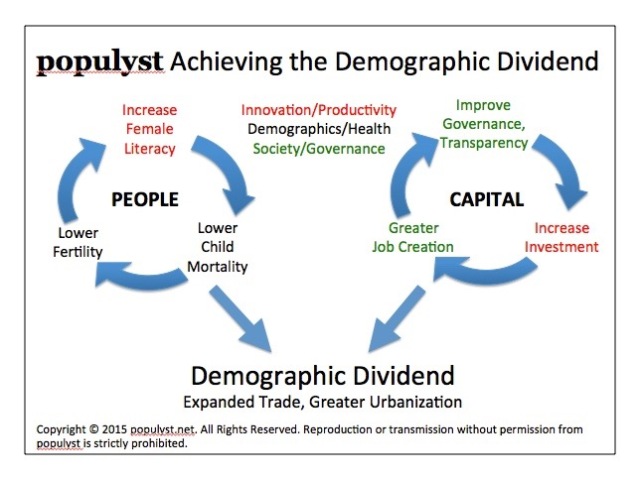
    The experience of China provides a useful policy template for countries with booming populations in south and southeast Asia and in sub-Saharan Africa. The Chinese boom showed that a growing working-age population combined with a declining fertility ratio can result in a large demographic dividend if certain conditions are met. As noted in this recent post, two important drivers of lower fertility are an increase in female literacy and a decline in child mortality.

    At the same time, better governance, lower corruption, an improvement in business conditions and increased investments in infrastructure and education would lead to higher foreign and domestic investments and greater job creation. Greater urbanization and an expansion of foreign trade can also be byproducts or causes or effects of the demographic dividend.

    Screen Shot 2015-12-01 at 1.19.23 PM

    After the demographic dividend, a country can remain on a growth path through additional political and regulatory reforms that encourage innovation and strengthen institutions.

    Sami Karam is the founder and editor of populyst.net and the creator of the populyst index™. populyst is about innovation, demography and society. Before populyst, he was the founder and manager of the Seven Global funds and a fund manager at leading asset managers in Boston and New York. In addition to a finance MBA from the Wharton School, he holds a Master’s in Civil Engineering from Cornell and a Bachelor of Architecture from UT Austin.

  • Declining Population Growth in China’s Largest Municipalities: 2010-2014

    After three decades of breakneck urban growth, there are indications of a significant slowdown in the largest cities of China. This is indicated by a review of 2014 population estimates in the annual statistical reports filed individually by municipalities with the National Bureau of Statistics.

    For context, municipalities in China, which are also translated as “cities” in English are nothing like cities as is commonly understood in English. In China, municipalities are large geographic areas that have their own governments, but also control rural lands often far beyond the urban area. Indeed, in China, counties are subdivisions of cities, while in Anglo heritage nations, cities are within counties, with the notable exception of the city of New York or in a few, like San Francisco, are identical with counties. Some cities, like Kansas City and Atlanta stretch into adjacent counties, though occupy only part of their main county.

    This article examines municipality population growth trends, from 2010 to 2014 and comparing to the 2000 to 2010 period. The analysis focuses on 21 municipalities, which include 20 of the 25 largest built-up urban areas in the nation areas of continuous development. The 21st municipality is Foshan, which shares its built-up urban area with Guangzhou. The statistical reports the other five municipalities did not provide sufficient data to be included in this analysis (Table).

    Back in 1980, as Deng Xiaoping’s reforms were beginning to take effect, China was approximately 20 percent urban. By 2010, 55 percent of Chinese citizens lived in urban areas, a near tripling of the urban share. A large share of this growth was the so-called “floating population,” which was made up largely of rural residents who moved to the urban areas to take jobs in the export oriented factories and the massive building and infrastructure construction sites.

    The Roaring 2000s

    In the 2000s, the largest Chinese municipalities experienced some of the most rapid growth in world history. Shanghai and Beijing added between 6 and 7 million residents. Both had annual growth rates of between 3% and 4%. During the same period, the U.S. annual growth rate was about 1.0 percent.

    But even these growth rates were not the highest in the country. Xiamen, in Fujian grow at an annual rate of 5.6%, while Suzhou (in Jiangsu, adjacent to Shanghai on the west) and Shenzhen (in Guangdong, just north of Hong Kong) expanded their population at rates between 4% and 5%.

    The Slowing 2010s

    The last four years have been very different. Overall, these 21 municipalities added population at a rate of 2.2% annually between 2000 and 2010. Between 2010 and 2014, the annual growth has been reduced by nearly half, to 1.2%. This is a far greater rate than that of the national population increase, which is gradually moving from modest growth to eventual decline. The 2010 to 2014 annual national population growth rate was 0.50 percent, a 12 percent reduction from the 0.57 percent 2000 to 2010 annual rate, according to the National Bureau of Statistics. The cause of the larger decline in these municipalities thus seems likely to be the result of reduced domestic migration from more rural areas.

    Nearly all — 19 of the 21 municipalities — are experiencing slower growth in this decade than in the last. Only one, Tianjin, is experiencing the growth similar to the fast-growing municipalities of the last decade. Between 2010 and 2014, Tianjin grew 4.1%, annually, a considerable increase over its 2.8% rate from between 2000 and 2010. During this decade, Tianjin added approximately 560,000 residents annually, the largest increase among the 21 municipalities. This fits well with national priorities, since the high densities of Beijing and related consequences have led to a plan to decentralize the population of nearby Beijing (100 miles or 160 kilometers away), encouraging the movement of residents, businesses and government agencies to Tianjin as well as to the municipalities of Tangshan (location of the great 1976 earthquake), and Langfang (midway between Beijing and Tianjin) and Baoding in the province of Hubei. The newly integrated area would be called Jin-Jing-Ji.

    Chongqing has begun to grow, after having lost 1.7 million residents in the last decade. . But Chongqing itself is uncharacteristic and the most “uncitied” of Chinese municipalities. Chongqing is a largely rural province, governed directly from Beijing (like Beijing, Shanghai and Tianjin). The principal built-up urban area, Chongqing, has a population of less than 7.5 million, or one-quarter of the municipality population. Chongqing has grown 0.9 percent annually since 2010 and is adding 267,000 residents per year. The population losses of the last decade occurred principally in the rural areas, as the Chongqing metropolitan area added more than three million residents, according to United Nations data.

    Strong growth continues in Beijing, but at a much reduced rate. The annual population growth rate in Beijing has dropped 38%, to 2.3% annually. Beijing is adding 475,000 residents annually, second only to nearby Tianjin.

    Shanghai’s growth has fallen even further, to 60% below the 2000 (1.3%). Shanghai is adding 310,000 residents annually. Other municipalities in the Yangtze Delta region are not doing as well. Suzhou’s annual growth has dropped more than 90% to 0.3%. Hangzhou and Nanjing have seen their growth drop more than 70 percent, with Hangzhou growing 0.5 percent annually and Nanjing 0.7 percent.

    The Pearl River Delta, in Guangdong, was at the heart of China’s three decade economic miracle, with its export driven growth. All four of the Pearl River Delta’s largest municipalities have seen their population growth rates dropped by 70% or more. Shenzhen grew 4.0% in the 2000’s and grows barely 1.0% today. Guangzhou has fallen from 2.5% in the 2000 to 0.7%. Foshan, which grew 3.0% in the 2000’s, now grows only 0.5%. Dongguan has fallen from a growth rate of 2.5% in the 2002 0.4% over the past four years, the slowest among the Pearl River Delta giants.

    Some other municipalities have grown nearly as quickly as before. Zhengzhou, the capital of Henan, grew rapidly during the 2000’s, at 2.6%, and has maintained a growth rate of 2.1%. With the third fastest growth rate, after Tianjin and Beijing, Zhengzhou is adding 186,000 residents annually, Quanzhou (Fujian), one of the best world examples of “in situ” urbanization is growing at 85% of its previous rate, though only 0.9% annually. Wuhan (Hubei), a long-time central China manufacturing center has been similarly successful in retaining its growth, and now has an annual growth rate of 1.4%.

    Without complete information on all of China’s largest municipalities, it is difficult to assess the extent to which (if any) urban growth has slowed. Certainly, the national government remains committed to strong urban growth. On the other hand, with China’s slowing economic growth rates, there may be less reason to leave the countryside for the city.

    2014 Population & Comparison of 2000-10 and 2010-4 Growth Rates
    Municipalities of China Corresponding to Largest Built-Up Urban Areas
    Annual Population Growth % Annual Population Growth
    Municipality Population: 2014 2000-2010 2010-2014 2000-2010 2010-2014
    Beijing            21,516,000 3.8% 2.3%      604,300      476,000
    Chengdu            14,428,000 2.4% 0.7%      293,900        95,000
    Chongqing            29,914,000 -0.6% 0.9%     (166,700)      267,000
    Dongguan              8,343,000 2.5% 0.4%      177,400        30,750
    Foshan              7,351,000 3.0% 0.5%      185,600        39,250
    Guangzhou            13,081,000 2.5% 0.7%      275,900        95,000
    Hangzhou              8,892,000 2.4% 0.5%      182,100        48,000
    Jinan              7,067,000 1.4% 0.9%        89,200        63,250
    Nanjing              8,216,000 2.7% 0.7%      187,900        52,750
    Qingdao              9,046,000 1.5% 0.9%      122,100        82,750
    Quanzhou              8,440,000 1.1% 0.9%        84,600        77,750
    Shanghai            24,257,000 3.4% 1.3%      661,100      309,500
    Shenyang              8,287,000 1.2% 0.6%        90,200        45,250
    Shenzhen            10,790,000 4.0% 1.0%      334,900      108,000
    Suzhou            10,604,000 4.4% 0.3%      366,800        36,000
    Taiyuan              4,299,000 2.3% 0.6%        85,800        24,250
    Tianjin            15,168,000 2.8% 4.1%      308,900      557,500
    Wuhan            10,338,000 1.6% 1.4%      147,200      138,250
    Xiamen              3,810,000 5.6% 1.9%      147,800        69,750
    Xi’an              8,628,000 1.5% 0.5%      119,300        40,000
    Zhenghou              9,371,000 2.6% 2.1%      197,000      186,000
    Total          241,846,000 2.2% 1.2%   4,495,300   2,842,000
    Calculated from annual municipality reports to the National Bureau of Statistics and NBS data
    Comparable data not available for 5 municipalities corresponding to the 25 largest built-up urban areas
    Built-up urban areas from Demographia World Urban Areas


    Photograph: Still fast growing Zhengzhou (by author)

    Wendell Cox is Chair, Housing Affordability and Municipal Policy for the Frontier Centre for Public Policy (Canada), is a Senior Fellow of the Center for Opportunity Urbanism (US), a member of the Board of Advisors of the Center for Demographics and Policy at Chapman University (California) and principal of Demographia, an international public policy and demographics firm. He is co-author of the "Demographia International Housing Affordability Survey" and author of "Demographia World Urban Areas" and "War on the Dream: How Anti-Sprawl Policy Threatens the Quality of Life." He was appointed to three terms on the Los Angeles County Transportation Commission, where he served with the leading city and county leadership as the only non-elected member. He served as a visiting professor at the Conservatoire National des Arts et Metiers, a national university in Paris.

  • Seeing the West as Worse

    “Hey-hey, ho-ho, Western culture’s got to go.

    – Slogan from 1988 Stanford University protest led by Jesse Jackson.

    In the aftermath of San Bernardino and Paris massacres, our cognitive leaders – from President Obama on down – have warned Americans not to engage in what Hillary Clinton has described as “a clash of civilizations.” But you can’t have a real clash when one side – ours – seems compelled to demean its traditions and values.

    Leaders in America and Europe don’t want to confront Islamic fundamentalism, or other nasty manifestations of post-Western thinking, because they increasingly no longer believe in our own core values. At the same time, devoted to the climate issue, they are squandering our new energy revolution by attempting to “decarbonize,” essentially leaving the field and the financial windfall to our friends in Riyadh, Moscow, Tehran and Raqqa.

    Western ethos deconstructed

    As the great 15th century Arab historian Ibn Khaldun observed, societies that get rich also tend to get soft, both in the physical sense and in the head. Over the past two centuries, Western societies, propelled by the twin forces of technology and capitalist “animal spirits,” have created a diffusion of wealth unprecedented in world history. A massive middle class emerged, and the working class received valuable protections, not only in Europe and America, but throughout parts of the world, notably East Asia, which adopted at least some of the Western ethos.

    Read the entire piece at the Orange County Register.

    Joel Kotkin is executive editor of NewGeography.com and Roger Hobbs Distinguished Fellow in Urban Studies at Chapman University, and a member of the editorial board of the Orange County Register. He is also executive director of the Houston-based Center for Opportunity Urbanism. His newest book, The New Class Conflict is now available at Amazon and Telos Press. He is also author of The City: A Global History and The Next Hundred Million: America in 2050. He lives in Orange County, CA.

    Photo by Payton Chung from DCA, USA (Polar bear protestUploaded by AlbertHerring) [CC BY 2.0], via Wikimedia Commons

  • San Francisco With 200,000 More People — Would we be Better Off?

    You want something truly scary? Take a look at these mockups of what San Francisco might look like if we build all the housing that the developers say we need.

    According to writer Greg Ferenstein,

    The city probably needs somewhere north of 150,000 more units: most high-rises would be concentrated in the Eastern, Downtown, and mid-market areas, while every block in the entire city would need at least one 7-story building. Essentially, San Francisco would be Manhattan downtown and Paris everywhere else.

    Set aside that I never want to live in Manhattan (at any price), and that the infrastructure to handle 200,000 more people would be horrendously expensive (and developers are already refusing to pay their fair share for far lower levels of need).

    It’s not just “how to we build that much housing.” It’s how do we build maybe $20 billion or more worth of transportation capacity to handle that density. Manhattan has a citywide underground transit system with high capacity and no surface traffic issues. SF doesn’t, and won’t, as long as we can’t raise property taxes and refuse to charge developers for the cost of that new system.

    Never mind, let’s take Ferenstein’s idea and play it out. Suppose we decided as a city that we are willing to accept a lot more density in exchange for affordability. (This is something the mayor is promoting). Let’s say that the city really needs to build highrises all over the eastern side of town (why only the east?) and put mid-rise buildings everywhere.

    Let’s say we decide that 47.5 square miles of space are enough for1 million people, and that we are willing to give up everything about San Francisco that we would lose in the process.

    Remember, the streets in the highrise districts in Manhattan are much broader than the streets in SF, able to handle more traffic, with big sidewalks that can handle more pedestrians – and still it’s often overwhelming.

    Right now in SF, for example, I am able to walk down the streets at 5pm without being jammed in a pack of stressed-out pushing people, which is life in parts of NYC. It’s possible to able to take your young kids and your dog for a walk in a place where there’s actually room to walk.

    Imagine Mission and Valencia, being packed with thousands more pedestrians. Don’t even think about the traffic.

    In fact, unless we took entire streets and banned cars, forget about the bicycle lanes – they are narrow and limited and can’t easily handle say 200 percent more traffic.

    But again, whatever. Let’s say that it’s elitist to try to keep the charm of a human-scale city in a world-class city like SF, which Ferenstein calls “quaint.” Let’s say that our only hope of avoiding being a city of just the rich is to build all the apartments and condos anyone could every want to build.

    Let’s say we have that debate and decide that the need for affordable housing trumps all, and we will just have to live with the implications.

    So what happens if we let the developers build 200,000 new units – and prices don’t come down?

    That’s actually a pretty likely scenario. It’s happened in other places (NYC, for example, where lots of new housing is being built and prices are not in any way coming down.)

    It’s happened in SF so far, where we have built more market-rate housing in the past four years than at any point since the 1960s, and prices continue to soar.

    Ferenstein talked to an econometrics expert at a credit agency. Okay. No idea if this person has ever studied housing or housing price trends in San Francisco, but he has a model. It assumes that we have to build housing faster than the population grows. Nice.

    Except that market-rate housing causes population growth as fast as it solves it – that is, if your model is the traditional capital-market model, you can’t keep up with population growth by building. You might as well try to decrease traffic by building freeways; never works, never has – not in San Francisco.

    And how come we never talk about why the population is growing so fast, and why so much of that growth comes from one industrial sector that hires one type of workers?

    I emailed Ferenstein with my questions, and here’s what he said:

    Well, prices don’t fall here because we don’t build enough. It’s been an issue for decades. And, if you build enough units, prices will fall. You just have to build more supply than people. The question is whether it is possible to do so. But, I’m actually not advocating for that. I’m advocating for *some* solution. If the city decides it doesn’t want to grow, then it should be responsible for finding some solution where people can live and work in the same city–somewhere. Maybe it’s San Francisco. Maybe it’s Oakland. Maybe it’s a new city. But there has to be a giant metropolis somewhere. And, San Franciscans must realize, if jobs relocate elsewhere, they will suffer massive inequality and terrible commutes.

    Interesting argument. Of course, we are not talking about a city where people live and work; San Francisco’s housing crisis in large part the result of people living here and commuting to Silicon Valley, on private buses. The Valley cities build no housing at all, and expect us to solve the problem.

    And I would argue that if some tech jobs went elsewhere, we would have less inequality and less terrible commutes – it’s the displacement from too many people moving here for jobs when housing doesn’t exist that has created the problem. Most of San Francisco does better when there is slower growth in bubbly tech industries.

    There’s a much more interesting question that we might want to address: Suppose we built may 20,000 new units, or 30,000, or 50,000, spread all over the city – and every one of them was social housing, that is, housing that was never in the private sector? Would that bring down prices? Would that provide the same level of affordability, or maybe much more, than the Manhattan West model?

    Would that be a better deal?

    At the very least, we would know that the new housing would be affordable, instead of taking a huge gamble that the (failed) free market, and the (failed) econometric projections of the past, would save us.

    Oh, and what if we said that SF no longer wants to be the bedroom community for Silicon Valley, and will stop entitling things like private buses that make that trend possible?

    That’s a bit of a different picture.

    This piece originally appeared at 48hills.org.

    Photo: A mockup by Alfred Two for a Medium story on what an “affordable” SF might look like

  • People Rather than Places, Ends Rather than Means: LSE Economists on Urban Containment

    “People rather than places” should be the focus of urban policy, according to Urban Economics and Urban Policy: Challenging Conventional Policy Wisdom. (paperback, Edward Elgar Publishing, 2015 $39.95). The book is among the most effective critiques of contemporary urban planning thought,  characterized by such approaches as urban containment, compact city, and densification. The authors are Paul C. Cheshire, Max and Nathan and Henry G. Overman, all economists at the London School of Economics and Political Science. Cheshire has a long list of publications analyzing urban planning policy. The authors characterize the central thesis of urban planning’s misdirected priorities stating that:

    "… that the ultimate objective of urban policy is to improve outcomes for people rather than places; for individuals and families rather than buildings."

    They argue that there is a place for urban planning, but that it must be in the appropriate context.

    "This is not to say that we should stop caring about what is happening in different cities and neighbourhoods but serves to remind us that improving places is a means to an end, rather than an end in itself." (emphasis added)

    This theme is applauded and characterized as “revolutionary” in the Foreword by Harvard University economist Edward Glaeser, who posits:

    "All policies need to be judged by the impact on people, not places."

    Basic Economics

    It has long been known that urban containment policy is fundamentally flawed, principally by its inconsistency with the fundamentals of economics, which leads to destructive housing affordability losses.

    Cheshire et al begin with the basics:

    “…there are some things on which nearly all mainstream economists would agree. Perhaps the nearest to unanimity one could find would be the proposition that if the supply of a good does not vary much as its price changes, and if the demand for that good rises proportionally more than incomes as incomes rise but is subject to cyclical fluctuations, then the price of that good will rise over the long run relative to other prices and its price will be volatile over the cycle.”

    They remind us that this is: “…one of the fundamental elements of economic analysis with a history of research and application going back at least 200 years.”

    The Problem

    This denial of economic realities, rooted in human nature itself, sets urban containment policy up to inflict major consequences, when evaluated based on outcomes for people.

    Urban containment’s forbidding or severely limiting house construction on the urban fringe has been associated with huge house price increases. This is particularly evident across the United Kingdom, which receives the principal attention from the authors. There house prices have doubled and even tripled compared to incomes. Obviously, being forced to spend more money on housing, people have less discretionary income to spend on other goods and services (and discretionary income virtually defines the standard of living and poverty).

    Rather than improving the standard of living and reducing poverty, which are fundamental domestic policy objectives, urban containment leaves in its wake “rising real house prices, falling affordability and increasing price volatility.” The authors note that price fluctuations are significantly greater where restrictions on development do not allow the supply of new housing to sufficiently respond to increases in consumer demand. To this they add concerns that all of this is leading to greater inequality.

    The problems with urban containment policy have long been known, not only to economists, but also to urban planners dispassionately examining the outcomes. On this score, the authors give well-deserved credit to a team of researchers led by the late Sir Peter Hall, one of history’s pre-eminent urban scholars. Hall led a team that was “…seriously sympathetic to the ideals of planning but who saw that the rigid policy of urban containment and the specific way in which the boundaries of the Greenbelts had been determined during the 1950s was perverting what they saw as the underlying purpose of town planning.” (See The Costs of Smart Growth Revisited: A 40 Year Perspective.)

    According to the authors, Hall et al had become convinced that “Far from providing people with greener environments and garden cities, the planning system had developed in a way which produced higher densities and made housing space more difficult to acquire.”

    Glaeser expands on this in the Foreword:

    “…we must never forget that any time we say ‘no’ to new building, whether in the city centre or on the edge, we are saying ‘no’ to families that want to experience the magic of urban life. We also ensure that every other family that lives in the city is paying more for their own homes.”

    Ignoring the Consequences

    The authors suggest that the planning objective of a compact city may “be a planner’s dream but for ordinary people it is more like a nightmare." They further imply that urban planning establishment has been “tone deaf” on the consequences of urban containment policy, noting that it is well and good to:

    “…argue that the costs imposed by the planning system are prices worth paying to ‘protect the countryside’ or achieve other policy objectives. However, it is not helpful for public debate to pretend that the costs we have documented do not exist; or even that they are negligible. Existing research shows that this is simply not the case; indeed research shows the costs are very substantial even if some are difficult to measure exactly."

    Cheshire et al express concern that the planning system is spreading beyond Great Britain. They continue: “…the British experience also provides some idea of what the future might hold for other countries as planning systems become increasingly restrictive.” Indeed that prediction is already being fulfilled with a vengeance.

    This can be seen across Australia and New Zealand, where the housing affordability losses have been at least as severe as in Britain. In the United States the predicament is highly regionalized. We can see its impacts in Portland, as well as huge losses in housing affordability in California, Seattle, Denver and elsewhere. And in Canada there is Vancouver, with the second worst housing affordability among the major markets in the 11th Annual Demographia International Housing Affordability Survey, and Toronto, where house prices have nearly doubled relative to incomes since 2000, under the Places to Grow Greenbelt initiative.

    They add a sobering assessment:

    "The problem is it is utterly unviable in the long term. With every passing decade the problems would get worse, the wider economic costs would become more penalising, the economy and monetary policy more unmanageable and the outcomes – the divide between the property haves and the property have-nots – more unacceptable."

    They add a perspective that should be appreciated by both students of history and politics:

    "In our judgment there is no doubt that if things go on as they are then at some point there will be a system breakdown and perhaps serious social unrest."

    Towards Resolution

    Cheshire and his colleagues suggest that: “any useful and rational debate should attempt to rigorously quantify the benefits conferred by the system rather than just assert them as ‘fact’.”

    More importantly, they offer workable solutions that can put urban policy back “on track” by seeking ends rather than means. Generally, they say that land use restrictions should be relaxed except where “there are amenity reasons not to do so.”

    This would start with an understanding that the large urban containment policy land price discontinuities be recognized for what they are — price signals that the demand for housing in an area is far greater than the supply.

    According to the authors,

    “…observed price discontinuities – the difference in market prices across boundaries of use categories – should become a ‘material consideration’ leading to a presumption in favour of any proposed development unless (a very important ‘unless’) it could be shown that the observed monetary value of the discontinuity reflected wider environmental, amenity or social values of the land in its current use.” (emphasis added)

    This would make sufficient land for development available to serve the economic well-being of households: “there is a very large amount of land where the ‘wider’ values are negligible.”

    A similar proposal was offered by the Productivity Commission of New Zealand in its recent report, which suggested setting a discontinuity maximum standard. When the standard is violated, land would be released.

    Getting Urban Policy Back on Track

    The authors say that “the economic and welfare – even environmental – damage done by Britain’s current planning system is overwhelming.” Moreover “the impact will get progressively more damaging over time.” The same damage can be expected beyond Britain, to the United States, Canada and wherever else urban containment policy is implemented, because of its fatal aversion to the realities of economics.

    Cheshire et al describe the dilemma that the policy detour urban containment has created.

    “The question is not will we reform it but when will we reform it and will that be before a catastrophic collapse? … The problem is that any radical reforms are politically unpalatable, but no alternative strategy will work.”

    Forty years ago, Hall and his colleagues lamented the disinterest of economists in urban planning. Cheshire et al similarly noted that economists have “contributed very little to the development and evaluation of real-world urban policy.” That needs to change and Urban Economics and Urban Policy: Challenging Conventional Policy Wisdom could be an important first step.

    Wendell Cox is Chair, Housing Affordability and Municipal Policy for the Frontier Centre for Public Policy (Canada), is a Senior Fellow of the Center for Opportunity Urbanism (US), a member of the Board of Advisors of the Center for Demographics and Policy at Chapman University (California) and principal of Demographia, an international public policy and demographics firm.He is co-author of the “Demographia International Housing Affordability Survey” and author of “Demographia World Urban Areas” and “War on the Dream: How Anti-Sprawl Policy Threatens the Quality of Life.” He was appointed to three terms on the Los Angeles County Transportation Commission, where he served with the leading city and county leadership as the only non-elected member. He served as a visiting professor at the Conservatoire National des Arts et Metiers, a national university in Paris.

    Photograph: The Shard, London © User:Colin / Wikimedia Commons, via Wikimedia Commons

  • The New Masters of the Universe

    Every age produces its own brand of oligarchs – feudal lords, banking gnomes, captains of industry. Our age has its own incipient ruling class, the tech oligarchs.

    The ascendency of these new hegemons is barely complete, and could conceivably be slowed or even reversed. But the tidal wave of new wealth, and even greater influence, will not be easily turned back. Six of the world’s 20 richest people are from tech or related industries like media and entertainment. In America, the media-tech sector in 2014 accounted for five of the top wealthiest people. Not surprisingly, most self-made billionaires are either quite old (the Koch Brothers, the Waltons, Warren Buffett) or got rich the traditional way: they inherited it. In contrast, virtually all self-made billionaires under 40 are techies.

    The making of a new ruling class

    With their massive, and early, accumulated wealth, the tech oligarchs will dominate us long after the inheritors have financed the last art museum or endowed the newest hospital. Two decades from now, many tech oligarchs will still be young enough to be counting their billions and thinking up new ways to ‘disrupt’ our lives – for our own good, of course.

    This tech elite differs from the founding generation of Silicon Valley. The early leaders – Bob Packard, Bob Noyce, Andrew Grove, Jerry Sanders – tended to be centrist and pragmatic. After all, the early Valley was heavily subsidised by the military and NASA, and produced industrial products that faced enormous competition. They also managed vast organisations with large numbers of ordinary employees. Like other industrialists, they were concerned with low-cost power and water, reasonable labour regulation and the health of the overall manufacturing economy.

    This changed when a combination of keen Asian competition and Californian regulation gradually shifted the chip and computer manufacturers out of Silicon Valley, which has lost roughly 80,000 manufacturing jobs since 2000. The new Valley is predominately post-industrial. For example, only 30 of about 16,000 production workers for the iPod are based in the US.

    As Silicon Valley became software valley, tech firms no longer needed large numbers of semi-skilled workers and the network of small subcontractors to keep the industrial machine going. Those services, if needed, could be performed in India, China, Utah, Texas or North Carolina. ‘The job creation has changed’, notes long-time San Jose economic development official Leslie Parks. ‘We used to be the whole food chain and create all sorts of middle-class jobs. Now, increasingly, we don’t design the future – we just think about it. That makes some people rich, but not many.’

    What has made ‘the sovereigns of cyberspace’, to quote author Rebecca MacKinnon, so wealthy is precisely what made John D Rockefeller so rich: control of markets. Google, for example, accounts for over 60 per cent of search, while, alongside Apple, it control almost 90 per cent of the operating systems forsmartphones. Similarly, over half of American and Canadian computer users use Facebook, making it easily the world’s dominant social-media site.

    More important still, the tech oligarchs control portions of their companies that would make most oilmen or auto executives fantastically rich. Indeed, owners of only one energy-related firm, Koch Industries, have made it into the top 10 of the Forbes 400. The CEO and chairman of Exxon-Mobil, America’s largest oil company, Rex Tillerson, controls 0.04 per cent of Exxon stock, while Google’s Sergey Brin, Larry Page and Eric Schmidt control roughly two thirds of the company’s voting stock. Larry Ellison, the founder of Oracle, Bill Gates and Mark Zuckerberg also control outsized shares of their firms.

    These firms are now so rich that they resemble countries. Besides General Electric, a classic conglomerate, Apple, Microsoft, Cisco, Oracle and Google often have more dollars on hand than the US government. And their influence can be felt in every office, home and phone through intrusive software that provides a trove of personal data that would make the old KGB turn from red to green with envy. As Google’s Eric Schmidt put it: ‘We know where you are. We know where you’ve been. We can more or less know what you’re thinking about.’

    The politics of the intangible class

    The liberation from the constraints of the tangible economy has inflamed the ambitions of the oligarchs. ‘Politics for me is the most obvious area [to be disrupted by the web]’, suggests former Facebook president Sean Parker. The success with which social media assisted President Obama’s re-election effort offers clear support to Parker’s assertion.

    In allying with Obama, tech is moving in the opposite direction to much of the business community, particularly small business, which Gallup finds a hotbed of anti-Obama sentiment. Other traditional industries like oil and gas have also turned overwhelmingly to the right, as Obama has targeted them for their role in climate change. In 1990, energy firms gave out almost as much to Democrats as Republicans; in 2014 they gave over three times as much to the GOP.

    In contrast, the oligarchs, as they have become ever richer, are clearly moving leftwards. In 2000, the communications and electronics sector was basically even in its donations; by 2012, it was better than two to one Democratic. Microsoft, Apple and Google – not to mention entertainment companies – all overwhelmingly lean to the Democrats with their donations.

    The transformer and the disrupters

    There seems a natural affinity between President Obama, who sees himself as a force for transformation, and the tech oligarchs, who love ‘disruption’. Each shares a high estimate of their basic intelligence and foresight; it is an alliance of those who feel they should own and shape the future.

    ‘We need to run the experiment, to show what a society run by Silicon Valley looks like’, venture capitalist Chamath Palihapitiya recently argued. This effort could appeal to a public that tends to regard the tech firms as better than more mundane businesses or the government. Indeed, when Steve Jobs, a 0.000001 per center worth $7 billion, and rugged capitalist of the classic type, passed away, protesters openly mourned his demise.

    One critical PR advantage the tech firms enjoy is that most, with a notable exception of Amazon, don’t mistreat blue-collar workers, or unions, since they have few of either. This gets them a free pass from social-justice warriors unavailable to traditional firms. Andrew Carnegie and Henry Ford mostly exploited workers in Pittsburgh or Detroit, and paid a price; the exploitation of the oligarchs takes place far away in Chengdu, Guangzhou or India.

    This alliance with the Democrats will not fade after Obama leaves office. Obama has enlisted several tech giants – including venture capitalist John Doerr, LinkedIn billionaire Reid Hoffman and Sun Microsystems co-founder Vinod Khosla – to help plan out his no doubt lavish and highly political retirement. Many former Obama aides have gone to work for tech firms. Uber, for example, uses Obama campaign manager David Plouffe to lead its PR team, while other former officials have descended to other tech firms such as AirBnB, Google, Twitter and Amazon.

    What is the ideology of Silicon Valley?

    Silicon Valley may be progressive in its social or environmental positions, but it has little interest in class politics, an issue being pushed by Vermont Senator Bernie Sanders in the Democratic primaries. ‘They don’t like [Bernie] Sanders at all’, notes San Francisco-based researcher Greg Ferenstein, who has been polling internet company founders for an upcoming book. Sanders’ emphasis on income redistribution, protecting union privileges and pensions hardly reflects the views of the tech elite. ‘He’s an egalitarian liberal’, Ferenstein explains, ‘these people are tech liberals. Equality is a non-issue in Silicon Valley.’

    What are ‘tech liberals’? Ferenstein provides a picture of an unconscious elitism that runs through their worldview. Although their industry is overwhelmingly based in the San Francisco Peninsula’s suburban sprawl, the internet oligarchs, he claims, want ‘everyone’ to move to the urban centre, something not remotely practical for most middle- and working-class families. They also advocate for strict environmental laws and ever higher energy prices, which don’t threaten their lifestyles, but are often devastating to those below them.

    Yet there is a danger that the issue of inequality could eventually affect the tech industry’s PR. Unlike the earlier products, such as computers or semiconductors, the products the tech industry now develop have provided little of value to the rest of society, whether in terms of jobs (outside of the Bay Area) or boostingproductivity. The social-media industry has made the likes of Mark Zuckerberg fantastically wealthy, but it’s difficult to maintain it has improved living conditions for most Americans.

    At the same time, well-financed Valley ‘disruption’ can be seen as a threat to many businesses and individuals. These already include groups such as cab drivers, owners and workers at small hotels, realtors and travel agents, and newspaper scribblers, all of whom are being driven out of the middle class. The much-needed ‘sharing economy’ often offers these workers part-time employment without much in the way of benefits.

    Even in the tech industry itself, American workers find themselves increasingly replaced by imported foreign workers. Oligarchs such as Mark Zuckerberg are anxious to expand H1B and other ‘guest-worker programmes’ that bring in low-cost indentured tech workers to the Valley, as well as to IT departments across corporate America.

    Of course, this hardly makes the tech oligarchs unique – after all, capitalists have always sought out the cheapest source of labour, and understandably so. But it does mean that, in oligarchic America, where even getting a degree in computer science and software does not guarantee a bright future, the hip, PR-friendly ‘don’t be evil’ appearance of tech companies may soon be looking a little less cool.

    Techies on the green team

    Perhaps nothing separates the oligarchy from the rest of business than its support for Obama’s climate-change policies. Many industries see these policies as a direct threat to their very existence, but this means little to moguls, who can shift their energy needs to cheaper locales, such as the Pacific Northwest or the South. In California, such policies have less an impact on the temperate coast than in the less glamorous interior. As one recent study found, the summer electrical bills in rich, liberal and temperate Marin come to $250 monthly, while in impoverished, hotter Madera, the average is twice as high.

    Not that there’s anything cynical about the tech oligarchy’s commitment to green policies. It is entirely sincere – the oligarchs really do believe, as do many liberal, Democratic types, that they are fighting the good fight. But that doesn’t mitigate the effects of their worldview.

    Still, the oligarch’s energy politics are not entirely based on the greater good. ForSilicon Valley and Wall Street supporters, there are also some business opportunities in the assault on fossil fuels. Cash-rich firms like Google and Apple, and many high-tech financiers and venture capitalists, have invested in subsidised green energy firms. Some, like Elon Musk, exist largely as creatures of subsidies. Neither SolarCity nor Tesla would be so attractive, or might not even exist, without generous handouts.

    The brave new world of the oligarchs

    If we want to get some idea how an oligarch-dominated economy works, take a look at my adopted home state – of over 40 years – of California, the home of the most powerful oligarchs. The Golden State sees itself as the ‘brains’ of the tech culture and proof of the bountiful ingenuity of ‘the creative class’.

    Yet behind the media glitz, California is increasingly a bifurcated state, divided between a glamorous software- and media-based economy concentrated in certain coastal areas, and a declining, and increasingly impoverished, interior. Overall, nearly a quarter of Californians live in poverty, the highest percentage of any state, including Mississippi, and, according to a recent United Way study, close to one in three people are barely able to pay their bills.

    So how do the oligarchs make this work politically? One way is simply to make alliances – through contributions and media support – with politicians who are most hurt by California’s regulatory vice. This strategy is evident in the odd coupling of San Francisco hedge-fund billionaire, Tom Steyer, the biggest funder of climate-change hysteria, and his Latino sidekick, California Senator Kevin de Leon, who represents impoverished East Los Angeles.

    The new political configuration works in classic medieval fashion, with the rich providing the necessities for the poor, without providing them opportunity for upward mobility or the chance, God forbid, to buy a house in the outer suburbs. With the fading of California’s once powerful industrial economy – Los Angeles has lost much of its manufacturing base over the past decade – its working classes now must be mollified by symbolic measures, such as energy rebates, subsidised housing and the ever illusive chimera of ‘green jobs’.

    This ‘upstairs-downstairs’ California coalition could presage the country’s political future. Perhaps it’s best to think of it as a form of high-tech feudalism, in which the upper classes run the show, but bestow goodies on the struggling masses. This alliance will allow the present tech oligarchs to thrive without facing a populist challenge that could interfere with their profits and expansion into other markets.

    In the oligarchic era, the bottom line is an increasing concentration of power in ever fewer hands. Romantic notions that the high-tech era would be marked by a surge of small, independent companies are belied by the market domination of a few firms and their expansion into ever more business areas. Companies like Google begin to morph into conglomerates, or American versions of Japan’skeiretsu, with interests in such businesses as health, media and autonomous vehicles.

    Similar keiretsu are forming around companies such as Apple, Amazon and Facebook, which now can buy their way into what were once seen as unrelated markets. This is married to increased media power, which will allow them to set the agenda in coming decades. This is being accomplished both through the purchase of old media – the most important being the purchase by Amazon’s Jeff Bezos of the venerable Washington Post – or by new sites controlled by firms like Yahoo, the No1 news site in the US, with 110million monthly viewers, or Google’s news site with 65,000,000 users.

    The intrusion of tech firms into media is likely to become even more pervasive as the millennial generation grows up and the older cohorts begin to die off. Among those over 50, only 15 per cent, according to a Pew report, get their news over the internet; among those under 30, the number rises to 65 per cent.

    Ultimately the ambitions of the oligarchs are boundless. Firms like Amazon CEO Jeff Bezos’ Blue Origin, and Elon Musk’s Space X, seek to lead the world in space exploration. If NASA continues to retreat from many areas of space exploration, it is likely that, in the future, the heavens may end up belonging to the oligarchs as well.

    When historians write the history of this age, their attention likely will focus on the rise of these oligarchies. They already control California, with its unparalleled creative and technical prowess, as well as the dominant cultural power centre in the English-speaking world. Tomorrow the new oligarchs will be looking to consolidate their power in Washington. And the day after that, maybe the world and galaxy as well.

    This piece originally appeared at Spiked.

    Joel Kotkin is executive editor of NewGeography.com and Roger Hobbs Distinguished Fellow in Urban Studies at Chapman University, and a member of the editorial board of the Orange County Register. He is also executive director of the Houston-based Center for Opportunity Urbanism. His newest book, The New Class Conflict is now available at Amazon and Telos Press. He is also author of The City: A Global History and The Next Hundred Million: America in 2050. He lives in Orange County, CA.

    Official White House Photo by Pete Souza.
  • The Cities Doing The Most To Address The U.S. Housing Shortage

    America is suffering from the severest undersupply of housing since the end of the Second World War. Although population growth has slowed significantly since the 1950s and 1960s, production has slowed down even more so. It’s not surprising that homebuilding declined after the housing bubble burst in 2008, but from 2011 to 2015 it continued to fall, dropping almost a quarter.

    Meanwhile, housing price inflation has re-emerged. Housing now accounts for roughly 35% of household expenditures, up from about 30% in 1985, while expenditures on food, apparel and transportation have dropped or stayed about the same.

    High home prices help to boost rents by forcing potential buyers into the apartment market. As of midyear, rental costs were eating up the largest share of renters’ income in recent U.S. history, 30.2%. Since 1990, renters’ income has not increased, but rents have soared 14.7% (both inflation adjusted).

    In high-priced markets like New York, Los Angeles, Miami and San Francisco, the average renters spend from 42% to 48% of their income on rent, well above the national average. In New York, rents increased between 2010 and 2015 by 50%, while incomes for renters between ages 25 and 44 grew by just 8%.

    The Cities Building The Most New Homes

    Some metropolitan areas are doing a much better job than others at meeting this pent-up demand by building new housing.

    We looked at the volume of construction permits for single and multifamily units in the 53 largest metropolitan statistical areas in the country from 2011 through 2014, and compared them to those metro areas’ existing housing bases.

    To a large extent, the superstars of the past four years have been those areas that have enjoyed both the greatest job and population growth. The top of our list of cities that are increasing their housing supply the most is dominated by metro areas that have generally better housing affordability, with a multiple of median incomes to median housing prices between three and four.

    Leading the way is Austin, Texas, which issued permits for the construction of roughly 71,000 housing units from 2011 through 2014, equal to 11.5% of its existing housing base in 2010. Austin’s new construction was split almost 50-50 between single family and multifamily units.

    Other Texas cities in our top 10 include No. 3 Houston, which permitted the construction of 189,634 new units from 2011-14, the most in the nation over that span, equal to 9.7% of its 2010 base. Dallas-Ft. Worth ranks seventh, with a total of 148,329 units, second most in the nation behind Houston, for a 6.7% expansion of its housing supply from 2010. Most of the rest of our top 10 — including the North Carolina boom towns Raleigh (No. 2) and Charlotte (No. 4) — are located in or adjacent to the southern rim of the country. Only No. 10 Seattle can be considered a “smart growth” region, with the predictable high prices relative to incomes.

    Families vastly favor single-family homes, and they can still find them at a relatively affordable price in many Southern cities. Some two-thirds of housing construction permits in Houston from 2011-14 was for single-family homes, and six of the top 10 metro areas for single-family construction over that span were located in the South. Houston alone produced nearly as many new single-family homes in 2014 as the entire state of California, which has about six times as many residents.

    If you go by new single-family construction as a percentage of the existing housing base, sprawling, suburban, smaller and mid-sized metropolitan areas in the South are in the lead: Raleigh, Austin, Nashville, Charlotte, Orlando, Oklahoma City and Jacksonville.

    But it’s important to recognize that as these areas “sprawl” they are also densifying. Houston ranks second nationally for new multifamily units over the span we looked at with 65,261; Austin, seventh (35,687, representing 18% of its 2010 base); and Charlotte ranks 15th. Some of this growth is concentrated near their urban cores, which have revived in recent years.

    The Doyennes Of Density

    In expensive parts of the Northeast and the West Coast, the favored solution to the housing affordability crisis is to pack more people into a smaller space: force households into smaller homes and apartments by raising the price of single-family dwellings for middle-income buyers through land-use restrictions.

    This approach may produce some units, but it hardly addresses the affordability issue. By most measures, higher-density housing is far more expensive to build. Gerard Mildner of the Center for Real Estate at Portland State University, notes that a high rise over five stories costs nearly three times as much per square foot as a garden apartment. Even higher construction costs are reported in the San Francisco Bay Area, where townhome developments can cost up to double that of detached houses per square foot to build (excluding land costs), and units in high rise condominium buildings can cost up to 7.5 times as much.

    New York epitomizes the limitations of density to address the affordability crisis. The Big Apple ranks third behind Houston and Dallas-Ft. Worth in total residential construction permits from 2011-14 at 140,041 units, but that’s underwhelming given that it’s the most populous metro area in the nation by far. That total represents only 2.0% of the metro area’s 2010 housing base, 42nd best out of the nation’s 53 largest MSAs.

    Nearly 75% of the New York area’s housing construction over that span was multifamily, with permits for 103,000 units from 2011-14, but that only makes for a 2.6% increase in apartment supply over 2010, placing it a meager 39th among the major metro areas over that span.

    That 75% multifamily proportion is common in other expensive, highly regulated markets such as Los Angeles and San Francisco. In Boston, regulatory and land costs have boosted the cost of building a 1,600 square foot apartment to $438,000.

    The failure of high-density housing to relieve the affordability crisis is most evident in the Golden State. The state’s largest metro areas have among the highest ratios of home prices to income. Prices in San Diego, Los Angeles have all risen considerably above the national average, despite only meager economic recoveries. San Jose and San Francisco have also experienced huge home price increases and are among the most unaffordable major metropolitan markets in the nation. Among these, only San Jose ranks in the top 10 in multi-family building permits as a percentage of the 2010 base (fifth).

    The Metro Areas That Are Lagging, And What Lies Ahead

    The lowest rung of our rankings are mostly smaller, old industrial cities with little in the way of population growth. Providence, R.I., barely eked out 1% growth in its housing supply since 2011. Other low-ranking areas include Hartford, Cleveland, Detroit, Milwaukee, Chicago and Rochester.

    Overall, future prospects seem to be brighter in cities that have both reasonable prices and strong economies. These metro areas, which dominate our list, have the advantage also of being able to offer millennials, as they age, the sort of affordable single-family housing that they tend to move into during their 30s and beyond, notes economist Jed Kolko.

    By building both single-family and multifamily housing at a higher clip, these areas are building the foundations for future growth, particularly for the next generation. There will be ups and down in the years ahead, but metropolitan areas producing adequate, diverse and affordable housing seem likely to enjoy future advantages in the race for talent and jobs.

    No. 1: Austin, TX

    New Permitted Multifamily Units, 2011-14: 35,687

    New Permitted Single-Family Units, 2011-14: 35,288

    New Units As Pct. of 2010 Housing Base: 11.5%

    No. 2: Raleigh, NC

    New Permitted Multifamily Units, 2011-14: 15,478

    New Permitted Single-Family Units, 2011-14: 26,892

    New Units As Pct. of 2010 Housing Base: 10.6%

    No. 3: Houston, TX

    New Permitted Multifamily Units, 2011-14: 65,261

    New Permitted Single-Family Units, 2011-14: 124,373

    New Units As Pct. of 2010 Housing Base: 9.7%

    No. 4: Charlotte, NC

    New Permitted Multifamily Units, 2011-14: 20,195

    New Permitted Single-Family Units, 2011-14: 35,536

    New Units As Pct. of 2010 Housing Base: 7.1%

    No. 5: Orlando, FL

    New Permitted Multifamily Units, 2011-14: 19,306

    New Permitted Single-Family Units, 2011-14: 30,883

    New Units As Pct. of 2010 Housing Base: 6.8%

    No. 6: Nashville, TN

    New Permitted Multifamily Units, 2011-14: 13,966

    New Permitted Single-Family Units, 2011-14: 27,292

    New Units As Pct. of 2010 Housing Base: 6.7%

    No. 7: Dallas, TX

    New Permitted Multifamily Units, 2011-14: 63,978

    New Permitted Single-Family Units, 2011-14: 84,351

    New Units As Pct. of 2010 Housing Base: 6.7%

    No. 8: Oklahoma City, OK

    New Permitted Multifamily Units, 2011-14: 4,342

    New Permitted Single-Family Units, 2011-14: 21,000

    New Units As Pct. of 2010 Housing Base: 5.5%

    No. 9: Jacksonville, FL

    New Permitted Multifamily Units, 2011-14: 5,812

    New Permitted Single-Family Units, 2011-14: 20,404

    New Units As Pct. of 2010 Housing Base: 5.5%

    No. 10: Seattle, WA

    New Permitted Multifamily Units, 2011-14: 38,803

    New Permitted Single-Family Units, 2011-14: 31,563

    New Units As Pct. of 2010 Housing Base: 5.4%

    This piece first appeared at Forbes.com

    .

    Joel Kotkin is executive editor of NewGeography.com and Roger Hobbs Distinguished Fellow in Urban Studies at Chapman University, and a member of the editorial board of the Orange County Register. He is also executive director of the Houston-based Center for Opportunity Urbanism. His newest book, The New Class Conflict is now available at Amazon and Telos Press. He is also author of The City: A Global History and The Next Hundred Million: America in 2050. He lives in Orange County, CA.

    Wendell Cox is Chair, Housing Affordability and Municipal Policy for the Frontier Centre for Public Policy (Canada), is a Senior Fellow of the Center for Opportunity Urbanism (US), a member of the Board of Advisors of the Center for Demographics and Policy at Chapman University (California) and principal of Demographia, an international public policy and demographics firm.He is co-author of the “Demographia International Housing Affordability Survey” and author of “Demographia World Urban Areas” and “War on the Dream: How Anti-Sprawl Policy Threatens the Quality of Life.” He was appointed to three terms on the Los Angeles County Transportation Commission, where he served with the leading city and county leadership as the only non-elected member. He served as a visiting professor at the Conservatoire National des Arts et Metiers, a national university in Paris.

    Photo by LoneStarMike (Own work) [CC BY-SA 3.0], via Wikimedia Commons

  • The Fall of Rahm Emanuel

    Rahm Emanuel, a man of obvious talent, drive, and leadership capacity, should have been an ideal person to run a big city like Chicago. Unfortunately, because of his stubborn unwillingness to admit and compensate for his flaws, that was not to be.  After barely limping across the finish line in his re-election bid and tamping down the fallout from Moody’s downgrading the city’s debt to junk status, Emanuel has now been rocked by a truly huge scandal. The Chicago Police Department shot 17 year old Laquan McDonald 16 times, killing him, then did not release a video of it for over a year – including sitting on it during the entire election season. And that’s just the start of it.

    My latest piece in City Journal, The Fall of Rahm Emanuel, looks at Rahm’s tragic trajectory:

    Emanuel’s leadership style came with fatal flaws. A political streetfighter by inclination, he lacks an operational orientation. He didn’t appear to grasp the scope of the city’s financial problems until four years after he was first elected, when Chicago’s bond rating was cut to junk. His infrastructure trust fizzled. The schools went from bad to worse, with his first CPS leader forced out and his secondpleading guilty to corruption. He didn’t get it that Chicago’s police department hadn’t been fundamentally reformed the way New York’s and Los Angeles’s had been.

    Emanuel’s governing style has been all tactics, no strategy. He’ll pick up the phone to twist the arm of a CEO or fight to win the day’s media cycle. But what’s his vision for the city? He has no idea how to make Chicago as a whole work over the long term. Nobody is great at everything, but Emanuel’s arrogance seemingly won’t allow him to address his own shortcomings. Famously vindictive, he alienated the local press and others, turning those who might have helped him into enemies. He also brought a Washington-style spin-control mindset to Chicago. In Washington, an army of apparatchiks and a compliant media lets politicians like Obama create a reality bubble. In national politics, perception is often is reality. But in local government, reality is reality. The West Side isn’t Benghazi. The people who live in Chicago can walk out their front doors and see for themselves what’s going on.

    Click through to read the whole thing.

    Aaron M. Renn is a senior fellow at the Manhattan Institute and a Contributing Editor at City Journal. He writes at The Urbanophile, where this piece originally appeared.

    Photo: Chicago Mayor Rahm Emanuel, left, greets U.S. Defense Secretary Leon E. Panetta upon his arrival at a CEO roundtable in Chicago, May 20, 2012, courtesy of the Department of Defense.

  • Our Anemic Suburbs: Every Urban Area Needs its Outskirts — and New York City’s Are in Trouble

    New York City has prospered since the great recession of 2008, buoyed by an endless supply of free money from Washington that’s elevated the stock and real estate markets. But the broader metro region has struggled, in an ominous sign of tougher times to come.

    Little acknowledged in the discussion of New York’s “tale of two cities” is something beyond the control of Mayor de Blasio: the fading of the city’s once-thriving suburbs, even as the city grows more populous and more expensive.

    Although some urban boosters blame suburbs for city ills and wish for their demise, the truth is they depend upon one another. Suburbs, including in New York, have long provided a local outlet for people to migrate to from the urban core as they start families and otherwise age out of cloistered living. But in the outskirts of Gotham, this model now appears to be in decline.

    At a time when New York City itself is growing, the suburban dream here has slowly died, choked off by a difficult commutes, stagnant local economies, rapidly rising house prices and punishing property taxes. House prices have increased in New York’s suburbs in New York and New Jersey at double the increase of household incomes since 2000. In Suffolk and Passaic, N.J., they’ve tripled. The suburbs in New York also have among the nation’s highest property taxes.

    When New Yorkers get to the point they want to start a family and buy a house, those who can — the best and brightest — are no longer decamping for places like Great Neck or Scarsdale but appear to be leaving the region entirely.

    The decline is evident in Long Island, where there is very little new building and time seems to have stopped around 50 years ago. New restaurants, malls and cultural facilities are rare. Long Island and New Jersey have lost sports franchises to Brooklyn. Unlike in other regions, few businesses leave the city for the surrounding suburbs.

    Nor is this just a matter of mass migration to one or two places. Greater New York loses net migrants to virtually every big urban region of the country, including Los Angeles as well as such diverse places as Philadelphia, Washington, Boston, Atlanta, Dallas-Fort Worth and Houston.

    To some urbanists, this decline of New York’s suburban belt represents welcome news. After all, between 1950 and 2010, more than 95% of the region’s growth took place on its periphery, and worries focused on the hollowing out of the urban core.

    Since 2010, those trends have had a stunning reversal: The boroughs have added 316,000 people — a growth rate four times that of the burbs.

    But what makes urban boosters trill in ecstasy also suggests that greater New York is no longer a place that accommodates upward mobility.

    A lot of that comes down to the bottom line. Between property values and property taxes, the cost of suburban living in Nassau and Westchester no longer offers the relief it once did. Throw in arduous commutes, and even the appeal of a yard and a good school fades for many.

    The point comes into especially sharp focus when you stack New York City up against other big metro areas. Across the country, suburbs are still growing faster, often much faster, than cities, according to a Brookings Institution analysis of Census statistics.

    Many of those places — including Austin, Charlotte and Nashville — are experiencing a revival of both their cores and their suburban rings. In Houston, which has enjoyed one of the biggest inner-city booms in the nation, two-thirds of all new units are single-family houses, usually in the suburbs. This preponderance of single-family homes is common in the areas that New Yorkers are going to, such as Charlotte, Orlando and Dallas.

    Of the nation’s 52 largest metropolitan areas, New York had the lowest percentage of single-family homes, some 26%. Nor are enough new apartments being built to accommodate New Yorkers. Between 2011 and 2014, the New York region was 42nd in the percentage increase in the number of building permits issued.

    To some extent, the ailment reflects Gotham’s unique economic climate, increasingly dominated by key industries — tourism and hospitality, media and finance — that tend to concentrate in high-cost, high-density urban centers. These sectors, along with tourism, have driven New York’s recovery, unlike in the Bay Area, Raleigh or Austin, where technology has played the key role.

    Once, greater New York boasted a large and important technology industry (remember IBM?), but no longer. Despite the endless hype about New York being a “high-tech” capital, today the region suffers one of the lowest percentages of engineers per capita — 77th out of 85 large metro areas. Greater New York City is never going to be the next Silicon Valley.

    With no economic engine, but with property taxes among the highest in the nation, New York’s suburbs are a drag. In a recent ranking of the best places for jobs we developed for Forbes, New York City, although slipping somewhat, ranked a respectable 17th. But Northern New Jersey, Long Island and close-in parts of Connecticut were all near the bottom of the 70 metropolitan areas studied.

    The result is that even as the city swells, giddy with gentrification and Brooklynization, the region continues to hemorrhage people at the highest rate of any large metropolitan area. Over the past four years, 528,000 more people left for other parts of the country than came here from them.

    New Yorkers tend to think of the city as diverse and of suburbs as lily-white. But in other parts of the country, suburbs are increasingly the geography of opportunity not just for young families, but for immigrants and minorities in particular.

    New York is the exception. Few African-Americans head to Westchester, but many leave for the sprawling reaches of Atlanta, Dallas or Houston — places where they are twice as likely to own their own homes.

    It may be fine for the jaded offspring of the wealthy who can afford to stay in Gotham to look down on these new sunbelt residents and suburb-dwellers. But for many, these geographies offer unprecedented opportunity to live in safer and less poor areas.

    And the New Yorkers who leave — like migrants in general — tend to be those who are most ambitious. One doesn’t move to Texas to gain access to government benefits, which are much less generous there than in New York, but for greater opportunity.

    One could argue that New York City can thrive simply by drawing ever more highly educated millennials to the five boroughs. Between 2010 and 2014, the city gained 106,000 college-educated people ages 25 to 34, with nearly half of them moving to Brooklyn. The suburban rings gained barely 38,000.

    But new research shows the millennial rush to Gotham is already slowing. Between 2008 and 2010, according to an analysis by demographers at Cleveland State University, New York ranked a respectable eighth among the 40 largest metropolitan areas in terms of attracting young, college-educated people, growing by 15.6%. But it dropped to 27th between 2010 and 2013 with a growth rate of barely 5%.

    One reason for this shift: the rising cost of shelter. In New York City, market-rate renters now spend 40% of their incomes on rent, well above the national average of under 30%. Rents increased between 2010 and 2015 by a staggering 50%, while incomes for renters between ages 25 and 44 grew by just 8%.

    Some suggest that young New Yorkers will be willing to live in ever-smaller places, like the “micro-apartments” now being pushed by developers and the mayor, in order to stay in the city. But basic research does not support this assertion. As the price of housing in the city has skyrocketed, young people have instead begun opting for less expensive metropolitan areas entirely. People move to such places to live an urban lifestyle that, although hardly as exciting as New York, does not require living in a glorified shipping crate.

    Half-hearted attempts in places like Nassau to become a bit more urban haven’t helped, since they ignore the fundamental advantage — particularly to families — of a less dense, village-like atmosphere.

    And ignore trend stories about retirees moving back to the city. In fact, urban residence drops precipitously with age. Between 2000 and 2010, America’s dense urban cores registered a decline of more than 100,000 seniors, while the suburbs and exurbs gained 2.8 million.

    A final note of warning: If trends hold, and middle-class families with no affordable place to settle flee the region entirely, it is likely that New York’s already deepening inequality will get worse.

    As Mayor de Blasio continually reminds us, poverty here co-exists cheek-to-jowl with wealth. If it were a country, New York City would have the 15th highest inequality level out of 134 countries, landing between Chile and Honduras.

    To bridge this growing gap, the larger New York area needs homes not only for investment bankers and media moguls, but also for ordinary middle-class families. In a functioning economic ecosystem, those homes are naturally found in Levittown and other towns in the suburban rings.

    Which means the fate of de Blasio’s project to build a fairer city depends in no small part on the revival of the suburbs once considered escape valves from the five boroughs. If the suburbs continue to flail, the region — and the city itself — will suffer.

    This piece originally appeared in The New York Daily News.

    Joel Kotkin is executive editor of NewGeography.com and Roger Hobbs Distinguished Fellow in Urban Studies at Chapman University, and a member of the editorial board of the Orange County Register. He is also executive director of the Houston-based Center for Opportunity Urbanism. His newest book, The New Class Conflict is now available at Amazon and Telos Press. He is also author of The City: A Global History and The Next Hundred Million: America in 2050. He lives in Orange County, CA.

    Wendell Cox is Chair, Housing Affordability and Municipal Policy for the Frontier Centre for Public Policy (Canada), is a Senior Fellow of the Center for Opportunity Urbanism (US), a member of the Board of Advisors of the Center for Demographics and Policy at Chapman University (California) and principal of Demographia, an international public policy and demographics firm.He is co-author of the “Demographia International Housing Affordability Survey” and author of “Demographia World Urban Areas” and “War on the Dream: How Anti-Sprawl Policy Threatens the Quality of Life.” He was appointed to three terms on the Los Angeles County Transportation Commission, where he served with the leading city and county leadership as the only non-elected member. He served as a visiting professor at the Conservatoire National des Arts et Metiers, a national university in Paris.