Blog

  • When Detroit Stood Tall and Shaped the World

    My recent post about how urban planning decisions helped lead to the Motown sound in Detroit was inspired by David Maraniss’ new book Once in a Great City: A Detroit Story.

    The book takes a deep dive into Detroit 1963, a city that was, although in some ways already in decline, in others near its zenith.

    It’s a great read, in particularly for the depth of characterization. Too often Detroit writing is a story of heroes, villains, and victims. Maraniss rejects that approach and provides mostly nuanced portrayals of Detroiters that allows them to be the actual real, red-blooded human beings that they are.

    I just posted a review of the book over at City Journal.  Here’s an excerpt:

    In his new book, Once in a Great City: A Detroit Story, Pulitzer Prize winner David Maraniss takes a fascinating and engrossing look at the Motor City during this fateful year. Under Henry Ford II (“the Deuce”) and hard-charging salesman Lee Iacocca, the Ford Motor Company was set to unveil its revolutionary Mustang. The civil rights struggle was creating tensions in Detroit and elsewhere, but Mayor Jerome Cavanagh was committed to addressing discrimination and reforming the police. Detroit was about to transform the American musical landscape with Motown Records, whose roster of superstar artists included Smokey Robinson, Diana Ross and the Supremes, Stevie Wonder, and Marvin Gaye. The United States Olympic Committee even nominated Detroit as the American representative to host the 1968 summer Olympics, though it lost out to Mexico City. On the more dubious side, the mafia had a powerful presence in the Motor City, where colorful mob boss Tony Jack Giacalone rode around town in his garish “Party Bus” painted blue and silver, the colors of the NFL’s Detroit Lions.

    Click through to read the whole review or buy the book.

    Aaron M. Renn is a senior fellow at the Manhattan Institute and a Contributing Editor at City Journal. He writes at The Urbanophile, where this piece originally appeared.

  • China’s Demographics at a Turning Point

    For decades, the decline in China’s birth rate was a big boost for the economy. What now?

    This week, schadenfreude could have been a word invented for China experts if you judge by some of the commentary surrounding the country’s lifting of its one-child policy. Most got it right that the legacy of the one-child policy is now a problem for the Chinese economy because of a rapidly rising old-age dependency ratio (green line in the first chart below). This was tacitly acknowledged by the lifting of the policy.

    But many got it wrong that the one-child policy has always been a problem for the Chinese economy since its inception. The cause of their error is the inclination in some quarters to merge a political and moral issue with an economic one, as if to press the point that unfree and coercive decisions are not only bad eventually for the economy, but bad always and from day one. Unfortunately, economic accountability does not come instantaneously after coercive policies are implemented. Politicians are lucky in that the ultimate consequences of their decisions can take years or even decades to finally be seen in full relief.

    Before this occurs, the more immediate and proximate result of a bad policy may in fact be hugely positive for a long time. The reason is that a bad policy can borrow prosperity from the future, or in other words, front-load prosperity to the detriment of future generations. By enacting a policy that pulls prosperity forward, the present can look like a boom but the future then has to contend with the reversing undertow of that same policy.

    At any rate, it is right that a free society focuses on the one-child policy’s encroachment on personal freedom and on the unintended consequence of a lopsided male-female ratio. But ignoring these very important issues for a moment, it must also be said that the one-child policy was in fact a significant contributor, arguably even a critical enabler, of the Chinese boom of the past few decades.

    (The chart shows China’s dependency ratios: Total DR in blue; Child DR in red; Old-age DR in green. Source: UN Population Division. See definitions in footnotes.)

    DR China

    There is no mystery here because the chain reaction is well understood by demographers and economists, albeit perhaps forgotten or ignored by some this week. As the Chinese fertility ratio declined, so did the total and child dependency ratios (blue and red lines in the chart), opening a window of opportunity for a demographic dividend.

    China’s policymakers managed to seize on this window to accelerate the economy. Here business dynamism, economic policy and the large expansion of trade with the US, Europe, Japan and other economies made a big difference and allowed the country to capitalize on the opportunity and to reap a large demographic dividend.

    But there is no free lunch in economics or indeed in demographics. The long-term effect of the one-child policy was to pull prosperity forward by crashing the dependency ratio faster and generating a demographic dividend that was far larger than would have been if households had had more children.

    Without the one-child policy, China’s dependency ratio would have fallen more slowly between 1980 and 2010 and may have looked more like India’s (chart below). The decline would have been less pronounced in 1980-2010 and therefore the demographic dividend less great, but the climb would be less steep now and therefore the future less challenging. See Demography Charts – 1 for dependency ratios of other countries.

    BRIC Countries Total Dependency Ratios

    BRIC Countries Total Dependency Ratios

    With only one child to support aging parents, the dependency ratio has started a climb that will continue for several decades. Should the removal of the one-child policy result in more children, this would in the near term push the dependency ratio to rise even faster. As sure as demography was a tailwind in the years 1990-2010, it will be a headwind for decades to come.

    This does not mean that the Chinese economy will be weak for decades. Demographics is only one component among many and economies can adapt to changing conditions. Should there be a surge in Chinese innovation and/or new reforms to raise productivity, China could very well skirt or mitigate the coming demographic challenge.

    China’s target for annual real GDP growth is now 6.5%, compared to nearly 10% on average since 1980.  These figures must be seen against the backdrop of a working-age population that rose steadily from 500 million in 1975 to a billion in 2015, and that is expected to level off and contract to 920 million by 2035. See also Working Age Population Around the World 1960-2050.

    Version 2

    Here are a few notable recent articles on the one-child policy:

    • Harvard Professor Amartya Sen writes in the New York Times that the empowerment of women had more to do with China’s declining fertility ratio than did the one-child policy. This is credible on the one hand because the fertility ratio had already declined significantly by the time the policy was enacted. But it is not wholly credible on the other hand because it does not square with the issue of selective abortions. It seems odd that empowered women would have a bias for male children. Perhaps the chronology of events must be examined more closely in order to validate Professor Sen’s thesis.
    • Several commentators are quoted in this other New York Times article and most get it right. Many agree with Harvard Professor David Bloom’s statement that “the economically active share of the population will fall, reversing the demographic dividend that has figured so prominently in China’s rapid economic growth over the past few decades”. Fred Hu, founder of Chinese investment firm Primavera Capital Group, argues that “what drives China’s future in the next two or three decades is not the population. It is whether future leaders can continue to push ahead political and economic reforms.”
    • In this Wall Street Journal piece, economist Nicholas Eberstadt seems to ignore the demographic dividend when he writes that “the one-child mandate is the single greatest social-policy error in human history.” As argued above, this is true from the point of view of individual freedom, and maybe true for the Chinese economy going forward, but certainly not true for that economy from 1980 to today.

    Definitions:

    The total dependency ratio is the ratio of the population aged 0-14 and 65+ to the population aged 15-64. They are presented as number of dependents per 100 persons of working age (15-64).

    The child dependency ratio is the ratio of the population aged 0-14 to the population aged 15-64. They are presented as number of dependents per 100 persons of working age (15-64).

    The old-age dependency ratio is the ratio of the population aged 65 years or over to the population aged 15-64. They are presented as number of dependents per 100 persons of working age (15-64).

    Sami Karam is the founder and editor of populyst.net and the creator of the populyst index™. populyst is about innovation, demography and society. Before populyst, he was the founder and manager of the Seven Global funds and a fund manager at leading asset managers in Boston and New York. In addition to a finance MBA from the Wharton School, he holds a Master’s in Civil Engineering from Cornell and a Bachelor of Architecture from UT Austin.

    Top photo by Rex Pe from Savannah, Georgia, USA (student teacherUploaded by Adrignola) [CC BY 2.0], via Wikimedia Commons

  • Too Many Places Will Have too Few People

    The adage “demographics are destiny” is increasingly being replaced by a notion that population trends should actually shape policy. As the power of projection grows, governments around the world find themselves looking to find ways to counteract elaborate and potentially threatening population models before they become reality.

    Nowhere is this clearer than in China’s recent announcement that it was suspending its “one child” policy. The country’s leaders are clearly concerned about what demographer Nicholas Eberstadt has labeled “this coming tsunami of senior citizens” with a smaller workforce, greater pension obligations and generally slower economic growth.

    A second example is Europe’s open migration policy. Despite widespread opposition by its own citizens, and cost estimates that run to a trillion euros over 30 years, Europe’s political and business leaders regard migration as critical to address the Continent’s aging demographics. Germany knows it may not be able to keep its economic engine running without a huge influx of workers.

    In defense of the migration policy, European Union economists project that refugees from the Middle East, Africa and Central Asia could boost Europe’s GDP by 0.2 percent to 0.3 percent by 2020.

    This all speaks to a kind of demographic arbitrage between countries with aging demographics and those with youth to spare. Half the world’s population already lives in countries with fertility rates below replacement level (2.1 per woman).

    Read the entire piece at The Orange County Register.

    Joel Kotkin is executive editor of NewGeography.com and Roger Hobbs Distinguished Fellow in Urban Studies at Chapman University, and a member of the editorial board of the Orange County Register. He is also executive director of the Houston-based Center for Opportunity Urbanism. His newest book, The New Class Conflict is now available at Amazon and Telos Press. He is also author of The City: A Global History and The Next Hundred Million: America in 2050. He lives in Orange County, CA.

    Photo “Nursery Cart” by flickr user Pieterjan Vandaele

  • Berlin: The Imperial Impulse in City Planning

    “He who controls Berlin, controls Germany, and who controls Germany, controls Europe.” V.I. Lenin (but also attributed to Karl Marx, and sometimes to Otto von Bismarck)

    About the time that Syrian refugees were on the march to Germany’s safe havens, I spent a few days in Berlin, which is not only the capital of reunified Germany, but the unofficial capital of the European Union, as well as being hipster ground zero.

    The Europe that united under the EU — the New Europe — was predicated on a weak, federal Germany surrounded by strong members such as France, Britain, and Italy. On paper, the EU has its headquarters in Brussels and, for one week a month, in Strasbourg (to placate the envious French). But the Union’s power emanates from Berlin, where Angela Merkel — the latest Iron Chancellor — has made most of the EU decisions concerning the Greek bailout and Syrian emigrants. The EU has become a ward of the Teutonic Knights, where solvency and peace come only from German diktats.

    Does the modern city of Berlin speak about a resurgent Germany (über alles, so to speak), or about the ability of the Union to tame the excesses of German nationalism?

    Since Germany united in 1989 the success of reunification has often been measured in the bright lights and new buildings that have spread across Berlin, from West to East. Once a Cold War no-man’s land, the Potsdamer Platz is now a crossroads on Architectural Digest walking-tour maps, while the worker housing in the East has been recycled into studios and sidewalk bistros for hi-tech executives and skateboarders.

    For the past twenty years, I have believed that a healthy and vibrant Berlin could only mean good things for the European Union. It meant that reunified Germany was working, that Russia was at bay, and that in the New Europe there were enough new jobs to service the debt on the leveraged buyout of Eastern Europe.

    On this trip to Berlin, however, I glimpsed the other side of the German coin, which is that as Germany succeeds — economically and politically — the European dream will become ever more distant.

    What did I see in Berlin that made me doubt the future of the European Union?

    On the surface, Berlin is a success story, with open-topped tourist buses crisscrossing the city and new restaurants. Old working-class neighborhoods such as Prenzlauer Berg and Kreuzberg have gotten facelifts, and the city’s infrastructure of railroad stations, banks, and conference centers glistens.

    In other, more subtle ways, however, the city seems to be fulfilling the dreams of Adolf Hitler and his architect, Albert Speer, to turn Berlin into a capital of the thousand year Reich, even if, for now, it is a dream of admirable intentions.

    Take the $600 million gilded palace of the Humboldt Forum that is being built on Museum Island, just off Unter den Linden, the imperial boulevard of Prussian dreams.

    Swathed in marble frontage, the reconstructed palace dwarfs much that is nearby, including several classical museums. The web site descriptions make it sound like an elaborate visitors’ center, however, with nebulous goals:

    The Humboldt Forum is a novel centre for exhibitions, events, and human encounter in the heart of Berlin. Museums, a library and a university will pool their competencies and create a lively place where knowledge about the cultures of the world can grow and be exchanged. In this, the Humboldt Forum distinguishes itself from the traditional idea of the ethnographic museum.

    It’s difficult not to recall that Hitler, when he spoke to Speer about the purpose of the nearby New Reich Chancellery on Voss Strasse, said, “On the long walk from the entrance to reception hall they’ll get a taste of the power and grandeur of the German Reich!”

    * * *

    On this trip, I had the use of a bicycle — until it was stolen — to ride around the city, including along Unter den Linden. Graffiti is still visible on the last fragments of the Wall; elsewhere, I came across some posters of the far-right National Democratic Party (NPD), with turbaned immigrants and the tag line: “Have a good flight home.”

    I first saw united Berlin in December 1989, a month after the Wall came down, when it was a city in liquidation. As if in the Berlin airlift, I flew on a Pan American jet from Frankfurt, and in a friend’s small Trabant toured West and East Berlin, which felt, respectively, like Manhattan and Brooklyn, in the days before gentrification. The Kurfürstendamm had the brand-name franchises of New York’s Fifth Avenue, while East Berlin felt like the far reaches of Bensonhurst.

    This time, on foot (post-bike theft), I saw a united Berlin, but one with many cracks in the sidewalks. I found a street on which the English writer Christopher Isherwood, whose fiction inspired the play and movie Cabaret, had lived. His building was destroyed in the war, and the replacement speaks of the temporary housing that became permanent. If writing now about the city’s decadence, he might describe its bureaucracies — Humboldt is run by the Prussian Cultural Heritage Foundation — rather than its cabarets.

    Another thing I did was go around to Berlin’s bookstores, and was surprised at how mediocre many were. Yes, they had book club novels and Hitler histories, but everything looked second-hand, not fresh off presses with any new ideas about the European Union, Mrs. Merkel, or Berlin. Has Germany discovered the end of history?

    * * *

    Before the bike vanished, I did take it up and down the Wilhelmstrasse to see what remains of Hitler’s and Bismarck’s Berlin. The city doesn’t have much from Bismarck’s era as the head of the German government. He wanted Berlin at the head of a unified Germany. When he got what he wanted in 1871, he realized (although it was too late for him to do much about it) he had the rest of Europe as his enemies.

    Likewise, the imperial masquerade of Speer’s Berlin went up in the smoke of the World War II. Hitler mandated him to draw boulevards wider than the Champs-Élysées, and reception halls vaster then the cathedral at Rheims. It was to have been Rome on steroids.

    In his memoirs, published in the 1970s, Speer describes a Hitler consumed with architectural ambitions, as if his military and political aggression was just to make the world safe for his city planning. The two spent countless hours discussing castles in the air, or an imperial way from the south Berlin station to a Great Hall near the Reichstag.

    There was to have been an oversized Arch of Triumph, and various Nazi ministries housed behind those faceless façades of National Socialism that spoke of government by diktat. Looking back on his dreams, however, Speer wrote of the Grunewald forest, “Of the whole vast project for the reshaping of Berlin, these deciduous trees are all that have remained.”

    Matthew Stevenson, a contributing editor of Harper’s Magazine, is the author most recently of Remembering the Twentieth Century Limited, a collection of historical travel essays, and Whistle-Stopping America. His next book, Reading the Rails, will be published in 2015. He lives in Switzerland.

    Flickr photo by Nigel Swales: Billboard announcing construction on the now-completed Schlossplatz – Berliner Schloss (Humboldt Forum); a modern building housing museums and offices, but with the façade of the original city palace.

  • 12 Ways to Map the Midwest

    What is the Midwest? There’s been a lot of debate about this question among folks passionate about such thing. But it defies easy definition. Here are eleven ways various people have taken a crack at drawing the map.

    Traditional Maps

    1. The Northwest Territory

    Start with the original Northwest Territory, now sometimes referred to as the Great Lakes region. This is the historic core of what we now think of as the Midwest.

    nwterr

    Image via WorldAtlas.com

    2. Midwest Census Division

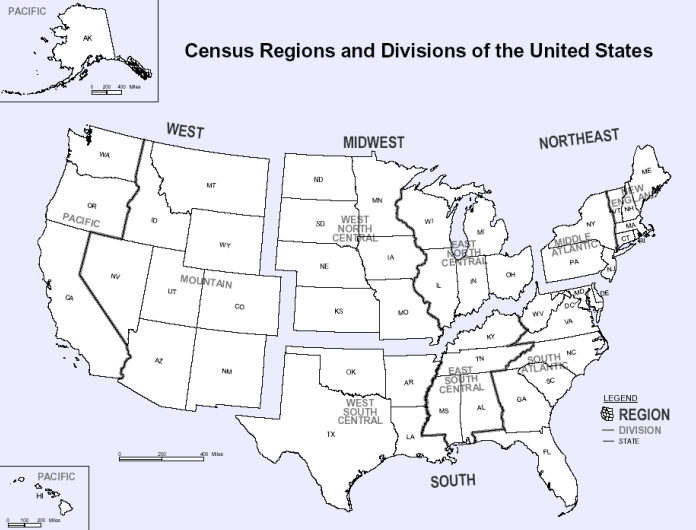
    The Census Bureau has an official definition of the Midwest, which is one of four so-called “Census Divisions.” This is further divided into two “Census Regions” as in the map below.

    Ethnic and Cultural Definitions

    Others have attempted to draw maps based on shared ethnicity and culture. These tend to deny the existence of an actual Midwest as we think about it today.

    3. Nine Nations of North America

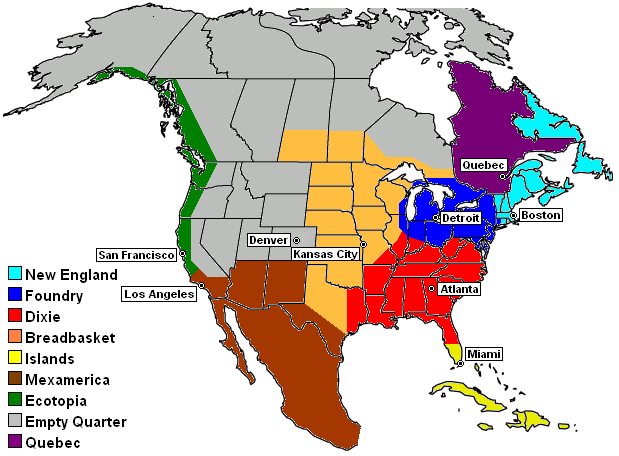
    One of the most famous of these is from Joel Garreau, who made a claim that there were actually nine nations on the North American continent in his book of that same name.

    9nations

    Joel Garreau’s Nine Nations

    4. Eleven Nations of North America

    Colin Woodard took this a step further and argued that there were really eleven nations in North America, which he identifies based on settlement patterns. You can see his writeup on this in an article in Tufts Alumni magazine.

    Colin Woodard's 11 Nations

    Colin Woodard’s 11 Nations

    Economic Definitions

    Other maps try to define a region based on shared economic characteristics such as industries.

    5. The Rust Belt
    Here’s a map of the Rust Belt that’s floating around the I found on a website about coal communities of all places. I’m not sure exactly where it originated.

    The Rust Belt

    The Rust Belt

    Hybrid Definitions

    These maps attempt to use both shared cultural/historical and economic characteristics to define a Midwest region.

    6. Richard Longworth’s Midwest

    In his book Caught in the Middle: America’s Heartland in the Age of Globalism, Richard Longworth created his own bespoke definition of the Midwest. He notably excludes the southern regions of Missouri, Illinois, Indiana, and Ohio as extensions of the south (similar to the 9 & 11 nations map), and also the pure play Great Plains states along the western edge of the Census definition.

    Richard Longworth's Midwest

    Richard Longworth’s Midwest

    7. Pete Saunder’s Five Midwests

    Pete combines the nations approach with the traditional Census definition of the Midwest in order to divide the Midwest into five sub-regions.

    Pete Saunder's Five Midwests

    Pete Saunders’s Five Midwests

    8. Kotkin’s American Regions and City-States

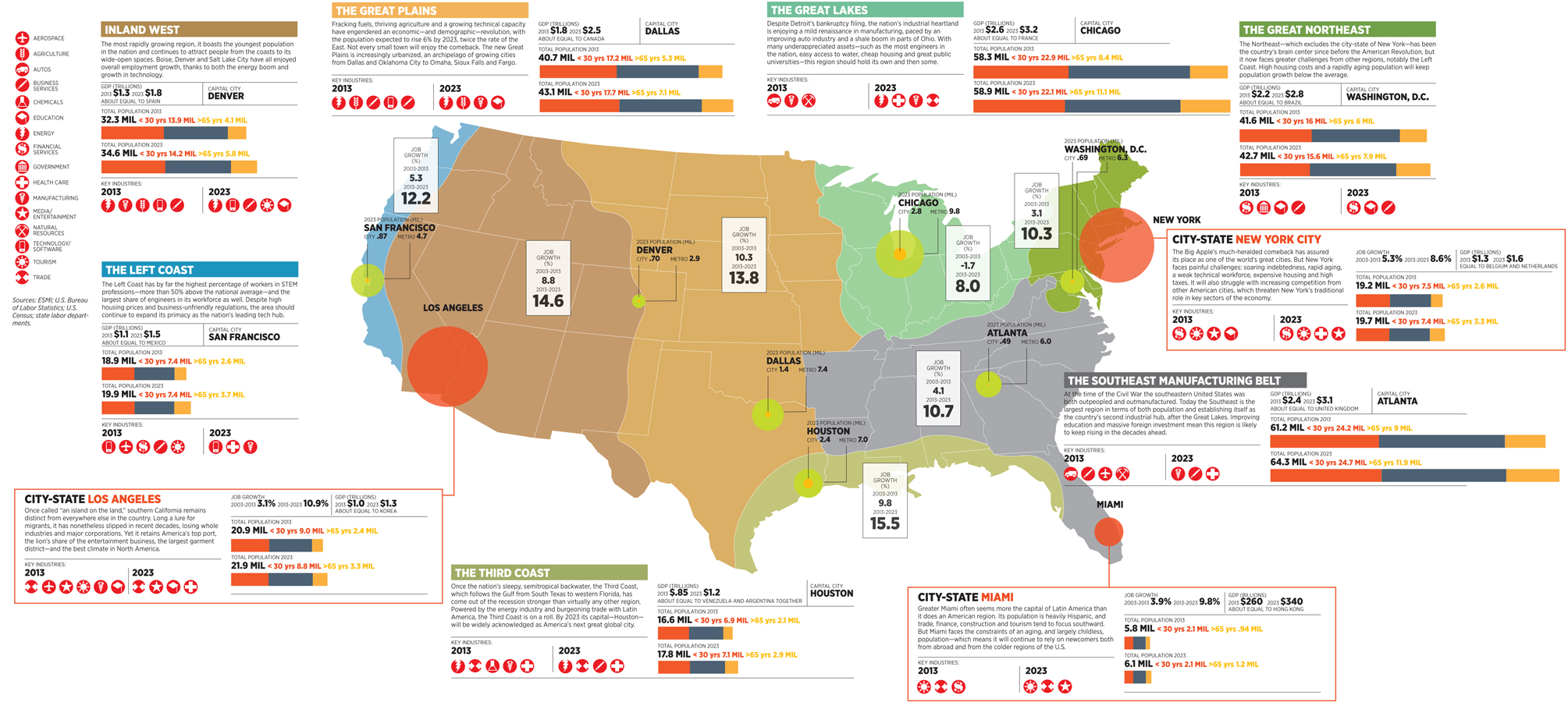
    Joel Kotkin took a similar approach to dividing America up in Forbes magazine. His view also appears to be a hybrid of culture, economics, and history. He turns America into seven regions and three city-states (New York, LA, and Miami). The full map is too huge to blog, but an excerpt is below which you can click on to see the whole thing in a new window.

    The Midwest in Kotkin's map

    The Midwest in Kotkin’s map

    Crowdsourced Maps

    A couple of other people used crowdsourcing, in whole or in part, to define the Midwest

    9. Walter Hickey/538 Map

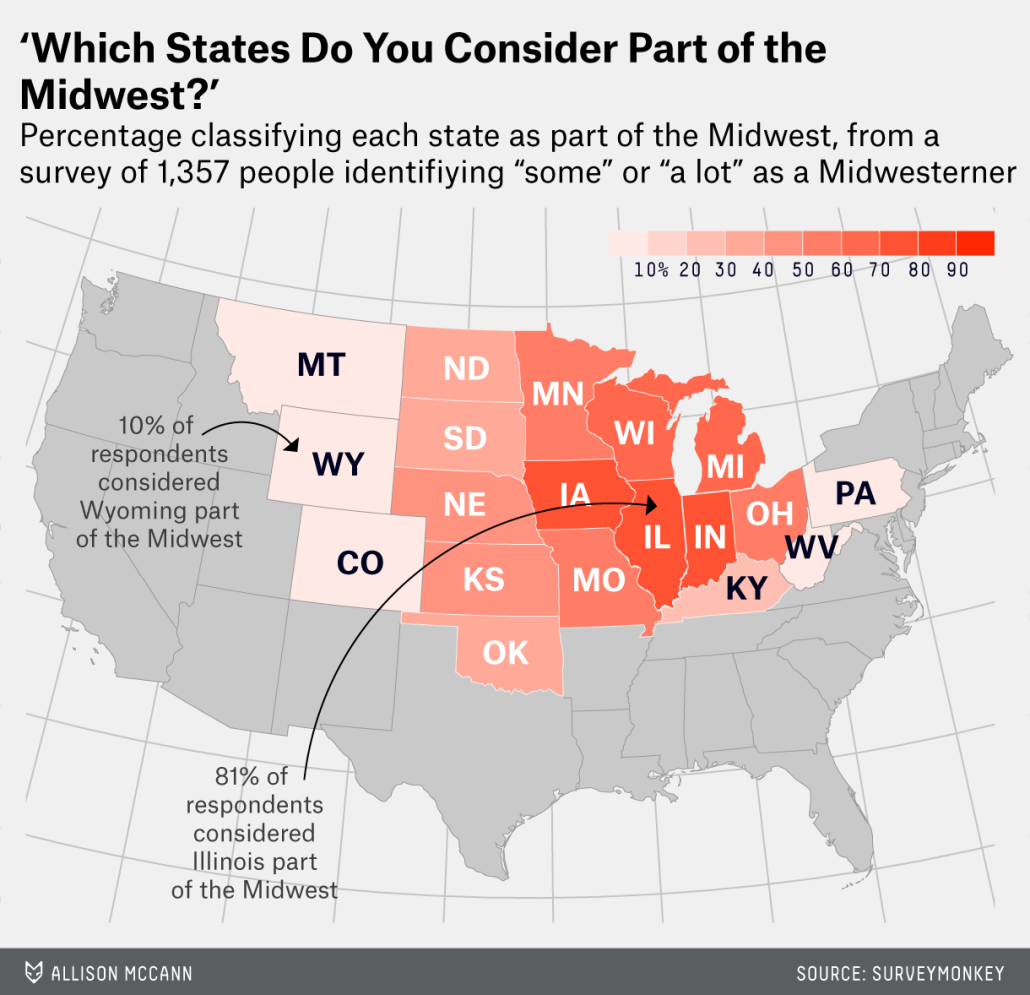
    Walter Hickey, writing at 538, conducted a survey with Survey Monkey to ask people which states they thought were in the Midwest. Here’s what he came up with.

    Walter Hickey/538 Map

    Walter Hickey/538 Map

    10. miguecolombia’s Reddit Map

    Here’s one that I found on a Reddit thread started by user miguecolombia. It appears to be his personal take on how to divide America, with a strong dose of crowdsourcing from Reddit.

    miguecolombia and Reddit's map

    miguecolombia and Reddit’s map

    Self-Defining Maps

    And a couple maps that try to use statistical techniques to let the Midwest map itself.

    11. Facebook Network Maps

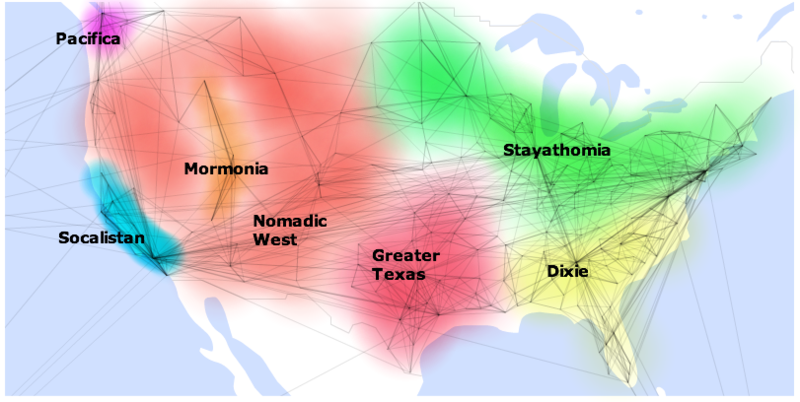
    Pete Warden took a look at Facebook profiles and connections to create clusters of regions. Most of what we’d think of as the Midwest he called Stayathomia, which also covers much of New England.

    Pete Warden's Map

    Pete Warden’s Map

    12. Chicago Migration Map

    Lastly, a special surprise – a map you’ve never seen before. This was created by someone named Daniel Jarratt, who emailed it to me back in 2012. Using Chicago as the capital of the Midwest, he used IRS migration data and a statistic technique called modularity to divide the US into regions based on affinity with Chicago. Darker red means more connection to Chicago and thus in a sense more Midwest.

    Daniel Jarratt's Midwest

    Daniel Jarratt’s Midwest

    Aaron M. Renn is a senior fellow at the Manhattan Institute and a Contributing Editor at City Journal. He writes at The Urbanophile, where this piece originally appeared.

    Top photo by Benjamin Reed (flying over the midwestUploaded by France3470) [CC BY-SA 2.0], via Wikimedia Commons

  • How Land Use Regulations Hurt the Poor

    Sandy Ikeda and I have published a new Mercatus paper on the regressive effects of land use regulation. We review the empirical literature on how the effects of rules such as maximum density, parking requirements, urban growth boundaries, and historic preservation affect housing prices. Nearly all of the studies on the price effects of land use regulations find that — as supply and demand analysis would predict — these rules increase the price of housing. While the broad consensus on the price effects of land use regulations is probably to no surprise to Market Urbanism readers, some policy analysts continue to insist that in fact rules requiring detached, single family homes help cities maintain housing affordability.

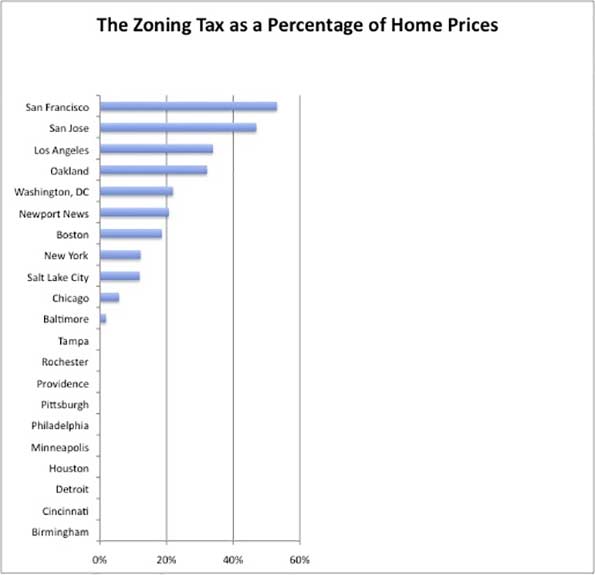
    Ed Glaeser, Joseph Gyourko, and Raven Saks estimate the effects of regulations on house prices in their paper “Why Is Manhattan So Expensive? Regulation and the Rise in Housing Prices.” They estimate what they call the “zoning tax” in 21 cities. The zoning tax indicates the proportion of housing costs that are due to land use regulations. The chart below shows the percentage of housing costs that this “tax” accounts for:

    The zoning tax as calculated by Edward Glaeser, Joseph Gyourko, and Raven Saks in 'Why Is Manhattan So Expensive? Regulation and the Rise in House Prices' (2003).

    The zoning tax as calculated by Edward Glaeser, Joseph Gyourko, and Raven Saks in “Why Is Manhattan So Expensive? Regulation and the Rise in House Prices” (2003).

    Policies that increase housing costs have a clear constituency in all homeowners, but they hurt renters and anyone who is hoping to move to an expensive city. The burden of land use regulations are borne disproportionately by low-income people who spend a larger proportion of their income on housing relative to higher income people. These regressive effects of land use policy extend beyond reducing welfare if the least-advantaged Americans. Additionally, rules that increase the cost of housing in the country’s most productive cities reduce income mobility and economic growth.

    In our paper Sandy and I also discuss proposals for reducing the inefficiency of cities’ current land use regulation practices. David Schleicher has proposed some of innovative policy improvements, including a zoning budget that a city can implement to commit itself to permitting a certain amount of new development. A zoning budget would create a situation in which local policymakers are forced to make tradeoffs between different land use restrictions, as opposed to the current situation in which there is no limit to policies restricting building. Another proposal that Schleicher suggests is a tax increment local transfer, or a TILT. With TILTs, homeowners who live near new development would receive some portion of the additional property taxes that the city raises by allowing the development. The purpose of TILTs is to reduce NIMBY opposition to development.

    We hope that our paper will be a helpful resource to those looking for an accessible overview of this area of research and point to future research opportunities for institutional reforms to allow for the construction of affordable housing.

    This piece first appeared at Market Urbanism.

    Emily Washington is a policy research manager for the Mercatus Center at George Mason University. She manages the Spending and Budget Initiative and State and Local Policy Project portfolios. Her writing has appeared in USA Today, The Christian Science Monitor, Economic Affairs, and The Daily Caller. She contributes to the blogs Neighborhood Effects and Market Urbanism.

  • Public Transport’s Biggest Problem: The Public (That’s Us)

    When’s the last time you heard some futurist or management guru suggest that in the future more of us will be working at the same desk doing routine tasks on a predictable working week schedule? No? That’s just one of many problems that advocates of limitless spending on public transport need to keep in mind in dealing with the issue of urban congestion.

    Increasing urban congestion is said to cost the economy dearly and if Infrastructure Australia is to be believed, it will cost even more in the future unless something is done now. They warn the current estimate of a $13.7 billion annual cost will balloon to $53 billion by 2031.

    Congestion is without dispute a handbrake on economic productivity but the range of solutions for reducing congestion range from the outright zany (see Elizabeth Farrelly’s suggestions  for Prime Minister Turnbull as one example) to milder versions of zany. They all tend to be very expensive and many impose unacceptable compromises on our basic freedoms (such as proposals to ban cars from cities).

    Increased investment in public transport is a feature of many proposed solutions for alleviating congestion. It is true that we have under-invested in public transport systems in past decades and it’s equally true that we’ve under-invested in private transport. Basically, we’ve cheered a rising population while passing the buck for funding and delivering the infrastructure needed to support that growth to future generations. Rising congestion levels are making it feel like crunch time now.

    But there are valid questions about the capacity of public transport to alleviate congestion which are rarely getting asked. Rather than a magical silver bullet, there are a few things to keep in mind before you climb aboard the merry bandwagon of limitless investment in public transport…

    The nature of work is changing. Public transport systems work best on a hub and spoke model of employment and commuting, built on predictable schedules designed around predictable commuter needs. Central business districts of very high employment concentrations, where people work in the same workplace from day to day and for the same hours each day, are ideal candidates for public transport.  But increasingly this is looking like a 20th century model of work. Technology has been the primary driver of change, allowing more workplace flexibility and providing for increased location diversity. ‘Standard hours’ of work are being diluted and at the same time companies increasingly realise the high costs of ‘paper factories’ for administrative staff in costly CBD locations makes little sense. With this, the centralised nature of work is also being diluted and this is working against the centralised economic model that makes fixed public transport systems (especially rail) effective.

    Society is changing. There was a time when commuting trips to work in central locations were mainly a case of getting there and getting home.  Much has changed. A rising proportion of women in the workforce and how this has changed family responsibilities means that commutes to and from work are also often tied in with other objectives: dropping off or picking up school kids or children in child care is only a part of this (but one which is said to contribute to 20% of private vehicle traffic on the roads in peak periods during school terms).  Add in to this the increasing propensity to shop less but more frequently (who owns a chest freezer anymore?) and to mix in pre and post work social or recreational appointments, and you have a very different pattern of commuting which public transport will struggle to service.

    The suburban economy. A telling reality for proponents of increased public transport investment is that employment remains – and in some cases is increasingly – suburban by nature. Between 8 and 9 out of 10 of all jobs in metropolitan regions are suburban by location, and when you consider that the same proportion of residents in any metropolitan location are also suburban by residence, the problem of servicing this reality through public transport is apparent. In the last inter censal period, the proportion of metropolitan wide jobs located in the CBD actually fell in Brisbane (to 12.5%), while in Melbourne it remain unchanged (at 10%) and Sydney recorded a small rise (to 13.5%). The raw numbers of jobs in suburban locations are growing faster, as a rule, than those in CBDs.  The cost of creating a public transport system designed around suburban home to suburban workplace commutes is beyond calculation. In Australia, we will be in flying cars like the Jetsons long before this happens.

    The new and emerging economy. The way cities were designed – with concentrations of white collar workers in CBDs and with discrete areas set aside for industrial, retail or other specified activities – is no longer as important for new or emerging economies. Technology in particular means that physical place is less essential for connectivity to markets. Communication is less dependent on physical proximity. This doesn’t mean CBDs will lose their higher order function but it does mean that disruptive or emerging businesses, for which new technologies are more than just a novelty but a foundation, will have less need for the types of places offered by centralised business districts. They can locate in lower cost areas of the metropolitan area, and make use of the central business districts on occasion, rather than routine. Attracting and retaining these emerging types of businesses will also put the onus on suburban business centres to lift their game, but in many cases this isn’t difficult. Just think of any number of start ups or tech based companies you’ve read of recently and think about how many of these have been in non-traditional locations. Even when these businesses mature, their lack of interest in a CBD style presence doesn’t seem to change. Witness the many technologically innovative businesses in the USA or Europe, by way of example.

    Where does this leave us with solutions for congestion? Ironically, increasing public transport investment designed to ferry people into and out of central business areas is unlikely to make much difference to metropolitan wide congestion. It can’t – simply because only a minority of jobs (between 10% and 15% in the case of Australia’s major cities) are in these locations. People with jobs in these locations may currently have relatively high rates of public transport usage already (often 40% plus) but imagine the cost of increasing this to 80%? The cost of getting there is incalculable for cities of our size, and in any way, it would only benefit 10% to 15% of the urban workforce. Ironically, the people most likely to benefit from this type of public transport prescription tend be much higher wage earners, living close to the inner city in highly valued real estate. (Have a look at this analysis from The Pulse a couple of years ago). Yet their higher capacity to pay is not reflected in most policy debate.

    The reality is that public transport can only go so far in alleviating congestion. Social and economic change to the nature of work is changing the shape of employment decisions and has forever changed the nature of the commute. Public policy officials, urbanists and politicians who pretend that all that’s needed to ‘solve congestion’ is massively increased investment in heavy rail, light rail or dedicated busway networks are deluded: this thinking is rooted in nostalgic notions of work, unrelated to the future of work.

    And as if to demonstrate the fact we should not expect better from our various governments, when a technological innovation comes along that promises to realize the long held dream of ride sharing and increased persons per vehicle – which if widely embracedwould go a long way to solving congestion at no cost to taxpayers –  governments stand in the way. It’s called Uber. Go figure.

    Ross Elliott has more than 20 years experience in property and public policy. His past roles have included stints in urban economics, national and state roles with the Property Council, and in destination marketing. He has written extensively on a range of public policy issues centering around urban issues, and continues to maintain his recreational interest in public policy through ongoing contributions such as this or via his monthly blog The Pulse.

  • The Sociology of Fear

    As part of its annual Survey on American Fears, Chapman University has tried to identify what Americans fear the most. A team of professors and students teamed up to retool last year’s survey tool and dig up American’s deepest horrors. In total, a random sample of 1,500 adults across the country were  asked about 88 different individual fears, in which they were to rank questions accordingly. Last year Americans were worried about walking alone at night and identity theft. But with the presidential elections just around the corner, it wasn’t surprising to see that corruption of our own government officials topped this year’s results.

    Sociology of Fear
    Nobody has ever cracked the code of human emotions. Our feelings are rooted within the depths of our physiology, but our cheers and screams are also products of our environment. Put in sociological terms, “fearfulness in varying degrees is part of the very fabric of everyday social relations”. This is bad news for those who thought the pursuit of happiness would be all fun and games.

    Director of the Fear Survey Chris Bader recruited a group of interdisciplinary students to join the semester long course to help retool last year’s survey and to provide fresh perspective on what American’s Fear. But when the student researchers involved in the project (including me) arrived at the first class of Sociology of Fear, we weren’t completely aware of what would be a grueling month of debate, passion, and even tears.

    Our class conducted multiple rounds of survey testing with friends, family and strangers to get feedback on additions made to last year’s survey tool. The most common fear amongst us twenty something college students facing the brink of graduation was “not living up to our potential”, and we considered this when evaluating the current state of American fears.

    Rapid communication and transfer of information creates the perception that our peers are having more fun and being more productive than us, and FOMO (Fear of Missing Out) was brought up numerous times during discussion. But our personal explorations did not interfere with the macro-level research conducted for the project, and in the end, the fears that rose to the top of the list were cross-generational.  After all, the survey was on American fears, not millennial anxieties.

    The course was a growing experience, but it was the work of the research faculty and project leaders that transformed this experience into excellent insights on the current American situation.

    Biggest Fears Today
    The survey explored four categories of fear: personal fears, natural disasters, paranormal fears, and drivers of fear behavior. The top American domains of fear averaged to be man-made disasters, technology, and government. Given the political transformations and technological developments taking place today, the results seem spot on.

    In order of most feared to least, the environment, personal future, natural disasters, crime, personal anxieties, daily life, and judgment of others came in next on the list. Makes sense – I’m sure most of us have some concern about how we’re perceived by others, but this sentiment doesn’t quite stack up to a 8.0 earthquake or creepy government spying.

    As for the top individual fears, 58% of respondents were afraid or very afraid of corruption of government officials. Perhaps Americans are on to some of the fishy things going on in Washington at the moment, or are simply sucked into the negative rhetoric commonplace in some opinion outlets.  Meanwhile, only 30% of Americans are afraid or very afraid of global warming impacting their lives.

    Following behind fear of government officials, 44.8% of Americans are afraid or very afraid of cyber terrorism. 44.6% are afraid or very afraid of corporate tracking of personal info, and 44.4% of terrorist attacks. 41.4% where afraid or very afraid of government tracking of personal info, and 40.9% of bio-warfare. The remaining top fears surrounded financial and personal issues, with identity theft coming in at 39.6%, economic collapse at 39.2%, running out of money in future at 37.4%, and credit card fraud at 36.9%.

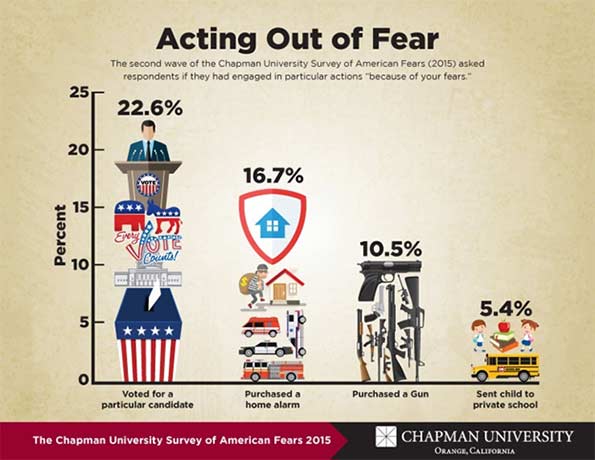
    The survey also found that these fears are actually driving our actions. Fear has the strongest impact on our voting patterns. About one third who have an above average fear of government reported having voted for a particular candidate due to their fears. Even more alarming is the fact that “of those respondents who have an above average fear of the government, over 15% have purchased a gun due to fear.” Eight percent of people with an above average fear of the government send their children to private school out of fear.

    As if gun control and education reform weren’t complicated enough, we can say that emotions will play some role in how policy is shaped in the coming years.

    A society of hope or fear?
    That fact that Americans fear government and technology is not surprising, given the individualist basis on which our nation was founded and the exponential technological growth we’re experiencing today. The Internet is forcing institutions and businesses to be increasingly transparent in everything from product sourcing to internal communications, and the watchdog power that citizens now have is both empowering, and frightening.

    It’s easy to be blinded by fear, as our emotions are the most mysterious, yet powerful forces behind our decisions. But for every 58% who are afraid of government corruption, there is 42% who isn’t. For every 44.4 percent who are afraid of terrorism, there is 55.6% with no worries. Surely, there are preventative benefits that come with healthy skepticism and insecurity, but too much diminishes any hope for societal progress. Can we keep this in mind as we go about our business, citizenship, and personal lives?

    The things that make us afraid can be dealt with. Some of them are opportunities, others are threats, and a good deal of them are complex issues and events that require brave souls to challenge them head on. This being said, we can all use a little inspiration to give us light in the face of darkness.

    Nelson Mandela told us quite simply, “May your choices reflect your hopes, not your fears.” Emerson’s advice was a bit more menacing, perhaps more appropriate given the nature of this survey. “Always do what you are afraid to do.”

    Charlie Stephens is a researcher at the Chapman University Center for Demographics and Policy, and an MBA candidate at the Argyros School of Business and Economics at Chapman University.He is also a regular contributor to the creative business site PSFK.com and the founder of substrand.com, a social awareness site that helps people, businesses, and communities understand their cultural environments and connect in new grounds.

    Photo: “Actress-fear-and-panic” by MyName (Bantosh) – self-made, taken in course of professional work. Licensed under Wikimedia Commons.

  • A Question of Values: Middle-Income Housing Affordability

    This is the Executive Summary from a new report “A Question of Values: Middle-Income Housing Affordability and Urban Containment Policy" authored by Wendell Cox and published by the Frontier Centre for Public Policy. Ailin He, a PhD doctoral candidate in economics at McGill University served as research assistant.

    The "report is a public policy narrative on the relationships between urban containment policy, housing affordability and national economies. It is a synthesis of economic and urban planning analysis that is offered as a policy evaluation of urban containment. The analysis is presented in the context of higher-order objectives of domestic policy: improving the standard of living and eradicating poverty" (Page 9). The research focuses on the international experience, especially in Canada, Australia, New Zealand, the United Kingdom and the United States. Download the full report (pdf) here.

    Middle-income housing affordability is important to people and the economy: Canada’s house prices have risen more than house prices in most other high-income nations. This is of concern, because higher house prices reduce discretionary incomes, which defines the standard of living and poverty. If discretionary incomes are reduced, households will have less to spend on other goods and services, which can retard job creation and economic growth. Improving the standard of living and eradicating poverty are among the highest-order domestic priorities.

    Urban containment policy can lead to higher house prices: Urban land-use regulation has become stronger in many metropolitan areas and often includes urban containment policy. Urban containment severely restricts or bans development in urban fringe areas. Consistent with basic economics, this increases land values and house prices (all else equal). The planning intention and expectation is that higher housing densities will offset the land-price increases and that housing affordability will be maintained.

    Severe losses in housing affordability have been experienced in urban containment markets: Top housing and economic experts attribute much of the loss in housing affordability to stronger land-use policy.

    Housing affordability losses have been sustained in the five nations this report focuses upon: Across the United Kingdom, Australia, New Zealand and some markets in Canada and the United States, house prices have nearly doubled or tripled compared with household incomes as measured by price to income ratios. Much of this has been associated with urban containment policy.

    Demand and supply: Some research suggests that the huge house-price increases have occurred due to higher demand and the greater attractiveness of metropolitan areas that have urban containment policy. However, the interaction of supply and demand sets house prices. Claims that metropolitan areas with urban containment policy are more attractive are countered by their net internal out-migration and diminished amenities for some households.

    An intrinsic urban containment amenity seems doubtful: Some urban containment advocates claim that urban containment policy intrinsically improves amenities (such as a dense urban lifestyle). However, whether a feature is an amenity depends on individual preferences. Moreover, the strong net internal migration away from many metropolitan areas with urban containment policy is an indication that there is no urban containment amenity for most households.

    Higher densities have not prevented huge losses in housing affordability: In contrast with planning expectations, the land-value increases expected from urban containment have not been nullified by higher densities within urban containment boundaries.

    Intervening urban containment boundaries are more influential than topographic barriers: It has been suggested that topographic barriers such as mountains and the ocean cause higher house prices. However, in urban containment metropolitan areas, urban containment boundaries are usually placed between the built-up urban areas and the topographic barriers. As a result, house-price increase associated with the land shortage will be principally associated with the urban containment boundary, not the topographic barrier.

    A competitive land supply is required for housing affordability: A risk with urban containment policy is that by limiting the land for sale, large landholders will seek to buy up virtually all of the land for future gain. Without urban containment, there will not be a land shortage, and there will not be an incentive to monopolize the land supply. A sufficient land supply can be judged to exist only if prices relative to incomes are not higher than before the urban containment policy came into effect.

    Urban containment policy has been associated with reduced economic growth: Evidence suggests that urban containment policy reduces job creation and economic growth. The increased inequality noted by French economist Thomas Piketty is largely attributed to the housing sector and is likely related to strong regulation. Other research estimated a US$2-trillion loss to the U.S. economy, much of it related to strong land-use regulation, and called this “a large negative externality.”

    Urban containment policy has important social consequences: There are also important social consequences such as wealth transfers from younger to older generations and from the less-affluent to the more-affluent households.

    Urban containment policy has failed to preserve housing affordability: Some have expressed concern that urban containment policy might not have been implemented if there had been the expectation of losses in housing affordability. In fact, the administration of urban containment policy has been deficient, with corrective actions largely not taken despite the considerable evidence of losses in housing affordability. In urban containment markets, programs should be undertaken to stop the further loss of housing affordability and transition toward restoring housing affordability. Further, urban containment should not be implemented where it has not already been adopted.

    Canada could be at risk: Canada could be at greater risk in the future. Already, huge losses in housing affordability have been sustained in Vancouver and Toronto. Other metropolitan areas are strengthening land-use regulations. This could lead to severe consequences such as lowering middle-income standards of living and greater poverty with less job creation and less economic growth.

    The urban containment debate is fundamentally a question of values: Ultimately, the choice is between the planning values of urban design or urban form and the domestic policy values of improving the standard of living and reducing poverty. Urban containment policy appears to be irreconcilable with housing affordability. Proper prioritization requires that the higher-order values of a better standard of living and less poverty take precedence.

    Download the full report (pdf) here.

    Wendell Cox is Chair, Housing Affordability and Municipal Policy for the Frontier Centre for Public Policy (Canada), is a Senior Fellow of the Center for Opportunity Urbanism (US), a member of the Board of Advisors of the Center for Demographics and Policy at Chapman University (California) and principal of Demographia, an international public policy and demographics firm.He is co-author of the “Demographia International Housing Affordability Survey” and author of “Demographia World Urban Areas” and “War on the Dream: How Anti-Sprawl Policy Threatens the Quality of Life.” He was appointed to three terms on the Los Angeles County Transportation Commission, where he served with the leading city and county leadership as the only non-elected member. He served as a visiting professor at the Conservatoire National des Arts et Metiers, a national university in Paris.

  • California Companies Head for Greatness – Outside of California

    Why would companies located in one of the most beautiful states in the country – California – undertake the costly proposition of relocating to places with less scenic appeal and less-than-ideal weather?

    There are three answers and they relate to California’s business environment: Regulations, taxes and anxiety.

    Let’s take anxiety first. Corporate leaders and business owners fear what will happen in the future regarding proposals to raise taxes on business property, extend the Proposition 30 taxes that were supposed to be “temporary,” raise cap-and-trade fees to curb carbon emissions, and impose new workplace regulations regarding family leave and health care. We’re talking about billions of dollars in new operating and ownership costs.

    Some of those proposals were defeated this year. But the energy level of the zealotry in California’s legislature means they are certain to rise again in 2016 and 2017. Projecting the resulting cost and complexity in future operations causes leaders in corporations and small businesses to worry – then they worry some more over the unpredictability of it all.

    About taxes: This could be discussed for hours, but suffice to say that the Tax Foundation’s 2015 State Business Tax Climate Index lists California at No. 48.

    The regulatory environment can be brutal. Examples include fines for trivial errors such as a typo on a paycheck stub – not on the check, just the stub – and putting into law costly overtime provisions that in most states aren’t codified in a statute.

    Last year, when Gov. Jerry Brown was asked about business challenges, he revealed his aloofness by saying, “We’ve got a few problems, we have lots of little burdens and regulations and taxes, but smart people figure out how to make it.” The Wall Street Journal responded: “California’s problem is that smart people have figured out they can make it better elsewhere.”

    In short, California is so difficult that companies relocate entirely or, if they keep their headquarters here, find other places to expand.

    In an effort to offset Sacramento’s head-in-the-sand approach to business concerns, my firm completed a new study that provides details of business disinvestments in the state. Over the seven-year period that includes last year, the study estimates that 9,000 businesses disinvested in California in favor of other locations.

    The study shows that 1,510 California disinvestment events have become public knowledge and provides details on each and every event. Site selection experts I’ve been in touch with conservatively estimate that a minimum of five events fail to become known for every one that does. One reason is that when companies with fewer than 100 employees relocate it almost never becomes public knowledge. Hence, it is reasonable to conclude that about 9,000 California disinvestment events have occurred in the last seven years.

    Los Angeles County #1 in Losses

    The study found that the Top Fifteen California counties with the highest number of disinvestment events put Los Angeles with the most losses at No. 1, followed by (2) Orange, (3) Santa Clara, (4) San Francisco, (5) San Diego, (6) Alameda, (7) San Mateo, (8) Ventura, (9) Sacramento, (10) Riverside, (11) San Bernardino, (12) Contra Costa tied with Santa Barbara, (13) San Joaquin, (14) Stanislaus and (15) Sonoma.

    The report excluded instances of companies opening new out-of-state facilities to tap a growing market, acts unrelated to California’s business environment. It also points to shortcomings in Federal and state reporting systems that result in underreporting of business migrations. Those factors reduced the number of California losses.

    It is easy to verify circumstances described in the report since every disinvestment event is public information, is outlined in detail and sources are identified in endnotes.

    When a company launches a site search, it always wants to examine potential costs. I’ve seen many business people smile upon learning that operating cost savings are between 20 and 35 percent in other states. By the way, the appeal isn’t necessarily to the lowest-cost states, but to lower-cost states with the proper workforce.

    Winning Locations

    The Top Ten States to which businesses migrated puts Texas in the No. 1 spot, followed by (2) Nevada, (3) Arizona, (4) Colorado, (5) Washington, (6) Oregon, (7) North Carolina, (8) Florida, (9) Georgia and (10) Virginia. Texas was the top destination for California companies each year during the study period.

    Metropolitan Statistical Areas (MSAs) benefiting from California disinvestment events, in the order starting with those that gained the most, are: (1) Austin-Round Rock-San Marcos, (2) Dallas-Fort Worth-Arlington, (3) Phoenix-Mesa-Scottsdale, (4) Reno-Sparks, (5) Las Vegas-Paradise, (6) Portland-Vancouver (WA)-Hillsboro, (7) Denver-Aurora-Lakewood, (8) Seattle-Tacoma-Bellevue, (9) Atlanta-Sandy Springs-Marietta and (10) Salt Lake City tied with San Antonio.

    Offshoring still occurs, and the Top Ten Foreign Nations that gained the most put Mexico at No. 1, followed by (2) India, (3) China, (4) Canada, (5) Malaysia, (6) Philippines, (7) Costa Rica, (8) Singapore, (9) Japan and (10) United Kingdom.

    Capital diverted to out-of-state locations totaled $68 billion, a small fraction of actual experience because only 16 percent of public source materials provided capital costs for the 1,510 events. Moreover, the top industry to disinvest in California is manufacturing, a capital-intensive sector, and more detailed knowledge of this industry alone would likely increase the capital diversion.

    As California companies relocated or expanded facilities elsewhere they transferred more than capital – they also shifted jobs, machinery, taxable income, intellectual capital, training facilities and philanthropic investments.

    Indicators are that California’s business climate will worsen, enhancing prospects that more companies will seek places that are friendlier to business interests.

    The report is based exclusively on news stories and company reports to the U.S. Department of Labor, the Securities and Exchange Commission and the California Employment Development Dept. Although all entries are based on public information, it’s rare for so much data to be gathered into one report.

    Read the full study: “Businesses Continue to Leave California – A Seven-Year Review” available as a PDF here.

    Joseph Vranich is the Principal of Spectrum Location Solutions, a Site Selection firm that helps companies identify optimum locations to accommodate growth or to improve competitiveness. In doing so, he conducts an in-depth analysis of business taxes, the regulatory climate, labor rates and lifestyle factors.