Blog

  • Are We Heading for An Economic Civil War?

    When we speak about the ever-expanding chasm that defines modern American politics, we usually focus on cultural issues such as gay marriage, race, or religion. But as often has been the case throughout our history, the biggest source of division may be largely economic.

    Today we see a growing conflict between the economy that produces consumable, tangible goods and another economy, now ascendant, that deals largely in the intangible world of media, software, and entertainment. Like the old divide between the agrarian South and the industrial North before the Civil War, this threatens to become what President Lincoln’s Secretary of State, William Seward, defined as an “irrepressible conflict.”

    Other major economic divides—between capital and labor, Wall Street versus Main Street—defined politics for much of the 20th century. But today’s tangible-intangible divide is particularly tragic because it undermines America’s peculiar advantage in being a powerhouse in both the material and non-material worlds. No other large country can say that, certainly not China, Japan, or Germany, industrial powerhouses short on resources, while our closest cousins, such as Canada, Australia, and New Zealand, remain, for the most part, dependent on commodity trade.

    The China syndrome and the shape of the next slowdown

    Over the past decade, the United States has enjoyed two parallel booms that combined to propel the economy out of recession. One was centered in places like Houston, Dallas-Ft. Worth, Oklahoma City, and across much of the Great Plains. These areas were all located in the first states to emerge from the recession, and benefited massively from a gusher in energy jobs due largely to fracking.

    At the same time, another part of the economy, centered in Silicon Valley as well as Seattle, Austin, and Raleigh/Durham, has also been booming. Though far more restricted than their counterparts in the “tangible” economy in terms of both geography and jobs, the tech/digital economy did not lag when it came to minting fortunes. By 2014, the media-tech sector accounted for six of the nation’swealthiest people. Perhaps more important, 12 of the nation’s 17 billionaires under 40 also hail from the tech sector.

    Until China’s economy hit a wall this fall, these two sectors were humming along, maybe not enough to restore the economy to its ’90s trim robustly enough to improve conditions in many parts of the country. But as China begins to cut back on commodity purchases, many key raw material prices—copper and iron to oil and gas as well as food stuffs—have fallen precipitously, devastating many developing economies in South America, Africa, the Middle East, and Southeast Asia.

    Plunging prices are also beginning to hurt many local economies in the U.S., particularly in the “oil patch” that spreads from west Texas to North Dakota. This is one reason why overall economic growth has fallen, and is unlikely to revive strongly in the months ahead. Overall, according to the most recent numbers, job growth remains slow and long-term unemployment stubbornly high while labor participation is stuck at historically low levels. Much of this loss is felt by the kind of middle and working class people who tend to work in tangible industries.

    But it’s not just the much maligned energy economy that is in danger. The recovery of manufacturing was one of the most heartening “feel good” stories of the recession. Every Great Lakes state except Illinois now enjoys an unemployment rate below the national average, and several, led by the Dakotas, Minnesota, Nebraska, and Iowa, boast unemployment that is among the lowest in the nation. Now a combination of a too-strong dollar, declining demand for heavy equipment, and falling food prices threaten economies throughout the Great Lakes and the Great Plains.

    Waging war on the tangible economy

    President Obama’s emphasis on battling climate change—aimed largely at the energy and manufacturing sectors—in his last year in office will only exacerbate these conflicts. For one thing, the administration’s directive to all but ban coal could prove problematic for many Midwest states, including several—Iowa, Kansas, Ohio, Illinois, Minnesota, and Indiana—that rely the most on coal for electricity. Not surprisingly, much of the opposition to the Environmental Protection Agency’s decrees come from heartland states such as Oklahoma, Indiana, and Michigan. The President’s belated rejection of the Keystone Pipeline is also intensely unpopular, including among traditionally Democratic-leaning construction unions.

    These policies have also succeeded to pushing the energy industry, in particular, to the right. In 1990 energy firms contributed almost as much to Democrats as to Republicans; last year they gave more than three times as much to the GOP.

    In contrast, the tech oligarchs and their media allies largely embrace the campaign against fossil fuels. Environmental icon Bill McKibben, for example, has won strong backing in Silicon Valley for his drive to marginalize oil much like the tobacco industry was ostracized earlier. Meanwhile the onetime pragmatic interest in natural gas as a cleaner replacement for coal is fading, as the green lobby demands not just the reduction of fossil fuel but its rapid extermination.

    Embracing the green agenda costs Silicon Valley little. High electricity prices may take away blue collar jobs, but they don’t bother the affluent, well-educated, Telsa-driving denizens of the Bay Area, who also pay less for power. But those rates are devastating to the less glamorous people who live in California interior. As one recent study found, the average summer electrical bill in rich, liberal andtemperate Marin County was $250 a month, while in impoverished , hotter Madera, the average bill was twice as high.

    Many Silicon Valley and Wall Street supporters also see business opportunities in the assault on fossil fuels. Cash-rich firms like Google and Apple, along with many high-tech financiers and venture capitalist, have invested in subsidized green energy firms. Some of these tech oligarchs, like Elon Musk, exist largely as creatures of subsidies. Neither SolarCity nor Tesla would be so attractive—might not even exist—without generous handouts.

    In this way California already shows us something of what an economy dominated by the intangible sectors might look like. Driven by the “brains” of the tech culture, the ingenuity of the “creative class,” and, most of all, by piles of cash from Wall Street, hedge funds, and venture capitalists, the tech oligarchs have shaped a new kind of post-industrial political economy.

    It is really now a state of two realities, one the glamorous software and media-based economy concentrated in certain coastal areas, surrounded by a rotting, and increasingly impoverished, interior. Far from the glamour zones of San Francisco, the detritus of the fading tangible economy is shockingly evident. Overall nearly a quarter of Californians live in poverty, the highest percentage of any state. According to a recent United Way study, almost one in three Californians is barely able to pay his or her bills.

    Silicon Valley’s political agenda

    For the time being, with the rest of the economy limping along, the tech oligarchs seem, if anything, ever more arrogant and sure that they will define the future of the country’s politics. At a time when most small business owners hold Obama in low regard, the Democratic Party can consider the tech sector as an intrinsic part of its core political coalition. In 2000 the communications and electronics sectorwas basically even in its donations; by 2012 it was better than two to one democratic.

    Once largely apolitical or non-partisan in their approach, firms like Microsoft, Apple and Google now overwhelmingly lean to the Democrats. President Obama has even enlisted several tech giants—including venture capitalist John Doerr, Linked In billionaire Reid Hoffman, and Sun cofounder Vinod Khosla—to help plan his no doubt lavish and highly political retirement.

    The love-fest between Obama and Silicon Valley grows from a common belief in being extraordinary. The same media that has marveled at Obama’s celebrated brilliance also hails Silicon Valley’s ascendency as a triumph of brains over brawn.

    Yet in reality many traditional industries such as energy and manufacturing still depend on skilled engineers. Indeed, after Silicon Valley, the biggest concentration of engineers per capita (PDF) can be found in brawny metros like Houston and Detroit. New York and Los Angeles, which like to parade as tech hotbeds, rank far behind.

    In contrast to engineers laboring in Houston or Detroit, those who work in Silicon Valley focus largely on the intangible economy based on media and software. The denizens of the various social media, and big data firms have little appreciation of the difficulties faced by those who build their products, create their energy, and grow their food. Unlike the factory or port economies of the past, those with jobs in the new “creative” economy also have little meaningful interaction with working class labor, even as they finance politicians who claim to speak for those blue collar voters.

    This may explain the extraordinary gap between the economies—and the expectations—of coastal and interior California. The higher energy prices and often draconian regulations that prevented California from participating in the industrial renaissance are hardly issues to companies that keep their servers in cheap energy areas of the Southwest or Pacific Northwest and (think Apple) manufacture most if not all of their products in Asia.

    In the process the Democrats, once closely allied with industry, are morphing into a post-industrial party. Manufacturing in strongholds like Los Angeles, long the industrial center of the country, continues to erode. In a slide that started with the end of the Cold War, Southern California’s once-diverse industrial base has eroded rapidly, from 900,000 jobs just a decade ago to 364,000 today. New York City, which in 1950 boasted 1 million manufacturing jobs, now has fewer than 100,000. Overall, manufacturing accounts for barely 5 percent of state domestic product in New York and 8 percent in California, compared to 30 percent in Indiana and 19 percent in Michigan.

    This divide could become decisive in the election. In contrast to advances in energy, autos, and homebuilding, which produced good blue collar and middle-skilled jobs, the benefits of the current tech boom have been limited, both in terms of job creation (outside of the Bay Area) and increased productivity, for the vast majority of voters.

    This underlying economic conflict is redefining our politics less along lines of ideology and more in terms of interests. Increasingly states that follow the Obama line on energy, such as New York and California, are not contestable for Republicans. But elsewhere—beyond the coasts—there may be greater resistance.

    Among those who are likely to revolt are those workers and entrepreneurs in the oil patch, those who build heavy machinery, and those who grow large quantities of food. The recent Republican win in Kentucky was in part based on opposition to anti-coal regulations coming from the Obama administration. As the EPA ramps up its regulatory onslaught, one can expect energy-dependent industries and regions to recoil, particularly at a time when their industries are headed into a recession. Republicans claims that regulatory policies hurt the tangible economies will gain traction if car factories and steel mills start shutting down again, while farmers plant fewer soybeans and developers build fewer suburban homes.

    The emergence of an economic civil war?

    Hillary Clinton may praise the economic progress under President Obama, and win the nods of those in the tech, media, and financial community who have done very well on his watch. There’s enough momentum from these industries to guarantee that the entire West Coast and the Northeast will fold comfortably, and predictably, into the Clinton column, despite rising concern about crime, homelessness, and loss of middle class jobs. But the very same policies that attract the tech world voter to Clinton will just as certainly alienate many working class and middle class Democrats in places like Appalachia, the Gulf Coast, and particularly the politically pivotal Great Lakes.

    The stakes could be huge. If the Republicans can convince most voters in the middle of the country that the coastal-driven policy agenda is a direct threat to their interests, the GOP will likely carry the day. But if the Democrats can convince the country that coastal California and New York City represent the best future for us all, then get ready for Hillary, because nothing else—certainly not the old social issues—will stop her.

    This piece first appeared at The Daily Beast.

    Joel Kotkin is executive editor of NewGeography.com and Roger Hobbs Distinguished Fellow in Urban Studies at Chapman University, and a member of the editorial board of the Orange County Register. He is also executive director of the Houston-based Center for Opportunity Urbanism. His newest book, The New Class Conflict is now available at Amazon and Telos Press. He is also author of The City: A Global History and The Next Hundred Million: America in 2050. He lives in Orange County, CA.

  • Collingswood: The Main Street Model

    There’s a weird war raging these days. There are people who advocate high rise living and public transit in the urban core to the exclusion of other arrangements. And then there are folks who can’t hold their head up high in church on Sunday if they don’t live on a quarter acre lot out on the far fringe of the metroplex with four cars parked in front of their fully detached home. I always choose the thing in the middle. It’s called a “town”. I’m a Main Street kind of guy.

    IMG_2543 (1024x683)

    IMG_2294 (1024x683)

    IMG_2490 (1024x683)

    IMG_2497 (1024x683)

    IMG_2546 (1024x683)

    IMG_2559 (1024x683)

    IMG_2564 (1024x683)

    IMG_2561 (1024x683)

    This is Haddon Avenue in Collingswood, New Jersey. It’s an intact functioning pre World War II Main Street town complete with hardware store, local mom and pop shops, great places to eat, business incubators, post office, public parks, and City Hall. The majority of the buildings are one and two stories tall.

    IMG_2419 (1024x683)

    IMG_2601 (1024x683)

    IMG_2453 (1024x683)

    Transit exists in Collingswood in the form of a PATCO train station and bus service, but transit isn’t necessary to travel within Collingswood itself. The train and bus are there to get people from one town center to another. Philadelphia is fifteen minutes away. Once you’re in town you can walk or bike everywhere. That includes the young, the elderly, people with limited physical mobility, the rich, the poor… everyone.

    IMG_2479 (1024x683)

    IMG_2469 (1024x683)

    IMG_2394 (1024x683)

    The most affordable apartments are directly above the shops. These are perfect for young adults as well as older people on a fixed income. Both groups enjoy the convenience of nearby shops and activities. As you turn off of Haddon Avenue the commercial buildings transition to residential side streets.

    IMG_2396 (1024x683)

    IMG_2296 (1024x683)

    IMG_2300 (1024x683)

    IMG_2344 (1024x683)

    Duplexes nestle up against the commercial corridor and provide moderately priced homes and rental accommodations. These in-between properties work well for couples, empty nesters, and young families on a budget.

    IMG_2752 (1024x683)

    IMG_2767 (1024x683)

    IMG_2772 (1024x683)

    IMG_2750 (1024x683) (2)

    IMG_2788 (1024x683)

    IMG_2758 (1024x683)

    IMG_2776 (1024x683)

    A couple of blocks away are fully detached homes on larger lots. Collingswood is built in such a way that a person could go from childhood to old age and find a comfortable place to live at an appropriate price point within a half mile.

    IMG_2744 (1024x683)

    IMG_2745 (1024x683)

    IMG_3066 (1024x683)

    IMG_3061 (1024x683)

    IMG_3059 (1024x683)

    Schools and public parks are located right in the residential neighborhoods.

    IMG_2363 (1024x683)


    IMG_2498 (1024x683)

    unnamed

    All levels of employment from a first teen aged service job to an advanced career in Center City Philadelphia (fifteen minutes away by train) are available.

    This arrangement satisfies nearly all the metrics for both of the warring factions. A traditional Main Street town is neither sprawl nor a hyper dense concrete city. It’s economical as well as ecological. It’s beautiful and family friendly. And perhaps most importantly, a Main Street town is physically structured in a way that allows its diversified local tax base to support the required infrastructure over the long haul.

    Too bad it’s essentially illegal to build new places like this anymore…

    John Sanphillippo lives in San Francisco and blogs about urbanism, adaptation, and resilience at granolashotgun.com. He’s a member of the Congress for New Urbanism, films videos for faircompanies.com, and is a regular contributor to Strongtowns.org. He earns his living by buying, renovating, and renting undervalued properties in places that have good long term prospects. He is a graduate of Rutgers University.

  • Report: Africa’s Demographic Transition, Dividend or Disaster?

    A recent report published jointly by the World Bank and by Agence Française de Développement highlights the challenge of realizing Africa’s promised demographic dividend. The title Africa’s Demographic Transition: Dividend or Disaster? (see footnote 1) sums up the authors’ thesis that the dividend is not an automatic result of falling fertility ratios (TFR).

    Instead, falling TFRs open a window of opportunity which can lead to a demographic dividend when governments and the public sector implement the requisite steps to capitalize on this opportunity. Lower child mortality usually leads to falling fertility ratios and improvements in women’s health. But most important among concurrent or subsequent initiatives are investments in education, and the provision of sufficient jobs to a booming working-age population.

    From the report [our emphasis]:

    Declines in child mortality, followed by declines in fertility, produce a “bulge” generation and a period when a country has a large number of working-age people and a smaller number of dependents. Having a large number of workers per capita gives a boost to the economy provided there are labor opportunities for the workers.

    And elsewhere:

    The first and perhaps most challenging step is to speed up the fertility decline in countries where it is currently slow or stalled. Reducing fertility leads to immediate gains in income per capita as youth dependency rates fall. However, achieving the full potential of the demographic dividend requires economic policies that take advantage of the opportunity. Formulating and implementing policies that strengthen financial institutions and encourage saving will channel rising incomes into domestic savings and investments that further fuel growth and development.

    Empirical evidence points to three highly interactive accelerators [of fertility decline]:

    • Health, especially child health. Child health is a critical input into fertility declines. As children’s health and survival rates improve, family demand for more children declines as confidence in child survival increases. Smaller family sizes improve maternal health, which further improves child health, completing a virtuous cycle.
    • Education, especially education for girls. Female education is a critical driver of lower desired fertility and the transition from high to low fertility. Fertility decline, in turn, has a strong effect on education by allowing for fewer, healthier, better nourished, and better educated children.
    • Women’s empowerment, which is clearly related to the first two. Better educated and healthier women with more market, social, and decision-making power in the family—are likely to have fewer children (World Bank 2011). And women who have fewer children—as a result of delayed age of marriage, delayed first sexual contact, or more space between births—are much more likely to enter the paid labor market, to have higher earnings, and to be more empowered.

    Further, the report provides a road map of the policies that are necessary to convert fertility decline into a first demographic dividend and a second demographic dividend. These policies are shown in Table 0.3 (all charts below are from the report).

    Screen Shot 2015-10-29 at 10.04.26 AM


    Table 0.1 shows a correlation between each country’s total fertility ratio (TFR) and its GDP per capita. Countries with high TFRs have lower GDP per capita. Some of the most populous countries, Kenya, Ethiopia and Tanzania are in the middle ranges, while others like DR Congo are near the GDP bottom (and TFR top). Nigeria is an outlier with better than average GDP per capita but a higher than average TFR. Botswana and South Africa have higher GDP per capita and lower TFRs.

    Screen Shot 2015-10-28 at 1.49.21 PM


    Table 0.2 shows the relation of child mortality and TFRs. Low mortality coincides with a low TFR. Nigeria and DR Congo are problematic with high mortality and high TFRs, whereas Tanzania still maintains a higher than average TFR despite relatively low child mortality.

    Screen Shot 2015-10-28 at 1.50.27 PM


    Figure 0.5 shows the evolution of TFRs for several countries since 1960. Niger’s remained high while South Africa’s declined. Nearly all country TFRs are falling, albeit at a slower rate than previously expected in some cases.

    Screen Shot 2015-10-28 at 1.49.50 PM

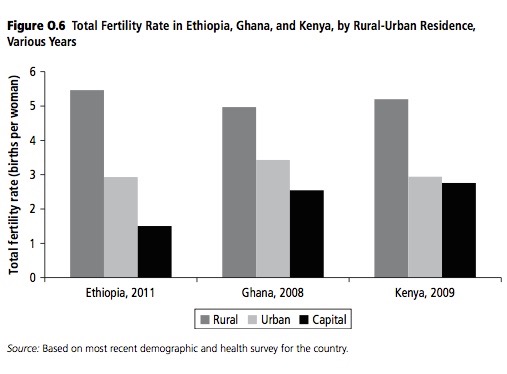
    Figure 0.6 shows the clear divide in TFRs between rural and urban areas of Ethiopia, Ghana and Kenya. An increase in agricultural productivity and the creation of urban jobs will contribute to further declines in TFRs.

    Screen Shot 2015-10-28 at 1.50.06 PM


    Download the full report here.

    Sami Karam is the founder and editor of populyst.net and the creator of the populyst index™. populyst is about innovation, demography and society. Before populyst, he was the founder and manager of the Seven Global funds and a fund manager at leading asset managers in Boston and New York. In addition to a finance MBA from the Wharton School, he holds a Master’s in Civil Engineering from Cornell and a Bachelor of Architecture from UT Austin.

    1. Canning, David, Sangeeta Raja, and Abdo S. Yazbeck, eds. 2015. Africa’s Demographic Transition: Dividend or Disaster? Africa Development Forum series. Washington, DC: World Bank. doi:10.1596/978-1-4648-0489-2. License: Creative Commons Attribution CC BY 3.0 IGO
  • How Chicago’s 606 Trail Fell Short of Expectations

    When I was back in Chicago over Labor Day, I had to check out the “big three” new public space projects there: the Riverwalk, Maggie Daley Park, and the 606 Trail. The Riverwalk is a spectacular project I already wrote about. Maggie Daley Park, a new playground just across Columbus Dr. from Millennium Park’s Frank Gehry designed band shell, has been controversial and got mixed reviews. But I really liked it. More importantly, kids seem to love it. The place was jammed, and it appeared to be mostly locals. My cousin tells me her young daughter can’t get enough of the place. I’m not doing a post on this, but it looks like another big win.

    The 606 Trail, a 2.7 mile biking and walking trail built on the embankment of an abandoned rail line, is a different story, however.

    The problem with the 606 is not that it’s bad. In fact, it’s a nice, eminently serviceable rail trail. I won’t do a full writeup since Edward Keegan had a good review in Crain’s in which he asks, “Is that all there is?” that I think gets it basically right.  Numerous other reviews are also available.

    What I will do is highlight three areas that I think contribute to Keegan being underwhelmed: inflated expectations, financing problems, and an odd lack of attention to design detail.

    Inflated Expectations

    The fact that the 606 is an elevated trail on an abandoned rail line creates an almost inevitable comparison to New York’s High Line. The city did nothing to downplay those comparisons, and in fact suggested Chicago’s trail would actually be considered superior. For example, in national urbanist web site Next City, Deputy Mayor Steve Koch said, “A lot of people are familiar with the High Line — this is a concept far beyond that truly transformative project.”  Frances Whitehead, lead artist for the project, told WBEZ regarding the High Line, “I think we’re gonna smoke them.”

    It’s very clear the city wanted this to be considered a project worthy of national, not just local attention. Back to Koch, he said, “Someone will call you up and say, ‘I want to see the city’ Thisis where you’ll go; this is the way you’ll do it. And I think people are going to come from all over the globe.”

    The very name speaks to the ambition level. Originally it was known as the Bloomingdale Trail, a name that technically still exists but which has been replaced for most purposes by “the 606.” The new name was taken from the first three digits of zip codes in the city of Chicago. Thus by using 606, the name itself suggests a project of citywide, not neighborhood, significance. The city also pushed for national media – and got it.

    The problem is that the 606 is not even remotely another High Line, nor a project of citywide significance, nor a bona fide tourist attraction for the masses. It’s a neighborhood serving rail-trail that is elevated above the streets with some nicer features like lighting that you don’t see often. Like many other rail trails around the country, I expect it to have a significant positive development affect in the neighborhood, as well as being a great recreational amenity. All great things – if the trail had been sold that way originally.

    To be fair, some like the Trust for Public Land, which was involved in the project design, were more realistic. Their CEO Will Rogers told Next City, “The High Line really reshaped the whole Meatpacking District. The Bloomingdale is going to provide parks and green space for neighborhoods that desperately need it, and bicycle access for people going downtown. It’s a different kind of investment.” But this isn’t the message that won out in shaping perceptions. The city would have been better off setting expectations much differently.

    Insufficient Funds

    The 606 Trail was primarily paid for using federal CMAQ transportation funds. According to DNA Chicago, the total price of the 606 is $95 million, with $50 million in CMAQ funds, $20 million privately raised, $5 million from the city, and $20 million to fill (for what purposes I am not sure, though see below).

    The use of a CMAQ funding had key implications. One is that it more or less required the project to be primarily a bicycle trail. The entire edifice of obnoxious federal transport regs are in play here. Two is that it made this a CDOT project, not a Parks District one (though I believe the Parks District is now in charge of it). I believe many of the things that contribute to Keegan’s feelings come from the funding strings and a budget that was too low. In fact, this project to me brought back echoes of the CTA’s Brown Line expansion project in the way that various parts of it give off the vibe of being value engineered.

    One of the things that got whacked in the Brown Line project, for example, was paint. Except for a handful of places such as over Armitage Ave, metal on the project was simply left in a raw galvanized state. I previously noted the austere results of that project give off an homage to prison yard feel. The same look is present on the 606. Consider these photos:

    Galvanized metal railing at the CTA Fullerton station.

    Mesh galvanized metal railing at the CTA Fullerton station.


    IMG_2128

    Mesh galvanized railings along the 606.


    There’s nothing wrong with using an industrial motif, which is very appropriate in Chicago. And obviously security for adjacent property owners is important. It’s also possible that these had to be over-engineered to meet DOT/federal standards, much like the Brown Line station railings for passengers that could stop a Mack truck. The designers may well have felt these were the best choices. But my gut tells me that, like with the Brown Line, this may have been a money issue.

    A lot of people have noted the fact that the landscaping has not yet been fully planted or grown to maturity as a reason for the trail’s feel. That surely plays a role. But the preponderance of galvanized metal through much of it plays a big role in giving the 606 an austere feel.

    This also demonstrates how the city’s financial problems have practical consequences. Because the city’s budget is in such bad shape, it had to turn to CMAQ, which imposed strings you’d rather not have in an ideal world. And you may not have the cash to do it right. (The Riverwalk doesn’t suffer from this, possibly because its commercial spaces generate revenues to bond against).

    Design Oddities

    The 606 also has some odd design misses. For example, here is what the Trail physically looks like. It’s a concrete biking path with a soft blue rubberized running path on either side.

    IMG_2116

    Let’s see, where have I seen this design pattern before?

    Fullerton L platform.

    Fullerton L platform.

    The CTA uses a similar blue shoulder area on its platforms. But in its case, the design pattern is used to indicate the edge of the platform and thus an unsafe area to stand. You are supposed to stand behind the blue line. Using a similar width blue area, even if a different shade, for a jogging path on the 606 violates a local design affordance, like putting a handle on a door and labeling it “Push.”

    Then there’s this arch bridge:

    The 606 Trail over Milwaukee Ave.

    The 606 Trail over Milwaukee Ave.

    This design is dimensionally awkward, something Keegan points out too. Given that this is a rail trail, it’s also notable that the designers chose a steel arch pattern that is not idiomatic of rail bridge design, certainly not in Chicago anyway. This also makes me again wonder about the role of CDOT in the project. This arch structure is the same pattern they used for the Halsted St. bridge over the north branch of the Chicago River that Blair Kamin similarly labeled, “less than graceful.” (The Damen Ave arch bridge works much better, probably because the span is longer and higher, lending itself to more elegant design proportions).

    The name “606” itself is also a bit off. Inside Chicago the reference may be obvious, but outside of its this name is likely to be parsed as an area code, particularly with the “0” middle digit from the original North American Numbering Plan. Today you frequently see people sporting their city’s main area code on shirts and such as a bit of local pride, particularly as area codes have shrunk down to city scale size in many places. The 606 area code is Appalachian Kentucky, however, not Chicago. Few people without a connection to Chicago will know that its zip codes start with 606.

    These aren’t huge items, but cumulatively they add up. The little things separate great design from good, and the 606 missed some opportunities.

    On the whole, this trail will be a great amenity for the neighborhoods it passes through, and also be legitimately functional for transportation given its elevated nature and the transportation lines it connects to such as Metra’s Clybourn station. It was fairly well patronized when I was on it, but with no sense of crowding. And this was on a nice Labor Day afternoon, suggesting that that chaos and safety issues of the lakefront path won’t be repeated here.

    If only it had originally been sold for what it was instead of a High Line beater, had raised that last $20 million (plus a bit more, perhaps), and had a little more attention to detail in some design elements, the 606 would be probably be seen as something that significantly exceeded expectations instead of something that did not live up to the hype.

    Aaron M. Renn is a senior fellow at the Manhattan Institute and a Contributing Editor at City Journal. He writes at The Urbanophile, where this piece originally appeared.

  • So Much For The Death Of Sprawl: America’s Exurbs Are Booming

    It’s time to put an end to the urban legend of the impending death of America’s suburbs. With the aging of the millennial generation, and growing interest from minorities and immigrants, these communities are getting a fresh infusion of residents looking for child-friendly, affordable, lower-density living.

    We first noticed a takeoff in suburban growth in 2013, following a stall-out in the Great Recession. This year research from Brookings confirms that peripheral communities — the newly minted suburbs of the 1990s and early 2000s — are growing more rapidly than denser, inner ring areas.

    Peripheral, recent suburbs accounted for roughly 43% of all U.S. residences in 2010. Between July 2013 and July 2014, core urban communities lost a net 363,000 people overall, Brookings demographer Bill Frey reports, as migration increased to suburban and exurban counties. The biggest growth was in exurban areas, or the “suburbiest” places on the periphery.

    How could this be? If you read most major newspapers, or listened to NPR or PBS, you would think that the bulk of American job and housing growth was occurring closer to the inner core. Yet more than 80% of employment growth from 2007 to 2013 was in the newer suburbs and exurbs. Between 2012 and 2015, as the economy improved, occupied suburban office space rose from 75% of the market to 76.7%, according to the real estate consultancy Costar.

    These same trends can be seen in older cities as well as the Sun Belt. Cities such as Indianapolis and Kansas City have seen stronger growth in the suburbs than in the core.

    This pattern can even be seen in California, where suburban growth is discouraged by state planning policy but seems to be proceeding nevertheless. After getting shellacked in the recession, since 2012 the Inland Empire — long described as a basket case by urbanist pundits — has logged more rapid population growth  than either Los Angeles and even generally healthy Orange County. Last year the metro area ranked third in California for job growth, behind suburban Silicon Valley and San Francisco.

    To those who have been confidently promoting a massive “return to the city,” the resurgence of outer suburbs must be a bitter pill. In 2011, new urbanist pundit Chris Leinberger suggested outer ring suburbs were destined to become “wastelands” or, as another cheerily described them, “slumburbs” inhabited by the poor and struggling minorities chased out of the gentrifying city.

    In this worldview, “peak oil” was among the things destined to drive people out of the exurbs . So convinced of the exurbs decline that some new urbanists were already fantasizing that suburban three-car garages would be “subdivided into rental units with street front cafés, shops, and other local businesses,” while abandoned pools would become skateboard parks.

    This perspective naturally appeals to people who write most of our urban coverage from such high-density hot spots as Brooklyn, Manhattan, Washington, D.C., or San Francisco. And to be sure, all these places continue to attract bright people and money from around the world. Yet for the vast majority, particularly families, such places are too expensive, congested and often lack decent public schools. For those who can’t afford super-expensive houses and the cost of private education, the suburbs, particularly the exurbs, remain a better alternative.

    Even as Houston, like other Sun Belt cities, has enjoyed something of a renaissance in its inner core, nearly 80% of the metro area’s new homebuyers last year purchased residences outside Beltway 8, which is far to west of the core city.

    If you want to know why people move to such places, you can always ask them. On reporting trips to places like Irvine, California, Valencia, north of Los Angeles, or Katy, out on the flat Texas prairie 31 miles west of Houston, you get familiar answers: low crime, good schools and excellent access to jobs. Take Katy’s Cinco Ranch. Since 1990, the planned community has grown to 18,000 residents amid a fourfold expansion in the population of the Katy area to 305,000.

    To some, places like Cinco Ranch represents everything that is bad about suburban sprawl, with leapfrogging development that swallows rural lands and leaves inner city communities behind. Yet to many residents, these exurban communities represent something else: an opportunity to enjoy the American dream, with good schools, nice parks and a thriving town center.

    Nor is this a story of white flight. Roughly 40% of the area’s residents are non-Hispanic white; one in five is foreign born, well above the Texas average. Barely half of the students at the local high school are Caucasian and Asian students have been the fastest-growing group in recent years, with their parents attracted to the high-performing schools.

    “We have lived in other places since we came to America 10 years ago,” says Pria Kothari, who moved to Cinco with her husband and two children in 2013. “We lived in apartments elsewhere in big cities, but here we found a place where we could put our roots down. It has a community feel. You walk around and see all the families. There’s room for bikes –that’s great for the kids.”

    Here Come The Millennials

    Potentially, the greatest source of exurban and peripheral revival lies with the maturation of the millennial generation. Millennials — born between 1982 and 2002 — are widely portrayed as dedicated city dwellers. That a cohort of young educated, affluent people should gravitate to urban living is nothing new. The roughly 20% who, according to an analysis by demographer Wendell Cox, live in urban cores may be brighter, and certainly more loquacious, than their smaller town counterparts, dominating media coverage of millennials. But the vast majority of millennials live elsewhere — and roughly 90% of communities’ population growth that can be attributed to millennials since 2000 has taken place outside of the urban core.

    To be sure, millennials are moving to the suburbs from the city at a lower rate than past generations , but this is more a reflection of slower maturation and wealth accumulation.

    According to U.S. Census Bureau data released last month, 529,000 Americans ages 25 to 29 moved from cities out to the suburbs in 2014 while 426,000 moved in the other direction. Among younger millennials, those in their early 20s, the trend was even starker: 721,000 moved out of the city, compared with 554,000 who moved in.

    This may well reflect rising cost pressures, as well as lower priced housing many millennials can afford. Three-quarters, according to one recent survey, want a single-family house, which is affordable most often in the further out periphery.

    Future trends are likely to be shaped by an overlooked fact: as people age, they change their priorities. As the economist Jed Kolko has pointed out, the proclivity for urban living peaks in the mid to late 20s and drops notably later. Over 25% of people in their mid-20s, he found, live in urban neighborhoods; but by the time they move into their mid-30s, it drops to 18% or lower. In 2018, according to Census estimates, the number of millennials entering their 30s will be larger than those in their 20s, and the trend will only get stronger as the generation ages.

    Some might argue that millennials will be attracted to more urban suburbs, places like Bethesda, Md.; Montclair, N.J.; or the West University or Bellaire areas of Houston, all of them located near major employment centers with many amenities. These suburban areas are also among the most expensive areas in the country, with home prices often in the millions. And a number of older inner ring suburbs, as we saw in the case of Ferguson, are troubled and have lost population — even as the number of residents in downtown areas have grown.

    So when millennials move they seem likely to not move to the nice old suburbs, or the deteriorating one, but those more far-flung suburban communities that offer larger and more affordable housing, good schools, parks and lower crime rates.

    Among the research that confirms this is a study released this year by the Urban Land Institute, historically hostile to suburbs, which found that some 80% of current millennial homeowners live in single-family houses and 70% of the entire generation expects to be living in one by 2020.

    The Future Of Exurbia

    Far from being doomed, exurbia is turning into something very different from the homogeneous and boring places portrayed in media accounts. For one thing exurbs are becoming increasingly ethnically diverse. In the decade that ended in 2010 the percentage of suburbanites living in “traditional” largely white suburbs fell from 51% to 39%.  According to a 2014 University of Minnesota report, in the 50 largest U.S. metropolitan areas, 44% of residents live in racially and ethnically diverse suburbs, defined as between 20% and 60% non-white.

    And how about the seniors, a group that pundits consistently claim to be heading back to the city? In reality, according to an analysis of Census data, as seniors age they’re increasingly unlikely to move, but if they do, they tend to move out of urban cores as they reach their 60s, and to less congested, often more affordable areas out in the periphery. Seniors are seven times more likely to buy a suburban house than move to a more urban location. A National Association of Realtors survey found that the vast majority of buyers over 65 looked in suburban areas, followed by rural locales.

    Trends among millennials, seniors and minorities suggest that demographics are in the exurbs’ favor. The movement to these areas might be accelerated by their growing sophistication, as they build amenities long associated with older cities, such as town centers, good ethnic restaurants and shops, diverse religious institutions and cultural centers. At the same time, the growth of home-based business — already larger than transit ridership in two-thirds of American metropolitan areas and growing much faster — increases the need for larger homes of the sort found most often in the outer rings.

    Rather than regard these communities as outrages to the urban form, planners and developers need to appreciate that peripheral developments remain a necessary part of our evolving metropolitan areas. With a new generation looking for affordable homes, good schools and low crime, it seems logical that many will eventually leave core cities that offer none of the above. The future of exurbia is far from dead; it’s barely begun.

    This piece first appeared at Forbes.

    Joel Kotkin is executive editor of NewGeography.com and Roger Hobbs Distinguished Fellow in Urban Studies at Chapman University, and a member of the editorial board of the Orange County Register. He is also executive director of the Houston-based Center for Opportunity Urbanism. His newest book, The New Class Conflict is now available at Amazon and Telos Press. He is also author of The City: A Global History and The Next Hundred Million: America in 2050. He lives in Orange County, CA.

  • How Commuters Get Railroaded by Cities

    With more than $10 billion already invested, and much more on the way, some now believe that Los Angeles and Southern California are on the way to becoming, in progressive blogger Matt Yglesias’ term, “the next great transit city.” But there’s also reality, something that rarely impinges on debates about public policy in these ideologically driven times.

    Let’s start with the numbers. If L.A. is supposedly becoming a more transit-oriented city, as boosters already suggest, a higher portion of people should be taking buses and trains. Yet, Los Angeles County – with its dense urbanization and ideal weather for walking and taking transit – has seen its share of transit commuting decline, as has the region overall.

    Since 1980, before the start of subway and light-rail construction, the percentage of Angelenos taking transit has actually dropped, from 7.0 percent to 6.9 percent, while the region (including the Inland Empire and Ventura County) has seen the transit share drop from 5.1 percent to 4.7 percent. These reductions in ridership have been experienced both on the rail and bus lines.

    The simple truth is that this region is just not structured to run largely on rails. We should not prioritize our transit dollars on trying to remake our region into something resembling New York, or even San Francisco, but in serving the needs, first and foremost, of those who remain dependent on public transit.

    Read the entire piece at The Orange County Register.

    Joel Kotkin is executive editor of NewGeography.com and Roger Hobbs Distinguished Fellow in Urban Studies at Chapman University, and a member of the editorial board of the Orange County Register. He is also executive director of the Houston-based Center for Opportunity Urbanism. His newest book, The New Class Conflict is now available at Amazon and Telos Press. He is also author of The City: A Global History and The Next Hundred Million: America in 2050. He lives in Orange County, CA.

  • Auckland Tackles Housing Affordability Crisis

    City of Auckland Chief Economist Chris Parker has called for establishment of a house price to income ratio objective of 5.0, to be achieved by 2030. The recommendation was included in a report commissioned by Auckland Mayor Len Brown and Deputy Mayor Penny Hulse.

    Housing Affordability and Urban Containment Policy

    The recommendation has been brought about in response to Auckland’s severely unaffordable housing. Recent reports indicate a price to income ratio over 9.0, at least triple that of New Zealand to the early 1990s.

    Like a number of metropolitan areas, Auckland has had urban containment land-use policy for some time. Auckland has drawn an urban growth boundary around development, largely banning new greenfield housing outside the boundary. As economics would predict, with a continuation of strong housing demand and the significant supply reduction, house prices have been shot skyward. The latest Demographia International Housing Affordability Survey showed Auckland to have a median multiple of 8.2 (the median multiple is the median house price divided by the median household income), though later data indicates a further deterioration (above).

    Avoiding the Consequences of Urban Containment

    House price volatility has been a growing concern in urban containment markets where house prices have escalated so strongly relative to incomes and economic productivity. The bursting of the US housing bubble in the last decade indicates the damage that can be inflicted on people and their finances when exorbitantly high house prices collapse. This is a fate governments seek to avoid not only in Auckland, but at the national level.

    According to Parker’s report, the city of Auckland is expected to add 1 million additional residents over the next 30 years. Parker indicated that: "If high house prices are sustained or continue to rise relative to incomes then … consequences and risks will become more significant:" He cited:

    "-loss of social cohesion — an increasingly socially divided city with a line drawn between those in the housing market and those outside

    -macroeconomic instability via rapid house price deflation.

    -Increased unemployment as businesses relocate activities to other more competitive cites locally (e.g. Christchurch, Hamilton, Tauranga) and internationally (e.g. Melbourne and Sydney)

    -Increased household crowding and related social ills."

    City Councilor Dick Quad echoed similar concerns in an email: "It’s staggering that Auckland’s homeownership is now down to 50% from 64% just 9 years ago. The social chaos we are creating can be seen on a daily basis with overcrowding, third world diseases (resulting from overcrowding) poor educational outcomes, and a city in which the landed gentry have grabbed all the wealth. We are engaged in a social experiment which is destined to end in disaster.”

    Councilor Quax applauded Parker’s work, but had concerns about implementation, indicating that the policy "flies in the face of what many of our politicians believe."

    According to Parker, reaching that the objective will include a number of both supply and demand side strategies. Most, importantly, Parker’s list includes opening greenfield land for development. Even urban containment (smart growth) theorists agree that the imposition of urban containment boundaries, such as in Auckland, is associated with higher land prices within the urban area. Their hopes that higher density housing would cancel out the housing affordability losses have been dashed, due to the massive increase in land costs. For example, comparable land on either side of Auckland’s urban containment boundary varies by a minimum of 8 times. Without the boundary, the expected difference would be virtually nil. In addition, high density housing is considerably more expensive to build than the detached housing people prefer.

    Yet, only in a few places have policymakers taken the important step from failed intentions to the reforms necessary to reverse the housing affordability losses. Among the major metropolitan areas with the most severe urban containment policies, house prices have risen to two to three times the rate of household incomes.

    The "Good:" Better than an Unattainable "Perfect"

    Even if the 5.0 price to income multiple were achieved by 2030, housing would remain seriously unaffordable in Auckland. Parker argues that a lower target (such as the 3.0 Demographia International Housing Affordability Survey standard) would not likely be achievable:

    "It is doubtful that a 5.0 median price multiple could be achieved considerably earlier than 2030. (Unless there was a substantial bust, which should be avoided, given that so much is now at stake with existing high prices and the macroeconomic risks that would result.) The types of changes needed are structural (and change at a glacial pace), and will take many years to compound."

    His point is well taken. The "perfect" strategy of a 3.0 objective could well be the enemy of the good.
    Reaching a 5.0 price to income multiple by 2030 would be a great improvement. Two decades of housing market distortion cannot be erased overnight.

    The alternative could be continued house price increases in a policy environment that continues to outlaw building the new housing that people prefer.

    As the city continues to examine options for improving housing affordability, it will be important to set interim objectives, such as annual improvements or perhaps improvements on a three year basis. Further, it will be important for the city to continually review its policies and liberalize regulation even further if the targets are not reached.

    Setting an Example

    Auckland could be taking a significant step by seeking to reverse the damage done by out-of-control house prices. Certainly, the prodding it has received from the New Zealand government has helped. Just a couple of weeks ago, Deputy Prime Minister Bill English told a university audience: "… while the justification for planning is to deal with externalities, what has actually happened is that planning in New Zealand has become the externality." Research commissioned by the Productivity Commission of New Zealand may have also been influential.

    The city’s Auckland Development Committee recently endorsed Parker’s proposal and agreed "in principle" to include the objective in the next update of Auckland’s metropolitan plan. By lowering  housing costs, the city  would improve standards of living and reduce poverty. Auckland could also become an example for metropolitan areas as diverse as Vancouver, San Francisco, Portland, and London, where all of the talk about improving housing affordability has remained just that, while prices continue to soar beyond the means of the middle class, particularly young families

    Wendell Cox is Chair, Housing Affordability and Municipal Policy for the Frontier Centre for Public Policy (Canada), is a Senior Fellow of the Center for Opportunity Urbanism (US), a member of the Board of Advisors of the Center for Demographics and Policy at Chapman University (California) and principal of Demographia, an international public policy and demographics firm.He is co-author of the “Demographia International Housing Affordability Survey” and author of “Demographia World Urban Areas” and “War on the Dream: How Anti-Sprawl Policy Threatens the Quality of Life.” He was appointed to three terms on the Los Angeles County Transportation Commission, where he served with the leading city and county leadership as the only non-elected member. He served as a visiting professor at the Conservatoire National des Arts et Metiers, a national university in Paris.

    Lead photo: City of Auckland Coat of Arms by Jayswipe (Heraldry photos) [Public domain], via Wikimedia Commons

  • NFL Fantasy Meets EU Brexit

    Will Britain vote before the end of 2017 to stay in the European Union? Or will it leave, launching the much-debated Brexit? As the Lions face the Chiefs this Sunday in London, a perhaps related question is whether London should be awarded a franchise in the National Football League. Many Londoners would love nothing more than for the city to be granted a team, even if that team turns out to be the Jacksonville Jaguars, who are considering whether to become the first NFL exiles. If Britain were to leave the EU but join the NFL, maybe the last act of the American revolution will be a reverse takeover of England.

    Before explaining the English romance for what they call “American football,” let’s briefly review why Britain is getting cold feet about the EU. Keep in mind that the United Kingdom is an EU member more in spirit than on the ground, as Britain kept the pound as its currency, and has yet to embrace the Maastricht treaty on open borders. About all it conceded to the Union on immigration was a relaxation of the quarantine for cats and dogs.

    Britain liked the EU when it meant that Brits could easily buy condos in the south of Spain, or import duty-free claret from Bordeaux. It has had less enthusiasm for providing social services for Polish emigrants or bailing out insolvent Greek banks.

    The chances are good that Britain will be the first major power to bolt from the Union. For the moment, those supporting Brexit span the political spectrum, and include left-wing Labour socialists—angry at Europeans for taking away British jobs—and Tory rebels, for whom the EU is yet another melting-pot being dumped on traditional English values.

    Nor has the Balkanization of British politics helped the European cause. Prime Minister David Cameron, whose Conservatives enjoy an 8 seat majority in the House of Commons (but have 98 seats more than Labour, with many fringe parties taking up the balance), supports staying in Europe with some “fundamental” modifications to the terms of British membership. But if the price of power for Cameron means ditching the Europeans, he might be the first to whisper “wogs out” at the Tory club bar.

    Cameron’s political luck, so far, is that his term in office has coincided with the self-destruction of the Labour party (from 256 seats down to 232) and the near-extinction of the Liberal Democrats, who in the last election went from having 56 seats in the Commons to 8.

    In the 2015 election, Labour also found itself bounced out of Scotland, with its supporters going to the Scottish Nationalists. Then it replaced opposition leader Ed Miliband with Jeremy Corbyn, a dyed-in-the-wool, North London, Tony Benn socialist who dreams of nationalizing industry, and possibly — although not probably — reinstituting 1970s coal miner strikes and BritRail cold pork pies.

    After their electoral losses, the Labour faithful decided to vilify their last prime minister, Tony Blair, now the most unpopular man in British politics, for abandoning socialism in favor of his New Labour concoction, which was the British equivalent of Bill Clinton’s cozy triangulation with House Republicans in the 1990s.

    Labour’s lurch to the far left has put the Tories in position as Britain’s leading national political party. But they cannot find much consensus around centrist, pro-European opinions, as Conservatives have the dichotomous challenge of keeping Scotland and maybe Wales in the United Kingdom while watering down the appeal of nativist, skinhead nationalist parties.

    The most visible European opposition to EU membership comes from the right-wing UK Independence Party (UKIP), although it only has one seat in the Commons. Scottish Nationalists, who went from 6 to 55 seats, for the moment are pro-EU, and a negative vote on Europe might renew the push within Scotland to leave the United Kingdom.

    With the center unable to hold, it is no wonder that London has embraced the National Football League as if it were a wartime support convoy. My younger son and I recently went to Wembley Stadium to watch the New York Jets play the Miami Dolphins, and at the same time see how London views the NFL. We were part of a throng of 83,000 (keep in mind that UKIP’s entire membership is only 47,000), few of whom seemed much concerned about the future of the European charter.

    To be sure, the crowd included diehard Jets and Dolphin fans who flew in for the game. Seated in front of us were three older guys (I could have been one of them) wearing Klecko, Namath, and Maynard jerseys, and no one would mistake them for moonlighting Arsenal fans taking in some American “footie.”

    Many of those in the stands wore American football jerseys from the closet depths. Wembley Stadium was temporarily transformed into a NFL Halloween parade with the likes of Rodgers, Roethlisberger, Montana, Rice, Gastineau, Luck, Romo, Marino, and Peyton Manning astride the stadium ramps.

    I associate British football (okay, soccer) fans with drunken hooliganism, but this sober crowd stood to sing “God Save the Queen,” and it applauded the Dolphin cheerleaders as if they were a road opera company.

    Unlike a European soccer game with all the advertisements jammed into halftime, the Jets and Dolphins “match” took almost four hours to complete.

    During the long afternoon there were booth reviews, thirty-second time outs, injuries, instant replays, concussion protocols, pauses after each quarter, and the two-minute warning, which felt like three-week business trip (“Hey Queen Elizabeth, this Bud’s for you!”).

    So frequent were the official time-outs for beer and car commercials, after a while Wembley had the air of the Universal Studios back lot, and the Jets and Dolphins looked like extras, hired out for a day of filming.

    The Jets beat the Dolphins, although for much of the second half they tried to snatch defeat from the jaws of victory. (It is, after all, the 45th year of their rebuilding program.) Mercifully for Jets fans, the refs littered the “pitch” with penalty flags, and they nullified a Dolphins drive that started one yard from the Jets’ end zone.

    During many time-outs, I wondered why the British might vote out the European Union (and its time-efficient, free-flowing soccer matches), and vote in the NFL, or at least lobby it for a local franchise. In British soccer the clock never stops, not even for injuries, and the game ends in two hours. Neither side has cheerleaders in sequins.

    My guess is that that the London romance with the NFL speaks to UK ambivalence about the continuing embrace of the European Union.

    American football might be, as my British friend Simon Hoggart said, “random violence interrupted by committee meetings,” but unlike the European Union it has clear winners and losers and ends with a Super Bowl, as opposed to a wobbly common currency, milk subsidies, and Greeks on the dole.

    Will London trade EU membership for an NFL franchise? My guess is that it will. During the ill-fated NFL Europe attempt, London had the Monarchs, who could not keep pace with Düsseldorf’s Rhein Fire, and the league folded. This time, among the team names they should consider are the Queens, Kings, Beefeaters, Towers, Guards, and Tussauds. I can’t quite come to terms with the London Jaguars. It sounds like a car dealership.

    Would 83,000 fans have turned up for a Jeremy Corbyn or David Cameron speech on Brexit? I doubt it. Who really knows if Britain wins or loses by being in the European Union? It’s one of those political issues that is impossible to decipher, except on an emotional level.

    Or, as Joe Namath, the legendary New York Jets quarterback and counterculture figure, said of an earlier dilemma, “I don’t know if I prefer Astroturf to grass. I never smoked Astroturf.”

    Matthew Stevenson, a contributing editor of Harper’s Magazine, is the author most recently of Remembering the Twentieth Century Limited, a collection of travel essays, and Whistle-Stopping America. His next book, Reading the Rails, will be published in 2015. He lives in Switzerland.

    Flickr photo by Tony Webster: NFL on Regent Street, London

  • End Of One-Child Policy Is Unlikely To Solve China’s Looming Aging Crisis

    By finally backing away from its one-child policy, China would seem to be opening the gates again to demographic expansion. But it may prove an opening that few Chinese embrace, for a host of reasons.

    Initially, the one-child policy made great sense. The expansion of China’s power under Mao Zedong was predicated in part on an ever-growing population. Between 1950 and 1990, the country’s Maoist era, the population, roughly doubled to 1.2 billion, according to U.N. figures. Deng Xiaoping’s move to limit population growth turned out to be a wise policy, at least initially, allowing China to focus more on industrialization and less on feeding an ever-growing number of mouths.

    Three decades later, this policy clearly has outlived its usefulness. China’s population growth is now among the slowest in the world, and it is aging rapidly. The U.N. expects the Chinese population to peak around 2020, about when India will pass the Middle Kingdom as the world’s most populous country.

    Perhaps the most troubling impact will be on the workforce. In 2050, the number of children in China under 15 is expected to be 60 million lower than today, approximately the size of Italy’s population. It will gain nearly 190 million people 65 and over, approximately the population of Pakistan, which is the world’s sixth most populous country.

    The same broad pattern will play out in Taiwan, South Korea, Singapore and Japan, but those countries’ much greater per capita wealth gives them a greater ability to cushion the impact than China. Demographer Nicholas Eberstadt envisions a developing of fiscal crisis in China caused by “this coming tsunami of senior citizens,” with a smaller workforce, greater pension obligations and generally slower economic growth.

    These factors were clearly part of the calculus that led to suspending the one-child policy. But if China’s rulers think they can change demographic trends on a dime, they are massively mistaken.

    The birthrates of many other East Asian countries have plummeted as well, despite campaigns to promote fertility. In South Korea, Taiwan, Japan, Singapore birthrates are near one per woman, roughly half the rate needed to sustain the current population. With the exception of Singapore, which accepts many immigrants, none have a reasonable path away from rapid aging of their populations and shrinking workforces.

    So what is causing this plunge? Gavin Jones, a demographer based at the National University of Singapore, identifies primarily rapid urbanization and sky-rocketing house prices. In 1979, China’s population was 80 percent rural; today the proportion is roughly half that.

    This transformation makes reversing the one-child policy largely moot, Jones says. Indeed a 2013 easing of restrictions on family size in certain circumstances elicited far fewer takers than expected. Barely 12 percent of eligible families even applied.

    One critical problem is the high cost of real estate, particularly in China’s most important cities, which makes it difficult for young couples to attain the space to house a larger family, let alone leave them sufficient financial resources to raise the children. China’s main cities have suffered arguably the world’s most rapid growth of property prices relative to income. Last year, The Economistestimated house price to income ratios of nearly 20 in Shenzhen 17 in Hong Kong and over 15 in Beijing, between 50% and 100% higher than ultra-expensive Western places like San Francisco, Vancouver or Sydney.

    This explains in part why prosperous cities like Shanghai and Beijing, now have among the lowest fertility rates ever recorded — down near 0.7 per woman, or one-third the replacement rate. If the experience of densification and high prices spread to other Chinese cities, officials may be lucky if couples even bother to have one child.

    One alternative strategy may be to slow urbanization and disperse population to less congested areas, but policy seems to be headed in the exact opposite direction. In 2013 China announced plans to bring an additional 250 million people from the countryside into the city.

    This could boost the economy, as planners hope, but also reduce the fertility rate. All over the world the displacement of rural populations, accelerate the pattern of low fertility, notes the demographer Jones. For one thing, separation from their relatives in the countryside means there is little in the way of family support for taking care of children.

    Jones suggests that urbanization has also undermined the traditionally family centered religious values of Chinese society. Pew Research identifies China as the least religious major country in the world, making it, even more than Europe, a paragon of atheism. All around the world, the decline of religious sentiments has been associated with low fertility around the world.

    Finally the announcement’s timing may not be fortuitous. When China’s economy was booming and the future looked limitless, more families might have considered a second child. But with the economy slowing, it seems logical to expect that weak economic conditions will reduce fertility rates further, as has been the case in Japan and Taiwan.

    What matters most here is what China’s decision reveals about changing attitudes on population. For the last half century, we have tended to be worried about overpopulation, particularly in Asia. And to be sure some parts of the world, notably sub-Saharan Africa still have birthrates far above their capacity to accommodate newcomers.

    But it is now clear that many parts of the world — notably East Asia and Europe — face a very different demographic challenge rooted in falling fertility, diminishing workforces, and rapid aging. As British author Fred Pearce has put it, “The population ‘bomb’ is being defused over the medium and long term.”

    Eliminating the one-child policy may not much change the current trajectory of China’s demography, but it marks a significant shift in the debate about population that will be with us for decades to come.

    This piece first appeared at Forbes.

    Joel Kotkin is executive editor of NewGeography.com and Roger Hobbs Distinguished Fellow in Urban Studies at Chapman University, and a member of the editorial board of the Orange County Register. He is also executive director of the Houston-based Center for Opportunity Urbanism. His newest book, The New Class Conflict is now available at Amazon and Telos Press. He is also author of The City: A Global History and The Next Hundred Million: America in 2050. He lives in Orange County, CA.

    Photo by Paul Munhoven (Own work) [CC BY-SA 3.0], via Wikimedia Commons

  • Is California’s Bubble Bursting?

    California has a long history of boom and bust cycles, but over the past 25 years or so, California’s cycles appear to be becoming more volatile, with increasing frequency, higher highs, and lower lows.  The fast-moving business cycle may not provide the time necessary for many people to recover from previous busts, and may be too limited in its impact. Even now, 22 of California’s 58 counties have unemployment rates of 7.5 percent or higher. Eleven California counties have unemployment rates of at least nine percent.  And these, we are told, are the best of times.

    Policy behavior is predictable throughout the business cycle. 

    Sacramento is awash in cash during a boom, because California’s revenues are more closely related to asset prices than economic activity.  As the economy grows, particularly in an era of ultra-low interest rates, asset prices climb faster than the economy grows, and California is flush.  Sacramento acts as if the boom will continue forever.  Spending commitments are increased, or taxes are decreased.  Politicians congratulate themselves on “fixing” the budget problem.

    For Sacramento, economic busts and the resulting fiscal crisis are acts of God, completely independent of policy.  State revenues fall more rapidly than economic activity falls, because asset prices fall faster than overall economic activity. Sacramento tries to transfer the fiscal pain to local governments.  Mostly, they are successful. As of July, Local government employment was still down almost five percent from its pre-recession high, while state government employment is up about 4.5 percent over the same period.

    Sacramento is currently enjoying a boom, but this boom, like all booms, will ultimately lead to a bust.  There are signs that California’s confrontation with its next bust could come soon.

    Asset prices are cause for concern.  After a five-year Bull Market that saw cumulative gains of over 70 percent, the S&P is little changed this year.  Over the past 60 days, it’s been very volatile.  California’s median home price is up over 70 percent from its recession low.  It too has recently shown volatility, reflecting the huge differences between regional markets.

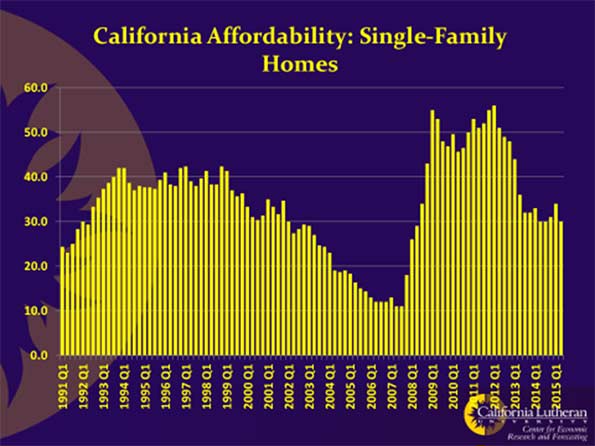
    Housing affordability (percentage of population that could afford the median home) is down too.  It’s fallen from over 50 percent to about 30 percent.  We can’t be sure, but it’s probably below a sustainable level.  That is, below a level that can sustain a middle-class population.  Several California communities have lower levels home ownership rates, but places like Marin County have minimal middle classes.

    California’s tech sector has served the state well over the past business cycle.  In quarter after quarter the Bay Area has led the state in job creation.  In many quarters, the Bay Area was the only California region to gain jobs.

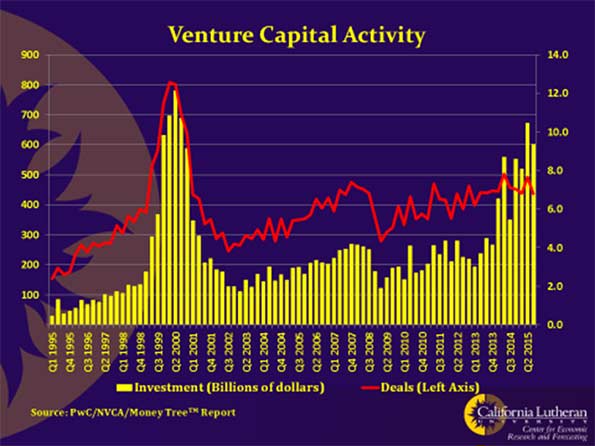
    But California’s tech sector can be very volatile, as the last dot.com bust in 2000 showed.  Today, venture capital investment is near the levels we saw just before tech’s big bust.  The number of deals is lower though.  It’s not clear that it is again a bubble about to bust, the possibility should be seriously considered.  Ideally, we would have a plan to deal with the subsequent fiscal challenges.

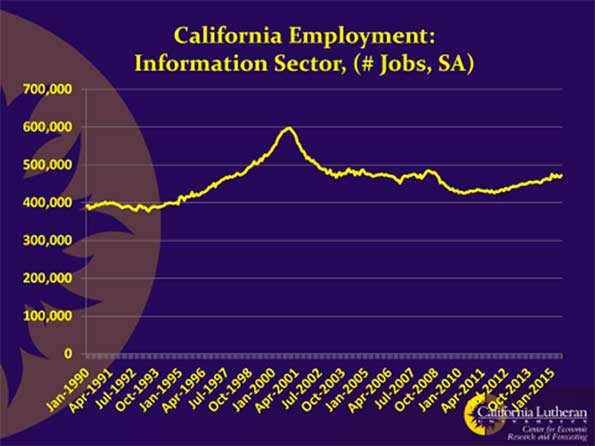
    If tech does decline, the impacts will be more than fiscal.  California’s Information sector, down more than 100,000 jobs from its previous high, still has not recovered from the dot.com bust:

    Recent data imply that continued economic growth, even the slow growth we’ve become accustomed to, is threatened.  California’s most recent jobs report was a big disappointment.  National data was disappointing too.  Only 20 states saw employment increases in September.

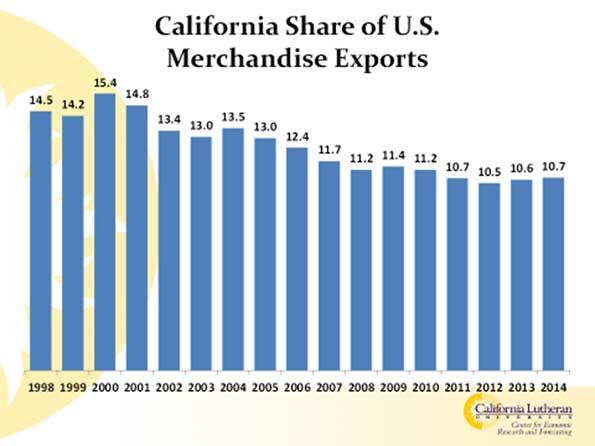
    California’s position on the Pacific Rim between Asia’s manufacturing sector and the world’s largest consumer market guarantees that trade is an important sector for California.  Increasingly, however, that sector is at risk.  China’s economic growth is weakening.  Competing ports in Mexico and Canada threaten California’s trade sector, as does the Panama Canal expansion.  California’s response has been to ignore the challenges and to refuse to expand ports to accept today’s largest ships.  California’s share of North American trade will surely continue to decline:

    An economic downturn would have a huge impact on California and its citizens.  California’s budget surplus is precarious, and the state has failed to make any real changes in California’s fiscal structure.  Instead of using California’s period of good fortune to reduce the budget’s vulnerability to volatile asset prices, by broadening the tax base, Sacramento has amazingly elected to increase revenue volatility by augmenting the status quo with a temporary tax.

    The games that partisan politicians play leads me to the conclusion that they either don’t believe that their policies adversely affect real lives, or they don’t care.  Certainly, economic outcomes   affect real lives.  There is abundant evidence that unemployment and poverty cause drug abuse, domestic violence, broken families, poor health outcomes, and many other social pathologies.

    The question, then, is do policies affect economic outcomes?  In their book Why Nations Fail, Acemoglu and Robinson compare side-by-side communities that appear identical but have different economic outcomes, cities like Nogales Arizona and Nogales Mexico.  These two cities, and the other pairs in the book, are identical, except for being in different countries.  They are adjacent to other.  They have the same resources.  They are demographically very similar.  They only differ by political regimes.   Acemoglu and Robinson find that policy decisions and the inclusiveness of the decision process have dramatic impacts on economic outcomes, and thus people’s lives.

    California policy is dominated by a rich coastal elite who control most of the media, finance campaigns, rule over the universities and generally dominate all discussion.  The result is extreme inequality, persistent nation-leading poverty, high housing costs, and limited opportunity for California’s most disadvantaged populations.  And, California’s most disadvantaged will pay the most for California’s next downturn.  They won’t write checks, because they can’t.  Their net worth won’t decline, because it’s already at or below zero.  They’ll pay a far higher cost in broken homes, broken families, and broken lives.

    Bill Watkins is a professor at California Lutheran University and runs the Center for Economic Research and Forecasting, which can be found at clucerf.org.