Blog

  • A Different Kind of Border Wall

    To slow mass migration, stop the illicit capital flight from poor to rich countries.

    An asset manager called ____ Capital recently sent out this email seeking referrals:

    The US Investor visa program allows one to invest $500,000 U.S. in a government licensed fund for a period of about five years and in around 18 months, a conditional green card is attained for the investor and their immediate family. The investor and their family can live, work and study anywhere in the United States and there are no educational, age or English language requirements.

    Most experts report that on September 30th the investment amount will increase from $500k to $1.3m, a significant jump that will price out many potential investors.

    There is still time to file before September 30th if you start your process with ____ Capital now.

    Others can comment on the practice of selling green cards (and ultimately US citizenships) to wealthy foreigners while millions of other applicants, some of whom would be greater contributors to the United States, continue to wait in line for years. Our concern is one step removed and has to do with the legality of this money.

    Give me your rich, but no huddled masses. (photo: populyst)

    It would be unfortunate if foreign money inflows into the US, whether green card-related or not, benefited only a small number of American fund managers and real estate developers while they lowered the standard of living of larger numbers of Americans, for example by crowding them out of some cities because of rising home prices. But it would be doubly unfortunate if some of this money was also illicit, in other words stolen or obtained through dubious maneuvers by corrupt or crony foreign government officials and corporate executives.

    Indeed, to use just one example, the fact that the identity of many buyers in New York’s newest condominiums is cloaked by the use of shell companies is unhelpful to anyone claiming that these vast incoming sums are mostly clean money. For more on this, see Manhattan Ultra-Luxury ‘Battling the Serpent of Chaos’.

    Why Mass Migration

    Before we loop and close this circle, let us examine a very related issue: the mass migration of people from poor countries towards Europe, North America and other wealthy nations.

    When considering the migrant crisis, from the Middle East, Asia and Africa into Europe, or from Asia and Latin America into the United States, the question among policy makers has been on whether and on how to allow or to stop the inflow of people: when, where, how and how many?

    But an antecedent question should be: what in the first place is causing these people to migrate thousands of miles, often at the risk of their own lives? Clearly the answer resides in the poor economies of their home countries. But then what accounts for this poor state of their economies?

    Capital flight must be one of the most important reasons. Modern economics and globalization encourage the free flow of capital. But what if this capital leaving poor countries was ill-obtained? What if it was stolen by corrupt government officials or corrupt corporate executives, or diverted unethically by cronies operating on the margin of legality?

    We do know that wealth and opportunity in many of these countries are hoarded by a small, insecure and often corrupt governing elite. Indeed it is the insecurity that accompanies such hoarding that naturally leads to a significant share of this capital being exported towards jurisdictions where the risk of seizure is deemed to be minimal.

    Yet rich country economies are already awash in capital due to extremely accommodative central bank monetary policy while at the same time poor countries are in dire need of capital to improve their own infrastructure and economy. Simply put, their economies need this money a lot more than ours do. If anything, our own economies may be suffering from too much capital because of extremely low interest rates.

    Closing the Loop

    This then is the reality of today. Rich countries have been on the one hand accepting with open arms the capital coming from poor countries and profiting from it handsomely, and on the other hand balking, to put it euphemistically, at accepting the people from these poor countries who are emigrating in part as a result of this large capital flight.

    The Honest Accounts report estimates that illicit capital outflows from sub-Saharan Africa alone totaled $67.6 billion in a single recent year and that the continent is a net creditor to the world to the tune of $41.3 billion per year.

    One way to think about it then is that migrants are coming to our shores after their country’s money has already come to our shores. As with your typical human being, their search for better living conditions are forcing them to follow the money, some of which happens to be their money. This is not to justify illegal immigration but to explain that it is at least partially a result of our open and undiscriminating stance towards incoming wealth.

    If, as Pope Francis recently stated, corruption steals from the poor, then its younger brother, cronyism, steals from the middle class. Of course, most poor countries don’t have a middle class and their elites therefore often don’t even bother to become cronies. With a weak judiciary, they go directly into corruption, usually with impunity until the levers of power change hands, which is not all that often.

    Parenthetically, it stands to reason that elites in poor countries would not love democracy at home because it reconfigures the power structure every few years in a way that threatens their standing and prosperity. These same elites however do love the democracy and fair play of rich countries because they are the conditions that allow them to safeguard their assets.

    For better or for worse, things are different now due to demographics and technology. For decades, all the power players – government officials, foreign corporations, safe-haven banks – have extracted a large share of wealth because the poor in underdeveloped nations were few, disorganized and largely uninformed. But now they are far more numerous, goaded by smugglers to emigrate, and better informed through the internet. See Working Age Population Around the World to understand the potential magnitude of the migrant issue.

    Where the Money Goes

    The image of the elite from poor countries living in the lap of luxury, jetting to their homes in New York, Miami and London, visiting their financial advisors in Zurich and Cayman, and educating their children at tony private colleges while the masses of their countries subsist in abject poverty, often without sanitation, water or electricity, is so widespread and so real that it has almost become an accepted cliche to most people.

    But to the European and American business and financial elite, the moneyed foreign elite is irresistibly cool, usually not because it is foreign but because it is moneyed and often free-spending. For every American consumer whose appetite for luxury goods is flagging, there may be two or three new wealthy consumers in emerging nations who are eager to collect luxury status symbols. If Louis Vuitton and BMW revenues were to stall in the United States, these firms would merely intensify their focus on new customers in the Middle East, Africa and Asia.

    Foreign elites are also big investors in the United States and Europe. The destination of flight capital is usually one of the following:

    • Banks or financial institutions that offer some secrecy and safety. Historically, this has been private banks domiciled in Switzerland but more recently, it has become any financial institution in an offshore financial center such as the Cayman Islands, Bermuda, Panama, Cyprus, the Channel Islands or other. The Tax Justice Network estimated in 2016 that $12 trillion from developing countries were parked in offshore havens.
    • This capital is then funneled by these banks to asset management firms, be they stock and bond funds, private equity funds or other, to be put to productive use through investments in the public or private markets (see footnotes 1 and 2).
    • Real estate projects in New York, Miami, London, Vancouver and many other places. In 2015, a report by the New York Times estimated that in six of Manhattan’s most expensive buildings, shell companies owned between 57 and 77 percent of the condominiums. (see footnote 3).
    • Other asset classes such as art where funds can be parked safely.

    So, here today, we are faced with this question: is it right to accept into our country another people’s money but to turn away the people themselves? And if we cannot, due to their sheer numbers, accept the people themselves without risking a disruption of our own politics and economics, shouldn’t we then at least turn away the illicit capital that is fleeing their countries? Shouldn’t that capital remain in their countries where it can help them build a better economy and thus remove or reduce their need to emigrate across the sea?

    Given that the number of working-age Africans and Asians is about to swell by hundreds of millions of additional job seekers, it would be prudent for us to encourage the capital originating in their countries to stay at home rather than come to rich countries where it is distorting prices in real estate and other markets. We may not be able to enforce a barrier against all such capital but it behooves us to try and limit the migration of illicit wealth, or to face the inevitable blowback, a human wave of tens of millions of migrants banging on the door to enter the rich world.

    Cruelty plays its hand artfully. Some large beneficiaries of foreign money inflows are also vociferous proponents of greater limits on immigration. These two positions can coexist harmoniously within the same brain only until the connection between the trillions in capital flight and the millions of migrants is exposed in full relief.

    _____________________

    1. Most of the returns on this capital underperform the major stock indices but custodians seem indifferent while they extract their own hefty fees. Meanwhile the owners of the capital don’t worry about a few percentage points of underperformance when their main motive is the safety of the principal. This is the real reason why hedge funds continue to thrive despite delivering poor performance. Their investors are more tolerant of subpar returns because the main alternative is to keep their money in their home countries where they could lose some or all of it in an unfriendly crackdown.

    2. In theory, the Patriot Act required financial institutions to investigate the sources of funds that they receive from foreign countries. But in practice, depositors with no suspected connection to terrorism are ostensibly granted the all clear. Finance firms are simply not staffed or equipped to differentiate between ill-gotten funds and clean funds.

    3. Here too, investors are relatively indifferent to the return they obtain and are merely looking to garage their wealth. Some of New York’s new high-rise condominiums have been called “safety deposit boxes with a view”.

    This piece originally appeared on Populyst.net

    Sami Karam is the founder and editor of populyst.net and the creator of the populyst index™. populyst is about innovation, demography and society. Before populyst, he was the founder and manager of the Seven Global funds and a fund manager at leading asset managers in Boston and New York. In addition to a finance MBA from the Wharton School, he holds a Master’s in Civil Engineering from Cornell and a Bachelor of Architecture from UT Austin.

    Photo by Mstyslav Chernov/Unframe (Own work) [CC BY-SA 4.0], via Wikimedia Commons

  • A New Way Forward on Trade and Immigration

    President Donald Trump’s policy agenda may seem somewhat incoherent, but his underlying approach — developed, in large part, by now-departed chief strategist Steve Bannon — can be best summarized in one word: nationalism. This covers a range of issues from immigration and trade to cultural and ethnic identity, and generally the ones with the most polarizing impact on our political system.

    To many progressives, nationalism is, by its very nature, a dirty word, associated with fascist, Nazi or otherwise repressive regimes throughout history, and tied to violent extremists among the “alt-right,” like the small group of truly “deplorables” that recently surfaced in Charlottesville, Va. Liberal globalists detested Trump’s Poland speech defending Western values. To them, progressive theology matters more than affiliation with political tradition. Assaults on free trade also concern tech and other corporate chieftains, whatever their impact on the American working class.

    Yet, despite his consistently ill-considered rhetoric, Trump is actually about half-right on nationalism. The postindustrial, globalized economy has not worked for most Americans, as judged by their meager income growth. The West is, indeed, threatened not only by Islamic fundamentalists, but also by China, Russia, North Korea and other authoritarian states. In comparison with today’s progressives, the Roosevelts, Truman, Kennedy and Johnson would be considered rampant nationalists.

    Reassessing free trade

    Free trade, the fundamental economic dogma of the global corporate class and its neoliberal allies, has proven, in practice, to be far less benign than “global strategists” suggest. What works for Manhattan or San Francisco has had devastating impacts in more industrially oriented places like the Midwest and much of the South. Overall, notes a recent study from the labor-backed Economic Policy Institute, trade with China has cost an estimated 3.4 million jobs so far this century.

    Commerce Secretary Wilbur Ross points out — correctly — that many leading trading partners, like the EU and China, impose higher tariffs on incoming U.S. goods than what we impose on their exports. China, in particular, seeks to gain advantage over U.S. producers, embracing what William Galston, former policy adviser to President Bill Clinton, calls “technonationalism,” under which a country seeks to extort the surrender of intellectual property in exchange for market access and cold hard cash.

    In this sense, Trump’s hard-line position on trade — and his courting of foreign investors such as Toyota and Mazda — represents a justifiable throwback to the nationalist policies framed by Alexander Hamilton, which persisted until World War II. The problem here, as elsewhere, is that Trump’s pettiness and Twitter inanities allow our trading partners to divert the discussion away from the legitimate issues around international commerce.

    Read the entire piece in the Orange County Register.

    Joel Kotkin is executive editor of NewGeography.com. He is the Roger Hobbs Distinguished Fellow in Urban Studies at Chapman University and executive director of the Houston-based Center for Opportunity Urbanism. His newest book is The Human City: Urbanism for the rest of us. He is also author of The New Class ConflictThe City: A Global History, and The Next Hundred Million: America in 2050. He lives in Orange County, CA.

    Photo by Dirk Dallas, via Flickr, using CC License.

  • A Roadmap to Job-Creating Transportation Infrastructure: Doing the Right Things Right

    There is broad public concern about the status of transportation infrastructure in the United States. On election night the future President said, “We are going to fix our inner cities and rebuild our highways, bridges, tunnels, airports, schools, hospitals.” This report (“A Roadmap to Job-Creating Transportation Infrastructure: Doing the Right Things Right”) examines the condition of the nation’s infrastructure and makes recommendations to improve federal efforts in supporting ground transport.

    Infrastructure is important to the accomplishment of such important public goals as increased economic growth, long-term job creation (beyond project employment benefits), a better standard of living, and the reduction of poverty. The United States used to lead the world in infrastructure, but has fallen behind some of its competitors. At the same time, past infrastructure policy in the United States created an inertia that prevented serious prioritization of federal resources.

    All of this is made more arduous by the nation’s strained finances. The national debt is now approximately $20 trillion while budget deficits continue and could increase without significant reforms. This means it will be difficult to commit additional resources to the nation’s highways and rail systems.

    Administration Proposals

    The Administration has proposed approaches that go beyond “business as usual”. They would focus federal resources on national and regional priorities, improving both the effectiveness and efficiency of federal programs.

    Perhaps the most significant federal program is the Highway Trust Fund, which uses highway user fees to support highway and transit. In recent years, general funds have also been added to the program because revenues have risen more slowly than needs, in part because of improved fuel economy and low gas prices. The Administration proposes no highway user fee increases and proposes to phase out general fund support.

    In addition, the Administration proposes to phase out funding for “new starts,” which are usually expensive urban rail transit programs, because these programs are not of sufficient national significance.

    The Administration has proposed increasing funding through programs that attract private infrastructure development and has proposed $200 billion over the next 10 years in infrastructure expenditures, including transportation.

    Because there are sufficient travel alternatives, the Administration proposes ending support for Amtrak’s long-distance trains.

    The Administration has referred to the necessity of regulatory reform and streamlining permitting requirements, both to reduce costs and speed up project delivery.

    Analysis and Recommendations

    It is expected that the Administration will propose further initiatives, consistent with the directions it has outlined. The proposals are analyzed below and additional recommendations are offered.

    Highways and Transit: The Highway Trust Fund provides most of the federal contribution to highways and transit from user fees from drivers and commercial vehicle operators, such as the trucking industry. As expenditures have risen faster than revenues, the Highway Trust Fund has received general fund support as well.

    The highway system is the country’s most comprehensive transportation system. Autos (including light trucks) using the highway and roadway system account for the overwhelming majority of ground passenger travel, both for commuting and other trips. These roads allow people to commute to jobs throughout metropolitan areas more quickly than any other mode. The employment opportunities available by auto dwarf those by any other mode. Perhaps surprisingly, autos provide by far the largest share of commuting by low income populations. Highways provide the infrastructure for much of the freight transport and service vehicles. In the long run, improving access to employment and reducing traffic congestion will be best accomplished by improvements that involve highways.

    By contrast, transit, which has received funding from the Highway Trust Fund for more than three decades, is intensely concentrated in just a few local areas. Only two percent of motorized trips are on transit. Even in the largest metropolitan areas, transit provides far less access to jobs than autos, while new transit rail projects and additional transit funding has failed to reduce traffic congestion.

    By virtually any measure, transit is less effective and efficient than highways for passenger travel. Transit moves no freight or other commercial traffic and does not provide emergency service access. Highway Trust Fund revenues should be used only on highways.

    Private Finance: The programs the Administration has proposed for attracting private infrastructure capital include the Transportation Infrastructure Finance and Innovation Act (TIFIA) program and US Department of Transportation authorized private activity bonds. As currently designed and operated, these programs do sufficiently prioritize transportation infrastructure. Process reforms are needed to ensure the limited funding available is used for the highest priority projects. Evaluation criteria should be adopted, with traffic congestion relief, critical bridge replacement and highway system maintenance being the highest priorities. Express toll lanes, added to existing roadways, are among the most promising approaches because of their additional capacity and ability to reduce traffic congestion.

    Further, the tax exempt financing and interest subsidies of these programs have a federal budgetary impact that increases deficits and the national debt. The Administration should seek to minimize these impacts by ensuring that only the most productive projects are approved.

    Another federal credit instrument, the Railroad Rehabilitation and Investment Financing program, could impose substantial losses on taxpayers. Despite its success to date, there are now indications that privately sponsored high-speed rail projects will seek large taxpayer guaranteed loans from RRIF. Private, at risk investment has not proven profitable in high-speed rail, which suggests a potential for default, such as what occurred with Solyndra. Program reforms are needed.

    Amtrak and High-Speed Rail: It will be important to eliminate unnecessary subsidies. For example, as an Administration document puts it: “communities are served by an expansive aviation, interstate highway and interstate bus network.” In this environment, Amtrak subsidies are unnecessary. Subsidies to high-speed rail are similarly unnecessary.

    Regulatory Reform and Streamlined Permitting: The Administration has also proposed regulatory reform and streamlined permitting. Among the most important opportunities are repeal of the Davis – Bacon labor requirements, prohibition of project labor agreements, and setting up a single point of contact in the federal government for project sponsors.

    Conclusion: Improving Efficiency and Effectiveness

    It will be important to better focus private funding programs on the highest infrastructure priorities, and to minimize serious risks to taxpayers and bond buyers that could emerge from insufficiently vetted projects. The recommendations suggest doing the right things by limiting federal support to genuine needs for programs for which there is no alternative, and doing them right by spending no more than necessary. The sooner the hard choices are made, the better for future generations.

    The above is the Executive Summary to ““A Roadmap to Job-Creating Transportation Infrastructure: Doing the Right Things Right,” published by the Center for Opportunity Urbanism (author, Wendell Cox, Senior Fellow).

    Wendell Cox is principal of Demographia, an international public policy and demographics firm. He is a Senior Fellow of the Center for Opportunity Urbanism (US), Senior Fellow for Housing Affordability and Municipal Policy for the Frontier Centre for Public Policy (Canada), and a member of the Board of Advisors of the Center for Demographics and Policy at Chapman University (California). He is co-author of the “Demographia International Housing Affordability Survey” and author of “Demographia World Urban Areas” and “War on the Dream: How Anti-Sprawl Policy Threatens the Quality of Life.” He was appointed to three terms on the Los Angeles County Transportation Commission, where he served with the leading city and county leadership as the only non-elected member. He served as a visiting professor at the Conservatoire National des Arts et Metiers, a national university in Paris.

    Photograph: Intercounty Connector, Montgomery County Maryland (a TIFIA project). Photograph by Ewillison (Own work) [CC BY-SA 4.0 (http://creativecommons.org/licenses/by-sa/4.0)], via Wikimedia Commons.

  • Children and Cities

    My wife recently gave birth to our first child. It’s an exciting time – and also one that portends great changes for our future.

    Cities are supposedly hostile to children. But living on the Upper West Side of New York, we’ve experienced nothing but oohs and ahhs over our son. The people in our neighborhood love children. And there are plenty of them around. The UWS is one of those places you could probably classify as a “strollerville.”

    But it’s hard not to notice that while there are lots of very young children here, there are far fewer school aged ones. I don’t have any desire or plans to leave, but I have to recognize that children have a way of changing your priorities. Realistically, most people with school-aged children still seem to move to the suburbs. Those I see raising older kids in the city are generally well-off enough to afford large apartments or even single family homes (in cities like Chicago). They can also either pay the premium to live in a high quality neighborhood school zone or pay the freight for private schooling.

    The number of children in cities, particularly in the dense urban centers were the creative class often congregates, is often low. San Francisco, one of the paradigms of creative class urbanism, has the lowest share of children of any major city at only 13%. The city famously has as many dogs as children.

    This has important implications. These global cities are where the culture is made, where the media are, etc. To the extent that they represent a very atypical demographic profile that largely excludes families with school-aged children, this only perpetuates the “bubble” in which America’s leadership class often lives.

    The values and priorities of people without children are different from those with children. One example is the value people put on space. In our central cities populated with largely people who have no children, a big obsession is changing zoning regulations to allow smaller units, including so-called “micro-apartments.” These kinds of developments would enable more upscale young adult singles to live in cities. That’s good in itself. Yet it is not paired with equal concern about creating more housing for families. What’s more, urbanists are often hostile to changes in the city that would increase child friendliness. For example, central cities often have smaller apartments. One way to create the space families require is to combine units. But people doing just that in Chicago – converting or deconverting multi-flat buildings into single family homes – are opposed by urbanists, who see this as destroying housing supply and reducing density.

    Jane Jacobs saw cities as a superior vehicle for the socialization of children, writing:

    In real life, only from the ordinary adults of the city sidewalks do children learn – if they learn at all – the first fundamental of successful city life: People must take a modicum of public responsibility for each other even if they have no ties to each other. This is a lesson nobody learns by being told. It is learned from the experience of having other people without ties of kinship or close friendship for formal responsibility to you take a modicum of public responsibility for you.

    Yet today cities are increasingly no longer seen as a locus of family life and child rearing, but rather an “entertainment machine” for adults, as Terry Nichols Clark famously labeled.

    There’s nothing wrong with urban centers playing that role as playground for adults and production node in the creative class economy – as long as you recognize the limits that implies. These urban environments are often held up as the model for the future, especially in a world of climate change. But a city without children has no future. To the extent that central cities outsource the rearing of future generations to the suburbs or foreign countries, they cannot plausibly serve as a general-purpose model. The world can have and celebrate its San Franciscos or lower Manhattans, but they will remain a minority of places.

    Aaron M. Renn is a senior fellow at the Manhattan Institute, a contributing editor of City Journal, and an economic development columnist for Governing magazine. He focuses on ways to help America’s cities thrive in an ever more complex, competitive, globalized, and diverse twenty-first century. During Renn’s 15-year career in management and technology consulting, he was a partner at Accenture and held several technology strategy roles and directed multimillion-dollar global technology implementations. He has contributed to The Guardian, Forbes.com, and numerous other publications. Renn holds a B.S. from Indiana University, where he coauthored an early social-networking platform in 1991.

    Photo by Garry Knight, via Flickr, using CC License.

  • Why Rail Transit Doesn’t Work in Atlanta

    One of the more interesting presentations at the 2017 American Dream conference was by Alain Bertaud, a French demographer currently working at New York University. He has compared urban areas all over the world to see how transportation has influenced the layout of those areas.

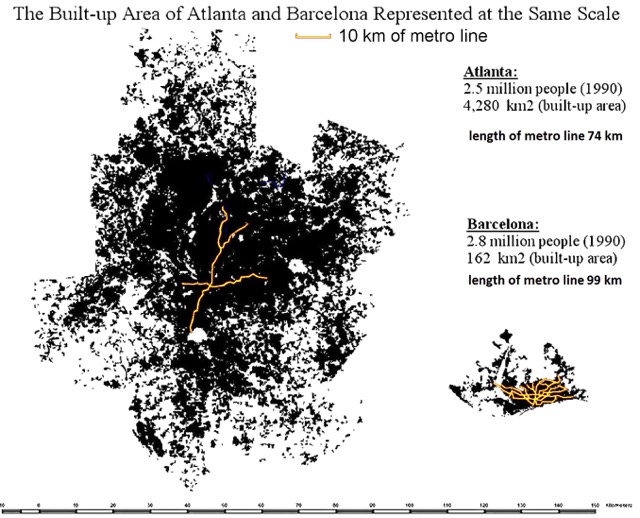
    He started by comparing Atlanta with Barcelona, Spain. Although both have about the same number of people, Barcelona occupies about 63 square miles while Atlanta covers 1,650 square miles. Barcelona has about 62 miles of rail lines, while Atlanta had about 46 when Bertaud was making his comparison (it’s up to 52 today). In order for Atlanta’s rail system to provide the same level of service to its residents as Barcelona’s, the region would need to build another 2,350 miles of rail lines. At current construction prices, that would cost at least $700 billion.

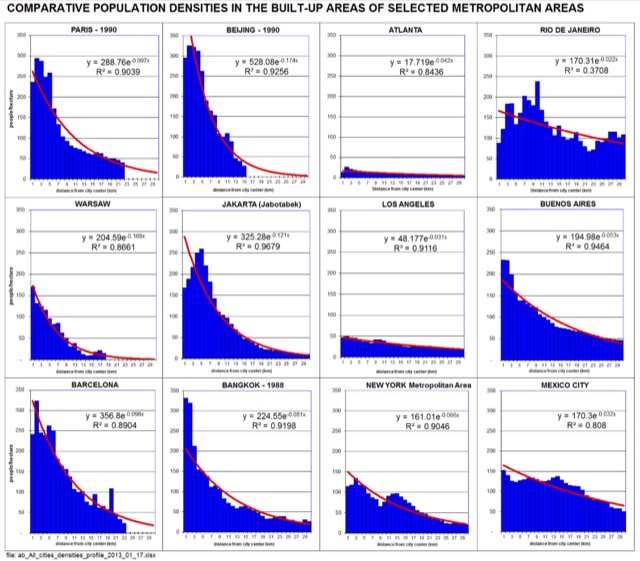
    The above charts show population densities within 30 kilometers of urban centers, with the first kilometer on the left and the 30th kilometer on the right. The European cities, including Paris, Warsaw, and Barcelona, shown in the first column, are very dense in the center with densities falling to nothing after 22 miles from the center. Asian cities in the second column–Beijing, Jakarta, and Bangkok–are similar. But American cities in the third column–Atlanta, Los Angeles, and New York–look very different. Densities do taper off but the centers, even of New York, are nowhere near as dense as in Europe and Asia.

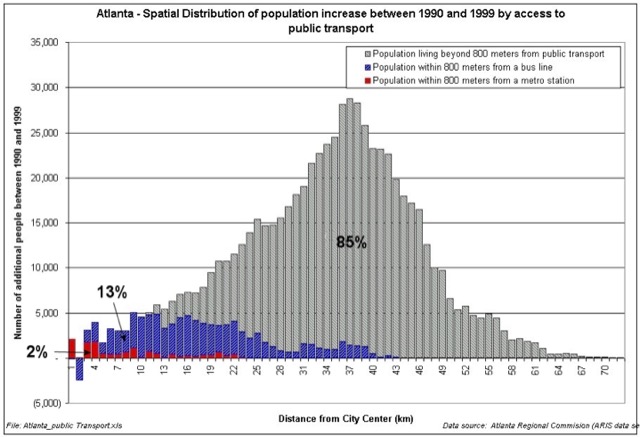
    Moreover, Atlanta’s population growth in the 1990s was mostly in the outlying areas. Only 2 percent of new Atlanta residents located within a half mile of a rail station and only 13 percent located within a half mile of a bus stop, while 85 percent located more than half mile from either.

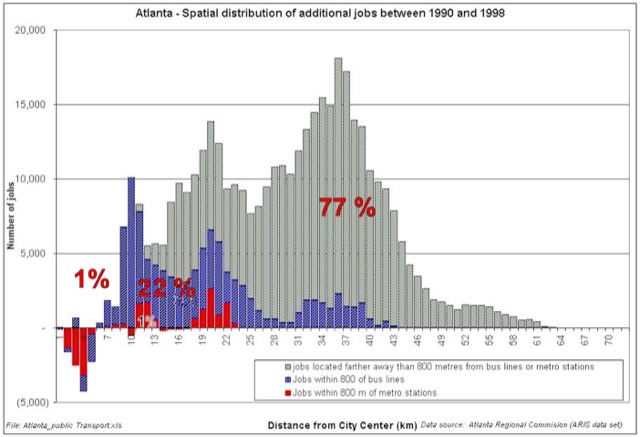
    New job locations are even worse for transit, with jobs in four of the first five miles from the center actually declining. Only 1 percent of new jobs located within a half mile of a rail station, and 22 percent within a half mile of a bus stop, meaning 77 percent were not reached by transit. (The original chart said 32 percent, but that made the total add up to 110 percent. Dr. Bertaud updated and corrected the chart to read 22 percent.)

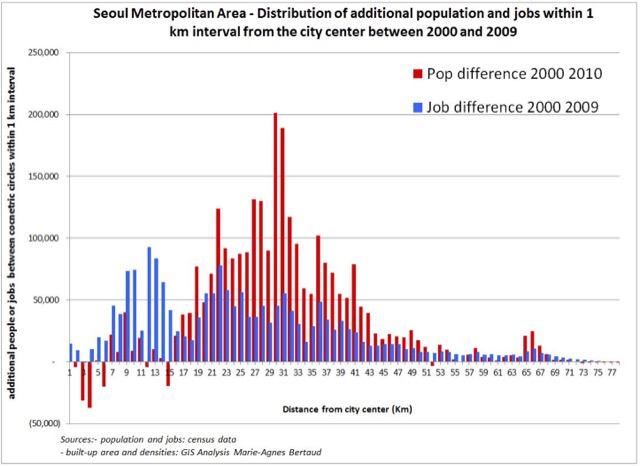
    Even as American urban planners, particularly on the West Coast, try to make our cities more like European ones, European and Asian cities are becoming more like American ones. In Seoul, for example, most population growth was in the bands between 20 and 40 kilometers from the center, while most job growth was in the bands between 9 and 35 kilometers from the center.

    The same is true for European cities. While the second chart shown above makes it appear that Paris and other cities are monocentric, in fact they have large numbers of suburban jobs. As Bertaud noted, “Even in metropolitan area like Paris, with an elaborate transit system, the majority of trips are made by cars from suburb to suburb.” Transit ridership in many European cities is flat or declining, while driving is rapidly growing.

    When new technologies like automobiles change the shape of cities, there is no going back. Cities can build rail lines, subsidize dense housing projects, and try to discourage driving, but driving will continue to grow even as transit ridership stagnates, at best, and per capita ridership falls.

    This piece first appeared on The Antiplanner.

    Randal O’Toole is a senior fellow with the Cato Institute specializing in land use and transportation policy. He has written several books demonstrating the futility of government planning. Prior to working for Cato, he taught environmental economics at Yale, UC Berkeley, and Utah State University.

    Photo by Nicolas Henderson, via Flickr, using CC License.

  • By Chinatown Bus to New York

    I have long heard of the “Chinatown” buses that ply between Washington and New York. I recently planned a quick trip from Washington, both to try a Chinatown bus and to visit Manhattan. This would be my first intercity bus trip in decades, duplicating my first trip to New York (from Washington), just before college. That time, Trailways delivered me on an overnight schedule to the Port Authority Bus Terminal, just beyond the end of the Lincoln Tunnel. It was very exciting then, as now, just as any visit to Manhattan must be for anyone who enjoys cities.

    From Washington to New York

    Arranging the trip was very easy. An internet search quickly produced Chinatown-Bus.org, which provides links to operators (including non-Chinatown bus services). I chose Eastern Coach, which just a few days before departure had a fare of $22 one-way. Credit card booking was simple on the internet (as it has become for most travel).

    The bus was to leave at 4:00 pm from a point between 7th and 8th on H Street N.W. in Washington. Not knowing what to expect, I arrived more than an hour early, at the same time fearing that it would be necessary to stand outside on the curb for a long time in Washington’s notorious August heat. However, Eastern Coach had a station, or at least an air conditioned waiting room.

    Since I was so early I tried to get on the hour earlier schedule, but was advised that it was already full (I routinely try to get on earlier flights when possible at airports). The personnel were professional and very polite. At about 3:40 pm, we were advised that the bus was waiting for us, approximately 3 blocks away. Eastern Coach personnel directed us to it, where we put our larger luggage under the bus.

    One of the attractions of the service was the advertised electric plugs (for laptops with insufficiently powerful batteries) and free wifi internet service. I couldn’t find any plugs, since they were not at every seat. However, the Eastern Coach people quickly located me a seat with a plug.

    Getting out of Washington was not easy. There was stop and go traffic until Bladensburg Road, after which the driver continued out New York Avenue and entered U.S. 50 toward Annapolis and then Interstate 97 to the Baltimore area. This, of course, is not the conventional route, which would have been on the Baltimore-Washington Parkway (operated by the National Park Service), however that route had serious construction delays. We rejoined the normal route on Interstates 895 and 95 in Baltimore.

    The trip was uneventful, a good thing. The internet worked fine, as I alternated between work and watching the scenery. There are changes along the route that were not evident the last time I drove it. There are the extensive, two-way express toll lanes for a few miles north of Baltimore, which augment the existing free lanes. The Goethals Bridge reconstruction was visible from the New Jersey Turnpike in Elizabeth. In the distance, the deck of the Bayonne Bridge, which is being raised for better ocean port access, could be seen a few miles later. Next comes the historic Pulaski Skyway (photo below), the keystone to “America’s First Superhighway” (page 11), a 13 mile segment from the Holland Tunnel (which leads to Manhattan) opened nearly 90 years ago, reaching to Elizabeth (approximately where it was met by the Goethals Bridge approach).

    Even with the delay out of Washington and the Interstate 97 diversion, we reached the New York terminus by 8:15 p.m., 45 minutes ahead of the very conservative (9:00 p.m.) scheduled arrival. This was made possible by the somewhat unusual lack of delay entering the Lincoln Tunnel as we approached Manhattan. Drop off was on 7th Avenue, just south of 34th Street, in the area of Penn Station. The bus continued to its final stop in Chinatown. The bus cost was so low, that as we neared the end of the trip I decided that using a taxi or ride hailing service was likely to cost more for the final 2 miles of the trip than for the first 240. Thus, I dragged my roller bag and walked to my East 50’s hotel quite comfortably.

    From New York to Washington

    For the return trip, I wanted to use a conventional (non-Chinatown) service to compare the two. In US intercity buses, there is nothing more conventional than Greyhound. I walked to the Port Authority Bus Terminal, which I found to be every bit as uninviting as it was decades ago. The only advantage over flying is that there were no security lines, but the boarding process was similar to that of Southwest Airlines, standing in lines by boarding number. The difference was that the standing was longer, because of the shortage of waiting room seats, apparently designed with an exurban city bus stop in mind rather than the holding area for a bunch of 50-plus seat buses.

    Anyway, that was not Greyhound’s fault. I noticed that another non-Chinatown operator, Megabus, serves from its own location outside the Port Authority Bus Terminal, like the Chinatown buses. Seriously, any future trips of mine will involve carriers that do not use the Port Authority Bus Terminal.

    But Greyhound did just fine. We left mid-morning for a trip Greyhound indicated would take 4 hours and 20 minutes. Immediately outside the Port Authority Bus Terminal we sat in stuck traffic for about 10 minutes.

    Like Eastern Coach, there were not plugs at every seat (row), but it was not hard to find a seat with a plug. The internet, however, was another matter. It was much slower than on Eastern Coach and I stopped using it because it was too painful. I had a good book and there is always the scenery. There are few places more picturesque from a highway than the forests of northern Maryland and the view of the Susquehanna River from the Millard Tydings Bridge.

    As in the case of the northbound trip, detours were necessary. The bus driver wisely diverted to the Commodore Perry Bridge and Interstate 95 from New Jersey to Chester, PA due to serious traffic congestion as the New Jersey Turnpike approaches the Delaware Memorial Bridge. Again, the bus used the Interstate 97-U.S. 50 detour at the south end of the trip, to avoid the Parkway congestion.

    There was a single 15-minute rest/meal stop, which I would have been happy to skip. The bus reached Union Station in Washington about 30 minutes later than advertised. Anyone, however, who understands the traffic difficulties in the Northeast should not be surprised by a five hour trip. Greyhound’s fare of $23 competes nicely with the Chinatown buses.

    Other Alternatives

    There are a number of other alternatives for travel between Washington and New York. There is the private car and airlines. Just gasoline for the car is likely to be more than the bus fare. The train is far more expensive (and subsidized by taxpayers). The best fare I could find was four times that of the buses. Amtrak’s Northeast Direct service is scheduled at 3:20, between 1:00 and 1:40 faster than the bus. On-time performance over the past year has been about 75 percent, though dropped to 62 percent in June.

    Thus, the time advantage of the train may be illusory in many cases and certainly the bus has a considerable cost advantage (for both riders and taxpayers). Some might find the bus a bit too cramped compared to the train. There is now luxury bus service with three-across seating, rather than four and with plugs at every seat. One such operator is Vamoose, which provides service between New York and Washington (Rosslyn or Bethesda) in five hours. Both stations are near Washington Metro stations and are likely more convenient for people arriving by car than Union Station. The fare is higher, at $60 to $75, but there is no public subsidy.

    I look forward to my next New York trip, Chinatown bus one way and luxury bus the other.

    Wendell Cox is principal of Demographia, an international public policy and demographics firm. He is a Senior Fellow of the Center for Opportunity Urbanism (US), Senior Fellow for Housing Affordability and Municipal Policy for the Frontier Centre for Public Policy (Canada), and a member of the Board of Advisors of the Center for Demographics and Policy at Chapman University (California). He is co-author of the “Demographia International Housing Affordability Survey” and author of “Demographia World Urban Areas” and “War on the Dream: How Anti-Sprawl Policy Threatens the Quality of Life.” He was appointed to three terms on the Los Angeles County Transportation Commission, where he served with the leading city and county leadership as the only non-elected member. He served as a visiting professor at the Conservatoire National des Arts et Metiers, a national university in Paris.

    Top photo: Hudson Yards construction (Manhattan), by author

    Second photo: Pulaski Skyway, by Jack Boucher [Public domain], via Wikimedia Commons

  • California’s Coming Youth Deficit

    Images of California, particularly the southern coast, are embedded with those associated with youthfulness — surfers, actors, models, glamorous entrepreneurs. Yet, in reality, the state — and the region — are falling well behind in the growth of their youthful population, which carries significant implications for our future economic trajectory and the nature of our society.

    The numbers, provided by demographer Wendell Cox, based on U.S. Census Bureau estimates, should concern every business and community, particularly across the high-priced coastal areas. On the other hand, the stronger youthful growth in the interior, notably the Inland Empire, may become the basis for a regional resurgence, given a less draconian state regulatory regime.

    What the numbers say

    Let’s start with the millennials, the population that was aged between 20 and 34 in 2015. Since 2000, the growth of this segment of the population has been, for the most part, very slow along the coastal regions, well below the 6 percent national average. In Los Angeles and Orange County, the youth population grew by roughly 3 percent, about half the national average. San Francisco-Oakland, did a bit better, at 7 percent, but Silicon Valley-San Jose experienced a barely 1 percent increase.

    In comparison, the millennial population of Orlando, Fla., grew by 47 percent, while in Las Vegas it increased by 42 percent. The four big Texas cities — led by San Antonio, with a 43 percent increase — all registered well over 20 percent growth. Rising tech regions, like Raleigh, N.C., saw 30 percent growth — 30 times the rate in Silicon Valley.

    Yet, not all of California is losing out in the coming generation. The fastest-growing region for young people among the 53 largest metropolitan regions is right here in Southern California, the Riverside-San Bernardino area, which saw its 20-34 population expand by a remarkable 47 percent. Another inland standout in California, Sacramento, grew by over 30 percent, far ahead of any of the coastal areas.

    Read the entire piece in the Orange County Register.

    Joel Kotkin is executive editor of NewGeography.com. He is the Roger Hobbs Distinguished Fellow in Urban Studies at Chapman University and executive director of the Houston-based Center for Opportunity Urbanism. His newest book is The Human City: Urbanism for the rest of us. He is also author of The New Class ConflictThe City: A Global History, and The Next Hundred Million: America in 2050. He lives in Orange County, CA.

    Wendell Cox is principal of Demographia, an international public policy and demographics firm. He is a Senior Fellow of the Center for Opportunity Urbanism (US), Senior Fellow for Housing Affordability and Municipal Policy for the Frontier Centre for Public Policy (Canada), and a member of the Board of Advisors of the Center for Demographics and Policy at Chapman University (California). He is co-author of the “Demographia International Housing Affordability Survey” and author of “Demographia World Urban Areas” and “War on the Dream: How Anti-Sprawl Policy Threatens the Quality of Life.” He was appointed to three terms on the Los Angeles County Transportation Commission, where he served with the leading city and county leadership as the only non-elected member. He served as a visiting professor at the Conservatoire National des Arts et Metiers, a national university in Paris.

    Photo by vlasta2 [CC BY 2.0], via Wikimedia Commons

  • Detroit — The Movie

    I guess there was always going to be a difference between the Detroit film I wanted and the Detroit film that was produced.

    “Detroit”, the new big-budget exploration by director Kathryn Bigelow that goes into the details of one of Motor City’s most defining events, came out this weekend to strong critical acclaim but less than outstanding popular success. As a native Detroiter I was intrigued from the outset about the film’s premise and how it would present such a tense and difficult subject — and if the film could offer any potential for resolving the issues that still plague the city 50 years later. In an attempt to connect 1967 Detroit to present-day concerns over police brutality, the film succeeds in making us feel brutality, but fall just short of explaining how it became a tool of oppression and how it can be undone.

    As someone whose absolute earliest memory is of watching National Guardsmen drive down residential streets in fatigues and pointing rifles, while in my mother’s arms, I had envisioned a film that would provide context for the uprising. One that would provide meaning. I envisioned an epic, sweeping, panoramic film that would establish the economic and social roots of the riot. Possibly develop the perspectives of people on multiple sides of the uprising — police, looters, white and black riot resisters, dispassionate suburbanites. Something that would acknowledge that before 1967, there was 1943, there was 1941, there was 1925, and a host of other indignities large and small. The film begins with that potential, but loses it along the way.

    The film starts with a well done animated montage that describes, basically, how the cauldron that would eventually explode was built. But it does so in a way that doesn’t convey the sense of desperation felt by many blacks, nor is particularly specific to Detroit. Blacks moved up from the South for jobs. They were confined to the worst neighborhoods and the worst jobs. Efforts by blacks to gain better housing and better economic opportunity were met with resistance — sometimes procedural and administrative, others visceral and violent — by the white majority. That’s the case in hundreds of cities nationwide, but I feel as if Detroit still needs more context.

    The film then moves into the event that spurred the riot itself — the police raid of a Vietnam War veteran’s welcome home party at a “blind pig”, or unlicensed after-hours club. The montage may seem sanitized, but the raid itself and the start of the riot seems very real.

    We then see the first three days of the disturbance played out. Looting, buildings burning, exasperated black residents in conflict with overwhelmed, but quite angry, Detroit police officers, state police, and National Guardsmen. Perhaps as a metaphor for dreams dashed and never realized, we’re introduced to a group of young black singers known as the Dramatics (a real group, dramatized) hoping to make it big with a performance to Motown executives at Detroit’s Fox Theater, but police tell guests to evacuate the theater just prior to their performance.

    Then the film sharply narrows its focus to its depiction of events at the Algiers Motel. In fact, a strong case could be made that the film should have been named “Algiers” instead of “Detroit”, because of its focus. But any film that would try to tackle a topic as significant as Detroit’s 1967 conflict would have to have the city’s name in it. Spoiler alert for those who wish to see the film (but the film is based on actual and easily found events): the Algiers Motel incident was a deeply tragic and brutal injustice in which police officers killed three young black men and severely beat five other men and (white) women. Police respond to a perceived sniper attack coming from the motel by seizing it, gathering its occupants and then engaging in truly evil torture and intimidation. Police were later acquitted on all charges in the murders and beatings, but never served on the Detroit police force again.

    The Algiers Motel scenes, making up almost half of the film, extremely violent, claustrophobic, and visceral. It is hard to watch. Without question, if one wants to see what it looks like to be under the control of a deranged sociopath, this is the film. But is this what racism is? Or all that racism is? Did it require hundreds of thousands of similarly deranged people to terrorize Detroit’s black community? Not at all. And that’s where the film fails. It reduces racism to the violent actions of deranged individuals, who have no regard for the lives of the people they’re supposed to protect.

    The racism that led to the conflict in 1967 was far more subtle, until it wasn’t. Redlining, urban renewal, interstate highway construction, job and educational disparities, and more — they weren’t practices explicitly tailored to diminish black progress, but those who supported them knew they did the trick. And all it took to support them was a nod of agreement.

    In an attempt to find a connection between the tragedy of Detroit then and recent police killings, from Ferguson to Baltimore to St. Paul, we lost out on a chance to develop greater meaning and understanding of what happened 50 years ago.

    For what it’s worth, it seems the film, or the process of completing the film, or the healing powers of time itself, has had a redemptive impact for residents of metro Detroit. The 1967 conflict kicked off a decade of controversy in Detroit — the Algiers Motel trials, a contentious mayoral race for control of the city, tense fights over metro-level school busing, all while the auto industry slipped into decline and violent crime moved steadily upward. Many white residents fled the city during that time and afterward, believing “one day our city was fine, and the next it was on fire”, and never looked back. But more are beginning to acknowledge a sense of pain and loss from their dislocation from the city. If the film has that effect on Detroiters, then it’s succeeded despite its flaws.

    This piece originally appeared on The Corner Side Yard.

    Pete Saunders is a Detroit native who has worked as a public and private sector urban planner in the Chicago area for more than twenty years.  He is also the author of “The Corner Side Yard,” an urban planning blog that focuses on the redevelopment and revitalization of Rust Belt cities.

    Photo: Actors Will Poulter (left) and Anthony Mackie in a scene from “Detroit”. Source: parlemag.com

  • Will Donald Trump Expose America’s Great Mass Transit Hoax?

    Whatever you think of President Trump, his claims about the lousy condition of America’s basic infrastructure are widely accepted—even by resisting Democrats grinding their teeth on a L.A. freeway or waiting for a New York or D.C. train to arrive. His call for a trillion-dollar infrastructure plan may be his last best bet for finding bipartisan support.

    The question is if he’s at all serious about the urgent need to fix the failing mass-transit systems we have, or if he’ll repeat what Washington’s done to get us in this mess, and offer funds that encourage cities to build shiny new systems few will actually ride even as the existing ones decay.

    As we’ve demonstrated in a new paper for Chapman University (PDF), nowhere is the infrastructure deficit more obvious than in urban transit, which last year lost over 3.1 percent of its ridership, according to the American Public Transit Association (PDF). Despite the vast sums spent by the federal government on light rail, subways, and trolleys since 1970, most mass transit systems fail to meet the needs of commuters.

    In many cases, as in New York and Washington, vast expenditures on new lines have occurred even as maintenance has been deferred, with overall service deteriorating. Many billions of dollars more have been spent in other cities on new rail systems that haven’t reduced the number of people driving to work.

    How the Feds Failed Legacy Cities

    Rail transit works best in what might be considered the “legacy cores.” Approximately 55 percent of America’s transit commuters have destinations in the urban cores (and many of those rides to the central business districts) of six older cities (not metropolitan areas)—New York, Washington, Boston, Philadelphia, Chicago, and San Francisco. New York, by itself, has a remarkable 56 percent of its jobs in its urban core.

    Between 2006 and 2015, those six metropolitan areas captured 77 percent of the national increase in transit work trip destinations.

    These cities were shaped when public transit held a virtual monopoly on both motorized and horse-drawn passenger transport within U.S. cities. Annual transit ridership peaked in the early 1920s, except for the period around the Second World War, the high-water mark for transit nationally. Between 1960 and 2015, transit’s work trip market share dropped more than 50 percent, from 12.1 percent to 5.2 percent. Until very recently, the demographic recovery of legacy cores, notably New York, drove a slight increase in transit share. But this progress is threatened by growing safety and reliability issues. Part of the problem stems from a decision by New York’s political elite, starting with Michael Bloomberg, to build a new, ultra-expensive line—the Second Avenue subway—while maintenance on other lines deteriorated. This decision reflects political realities including federal incentives for new systems, and the greater political rewards for building shiny new things.

    The result is that service delays in New York have skyrocketed as antiquated signals break down, with breakdowns now twice as frequently as they were just five years ago. After decades of increases, ridership has declined while the extensive commuter rail system serving Manhattan from the suburbs (the nation’s largest) is experiencing its own substantial difficulties.

    The picture is similar in Washington, D.C., where the U.S. secretary of Transportation went so far as to threaten a shutdown of the system due to fatal accidents, attributed to policies that prioritized system expansion over safety. D.C.’s transit ridership, growing for decades, has now declined as well.

    The Real Train Robbery

    Yet even as cities that depend on transit, such as New York, suffer from under-investment, Washington has poured billions into new rail system in cities created largely in the auto-dominated era. Among 19 metropolitan areas that have opened substantially new urban rail systems since 1980, the share of riders using mass transit remains below the national average while the share of those driving alone has increased.

    Nowhere is the power of ideology and entrenched interests over the common good more evident than in Los Angeles, the pioneer for the multi-polar and highly dispersed post-1950 metropolis.

    On the surface, L.A. provides the sunbelt’s best case for transit—it once had a robust transit system, is the densest urban area in the country, has a huge poverty population and ideal weather for waiting outside for the train. L.A. has been widely celebrated as “the next great transit city,” and The New York Times and others are continually celebrating its imminent conversion from a car culture to a train one. Some believers, like Los Angeles architectural critic Christopher Hawthorne, envision “a third Los Angeles” that will see the eclipse of the freeways, single family homes, and suburban neighborhoods.

    Yet despite this Manhattan envy among its elites, L.A. simply does not follow the “model” of urbanist paragons such as New York, Chicago or San Francisco. Downtown Los Angeles is a relative economic pygmy, accounting for barely 2 percent of regional employment, less than a tenth of lower Manhattan’s share. Transit works best when most commuters are headed to a dominant core destination. The more scattered the destinations, the less likely trains can muster a decent commuter share. The entire Los Angeles MTA system carries fewer riders than New York’s Lexington Avenue line.

    Money is not the issue. Since 1990, Los Angeles has opened seven new urban metro and light-rail lines and two exclusive busways at a cost of more than $15 billion. During this period, transit’s work trip market share has dropped from 5.6 percent from 5.1 percent in 2015. Ridership is at least 15 percent below 1985 levels, when there was only bus service and when Los Angeles County had about 20 percent fewer people. No surprise, then, that according to a recent USC study, the new lines have done little or nothing to lessen the area’s infamous congestion.

    Rather than hop on the rails, more residents are addressing traffic woes by simply staying home. By 2015, more Los Angeles-area residents were working at home than were taking transit. Since 1990, the number of people working at home increased eight times as rapidly as the number of people using the transit system. The number of people driving increased even more rapidly.

    This story is repeated in other sunbelt cities. In Houston, 3.2 of residents commuted to work in 2000, before the city’s $1.5 billion new light-rail system opened. In 2015, the share of commuters had dropped by a third, to 2.2 percent.

    It’s Atlanta, though, that most fully epitomizes the futility of conventional transit spending. With the opening of MARTA in 1979, Atlanta built the third largest new metro system (fully grade separated rail) in the U.S. Since then, transit share has plummeted—from 6.8 percent in 1980 to 3.1 percent in 2015, 40 percent below the average national transit market share. Traffic congestion more than doubled over the same time span.

    The most recent addition to Atlanta’s rail system is a central city streetcar line some locals have nicknamed it “a streetcar named undesirable” for its low ridership.

    Even urban planning model Portland, which opened its MAX light rail system in 1986, has seen its transit market share drop from 7.9 percent in 1980 to 6.9 percent in 2015, only modestly above the national transit-riding average. The percentage of people working at home rose from 2.3 to 6.4 percent, at virtually no cost to the public treasury, compared to the more than $3 billion to build urban rail.

    But the award for the country’s most absurd project should go to the Honolulu elevated rail line. In a metropolitan area of barely a million people, the attempt to build a 20-mile elevated train has increased in cost from $5 billion to an estimated $10 to $13 billion, with the feds chipping in $1.6 billion. The impact on state finances—for an estimated 1 percent drop in road traffic—so disturbed former Governor Ben Cayetano, a Democrat, that he’s publicly called on President Trump to cut future funding. The Honolulu Star-Advertiser recently referred to the elevated lines as an “epic fail on rail.”

    The Future of Transit

    Before President Trump or Congress tackle infrastructure, they should work to remove federal involvement in control of local transit spending. Some experts like David Levinson of the University of Minnesota, blame federal policy for distorting investment to new project that favor “ribbon-cuttings for politicians” while resulting in neglect for local operations.

    In most of the country, simply put, localities would be better off not investing in new rail schemes. Americans seem generally happy with their overwhelmingly suburban lifestyle and their ability to reach places of employment faster than most of those in the high-income world can. Today, over 75 percent of jobs are in the suburbs and exurbs combined. Between 2010 and 2015, 81 percent of job growth was in the suburbs and exurbs. Similarly 85 percent of major metropolitan area residents live outside the urban core, in the suburbs and exurbs, where transit service is sparse.

    This is not likely to change much in the near or even medium term. Rather than centralizing, the consulting firm Bain envisions evolution toward a “post-urban economy” that will be more localized and home-based. By 2025, it reports, more people could live “beyond the traditional commuting belt” than inside.

    These realities suggest that rather than the “one size fits all” model, metropolitan areas should better customize their transportation spending to local needs. To achieve this, we need to jettison the quasi-religious affection for rail transit and explore in most of the country technologically enabled solutions such as telework, which is growing faster than any form of commuting, as well as rideshare technology. This is particularly true in suburbs, such as Dublin, California, which eliminated their local bus system in exchange for providing vouchers for Uber-like services for those unable to afford or drive cars.

    Over the longer term, the autonomous car could make even more revolutionary impacts on both the urban form and transit. Automated car proponents claim that the cost of operations will be considerably below that of today’s cars. If that should be achieved, the autonomous car could be used to provide door-to-door mobility not only for the elderly and disabled, but also for people who currently cannot afford their own cars. Under any circumstances, this innovation seems certain to further weaken conventional transit outside the cities with legacy cores.

    Ultimately it will take common sense, even more than just money, to fix our transit problems. In dispersed places like southern California, Dallas-Fort Worth, and Houston, the emphasis may be on using new technologies as well as private express bus service to connect their widely dispersed communities. Monies that go into rail transit, suggest urban analyst Aaron Renn, should be focused on maintaining and improving current service in cities where they make sense. As Renn puts it succinctly: “The priority should be: repairs to existing mission critical rail lines, and helping distressed communities.”

    The current trend of wasting billions of dollars to serve a urban theology may be popular among planners, speculators and engineering firms. It hasn’t been particularly helpful to the people who need to get, in appropriate time and without too much stress, from one place to another.

    This piece originally appeared on the Daily Beast.

    Joel Kotkin is executive editor of NewGeography.com. He is the Roger Hobbs Distinguished Fellow in Urban Studies at Chapman University and executive director of the Houston-based Center for Opportunity Urbanism. His newest book is The Human City: Urbanism for the rest of us. He is also author of The New Class ConflictThe City: A Global History, and The Next Hundred Million: America in 2050. He lives in Orange County, CA.

    Wendell Cox is principal of Demographia, an international public policy and demographics firm. He is a Senior Fellow of the Center for Opportunity Urbanism (US), Senior Fellow for Housing Affordability and Municipal Policy for the Frontier Centre for Public Policy (Canada), and a member of the Board of Advisors of the Center for Demographics and Policy at Chapman University (California). He is co-author of the “Demographia International Housing Affordability Survey” and author of “Demographia World Urban Areas” and “War on the Dream: How Anti-Sprawl Policy Threatens the Quality of Life.” He was appointed to three terms on the Los Angeles County Transportation Commission, where he served with the leading city and county leadership as the only non-elected member. He served as a visiting professor at the Conservatoire National des Arts et Metiers, a national university in Paris.

    Photo by Gage Skidmore, via Flickr, using CC License.

  • The Precariat Shoppe

    The precariat is a term coined to describe the segment of the population that lives without security or predictability. These days it often refers to the former American middle class that’s currently experiencing reduced circumstances. There’s always been a precariat, but it usually includes a minor subset of the population that no one really likes or cares about. Indentured Irish servants, black slaves, Jewish and Italian sweatshop workers, Mexican field hands, Puerto Rican cleaning ladies… It’s a long list. People are up in arms now because the “wrong people” have fallen in to the precariat that didn’t used to “belong” there. There’s been a sudden realization that sometimes the structure of the economy itself institutionalizes their personal decline. Shocking! I’m not a political animal so I’ll leave those discussions to others to hash out. Instead, I’m interested in how people adapt to the circumstances they find themselves in.

    We’re all familiar with the ice cream man whose truck rolls around with the happy music playing on hot summer days. This one is in Detroit – and it’s an ice cream lady. She bought an old delivery vehicle, did a bit of hand painting, fitted it with chest freezers, and opened for business. It’s a fast, low cost, and flexible way to get a business off the ground even in the most challenging economic environments.

    The ubiquitous food truck fills the gap between the cost, complexity, and risk of opening a brick and mortar restaurant vs. working for someone else. A well constructed food truck isn’t necessarily cheap, but it’s within the reach of many more people than anything in a building. This one is in Los Angeles.

    Here’s a twist on the mobile shop theme that’s a direct result of rising commercial rents. This woman ran a successful second hand clothing boutique for many years and was driven out when her shop rent hit $5,400 a month. You have to sell a lot of schmatta to make that nut. Now she follows various fairs and pubic gatherings with her merchandise in a repurposed school bus. She goes directly to where her customers are most likely to find her. As I’ve heard many times from shopkeepers around the world – it’s not how much money you earn, it’s how much you have left over after all the thieves are paid.

    Here’s a mobile veterinary clinic. Dogs, cats, horses… As the cost of a medical degree, insurance, and real estate have skyrocketed even doctors are taking a long hard look at the whole medical office building situation. The transition from a practice with a full team of professionals to a solo gig in a tricked out custom van can be described as a positive lifestyle change, but it’s almost certainly about money.

    I stumbled on this mobile grocery store complete with fresh produce, real bread, and dairy products. The offerings and prices were substantially better than what can be found at the alternative in this location – a classic food desert where people without access to a car have little choice but to buy low quality industrial food-like products at inflated prices at gas stations.

    Down the street I found a similar grocery truck. I chatted with the family that runs the business. There was a need in the community to bring in groceries as well as an opportunity to make money. The usual chain stores on the main arterial road don’t always work well for either customers or potential shopkeepers. The trucks do. They arrive exactly when and where they’re needed and stock what people want. I noticed health department certificates and Weights and Measures seals. Both trucks were Grade A.

    Here’s a mobile woodworker’s tool shop. These are specialty items not typically found in most hardware stores. This man has a relationship with various brick and mortar lumber yards who find his presence good for business. Social media alerts customers of his schedule. Mobile shops have the ability to specialize and cover a wider territory more economically than a stationary establishment burdened with overhead and a limited static customer base.

    The irony here is that all around the parking lots that host occasional mobile vendors are empty buildings that once housed chain pharmacies, banks, and such. Sometimes new buildings are constructed to house updated versions of the same stores in the same town. Sometimes there’s simply less need for physical operations as activity migrates to the interwebs. But repurposing the vacated spaces is hard. The size, configuration, and cost of these places is fundamentally at odds with the creation of new small scale mom and pop enterprises. The numbers don’t add up. I’ve had nearly everyone I talked to tell me some version of the same story. The combination of expenses, regulations, and the culture of distant corporate management is all agressively hostile to their efforts. And taking on a single employee is often the difference between making money and failing within the first year.

    Here’s one example of the challenges of opening a brick and mortar shop even if you have a generous budget. A prosperous California winery decided to open a tasting room in town to promote its products. The building had been a family paint store since the 1950s. The 2008 financial crash forced it to close. The new owners gave the old nondescript concrete block building a designer facelift. But it was a bumpy road. The climate controlled warehouse in the back was subject to a design review board that spent months rejecting the proposed color of the structure. White was preferred by the owner since it reflected heat most effectively. Evidently pure white was not in keeping with the character of the community. There was a back and forth with the oversight committee over various shades of off white, beige, and creme anglaise. Each time the committee rejected a color the process had to start all over again which delayed the opening of the shop by several weeks – which all costs money.

    The fire marshal insisted on the installation of this bit of plumbing that cost $65,000. I can’t think of anything more flammable than 1950s era paint – not even wine – yet somehow the building managed not to burn for sixty odd years. But no new business could open in this spot until this valve was installed. And then there was the requirement that each seat and stool in the tasting room have a corresponding parking spot on site while not interfering with the ability of a giant fire truck to completely encircle the entire property.

    Here’s the other end of the spectrum. A mother and daughter sell cold drinks at a busy bus stop from an ice chest. Totally ADA compliant!

    But the award for creative entrepreneurial capitalism goes to this mobile video game kiosk that regularly parks outside a San Francisco bar on weekend evenings. Comfortably liquified patrons settle in to folding chairs and play electronic games on the sidewalk. Free! (But please keep the tips coming.) It’s been in the same spot for so long the bar owners must not mind. This is how you work a side hustle when you’re part of the precariat.

    This piece first appeared on Granola Shotgun.

    John Sanphillippo lives in San Francisco and blogs about urbanism, adaptation, and resilience at granolashotgun.com. He’s a member of the Congress for New Urbanism, films videos for faircompanies.com, and is a regular contributor to Strongtowns.org. He earns his living by buying, renovating, and renting undervalued properties in places that have good long term prospects. He is a graduate of Rutgers University.