Blog

  • Techno Fixing the Urban Zone

    In 2008, when Chicago inked a deal to privatize its parking meters, a chorus of groans ensued. To say that the deal was widely panned is putting it mildly. Its detractors say the city accepted too little in exchange for turning over the operations of its parking meters for a near-eternal 75 years to a private company that promptly raised the prices and sued the city. To many, the deal appeared desperate and irresponsible; a prime instance of a city in the red buckling to the ambitions of a private operator and getting little in return except for a pittance of one-time cash.

    The case of Chicago is not unique. While several other cities have flirted with privatizing large-scale city services, politicians who support even many of the best-constructed of these measures have been rejected at the ballot box.

    The argument against privatization has primarily been a financial one. In most cases, it appeared that transferring the development and management of large city networks into private hands would at best yield equally adequate services, but for a much higher price to residents, while creating a barrier to cities’ long-term flexibility. Not long ago the verdict on urban privatization read more like an epitaph. Common sense dictated that city services could best be cared for in public hands. Major movements in city management like New Urbanism’s burgeoning lean urbanism would optimize choices about government decision-making. Public-sector and populist ideas like widespread bike lanes, traffic calming design features, urban farming, and streetcars appeared the best options available for driving future city development, and as the seminal techniques for optimizing livability and resources while eliminating congestion.

    The shame about the damage that the perceived failure of the Chicago deal has inflicted on the reputation of urban privatization is that few have noticed the increasingly obvious relationships between privatization, data, and city services in the period since. Many planners continue to present “livability” and “placemaking” as topics best solved through traditional planning approaches, well removed from the explosion of privately developed data technologies. While keeping their eyes on the ever-coveted fractional percentage gains in bicycle ridership in the cores of the largest cities, they’ve largely missed the more significant transformations around us. The public-sector response to the failed privatization ploys of a few years ago has in many cases been to write off privatization forever.

    But today, the private sector is offering better products. The Smart Cities Week conference in Washington, DC recently highlighted some of these advances, which range from programs to optimize transit systems (in order to speed up services and reduce the need for investment in hard infrastructure), to Uber-style trash pick-up that allows private waste management companies to electronically compete over who will empty a just-filled dumpster quickest and cheapest. Far from the expensive and resource-intensive pipe dreams that many have ascribed to these kinds of technological innovations (thus writing them off as impractical for the coming post-fossil fuel economy), most of these new products seem designed to reduce inefficiencies, lower costs, and minimize resource usage through precision monitoring and optimization.

    Rather than making a key fiscal offering to cities in the form of large, up-front payments in exchange for the rights to take over ordinary city services (a useful tool for paying off debt, but a tough political sell given the high consumer payments needed to make the undertaking worthwhile to the private vendor), the private sector appears to have shifted its commitment towards making the case that technological advances can generate value on both sides of the equation. While the parking vendors in the initial privatization cases were hard-pressed to prove that they were able to offer services even on par with those of the cities’ existing systems, a commitment to research and development in urban scale technology is now allowing private vendors to offer services that are overwhelmingly more user-friendly, more efficient, and more advanced than municipal services.

    Because so much of the private-sector focus has been on optimizing network operations, the notion that private management is inevitably more expensive than city management is fast-becoming obsolete. The question has shifted away from whether a city that receives an up-front payment ends up with a greater rate of return than it otherwise would have, and more toward asking how much value the privatization of a service will create for the city’s residents. While up-front payments may still be juicy bait, the real meat lies in across-the-board cost savings and noticeably better service options quickly coming on line.

    The answer to many of these questions seems clear. Who is going to accept coin-operated parking meters and confusing, impersonal signage instead of interactive, clear, and usable ones? Who will be satisfied with a 10-minute walk to an inefficient transit system if a self-driving car would come to his or her door for a similar price? Why would a city install conventional street lights if a private operator could more cheaply operate energy-efficient sensor-activated lighting that can simultaneously forestall crime through remote monitoring? And who wants to live in a city where conservation objectives are primarily pursued through inconvenient regulations, parking restrictions, and limits on plastic bag usage, when hyper-local smart grid technology can achieve the same savings by automatically optimizing load storage, green roofs, solar, and wind power block by block, all while lowering prices, eliminating losses, and hedging risk through variable city and local networks? Nearly all of these products are already on the market.

    Once city governments and voters realize that the private sector is beginning to offer services that are more efficient, more affordable, more sustainable, and more convenient than even the best conventional optimization practices being pushed today, it’s hard to believe that they will tolerate doing without them. If the newness of such systems also helps attract millennials wooed by ever-fancier gadgetry, then the case becomes even stronger.

    The blind spot the planning profession has often shown to this kind of thinking is understandable and justified. Getting a good description of a ‘smart city’ from the technology industry is an exercise in tooth-pulling. And who really believes that corporate technology firms can make places as livable as those planners that are dedicated to designing for livability? The private sector hasn’t helped itself with years of offerings that seemed designed to bilk bureaucrats out of public money. Luckily, the technological advances are now being paired with better, more creative, and fairer financing mechanisms.

    Hesitation by planners may be a good thing, because it has forced the private sector to begin to integrate the livability principles of urban design. Past perceived failures may give cities added pause, allowing a more thoughtful merge between planning objectives and privately-developed data capabilities.

    But planners best not wait too long. Popular urban advances are increasingly being forged by technologists with little input (or even sometimes with disdain) from planners. Writing off technology and divorcing big data is not a winning formula. As Silicon Valley continues to boom with large-scale, cost-effective advances, the planning profession may increasingly lose power. Enter cities designed by corporate private-sector technologists, and city budgets rescued by the ever-resilient engines of private capital.

    Roger Weber is a city planner specializing in global urban and industrial strategy, urban design, zoning, and real estate. He holds a Master’s degree from the Harvard Graduate School of Design. Research interests include fiscal policy, demographics, architecture, housing, and land use.

    Flickr photo by Mark Turnauckas: a smart parking meter in Akron, Ohio.

  • Oil Bust? Bah — North Dakota Is Still Poised To Thrive

    Oil and gas companies have the worst public image of any industry in the United States, according to Gallup. But it’s well-loved in a swathe of the U.S. from the northern Plains to the Gulf Coast, where the boom in unconventional energy production has transformed economies, enlivened cities and reversed negative demographic trends.

    What now that the good times are over in the oil patch? In North Dakota, the epicenter of the once-hot Bakken shale play, the number of active rigs is down to 68 as of this week from 145 in June of 2014.

    Some might argue that it’s now the turn of oil patch cities to suffer, just as they did when prices plunged back in the early 1980s, setting off a decade long decline. But many of these cities have made considerable progress in economic diversification, making themselves far more attractive places for non-energy businesses.

    Perhaps no state benefited more from the energy boom than North Dakota. Long known more for its harsh weather, low population and featureless expanses than for anything positive, the massive deposits on the Bakken formation turned the state into the No. 2 energy producer in the country, trailing only Texas. The prairie state gained 45,000 energy jobs between 2007 and 2014. Now the decline in oil prices promises to eliminate quite a few of them.

    But few North Dakotans seem to believe that the energy bust will turn the state once again into a poster child for stagnation. For one thing, North Dakota’s job base has also expanded well beyond oil, with a net growth of 155,000 jobs   jobs from 2007 to 2014  — no small beer in a state with a population of 739,000. This growth started well before the oil boom, with employment surging by 50,000 jobs between 2000 and 2007.

    Transportation, logistics, wholesale trade and construction are among the industries that have added jobs, and the state’s technology industry has surged, doubling employment since 2009. The state’s engineer count has expanded 41% since 2009, almost seven times the national increase. Fargo, the state’s largest city but hundreds of miles from the Bakken, has thrived in large part due to the expansion in tech and business services. Overall Fargo has 38% more jobs than in 2000.

    In the coming years, other industries may help pick up the slack from energy. One prime candidate is aerospace, where North Dakota is touting itself as the “Silicon Valley of drones,” an outgrowth of the conversion of the Grand Forks Airforce Base from launching bombers and tankers to drones. The country’s first drone-only business park is being built on an unused portion of the base. Other industries on the upswing include biomedicine and wind turbine parts.

    Although some accounts have focused on the high costs to North Dakota communities of the oil boom, it’s difficult to find many North Dakotans who think it hasn’t been worth it. Over the past decade the state’s per capita income soared from 38th in the nation in 2004 to sixth in 2014. In this surge North Dakotans bought lots of things that once seemed unattainable, including winter homes in places like Phoenix.

    Beyond The Buffalo Commons

    But perhaps the biggest transition is demographic. A decade ago North Dakotans were being told by geographers like Rutgers’ Frank and Deborah Popper that their state would continue to lose residents and would best be transformed into a “buffalo commons,” a giant park that would be home largely to native Americans and the state’s varied wildlife .

    Yet North Dakota has enjoyed a remarkable demographic revival. After stagnating at roughly 640,000 for 15 years between 1990 and 2005, the state’s population now stands at roughly 100,000 higher.

    Once among the oldest states, it now ranks as the fourth youngest, with among the highest birthrates and the strongest in-migration per capita in the nation. More important still, the youngest residents are now much better educated, according to an analysis of Census data by Mark Schill of the Grand Forks-based Praxis Strategy group. Some 34% of North Dakotans between the ages of 25 and 34 have college degrees, and 40.8% in Fargo, well above the 31.7% rate nationally.

    Critically much of the demographic recovery in North Dakota is concentrated in Fargo and other places far from the energy belt, such as Sioux Falls, Omaha and Des Moines.

    Do The Plains Have A Future?

    Clearly the drop in price of oil, as well as of some farm commodities, will slow the Plains’ progress. Some sectors, notably the coal industry, seem destined to shrink as the EPA clamps on tighter emissions controls. North Dakota’s now low energy costs could be undermined by such steps, eliminating one competitive advantage. Iowa, Kansas and Minnesota also rank among the states most reliant on coal for electricity.

    The decline in key commodity markets could also hit the region’s resurgent manufacturing sector, which specializes in farming and earth-moving equipment; the current problems plaguing Caterpillar and are being felt across the region. The problems in key export markets, such as China and Canada, are being further exacerbated by the strong dollar.

    But younger demographics and low business costs suggest that the state will remain attractive for tech and business services companies. The state’s ability to draw businesses from higher-cost coastal areas has been bolstered by strong on the ground improvements. In Fargo there has been substantial downtown development and it boasts cultural attractions and a lively restaurant scene. The same can be said for in many Plains cities, notably Oklahoma City, Des Moines and Omaha. Anyone who had visited these place a decade or two ago would likely barely recognize them.

    To be sure with its tough climate and location far from the coasts, the Great Plains cities are not likely to challenge places like California or New York for leadership in media or software. But there’s an opportunity for these metro areas to grow in industries ranging from manufacturing and logistics to customer support that can sustain them until commodity prices once again begin to rise. When that happens, as they say out there, honey, bar the door.

    This piece first appeared in Forbes.

    Joel Kotkin is executive editor of NewGeography.com and Roger Hobbs Distinguished Fellow in Urban Studies at Chapman University, and a member of the editorial board of the Orange County Register. He is also executive director of the Houston-based Center for Opportunity Urbanism. His newest book, The New Class Conflict is now available at Amazon and Telos Press. He is also author of The City: A Global History and The Next Hundred Million: America in 2050. He lives in Orange County, CA.

    Photo “Western North Dakota” by Aaronyoung777Own work. Licensed under CC BY 4.0 via Wikimedia Commons.

  • Working Age Population Around the World 1960-2050

    A fast growing economy usually requires a growing working-age population.  It is informative in this regard to look at the size of the working-age population (wap) for different regions and countries of the world.

    Screen Shot 2015-09-25 at 1.05.48 PM

    This data, compiled from the UN’s World Population Prospects – the 2015 Revision, tells us the following:

    • The wap of Europe, the US and Japan experienced healthy growth between 1960 and 1990. After 1990, it started to decline in Japan and to stagnate in Europe but it continued to grow in the US.
    • Based on the UN’s ‘medium variant’ forecast, the wap of Europe will decline steadily for the rest of this century, from 492 million in 2015 to 405 million in 2050. Barring a massive inflow of immigrants or a sharp rise in the birth rate, France’s wap will flatline and Germany’s will fall by 23% in 2015-2050.
    • The US wap will grow for the rest of the century, but at a much lower rate than in the years 1960-2015. See this table for average annual growth rates:

    Screen Shot 2015-09-25 at 1.05.26 PM

    • The wap of the BRIC countries experienced strong growth until 2015, but it will be flat from hereon. Only India’s wap will continue to grow. Brazil’s will be flat while China’s and Russia’s fall sharply.
    • Last but certainly not least, the wap of sub-Saharan Africa will continue to boom, adding 800 million people in the next 35 years.
    • Looking at the entire world picture, the wap will grow by 1.27 billion in 2015-2050, which is a slower rate of growth than in the past. The vast bulk of this addition will come from sub-Saharan Africa, India and a few other Asian countries.

    Version 2

    In the 25 year interval 1990-2015, the wap of BRIC countries grew by 650 million, driven by India, China and to a lesser extent Brazil. The question now is whether sub-Saharan Africa and India can translate their own booming wap into rapid and sustainable economic growth. With developed and BRIC countries slowing down, the world economy depends on it.

    This piece first appeared at Populyst.com.

  • No Wiggle Room in Housing Market

    The salary gap – where top-end incomes are rising faster than middle- and lower-end salaries – plays a large role in the affordability of middle-class housing along with interest rates and prices. Which factor has more influence depends on where you live and how you make your living.

    Using some simplifying assumptions (20 percent down payment and a 30-year fixed-rate mortgage), today’s middle-class household increasingly cannot afford a middle-class home. Two things hurt this market: poor job outlook (impacts income) and interest rates (impacts affordability).

    Cities

    Salary Needed

    Mortgage Rate

    Salary Gap

    Jobs/People Ratio

    Unemployment Rate

    Cleveland

    $33,714.17

    3.96

    10%

    .59

    5.3

    Pittsburgh

    $33,838.57

    3.87

    7%

    .61

    5.1

    Detroit

    $37,544.40

    4.05

    2%

    .54

    5.6

    Cincinnati

    $36,357.35

    3.98

    1%

    .60

    4.0

    St Louis

    $36,784.94

    3.94

    0%

    .62

    5.0

    Atlanta

    $39,356.45

    3.97

    -7%

    .61

    5.5

    Phoenix

    $43,170.07

    3.97

    -19%

    .59

    5.3

    Tampa

    $41,488.22

    4.04

    -23%

    .56

    5.0

    Minneapolis

    $50,969.96

    3.96

    -20%

    .69

    3.5

    Philadelphia

    $54,385.77

    3.96

    -34%

    .59

    5.5

    Baltimore

    $55,842.76

    3.89

    -34%

    .62

    5.3

    Houston

    $53,684.45

    3.94

    -41%

    .64

    4.3

    Orlando

    $46,300.92

    3.99

    -52%

    .61

    4.8

    San Antonio

    $48,092.30

    3.99

    -50%

    .60

    3.4

    Dallas

    $52,947.58

    3.97

    -44%

    .65

    3.7

    Sacramento

    $61,517.63

    4.03

    -47%

    .55

    5.6

    Chicago

    $61,068.50

    3.97

    -58%

    .60

    5.5

    Portland

    $65,009.41

    4.01

    -61%

    .61

    5.5

    Denver

    $69,912.24

    4.04

    -68%

    .67

    3.7

    Miami

    $63,289.86

    4.00

    -93%

    .59

    5.2

    Washington

    $83,027.24

    3.90

    -61%

    .67

    4.3

    Seattle

    $78,118.97

    4.05

    -69%

    .66

    4.2

    Boston

    $86,164.15

    3.91

    -78%

    .63

    4.1

    New York City

    $90,750.14

    3.97

    -102%

    .58

    5.1

    Los Angeles

    $88,315.32

    3.94

    -124%

    .59

    6.0

    San Diego

    $104,839.73

    4.04

    -161%

    .56

    4.8

    San Francisco

    $157,912.06

    3.95

    -211%

    .63

    4.0

    Salary Gap expressed as percent of Median Salary (that is, Salary Gap = (Median Salary minus Salary Needed) divided by Median Salary); negative numbers mean the salary needed to buy the median-priced home is greater than the median salary in that city. Data on salary needed and mortgage rates from http://www.hsh.com/finance/mortgage/salary-home-buying-25-cities.html; data on median salary from http://www.bls.gov/oes/current/oessrcma.htm. Unemployment rate for August 2015 and Participation rate is 2014 annual average from www.bls.gov.

    In some ways, Minneapolis is not unlike San Francisco: both enjoy relatively low levels of unemployment and low mortgage costs. Nationally, the average 30-year mortgage rate is 4.09% (for July 17, 2015). Minneapolis and San Francisco are at 3.96% and 3.95%, respectively. Compared to the national unemployment rate of 5.3%, Minneapolis is at 3.5% and San Francisco is at 4.0%. So how do we explain the difference in affordability, aside from the realtor’s rant of “location, location, location”? San Francisco has a higher jobs/population ratio than Minneapolis, but that is only part of the story. As someone once told me when I was trying to understand why the jobs/housing relationship in Orange County didn’t fit the model: “What makes you think those people have jobs?”

    In other words, where a population is less dependent on the traditional economy, higher home prices may be sustainable. This occurs in areas with a concentration of rich (“high-net-worth”) individuals. Some cities, like San Francisco and New York, are also attractive to rich homebuyers from outside the US. About 5% of existing home sales in California were to buyers from China (mainland, Hong Kong and Taiwan), who spent about $12 billion on homes primarily in San Francisco, Los Angeles and San Diego. The Chinese buyers paid an average of $831,000 per home – 69% paid with all-cash. In that sense, San Francisco is more like New York. The New York metro has an unemployment rate slightly below the national average, but only 57.8% as many jobs as there are people, compared to the national average of 59.2%. Foreign buyers from Canada and Mexico – who, along with China, make up about half of all foreign home buyers in the US – tend to buy in lower-priced housing markets in Florida, Arizona and Texas. Although more units are sold to international buyers in Florida (about 21% in 2015), the higher dollar volume is in California and New York. Homebuyers from Canada spent $6.4 billion in Florida and Arizona last year while buyers from China spent a total of $12 billion in California and New York. These statistics hint at a population that is less job-dependent, less “middle-class” than the national average.

    The behavior of middle-class households in the decade before the 2008 collapse confirmed what I called a “distinct shift in the paradigm governing the housing market.” In November 2004, the stock market was climbing and the Fed was raising interest rates. The combination brought out talk of a real estate bubble. If investors started moving money away from housing they would be selling houses at a time when higher mortgage interest rates would make it more difficult to find buyers. That was 2004, mind you, not 2008; there were four years of housing prosperity ahead.

    Under the new paradigm, rising stock market prices are neither cause nor effect for changes in residential real estate prices. (One exception is the New York metropolitan area, where Wall Street drives home prices by virtue of its impact on employment and income.) The break in the statistical relationship between Wall Street and Main Street started around 1980. In 1979, the Federal Reserve changed their policy away from interest rate targeting. As they attempted to control the supply of money, interest rates began to swing wildly. Households put more money in real estate when they saw more uncertainty in the economy. At the time I dubbed housing “A New Kind of Gold.” It wasn’t that the prices of houses behaved the same way as gold prices but because of the shared attitude from buyers. Gold is a traditional hedge against economic uncertainty. In the 1990s, people started buying homes when other investments seemed uncertain.

    Prior to 1995, the Federal Reserve kept secret their monetary policy objectives. Twenty years later, we know that they are using the federal funds rate to reach targets for the money supply. Technically, the federal funds rate is the rate at which the Federal Reserve would like banks to lend to each other (although the banks are free to charge each other whatever they want). Banks also use the federal funds rate as the basis for setting consumer interest rates, like mortgage rates. Real estate investments are sensitive to interest rate changes in very specific ways. The total impact of current events on home prices will come from the Federal Reserve, regardless of what happens in the stock market. When interest rates rise it makes expansion more expensive for businesses by raising their borrowing costs. When businesses don’t expand, neither does employment. In addition to the fact that homes with mortgages become affordable to a smaller portion of the population, the impact on jobs is another reason why rising interest rates would reduce the demand for homes.

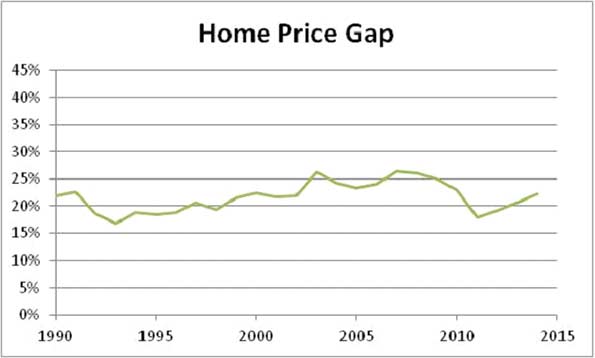
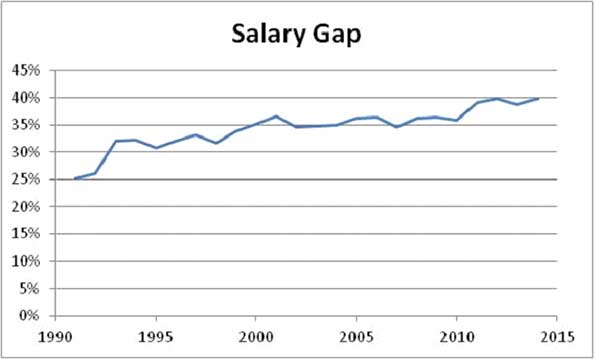
    The gap between the mean- and median-priced homes was increasing across the country before the 2008 crisis, indicating that prices at the top of the scale were rising faster than the prices of more modest homes. The return of the home price gap to pre-1995 levels could have equalized affordability for middle-class Americans if income had followed suit. In addition to the poor employment outlook, fewer and fewer people will be able to afford the higher priced homes because the gap between mean- and median-income is rising faster than the home price gap is falling.

    Median and mean (average) home sales prices are for new homes sold in the U.S. where the sales price includes land. Data from www.census.gov. Median and mean (average) salary from www.census.gov (Table H-13).

    If the long-anticipated strengthening in the jobs market had appeared after the Great Recession, it could have made a real difference for middle-America. But so far, the employment recovery has not appeared. As weak job growth appeared in September, the previously encouraging July and August growth numbers were revised downward. The labor force participation rate declined, leaving only 59.2% of the population working. Population growth in the US is less than 1% per year but job growth is not keeping up with it.

    Month 2015

    Civilian Population Growth

    Employment Growth

    June

    199,362

    -56,000

    July

    205,661

    101,000

    August

    220,858

    196,000

    September

    233,715

    -236,000

    4-Month Total

    859,596

    5,000

    Civilian Population Growth based on population estimates from www.FactFinder.census.gov, Employment Growth based on number of persons employed from www.bls.gov.

    As long as the monthly payments on median-priced homes are out of reach for median-income households, demand in the middle-class housing market cannot strengthen. This is one more reason the Federal Reserve cannot afford to raise interest rates this year. That doesn’t mean that they won’t do; just that they shouldn’t – that don’t always do that smart thing.

    Housing photo courtesy of BigStockPhoto.com.

    Susanne Trimbath, Ph.D. is CEO and Chief Economist of STP Advisory Services. Dr. Trimbath’s credits include appearances on national television and radio programs and the Emmy® Award nominated Bloomberg report Phantom Shares. She appears in four documentaries on the financial crisis, including Stock Shock: the Rise of Sirius XM and Collapse of Wall Street Ethicsand the newly released Wall Street Conspiracy. Dr. Trimbath was formerly Senior Research Economist at the Milken Institute. She served as Senior Advisor on United States Agency for International Development capital markets projects in Russia, Romania and Ukraine. Dr. Trimbath teaches graduate and undergraduate finance and economics.

  • Eco-Modernism, Meet Opportunity Urbanism

    California has always been friendly ground for new ideas and bold proposals. That was a good thing when California’s economic and social policies encouraged middle-class opportunity, entrepreneurship, and social mobility, way back in the 1960s. But the contemporary California political elite tends to pioneer policies that endanger the spirit of opportunity that once made California great.

    Fortunately, some alternative ways of thinking are emerging. An environmental policy think-tank in Oakland called The Breakthrough Institute has been pioneering a new, pro-growth environmentalism called Eco-Modernism, premised on the idea of technological decoupling. That is, it is based on the principle that by intensifying the use of resources, human needs could be met with far less material. If technologies that do more with less were to be developed, more of the environment would be allowed to flourish independent of human exploitation.

    The Eco-Modernist’s answer to a problem as vast as climate change would not be to reduce emissions through cap-and-trade schemes or to put limits on the use of fossil fuels. Instead, Eco-Modernists would encourage investments in next-generation technologies capable of replacing fossil fuels. Hydroelectric and nuclear facilities have been providing such clean, carbon-free energy for decades. Eco-Modernists support government-funded construction of nuclear plants and hydroelectric systems to reduce carbon emissions and fight climate change while providing affordable energy. Technological advancement and government investment can both promote prosperity and save the environment, if used properly.

    Meanwhile, a Houston-based think-tank, the Center for Opportunity Urbanism, (directed by New Geography’s Southern California-based Executive Editor, Joel Kotkin, where I am a research associate) has been suggesting that urban planning and macroeconomic policy ought to be conducted with the goal of expanding opportunities for social mobility and a middle-class lifestyle. The center favors policies that maximize the availability of work and minimize the cost of living. In practice, this means promoting business and development-friendly tax, regulatory, and zoning codes, and investments in effective public infrastructure and education. The goals include removing unreasonable land and energy regulations that drive up the cost of housing and utilities, and investment in quality public education and in infrastructure.

    These two philosophies offer compelling, positive alternatives to the reigning green-and-blue consensus. Their shared goal: a wealthy, high-tech society, replete with opportunities for upward mobility, leaving little environmental impact. A meld of Eco-Modernism and Opportunity Urbanism could provide a thoughtful, compelling alternative to the California’s current orthodoxy; a path that would neither stifle economic growth, nor be uncaring towards the environment or the working class.
    There are at least two policy areas where the philosophies conflict, however, and if such a synthesis were to become viable, these differences would need to be addressed.

    Eco-Modernism doesn’t particularly support suburban sprawl, because it takes up more land than dense urban cores, while Opportunity Urbanism strongly encourages suburb formation. And Opportunity Urbanists support fossil fuel use for the indefinite future to provide cheap energy, while Eco-Modernists seek a gradual phasing-out of fossil fuels, and their replacement with nuclear energy.

    There’s a fairly straightforward policy compromise evident here. Eco-Modernists ought to accept suburban sprawl as important to economic growth and opportunity, and recognize that human housing needs take up comparatively little land. Opportunity Urbanists, for their part, should accept that nuclear energy can provide more sustainable and lasting energy than fossil fuels, and that a more nuclearized power system would be healthier, provide cheaper energy, and would generally provide a better quality of life for more people than fossil fuels ever could.

    If Eco-Modernists gave up their hostility to suburbia they would gain a zero-carbon nuclear platform, while Opportunity Urbanists that gave up on fossil fuels would retain an opportunity society with more advanced energy technology.

    Aside from this great compromise, Eco-Modernism and Opportunity Urbanism could complement each other very well. Intensive government investments in infrastructure, technology, and education drive the economy; market principles and expanded economic opportunity distribute its fruits. This strong-government/ market-based synthesis begins to resemble the economic philosophy of Henry Clay and Abraham Lincoln, that old Whig tradition that has unfortunately left us for the time being. Perhaps these new ideas will resurrect it.

    What better state to articulate new philosophies and a new synthesis based on innovation and opportunity, and put it into practice? California has always been about creating something new, and giving individuals the chance to create themselves anew. The state’s policy should reflect the state’s character. But two recent stories illustrate the lunacy that our political class substitutes for good policy.

    In September, a whole raft of Governor Jerry Brown’s anti-climate change legislation was soundly defeated. The boldest of these proposals called for a 50 percent cut in petroleum usage statewide by 2030 (amended later to 2050). The agenda was clear: bring California’s carbon emissions down to lead the fight against climate change through the force of example. An earlier drama occurred in June, when the Los Angeles City Council passed, nearly unanimously, a resolution to raise L.A.’s minimum wage to $15 an hour by the year 2020. Almost immediately, the move was condemned by business leaders and policy wonks across the state and nation on the grounds that it would raise the cost of doing business and drive industries out.

    This heavy-handed regulatory mode of problem-solving — a crucial component of what commentator Walter Russell Mead calls the “Blue Model” — dominates areas of California policy from water quality to food prices to pensions.

    The Republican alternative isn’t much better. Out of power and lost in the wilderness since the follies of the Pete Wilson administration, California Republicans typically unload pseudo-Reaganite market-based ideas when asked significant policy questions. In the above two cases, their solutions would be don’t put restrictions on carbon emissions, and don’t raise the minimum wage. But the problems still would not be fixed.

    New ideas need to be out there in response. Perhaps it’s time for Eco-Modernists and Opportunity Urbanists to enter into a dialogue and establish a common policy agenda for the Golden State. The dominant Democratic Party and the floundering Republicans don’t have these ideas. Someone needs to show them the way.

    Luke Phillips is a student studying International Relations at the University of Southern California. He has written for the magazine The American Interest and is a research associate at the Center for Opportunity Urbanism.

    Flickr photo by Jim Bowen: Sacramento, the California Statehouse.

  • Light Rail in the Sun Belt is a Poor Fit

    There is an effective lobby for building light rail, including in cities such as Houston. But why build light rail? To reduce car use? To improve mobility for low-income citizens? This certainly seems a worthwhile objective, with the thousands of core-city, low-income residents whose transit service cannot get them to most jobs in a reasonable period of time.

    ut rather than accept the flackery that accompanies these projects, maybe we should focus on effectiveness, judged by ridership, and the impact of such expensive projects on the transportation of the transit-dependent.

    Take the Dallas light rail system, which serves growing Dallas and Collin counties. The DART light rail system expanded its lines by approximately three quarters between 2000 and 2013, yet the number of transit commuters declined, and transit’s commuting market share dropped by one-quarter. More than twice as many Dallas workers are employed at home than ride transit, and do not require the massive capital and operating subsidies of light rail.

    Even the widely praised Denver system has barely moved the needle for transit ridership; before opening its massive light rail system in 1990, 4.3 percent of Denver commuters used transit to get to work.

    The share did rise – by a total of 0.1 percent to 4.4 percent. Even Portland, considered the Mecca of the “smart growth” strategy, actually has seen a decrease in its transit market share, from 7.9 percent before light rail to 6.4 percent in 2013. San Diego, arguably one of the more successful light rail systems, has seen its transit market share stagnate, from 3.3 percent in 1980 before light rail to 3.2 percent in 2013.

    And then there is Los Angeles, a city that was essentially built around the Pacific Electric “Red Car” system in the early 20th Century, and is the densest in the United States, more than twice as dense as Houston. Yet despite this, the regional MTA, which operates its large bus and rail system, as well as a subway, still struggles to reach its ridership record reached in 1985, when transit consisted of only buses. Despite spending over $10 billion in public funds, Los Angeles has seen ridership decline while the once-more thriving bus system has deteriorated. Nearly three quarters of all Angelenos still drive to work.

    No surprise then that Houston, where the light rail system opened in 2004, has not been notably successful.

    Between 2003 and 2014, Harris County’s population grew 23 percent, but transit ridership decreased 12 percent, according to American Public Transportation Association data. This means that the average Houstonian took 30 percent fewer trips on the combined bus and light rail system in 2014 than on the bus only system in 2003.

    Finally, in each of these cities, driving alone has increased and, with the exception of Los Angeles, more people now work at home than ride transit to work.

    These results reflect stubborn historical facts. Transit works well generally in older cities with historically large downtowns built largely before the ascendency of the car. These “legacy” cities, notably New York, are hard-wired for transit and have the largest downtowns; in New York the Manhattan business districts accounts for about 20 percent of the workforce. Together these legacy cities – New York, Boston, Chicago, Philadelphia, San Francisco and Washington – account for 55 percent of all transit work trip destinations in the nation.

    In contrast, most Sun Belt cities have far fewer downtown jobs. In Los Angeles, downtown amount for less than 3 percent of employment and Dallas’ downtown accounts for only 2 percent of metropolitan employment. In Houston the number is only 6.4 percent.

    With population and jobs concentrating in the periphery, light rail service ends up serving a geography to which relatively few commute. They have not materially increased transit’s share of travel, or reduced car travel. Worse still, their intense expense on single lines (routes) has precluded greater and less costly bus expansions that could have provided neglected communities – the young, the poor, the disabled, immigrants and minorities – with access to more jobs. The performance of light rail simply has not justified the expense.

    Houston and other metropolitan areas need to take advantage instead of an incipient transportation revolution. Working at home is likely to increase substantially and automated vehicles promise to increase mobility while reducing traffic congestion. Companies like Uber could offer other private-sector based solutions. Houstonians should address the needs of the 21st century city not as some wish it to be but based how things really work.

    This piece first appeared in the Houston Chronicle.

    Joel Kotkin is executive editor of NewGeography.com and Roger Hobbs Distinguished Fellow in Urban Studies at Chapman University, and a member of the editorial board of the Orange County Register. He is also executive director of the Houston-based Center for Opportunity Urbanism. His newest book, The New Class Conflict is now available at Amazon and Telos Press. He is also author of The City: A Global History and The Next Hundred Million: America in 2050. He lives in Orange County, CA.

    Wendell Cox is Chair, Housing Affordability and Municipal Policy for the Frontier Centre for Public Policy (Canada), is a Senior Fellow of the Center for Opportunity Urbanism (US), a member of the Board of Advisors of the Center for Demographics and Policy at Chapman University (California) and principal of Demographia, an international public policy and demographics firm.He is co-author of the “Demographia International Housing Affordability Survey” and author of “Demographia World Urban Areas” and “War on the Dream: How Anti-Sprawl Policy Threatens the Quality of Life.” He was appointed to three terms on the Los Angeles County Transportation Commission, where he served with the leading city and county leadership as the only non-elected member. He served as a visiting professor at the Conservatoire National des Arts et Metiers, a national university in Paris.

  • Cities That Locate Art In Odd Places

    The city sidewalk today is pretty empty, with online shopping and social media having replaced shoe leather on pavement. Restrictions in the name of safety have also become more common since 9/11. One result of these trends is a movement called Art in Odd Places : the work of artists that use public space itself as a huge, blank canvas. Orlando is the most recent city to experiment in this fashion. This month, more than fifty artists there reasserted the right to an unfettered exchange of ideas in public space, reinventing the sidewalk. It was an interesting experiment that led to some bigger questions about the relationship between public space and civic involvement.

    Art in Odd Places was started by New York artist Ed Woodham in 1996 during the Cultural Olympiad in Atlanta, which coincided with the Olympics. With the media focused on sports, few recall that the Olympics is a celebration of mind and spirit, as well as of the body. Olympic cities host poets on the street reciting verses, and painters and sculptors exhibiting their pieces. Woodham struggled with officials to bring performance art to the event, and went home determined to keep the town square in its rightful place as the unfettered medium of exchange for art and ideas.

    All the way through the nineties, movies and television documented sidewalks thronging with people, parks full of activity, and public plazas alive with protests or festivals. Despite popular rhetoric that accuses the car of killing public space, something different was happening. Sidewalks and plazas have continued as the arena for public encounters in our cities. They reached capacity, but as cities spread out the car had little effect on, for example, Times Square, or on any other city’s sidewalk.

    Something funny started happening however; something only a few like Ed Woodham noticed. “In Atlanta, we were placed in a designated ‘free speech zone,’ which I found odd,” he commented to me while preparing for Orlando’s event. “I wondered when the city was no longer a free speech zone in its entirety.” Woodham noted, in particular, the clampdown after 9/11. Any sort of organized activity on the sidewalk was more and more regulated, in part due to a heightened sense of security.

    Today the value of public space is open to debate. Nicolett Mall, a pedestrian zone in downtown Minneapolis, is hardwired into the city’s soul and is being rejuvenated. Meanwhile, New York Mayor Bill de Blasio is considering removal of the plazas in Times Square that have attracted a lively crowd and the presence of costumed characters and street performers, many of them seeking tips.

    In 2013, Greensboro, North Carolina hosted Art in Odd Places, and the director of downtown Orlando’s Gallery at Avalon Island art curator Pat Greene visited. Two years later, Greene successfully co-curated the Orlando show, along with Voci Dance Director Genevieve Bernard. Between September 17th and 20th this year, Orlando became a host to dozens of artists on the street. The theme in Orlando is “Tone,” which is interpreted by each artist individually; pieces have been created around audio tones, color tones or other meanings of this word (I reviewed the work in a recent critique for the Orlando Weekly).

    For example, Forrest MacDonald’s subtle water pipes, inserted next to actual storm water pipes, were sprinkled down Magnolia Avenue, with hands reaching out of the pipes to stroke tufts of grass. Nathan Selikoff fed a microphone into a computer, and then onto a giant screen, projecting an “Audiograph” that mapped the soundwaves of the city like a huge EEG.

    On the more ethereal side, performance artist Masami Koshikawa created “Self Portrait as Butterfly Woman,” posing in white while an assistant invited passersby to place gold origami butterflies on her body suit. This gesture broke the barriers between strangers and the taboo of touch, and represented a sublime moment in the festival. Koshikawa eventually collected hundreds of butterflies.

    Arvid Tomayko paraded up and down Magnolia Street in his “Wearable Tentacle Horn,” a suit with trumpets coming out the ends of various sleeves. And Chris Scala pulled a wire mesh camper into a parking lot and slept in it, LED lights washing over his sleeping form, in a piece entitled “X-Ray Camper”. These are only a few examples of artists using public space to make a spectacle in a traditional manner.

    I visited Art in Odd Places at the height of the lunch rush on one day. A few scattered pedestrians wandered in and out of restaurants, and a preschool teacher led her little ones back to school from a library trip. The artists and their supporters comprised the largest single population group. (More people came by in the evening, according to Greene.)

    In the last ten years, the number of people living in downtown Orlando has actually increased, with more and more residential housing available in and around the city’s core. What has sucked the life out of sidewalks, it turns out, isn’t the suburbs; instead, it’s the tiny screen and the big screen that have occupied more and more of our lives, taking over the social space that was once reserved for the street. Casual shopping encounters, mixing social and economic activity, walking to business appointments, encounters on the once-active courthouse steps: all of this has become the archaic activity of yesteryear.

    Art in Odd Places did interrupt the tiny screen focus of the average pedestrian who braved the sunny weather that day. Some of the artists deliberately sought to enter the cell phones of bystanders: Sound artist Jeff Knowlton created an app called “Sonify: Orlando” which, when downloaded, provided an acoustic narrative with sounds triggered by the immediate location. A new art form, which Knowlton describes as “locative media,” is born. And overall, Woodham, in an optimistic manner, has aroused artists in city after city to reinvent the sidewalk. In Orlando, the event was a success.

    The darker issue of the regulation of the sidewalk, has, however, remained unaddressed. Woodham feels that well-meaning but overly stiff regulation has turned people out of their public space, and is working hard to reinvigorate the streets with art. Where a vacuum exists, artists often rush in, and the result reflects our contemporary culture. This type of activist art is not seeking to right a gross injustice or advocate a cause, except for that of free speech. It is spurred by open conjecture about the future use of the sidewalk, and asks pedestrians to re-invent the nature of our public space in the twenty-first century.

    Richard Reep is an architect with VOA Associates, Inc. who has designed award-winning urban mixed-use and hospitality projects. His work has been featured domestically and internationally for the last thirty years. An Adjunct Professor for the Environmental and Growth Studies Department at Rollins College, he teaches urban design and sustainable development; he is also president of the Orlando Foundation for Architecture. Reep resides in Winter Park, Florida with his family.

    Photos by the author: Anna McCambridge interacting with a piece of “Storm Water;” Koshikawa, right, with butterfly assistant.

  • Should Older Americans Live in Places Segregated from the Young?

    Demographers frequently remind us that the United States is a rapidly aging country. From 2010 to 2040, we expect that the age-65-and-over population will more than double in size, from about 40 to 82 million. More than one in five residents will be in their later years. Reflecting our higher life expectancy, over 55% of this older group will be at least in their mid-70s.

    While these numbers result in lively debates on issues such as social security or health care spending, they less often provoke discussion on where our aging population should live and why their residential choices matter.

    But this growing share of older Americans will contribute to the proliferation of buildings, neighborhoods and even entire communities occupied predominantly by seniors. It may be difficult to find older and younger populations living side by side together in the same places. Is this residential segregation by age a good or a bad thing?

    As an environmental gerontologist and social geographer, I have long argued that it is easier, less costly, and more beneficial and enjoyable to grow old in some places than others. The happiness of our elders is at stake. In my recent book, Aging in the Right Place, I conclude that when older people live predominantly with others their own age, there are far more benefits than costs.

    Why do seniors tend to live apart from other age groups?

    My focus is on the 93% of Americans age 65 and older who live in ordinary homes and apartments, and not in highly age-segregated long-term care options, such as assisted living properties, board and care, continuing care retirement communities or nursing homes. They are predominantly homeowners (about 79%), and mostly occupy older single-family dwellings.

    Older Americans don’t move as often as people in other age groups. Typically, only about 2% of older homeowners and 12% of older renters move annually. Strong residential inertiaforces are in play. They are understandably reluctant to move from their familiar settings where they have strong emotional attachments and social ties. So they stay put. In the vernacular of academics, they opt to age in place.

    Over time, these residential decisions result in what are referred to as “naturally occurring” age-homogeneous neighborhoods and communities. These residential enclaves of old are now found throughout our cities, suburbs and rural counties. In some locales with economies that have changed for the worse, these older concentrations are further explained by the wholesale exit of younger working populations looking for better job prospects elsewhere – leaving the senior population behind.

    Even when older people decide to move, they often avoid locating near the young. The Fair Housing Amendments Act of 1988 allows certain housing providers to discriminate against families with children. Consequently, significant numbers of older people can move to these “age-qualified” places that purposely exclude younger residents. The best-known examples are those active adult communities offering golf, tennis and recreational activities catering to the hedonistic lifestyles of older Americans.

    Others may opt to move to “age-targeted” subdivisions (many gated) and high-rise condominiums that developers predominantly market to aging consumers who prefer adult neighbors. Close to 25% of age-55-and-older households in the US occupy these types of planned residential settings.

    Finally, another smaller group of relocating elders transition to low-rent senior apartment buildings made possible by various federally and state-funded housing programs. They move to seek relief from the intolerably high housing costs of their previous residences.

    Is this a bad thing?

    Those advocates who bemoan the inadequate social connections between our older and younger generations view these residential concentrations as landscapes of despair.

    In their perhaps idyllic worlds, old and young generations should harmoniously live together in the same buildings and neighborhoods. Older people would care for the children and counsel the youth. The younger groups would feel safer, wiser and respectful of the old. The older group would feel fulfilled and useful in their roles of caregivers, confidants and volunteers. In question is whether these enriched social outcomes merely represent idealized visions of our pasts.

    A less generous interpretation for why critics oppose these congregations of old is that they make the problems faced by an aging population more visible and thus harder to ignore.

    Residents play shuffleboard at Limetree Park in Bonita Springs, Florida. Steve Nesius/Reuters
    A better social life

    But why should we expect older people to live among younger generations? Over the course of our lives, we typically gravitate to others who are at similar stages in life as ourselves. Consider summer camps, university dormitories, rental buildings geared to millennials or neighborhoods with lots of young families. Yet we seldom hear cries to break up and integrate these age-homogeneous residential enclaves.

    In fact, studies show that when older people reside with others their age, they have more fulfilled and enjoyable lives. They do not feel stigmatized when they practice retirement-oriented lifestyles. Even the most introverted or socially inactive older adults feel less alone and isolated when surrounded with friendly, sympathetic, and helpful neighbors with shared lifestyles, experiences, and values – and yes, who offer them opportunities for intimacy and an active sex life.

    Moreover, tomorrow’s technology is especially on the side of these elders. Because of online social media communications, older people can engage with younger people – as family members, friends, or as mentors – but without having to live next to what they sometimes feel are noisy babies, obnoxious adolescents, indifferent younger adults or insensitive career professionals.

    Age-specific enclaves prolong independent living

    Could living in these age-homogeneous places help older people avoid a nursing home stay?

    Studies say yes – because here they have more opportunities to cope with their chronic health problems and impairments. Now their greater visibility as vulnerable consumers becomes a plus because both private businesses and government administrators can more easily identify and respond to their unmet needs.

    These elder concentrations spawn a different mindset. The emphasis shifts from serving troubled individual consumers to serving vulnerable communities or “critical masses” of consumers.

    Consider how many more clients home-care workers can assist when they are spared the traveling time and costs of reaching addresses spread over multiple suburbs or rural counties. Or recognize how much easier it is for a building management or homeowners’ association to justify the purchasing of a van to serve the transportation needs of their older residents or to establish an on-site clinic to address their health needs.

    Consider also the challenges confronted by older people seeking good information about where to get help and assistance. Even in our internet age, they still mostly rely on word of mouth communications from trusted individuals. It becomes more likely that these knowledgeable individuals will be living next to them.

    These enclaves of old have also been the catalyst for highly regarded resident-organizedneighborhoods known as elder villages.

    Their concerned and motivated older leaders hire staff and coordinate a pool of their older residents to serve as volunteers. For an annual membership fee, the predominantly middle-income occupants in these neighborhoods receive help with their grocery shopping, meal delivery, transportation and preventive health needs. Residents also benefit from knowing which providers and vendors (like workers performing home repair) are the most reliable, and they often receive discounted prices for their goods and services. They also enjoy organized educational and recreational events enabling them to enjoy the company of other residents. Today, about such 170 villages are open and 160 are in planning stages.

    A question of preference

    Ageist values and practices are indeed deplorable. However, we should not view the residential separation of the old from the young as necessarily harmful and discriminatory but rather as celebrating the preferences of older Americans and nurturing their ability to live happy, dignified, healthy and autonomous lives. Living with their age-peers helps these older occupants compensate for other downsides in their places of residence and in particular presents opportunities for both private and public sector solutions.

    Tihs piece was first published by The Conversation.

    Stephen M. Golant, Ph.D, a gerontologist and geographer, is now a Professor in the Department of Geography at the University of Florida. Previously, he was a faculty member in the Committee on Human Development and in the Department of Geography at the University of Chicago. Dr. Golant has been conducting research on the housing, mobility, transportation, and long-term care needs of older adult populations for most of his academic career. He is a Fellow of the Gerontological Society of America and a Fulbright Senior Scholar award recipient. He earlier served as a consultant to the Congressionally appointed Commission on Affordable Housing and Health Facility Needs for Seniors in the 21st Century (Seniors Commission). He has written or edited about 140 papers and books. His latest book is Aging in the Right Place (Health Professions Press, 2015).

    Laed photo by Steve Nesius/Reuters.

  • Who Should Pay for the Transportation Infrastructure?

    Urban regions are significantly more important than any one city located within them. Housing, transportation, economy, and politics help produce uneven local geographies that shape the individual identities of places and create the social landscapes we inherit and experience. As such, decisions made within one city can ripple through the entire urban region. When affordable housing is systematically ignored by one city, neighboring cities become destinations for those who cannot afford higher housing costs. Even when the minimum wage is adjusted in one city, others cannot ignore it.

    In fact, a differential wage structure can produce diverse economic and labor geographies. Affordable housing and uneven economic development, in their turn, impact the regional transportation and infrastructure: if the cost of living and wages in one city in a particular region are high (as in San Francisco and Seattle), then low and middle-income workers will move to a more affordable neighboring city and pay a higher price, particularly in time spent, for transportation. They also pay more in fuel, and hence taxes that fund infrastructure maintenance and expansion.

    In other words, while companies and the more affluent population benefit from the agglomeration economies of alpha cities, it is the lower-wage workers and the population at large that pay for these uneven development. Therefore, a company deciding to locate in Seattle or San Francisco, or any location, does not have to bear the cost their decision imposes on urban transportation and the infrastructure needed to support their operation. Instead it’s their employees, particularly those with lower earning power, who do.

    How many LEED certified buildings and downtown redevelopment projects does it take to make up for this inequity?  Should a city be considered green, if a significant portion of its low earners has to commute to neighboring cities to afford a home? Can a city be seen as sustainable, if in a style akin to medieval cities, serfs have to leave every evening and return in the morning to make sure that the ‘creative class’ is adequately served?

    As states such as Washington engage with the old “pay as you go” policy of increasing fuel taxes to pay for the infrastructure, the question of what forces created the emergent commuting patterns remains unanswered. Was it just the commuters, acting as informed participants in the market economy, who sought to optimize their housing and transportation trade offs? Or did the locational choices of employers contribute to the growing commuting problems in the region? If commuters are subjected to “pay as you go” policies, shouldn’t employers who locate in expensive housing markets, irrespective of their employees’ income profile, be subjected to “pay as you locate” policies?

    Perhaps no metro region will make a better case study for this inequity than the area that ‘serves’ Seattle. The Puget Sound Region consists of four counties; however, to make sure that no one county that might have an economic connection with Seattle is left behind, we can look at six counties: Snohomish, King (where Seattle is located), Pierce, Kitsap, Thurston, and Mason.

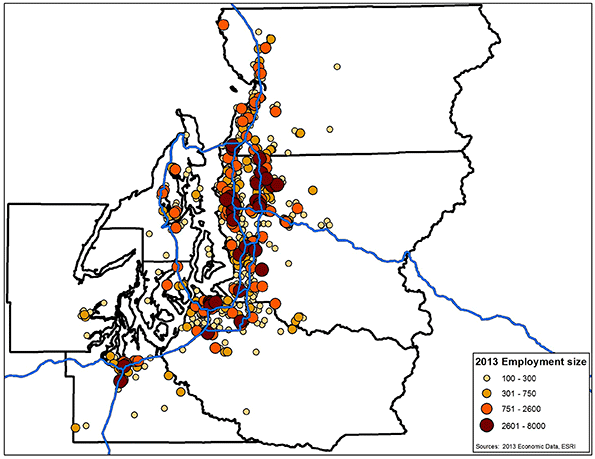
    The entire urban region is served by a small number of highways, including Interstate 5. According to 2013 economic data, these six counties housed nearly 62% of all firms in the state. Furthermore, a quarter of all businesses in these counties were located within half a mile of a freeway. In terms of total employees, the six counties contained 69% of the state employment, and workplaces within half a mile of a freeway employed 37% of all employees in the counties. The inequity in the regional economic distribution is further exacerbated by the fact that the small area in West King county bounded by I-405 houses 30% of workplaces and 47% of employment, and generates a significant portion of the sales/revenue in the six counties. This area relies on I-5, I-405 and I-90 for the delivery of its employees from near and far.   

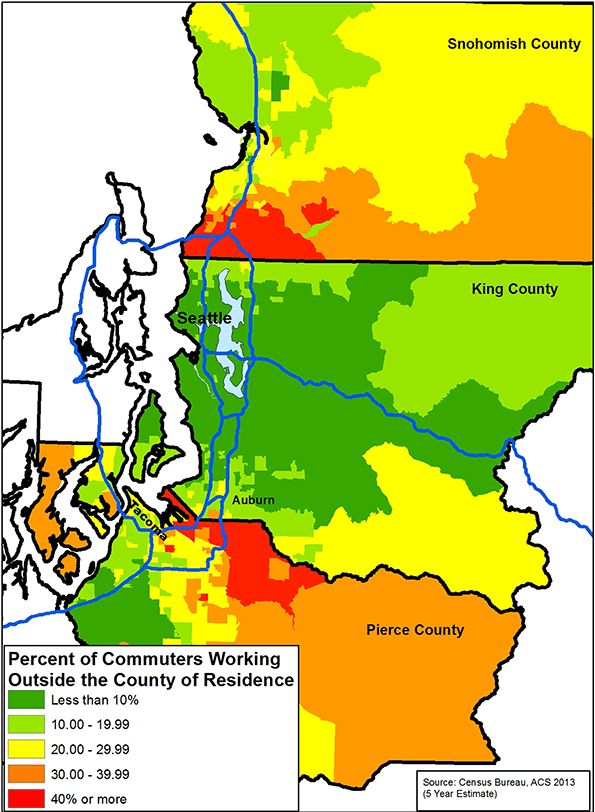
    The economic calculus of the early days of Interstate construction may have suggested that the trucking industry would benefit from this transportation infrastructure, but 1960s economists might be surprised by the type of companies now located within half a mile of freeways. In the six counties in Western Washington, the economic sectors over-represented in these geographies are: services and finance, real estate, and insurance (FIRE). Anyone driving on I-5 and I-405 (where Microsoft and other corporations are visible) can see this.  None of these workplaces require trucking. While their well-paid employees can afford to live in well-to-do places, including Bellevue and Seattle, many others reside in less expensive places such as Auburn, Tukwila, Tacoma, and Federal Way.

    A map of the region clearly suggests that neighboring counties and cities are housing those who work in West King County. Mobility has been the answer to unaffordability in this and other similar urban regions. If a city is unaffordable, is it fair to ask those who search for affordability in ‘other’ geographies pay for their so-called choices? Is this truly a choice? Are employers, current and future, asked to pay for their locational ‘choices?’ 

    Surely, we can do better than asking employees to bear the burden of a regional economic imbalance. Freeways should not be freer to some than others.  If this nation is about people paying for choices they make, then everyone should do so: employers and employees alike.

    Ali Modarres is the Director of Urban Studies at University of Washington Tacoma.  He is a geographer and landscape architect, specializing in urban planning and policy. He has written extensively about social geography, transportation planning, and urban development issues in American cities.

    Seattle photo courtesy of BigStockPhoto.com.

  • The Cities Americans Are Thronging To And Fleeing

    Cities get ranked in numerous ways — by income, hipness, tech-savviness and livability — but there may be nothing more revealing about the shifting fortunes of our largest metropolitan areas than patterns of domestic migration.

    Bright lights and culture may attract some, but people generally move to places with greater economic opportunity and a reasonable cost of living, particularly affordable housing.

    So who moves? Census data suggests that it is primarily the young — those aged 25 to 34 — followed by people approaching retirement. Family and friends are a big motivating factor in both age groups. According to the moving company Mayflower,   one in four millennials aged 18 and 34 moved back to their hometowns over the past five years. At the same time seniors also express a strong desire to live close to their children and grandchildren; most elderly who do not make such moves age in place.

    Forbes took a close look at the most recent data on domestic migration — that is movement within the U.S. between metro areas — between 2010 and 2014. We ranked the nation’s 53 largest metropolitan areas based on their annualized rates of population change attributable to migration. What we found is that to a remarkable extent, Americans still seem to be whistling Dixie. Eight of the 10 fastest gainers were in the former Confederacy, led by Austin, Texas, which gained 126,296 more migrants over that time span from other parts of the country than it lost in outmigration, accounting for an annual increase in its population of 1.69%. No other metro area in the country enjoyed anything like this rate of in-migration.

    Austin’s high job creation rate — over 3% growth annually since 2010 — has a great deal to do with its ability to lure new residents not only from other Texas cities, but from the coasts as well.

    The other Southern standouts are from the northern and western edges of the region. They include several Texas cities — No. 3 San Antonio (1.02% annual increase in population from migration) and No. 8 Houston — which have logged strong job growth and offer housing prices, adjusted for incomes, that are less than half those in coastal California, New York and parts of New England.

    The oil bust could slow down the allure of some of these cities, notably Houston as well as No. 9 Oklahoma City. But lower petroleum prices could prove a boon to nearly universally suburbanized cities such as No. 2 Raleigh, N.C. (1.14% annual growth in population from migration), and No. 5 Nashville, Tenn.,  both of which have economies built around technology, manufacturing and business services. Raleigh is growing so strongly that local officials expect the population of the metro area will double over the next 20 years.

    It’s a continuation of a longstanding shift to the South, a trend that some pundits were quick to declare was over after the Great Recession amid a perceived rise in interest in urban living. There have certainly been some Southern metro areas that seem to have lost appeal since 2010, notably Atlanta, Tampa-St. Petersburg and Jacksonville, all of whose rates of in-migration have slowed, although they’re still comfortably among the 20 top destinations.

    The Rockies And The Pacific Northwest

    In this century, the other great migration draw has been two parts of the West: the Mountain States and the Pacific Northwest. This vast region extending from Colorado to Oregon has enjoyed generally strong economic growth and reasonable housing costs, particularly in comparison with coastal California. The big winner here has been No. 4 Denver, which gained a net 103,785 domestic migrants from 2010 to 2014.

    The other strong performers in the region include No. 11 Phoenix, which gained 119,000 net migrants since 2010. But this is a slowdown from its previous pace; between 2000 and 2009 (the Census Bureau did not produce migration figures for 2009-2010), Phoenix ranked fifth in the nation. But an even bigger decline has occurred in Las Vegas, the boomtown of the last decade, which has fallen from the No. 2 in the first decade of the new millennium to 16th place in 2010-14. On an annual basis, Las Vegas is now attracting about 9,000 net migrants a year compared to 35,000 in the 2000s.

    The Pacific Northwest continues to attract more migrants than it loses, many from California. The big winner here has been No. 15 Seattle, which has gained 60,000 net migrants since 2010; in the last decade, the Emerald City barely managed 40,000 net migrants from 2000 to 2009. Portland has added about 49,000 net migrants, though its annual inflow has dropped somewhat.

    Winners And Losers

    It is frequently claimed by fiscal conservatives that politics and regulation drive these patterns. Generally speaking, there tends to be more growth in lower-tax states than in higher-taxed ones, but this analysis only goes so far. Blue metro areas like Seattle, Portland and Denver are luring new residents despite somewhat higher costs and stringent regulation. It seems likely that their success is that they are not California, a regulatory state on steroids.

    Indeed economic booms can make up for a lot of sins. No. 20 San Francisco may not be drawing newcomers like an Austin or a Nashville, but super-high costs have not been enough to overcome the lure of riches from the current tech boom. Since 2010, the area, which includes suburban San Mateo County, Marin County and the East Bay, has attracted a net 49,000 new migrants, a big turnaround compared to the massive outflow of 347,000 suffered in the first decade of this millennium.

    But other expensive and expansive metropolitan areas are not doing as well in the population sweepstakes. The nation’s three largest metropolitan areas fall to the bottom of our list: Los Angeles (46th), Chicago (52nd) and, in last place New York. Since 2010, the New York metro area has lost a net 529,000 domestic migrants, adding to the 1.9 million who departed from 2000 to 2009.

    Yet these great metropolitan areas are not shrinking, due to a steady flow of new residents from overseas and a surplus of births over deaths. In this sense, they are less vulnerable to migration losses than cities such as Cleveland, Pittsburgh and Detroit, where the rate of domestic outmigration is lower, but the number of new foreign immigrants is relatively low.

    Clearly America’s migration trends are always changing, but for the most part the basics remain the same. Places that are more affordable, and also have thriving economies, tend to attract new residents while those with relatively tepid economies and high costs fare, all things being equal,  far worse.

    The Winners: No. 1: Austin, Texas

    Metro Area Population, 2014: 1.94 million

    Net Domestic Migration Gain, 2010-14: 126,296

    Annual Rate Of Pop. Increase Since 2010 From Migration: 1.69%

    No. 2: Raleigh, NC

    Metro Area Population, 2014: 1.24 million

    Net Domestic Migration Gain, 2010-14: 55,920

    Annual Rate Of Pop. Increase Since 2010 From Migration: 1.14%

    No. 3: San Antonio, TX

    Metro Area Population, 2014: 2.33 million

    Net Domestic Migration Gain, 2010-14: 94,159

    Annual Rate Of Pop. Increase Since 2010 From Migration: 1.02%

    No. 4: Denver, CO

    Metro Area Population, 2014: 2.75 million

    Net Domestic Migration Gain, 2010-14: 103,785

    Annual Rate Of Pop. Increase Since 2010 From Migration: 0.95%

    No. 5: Nashville, TN

    Metro Area Population, 2014: 1.79 million

    Net Domestic Migration Gain, 2010-14: 63,477

    Annual Rate Of Pop. Increase Since 2010 From Migration: 0.88%

    No. 6: Charlotte, NC-SC

    Metro Area Population, 2014: 2.38 million

    Net Domestic Migration Gain, 2010-14: 83,305

    Annual Rate Of Pop. Increase Since 2010 From Migration: 0.87%

    No. 7: Orlando, FLA

    Metro Area Population, 2014: 2.32 million

    Net Domestic Migration Gain, 2010-14: 72,735

    Annual Rate Of Pop. Increase Since 2010 From Migration: 0.79%

    No. 8: Houston, TX

    Metro Area Population, 2014: 6.49 million

    Net Domestic Migration Gain, 2010-14: 191,796

    Annual Rate Of Pop. Increase Since 2010 From Migration: 0.75%

    No. 9: Oklahoma City, OK

    Metro Area Population, 2014: 1.34 million

    Net Domestic Migration Gain, 2010-14: 37,528

    Annual Rate Of Pop. Increase Since 2010 From Migration: 0.70%

    No. 10: Dallas-Fort Worth, TX

    Metro Area Population, 2014: 6.95 million

    Net Domestic Migration Gain, 2010-14: 184,021

    Annual Rate Of Pop. Increase Since 2010 From Migration: 0.67%

    The Losers: No. 10: Milwaukee, WI

    Metro Area Population, 2014: 1.57 million

    Net Domestic Migration Loss, 2010-14: 22,597

    Annual Rate Of Pop. Decrease Since 2010 From Migration: -.34%

    o. 9: Virginia Beach-Norfolk, VA-NC

    Metro Area Population, 2014: 1.72 million

    Net Domestic Migration Loss, 2010-14: 24,374

    Annual Rate Of Pop. Decrease Since 2010 From Migration: -.34%

    No. 8: Los Angeles, CA

    Metro Area Population, 2014: 13.26 million

    Net Domestic Migration Loss, 2010-14: 208,635

    Annual Rate Of Pop. Decrease Since 2010 From Migration: -.39%

    No. 7: Rochester, NY

    Metro Area Population, 2014: 1.08 million

    Net Domestic Migration Loss, 2010-14: 17,665

    Annual Rate Of Pop. Decrease Since 2010 From Migration: -.39%

    No. 6: Memphis, TN-MS-AR

    Metro Area Population, 2014: 1.34 million

    Net Domestic Migration Loss, 2010-14: 21,999

    Annual Rate Of Pop. Decrease Since 2010 From Migration: -.39%

    No. 5: Cleveland, OH

    Metro Area Population, 2014: 2.06 million

    Net Domestic Migration Loss, 2010-14: 38,424 

    Annual Rate Of Pop. Decrease Since 2010 From Migration: -.44%

    No. 4: Detroit, MI

    Metro Area Population, 2014: 4.30 million

    Net Domestic Migration Loss, 2010-14: 89,649

    Annual Rate Of Pop. Decrease Since 2010 From Migration: -.50%

    No. 3: Hartford, CT

    Metro Area Population, 2014: 1.21 million

    Net Domestic Migration Loss, 2010-14: 27,425

    Annual Rate Of Pop. Decrease Since 2010 From Migration: -.54%

    No. 2: Chicago, IL-IN-WI

    Metro Area Population, 2014: 9.55 million

    Net Domestic Migration Loss, 2010-14: 237,666

    Annual Rate Of Pop. Decrease Since 2010 From Migration: -.60%

    No. 1: New York, NY-NJ-PA

    Metro Area Population, 2014: 20.09 million

    Net Domestic Migration Loss, 2010-14: 528,742

    Annual Rate Of Pop. Decrease Since 2010 From Migration: -.64%

    This piece first appeared at Forbes.

    Joel Kotkin is executive editor of NewGeography.com and Roger Hobbs Distinguished Fellow in Urban Studies at Chapman University, and a member of the editorial board of the Orange County Register. He is also executive director of the Houston-based Center for Opportunity Urbanism. His newest book, The New Class Conflict is now available at Amazon and Telos Press. He is also author of The City: A Global History and The Next Hundred Million: America in 2050. He lives in Orange County, CA.

    Wendell Cox is Chair, Housing Affordability and Municipal Policy for the Frontier Centre for Public Policy (Canada), is a Senior Fellow of the Center for Opportunity Urbanism (US), a member of the Board of Advisors of the Center for Demographics and Policy at Chapman University (California) and principal of Demographia, an international public policy and demographics firm.He is co-author of the “Demographia International Housing Affordability Survey” and author of “Demographia World Urban Areas” and “War on the Dream: How Anti-Sprawl Policy Threatens the Quality of Life.” He was appointed to three terms on the Los Angeles County Transportation Commission, where he served with the leading city and county leadership as the only non-elected member. He served as a visiting professor at the Conservatoire National des Arts et Metiers, a national university in Paris.