Blog

  • The Green Urbanization Myth

    Once a fringe idea, the notion of using technology to allow humanity to “decouple” from nature is winning new attention, as a central element of what the Breakthrough Institute calls “ecomodernism.” The origins of the decoupling idea can be found in 20th century science fiction visions of domed or underground, climate-controlled, recycling-based cities separated by forests or deserts. A version of decoupling was promoted in the 1960s and 1970s by the British science writer Nigel Calder in The Environment Game (1967) and the radical ecologist Paul Shepard in The Tender Carnivore and the Sacred Game (1973). More recent champions of decoupling include Martin Lewis, Jesse Ausubel, Stewart Brand, and Linus Blomqvist.  

    Proponents of decoupling point out correctly that the greatest threat to wilderness is not urban sprawl, but agricultural sprawl. The amount of the earth’s surface devoted to the unnatural, simplified ecosystems of agriculture—that is, farms and ranches—dwarfs the small amount consumed by cities, including low-density suburbs. Industrial, energy- and fertilizer-intensive agriculture has permitted us to grow far more food on far less land—with costs, to be sure, including water pollution from fertilizer runoff. Genetically modified crops will make it possible to shrink the footprint of global agriculture altogether, and if human beings ever derive most of their diet from laboratory-synthesized foods like in vitro meat and vegetables created from stem cells, most of today’s farmland can be freed for other uses.

    The decouplers are right to predict that technology will free up vast amounts of land for purposes other than farming. But many of them go wrong, I believe, when they assume that the decline of agricultural sprawl will be accompanied by the decline of urban sprawl, for two reasons. First, as societies become richer, more and more people choose low-density housing and can afford it. Second, whatever may be the case in other countries, in the United States, the private market for land—including retired farmland—ensures that little if any of the land freed by technology from agriculture will be turned into public wilderness preserves.

    One of the great urban legends of our time is the claim, endlessly repeated by urban gentry journalists, that Americans are tired of the suburbs and are moving back into the city in the search of walkable neighborhoods. The data disprove the claim. As Wendell Cox points out at Newgeography:

    But the core municipalities now contain such a small share of major metropolitan area population that the suburbs have continued to add population at about three times the numbers of the core municipalities…Indeed, if the respective 2010-2013 annual growth rates were to prevail for the next century,  the core municipalities would house only 28.0 percent of the major metropolitan area population in 2113 (up from 26.4 percent in 2013).           

    Thanks to decoupling, the low-density metro areas will probably become even bigger and even less dense. As farmland on the periphery of metro areas is retired from agriculture, much of it will be converted into cheap housing, low-rent office parks and inexpensive production facilities.

    The rise of robocars may accelerate metro area decentralization. Congestion will be reduced, and the greater safety of driverless cars may permit higher speeds on metro area beltways and cross-town freeways. Once taxi drivers are replaced by robot taxis, the cost of taxis will plummet and the greater convenience of point-to-point personal travel anywhere in a sprawling metro area will make rail-based mass transit obsolete except in places like airports and tourist-haven downtowns.  As in the past, most working-class families with children will probably prefer a combination of a longer commute with a bigger single-family house and yard to a shorter commute and life in a cramped apartment or condo. 

    Nor will most working-class and middle-class retirees move to walkable downtowns. They won’t be able to afford to. And robocars plus in-home medical technology will make it much easier for the elderly to age in place in car-based suburbs. 

    As great numbers of middle- and low-income Americans move to bigger, cheaper homes on the former farmland that rings expanding metro areas, they will be leap-frogged by the rich. Absent a reversal of today’s top-heavy income concentration, much of America’s wealth will continue to be concentrated in the hands of a few people. And when farmland is retired, thanks to GM crops, in vitro food, or other new land-sparing technologies, a lot of the former farm acreage will be bought by One Percenters and turned into rural retreats.

    The decouplers hope that retired farmland will be “rewilded” and transformed into nature parks that everyone can enjoy. But how realistic is this hope? At least in the United States, it is impossible to imagine federal or state governments buying more than a negligible portion of retired farmland and turning it into public parks. What is more likely, that most retired Midwestern farmland will be turned into rewilded public prairie preserves—or that it will be divided into the vast baronial estates of super-rich bankers, tech oligarchs, and trust-fund heirs and heiresses, who commute from their downtown skyscraper penthouses to their high-tech Downtown Abbeys?

    A certain amount of the former farm acreage owned by the plutocracy may be rewilded, with the encouragement of tax incentives like conservation easement laws. But rewilding on the scale imagined by some environmentalists is unlikely. For one thing, the former farmland will still be chopped up by fences, roads, power lines, and other structures. And all but the greatest recreational ranches will be too small to support self-sustaining populations of bison and other megafauna. Nor are voters likely to smile on the restoration of predators like wolves, coyotes, bears, and mountain lions, even if a few of eccentric rich landowners fancied the idea.

    And then there is the aesthetic factor. The biologist E.O. Wilson has suggested that, because we are descended from hominids who evolved on African savannahs, we naturally prefer vistas with grassy expanses to forests, deserts, and other biomes. Some evidence for this comes from the work of the Russian artists Komar and Melamid, who polled members of different nationalities and then painted the “Most Wanted Paintings” based on the results. In most countries, if they are to be believed, the favorite sofa painting shows a grassy landscape with a river and some woods in the background. 

    As Paul Shepard pointed out, the country-house landscape of 18th century Britain was anything but natural. The natural landscape of most of Britain, as of most of Western Europe, is dense forest. But the British rural upper class cleared the forests to create grassy vistas—the ancestors of the modern British and American suburban lawn. Shepard blamed this on the influence of Renaissance Italian landscape painting, which showed once-forested Mediterranean coast land that had been denuded by goats and sheep. But the Wilson theory may provide another explanation.

    Whether for cultural or instinctive reasons, the rich who buy up most of the land spared by technology may wish to keep open spaces, even if the area would naturally be forest. The late architect Philip Johnson waged a constant war on the New England forest in order to maintain grassy lawns over which to view his Glass House and other iconic buildings on his 47-acre New Canaan, Connecticut, estate. In prairie biomes, conversely, the rural rich are likely to plant some trees, to make the land conform to conventional notions of the scenic.   

    If the American rich are given a free hand to shape the former farm acreage they have bought, the most likely result will be a park-like landscape, with open vistas and clumps of trees—regardless of what the natural environment of the area would look like. The rewilding would be limited chiefly to small animals and birds, like raccoons and turkeys. No bison herds and no wolf packs. And as acreage was converted from farmland to One Percenter parkland, the already excessive deer population, freed from natural predators and rural American hunters alike, would swell even more. 

    The decouplers are right, I believe, to predict that advances in food production technology will free enormous amounts of former farmland for other uses. But very little of that land will be converted into the public wilderness preserves envisioned by Calder and Shepard and others. A minority of the former farmland will be converted into single-family housing on the edges of major metro areas. Most of the land retired from farming, instead of being spared for nature, will become rural estates for the plutocracy, surrounded by signs reading PRIVATE PROPERTY: KEEP OUT and overrun by starving deer.

    Michael Lind is the Policy Director of the Economic Growth Program at the New America Foundation in Washington, D.C., editor of New American Contract and its blogValue Added, and a columnist forSalon magazine. He is also the author of Land of Promise: An Economic History of the United States. Lind was a guest lecturer at Harvard Law School and has taught at Johns Hopkins and Virginia Tech. He has been an editor or staff writer at the New YorkerHarper’s Magazine, the New Republic and the National Interest.
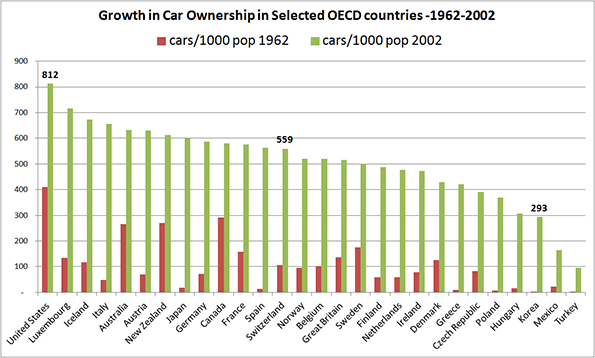
    Image from BigStockPhoto.com

  • It’s Becoming Springtime for Dictators

    In a rare burst of independence and self-interest, the California Legislature, led by largely Latino and Inland Democrats, last month defeated Gov. Jerry Brown’s attempt to cut gasoline use in the state by 50 percent by 2030. These political leaders, backed by the leftovers of the once-powerful oil industry, scored points by suggesting that this goal would lead inevitably to much higher fuel prices and even state-imposed gas rationing.

    Days later, however, state regulators announced plans to impose similarly tough anti-fossil-fuel quotas anyway. This pronouncement, of course, brought out hosannas from the green lobby – as well as their most reliable media allies. Few progressives today appear concerned that an expanding, increasingly assertive regulatory state, as long as it errs on the “right side,” poses any long-term risks.

    Welcome to the new age of authority, in which voters’ mundane concerns are minimized, and the bureaucracy – backed by an elected executive – rules the roost, armed with full confidence that it knows best. Nor is this merely a California phenomenon. Rule by decree has become commonplace in Washington, D.C., as President Obama seems to dictate policies on everything from immigration to climate change without effective resistance from a weak Congress and a listless judiciary.

    While no modern leader since President Richard Nixon has been so bold in trying to consolidate power, this centralizing trend has been building for decades. Since 1910, the federal government has doubled its share of all government spending to 60 percent and grows ever more meddlesome in people’s daily lives. Its share of GDP has now grown to the highest level since the Second World War.

    Read the entire piece at The Orange County Register.

    Joel Kotkin is executive editor of NewGeography.com and Roger Hobbs Distinguished Fellow in Urban Studies at Chapman University, and a member of the editorial board of the Orange County Register. He is also executive director of the Houston-based Center for Opportunity Urbanism. His newest book, The New Class Conflict is now available at Amazon and Telos Press. He is also author of The City: A Global History and The Next Hundred Million: America in 2050. He lives in Orange County, CA.

    Flickr photo by Pranav Bhatt of drivers in Los Angeles.

  • Is This Hell or Indianapolis?

    I’ve observed many times that cities outside of the very top tier almost always come across as generic, cheesy, and trying too hard in their marketing efforts. They highlight everything about their city that is pretty much a variant on things everybody else already has (beer, beards, bicycles, etc) while downplaying the things that truly reflect their community. Call it “aspirational genericism.”

    Most places are extremely desperate to be part of the cool kids club, and so they buy the right preppy clothes, etc. and treat the things that are authentic and true about themselves as something to be ashamed of instead of celebrated.

    Today lots of cities produce videos to showcase themselves. But a while back it was cities commissioning songs, hoping for something like Frank Sinatra’s standards about New York and Chicago. These were for the most part embarrassingly cringe worthy.

    Indianapolis did the same a while back, in an effort I won’t given specifics on to protect the guilty, who were, after all, operating with the utmost sincerity.

    What I do want to highlight is though is that Indianapolis has one of the greatest songs ever recorded about a city, the Bottle Rockets’ “Indianapolis.” I have not, however, ever heard anyone in the city actually bring it up.

    And it’s easy to understand why. The song is an extremely negative take on the city in every respect. The refrain is:

    Can’t go west
    can’t go east
    I’m stuck in Indianapolis
    with a fuel pump that’s deceased

    Ten days on the road
    Now I’m four hours from my hometown
    Is this Hell or Indianapolis
    with no way to get around?

    He proceeds to regale us with a series of humorous but negative observations about the city, such as:

    Who knows what this repair will cost
    Scared to spend a dime
    I’ll puke if that jukebox
    Plays John Cougar one more time.

    Having seen the Bottle Rockets in concert many times, I can tell you that songwriter and lead singer Brian Henneman really does seem to dislike Indianapolis, where he apparently had an actual bad experience. (His hometown is somewhere near St. Louis, and he spent a lot of time with the Uncle Tupelo crew in Southern Illinois – and environment one would not expect to encounter someone looking down on Indy).

    Nevertheless, this is an amazingly great song. Here’s a 1991 acoustic demo version recorded with Jeff Tweedy and Jay Farrar. If the video doesn’t display, click over to listen on You Tube.

    While it’s probably a bridge too far to suggest that the city should embrace this song as a branding anthem, I’d like to point out that many nicknames and branding aspects of cities started out as digs. And let’s be honest, the idea of being trapped in Indy without a car isn’t that far from the truth. I might also observe that gangster rap became a phenom precisely because it did not deny the reality of life in the inner city.

    Here’s another, though not a song but a TV commercial. This one is a local legend. You’ll have to watch it to believe it. It’s a TV ad for local institution “Don’s Guns.” The eponymous Don was famous for his slogan, “I don’t want to make any money, folks. I just love to sell guns.” If the video doesn’t display for you, click over to watch on You Tube.

    If you search “Don’s Guns” on You Tube you can watch a variety of other colorful ads.

    Again, this is not likely to be something that will be used in the chamber of commerce’s marketing materials anytime soon. But if you don’t live in Indy, wouldn’t you find the idea of a bunch of people there who love guns believable? Of course you would, because it’s true. Indiana is a state that explicitly includes a right to bear arms for self defense in its constitution. Now, many people locally may not like guns, but at some point people are going to discover the actual reality of the place, even if you don’t tell them about it. And believe it or not there’s a large market of people who have an interest in guns. If you want to try to market to the gun-free crowd, are they likely to put Indy at the top of their list anyway? You’re probably fighting an uphill battle.

    Then lastly back to music. If there’s one thing that people around the world know about Indianapolis, its the Indianapolis 500. So it’s no surprise that the city and race were featured in the 1983 song “Indianapolis” by Puerto Rican boy band Menudo. There’s even a music video for it. You should click over to watch on You Tube as this copyrighted music has playback restrictions.

    This one, it’s true, is a cultural relic that has not stood the test of time, other than for retro flourish purposes (though it’s not a bad song). But it seems to be little known locally. I didn’t know about it until a message board commenter linked some years back. And I haven’t seen a marketing campaign around the city focused on auto racing in a long time.

    The struggles of working class life in a car dependent town, guns, and auto racing. Not the makings of glamour, but certainly authentic. Jim Russell and others have written a lot about rembracing the industrial heritage of the Midwest as “Rust Belt chic.” Indy is not really Rust Belt in the same sense as Cleveland or Pittsburgh. But these items are part of its own unique take on the formula. What could potentially be done with them?

    Certainly Texas has done well by being Texas. And Nashville has succeeded by being unapologetic about country music. And I’ll point out again that the Midwest repudiated its own heritage of agriculture, workwear, and blue collar lagers only to have them picked up by Brooklyn hipsters and made cool again. The Midwest threw its culture away and Brooklyn bought it out of the thrift store. Now the region is reimporting is own birthright after it has been made “safe” by the embrace of the cool kids. Midwest cities should have owned local and urban agriculture. But of course, in a region of places like Columbus that are deeply ashamed of being seen as “cow towns”, that was simply impossible. If Brooklynites ever start buying up old Chevy Vans, expect that only then will a place like Indy embrace the reality of that culture as well.

    Aaron M. Renn is a senior fellow at the Manhattan Institute and a Contributing Editor at City Journal. He writes at The Urbanophile, where this piece first appeared.

  • Running The Numbers On Transport Options

    Households are offered a great deal of advice which seems intended to dissuade them from using private, motorised transportation — that is, cars. Information about the negative fallout of car ownership — environmental and otherwise — has often been coloured with ethical overtones. Yet, despite those exhortations and the many well-known and indisputable reasons to cut back, extensive reliance on personal motor transport remains unchanged, if not growing. For example, the rate of car ownership since 1962 has doubled in the US, Canada, Australia and New Zealand; quintupled in Switzerland, Norway and Belgium and tripled in Sweden. This persistent growth alone undermines the claim of a high cost of ownership.

    Other trends also back up the notion that cost is not a key issue, and does not belong among the arguments in favour of reducing driving.


    Chart 1. Source: Joyce Dargay, Dermot Gately and Martin Sommer: Vehicle Ownership and Income Growth, Worldwide: 1960-2030. Institute for Transport Studies, University of Leeds

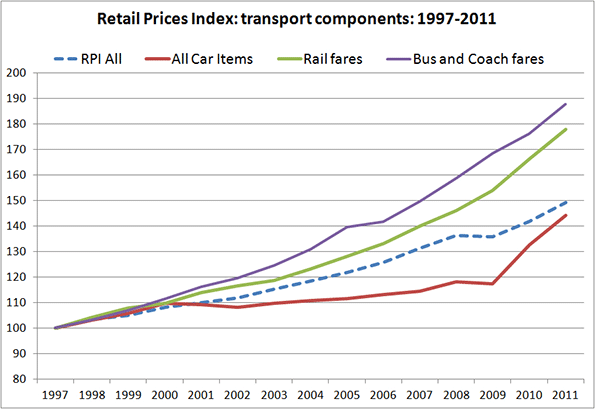
    In the US, for example, the costs of buying and operating a car have been continuously dropping. An analogous trend can be seen in the UK (Chart 2), where car costs have risen more slowly than the general retail price index, and slower than rail and bus fares (Note: The UK sustains higher tax levels and gasoline prices than the US.) It stands to reason that lower purchase and operation costs increase the car’s affordability.


    Chart 2. Source: UK Department for Transport Statistics 1997-2011 report Table TSGB0123 Retail Prices Index: Transport Components.

    Since 1979, incomes in developed countries have been on a rising trend, despite transient periods of economic stagnation. Increased buying power has made numerous commodities — including cars — more accessible.

    The obvious affordability of personal motorized transport does not mean that it will or should obliterate other, more affordable transport options: public transit in all its forms, and bicycling or walking.

    Public transit’s drawbacks are inflexibility and tardiness. Its reach often excludes employment sites at peripheral locations; as a Brookings Institute report has noted, “…Among very large metro areas, the share of jobs accessible via transit ranges from 37 percent in Washington and New York to 16 percent in Miami.” This limits access to employment for those disadvantaged households that rely entirely on transit for transportation. Though this inflexibility is shared by subway systems, subways generally have a speed advantage over cars in central, congested districts.

    The almost no-cost options of walking and cycling are limited by their low maximum speed, and by the effort required. Commuting distances in large cities can often exceed 8 to 12 miles as their diameters range between 15 to 30 miles. Those distances, when undertaken by foot or bike, become untenable because they break the universal half-hour threshold and may require excessive effort. These modes are also ill-suited to trip chains, which involve multiple tasks and destinations on a single trip (e.g. combining work commuting with school drop off/pick-ups, shopping, etc). As with transit, biking and walking has a limited reach of employment destinations. Moreover, a percentage of households may also find it difficult to accommodate all their transportation needs based entirely on these two modes.

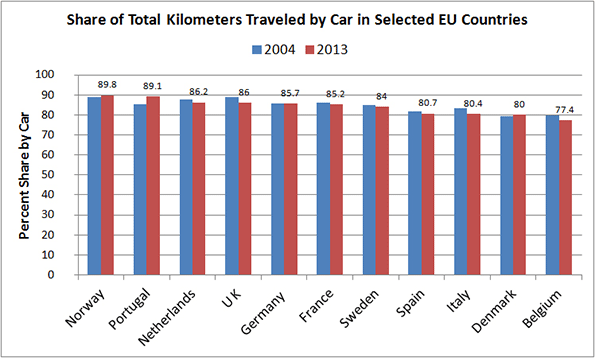
    For these and many more reasons, reliance on private vehicles is extensive. That fact is supported by statistics on mode choice among Europeans, who typically have large shares of walking and bicycle trips. The data shows that, when looking at the total kilometers traveled by mode, personal motorised transport takes the lion’s share.


    Chart 3. Source: Modal Split of Passenger Transport [tran_hv_psmod] – Eurostat, last update 2015

    New ideas in transport that include transit, biking, and new forms of car use are emerging. The innovative solutions that follow are consistent with city-building and environmental objectives. Here are a few possibilities, still in a nascent stage:

    Shared car enterprises have sprung up in many urban centers, and offer the convenience of a car without the financial burden of ownership. They reduce total personal driving, and therefore greenhouse gasses (GHGs), as their use is intermittent.

    Pay as you drive car insurance and, a recent entry, pay by how you drive insurance. Both provide an incentive to drive less and better. They could reduce car ownership costs, congestion and GHGs.

    Electric cars are more economical to operate than conventional vehicles, while reducing pollution and city noise—all positive attributes.

    Ride-share services, though controversial, have the potential of reducing the cost of transport by improving its economic efficiency and performance. Both the driver (car owner) and the passenger(s) lower their respective costs, as cars occupancy increases and chained trips become the norm.

    Bicycle parking at subway/rail stations increases the potential universe of a subway or rapid-transit bus line (BRT) to four times or more the area of pedestrians within easy reach. This combined personal and communal transport yields excellent affordability.

    Bike lane systems on existing streets and paths off the streets increases the perception of safety, which typically increases bike commuting.

    Enlarging and enhancing city core sidewalks increases the comfort, safety and pleasure of walking in the city by reducing or removing traffic and, in a similar vein, introducing lanes and passages in the middle of long city blocks reduces walking distances.

    Uni-tickets (e.g. London’s Oyster, or New York’s MetroCard) for all public transit services increase the convenience and affordability of public transit and lead to higher ridership.

    That’s a short, unsorted excerpt of a longer and growing list of opportunities for transportation planning initiatives. What is not growing — and needs to — is the extent and speed of implementation; a great, worthwhile challenge for planners.

    Fanis Grammenos heads Urban Pattern Associates (UPA), a planning consultancy. UPA researches and promotes sustainable planning practices including the implementation of the Fused Grid, a new urban network model. He is a regular columnist for the Canadian Home Builder magazine, and author of Remaking the City Street Grid: A model for urban and suburban development. Reach him at fanis.grammenos at gmail.com.

    After twenty-four years at Canada Mortgage and Housing Corporation, Tom Kerwin now leads an active volunteer life, including being the Science and Environment Coordinator for the Calgary Association of Lifelong Learners. He holds a Master’s degree in Environmental Studies from York University.

    Special thanks to Luis Rodriguez for collaborating in shaping this article.

    Flickr photo by Fraser Mummery; Golden Gate Traffic: Auto drivers, pedestrians and a bus on one of the most recognizable structures in the world… the Golden Gate Bridge in San Francisco, California.

  • The Energy Election

    Blessed by Pope Francis, the drive to wipe out fossil fuels, notes activist Bill McKibben, now has “the wind in its sails.” Setting aside the bizarre alliance of the Roman Catholic Church with secularists such as McKibben, who favor severe limits of family size as an environmental imperative, this is a potentially transformational moment. 

    Simply put, the cultural and foreign policy issues that have defined U.S. politics for the past have century are increasingly subsumed by a divide over climate and energy policy. Progressive pundits increasinglyenvision the 2016 presidential election as a “last chance,” as one activist phrased it, to stop “climate change catastrophe.” As this agenda gets ever more radical, the prominence of climate change in the election will grow ever more obvious.

    The key here is that the green left increasingly does not want to limit or change the mix of fossil fuels, but eliminate them entirely, the faster the better. The progressive website Common Dreams, for example, proposes eliminating fossil fuels within five or six years in order to assure “reasonable margin of safety for the world.”

    This new militancy is a break from the recent past, when many greens embraced natural gas and nuclear power as practical, medium-term means to slow and even reverse greenhouse gas growth. But the environmental juggernaut, deeply entrenched within the federal bureaucracy and pushed by a president with seemingly limitless authority, is committed increasing to the systematic destruction of one of the country’s most important, and high-paying, industries. One goal is to demonize fossil fuel producers along the lines of the tobacco industry.

    The pope’s intervention has bolstered the tendency within the environmental movement not to allow any challenge to its own version of infallibility. This, despite discrepancies between some models of climate change and what has actually taken place.

    As we have moved from a rational discussion of the issue toward an increasingly dogmatic agenda, we have lost sight of more pragmatic, and less economically painful, ways to reduce greenhouse gases through methods such as conservation, the substitution of natural gas for coal, and a re-embrace of nuclear power. As the Breakthrough Institute has shown, most reductions in greenhouse gases in the United States have not come from subsidized renewable energy sources but instead from improved efficiency and the rise of natural gas at the expense of coal. Overall, solar and wind, the favorites of the greens, account for barely 1.35 percent of the world’s energy.

    The Breakthrough Institute’s pragmatism intends to create a middle ground between the left, which demonizes even the slightest criticism of green policy dogma, and the right, which equally mistakenly dismisses climate change as essentially a fabrication. But with the extremes in control of the debate, we can expect next year to mainly hear divisive discourse instead of solutions.

    The Geography of Energy

    In some parts of the country, most notably the Northeast and the West Coast, the imperatives of climate change demand the destruction of the fossil fuel industry. In others, those that depend the most on low-cost energy, the attack on fossil fuels represents a moral threat to local economies, jobs and well-being. The battleground will be in the Great Lakes, arguably the most critical region for the next election. Contrary to its sad sack image, the economy there has been on the rebound for years. Virtually every Great Lakes state except Illinois now enjoys unemployment rates below the national average. Several, led by the Dakotas, Minnesota, Nebraska, and Iowa, boast job rates that are among the nation’s highest. 

    Three key factors are propelling this comeback: an energy boom, a resulting jump in manufacturing, and relatively low housing costs. Energy firms have been a major source of new work for industrial firms, and lower electricity costs have provided U.S. manufacturers with an energy price advantage over European and Asian firms. German electricity prices, a result of their “green” energy policies, are almost three times the average of those in the United States.

    The administration’s directive to all but ban coal could be problematic for many Midwest states, including several—Iowa, Kansas, Ohio, Illinois, Minnesota and Indiana—that rank among those most reliant on coal for electricity. Not surprisingly, much of the opposition to the EPA’s decrees come from Heartland states such as Oklahoma, Indiana, and Michigan.  

    Politically, the energy-rich states running from Texas, Oklahoma, and Louisiana up to the Dakotas may be all but lost to the Democrats. Before the decline in oil prices, these areas enjoyed a gusher in energy jobs, providing high wage employment (roughly $100,000 annually) that exceeds compensation for information, professional services, or manufacturing. Due largely to energy, they have enjoyed the highest jobs growth since 2007 and were among the first states to gain back the jobs lost in the recession. 

    In contrast, the areas that form the solid base of the progressives—basically the Northeast and the West Coast—have an increasingly small stake in fossil fuel industries. California, which has the fifth largest oil reserves among the states, has basically decided to abandon the industry, gradually pushing the remnants of what was once a thriving sector out of the state.

    For the most part, with the notable exception of Pennsylvania, Northeastern states have little in the way of fossil fuels, and have gradually been eliminating much of their manufacturing base for over a half century. Nor do they have much need for electricity for industry as they continue to deindustrialize. Manufacturing accounts for barely 5 percent of state domestic product in New York and 8 percent in California—but 19 percent in Michigan and 30 percent in Indiana.

    Rise of the Climate-Industrial Complex

    Climate activists such as hedge fund billionaire Tom Steyer increasingly couch their policies on theological grounds, one reason why the pope’s intervention was so timely. Stark self-interest is also at work. Many of the Silicon Valley and Wall Street supporters of green policies have been among those most anxious to capitalize on big oil’s demise. 

    This includes cash-rich firms such as Apple, as well as many high-tech financiers and venture capitalists. Some of the biggest new fortunes, notably that of Elon Musk, are largely the creatures of subsidies. Neither SolarCity nor Tesla would be so attractive—and might even not exist—without generous handouts from taxpayers.

    In contrast to traditional manufacturers, capitalists like Musk have a well-developed interest  in taking advantage of the most draconian energy legislation. Other tech figures, including top executives atGoogle, have benefited from government-subsidized renewable energy schemes, including a remarkably inefficient and expensive solar project that has obliterated a huge part of the Mojave Desert. 

    No surprise, then, that the crony capitalists of Silicon Valley and their Wall Street financiers have emerged as primary funders of the green left. Much like the oil firms that help finance Republicans, particularly those who are climate change skeptics, the new oligarchs have solid business reasons to embrace the pontiff’s environmental dogma, though they seem unlikely to follow his admonitions to eschew corporate greed.

    Ironically, the new militancy among greens is likely to hurt most the poor and working class with whom Pope Francis takes pains to identify. A rapid ban on fossil fuels in the developing world would hurt efforts to increase access to electricity. Today, some 1.3 billion people  are off the grid, and not by choice. In sub-Saharan Africa, where much of the world’s population growth is expected to take place, roughlytwo-thirds of the population lacks regular access to electricity.

    As Bjorn Lomborg has pointed out, whatever the negative effects of climate change on the poor, the impact of no electricity and poor sanitation are infinitely greater. Climate change policies, he notes, are an inefficient way to accomplish such things as reducing malaria; the Kyoto Protocol’s carbon cuts could save 1,400 malaria deaths for about $180 billion a year. More traditional approaches could save 300,000 people for about $500 million year.

    Greens seem to have little idea what the poor want or need. When asked, people in developing countries prioritize such things as education, health care, job opportunities and better food; climate change ranked 16th—dead last on the list—according to a UN survey.

    But the green gentry retain their catechisms. Prince Charles embraces the “intuitive grammar” of ultra-dense slums such as Mumbai’s Dharavi, which, he claims, have perfected more “durable ways of living” than those in the suburbanized West.San Francisco’s Friends of the Earth  similarly applauds slum-dwellers as an “inspiration” for the low-carbon urban future, while Stewart Brand openly endorses the notion, “Save the Slums,” because they will save the planet.

    Needless to say, it’s unlikely these apostles of urban squalor would want their children to live like that and it is absurd to suppose that leaders of such emerging powers as India and China have any intention of giving up on their gains in reducing poverty. We cannot expect they will accommodate the passions of wealthy Westerners at the expense of their own people.

    A War on the Western Working Class?

    Those most likely to pay for the new green agenda will be middle- and working-class populations in what are now rich countries. Germany spends hundreds of billions of dollars on solar panels and wind turbines that provide only an unreliable 15 percent of its electricity and 3 percent of its total energy. German consumers pay three times more for electricity than the average American. It’s so bad that Germans have added a new term to the language: “energy poverty.”

    Perhaps the best test case for the impact of draconian climate policies is in my adopted home state of California. Here, high energy costs brought about by renewable mandates have devastated manufacturing growth and boosted electric bills, particularly in the poorer, and hotter, inland areas. Asone recent study found, the summer electrical bills in rich, liberal Marin come to $250 monthly while in impoverished Madera, the average is twice as high.

    Of course, energy policy is just one of the things raising poverty in a state where many of the world’s greatest fortunes are being minted. But it’s part of a climate change-driven agenda that is also somewhat responsible for the state’s absurdly high housing costs by consciously limiting affordable suburban growth. Overall, nearly a quarter of Californians live in poverty, the highest percentage of any state, including Mississippi, and, according to a recent United Way study, close to one in three are barely able to pay their bills.

    With the blessings of the pope and broad support in the media, few Democrats are likely to stand up against the green policies. Hillary Clinton’s shift against the Keystone XL Pipeline, despite strong union support for the project, shows that she is willing to trade blue-collar workers in the Heartland for the approval of the coastal gentry, among whom climate change has acquired something of a religious aspect. “Whether it’s eating vegetarian or wearing organic eye shadow, we’re all shopping for absolution,” observes Daniel Engber in Slate.

    Ultimately Democrats will embrace the determined attempt by President Obama to secure his “legacy” as the great calmer of the Earth’s climate. Yet there’s some question how effective these policies will prove. Invariably, efforts will follow to silence those skeptical of the current course, particularly regarding the economic impact on working-class voters. In California, Steyer and his allies have worked overtime to suppress any potential dissent from politicians who hail from the largely Latino, blue-collar districts hit most directly by these policies.

    Despite a massive investment in Latino “grassroots” front groups, as well as politicians, this effort is not foolproof. This month a handful of largely Latino and inland Democrats, some of them backed by the state’s residual energy industry, killed Jerry Brown’s attempt to force a 50 percent reduction in fossil fuel use by 2030, a measure that would have allowed the state impose gas rationing.

    To be sure, this rebellion may prove short-lived, as state regulators now seem determined to impose by decree what could not even make it through the state’s Democratic-dominated legislature. Steyer loyalists such as State Senate President Kevin de Leon will continue to mollify his impoverished constituents–nearly half of all households in his district earn less than $34,000 a year—with handouts from “cap and trade funds” and the ever illusive chimera of “green jobs.”

    In truth, if anyone has benefited from green policies and subsidies, it’s been the well-off.

    They are the ones who benefit from subsidized solar, electric vehicles, and fuel-efficient cars; a recent UC Berkeley study found the top fifth of households received 60 percent of these wealth transfers, compared to barely 10 percent of those in the bottom quintile. Generally speaking, barrio residents don’t drive $100,000 Teslas.

    So will climate change be an effective issue for the Democrats next year? There is room for skepticism. In 2014 Steyer and his acolytes spent some $85 million on “green” candidates, only to fail impressively. Geography and class work against their efforts, driving longtime working and middle-class Democrats, driving voters in places like Appalachia, the Gulf Coast and some areas of the Great Lakes increasingly out of the Democratic Party.

    It is not even certain that Millennials, faced with diminishing prospects for good jobs and home ownership, will prove reliable backers of a draconian climate agenda. One recent survey suggested that young voters are actually less likely to identify as “environmentalist” than previous generations. 

    Like extreme social conservatism on the right, climate change thrills the coastal “base” of the Democratic Party, but threatens to lose support from other parts of the electorate. Despite the duet of hosannas of both the hyper-secular media and the Bishop of Rome, a policy that seeks, at base, to reduce living standards may well not prove politically sustainable.

    This piece originally appeared at Real Clear Politics.

    Joel Kotkin is executive editor of NewGeography.com and Roger Hobbs Distinguished Fellow in Urban Studies at Chapman University, and a member of the editorial board of the Orange County Register. He is also executive director of the Houston-based Center for Opportunity Urbanism. His newest book, The New Class Conflict is now available at Amazon and Telos Press. He is also author of The City: A Global History and The Next Hundred Million: America in 2050. He lives in Orange County, CA.

    Midwest drilling rig photo by Bigstock.

  • Providing Electricity to Africa by 2050

    How many Africans will have access to electricity by 2050?

    According to the World Bank’s latest figures, 64.6% of the population of sub-Saharan Africa lacked access to electricity in 2012, or a total of 572 million people. Across the world, 1.09 billion have no access to electricity. So, sub-Saharan Africa accounts for more than half the total.

    Given the expected boom in the African population and the likely increase in access, the demand for electricity infrastructure is going to explode between now and 2050. On UN estimates (medium variant), the sub-Saharan population will jump from 886 million in 2012 to 2.1 billion in 2050. Assuming that each country’s current access rate remains the same, 381 million additional people will have access to electricity and 855 million additional people will not.

    Screen Shot 2015-09-15 at 4.33.48 PM (2)

    In order to maintain its current low rate of access, sub-Saharan Africa would have to increase its power generation by at least 100%, and more likely by 200% or more if one accounts for the frequent power outages across the continent.

    In order for the subcontinent to raise to 50% the percentage of people who have electricity on a reliable basis, it would need to increase its electricity generation by a factor of 3 to 5.

    Power Africa

    Then there is President Obama’s Power Africa initiative launched in 2013 which seeks to “double access to power in sub-Saharan Africa”. At first, Power Africa focused on six countries – Ethiopia, Ghana, Kenya, Liberia, Tanzania and Nigeria – and its goal was to add 10,000 megawatts of electricity generation and 20 million new connections.  But during the US-Africa Leaders Summit of 2014, the program was expanded to other countries and its scope was tripled to 30,000 megawatts and 60 million new connections. (Note: this assumes 2,000 connections per megawatt. In developed countries, the ratio is often closer to 1,000 connections per megawatt).

    July 2015 fact sheet from the White House states that Power Africa has helped bring on line 4,100 megawatts to 4 million connections. But critics claim that these projects were already in progress before the program was introduced and that new projects have been slow to get off the ground. As reported in this New York Times article, Sam Amadi, chairman of the Nigerian Electricity Regulatory Commission, the country’s electric power regulator, recently said that he was “not aware of any concrete plans for power plants that have emerged as a result of Power Africa.”

    In the long term, if ‘double access’ means doubling the number of people who have access to electricity without necessarily increasing individual consumption, that would translate into access for an additional 314 million people, roughly equivalent to the current size of the US population.

    But if ‘double access’ means doubling the percentage of people who have access to electricity, that would mean enough new electricity to reach an additional 1.19 billion people on the continent in 2050. This number exceeds the 2015 combined populations of the USA and Europe.

    If Africa reaches 100% access in 2050, it will have built enough infrastructure to reach 1.8 billion additional people, a near six-fold increase from the number that have access today.

    Other populous nations of the world already enjoy higher access rates. But here also, there is likely to be significant new demand from rising population numbers. Assuming the same access rates in 2050 as in 2012, there would need to be new infrastructure to reach an additional 708 million people living in Mexico, Brazil and several Asian countries.

    Per Capita Consumption

    At the same time, ‘access’ can mean different things to different people. In the United States, per capita consumption of electricity stands at nearly 13,000 kWh. In China, it is 3,475 kWh. In India, 744 kWh and in much of sub-Saharan Africa, it is less than 500 kWh. Below are per capita consumption numbers for Africa.

    Screen Shot 2015-09-23 at 2.25.54 PM (2)<

    And here are per capita consumption numbers for other emerging nations:

    Screen Shot 2015-09-23 at 2.26.12 PM (2)

    As usual, financing and execution will be the main hurdles but it is clear that the demand for new electricity infrastructure is going to be very very high in Africa and in Asia.

    Sami Karam is the founder and editor of populyst.net and the creator of the populyst index™. populyst is about innovation, demography and society. Before populyst, he was the founder and manager of the Seven Global funds and a fund manager at leading asset managers in Boston and New York. In addition to a finance MBA from the Wharton School, he holds a Master’s in Civil Engineering from Cornell and a Bachelor of Architecture from UT Austin.

    Photo by DIVatUSAID via Flickr

  • New Report: Putting People First

    This is the abstract from a new report “Putting People First: An Alternative Perspective with an Evaluation of the NCE Cities ‘Trillion Dollar’ Report,” authored by Wendell Cox and published by the Center for Opportunity Urbanism. Download the full report (pdf) here.

    A fundamental function of domestic policy is to facilitate better standards of living and minimize poverty. Yet favored urban planning policies, called "urban containment" or "smart growth," have been shown to drive the price of housing up, significantly reducing discretionary incomes, which necessarily reduces the standard of living and increases poverty.

    This makes the alleviation of poverty, the opportunity for better living standards and aspirations for upward mobility secondary to contemporary urban planning prescriptions. Despite this, calls to intensify land use regulations are becoming stronger and more insistent.

    A New Climate Economy report (NCE Cities report), by Todd Litman, "Analysis of Public Policies that Unintentionally Encourage and Subsidize Urban Sprawl," contends that the failure to implement urban containment policy (smart growth) costs more than $1.1 trillion annually in the United States. The urban containment policies favored by the NCE Cities report seek substantially increase urban population densities and transfer urban travel from cars to transit, walking and cycling.

    There are serious consequences to such policies, which lead to lower standards of living and greater poverty. This report evaluates the NCE Cities report which places urban containment policy as its most important priority. This Evaluation report offers an alternate vision, focused on improving living standards for all, while seeking to eradicate poverty.

    The NCE Cities report relies heavily on social costing and externality analysis of lower density development. While these are useful tools, they are ultimately subjective and should be used with great caution.

    This Evaluation identifies a number of issues with respect to the NCE Cities report cost analysis.

    1. Nearly 90% of the cost is attributable to personal vehicle use, and is based on a fixed cost per mile differential between the Most Compact (densest) quintile of US urban areas and the four quintiles that are less dense. This Evaluation finds a range of differences in per capita mileage among the quintiles that is far smaller than the NCE Cities report estimates. Adjustment for this and other issues would reduce the NCE Cities report cost estimate by nearly 85 percent, to a maximum that is under $200 billion. Other, unquantified issues are identified that could reduce the reduced estimate even further.

    2. The NCE Cities report largely dismisses the housing affordability consequences of urban containment policy. By rationing land, urban containment policy drives up the price of housing and has been associated with an unprecedented loss of housing affordability in a number of metropolitan areas in the United States and elsewhere. Urban containment policy has also been associated with greater housing market volatility. This is a particular concern given the role of the 2000s US housing bubble and bust in precipitating the Great Financial Crisis that resulted in a reduction of international economic output.

    3. Urban containment policy has significant negative externalities. A recent economic analysis associates an annual loss of nearly $2 trillion in gross domestic product in the United States with more stringent housing regulation. This estimate would nullify the NCE Cities report cost of dispersion estimate by more than 1.5 times. More significantly, it would dwarf the NCES Report cost estimate as adjusted in this Evaluation.

    The purpose of public policy in cities is not to focus a particular urban form, planning philosophy, type of housing, population density, or mode of transport. The purpose is rather to seek better lives for people. The most appropriate form of urban planning policy is that which facilitates better living standards and less poverty. There is increasing evidence that urban containment policy is not only irreconcilable with housing affordability and price stability but also with better standards of living and reduced poverty.

    Download the full report (pdf) here.

    Wendell Cox is Chair, Housing Affordability and Municipal Policy for the Frontier Centre for Public Policy (Canada), is a Senior Fellow of the Center for Opportunity Urbanism (US), a member of the Board of Advisors of the Center for Demographics and Policy at Chapman University (California) and principal of Demographia, an international public policy and demographics firm.He is co-author of the "Demographia International Housing Affordability Survey" and author of "Demographia World Urban Areas" and "War on the Dream: How Anti-Sprawl Policy Threatens the Quality of Life." He was appointed to three terms on the Los Angeles County Transportation Commission, where he served with the leading city and county leadership as the only non-elected member. He served as a visiting professor at the Conservatoire National des Arts et Metiers, a national university in Paris.

  • China’s Planned City Bubble Is About to Pop—and Even You’ll Feel It

    Seven years after the last housing debacle devastated the world economy, we may be on the verge of another, albeit different, bubble. If the last real estate collapse was created due to insanely easy lending policies aimed at the middle and working classes, the current one has its roots largely in a regime of cheap money married to policies of planners who believe that they can shape the urban future from above.

    This time, the potential property blowout has roots in large part outside the United States. Many of China’s current problems, in fact, can be traced in part to its unhealthy inflation of real estate values spurred by a drive to increase urbanization and density. Last year, The Economist estimated median home price to median income of nearly 20 in Shenzhen, 17 in Hong Kong, and more than 15 in Beijing, between 50 percent and 100 percent higher than ultra-expensive places (PDF) like San Francisco, Vancouver, or Sydney.

    At the same time, China’s response to these soaring prices has been to limit demand, but there’s little effort to liberalize land use that would allow for more affordable, less congested housing.

    This emphasis on high-density development also threatens the country’s demographic future. Fertility rates in Shanghai and Beijing, notes Singapore-based demographer Gavin Jones (PDF), are already among the lowest found anywhere in the world, as low as one-third the necessary rate to replace their population. Jones’s research has shown an association between higher density living and far below replacement fertility rates.

    As a highpoint in social engineering, a whole new dense city (Kangbashi) has been constructed by the Ordos, Inner Mongolia city government, in the middle of nowhere, growing, but still apparently mainly vacant.

    The key here is not so much planning, per se, but planning in a manner that ignores the aspirations of people. Americans no more want to live stacked in boxes in the middle of nowhere than do their Chinese counterparts. America’s public housing may have been a notable disaster, but many private-sector-led planned developments have been remarkably successful. What works is planning that matches people’s aspirations, like those developments made by such giants as the late Bill Simon, who died Monday, in Reston, Virginia. But Simon’s development was not unique. Valencia and Irvine in southern California as well as the Woodlands and Cinco Ranch on the fringes of Houston have continued to thrive, and generally outperform their less planned alternatives.

    Catching China’s Cold

    For the first time in a century, America may not be the source of the next “global recession;” that honor, so to speak, notes Morgan Stanley’s Ruchir Sharma, could well go to China. The country’s sky high real estate prices—and the prospect of their fall—will mean far more to the world than the recent widely ballyhooed downturn in the country’s stock markets. In reality, relatively few Chinese actually participate in equities. Only one in 30 Chinese owns stock. Investment in property is by far the favorite means by which affluent Chinese invest in the future.

    This obsession with property is now being felt around the world. Real estate and hospitality, mostly hotels, accounted for 65 percent of China’s $6.4 billion investment in the US in the first half of 2015. This has been a major part of theoutflow of capital from China, which, at least until recently, has been accelerated by the perception of a weakening economy. Now the government appears ready to impose greater restrictions on private overseas investment, something that is already noted among real estate insiders in California. A devalued yuan, a sure sign of a weakening economy, also means Chinese investors will have less to spend in dollar terms.

    Nowhere will this be more keenly felt than in countries like Australia, which has been a primary recipient of Chinese flight capital as well as immigration. Chinese students, as well as investors, have been critical to boosting the prices of Australian property, and losing their dollars could cause what some see as an impending crash in multi-family apartment across Australia. Census authorities in Australia indicate that mainland Chinese represent the third largest foreign-born segment of the population, trailing only the United Kingdom and New Zealand, long the principal contributors of overseas immigrants.

    Making matter worse

    The blame for the pending Australian meltdown however comes not just from China, but from the policies embraced by most of Australia’s planning authorities. Despite the fact that barely one-quarter of 1 percent of the country’s land is occupied, these authorities insist on promoting high-density development, even in old attractive suburbs. The result has been soaring prices for single-family homes, which, in Australia as elsewhere, are far more popular than the high-density housing preferred by planners. Upwards of 90 percent of people surveyed felt it was worthwhile to buy a house. This was marked particularly among people with children.

    This disconnect between people and planners has turned Australia, a country of boundless spaces, into a nation with some of the most expensive cities in the world. Remarkably, Sydney is more expensive than virtually any American city and Melbourne is not far behind. Even middle-of-nowhere Adelaide, in the country’s temperate south, has housing costs, relative to income, of much larger and infinitely more consequential Seattle.

    Australia is not alone in suffering the potentially lethal combination of planning orthodoxy and dependence on Chinese investment—this toxic mash up also applies to Canadian cities such as Toronto and Vancouver, which have imbibed the high density mantra, producing home prices well above those of most North American cities. Like Australians, the vast majority of Canadians prefer single-family houses. The Organization for Economic Cooperation and Development (OECD) has noted that Canada’s house prices have risen faster in recent years than those in any other high-income nation.

    American realities

    Traditionally, planning in the United States was liberal in the classical sense, that is, responsive to market forces. But increasingly, particularly during the Obama years, state planning agencies, notably in California, and the federal Department of Housing and Urban Development (HUD) have embraced a largely anti-suburban, pro-density agenda. In 2010, HUD Secretary Shaun Donovan, pointing to foreclosures in suburban Phoenix, claimed that the die was already cast: “we’ve reached the limits of suburban development,” Donovan claimed. “People are beginning to vote with their feet and come back to the central cities.”

    In embracing density as a preferred national policy, HUD is now following a path blazed earlier by planners in England, China, the former Soviet Bloc, and a handful of U.S. metropolitan areas.

    Alexei Gutnov, one of the authors of the book The Ideal Communist City,acknowledged that in suburban development “ideal conditions for rest and privacy are offered by the individual house situated in the midst of nature.” But Gutnov feared that such housing might lead the citizen to “separate himself from others, rest, sleep, and live his family life,” which would make it harder for the state to steer him to the proper “cultural options.”

    Socialist planning led to few Levittowns, but such mass and affordable housing flourished in capitalist America—albeit to the horror of many planners, academics, urban boosters, and inner city real estate developers.

    Yet roughly 80 percent of Americans prefer the sort of single family housing found primarily in suburbia, according to a 2011 study conducted by the National Association of Realtors and Smart Growth America. Among home-owning households, apartment style dwellings (multi-family, including high rise condominiums) are the fourth most popular type of housing (5.3 percent), following detached (82 percent), mobile homes (6.4 percent), and attached or townhomes (5.7 percent). Only boats, RVs, etc. have less of the market, at 0.1 percent, according to the newly released 2014 American Community Survey.

    Even in the Portland metropolitan area, where smart growth policy is perhaps the most entrenched in the United States, a public opinion research report (PDF) co-sponsored by the agency managing the land use regulation system, found that 80 percent of respondents would prefer a detached house.

    Yet, like Soviet planners and their Chinese counterparts, our political elite and the planning apparat seem to care little about preferences, and have sought to limit single-family homes through regulations. This is most evident in California, notably its coastal areas, where house prices and rents have risen to hitherto stratospheric levels.

    The losers here include younger middle and working class families. Given the regulatory cost, developers have a strong incentive to build homes predominately for the affluent; the era of the Levittown-style “starter home”, which would particularly benefit younger families, is all but defunct. Spurred by the current, highly unequal recovery, these patterns can be seen elsewhere, with a sharp drop in middle income housing affordability while the market shifts towards luxury houses.

    These distortions in the market have been exacerbated by rising demand fromChinese buyers, which tends to concentrate at the luxury end of the market. Decreasing middle income housing supply has driven declining affordability for both renters and owners for a decade or more. Overall, U.S. housing production dropped not only since the 2007 recession but also by almost a quarter between 2011 and 2015. In California, production has fallen so far that one Texas metropolitan area, Houston, produced nearly as many new single-family homes in 2014 as the entire state of California.

    The resultant boost in housing prices has worked its way into rents, too, largely by forcing buyers into the apartment market, and driving up rental rates to the largest share of income in modern U.S. history. In part this is due to a still weak economy that is generating little in the way of income gains; overall housing prices have been rising by more than twice that of incomes. Since 1990 renters’ income has been stagnant, while inflation-adjusted rents have soared 14.7 percent.

    This situation, of course, is most severe in the highest priced markets. In New York, Los Angeles, Miami, and San Francisco, for example, renters spend 40 percent of their income on rent, well above the national average of less than 30 percent. In each of these markets there have been strong income adjusted increases relative to historic averages. In New York, rents increased by 50 percent between 2010 and 2015, while incomes for renters between 25 and 44 grew by just 8 percent.

    One critical point: high density does not, as is commonly claimed by urban containment advocates, help solve the affordability issue. High density housing is far more expensive to build than single family or townhouse developments. Gerard Milder (PDF), the academic director at the Center for Real Estate at Portland State University, notes that a high rise of more than five stories costs nearly three times as much to build as a garden apartment. An analysis of costs in the San Francisco Bay Area found townhome developments can cost up to double that of detached houses per square foot (excluding land costs) and units in high-rise condominium buildings can cost up to 7.5 times as much. Not surprising, we now face an impending surplus of expensive, multi-family units in places where single-family housing is preferred by most and affordable housing is a dire necessity for many others.

    The Shape of the Next Bust: The Planners’ Recession

    The new real estate bust will be markedly different from the last one. In the last bubble, there was a surfeit of cheap capital loaned, often without adequate financials, to working and middle class people. The results were particularly harsh in places where strong urban containment (“smart growth”) policies were in effect—notably California, Arizona and Florida—and prices elevated as a result. In contrast more liberal markets, notably Texas, suffered far less while Florida has since repealed its urban containment requirements.

    Today’s emerging potential bubble is driven in large part by low interest rates and a new post—TARP financial structure, anchored by ultra-low interest rates, which favor wealthy investors, including those from China and other capital exporting countries. This, plus planning policies, has accelerated a boom in multi-family construction, much of it directed at high-end consumers. In New York andLondon, wealthy foreigners as well as the indigenous rich have invested heavily in high-rise apartments, many of which remain empty for much of the year. In San Francisco, for example, roughly half of all new condos are owned by non-residents, including both Chinese investors and Silicon Valley executives.

    Since the vast majority of people cannot afford to buy these apartments, even if they want them, this kind of construction does little to address the country’s housing shortage. Much of the building in the most expensive markets, such asWashington, is well out of the reach of the vast majority of residents, which should be sending warning signals to investors.

    The signs of an impending downturn are already there, for those who wish to look for them. In Southern California, which has seen the most multi-family construction in recent years, multi-family starts have dropped dramatically this year from last; a similar process seems to be occurring in the ultra-expensive San Francisco metropolitan area, where currently only 11 percent of homes can be afforded by the median income family. This is one-sixth the national rate. Washington, Philadelphia, Dallas-Fort Worth, Houston and Phoenix—once hotbeds of apartment construction—have also slowed appreciably.

    The high-density push by investors and regulators also misses the larger demographic trend. Suburban growth may have slowed in the immediate aftermath of the recession, but Trulia reported that between 2011 and 2012 less-dense-than-average ZIP codes grew at double the rate of more-dense-than-average ZIP codes in the 50 largest metropolitan areas. By 2013 urban core growth, then about as fast as suburbs, had once again slipped behind suburbs and exurbs. These trends intensified by 2014, with the biggest growth in exurban areas, repeating the patterns that existed before the crash.

    Nor are the preferences likely to change—despite the predilections of pundits, planners, and the political class. As most millennials enter their 30s by 2018, economist Jed Kolko suggests that demand for suburban single family houses is likely to increase dramatically. Contrary to urban legend, most surveys reveal that millennials overwhelming prefer a home in the suburbs. Even the Urban Land Institute, historically no fan of the suburbs, found that more than 60 percent of the entire generation (PDF) expects to be living in a single family house by 2020, six times as many who plan to reside in a mid- or high-rise building.

    The payback for ignoring the market could be imminent. In Boston, demand for space in expensive residential buildings—where a 500-square-foot studio in the Fenway Park area starts at $2,700 a month, and new two-bedrooms stretch into the $7,000s—may be headed toward a glut. Sound familiar?

    Even some ascendant markets like Nashville, where apartment construction is growing more than 3 percent annually, appear to be on the way to being overbuilt. If there’s a downturn in tech, which seems likely in the next year or so, expect San Jose, Raleigh, and Austin to start seeing a decline in rents and greater competition for tenants. As we can see in China, Australia, Canada, and now at home, planners’ hubris about what is best seems to lead inevitably to a new real estate bust. What we don’t need is not so much more pack and stack housing, luxury units, and absentee owners but a return to an updated version of Levittown or Lakewood. This would help middle class families and would supercharge the economy, producing three times as many jobs as multifamily construction.

    It’s about time for the political class to acknowledge that, in most cases, people know what they want better than those who claim to know best. That’s as true in Beijing or Shanghai as it is in Sydney, Toronto, or Los Angeles.

    This piece first appeared at The Daily Beast.

    Joel Kotkin is executive editor of NewGeography.com and Roger Hobbs Distinguished Fellow in Urban Studies at Chapman University, and a member of the editorial board of the Orange County Register. He is also executive director of the Houston-based Center for Opportunity Urbanism. His newest book, The New Class Conflict is now available at Amazon and Telos Press. He is also author of The City: A Global History and The Next Hundred Million: America in 2050. He lives in Orange County, CA.

    Wendell Cox is Chair, Housing Affordability and Municipal Policy for the Frontier Centre for Public Policy (Canada), is a Senior Fellow of the Center for Opportunity Urbanism (US), a member of the Board of Advisors of the Center for Demographics and Policy at Chapman University (California) and principal of Demographia, an international public policy and demographics firm.He is co-author of the “Demographia International Housing Affordability Survey” and author of “Demographia World Urban Areas” and “War on the Dream: How Anti-Sprawl Policy Threatens the Quality of Life.” He was appointed to three terms on the Los Angeles County Transportation Commission, where he served with the leading city and county leadership as the only non-elected member. He served as a visiting professor at the Conservatoire National des Arts et Metiers, a national university in Paris.

    Photo: Shenzhen:  Binhe Avenue from the Shun Hing Tower (by Wendell Cox)

  • Recent Growth and Decline of Children in Major Metropolitan Areas

    That America has an aging population is well known. Estimates data released this summer by the Census Bureau illustrate this transition in progress – and paint a picture of an actual shrinking number of children in many major American metro areas.

    From 2010 to 2014, the percentage of the population of residents under the age of 18 shrank in every single metro area with more than a million people. This reflects the aging of the population in progress.  But it’s not just that there are more older people. In about half of these major American metros, the actual number of children declined

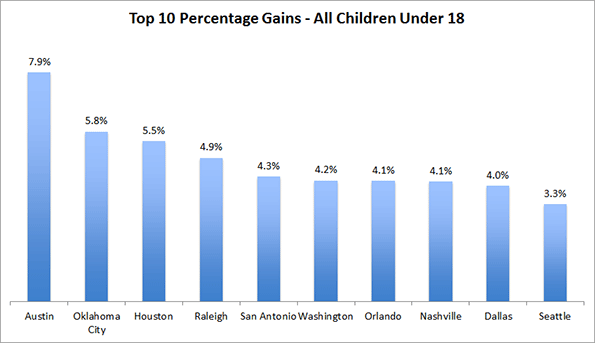
    These results roughly fall alone lines that would be expected, with regions that are rapidly growing their total population, like Austin, also strongly growing in children. In fact, Austin was the top gainer with a 7.9% increase in children. Houston (+5.5%), Washington, DC (+4.2%) and Denver (+3.1%) were also among those posting strong gains.

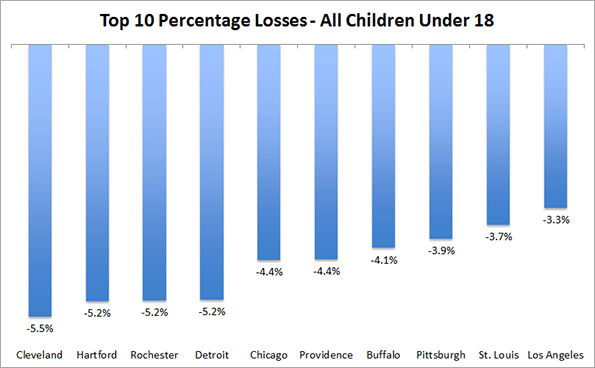
    The loss department is dominated by usual post-industrial suspects, with Cleveland being the “biggest loser” at -5.5%. Detroit (-5.2%), Chicago (-4.4%), and Philadelphia (-2.7%) were also among the losers.  But you don’t have to have crummy weather to lose kids. Notable among those losing children is Los Angeles, whose child population dropped by 3.3% or over 100,000 people. This loss is not being made up, as in the past, by the Inland Empire, with Riverside-San Bernardino also seeing its child population shrink, by 2.1% or over 25,000 people. This is a remarkable reversal for Los Angeles, once one of America’s great growth stories.

    This loss of children augurs poorly for reversing population loss or stagnation in many of these regions. With the next generation of women of childbearing age smaller than the one before it, this suggests even further declines are possible.

    In sum, while very few regions are losing population on a total basis, many more   are failing at creating the next generation of residents. Of course it  is possible to make up for natural increase in population by attracting newcomers, but consider that these statistics include the children of those recent arrivals as well.

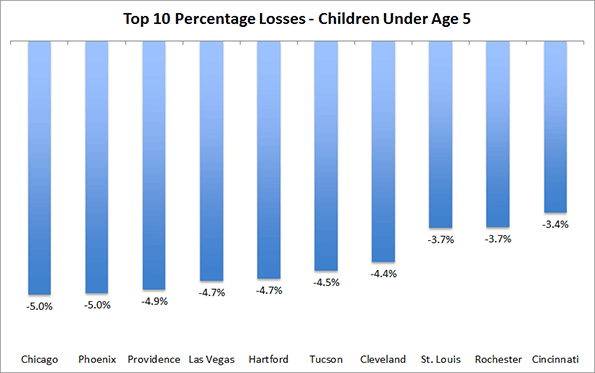
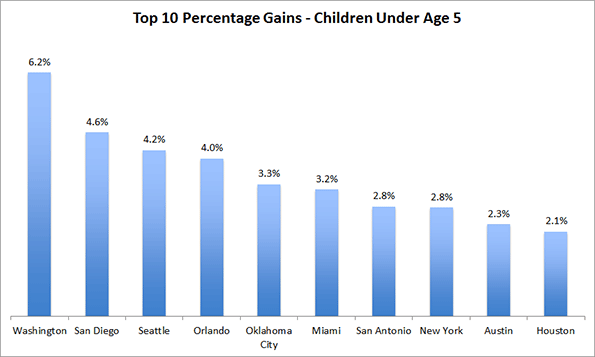
    Looking at younger, pre-school age children under the age of five, even more – 34 out of 54 – large metro areas showed a decline. This includes surprising small losses even in rapidly growing, traditional family magnets like Atlanta, Charlotte, Nashville and Kansas City. This reflects how pervasive low birthrates have become.

    Conversely, again some traditionally slower growth cities and some conventionally viewed as not child friendly– San Francisco, Seattle, and Boston  are seeing slight  gains in their population of young children even though their percentages drop. Keep in mind these are metropolitan area numbers, not central city ones, as most children, particularly those older than five, end up in suburbs. But even so, the performance of these regions is remarkable compared to declines in celebrated urban areas like Chicago and Los Angeles.

    The Pacific Northwest cities of Portland and Seattle also make for an interesting contrast. Both have experienced similar, and healthy, overall population growth since 2010, with Portland growing slightly faster.  But the Seattle area was a much stronger performer when looking at children. In fact, Seattle ranked #10 (out of 53) large metros in the country with 3.3% growth.  Portland, however, eked out only 0.4% growth.  Looking at children under age five, Seattle actually ranked third in growth at 4.2% while Portland shrank by 2.6%.

    And New York City is a particularly interesting case. Its total child population declined by over 47,000 people, or 1.1%.  But its under five population grew by over 33,000, or 2.8%, and it was one of only two large metros, along with Buffalo, that actually increased it share of the population in that age group.  Brooklyn and Manhattan led the way, each posting double digit percentage growth, though from a low base in Manhattan’s case. Queens did nearly as well.  Staten Island, traditionally the most family centered area, was the only borough to lose young children.  Long Island, Westchester, and Dutchess County lost them as well. 

    The real question is whether places like Manhattan will be able to retain these families as the kids reach school age. Its population of those 5-17 has continued to decline. Given its high costs, it’s not realistic to expect Manhattan to ever be a premier family magnet. But there are surely some city-dwellers with children who might want to stay if life with children could be incrementally better supported in the city with things, such as low crime, clean parks and good schools, that tend to matter to families. This challenge will be felt by all cities as their youth populations begin to enter their prime childbearing years.

    Aaron M. Renn is a senior fellow at the Manhattan Institute and a Contributing Editor at City Journal. He writes at The Urbanophile.

    Baby photo by Bigstock.