Blog

  • Peak People in Japan

    Japan reached "peak people" in 2011, when its population reached 127.4 million residents. From that point, all trends point to significant population losses. But, there is by no means unanimity on the extent of those population losses. Population projection is anything but an exact science, and Japan provides perhaps the ultimate example.

    Dueling National Population Projections

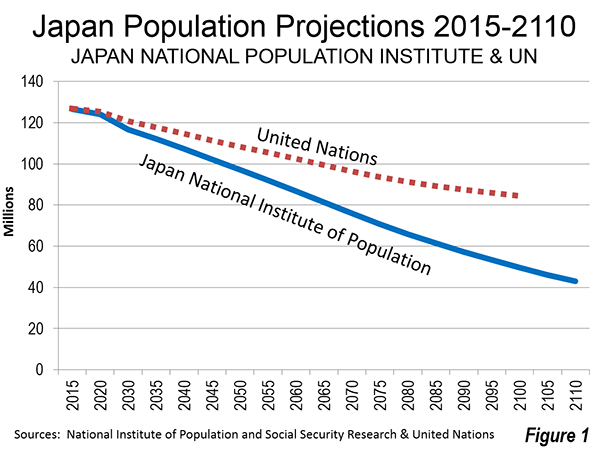
    Japan’s agency responsible for projecting population, the National Institute of Population and Social Security Research forecasts a stunning reduction of population to only 42.9 million residents in 2110. For every three Japanese residents today, there will be one in 2110 according to the National Institute of Population. If this projection is realized, Japan’s population would drop to a level not seen since the middle 1890s.

    The National Institute of Population projects a population loss to 97.0 million residents by 2050, for an annual population loss rate of 0.7 percent from 2015. By 2100, the population would fall to 49.6 million, for an annual loss rate of 1.3 percent. Over the 95 years from 2015, the annual population loss rate would accelerate from 0.4 percent annually to nearly 1.5 percent.

    The United Nations is considerably more optimistic about Japan’s future population than the National Institute of Population. The UN forecasts a population of 108.3 million residents by 2050, or 11 million more residents than expected by the National Institute of Population. The annual loss rate is 0.4 percent, one half the rate projected by the National Institute of Population. By 2100, the last year of the UN series, the population would be 84.5 million, 35 million more than the National Institute of Population figure. The UN’s annual population loss rate would be 0.8 percent (Figure 1).

    Major Metropolitan Areas

    Much of Japan’s urban population is in the dense corridor from Tokyo-Yokohama to Osaka-Kobe-Kyoto, a distance of approximately 300 miles (500 kilometers). The four metropolitan areas of this corridor (Tokyo-Yokohama, Shizuoka-Hamamatsu, Nagoya, and Osaka-Kobe-Kyoto) contain approximately 75 million residents. By comparison, the US Northeast Corridor is about 1.5 times as long and has under 50 million residents.

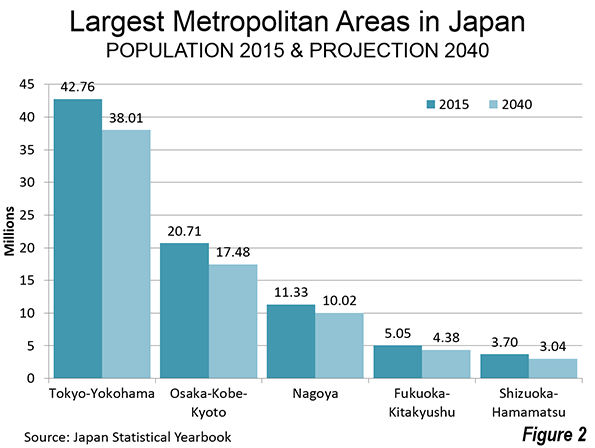
    According to National Institute of Population data, each of the 10 largest metropolitan has reached its population peak. The most populous, Tokyo-Yokohama is the only major metropolitan area to have gained population between 2010 and 2015. Each of the others had already reached their population peaks, according to the forecasts that end in 2040 (Figure 2).

    Tokyo-Yokohama:Tokyo-Yokohama is the world’s largest metropolitan area (labor market area). Much of it is located on the Kanto plain that stretches in three directions from Tokyo Bay. Between 2010 and 2015, Tokyo-Yokohama grew from a population of 42.6 million to 42.8 million. However a strong turnaround is anticipated. By 2020, the population is expected to fall to 42.4 million. Tokyo-Yokohama is expected to decline to 38.0 million residents in 2040, a reduction approximately equal to the population of metropolitan areas such as Phoenix, Montréal, and Melbourne. The 2040 population would represent a loss of approximately 11 percent from 2015.

    Osaka-Kobe-Kyoto: Osaka-Kobe-Kyoto has been Japan’s second largest metropolitan area for decades. Osaka-Kobe-Kyoto is a true conurbation, with three separate core cities and their suburbs that have grown together to form a single urban area, which now also encompasses smaller Nara, the country’s ancient capital. Some of Japan’s most important historical sites are in Kyoto and Nara. Despite having less than one half the population of Tokyo-Yokohama, Osaka-Kobe-Kyoto has been one of the world’s largest metropolitan areas for at least the last half of the century. Osaka-Kobe-Kyoto’s population fell from 20.9 million in 2010 to 20.7 million in 2015. By 2040, this large urban agglomeration is forecast to have a population of 17.5 million, down 16 percent from its 2015 level.

    Nagoya: Nagoya is Japan’s third largest metropolitan area and is located about two thirds of the way between Tokyo-Yokohama and Osaka-Kobe-Kyoto. Nagoya is renowned as the headquarters of Toyota. Nagoya is expected to fall from its 11.3 million residents in 2015 to 11.2 million in 2020 and 10.0 million in 2040. This population loss rate would be similar to that of Tokyo-Yokohama, at approximately 11 percent.

    Fukuoka-Kitakyushu: The Fukuoka-Kitakyushu metropolitan area is comprised of two large and separate urban areas. It is the only metropolitan area of the largest five that is not in the Tokyo to Osaka corridor. Further, Fukuoka-Kitakyushu is on the island of Kyushu, to the south of the main island of   Honshu. Fukuoka-Kitakyushu had a population of 5.0 million in 2015 and is expected to fall to 4.4 million in 2040. This is an approximately 12 percent population loss rate, somewhat worse than Tokyo-Yokohama and Nagoya.

    Shizuoka-Hamamatsu:The Shizuoka-Hamamatsu metropolitan area is located between the Tokyo-Yokohama and Nagoya metropolitan areas. In 2015, the population was 3.7 million, which is expected to drop to 3.0 million in 2040. This area, long a critical part of Japan’s industrial complex, would suffer the largest loss among the five largest metropolitan areas, at 18 percent.

    The Rest of Japan: The balance of Japan would experience an even greater loss, dropping from 43 million in 2015 to 34 million in 2040. This would represent a decline of 20 percent.

    Japan: Leading the Way?

    Japan is just the first of a wave of nations that are expected to experience population declines. The challenges are likely to be great as the nation is forced to downsize its considerable infrastructure to accommodate a smaller population. With a growing imbalance of senior citizens relative to working age adults, there are likely to be significant difficulties in financing social services. Japan’s strategies and successes or failures will be watched closely by national leaders from Berlin to Beijing and Brasilia whose nations  are likely to experience reductions in population and demographic imbalances starting mid-century or sooner.

    Wendell Cox is Chair, Housing Affordability and Municipal Policy for the Frontier Centre for Public Policy (Canada), is a Senior Fellow of the Center for Opportunity Urbanism (US), a member of the Board of Advisors of the Center for Demographics and Policy at Chapman University (California) and principal of Demographia, an international public policy and demographics firm.
    He is co-author of the "Demographia International Housing Affordability Survey" and author of "Demographia World Urban Areas" and "War on the Dream: How Anti-Sprawl Policy Threatens the Quality of Life." He was appointed to three terms on the Los Angeles County Transportation Commission, where he served with the leading city and county leadership as the only non-elected member. He served as a visiting professor at the Conservatoire National des Arts et Metiers, a national university in Paris.

    Photo: Fukuoka (by author)

  • Neither Olympics Nor NFL Will Rescue Los Angeles

    We all tend to have fond memories of our greatest moments, and for Los Angeles, the 1984 Olympics has served as a high point in the city’s ascendency. The fact that those Summer Games were brilliantly run, required relatively little city expenditure and turned a profit confirmed all those things we Angelenos loved about our city – its flexibility and pragmatism and the power of its civic culture.

    After Boston turned down its chance to be the U.S. entrant in the sweepstakes to host the 2024 Olympics, it’s natural that Mayor Eric Garcetti and the city establishment, at least what’s left of it, desire a return engagement. But the Los Angeles of today barely resembles the vibrant, optimistic city of 30 years ago.

    “The city where the future once came to happen,” a devastating report from the establishmentarian Los Angeles 2020 Commission recently intoned, “is living the past and leaving tomorrow to sort itself out.”

    Last Best Chance?

    So rather than a bold move toward establishing the city’s preeminence, the current move smacks more of a Hail Mary pass. It also seems to embody a kind of nostalgia, a sentiment reflected not only in the desire to relive Olympic glory but also in the efforts to bring pro football back to town, including, perhaps, a return of the long-departed Rams.

    Yet ultimately, neither a third Olympics (the first was in 1932) nor the return of NFL football can alter a city’s fate. After all, the 2000 Athens Olympics did not lead to a new Greek renaissance, but may, instead, have contributed to that country’s fiscal morass. Summer Games in Montreal (1976) and Atlanta (1996) did not usher in a golden age for those cities, but periods of decline.

    Read the entire piece at The Orange County Register.

    Joel Kotkin is executive editor of NewGeography.com and Roger Hobbs Distinguished Fellow in Urban Studies at Chapman University, and a member of the editorial board of the Orange County Register. He is also executive director of the Houston-based Center for Opportunity Urbanism. His newest book, The New Class Conflict is now available at Amazon and Telos Press. He is also author of The City: A Global History and The Next Hundred Million: America in 2050. He lives in Orange County, CA.

    Olympic Torch Tower of the Los Angeles Coliseum” by unknown, U.S. Air Force – http://www.defenseimagery.mil; VIRIN: DD-SC-85-08929. Licensed under Public Domain via Wikimedia Commons.

  • Family Friendly Cities

    One of the common criticisms leveled at people who promote urban living goes something like this. “Cities are great for college kids, people starting off in their careers, bohemians, and maybe some older empty nesters with money who have a taste for theater and art. But most people have families and tight budgets. Suburbia is the only place that provides a high quality, safe, affordable life for regular folks with children.”

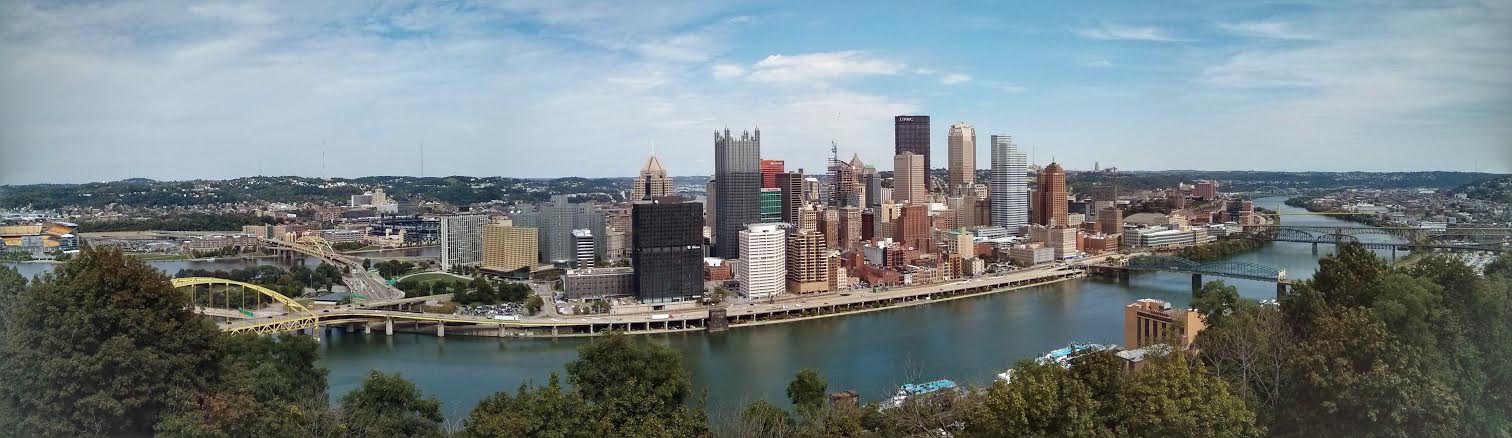
    Last year I flew to Pittsburgh, Pennsylvania to attend a wedding. As we were all milling about with friends and family on the porch eating ice cream on a gorgeous September afternoon I noticed some of my fellow out-of-town visitors from New York and San Francisco looking around with a peculiar expression. It was the same kind of look that dogs get when they’re curious and a little confused – one ear up and one ear down. They looked at their kids playing in the grass and sitting on grandma’s lap. I knew very well what they were thinking. They were a family of four living in a tiny one bedroom apartment in Brooklyn and their oldest child will be starting school next year.

    IMG_0202 (800x533) (2) Screen Shot 2014-10-11 at 11.03.48 PM Screen Shot 2014-10-11 at 11.08.00 PM Screen Shot 2014-10-11 at 11.02.26 PM

    Now, I need you to picture the neighborhood so you get the context here. This is a century old streetcar suburb five miles from downtown. There are tree lined streets, front porches on elegant old homes, a charming Main Street with mom and pop shops a couple of blocks away, and an elementary school directly across the street. Even in this very comfortable and pricey neighborhood a grand home with a patch of grass could be purchased for significantly less than the cost of a one bedroom apartment in Brooklyn. You can actually ride a bicycle to downtown Pittsburgh – and it would be a pleasant and convenient ride. Carnegie Mellon University and a dozen other prominent institutions are nearby.

    Screen Shot 2014-10-11 at 11.00.56 PM Screen Shot 2014-10-11 at 11.00.36 PM Screen Shot 2014-10-11 at 11.41.36 PM Screen Shot 2014-10-11 at 10.40.35 PM

    In large expensive cities many young families are having to make harsh choices. They can stay where they are and pay exorbitant rents or a shockingly high mortgage for less than ideal accommodations in order to have access to good jobs and urban amenities. Or they can move to a more affordable suburb and spend a couple of hours each day schlepping in and out of the city. Or they can step away from the city entirely and organize their lives around a purely suburban set of arrangements: the subdivision, the office park, the shopping mall… For many people who value urban life these are difficult decisions with a lot of unsavory trade offs.

    Screen Shot 2014-10-11 at 11.31.54 PM Screen Shot 2014-10-11 at 11.46.03 PM Screen Shot 2014-10-11 at 11.26.11 PM

    Pittsburgh is just one of hundreds of small and medium sized cities in the interior that people in coastal cities like to dismiss as part of “Flyover Country”. What isn’t clearly understood is that Pittsburgh isn’t competing with New York or San Francisco. Instead Pittsburgh is competing with the distant suburbs of places like New York and San Francisco out in the endless smear of anonymous tract homes and strip malls that ring those cities. Pittsburgh wins that taste test hands down every time for anyone who shows up and actually looks around and experiences what’s on offer.

    unnamed

    John Sanphillippo lives in San Francisco and blogs about urbanism, adaptation, and resilience at granolashotgun.com. He’s a member of the Congress for New Urbanism, films videos for faircompanies.com, and is a regular contributor to Strongtowns.org. He earns his living by buying, renovating, and renting undervalued properties in places that have good long term prospects. He is a graduate of Rutgers University.

  • The Comeback Of The Great Lakes States

    For generations the broad swath of America along the Great Lakes has been regarded as something of a backwater. Educated workers and sophisticated industries have tended to gather in the Northeast and on the West Coast, bringing with them strong economic growth.

    Yet increasingly these perceptions are outdated. The energy hotbeds of Texas, Oklahoma and North Dakota may have posted the strongest employment growth since 2007, and were among the first states to gain back all the jobs lost in the recession. But a group of less heralded places from Minnesota to western Pennsylvania have also enjoyed a considerable revival, as energy, manufacturing, logistics and other basic industries have rebounded.

    Every Great Lakes state except for Illinois now has an unemployment rate below the national average, a stunning reversal from previous decades.

    Ironically the state most popularly associated with long-term economic decline, Michigan, has been lauded in a Pew study as perhaps the ”biggest success story.” From the state’s nadir of household employment in November 2009 through this July, the Wolverine State has added 302,543 jobs, a 7.2% increase.

    An Industrial Comeback

    One clear key to improving conditions in Michigan and elsewhere is the revival of America’s industrial economy. Following a generation of falling employment, the sector has been on something of a rebound since 2010, adding some 855,000 jobs. Although many of these new jobs are in the Southeast and Texas, Great Lakes states have been at the center of the turnaround. The fastest growth in industrial employment over the past five years has been in three Michiganmetro areas — Detroit, Warren and Grand Rapids – and Toledo, Ohio.

    Structural and political factors are behind the Midwestern recovery. Rising wages in China and the North American energy boom have helped make U.S. companies more cost competitive. German electricity prices, for example, are almost three times the average for the United States. Energy production has been a major driver in large swaths of the heartland, notably Pennsylvania, Ohio, and Oklahoma, where fracking has sparked new development.

    This growing competitiveness can be seen in a surge of capital investment. Four of the top 10 statesfor new plant and equipment investment in 2014 are in the Great Lakes region, according to Site Selection Magazine: Ohio, Illinois, Michigan, and Pennsylvania.

    Changing Geography Of Human Capital

    For generations the Great Lakes has been hemorrhaging people to the rest of the country, mainly the South and West. But that outflow has recently slowed, and in some cases reversed. According to demographer Wendell Cox, the rate of outmigration from Cleveland and Detroit has been cut by half or more while some metro areas, including Indianapolis and Columbus, Ohio, are firmly in positive territory. In contrast, Los Angeles, New York and even the Silicon Valley hub of San Jose continue to lose people to other regions.

    More surprising is the movement of younger college-educated people. American Community Survey numbers show some of the fastest growth in the population of educated workers between 2005 and 2013 occurred in places such as Pittsburgh, Columbus, Indianapolis and, yes, Cleveland, which, according to Cleveland State’s Richey Piiparinen, are attractive due to lower costs and a more family-friendly environment.

    Another analysis of the changes in the population of educated workers since 2005, by Mark Schill at the Praxis Strategy Group, reflects this shift. The rate of increase in the population of people 25 to 35 with graduate degrees was slightly higher in Pittsburgh than in San Francisco. Grand Rapids, Buffalo, Indianapolis, Columbus and Louisville did even better (albeit off low bases). These citiesare even considered something of new “hipster havens,” as young people look to these old industrial cities as better bargains for life and work.

    This brain gain parallels another important shift — the growing relevance of the Great Lakes workforce to companies here and around the world. The region already possesses the nation’s largest store of engineers in the country. STEM employment in a host of fields from manufacturing and medicine to business services is surging fast in many of these areas. Between 2004 and 2014, according to an analysis by Schill, several Midwestern states — Iowa, Michigan, Oklahoma, the Dakotas — added STEM jobs at double digit rates, equaling the percentage increases enjoyed by California and easily outpacing New York.

    It turns out that much STEM growth takes place out of the high-profile world of search engines, social media and “disruptive” business service firms. In many cases technical innovations, in the words of the French sociologist Marcel Mauss, constitute “a traditional action made effective,” often in manufacturing, medicine and other fields not always associated with “tech.” The social media and search explosion, so prominent in the Bay Area, home to a remarkable 40% of such jobs, often obscures the serious innovation taking place in the Midwest. For example, much of the earliest advances in self-driving vehicles came not from Google but tractor maker John Deere.

    As it looks to develop auto software for cars, Google looks to, in the words of the autonomous car project’s director, “a lot of amazing companies in the Detroit area and international than know how to make cars.”

    The Great Lakes position as an innovation center is based on a unique combination of engineeringschools and a high concentration of engineers. Dayton and Detroit rank among the top 12 metro areas in the country in terms of engineers per capita, with a higher concentration than Boston, San Francisco, New York, Los Angeles and Chicago.

    One particular hot spot is the area around Warren and Troy, Mich., sometimes referred to “automation alley.” This is where software meets heavy metal, with a plethora of companies focusing on factory software and new computer-controlled systems for automobiles. It is home to engineering software firms like Altair, which has been expanding rapidly, and also where General Motors recently announced plans for a $1 billion tech center, employing 2,600 salaried workers.

    Other tech development has been tied to the health care industry, including such regional standouts as the Cleveland Clinic and Mayo Clinic. Madison, Wisc., has a strong government and education employment base but also is home to growing number of technology firms, with information employment since 2009 up an impressive 36.1%. But much of the growth is related to health care, with the leading local company being medical software maker Epic, which employs 6,800 at its sprawling campus in nearby Verona.

    Qmed ranks California as the best state for medical device makers, but also ranking highly are Minnesota, Indiana, Pennsylvania and Wisconsin.

    In the coming years, more talent should be heading to these area. Housing prices in the San Francisco Bay Area, Los Angeles and New York are at least two to three times higher than most Great Lake metro areas. This is a boon to those who bought far in the past, but a barrier to entry to young aspirational families. To live in San Francisco, particularly for those who hope to raise a family, is increasingly impossible.

    It has also led some companies to locate elsewhere, particularly to the Pacific Northwest. In 2011, 1 in 7 people in the Bay Area searched Redfin.com for homes outside of the Bay Area. Now it’s 1 in 4. Adam Wiener, Redfin’s chief growth officer, announced to other executives last month: “The dam has broken.”

    Potential Threats

    Ultimately the durability of the Great Lakes recovery depends on building off its natural strengths in engineering, its central location along water routes, ample natural resources and low living costs. Pro-business policies have enhanced these advantages and made several Midwestern governors intoserious national political figures, namely Snyder in Michigan, Walker in Wisconsin, and Ohio’s Kasich.

    Yet there are serious clouds on the horizon, perhaps the biggest of which is looming EPA greenhouse gas regulations, which could shut down many coal-fired power plants in the region and raise electric rates. 

    International forces – notably the devaluation of the Chinese yuan – threaten the industrialresurgence. A strong dollar tends to make exports pricier and imports more competitive. Such changes may not matter too much on the coasts, but Midwestern states are far more dependent on manufacturing. According to the U.S. Bureau of Economic Analysis, many of the states with the highest percentage of their GDP tied to manufacturing are in the region, led by Indiana, where 25%of GDP is tied to industry, followed closely by Iowa, Ohio, Wisconsin, and Michigan.

    Ultimately the Great Lakes cannot recover fully unless it continues the revival of its core industries, while expanding in other fields based on the movement of skilled labor coming to the region. If the region can continue its progress, it will be a major boon not only to the people who live there, but to the country that needs an infusion of economic sanity, and down to earth production, to complement the growth of finance, media and communications that dominate so many business headlines.

    This piece first appeared in Forbes.

    Joel Kotkin is executive editor of NewGeography.com and Roger Hobbs Distinguished Fellow in Urban Studies at Chapman University, and a member of the editorial board of the Orange County Register. He is also executive director of the Houston-based Center for Opportunity Urbanism. His newest book, The New Class Conflict is now available at Amazon and Telos Press. He is also author of The City: A Global History and The Next Hundred Million: America in 2050. He lives in Orange County, CA.

    Photo courtesy of BigStockPhoto.com.

  • Traffic Congestion: The Latest Urban Mobility Report Ratings

    In recent years there has been a proliferation of traffic congestion rating reports. Tom Tom and Inrix are now making it possible to compare traffic congestion in Louisville or even Lexington to Moscow or Paris. The Castrol Magnatic Start-Stop Index adds places like Jakarta and Bangkok. But the granddaddy of them all is the Texas A&M Transportation Institute Urban Mobility Report, which has just been released with 2014 data.

    Los Angeles

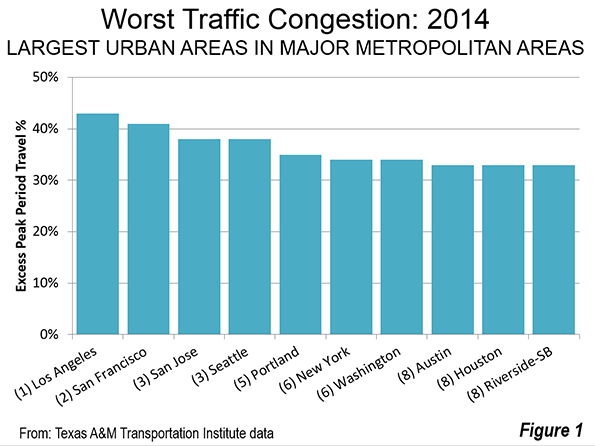
    Los Angeles remains the most congested major urban area in the nation with an average 43 percent added to travel times during peak hours. This article discusses the largest urban areas in the 53 US metropolitan areas with more than 1 million population.

    Los Angeles is long been the champion of traffic congestion in the United States. Since Texas A&M began publishing a traffic congestion scorecard in 1982, Los Angeles has usually had the worst traffic congestion, though Houston was reported to have the worst congestion for a few years in the mid-1980s.

    It should not be surprising that Los Angeles has the worst traffic congestion. Los Angeles is the nation’s most densely populated larger urban area, with 7000 residents per square mile. This high density means that the demand for both car and truck travel is higher than it would be in a lower density city. The Los Angeles freeway system is extensive and its roadways tend to be very wide. Part of the problem is that much of the planned freeway system was not built, such as the Slauson Freeway, the Reseda Freeway, the Topanga Canyon Freeway, the Laurel Canyon Freeway, the Beverly Hills Freeway and the missing link northern extension of the Long Beach Freeway through South Pasadena. None of these freeway cancellations drove people to transit, as some might suggest, as traffic volumes just continued to increase. Despite billions that were spent on rail and busway systems, Southern California’s largest transit system continues to draw fewer riders than when there were only buses in 1985.

    Congested in Other Urban Areas

    The top 10 congested urban areas include two that share commuting sheds with larger urban areas. These are third-ranked San Jose and 10th ranked Riverside-San Bernardino, which can blame part of their traffic congestion on their larger neighbors, Los Angeles and San Francisco (Figure 1).

    San Francisco is the second most congested urban area in the nation. The three most congested urban areas are also the three densest urban areas, Los Angeles, San Francisco and San Jose. Seattle ranks fourth and Portland ranks fifth, despite their much lower densities. Seattle’s intense traffic congestion is understandable, given its long, narrow geographical shape and the fact that there are only two north to south freeway routes through the urban area. Moreover, things are likely to get worse, as Seattle seeks to implement urban containment (densification) policies that are likely to worsen traffic congestion (Greater  traffic congestion is associated with higher densities).

    Portland has obtained the worldwide praise of urban planners who like its densification and anti-automobile policies. Portland, however is paying the price for that with traffic congestion 80 percent as bad as Los Angeles, even with a population density barely half that of Los Angeles.

    Austin may also be surprising, because it has a relatively small population (about 2 million) compared to most of the 10 worst congested urban areas. Austin was not large enough to justify more than a single route when the interstate system was designed in the 1950s and was very slow to develop its freeway system. At the same time, in recent years Austin has been the fastest-growing major metropolitan area in the United States, which has also added to traffic pressures.

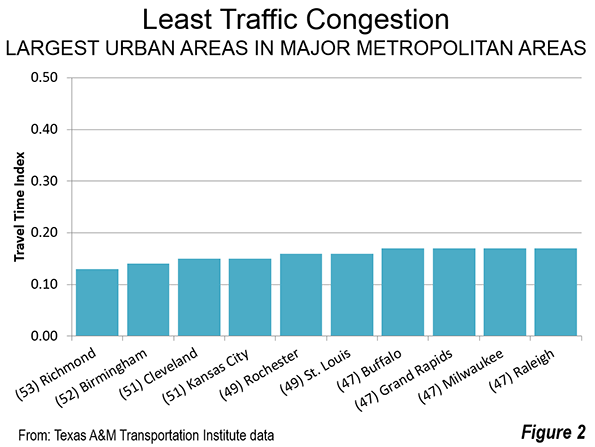
    The least traffic congestion is in Richmond, which has also been estimated to have the best composite traffic congestion among international scorecards. Most of the least congested urban areas have metropolitan population between 1 million and 2 million residents and are located in the East, South or Midwest (Figure 2).

    Wasted Fuel

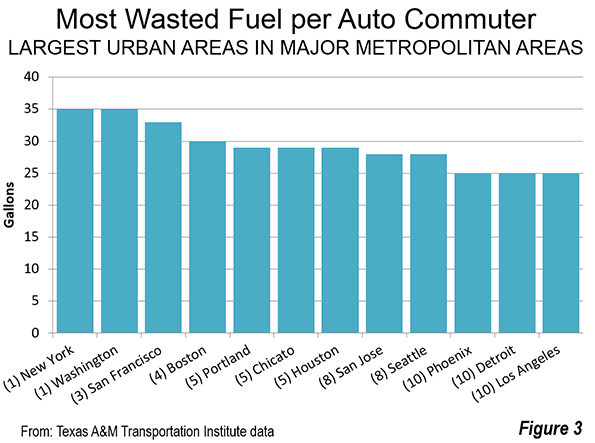
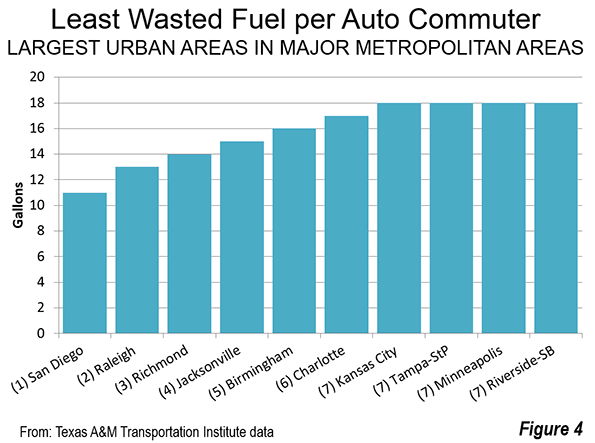
    Driving in congested traffic reduces fuel economy and results in wasted fuel (each gallon of gasoline consumed produces the same amount in greenhouse gas emissions). New York and Washington have the largest amount of wasted fuel per commuter, followed by San Francisco, Boston and Portland (Figure 3). The least wasted fuel per peak period commuter is in San Diego, Raleigh, Richmond, Jacksonville and Birmingham (Figure 4).

    Changes Since 1982

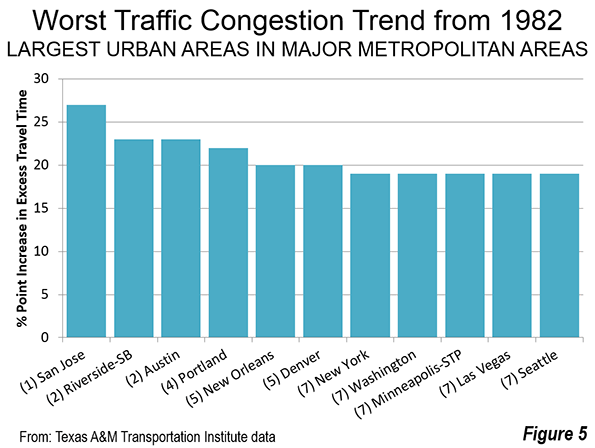
    There have been major changes in traffic congestion indexes among the 53 urban areas since 1982. San Jose has experienced the worst percentage point increase in excess travel time, adding 27 percentage points to its excess peak period travel time. Riverside-San Bernardino, Austin, Portland and New Orleans round out the five urban areas with the greatest increases in traffic congestion (Figure 5). With less growth in recent decades, however, traffic congestion has not increased enough to place in the worst ten in trend.

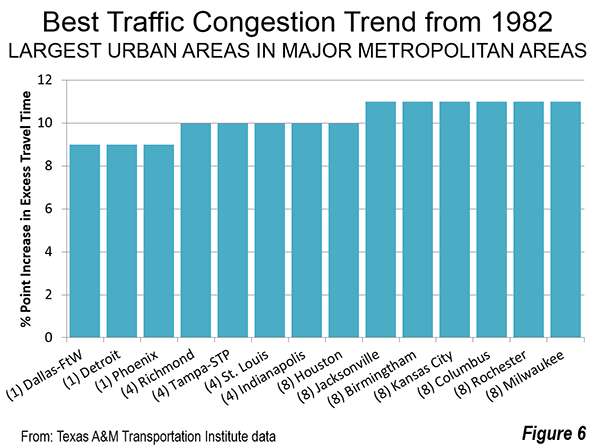
    The urban areas best at controlling their traffic congestion include some surprises. Dallas-Fort Worth has been one of the three fastest growing metropolitan areas in the high income world over the period, but has managed to keep up with its traffic congestion as well as any other urban area (Figure 6).

    Similarly, Phoenix has been very rapidly growing and has tied Dallas-Fort Worth for first place in best traffic congestion trend. Phoenix undertook a substantial Freeway building program in the 1980s. Detroit also ties Dallas-Fort Worth and Phoenix, though this reflects its long term economic difficulties and shows that better traffic congestion that results from less growth and job creation is not a positive. Five urban areas tied for fourth best traffic congestion trend, Richmond, Tampa St. Petersburg, St. Louis, Indianapolis and Houston. Like Dallas-Fort Worth, Houston was among the three fastest growing metropolitan areas of more than 5 million people over the period. Like Phoenix, Houston began a major freeway and arterial street improvement program in the late 1980s (perhaps partially in response to the publicity about having the worst congestion).

    Four Other Cities

    Four urban areas rank in the worst ten in each of the categories of traffic congestion, wasted fuel and congestion trend. San Jose abuts San Francisco which has the second worst congestion in the nation. Among the four, Portland is the most consistent, ranking 5th worst in traffic congestion, tied for 5th worst in wasted fuel and ranked fourth worst in congestion trend. Portland also seems the most out of place, being smaller and not having a more congested, larger urban area abutting it. New York is not a surprise, being the nation’s largest urban area, and having many bridges and tunnels, which concentrates traffic. Seattle has long been one of the most congested urban areas and also has geographical challenges, with a number of water crossings, as well as its limited north-south freeway capacity.

    The Texas A&M Annual Mobility Report pioneered the way for important urban competitiveness information that allows comparisons by public official and companies that were not possible before. The latest edition advances that purpose.

    Wendell Cox is Chair, Housing Affordability and Municipal Policy for the Frontier Centre for Public Policy (Canada), is a Senior Fellow of the Center for Opportunity Urbanism (US), a member of the Board of Advisors of the Center for Demographics and Policy at Chapman University (California) and principal of Demographia, an international public policy and demographics firm.

    He is co-author of the "Demographia International Housing Affordability Survey" and author of "Demographia World Urban Areas" and "War on the Dream: How Anti-Sprawl Policy Threatens the Quality of Life." He was appointed to three terms on the Los Angeles County Transportation Commission, where he served with the leading city and county leadership as the only non-elected member. He served as a visiting professor at the Conservatoire National des Arts et Metiers, a national university in Paris.

    Top Image: Los Angeles Traffic Congestion: AM Peak, September 2, 2015 From: Google Traffic

  • As Rivals Stumble, America Steps Up

    As its former rivals in Asia and Europe slip into torpor and even decline, America, almost despite itself, is recovering its perch as the world’s bastion and predominant power. This is all the more remarkable given that our government is headed by someone who largely rejects traditional ideas about American exceptionalism, preferring to “lead from behind.”

    Just a quick look around the world makes clear that the United States has emerged as a relative hot spot in a chilly global economy. China is devaluating its currency and ratcheting down its growth expectations. Japan and Europe continue to lag, as they have for the past decade or two. Indeed, with the possible exception of India, no major country appears on the rise, and several once-ballyhooed rising stars – Russia, Brazil, South Africa – now seem headed for prolonged economic eclipse.

    Time for new thinking

    America’s mainstream media and intellectual classes now face a quandary. Generally attracted over the past century to economic models other than our own, they have shifted their admiration from Mussolini’s Italy and Stalin’s Soviet Union in the 1930s and, in the 1960s and beyond, Japan, Germany and, most recently, China.

    Now all those fashionable role models are clearly unravelling. Instead of seeking to imitate other countries, perhaps it’s time to find ways to bolster our own capabilities. President Obama may prefer to lead from behind, but that has not turned America into the world’s caboose. The country, in its fundamentals, is potentially far stronger and resilient than many believe.

    This is not to say that we cannot learn from abroad. There are specific things we should try to emulate, like the Chinese commitment to infrastructure building, northern Europe’s craft training, Japanese industrial precision, Korean technological development and water management strategies from Israel. Even Stalinism produced a terrific subway system in Moscow that still puts ours to shame.

    Read the entire piece at The Orange County Register.

    Joel Kotkin is executive editor of NewGeography.com and Roger Hobbs Distinguished Fellow in Urban Studies at Chapman University, and a member of the editorial board of the Orange County Register. He is also executive director of the Houston-based Center for Opportunity Urbanism. His newest book, The New Class Conflict is now available at Amazon and Telos Press. He is also author of The City: A Global History and The Next Hundred Million: America in 2050. He lives in Orange County, CA.

    Baby photo by Bigstock.

  • America’s Shrinking Cities Are Gaining Brains

    If there’s one thing that’s a nearly universal anxiety among cities, it’s brain drain, or the loss of educated residents to other places. I’ve written about this many times over the years, critiquing the way it is normally conceived.

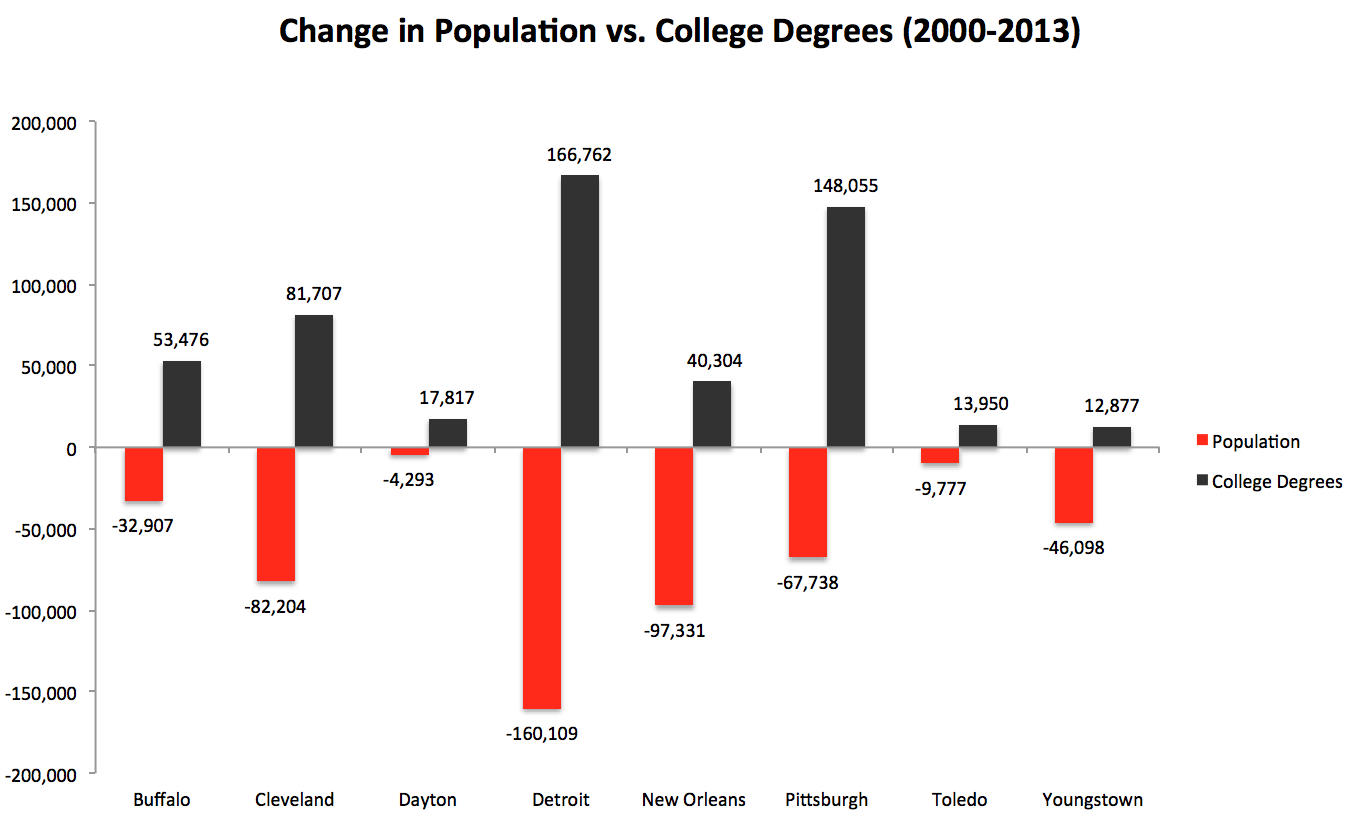
    Since brain drain seems to be a major concern in shrinking cities, I decided to take a look at the facts around brains in those places. Looking at the 28 metro areas among the 100 largest that had objective measures of shrinkage – in population and/or jobs – between 2000 and 2013, I looked what what happened to their educational attainment levels.

    My results were published in my Manhattan Institute study “Brain Gain in America’s Shrinking Cities.” As the title implies, my key findings were:

    • Every major metro area in the country that has been losing population and/or jobs is actually gaining people with college degrees at double digit rates.
    • As a whole the shrinking city group is holding its own with the country in terms of educational attainment rates, and in many cases outperforming it.
    • Even among younger adults, most shrinking cities are adding more of them with degrees, increasing their educated population share, and even catching up with the rest of the country in their college degree attainment levels.

    The following chart of metro area population change vs. degree change for select cities should drive the point home.

    Click through to read the whole thing.

    In short, for most places, it looks like the battle against brain drain has actually been won. As people there can attest, thanks to many improvements public and private over the years, they are now viable places to live for higher end talent in a way they weren’t say 20 years ago. This means the attention and resources that have been devoted to this issue can now be put to more present day tasks such as repairing civic finances, rebuilding core public services, and creating more economic opportunity for those without degrees.

    More commentary later perhaps, but for now please check out the report and share widely.

    Aaron M. Renn is a senior fellow at the Manhattan Institute and a Contributing Editor at City Journal. He writes at The Urbanophile.

  • Economic Progress is More Effective Than Protests

    The election of Barack Obama promised to inaugurate the dawn of a post-racial America. Instead we seem to be stepping ever deeper into a racial quagmire. The past two month saw the violent commemoration of the Ferguson protests, “the celebration” of the 50th anniversary of the Watts riots, new police shootings in places as distant as Cincinnati and Fort Worth, and renewed disorder, tied to a police-related shooting, in St. Louis last week.

    When President Obama was elected, two-thirds of Americans thought race relations were good. Now six in 10 think they are bad, according to a New York Times poll, including some 68 percent of African Americans.

    This extreme alienation creates a rich soil for resurgence of a cramped form of black nationalism, as revealed in such widely read books as Ta-Nehisi Coates’s Between the World and Me. Coates, like the black nationalists of the ’60s, is fawned over by today’s progressive gentryNew York Times film critic A.O. Scott gushed that Coates’s writing is “essential, like water or air.” Yet the new nationalists do not, like many previous iterations, look to Africa for salvation, and as a potential place of re-settlement. Instead they may look to Africa for inspiration, but seem content to stew in the American racial cauldron, always apart but also here.

    Yet to this reader, it’s hard to regard Coates’s book as anything more than a narrow selfie that holds little hope for any future racial progress. To Coates, America itself seems irredeemable, its very essence tied to racial oppression and brutality. America is not about ideals not yet fulfilled, but a legacy of “pillaging,” the “destruction of families,” “the rape of mothers,” and countless other outrages. Today’s abusive police—and clearly some can be so described—are not outliers who should be punished but “are merely men enforcing the whims of our country, correctly interpreting its heritage and legacy.” His alienation from America is so great that he admits to little sympathy for the victims of 9/11.

    He has particular contempt for those blacks who seek to succeed within the American system, although Coates, a talented rhetorician, has clearly done well for himself. To him, they are deluded into believing they can make their way by “acting white, of talking white, of being white.” African-American families that have broken away from the inner city or the poor small town and found a home in the suburbs, he suggests, “would rather live white than live free.” In language no doubt reassuring to New York urbanistas, he even accuses these blacks of participating in a grand global destruction merely because they drive cars and live in suburbs.

    Coates’s book also reinforces other nationalist voices such as can be found in certain vocal corners of the “Black Lives Matter” movement, which seems to have little room for the inclusive humanism that characterized the early ’60s civil rights campaigners. They shout down genuine progressives like Bernie Sanders and poseurs like Martin O’Malley for insisting that “all lives matter.” In this world-view all police are tarred similarly; in this construct, clear abuses, such as the Eric Garner case, are no different than that of Michael Brown in Ferguson, which even the Obama Justice Department found unworthy of federal prosecution.

    The current radicalization of some prominent black thinkers poses some challenges to Democrats in particular, reflecting their increased dependence on lopsided support from African Americans. Republicans may be doomed to become “the white man’s party,” as my old friend Harold Meyerson suggests, but who thinks the GOP’s insularity deserves emulating? Do the new black nationalists think they have anything to sell outside the confines of liberal bastions or inner-city African-American communities?

    Ultimately this program represents a dead end, both for the country and its increasingly diverse population. Ta-Nehisi Coates can’t expect to castigate whites as brutes who need to oppress blacks for both self-esteem and economic survival and then expect these same brutes to get on board with concessions, subsidies, and even reparations. Many academics and mainstream journalists may go along with such a program, but this is not a reasonable strategy for the rest of the country.

    ***

    When desegregation began in earnest in the ’60s, the hope was that we would see the emergence of greater equality between minorities and whites. And to be sure, there was reduction in black poverty in the booming ’60s, and then again during the Reagan and Clinton expansions. Yet in ensuing years, and especially with the onset of the Great Recession, this progress reversed, in large part because black and Latino families bore the brunt of the foreclosure crisis. African Americans saw their household wealth plunge 31 percent during the recession, including a steep 35 percent decline in their retirement assets, according to the Urban Institute. By comparison, the wealth of white families fell a relatively mild 11 percent from 2007 to 2010.

    This growing disparity has prompted demands for expanded racially-derived benefits that, according to advocates like former Attorney General Eric Holder, should be a permanent part of national policy. “The question,” says Holder, “is not when does it end, but when does it begin … When do people of color truly get the benefits to which they are entitled?”

    This idea has been further expanded by the Obama administration’s commitment to correcting what it calls “disparate impact,” which would force communities—presumably middle-class suburbs—to accommodate poor and minority residents at taxpayer expense, if the federal Housing and Urban Development or the courts deem it appropriate.

    Such an approach negates the aspirations of middle-class families, including many African Americans who have headed to the suburbs for a better life.Upwardly mobile African Americans have been deserting core cities for years: Today, only 16 percent of the Detroit area’s African Americans live within the city limits.

    The big problem here is the emphasis on legal remedies and identity politics, rather than focusing on economic empowerment for Americans of all ethnicities. Perhaps as much as any senior government official, Holder argued in support of a quota regime, which at its logical extreme guarantees that even the children of black billionaires get preferences easier than a white kid brought up in an Appalachian hovel.

    Yet this is the same official who gently treated Wall Street malefactors—the very people in large part responsible for millions of foreclosures, including those that affected many blacks—to an extent that even the usually pro-Obama Rolling Stone openly wondered if he was a “Wall Street double agent.”

    The Obama years—following the previous disasters left over from the Bush regime—have been largely an economic disaster for black America. Child poverty is at the highest level in 20 years, and among African Americans it stands at a disastrous 38 percent, rising even during the recovery. After decades of gradual decline, concentrated urban poverty has grown rapidly over the past decade.

    Nor have African Americans benefited much from the recovery. White American unemployment is either about the same or below what it was before the recession levels, while the gap with African Americans has grown, in some states two and a half times that of the majority population. In Washington, D.C., the fundamental center of blue-state America, it’s five times as high.

    Far more helpful than expanding racial quotas would have been steps to put African Americans to work, particularly teenagers, who suffer nearly 30 percent unemployment rate, twice the national average. Many African Americans, for example, could have benefited more from a revival of the old Works Progress Administration, which would have put unemployed and underemployed people to work, than from any extension of affirmative action in universities. It’s hard to see how doling out “green” subsidies and breaks to Silicon Valley and Wall Street crony capitalists has been much of a benefit to African-American communities, or other underserved minorities.

    Nor is the overall Obama environmental program—particularly on energy—helpful to African-Americans who need jobs in basic industries and in some places, such as California, are stuck with high electricity bills. Harry Alford, head of the U.S. Black Chamber of Commerce, accuses the EPA of “apparent indifference to the plight of low-income and minority households,” which he calls “inexcusable.”

    For Coates’s part, he claims several times in his book that America depends on the oppression of blacks—who, he claims, represent “the essential below,” an oppressed class of workers whose sweat and blood propel America’s economy. This may well have been true in the times when cotton was king and the South produced most of our exports. But for many states in 2015, the fact is that the low-wage labor force is now made up of workers largely from Latin America or Asia, who do the grueling work that blacks too often performed in the past.

    In a multi-racial society—where African Americans are in many places the second- or third-largest minority—black communities must focus on developing a competitive economic advantage. There are traditions here to draw on, from such disparate figures as Booker T. Washington and Marcus Garvey, who emphasized the need to be competitive with other peoples. The role models are not posturing Black Panthers but those who built institutions like Tuskegee Institute or even Howard University, Coates’s “Mecca.” Instead, Coates seems to prefer the theatrical racialism of the Panthers, whose legacy of violence left little in terms of tangible accomplishments, but who, like him, can count on the continued fawning approval of white intellectuals.

    Revolutionary posturing and racial redress may appeal to New York publishers, but economic success requires more than identity politics. Community members must loan to each other, start banks and nonprofits, and seek to dominate specific niches. In contrast, how much independent wealth or how many jobs have been created by the likes of Al Sharpton, whose career is largely one of extracting money from frightened corporate donors seeking anti-racist absolution?

    Ultimately the fate of black America is no different from the fate of the country as a whole: Both depend on economic progress more than political agitation. In a recent study I conducted with colleagues at the Center for Opportunity Urbanism, we found that the cities where African Americans and other minorities did best—measured by employment, income, homeownership—were those that created the most jobs, particularly for mid-skilled workers, and kept costs, particularly for housing, low.

    These included primarily regions in the least “progressive” parts of the country, such as the Southeast. Since 2000, when the census registered the first increase in the region’s black population in more than a century, the “Great Migration” to the North has now reversed and is heading back South. In our survey, the South accounted for a remarkable 13 of the top 15 metro areas for African Americans. Blacks in Texas, for example, suffer an unemployment rate 50 percent lower than blacks in California. School segregation, notes the University of California’s Civil Rights Project, is greatest in the Northeast and urban areas and least pronounced in the Southeast and the suburbs. 

    ***

    Despite all the negative aspects of America’s tortured racial history, comparing today’s situation to that of the early 20th or even 19th centuries—most particularly in the South—is misleading and hyperbolic. America is no longer a black-white country and many newcomers, such as Asians, also suffered severe discrimination but have made enormous progress. Yet today Asians enjoy higher incomes and levels of education than whites. Increasingly they are no longer the subjects of affirmative action, but among its primary victims.

    Perhaps even more revealing has been the progress of African immigrants, who represent one of the fastest-growing parts of our newcomer population. Between 2000 and 2010, their numbers grew from 800,000 to more than 1.6 million, and since 2010 grew by another 100,000, expanding faster as an immigrant group than those from any part of the world. Like African Americans, they are moving increasingly to Southern states, notably Texas and Virginia. As a group, they have done well in terms of income, education, and entrepreneurship.

    To be sure, most Africans in America, like Latinos and Asians, do not carry with them the burdens of slavery, or as consistent a long history of legal discrimination. They came here by choice and this no doubt influenced their behavior. Yet the success of other minorities does suggest that lingering racism, so deeply entwined in the analysis of Coates and other neo-black nationalists, does not present an insurmountable barrier.

    Of course, there is no clear pattern of such discrimination by police against Asians, and no way to distinguish the experiences of African immigrants from other blacks in terms of crime. Yet each group each is physically distinct, and they have not allowed this fact to prevent their ascendency in American society. This is not to say that serious changes in policing are not necessary—there certainly are—but that the focus of ethnic uplift needs to be focused not on what “they” do to you, but what you can manage to accomplish yourself despite their depredations.

    America’s racial divide cannot be bridged anymore by demonizing the country than by ignoring the issue. America is not, and won’t be, entirely “color blind” any time soon. But that is somewhat beside the point—the key to economic success lies not in celebrating or exploiting victimhood but in people moving forward both as individuals and groups.

    Simply put, to suggest that America is as racist today as in 1865 or 1965 is absurd, given the reality of the Obama presidency or, more specifically, given the demonstrable change in national attitudes. In 1958, a mere 4 percent of the population endorsed racial intermarriage, while today that percentage has risen to 87 percent. These views are particularly deeply felt among millennials, who are themselves the most diverse generation in American history.

    In the long run, demanding an economy with sufficient opportunities represents the best way to address racial disparities. The new black nationalists may be feted by the intellectually chic, but in the end their strategies can only leave their people in a cul-de-sac of disappointment, anger, rage, and, ultimately, impotence.

    This piece first appeared in The Daily Beast.

    Joel Kotkin is executive editor of NewGeography.com and Roger Hobbs Distinguished Fellow in Urban Studies at Chapman University, and a member of the editorial board of the Orange County Register. He is also executive director of the Houston-based Center for Opportunity Urbanism. His newest book, The New Class Conflict is now available at Amazon and Telos Press. He is also author of The City: A Global History and The Next Hundred Million: America in 2050. He lives in Orange County, CA.

    Photo by flickr user amir aziz
  • When Stocks Drop, California Suffers

    I recently made a couple of tweets/Facebook posts pointing out that market declines threaten California’s budget surplus. I referenced articles in the WSJ and Bloomberg, and I thought the observation was non-controversial—almost banal.

    So I was surprised at the feedback. One person asked why. Another said it doesn’t mean anything until holders of declining assets cash out. Yet another pointed out that the wealthy were back to where they were eight months ago. Finally, one said we wouldn’t know of the impact until after the end of the next budget year.

    Let’s answer the question “Why?” first: A decline in asset prices would have a detrimental impact on California’s budget because California’s tax system is extraordinarily progressive, with the result that a few really wealthy people pay a huge proportion of California’s taxes. California’s Legislative Analyst’s Office has estimated that the top one percent of California’s population paid half of the state’s income taxes in 2012. Income taxes are California’s major revenue source, comprising about 65 percent of the state’s income.

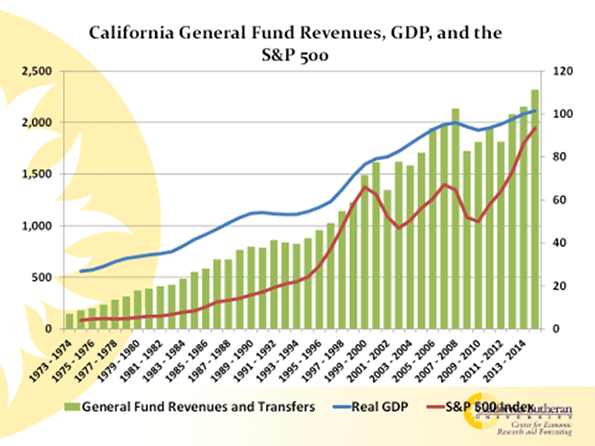
    Since much of wealthy people’s income is from increased asset values—capital gains—rather than from wages that have been paid to them, their income, and thus California’s tax revenue, is more volatile than the economy. California revenue tracks changes in asset values more closely than it tracks changes in economic growth. See the following chart:

    The increased revenues from the dot-com boom, the 2000s asset boom, and today’s boom are readily apparent in the chart. The declines that inevitably follow booms are also apparent.

    California goes through these repeating cycles like a bad dream. Asset prices increase. California’s revenues increase. Sacramento spends that windfall as if asset prices will continue to rise forever. Worse, legislators commit to future spending as if the boom will continue forever.

    Of course, booms don’t go on forever. Inevitably, prices fall. The gains that drive California’s revenue turn into losses, and California faces yet another budget crisis. Sacramento responds by raising taxes on the wealthy, and increasing the state’s reliance on the few wealthy. This pretty much guarantees that the problem will be even worse in the next cycle.

    It’s a self-reinforcing boom and bust cycle of ever increasing revenue volatility.

    It’s amazing to me that California’s leadership continues to do this, and that Californians allow it. It can only be possible because so few Californians understand the state’s finances. The people who responded to me are relatively well informed; far better informed than most Californians. Yet, even they don’t know how California’s revenues work.

    It appears that California’s susceptibility to asset volatility is California’s best kept secret. That needs to change.

    Governor Brown was hailed as a hero when proposition 30 was passed, raising taxes on those who earn over $250,000 a year. It was even retroactive. California’s revenues soared, a result of the combination of new taxes and a huge bull market on Wall Street. It was said that Brown had solved California’s deficit problem. What he really did was sow the seeds of California’s next budget crisis.

    What about the next response I heard, the objection that losses have to be realized before they impact California’s budget? Can we be realistic? The people who pay over half of California’s income taxes have resources that are unimaginable to most of us. You can bet your net worth that, for tax purposes, they recognize losses as quickly as possible and do their best to never realize gains. The gains we’ve seen were only reluctantly recognized. The losses will be enthusiastically recognized.

    The comment about retained wealth—that the wealthy were back to where they were eight months ago—is a red herring. Wealth is irrelevant. Income taxes are paid on changes to wealth, not wealth. And, we don’t have to wait until after the fact, or until the end of the fiscal year, to know what the story will be. We don’t even need a real bust to see California’s surplus slip away. The surplus is dependent on increasing asset values. It’s not necessary for asset prices to decline for the surplus to be eliminated. All that is required is that asset values cease increasing.

    I thought it was irresponsible for people to cheer California’s surplus without at least recognizing its fragility. Ignoring the fragility now, when asset prices are especially volatile, is foolhardy. Our governor and legislators know what will become of California’s surplus when asset prices decline. They should be developing a plan.

    Of course, California’s leadership is not working on a plan. Instead, the best of them (admittedly a low hurdle) continue to pat themselves on the back and hope for the best. Some do worse by attempting to increase California’s spending even more.

    Besides developing a plan to deal with the sure-to-come deficit, Sacramento should be working on a plan to make California’s revenues more closely track broad economic activity, instead of volatile asset prices. This would require a broader tax base and a less progressive income tax. Unfortunately, that’s not likely to happen.

    Bill Watkins is a professor at California Lutheran University and runs the Center for Economic Research and Forecasting, which can be found at clucerf.org.

    Flickr photo by Thomas Hawk: The Good Life; the Ritz Carlton, Laguna Niguel, California.

  • Tech Oligarchs Tightening Their Grip on Democrats

    The current state of the Republican Party may seem like a demolition derby, but there’s an equally fascinating, if less well-understood, conflict within the Democratic Party. In this case, the disruptive force is largely Silicon Valley, a natural oligarchy that now funds a party teetering toward populism and even socialism.

    The fundamental contradictions, as Karl Marx would have noted, lie in the collision of interests between a group that has come to epitomize self-consciously progressive megawealth and a mass base which is increasingly concerned about downward mobility. For all his occasional populist lapses, President Obama generally has embraced Silicon Valley as an intrinsic part of his political coalition. He has even enlisted several tech giants – including venture capitalist John Doerr, LinkedIn billionaire Reid Hoffman and Sun Microsystems co-founder Vinod Khosla – in helping plan out Obama’s no-doubt lavish and highly political retirement.

    In contrast, Hillary Clinton is hardly the icon in the Valley and its San Francisco annex as are both her husband and President Obama. But her “technocratic liberalism,” albeit hard to pin down, and close ties to the financial oligarchs seems more congenial than the grass-roots populism identified with Bernie Sanders, her chief rival for the Democratic presidential nomination.

    “They don’t like Sanders at all,” notes researcher Greg Ferenstein, who has been polling Internet company founders for an upcoming book. Sanders’ emphasis on income redistribution and protecting union privileges and pensions is hardly popular among the tech elite. “He’s an egalitarian liberal,” Ferenstein explains, “These people are tech liberals. Equality is a nonissue in Silicon Valley.”

    Read the entire piece at The Orange County Register.

    Joel Kotkin is executive editor of NewGeography.com and Roger Hobbs Distinguished Fellow in Urban Studies at Chapman University, and a member of the editorial board of the Orange County Register. He is also executive director of the Houston-based Center for Opportunity Urbanism. His newest book, The New Class Conflict is now available at Amazon and Telos Press. He is also author of The City: A Global History and The Next Hundred Million: America in 2050. He lives in Orange County, CA.

    Official White House Photo by Pete Souza