Blog

  • Mid-Sized Cities Business Services Jobs – 2015 Best Cities Rankings

    Read about how we selected the 2015 Best Cities for Job Growth

    We used five measures of growth to rank MSAs over the past 10 years. “Large” areas include those with a current nonfarm employment base of at least 450,000 jobs. “Midsize” areas range from 150,000 to 450,000 jobs. “Small” areas have as many as 150,000 jobs. This year’s rankings reflect the new Office of Management and Budget definitions of MSAs for all series released after March 2015. As a result, the MSA listed in this year’s rankings do not necessary correspond directly to those listed in prior years. In some instances, MSAs were consolidated with others — for example Pascagoula, MS, was combined with the Gulfport-Biloxi, MS, MSA to form the new Gulfport-Biloxi-Pascagoula, MS, MSA. Others were separated from previously consolidated MSAs and in still other instances individual counties were shifted from one MSA to another. The bottom line is that this year’s rankings are based on good time series for the newly defined MSAs but may not be precisely comparable to those listed in prior years. The total number of MSAs included in this year’s rankings has risen from 398 to 421. This year’s rankings reflect the current size of each MSA’s employment.

    2015 MSA Prof & Bus Svcs Midsized MSA Ranking Area 2015 Prof & Bus Svcs Weighted INDEX 2014 Prof & Bus Svcs Emplmt (1000s) Total Prof & Bus Svcs Emplmt Growth Rate 2013-2014 Total Prof & Bus Svcs Emplmt Cum Growth
    2009-2014
    2015 MSA Prof & Bus Svcs Overall Ranking
    1 Provo-Orem, UT 67.3     29.6 11.5% 46.5% 9
    2 North Port-Sarasota-Bradenton, FL 64.7     40.0 8.3% 32.6% 17
    3 Reading, PA 62.6     23.5 7.6% 26.6% 21
    4 Fayetteville-Springdale-Rogers, AR-MO 61.8     45.7 6.8% 36.6% 26
    5 Fresno, CA 61.3     33.5 12.1% 24.9% 27
    6 Deltona-Daytona Beach-Ormond Beach, FL 59.9     21.5 9.1% 24.3% 35
    7 Ogden-Clearfield, UT 59.8     28.6 5.2% 35.6% 36
    8 Beaumont-Port Arthur, TX 58.5     15.7 13.5% 21.8% 40
    9 Cape Coral-Fort Myers, FL 58.5     30.5 5.7% 26.4% 41
    10 Springfield, MO 55.8     25.5 6.0% 37.2% 49
    11 Lancaster, PA 55.7     23.9 7.0% 26.1% 50
    12 Lexington-Fayette, KY 53.7     39.1 -4.2% 30.2% 55
    13 Greensboro-High Point, NC 53.3     51.8 8.3% 22.5% 57
    14 Greenville-Anderson-Mauldin, SC 52.0     68.5 3.9% 31.3% 65
    15 Des Moines-West Des Moines, IA 51.0     45.7 4.5% 23.5% 69
    16 Modesto, CA 51.0     14.8 8.8% 13.0% 70
    17 Knoxville, TN 50.2     61.1 6.0% 20.9% 79
    18 Rockford, IL 49.8     16.7 8.9% 16.3% 83
    19 Savannah, GA 49.7     20.2 6.1% 19.8% 85
    20 York-Hanover, PA 48.3     20.8 3.1% 31.6% 98
    21 Wichita, KS 45.6     33.6 3.9% 18.4% 113
    22 Charleston-North Charleston, SC 45.5     49.2 5.0% 22.4% 114
    23 Gary, IN Metro Div 43.7     23.4 2.3% 20.0% 126
    24 Madison, WI 42.4     48.5 2.1% 21.7% 136
    25 Elgin, IL Metro Div 42.0     35.5 -3.5% 32.0% 138
    26 Baton Rouge, LA 41.5     47.7 6.0% 13.8% 142
    27 Winston-Salem, NC 41.2     34.8 5.2% 23.1% 146
    28 Pensacola-Ferry Pass-Brent, FL 40.7     22.0 4.3% 16.6% 149
    29 Asheville, NC 39.9     17.4 0.4% 21.3% 152
    30 Baltimore City, MD 39.8     47.2 0.5% 23.0% 155
    31 Springfield, MA-CT NECTA 39.1     25.7 3.6% 16.8% 161
    32 Ann Arbor, MI 38.8     27.7 5.7% 9.8% 165
    33 Canton-Massillon, OH 38.5     15.0 5.6% 11.7% 168
    34 Montgomery, AL 38.3     21.9 6.0% 11.5% 169
    35 New Haven, CT NECTA 38.2     30.3 2.4% 19.8% 172
    36 Chattanooga, TN-GA 38.0     27.7 3.5% 27.8% 173
    37 Salem, OR 37.7     12.6 2.2% 9.3% 177
    38 Evansville, IN-KY 37.5     19.0 4.0% 13.6% 179
    39 Jackson, MS 37.5     32.8 2.5% 20.1% 180
    40 Lakeland-Winter Haven, FL 37.4     28.2 8.3% 5.6% 182
    41 Tacoma-Lakewood, WA Metro Div 37.1     25.6 3.9% 8.5% 186
    42 Santa Rosa, CA 36.8     20.1 1.2% 11.2% 188
    43 Stockton-Lodi, CA 36.0     18.2 2.6% 12.6% 194
    44 Tallahassee, FL 36.0     19.7 5.3% 9.4% 195
    45 Spokane-Spokane Valley, WA 35.7     24.1 4.8% 15.5% 199
    46 Lake County-Kenosha County, IL-WI Metro Div 35.2     68.3 -1.2% 24.8% 202
    47 Boulder, CO 35.0     32.5 0.4% 18.3% 205
    48 Delaware County, PA 34.8     31.9 2.6% 16.0% 209
    49 Dayton, OH 34.3     49.6 3.7% 11.3% 213
    50 Framingham, MA NECTA Div 33.9     35.1 3.2% 11.4% 215
    51 Augusta-Richmond County, GA-SC 33.3     33.0 3.9% 8.7% 218
    52 Tulsa, OK 33.2     59.7 3.9% 9.9% 219
    53 Santa Maria-Santa Barbara, CA 32.7     23.3 0.6% 14.8% 222
    54 Wilmington, DE-MD-NJ Metro Div 31.7     54.6 1.3% 11.2% 228
    55 Columbia, SC 31.4     47.4 -3.3% 23.3% 231
    56 Harrisburg-Carlisle, PA 30.5     44.9 0.4% 17.0% 236
    57 Allentown-Bethlehem-Easton, PA-NJ 28.9     48.2 -2.4% 14.8% 245
    58 Reno, NV 28.9     27.6 1.2% 9.1% 246
    59 Calvert-Charles-Prince George’s, MD 28.9     47.8 5.3% 2.1% 247
    60 Worcester, MA-CT NECTA 28.7     26.8 4.4% 4.4% 249
    61 Scranton–Wilkes-Barre–Hazleton, PA 27.8     28.3 -1.6% 14.3% 252
    62 Fort Wayne, IN 27.4     20.9 3.5% 6.3% 254
    63 Shreveport-Bossier City, LA 27.2     17.8 1.9% 5.7% 257
    64 McAllen-Edinburg-Mission, TX 26.9     15.6 -1.5% 11.5% 258
    65 Youngstown-Warren-Boardman, OH-PA 26.8     23.3 -0.3% 15.5% 259
    66 Toledo, OH 26.2     34.4 -4.5% 12.1% 263
    67 Trenton, NJ 25.7     38.4 1.5% 10.1% 269
    68 Portland-South Portland, ME NECTA 25.6     26.5 -0.7% 13.4% 270
    69 Lansing-East Lansing, MI 25.6     21.5 0.5% 8.8% 273
    70 Davenport-Moline-Rock Island, IA-IL 25.1     23.2 -1.4% 13.2% 274
    71 Palm Bay-Melbourne-Titusville, FL 24.3     29.9 4.7% -6.9% 280
    72 Lafayette, LA 23.8     22.9 -2.3% 15.6% 283
    73 Akron, OH 23.6     50.2 0.2% 8.4% 285
    74 Colorado Springs, CO 23.3     41.7 1.2% 1.1% 289
    75 Durham-Chapel Hill, NC 23.0     36.9 0.6% 5.7% 290
    76 Tucson, AZ 22.8     50.4 0.3% 7.2% 292
    77 Bridgeport-Stamford-Norwalk, CT NECTA 22.5     65.4 0.6% 7.4% 294
    78 Bakersfield, CA 21.4     25.7 0.4% 9.7% 299
    79 Roanoke, VA 21.3     21.2 0.8% 4.4% 301
    80 Boise City, ID 19.6     40.1 -2.4% 5.4% 308
    81 Oxnard-Thousand Oaks-Ventura, CA 19.5     36.0 -1.0% 4.7% 309
    82 Huntsville, AL 19.2     49.7 0.5% 0.3% 311
    83 Albuquerque, NM 19.2     57.7 1.1% -1.7% 312
    84 Lincoln, NE 18.8     18.3 -2.8% 7.2% 316
    85 Little Rock-North Little Rock-Conway, AR 18.2     43.9 -2.2% 4.4% 319
    86 Green Bay, WI 18.1     20.1 -2.0% 3.4% 320
    87 Syracuse, NY 17.6     33.1 -0.2% 1.2% 322
    88 El Paso, TX 17.5     31.2 -1.9% -1.4% 323
    89 Corpus Christi, TX 17.4     15.7 0.9% 0.6% 324
    90 Mobile, AL 15.9     21.2 -2.0% 3.4% 335
    91 Anchorage, AK 13.7     20.6 -4.9% 4.6% 340
    92 Peoria, IL 10.6     20.5 -1.6% -2.2% 351
    93 Gulfport-Biloxi-Pascagoula, MS 7.4     15.3 -6.9% -5.4% 359
  • Small Business Services Jobs – 2015 Best Cities Rankings

    Read about how we selected the 2015 Best Cities for Job Growth

    We used five measures of growth to rank MSAs over the past 10 years. “Large” areas include those with a current nonfarm employment base of at least 450,000 jobs. “Midsize” areas range from 150,000 to 450,000 jobs. “Small” areas have as many as 150,000 jobs. This year’s rankings reflect the new Office of Management and Budget definitions of MSAs for all series released after March 2015. As a result, the MSA listed in this year’s rankings do not necessary correspond directly to those listed in prior years. In some instances, MSAs were consolidated with others — for example Pascagoula, MS, was combined with the Gulfport-Biloxi, MS, MSA to form the new Gulfport-Biloxi-Pascagoula, MS, MSA. Others were separated from previously consolidated MSAs and in still other instances individual counties were shifted from one MSA to another. The bottom line is that this year’s rankings are based on good time series for the newly defined MSAs but may not be precisely comparable to those listed in prior years. The total number of MSAs included in this year’s rankings has risen from 398 to 421. This year’s rankings reflect the current size of each MSA’s employment.

    2015 MSA Prof & Bus Svcs Small MSA Ranking Area 2015 Prof & Bus Svcs Weighted INDEX 2014 Prof & Bus Svcs Emplmt (1000s) Total Prof & Bus Svcs Emplmt Growth Rate 2013-2014 Total Prof & Bus Svcs Emplmt Cum Growth
    2009-2014
    2015 MSA Prof & Bus Svcs Overall Ranking
    1 Auburn-Opelika, AL 74.3         7.7 13.3% 66.7% 1
    2 Tuscaloosa, AL 71.8      10.9 19.9% 68.0% 2
    3 Grants Pass, OR 71.7         2.2 8.3% 54.8% 3
    4 Jackson, TN 70.9         6.6 9.4% 58.4% 4
    5 New Bedford, MA NECTA 69.6         5.7 12.5% 43.7% 5
    6 Port St. Lucie, FL 69.0      17.0 15.7% 38.3% 6
    7 Janesville-Beloit, WI 68.0         6.0 13.9% 46.3% 7
    8 Lynn-Saugus-Marblehead, MA NECTA Div 67.6         3.1 9.4% 31.0% 8
    9 Waco, TX 67.0      11.3 12.6% 30.4% 10
    10 Burlington, NC 66.8         6.0 22.6% 45.5% 11
    11 Monroe, MI 66.1         4.5 7.1% 51.7% 12
    12 Sherman-Denison, TX 65.8         3.3 6.5% 46.3% 14
    13 Lafayette-West Lafayette, IN 65.0         8.4 8.1% 61.1% 16
    14 Greeley, CO 64.6         9.7 6.2% 49.7% 18
    15 Elkhart-Goshen, IN 63.7      10.1 6.7% 43.4% 19
    16 Columbus, IN 63.2         5.5 5.7% 48.2% 20
    17 Springfield, OH 62.3         4.8 9.9% 28.6% 23
    18 Naples-Immokalee-Marco Island, FL 62.2      15.2 7.8% 44.9% 24
    19 Lake Havasu City-Kingman, AZ 61.9         4.1 10.9% 29.8% 25
    20 Gadsden, AL 61.2         4.4 3.9% 50.0% 28
    21 Salinas, CA 61.1      13.0 12.4% 19.7% 29
    22 Morgantown, WV 60.8         6.5 9.0% 24.4% 30
    23 Redding, CA 60.2         6.1 10.2% 19.6% 31
    24 Hickory-Lenoir-Morganton, NC 60.1      14.6 7.4% 30.8% 32
    25 Cleveland, TN 60.0         6.2 -34.5% 97.9% 33
    26 Gainesville, FL 59.9      12.9 10.6% 27.0% 34
    27 Yuba City, CA 59.8         3.1 9.4% 24.0% 37
    28 Kankakee, IL 58.6         4.1 -1.6% 42.5% 39
    29 Flagstaff, AZ 58.5         3.1 13.3% 23.7% 42
    30 Odessa, TX 57.6         5.0 11.2% 25.2% 43
    31 Manchester, NH NECTA 57.0      16.2 8.3% 23.1% 46
    32 Bend-Redmond, OR 56.8         7.9 10.2% 20.9% 47
    33 Topeka, KS 56.8      13.0 2.9% 37.0% 48
    34 Macon, GA 54.6      12.4 6.9% 22.4% 52
    35 College Station-Bryan, TX 54.0         7.7 4.5% 27.6% 53
    36 Michigan City-La Porte, IN 53.5         3.1 10.8% 24.3% 56
    37 Wausau, WI 53.1         5.2 6.8% 21.9% 58
    38 Iowa City, IA 53.1         7.1 4.9% 37.4% 59
    39 Bay City, MI 52.7         3.6 6.9% 18.7% 60
    40 Saginaw, MI 52.5      11.5 3.9% 21.8% 61
    41 Ocala, FL 52.4         9.8 6.9% 21.4% 63
    42 Victoria, TX 52.4         2.7 15.7% 14.1% 64
    43 Laredo, TX 51.6         8.3 6.0% 40.9% 66
    44 Prescott, AZ 51.0         3.7 12.1% 11.0% 71
    45 Fond du Lac, WI 50.9         2.6 5.3% 19.7% 72
    46 Corvallis, OR 50.8         4.3 10.3% 21.9% 73
    47 Lawrence, KS 50.8         5.6 7.1% 12.1% 74
    48 Ithaca, NY 50.8         3.4 6.3% 18.8% 75
    49 Charlottesville, VA 50.5      14.5 6.4% 21.9% 76
    50 Bismarck, ND 49.8         8.1 6.1% 26.4% 82
    51 Kalamazoo-Portage, MI 49.7      16.5 6.0% 18.8% 84
    52 Bangor, ME NECTA 49.2         6.6 7.1% 14.5% 87
    53 Waterloo-Cedar Falls, IA 49.2         7.5 3.2% 24.3% 88
    54 Muskegon, MI 48.9         3.6 2.9% 22.7% 90
    55 Myrtle Beach-Conway-North Myrtle Beach, SC-NC 48.8      12.7 5.2% 15.4% 91
    56 Napa, CA 48.6         6.6 5.9% 20.7% 94
    57 Barnstable Town, MA NECTA 48.4         8.9 10.3% 14.1% 95
    58 Panama City, FL 48.4         9.1 -3.5% 21.9% 96
    59 Lake Charles, LA 48.2         8.6 3.6% 27.2% 99
    60 Midland, TX 47.9         9.8 3.9% 40.2% 101
    61 Pueblo, CO 47.3         6.8 5.7% 20.7% 104
    62 Battle Creek, MI 47.1         6.6 10.7% 10.7% 106
    63 Burlington-South Burlington, VT NECTA 47.1      13.9 3.5% 29.1% 107
    64 San Luis Obispo-Paso Robles-Arroyo Grande, CA 46.9      12.2 4.3% 28.3% 108
    65 Greenville, NC 46.5         7.4 0.9% 29.1% 110
    66 Elizabethtown-Fort Knox, KY 46.4         5.7 4.9% 25.0% 111
    67 Waterbury, CT NECTA 45.3         5.5 5.8% 12.2% 115
    68 Punta Gorda, FL 44.7         4.5 -1.4% 37.4% 118
    69 South Bend-Mishawaka, IN-MI 44.5      13.3 5.5% 14.3% 119
    70 Chico, CA 44.2         6.1 3.4% 30.7% 122
    71 Elmira, NY 44.1         2.7 5.3% 14.3% 123
    72 Danbury, CT NECTA 44.1         9.2 5.3% 19.4% 124
    73 Kingsport-Bristol-Bristol, TN-VA 43.6         9.9 1.7% 21.6% 127
    74 Salisbury, MD-DE 43.6      11.7 3.5% 18.1% 128
    75 Olympia-Tumwater, WA 43.4      10.0 0.3% 30.0% 129
    76 Brockton-Bridgewater-Easton, MA NECTA Div 42.9         7.9 1.3% 19.8% 130
    77 Chambersburg-Waynesboro, PA 42.7         5.2 8.3% 3.3% 132
    78 Pocatello, ID 42.7         3.9 0.0% 21.9% 133
    79 Flint, MI 42.6      15.1 4.6% 24.5% 134
    80 Cheyenne, WY 42.5         3.5 6.1% 10.5% 135
    81 Wilmington, NC 42.3      14.8 3.5% 15.3% 137
    82 Fargo, ND-MN 41.9      16.1 3.6% 25.4% 139
    83 Medford, OR 40.9         7.2 10.7% 5.9% 148
    84 Clarksville, TN-KY 40.4         9.1 7.5% 10.5% 150
    85 Brownsville-Harlingen, TX 39.8      11.7 -3.6% 29.5% 153
    86 Kahului-Wailuku-Lahaina, HI 39.7         7.1 3.9% 16.9% 156
    87 Oshkosh-Neenah, WI 39.7      11.5 2.1% 20.3% 157
    88 Appleton, WI 39.7      13.3 5.0% 14.4% 158
    89 Bellingham, WA 39.4         7.8 5.0% 7.9% 159
    90 Spartanburg, SC 39.1      15.5 3.1% 14.5% 163
    91 Huntington-Ashland, WV-KY-OH 39.1      12.2 8.3% 4.6% 164
    92 Sebastian-Vero Beach, FL 38.7         5.1 6.9% 10.0% 166
    93 State College, PA 38.6         6.1 5.2% 9.6% 167
    94 Abilene, TX 38.3         5.6 2.4% 9.1% 170
    95 Tyler, TX 38.3         9.0 5.9% 4.7% 171
    96 Altoona, PA 37.8         5.7 2.4% 18.1% 175
    97 Dothan, AL 37.7         4.7 10.9% 8.4% 176
    98 Morristown, TN 37.7         3.4 0.0% 14.8% 178
    99 St. George, UT 37.3         4.2 2.4% 23.5% 183
    100 Hagerstown-Martinsburg, MD-WV 37.3         9.6 4.0% 17.6% 184
    101 Dalton, GA 37.1         6.2 9.4% -7.0% 185
    102 Mansfield, OH 37.1         5.3 -1.3% 15.3% 187
    103 Johnson City, TN 36.6         8.4 5.4% 11.9% 189
    104 Dover-Durham, NH-ME NECTA 36.1         3.9 4.5% 11.4% 193
    105 Longview, TX 35.8         9.4 4.5% 11.5% 197
    106 Bloomsburg-Berwick, PA 35.8         4.5 -3.5% 27.1% 198
    107 Erie, PA 35.2      10.1 6.7% -1.0% 201
    108 Lewiston-Auburn, ME NECTA 35.1         6.8 0.0% 15.2% 203
    109 Coeur d’Alene, ID 35.0         6.4 2.1% 6.7% 206
    110 Grand Forks, ND-MN 35.0         3.1 9.4% 4.5% 207
    111 Athens-Clarke County, GA 34.8         7.2 -0.9% 13.7% 208
    112 Binghamton, NY 34.7         9.9 4.6% 12.1% 210
    113 Bowling Green, KY 34.6         8.6 1.6% 16.1% 211
    114 Glens Falls, NY 34.3         5.6 -0.6% 16.8% 212
    115 Fort Smith, AR-OK 34.2      12.2 4.0% 10.6% 214
    116 Leominster-Gardner, MA NECTA 33.6         3.6 1.9% 12.5% 216
    117 Carson City, NV 33.3         2.1 6.9% 10.7% 217
    118 Monroe, LA 32.7         8.2 2.1% 10.4% 221
    119 Atlantic City-Hammonton, NJ 32.4         9.6 5.1% 2.9% 223
    120 Rochester, MN 32.1         5.8 -0.6% 21.8% 224
    121 Kingston, NY 32.0         4.4 -3.0% 11.0% 225
    122 Madera, CA 32.0         2.9 0.0% 17.8% 226
    123 Casper, WY 31.9         3.0 0.0% 15.4% 227
    124 Albany, OR 31.5         3.4 1.0% 11.0% 230
    125 Hanford-Corcoran, CA 31.1         1.4 7.5% -12.2% 233
    126 Nashua, NH-MA NECTA Div 30.7      14.4 -0.2% 13.9% 235
    127 Fort Collins, CO 30.4      19.0 -0.7% 15.2% 238
    128 San Angelo, TX 30.2         3.9 -0.9% 12.6% 239
    129 Lowell-Billerica-Chelmsford, MA-NH NECTA Div 29.3      21.5 6.3% 2.2% 240
    130 Lubbock, TX 29.2      11.0 0.3% 16.6% 241
    131 Lima, OH 29.2         4.7 -2.8% 21.6% 243
    132 Duluth, MN-WI 28.8         8.4 2.9% 7.2% 248
    133 Sioux Falls, SD 28.1      13.1 -4.1% 22.7% 250
    134 Grand Junction, CO 27.9         5.5 1.9% 5.8% 251
    135 Johnstown, PA 27.5         5.7 3.6% 4.9% 253
    136 Missoula, MT 27.3         7.0 3.5% 3.5% 255
    137 Weirton-Steubenville, WV-OH 26.6         1.9 5.6% 1.8% 261
    138 Crestview-Fort Walton Beach-Destin, FL 26.0      13.3 0.8% 7.0% 265
    139 Champaign-Urbana, IL 26.0         8.2 1.7% 10.3% 266
    140 Taunton-Middleborough-Norton, MA NECTA Div 25.8         5.7 1.2% 11.0% 268
    141 Niles-Benton Harbor, MI 25.6         5.5 7.8% 3.1% 271
    142 Vallejo-Fairfield, CA 25.6         9.7 3.9% -10.7% 272
    143 Rapid City, SD 24.9         5.1 1.3% 10.1% 276
    144 Sheboygan, WI 24.8         4.5 -2.2% 9.8% 277
    145 Haverhill-Newburyport-Amesbury Town, MA-NH NECTA Div 24.5         5.2 -0.6% 10.6% 278
    146 Norwich-New London-Westerly, CT-RI NECTA 24.4         9.2 3.4% 0.0% 279
    147 Amarillo, TX 24.1         8.9 1.9% 5.5% 281
    148 Eau Claire, WI 23.8         9.0 0.0% 5.9% 282
    149 Decatur, AL 23.7         5.3 -5.3% 16.8% 284
    150 Racine, WI 23.4         6.3 0.0% 12.5% 287
    151 Lawton, OK 23.3         3.8 4.6% 9.6% 288
    152 Logan, UT-ID 22.9         5.6 -0.6% 5.7% 291
    153 Sierra Vista-Douglas, AZ 22.6         4.6 7.9% -25.9% 293
    154 Lynchburg, VA 22.5      12.4 1.1% -4.4% 295
    155 Peabody-Salem-Beverly, MA NECTA Div 22.4         9.9 0.7% 8.4% 296
    156 Idaho Falls, ID 22.3      12.1 2.3% -5.2% 297
    157 Fairbanks, AK 21.6         2.3 3.0% 4.5% 298
    158 Charleston, WV 21.2      14.6 -0.2% 7.6% 302
    159 Eugene, OR 20.7      15.3 -1.5% 7.0% 303
    160 Owensboro, KY 20.4         3.8 -5.0% 16.5% 304
    161 Danville, IL 20.1         1.9 1.8% -10.8% 305
    162 Portsmouth, NH-ME NECTA 19.9      10.6 0.3% -0.9% 307
    163 Dover, DE 19.4         4.2 -2.3% 1.6% 310
    164 Walla Walla, WA 19.2         0.9 -6.7% 3.7% 313
    165 La Crosse-Onalaska, WI-MN 19.0         6.5 -1.5% 7.7% 314
    166 Las Cruces, NM 18.8         7.3 -0.9% -4.3% 315
    167 Pittsfield, MA NECTA 18.7         3.7 0.9% 0.9% 317
    168 Santa Cruz-Watsonville, CA 18.3         9.4 0.4% 5.6% 318
    169 Bremerton-Silverdale, WA 17.8         7.1 0.0% -2.3% 321
    170 Wichita Falls, TX 17.3         3.5 -2.8% 9.5% 326
    171 Billings, MT 17.2         8.6 1.2% -6.5% 327
    172 Florence-Muscle Shoals, AL 17.2         4.0 4.4% -12.5% 328
    173 East Stroudsburg, PA 17.1         3.3 4.3% -12.5% 329
    174 Lawrence-Methuen Town-Salem, MA-NH NECTA Div 16.6      10.1 0.0% 5.9% 331
    175 Kennewick-Richland, WA 16.3      20.8 2.6% -9.3% 333
    176 Rocky Mount, NC 16.2         5.5 1.2% -1.2% 334
    177 Yuma, AZ 14.9         6.1 -2.7% 4.6% 337
    178 Visalia-Porterville, CA 13.9         9.1 -6.8% 6.6% 338
    179 Yakima, WA 13.7         3.7 0.0% -2.7% 339
    180 San Rafael, CA Metropolitan Div 13.5      18.3 -1.8% -0.4% 341
    181 Columbus, GA-AL 13.2      12.6 -3.1% -3.3% 342
    182 Terre Haute, IN 13.0         5.4 -2.4% -4.7% 343
    183 St. Cloud, MN 12.6         8.3 -9.5% 2.9% 344
    184 Jackson, MI 12.5         3.8 -6.6% 4.6% 345
    185 Killeen-Temple, TX 12.2         9.0 -0.7% -7.5% 346
    186 Great Falls, MT 11.7         3.1 -1.1% -3.2% 347
    187 Santa Fe, NM 11.3         4.3 -2.3% -2.3% 348
    188 Fayetteville, NC 10.7      12.4 -0.8% -4.8% 349
    189 Dutchess County-Putnam County, NY Metropolitan Div 10.7      11.5 -2.3% -4.4% 350
    190 Springfield, IL 9.9      10.3 -0.6% -7.5% 352
    191 Cedar Rapids, IA 9.5      12.9 -6.3% -1.5% 353
    192 Merced, CA 9.4         3.9 -2.5% -3.3% 354
    193 Sioux City, IA-NE-SD 9.1         8.6 -7.2% -1.5% 355
    194 El Centro, CA 9.1         2.5 -18.5% 1.4% 356
    195 Bloomington, IL 8.8      17.1 -4.3% -4.5% 357
    196 Watertown-Fort Drum, NY 8.3         2.1 -9.9% -12.3% 358
    197 Lewiston, ID-WA 7.1         1.2 -2.7% -16.3% 360
    198 Decatur, IL 7.1         3.0 -4.2% -9.9% 361
    199 Texarkana, TX-AR 6.9         3.7 -7.6% -6.0% 362
    200 Utica-Rome, NY 6.5         7.9 -4.8% -9.5% 363
    201 Vineland-Bridgeton, NJ 5.6         3.3 -20.6% -7.4% 364
    202 Anniston-Oxford-Jacksonville, AL 5.3         4.3 -7.9% -14.6% 365
    203 Bloomington, IN 5.2         4.1 -8.1% -34.4% 366
  • All Cities Business Services Jobs – 2015 Best Cities Rankings

    Read about how we selected the 2015 Best Cities for Job Growth

    We used five measures of growth to rank MSAs over the past 10 years. “Large” areas include those with a current nonfarm employment base of at least 450,000 jobs. “Midsize” areas range from 150,000 to 450,000 jobs. “Small” areas have as many as 150,000 jobs. This year’s rankings reflect the new Office of Management and Budget definitions of MSAs for all series released after March 2015. As a result, the MSA listed in this year’s rankings do not necessary correspond directly to those listed in prior years. In some instances, MSAs were consolidated with others — for example Pascagoula, MS, was combined with the Gulfport-Biloxi, MS, MSA to form the new Gulfport-Biloxi-Pascagoula, MS, MSA. Others were separated from previously consolidated MSAs and in still other instances individual counties were shifted from one MSA to another. The bottom line is that this year’s rankings are based on good time series for the newly defined MSAs but may not be precisely comparable to those listed in prior years. The total number of MSAs included in this year’s rankings has risen from 398 to 421. This year’s rankings reflect the current size of each MSA’s employment.

    2015 MSA Prof & Bus Svcs Overall Ranking Area 2015 Prof & Bus Svcs Weighted INDEX 2014 Prof & Bus Svcs Emplmt (1000s) Total Prof & Bus Svcs Emplmt Growth Rate 2013-2014 Total Prof & Bus Svcs Emplmt Cum Growth
    2009-2014
    2015 MSA Size Group
    1 Auburn-Opelika, AL 74.3          7.7 13.3% 66.7% S
    2 Tuscaloosa, AL 71.8        10.9 19.9% 68.0% S
    3 Grants Pass, OR 71.7          2.2 8.3% 54.8% S
    4 Jackson, TN 70.9          6.6 9.4% 58.4% S
    5 New Bedford, MA NECTA 69.6          5.7 12.5% 43.7% S
    6 Port St. Lucie, FL 69.0        17.0 15.7% 38.3% S
    7 Janesville-Beloit, WI 68.0          6.0 13.9% 46.3% S
    8 Lynn-Saugus-Marblehead, MA NECTA Division 67.6          3.1 9.4% 31.0% S
    9 Provo-Orem, UT 67.3        29.6 11.5% 46.5% M
    10 Waco, TX 67.0        11.3 12.6% 30.4% S
    11 Burlington, NC 66.8          6.0 22.6% 45.5% S
    12 Monroe, MI 66.1          4.5 7.1% 51.7% S
    13 San Jose-Sunnyvale-Santa Clara, CA 65.9     212.7 7.9% 34.7% L
    14 Sherman-Denison, TX 65.8          3.3 6.5% 46.3% S
    15 San Francisco-Redwood City-South San Francisco, CA Metro Div 65.4     256.9 9.0% 42.3% L
    16 Lafayette-West Lafayette, IN 65.0          8.4 8.1% 61.1% S
    17 North Port-Sarasota-Bradenton, FL 64.7        40.0 8.3% 32.6% M
    18 Greeley, CO 64.6          9.7 6.2% 49.7% S
    19 Elkhart-Goshen, IN 63.7        10.1 6.7% 43.4% S
    20 Columbus, IN 63.2          5.5 5.7% 48.2% S
    21 Reading, PA 62.6        23.5 7.6% 26.6% M
    22 Raleigh, NC 62.6     113.1 8.6% 36.5% L
    23 Springfield, OH 62.3          4.8 9.9% 28.6% S
    24 Naples-Immokalee-Marco Isl&, FL 62.2        15.2 7.8% 44.9% S
    25 Lake Havasu City-Kingman, AZ 61.9          4.1 10.9% 29.8% S
    26 Fayetteville-Springdale-Rogers, AR-MO 61.8        45.7 6.8% 36.6% M
    27 Fresno, CA 61.3        33.5 12.1% 24.9% M
    28 Gadsden, AL 61.2          4.4 3.9% 50.0% S
    29 Salinas, CA 61.1        13.0 12.4% 19.7% S
    30 Morgantown, WV 60.8          6.5 9.0% 24.4% S
    31 Redding, CA 60.2          6.1 10.2% 19.6% S
    32 Hickory-Lenoir-Morganton, NC 60.1        14.6 7.4% 30.8% S
    33 Clevel&, TN 60.0          6.2 -34.5% 97.9% S
    34 Gainesville, FL 59.9        12.9 10.6% 27.0% S
    35 Deltona-Daytona Beach-Ormond Beach, FL 59.9        21.5 9.1% 24.3% M
    36 Ogden-Clearfield, UT 59.8        28.6 5.2% 35.6% M
    37 Yuba City, CA 59.8          3.1 9.4% 24.0% S
    38 Nashville-Davidson–Murfreesboro–Franklin, TN 59.1     136.8 4.3% 41.4% L
    39 Kankakee, IL 58.6          4.1 -1.6% 42.5% S
    40 Beaumont-Port Arthur, TX 58.5        15.7 13.5% 21.8% M
    41 Cape Coral-Fort Myers, FL 58.5        30.5 5.7% 26.4% M
    42 Flagstaff, AZ 58.5          3.1 13.3% 23.7% S
    43 Odessa, TX 57.6          5.0 11.2% 25.2% S
    44 Austin-Round Rock, TX 57.3     150.3 4.3% 37.2% L
    45 Dallas-Plano-Irving, TX Metro Div 57.2     437.4 6.8% 29.7% L
    46 Manchester, NH NECTA 57.0        16.2 8.3% 23.1% S
    47 Bend-Redmond, OR 56.8          7.9 10.2% 20.9% S
    48 Topeka, KS 56.8        13.0 2.9% 37.0% S
    49 Springfield, MO 55.8        25.5 6.0% 37.2% M
    50 Lancaster, PA 55.7        23.9 7.0% 26.1% M
    51 West Palm Beach-Boca Raton-Delray Beach, FL Metro Div 54.9     103.9 5.9% 25.0% L
    52 Macon, GA 54.6        12.4 6.9% 22.4% S
    53 College Station-Bryan, TX 54.0          7.7 4.5% 27.6% S
    54 Riverside-San Bernardino-Ontario, CA 53.8     144.8 8.3% 19.5% L
    55 Lexington-Fayette, KY 53.7        39.1 -4.2% 30.2% M
    56 Michigan City-La Porte, IN 53.5          3.1 10.8% 24.3% S
    57 Greensboro-High Point, NC 53.3        51.8 8.3% 22.5% M
    58 Wausau, WI 53.1          5.2 6.8% 21.9% S
    59 Iowa City, IA 53.1          7.1 4.9% 37.4% S
    60 Bay City, MI 52.7          3.6 6.9% 18.7% S
    61 Saginaw, MI 52.5        11.5 3.9% 21.8% S
    62 Charlotte-Concord-Gastonia, NC-SC 52.5     177.2 4.4% 26.8% L
    63 Ocala, FL 52.4          9.8 6.9% 21.4% S
    64 Victoria, TX 52.4          2.7 15.7% 14.1% S
    65 Greenville-&erson-Mauldin, SC 52.0        68.5 3.9% 31.3% M
    66 Laredo, TX 51.6          8.3 6.0% 40.9% S
    67 Atlanta-S&y Springs-Roswell, GA 51.6     469.1 5.2% 24.0% L
    68 Gr& Rapids-Wyoming, MI 51.1        79.5 2.7% 31.5% L
    69 Des Moines-West Des Moines, IA 51.0        45.7 4.5% 23.5% M
    70 Modesto, CA 51.0        14.8 8.8% 13.0% M
    71 Prescott, AZ 51.0          3.7 12.1% 11.0% S
    72 Fond du Lac, WI 50.9          2.6 5.3% 19.7% S
    73 Corvallis, OR 50.8          4.3 10.3% 21.9% S
    74 Lawrence, KS 50.8          5.6 7.1% 12.1% S
    75 Ithaca, NY 50.8          3.4 6.3% 18.8% S
    76 Charlottesville, VA 50.5        14.5 6.4% 21.9% S
    77 Miami-Miami Beach-Kendall, FL Metro Div 50.3     156.8 5.0% 25.8% L
    78 Kansas City, KS 50.3        87.9 4.5% 28.0% L
    79 Knoxville, TN 50.2        61.1 6.0% 20.9% M
    80 Memphis, TN-MS-AR 50.1        97.2 3.8% 26.9% L
    81 Portl&-Vancouver-Hillsboro, OR-WA 49.9     164.8 3.8% 25.4% L
    82 Bismarck, ND 49.8          8.1 6.1% 26.4% S
    83 Rockford, IL 49.8        16.7 8.9% 16.3% M
    84 Kalamazoo-Portage, MI 49.7        16.5 6.0% 18.8% S
    85 Savannah, GA 49.7        20.2 6.1% 19.8% M
    86 Louisville/Jefferson County, KY-IN 49.2        84.8 6.1% 20.9% L
    87 Bangor, ME NECTA 49.2          6.6 7.1% 14.5% S
    88 Waterloo-Cedar Falls, IA 49.2          7.5 3.2% 24.3% S
    89 Columbus, OH 48.9     179.0 4.0% 24.8% L
    90 Muskegon, MI 48.9          3.6 2.9% 22.7% S
    91 Myrtle Beach-Conway-North Myrtle Beach, SC-NC 48.8        12.7 5.2% 15.4% S
    92 Hartford-West Hartford-East Hartford, CT NECTA 48.8        70.4 4.8% 21.3% L
    93 Jacksonville, FL 48.7        99.7 3.2% 23.3% L
    94 Napa, CA 48.6          6.6 5.9% 20.7% S
    95 Barnstable Town, MA NECTA 48.4          8.9 10.3% 14.1% S
    96 Panama City, FL 48.4          9.1 -3.5% 21.9% S
    97 Las Vegas-Henderson-Paradise, NV 48.3     119.7 5.4% 20.6% L
    98 York-Hanover, PA 48.3        20.8 3.1% 31.6% M
    99 Lake Charles, LA 48.2          8.6 3.6% 27.2% S
    100 Houston-The Woodl&s-Sugar L&, TX 48.0     469.1 3.8% 27.8% L
    101 Midl&, TX 47.9          9.8 3.9% 40.2% S
    102 Salt Lake City, UT 47.5     115.5 2.3% 26.1% L
    103 Indianapolis-Carmel-&erson, IN 47.4     156.5 1.1% 26.2% L
    104 Pueblo, CO 47.3          6.8 5.7% 20.7% S
    105 Oakl&-Hayward-Berkeley, CA Metro Div 47.2     184.1 5.1% 23.1% L
    106 Battle Creek, MI 47.1          6.6 10.7% 10.7% S
    107 Burlington-South Burlington, VT NECTA 47.1        13.9 3.5% 29.1% S
    108 San Luis Obispo-Paso Robles-Arroyo Gr&e, CA 46.9        12.2 4.3% 28.3% S
    109 Fort Lauderdale-Pompano Beach-Deerfield Beach, FL Metro Div 46.8     139.2 4.3% 19.9% L
    110 Greenville, NC 46.5          7.4 0.9% 29.1% S
    111 Elizabethtown-Fort Knox, KY 46.4          5.7 4.9% 25.0% S
    112 Providence-Warwick, RI-MA NECTA 45.9        66.7 2.9% 17.2% L
    113 Wichita, KS 45.6        33.6 3.9% 18.4% M
    114 Charleston-North Charleston, SC 45.5        49.2 5.0% 22.4% M
    115 Waterbury, CT NECTA 45.3          5.5 5.8% 12.2% S
    116 Sacramento–Roseville–Arden-Arcade, CA 45.0     120.9 4.2% 21.1% L
    117 San Antonio-New Braunfels, TX 44.9     123.3 5.7% 17.6% L
    118 Punta Gorda, FL 44.7          4.5 -1.4% 37.4% S
    119 South Bend-Mishawaka, IN-MI 44.5        13.3 5.5% 14.3% S
    120 New York City, NY 44.5     682.2 4.1% 20.5% L
    121 Anaheim-Santa Ana-Irvine, CA Metro Div 44.4     281.6 4.3% 17.2% L
    122 Chico, CA 44.2          6.1 3.4% 30.7% S
    123 Elmira, NY 44.1          2.7 5.3% 14.3% S
    124 Danbury, CT NECTA 44.1          9.2 5.3% 19.4% S
    125 Seattle-Bellevue-Everett, WA Metro Div 43.8     235.2 3.5% 21.9% L
    126 Gary, IN Metro Div 43.7        23.4 2.3% 20.0% M
    127 Kingsport-Bristol-Bristol, TN-VA 43.6          9.9 1.7% 21.6% S
    128 Salisbury, MD-DE 43.6        11.7 3.5% 18.1% S
    129 Olympia-Tumwater, WA 43.4        10.0 0.3% 30.0% S
    130 Brockton-Bridgewater-Easton, MA NECTA Division 42.9          7.9 1.3% 19.8% S
    131 Fort Worth-Arlington, TX Metro Div 42.9     114.0 3.1% 21.6% L
    132 Chambersburg-Waynesboro, PA 42.7          5.2 8.3% 3.3% S
    133 Pocatello, ID 42.7          3.9 0.0% 21.9% S
    134 Flint, MI 42.6        15.1 4.6% 24.5% S
    135 Cheyenne, WY 42.5          3.5 6.1% 10.5% S
    136 Madison, WI 42.4        48.5 2.1% 21.7% M
    137 Wilmington, NC 42.3        14.8 3.5% 15.3% S
    138 Elgin, IL Metro Div 42.0        35.5 -3.5% 32.0% M
    139 Fargo, ND-MN 41.9        16.1 3.6% 25.4% S
    140 Camden, NJ Metro Div 41.6        81.1 2.8% 16.1% L
    141 Warren-Troy-Farmington Hills, MI Metro Div 41.5     246.5 1.4% 26.6% L
    142 Baton Rouge, LA 41.5        47.7 6.0% 13.8% M
    143 Orl&o-Kissimmee-Sanford, FL 41.4     187.8 4.4% 14.8% L
    144 Oklahoma City, OK 41.4        81.9 4.7% 16.3% L
    145 Denver-Aurora-Lakewood, CO 41.4     242.0 2.7% 20.4% L
    146 Winston-Salem, NC 41.2        34.8 5.2% 23.1% M
    147 Cincinnati, OH-KY-IN 41.0     171.4 3.7% 17.3% L
    148 Medford, OR 40.9          7.2 10.7% 5.9% S
    149 Pensacola-Ferry Pass-Brent, FL 40.7        22.0 4.3% 16.6% M
    150 Clarksville, TN-KY 40.4          9.1 7.5% 10.5% S
    151 Phoenix-Mesa-Scottsdale, AZ 40.1     318.4 2.5% 17.6% L
    152 Asheville, NC 39.9        17.4 0.4% 21.3% M
    153 Brownsville-Harlingen, TX 39.8        11.7 -3.6% 29.5% S
    154 Tampa-St. Petersburg-Clearwater, FL 39.8     203.9 1.9% 21.1% L
    155 Baltimore City, MD 39.8        47.2 0.5% 23.0% M
    156 Kahului-Wailuku-Lahaina, HI 39.7          7.1 3.9% 16.9% S
    157 Oshkosh-Neenah, WI 39.7        11.5 2.1% 20.3% S
    158 Appleton, WI 39.7        13.3 5.0% 14.4% S
    159 Bellingham, WA 39.4          7.8 5.0% 7.9% S
    160 San Diego-Carlsbad, CA 39.4     236.1 3.3% 14.8% L
    161 Springfield, MA-CT NECTA 39.1        25.7 3.6% 16.8% M
    162 Chicago-Naperville-Arlington Heights, IL Metro Div 39.1     669.9 1.7% 18.1% L
    163 Spartanburg, SC 39.1        15.5 3.1% 14.5% S
    164 Huntington-Ashl&, WV-KY-OH 39.1        12.2 8.3% 4.6% S
    165 Ann Arbor, MI 38.8        27.7 5.7% 9.8% M
    166 Sebastian-Vero Beach, FL 38.7          5.1 6.9% 10.0% S
    167 State College, PA 38.6          6.1 5.2% 9.6% S
    168 Canton-Massillon, OH 38.5        15.0 5.6% 11.7% M
    169 Montgomery, AL 38.3        21.9 6.0% 11.5% M
    170 Abilene, TX 38.3          5.6 2.4% 9.1% S
    171 Tyler, TX 38.3          9.0 5.9% 4.7% S
    172 New Haven, CT NECTA 38.2        30.3 2.4% 19.8% M
    173 Chattanooga, TN-GA 38.0        27.7 3.5% 27.8% M
    174 Minneapolis-St. Paul-Bloomington, MN-WI 37.9     304.0 3.0% 17.1% L
    175 Altoona, PA 37.8          5.7 2.4% 18.1% S
    176 Dothan, AL 37.7          4.7 10.9% 8.4% S
    177 Salem, OR 37.7        12.6 2.2% 9.3% M
    178 Morristown, TN 37.7          3.4 0.0% 14.8% S
    179 Evansville, IN-KY 37.5        19.0 4.0% 13.6% M
    180 Jackson, MS 37.5        32.8 2.5% 20.1% M
    181 Los Angeles-Long Beach-Glendale, CA Metro Div 37.4     613.8 0.5% 17.4% L
    182 Lakel&-Winter Haven, FL 37.4        28.2 8.3% 5.6% M
    183 St. George, UT 37.3          4.2 2.4% 23.5% S
    184 Hagerstown-Martinsburg, MD-WV 37.3          9.6 4.0% 17.6% S
    185 Dalton, GA 37.1          6.2 9.4% -7.0% S
    186 Tacoma-Lakewood, WA Metro Div 37.1        25.6 3.9% 8.5% M
    187 Mansfield, OH 37.1          5.3 -1.3% 15.3% S
    188 Santa Rosa, CA 36.8        20.1 1.2% 11.2% M
    189 Johnson City, TN 36.6          8.4 5.4% 11.9% S
    190 Boston-Cambridge-Newton, MA NECTA Division 36.4     331.8 1.8% 16.5% L
    191 Urban Honolulu, HI 36.2        66.9 1.4% 16.3% L
    192 Birmingham-Hoover, AL 36.2        65.5 5.3% 10.6% L
    193 Dover-Durham, NH-ME NECTA 36.1          3.9 4.5% 11.4% S
    194 Stockton-Lodi, CA 36.0        18.2 2.6% 12.6% M
    195 Tallahassee, FL 36.0        19.7 5.3% 9.4% M
    196 Detroit-Dearborn-Livonia, MI Metro Div 35.9     123.0 2.2% 19.4% L
    197 Longview, TX 35.8          9.4 4.5% 11.5% S
    198 Bloomsburg-Berwick, PA 35.8          4.5 -3.5% 27.1% S
    199 Spokane-Spokane Valley, WA 35.7        24.1 4.8% 15.5% M
    200 St. Louis, MO-IL 35.6     204.0 2.0% 13.2% L
    201 Erie, PA 35.2        10.1 6.7% -1.0% S
    202 Lake County-Kenosha County, IL-WI Metro Div 35.2        68.3 -1.2% 24.8% M
    203 Lewiston-Auburn, ME NECTA 35.1          6.8 0.0% 15.2% S
    204 Kansas City, MO 35.1        83.3 3.4% 14.4% L
    205 Boulder, CO 35.0        32.5 0.4% 18.3% M
    206 Coeur d’Alene, ID 35.0          6.4 2.1% 6.7% S
    207 Gr& Forks, ND-MN 35.0          3.1 9.4% 4.5% S
    208 Athens-Clarke County, GA 34.8          7.2 -0.9% 13.7% S
    209 Delaware County, PA 34.8        31.9 2.6% 16.0% M
    210 Binghamton, NY 34.7          9.9 4.6% 12.1% S
    211 Bowling Green, KY 34.6          8.6 1.6% 16.1% S
    212 Glens Falls, NY 34.3          5.6 -0.6% 16.8% S
    213 Dayton, OH 34.3        49.6 3.7% 11.3% M
    214 Fort Smith, AR-OK 34.2        12.2 4.0% 10.6% S
    215 Framingham, MA NECTA Division 33.9        35.1 3.2% 11.4% M
    216 Leominster-Gardner, MA NECTA 33.6          3.6 1.9% 12.5% S
    217 Carson City, NV 33.3          2.1 6.9% 10.7% S
    218 Augusta-Richmond County, GA-SC 33.3        33.0 3.9% 8.7% M
    219 Tulsa, OK 33.2        59.7 3.9% 9.9% M
    220 Clevel&-Elyria, OH 32.8     148.5 1.2% 14.9% L
    221 Monroe, LA 32.7          8.2 2.1% 10.4% S
    222 Santa Maria-Santa Barbara, CA 32.7        23.3 0.6% 14.8% M
    223 Atlantic City-Hammonton, NJ 32.4          9.6 5.1% 2.9% S
    224 Rochester, MN 32.1          5.8 -0.6% 21.8% S
    225 Kingston, NY 32.0          4.4 -3.0% 11.0% S
    226 Madera, CA 32.0          2.9 0.0% 17.8% S
    227 Casper, WY 31.9          3.0 0.0% 15.4% S
    228 Wilmington, DE-MD-NJ Metro Div 31.7        54.6 1.3% 11.2% M
    229 Milwaukee-Waukesha-West Allis, WI 31.7     123.2 -0.4% 17.5% L
    230 Albany, OR 31.5          3.4 1.0% 11.0% S
    231 Columbia, SC 31.4        47.4 -3.3% 23.3% M
    232 Omaha-Council Bluffs, NE-IA 31.2        71.1 -1.1% 14.9% L
    233 Hanford-Corcoran, CA 31.1          1.4 7.5% -12.2% S
    234 Orange-Rockl&-Westchester, NY 31.0        86.6 2.0% 12.1% L
    235 Nashua, NH-MA NECTA Division 30.7        14.4 -0.2% 13.9% S
    236 Harrisburg-Carlisle, PA 30.5        44.9 0.4% 17.0% M
    237 Philadelphia City, PA 30.5        89.1 1.9% 10.3% L
    238 Fort Collins, CO 30.4        19.0 -0.7% 15.2% S
    239 San Angelo, TX 30.2          3.9 -0.9% 12.6% S
    240 Lowell-Billerica-Chelmsford, MA-NH NECTA Division 29.3        21.5 6.3% 2.2% S
    241 Lubbock, TX 29.2        11.0 0.3% 16.6% S
    242 New Orleans-Metairie, LA 29.2        74.0 0.4% 9.6% L
    243 Lima, OH 29.2          4.7 -2.8% 21.6% S
    244 Middlesex-Monmouth-Ocean, NJ 29.1     141.2 1.0% 12.4% L
    245 Allentown-Bethlehem-Easton, PA-NJ 28.9        48.2 -2.4% 14.8% M
    246 Reno, NV 28.9        27.6 1.2% 9.1% M
    247 Calvert-Charles-Prince George’s, MD 28.9        47.8 5.3% 2.1% M
    248 Duluth, MN-WI 28.8          8.4 2.9% 7.2% S
    249 Worcester, MA-CT NECTA 28.7        26.8 4.4% 4.4% M
    250 Sioux Falls, SD 28.1        13.1 -4.1% 22.7% S
    251 Gr& Junction, CO 27.9          5.5 1.9% 5.8% S
    252 Scranton–Wilkes-Barre–Hazleton, PA 27.8        28.3 -1.6% 14.3% M
    253 Johnstown, PA 27.5          5.7 3.6% 4.9% S
    254 Fort Wayne, IN 27.4        20.9 3.5% 6.3% M
    255 Missoula, MT 27.3          7.0 3.5% 3.5% S
    256 Nassau County-Suffolk County, NY Metro Div 27.2     167.6 -0.4% 11.8% L
    257 Shreveport-Bossier City, LA 27.2        17.8 1.9% 5.7% M
    258 McAllen-Edinburg-Mission, TX 26.9        15.6 -1.5% 11.5% M
    259 Youngstown-Warren-Boardman, OH-PA 26.8        23.3 -0.3% 15.5% M
    260 Richmond, VA 26.8     100.3 2.4% 10.1% L
    261 Weirton-Steubenville, WV-OH 26.6          1.9 5.6% 1.8% S
    262 Montgomery County-Bucks County-Chester County, PA Metro Div 26.5     192.8 1.6% 8.8% L
    263 Toledo, OH 26.2        34.4 -4.5% 12.1% M
    264 Virginia Beach-Norfolk-Newport News, VA-NC 26.1     104.3 2.0% 5.8% L
    265 Crestview-Fort Walton Beach-Destin, FL 26.0        13.3 0.8% 7.0% S
    266 Champaign-Urbana, IL 26.0          8.2 1.7% 10.3% S
    267 Pittsburgh, PA 25.8     173.6 0.2% 13.5% L
    268 Taunton-Middleborough-Norton, MA NECTA Division 25.8          5.7 1.2% 11.0% S
    269 Trenton, NJ 25.7        38.4 1.5% 10.1% M
    270 Portl&-South Portl&, ME NECTA 25.6        26.5 -0.7% 13.4% M
    271 Niles-Benton Harbor, MI 25.6          5.5 7.8% 3.1% S
    272 Vallejo-Fairfield, CA 25.6          9.7 3.9% -10.7% S
    273 Lansing-East Lansing, MI 25.6        21.5 0.5% 8.8% M
    274 Davenport-Moline-Rock Isl&, IA-IL 25.1        23.2 -1.4% 13.2% M
    275 Bergen-Hudson-Passaic, NJ 25.1     140.7 -0.5% 11.1% L
    276 Rapid City, SD 24.9          5.1 1.3% 10.1% S
    277 Sheboygan, WI 24.8          4.5 -2.2% 9.8% S
    278 Haverhill-Newburyport-Amesbury Town, MA-NH NECTA Div 24.5          5.2 -0.6% 10.6% S
    279 Norwich-New London-Westerly, CT-RI NECTA 24.4          9.2 3.4% 0.0% S
    280 Palm Bay-Melbourne-Titusville, FL 24.3        29.9 4.7% -6.9% M
    281 Amarillo, TX 24.1          8.9 1.9% 5.5% S
    282 Eau Claire, WI 23.8          9.0 0.0% 5.9% S
    283 Lafayette, LA 23.8        22.9 -2.3% 15.6% M
    284 Decatur, AL 23.7          5.3 -5.3% 16.8% S
    285 Akron, OH 23.6        50.2 0.2% 8.4% M
    286 Rochester, NY 23.5        66.3 -0.5% 10.1% L
    287 Racine, WI 23.4          6.3 0.0% 12.5% S
    288 Lawton, OK 23.3          3.8 4.6% 9.6% S
    289 Colorado Springs, CO 23.3        41.7 1.2% 1.1% M
    290 Durham-Chapel Hill, NC 23.0        36.9 0.6% 5.7% M
    291 Logan, UT-ID 22.9          5.6 -0.6% 5.7% S
    292 Tucson, AZ 22.8        50.4 0.3% 7.2% M
    293 Sierra Vista-Douglas, AZ 22.6          4.6 7.9% -25.9% S
    294 Bridgeport-Stamford-Norwalk, CT NECTA 22.5        65.4 0.6% 7.4% M
    295 Lynchburg, VA 22.5        12.4 1.1% -4.4% S
    296 Peabody-Salem-Beverly, MA NECTA Division 22.4          9.9 0.7% 8.4% S
    297 Idaho Falls, ID 22.3        12.1 2.3% -5.2% S
    298 Fairbanks, AK 21.6          2.3 3.0% 4.5% S
    299 Bakersfield, CA 21.4        25.7 0.4% 9.7% M
    300 Washington-Arlington-Alex&ria, DC-VA-MD-WV Metro Div 21.3     584.9 1.3% 5.8% L
    301 Roanoke, VA 21.3        21.2 0.8% 4.4% M
    302 Charleston, WV 21.2        14.6 -0.2% 7.6% S
    303 Eugene, OR 20.7        15.3 -1.5% 7.0% S
    304 Owensboro, KY 20.4          3.8 -5.0% 16.5% S
    305 Danville, IL 20.1          1.9 1.8% -10.8% S
    306 Newark, NJ-PA Metro Div 19.9     212.7 0.0% 4.6% L
    307 Portsmouth, NH-ME NECTA 19.9        10.6 0.3% -0.9% S
    308 Boise City, ID 19.6        40.1 -2.4% 5.4% M
    309 Oxnard-Thous& Oaks-Ventura, CA 19.5        36.0 -1.0% 4.7% M
    310 Dover, DE 19.4          4.2 -2.3% 1.6% S
    311 Huntsville, AL 19.2        49.7 0.5% 0.3% M
    312 Albuquerque, NM 19.2        57.7 1.1% -1.7% M
    313 Walla Walla, WA 19.2          0.9 -6.7% 3.7% S
    314 La Crosse-Onalaska, WI-MN 19.0          6.5 -1.5% 7.7% S
    315 Las Cruces, NM 18.8          7.3 -0.9% -4.3% S
    316 Lincoln, NE 18.8        18.3 -2.8% 7.2% M
    317 Pittsfield, MA NECTA 18.7          3.7 0.9% 0.9% S
    318 Santa Cruz-Watsonville, CA 18.3          9.4 0.4% 5.6% S
    319 Little Rock-North Little Rock-Conway, AR 18.2        43.9 -2.2% 4.4% M
    320 Green Bay, WI 18.1        20.1 -2.0% 3.4% M
    321 Bremerton-Silverdale, WA 17.8          7.1 0.0% -2.3% S
    322 Syracuse, NY 17.6        33.1 -0.2% 1.2% M
    323 El Paso, TX 17.5        31.2 -1.9% -1.4% M
    324 Corpus Christi, TX 17.4        15.7 0.9% 0.6% M
    325 Northern Virginia, VA 17.4     374.6 -0.2% 4.6% L
    326 Wichita Falls, TX 17.3          3.5 -2.8% 9.5% S
    327 Billings, MT 17.2          8.6 1.2% -6.5% S
    328 Florence-Muscle Shoals, AL 17.2          4.0 4.4% -12.5% S
    329 East Stroudsburg, PA 17.1          3.3 4.3% -12.5% S
    330 Buffalo-Cheektowaga-Niagara Falls, NY 17.0        71.8 -0.2% 2.2% L
    331 Lawrence-Methuen Town-Salem, MA-NH NECTA Division 16.6        10.1 0.0% 5.9% S
    332 Albany-Schenectady-Troy, NY 16.5        51.4 -0.6% 2.6% L
    333 Kennewick-Richl&, WA 16.3        20.8 2.6% -9.3% S
    334 Rocky Mount, NC 16.2          5.5 1.2% -1.2% S
    335 Mobile, AL 15.9        21.2 -2.0% 3.4% M
    336 Silver Spring-Frederick-Rockville, MD Metro Div 15.9     121.7 -0.1% -0.2% L
    337 Yuma, AZ 14.9          6.1 -2.7% 4.6% S
    338 Visalia-Porterville, CA 13.9          9.1 -6.8% 6.6% S
    339 Yakima, WA 13.7          3.7 0.0% -2.7% S
    340 Anchorage, AK 13.7        20.6 -4.9% 4.6% M
    341 San Rafael, CA Metro Div 13.5        18.3 -1.8% -0.4% S
    342 Columbus, GA-AL 13.2        12.6 -3.1% -3.3% S
    343 Terre Haute, IN 13.0          5.4 -2.4% -4.7% S
    344 St. Cloud, MN 12.6          8.3 -9.5% 2.9% S
    345 Jackson, MI 12.5          3.8 -6.6% 4.6% S
    346 Killeen-Temple, TX 12.2          9.0 -0.7% -7.5% S
    347 Great Falls, MT 11.7          3.1 -1.1% -3.2% S
    348 Santa Fe, NM 11.3          4.3 -2.3% -2.3% S
    349 Fayetteville, NC 10.7        12.4 -0.8% -4.8% S
    350 Dutchess County-Putnam County, NY Metro Div 10.7        11.5 -2.3% -4.4% S
    351 Peoria, IL 10.6        20.5 -1.6% -2.2% M
    352 Springfield, IL 9.9        10.3 -0.6% -7.5% S
    353 Cedar Rapids, IA 9.5        12.9 -6.3% -1.5% S
    354 Merced, CA 9.4          3.9 -2.5% -3.3% S
    355 Sioux City, IA-NE-SD 9.1          8.6 -7.2% -1.5% S
    356 El Centro, CA 9.1          2.5 -18.5% 1.4% S
    357 Bloomington, IL 8.8        17.1 -4.3% -4.5% S
    358 Watertown-Fort Drum, NY 8.3          2.1 -9.9% -12.3% S
    359 Gulfport-Biloxi-Pascagoula, MS 7.4        15.3 -6.9% -5.4% M
    360 Lewiston, ID-WA 7.1          1.2 -2.7% -16.3% S
    361 Decatur, IL 7.1          3.0 -4.2% -9.9% S
    362 Texarkana, TX-AR 6.9          3.7 -7.6% -6.0% S
    363 Utica-Rome, NY 6.5          7.9 -4.8% -9.5% S
    364 Vinel&-Bridgeton, NJ 5.6          3.3 -20.6% -7.4% S
    365 Anniston-Oxford-Jacksonville, AL 5.3          4.3 -7.9% -14.6% S
    366 Bloomington, IN 5.2          4.1 -8.1% -34.4% S
  • Chicago’s Great Financial Fire

    My latest piece is online in City Journal and is called “Chicago’s Financial Fire.” It’s a look at the ongoing financial crisis in that city, which has all of a sudden gotten very real thanks to a downgrade of the city’s credit rating to junk by Moody’s. Here’s an excerpt:

    While some sort of refinancing may be required, the proposed debt issue contains maneuvers similar to those that helped get Chicago into trouble in the first place—including more scoop and toss deferrals, $75 million for police back pay, $62 million to pay a judgment related to the city’s lakefront parking-garage lease, and $35 million to pay debt on the acquisition of the former Michael Reese Hospital site (an architecturally significant complex Daley acquired and razed for an ill-fated Olympic bid). The debt-issue proposal also includes $170 million in so-called “capitalized interest” for the first two years. That is, Chicago is actually borrowing the money to pay the first two years of interest payments on these bonds. In true Chicago style, the proposal passed the city council on a 45-3 vote. Hey, at least the city is getting out of the swaps business.

    Even with no further gimmicks, Emanuel will be six years into his mayoralty before the city can stop borrowing just to pay the interest on its debt. And without accounting for pensions, it will take the full eight years of both his terms to get the city to a balanced budget, where it can pay for the regular debt it has already accumulated.

    Click through to read the whole thing.

    Rahm donned a sweater during his reelection campaign and told the public he recognized he needed to change his ways, saying that he knows he “can rub people the wrong way.” The title of that ad was “Chicago’s Future.”

    I decided to take him up on his new approach. When I was working on this piece, I tried to get some information of the mayor’s press office. I asked them such extremely hard hitting questions as, “Is there a consolidated location where all of the mayor’s most recent financial proposals can be seen in their current form?” I emailed them and got no response. So I followed up with a phone call. I was put on hold for a while then told the person I needed to talk to was away from her desk, but I should email her at a XYZ address. So I did. No response. This is the same pattern all previous inquiries I’ve made have followed, though I believe on occasion I’ve been put through to a voice mail from which I got no callback. Now, it’s not like I try to get stuff from these guys every day, but the message is pretty clear. I gather that this experience is not at all unusual when dealing with Rahm.

    Having his press office simply refuse to respond at all to even basic inquiries from (the apparently many) people on his blacklist is naught put pettiness. Rahm takes people who could be friends and does his best to turn them into enemies. No wonder the Sun-Times titled a recent about him, “Rahm’s troubles plentiful, allies scarce.”

    Thus it is that Chicago, a city of grand and expansive history and ambition, a city so big it overflows the page, comes to have a mayor with a certain smallness of spirit.

    Aaron M. Renn is a senior fellow at the Manhattan Institute and a Contributing Editor at City Journal. He writes at The Urbanophile, where this piece first appeared.

    Chicago photo by Bigstock.

  • The Evolving Urban Form: Sprawling Boston

    Few terms are more misunderstood than "urban sprawl." Generally, it refers to the spatial expansion (dispersion) of cities and has been use to describe urbanization from the most dense (least sprawling) in the world (Dhaka, Bangladesh), the most dense in the United States (Los Angeles) and also the least dense in the world (such as Atlanta and Charlotte, low density world champions in their population categories).

    The discussion of density and dispersion is often confused, a prisoner of pre-conceived notions about various urban areas.  Boston is in a class by itself in this regard. Boston certainly deserves its reputation for a high density urban core and a strong CBD. Yet, Boston itself represents only a small part of the urbanization in its commute shed, which is a combined statistical area (CSA) or stand-alone metropolitan area (Note 2). The CSA is the largest labor market definition and combines adjacent metropolitan areas with strong commuting ties. The city of Boston had only 8% of the Boston-Worcester-Providence CSA population in 2010.

    Much of the Boston CSA is made up of extensive, low density suburbanization more akin to Atlanta or Charlotte than to Los Angeles, which has the densest suburbs.

    The Boston Combined Statistical Area

    In contrast to its reputation for compactness, the Boston CSA is massive in its geography, covering more than 9,700 square miles (25,000 square kilometers). It is larger than Slovenia or Israel. The CSA stretches across parts of four states, including the eastern half of Massachusetts, all of Rhode Island, a large southeastern corner of New Hampshire and the northeastern corner of Connecticut. It includes the Boston, Providence, Worcester, Manchester and Barnstable Town metropolitan areas and the Concord (NH) and Laconia (NH) micropolitan areas.

    Boston is the only CSA in the nation that includes three state capitals, Boston (Massachusetts), Providence (Rhode Island) and Concord (New Hampshire). It is the only CSA in the nation that contains the largest municipalities in three states, Boston, Providence and Manchester (New Hampshire).

    The Boston CSA also includes multiple CBDs, from the fifth largest in the nation, Boston, to much smaller, but historically significant Providence, Worcester, and Manchester.

    Consider this: The Boston CSA is more than 200 miles (320 kilometers) from the southernmost point, Westerly, Rhode Island to the northernmost point, on the shores of Lake Winnipesaukee, north of Laconia, New Hampshire and more than a third the way to Montréal. Westerly itself is less than 50 miles (80 kilometers) from the New York combined statistical area, which begins at Madison, Connecticut across the New Haven County line. From Boston’s easternmost point near Provincetown, at the end of Cape Cod, it is more than 225 miles (360 kilometers) to Lake Winnipesaukee. From Provincetown to Athol, Massachusetts, to the west is more than 180 miles (290 kilometers).

    Urbanization in the Boston CSA

    But perhaps the most remarkable feature of this "Greater Greater Boston" is the extent of its urbanization (Note 3). The urban areas within the Boston CSA cover 3,640 square miles (9,400 square kilometers). This includes the dominant urban area of Boston (4.2 million), Providence (1.1 million), Worcester (0.5 million), which have largely grown together and a number of other urban areas. The urbanization is illustrated in the photograph above, which superimposes a Census Bureau maps of Boston’s urbanization and the Boston CSA, both on a Google Earth image. The CSA is a "reddish" color, while the urban areas are more "pinkish," and completely enclosed in the CSA.

    If all of Boston’s urbanization were a single urban area, it would be the third most expansive in the world (Figure 1), following the combined urban area of New York-Bridgeport-New Haven (4,500 square miles or 11,600 square kilometers) and Tokyo-Yokohama (3,300 square miles or 8,500 square kilometers).

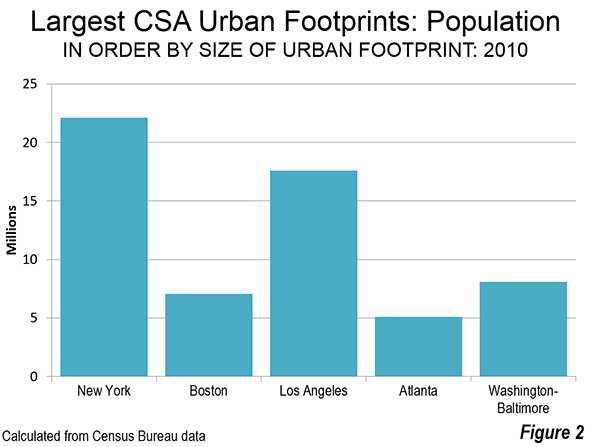
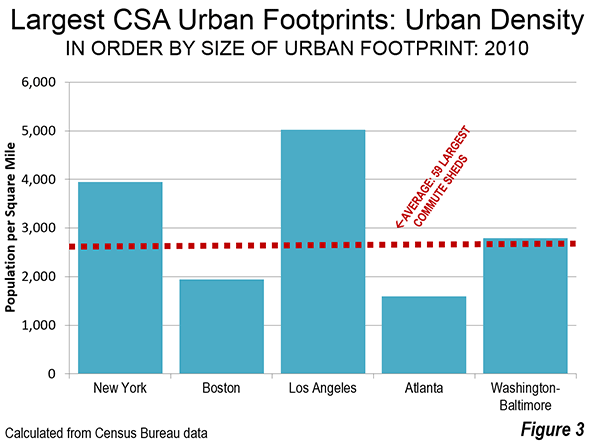
    There is a big difference, however, in the intensity of development between the urbanization in these labor markets. The urban population of the Boston CSA is 7.1 million (Figure 2). The urbanization of the New York CSA has more than three times as many people (23 million), but covers only about 1.5 times the land area. Tokyo, with a tenth less land area, has more than five times the population (38 million). With a density of 1,941 per square mile (750 per square kilometer), the urbanization of Boston is 60% less dense (Figure 3) than the urbanization of the Los Angeles CSA (5,020 per square mile or 1,940 per square kilometer), which includes the Inland Empire urban area of Riverside-San Bernardino.

    Pre-World War II Boston is largely confined within the Route 128 semi-circumferential highway (most of it now called Interstate 95), had a 2010 population of approximately 1.9 million, with a population density of 6,300 per square mile (2,400 per square kilometer). The core city of Boston is among the most dense in the United States, with a 2014 density of 13,300 per square mile (5,200 per square kilometer). It is also very successful, having experienced a strong population turnaround, after falling from 801,000 residents in 1950 to 562,000 in 1980 (a 30% loss). By 2014, the city had recovered nearly 40% of its former population, rising to 656,000.

    Suburban Densities

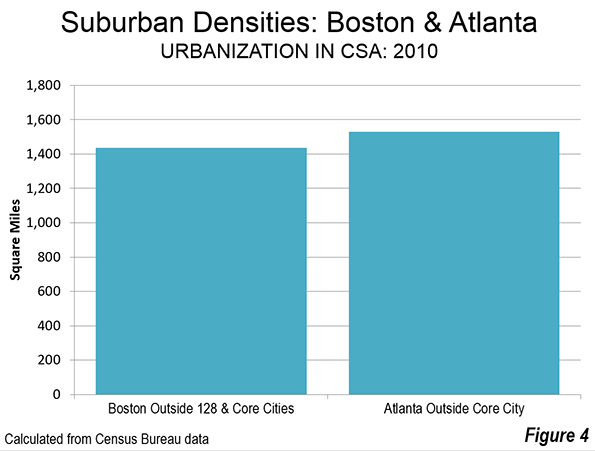
    But once you get outside of 128, Boston’s urban population density fall steeply. If the denser urbanization inside Route 128 and the historic, dense municipalities of Providence, Worcester and Manchester are excluded, the remainder of Boston’s urbanization has a population density of 1,435 per square mile (550 per square kilometer). This is less dense than Atlanta’s urbanization outside the city of Atlanta. Overall, the Atlanta urban area is the least dense in the world with more than 2.5 million population. Approximately two-thirds of the Boston CSA urban population lives in these sparsely settled suburbs (Figure 4).

    If the Boston CSA were as dense as  the Los Angeles urban form, the population would be 18.3 million, not 7.1 million, more than 2.5 times as -people as now reside there. 

    In many ways, Boston is the epitome of the dispersed urban development that followed World War II. Once one of the nation’s densest urban areas, it has evolved into one of the least. What distinguishes Boston from other low density urban areas, like Atlanta, Charlotte or Birmingham (Alabama) is that is core well reflects the urban form built for the pre-automobile age.

    Employment Dispersion

    As would be expected, Boston’s highly dispersed urbanization has been accompanied by highly dispersed employment. Despite having the fifth largest CBD in the nation, Boston’s "hub" accounts for only 6% of the CSA employment. In the 1950s and 1960s, Route 128 became the nation’s first high-tech corridor and has been referred to as the birthplace of the modern industrial park. But most people work outside 128.

    Despite Boston’s huge urban expanse the average trip travel time is only 29 minutes. This is slightly above the US average of 26 minutes and 18 minutes shorter than Hong Kong, the high-income world’s densest urban area. Hong Kong’s urban density is more than 30 times that of Boston’s urbanization.

    One of the World’s Most Prosperous Metropolitan Areas

    Highly dispersed Boston has emerged as one of the world’s most affluent areas. According to the Brookings Global Metro Monitor, the Boston metropolitan area has the fourth largest GDP per capita, purchasing power parity, in the world. Boston trailed only Macau, nearby Hartford and San Jose, the world’s leading technology hub. Two other Boston CSA metropolitan areas were successful enough to be included in the top 100 in the Brookings data. The Providence and Worcester metropolitan areas ranked in the top 100 (like 65 other US metropolitan areas), at about the same level as Vienna, while leading Brussels and Tokyo. Overall, Boston has to rank as one of the country’s – and the world’s most successful labor markets. It has done so while not being denser but while combining the virtues of both a successful core city and a large, expansive periphery.

    Note 1: Cites have two generic forms, physical and economic (or functional). The physical form is the continuously built-up area, called the urban area or the urban agglomerations. This is the area that would be outlined by the lights of the city from a high flying airplane at night. The economic form is the labor market (metropolitan area or combined statistical area), which includes the urban area but stretches to include rural areas and other areas from which commuters are drawn. There is considerable confusion about urban terms, especially when applied to municipalities when called "cities," Municipalities are not themselves generic cities, but are usually parts of generic cities. Some municipalities may be larger than their corresponding generic cities (principally in China).

    Note 2: "Commute sheds" encompass core based statistical areas, as defined by the Office of Management and Budget. including combined statistical areas, as well as metropolitan and micropolitan areas that are not a part of combined statistical areas), Combined statistical areas themselves are formed by strong commuting patterns between adjacent metropolitan and micropolitan areas. A table of all 569 commuter sheds is posted to demographia.com.

    Note 3: Combined statistical areas (and metropolitan areas) often have more than one urban area. This article combines all of the urban areas in the Boston CSA, rather than focusing only on the principal urban area, Boston. Comparisons are made to the total urbanization (not the principal urban areas) of other CSAs in the United States.

    Wendell Cox is Chair, Housing Affordability and Municipal Policy for the Frontier Centre for Public Policy (Canada), is a Senior Fellow of the Center for Opportunity Urbanism (US), a member of the Board of Advisors of the Center for Demographics and Policy at Chapman University (California) and principal of Demographia, an international public policy and demographics firm.

    He is co-author of the "Demographia International Housing Affordability Survey" and author of "Demographia World Urban Areas" and "War on the Dream: How Anti-Sprawl Policy Threatens the Quality of Life." He was appointed to three terms on the Los Angeles County Transportation Commission, where he served with the leading city and county leadership as the only non-elected member. He served as a visiting professor at theConservatoire National des Arts et Metiers,a national university in Paris. 

    Photo:  Second largest geographical expanse of labor market urbanization in the world (Boston). US Census Bureau maps superimposed on Google Earth.

  • Revisiting Two Forces of Modern Urban Transformation

    Few factors have had a greater impact on recent urban growth than communications technology (ICT) and property investment strategies. The evolution of both is transforming space and social interaction at an unprecedented pace and depth, with mixed results. As these maturing forces are increasingly taken for granted, the next generation of urban growth should accommodate them in ways that preserve urban vitality and citizen livelihoods.

    The jetpack that wasn’t

    The impacts of ICT on urban life have been examined primarily in two realms: government operations and citizen-user lifestyles. With several decades of modern technology absorbed into urban life, it is now possible to longitudinally examine the impacts of ICT in both its functional and social dimensions.

    In the mid-20th century, simple technologies supported the minutiae of city operations in ways that now seem mundane: stoplight sequencing, emergency response, utilities management, etc. After decades of innovation, technology is now a broader and more integral part of urban governance, from design to operations. For example, ICT’s value in aiding growth projection continues to be explored through highly sophisticated systems such as UrbanSim, which is being used by several cities around the world. What was once the concern only of technocrats – and the muse of Popular Science magazine – is now the recipient of large budget appropriations and a common topic for discussions about inter-urban competitiveness.   

    Beyond operations, ICT has also restructured urban social interaction in both planned and unexpected ways; these are expressed in particular through changes in the physical environment. One example is the book retail industry, for which virtual markets have caused catastrophic impacts. For example, Barnes and Noble provided proxy community gathering spaces where people of varying ages and interests interacted. Aimless and leisurely perusing created a shared atmosphere of curiosity and exploration. However, many such stores are now bankrupt, replaced by an online shopping medium that eliminates the need for face-to-face interaction. A vestige of community life may have perished as a result.

    Urban planners should be concerned about the socio-physical impacts of these transformations. As society withdraws into virtual realms, ICT exerts both convergent and divergent effects. The former allows people in dispersed locations to rally around a common interest, political cause, or commercial pursuit. It bridges cultures and geographies, and “flattens” the world in ways already amply studied. At the same time, ICT can splinter interests and fragment shared identities. There is little consensus about this matter, with some studies arguing that online media diminishes social skills and increases isolation, and others arguing that it has a positive correlation with “civic engagement” and tightens familial ties. Regardless, as social and commercial activity is virtualized there remains the chance that that place-based affinities – expressed, for example, by patronage of local enterprises – will gradually erode. Despite their virtues, “online communities” are still fundamentally a-spatial constructs. What is begun there often must be executed in person, underscoring the continued relevance of public space.

    The long-term transformative effects of ICT cannot yet be fully appraised in part because technology uptake is rapid and unpredictable. Nevertheless, in one aspect – urban design – a synergy has emerged between bricks-and-mortar merchants and planners, in reaction to virtualization. Their complementary efforts, when successful, imbue commercial space with interaction-based vitality. The human instinct for sociability further supports these efforts, evidence that there is no substitute for many of the benefits cities offer. Lives are arguably better in proximity, a point supported by decades of agglomeration and anthropological research. The challenge for planners, therefore, is to create space for meaningful experiences inimitable in the virtual realm.

    The masters of the neighborhood

    Modernized property investment models predate ICT, but have imposed similarly transformative impacts on urban growth. 20th century efforts to generate vibrant commercial and residential spaces have a chequered history: suburban malls of the 1960s, festival marketplaces of the 1980s, and live-work-play new urbanist developments of the pre-recession 2000s. These development strategies exhibit the prevailing commercial and social trends of the time: white-flight suburbanization, urban core revitalization, and densified brownfield redevelopment.

    More importantly, property development in its various forms is a product of the global investment climate. Susan Fainstein argues that emotion, shoddy research, and availability of (other people’s) money have fuelled unsuccessful investments that ultimately destabilised property markets. Development capital – particularly for large projects that can redefine an entire urban core – is increasingly sourced from institutional investors who arguably have little stake beyond financial returns. For example, Turkey has recently announced plans to facilitate international investment in its domestic property markets, and investment in Indian property by private equity firms has risen sharply in 2015. These types of developments range from business and technology parks to vast urban retail and residential complexes.

    Additionally, the behavior of investors can influence the nature of such development. Stock investment strategies increasingly favor the short-run – “in and out quickly” – over the long-run (“blue-chips”). Translated into property investment, this strategy attracts capital to projects with quick returns but poor long-run viability. The immediacy of funding is commercially alluring, but rapid flight of capital can be devastating for neighborhoods. For example, the mortgage crisis illustrated the risk of designing property investment models like those for intangible (and liquid) assets such as stocks. Rapid divestment of investment shares and properties – in panicked response to market signals – elevates natural cycles into manic booms and catastrophic busts.

    Cases like this illustrate how urban growth is impacted not only by the characteristics of financial institutions, but also by the eminently human irrationalities that distort their function. The city becomes less a product of local market demand than of the financial ambitions and risk preferences of absentee investors. These global prospectors often have little contextual knowledge of projects and even less interest in their social impacts. This investment approach may work for stocks, but not for property developments – particularly those that support urban growth and generate economically sustainable neighborhoods.

    Citizens as social investors

    Both technology and investment patterns have been enablers of growth strategies that serve interests beyond local livelihoods. This tension tests the power and will of urban governments to interpret global trends – including those of ICT and capital markets – in ways that enhance local livability and equity. It is therefore incumbent on planners to reconcile the vicissitudes of technological and financial change with the exigencies of authentic and inclusive urban growth. Moreover, a city is not merely a product of planning; it is the embodiment of resident priorities.

    Authentic urban transformation relies more on citizen initiative than the influence of global capital, and may be facilitated by ICT but not defined by it; this can be seen in the quiet regeneration of urban neighborhoods. Global capital may underwrite loans for acquiring properties and developing land, decisions in such neighborhoods are often made locally and in the type of fragmented manner that generates a bricolage of uses and styles. Examples in the United States include East Nashville, Kansas City’s Crossroads district, and Oakland’s foodie Temescal and KoNo districts. None displays the architectural shock-and-awe of emerging global mega-cities, but each embodies a citizen-level developmental determinism that shapes their design and atmosphere. They are literal incarnations of the unique priorities of citizens at that time and place, independent of global trends that often result in regression to an aesthetic mean.

    If cities balance opportunism with judiciousness in absorbing these forces, citizens ultimately should be the ones to demand it. Examples of facilitative policies are inclusive zoning, public space requirements, mixed-use zoning that reserves space for local enterprises. From the current vantage point, ICT and global investment appear poised to maintain their role in development; however, this no defeat for citizen livelihoods. Among their many responsibilities, planners should embrace their role as public-private intermediaries, creatively channelling external forces to de-commodify space and preserve vernacular authenticity. This is only possible by balancing stakeholder influence.

    Kris Hartley is a visiting researcher at the Center for Government Competitiveness at Seoul National University, and a PhD Candidate at the National University of Singapore, Lee Kuan Yew School of Public Policy.

  • Institution of Family Being Eroded

    Recent setbacks for social conservative ideals – most particularly on same-sex marriage – have led some to suggest that traditional values are passé. Indeed, some conservatives, in Pat Buchanan’s phrase, are in “a long retreat,” deserted by mainstream corporate America sporting rainbow logos. Some social conservatives are so despondent that they speak about retreating from the public space and into their homes and churches, rediscovering “the monastic temperament” prevalent during the Dark Ages.

    This response would be a tragedy for society. For all its limitations, the fundamental values cherished by the religious – notably, family – have never been more important, and more in need of moral assistance. The current progressive cultural wave may itself begin to “overreach” as it moves from the certainty of liberal sentiment to ever more repressive attempts to limit alternative views of the world, including those of the religious.

    In the next few years, social conservatives need to engage, but in ways that transcend doctrinal concerns about homosexuality, or even abortion. It has to be made clear that, on its current pace, Western civilization and, increasingly, much of East Asia are headed toward a demographic meltdown as people eschew family formation for the pleasures of singleness or childlessness.

    Read the entire piece at The Orange County Register.

    Joel Kotkin is executive editor of NewGeography.com and Roger Hobbs Distinguished Fellow in Urban Studies at Chapman University, and a member of the editorial board of the Orange County Register. He is also executive director of the Houston-based Center for Opportunity Urbanism. His newest book, The New Class Conflict is now available at Amazon and Telos Press. He is also author of The City: A Global History and The Next Hundred Million: America in 2050. He lives in Orange County, CA.

    Baby photo by Bigstock.

  • Gates and Borders, Malls and Moats: A Photo Essay of Manila

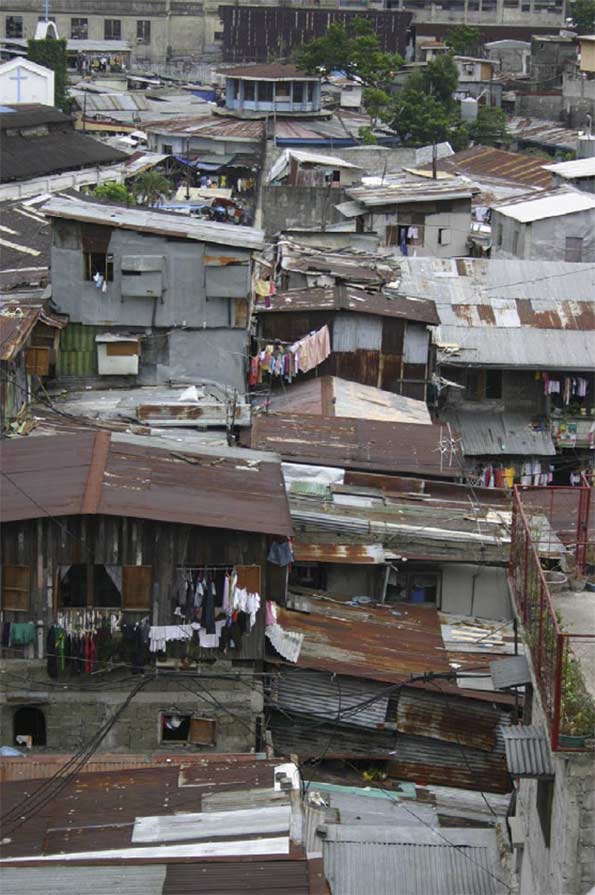
    Home-made housing (left): Refugee families from Mindanao set up shop-houses in the grounds of the mosque in Quiapo. Quiapo contains a number of significant sacred sites for Catholic pilgrimages and festivals. Islamic refugees are making a living in the markets, even as some have sought refuge inside their own sacred site.


    Private turned public (above): Stylish home design transformed into gallery space showing contemporary Pinoy artworks. Pinto Art Gallery, Antipolo.

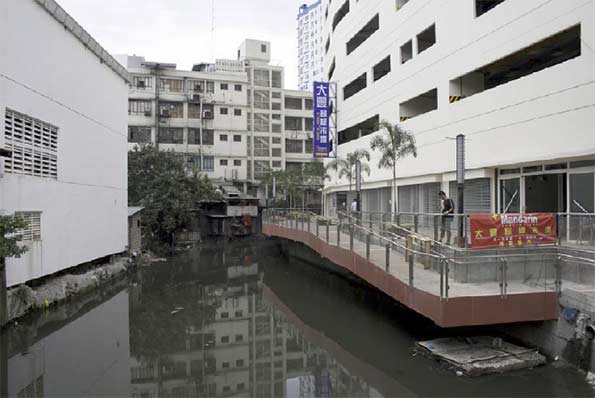
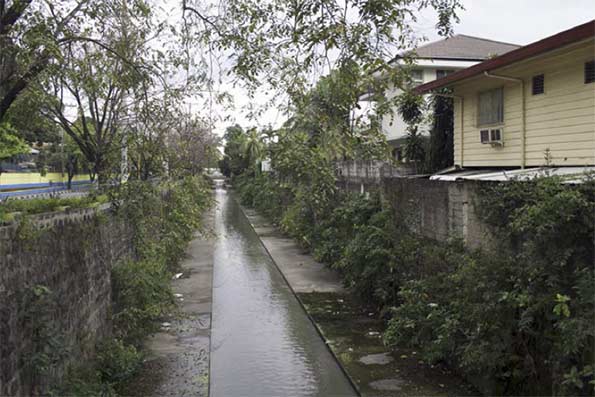
    Modernizing the canal frontage: A Spanish-era esterogets a make-over Chinatown style. The water is polluted, the smells are noxious and the blank wall opposite and infor- mal housing at the back compromise the attempt at a waterfront outdoor sitting area.


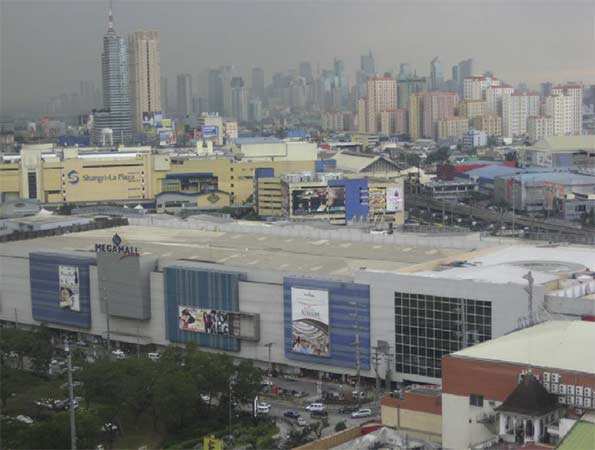
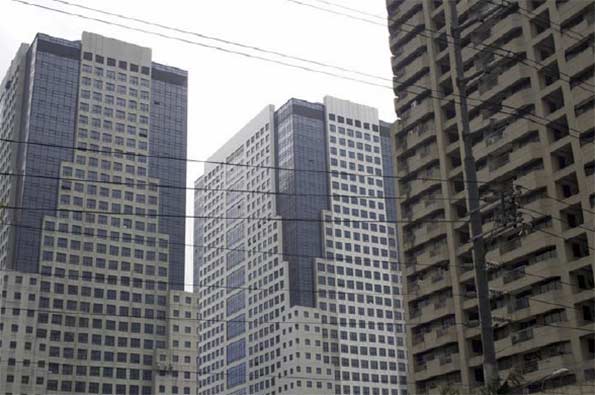
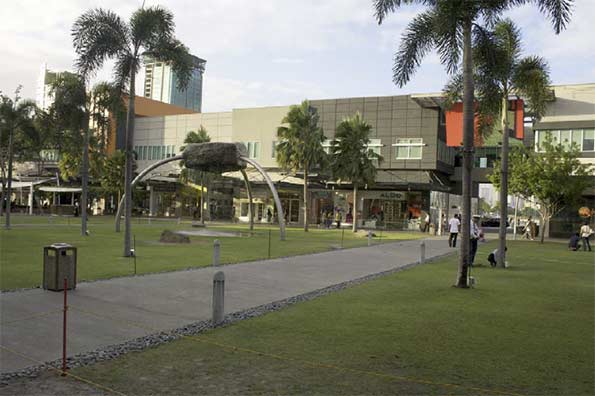
    The air-con city: Mega-malls and new skyscraper districts such as these in Pasig City (Ortigas) provide havens from the outside world of heavy metals – in the air and on the tollways. The lack of commons means that the corpora- tized spaces of malls, and gated apartment and business high-rises, are very popular not least because these cathedrals of consumption are air-con simula- cra of public life. Mega-malls are not only about the shopping but also about looking, promenading and hanging out. But these are not public spaces so much as corporately owned.


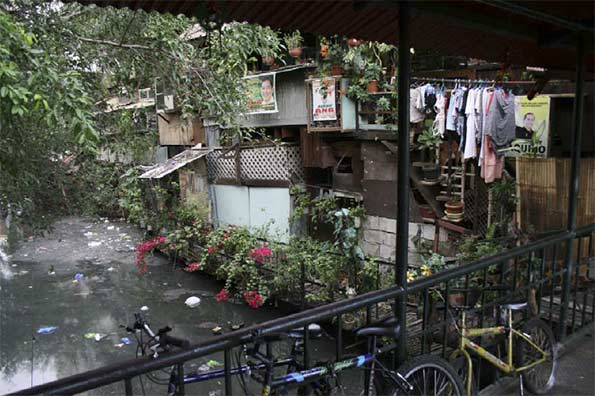
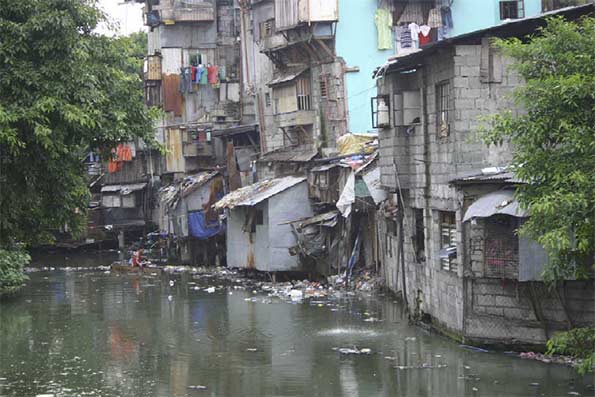
    Informal housing on an estero, Quiapo: Public space is non-owned space and therefore represents what is left over rather than something consciously created to reflect public order and culture. Without adequate sanitation systems the water- ways do the flushing, but modern cities generate more than organic waste so the esteros have long been biologically dead. The poor are ever ingenious in making the best out of whatever comes to hand – in recycling building materials for their homes, parking their bicycles on the public bridge, hanging the washing over the canal, and creating walled gardens.

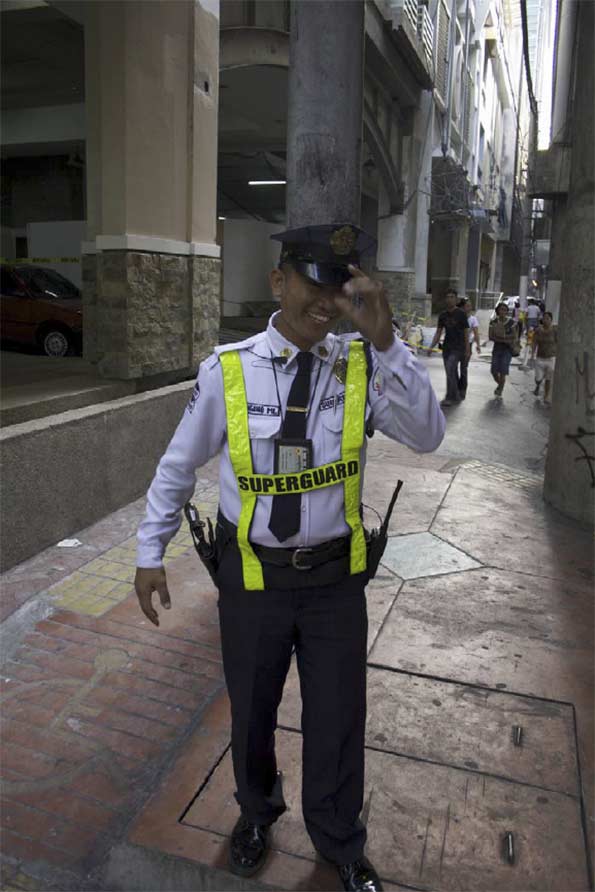
    Superguard at your service: In a city of gates and borders that mark the boundaries of private territories, private armies are required by rich and poor alike to police them. Uniforms and guns abound and it is not always obvious who is protecting whom. Regulation and authorization of the guardians is a complex, semi-legal and irregular process. Each guard has his own moniker, many of them spoofs of popular culture super-heroes.


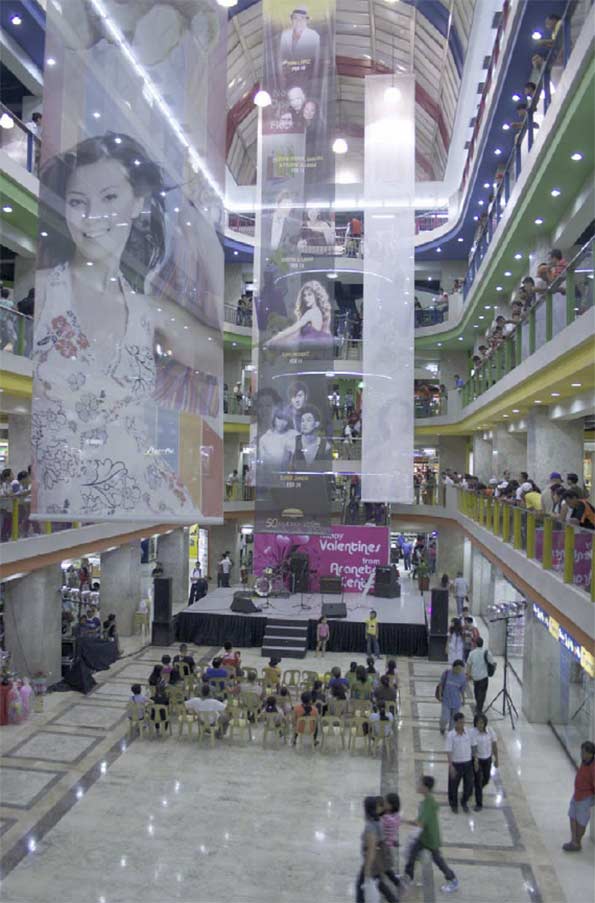
    Mega-mall commons: Shopping malls are owned by billionaire tycoons with dynasties like the Araneta, Ayala and Sy families. Local pop and film stars perform on concert stages in the cathedral-like vaults of the central halls where fashion shows, trade fairs and church masses are also held every day. Araneta Center, Cubao, where this photo was taken, is one of the earliest popular mall areas in Manila, dating back to the 1950s, that is undergoing a major make-over. Its fortunes declined into the ’80s as the attentions of the fashion-conscious middle class moved to other malled cities. For the past two decades, Cubao has been a shopping centre for the poor and a bus terminus for the provinces. The area itself has been notable for its urban grunge. The sex bars were shifted from Ermita and Malate to Cubao in the ’90s. The shopping mall has recently had a major make-over and is now connected to two light rail lines – a development that in turn attracts high-density apartment building in the area. As Cubao begins a gentri- fication process, so its urban rents rise. The rich return – or at least a new middle class arrives to graze, shop and parade. The Araneta Center and Coliseum complex has over a million visitors daily.


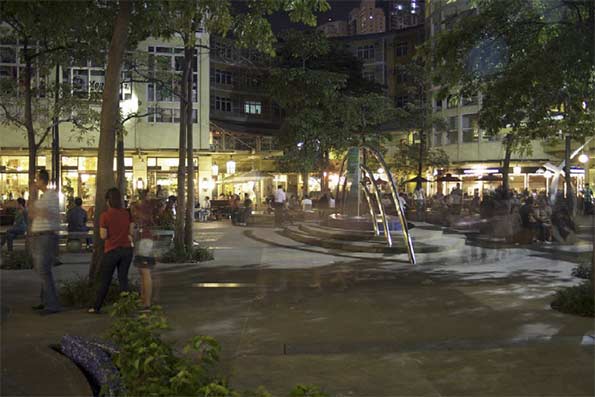
    New urban villages arrive in Manila: Fort Bonifacio is the biggest, boldest experiment in new city building inside a Southeast Asian mega-city. As a series of public-private partnerships, it represents a sustained attempt to mimic world’s best practice in city building and urban renewal. Here at Serendra the pedestrian mall exhibits a careful integration of greenery, sitting areas, promenades, and restau- rants, cafes, boutiques and medium-density walk-up apartments. Not surprisingly, it is very popular and is copied by developers of other new cities in Metro Manila. It is one thing to get the plan right, quite another to regulate and maintain these areas in a city of massive socio-economic inequalities.


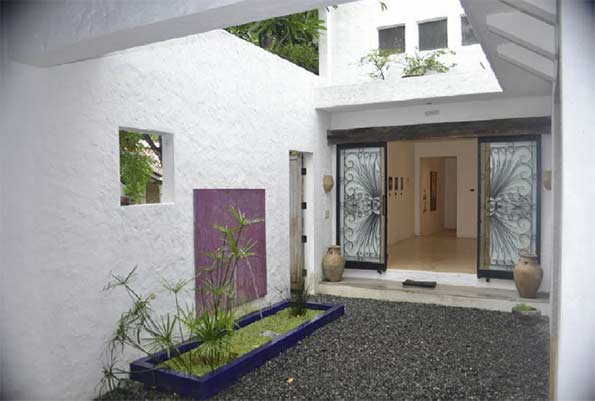
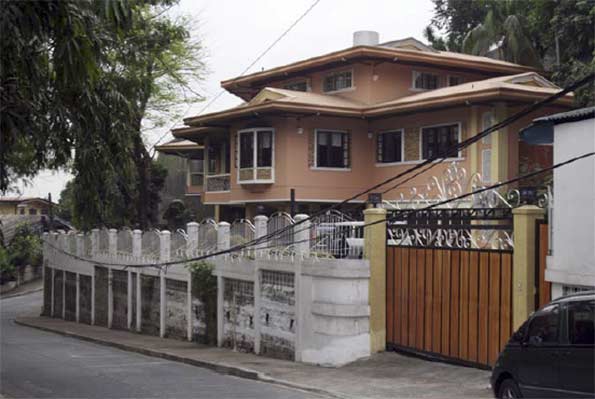
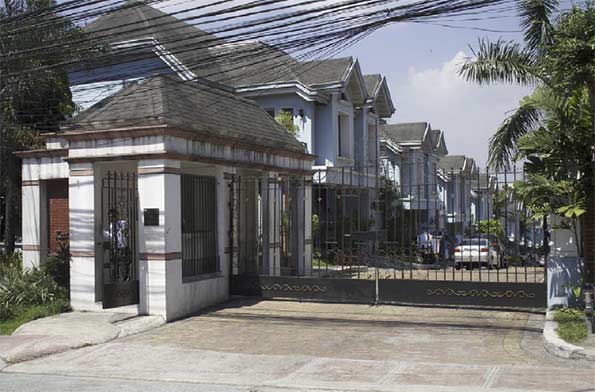
    High wall to the street: The rich build fashionable mansions with global-local consciousness of design fashions. Even if the suburb is not gated, the fence to the street is – more often than not – high. The formula is something like this: the more aspirational and richer the houseowner, the greater the probability that the sociality is turned indoors and against the street. The rationalization is security.

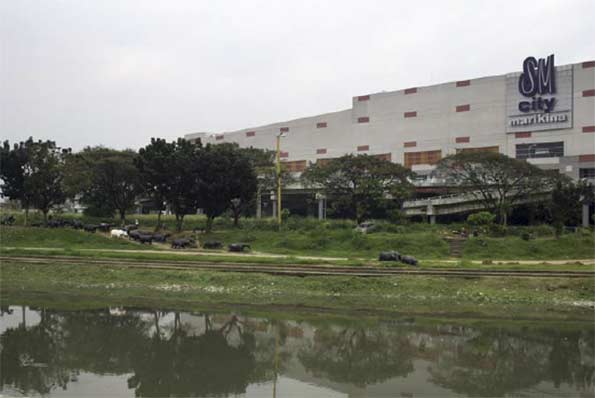
    SM Marikina: shopping mall as fortress: Waterfront park on the Pasig River replete with sculpted carabao. The people’s park project has been embraced by the citizens of Marakina Barangay, but here SM presents a blank wall and car park to the riverfront and thereby discourages pedestrian flows between the shops and the park.


    Skyscraper city: Ortigas, Pasig City, is a poorly planned new city along EDSA. Identi-kit skyscrapers sit cheek to jowl, there are no parks, and the streets are car-jammed 24-7.

    Drain as moat: The gated community of Casa Verde has three defensive layers to the street – the walls of the houses themselves, the drain which acts as a moat, and a wall on the street. The opposite side of the street is likewise walled. It is a street without pedestrians – an unusual phenomenon in Asian urbanism.


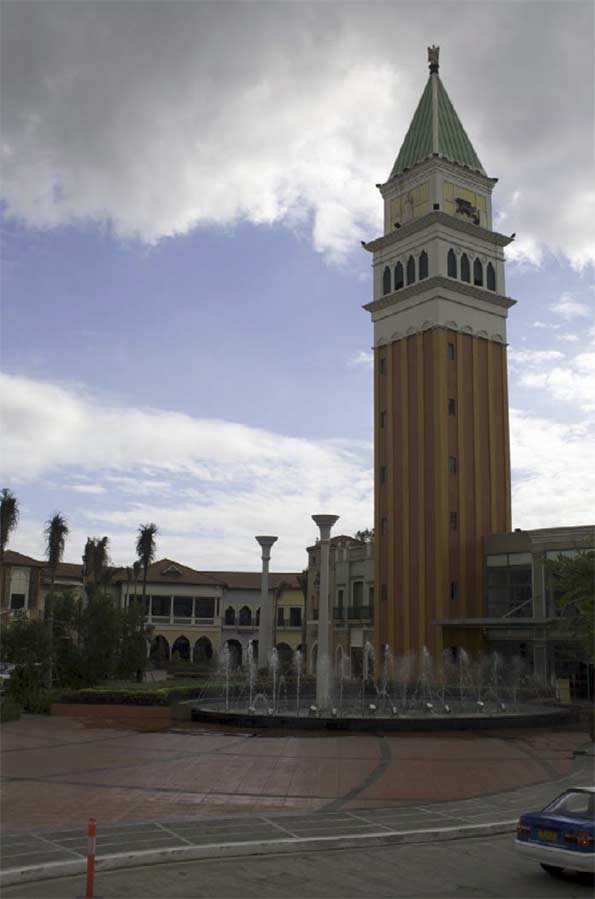
    Theme park cities: Las Vegas is most famous for this kind of ersatz ‘Dis- neyfication’ of living spaces, but Manila has been doing it for longer – theme park histories of imagined communities in medieval and Renaissance Europe abound. The aesthetic might be kitsch but the lived experience for the local residents and business folk is another thing altogether. In a city with one of the lowest percen- tages of green and pedestrianized spaces, these places – such as this one in McKinley Hill, Fort Bonifacio – are highly sought after and valued by its citizens.


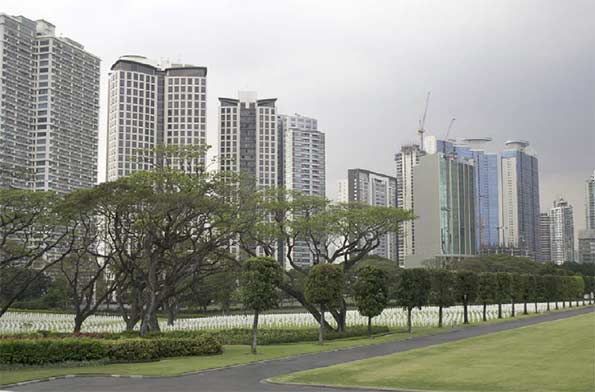
    Spectres and spectacles: New apartment blocks in Fort Bonifacio tower over the hauntingly beautiful memorial park and cemetery for 17,201  American  military killed during ‘the liberation (sic) of Manila’ and other parts of the Philippine archipelago. It is the largest such Second World War cemetery for  American military in the world, covering 152 acres. They have the best views and sea breezes in Manila.


    Tampa Bay, Florida, or Cairns, Australia? No, it’s Fort Bonifacio, Manila. Fort Bonifacio was made possible by Mt Pinatubo blowing its top on 15 June 1991. No amount of protests against the US communications and military bases in the Philippines could budge the Americans. But the fall of the Soviet empire and a volcano did the trick. Fort Bonifacio, ironically, named by the Americans after one of the revolutionary leaders against the Spanish colonisers, when vacated, left one of the largest areas ever made available for urban renewal in an Asian city. It is now one of the highest social status new areas and consequently one of the most expensive. Its progress has been slow, not least due to various economic downturns but also because of the care taken by government planners and corporate investors in designing the infrastructure of a city that integrates commercial, government, and social facilities and amenities. In stark contrast to the big boxed mega-malls, this shopping area seeks a suburban outdoor tropical ambience, and again privi- leges pedestrians over vehicles – a too rare occurrence in Manila.


    Gates, guards and wires: Manila is a world leader in gated community living. This one in Cubao is typical in its structure – two-storey, semi-detached houses inside a fortress wall with single gate entrance with 24-7 security guards. Standard issue telephone lines clutter the streetscapes of cities the world over – will Wifi technologies clear urban skies?


    Quiapo, Manila: How can a city turn a backyard sewer into a living waterfront again? The canals (esteros) of Manila are historical artefacts of the Spanish era, but are now the backyards of the poor. The challenge is threefold: heritage (historical con- servation and re-use), ecology (toxic and organic waste management, restoring riv- erine and estuarine ecosystems requiring an integrated approach to the whole Pasig River and Manila Bay area and not just the canals themselves), and livelihoods and sustainable housing for the poor (including their involvement in the re-development of the area and the restoration of the canals). Some success on all three fronts can not only transform the economic fortunes of the whole city but make the area an urban village area that is aesthetically appealing to locals and tourists alike.


    Spot the prison wall!: This high-density informal settlement in the university belt area opposite Far Eastern University fences in a prison! You can spot the panopti- con guard house at the centre-top of the photo. This community is well-established but has been legally protesting a developer’s permit to build a shopping mall on their site. Informal settlers use every available space and the streets and paths are literally left-over space. The more established, longer-term settlers build up and consolidate their homes by turning their walls from cardboard, Masonite and plas- tic into concrete bricks and tin roofs. By definition informal settlements are DIY – including sanitation, water, electricity and telephone connections. The high density ensures maximization of population in an inner city zone and makes it easier for its residents to organize protection against potential hostile intruders. The disadvantage is that should there be a fire or flood then fast and efficient assistance by city services is hard to provide.

    Intramuros: The old wall and the new moat: Intra-muros is the original walled city of Manila, and now the old Spanish moat – that was filled in by the Americans in the name of public health – has a new purpose: golf! Along with polo and yachting, golf is a high status sporting pastime which the very rich can use to assert their distinction. In a city where over 50 per cent are poor and which has one of the lowest proportions of areas allocated to public parks in the world, here is a key public space that has been turned into a private space for those rich enough to afford leisure time and who can pay for the privilege.

    This piece was originally published by Sage Publications Thesis Eleven, 112, October: 35-50.

    Trevor Hogan teaches in Sociology at the School of Social Sciences, La Trobe University, where he is Deputy Director of the Thesis Eleven Centre for Cultural Sociology and Director of the Philippines-Australia Studies Centre.

    Caleb J. Hogan is a Fine Arts student at Royal Melbourne Institute of Technology University (RMIT).

  • Countering Progressives’ Assault on Suburbia

    The next culture war will not be about issues like gay marriage or abortion, but about something more fundamental: how Americans choose to live. In the crosshairs now will not be just recalcitrant Christians or crazed billionaire racists, but the vast majority of Americans who either live in suburban-style housing or aspire to do so in the future. Roughly four in five home buyers prefer a single-family home, but much of the political class increasingly wants them to live differently.

    Theoretically, the suburbs should be the dominant politically force in America. Some 44 million Americans live in the core cities of America’s 51 major metropolitan areas, while nearly 122 million Americans live in the suburbs. In other words, nearly three-quarters of metropolitan Americans live in suburbs.

    Yet it has been decided, mostly by self-described progressives, that suburban living is too unecological, not mention too uncool, and even too white for their future America. Density is their new holy grail, for both the world and the U.S. Across the country efforts are now being mounted—through HUD, the EPA, and scores of local agencies—to impede suburban home-building, or to raise its cost. Notably in coastal California, but other places, too, suburban housing is increasingly relegated to the affluent.

    The obstacles being erected include incentives for density, urban growth boundaries, attempts to alter the race and class makeup of communities, and mounting environmental efforts to reduce sprawl. The EPA wants to designate even small, seasonal puddles as “wetlands,” creating a barrier to developers of middle-class housing, particularly in fast-growing communities in the Southwest. Denizens of free-market-oriented Texas could soon be experiencing what those in California, Oregon and other progressive bastions have long endured: environmental laws that make suburban development all but impossible, or impossibly expensive. Suburban family favorites like cul-de-sacs are being banned under pressure from planners.

    Some conservatives rightly criticize such intrusive moves, but they generally ignore how Wall Street interests and some developers see forced densification as opportunities for greater profits, often sweetened by public subsidies. Overall, suburban interests are poorly organized, particularly compared to well-connected density lobbies such as the developer-funded Urban Land Institute (ULI), which have opposed suburbanization for nearly 80 years. 

    The New Political Logic

    The progressives’ assault on suburbia reflects a profound change in the base of the Democratic Party. As recently as 2008, Democrats were competitive in suburbs, as their program represented no direct threat to residents’ interests. But with the election of Barack Obama, and the continued evolution of urban centers as places with little in the way of middle-class families, the left has become increasingly oriented towards dense cities, almost entirely ruled by liberal Democrats.

    Obama’s urban policies are of a piece with those of “smart growth” advocates who want to curb suburban growth and make sure that all future development is as dense as possible.  Some advocate radical measures such as siphoning tax revenues from suburbs to keep them from “cannibalizing” jobs and retail sales. Some even fantasize about carving up the suburban carcass, envisioning three-car garages “subdivided into rental units with street front cafés, shops and other local businesses” while abandoned pools would become skateboard parks.

    At the end of this particular progressive rainbow, what will we find? Perhaps something more like one sees in European cities, where the rich and elite cluster in the center of town, while the suburbs become the “new slums” that urban elites pass over on the way to their summer cottages.

    Political Dangers

    The abandonment of the American Dream of suburban housing and ownership represents a repudiation of what Democrats once embraced and for which millions, including many minorities, continue to seek out. “A nation of homeowners,” Franklin D. Roosevelt asserted, “of people who own a real share in their land, is unconquerable.”

    This rhetoric was backed up by action. It was FDR, and then Harry Truman, who backed the funding mechanisms—loans for veterans, for example—that sparked suburbia’s growth. Unlike today’s progressives, the old school thought it good politics to favor those things that most people aspire to achieve. Democrats gained ground in the suburbs, which before 1945 had been reliably and overwhelmingly Republican.

    Even into the 1980s and beyond, suburbanites functioned less as a core GOP constituency than as the ultimate swing voters. As urban cores became increasingly lock-step liberal, and rural Democrats slowlyfaded towards extinction, the suburbs became the ultimate contested territory. In 2006, for example, Democrats won the majority of suburban voters. In 2012, President Obama did less well than in 2008, but still carried most inner and mature suburbs while Romney trounced him in the farther out exurbs. Overall Romney eked out a small suburban margin.

    Yet by 2014, as the Democratic Party shifted further left and more urban in its policy prescriptions, these patterns began to turn.  In the 2014 congressional elections, the GOP boosted its suburban edge to 12 percentage points. The result was a thorough shellacking of the Democrats from top to bottom. 

    Will demographics lead suburbs to the Democrats?

    Progressive theory today holds that the 2014 midterm results were a blast from the suburban past, and that the  key groups that will shape the metropolitan future—millennials and minorities—will embrace ever-denser, more urbanized environments. Yet in the last decennial accounting, inner cores gained 206,000 people, while communities 10 miles and more from the core gained approximately 15 million people.

    Some suggest that the trends of the first decade of this century already are passé, and that more Americans are becoming born-again urbanistas. Yet after a brief period of slightly more rapid urban growth immediately following the recession, U.S. suburban growth rates began to again surpass those of urban cores. An analysis by Jed Kolko, chief economist at the real estate website Trulia, reports that between 2011 and 2012 less-dense-than-average Zip codes grew at double the rate of more-dense-than-average Zip codes in the 50 largest metropolitan areas. Americans, he wrote, “still love the suburbs.”

    What is also missed by the Obama administration and its allies is the suburbs’ growing diversity. If HUD wants to start attacking these communities, many of their targets will not be whites, but minorities, particularly successful ones, who have been flocking to suburbs for well over a decade.

    This undermines absurd claims that the suburbs need to be changed in order to challenge the much detested reign of “white privilege.” In reality, African-Americans have been deserting core cities for years, largely of their own accord and through their own efforts: Today, only 16 percent of the Detroit area’s blacks live within the city limits.

    These trends can also be seen in the largely immigrant ethnic groups. Roughly 60 percent of Hispanics and Asians, notes the Brooking Institution, already live in suburbs. Between the years 2000 and 2012, the Asian population in suburban areas of the nation’s 52 biggest metro areas grew by 66 percent, while that in the core cities expanded by 35 percent. Of the top 20 areas with over 50,000 in Asian population, all but two are suburbs.

    Left to market forces and natural demographic trends, suburbs are becoming far more diverse than many cities, meaning that in turning on suburbia, progressives are actually stomping on the aspirations not just of privileged whites but those of many minorities who have worked hard to get there.

    Another huge misreading of trends relates to another key Democratic constituency, the millennial generation.  Some progressives have embraced the dubious notion that millennials won’t buy cars or houses, and certainly won’t migrate to the suburbs as they marry and have families. But those notions are rapidly dissolving as millennials do all those things. They are even—horror of horrors!—shopping atWal-Mart, and in greater percentages than older cohorts.

    Moreover, notes Kolko, millennials are not moving to the denser inner ring suburban areas. They are moving to the “suburbiest” communities, largely on the periphery, where homes are cheaper, and often schools are better. When asked where their “ideal place to live,” according to a survey by Frank Magid and Associates, more millennials identified suburbs than previous generations. Another survey in the same year, this one by the Demand Institute, showed similar proclivities.

    Stirrings of Rebellion

    So if the American Dream is not dead among the citizens, is trying to kill it good politics? It’s clear that Democratic constituencies, notably millennials, immigrants and minorities, and increasingly gays—particularly gay couples—are flocking to suburbs. This is true even in metropolitan San Francisco, where 40 percent of same-sex couples live outside the city limits.

    One has to wonder how enthusiastic these constituents will be when their new communities are “transformed” by federal social engineers. One particularly troubling group may be affluent liberals in strongholds such as Marin County, north of San Francisco, long a reliable bastion of progressive ideology.

    Forced densification–the ultimate goal of the “smart growth” movement—also has inspired opposition in Los Angeles, where densification is being opposed in many neighborhoods, as well as traditionally more conservative Orange Country. Similar opposition has arisen in Northern Virginia suburbs, another key Democratic stronghold.

    These objections may be dismissed as self-interested NIMBYism, but this misses the very point about why people move to suburbs in the first place. They do so precisely in to avoid living in crowded places. This is not anti-social, as is alleged, but an attempt—natural in any democracy—to achieve a degree of self-determination, notes historian Nicole Stelle Garrett.

    Aroused by what they perceive as threats to their preferred way of life, these modern pilgrims can prove politically effective. They’ve shown this muscle while opposing plans not only to increase the density in suburbs, and also balking at the shift of transportation funding from roads, which suburbanites use heavily, to rail transit. This was seen in Atlanta in 2012 when suburban voters rejected a mass transit plan being pushed by downtown elites and their planning allies. Opposition to expanding rail service has also surfaced in the Maryland suburbs of Washington.

    Suburbs and 2016 Election

    To justify their actions against how Americans prefer to live, progressives will increasingly cite the environment. Climate change has become the “killer app” in the smart growth agenda and you can expect the drumbeat to get ever louder towards the Paris climate change conference this summer.

    Yet the connection between suburbs and climate is not as clear as the smart growth crowd suggests.  McKinsey and other studies found no need to change housing patterns to reduce greenhouse gases, particularly given improvements in both home and auto efficiency. Yet so great is their animus that many anti-suburban activists seem to prefer stomping on suburban aspirations rather seeking ways to make them more environmental friendly.

    As for the drive to undermine suburbs for reasons of class, in many ways the  assault on suburbia is, in reality,  a direct assault on our most egalitarian geography. An examination of American Community Survey Data for 2012 by the University of Washington’s Richard Morrill indicates that the less dense suburban areas tended to have “generally less inequality” than the denser core cities; Riverside-San Bernardino, for example, is far less unequal than Los Angeles; likewise, inequality is less pronounced in Sacramento than San Francisco. Within the 51 metropolitan areas with more than 1 million people, notes demographer Wendell Cox, suburban areas were less unequal (measured by the GINI Coefficient) than the core cities in 46 cases.

    In the coming year, suburbanites should demand more respect from Washington, D.C., from the media, the political class and from the planning community. If people choose to move into the city, or favor density in their community, fine. But the notion that it is the government’s job to require only one form of development contradicts basic democratic principles and, in effect, turns even the most local zoning decision into an exercise in social engineering.

    As America’s majority, suburbanites should be able to deliver a counterpunch to those who seem determined to destroy their way of life. Irrespective of race or generation, those who live in the suburbs—or who long to do so—need to understand the mounting threat to their aspirations  Once they do, they could spark a political firestorm that could reshape American politics for decades to come.

    This piece first appeared at Real Clear Politics.

    Joel Kotkin is executive editor of NewGeography.com and Roger Hobbs Distinguished Fellow in Urban Studies at Chapman University, and a member of the editorial board of the Orange County Register. He is also executive director of the Houston-based Center for Opportunity Urbanism. His newest book, The New Class Conflict is now available at Amazon and Telos Press. He is also author of The City: A Global History and The Next Hundred Million: America in 2050. He lives in Orange County, CA.

    Suburbs photo courtesy of BigStockPhoto.com.
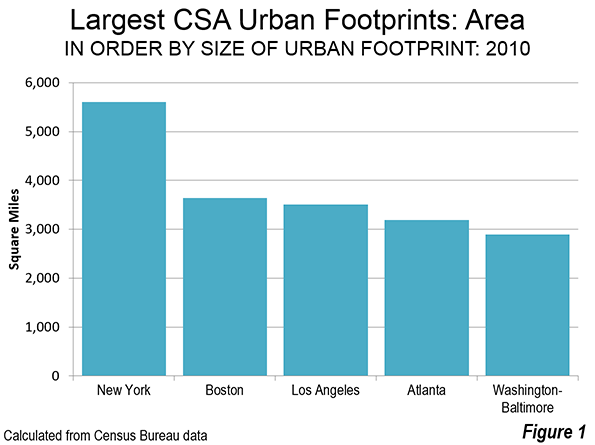
  • How To Justify Spending $8M On Something Nobody Wants

    The Minneapolis-St. Paul Metropolitan Council is gambling $8.7 million on a project to alleviate pedestrian congestion that might exist in 5 to 10 years if we’re somehow able to build two additional light rail lines and they are operating at full capacity for 10 days a year.

    That’s like buying flood insurance on the house you have yet to buy.

    The below $8.7 million piece of public infrastructure is intended to create a more safe passageway for travelers at the Downtown East station during Vikings home games. It’ll serve west and northbound train passengers and other pedestrians looking to enter a new football stadium. It is deemed this will be an important pedestrian overpass once all four major light rail lines completed.

    Download the Downtown East Plan Met Council PowerPoint here [PDF].

    Those reading this should have at least two questions:

    1. How did this come to be a thing?
    2. Why is it all of a sudden getting $8.7 million?

    I pay particularly close attention to local projects. I read blogs, forums and newspapers daily. I know and follow local decision-makers on social media, track development proposals, and pay attention to those boring committees few care about. I also work in the industry and talk to other people who work and follow the industry across related professions. It’s fair to say that I have a very good idea of what’s going on in the Twin Cities and the transportation and development needs of the community.

    Never once have I heard of this project until a few days ago. And now, out of the blue, we’re dropping $8.7 million on a bridge that’ll be needed 10 days a year starting in 2019.

    I wrote a blog post last year titled The Politics of Dumb Infrastructure. It was well received, and is even being used as required reading in an undergrad planning course in California. In the article I theorize as to why we make bad decisions when it comes to receiving other people’s money on transit projects;

    It’s the orderly, but dumb system that makes planners and politicians play to a bureaucratic equation that is supposed to guide officials towards the best alternative. Only it never actually works out that way and it usually forces smart people into making highly compromised and less-than-ideal decisions.

    The pedestrian bridge is different. It may deal with Federal grants, but is also come from local and regional coffers. Regardless, this project is being pushed forward. According to the Star Tribune,

    “The transit agency will likely devote $6 millon from its coffers for the project (this figure could be offset by federal grants), with the Minnesota Sports Facilities Authority (which oversees stadium construction) ponying up $2 million, and the rest coming from bonds issues by the Met Council.”

    Before we go any further, I think we need to ask a complex question.

    How Did We Get Here?

    The new $1 billion Green Line is done and the $1.1 billion Vikings Stadium is underway. They combine to represent over $2 billion of investment. Our local leaders are concerned, as they should be, that these pieces of infrastructure be as perfect as possible.

    To quote a former Governor (one who wasn’t a professional wrestler),

    “All too often, the human tendency is to compound one big mistake with a series of additional mistakes in the hope that somehow the results will improve. This appears to be the case with the Vikings stadium.”

    Politicians are attracted to big, transformitive projects, so it seems only natural that our leaders, who have expelled a great amount of political capital, want to see every inch of it succeed. Even if that means throwing good money after bad.

    How We Justify It All

    An engineer at the Met Council, likely under much political pressure, noticed something: based on 2019 projections, during peak hours on Minnesota Vikings game days, there will be only a 120 second headway between trains. This will likely not be enough time to manage safe pedestrian crossings. The proposed solution is the bridge.

    TopView

    Please note the skyway attached to the State-mandated parking structure.

    The pedestrian bridge makes some sense. Based on the projections, there will be long lines and delays during this period; and building a bridge for pedestrians certainly isn’t an unreasonable response. The Met Council’s Transportation Committee appears to be interested in the idea.

    Let’s look at these assumptions: they assume that there will be two additional light rail lines in full operation, both of which have not yet even been either fully allocated money or constructed. Basically, the Met Council is gambling $8.7 million that there might be a problem in 5 years if we’re somehow able to build two additional light rail lines and they are operating at full capacity for 10 days a year.

    To reiterate: Four (4) LRT lines being in operation (Blue, Green, SW & Bottentieu) and that Vikings game attendees hitting a 40% transit mode share. All of things don’t currently exist. It also assumes, more importantly, that if there is congestion people will not find an alternative route or change their travel behavior. This isn’t to say we can’t plan ahead. We should. But, we should be more realistic in our projections and our priorities.

    Where Are Our Priorities?

    Why did this project get fast-tracked while other smaller, more “everyday” projects never see the light of day? And, when smaller projects get the public’s attention, why do they struggle to find funding? These are merely a question of priorities.

    As Nick Magrino (at streets.mn) has asked so often, “why are we embarrassed by the bus?” He writes,

    “… I can’t shake the feeling that many of the expensive transit improvements we get in the Twin Cities are thought up by people who don’t actually use transit. Which is why we end up with Northstar, the Red Line, and so on.”

    A bridge like this seems like such a low priority, especially when we have legitimate transportation needs. For example, THIS is a bus stop on a heavily used transit line near the center of Minneapolis.

    It’s not that a pedestrian bridge is a terrible idea. Under the projections, at some point in the future, it seems maybe reasonable. But, why is the Met Council prioritizing and fast-tracking this, whereas things like bike lanes, bus shelters, and potholes get ignored? I say this because you could build 40 miles of protected bike lanes for the same price tag.

    Projects can take on a life of their own. There is no traditional process to getting things done. In this pedestrian overpass, you have the right person with the right slideshow presenting it to the right people at the right time. From here, you have the Met Council employees and political-appointed representatives who have monies at their disposal. The proposal, while not perfect, seems reasonable enough. And, we’ve just spent $2 billion on infrastructure, so we need to make it right. The presentation looks good, so why not go for it?

    What Would Your City Do With $8.7 Million?

    Imagine if the City of Minneapolis was given $8.7 million that could only be used on downtown pedestrian and/or transit projects. What would they do? The answer is: not a pedestrian bridge to be used during 10 sports games a year.

    So, why are we doing it?

    The answer is that we can get money from elsewhere to do the things we don’t need to do. But, when it comes to doing the simple things that we need to do, well, that money isn’t available from elsewhere. The pedestrian bridge is a bad idea (right now) that’s made worse when you think of the countless thousands of more useful public investments we could be making.

    The truth is that the people and the City of Minneapolis don’t even care about it. It’s not on their radar. It’s the people who control infrastructure and transportation dollars who care about this. If given the opportunity to allocate these dollars elsewhere, it’s fair to say thatliterally everyone locally would divert them elsewhere.

    Our priorities get skewed and we misallocate resources most when our funding comes from elsewhere. In fact, it is precisely why Minneapolis has the below. All of which the City of Minneapolis will be tearing down in 30 years …

    vikingsblahugh

    Note: This is also next to a proposed park called “The Yard” that neither the City of Minneapolis nor it’s Park Board want to maintain. Yet, somehow it’s still a thing.

    This post originally appeared in Strong Towns on September 9, 2014. Content licensed under a Creative Commons Attribution-Share Alike 3.0 Unported License.

    Find more from Nathaniel M. Hood at his blog: nathanielhood.com