Blog

  • First Mile-Last Mile, Intermodialism, and Making Public Transit More Attractive

    In the ever-trendy world of transportation planning people seem to be infatuated with discussions of first mile-last mile public transportation connections and intermodalism. Given all the attention, one would think that the traveling public is anxiously awaiting their next opportunity to transfer vehicles to complete their trip. Nothing can be further from the truth. People don’t aspire to transfer; they don’t aspire to experience an intermodal terminal. They almost always want to get door to door in the fastest, simplest, and most reliable fashion. Transferring between vehicles is a necessary inconvenience, not a virtue.

    The concept of using multiple means of travel to complete a given trip is an outgrowth of the reality that different services and technologies offer the optimal means of travel for different contexts, which can result in trips that require transfers for the overall optimal means of travel. The most obvious example is traveling from, say Chicago to New York. Air travel is the time and cost superior means of carrying out the line-haul component of the trip. U.S. airlines, for example, routinely extract less than $.20 per passenger mile from travelers to transport them between airports while also saving them time and perhaps lodging and meal expenses. But jet aircraft will not pick you up at the door or delivered you to the entrance to your destination. Thus, transferring between modes at airports is a necessary and logical interface between air and surface modes. The opportunity to take advantage of the premium performance of air travel more than offsets the onerousness of navigating through airports and transferring between access and egress modes.

    On other kinds of trips, the onerousness of transferring might not be as easily offset by the travel benefits of the line-haul or primary mode of travel. For many shorter urban trips, it becomes very challenging for the onerousness of a transfer to be offset by the benefits of using a combination of modes or vehicles to complete a trip. Travel modeling has long recognized the onerousness of transferring, thus quantitatively penalizing the need to transfer by calculating time spent transferring as two or more times more onerous than in-vehicle travel time. From a practical perspective, transferring introduces uncertainty into a trip. Your arrival at the transfer point is captive to the system schedules and you cannot necessarily minimize the transfer wait. The second vehicle introduces an additional chance to be impacted by unreliable service. For first-time trips, you need to figure out both the location of the destination and how to get to it. You may lose your seat or place and interrupt whatever you are doing during your travel. You might be exposed to weather or other risks, and you can’t use the time as productively as you might have had a transfer not been required.

    If you do have to transfer, you want it to be as quick and convenient as possible. While basic amenities such as restrooms and convenience retail might be appreciated, the local traveler is most often interested in getting quickly to their destination and not turning the transfer experience into a retail opportunity or recreational outing. For longer distance intercity trips where the traveler may be captive to more lengthy waits between travel segments, additional retail and personal service accommodations might be appreciated to the extent that they don’t disadvantage other passengers by excessively increasing walk distances or causing other delays.

    The vehicle travel to and from the transfer location should deviate from the optimal origin-destination travel path as little as possible. If one does have to suffer a transfer, they would much preferred that the point of transfer not dramatically impact the circuity of their travel.

    The growing motivation for providing first mile-last mile connections derives from the logical desire to increase the accessibility to public transportation for more homes and destinations. A multitude of efforts in recent years have been carried out to quantify accessibility of residents and activities to public transit. Early work carried out by CUTR indicated that about half the homes in the America were within a half a mile of a transit route. A slightly higher share of employment locations were similarly within a half a mile of transit. More recently, sophisticated software tools have been developed to evaluate accessibility via transit, such as initiatives by the Brookings Institute and the University of Minnesota Accessibility Observatory, as well as tools such as Transit Score. The collective message of these analyses indicate that, in general, access to transit both geographically and temporally is, on average, limited. Hence, folks are interested in improving first mile-last mile connections with the hopes of making transit more attractive and productive.

    Historically, line-haul premium transit services provided feeder bus, park-and-ride, and kiss and ride (drop off) opportunities so that travelers could access these premium modes, most typically for longer-distance commute travel. More recently, additional means of access, including bikeshare, carshare, and transportation network company (TNC) connections (i.e., Uber, Lyft, etc.), are being deployed. Automated shuttles are being evaluated as yet another means of enhancing the appeal of line-haul premium travel modes. These concepts make sense in contexts where the line-haul mode is sufficiently attractive by virtue of its speed or cost advantages that the traveler is willing to incur the inconvenience, time cost, trip circuity, or other potential negative characteristics of incurring one or more transfers to complete a trip.

    Better first mile-last mile connections work where they work. But where is that and what planning and service investments makes sense to enhance first mile-last mile connections? Individuals who use intermodal connections do it either because there is no viable alternative or because the disutility of transferring is more than made up for by being able to take advantage of the line-haul mode of travel. This is most possible in situations where the line-haul mode is superior to other travel options, typically meaning it is faster by virtue of fewer stops, exclusive guideway, signal priority, utilization of a higher performance travel path (freeway versus arterial), and that the transfer penalty is minimized most typically by having high-frequency service on the line-haul. Faster travel speed is typically only virtuous in instances where the distance of the trip is sufficient to accumulate enough marginal travel time advantage to offset the transfer induced delays. Thus, enhancing first mile-last mile connections has the greatest leverage for longer distance trips and premium services.

    Over 60% of person trips according to the last National Household Travel Survey, are less than 5 miles in length, over 75% less than 10 miles in length. Many of the shorter trips are unlikely to be appealing as trips requiring first mile-last mile connections to travelers who have choices. Absent extremely high quality first mile-last mile connections, the circuity and delays likely to be introduced by a first mile-last mile connection(s), as opposed to a direct door-to-door single vehicle trip, are unlikely to make this arrangement attractive for travelers with choices. Such services could incentivize more trips or increase convenience by shortening walk access for travelers without personal vehicle options.

    So what does this have to do with anything? Numerous communities are striving to leverage their transit investments and increase mobility for their populations by exploring additional first mile-last mile connections. Though well intentioned, first mile-last mile programs will be most successful if fully informed by an understanding of traveler behavior in general and market conditions in particular. Context has implications in terms of the magnitude of ridership response as a result of improved connections based on the geography of deployment and the trip pattern emanating to and from that geography. First mile-last mile connections are most likely to attract new travelers if they offer high-quality connections, support high performance modes, and serve sufficiently long trips such that the circuity and transfer disutility can be amortized over a longer line-haul premium service segments.

    In addition, equity considerations may become an issue. Additional investments in first mile-last mile connections will have to be evaluated in the context of alternative investments in service and facility improvements. Additionally, attention needs to be paid to the question of who will benefit, both geographically and demographically, from various first mile-last mile connections. How much should be spent to coax travelers with personal or private sector mobility options to use public transportation, or should resources be directed to basic service improvements for those dependent on transit?

    Experimentation and a learning curve are to be expected as new technologies, business models, and deployment strategies are deployed and experience accumulates. But it will be important to glean a well-informed sense of the public and user costs, travel impacts, and environmental, safety, and other impacts. The role of new technologies and service models in enhancing connections to public transportation is important, but like everything about public transit, it’s not so easy to make it work.

    This piece first appeared on Planetizen.

    Dr. Polzin is the director of mobility policy research at the Center for Urban Transportation Research at the University of South Florida and is responsible for coordinating the Center’s involvement in the University’s educational program. Dr. Polzin carries out research in mobility analysis, public transportation, travel behavior, planning process development, and transportation decision-making. Dr. Polzin is on the editorial board of the Journal of Public Transportation and serves on several Transportation Research Board and APTA Committees. He recently completed several years of service on the board of directors of the Hillsborough Area Regional Transit Authority (Tampa, Florida) and on the Hillsborough County Metropolitan Planning Organization board of directors. Dr. Polzin worked for transit agencies in Chicago (RTA), Cleveland (GCRTA), and Dallas (DART) before joining the University of South Florida in 1988. Dr. Polzin is a Civil Engineering with a BSCE from the University of Wisconsin-Madison, and master’s and Ph.D. degrees from Northwestern University.

    Photo by Jeremy Brooks, via Flickr, using CC License.

  • Smaller American Cities Need to Focus on Private Sector Job Growth Downtown

    I’m back from a short break. While I was away my debut contribution to City Lab was published. In it I argue that the next frontier for smaller cities (meaning metros in the 1-3 million raise) in their downtown development efforts needs to be a focus on growing private sector jobs.

    There’s a reason it’s call the Central Business District. Commerce is the beating heart of a downtown. Here’s an excerpt:

    For downtowns in major American cities, these are boom times. The urban centers of New York and Chicago boast record high employment. In San Francisco and Seattle, there’s an explosion of residential construction, dining, and entertainment options, as well as a commercial rebirth in high-end, white-collar employment.

    But in many smaller cities, the downtown renaissance doesn’t rest on such solid ground. Look to downtown Cincinnati or St. Louis and you’ll see large growth in residential and entertainment offerings, and major investment in civic spaces and buildings. What you won’t see is the same level of success in becoming growing centers of commerce.

    For decades, jobs have been leaving downtowns and heading to the suburbs. In 2015, a City Observatory report suggested this might be turning around based on 2007-2011 data, but many downtowns were still losing jobs in that time, including Kansas City, Minneapolis, and San Antonio. A 2015 analysis by Wendell Cox found that just six cities were responsible for about three-fourths of all major-city downtown employment growth from 2010 to 2013: New York, Chicago, Boston, San Francisco, Seattle, and Houston. This shows the disparity between the major business and tech hubs and all the rest.

    Click through to read the whole thing.

    This piece originally appeared on Urbanophile.

    Aaron M. Renn is a senior fellow at the Manhattan Institute, a contributing editor of City Journal, and an economic development columnist for Governing magazine. He focuses on ways to help America’s cities thrive in an ever more complex, competitive, globalized, and diverse twenty-first century. During Renn’s 15-year career in management and technology consulting, he was a partner at Accenture and held several technology strategy roles and directed multimillion-dollar global technology implementations. He has contributed to The Guardian, Forbes.com, and numerous other publications. Renn holds a B.S. from Indiana University, where he coauthored an early social-networking platform in 1991.

    Photo: The tallest building in Indianapolis was recently renamed after tech giant Salesforce. Image via Salesforce.com.

  • A Reporter Rode Denver’s Airport Light Rail–And You Won’t Believe What Happened Next

    Here’s a heartwarming story of a man who rode Denver’s airport light rail once, and it worked for him, so now he wants everyone in his Virginia city to pay higher taxes to build light rail to the local airport in case he might want to ride it again someday. How thoughtful and touching.

    Of course, there are a few problems with his story. First, what he rode wasn’t light rail, which averages about 20 miles per hour; instead, he rode a commuter train that averages 38 miles per hour. So if he manages to persuade people in Virginia to build light rail to his local airport, he will get something far inferior to what he rode in Denver.

    Second, the writer is guilty of survivorship bias, which is an assumption that because something worked for him, it will work for everyone else. But the Denver airport train doesn’t work for everyone else, partly because it is unreliable and partly because transit is slow for anyone who isn’t near an airport line station.

    In fact, it works for very few people. There are just 144 daily round trips between downtown Denver and the airport. Of course, people can get on the train in places other than downtown Denver, but the majority of people in the Denver area who want to go to the airport would have to first go downtown, presumably on a bus or another rail line.

    Unfortunately, the Virginia writer never bothered to ask what share of air travelers take the train and Denver’s Regional Transit District hasn’t released that information. But we know that, in 2016, an average of 104,000 air travelers a day went to or from Denver International Airport. RTD says that an average of 10,256 people get on or off the train at the airport station each weekday, which is slightly less than 10 percent of air travelers. Based on the experience in other cities, a significant number of those are from the more than 30,000 airport employees. So the train probably carries between 5 and 10 percent of air travelers.

    Third, the writer has no perspective on the huge cost of rail, especially since he only had to pay a tiny fraction of the cost of his ride. From downtown to the airport, Supershuttle costs $25 and Uber costs about $35. The airport train is $9, which sounds like a good deal. But Supershuttle and Uber drivers both pay gas taxes that covered virtually all of the costs of I-70 and the other highways to the airport, while train riders paid none of the $1.1 billion construction cost and only a fraction of the operating cost of the airport train.

    Contrary to the above headline, you probably will believe that the Virginia writer made the same mistake that many Americans make when they ride trains in Europe. They see other people riding them and assume they are seeing a cross-section of the city or country they are visiting. They fail to find out about all the people who aren’t riding the trains and why the trains don’t work for those people. Nor do they ask who is paying for and who really benefits from all the subsidies to passenger rail transportation.

    The reality is that the Denver airport line would have been a huge waste of money and should never have been built even if it hadn’t had an 89 percent cost overrun. With that overrun, Denver is basically bankrupting itself so a few people can take a train to the airport which the city nearly bankrupted itself building.

    This piece first appeared on The Antiplanner.

    Randal O’Toole is a senior fellow with the Cato Institute specializing in land use and transportation policy. He has written several books demonstrating the futility of government planning. Prior to working for Cato, he taught environmental economics at Yale, UC Berkeley, and Utah State University.

    Photo by Jeffrey Beall (Own work) [CC BY-SA 3.0 or GFDL], via Wikimedia Commons

  • Reconciling the three Democratic parties

    With President Donald Trump’s Dr. Demento impersonation undermining his own party, the road should be open for Democrats to sweep the next election cycle. And, for the first time since their horrific defeat of 2016, not only nationally but also in the states, the Democrats are slowly waking up to the reality that they need to go beyond the ritual Trump-bashing.

    No one will compare the recently released “A Better Deal: Better Skills, Better Jobs, Better Wages” slogan to Franklin D. Roosevelt’s New Deal, or even Newt Gingrich’s “Contract for America.” One Bernie Sanders supporter called it “anodyne, focus-grouped, consultant-generated pablum.” Yet, at least it attempted to identify the party with something other than Trump hatred, which is all most Americans think the Democrats are all about.

    The three Democratic parties

    Before this new approach can work, Democrats need to decide what kind of party they are, or what coalition can bring them back into power. None of the present factions is strong enough, by themselves, to win consistently on a national basis; some accommodation between often opposing tendencies must be found. Finally, there needs to be a credible message that derives not from carefully orchestrated focus groups and surveys — the Hillary Clinton approach — but rather one that resonates with the very middle- and working-class voters that the party needs to win back.

    Since the days of Franklin D. Roosevelt, the traditional Democratic Party has combined some degree of social moderation — albeit often too timid on issues related to gays and racial minorities — with a unifying message of economic growth, national security and upward mobility. Although business interests sometimes supported them, the old Democrats primarily directed their appeal to urban, and later suburban, middle- and working-class voters.

    By the 1970s, many of these voters were headed rightward, as Democrats’ positions on social issues, defense and civil rights moved sharply to the left. Seeking to make up for some of the loss of some traditional FDR voters, Bill Clinton reoriented the party to include the rising class of information workers who were often socially liberal but fiscally conservative. But Clinton’s political genius and down-home image also helped Democrats retain some New Deal working-class support, even while forging stronger ties to tech companies, the rising professional class and Wall Street.

    The third faction, the resurgent left, led by Sen. Bernie Sanders of Vermont, grew out of the clear failure of the second Democratic Party, led by its elite wing, to address the consequences of neoliberal economics, notably increased inequality, reduced social mobility and, to some extent, environmental degradation. To these activists, the Clintonian party is not much more than a light version of mainstream Republicanism.

    Read the entire piece in The Orange County Register.

    Joel Kotkin is executive editor of NewGeography.com. He is the Roger Hobbs Distinguished Fellow in Urban Studies at Chapman University and executive director of the Houston-based Center for Opportunity Urbanism. His newest book is The Human City: Urbanism for the rest of us. He is also author of The New Class ConflictThe City: A Global History, and The Next Hundred Million: America in 2050. He lives in Orange County, CA.

    Photo by The Real Cloud2013, via Flickr, using CC License.

  • MREs Are Not For The Weak

    Friends recently visited from Pittsburgh – a city I know well and am quite fond of. We spent time wandering around San Francisco doing the usual tourist things together including some museum stops that featured work by Pittsburgh native son Andy Warhol and a special exhibition of Norwegian painter Edvard Munch which was actually more disturbing and pervy than I expected.


    Over dinner in my kitchen a neighbor stopped by and the conversation turned from art to a gentle teasing over my prepper activities. “Has Johnny given you the tour of the grain he keeps stockpiled under his bed?”  The Pittsburgh wife asked if I had supplies of MREs – Meals Ready to Eat. The question was halfway between earnest curiosity and bemusement over a peculiar hobby. My reply was quick and emphatic. “Prepackaged military rations are for pussies. I make my own” The table broke out in laughter.

    The idea that anyone can prep by buying highly processed store bought goods manufactured at a great distance – and probably paid for with a credit card – is missing the point entirely. Real preparedness doesn’t come in a box. Preparedness is about organizing your ordinary everyday life in a way that makes you less dependent on larger attenuated systems and the cash economy. The two approaches aren’t mutually exclusive, but MREs will only get you so far. Once you eat the last mylar pouch of turkey tetrazzini you have to figure out where to get more money to buy more manufactured rations.

    What I engage in is closer to homesteading – or the modern incarnation given what’s possible within my particular circumstances. I think of it as household scale import replacement that counteracts the vulnerabilities of our highly leveraged modern just-in-time supply chain. If your goal is to have food on hand in a crisis – be it personal or societal – then store bought food in the pantry is an excellent first step. But the next step is to start producing and processing your own food. This isn’t about “self sufficiency” or going “off grid.” It’s about a steady transition toward a household economy that can more easily function outside the larger systems if they should wobble. Having the physical equipment and skills to fend for yourself ahead of the curve will serve you better over the long haul. And the stuff I make myself is a lot better than MREs.

    This piece first appeared on Granola Shotgun.

    John Sanphillippo lives in San Francisco and blogs about urbanism, adaptation, and resilience at granolashotgun.com. He’s a member of the Congress for New Urbanism, films videos for faircompanies.com, and is a regular contributor to Strongtowns.org. He earns his living by buying, renovating, and renting undervalued properties in places that have good long term prospects. He is a graduate of Rutgers University.

  • The Pittsburgh Conundrum

    Forty years after the decline of the steel industry, Pittsburgh has emerged from the ashes of deindustrialization to become the new Emerald City. Its formidable skyline gleams with homegrown names—PPG, UPMC, and PNC. Touted as the “most livable city” by the likes of The Economist and Forbes, its highly literate and educated workforce has contributed to a robust and diverse local economy known as a center for technology, health care, and bio-science. It is a leader in startup businesses. Uber and Ford’s announcement in 2016 that they would base development of their self-driving cars in Pittsburgh, rather than in Silicon Valley, is a telling example of the power of high-tech image and low costs.

    Pittsburgh also ranks high in housing affordability. Residents can easily walk or bike to public libraries, museums, and arts and entertainment venues. Some see Pittsburgh as a model for economic development and a new urbanism that could revitalize the Rust Belt and other former industrial regions.

    In short, Pittsburgh seems to have responded more effectively to the challenges of deindustrialization than many other cities. Hunter Morrison, winner of the American Planning Association’s 2015 Burnham Award for his work on regional planning in northeastern Ohio, notes that Pittsburgh has done better than Cleveland in several areas. It has retained more of its residents, largely minority households; stabilized its working-class neighborhoods without relying on gentrification; and steadily attracted educated millennials. Morrison also says that Pittsburgh has held on to its historic working-class culture and civic identity more than have other legacy communities. “The concept of the ‘Steelers Nation,’” he says, “goes well beyond a marketing campaign and appears to be embedded as a deeply felt personal identity by people of all classes. The retention of dialect, food, symbols, team colors, and attitude is remarkable and, I would argue, increasingly unique.”

    But is there really such a thing as Pittsburgh exceptionalism? Or, as with other successful cities, do we need to ask: A renaissance for whom? Residents like Kathleen Newman, a working-class studies scholar and professor at Carnegie Mellon, see gentrification expanding with Pittsburgh’s drive to attract high-tech industries. This threatens the city’s remaining working-class neighborhoods and its already small African American middle class. Some resistance to gentrification has emerged—protests over the construction of high-income housing and a Whole Foods Market in Pittsburgh’s East Liberty neighborhood, for instance. Residents are also proposing their own alternatives for affordable housing.

    And there are more fundamental questions: Can—does—Pittsburgh’s success extend beyond city limits? Can it resurrect its broader Rust Belt region? What can Pittsburgh do—what can we do—for the broader regions that it has left behind?

    Pittsburgh was always more than its city limits. The seven counties composing the metropolitan region include surrounding towns that contributed to Pittsburgh’s industrial might in the 20th century, such as Braddock, Homestead, Aliquippa, and McKees Rocks. But the area beyond Pittsburgh, extending from these towns through western Pennsylvania, has not experienced the revitalization that has transformed the city. From Weirton, West Virginia, to the west, Uniontown to the south, Johnstown to the east, and Sharon to the north, economic recovery has been, at best, uneven across the region. Apart from a few newer suburbs like Cranberry and some older revitalization projects, such as the Waterfront complex in Homestead, the region continues to be plagued by the long-term effects of deindustrialization and disinvestment. Along with underperforming schools, violence, and pollution—including, according to a recent report, lead contamination—the region still struggles with employment and population declines. The Bureau of Labor Statistics shows wide swings in employment over the last decade, but non-farm employment in the Pittsburgh metropolitan area declined by about 15,000 between October 2016 and March 2017. A University of Pittsburgh study reports that 23 percent of Pittsburgh residents live in poverty, and 43 percent earn less than 200 percent of the poverty level. Furthermore, outside its urban core, a larger number of individuals actually live in poverty than in Pittsburgh itself. In the seven-county Pittsburgh metropolitan statistical area, fully 79 percent of the people living in poverty reside outside the city limits.

    Both the city and the surrounding area are also losing population. Census data show that Pittsburgh’s Allegheny County lost almost 4,000 people in 2015 and 2016, while the seven-county region lost nearly 9,000 people on top of the more than 6,700 lost in the previous year.

    The Pittsburgh story, then, involves more than a shining city on many hills. As a case study for thinking about economic development and urban planning, we have to go beyond the city itself. If you drive out of the busy downtown, away from the academic neighborhoods, and past the new suburbs, you cannot help but see the remains of the troublesome legacy of deindustrialization. Deteriorating factories, empty parking lots, dilapidated housing, and vacant lots all bear witness to the continuing material and social costs of economic restructuring. Urbanists, developers, and politicians have much to learn by expanding their view of Pittsburgh.

    IN 2013, CARNEGIE MELLON University organized the 25th anniversary conference of the original Remaking Cities Congress. Pittsburgh was chosen as both site and symbol for its “25-year transformation from an industrial economy to a knowledge economy.” The conference brought together 300 leading national and international urban and city planners, economic development specialists, and architects to consider the state of efforts to revitalize deindustrialized communities. Many conference participants praised Pittsburgh as a prime example of the new urbanism that promotes walkability, diverse housing, quality architecture and design, increased density, mixed-use neighborhoods, smart public transportation, and commitment to sustainability and quality of life.

    The plenary speakers included urbanologist Richard Florida, the Brookings Institution’s Bruce Katz, the architect David Lewis, and Prince Charles, who had played a pivotal role in organizing the initial conference. Alongside numerous self-congratulatory presentations about how cities were reinventing themselves, however, ran a darker undercurrent of uncertainty. In his plenary presentation, Florida noted how the new urbanism was fostering inequality, outmigration, and racial divisions. His analysis became the foundation of his new book, The New Urban Crisis: How Our Cities Are Increasing Inequality, Deepening Segregation, and Failing the Middle Class—and What We Can Do about It.

    Florida had been in a good position to observe changes in Pittsburgh and other cities associated with the knowledge economy. He taught at Carnegie Mellon while researching his book The Rise of the Creative Class: And How It’s Transforming Work, Leisure, Community and Everyday Life, which argued for the power of technological determinism in shaping urban regeneration and economic growth. Initially published in 2002, the book instantly became a touchstone for economic developers and urban planners. Esquire magazine named Florida one of the “Best and Brightest” in 2005, and Businessweek called him a Voice of Innovation in 2006. Within several years, Florida became a beacon for those suggesting that postindustrial cities should concentrate on attracting a “creative class” of writers, painters, musicians, software developers, engineers, and doctors.

    At the Remaking conference, however, Florida focused (as he does in his new book) on the unintended consequences of the growing knowledge economy he had earlier championed. While obliquely addressing Pittsburgh and its region, his analysis of the growing inequality, injustice, and resentment shown toward this and other cities captured, among other things, the growing populist unrest in western Pennsylvania and eastern Ohio—a pattern that would play out a few years later in the 2016 election.

    Florida’s change of heart did not surprise Chapman University professor Joel Kotkin. As Kotkin argued in The Human City: Urbanism for the Rest of Us and The New Class Conflict, the new urbanism lay at the heart of an emerging class conflict. Unlike industrial conflicts between owners and laborers, this class conflict pitted a postindustrial elite made up of high-tech oligarchs and policy, media, and academic experts against the middle and working classes. According to Kotkin, the rise of the knowledge economy and new urbanist planning strategies had erased the idea that the city could be a place of hope for advancement for those in poverty. Instead, the poor, many of them people of color, were displaced by rising housing costs as white residents returned to the city and developers created a “Disneyland” of “restaurants, shops, and festivals.” For Kotkin, the American dream could now be found in the suburbs, where it was cheaper to live and survive in uncertain economic times. He argued that suburbs have become more racially diverse, and people with lower incomes had more opportunities to own property and build community.

    But Kotkin’s suburbanist dream has also come under scrutiny. Urbanists have claimed that suburban sprawl increases demand for land usage and water, police, and fire services, as well as car dependency. The opioid epidemic has also reached the suburbs. Long commutes disconnect suburban residents from community life. Online shopping causes suburban malls to close, shattering local retail economies. Shoddy construction and poor materials long associated with suburban tract housing have become increasingly apparent.

    Most crucially, studies make clear that poverty has grown most rapidly in suburban areas. Florida has countered Kotkin’s optimism. “The suburbs,” he has written, “are no longer the apotheosis of the American Dream and the engine of economic growth.” Citing David Lewis, he wrote that “the future project of suburban renewal would likely make our vast 20th-century urban renewal efforts look like a walk in the park.”

    Debates between urbanists and suburbanists have consequences for planning and policy—just as the rift between metropolitan residents and other Americans has political consequences. In the 2016 presidential election, voting patterns in Pittsburgh and western Pennsylvania reflect this divide. While many commentators focused on racial, educational, gender, and generational gaps, The Atlantic’s Ronald Brownstein argued that none of these divides “proved more powerful than the distance between the Democrats’ continued dominance of the largest metropolitan areas, and the stampede toward the GOP almost everywhere else.” Nationally, Democrats won an average of 72 percent of the vote in counties with an urban core. But they lost in suburbs, midsize cities, and small and very small cities, and the farther these places were from cities, the bigger the loss for Democrats.

    The voting in Pittsburgh and western Pennsylvania followed the national trend. Real Clear Politics reported that Hillary Clinton won culturally cosmopolitan areas “most commonly seen as centers of economic growth, political power, or cultural production,” but Trump made gains in the popular vote in traditional Democratic areas like Cleveland, Detroit, Buffalo, St. Louis, Pittsburgh, and other smaller cities in the middle of the country, when their decaying suburbs and exurbs were lumped into the tallies.

    Pittsburgh and Allegheny County voted Democratic at 56 percent. This was only slightly lower than the levels of 2008 and 2012. But in surrounding counties in western Pennsylvania, support for Democratic candidates dropped. With larger turnouts in areas with greater Republican support, like Butler and Westmoreland Counties, western Pennsylvania could not deliver the votes necessary for the Democrats to win Pennsylvania. In addressing the decline in support for Democrats even in the city, Pittsburgh Mayor Bill Peduto said it best: “What we saw [on Election Day] was Democrats voting Republican.”

    Clearly, the Republicans and Trump were successful in reducing support in what had been traditional Democratic areas by mining the divide between urban and suburban/rural areas, benefiting from the politics of resentment toward urbanism and economic elites.

    FOLLOWING THE ELECTION, deliberations over new urbanism, urban-suburban identities, and the urban crisis have intensified as part of the debate over our future economic policy. The competing narratives have been shaped by such think tanks as Brookings and New America, representing a range of liberal and conservative political viewpoints.

    For example, New America co-founder Michael Lind joined with Kotkin to produce a new report arguing that the solution to America’s economic problems lies in the revitalization of the heartland. In “The New American Heartland: Renewing the Middle Class by Revitalizing Middle America,” Lind and Kotkin reject the view that the coasts, epitomized by Silicon Valley in California and the finance industry in New York, should be the drivers of the American economy. They claim that what they call the “Gulf of Mexico watershed”—an admittedly imprecise geographic area—better reflects an ongoing population and economic shift away from the coasts toward middle America. This New American Heartland includes the older manufacturing rust belt, broad agricultural regions, and resource-extracting areas along the Gulf Coast. In other articles, Kotkin suggests this was the very region responsible for the election of Donald Trump.

    Lind and Kotkin reject both Democrats’ and Republicans’ belief that America’s economic future is tied to knowledge, media, and finance industries that require the higher-skilled and better-educated employees located in coastal areas, and they also point out that even knowledge workers are leaving the coasts. While they do not deny that automation and offshoring have reduced employment in manufacturing and goods-producing industries, they believe that “the tradable sector” is far more essential to American prosperity than its share of current employment suggests. This sector includes manufacturing, industrial agriculture, energy, and minerals, fields that are dominated by large firms and complex supply chains. Once again indirectly criticizing the failures of urbanists’ visions of technology as the source of economic growth, they argue that every city and county cannot be Silicon Valley, and that the lower housing and energy costs and weaker regulatory environment in the “New Heartland” will drive future economic growth and development.

    Lind and Kotkin’s political colors become more apparent in their discussion of the role of government in revitalizing the New American Heartland. They call for the government to supplement efforts of the private sector, but they also warn that “misguided regulations” could “thwart economic development.” For example, they note that regulatory attempts to mitigate the “possible” harms of climate change only increase the costs of fossil fuels. They are more concerned about possible dangers to energy industries, American jobs, and productivity growth. Instead, they suggest, the federal government should largely limit its support to basic science research and development, infrastructure, and tax support for state and local government and public-private partnerships.

    Brookings scholar Bruce Katz and Jennifer Bradley, director of the Center for Urban Innovation at the Aspen Institute, offer a similar but decidedly smaller geographic analysis, minus the anti-coastal attacks and criticism of technology industries. In The Metropolitan Revolution: How Cities and Metros Are Fixing Our Broken Politics and Fragile Economy, they argue that metro areas, like Greater Pittsburgh, will drive economic growth because they are home to clusters of universities, local businesses, hospitals, museums, and advanced technology and manufacturing industries, what Katz and Bradley call “innovation districts.” They encourage planners and government officials to develop new strategies based on “Emergent Metros.”

    Like Lind and Kotkin, Katz and Bradley raise doubts about the role of the federal government. They believe that the metropolitan revolution is “exploding this tired construct” about federal solutions. Instead, they argue, cities and metro areas “are becoming the leaders in the nation: experimenting, taking risk, making hard choices and asking for forgiveness, not permission.” This, they suggest, will lead to “only one logical conclusion: the inversion of the hierarchy of power in the U.S.”

    That inversion, however, would put business elites and their closely affiliated local foundations in power. The examples that Katz and Bradley highlight all involved a shift in power from elected government officials to unelected business and economic leaders and nongovernmental organizations, leaving local electorates, community groups, and neighborhoods with little power to do anything other than rubber-stamp the decisions made by local elites. They minimize the involvement of popular movements in urban issues. They contrast both the Occupy and Tea Party movements with their metropolitan revolution, which they describe as “reasoned rather than emotional, leader driven rather than leaderless, born of pragmatism and optimism rather than despair and anger.”

    In contrast, Richard Florida envisions a more critical and stronger role for government in supporting urban transformational changes. In The Urban Crisis, he argues that a “disconnect between the vital economic role of cities and our policymakers’ neglect of them” has led to a crisis. Florida still believes, as he wrote in The Rise of the Creative Class, that cities are most economically successful when they bring together the three “Ts”—technology, talent, and tolerance. Cities remain platforms for innovation, wealth creation, social and progressive values, and political freedom, and these, in turn, contribute to the health of suburbs and outlying areas. However, he now argues that cities must resist the “winner-take-all urbanism” that fosters economic inequality and segregation. He offers seven keys for more equitable development: reforms in building, zoning codes, and tax policies; infrastructure investment to spur density and clustering and to limit sprawl; affordable rental housing in central locations; turning low-wage service jobs into family-supporting work; addressing poverty through greater investment in people and places; helping build stronger and more prosperous international urban cities; and empowering local communities and local leaders to strengthen their own economies. No doubt many of these reforms would make cities more affordable and attractive to the middle and working classes, but they would also require massive government subsidies. For Florida, then, the federal government has a central role to play in alleviating the urban crisis.

    The real problem for Florida is not the coastal elites and tech hubs and oligarchs so vilified by Lind and Kotkin. Rather, the problem lies with “urbanized knowledge capitalism” itself, which has clear winners and losers, as evidenced by the economic segregation, wage and income inequality, and home unaffordability that plague the urban centers of knowledge capitalism. This urban crisis is not limited to coastal areas. It affects cities and metros of all sizes across the country. To address the underlying crisis of this “secular stagnation,” Florida believes, the federal government must move beyond the usual but vague debates over infrastructure spending and make “strategic investments in the kinds of infrastructure that can underpin more clustered and concentrated urban development.”

    WHAT IS MISSING FROM the larger discussions of urban and regional development are any fully formed progressive solutions. Even the most progressive of recent political campaigns offered little. While Bernie Sanders championed “New Deal Reforms” and a “new Bill of Rights” that, he claimed, would create “an economy that works for all, not just the very wealthy,” other than making housing affordable and increasing wages and benefits, he put forth no concrete plans for dealing with the broader crisis of urban and regional economies. Some of Richard Florida’s more progressive pillars found their way into Martin O’Malley’s campaign, but that never got off the ground.

    More recently, the Center for American Progress has put forward a progressive solution, a report entitled “Toward a Marshall Plan for America: Rebuilding our Towns, Cities, and the Middle Class.” It argues for developing a commission to design a “domestic Marshall Plan for jobs and community investment.” The Marshall Plan Commission would be “under the direction of national, regional, and local leaders.” They would “seek input from urban and rural leaders who represent labor, business, education, health, faith, community, economic development, and racial justice to help understand the problem; lift up promising practices; develop bold ideas; particularly for people who did not attend college.” The plan encourages the building of “community institutions that support incomes, employment, and mobility” through greater infrastructure spending, investment in education, public employment, improvements in access to child care and health care, tax reform, and increased wages and social security, among other strategies. Overall, the plan can be read as a provisional “New Deal Lite,” a thinly disguised re-do of the center’s contributions to Hillary Clinton’s economic platform, with belated attention to the working class and nonmetropolitan America.

    There is a good reason why no one has offered clearer strategies, though. As Pittsburgh shows, there are no easy answers to challenges facing metro regions. When we look beyond that city’s core, we clearly see that even the place most often praised for having gotten economic renewal right still battles uneven development and inequities just beyond the city limits. None of the strategists offer much hope for the many former mill towns and rural communities in western Pennsylvania. Without a new and enduring infusion of economic vitality, smaller towns and rural areas outside the upscale metropolitan hubs will show persistent signs of economic struggle. Some may be beyond repair.

    It isn’t that the Pittsburgh story is wrong. It is simply incomplete. The narratives about this city, like the broader debates among new urbanists and economic and urban planners, do not fully consider the continuing costs of deindustrialization, disinvestment, globalization, and neoliberal austerity programs on individuals and communities. These personal, community, and national costs rival the displacements caused by natural disasters and armed conflicts. The devastation of economic change has left far too many with limited options and little power to improve their lives or communities.

    Even if someone could offer clear solutions, however, their proposals would still have to surmount political gridlock. Neither party seems poised to take on this crisis in any effective way, which only contributes to the disillusionment of many voters and to a growing divide that, as Brownstein argues, splits urban residents from those living in suburbs, small towns, and rural areas.

    Even with the best of intentions, urban planners and economic developers are complicit in sustaining the broken socioeconomic system that Florida suggests is central to the urban crisis. They need to recognize that the problem goes beyond even secular stagnation, segregation, gentrification, inclusion, regional integration, and the business and government efforts so prominent in their narratives. The problem is with capitalism as it currently exists—its reliance on inequality and racism, and its externalization of its social costs. This is not to say that economic and social improvements cannot be made through some of the reforms suggested previously. But they won’t solve the underlying problems that come from capitalism’s subordination of social needs to its economic necessities.

    Urbanists need to consider long-term strategies based on values, and not just spatial considerations, that address the concrete needs of people. What makes our urban and regional crisis seem so intractable, ultimately, is this very tension between market forces and ethical and moral solutions.

    This piece originally appeared in The American Prospect.

    John Russo is the former co-director of the Center for Working-Class Studies at Youngstown State University and currently a visiting scholar at Georgetown University’s Kalmanovitz Initiative for Labor and the Working Poor.

    Photo by Dllu (Own work) [CC BY-SA 4.0], via Wikimedia Commons

  • Forget the Urban Stereotypes: What Millennial America Really Looks Like

    Perhaps no generation has been more spoken for than millennials. In the mainstream press, they are almost universally portrayed as aspiring urbanistas, waiting to move into the nation’s dense and expensive core cities.

    Yet like so many stereotypes — often created by wishful thinking — this one is generally exaggerated and even essentially wrong. We now have a solid 15 years of data on the growth of young people ages 20-34, from 2000 to 2015, which covers millennials over the time they entered college, got their first jobs and, in some cases, started families.

    What The Numbers Say

    An analysis of Census Bureau data by demographer Wendell Cox contradicts much of the conventional wisdom. Take, for example, the #1 region for growth in the number of young people since 2000 (out of the 53 largest metropolitan areas). True, it’s in California, but it’s not San Francisco, Los Angeles or even Silicon Valley; rather, it’s the sprawling Inland Empire (Riverside-San Bernardino), which saw a remarkable 47.7% growth in young people, adding more than 315,000.

    Cities widely seen as millennial magnets — like Seattle, San Francisco, San Jose, Los Angeles, New York and Chicago — did considerably worse. Seattle performed the best among those superstar cities, ranking 15th on our list with a healthy 24.2% growth, adding more than 75,000 young people. The Bay Area lags behind, with San Francisco at #39 with 7.7% growth and San Jose at #49 with growth of barely 1%. Together, the two areas added 78,000 young people — one-fourth the growth of the Inland Empire even though they have roughly twice its total population.

    The performances of New York, Los Angeles and Chicago were also unimpressive. New York (#43) saw growth of 6.2%, slower than the national increase of 12.9%. Los Angeles (#47) did even worse, at 3.3% growth, while Chicago ranked 50th with a meager 0.5% increase in the demographic.

    Housing And Rent Costs

    Behind these developments may well be the rising cost of housing, combined with paltry economic prospects. Young people face an economy that, according to the Luxembourg Income Study, has produced relatively lower incomes and too few permanent, high-paying jobs. New York City reported that the incomes of residents ages 18-29 in 2014 had dropped in real terms compared with those of the same age in 2000, despite considerably higher education levels; rents in the city, meanwhile, increased by 75 percent from 2000 to 2012. According to data from Zillow, rent costs claim upward of 40% of income for workers ages 22-34 in Los Angeles, San Francisco, Miami and New York, compared with closer to 30 percent of income in metropolitan areas like Washington, Dallas-Fort Worth, Houston and Chicago.

    Virtually all the fastest growing millennial locations — including Riverside-San Bernardino and the rest of the top 10 metropolitan areas (Orlando, San Antonio, Las Vegas, Austin, Houston, Sacramento, Jacksonville, Raleigh, Tampa-St. Petersburg) — have even lower housing costs.

    Of course, cheap housing is not enough to attract millennials by itself. They also need jobs, and most of the areas in our top 10, as well as #12 Nashville and #13 Denver, have done well, not just in terms of overall job growth but also in such critical fields as professional and business services. Low-priced cities with mediocre or poor growth — #53 Detroit, for example — have fared worse; the Motor City and its environs have seen their youth numbers drop by 9.3% since 2000, amounting to a loss of more than 83,000.

    What The Future Holds

    A more recent subset of the data, from 2010 to 2015, shows similarities to the broader set, but in this case, it’s booming San Antonio that comes in first. The tech boom has helped boost millennial growth in some markets, such as San Francisco, Boston and San Jose, but as this generation ages, these places seem likely to continue lagging behind the fast-growth markets, which are largely in the Sun Belt.

    There remains a school of thought, particularly in the mainstream media, that millennials have little interest in purchasing homes and will avoid suburbs, and sprawling places, at all costs. Yet more than 80% of people ages 25-34 in major metropolitan areas already live in suburbs and exurbs, according to the latest data. Further, since 2010, nearly 80 percent of population growth in this group has occurred in the suburbs and exurbs, even though the millennials living in urban cores are better educated and more celebrated by the media. Among those under 35 who do buy homes, four-fifths choose single-family detached houses, which are more affordable in the fast-growing cities and suburbs.

    These trends may deepen as these young people enter their 30s. As economist Jed Kolko notes, adult responsibilities tend to make people move to affordable suburbs; the website FiveThirtyEight notes that as millennials have aged, they have actually been more likely to move to suburban locations than those their age in the past. We have already passed, in the words of USC demographer Dowell Myers, “peak urban millennial” and may be witnessing the birth of a new suburban wave.

    Economic Impacts

    Over time, it’s likely that younger workers, oppressed by high housing prices, will continue to follow this pattern as they seek affordability. As shown in a new report from the Center for Demographics and Policy at Chapman University, the decline in the home ownership rate for Californians ages 25 to 34 stands at 25 percent, compared with the 18 percent national loss. In San Francisco, Los Angeles and San Diego, the 25-34 home ownership rates range from 19.6 percent to 22.6 percent — approximately 40 percent below the national average.

    It’s clear that, for the most part, high housing prices lead to out-migration — among millennials and other generations — as illustrated by the continuing exodus from California, indicated by the last two years of IRS data. This follows a national pattern: People leave areas where house prices are higher, relative to incomes, for places that are more affordable, a pattern documented in Harvard research.

    In the end, it boils down to aspirations. At their current savings rate, millennials would need about 28 years to save enough for a 20% down payment on a median-priced house in the San Francisco area, but only five years in Charlotte or three years in Atlanta, according to a study by Apartment List. This may be one reason, a recent Urban Land Institute report notes, that 74 percent of all Bay Area millennials are considering a move out of the region in the next five years. Unwilling to accept permanent status as apartment renters, many millennials, so key to California’s dynamism, could be driven out.

    Millennials represent the nation’s largest living generation, and where they choose to move will shape local economies over the coming years. Although some will likely continue to move to superstar cities like New York and San Francisco, with their evident allures, the bulk of growth in millennial America is likely to take place elsewhere, offering opportunities to those economies that best attract and retain them.

    This piece originally appeared on Forbes.

    Joel Kotkin is executive editor of NewGeography.com. He is the Roger Hobbs Distinguished Fellow in Urban Studies at Chapman University and executive director of the Houston-based Center for Opportunity Urbanism. His newest book is The Human City: Urbanism for the rest of us. He is also author of The New Class ConflictThe City: A Global History, and The Next Hundred Million: America in 2050. He lives in Orange County, CA.

    Wendell Cox is principal of Demographia, an international public policy and demographics firm. He is a Senior Fellow of the Center for Opportunity Urbanism (US), Senior Fellow for Housing Affordability and Municipal Policy for the Frontier Centre for Public Policy (Canada), and a member of the Board of Advisors of the Center for Demographics and Policy at Chapman University (California). He is co-author of the “Demographia International Housing Affordability Survey” and author of “Demographia World Urban Areas” and “War on the Dream: How Anti-Sprawl Policy Threatens the Quality of Life.” He was appointed to three terms on the Los Angeles County Transportation Commission, where he served with the leading city and county leadership as the only non-elected member. He served as a visiting professor at the Conservatoire National des Arts et Metiers, a national university in Paris.

    Photo by Michael Adams [CC BY-SA 3.0], via Wikimedia Commons

  • Increase in Long Commutes Indicates More Residential Dispersion

    A recent New York Times story chronicled the experiences of “extreme commuters,” those who travel two hours or more each way to work. The article focuses on people who commute to New York and notes that there is little or no data on extreme commutes. The Census Bureau, through the American Community Survey (ACS) does not survey two hour commutes. Its maximum classification is 90 minutes or more, though The Times focuses on the 60 minutes and over data, 2013 ACS.

    Regrettably, The Times is not terribly clear in its portrayal of the ACS data, in noting that the 21 percent of residents spend more than 60 minutes getting to work, not mentioning whether it is the New York figure or the national figure. It is New York. The most recent 2015 data shows that only 9.0 percent of US workers spend 60 minutes or more getting to work. The New York metropolitan area figure was 21.4 percent.

    However, The Times picks up on what’s going on in commuting. People are driving farther to qualify to live the lifestyles they prefer. Urban growth continues to be overwhelmingly in the suburbs, approximately 90 percent since 2010.

    Distribution of 90 Minute and Over Commuting

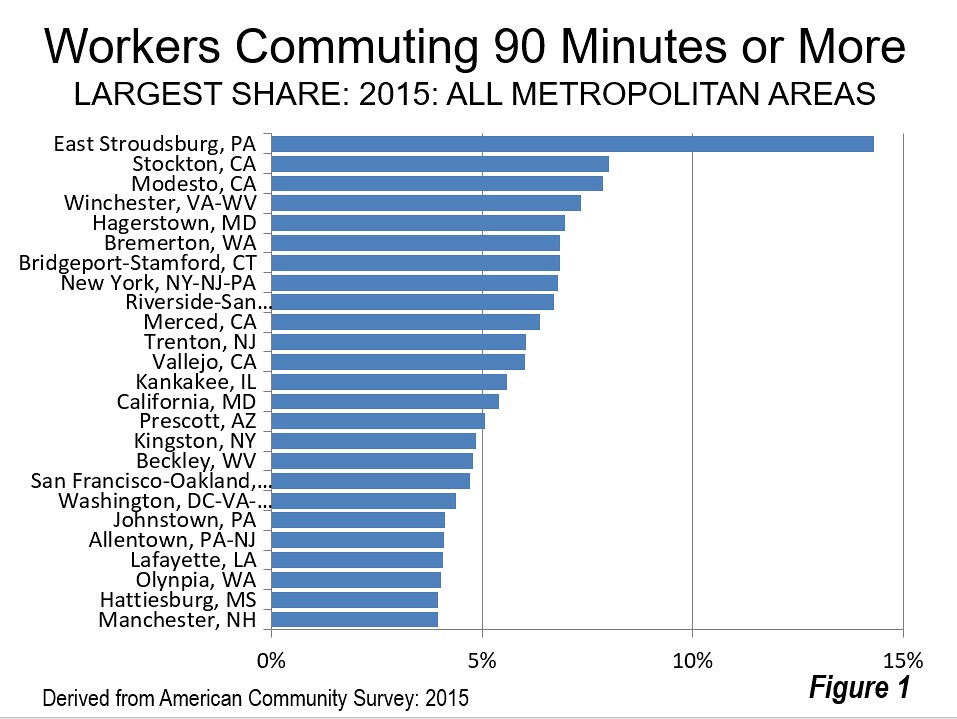
    Despite the frequent portrayal of long commuting as the norm, only 2.2 percent of the nation’s workers travel 90 minutes or more, one way to work. Moreover, that long commuting is concentrated in and near just a few combined statistical areas (CSAs), the larger the larger metropolitan area definition that combines adjacent metropolitan areas like Bridgeport-Stamford with New York, San Jose with San Francisco and Riverside-San Bernardino with Los Angeles. Figure 1 shows that 17 of the 25 metropolitan areas with the largest share of 90-plus minute commuters are in or adjacent to just four combined statistical areas (CSAs).

    Figure 1 shows that 17 of the 25 metropolitan areas with the largest share of 90-plus minute commuters are in or adjacent to just four combined statistical areas (CSAs), the larger metropolitan area region definition that connects places like New Haven County and Fairfield County with New York, San Jose with San Francisco and Riverside-San Bernardino with Los Angeles.

    Seven of the metropolitan areas are in the New York CSA, including New York (NY-NJ-PA), Bridgeport-Stamford (CT), Allentown (PA), Trenton (NJ), Kingston (NY) and East Stroudsburg (PA). The San Francisco CSA has three metropolitan areas among the longest commute metropolitan areas, San Francisco, San Jose and Stockton, as well as adjacent Modesto and Merced. The Washington CSA has four metropolitan areas in the longest 25 commutes, including Washington (DC-VA-MD-WV), California (MD), Hagerstown (MD) and Winchester (VA-WV). Seattle, by far the smallest CSA with more than one metropolitan area in the longest commute CSAs, has two, Bremerton (WA) and Olympia (WA).

    East Stroudsburg (New York CSA) has the largest share of 90 and more minute commuters, at 14.3 percent. Stockton (San Francisco CSA) has the second largest number, a much lower 8.0 percent. Nearby Modesto (adjacent to the San Francisco CSA and a candidate for inclusion after 2020) is at 7.8 percent. Winchester and Hagerstown (Washington CSA) are at 7.3 percent and 7.0 percent respectively.

    None of this is surprising, considering that each of these markets is plagued by urban containment land use policies that force up house prices. Harvard research indicates that domestic migration is being driven by the differential in house prices and people have been leaving the New York, Washington and San Francisco CSAs for other parts of the country. Seattle has done better, simply because its expensive housing is still a bargain compared to the much more onerous house costs in coastal California, from which migrants are being drawn. The trend in long commutes suggests another dimension to the domestic migration story, as households disperse more in the same general area.

    Long Commuting is Expanding

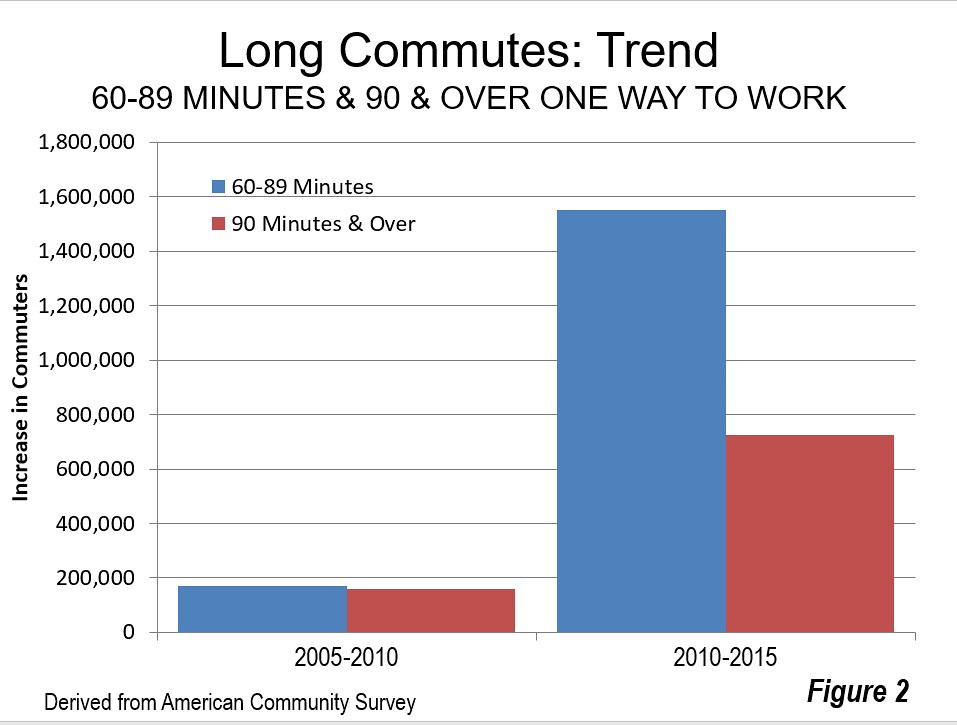
    Further, long commuting is expanding. Between 2005 and 2010, the increases were modest, with a market share rise of 3.0 percent among residents traveling 90 minutes or more to work and 0.3 percent among those traveling from 60 to 89 minutes to work. This is not surprising, given the Great Financial Crisis, which began during that period.

    However, there was a substantial increase in the trend after 2010. Between 2010 and 2015, the share of residents commuting 90 minutes or more increased 725,000, a market share increase of 13.6 percent. There was an increase of 1,550,000 among residents traveling from 60 minutes to 89 minutes, a market share increase of 12.5 percent (Figure 2). This combined increase of nearly 2.3 million 60 minutes plus commuters is substantial. It is more people that commute to work in the San Francisco metropolitan area (not counting those who work at home) and a larger number than the commuters in all but 10 of the nation’s metropolitan areas.

    This continuing dispersion is also indicated in data from the City Sector Model, which shows that suburban and exurban areas continued to attract 80 percent of the new jobs after 2010 (see “America’s Most Suburbanized Cities” and “Suburbs (Continue to) Dominate Jobs and Job Growth”).

    Comparisons by Mode of Travel

    Data by mode of travel is available only at the 60 minutes and over level, and for just 132 of the metropolitan areas. The percentage of those driving alone for 60 or more minutes is lower than the overall 9.0 percent average, at 7.0 percent. Car and van pool commuters are 60 plus commuters 10.7 percent of the time.

    Transit has a far higher level of 60 plus commuting, 38.3 percent at the national level. This is 5.5 times the rate of people driving alone (7.0 percent). While this may be surprising, it is consistent with what is obvious about transit commuting — that it takes about twice as long as commuting by car. And, transit provides scant job access compared to cars, even in the largest, best served metropolitan areas. On average, major metropolitan area resident can reach more than 40 times as many jobs in 30 minutes by car as by transit (the overall one-way work trip travel time is 26 minutes).

    Indeed, among the six metropolitan areas with the “legacy” cores that attract approximately 55 percent of the transit commute destinations in the nation, transit riders much more likely to travel 60 minutes or more to work than those who drive alone. In Philadelphia, the ratio is 3.8, while New York and Chicago transit commuters are 3.6 times as likely to travel 60 minutes or more than those who drive alone. In Boston the figure is 3.1 and San Francisco is 3.0. The smallest difference is in Washington, where transit commuters are only 2.4 times as likely to commute more than one hour than those who drive alone (Figure 3).

    In fact, transit commuters were more likely to travel 60 minutes or more to work than those who drive alone in all of the 53 major metropolitan areas (Table). New York has the largest share of residents commuting 60 minutes or more, at 21.4 percent. Washington is second, at 17.3 percent, San Francisco at 17.0 percent, Riverside-San Bernardino, which is adjacent to Los Angeles, at 16.9 percent and Boston at 14.8 percent. Buffalo, Salt Lake City, Oklahoma City, Kansas City and Milwaukee have the smallest share of their residents traveling 60 minutes or more to work, ranging from 2.5 percent to 2.7 percent.

    More Dispersion?

    The Times article that suggests that the increasing flexibility of companies toward full time working at home could permit people to disperse even more. Despite press reports that working at home is declining, its prospects look good. From 2014 to 2015, working at home experienced the largest increase of any work access mode except driving alone. The increase in work at home was 300,000, while the work at home share rose 5 percent in a single year according to ACS data. Moreover, Global Workplace Analytics reports a 115 percent increase in regular working at home among the non-self employed workforce since 2005, 10 times the increase in the workforce.

    These trends indicate that dispersion is continuing in US metropolitan areas as well as between metropolitan areas, as people seek better standards of living.

    Additional Data

    90 and Over Commute Shares by Metropolitan Area

    60 and Over Commute Shares by Mode by Metropolitan Area

    COMMUTE TIMES 60 & OVER MINUTES BY MODE
    US Major Metropolitan Areas: 2015
    Share by Mode
    All Workers Rank (Longest to Shortest) Drive Alone Transit Transit X Drive Alone
    UNITED STATES 9.0% 7.0% 38.3%          5.46
    Atlanta, GA 13.3%                    7 12.1% 40.5%          3.36
    Austin, TX 7.2%                  24 6.5% 27.9%          4.32
    Baltimore, MD 12.0%                    9 9.5% 46.2%          4.85
    Birmingham, AL 6.5%                  31 5.7% 30.0%          5.31
    Boston, MA-NH 14.8%                    5 11.8% 36.6%          3.11
    Buffalo, NY 3.4%                  53 2.5% 18.0%          7.21
    Charlotte, NC-SC 7.1%                  26 6.3% 33.7%          5.38
    Chicago, IL-IN-WI 14.4%                    6 11.0% 38.7%          3.50
    Cincinnati, OH-KY-IN 4.8%                  42 4.1% 31.7%          7.68
    Cleveland, OH 4.9%                  41 3.7% 33.0%          9.00
    Columbus, OH 4.2%                  46 3.7% 25.1%          6.80
    Dallas-Fort Worth, TX 8.7%                  16 7.7% 43.6%          5.65
    Denver, CO 7.8%                  21 6.2% 38.0%          6.18
    Detroit,  MI 6.8%                  30 6.1% 42.5%          6.95
    Grand Rapids, MI 4.3%                  45 3.6% 25.5%          7.04
    Hartford, CT 5.0%                  38 4.5% 23.0%          5.09
    Houston, TX 11.9%                  10 11.0% 39.0%          3.55
    Indianapolis. IN 5.0%                  39 4.6% 39.4%          8.64
    Jacksonville, FL 5.6%                  34 4.6% 39.6%          8.56
    Kansas City, MO-KS 3.6%                  50 3.2% 21.1%          6.51
    Las Vegas, NV 4.6%                  43 2.5% 45.9%        18.65
    Los Angeles, CA 12.5%                    8 10.8% 40.6%          3.77
    Louisville, KY-IN 4.4%                  44 3.6% 31.3%          8.60
    Memphis, TN-MS-AR 3.8%                  48 3.3% 37.1%        11.25
    Miami, FL 10.0%                  13 8.3% 43.1%          5.23
    Milwaukee,WI 3.8%                  49 2.7% 27.2%          9.89
    Minneapolis-St. Paul, MN-WI 5.5%                  37 4.5% 21.2%          4.68
    Nashville, TN 8.2%                  18 7.7% 29.6%          3.84
    New Orleans. LA 7.9%                  20 6.7% 37.9%          5.64
    New York, NY-NJ-PA 21.4%                    1 11.9% 42.1%          3.54
    Oklahoma City, OK 3.6%                  51 3.1% 7.5%          2.40
    Orlando, FL 6.9%                  28 5.6% 42.8%          7.66
    Philadelphia, PA-NJ-DE-MD 11.4%                  12 9.0% 33.8%          3.78
    Phoenix, AZ 6.8%                  29 5.3% 41.9%          7.95
    Pittsburgh, PA 8.0%                  19 7.3% 20.3%          2.77
    Portland, OR-WA 7.4%                  23 5.2% 28.9%          5.59
    Providence, RI-MA 9.1%                  15 7.3% 54.7%          7.47
    Raleigh, NC 6.0%                  32 5.0% 42.8%          8.61
    Richmond, VA 4.9%                  40 4.0% 33.1%          8.17
    Riverside-San Bernardino, CA 16.9%                    4 15.0% 48.5%          3.25
    Rochester, NY 4.0%                  47 3.1% 32.7%        10.43
    Sacramento, CA 7.6%                  22 6.5% 34.7%          5.37
    St. Louis,, MO-IL 5.8%                  33 4.6% 36.3%          7.85
    Salt Lake City, UT 3.5%                  52 2.1% 23.3%        11.34
    San Antonio, TX 6.9%                  27 5.8% 41.5%          7.17
    San Diego, CA 7.2%                  25 5.6% 37.5%          6.73
    San Francisco-Oakland, CA 17.0%                    3 12.5% 37.2%          2.97
    San Jose, CA 9.4%                  14 7.5% 48.1%          6.43
    Seattle, WA 11.8%                  11 8.9% 33.6%          3.78
    Tampa-St. Petersburg, FL 8.4%                  17 7.9% 33.2%          4.22
    Tucson, AZ 5.5%                  36 3.7% 29.5%          7.99
    Virginia Beach-Norfolk, VA-NC 5.6%                  35 4.8% 40.1%          8.35
    Washington, DC-VA-MD-WV 17.3%                    2 13.9% 35.7%          2.57
    Derived from American Community Survey, 2015

    Wendell Cox is principal of Demographia, an international public policy and demographics firm. He is a Senior Fellow of the Center for Opportunity Urbanism (US), Senior Fellow for Housing Affordability and Municipal Policy for the Frontier Centre for Public Policy (Canada), and a member of the Board of Advisors of the Center for Demographics and Policy at Chapman University (California). He is co-author of the “Demographia International Housing Affordability Survey” and author of “Demographia World Urban Areas” and “War on the Dream: How Anti-Sprawl Policy Threatens the Quality of Life.” He was appointed to three terms on the Los Angeles County Transportation Commission, where he served with the leading city and county leadership as the only non-elected member. He served as a visiting professor at the Conservatoire National des Arts et Metiers, a national university in Paris.

    Photograph: New Jersey Transit Commuter Train (by author)

  • State Governments Are Oppressive, Too

    Historically, the battle over the size and scale of government has been focused largely on “states’ rights.” This federalist notion also has been associated with many shameful things, such as slavery, Jim Crow laws and other abuses of personal freedom.

    Yet, increasingly, the clearest threat to democracy and minority rights today comes not just from a surfeit of central power concentrated in Washington, D.C., but also from increased centralization of authority within states, and even regional agencies. Oppressive diktats from state capitals increasingly seek to limit local control over basic issues such as education, zoning, bathroom designations, guns and energy development.

    This follows a historical trend over the past century. Ever since the Great Depression, and even before, governmental power has been shifting inexorably from the local governments to regional, state and, of course, federal jurisdictions. In 1910, the federal level accounted for 30.8 percent of all government spending, with state governments comprising 7.7 percent and the local level more than 61 percent. More than 100 years later, not only had the federal share exploded to nearly 60 percent, but, far less recognized, the state share had nearly doubled, while that of local governments has fallen to barely 25 percent, a nearly 60 percent drop. Much of what is done at the local level today is at the behest, and often with funding derived from, the statehouse or Washington.

    Diversity vs. regimentation

    This trend is particularly notable in the country’s two megastates: California and Texas. Each is increasingly controlled by ideological fanatics who see in their statehouse dominion an ideal chance to impose their agenda on dissenting communities. In California, Jerry Brown’s climate jihad is the rationale for employing “the coercive power of the central state,” in his own words, to gain control over virtually every aspect of planning and development.

    In Texas, the impetus comes from the far right, which has been working to strip localities of their traditional ability to control their own affairs, which, as two Houston scholars recently pointed out, has been critical to that state’s success. These efforts cover a host of issues, from fracking and ride-sharing to transgender bathrooms, a topic which affects very few but has, absurdly, become the key issue for a legislative special session.

    Just as Californians find themselves increasingly controlled by climate warriors and anti-suburban ideologues, diverse Texans in cities like Austin now must conform to the dictates of strident demands by a “liberty caucus” that eerily resembles their authoritarian doppelgangers in Sacramento.

    In other cases, such as in North Carolina, social conservatives, like their Texan bedfellows, seek to circumscribe progressive policies in places like Raleigh or Charlotte. Businesses, in particular, are concerned that some bills, like the state’s transgender bathroom legislation, could lead to painful boycotts by corporations and event planners. Conversely, some blue-state policies, like high mandated minimum wages and policies restricting fossil fuels, hurt disproportionately poorer areas, like upstate New York and rural California, which have lost much of their political clout.

    Read the entire piece in the Los Angeles Daily News.

    Joel Kotkin is executive editor of NewGeography.com. He is the Roger Hobbs Distinguished Fellow in Urban Studies at Chapman University and executive director of the Houston-based Center for Opportunity Urbanism. His newest book is The Human City: Urbanism for the rest of us. He is also author of The New Class ConflictThe City: A Global History, and The Next Hundred Million: America in 2050. He lives in Orange County, CA.

    Photo by LoneStarMike (Own work) [CC BY 3.0], via Wikimedia Commons

  • The Great Train Robbery: Urban Transportation in the 21st Century

    Below is an excerpt from a new report published by the Chapman University Center for Demographics and Policy titled, “The Great Train Robbery: Urban Transportation in the 21st Century.” Read the full report (pdf) here.

    Productive cities could not exist without transportation. Economic performance and job creation in a city — by which we mean a metropolitan area — generally improve when people can reach more job destinations more rapidly. Over time, the ways in which people have reached their worksites has changed. In the distant past, nearly all people walked. Later, they relied on mass transit. Now, people in metropolitan areas rely primarily on cars for transportation to their jobs.

    However, in some cities, transit remains both critical and effective.
    These are metropolitan areas with strong historic — legacy — urban cores, which include large, downtown central business districts or CBDs. This is most notable in New York’s central business district, which accounts for a dominant 40 percent of all transit work trip destinations in the country, despite having only two percent of the nation’s jobs.

    Overall, barely 5.2 percent of all commuter trips nationally are on some form of mass transit. Among the nation’s 53 major metropolitan areas (places with over 1,000,000 population), only 11 exceed this 5.2 percent average.

    Read the full report here.