Blog

  • Havana, Cuba–Stagnation Doesn’t Preserve Cities, Nor Does Wealth Destroy Them

    Before taking my trip to Havana, one thing that I was curious about was how a half-century of Communism had affected the built fabric. While there are obvious disadvantages to economic stagnation, I figured that it would have at least created a charming-looking city. There are, after all, a handful of U.S. cities, and numerous European ones, that have resisted growth, modernization, and the automobile, only to remain quaint and historic. But it didn’t take even a 10-minute cab ride from the airport to realize that my assumption about Havana had been naïve—even if it is still held by many of the city’s blissfully uncurious tourists.

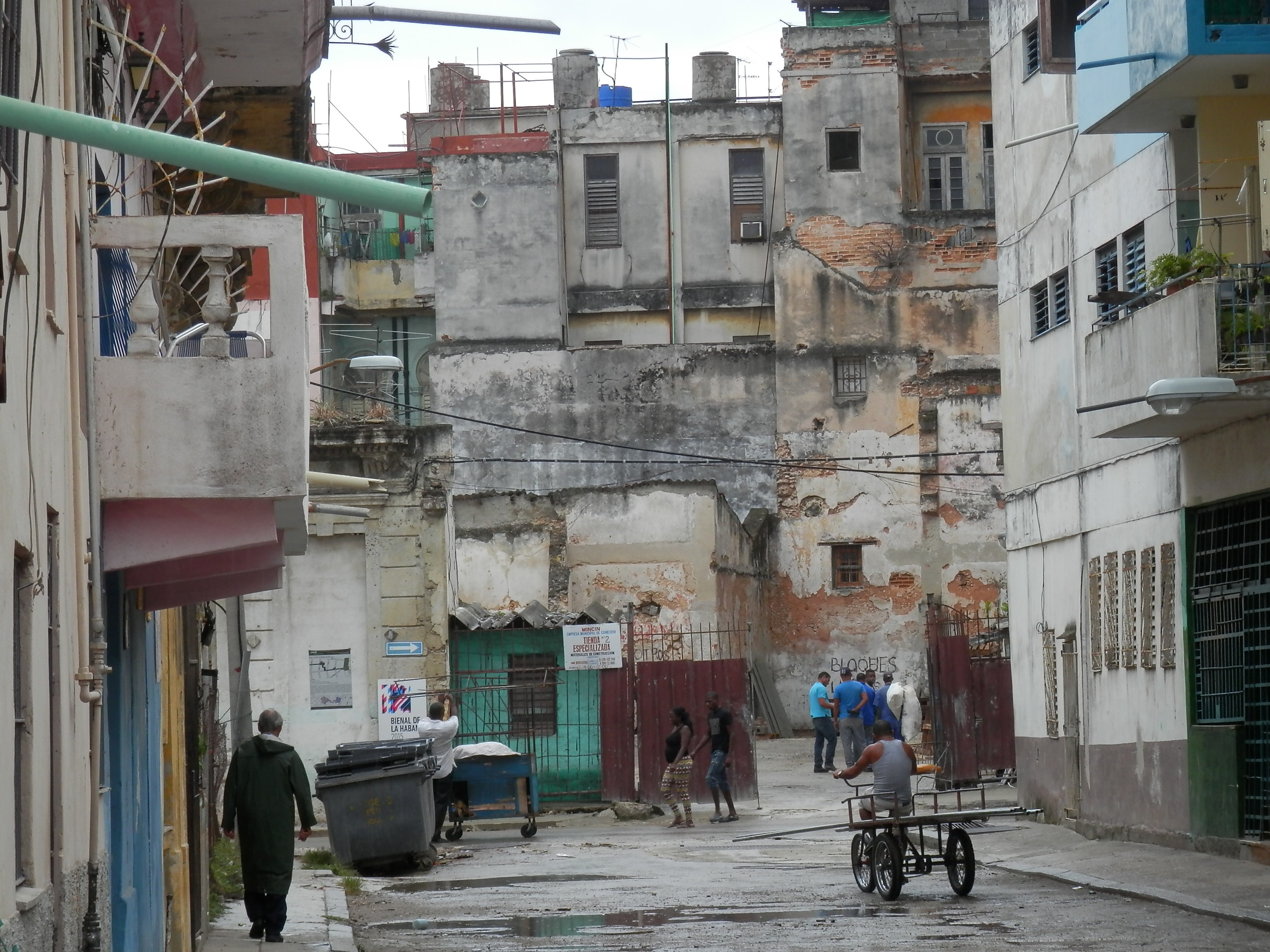
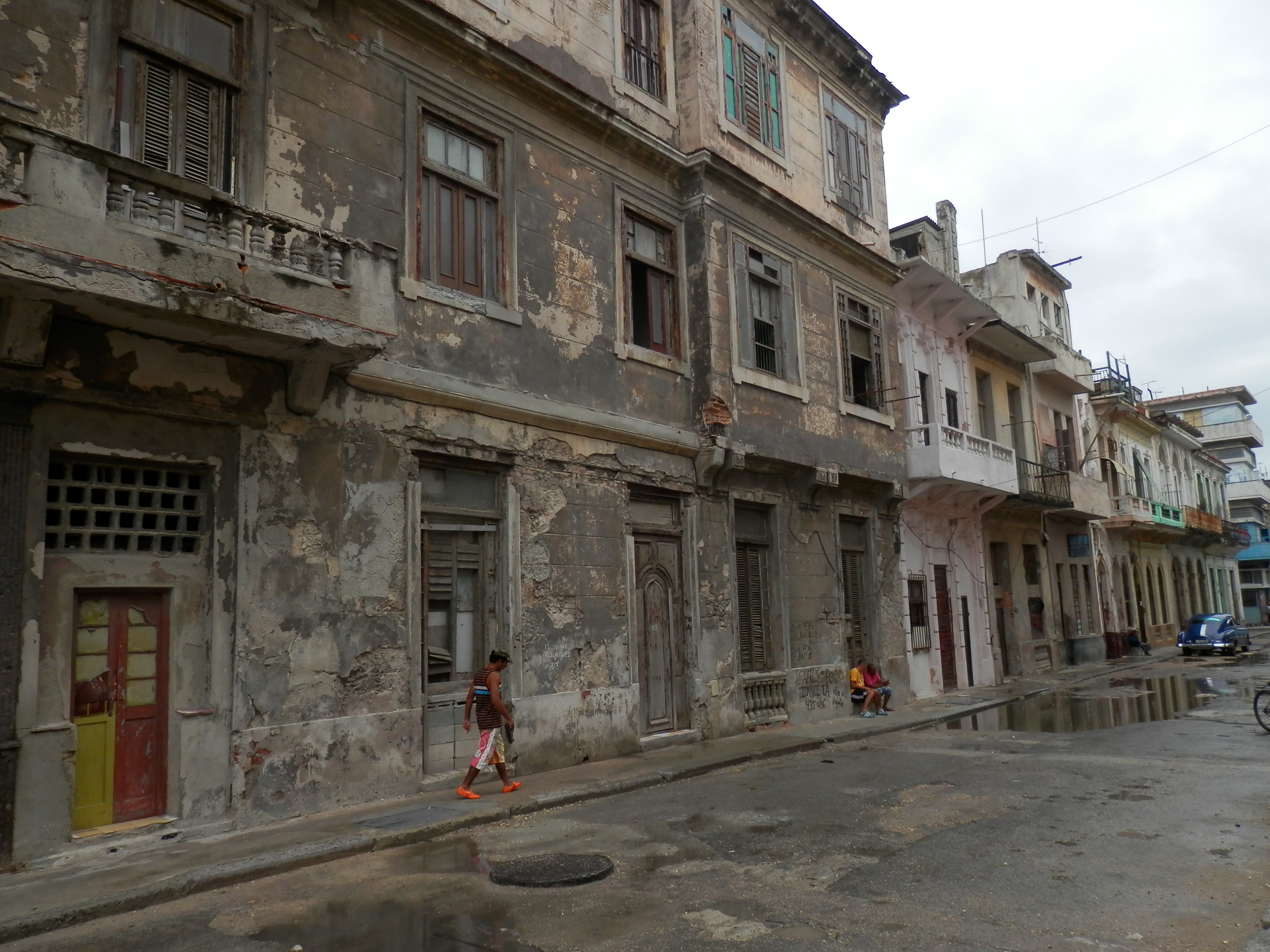
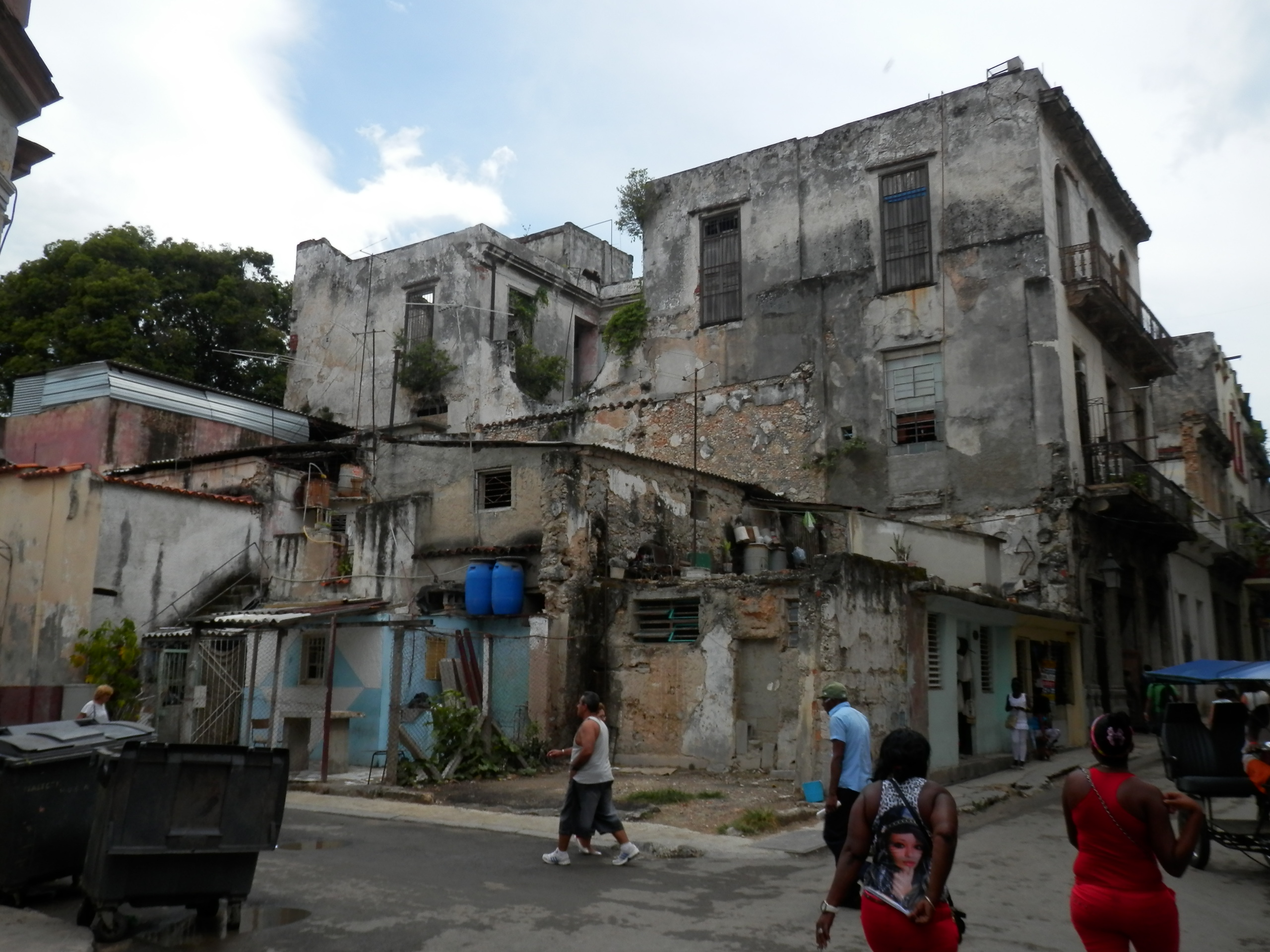
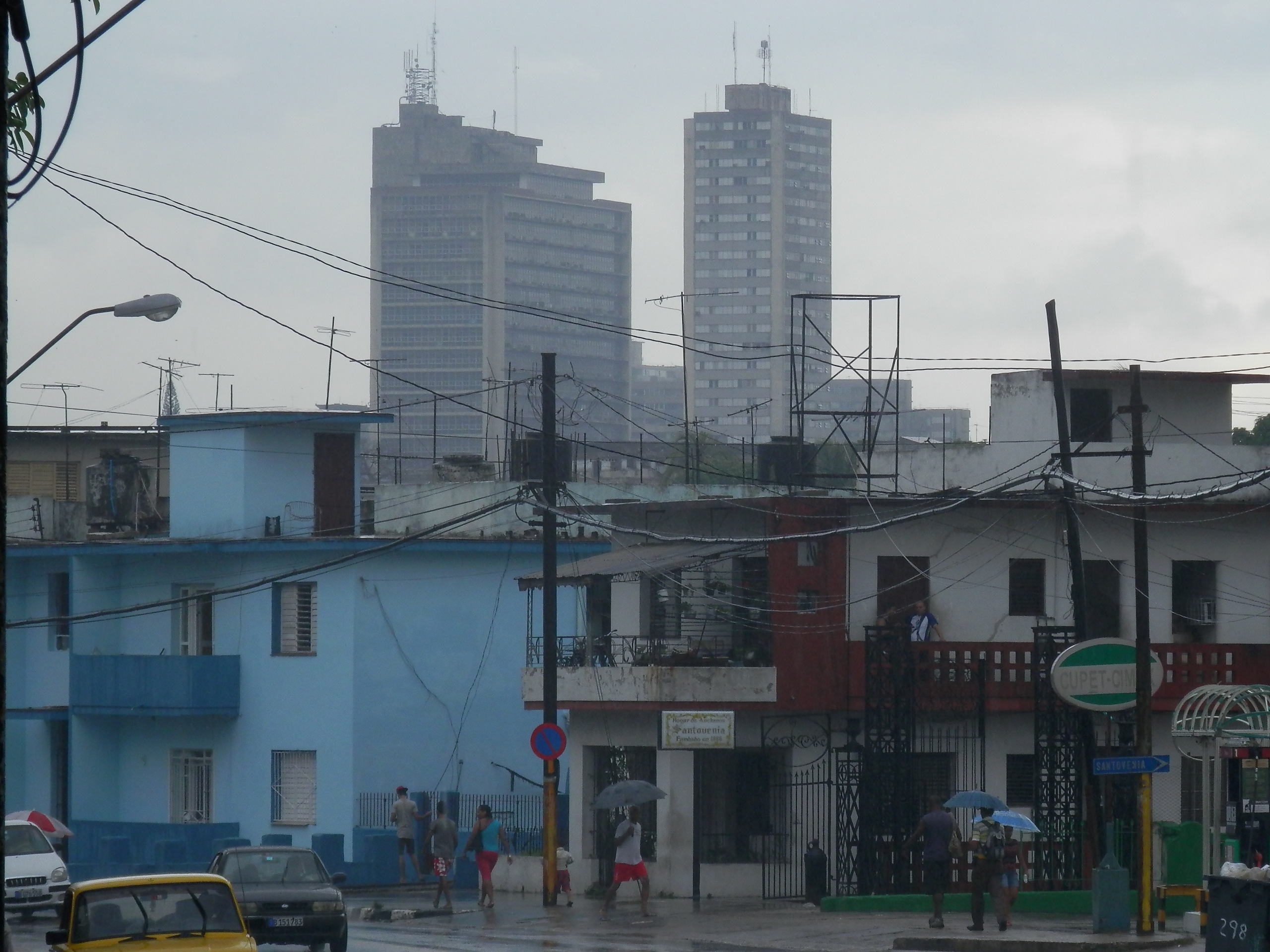
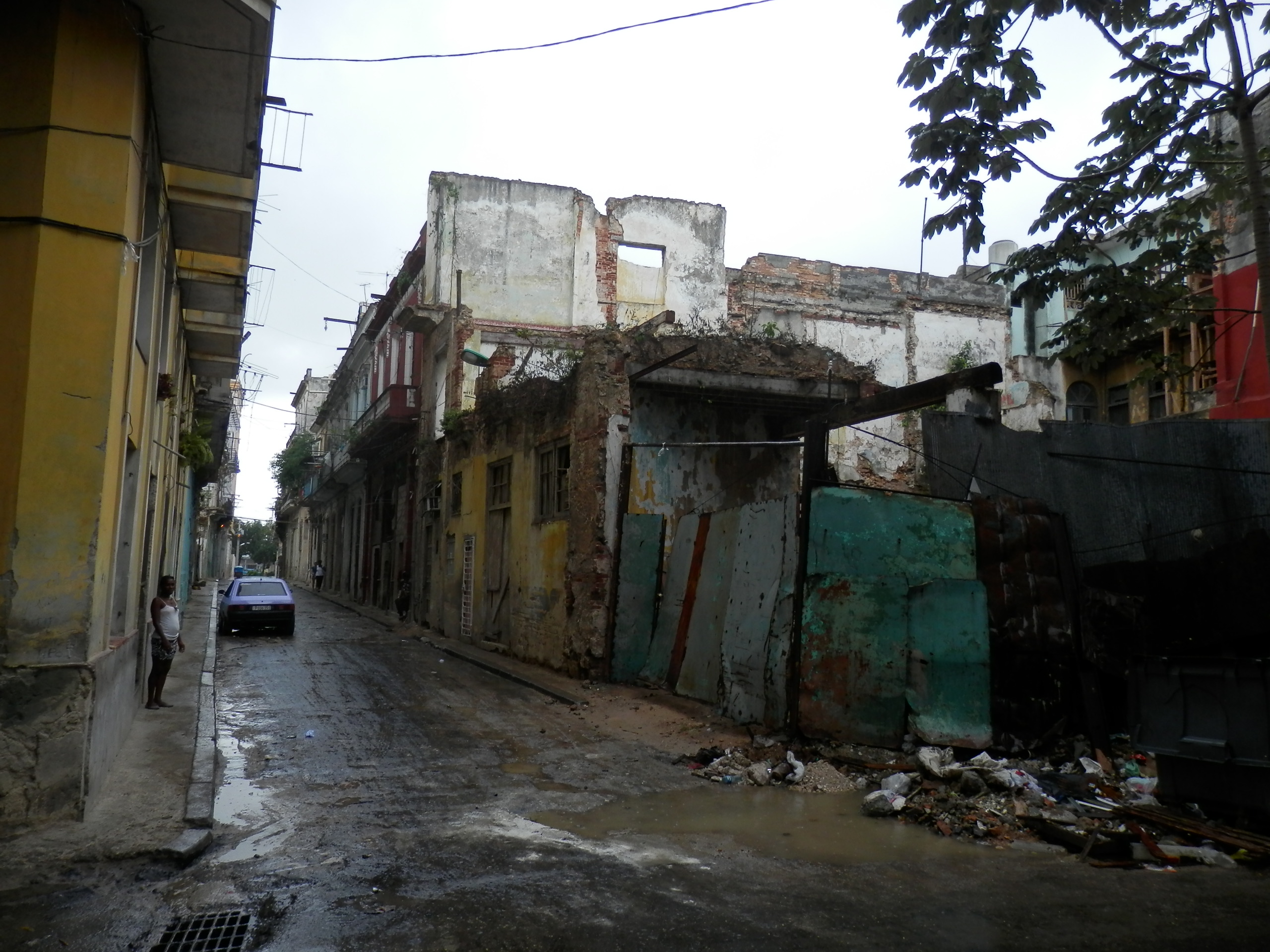
    In fact, very little about Havana has been “preserved.”  Instead, everything in the city is merely old, and because little gets produced, nothing is replaced. This applies to the automobiles, furniture, hand tools, manufacturing equipment—and most certainly the buildings. Collectively, this stagnation has destroyed the look of the city, with a physical blight that stretches nearly every block from downtown to the outer slums.

    OLYMPUS DIGITAL CAMERA

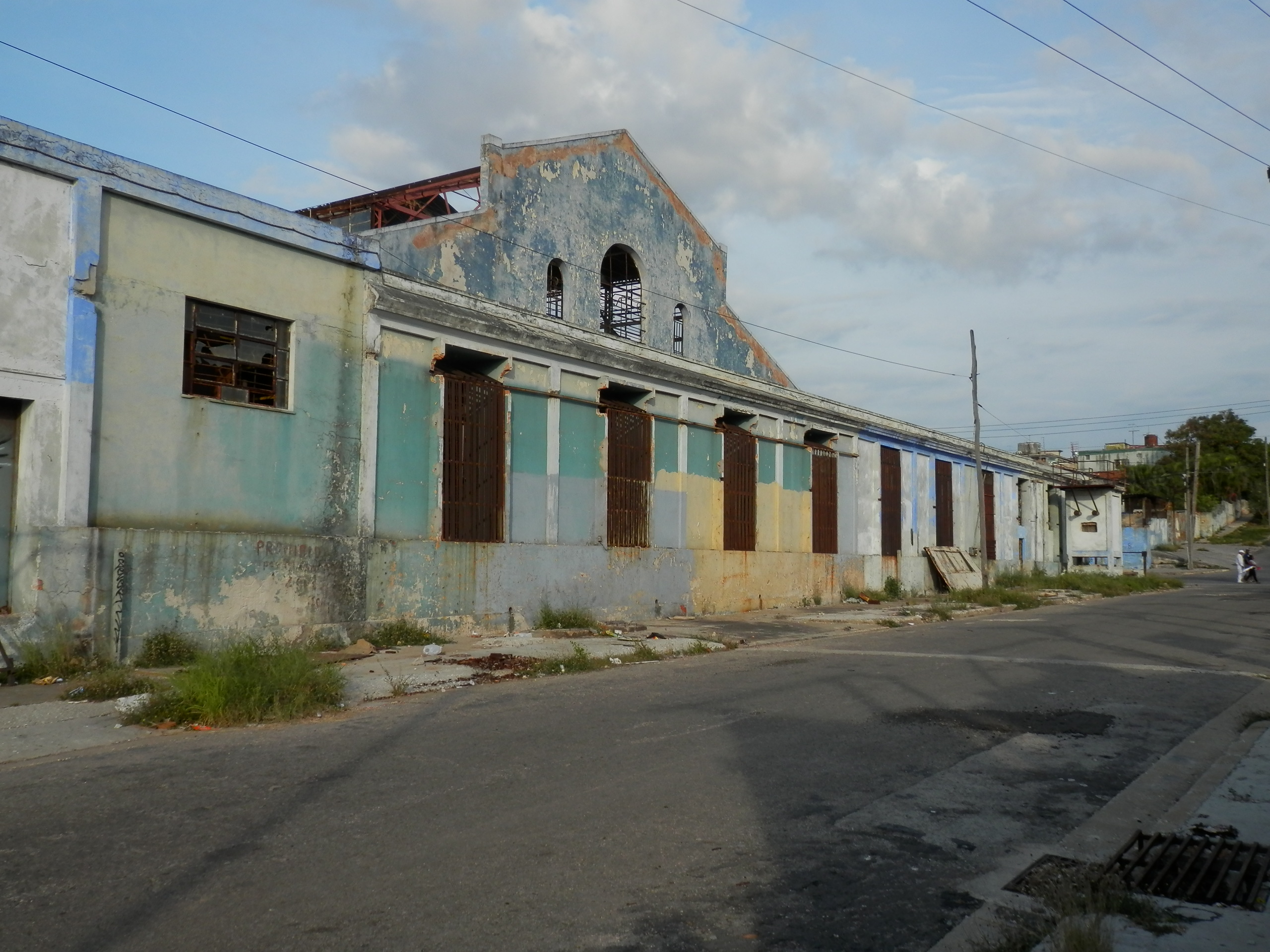
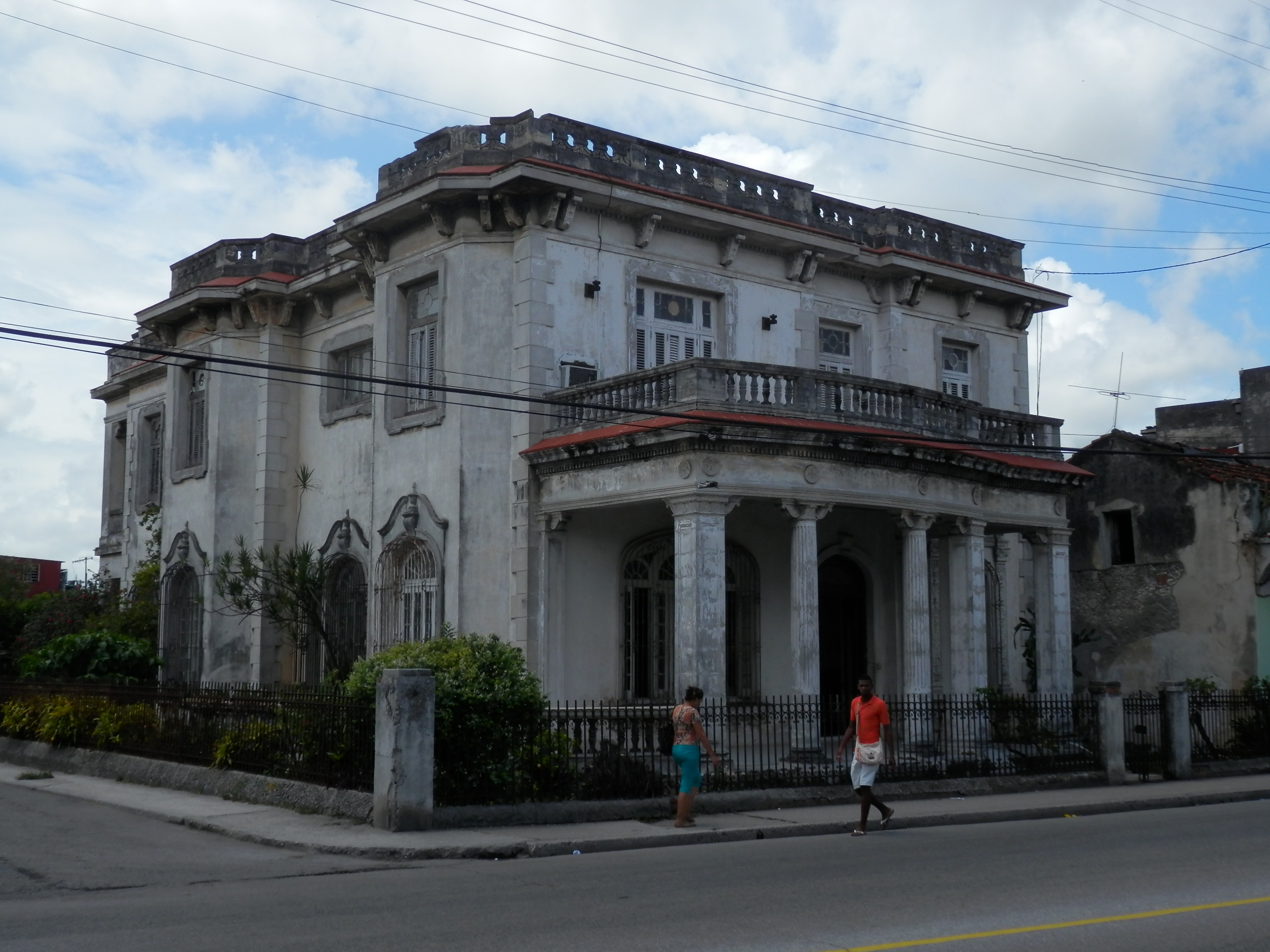
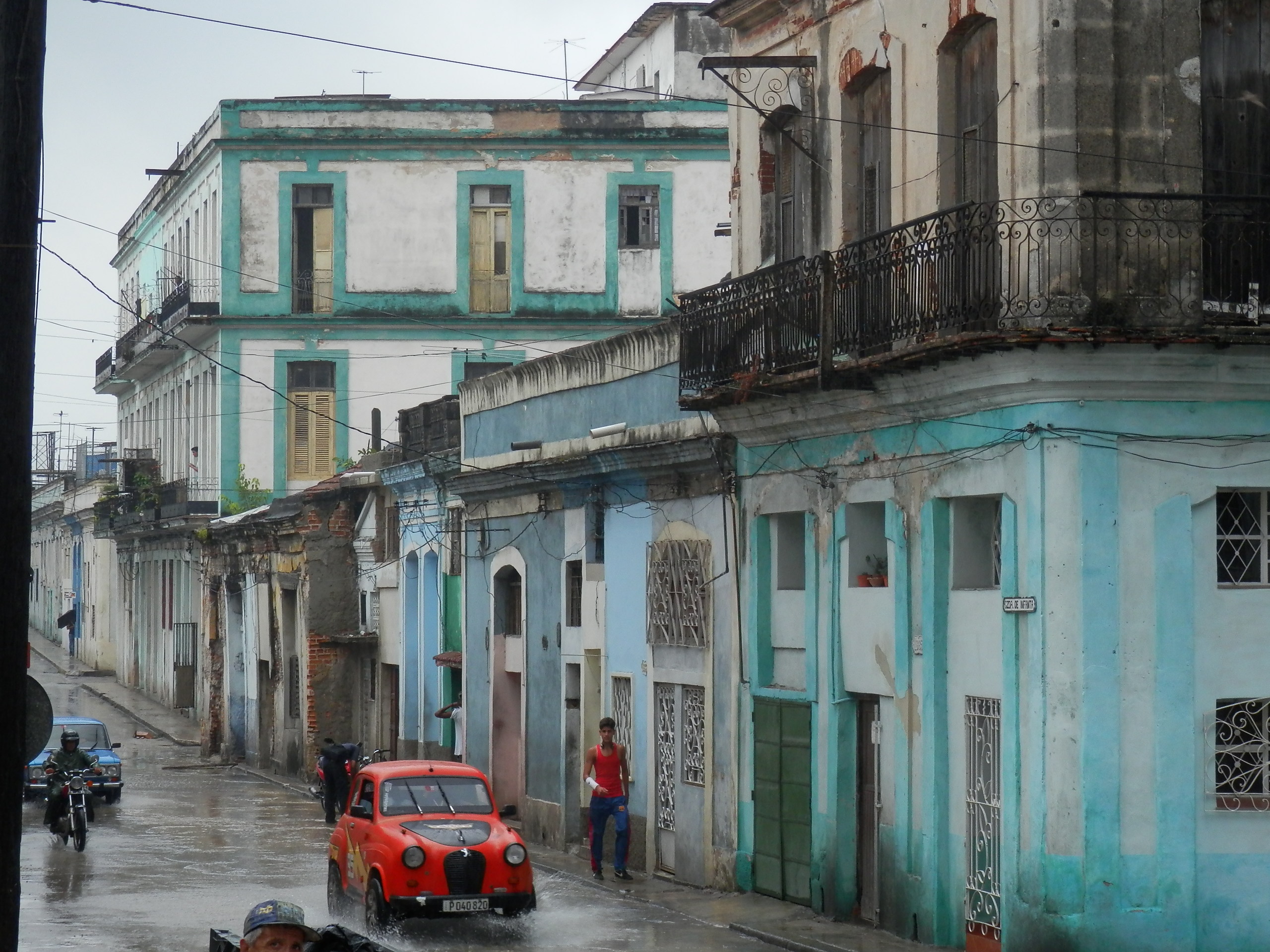
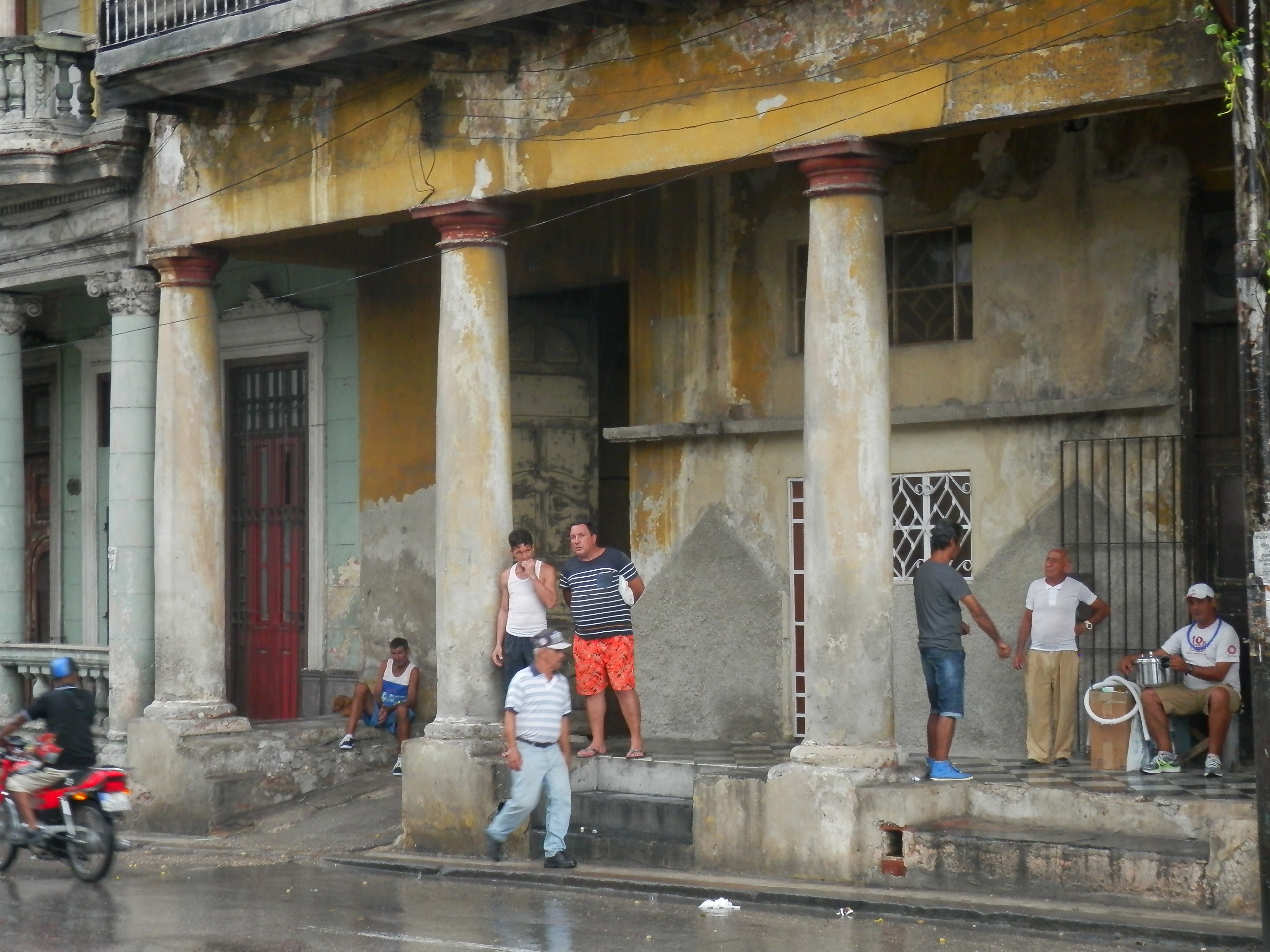
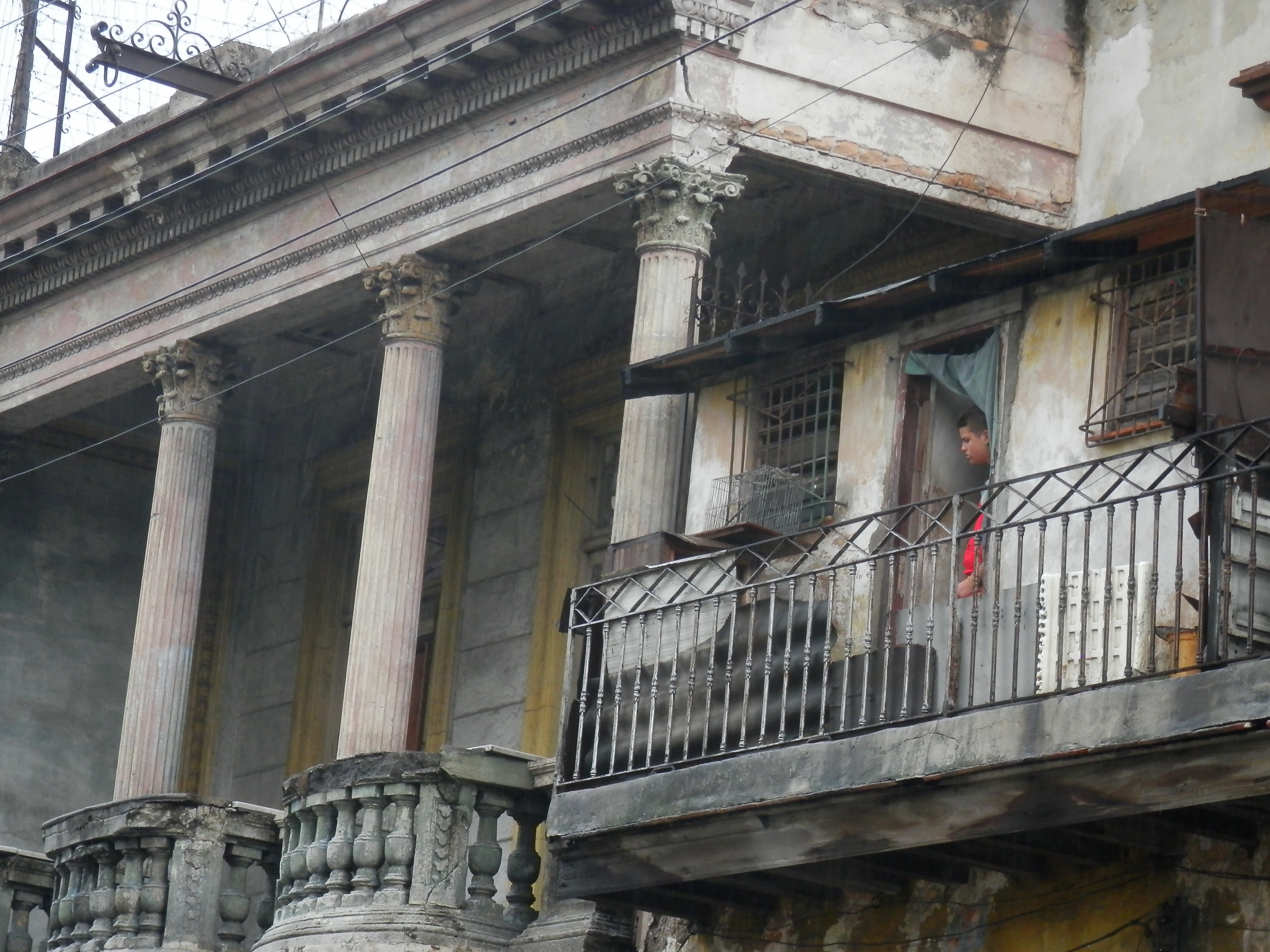
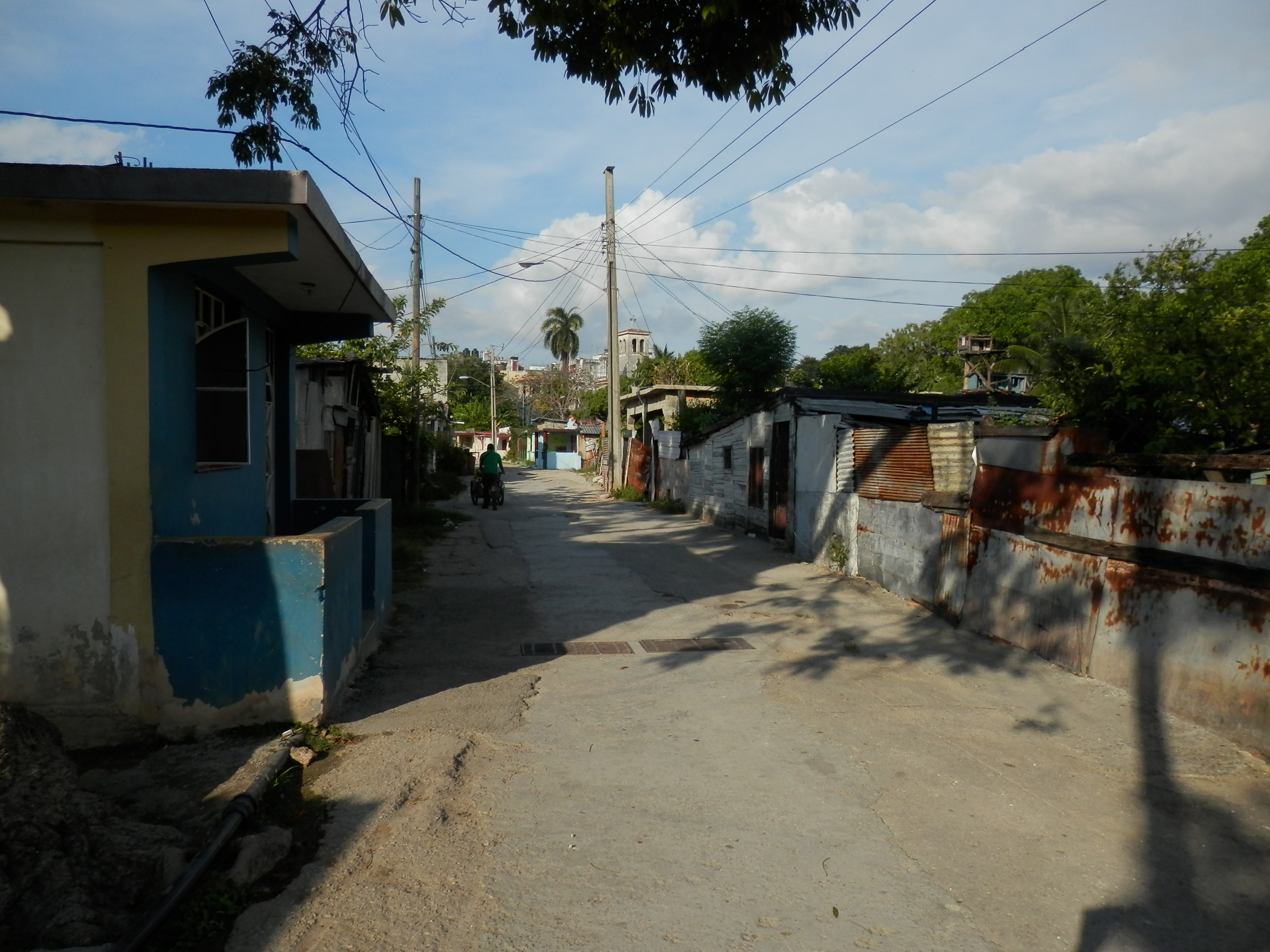
    If I could define in one statement what Havana looks like, after four days of extensively biking and walking through, I’d call it the Latin American Detroit. It was a once-great city that declined because of bad policies, and its pervasive ruination serves as a constant reminder of this. The houses themselves, while large and ornate, are almost uniformly inadequate by U.S. standards. If they have not crumbled to the ground altogether, many are caving in. The foundations are crooked, full of holes, and marred by broken windows and doors. Because of Havana’s European roots, stucco is a common material, but on most buildings is falling off, or in some cases has disappeared. Almost every building has dirt and grime, while some are covered in it.

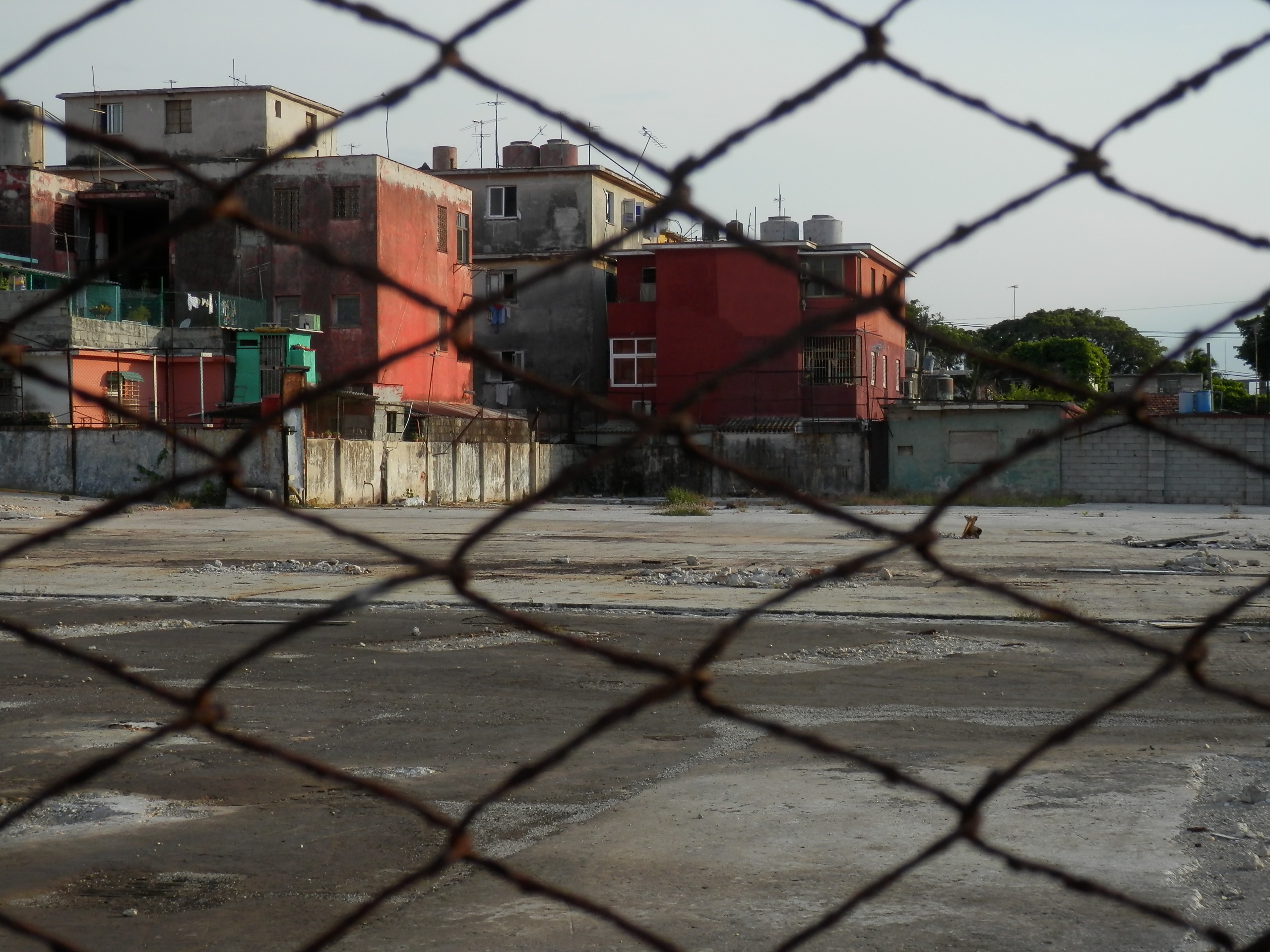
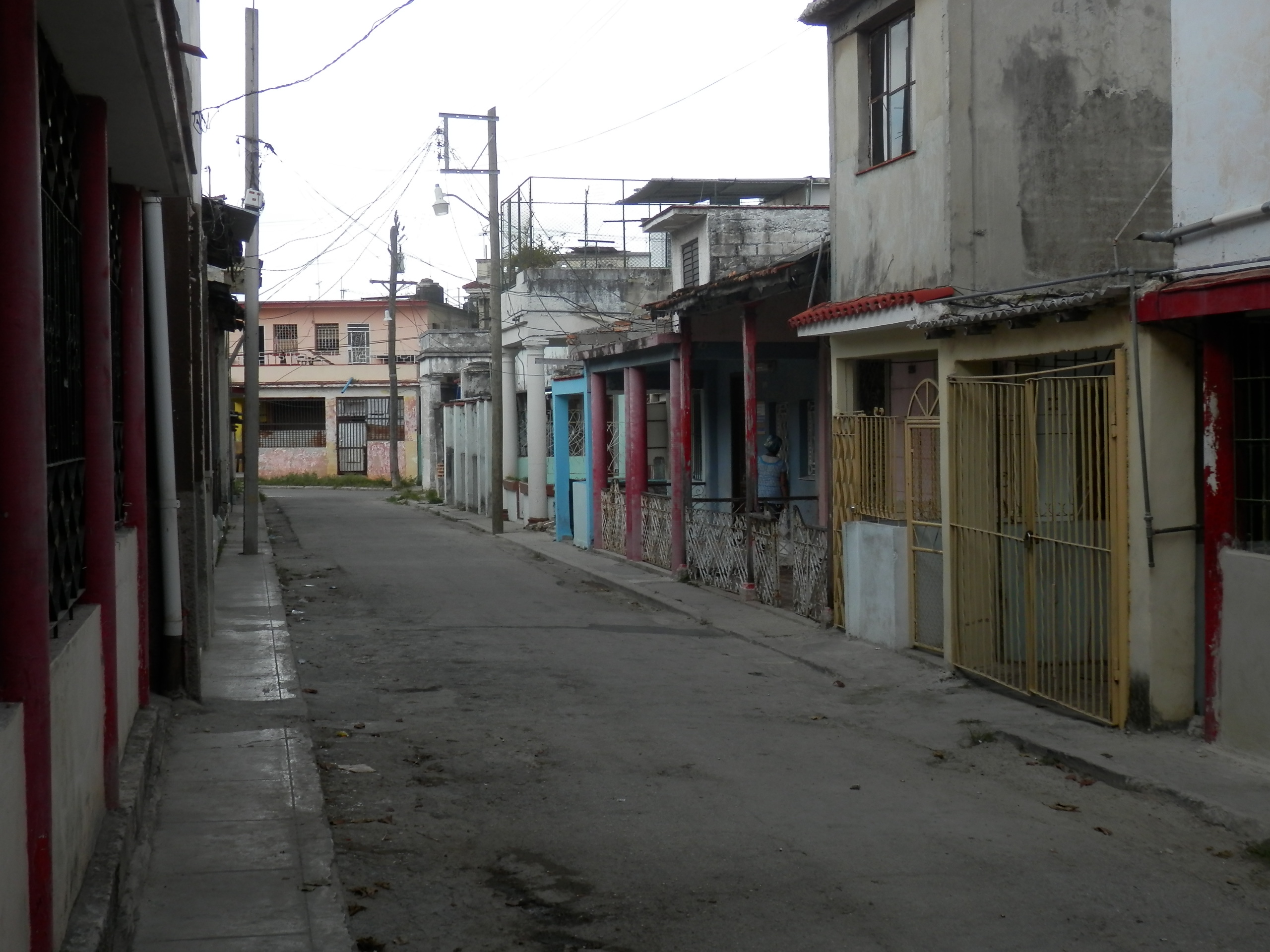
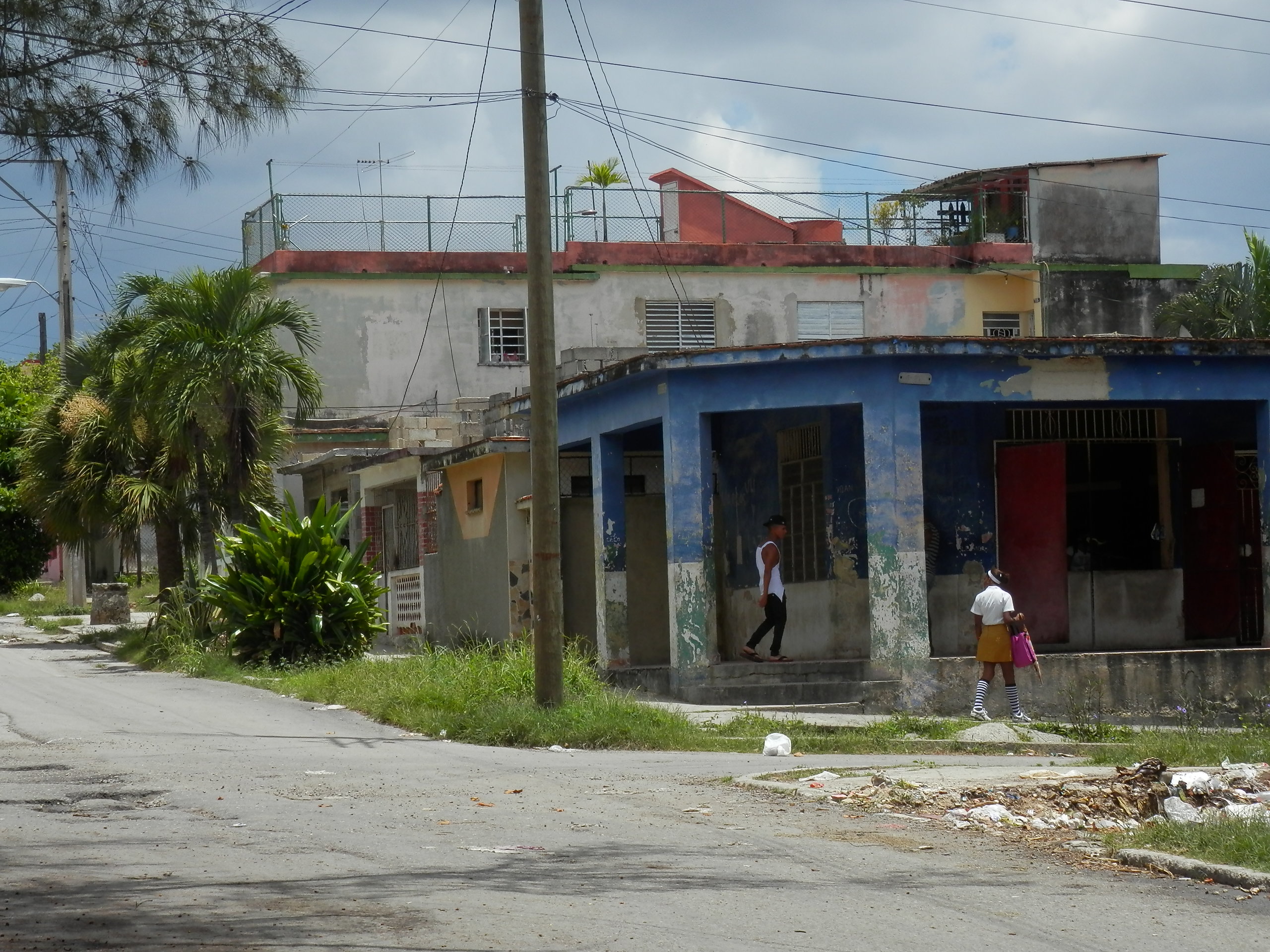
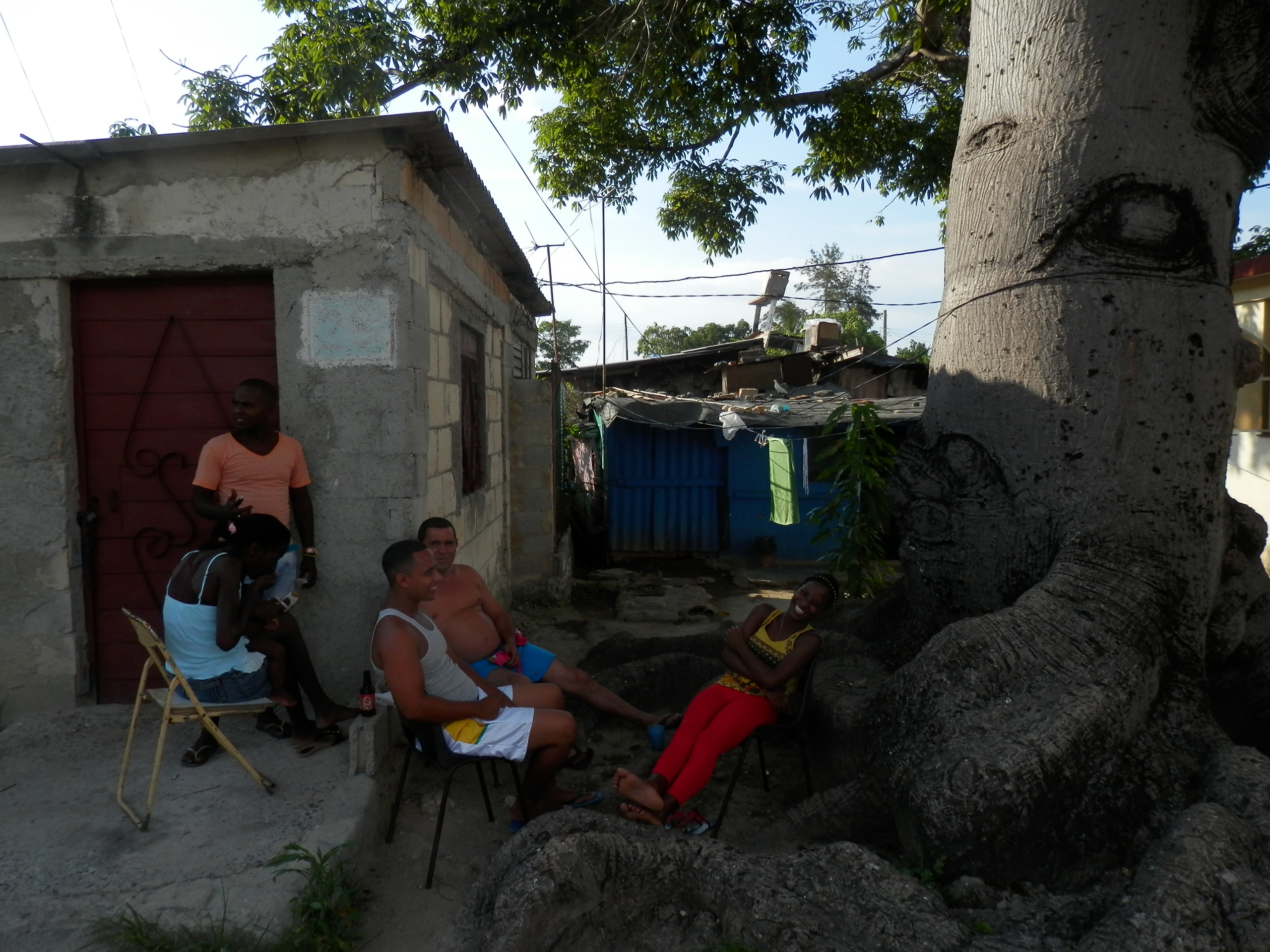
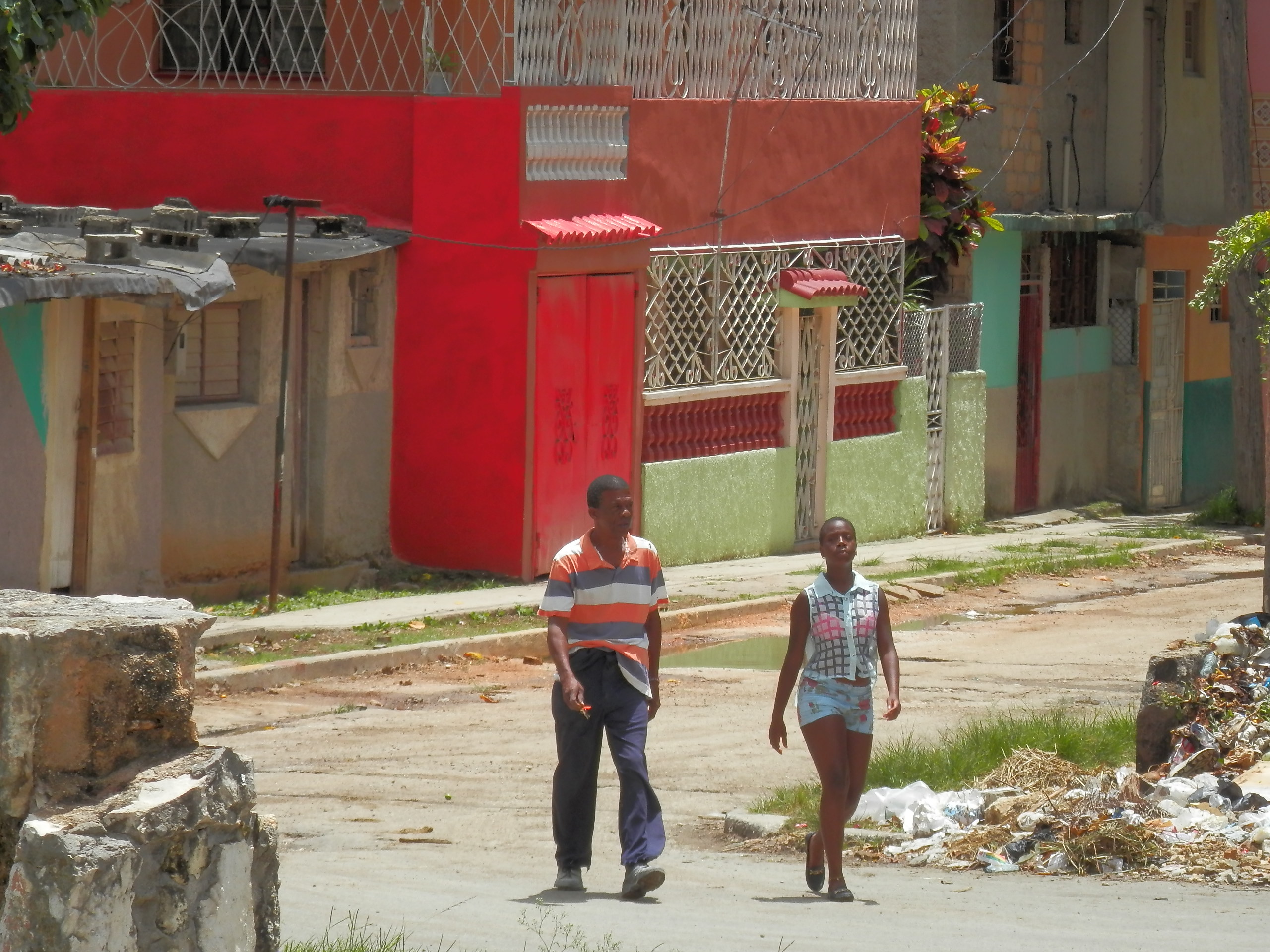
    And this is for Havana’s nice parts. Once I began biking out of the central neighborhoods and into the slums, I found that symbols of past wealth disappeared altogether, and were replaced with what in the U.S. would be considered shacks. These structures were usually patched up with knotted wood, metal scraps, and thatching. One gentlemen who lived in the poor neighborhood of Cerro, and who I spoke with at length, described his area as akin to a Brazilian favela—which I found believable. The two pictures I took below were from his front porch, and mirrored the aesthetic of such areas.
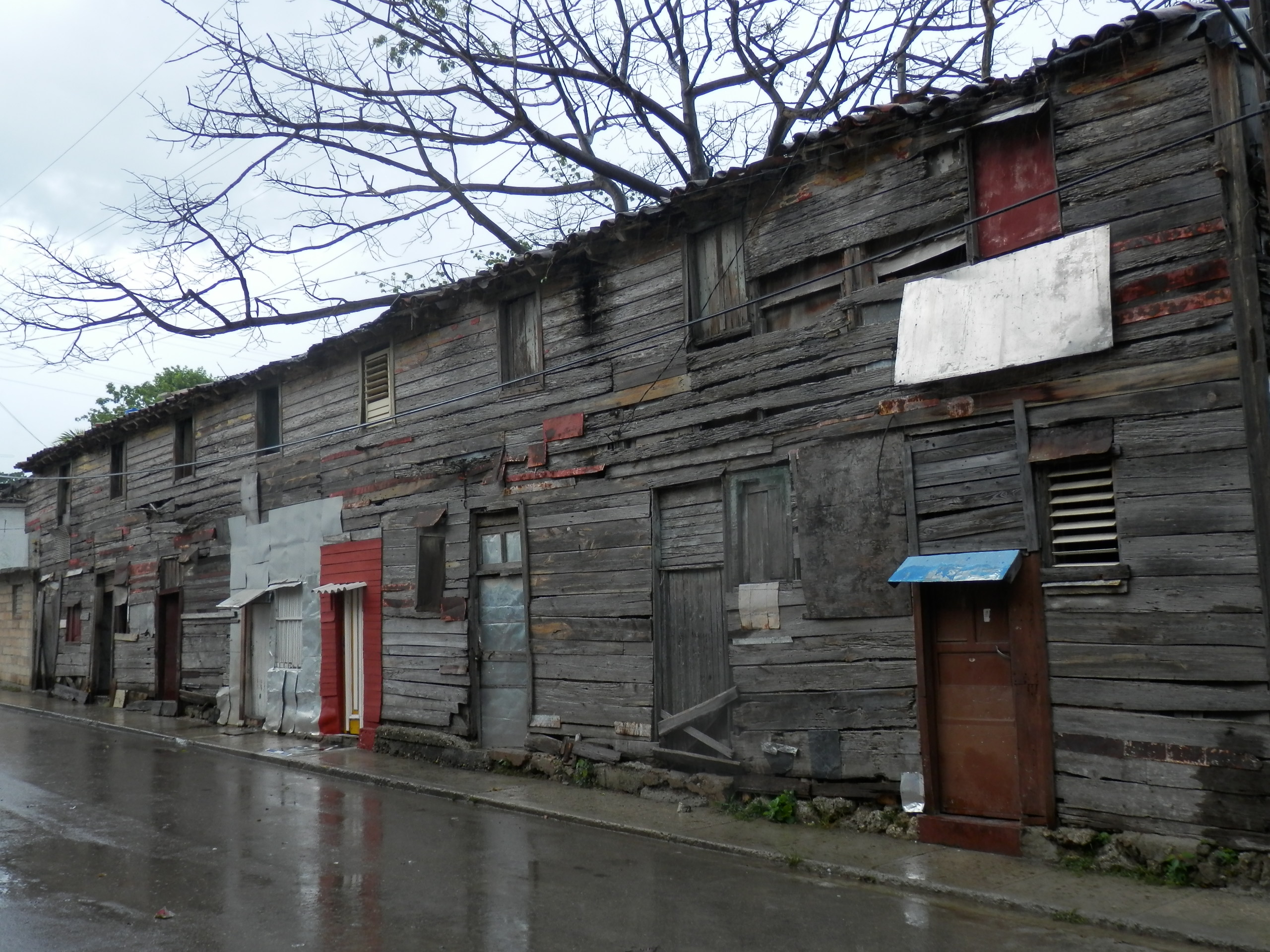
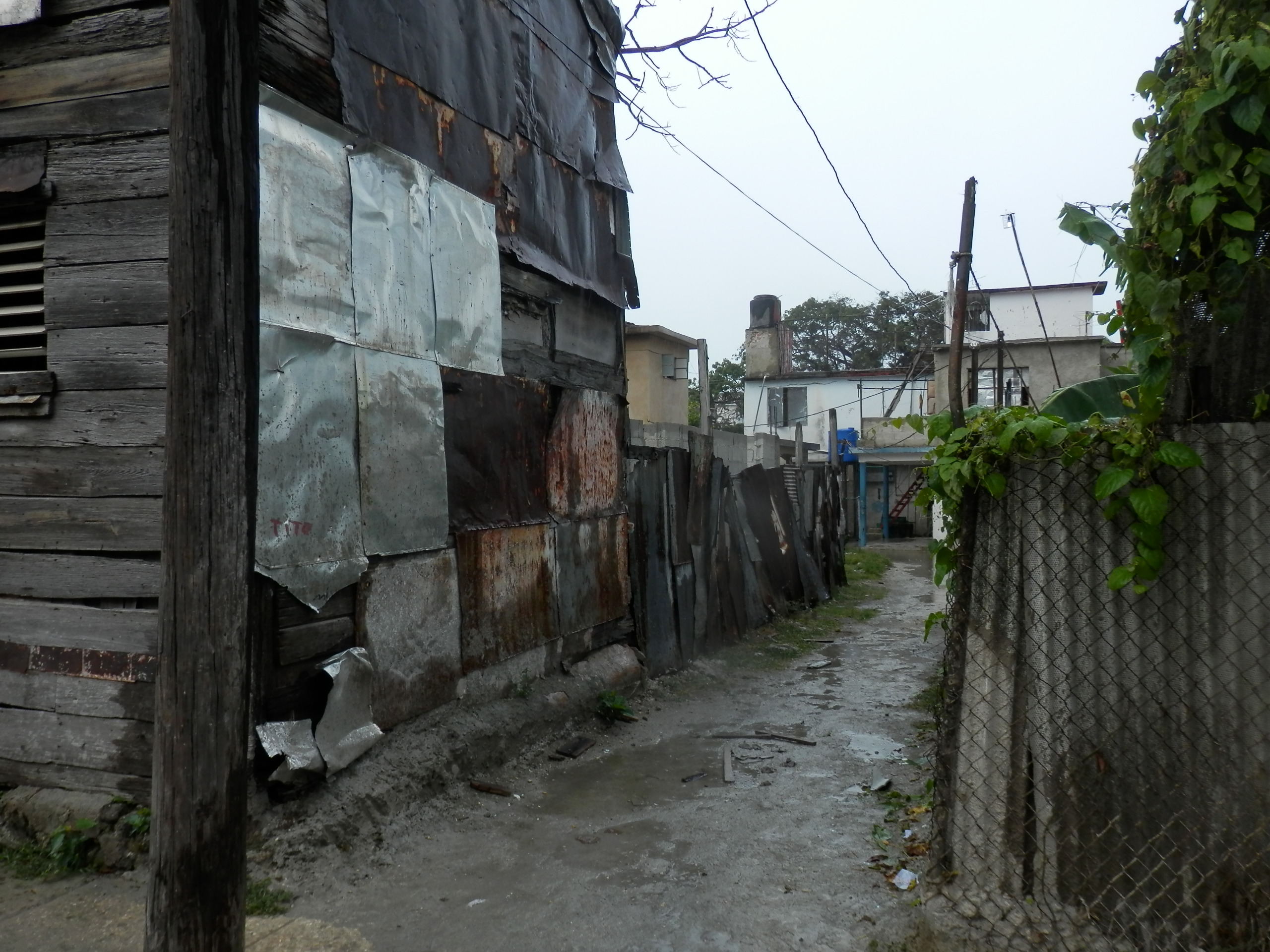
    So what is it like to live and work in these buildings? As one might expect, the outside decay permeates to the inside. The best access I got was through a 24-year-old working-class woman named Indira. I met Indira on my first night in Havana when stopping to ask directions, and after noticing that she spoke good English, took her to dinner. We became friends, and she invited me into her downtown apartment, where she lived with her mother and father-in-law. The apartment was roughly 150 square feet—far smaller than a typical New York City micro-unit. Because it had a high ceiling, the family had built a horizontal wooden floorboard halfway up the wall that served as the second floor, and built a makeshift staircase leading up. This upstairs “room” was for the mother and father-in-law, while Indira lived in the main room below, sleeping crammed against the kitchen.

    Even in such a small space, there were numerous malfunctions. There was no hot water, either for cooking or showering. In fact, the shower did not even work, meaning that the family instead took scrub baths. Because the toilet didn’t flush, they had to pour water into it each time after use to accelerate the draining. The built-in wooden floorboard was clearly sagging under the weight of the upstairs furniture, raising concerns that it would one day collapse. As for the actual roof—it had been crumbling for years, and was fixed recently by a neighborhood handyman. To pay for the work, the family had to spend over a year saving up $150.
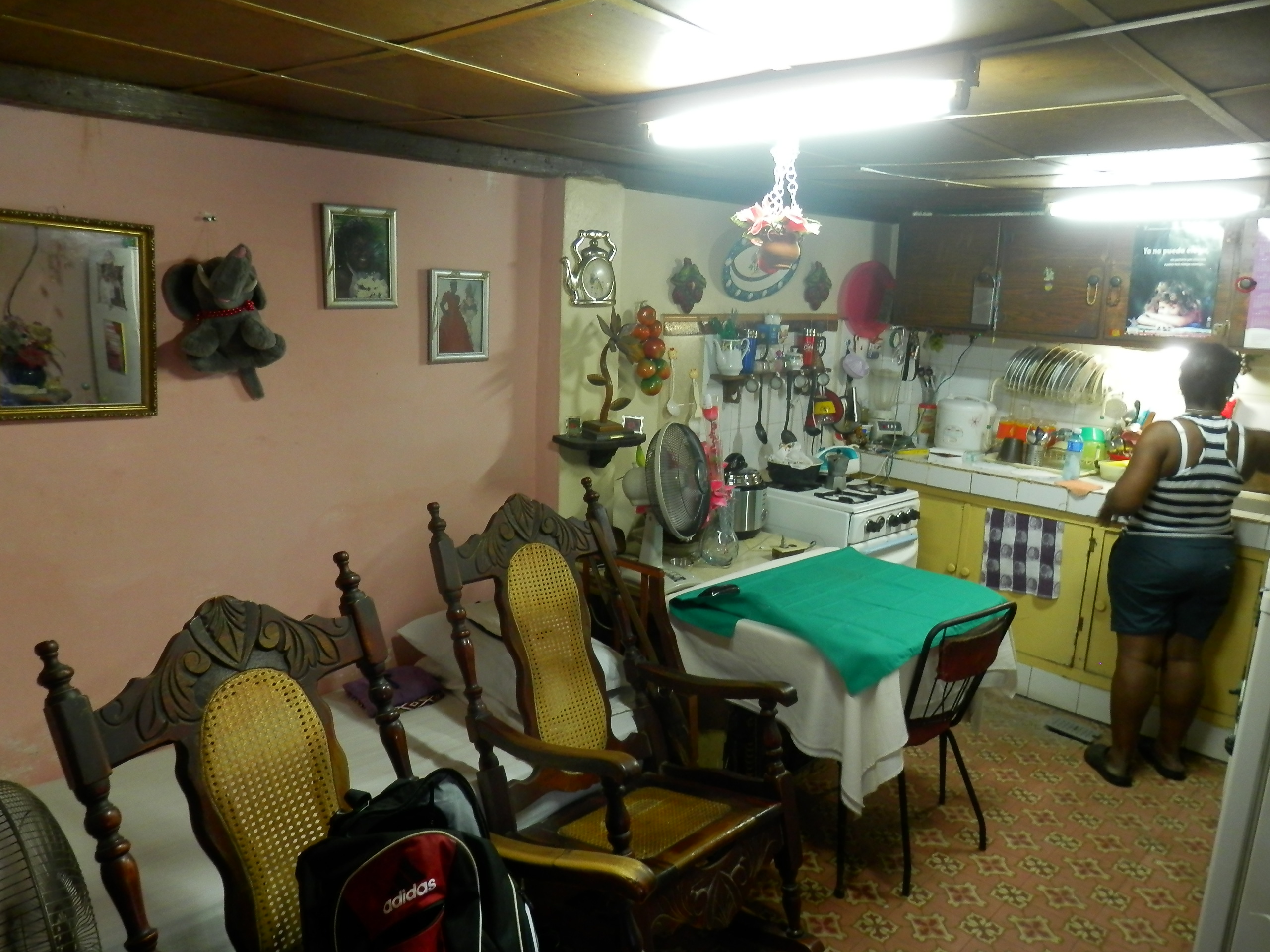
     

    The main story of Indira's apartment.

    The main story of Indira’s apartment.
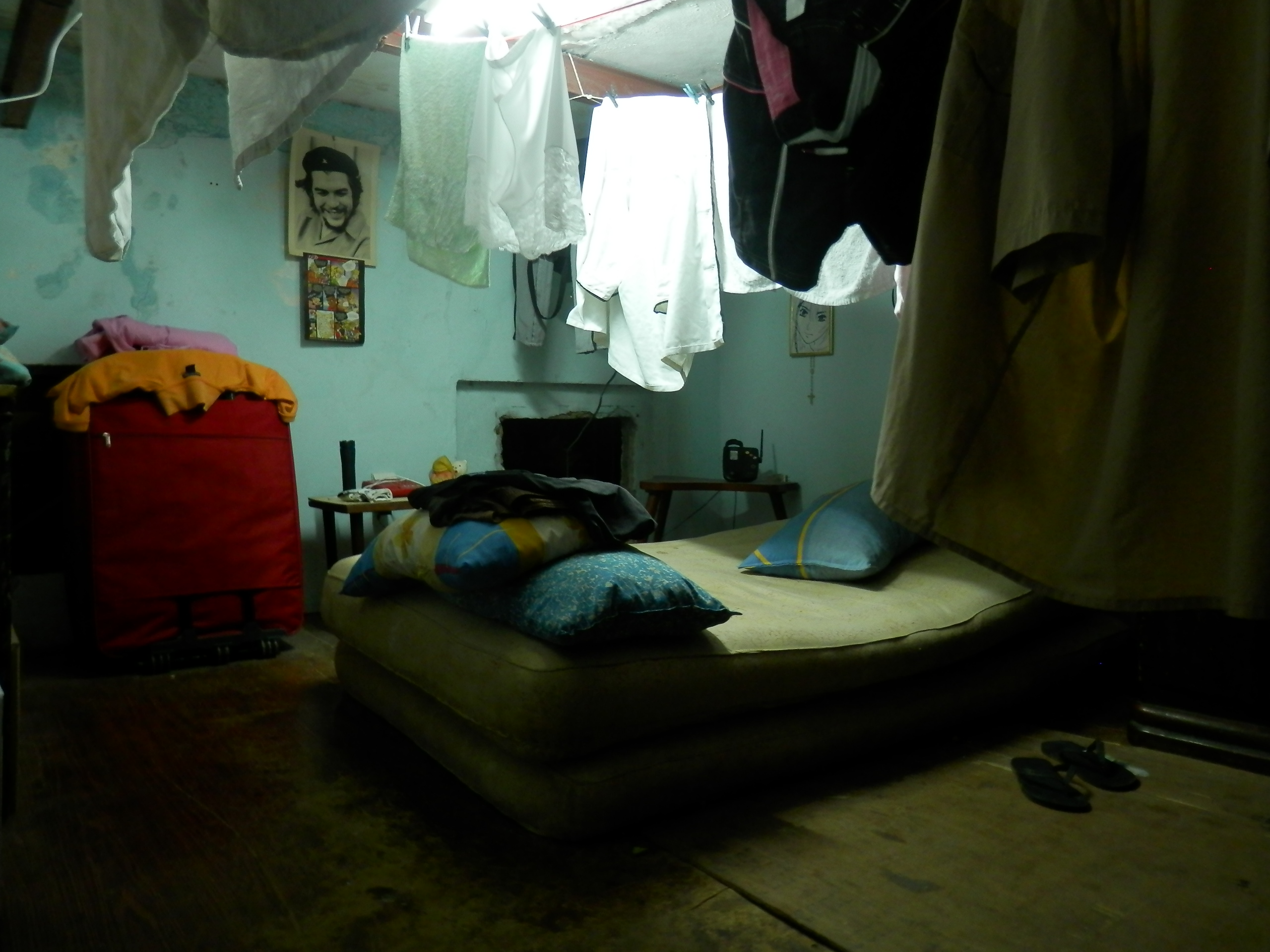
     

    The second story, upheld by a wood board

    The second story, upheld by a wooden board


    Public Infrastructure

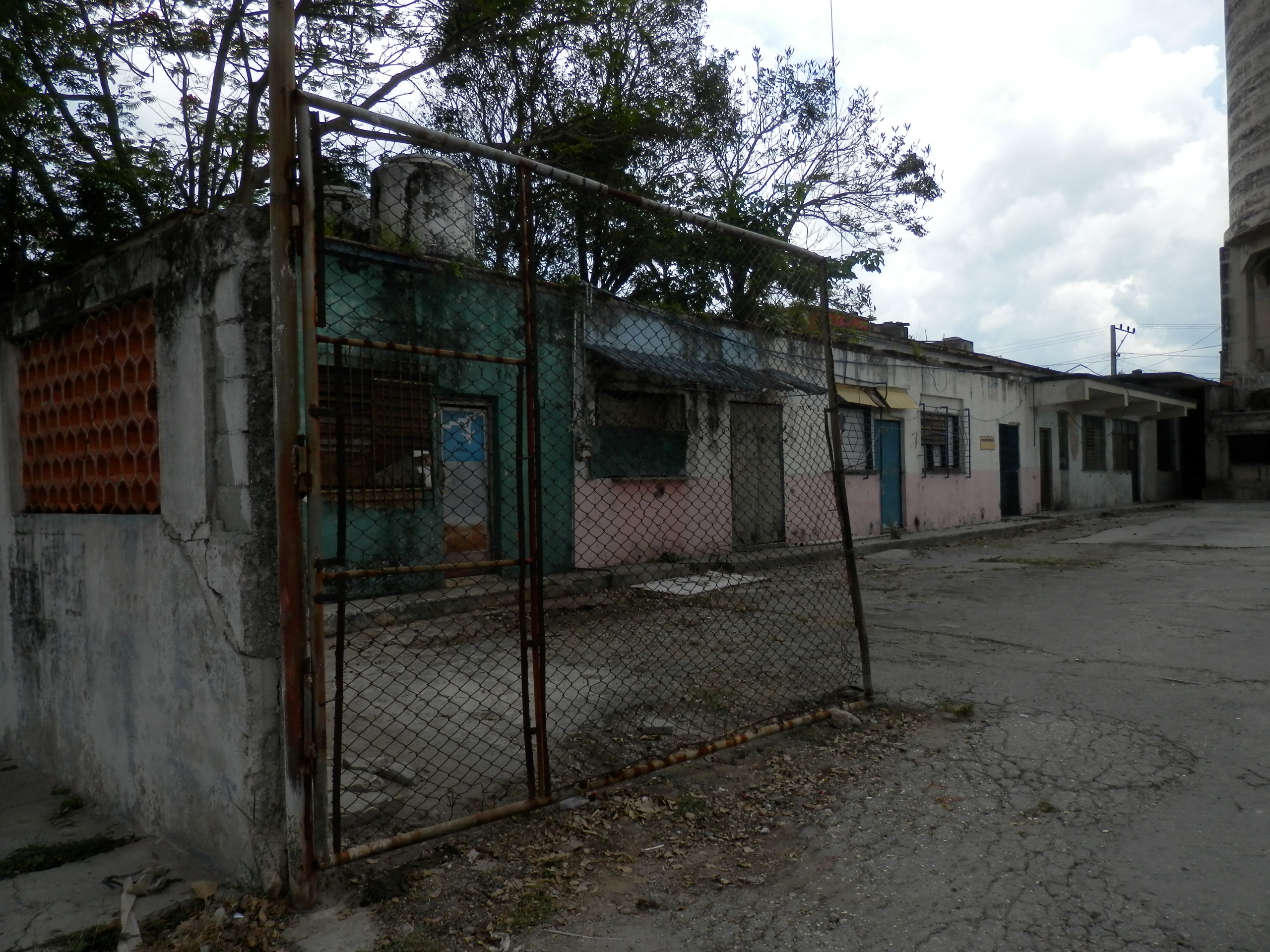
    Just as peoples’ private houses were crumbling, so too was the public infrastructure—again, much like Detroit. The public spaces, while well-used, were typically full of trash, overgrown weeds, and broken objects. Many parks, for example, were defined more by concrete than grassland. Streets, if they were even completely paved, were filled with potholes and had such poor drainage that, after it rained, they would gather huge puddles.
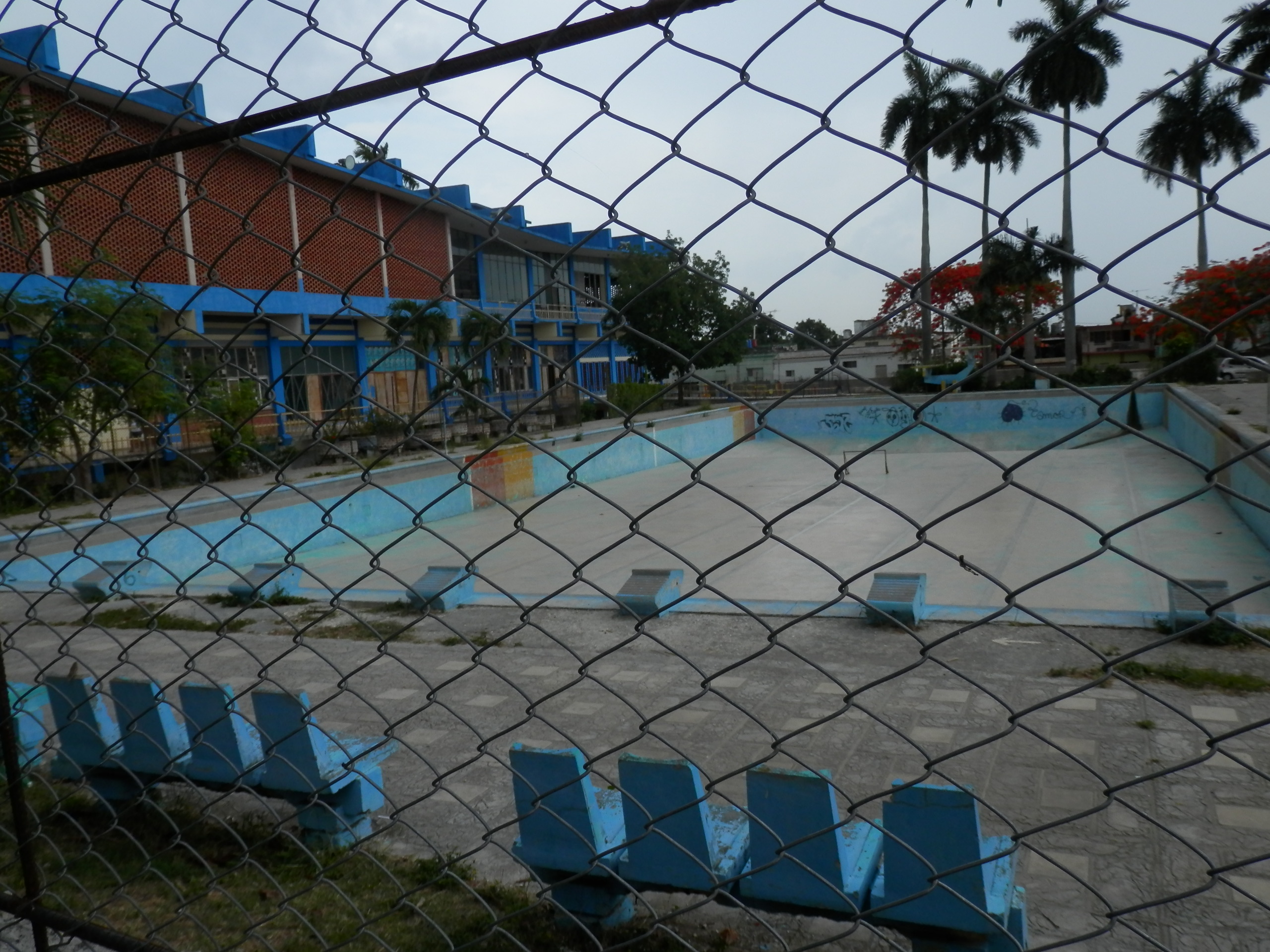
    A water-less pool

    A water-less pool

    I wasn’t able in my short time there to analyze the underground infrastructure. But if it is like everything else in Havana, I would assume that it, too, is crumbling. For example, contrary to what tourist brochures say, Havana’s tap water is considered undrinkable by locals, and I was routinely offered bottled water to avoid catching chlorida.

    Indeed, the substandard nature of Havana’s built entities were so common that after awhile I stopped noticing. For example, when I attended a rainy futbol match at a renowned Havana stadium, I sat underneath a roof that leaked constantly, getting soaked alongside other fans. Can anyone imagine this being tolerated at a U.S. arena? When I used bathrooms even in nice establishments, I would find that there often weren’t toilet seats, door locks, or (you guessed it) toilet paper. Schoolyards had swimming pools without water and basketball hoops without rims. And on it went.

    This is how life is in Havana. And I soon realized, given this, how buffoonish it would have been to go around looking for examples of “historic preservation.” Such preservation is an aesthetic notion from the First World, driven by those who are willing to pay more to retrofit attractive old housing. But in a city of extreme poverty, preservation is the pragmatic steps people take to prevent their roofs from caving in.
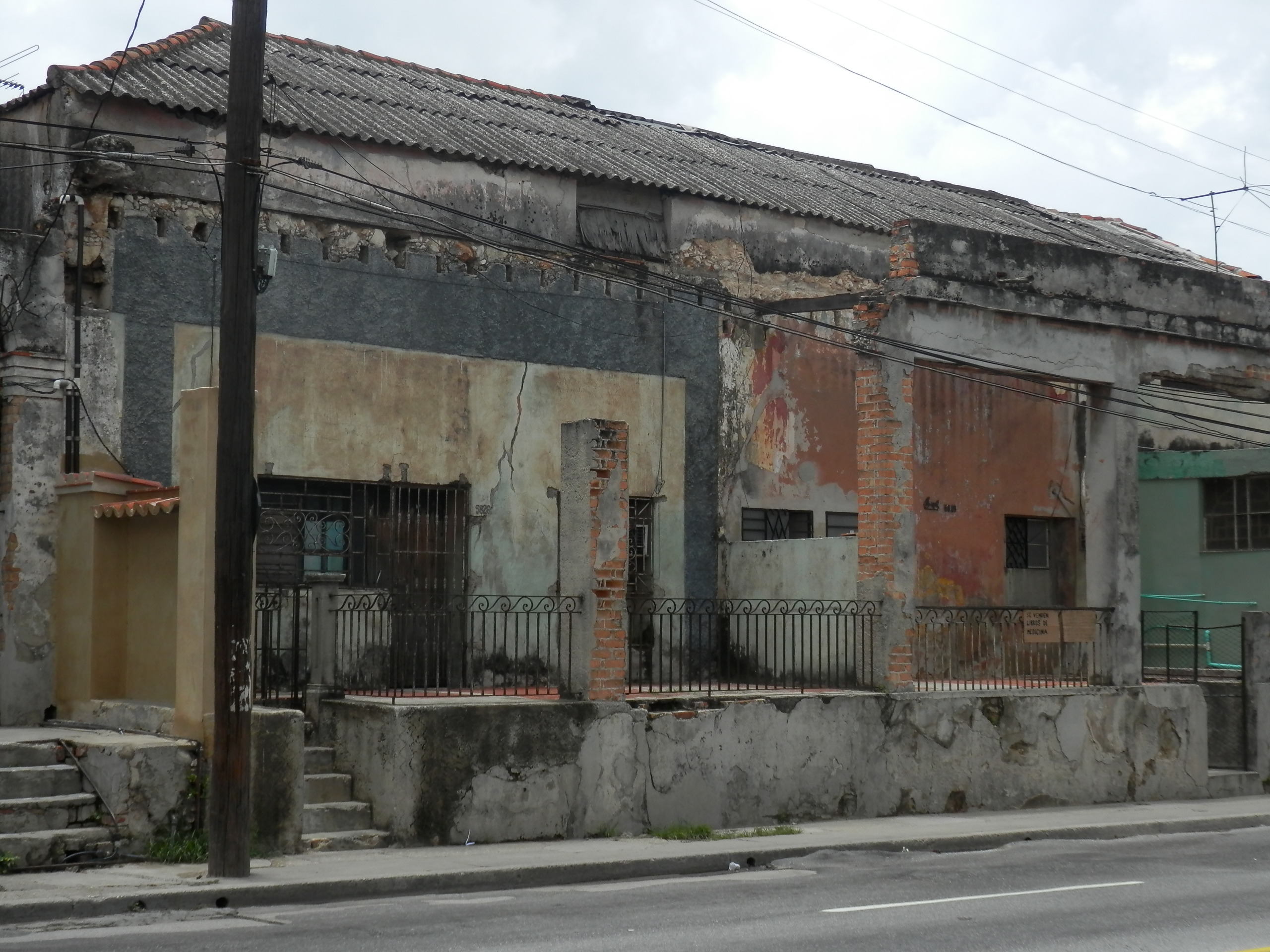
    a public park...

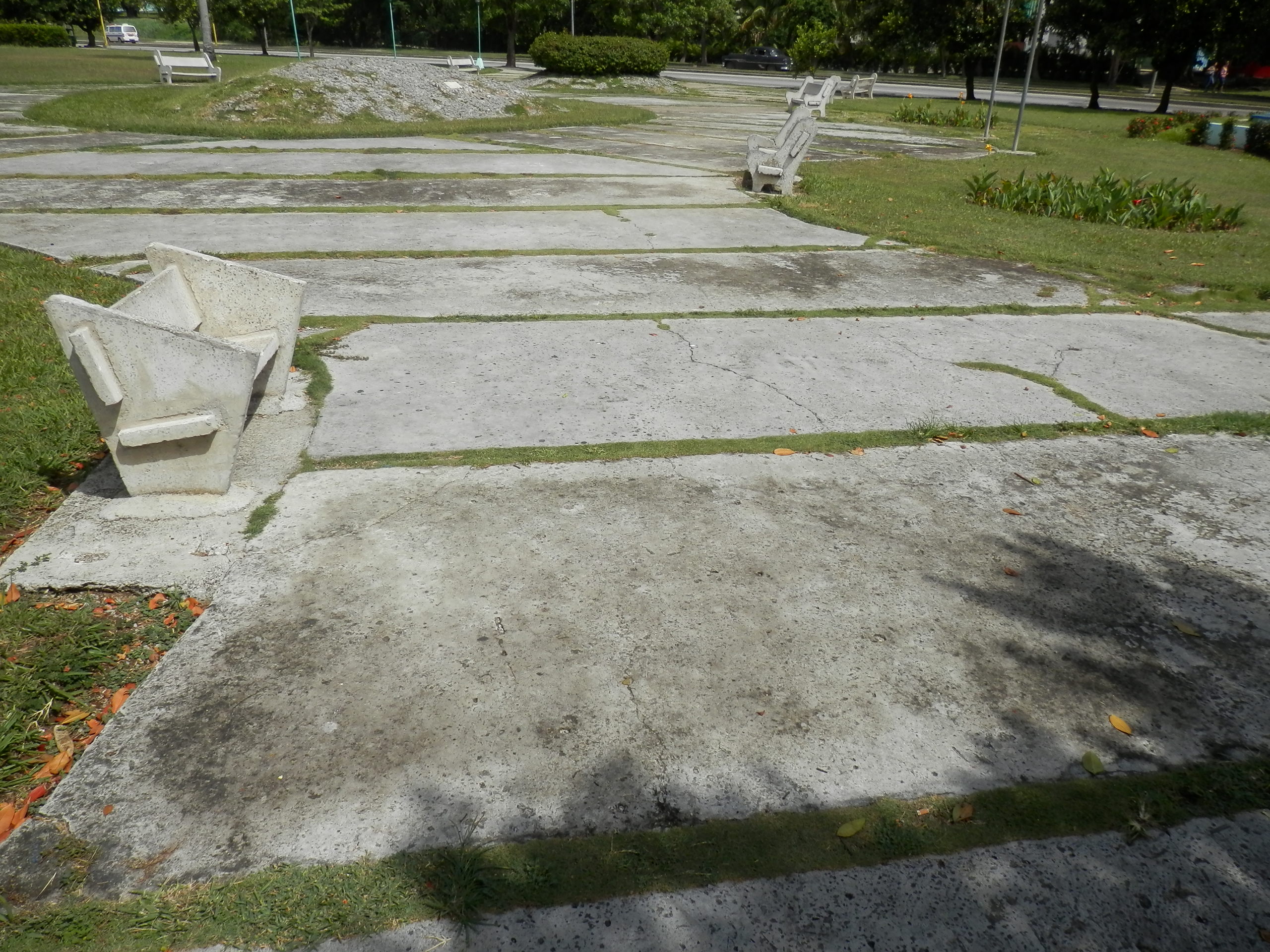
    and a public waterfront

    So How Does Havana Compare To…San Francisco?

    Have you ever read an article that was so hilariously wrong that you wanted to pick your laptop up and chuck it across the room? This was my reaction to one article I read several days after returning from Havana, with the city’s horrific conditions still on my mind. On June 8, MarketWatch.com published an article by columnist Therese Poletti called “New Tech Money Is Destroying The Streets Of San Francisco.” Poletti explained that a flood of wealthy executives were moving into San Francisco, buying old homes, and altering the interiors.

    It is now hard to find a Victorian home for sale that has not been gutted, its architectural details stripped and tossed. And owners or developers — looking to sell at a premium in the frenzied real estate market to “techies with cash” — hope to appeal to the tastes (or lack thereof) of current buyers, by turning once-charming homes with detailed woodwork, built-ins and art glass, into clones of Apple’s minimalist retail stores.

    This trend has been developing for several years, but it seems far more prevalent today, with construction sites sprouting across the Bay Area and especially in San Francisco. And in addition to the remodeling frenzy, older buildings appear to be disappearing at a scary pace.

    Before even addressing Poletti’s point, let me just set the record straight: San Francisco is not being “destroyed.” I can testify from having lived there in 2012, and visiting several times more, that the city is an architectural gem that has largely stayed in character since being rebuilt after the 1906 earthquake. Much of the city—including almost the entire northeast portion—is an oasis of historic Italianate, Queen Anne, Craftsman, and Art Deco construction. These buildings roll along the hills flanked by clean, well-paved streets, and small, impeccably-landscaped yards. From a purely aesthetic standpoint, San Francisco surpasses any other major U.S. city, and perhaps any European one.

    The reason for this is two-fold. San Francisco has expansive historic preservation laws that make it difficult or illegal to alter thousands of structures. Compelling arguments have been made that the city takes this preservationist impulse too far, to the detriment of adding new housing supply–although such laws help maintain its unique character. But the other factor—to which Poletti seems oblivious—is that the city has a large professional class with the financial wherewithal to maintain these homes.

    I would argue that this second factor, more than the first, has preserved San Francisco. You could put a historic overlay designation across Detroit, and it wouldn’t change much. The Motor City suffers from decay because it has undergone six decades of depopulation, and this has left no one around to preserve its own large historic stock. But the Bay Area has been flooded with capital during this period, and this has strengthened its culture of preservation. Maintaining a historic home, after all, can be an expensive endeavor that requires ripping out floorboards, replacing pipes, and other structural changes. It is usually done by educated, well-off households who have either the money to fund repairs, or the time to dedicate sweat equity. Perhaps not every family preserves their homes precisely to Poletti’s specifications, and I don’t blame them, since it is difficult to live in a floor plan that was laid out a century ago. But she should not miss the broader point, which is that San Francisco has remained as it is because of the demographics it attracts.

    Instead, she claims that these groups are “destroying” the city. She is thus spouting the same myth that is advanced about historic preservation by urban progressives, who seem to think that wealth and gentrification works against preservation. But a fair-minded look at U.S. cities demonstrates the opposite. If one looks at America’s most notable historic neighborhoods–the Back Bay in Boston; Capitol Hill in DC; the French Quarter in New Orleans; much of northern San Francisco; much of Manhattan and northern Brooklyn; downtown Savannah; and downtown Charleston–a unifying feature is that they have great residential wealth. Meanwhile, there are numerous cities—Baltimore, Philadelphia, Detroit, St. Louis, Cleveland—that have a similar number of historic structures. But many of them sit hollowed-out because of decline.

    The same could be said when comparing Havana with Poletti’s San Francisco. Both cities have similar architecture and planning, but their differing economic histories have led to opposite preservationist destinies. Wealthy and growing San Francisco is a city where thousands of structures remain in superb shape, and where people grieve over minor alterations. Havana’s system has produced a crumbling city where the desire for preservation gets lost in a sea of basic needs. If Poletti really wants to see a “destroyed” city, she should visit the latter.
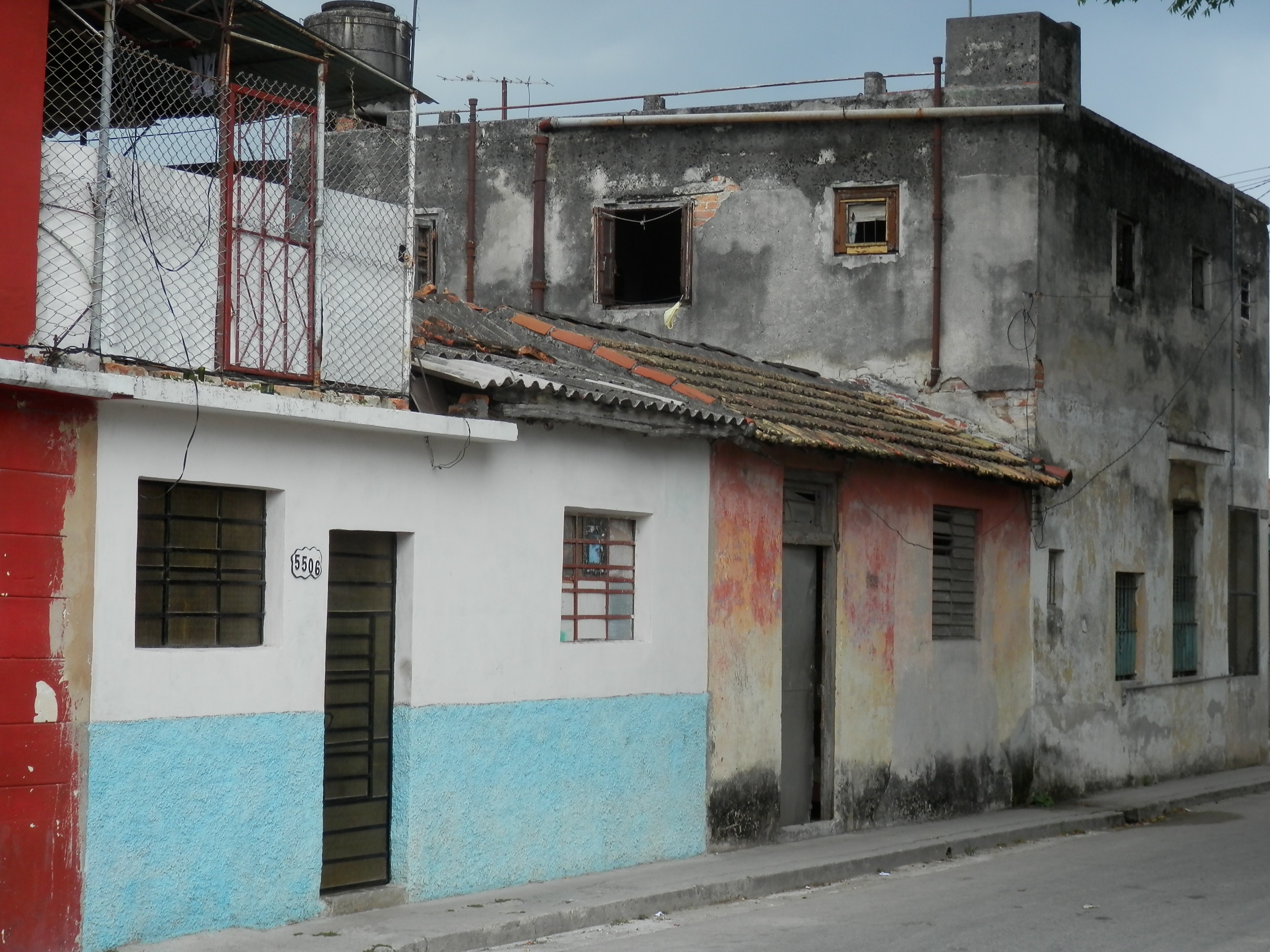
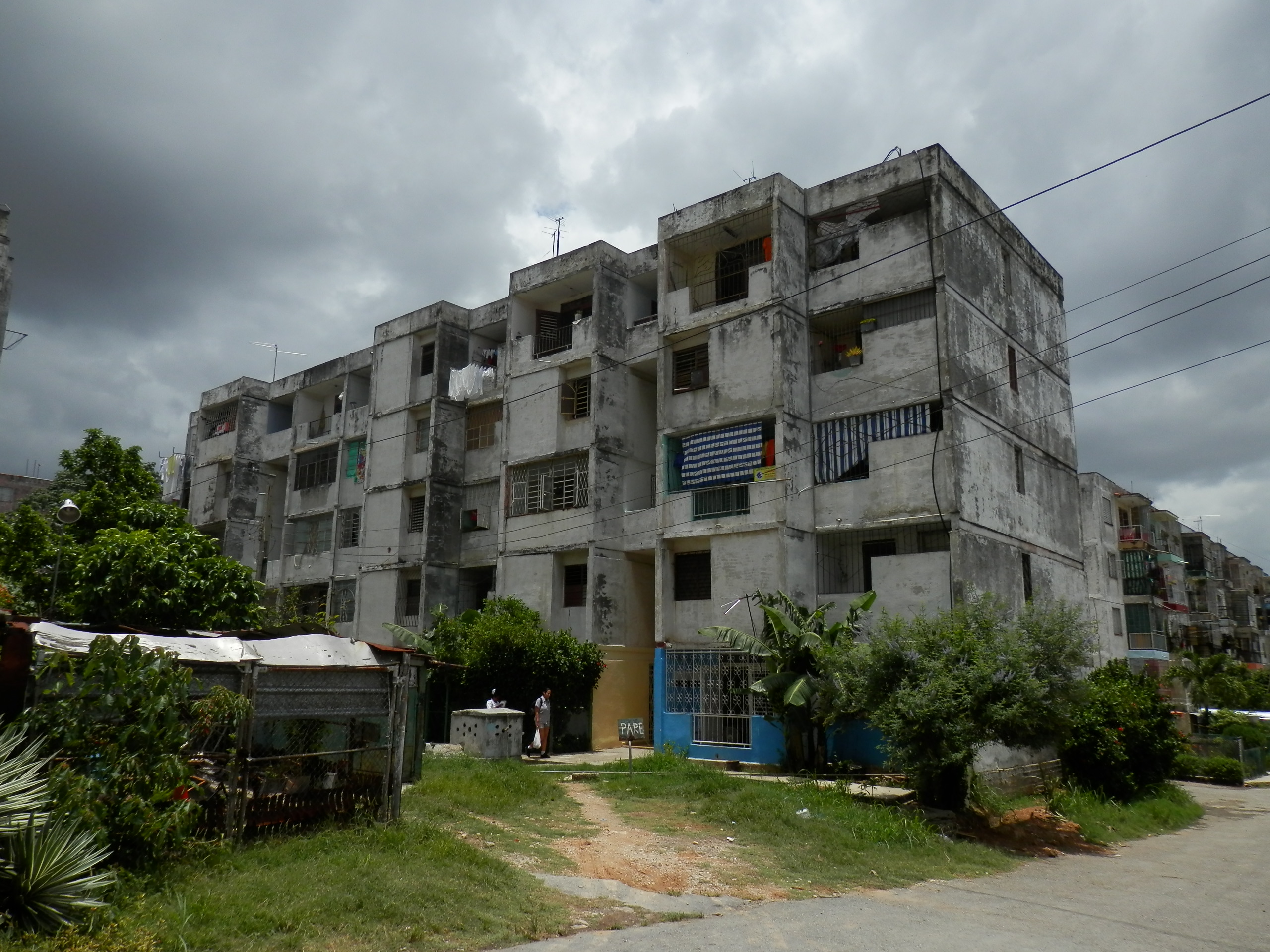
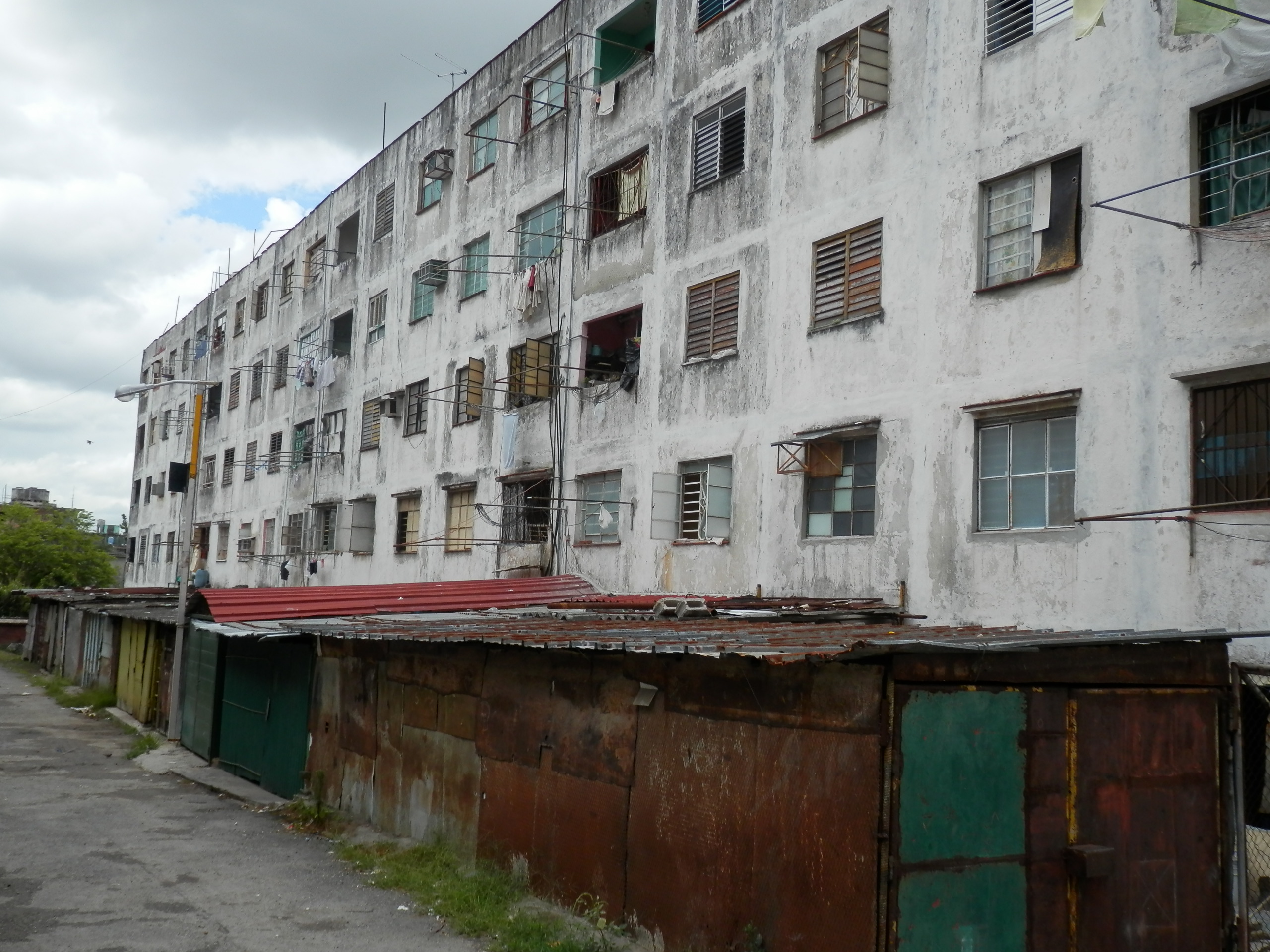
    a public housing complex from the outside...

    a public housing complex from the outside…
     

    and from the inside.
    and from the inside.


    OLYMPUS DIGITAL CAMERA

    OLYMPUS DIGITAL CAMERA

    OLYMPUS DIGITAL CAMERA

    OLYMPUS DIGITAL CAMERA

    This piece originially appeared at Market Urbanism.

    Scott Beyer is traveling the nation to write a book about revitalizing U.S. cities. His blog, Big City Sparkplug, features the latest in urban news. Originally from Charlottesville, VA, he is now living in different cities month-to-month to write new chapters.

  • Havana, Cuba–The City Of Scarcity

    1. I’m now a week removed from my Cuba trip, where I spent 4 days in Havana biking through the city’s near-hourly mix of high heat and torrential rainfall, returning to my bed & breakfast each night covered in soot. My first few days back in Miami I spent sick and exhausted in a hotel, but managed in the latter half to pump out a Forbes article on Miami’s inequality. The piece was slammed the next morning by the Miami New Times–a local alternative rag–for making arguments that staff writer Kyle Munzenrieder found “structurally racist.” I sent an email asking him to elaborate on the racism charge (since he didn’t in the article), but haven’t heard back.

    2. That said, my mind mostly remained in Cuba. It would be hard to summarize on this page everything that I learned there, since the nation has a complex history, and enforces a dizzying array of Communist-inspired regulations that would mystify Americans, and that has impoverished average Cubans. In coming weeks, I’ll explore these economic policies–and the effects of the U.S. embargo–in depth for other publications. But I’ll say a quick word here about Havana’s living conditions, peppered with a few of the more than 300 photographs I took.

    While exploring Havana’s neighborhoods, the thing that jumped out was not the city’s poverty (although there was plenty of that), but its scarcity. Because Cuba’s government does not value or comprehend mass production–namely not for agriculture–there are shortages of everything. In America, we take for granted that any basic convenience is but a short drive away. But in Havana, running errands isn’t that simple. City residents have limited mobility: the bus system is cheap but unreliable, the newly-private taxi system is efficient but costly, and for most Cubans, owning a bicycle–much less an automobile–requires years of savings. So they must stick to neighborhood stores with minimal inventory, and even if they did all have cars, there would still be few outside options.

    To understand why, just imagine a city where every store is literally 1% of what it would be in America.

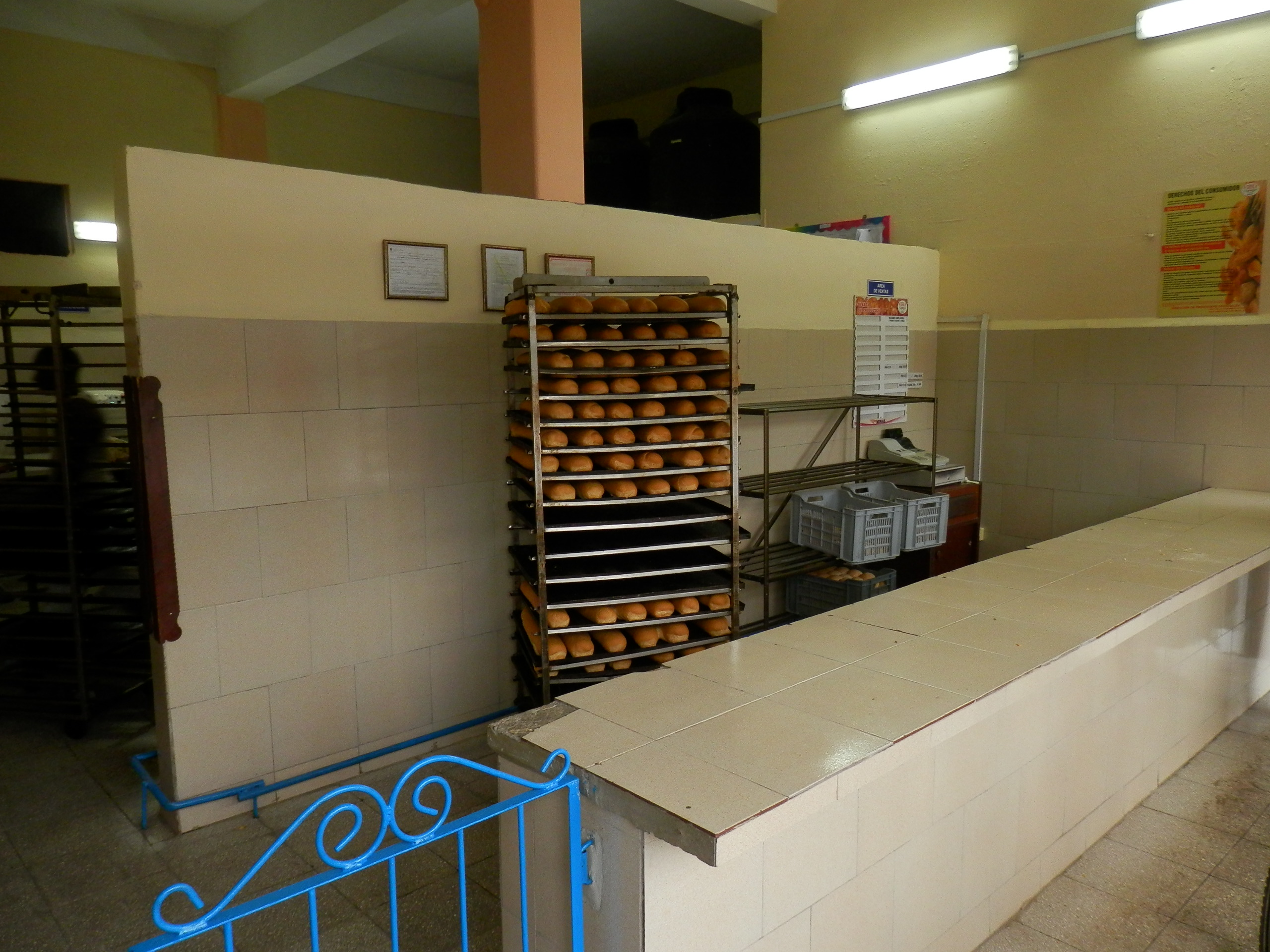
    A typical bakery in Havana.

    A typical bakery in Havana.


    While a U.S. pharmacy like Walgreens or CVS sells not only drugs, but numerous foods, beverages, household goods, etc., the average Havana farmacia has a few shelves with maybe 100 drugs–and that’s it. Modern U.S. grocery stores often exceed 50,000 square feet, and sell thousands of products. In Havana, different food types are sold separately in small, rickety stores that often contain one or two items. Mercados sell fruit and veggies; carnicerias sell meat; and many panaderias (pictured above) sell a low-nutrition roll that would be served as a side at a crappy American road diner. The typical gas station had not even one-tenth of what you would find in a 7-Eleven.

    A mercado that sold only mangos and potatoes.

    A mercado that sold only mangoes, plantains and potatoes.


    Half of the available meat supply at a downtown carniceria

    Half of the available meat supply at a downtown carniceria


    This isn’t surprising, since most Cubans earn about $20/month, and thus have minimal spending power. But the scarcity effects all income groups. For example, as an American tourist, I was considered massively wealthy by Cuban standards. That said, my expenditures were mostly limited to my B&B, my bike rental, bottled water, cheap cafes, and cab fares. My one splurge was taking a local couple who I had befriended out to a restaurant that, by Cuban standards, was exquisite, but that didn’t exceed the quality or cost of an Applebee’s. Over 4 days, all this cost $360. Compared to the few other U.S. tourists I met, this was an extremely economical budget–but was still more than what many Cubans spend annually.

    Yet despite this, I found myself unable to buy basic things. For example, during my first night in Havana, I didn’t realize–until it was too late–that the B&B landlord had not provided toilet paper. In America, this would be a glaring oversight, but in Havana, I would discover, is normal. This forced me to navigate my neighborhood at 3am, offering pesos to the many teenage boys still standing outside, to bring out “papel higienico” from their houses. Every time I tried this, they would each explain, in rather comical fashion, that none was available. Finally I found a teenager who spoke passable English, and asked him how this could be. After sending his little brother in to find something, he explained that “in Havana, toilet paper is a delicacy–like chocolate,” and that most residents don’t just have any sitting around. So how did people cope?

    “Here in Havana, we have a saying,” he quipped. “We say, ‘Cubans have a good ass. Our asses work for all kinds of paper. Toilet paper, newspaper, book paper–any kind of paper’.”

    When his younger brother reemerged from the house, he was holding for me a single sheet torn from his school journal. I would later learn while interviewing impoverished Cubans that other “delicacies” included soap, meat, milk, cheese, and ice cream, not to mention the hundreds of gadgets and appliances found in a typical American home.

    3. One thing I mentioned before leaving for Havana was that I wanted to see how urban street life functioned in a city suffering from 50 years of stagnation. I found much that was good and bad, but for the sake of brevity, will describe this week what was good.

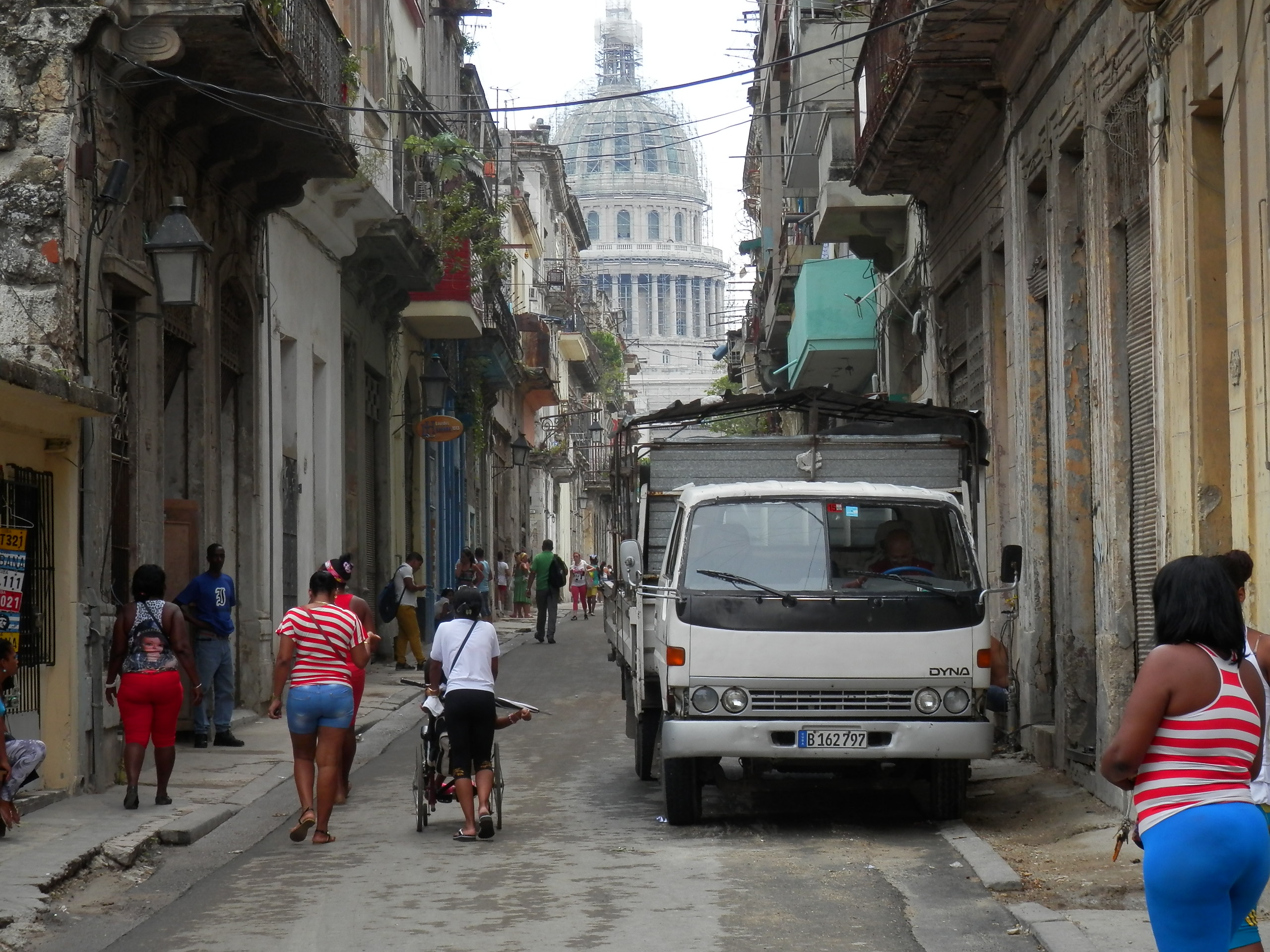
    Havana, both in downtown and the neighborhoods, offers a scintillating street culture dominated by people, music, and commerce (spartan as it may be). In many ways, it is an urban flaneur’s dream, as one can spend hours weaving through crowded streets full of friendly people who will spill their life details to a stranger. There are, in fact, few places one can go without finding numerous people on each block, and rather than ignoring one another, many are in perpetual communication, often yelling to each other from adjacent buildings.

    Just blocks from the Capitol building.


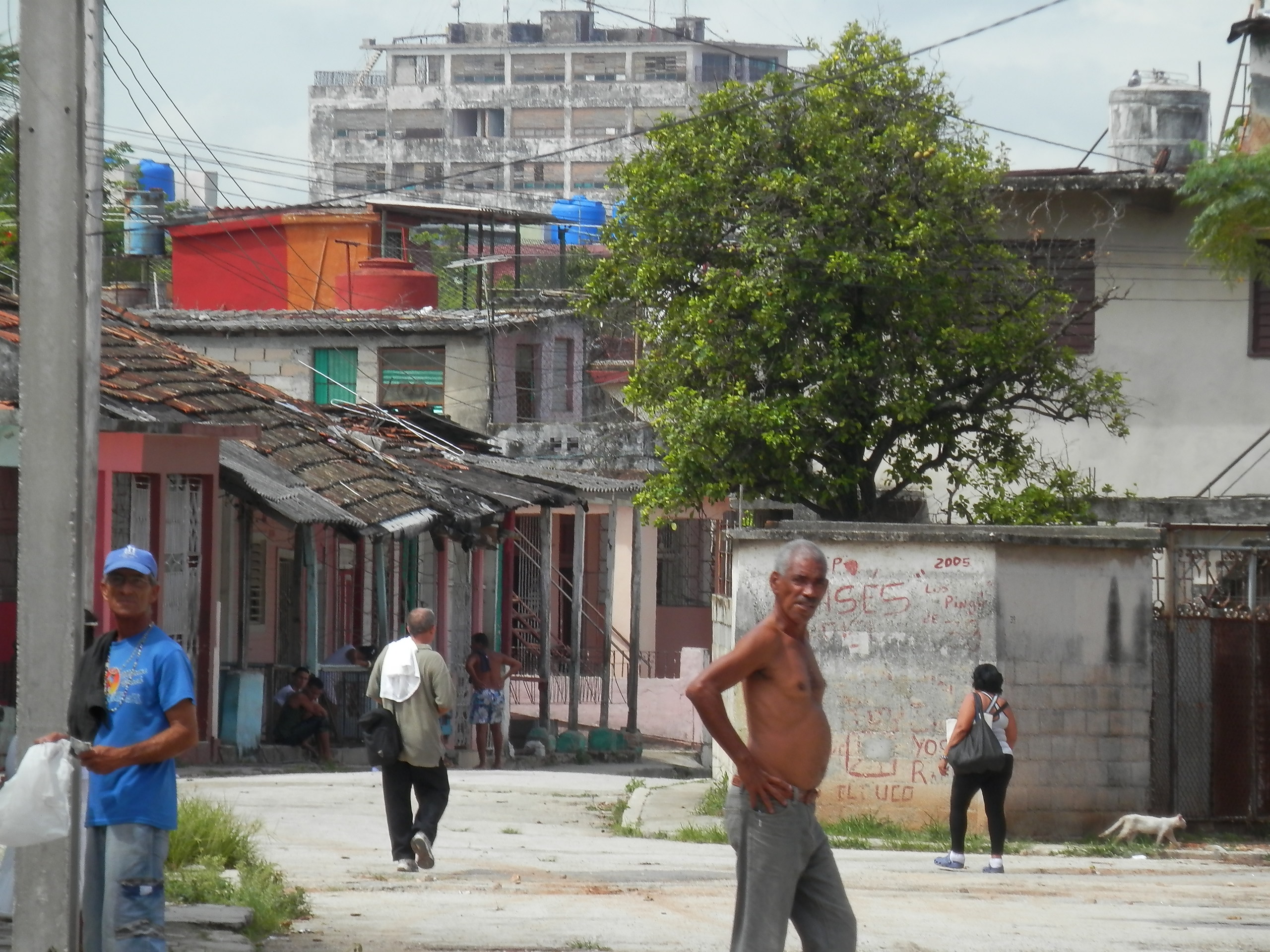
    A busy street in the southwestern Havana slum where I stayed.

    A busy street in the southwestern slum where I stayed.


    This atmosphere continues well into the early morning, as mostly teenagers stand on corners to laugh, drink and sing. For them, a rich gringo passerby is not a target, but a source for amusing dialogue, especially since they will bend over backwards to try overcoming the language barrier.

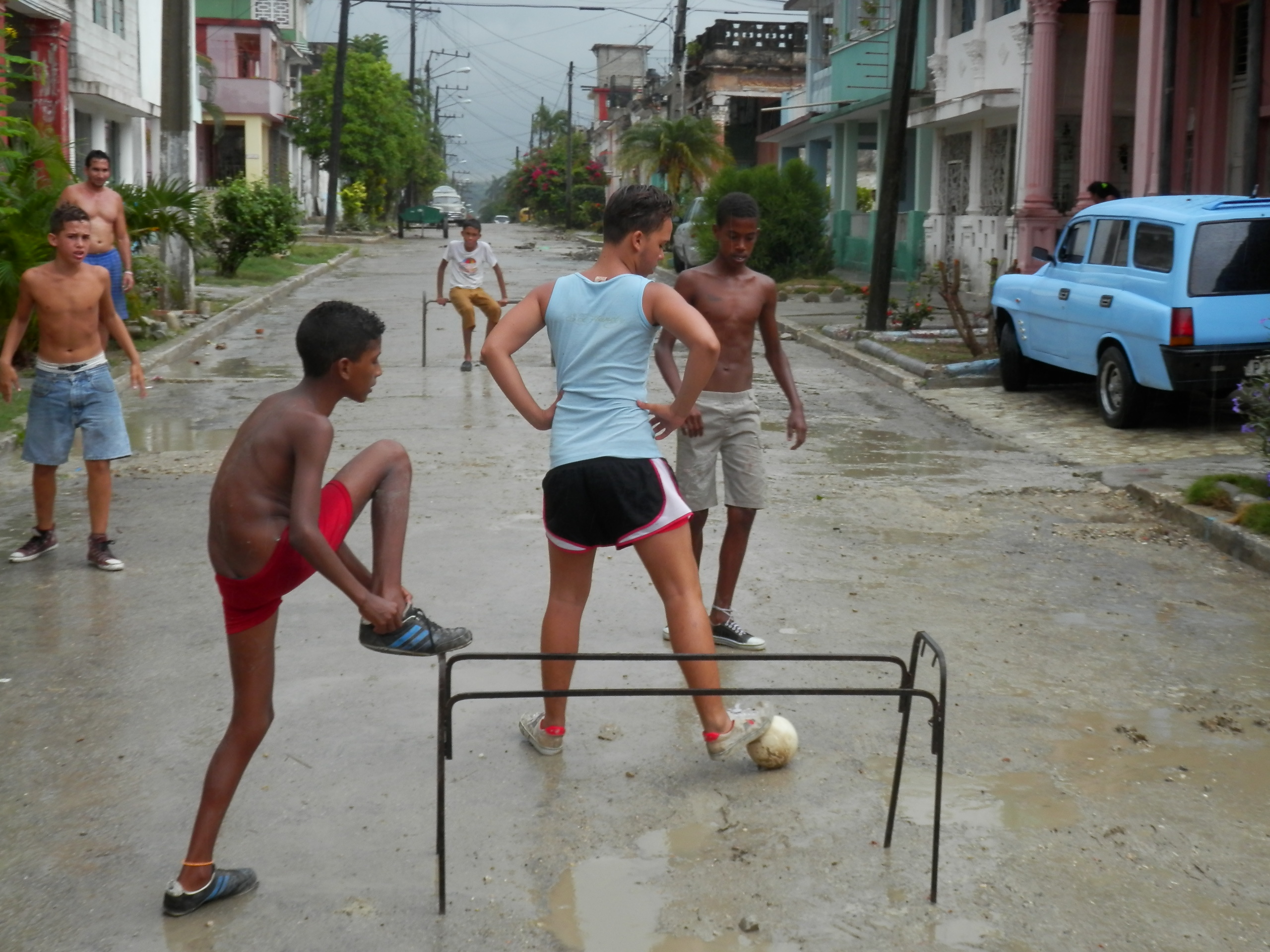
    But this street life seems less rosy when you consider that it is rooted in hardship. Many Cubans are forced by poverty to live cramped together–sometimes 10 to a house, according to one person I spoke with–so naturally they would escape to the street. Because some cannot afford front doors and windows, much less advanced security, there is little privacy, and people treat sidewalks like their extended living rooms. Because so few people own cars–and because those cars run slower than in America–traffic is less menacing, allowing pedestrians to linger in roadways. Because parks are in such disrepair, sporting children instead compete in the streets. And the built fabric itself is so narrow because modern buildings are seldom constructed.

    An equally fascinating aspect of Havana’s street culture, to be covered next week, was the physical decline. It was not difficult to tell that Havana was once a very advanced society indeed, defined by a merchant and governing class who had sophisticated urbanist sensibilities. At times while biking through Havana’s mild hills, I would get these weird flashbacks of San Francisco, when observing large, elaborate Spanish architecture that interspersed gracefully alongside pocket parks, public stairways and boulevards. But imagine if San Francisco had undergone 50 years of Detroit-style decline and neglect, and you’ll get an idea of the blight that pervades Havana. Many of the photos I provide next week will alarm you.

    4. I could go on and on about other aspects of Havana’s street life, but here are a few tidbits that readers will find interesting.

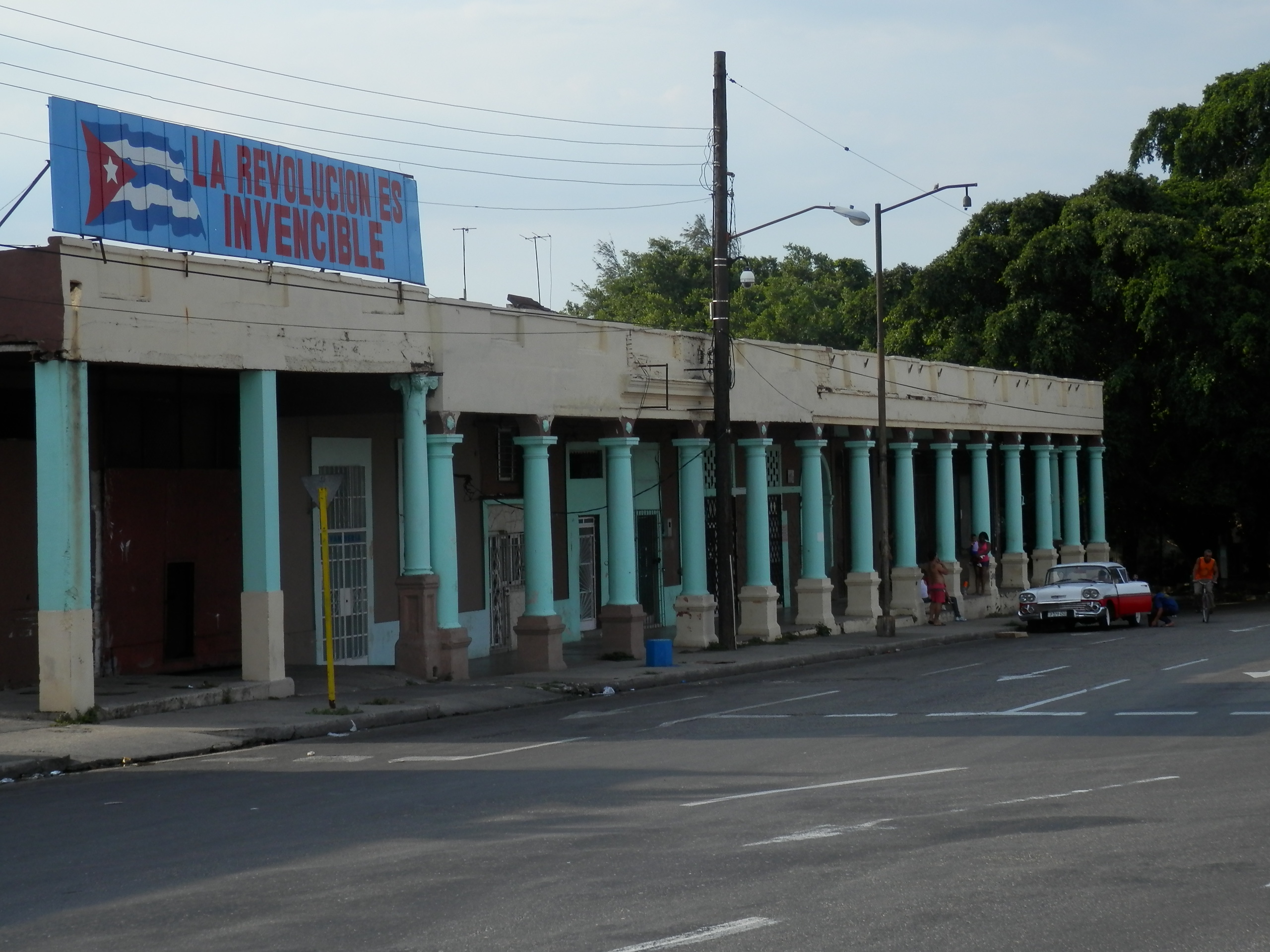
    – As might be expected from a Communist dictatorship, there were few religious symbols, but numerous political insignia celebrating the Revolution’s enduring strength. Ironically, many of these signs were in disrepair.

    OLYMPUS DIGITAL CAMERA

    Translation: 'study, work, rifle.'

    Translation: “study, work, rifle.”


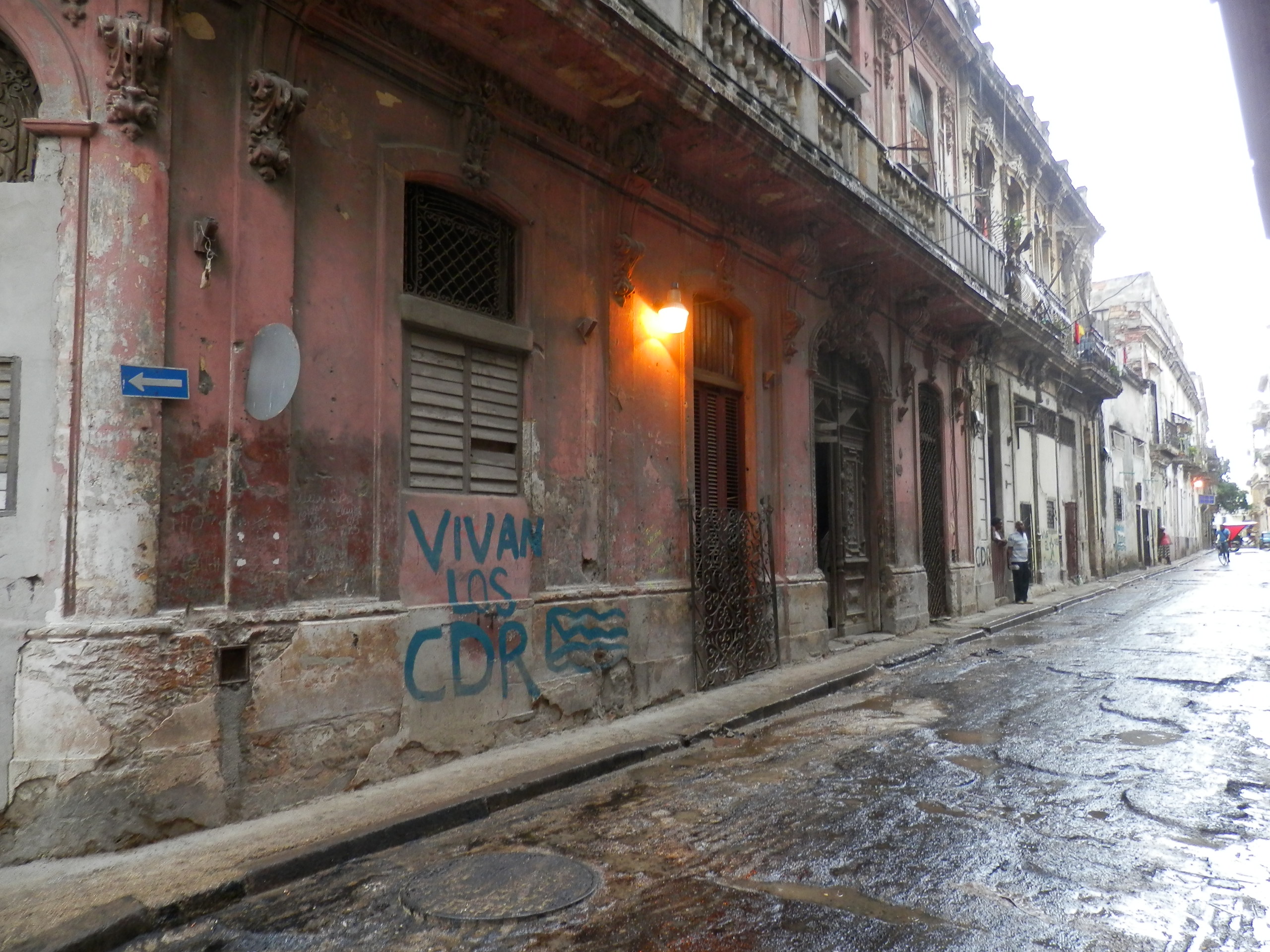
    A celebration of CDRs, the network of neighborhood watchdogs tasked with upholding the Communist order

    A celebration of CDR, the network of neighborhood watchdogs tasked with upholding the Communist order


    – Cuba’s many old automobiles might be charming, but are terrible for the environment. Old age and poor maintenance mean that many spew out toxic exhaust that blows into pedestrians’ faces. In the central parts of Havana, where streets were narrow and buildings taller, the stench lingers, making life unbreathable.

    They also frequently break down; it’s hard to bike 10 blocks without finding some car on the side of the road, hood popped.

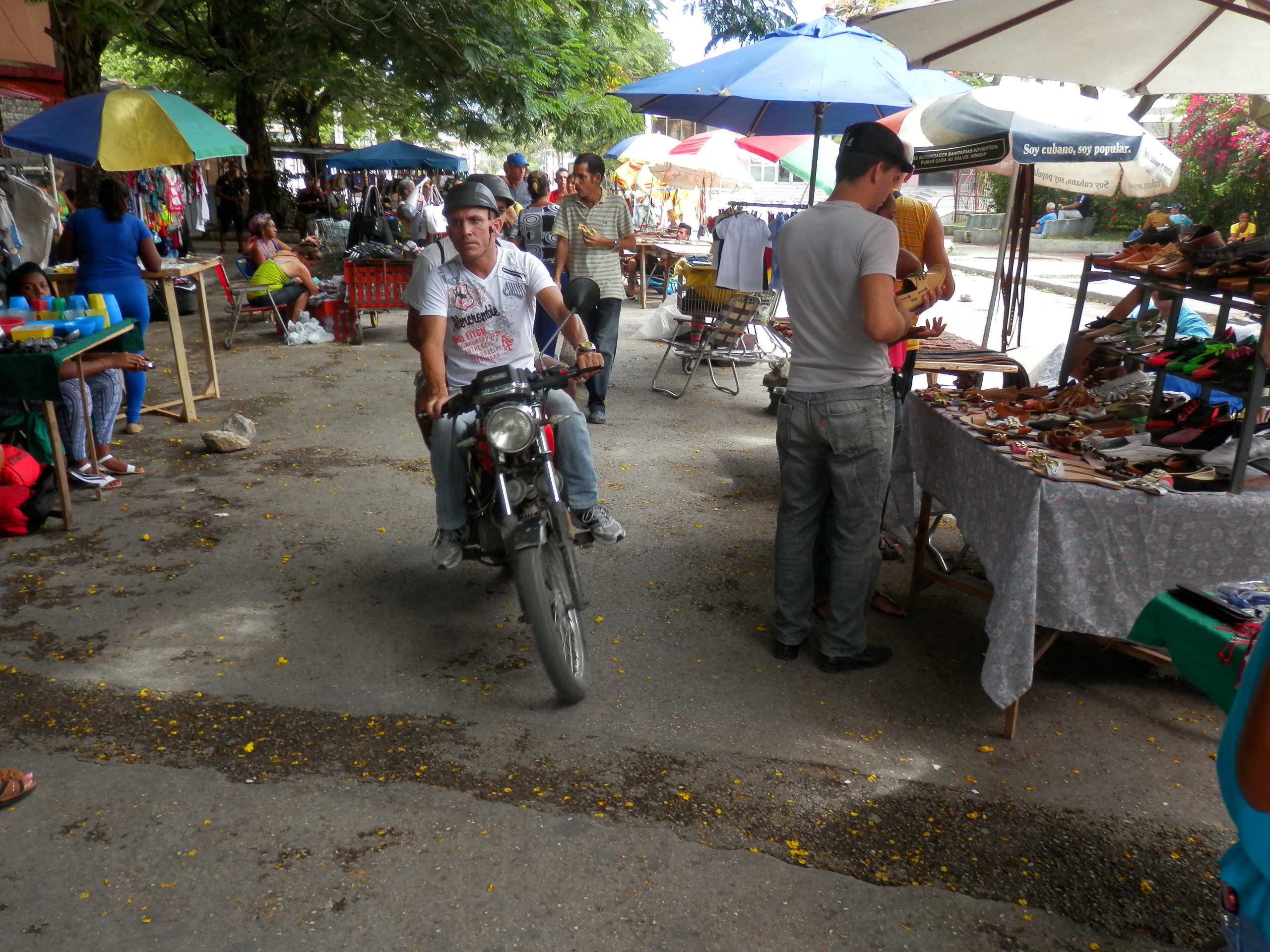
    – In America, farmer’s markets have become boutique destinations that sell products of greater quality and expense than what is found in a supermarket. Tables are often run by “gentlemen farmers” who view their activity as a hobby. In Havana, by contrast, such markets expose the desperation of the Cuban people, as many tables offer screws, dishes, spare auto parts, and whatever else a family may have scavenged.

    – Street drainage is terrible after it rains.

    – And more:

    OLYMPUS DIGITAL CAMERAOLYMPUS DIGITAL CAMERAOLYMPUS DIGITAL CAMERAOLYMPUS DIGITAL CAMERA

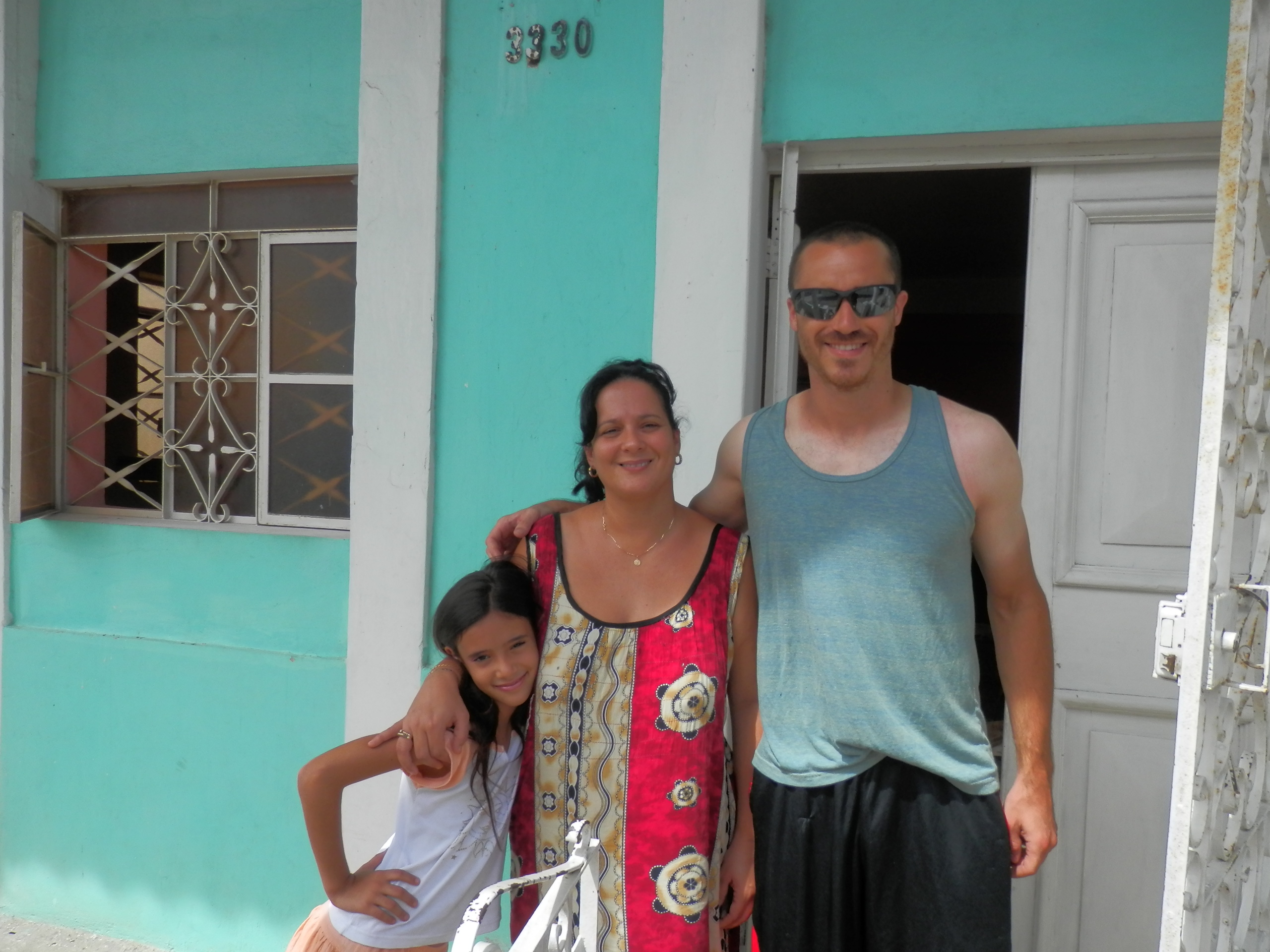
    Here I am with my host family

    Here I am with my host family

    This piece originially appeared at Market Urbanism.

    Scott Beyer is traveling the nation to write a book about revitalizing U.S. cities. His blog, Big City Sparkplug, features the latest in urban news. Originally from Charlottesville, VA, he is now living in different cities month-to-month to write new chapters.

  • Commuting in New York

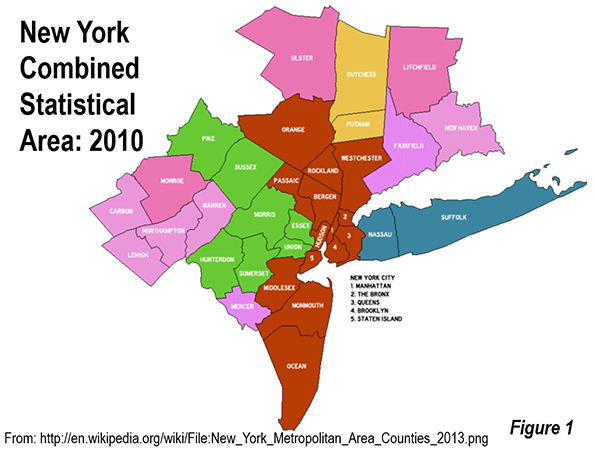
    The New York commuter shed (combined statistical area) is the largest in the United States, with 23.6 million residents spread across 13,900 square miles in New York, New Jersey, Connecticut and Pennsylvania. It includes 35 counties, in eight metropolitan areas, including New York (NY-NJ-PA), Allentown-Bethlehem (PA-NJ), Bridgeport-Stamford (CT), East Stroudsburg (PA), Kingston (NY), New Haven (CT), Torrington (CT) and Trenton (NJ). The criteria for designation of combined statistical areas is here and Figure 1 is a map of the New York CSA.

    This article examines employment and commuting in the New York area by broad geographic sector. The core sector, of course, is Manhattan (New York County). The second sector is the balance of the city of New York, the outer boroughs of the Bronx, Brooklyn, Queens and Staten Island. The inner counties are Westchester and Nassau in New York as well as Bergen, Essex, Hudson, Middlesex, Passaic and Union in New Jersey. The balance of the CSA is in the outer counties.

    Distribution of Employment

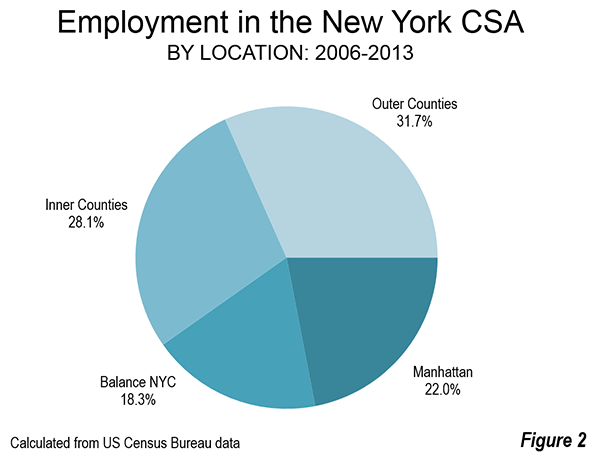
    The New York CSA is home to the world’s second largest central business district (CBD). Only Tokyo’s Yamanote Loop has more employment. Overall, Manhattan (New York County) has 2.4 million jobs, with approximately 2.0 million jobs in the CBD, which covers virtually all of the area to the south of 59th Street. Yet, despite this impressive statistic, unmatched anywhere in the country, Manhattan contains only 22 percent of the employment in the New York area. The largest portion of employment is in the outer counties, with 32 percent (Figure 2). Combined, the inner and outer county suburbs represent 60 percent of the jobs in the New York commuting shed.

    Where People Live and Work

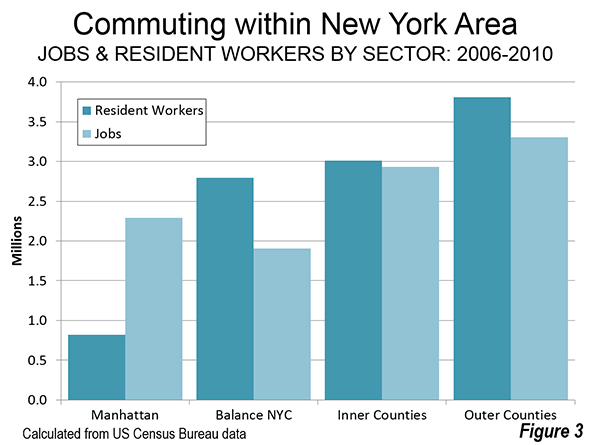
    The distribution of employee residences contrasts sharply with that of employment. Manhattan displays the most extreme imbalance between jobs and where people live. (Figure 3). There are nearly three times as many jobs as resident employees in Manhattan (2.8 jobs per resident employee). The most evenly balanced sector is the outer counties, which are at near parity, with 0.97 jobs for every resident employee. The outer counties are relatively balanced, with 0.87 jobs per resident employee. The balance of New York City has 2.7 million resident workers and only 1.9 million jobs. There are only 0.68 jobs per resident employee. When the entire city is considered, including Manhattan, there is a much closer balance, with 1.16 jobs per resident worker.

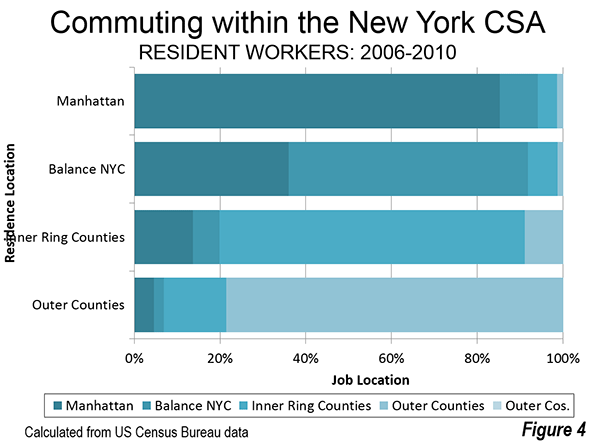
    Most employees work in their sector of residence. About 85 percent of Manhattan residents work in Manhattan. Nearly 79 percent of outer county residents work in the outer counties, while 71 percent of inner county residents work in the inner counties. Perhaps surprisingly, nearly two-thirds as many inner county residents work in the outer counties as work in Manhattan. Only 55 percent of resident workers in the four outer boroughs of New York City work in the outer boroughs (Figure 4)

    Commuting to Manhattan

    One of the most enduring urban myths is built around the idea of the monocentric city. This is the conception that most people work downtown (the CBD). This has been an inaccurate characterization for decades, even in New York. In New York, as noted above, the CBD accounts for little more than 20 percent of employment. By comparison, however, this is a substantial number compared to other large North American commuter sheds. The Chicago CSA, for example (the Loop) has about 11 percent of its employment downtown (the Loop), Toronto has less than 15 percent and Los Angeles is under two percent.

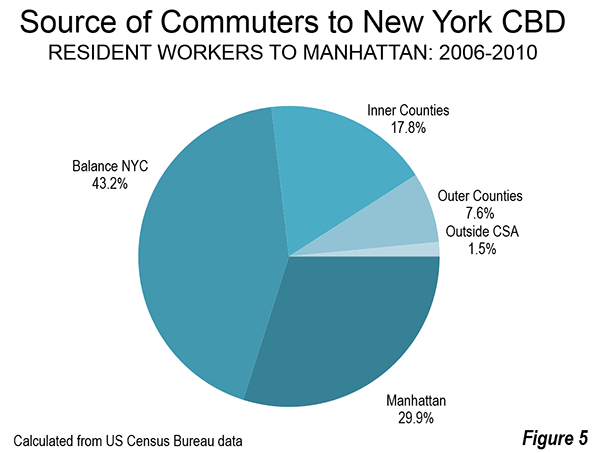
    The overwhelming majority of jobs in Manhattan are filled by local residents or nearby commuters. According to American Community Survey "flow" data for 2006-2010, 73 percent of Manhattan commuters live in Manhattan or in the balance of New York City. Another 18 percent of commuters travel from the inner counties. This leaves less than eight percent of commuters traveling from the outer counties. Less than two percent of commuters travel to Manhattan from outside the CSA (Figure 5).

    How Commuters Travel

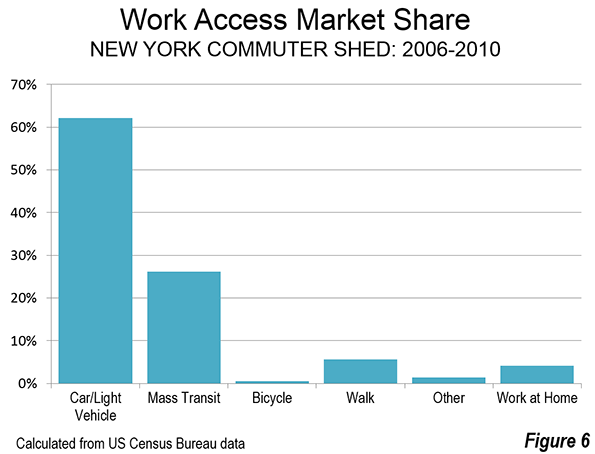
    New York relies on transit far more than any other US commuter shed. Overall approximately 27 percent of work trip travel is on transit. However, the extent of transit use varies widely by sector. Transit accounts for 75 percent of work trip travel to Manhattan employment. Transit also has a significant market share to jobs in the outer boroughs (38 percent). Jobs in the city of New York account for 88 percent of the transit commuting in the CSA. Outside the city, transit carries a much smaller share. In the inner counties, transit captures nine percent of commuters, while accounting for a much smaller 2.6 percent in the outer counties. In the outer counties, transit’s market share is slightly more than one-half the national average (Table).

    Cars have the largest work trip market share in every commuter shed in the nation, including the New York area, where they provide 61 percent of trips. Again, however, there is a very wide variation between the sectors. Cars provide less than 15 percent of commute trips to jobs in Manhattan. They provide a larger 44 percent share in the outer boroughs. In the inner counties and outer counties, cars are strongly dominant, providing for 80 percent and 88 percent of the commutes respectively.

    The walking commuter share is lower than might be expected in famously pedestrian oriented Manhattan. Manhattan has by far the densest urbanization in the United States. With more than 70,000 residents per square mile (28,000 per square kilometer), Manhattan is nearly four times as dense as San Francisco, which has the highest density of any large municipality in the US outside New York. With such a high density, and a job density of more than 100,000 per square mile (nearly 40,000 per square kilometer), it may be surprising that workers in the outer boroughs rely on walking to work to a greater extent. Walking has a 7.4 percent commuting share in Manhattan, and a 9.6 percent share in the outer boroughs, despite their much lower population and employment densities.

    Table
    New York CSA Means of Transportation: Work Location: 2013
    Area Drive Alone Car Pool Transit Bicycle Walk Other Work at Home
    Manhattan 10.0% 2.7% 74.7% 1.0% 7.4% 1.8% 2.4%
    Balance: NYC 37.0% 7.3% 38.7% 1.1% 9.6% 1.4% 4.8%
    Inner Counties 71.6% 8.6% 9.4% 0.3% 4.2% 1.7% 4.2%
    Outer Counties 79.6% 8.6% 2.6% 0.3% 2.8% 1.1% 5.0%
    New York CSA 54.3% 7.1% 26.9% 0.6% 5.4% 1.5% 4.2%
    Exhibit: United States 76.4% 9.4% 5.2% 0.6% 2.8% 1.3% 4.4%
    Calculated from American Community Survey


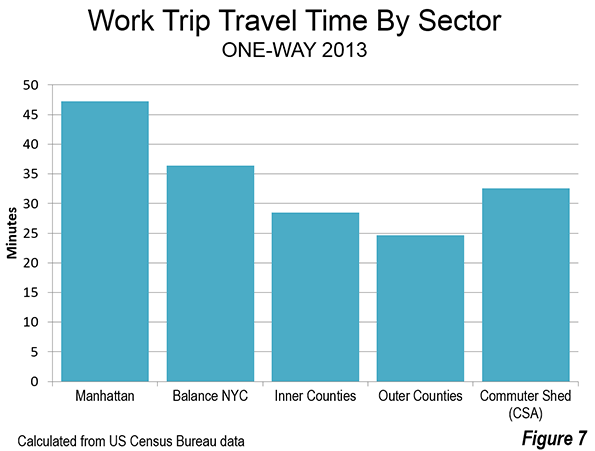
    The faster work commute trips of cars is illustrated in the sectoral analysis. Automobile commuting is most dominant in the outer county suburbs, which have the largest number of resident workers and jobs. The average one-way work trip travel time is 24.7 minutes in the outer counties, little more than one half the 49.7 minute one way trip to jobs in Manhattan. The inner counties have the second shortest travel time, at 28.5 minutes. Jobs in the outer boroughs of New York City have an average work trip travel time of 36.4 minutes (Figure 7).

    A Dispersed Commuter Shed

    Despite its reputation for monocentricity, and its primacy in terms of the sheer numbers of core area employees, the New York combined statistical area remains surprisingly dispersed when it comes to jobs, contrary to popular accounts, although less so than others.

    —–

    Wendell Cox is Chair, Housing Affordability and Municipal Policy for the Frontier Centre for Public Policy (Canada), is a Senior Fellow of the Center for Opportunity Urbanism (US), a member of the Board of Advisors of the Center for Demographics and Policy at Chapman University (California) and principal of Demographia, an international public policy and demographics firm.
    He is co-author of the "Demographia International Housing Affordability Survey" and author of "Demographia World Urban Areas" and "War on the Dream: How Anti-Sprawl Policy Threatens the Quality of Life." He was appointed to three terms on the Los Angeles County Transportation Commission, where he served with the leading city and county leadership as the only non-elected member. He served as a visiting professor at the Conservatoire National des Arts et Metiers, a national university in Paris. 

    Photograph: Inner County New York CSA: City of Elizabeth, seat of Union County, New Jersey (by author)

  • A Selectively Golden State Jobs Outlook

    Every year, I, along with Pepperdine’s Michael Shires, have what has become the often-dispiriting job – for a 40-year California resident – of evaluating the nation’s metropolitan regions in terms of both short-term and midterm job growth. Yet, this year, the results for our state’s metros are somewhat improved, as California’s post-recession job-growth rate now equals, and could surpass, the still-somewhat insipid national average.

    After years of subpar growth, California is reaping the advantages of a fortuitous economic alignment of ultralow interest rates, high stock values and growing investments in high-end residential real estate. Vast sums are pouring into the state for new tech ventures, speculative hotel and residential developments. Low borrowing rates allow the state to keep pace with its massive debts, while buoyant stocks help the massive government pension plans, which invest in the market.

    Read the entire piece at The Orange County Register.

    Joel Kotkin is executive editor of NewGeography.com and Roger Hobbs Distinguished Fellow in Urban Studies at Chapman University, and a member of the editorial board of the Orange County Register. He is also executive director of the Houston-based Center for Opportunity Urbanism. His newest book, The New Class Conflict is now available at Amazon and Telos Press. He is also author of The City: A Global History and The Next Hundred Million: America in 2050.  He lives in Orange County, CA.

    Photo by Thomas Pintaric (Own work) [GFDL or CC-BY-SA-3.0], via Wikimedia Commons

  • Small Towns: The Value of Unique Places

    Rural and small towns suffer from a loss of faith in their place, and seem desperate to be recognized in our new, standardized world. Plenty of our developed land remains specific and even unique, but the highway does not go to it. Outside the cities, unpretty feed stores, the availability of tractor parts, and the presence of cattle hardly contribute to scientifically measured success. The refuge of the individual, the ability of a person to see his or her life as meaningful while it is separate and apart from a larger mass, is crippled. You’re only as good as your income; you’re only as witty as your social media posts, and you’re only red or blue.

    In Sanford, Florida, the mayor recently sat down with my urban design students and discussed the future of this small town. Sanford, once larger than Orlando, was a significant port, loading Central Florida’s farm produce onto ships and railroad cars for hungry Northeasterners. Now diminished, its quaint downtown reeks of history, beautifully preserved, but only a few jobs exist. Today’s brick-paved Main Street, with its galleries, bookstores, and restaurants, caters to a trickle of visitors, but Sanford feels the effects of being on Orlando’s periphery.

    “People come to me,” said Mayor Jeff Triplett, “and ask me to help bring jobs to Sanford. They wish we had a national chain drugstore like a Walgreens or CVS on Main Street. That,” he declared,” is their measure of having arrived.” Sanford citizens, he explained, see something like this as true progress.

    “That would kill your Main Street,” protested one student. Enjoying Sanford’s originality, the students encouraged the Mayor to consider that Sanford could do better than a franchise’s low-paying jobs. The quest, however, for some sign of progress continues.

    The conversation reflects how meaning, or a sense of place, is measured only in relation to a greater national homogeneity. People petition their leaders to bring meaning to their towns via a national chain. This monolithic built environment is, by itself, a giver of meaning. To someone living in a small town, the standardization of our lifestyle is the normal condition, and the lack of homogeneity is seen as impoverishment. It is somehow a disease, a condition of malnutrition, to be deprived of the physical structures of standardization.

    Today’s homogeneity can be a strength, providing a level playing field for society. Its virtues are equity, efficiency, and supermobility. As a single, unified scaffold, our homogenous built environment has grown outward and filled our land to the edges, and it places cities at the focal points of a grand grid. Mainstream literature extols the virtues of this grid, and celebrates today’s urban life. But homogeneity has its downsides, and places that are outside of this grand grid of progress suffer deeply. Variety is subsumed by today’s great global culture.

    Once, writers like Alvin and Heidi Toffler, and George Orwell, warned against this kind of growth, citing the hazards of the rational, scientific underpinnings of modernity. Objectifying everything and extinguishing the mystery of life seemed to them to be an exercise in nihilism. Other thinkers in the 1930s and 1940s also foresaw that the monolith of western civilization would consume everything in its path. Indeed, this consumption of unique places has been largely accomplished, and those that remain are considered stunted and backward. Everywhere one looks, the loss of variety and individualism is profound.

    And so small towns suffer in silence, their best and brightest arriving like refugees into bigger cities. Smooth, suburban density levels set our current standards, while agriculture and ranching seem unable to retain people.

    Science has brought us to this point, but blaming science is like blaming the trash can for the garbage within it. If the manmade environment we’ve created is imperfect, then it is a reflection of us. It probably isn’t going away anytime soon. We now exist in a nearly wholly manmade environment. Even the most rural exurban dweller lives in a substantially more technological and manmade environment — house, car, job — than the most urbane city dweller did a century ago.

    No, this crisis of is not a failure of science. It is a lack of quality. What we’ve built is everywhere, but it isn’t very good… yet.

    What to do with this homogenous world is the next generation’s big task. But we, too, must act now to confront the physical evidence of this imperfection. Change will come when we accept that we must fix it, and not wait for a deus ex machina to swoop down. Those longing for an apocalypse are seeking the easy way out: let flood, fire, or epidemic take care of the mess.

    I’d rather take responsibility for what has been created, and take better care of it. This monolithic, homogenous latticework of roads and buildings is the new frontier. Where man has already strongly modified nature, there is plenty of room for improvement.

    More cities that nurture native industry will create this new future. Balancing that approach with the Jeffersonian ideals of a strong, rural economy will bring equity to areas that are suffering. And that will build upon our strength.

    Richard Reep is an architect with VOA Associates, Inc. who has designed award-winning urban mixed-use and hospitality projects. His work has been featured domestically and internationally for the last thirty years. An Adjunct Professor for the Environmental and Growth Studies Department at Rollins College, he teaches urban design and sustainable development; he is also president of the Orlando Foundation for Architecture. Reep resides in Winter Park, Florida with his family.

    Photo of Sanford by Christine Wood

  • America’s Largest Commuter Sheds (CBSAs)

    Core Based Statistical Area (CBSA) is the Office of Management and Budget’s (OMB) way of defining metropolitan regions.  The OMB (not the Census Bureau) defines criteria for delineating its three metropolitan concepts, combined statistical areas, metropolitan statistical areas, and micropolitan statistical areas. The CBSA has obtained little use since this adoption for the 2000 census. According to OMB:

    "A CBSA is a geographic entity associated with at least one core of 10,000 or more population, plus adjacent territory that has a high degree of social and economic integration with the core as measured by commuting ties."

    In this context, core means urban area. If an urban area has 50,000 or more population, OMB defines a metropolitan area around it. If an urban area has 10,000 or more population but fewer than 50,000 residents, OMB defines a micropolitan area around it.

    It is also important to understand that CBSAs, whether CSAs, metropolitan areas, or micropolitan areas are not urban areas. In fact, 94% of the area in CBSAs is rural — only 6% is urban (built-up urban cores and suburbs).

    Combined statistical areas (CSAs) are made up of adjacent CBSAs that have a significant amount of commuting between them, but less than required for a metropolitan area or a micropolitan area. In some cases the CSAs seem so obvious as to make the smaller metropolitan area definitions seem ludicrous. One keen observer, Michael Barone of the Washington Examiner, put San Francisco and San Jose, as well as Los Angeles and Riverside-San Bernardino together in his recent analysis of population growth, because, as he rightly pointed out, they seem to "flow together."

    Some CSAs are very large. For example the New York CSA is composed of 8 metropolitan areas (New York (NY-NJ-PA), Bridgeport (CT), New Haven (CT), Trenton (NJ), Allentown (PA-NJ), Kingston (NY). Torrington (CT) and East Stroudsburg (PA). On the other hand, many major metropolitan areas are not a part of a CSA, such as Phoenix and San Diego.

    Since the term CBSA seems unlikely to achieve popular usage, this article uses the term "commuter shed" to denote the highest local level of metropolitan definition.  The highest level for the largest regions are is the combined statistical area (CSA). In others they are defined as a metropolitan area or micropolitan area. The result is a consistent standard of economic geography defined by commuting. Yet such lists are rare or non-existent. A table of all 569 commuter sheds (over 1,000,000 population) is posted to demographia.com.

    10 Largest Commuter Sheds

    As a 2014, there were 60 commuter sheds in the United States with more than 1 million population (Table).

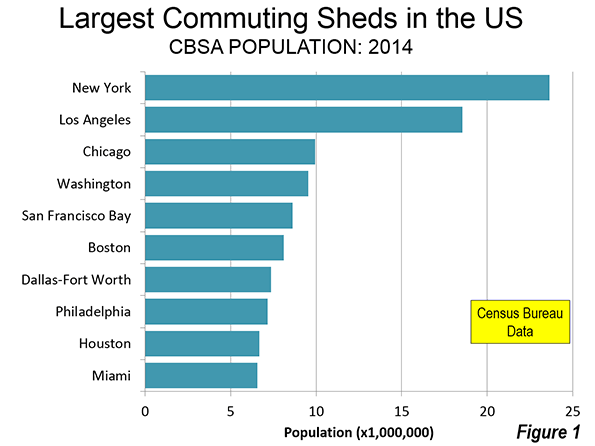
    Not surprisingly, the nation’s largest commuter shed is New York. New York stretches from New Haven and Bridgeport, and Connecticut which are separate metropolitan areas out to Allentown which is principally in Pennsylvania and Trenton in New Jersey. The New York commuter shed has a population of 23.6 million. In fact, given the extensive suburban rail transit service between Southwestern Connecticut and New York City, it may be surprising that New Haven and Bridgeport are separate metropolitan areas, both with nearly 1,000,000 population. Moreover, there is virtually no break in the continuously built-up area between New York and southwestern Connecticut (Fairfield and New Haven counties) — they "flow together" to use Barone’s term. Since 2010, the Allentown metropolitan area, with nearly 1,000,000 population, was added to the New York CSA.

    The second largest commuter shed is Los Angeles-Inland Empire, with 18.6 million residents. This includes the Los Angeles metropolitan area (Los Angeles and Orange Counties, Ventura County and the Riverside San Bernardino metropolitan area (Inland Empire, including Riverside and San Bernardino County), which is one of the largest in the nation, with more than 4 million population. Here, as in New York, there is virtually no break in the built-up urbanization between the two urban areas, Los Angeles and Riverside-San Bernardino.

    Chicago is the third largest commuter shed, though its adjacent metropolitan areas are far smaller than in New York and Los Angeles. Chicago is also growing very slowly, with its population increase over the last year so small that it will take nearly to 2020 to reach 10 million, even though it only has 72,000 to go.

    Just below Chicago, Washington and Baltimore combine to form nation’s fourth largest commuter shed. Already with more than 9.5 million residents and strong growth this decade, Washington-Baltimore could pass 10 million population and Chicago by 2020. Washington-Baltimore is unique in combining two of the nation’s historically largest and most intensely developed core municipalities along with the much more extensive suburbs (which contain 85% of the population). Washington-Baltimore now extends to Franklin County, Pennsylvania.

    The fifth largest metropolitan complex is the San Francisco Bay Area with a population of 8.6 million. This includes the San Francisco, San Jose, Vallejo, Santa Rosa, Santa Cruz metropolitan areas and the recently added Stockton metropolitan area.. There is no break in the urbanization between San Francisco and San Jose.  

    The Boston CBSA was enlarged during the last decade to include Providence, a major metropolitan area in its own right. Boston also includes the Worcester metropolitan area, which is nearing 1,000,000 population. Boston-Providence has a population of 8.1 million.

    The top 10 is rounded out by Dallas-Fort Worth (7.4 million), Philadelphia (7.2 million), Houston (6.7 million), and Miami (6.6 million).

    The largest metropolitan complex in the nation that is not a part of a CSA is Phoenix, which is ranked 14th. Only one other commuter sheds in the top 20 is not a CSA (San Diego) and only six of the 60 commuter sheds with more than 1,000,000 population is not a CSA.

    Fastest Growing Commuter Sheds

    The fastest commuter shed growth rates are in the South, which accounts for eight of the ten fastest growing commuter shed’s. Austin ranks number one in annual percentage growth between 2010 and 2014, a position it also holds among major metropolitan areas. Cape Coral (Florida) ranks second. Cape Coral also ranks as the fastest growing among the midsized metropolitan areas (from 500,000 to 1,000,000 population). Houston ranks third in growth rate. Houston and Dallas-Fort Worth are the only commuter sheds with more than 5 million population that are among the top 10 in growth. The two non-Southern top 10 entries are from the West: Denver and Phoenix (Figure 2).

    Slowest Growing Commuter Sheds

    All of the 10 slowest growing major commuter sheds are in the old industrial heartland of the Northeast and Midwest. Cleveland-Akron is the slowest growing, having lost approximately 0.1 percent of its population annually. Pittsburgh, Dayton, Buffalo and Detroit have also lost population.

    Continuing Dispersion

    The dispersion of US metropolitan areas continues, with perhaps the ultimate example of Portland (Oregon), which was recently combined with four other metropolitan areas (see: Driving Farther to Quality in Portland). The "flowing together" suggest that the combined statistical area may be an increasingly important in assessing regional trends.

    Core Based Statistical Areas (Commuter Sheds): United States
    Over 1,000,000 Population in 2014
    2014 Population Rank Metropolitan Area 2010 2014 Annual % Change: 2010-2014 Growth Rank
    1 New York-New Haven, NY-NJ-CT-PA CSA 23.077 23.633 0.56% 41
    2 Los Angeles-Inland Empire, CA CSA 17.877 18.550 0.87% 30
    3 Chicago, IL-IN-WI CSA 9.841 9.928 0.21% 50
    4 Washington-Baltimore, DC-MD-VA-WV-PA CSA 9.052 9.547 1.26% 18
    5 San Fransicsco-San Jose, CA CSA 8.154 8.607 1.28% 17
    6 Boston-Providence, MA-RI-NH-CT CSA 7.894 8.100 0.61% 38
    7 Dallas-Fort Worth, TX-OK CSA 6.818 7.353 1.79% 8
    8 Philadelphia, PA-NJ-DE-MD CSA 7.068 7.165 0.32% 47
    9 Houston, TX CSA 6.115 6.686 2.13% 3
    10 Miami-West Palm Beach, FL CSA 6.168 6.558 1.46% 14
    11 Atlanta, GA CSA 5.910 6.259 1.36% 16
    12 Detroit, MI CSA 5.319 5.315 -0.02% 56
    13 Seattle, WA CSA 4.275 4.527 1.36% 15
    14 Phoenix, AZ MSA 4.193 4.489 1.62% 9
    15 Minneapolis-St. Paul, MN-WI CSA 3.685 3.835 0.94% 26
    16 Cleveland-Akron, OH CSA 3.516 3.498 -0.12% 60
    17 Denver, CO CSA 3.091 3.345 1.88% 6
    18 San Diego, CA MSA 3.095 3.263 1.25% 20
    19 Portland-Salem, OR-WA CSA 2.921 3.060 1.10% 23
    20 Orlando-Daytona Beach, FL CSA 2.818 3.046 1.84% 7
    21 Tampa-St. Petersburg, FL MSA 2.784 2.916 1.10% 22
    22 St. Louis, MO-IL CSA 2.893 2.911 0.15% 52
    23 Pittsburgh, PA-OH-WV CSA 2.661 2.654 -0.06% 59
    24 Charlotte, NC-SC CSA 2.376 2.538 1.57% 11
    25 Sacramento, CA CSA 2.415 2.513 0.94% 27
    26 Salt Lake City-Ogden, UT CSA 2.272 2.424 1.54% 12
    27 Kansas City, MO-KS CSA 2.343 2.412 0.68% 36
    28 Columbus, OH CSA 2.309 2.398 0.90% 28
    29 Indianapolis, IN CSA 2.267 2.354 0.89% 29
    30 San Antonio, TX MSA 2.143 2.329 1.98% 4
    31 Las Vegas, NV-AZ CSA 2.195 2.315 1.26% 19
    32 Cincinnati, OH-KY-IN CSA 2.174 2.208 0.37% 46
    33 Raleigh-Durham, NC CSA 1.913 2.075 1.94% 5
    34 Milwaukee, WI CSA 2.026 2.044 0.21% 51
    35 Austin, TX MSA 1.716 1.943 2.97% 1
    36 Nashville, TN CSA 1.788 1.913 1.59% 10
    37 Norfolk-Virginia Beach, VA-NC CSA 1.779 1.819 0.53% 43
    38 Greensboro-Winston-Salem, NC CSA 1.589 1.630 0.60% 39
    39 Jacksonville, FL-GA CSA 1.470 1.543 1.14% 21
    40 Louisville, KY-IN CSA 1.460 1.499 0.62% 37
    41 Hartford, CT CSA 1.486 1.488 0.02% 55
    42 New Orleans, LA-MS CSA 1.414 1.480 1.09% 24
    43 Grand Rapids, MI CSA 1.379 1.421 0.71% 34
    44 Greenville, SC CSA 1.362 1.410 0.81% 33
    45 Oklahoma City, OK CSA 1.322 1.409 1.50% 13
    46 Memphis, TN-MS-AR CSA 1.353 1.370 0.29% 48
    47 Birmingham, AL CSA 1.303 1.317 0.27% 49
    48 Richmond, VA MSA 1.208 1.260 1.00% 25
    49 Harrisburg, PA CSA 1.219 1.240 0.39% 45
    50 Buffalo, NY CSA 1.216 1.215 -0.02% 57
    51 Rochester, NY CSA 1.175 1.177 0.05% 54
    52 Albany, NY CSA 1.169 1.174 0.10% 53
    53 Albuquerque, NM CSA 1.146 1.166 0.40% 44
    54 Tulsa, OK CSA 1.106 1.139 0.69% 35
    55 Fresno, CA CSA 1.081 1.121 0.84% 32
    56 Knoxville, TN CSA 1.077 1.104 0.58% 40
    57 Dayton, OH CSA 1.080 1.078 -0.05% 58
    58 Tucson, AZ CSA 1.028 1.051 0.53% 42
    59 El Paso, TX-NM CSA 1.013 1.050 0.85% 31
    60 Cape Coral, FL CSA 0.940 1.028 2.13% 2
    In millions
    Data from US Census Bureau
    Metropolitan Statistical Areas shown only if not in a Combined Statistical Area.


    Wendell Cox is Chair, Housing Affordability and Municipal Policy for the Frontier Centre for Public Policy (Canada), is a Senior Fellow of the Center for Opportunity Urbanism (US), a member of the Board of Advisors of the Center for Demographics and Policy at Chapman University (California) and principal of Demographia, an international public policy and demographics firm.

    He is co-author of the "Demographia International Housing Affordability Survey" and author of "Demographia World Urban Areas" and "War on the Dream: How Anti-Sprawl Policy Threatens the Quality of Life." He was appointed to three terms on the Los Angeles County Transportation Commission, where he served with the leading city and county leadership as the only non-elected member. He served as a visiting professor at the Conservatoire National des Arts et Metiers, a national university in Paris. 

    Photo: Albany (NY) City Hall (by author)

  • Stack and Pack vs. Smear All Over

    I drove out to a distant suburb recently to attend to some business and I passed by a cluster of billboards on the side of the freeway that got me thinking. The general gist of the slogans asserted a conservative anti-government anti-urban rebellion. These are clearly people who don’t want density and public transit imposed on them by pointy headed liberal idiots. I have to admit I have some sympathy for this perspective, although probably not for the same reasons as the billboard people. Their knee jerk reaction makes clear what they don’t want, but offers no alternative response to the underlying difficulties faced by the inevitable urbanization of rural areas.

    Screen Shot 2015-06-06 at 1.45.36 AM

    Screen Shot 2015-06-06 at 1.44.07 AM

    Screen Shot 2015-06-06 at 1.44.23 AM

    Screen Shot 2015-06-06 at 1.43.24 AM

    Screen Shot 2015-06-06 at 1.43.47 AM

    Screen Shot 2015-06-06 at 3.07.22 AM

    Screen Shot 2015-06-06 at 3.05.57 AM

    Screen Shot 2015-06-06 at 3.05.27 AM

    Screen Shot 2015-06-06 at 3.06.59 AM

    Screen Shot 2015-06-06 at 3.06.43 AM

    Here’s the fantasy of how this particular area should remain: bucolic landscapes, family farms, charming old homes, and delicate churches with little graveyards out back. But these are all part of a heritage park. School children are brought here to learn what the place was like in the 1850’s.

    Screen Shot 2015-06-06 at 3.08.52 AM

    Screen Shot 2015-06-06 at 3.11.23 AM

    Screen Shot 2015-06-06 at 3.10.27 AM

    Screen Shot 2015-06-06 at 3.08.27 AM

    Screen Shot 2015-06-06 at 3.08.08 AM

    Screen Shot 2015-06-06 at 3.13.18 AM

    Turn the camera just slightly to the left or the right and the landscape is filled with gas stations, parking lots, drive-thru banks, and freeway traffic. And everywhere there’s new construction. Money (lots and lots of San Francisco Bay Area money) and a whole lot of people are inevitably going to be occupying what is now open space in these distant counties. No political force can stop it. There are two competing models for what that new growth is going to look like and neither is pretty as far as I’m concerned.

    Screen Shot 2014-11-17 at 5.42.47 PM

    Screen Shot 2014-11-17 at 5.43.17 PM

    Screen Shot 2014-11-17 at 5.41.57 PM

    Screen Shot 2014-11-17 at 5.42.34 PM

    First, there’s the compact, dense, transit oriented development favored by regional planners. (This is precisely the kind of thing the billboard people are so pissy about.) Now… I live in a compact, dense, transit oriented neighborhood in San Francisco that I think is amazing. But when I look at what’s being built in the far flung suburbs I find nothing to love about any of it. The scale is overwhelming. Each of these complexes occupies a massive super block. And it’s not just the size per se that I don’t like. It’s the fact that these buildings have all the drawbacks of density without any of the compensating urbanism. Where are the shops on the ground floor? Where’s the corner grocery? Where are the cafes and nightclubs? Where are the intimate little restaurants and pocket parks? Where are the vibrant walkable places? There just aren’t any. These places are as lifeless as any cul-de-sac, minus the space and privacy provided by a tract house with a yard. It’s not a good combination.

    Screen Shot 2015-06-05 at 5.43.30 PM

    Screen Shot 2015-06-05 at 5.41.17 PM

    Screen Shot 2015-06-05 at 5.38.59 PM

    Screen Shot 2015-06-05 at 5.42.04 PM

    Screen Shot 2015-06-06 at 2.54.54 AM

    Screen Shot 2015-06-05 at 5.42.41 PM

    Screen Shot 2015-06-06 at 2.55.35 AM

    Screen Shot 2015-06-06 at 3.13.37 AM

    Here’s the second option. Traditional American values brought to life in shiny new single family homes with three car garages as far as the eye can see. This is the alternative to big bad government and communist apartment blocks. Luxury homes chew up the countryside and load the freeway with an unmanageable amount of traffic. And by the way, these homes each cost $1.4M.

    I compare this political situation with the dilemma the country faced in the early 1980’s when Reagan came to power. Conservatives hated the idea that the government operated halfway houses and insane asylums. They wanted no part of drug treatment programs either. At the same time liberals insisted that it was inhumane to lock people up against their will in underfunded and uncaring institutions where they were likely to be mistreated. So the two opposing elements of society conspired to shut down such institutions. The problem, of course, is that the mentally ill, drug addicted, and penniless segment of American society didn’t just disappear. They now live on our streets and fill our prisons. Both sides got what they wanted, but the problems persist in slightly different forms. So it is with the battles over land use regulation. Happenstance brings us a funky world and we all just muddle through some how.

    John Sanphillippo lives in San Francisco and blogs about urbanism, adaptation, and resilience at granolashotgun.com. He’s a member of the Congress for New Urbanism, films videos for faircompanies.com, and is a regular contributor to Strongtowns.org. He earns his living by buying, renovating, and renting undervalued properties in places that have good long term prospects. He is a graduate of Rutgers University.

  • The Cities Winning The Battle For Information Jobs 2015

    We are supposed to be moving rapidly into the “information era,” but the future, as science fiction author William Gibson suggested, is not “evenly distributed.” For most of the U.S., the boomlet in software, Internet publishing, search and other “disruptive” cyber companies has hardly been a windfall in terms of employment. As jobs in those areas have been created, employment has shriveled in old media like newspaper, magazine and book publishing (these industries lost a net 172,000 jobs from 2009 through 2014). In the 52 largest metropolitan areas that we studied, information employment declined for roughly half from 2009 through 2014. Overall, in information industries (a sprawling sector that also includes movie and TV production, radio and another big job loser, telecom) employment has shrunken 4.2% since 2009 to 2.7 million jobs, while total nonfarm employment in the U.S. grew by 5.1%.

    Yet looking at the information sector give us an important picture of how these changes have shifted jobs to certain regions and away from others. Our rankings are based on employment growth in the sector over the short-, medium- and long-term, going back to 2003, and factor in momentum — whether growth is slowing or accelerating. (For a detailed description of our methodology, click here.)

    By far the biggest winners in the information sweepstakes are areas that developed a strong engineering base before the rise of the Internet. This has provided the platform for the rapid growth of web-based businesses, including in fields such as entertainment, media, hospitality and transportation (like Uber). It’s not surprising then that the metro areas that have posted the strongest information job growth over the past 11 years are San Jose-Sunnyvale-Santa Clara and San Francisco-Redwood City-South San Francisco.

    The growth in these hot spots has been nothing short of spectacular: information employment rose 60.2% from 2009 through 2014 in the San Jose area to 70,900 jobs, 6.9% of total employment in the metro area, while the San Francisco area has seen a 51.3% surge over the same time span to 55,800 jobs, representing 5.4% of the total workforce there.

    After the dot-com bubble burst, Silicon Valley tech employment declined consistently until 2010, since which the rebound has been dramatic. While San Francisco and areas in the northern end of Silicon Valley have not yet reached the peak employment levels seen during the bubble era, the southern end centered in San Jose and Santa Clara has easily outstripped its peaks of the early 2000s. And with information employment continuing to surge, it’s too early to say these areas have hit their “information” peak. Last year, the number of information jobs jumped 16.0% in San Jose while San Francisco experienced an 8.3% jump.

    Other traditional tech centers that have thrived in the new era include No. 9 Seattle-Bellevue-Everett, Wash., where information employment has grown a healthy 9.2% since 2009 and No. 14 Boston, where employment is up 5.1% since 2009. Compared to the Bay Area, these regions appear less at the center of the web-based media and services industries, but their overall tech economies remain very strong.

    The Rise Of Sun Belt Information Hubs

    Some of the most rapid growth in information, however, is taking place not in the older established tech hotbeds but in the lower-cost metropolitan areas of the Sun Belt. Five of our top 10 ranked metropolitan areas are located in the belt that stretches from the Atlantic coast to Arizona, led by No. 3 Austin-Round Rock, Texas, where information employment has risen 30.8% since 2009 to 25,800 positions.

    Some of this reflects a gradual movement of companies, notably from Silicon Valley, to the Texas capital. Smaller Bay Area firms such as digital advertising firm Marin Software have expanded there while Apple is expected to add 3,600 jobs there over the next few years.

    Several other Sun Belt tech hubs also are high on our list. In fourth place is Raleigh, N.C., on the strength of a 13.8% jump in information employment since 2009. It’s followed in fifth place by No. 5 Charlotte-Concord-Gastonia, N.C., which boasts significant sources of venture capital, and No. 8 San Antonio-New Braunfels, Texas, which has seen the rise of locally based companies such as Execupay as well as large scale expansion of Bay Area firms such as Oracle that are flocking to the region.

    One big advantage these economies have compared to the ultra-pricey Bay Area is lower home costs, something that matters to tech workers as they enter their 30s. But the biggest challenge for some of these up and coming areas, such as Phoenix, is the dearth of large locally headquartered companies that can help create a management talent base and some tech street cred.

    The Battle Of The Bigs

    One key battleground for information supremacy is in the country’s media centers. The clear winner has been No. 7 New York, which has recorded a 13.0% jump in information jobs since 2009 to 185,200 jobs – second most in the country behind the Los Angeles metro area. That came amid an 11.8% decline over the same timespan in all publishing jobs not involving the Internet (note that we don’t have the level of detail at the local level to separate out software publishing from that figure, but it’s safe to assume the bulk of the decline was in newspapers and book and magazine publishing). The 13% jump reflects strength in new media as well as motion pictures, TV and radio, more so than technology, a field in which New York remains very much an also ran, right in the middle of the pack in terms of creating STEM and tech employment. But boosters claim this is changing, pointing out that there are now 7,000 tech firms employing 100,000 people in the area.

    Although New York is well behind the Bay Area in pace of growth, it is clearly outperforming its traditional media rivals in the rush towards digital media. Its growth dwarfs that of No. 29 Chicago, where information employment has ticked up 0.4% since 2009. The Los Angeles-Long Beach-Glendale metro area, still home to the largest number of information workers, has managed lackluster growth of 3.5% since 2009, including a 2.0% decline last year, which puts it 28th place on our list. For all the talk about L.A.’s emergence as a new media rival to the Bay Area, the numbers suggest this is more hope than reality. Over the past five years motion picture and television employment has not been hard-hit like traditional publishing but is only experiencing slow growth. No Facebook, Google or Apple equivalent has emerged in Southern California, although some hold out hope for L.A.-based Snapchat.

    A decade or two ago there was talk about the nation’s capital challenging New York’s media dominance. But as has become evident over the past year, the Beltway’s appeal is dropping, even when it comes to producing sound-bites and punditry. The core Washington D.C.-Arlington-Alexandria metropolitan division places a mediocre 43rd, with a 3.9% decline in information employment since 2009. Other areas around the capital did poorly also, including 41st-ranked Northern Virginia and 46th-place Silver Spring-Frederick-Rockville Md. which also have lost information jobs since 2009.

    Surprises And Up And Comers

    Generally speaking manufacturing, energy and logistics-oriented economies do not do well in terms of information jobs. As of now there’s no Rust Belt version of Facebook or Google, and most factory towns do very poorly. But there’s one outstanding exception to this rule: Warren-Troy-Farmington Hills, Mich., which places 10th on our list. This area, sometimes referred to “automation alley,” is Michigan’s premier tech region. It is where software meets heavy metal, with a plethora of companies focusing on factory software and new computer-controlled systems for automobiles. It is home to engineering software firms like Altair, which has been expanding rapidly, and also where General Motors recently announced plans for a $1 billion tech center, employing 2,600 salaried workers.

    If we are looking for future information hubs, one place to look would be our small and mid-sized metro area lists. Here the top ranks are dominated by college towns, including Baton Rouge, La., home to Louisiana State University, where information employment has surged 28.6% since 2009. It places third on our mid-size cities list, which also features such high-flying college towns as fourth place Provo-Orem, Utah (Brigham Young), No. 5 Durham-Chapel Hill (Duke, University of North Carolina), No. 6 Madison (University of Wisconsin), and No. 7 Ann Arbor (University of Michigan).

    The information sector may not be a big job generator, but it does play a critical role in several of our most important economies, including the San Francisco, New York, Los Angeles and Austin metro areas. The clear shift we are seeing towards consolidation of media with tech – a la Apple, Netflix and Google — will likely underpin a movement of these coveted jobs from traditional media centers to the Bay. But  given the unfriendly business atmosphere in California, and the super-high prices for houses, it also makes sense to look at secondary information centers, both in the Sun Belt and among college towns, which may attract even more of these jobs in the years ahead.

    Joel Kotkin is executive editor of NewGeography.com and Roger Hobbs Distinguished Fellow in Urban Studies at Chapman University, and a member of the editorial board of the Orange County Register. He is also executive director of the Houston-based Center for Opportunity Urbanism. His newest book, The New Class Conflict is now available at Amazon and Telos Press. He is also author of The City: A Global History and The Next Hundred Million: America in 2050.  He lives in Los Angeles, CA.

    Michael Shires, Ph.D. is a professor at Pepperdine University School of Public Policy.

  • All Cities Information Jobs – 2015 Best Cities Rankings

    Read about how we selected the 2015 Best Cities for Job Growth

    We used five measures of growth to rank MSAs over the past 10 years. “Large” areas include those with a current nonfarm employment base of at least 450,000 jobs. “Midsize” areas range from 150,000 to 450,000 jobs. “Small” areas have as many as 150,000 jobs. This year’s rankings reflect the new Office of Management and Budget definitions of MSAs for all series released after March 2015. As a result, the MSA listed in this year’s rankings do not necessary correspond directly to those listed in prior years. In some instances, MSAs were consolidated with others — for example Pascagoula, MS, was combined with the Gulfport-Biloxi, MS, MSA to form the new Gulfport-Biloxi-Pascagoula, MS, MSA. Others were separated from previously consolidated MSAs and in still other instances individual counties were shifted from one MSA to another. The bottom line is that this year’s rankings are based on good time series for the newly defined MSAs but may not be precisely comparable to those listed in prior years. The total number of MSAs included in this year’s rankings has risen from 398 to 421. This year’s rankings reflect the current size of each MSA’s employment.

    2015 MSA Info Ranking – Overall  Area 2015 Weighted INDEX 2014 Nonfarm Emplymt (1000s) 2014 Info Emplymt Total Information Emplymt Cum Growth 2009-2014 2015 MSA Size Group 2014  Info Overall Ranking
    1 Janesville-Beloit, WI 99.3              66.8       1.8 63.6% S 1
    2 San Jose-Sunnyvale-Santa Clara, CA 98.2        1,031.5     70.9 60.2% L 3
    3 San Francisco-Redwood City-South San Francisco, CA Met Div 97.2        1,034.2     55.8 51.3% L 8
    4 Savannah, GA 96.6            168.1       2.0 28.3% M 230
    5 Rochester, MN 94.3            114.9       2.0 27.1% S 12
    6 Tallahassee, FL 93.5            176.3       3.9 23.2% M 64
    7 Baton Rouge, LA 93.5            399.8       6.0 28.6% M 21
    8 Provo-Orem, UT 92.1            219.7     10.2 30.1% M 5
    9 Austin-Round Rock, TX 91.9            924.9     25.8 30.8% L 6
    10 Durham-Chapel Hill, NC 89.6            294.2       4.2 17.8% M 29
    11 Madison, WI 89.5            386.9     14.8 36.1% M 14
    12 Ann Arbor, MI 89.4            211.3       5.0 26.1% M 74
    13 Logan, UT-ID 88.8              58.3       0.9 28.6% S 4
    14 College Station-Bryan, TX 87.5            106.1       1.4 27.3% S 17
    15 Raleigh, NC 86.1            571.5     19.0 13.8% L 33
    16 Laredo, TX 85.6            100.2       0.7 16.7% S 10
    17 Charlotte-Concord-Gastonia, NC-SC 85.3        1,085.8     25.1 12.7% L 42
    18 Jackson, MS 85.1            273.3       5.3 19.4% M 77
    19 Cheyenne, WY 84.7              47.1       1.2 9.1% S 43
    20 Fond du Lac, WI 84.6              48.3       1.0 11.1% S 13
    21 Wilmington, NC 82.6            117.1       2.8 0.0% S 79
    22 Phoenix-Mesa-Scottsdale, AZ 81.1        1,900.0     34.6 25.2% L 15
    23 Santa Maria-Santa Barbara, CA 80.3            180.0       4.5 32.4% M 16
    24 Springfield, MO 79.4            204.8       4.3 7.6% M 124
    25 New York City, NY 79.1        4,165.9   185.2 13.0% L 18
    26 Victoria, TX 78.9              45.5       0.5 0.0% S 107
    27 San Antonio-New Braunfels, TX 78.7            960.3     21.8 17.0% L 27
    28 Oshkosh-Neenah, WI 78.6              95.1       1.7 13.3% S 49
    29 Seattle-Bellevue-Everett, WA Met Div 78.4        1,575.6     91.8 9.2% L 32
    30 Portsmouth, NH-ME NECTA 78.3              83.6       2.4 5.9% S 19
    31 Bloomington, IN 78.3              77.0       1.4 0.0% S 86
    32 Bend-Redmond, OR 77.9              70.3       1.5 7.1% S 52
    33 Flint, MI 77.8            142.3       4.1 32.6% S 2
    34 Sheboygan, WI 77.3              60.9       0.3 0.0% S 271
    35 Lincoln, NE 77.1            185.7       2.6 13.0% M 48
    36 Warren-Troy-Farmington Hills, MI Met Div 76.2        1,182.7     20.7 7.1% L 58
    37 McAllen-Edinburg-Mission, TX 76.1            247.9       2.3 9.5% M 71
    38 Las Vegas-Henderson-Paradise, NV 76.1            896.8     10.3 11.2% L 84
    39 El Paso, TX 75.9            296.7       5.9 16.4% M 38
    40 Huntsville, AL 75.6            217.9       2.7 14.1% M 22
    41 Atlanta-Sandy Springs-Roswell, GA 75.5        2,551.7     88.3 12.7% L 40
    42 Abilene, TX 75.5              69.2       1.2 9.1% S 9
    43 Rapid City, SD 75.3              65.0       1.0 0.0% S 262
    44 Charleston-North Charleston, SC 75.2            324.3       5.3 2.6% M 30
    45 Lawrence-Methuen Town-Salem, MA-NH NECTA Div 75.1              79.2       1.6 33.3% S  
    46 Haverhill-Newburyport-Amesbury Town, MA-NH NECTA Div 74.6              62.8       0.4 0.0% S 95
    47 Portland-Vancouver-Hillsboro, OR-WA 74.1        1,090.5     24.1 5.9% L 37
    48 Bridgeport-Stamford-Norwalk, CT NECTA 74.0            409.4     11.4 10.0% M 20
    49 Clarksville, TN-KY 73.7              88.2       1.2 20.7% S 76
    50 Columbus, IN 73.7              51.8       0.5 25.0% S 78
    51 San Luis Obispo-Paso Robles-Arroyo Grande, CA 73.4            111.1       1.4 16.7% S 11
    52 Boston-Cambridge-Newton, MA NECTA Div 72.7        1,742.0     55.9 5.1% L 25
    53 Fort Lauderdale-Pompano Beach-Deerfield Beach, FL Met Div 72.6            796.1     19.0 15.6% L 39
    54 Tyler, TX 71.8            100.2       2.3 11.1% S 24
    55 Napa, CA 71.6              69.5       0.6 5.6% S 209
    56 Orlando-Kissimmee-Sanford, FL 71.1        1,135.7     24.5 2.5% L 68
    57 Bay City, MI 71.0              37.4       0.5 0.0% S 62
    58 West Palm Beach-Boca Raton-Delray Beach, FL Met Div 70.8            576.2     10.2 13.0% L 75
    59 Champaign-Urbana, IL 70.3            108.7       2.6 -7.2% S 26
    60 Indianapolis-Carmel-Anderson, IN 70.1        1,006.9     16.8 6.3% L 36
    61 Augusta-Richmond County, GA-SC 70.1            228.2       3.2 6.7% M 35
    62 Oxnard-Thousand Oaks-Ventura, CA 70.0            295.6       5.5 5.1% M 146
    63 Salt Lake City, UT 69.8            666.2     18.5 12.6% L 31
    64 Winston-Salem, NC 69.8            255.2       2.3 0.0% M 121
    65 Pocatello, ID 69.8              35.2       0.4 0.0% S 184
    66 Green Bay, WI 69.6            173.6       2.1 1.6% M 221
    67 Peabody-Salem-Beverly, MA NECTA Div 67.7              96.2       1.3 30.0% S 162
    68 Port St. Lucie, FL 67.2            135.3       1.4 0.0% S 155
    69 Miami-Miami Beach-Kendall, FL Met Div 67.0        1,114.8     19.2 7.1% L 139
    70 Fort Collins, CO 67.0            148.9       2.5 -2.6% S 122
    71 Nashville-Davidson–Murfreesboro–Franklin, TN 67.0            892.0     20.8 4.5% L 50
    72 Jackson, MI 66.7              55.9       0.4 0.0% S 317
    73 Bergen-Hudson-Passaic, NJ 66.7            895.1     19.3 -0.3% L 218
    74 Spartanburg, SC 66.6            140.6       1.1 0.0% S  
    75 Tacoma-Lakewood, WA Met Div 66.4            293.5       2.9 0.0% M 67
    76 Dallas-Plano-Irving, TX Met Div 66.3        2,346.3     68.8 2.8% L 65
    77 Cleveland, TN 66.1              46.0       0.3 0.0% S 61
    78 Burlington, NC 65.8              60.9       0.5 0.0% S 83
    79 Fargo, ND-MN 65.4            140.2       3.3 -5.7% S 81
    80 Spokane-Spokane Valley, WA 65.2            235.4       3.1 8.1% M 66
    81 Auburn-Opelika, AL 65.1              60.7       0.5 0.0% S 56
    82 Flagstaff, AZ 65.1              64.3       0.4 0.0% S 57
    83 Taunton-Middleborough-Norton, MA NECTA Div 64.8              58.7       1.3 0.0% S  
    84 Louisville/Jefferson County, KY-IN 64.5            642.4       9.4 0.0% L 90
    85 Walla Walla, WA 64.5              27.1       0.4 0.0% S  
    86 Knoxville, TN 64.3            382.8       5.8 3.0% M 69
    87 Gainesville, FL 64.2            135.2       1.6 0.0% S 196
    88 Lewiston, ID-WA 64.1              27.4       0.4 0.0% S 60
    89 Fresno, CA 63.5            319.2       3.9 1.7% M 163
    90 Hartford-West Hartford-East Hartford, CT NECTA 63.4            571.3     11.4 0.3% L 92
    91 Redding, CA 63.4              63.1       0.7 10.5% S 133
    92 Muskegon, MI 63.3              63.0       0.8 0.0% S 73
    93 Kokomo, IN 63.0              40.7       0.4 0.0% S 104
    94 St. Louis, MO-IL 63.0        1,314.3     29.0 -2.9% L 80
    95 Eugene, OR 62.9            149.7       3.4 -1.9% S 63
    96 Asheville, NC 62.9            181.4       1.9 -4.9% M 142
    97 Myrtle Beach-Conway-North Myrtle Beach, SC-NC 62.7            148.3       2.3 0.0% S  
    98 Grand Rapids-Wyoming, MI 62.6            521.2       5.3 2.6% L 88
    99 Boise City, ID 62.6            284.2       4.4 -0.8% M 44
    100 Grants Pass, OR 62.4              24.5       0.3 0.0% S  
    101 North Port-Sarasota-Bradenton, FL 62.3            276.7       3.4 0.0% M 161
    102 Los Angeles-Long Beach-Glendale, CA Met Div 61.4        4,295.6   197.6 3.5% L 34
    103 Bismarck, ND 61.4              74.0       1.0 3.6% S 205
    104 Santa Fe, NM 61.1              61.8       0.9 -12.9% S 125
    105 Greenville-Anderson-Mauldin, SC 61.1            394.4       7.1 3.4% M 103
    106 Allentown-Bethlehem-Easton, PA-NJ 61.0            354.0       6.2 6.3% M 93
    107 Watertown-Fort Drum, NY 60.8              41.6       0.7 0.0% S  
    108 Chicago-Naperville-Arlington Heights, IL Met Div 60.7        3,597.7     71.3 0.4% L 114
    109 Prescott, AZ 60.5              60.9       0.6 0.0% S 82
    110 Dover-Durham, NH-ME NECTA 60.4              52.7       1.1 0.0% S  
    111 Anchorage, AK 60.3            177.7       4.5 -3.6% M 129
    112 Brownsville-Harlingen, TX 60.2            138.1       1.2 -42.9% S 261
    113 Chico, CA 60.1              76.9       1.1 6.7% S 245
    114 Lexington-Fayette, KY 59.5            268.3       5.8 7.5% M 195
    115 Denver-Aurora-Lakewood, CO 59.0        1,364.0     43.8 -0.1% L 106
    116 Santa Rosa, CA 58.7            193.7       2.7 3.8% M 109
    117 Las Cruces, NM 58.7              71.1       0.9 8.0% S 54
    118 Decatur, AL 58.6              53.8       0.3 0.0% S 110
    119 Binghamton, NY 58.6            105.7       1.9 -3.4% S 45
    120 Sioux Falls, SD 58.4            146.5       2.7 -10.0% S 101
    121 New Orleans-Metairie, LA 57.8            566.2       8.4 29.4% L 47
    122 Columbia, SC 57.4            375.8       5.5 -3.0% M 118
    123 Bangor, ME NECTA 57.3              66.4       1.1 0.0% S 255
    124 Akron, OH 56.9            332.2       3.9 -5.6% M 108
    125 Lowell-Billerica-Chelmsford, MA-NH NECTA Div 56.9            147.6       6.4 3.2% S 298
    126 Albany, OR 56.9              41.1       0.4 0.0% S  
    127 Hanford-Corcoran, CA 56.6              37.6       0.2 0.0% S 227
    128 Minneapolis-St. Paul-Bloomington, MN-WI 56.0        1,903.7     39.6 -2.1% L 99
    129 Fairbanks, AK 55.8              37.5       0.5 0.0% S 214
    130 Cape Coral-Fort Myers, FL 55.8            239.1       3.1 6.9% M 97
    131 Mobile, AL 55.6            174.8       2.0 -11.6% M 135
    132 Houston-The Woodlands-Sugar Land, TX 55.5        2,973.6     32.7 -3.2% L 72
    133 Omaha-Council Bluffs, NE-IA 55.4            486.6     11.1 -2.9% M 147
    134 Terre Haute, IN 55.3              70.8       0.7 0.0% S 134
    135 St. George, UT 54.8              54.6       0.7 0.0% S 115
    136 Lansing-East Lansing, MI 53.9            225.6       2.8 7.7% M 7
    137 Yuba City, CA 53.4              40.5       0.4 -14.3% S 130
    138 Wichita Falls, TX 53.2              58.5       1.1 -8.3% S 157
    139 Middlesex-Monmouth-Ocean, NJ 53.2            845.9     17.5 -3.7% L  
    140 South Bend-Mishawaka, IN-MI 53.0            137.6       1.8 0.0% S 137
    141 Buffalo-Cheektowaga-Niagara Falls, NY 52.9            556.7       7.6 -5.4% L 168
    142 Elgin, IL Met Div 52.6            249.9       3.7 -11.9% M  
    143 Chattanooga, TN-GA 52.6            242.1       2.9 -23.0% M 201
    144 San Rafael, CA Met Div 52.5            113.0       2.6 36.8% S  
    145 Texarkana, TX-AR 52.4              59.1       0.5 -16.7% S 145
    146 Tampa-St. Petersburg-Clearwater, FL 52.1        1,224.2     25.7 -2.4% L 149
    147 San Diego-Carlsbad, CA 51.8        1,372.3     24.8 -4.6% L 217
    148 Philadelphia City, PA 51.6            684.3     11.5 -7.0% L 169
    149 Madera, CA 51.5              36.5       0.4 -14.3% S 94
    150 Charlottesville, VA 51.5            112.2       2.1 0.0% S  
    151 Lawton, OK 51.4              45.4       0.5 -16.7% S 132
    152 Sebastian-Vero Beach, FL 51.2              48.4       0.6 0.0% S 46
    153 Pueblo, CO 51.2              60.6       0.7 -12.5% S 96
    154 Montgomery, AL 51.1            170.3       2.2 1.6% M 117
    155 Cincinnati, OH-KY-IN 51.1        1,047.8     13.5 -5.4% L 112
    156 Naples-Immokalee-Marco Island, FL 51.0            136.2       1.5 -6.3% S 105
    157 Boulder, CO 51.0            178.3       8.2 -6.5% M 144
    158 Columbus, OH 50.5        1,028.2     17.0 1.6% L 28
    159 Altoona, PA 50.4              61.1       0.8 -7.4% S 113
    160 Northern Virginia, VA 50.2        1,388.0     41.3 -4.1% L 210
    161 Burlington-South Burlington, VT NECTA 50.0            124.2       2.3 -11.5% S 187
    162 Jackson, TN 49.9              65.6       0.6 -10.0% S 263
    163 Corpus Christi, TX 49.0            196.6       2.1 -8.7% M 152
    164 Greenville, NC 49.0              78.4       0.9 -10.0% S 51
    165 Corvallis, OR 48.7              40.3       0.7 -22.2% S 304
    166 La Crosse-Onalaska, WI-MN 48.7              77.2       1.1 0.0% S 138
    167 Gary, IN Met Div 48.6            276.5       2.1 -10.1% M 98
    168 Memphis, TN-MS-AR 48.4            622.5       6.1 -7.1% L 182
    169 Visalia-Porterville, CA 48.2            116.6       0.9 -18.2% S 294
    170 Grand Forks, ND-MN 48.1              58.0       0.6 -10.0% S 150
    171 Washington-Arlington-Alexandria, DC-VA-MD-WV Met Div 47.9        2,560.7     63.0 -3.9% L 198
    172 Canton-Massillon, OH 47.8            172.2       1.7 -15.0% M 191
    173 Fayetteville-Springdale-Rogers, AR-MO 47.6            227.8       1.9 -12.3% M 208
    174 Stockton-Lodi, CA 47.6            212.1       2.1 -3.1% M 274
    175 Saginaw, MI 47.4              88.7       1.3 0.0% S 53
    176 Charleston, WV 47.3            123.3       1.7 -15.0% S 206
    177 Dothan, AL 47.3              57.3       0.7 -12.5% S 180
    178 Kankakee, IL 47.3              45.2       0.5 -17.6% S 154
    179 Worcester, MA-CT NECTA 47.3            277.1       3.4 0.0% M 55
    180 Beaumont-Port Arthur, TX 47.2            168.8       1.5 -6.3% M 248
    181 Framingham, MA NECTA Div 47.1            171.0       5.3 -5.9% M 188
    182 Pittsburgh, PA 47.1        1,164.6     18.3 -6.3% L 151
    183 Kansas City, KS 47.0            458.8     15.1 -8.3% M 189
    184 Lakeland-Winter Haven, FL 46.7            205.5       1.6 -10.9% M 258
    185 Camden, NJ Met Div 46.6            515.3       7.2 -6.9% L 272
    186 Silver Spring-Frederick-Rockville, MD Met Div 46.6            576.2     13.4 -8.4% L 226
    187 Olympia-Tumwater, WA 46.5            108.9       0.9 -6.9% S  
    188 Utica-Rome, NY 46.4            127.8       1.8 -19.7% S 316
    189 Nashua, NH-MA NECTA Div 46.3            125.4       1.9 -6.7% S 215
    190 Rochester, NY 46.1            527.8       8.9 -8.9% L 249
    191 Providence-Warwick, RI-MA NECTA 46.1            568.7     10.1 -9.0% L 216
    192 Palm Bay-Melbourne-Titusville, FL 45.8            199.8       1.9 -25.3% M 291
    193 Urban Honolulu, HI 45.6            467.2       7.2 -0.9% M 148
    194 Kingsport-Bristol-Bristol, TN-VA 45.6            122.2       2.0 -10.4% S 70
    195 Cedar Rapids, IA 45.4            140.5       4.7 -4.1% S 140
    196 Racine, WI 45.3              76.0       0.4 -7.7% S 181
    197 Delaware County, PA 44.6            232.4       2.6 -12.4% M  
    198 Hickory-Lenoir-Morganton, NC 44.5            147.2       0.9 0.0% S 41
    199 Hagerstown-Martinsburg, MD-WV 43.9            103.4       2.2 -4.3% S 171
    200 Kennewick-Richland, WA 43.8            104.6       0.8 -11.1% S  
    201 Colorado Springs, CO 43.8            263.9       6.8 -3.3% M 199
    202 Johnson City, TN 43.7              78.6       1.5 -22.0% S 278
    203 Columbus, GA-AL 43.6            123.2       1.6 -11.3% S 251
    204 Greensboro-High Point, NC 43.6            354.7       5.0 -10.2% M 268
    205 Jacksonville, FL 43.6            633.5       9.1 -11.1% L 172
    206 Springfield, MA-CT NECTA 43.3            324.0       3.7 -7.5% M 59
    207 Ogden-Clearfield, UT 43.0            234.7       2.1 -4.5% M 143
    208 Odessa, TX 42.7              81.7       0.5 -16.7% S 225
    209 Wichita, KS 42.6            294.5       4.5 -18.2% M 270
    210 Eau Claire, WI 42.3              85.3       0.9 -10.0% S 213
    211 Longview, TX 42.2            105.4       1.4 -10.9% S 128
    212 Manchester, NH NECTA 42.0            108.6       3.0 -9.1% S 123
    213 Amarillo, TX 41.9            117.4       1.4 -12.5% S 204
    214 Tuscaloosa, AL 41.7            104.4       0.8 -17.2% S 247
    215 Lancaster, PA 41.6            240.5       3.1 -13.1% M 224
    216 Toledo, OH 41.6            298.3       3.1 -1.1% M 136
    217 Waterbury, CT NECTA 41.4              68.4       0.7 -8.7% S 200
    218 Huntington-Ashland, WV-KY-OH 41.3            141.5       1.3 -13.3% S  
    219 Lafayette, LA 40.7            221.8       2.9 -9.4% M 229
    220 Milwaukee-Waukesha-West Allis, WI 40.7            845.7     14.4 -11.1% L 186
    221 Reno, NV 40.4            204.2       2.0 -16.7% M 296
    222 Albany-Schenectady-Troy, NY 40.4            457.2       8.3 -10.1% M 197
    223 Elmira, NY 40.0              39.6       0.4 -20.0% S 183
    224 Pittsfield, MA NECTA 39.8              41.4       0.6 -5.6% S 222
    225 Reading, PA 39.3            176.7       1.3 -4.9% M 244
    226 Albuquerque, NM 39.3            380.3       7.8 -15.9% M 243
    227 Punta Gorda, FL 39.3              44.6       0.4 -14.3% S 240
    228 Anaheim-Santa Ana-Irvine, CA Met Div 39.3        1,524.2     23.9 -7.3% L 102
    229 Yuma, AZ 39.2              52.7       0.5 -6.3% S 100
    230 Bakersfield, CA 39.2            261.7       2.3 -13.6% M 165
    231 Cleveland-Elyria, OH 38.7        1,038.2     14.5 -9.9% L 170
    232 Dutchess County-Putnam County, NY Met Div 38.7            142.4       1.9 -14.9% S  
    233 Topeka, KS 38.6            111.6       1.5 -25.0% S 299
    234 Niles-Benton Harbor, MI 38.6              60.2       0.5 -11.8% S 279
    235 Leominster-Gardner, MA NECTA 37.8              50.4       0.4 -20.0% S 309
    236 Lynn-Saugus-Marblehead, MA NECTA Div 37.8              45.2       1.0 -12.1% S  
    237 Oakland-Hayward-Berkeley, CA Met Div 37.6        1,081.5     21.3 -13.6% L 241
    238 Fort Wayne, IN 37.6            212.9       3.0 -8.2% M 153
    239 Muncie, IN 37.5              51.0       0.3 -25.0% S 178
    240 Richmond, VA 37.4            638.1       7.9 -17.8% L 236
    241 Barnstable Town, MA NECTA 37.3              97.6       1.5 -11.8% S 116
    242 Portland-South Portland, ME NECTA 37.2            193.8       3.1 -16.2% M 276
    243 Trenton, NJ 37.0            252.9       5.0 -18.0% M 159
    244 Kansas City, MO 36.8            571.7     14.5 -13.0% L 232
    245 Fort Smith, AR-OK 36.7            113.4       1.2 0.0% S 131
    246 Davenport-Moline-Rock Island, IA-IL 36.3            183.0       2.4 -18.2% M 174
    247 Montgomery County-Bucks County-Chester County, PA Met Div 36.2        1,024.8     20.6 -14.3% L  
    248 Lafayette-West Lafayette, IN 35.9            102.3       0.9 -10.0% S 23
    249 Santa Cruz-Watsonville, CA 35.8              95.7       0.8 -14.3% S 267
    250 Lynchburg, VA 35.6            103.7       0.9 -18.2% S  
    251 Tulsa, OK 35.5            445.6       7.5 -11.4% M 239
    252 Anniston-Oxford-Jacksonville, AL 35.2              46.3       0.6 -25.0% S 286
    253 Gulfport-Biloxi-Pascagoula, MS 35.1            152.0       1.5 -6.3% M  
    254 Vallejo-Fairfield, CA 35.1            130.4       1.1 -21.4% S 223
    255 Fayetteville, NC 34.7            128.6       1.4 -8.7% S 141
    256 St. Cloud, MN 34.6            107.0       1.6 -9.4% S 89
    257 Glens Falls, NY 34.3              53.6       0.9 -10.0% S 91
    258 Oklahoma City, OK 34.1            625.8       8.3 -18.6% L 295
    259 Virginia Beach-Norfolk-Newport News, VA-NC 33.5            753.9     11.0 -13.9% L 233
    260 Syracuse, NY 33.4            318.1       4.5 -12.4% M 238
    261 Brockton-Bridgewater-Easton, MA NECTA Div 33.4              80.8       0.6 -14.3% S 292
    262 Peoria, IL 32.9            178.0       2.2 -10.8% M 234
    263 Newark, NJ-PA Met Div 32.8        1,188.1     24.2 -13.3% L 231
    264 Springfield, IL 32.8            111.4       1.7 -19.0% S 297
    265 Kahului-Wailuku-Lahaina, HI 32.5              72.4       0.6 -25.0% S  
    266 Detroit-Dearborn-Livonia, MI Met Div 32.4            734.4       7.0 -12.8% L 164
    267 Tucson, AZ 31.6            370.8       4.1 -8.9% M 185
    268 Calvert-Charles-Prince George’s, MD 31.6            387.7       4.9 -2.0% M 228
    269 Youngstown-Warren-Boardman, OH-PA 31.4            226.2       1.9 -20.8% M 293
    270 Modesto, CA 31.0            163.0       0.9 -25.0% M 308
    271 Johnstown, PA 30.3              57.8       0.7 -12.5% S 246
    272 Casper, WY 30.2              43.2       0.4 -20.0% S 173
    273 Duluth, MN-WI 29.6            134.0       1.4 -20.4% S 175
    274 York-Hanover, PA 29.4            180.1       1.7 -17.7% M 119
    275 Harrisburg-Carlisle, PA 28.4            330.1       4.5 -22.0% M 207
    276 Salisbury, MD-DE 28.3            142.3       1.2 -21.7% S  
    277 Gadsden, AL 28.3              37.6       0.3 -40.0% S 120
    278 Riverside-San Bernardino-Ontario, CA 28.1        1,319.1     11.1 -20.7% L 193
    279 Dayton, OH 28.0            374.5       8.4 -21.5% M 284
    280 Decatur, IL 27.9              50.8       0.6 -21.7% S 289
    281 Fort Worth-Arlington, TX Met Div 27.9            993.0     13.0 -14.9% L 219
    282 Idaho Falls, ID 27.3              60.2       0.9 -30.8% S 256
    283 Baltimore City, MD 26.9            365.1       3.6 -12.1% M 282
    284 Roanoke, VA 26.9            161.4       1.7 -15.0% M 269
    285 Kingston, NY 26.6              60.9       0.9 -10.0% S 167
    286 Little Rock-North Little Rock-Conway, AR 26.6            347.8       6.7 -14.9% M 242
    287 Danville, IL 26.4              29.3       0.2 -33.3% S 306
    288 Deltona-Daytona Beach-Ormond Beach, FL 26.2            184.6       2.6 -21.2% M 273
    289 Merced, CA 26.1              64.5       0.4 -33.3% S 252
    290 Wausau, WI 26.0              71.6       0.4 -29.4% S 300
    291 Salem, OR 25.9            151.5       1.0 -23.1% M 288
    292 Lubbock, TX 25.1            138.6       3.8 -16.8% S 235
    293 Ocala, FL 24.4              98.3       0.8 -25.0% S 290
    294 El Centro, CA 24.3              54.9       0.3 -25.0% S 158
    295 Lake County-Kenosha County, IL-WI Met Div 24.3            399.2       3.6 -18.2% M 260
    296 Orange-Rockland-Westchester, NY 23.9            688.8     13.2 -16.8% L  
    297 Ithaca, NY 23.8              70.6       0.4 -20.0% S 111
    298 Birmingham-Hoover, AL 23.7            516.4       8.2 -16.9% L 202
    299 Waco, TX 23.5            112.4       1.2 -16.3% S 192
    300 Owensboro, KY 23.5              52.6       0.4 -20.0% S 264
    301 Sherman-Denison, TX 23.0              45.6       0.4 -20.0% S 85
    302 Rockford, IL 23.0            150.9       1.4 -22.2% M 315
    303 Nassau County-Suffolk County, NY Met Div 22.8        1,292.3     21.4 -18.7% L 177
    304 Appleton, WI 22.6            122.1       1.5 -27.4% S 275
    305 Salinas, CA 22.5            132.8       1.4 -17.6% S 254
    306 Scranton–Wilkes-Barre–Hazleton, PA 22.5            262.5       3.7 -29.9% M 305
    307 Killeen-Temple, TX 22.4            136.2       1.8 -23.6% S 126
    308 Grand Junction, CO 22.1              61.9       0.7 -22.2% S 127
    309 Sierra Vista-Douglas, AZ 21.9              34.7       0.3 -50.0% S  
    310 Evansville, IN-KY 21.7            157.9       1.8 -24.3% M 280
    311 Florence-Muscle Shoals, AL 20.8              56.4       0.4 -29.4% S 285
    312 Des Moines-West Des Moines, IA 20.2            345.7       6.6 -20.9% M 281
    313 Pensacola-Ferry Pass-Brent, FL 20.2            166.6       2.2 -27.5% M 250
    314 Midland, TX 19.7              98.6       0.9 -25.0% S 311
    315 Sacramento–Roseville–Arden-Arcade, CA 19.5            902.1     13.6 -24.0% L 259
    316 Panama City, FL 18.6              78.4       1.1 -31.3% S 287
    317 Kalamazoo-Portage, MI 18.1            141.0       0.9 -34.1% S 302
    318 Coeur d’Alene, ID 18.1              58.3       0.6 -29.2% S 160
    319 Greeley, CO 17.7            101.5       0.7 -28.6% S 277
    320 Medford, OR 16.7              82.0       1.3 -23.5% S 257
    321 Wilmington, DE-MD-NJ Met Div 16.6            352.1       4.1 -23.3% M 283
    322 Shreveport-Bossier City, LA 15.9            183.5       2.0 -52.0% M 179
    323 Bloomington, IL 15.8              94.4       0.7 -22.2% S 301
    324 Elkhart-Goshen, IN 15.3            124.5       0.5 -21.1% S 176
    325 New Haven, CT NECTA 13.3            282.4       4.0 -32.2% M 314
    326 Vineland-Bridgeton, NJ 12.5              56.6       0.5 -42.3% S 203
    327 Lake Havasu City-Kingman, AZ 10.7              46.6       0.6 -30.8% S 312
    328 Atlantic City-Hammonton, NJ 10.3            130.6       0.7 -30.0% S 212
    329 Erie, PA 10.1            130.6       1.2 -29.4% S 310
    330 San Angelo, TX 8.2              49.3       0.8 -34.2% S 313
    331 Dover, DE 7.3              68.0       0.4 -33.3% S 194
    332 Norwich-New London-Westerly, CT-RI NECTA 7.2            127.5       1.1 -32.7% S 266
    333 Lewiston-Auburn, ME NECTA 6.6              50.6       0.5 -34.8% S 303
    334 Crestview-Fort Walton Beach-Destin, FL 5.1            103.4       0.9 -32.5% S 307
    335 New Bedford, MA NECTA 4.2              66.3       0.4 -42.9% S 220
    336 Morristown, TN 3.9              44.2       0.3 -40.0% S 265
  • Large Cities Information Jobs – 2015 Best Cities Rankings

    Read about how we selected the 2015 Best Cities for Job Growth

    We used five measures of growth to rank MSAs over the past 10 years. “Large” areas include those with a current nonfarm employment base of at least 450,000 jobs. “Midsize” areas range from 150,000 to 450,000 jobs. “Small” areas have as many as 150,000 jobs. This year’s rankings reflect the new Office of Management and Budget definitions of MSAs for all series released after March 2015. As a result, the MSA listed in this year’s rankings do not necessary correspond directly to those listed in prior years. In some instances, MSAs were consolidated with others — for example Pascagoula, MS, was combined with the Gulfport-Biloxi, MS, MSA to form the new Gulfport-Biloxi-Pascagoula, MS, MSA. Others were separated from previously consolidated MSAs and in still other instances individual counties were shifted from one MSA to another. The bottom line is that this year’s rankings are based on good time series for the newly defined MSAs but may not be precisely comparable to those listed in prior years. The total number of MSAs included in this year’s rankings has risen from 398 to 421. This year’s rankings reflect the current size of each MSA’s employment.

    2014 MSA Info  Ranking – LARGE MSAs Area 2015 Weighted INDEX 2014 Nonfarm Emplymt (1000s) 2014 Info Emplymt Total Information Emplymt Cum Growth 2009-2014 2015  Change from 2014 – Large MSAs
    1 San Jose-Sunnyvale-Santa Clara, CA 98.2   1,031.5    70.9 60.2% 0
    2 San Francisco-Redwood City-South San Francisco, CA Met Div 97.2   1,034.2    55.8 51.3% 1
    3 Austin-Round Rock, TX 91.9      924.9    25.8 30.8% (1)
    4 Raleigh, NC 86.1      571.5    19.0 13.8% 7
    5 Charlotte-Concord-Gastonia, NC-SC 85.3   1,085.8    25.1 12.7% 12
    6 Phoenix-Mesa-Scottsdale, AZ 81.1   1,900.0    34.6 25.2% (2)
    7 New York City, NY 79.1   4,165.9  185.2 13.0% (2)
    8 San Antonio-New Braunfels, TX 78.7      960.3    21.8 17.0% (1)
    9 Seattle-Bellevue-Everett, WA Met Div 78.4   1,575.6    91.8 9.2% 1
    10 Warren-Troy-Farmington Hills, MI Met Div 76.2   1,182.7    20.7 7.1% 10
    11 Las Vegas-Henderson-Paradise, NV 76.1      896.8    10.3 11.2% 15
    12 Atlanta-Sandy Springs-Roswell, GA 75.5   2,551.7    88.3 12.7% 4
    13 Portland-Vancouver-Hillsboro, OR-WA 74.1   1,090.5    24.1 5.9% 1
    14 Boston-Cambridge-Newton, MA NECTA Div 72.7   1,742.0    55.9 5.1% (8)
    15 Fort Lauderdale-Pompano Beach-Deerfield Beach, FL Met Div 72.6      796.1    19.0 15.6% 0
    16 Orlando-Kissimmee-Sanford, FL 71.1   1,135.7    24.5 2.5% 6
    17 West Palm Beach-Boca Raton-Delray Beach, FL Met Div 70.8      576.2    10.2 13.0% 7
    18 Indianapolis-Carmel-Anderson, IN 70.1   1,006.9    16.8 6.3% (5)
    19 Salt Lake City, UT 69.8      666.2    18.5 12.6% (10)
    20 Miami-Miami Beach-Kendall, FL Met Div 67.0   1,114.8    19.2 7.1% 14
    21 Nashville-Davidson–Murfreesboro–Franklin, TN 67.0      892.0    20.8 4.5% (2)
    22 Bergen-Hudson-Passaic, NJ 66.7      895.1    19.3 -0.3% 32
    23 Dallas-Plano-Irving, TX Met Div 66.3   2,346.3    68.8 2.8% (2)
    24 Louisville/Jefferson County, KY-IN 64.5      642.4       9.4 0.0% 3
    25 Hartford-West Hartford-East Hartford, CT NECTA 63.4      571.3    11.4 0.3% 3
    26 St. Louis, MO-IL 63.0   1,314.3    29.0 -2.9% (1)
    27 Grand Rapids-Wyoming, MI 62.6      521.2       5.3 2.6% (4)
    28 Los Angeles-Long Beach-Glendale, CA Met Div 61.4   4,295.6  197.6 3.5% (16)
    29 Chicago-Naperville-Arlington Heights, IL Met Div 60.7   3,597.7    71.3 0.4% 4
    30 Denver-Aurora-Lakewood, CO 59.0   1,364.0    43.8 -0.1% 1
    31 New Orleans-Metairie, LA 57.8      566.2       8.4 29.4% (13)
    32 Minneapolis-St. Paul-Bloomington, MN-WI 56.0   1,903.7    39.6 -2.1% (3)
    33 Houston-The Woodlands-Sugar Land, TX 55.5   2,973.6    32.7 -3.2% (10)
    34 Middlesex-Monmouth-Ocean, NJ 53.2      845.9    17.5 -3.7% not ranked
    35 Buffalo-Cheektowaga-Niagara Falls, NY 52.9      556.7       7.6 -5.4% 5
    36 Tampa-St. Petersburg-Clearwater, FL 52.1   1,224.2    25.7 -2.4% 1
    37 San Diego-Carlsbad, CA 51.8   1,372.3    24.8 -4.6% 16
    38 Philadelphia City, PA 51.6      684.3    11.5 -7.0% 3
    39 Cincinnati, OH-KY-IN 51.1   1,047.8    13.5 -5.4% (7)
    40 Columbus, OH 50.5   1,028.2    17.0 1.6% (32)
    41 Northern Virginia, VA 50.2   1,388.0    41.3 -4.1% 10
    42 Memphis, TN-MS-AR 48.4      622.5       6.1 -7.1% 3
    43 Washington-Arlington-Alexandria, DC-VA-MD-WV Met Div 47.9   2,560.7    63.0 -3.9% 6
    44 Pittsburgh, PA 47.1   1,164.6    18.3 -6.3% (6)
    45 Camden, NJ Met Div 46.6      515.3       7.2 -6.9% 20
    46 Silver Spring-Frederick-Rockville, MD Met Div 46.6      576.2    13.4 -8.4% 10
    47 Rochester, NY 46.1      527.8       8.9 -8.9% 16
    48 Providence-Warwick, RI-MA NECTA 46.1      568.7    10.1 -9.0% 4
    49 Jacksonville, FL 43.6      633.5       9.1 -11.1% (6)
    50 Milwaukee-Waukesha-West Allis, WI 40.7      845.7    14.4 -11.1% (4)
    51 Anaheim-Santa Ana-Irvine, CA Met Div 39.3   1,524.2    23.9 -7.3% (21)
    52 Cleveland-Elyria, OH 38.7   1,038.2    14.5 -9.9% (10)
    53 Oakland-Hayward-Berkeley, CA Met Div 37.6   1,081.5    21.3 -13.6% 9
    54 Richmond, VA 37.4      638.1       7.9 -17.8% 6
    55 Kansas City, MO 36.8      571.7    14.5 -13.0% 3
    56 Montgomery County-Bucks County-Chester County, PA Met Div 36.2   1,024.8    20.6 -14.3% not ranked
    57 Oklahoma City, OK 34.1      625.8       8.3 -18.6% 9
    58 Virginia Beach-Norfolk-Newport News, VA-NC 33.5      753.9    11.0 -13.9% 1
    59 Newark, NJ-PA Met Div 32.8   1,188.1    24.2 -13.3% (2)
    60 Detroit-Dearborn-Livonia, MI Met Div 32.4      734.4       7.0 -12.8% (21)
    61 Riverside-San Bernardino-Ontario, CA 28.1   1,319.1    11.1 -20.7% (13)
    62 Fort Worth-Arlington, TX Met Div 27.9      993.0    13.0 -14.9% (7)
    63 Orange-Rockland-Westchester, NY 23.9      688.8    13.2 -16.8% not ranked
    64 Birmingham-Hoover, AL 23.7      516.4       8.2 -16.9% (14)
    65 Nassau County-Suffolk County, NY Met Div 22.8   1,292.3    21.4 -18.7% (21)
    66 Sacramento–Roseville–Arden-Arcade, CA 19.5      902.1    13.6 -24.0% (2)