Blog

  • Driving Farther to Qualify in Portland

    Portland has been among the world leaders in urban containment policy. And, as would be predicted by basic economics, Portland has also suffered from serious housing cost escalation, as its median multiple (median house price divided by median household income) has risen from a normal 3.0 in 1995 to 4.8 in 2014.

    One of the all too predictable effects of urban containment policy is at least some households will drive even farther to "qualify" for mortgages than before. Single-family detached houses have been the national preference in housing in the United States (and a number of other nations) for decades. Significant "leakage" can occur as people skip over the urban growth boundaries, inside of which housing has become unaffordable. For example, after the 2010 census, San Joaquin County, with its seat of Stockton, was added to the San Francisco Bay combined statistical area (CSA). Combined statistical areas are combinations of metropolitan areas have a somewhat weaker economic connection, as defined by commuting patterns than within metropolitan areas (Note 1).

    As in the San Francisco Bay Area, more Portlanders are now commuting from outside the metropolitan area in large enough numbers that four additional, metropolitan areas are now included in the Portland CSA.

    Driving to Qualify from Corvallis and Albany

    Perhaps most notable addition is Corvallis, seat of Benton County and home of Oregon State University. Corvallis is rather exurban to Portland, even though it is now officially in Portland’s commuting belt. At least 15 percent of resident workers in Benton County travel to one of the central counties of the Portland metropolitan area (Clackamas, Multnomah and Washington in Oregon and Clark in Washington) or vice versa. This is no 30 minute commute. Corvallis is 85 miles from downtown Portland. It is 65 miles from the nearest potential Portland MSA employment in southern Clackamas County. Further, the Corvallis metropolitan area is not adjacent to the Portland metropolitan area. To get to the Portland metropolitan area by the most direct route, a Benton County commuter passes through two other metropolitan areas Albany and Salem.

    This would be a very long commute, even by comparison to the nation’s largest metropolitan regions. Take New York, for example. The New York CSA extends from outside of New Haven, Connecticut, to beyond Allentown, Pennsylvania, to beyond Toms River, New Jersey and includes all of Long Island. Yet some of the farthest reaches of New York are no closer to Manhattan than Corvallis to Portland. These include Bethlehem, Pennsylvania, New Haven, Connecticut, and Port Jervis, New York. Philadelphia, beyond the New York CSA, is only slightly farther away (90 miles).

    Or, consider Los Angeles, which its undeserved reputation for sprawl. The Los Angeles CSA is the second largest in the nation. Yet, Banning, which sits on the mountain pass leading to Palm Springs is 85 miles from Los Angeles. San Clemente, the southernmost point in the CSA is only 60 miles from downtown. The expansive Portland commuter shed suggests that, in some ways, Portland, already far less dense, is also more sprawling.

    Expansions for Linn, Marion, Polk and Cowlitz Counties

    The Portland CSA added two more metropolitan areas in the Willamette Valley. Albany (Linn County), only about 15 miles closer than Corvallis is one. Salem, the state capital, was also added. Salem includes Marion and Polk counties and is 45 miles from Portland. To the north, Longview, Washington (Cowlitz County) was also added. By comparison with Corvallis, Longview seems close, at less than 50 miles from Portland.

    The Portland CSA now stretches 175 miles from the southern Linn County border to the northern Cowlitz County border. There it has collided with the southerly expanding Seattle CSA, which now includes Lewis County (Centralia-Chehalis), 85 miles from downtown Seattle.

    However, this does not imply 175 miles of continuous urbanization. Like all metropolitan areas, combined statistical areas, including Portland, have far more rural land than urban land.
    Dispersing in the Metropolitan Area

    Perhaps the greatest irony is that an “urban containment” policy designed to prevent sprawl could well be accelerating it. Higher prices, in part due to this policy, have forced more people to look ever further for housing that is affordable.

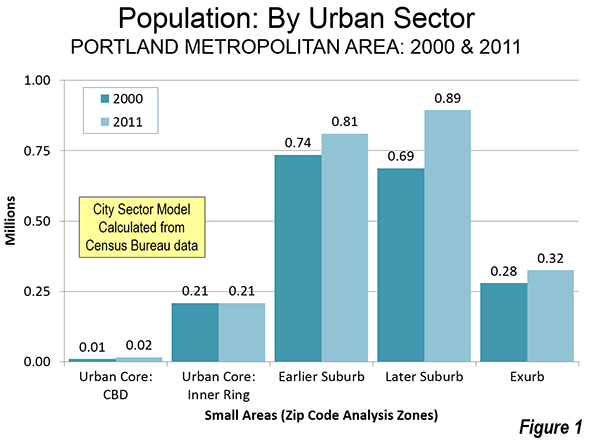
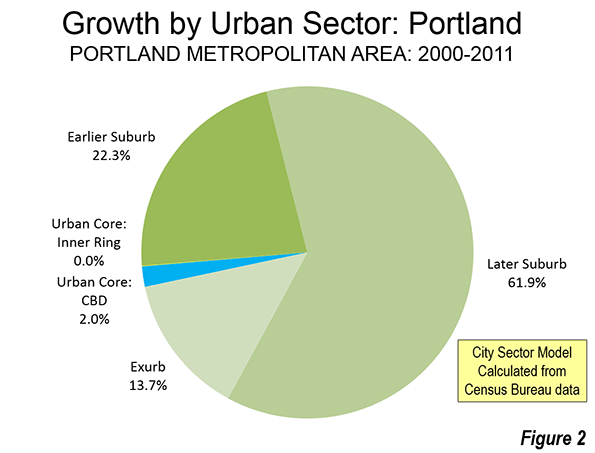
    Approximately 98 percent of Portland’s population growth between 2000 and 2011 occurred in the suburbs (Note). There was a small, but significant percentage growth around the central business district, but its addition of fewer than 7,000 residents paled by comparison to the more than 325,000 added to the suburbs and exurbs. The balance of the urban core, (the inner ring) grew by little more than 100, which is glacial for an urban sector with more than 200,000 residents (less than 0.1 percent).

    None of this should be surprising. The attractive inner city developments, especially the Pearl District, do not provide for the economic needs or wants of most people, as the population trend data indicates. Few households are drawn to buy less than one-half the space they want at nearly three times the price per square foot they would pay in outer suburbs like Forest Grove, Wilsonville or Hazel Dell.
    Job Dispersion

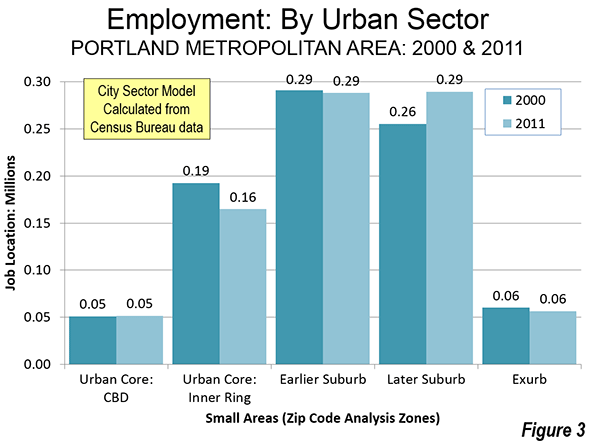
    Fortunately for both the suburbanites and an exurbanites, Portland’s job market also dispersed between 2000 and 2011, meaning that a smaller percentage of commuting was to downtown or the balance of the urban core (Figure 3). That makes it easier to drive to qualify. It turns out that while planners plan, people usually make choices that suit their basic needs rather than those of a particular urban ideology.
    Note 1: Metropolitan areas are defined by commuting patterns. Oversimplifying, metropolitan areas are organized around central counties that contain all or part of large urban areas ("built-up" urban areas). All such counties are included in the metropolitan area as well as any counties that have a strong commuting interchange with the central counties. For example, in the case of Portland, the central counties are Multnomah, Washington and Clackamas in Oregon and Clark in Washington. Columbia and Yamhill in Oregon are outlying counties as well as Skamania in Washington. Combined statistical areas are created from combinations of metropolitan areas that meet a weaker commuting interchange threshold. A complete description of the commuting thresholds that apply to metropolitan areas and combined statistical areas is found here.

    Note 2: Based on the City Sector Model (Figure 4), which classifies small areas (ZIP codes, more formally, ZIP Code Tabulation Areas, or ZCTAs) in metropolitan area in the nation based upon their behavioral functions as urban cores, suburbs or exurbs. The criteria used are generally employment and population densities and the extent of transit, versus car use. The purpose of the urban core sectors is to replicate, to the best extent possible, the urban form as it existed before World War II, when urban densities were much higher and when a far larger percentage of urban travel was on transit. The suburban and exurban sectors replicate automobile oriented suburbanization that began in the 1920s and escalated strongly following World War II. The data from 2000 is from the 2000 census. The 2011 data is from the 2009-2013 American Community Survey (mid-year 2011).
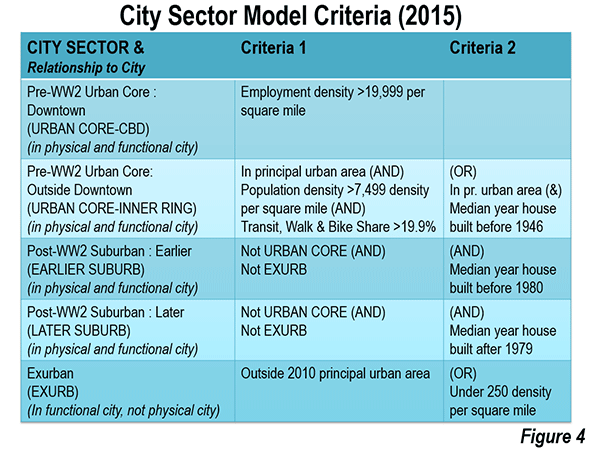
    Photo: Benton County Courthouse, Corvallis (in the Portland commuter shed) by Gregkeene (Own work) [CC BY 3.0 us or CC BY-SA 3.0], via Wikimedia Commons

    Wendell Cox is principal of Demographia, an international public policy and demographics firm. He is co-author of the "Demographia International Housing Affordability Survey" and author of "Demographia World Urban Areas" and "War on the Dream: How Anti-Sprawl Policy Threatens the Quality of Life." He was appointed to three terms on the Los Angeles County Transportation Commission, where he served with the leading city and county leadership as the only non-elected member. He served as a visiting professor at the Conservatoire National des Arts et Metiers, a national university in Paris. Wendell Cox is Chair, Housing Affordability and Municipal Policy for the Frontier Centre for Public Policy (Canada), is a Senior Fellow of the Center for Opportunity Urbanism and is a member of the Board of Advisors of the Center for Demographics and Policy at Chapman University.

  • Some Progressives Grow Disillusioned with Democracy

    Left-leaning authors often maintain that conservatives “hate democracy,” and, historically, this is somewhat true. “The political Right,” maintains the progressive economist and columnist Paul Krugman, “has always been uncomfortable with democracy.”

    But today it’s progressives themselves who, increasingly, are losing faith in democracy. Indeed, as the Obama era rushes to a less-than-glorious end, important left-of-center voices, like Matt Yglesias, now suggest that “democracy is doomed.”

    Yglesias correctly blames “the breakdown of American constitutional democracy” on both Republicans and Democrats; George W. Bush expanded federal power in the field of national defense while Barack Obama has done it mostly on domestic issues. Other prominent progressives such as American Prospect’s Robert Kuttner have made similar points, even quoting Italian wartime fascist leader Benito Mussolini about the inadequacy of democracy.

    Read the whole thing at The Orange County Register.

    Joel Kotkin is executive editor of NewGeography.com and Roger Hobbs Distinguished Fellow in Urban Studies at Chapman University, and a member of the editorial board of the Orange County Register. He is also executive director of the Houston-based Center for Opportunity Urbanism. His newest book, The New Class Conflict is now available at Amazon and Telos Press. He is also author of The City: A Global History and The Next Hundred Million: America in 2050.  He lives in Los Angeles, CA.

  • A Fix for California Water Policy

    Critics of California’s current water policy advocate more infrastructure spending on things like dams, canals, and desalination plants.  Many would also curtail water releases for the benefit of fish and other wildlife.

    Certainly, infrastructure spending would be better than wasting money on the governor’s high-speed-train fantasy.  However, California cannot spend enough money on water infrastructure to prevent water shortages.  And, solving California’s water shortage does not require an end to “dumping water” to save fish.

    California has a history of droughts lasting as long as 200 years.  You can dam every canyon in California and line the coast with desalination plants, and you won’t solve the water shortage in a 200-year drought, or even a ten-year drought.  Under the current allocation and pricing system, California will simply consume every new drop of water produced. We will have a water shortage all the same.

    Consider Westborough and Hillsborough, in the South San Francisco area. Hillsborough consumes more than four times the water per person as Westborough, just six miles away. Increasing the supply of water in California will simply allow Westborough to be more like its neighbor. The problem is how to constrain demand in places like Hillsborough.

    California policy makers prefer to use authoritarian conservation policies and police-state enforcement tactics to allocate water and control demand.  These polices do not end water shortages.  They perpetuate the shortage, and they add to the burdens imposed by energy and growth policies which are already driving businesses and people out of the state.

    Eliminating California’s water shortages in the presence of recurring droughts will require that the state resort to something truly radical — a free market in water.  This will require that ownership of water be clearly defined, that resale be allowed, and that we adopt a market-clearing price.

    We know what this looks like. Water markets equipped Australia to endure the 1995-2009 Millennium Drought. This was the worst Australian drought since European settlement.  Total water stored declined to just 27 percent of capacity. Yet water trading allowed Australian cities to avoid the most severe water restrictions. It protected agricultural businesses, and it ensured that the country’s endangered habitats and species received adequate water.

    Remarkably, in an end-of-drought survey, over 90 percent of Australian farmers reported that water markets were important to their businesses’ survival. There are many lessons for California here.  A key one is that the tension between water users is completely the creation of policy. There is no need for the tensions between the agricultural industry and California’s cities, between growers and endangered fish, between Hillsborough and Westborough, between neighbors. Water markets can balance competing uses in a way that benefits all.

    To work, markets need something to trade. The basis for trade in a functioning water market is exclusive access to a share of water from a specific body. Australian water laws provide this. California’s water laws do not.

    In California, water rights are often tied to land ownership. The right to surface- or ground-water is conferred by owning the land and often can only be transferred by selling the land. If a land owner wants to use the water, he needs only to put a straw in the ground or the stream. The landowner is entitled to “reasonable and beneficial” use of the water, but that right only extends to the borders of the property.  He can use all the water he can pump, but he has to use it on his land. There are legal barriers preventing the sale of water.

    This creates a “use it or lose it” system of water allocation, with lots of absurdities.  We have growers using sprinklers to irrigate low-value crops like alfalfa in our deserts, while neighbors shame each other for watering their lawns and cities establish water police to enforce arbitrary rationing goals.  We have huge aquifer overdrafts, with massive damage to the environment and to highways and canals.

    California water users are drawing from a common pool. Since they cannot do anything with their water except use it or lose it, an individual’s incentive is to use as much water as possible, before it’s gone and his neighbor gets it. During a drought, it’s literally a race to the bottom of the well. A functioning water market would provide each user with a specific allocation. Then, as the supply of water diminishes during a drought, remaining allocations would become more valuable, increasing the economic return to conservation.

    Prices in a functioning water market would behave just like those in any number of other healthy markets. Consider gasoline or coffee beans. Over the past year, the price of gasoline in California declined by 30 percent, reflecting new supplies and slower demand growth in some markets. In 2014, coffee bean prices increased by 72 percent, in fewer than four months, reflecting a severe drought in Brazil. Australia’s water behaves the same. During the Millennium Drought, water’s price increased by 20 times, from a low of $25 AUD per acre foot to $500 AUD. Naturally, when the rains returned, the price fell.

    California water prices are much more stable over time, but they vary a lot by geography. California municipalities see prices that vary by about 12 times. For example, Ventura pays pumping charges of just $120 per acre foot, while San Diego is purchasing desalinated water for $2,200 per acre foot. Price discrepancies like this defy economic laws. There is certainly nothing resembling a scarcity price for water.

    When you pay your personal water bill, the price that you pay does not signal that we are facing a critical water shortage. Water prices have increased incrementally, but not nearly enough to convey our dire situation. The gas lines of the 70s reminds us of what a world without scarcity pricing looks like.  Remember how quickly shortages disappeared when price controls were abandoned?

    California does not need another speech by the Governor.  It doesn’t need another legislative proposition promising additional water supply 20 years or more later (think Proposition 1). It doesn’t need more dams or canals.  Remarkably, it doesn’t even need more rain, although more rain would be nice.

    What California needs is a process to define who owns the water and how much is available.  A comprehensive rewrite of California’s water laws is the best way to achieve this, but this is probably politically impossible, especially since that rewrite would require Sacramento to cede control of water allocation to the markets.  Alternatively, California has a court-mediated alternative in place.  The process, adjudication, is far from perfect, but it can work.

    Twenty-three of California’s more than 400 groundwater basins have already undergone adjudication. While not models of efficient water use, adjudicated basins are a big improvement over non-adjudicated basins. Unfortunately, the current legal infrastructure requires a minimum of 10 years for the adjudication process to work.  This is obviously too slow to help with our immediate problem. Sacramento legislators have promised to implement policies to expedite adjudication, but we are still waiting for them to deliver. This should be California’s single highest legislative priority.

    Absent meaningful reform, litigation will take on an increasingly important role. Significant Proposition 218 cases have already been decided in San Juan Capistrano and Ventura. The Ventura case is especially noteworthy. The City sued the local water purveyor over pumping charges which are greater than those of local farmers. Suing to lower the City’s already low water prices during a severe shortage shows impressive audacity. Fortunately, an appeals court ruled that the current rate system is legal. Ventura’s pumping charges are not going down anytime soon.

    The San Juan Capistrano decision seems less helpful. There, an appeals court ruled that the City’s tiered rate system, which increases the cost of water as the number of units increases, is illegal under Proposition 218. We ask the question again, what will constrain the demand for water in places like Hillsborough? Or San Juan Capistrano? We are not qualified to object to the legal decision on its merits. But the cost of water for all users in San Juan Capistrano very likely ought to be higher than it is today. A free market in water would tell us just how much higher.

    Finally, allowing a market price for water would contribute to increased supply during droughts.  Businesses and business people are amazingly efficient at taking advantage of profit opportunities.  Who knows where water would come from if the price were higher? Water districts would have economic incentives to explore supply alternatives such as rain catchment, waste water reuse and desalination. Residents would have incentives to explore household alternatives such as grey water irrigation systems. Maybe Mexico would put in desalination plants and sell it to us? Maybe some business would use tankers to import water?  We don’t know how markets would provide the water, but they would.  We see this with oil, coffee, and every other commodity.  It’s time for California to move to a market price for water.  It’s time to end the current nonsense.

    Matthew Fienup teaches graduate econometrics and works for the Center for Economic Research and Forecasting at California Lutheran University, where he specializes in applied econometric analysis and the economics of land use. He is currently working on his PhD at the Bren School of Environmental Science and Management at the University of California Santa Barbara. He holds a Masters Degree in Economics from UCSB. Bill Watkins is a professor at California Lutheran University and runs the Center for Economic Research and Forecasting, which can be found atclucerf.org.

    Photo by TCAtexas (Own work) [CC BY-SA 3.0], via Wikimedia Commons

  • America’s Cities Mirror Baltimore’s Woes

    The rioting that swept Baltimore the past few days, sadly, was no exception, but part of a bigger trend in some of our core cities towards social and economic collapse. Rather than enjoying the much ballyhooed urban “renaissance,” many of these cities are actually in terrible shape, with miserable schools, struggling economies and a large segmented of alienated, mostly minority youths.

    We are witnessing an unwelcome reprise of the bad old days of the late ’60s, when much of American core cities went up in smoke. Already this year there have been serious disturbances in St. Louis as well as neighboring Ferguson. There’s also been a cascading of urban violence in cities such as Chicago, where the murder rate in 2013 exceeded that of the Capone era. Overall, the geography of fear remains very much what it was a half century ago. The most dangerous places in in the U.S. in terms of violent crime tend to be heavily black cities, led by Detroit, Oakland, Memphis, St. Louis, and Cleveland. Baltimore ranks sixth.

    Of course not everything is as it was. Some cities, notably New York and Los Angeles, are much safer today, and there remains a strong pull for younger people, particularly the well-educated, to move to core cities, at least in their 20s. Black urban professionals enjoy opportunities that were rare a generation ago to reach the highest levels in our most elite cities.

    But, as Baltimore makes clear, we are still very far from what Aaron Ehrenhalt has labeled the “great inversion,” in which our cities change into affluent redoubts while the suburbs devolve into future slums. In reality, this is very far from the truth: cities are, if anything, becoming more bifurcated than ever, with a large, and seemingly unmovable, population that has benefited little from the gentrification of some urban neighborhoods, including some in Baltimore itself.

    The Persistence of Concentrated Poverty

    Perhaps the biggest sign of how limited the urban renaissance has been is to look at the growth of precisely the kind of highly concentrated poor areas like those that blew up in Baltimore. Yet although the suburbs’ share of poverty may have increased, the average poverty rate in the historical core municipalities in the 52 largest U.S. metro areas remains at 24.1 percent, more than double the 11.7 percent rate in suburban areas—despite a considerable urban turnaround in this period.

    BALTIMORE, MD - AUGUST 20: Vacant houses on August 20, 2010 in Baltimore, Maryland . There are an estimated 30,000 vacant homes in Baltimore. More than one third of these buildings are now owned by the city.  (Photo by David S. Holloway/Getty Images)David S. Holloway/Getty

    In fact, neighborhoods suffering entrenched urban poverty (PDF) actually grew in the first decade of the new millennium, increasing in numbers from 1,100 to 3,100 and in population from two to four million. In other words, poverty spread but also became far more intense in cities. “This growing concentration of poverty,” note urban researchers Joe Cortright and Dillon Mahmoudi, “is the biggest problem confronting American cities.”

    Certainly Sandtown-Winchester—where Freddie Gray, whose death sparked the riots, grew up—fits this mode. As the liberal Think Progress website explains, more than half of that neighborhood’s people between the ages of 16 and 64 are out of work and the unemployment rate is double that for the rest of the city. Median income is below the poverty line for a family of four, and nearly a third of families live in poverty. About a quarter to a third of the buildings are vacant, compared to 5 percent in the city as a whole.

    Yet the people in these neighborhoods do not represent the majority of black America. Besides the gap between blacks and whites, there is also a growing one among African-Americans themselves. This is painfully obvious in the Baltimore region which, extending to the Washington, D.C., suburbs, has some of the highest black wages and homeownership rates of any of the county, and ranks among the best places for African-Americans in a new study I co-authored for the Center for Opportunity Urbanism.

    In fact, five of the ten wealthiest black communities in America are in Maryland. Needless to say, residents in those towns are not rioting. There is an increasingly enormous gap between entrenched poor communities, such as those in Baltimore, and a rapidly expanding black suburban population. Barely half of the 775,000 African-Americans in the Baltimore metropolitan region live in the city, and those outside do far better than inside the city limits. In the last decade, suburban Baltimore County added160,000 blacks, far more than moved into the city (PDF). The black suburbanites not only make more money than their urban counterparts but their life expectancy (PDF) is at least eight years longer.

    These trends can be seen nationwide. In the last two decades of the 20th century, more blacks moved into the suburbs than in the previous 70 years, a trend that continues unabated. The 2010 Census indicated that 56 percent of African Americans in major metropolitan areas live in the suburbs. This movement was particularly marked among families with children; the number of black children living in cities like New York, Oakland, Atlanta, Los Angeles all dropped precipitously, as families sought out safer streets, better schools, and more affordable space.

    The Changing Nature of Urban Economies

    African-Americans came to Baltimore and other northern cities in large part to work in the steel, port, and other blue collar, industrial businesses that flourished in mid-century America. Yet most of those jobs are now gone, leaving behind those who must scramble to find work in the growth industries of today—education, technology, medical services. This is the case in almost all heavily black cities, not only in the Northeast, but the Midwest and even parts of coastal California. But today’s star urban industries, notably technology and high-end business services, employ few working class blacks. African-Americans, for example, occupy only the tiniest sliver of jobs—roughly 2 percent—in Silicon Valley. Nor have African Americans done well in the tech boom, driven by software-related firms more likely to staff themselves with Indian technocoolies than boys up from the ’hood. Between 2009 and 2011, earnings dropped 18 percent for blacks and 5 percent for Latinos, according to a 2013 Joint Venture Silicon Valley report.

    Overall the places where these industries have grown often produce not more opportunities for poor people or minorities but rather a subtle form of “ethnic cleansing.” A recent report from the Urban League, for example, pointed out that the very cities most praised as exemplars of urban revival—San Francisco, Chicago and Minneapolis—also suffer the largest gaps between black and white incomes. Notwithstanding the rhetoric, much of the “hip cool” world increasingly consists of monotonic “white cities” with relatively low, and falling, minority populations, such as San FranciscoPortland, and Seattle. These places are achingly political correct in theory, but are actually becoming whiter and less ethnically diverse as the rest of the country diversifies. The situation has changed so much that former MayorGavin Newsom even initiated a task force to address black out-migration.

    Inverting the Inversion

    Baltimore proves that the “great inversion,” insofar as it exists at all, positively affects a relatively small part of the urban population, particularly in historically black cities. Cities may well have become a popular abode for the young, well-educated, and the rich (usually white), but they also contain another, usually much larger population of those, mostly minorities, who have been left behind in the urban evolution. Midwestern urban analyst Pete Saunders describes Chicago in this manner: “one third San Francisco, two thirds Detroit.”

    This is precisely what we see in Baltimore and many traditionally black cities. Everything that does not work in cities today—education, for example, and sometimes law enforcement—most directly affects minorities and the poor. Crime may be down overall in many cities, but not necessarily in predominately minority neighborhoods. As blogger Daniel Hertz has demonstrated, violent crime has actually increased since the early ’90s in several large, predominately African-American Chicago neighborhoods.

    Clearly what we are seeing then is not an urban kumbaya you see in TV ads for fast food and web services, but a hardening of class and racial divisions. Suburban poverty and crime may have increased in recent years, but they are not nearly as entrenched on the periphery as they are in the city. Places like inner Baltimore function essentially as a kind of dead-end, a cul-de-sac for dreams of a better future.

    The Changing Geography of African-American Opportunity

    We are witnessing a very unwelcome resurgence of racial tensions over the past six years, with concern about racism at the highest level since the Rodney King riots in 1992. Today, particularly in the divisive aftermath of Ferguson and other police-related controversies, two in five Americans feel race relations have gotten worse since President Obama took office, while only 15 percent thought they had gotten better.

    How do we reverse this ugly trend? Sadly it takes more than good intentions and handouts. To be sure, the initial Great Society programs helped reduce chronic black poverty. But the poverty rate was already dropping: in the prosperous early ’60s, black poverty plummeted from 56 percent to 34 percent; in contrast, in the years after President Lyndon Johnson launched the war on poverty, it dropped only slightly, to 32 percent. But by the ’70s this progress—despite the implementation of such programs as affirmative action—slowed to a crawl, in large part due to cascading social problems, particularly in industrial cities like Baltimore.

    Many progressives have blamed conservatives starting with President Reagan for the conditions that still prevail for many African Americans. Yet it turns out that expansive era was pretty good for blacks, if not for their leaders. Even as poverty spending growth slowed, the poverty rate dropped in the Reagan years to around 30 percent for African-Americans. Similarly the economic boom of the Clinton era saw even greater progress, with poverty dropping to 25 percent. It began to rise again, albeit slowly, during the tepid recovery of the Bush era, but then began to rise more steeply during the Great Recession, and through the slow, and also tepid, recovery of the Obama years.

    Clearly an improved economy is more important than ramping up social spending. Indeed, according to USC’s Luke Phillips, states. like New York, Massachusetts , California and Illinois spend almost twice as much on welfare payments than do states like North Carolina, Texas, or Florida, both in terms of GDP and state spending. Yet the best results for African Americans in our Center for Opportunity Urbanism study were found overwhelmingly in the former Confederacy, states generally not well known for their generosity to the poor or interest in racial redress.

    This is leading to a stunning reversal in black migration patterns. Between 1910 and 1970 six million African Americans migrated from the South to the North in what became known as the Great Migration. But since World War II the migration has changed course: ambitious blacks now head toward the suburbs, or the South. Between 2000 and 2013, the African American populations of Atlanta, Charlotte, Orlando, Houston, Dallas-Fort Worth, Raleigh, Tampa-St. Petersburg, and San Antonio all experienced growth of close to 40 percent or higher, well above the average of 27 percent for the 52 metropolitan areas.

    “Blacks who have relocated tend to be either retirees or well-educated, well-off middle-agers with children,” John Giggie, associate professor of history and director of graduate studies at the University of Alabama in Tuscaloosa, toldBET.com. They move to the South not because they like the politics (most probably don’t) but because they seek economic progress. Part of the reason may be that sunbelt cities have more broad based opportunites for middle and working class residents than have the increasingly post-industrial economies of California and the Northeast corridor.

    Our leadership class, black and white, misses all this. Sending Al Sharpton, President Obama’s highly publicized advisor, to Baltimore hardly bodes well for improving things on the ground. A little bit of catharsis, perhaps, but at some point you need to deal with reality.

    It would be far better if some CEOs or investors—American, Asian, or European—came to the old Chesapeake city bearing plans for expanding jobs and opportunities. That, at least, would begin to address the economic and social isolation that, inevitably, finds its expression in fires on the street. Good jobs and the prospect of a better future—not good intentions—is what ultimately matters.

    This piece first appeared at The Daily Beast.

    Joel Kotkin is executive editor of NewGeography.com and Roger Hobbs Distinguished Fellow in Urban Studies at Chapman University, and a member of the editorial board of the Orange County Register. He is also executive director of the Houston-based Center for Opportunity Urbanism. His newest book, The New Class Conflict is now available at Amazon and Telos Press. He is also author of The City: A Global History and The Next Hundred Million: America in 2050.  He lives in Los Angeles, CA.

    Photo by Voice of America, Victoria Macchi

  • Silicon Valley: Jelly in the Jam

    My last post was about how Silicon Valley is evolving into an urban form that’s not quite leafy and open enough to be a suburb anymore, but not really vibrant and compact enough to be a proper city either. “Too thin to be jelly. Too thick to be jam.” The story got an unusually large number of visits. I received some well informed comments that touched on the reality that Silicon Valley is a big place and I shouldn’t generalize. Palo Alto is very different from Fremont and so on. It’s not all isolated corporate enclaves. Fair enough. So here’s a quick follow up that explores the jelly in the jam.

    Screen Shot 2015-04-16 at 2.29.01 PM
    Google


    Screen Shot 2015-04-15 at 10.26.37 PM Screen Shot 2015-04-15 at 10.25.31 PM Screen Shot 2015-04-15 at 10.30.58 PM Screen Shot 2015-04-15 at 10.27.11 PM Screen Shot 2015-04-15 at 10.25.01 PM

    This is the town of San Carlos twenty five miles south of San Francisco and an equal distance north of San Jose. We all have our biases. I’m partial to the kind of walkable Main Street small town that was common everywhere a century ago. I like a place with mom and pop shops and a mix of modest cottages and grand stately homes a few blocks in each direction. For me that’s the perfect balance of city and suburb. A Main Street provides a broad range of activities while accommodating pedestrians, cyclists, and cars without prejudice. These places can also be well served by public transit – not so much to get around town, but to efficiently connect people to other towns that are also walkable. If these small towns are then surrounded by working farms and a bit of nature all the better. Toss in a nearby city for access to culture and jobs and I’m in heaven. But such places are hard to come by in America these days. Fortunately, Silicon Valley has a string of such places along the historic rail line like little gems imbedded in the post WWII sprawl.

    Screen Shot 2015-04-17 at 4.55.51 AM
    Google Screen Shot 2015-04-17 at 4.57.12 AM
    Google   Screen Shot 2015-04-15 at 10.14.31 PM Screen Shot 2015-04-15 at 10.16.33 PM Screen Shot 2015-04-15 at 10.16.08 PM Screen Shot 2015-04-15 at 10.17.11 PM

    San Carlos sits between two major freeways and right on El Camino Real and the CalTrain line that serves the entire peninsula. It’s possible to navigate most parts of San Carlos as a pedestrian, hop on a train or a bus, or drive to just about everything in the Bay Area. You have a lot of transportation choices that are equally good. What’s more important to me personally is that being a pedestrian or cyclist is actually pleasant in San Carlos. Transit within most of the town itself is entirely unnecessary. There are areas up in the hills with a lot of twisting cul-de-sacs that are more manageable in a car, but there’s at least a continuum of housing options including small apartment buildings next to shops downtown. People can select their own personal sweet spot.

    Screen Shot 2015-04-15 at 10.12.50 PM Screen Shot 2015-04-15 at 10.13.14 PM Screen Shot 2015-04-15 at 10.13.31 PM Screen Shot 2015-04-15 at 10.13.43 PM Screen Shot 2015-04-15 at 10.14.00 PM Screen Shot 2015-04-15 at 10.14.16 PM

    There are relatively “affordable” $950,000 bungalows (this is the Bay Area) while the big fancy homes up on the hill with water views sell for $7,000,000. I understand these numbers seem ridiculous to people in other parts of the country, but San Carlos has immediate access to very well paid jobs so these prices are justified based on local incomes. If you have the money it’s a great place to raise a family with excellent public schools and a safe clean environment. It’s also a pretty fabulous retirement spot if you decide to age in place. And it isn’t terrible to be a young single person in San Carlos either. That little downtown and the train station make all the difference. You’ll find the same basic arrangements in similar older towns along the train line: Burlingame, San Mateo, Menlo Park, Mountain View, and so on.

    Screen Shot 2015-04-18 at 4.09.16 PM Screen Shot 2015-04-18 at 4.08.41 PM Screen Shot 2015-04-18 at 4.08.13 PM Screen Shot 2015-04-18 at 4.09.02 PM

    Here’s another point that’s often overlooked by city planners obsessed with making everything pretty or attracting the right demographic to their town. Every town needs some ugly utilitarian stuff. Even in a place where schmaltzy tract homes sell for a million bucks people still need plumbers, electricians, and low grade warehouses. If a town zones or redevelops these areas out of existence they induce more people to get into their cars and trucks to commute to distant industrial parks in a region where freeway traffic already comes to a complete halt during most business hours. And these suburban warehouse districts are also excellent buffers from the ugliness and noise of freeways and rail lines. No one wants to live pressed up against a diesel train or freeway interchange full of tractor trailers. It’s often a mistake to see these light industrial areas as redevelopment opportunities for dense infill housing.

    Screen Shot 2015-04-17 at 7.03.28 AM
    Google

    Some of the comments I received from my last post mentioned recent projects that brought transit and density to some Silicon Valley suburbs. This is San Bruno, home to tech companies like YouTube. It has all the same advantages of San Carlos: immediate access to good jobs and nearby culture, the same freeways, El Camino Real, a BART rail station, similar single family housing stock, and so on. But the two towns are very different. I would love to live in San Carlos, but I could never live in San Bruno. Here’s why.

    Screen Shot 2015-04-17 at 7.16.22 AM Screen Shot 2015-04-17 at 7.22.27 AM Screen Shot 2015-04-17 at 7.17.37 AM Screen Shot 2015-04-17 at 7.11.50 AM 

    San Bruno was built after cars had come to dominate the landscape. There never was much of a town and everything built over the last sixty or seventy years has been organized around the freeways. A rail station in a shopping mall parking lot that’s cut off by massive twelve lane roads is just miserable for pedestrians and of little use to people in cars. There are plenty of people on foot in San Bruno, but they’re very poorly served in this environment.

    Screen Shot 2015-04-17 at 5.16.41 AM
    GoogleScreen Shot 2015-04-17 at 7.11.21 AM Screen Shot 2015-04-17 at 7.14.03 AM Screen Shot 2015-04-17 at 7.15.51 AM Screen Shot 2015-04-17 at 7.11.09 AM Screen Shot 2015-04-17 at 7.13.45 AM

    Density and transit all by themselves do nothing for a town if the public realm is completely car oriented. These new infill apartment buildings are perfectly respectable and I’m sure they’re very comfortable on the inside. But once you step outdoors you find yourself in the left over space between parking lots and highways. You can physically walk to the supermarket and the dentist and the train station so it checks off a lot of boxes on the “Smart Growth” list, but you feel like a social outcast as you schlep around the edge of speeding vehicles. The scale is out of whack with human needs because the needs of cars always come first. Adding apartments and giant parking garages to a suburban environment also adds that many more cars to the already congested roads. This kind of development bothers people who want a traditional suburb and it falls short for people who want a genuine urban experience. As I walked around this cluster of apartments I thought about how it could have been done better. What if the ground floors had shops in them? What if the sidewalks were wider? What if the roads were more narrow? What if the buildings were organized around outdoor public space instead of having the greenery sprinkled around the edges in useless landscaped berms and highway medians?

    Screen Shot 2015-04-17 at 5.19.18 AM
    Google Screen Shot 2015-04-18 at 12.36.51 PMScreen Shot 2015-04-18 at 12.26.02 PMScreen Shot 2015-04-18 at 12.25.06 PM Screen Shot 2015-04-18 at 12.42.29 PM

    As I made my way from one suburban train station to the next I discovered another infill project that actually made an effort to do many of the things on my list. Wide sidewalks? Check. Meaningful public space? Check. Shops on the ground floor? Check. At least a few narrow side streets? Check. Train station around the corner? Check. This place was significantly better. But… context is important.

    Screen Shot 2015-04-17 at 9.24.59 PM
    Google

    Here’s a Google Earth view of the area in which I colored the roads, surface parking lots, and multi-story parking garages blue. What would you call that building to pavement ratio? It looks like 60/40 to me in favor of pavement. The largest garage is owned by BART and is designed to collect suburban drivers and funnel them into the city by train for the last little stretch of the commute. This kind of train station is a highway patch to relieve traffic congestion in the city. It has nothing at all to do with “transit” or any kind of urbanism. It’s a clumsy and expensive prosthetic limb for cars and highways.

    Screen Shot 2015-04-18 at 12.36.19 PM Screen Shot 2015-04-18 at 12.35.53 PM Screen Shot 2015-04-18 at 12.34.29 PM Screen Shot 2015-04-18 at 12.20.32 PM

    Here’s what it looks like on the ground. This well intentioned mixed use infill project is an island in the middle of the usual suburban sprawl. I’m quite certain that the people who live in the single family homes across the street drive to the Trader Joe’s market even though it’s only a block away. If I had to choose a spot to live this place is marginally better than San Bruno, but still an order of magnitude worse than San Carlos. And I should point out that San Carlos has a downtown of mostly one story buildings surrounded by much smaller apartment buildings than these and a majority of detached single family homes. “Density” has nothing to do with the success or failure of good urbanism.

    Screen Shot 2015-04-18 at 12.37.48 PM Screen Shot 2015-04-18 at 12.41.36 PM Screen Shot 2015-04-18 at 12.33.46 PM Screen Shot 2015-04-18 at 1.50.29 PM Screen Shot 2015-04-18 at 1.51.16 PM

    Here’s the sad part. Even after what must have been an heroic effort on the part of everyone involved in getting this project built it still fails to cultivate enough foot or vehicular traffic to support small shops. The Trader Joe’s and the Starbucks are doing well enough, no doubt feeding off the morning and evening commuter flows from the BART station. And there is a small dry cleaner that’s managing to get by so far. But the rest of the storefronts are empty and have been so from the get go. Too thick to be jam. Too thin to be jelly. I keep wanting suburban retrofits to work, but they rarely do. The typical suburban chassis makes incremental urbanism a hit or miss affair. Mostly miss. The question is… what are the alternatives? Do we just let the cost of the existing single family homes rise until people and businesses pick up and move to Scottsdale or Orlando in search of economic relief? Do we let taxes rise on all the strip malls and gas stations until the necessary funds appear to repave all the twelve lane roads out in front of them? Or is mediocre the best we can expect from half assed infill projects that do the best they can under the circumstances?

    John Sanphillippo lives in San Francisco and blogs about urbanism, adaptation, and resilience at granolashotgun.com. He’s a member of the Congress for New Urbanism, films videos for faircompanies.com, and is a regular contributor to Strongtowns.org. He earns his living by buying, renovating, and renting undervalued properties in places that have good long term prospects. He is a graduate of Rutgers University.

  • Building a New California

    The Golden State has historically led the United States and the world in technology, quality of life, social innovation, entertainment, and public policy. But in recent decades its lead has ebbed. The reasons for this are various. But there is one area of decay whose story is a parable for California’s other plights—that area is infrastructure.

    California’s infrastructure, like California, has had a golden past full of larger-than-life personalities and heroic deeds. But in recent decades the state has lost its innovative edge, resting on the laurels of its past successes without adequately preparing for any such bold endeavors in the future. California’s infrastructure imperative, then, is this: to accomplish bold, ambitious projects that promise a transformed and vibrant future for California, yet are still practical and sensible, and have proven viability.

    Should California manage to get its act together and embark upon a course of infrastructure renewal, it will be taking one of several steps necessary to transform itself into an opportunity society again. Systemic reforms beyond infrastructure will be necessary to renew Californian society and lower the cost of living, raise the quality of life, and create opportunities for entrepreneurs and middle-class families. But infrastructure is a fantastic place to start.

    Aside from basic infrastructure renewal like fixing up roads and bridges, expanding our water storage capacity, and reforming public policy and internet regulation to provide a world-class infostructure, there are three main physical infrastructure projects California should be focusing on to bring the state forward into the 21st Century. These are driverless car networks, a new nuclear energy grid, and an archipelago of desalination plants.

    The current strategy for the future of California’s transportation system is wildly unrealistic. Passenger rail is simply too ineffective to justify building an expensive new High Speed Rail system that wouldn’t even be able to pay for itself. Commuter rail usage rates have been on the decline. A better way forward would be to embrace the power of computerization in the transport sector, and put our population on a path towards using self-driving cars.

    The benefits of a driverless car network are numerous. They include greater safety, optimized traffic flow, reduced congestion, higher productivity, and cheaper, more effective travel for those unable to afford a car. The possibilities are endless. Already a test range at the University of Michigan is exploring what a driverless car system would look like. One could expect such a system to seriously reduce traffic congestion, improve transport speeds, conserve energy, nearly eliminate accidents, increase worker productivity, and generally revolutionize driving.

    So how could California go about transitioning to a driverless car system? In the short run, there wouldn’t be much in the way of new construction to worry about. It’s mostly a question of technological investment and regulatory reform.

    First, the state of California should partner with major universities and tech firms currently working on driverless car systems, and fund research and innovation projects geared towards enhancing the vehicles.

    Once driverless cars are tested, California should work to lower the barriers to their deployment. This might include reforming insurance and licensing laws, to make it easier for people to purchase one. It would also help to offer incentives for middle-class individuals to purchase these new vehicles, too, such as tax deductions.

    As with all public goods and services, government policy towards transportation ought to be designed with providing the widest array of convenient options for consumers, rather than forcing people into a single system or expecting them to use costly, uneconomical, heavily subsidized services. The call for a driverless car system is not to rid the roads of traditional vehicles. Nor is this a call to abandon rail or buses or cease investing in bike paths and walkways. This plan, rather, would seek to make one particularly middle-class-convenient option more available.

    The next area California should focus on is its energy generation system, through a new nuclear generator fleet. Currently California generates energy with a combination of coal, oil, natural gas, and renewable power. Governor Brown has launched ambitious initiatives to have as much as 50% of the state’s electricity generated by renewables within a few decades (which doesn’t do anything to make energy cheaper for working and middle-class citizens and families, much less businesses.) Meanwhile the state’s use of fossil fuels for energy generation for backup continues to grow as unstable renewable energy sources go online.

    We need an ambitious energy infrastructure plan if we are to both provide cheap, readily-available energy to the masses of California’s citizens (and thus provide them with a lower cost of living and higher quality of life) and to continue the state’s commitment to combatting climate change. Incidentally, there is a way to achieve both of these goals, while growing the state’s economy at the same time. California should open its fossil fuel fields to exploitation, levy a carbon tax on the profits, and use that revenue from the carbon tax to fund an ambitious nuclear program that could generate a majority of the state’s electricity within a few decades.

    California’s antipathy toward fossil fuels has led it to impose onerous regulations that hurt growth and provide little environmental reward; the deposits of oil and gas off the coast and in the interior have been made even more accessible by the fracking revolution, and if it wanted to, California could become an energy giant. So California could open its fields for drilling, fighting off regulations and lawsuits by various anti-oil interest groups, and begin reaping huge revenues through the imposition of a light carbon tax.

    This light carbon tax would go towards funding research in advanced nuclear energy, and towards a fund for establishing a fleet of a dozen or so advanced nuclear plants across the state. This would signify California’s continued commitment to reducing carbon emissions and adopting advanced energy.

    These new nuclear reactors are not the hulking behemoths of Three Mile Island. Some new reactors have been designed to be as small as a car and power a small city. They are extremely safe. And, far more importantly, nuclear energy is the gift that keeps on giving. In civilizational terms, nuclear energy can power our society forever. And it provides far more bang for the buck than solar or wind, the current green fetish power sources.

    Finally, California seriously needs to confront the water scarcity challenge that has perennially afflicted it throughout its history, and seek a permanent solution for providing cheap and plentiful water to the residents of this parched coastal strip. Desalination is the best way to secure that.

    We are currently in the midst of what appears to be the worst drought California has faced in its entire history as a state, and this does not bode well for the future growth of California. Adequate water is one of those resources that every civilization has depended on. Although California is not literally “down to one year of water” as a recent LA Times article misleadingly claims, we are in a shortage that is economically catastrophic, environmentally devastating, and entirely unnecessary- for it is man-made. Better water policy in past years, allowing Californians to use more of their river water, could have staved it off, as could better storage infrastructure construction. But these projects and policies were never put in place to the degree necessary to stop this drought from happening.

    Rationing and conservation may indeed be the short-term solution, but we need to look to a longer-term solution- and buying more water from other states doesn’t solve the problem.

    Many arid coastal countries – including Australia, Israel, and some of the Persian Gulf states – use desalination plants to water their burgeoning populations, and it is something of a miracle that Southern California has gotten by without such systems. We have a long coastline on which we could build numerous desalination plants, powered by the aforementioned fleet of nuclear reactors. This system could more than satisfy the needs of California residents, farmers, and industries, while simultaneously reducing the pressure on our streams, rivers, and reservoirs.  It would be incredibly capital-intensive and costly, and would perhaps lead to some unforeseen environmental consequences. But it is a better water policy than what we are doing now.

    This infrastructure program would likely require budget, tax and regulatory reform, as well as the broad support of the majority of Californians. It would represent a reasonable response to the now excessive power of the environmental lobby.

    But more than fiscal reform and public support, it would require a newfound political moxie in both the private sector and the public sector. We need a new generation of visionary William Mullhollands, Henry Huntingtons,  and Pat Browns to pursue these and other reforms to turn our Golden State golden again.

    Can it be done? With some political maneuvering and engineering ingenuity, sure. Will it be done? That’s a choice that our next generation of political leaders will have to make for themselves.

    Luke Phillips is a student studying International Relations at the University of Southern California. He is an editorial intern for the magazine The American Interest and a research associate at the Center for Opportunity Urbanism.

  • America’s Mid-Sized Metropolitan Areas

    The United States has 53 mid-sized metropolitan areas, with populations from 500,000 to 1 million. These metropolitan areas together had a population of nearly 38 million in 2014, according to the most recent Census Bureau population estimates (Table). In number, they match the 53 major metropolitan areas (over 1 million population), though they have only one fifth of the population (178 million). The mid-sized metropolitan areas are growing somewhat slower than the major metropolitan areas, at an annual rate of 0.81% between 2010 and 2014, compared to 1.00% in the major metropolitan areas. Combined, the major metropolitan areas and the mid-sized metropolitan areas have two-thirds of the US population.

    Largest Mid-Sized Metropolitan Areas

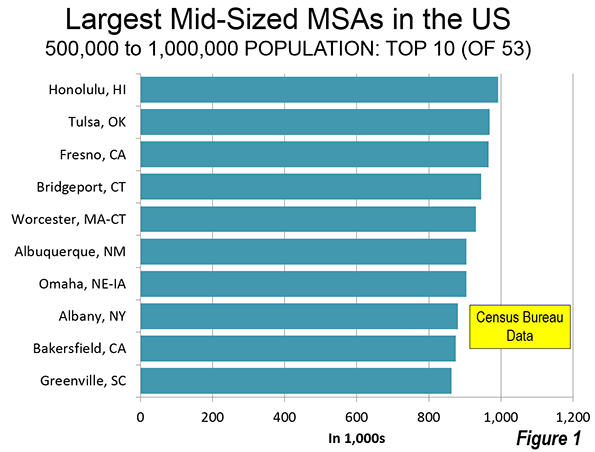
    Honolulu is the largest, with a population of 991,000. Honolulu seems destined to graduate into the major metropolitan category, though its growth rate over the last year could indicate this will occur in 2016 or later, rather than 2015 which appeared to be likely from earlier data. Tulsa, Oklahoma’s second largest metropolitan area, is growing somewhat more slowly, but seems likely to pass the million mark by the 2020 census. Third-ranked Fresno is growing somewhat faster and should also reach 1 million population by 2020. Bridgeport, which is a part of the New York Combined Statistical Area (Note) has grown almost as fast as the other three since 2010, though like Honolulu, its growth rate in the past year has been halved. Bridgeport has an outside chance of reaching 1 million by the 2020 census.

    The next three fastest-growing metropolitan areas, (Worcester, Albuquerque, and Omaha) all have populations exceeding 900,000. Worcester is experiencing the slow growth that would be expected for the Northeastern metropolitan area and is unlikely to reach 1 million this decade. Surprisingly, Albuquerque is growing almost as slowly and its 2014 growth was well below its previous three-year rate. Albuquerque has typically been a fast-growing metropolitan area. Omaha, which ranks seventh is the fastest growing of this group, sustaining a growth rate of about 1.0%, which is above the national average. Omaha should reach 1 million before 2030.

    The ninth and 10th largest mid-sized metropolitan areas are growing more strongly than average. This includes Bakersfield and Greenville (SC), both of which should reach 1 million before 2030 (Figure 1). Greenville is the only other metropolitan area in the top 10 growing at a rate above 1.0 percent (1.08 percent). By contrast five of the top 10 major metropolitan areas are growing at above 1.0 percent (Dallas-Fort Worth, Houston, Washington, Miami, and Atlanta).

    Among the top 10, all but Albany, Albuquerque and Omaha are single county metropolitan areas. Metropolitan areas are made up of complete counties, only three are single counties (San Diego, Las Vegas, and Tucson). Among the mid-sized metropolitan areas, their smaller size means that many more are composed of single counties.

    Smallest Mid-Sized Metropolitan Areas

    There were two new entries to the list of mid-sized metropolitan areas in 2014. One was Fayetteville (AR-MO), home of both the Wal-Mart world headquarters (Bentonville, AR) and the University of Arkansas. Santa Rosa, which is an exurban metropolitan area in the San Francisco Combined Statistical Area was also added.

    Fastest Growing Mid-Sized Metropolitan Areas

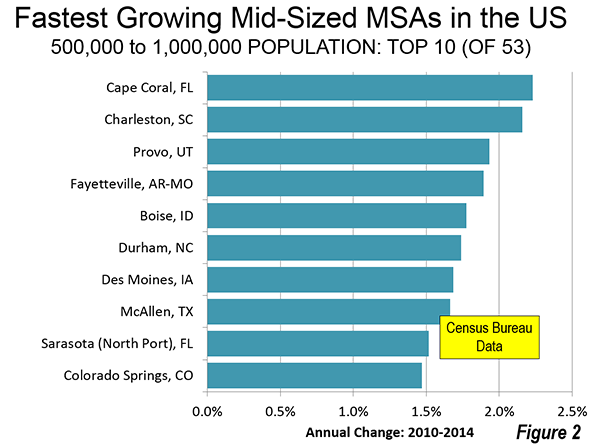
    The 10 fastest growing mid-sized metropolitan areas are from every major region of the country except for the Northeast. Cape Coral, FL was the fastest growing between 2010 and 2014. Its growth rate picked up substantially in 2013 to 2014. Cape Coral (formerly called Fort Myers) was hit particularly hard by the real estate bust of the late 2000s. The core municipality itself has not only the usual street system, but an extensive canal system (photo above). It is hard to imagine a metropolitan area that feels less urban.

    Charleston, SC was second ranked, nearly equaling the growth rate of Cape Coral. Four other Southern metropolitan areas were among the fastest growing, including Fayetteville, AR-MO (4th), academic and research center Durham, NC (6th), which is a part of the Raleigh Combined Statistical Area. The other Southern entries were Rio Grande Valley and border metropolitan area McAllen, TX and Sarasota (North Port), FL. Current growth rates indicate that Charleston and McAllen should exceed 1,000,000 by 2030, while chances for Sarasota and Cape Coral are somewhat less (Figure 2).

    Three of the fastest growing mid-sized metropolitan areas were in the West, including Provo, UT, Boise, ID and Colorado Springs. Des Moines, was the only Midwestern metropolitan area among the fastest growing.

    Slowest Growing Mid-Sized Metropolitan Areas

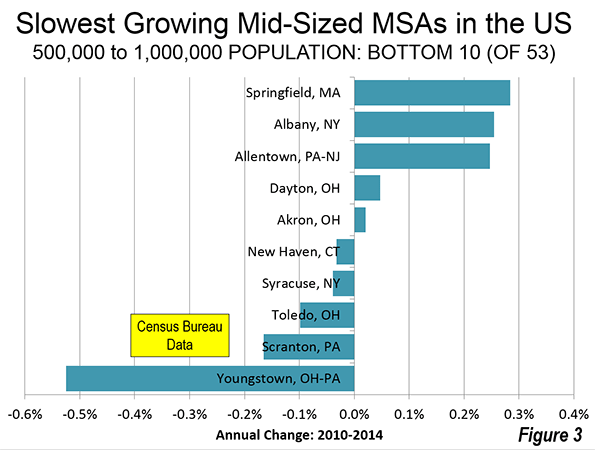
    Virtually all of the slowest growing mid-sized metropolitan areas are former industrial behemoths that lost out in the competition for survival in the Northeast and Midwest. A visit to any of these cities will reveal either a relatively strong pre-World War II central business district or the remains of one. Each of these has a built form that looks more like Louisville or Cincinnati than the dominant pattern for new metropolitan areas that developed with a far more modest density gradient and with much weaker cores.

    Five of the slowest growing are actually losing population. Since 2010, Youngstown has lost an average of 0.5% of its population annually. Scranton (Wilkes-Barre), PA continues its eight decade decline. The list also includes Toledo; Syracuse; Akron; Dayton; and Springfield, MA; which once had been strong manufacturing centers. The list also includes New Haven, which also lost population despite being home to Yale University. Allentown is also an old manufacturing center, but has recently been added to the New York Combined Statistical Area, indicating the expansion of the nation’s largest labor market. Perhaps the most unusual of the bottom 10 in growth is Albany, NY, which is one of the largest state government centers in the United States. Certainly, the Albany area has lost much of its industrial base, but a large government presence often can compensate for such losses.

    Prospects

    The list of mid-sized metropolitan areas is fluid. As noted above, a number of mid-sized metropolitan areas could move into the major metropolitan category before 2020 or 2030. On the other hand, there will be new mid-sized metropolitan areas. Three seem likely to be added by the 2020 census (Lexington, KY, Lafayette, LA and Pensacola, FL). There should be a rush of new mid-sized metropolitan areas between 2020 and 2030, at current growth rates. This could include Visalia, CA; Springfield, MO; Corpus Christi, TX; Port St. Lucci, FL; Reno, NV; Asheville, NC; Huntsville, AL; Santa Barbara, CA; and Myrtle Beach, SC.

    Note: Combined Statistical Areas are larger labor markets that are combinations of metropolitan areas. The commuting exchange between these metropolitan areas is less than that required to be included in a metropolitan area. Perhaps the most notable examples of combined statistical areas are New York, Los Angeles and San Francisco. The New York CSA which extends from the metropolitan area to include New Haven and Bridgeport in Connecticut and Allentown in Pennsylvania and New Jersey. The Los Angeles CSA includes the Riverside-San Bernardino and Oxnard metropolitan areas. The San Francisco CSA includes the San Francisco metropolitan area, the San Jose metropolitan area and the smaller metropolitan areas of Santa Rosa, Santa Cruz, Vallejo and Stockton (added since 2010).

    Mid-Sized Metropolitan Areas (US)
    Population: 500,000 to 1,000,000: 2010-2014
    Population 2013-2014
    Rank Metropolitan Area 2010 2013 2014 Annual % Change: 2010-2014 Rank % Change: 2010-2014
    1 Honolulu, HI 953 987 992 0.94%        21 0.48%
    2 Tulsa, OK 937 962 969 0.79%        25 0.71%
    3 Fresno, CA 930 956 966 0.89%        22 1.03%
    4 Bridgeport, CT 917 942 945 0.73%        29 0.35%
    5 Worcester, MA-CT 917 928 930 0.34%        43 0.26%
    6 Albuquerque, NM 887 903 905 0.46%        39 0.14%
    7 Omaha, NE-IA 865 896 904 1.04%        15 0.99%
    8 Albany, NY 871 878 880 0.25%        45 0.19%
    9 Bakersfield, CA 840 866 875 0.96%        19 1.00%
    10 Greenville, SC 824 850 862 1.08%        14 1.42%
    11 New Haven, CT 862 863 861 -0.03%        49 -0.20%
    12 Knoxville, TN 838 852 858 0.56%        36 0.66%
    13 Oxnard, CA 823 841 846 0.65%        32 0.62%
    14 El Paso, TX 804 835 837 0.94%        20 0.25%
    15 McAllen, TX 775 819 831 1.66%          8 1.48%
    16 Allentown, PA-NJ 821 827 830 0.25%        46 0.34%
    17 Baton Rouge, LA 802 820 825 0.67%        31 0.62%
    18 Dayton, OH 799 802 801 0.05%        47 -0.10%
    19 Columbia, SC 768 792 800 0.99%        17 1.02%
    20 Sarasota (North Port), FL 702 733 749 1.52%          9 2.19%
    21 Greensboro, NC 724 741 747 0.73%        28 0.71%
    22 Little Rock, AR 700 724 729 0.97%        18 0.66%
    23 Charleston, SC 665 712 728 2.16%          2 2.19%
    24 Stockton, CA 685 705 716 1.02%        16 1.50%
    25 Akron, OH 703 703 704 0.02%        48 0.09%
    26 Colorado Springs, CO 646 679 687 1.47%        10 1.21%
    27 Cape Coral, FL 619 661 680 2.23%          1 2.75%
    28 Boise, ID 617 650 664 1.77%          5 2.15%
    29 Syracuse, NY 663 663 661 -0.04%        50 -0.21%
    30 Winston-Salem, NC 641 652 655 0.53%        37 0.54%
    31 Wichita, KS 631 638 641 0.38%        42 0.44%
    32 Lakeland, FL 602 623 635 1.25%        12 1.84%
    33 Madison, WI 605 627 634 1.08%        13 1.01%
    34 Ogden, UT 597 622 632 1.35%        11 1.62%
    35 Springfield, MA 622 628 629 0.28%        44 0.11%
    36 Des Moines, IA 570 600 612 1.68%          7 1.91%
    37 Daytona Beach (Deltona), FL 590 601 610 0.77%        26 1.46%
    38 Toledo, OH 610 608 607 -0.10%        51 -0.16%
    39 Augusta, GA-SC 565 580 584 0.77%        27 0.59%
    40 Jackson, MS 567 577 578 0.43%        40 0.06%
    41 Provo, UT 527 562 571 1.93%          3 1.64%
    42 Harrisburg, PA 549 558 561 0.48%        38 0.53%
    43 Scranton, PA 564 562 560 -0.17%        52 -0.38%
    44 Melbourne (Palm Bay), FL 543 551 557 0.58%        35 0.99%
    45 Youngstown, OH-PA 566 556 553 -0.52%        53 -0.52%
    46 Chattanooga, TN-GA 528 542 545 0.72%        30 0.44%
    47 Durham, NC 504 534 543 1.74%          6 1.70%
    48 Spokane, WA 528 536 541 0.58%        34 0.98%
    49 Lancaster, PA 519 530 533 0.62%        33 0.60%
    50 Modesto, CA 514 526 532 0.79%        23 1.09%
    51 Portland, ME 514 520 524 0.43%        41 0.61%
    52 Fayetteville, AR-MO 463 492 502 1.89%          4 1.88%
    53 Santa Rosa, CA 484 495 500 0.79%        24 0.98%
    Total   36,361     37,316     37,620 0.81%
    In 000s
    Data from Census Bureau
    More familiar names substituted in some cases (Census names in parentheses)


    Photo: Cape Coral, Florida (fastest growing mid-sized metropolitan area)

    Wendell Cox is principal of Demographia, an international public policy and demographics firm. He is co-author of the "Demographia International Housing Affordability Survey" and author of "Demographia World Urban Areas" and "War on the Dream: How Anti-Sprawl Policy Threatens the Quality of Life." He was appointed to three terms on the Los Angeles County Transportation Commission, where he served with the leading city and county leadership as the only non-elected member. He served as a visiting professor at the Conservatoire National des Arts et Metiers, a national university in Paris. He is a Senior Fellow at the Center for Opportunity Urbanism and a member of the Board of Advisors at the Center for Demographics and Policy at Chapman University.

  • When it Comes to Technology Privacy, the Eyes Have It

    Back when integrated circuits were safely ensconced in missiles, spacecraft and machine tools, information technology could take us to the moon or build better cars, but – as long as they didn’t blow us up – they didn’t seem destined to strip away the last of our humanity. But as information technology has emerged as a factor in everyday life, the threat to our autonomy and privacy as individuals has mounted.

    This comes at a time when many, particularly the young, worship technology as a new kind of secular god. In a poll of British people, about as many said they trust Google to have their interests at heart as they do God. Apple, in particular, notes Brett Robinson, writer of “Appletopia,” has adherents who back their products with “fanatical fervor.”

    Yet while information technology may bring many blessings, it also threatens our basic freedoms. Such concerns have existed for years, particularly in science-fiction novels like Yevgeny Zamyatin’s 1924 classic, “We,” which described a society where technology served to curb personal privacy and autonomy. Four decades ago, computer industry pioneer Willis Ware warned that the new communication technology, rather than simply making information more universally available, could also increase the “intensive and personal surveillance” of individuals.

    Read the entire piece at The Orange County Register.

    Joel Kotkin is executive editor of NewGeography.com and Roger Hobbs Distinguished Fellow in Urban Studies at Chapman University, and a member of the editorial board of the Orange County Register. He is also executive director of the Houston-based Center for Opportunity Urbanism. His newest book, The New Class Conflict is now available at Amazon and Telos Press. He is also author of The City: A Global History and The Next Hundred Million: America in 2050.  He lives in Los Angeles, CA.

    Photo by Android Open Source project [Apache License 2.0, GPL or CC BY 2.5], via Wikimedia Commons

  • Global Cities in the 21st Century: a Chicago Model?

    As America’s “third” city, Chicago competes for international attention against the usual rivals: New York and Los Angeles. Even San Francisco, next to Silicon Valley, claims prominence for its cutting-edge industries and progressive culture. Ultimately, though, Chicago’s domestic peers have global status through definitive leadership in industries with visibility and impact (New York in finance, Los Angeles in entertainment, Houston in energy, and San Francisco in technology and innovation). Chicago has dim prospects of replicating such undisputable competitive advantages, but it may not need to.

    Global status in the 21st century favors international collaboration over industry dominance, for three reasons. First, the innovative nature of emerging industries and modernizing traditional industries shifts competitive determinants from resources to ideas. This equalizes the international knowledge race, with companies seeking ideas regardless of geographical origin. Second, technology-enabled connectivity integrates previously isolated regions into the global economy, creating what a recent Foreign Affairs article labels a “unified global marketplace for labor.” Third, the dynamic knowledge sector rewards flexibility over size; footloose over big and rigid. Accordingly, local workforce size loses relevance, good news for small cities. The digital revolution enables geographic dispersal of talent through “internet-based globalization.” In short, collaboration enables flexible capacity, while international collaboration taps a vastly more diverse and hungry talent pool.

    Is Chicago prepared to abandon pursuit of industry dominance and seek global status in the hyper-connected knowledge economy? The city already boasts corporate prominence and diverse lifestyle amenities, and has even seen post-recession growth in emerging creative industries like high-tech and film. Chicago also has a lively private sector, and visionary, pro-developmental planning from both its recent and distant past. In 2013 the city committed US$ 3 billion to revive urban neighborhoods, through a public-private initiative that Mayor Rahm Emanuel insists will help Chicago “live up to its potential as the global city that it should be.” Such factors make a city great, but do they make it global?

    Despite being a paragon of economic diversification, Chicago lacks an undisputed position in any transformative and globally relevant industry, as enjoyed by its coastal rivals. The city is even perceived by some as a striver whose influence is more regional than global. For example, in a 2012 New York Times article, a relocation expert stated that global business and political leaders “have an idea of Chicago that is 20 or 30 years out of date.” Indeed, Chicago has a development history that is steady but not exceptional. Before its recent struggles, the city’s plodding, linear economic progress was a product of the typical determinants: population growth and path-dependent agglomeration. Outdated theories recommend that Chicago aim for inimitable dominance in an emerging industry. However, such efforts would be misplaced in the current global economy.

    In practice, a growth approach favoring industry dominance has two problems. First, it ignores the fact that the most elite global cities acquired prominence the hard way: through gradual institutional evolution. Dominance across multiple industrial eras is only the shiny product of underlying economic, social, and political circumstances that generated structural flexibility. These circumstances, rather than industry prominence itself, should be the focus of urban growth strategies prioritizing prepared opportunism over industrial roulette.

    Second, the industry dominance approach unduly emphasizes competition, with a zero-sum philosophy that marginalizes collaboration. No industrial windfall or shock-opportunity has fundamentally transformed Chicago’s competitive position since the 19th century, when connectivity through railroads, canals, and westward expansion made the city a trading and logistics hub. Chicago can now develop global status through connectivity of a new sort, as a collaborative leader in emerging global networks for trade and production. It can even anchor an inter-governmental urban network addressing economic challenges in large inland cities lacking inimitable competitive advantages.

    Historically, an unchallenged advantage in trending industries generates global visibility and relevance. However, modern embodiments of the dominance model are fundamentally unstable, in particular due to sector cyclicality. Only three cities have historically maintained near-permanent global status: Tokyo, London, and New York. Their type of competitive advantage is institutionally entrenched and therefore largely inimitable, although Tokyo has struggled throughout Japan’s multi-decade economic slump. Aside from these mega-cities, Chicago’s global aspirations face significant competition from ambitious secondary cities. Rapid economic growth in Asia has attracted capital to places whose names were just decades ago scarcely recognizable in the West (e.g. Wuhan and Guangzhou, both with populations comparable to New York’s).

    A 21st century growth strategy should not assume zero-sum economic competition, but instead emphasize membership in the right “clubs.” Inter-urban cooperative networks are increasingly common; for example, Singapore is collaborating with Indian cities on “smart” development. This type of soft-diplomatic relationship is a form economic symbiosis that emerges from a “flattening” world. Networks also emerge around industry complementarity (e.g. Los Angeles-Nashville-Austin in entertainment, Oklahoma City-Dallas-Houston in energy, and Singapore-New York-Frankfurt in finance). Chicago must contemplate what it offers as a network partner, and move early in establishing inter-urban relationships to jointly capture global opportunities.

    Recent history is littered with failed urban growth strategies derived from outdated models. For example, to quickly garner status many cities have made grandiose commitments such as Olympic bids, sports stadiums, and ambitious megaprojects. Such efforts are cheap and politically expedient to announce, but drain municipal coffers during implementation. Chicago can alternatively stake its future on the more sustainable and farsighted growth model of networked interdependence. An internationally connected economy may not be glamorous, but it is certainly “global” and can also be diverse and stable, as quietly proven by some of the world’s more creative secondary cities (e.g. Toronto, Sydney, Amsterdam, and Bangalore). Chicago must decide first what kind of status is wants, and ultimately whose company to keep.

    Kris Hartley is a Visiting Researcher at Seoul National University and PhD Candidate at the National University of Singapore. He focuses on economic policy, urban planning, and governance innovation, and has a decade of experience with government agencies, community development corporations, and research institutes. His book Can Government Think? Flexible Economic Opportunism and the Pursuit of Global Competitiveness proposes a model for urban economic growth through the alignment of institutional structures and administrative processes supporting evidence-based policy. His work is available at www.krishartley.com.

  • The Simulated City Vs The Urban Downtown

    While the city’s star is rising in popular literature, it has fallen in popular usage. Where have our sidewalks gone—and why is sidewalk activity disappearing? Sidewalk life has declined in urbanized areas, while population has swelled. Here in Florida, the third most populated state in the country, the average town’s sidewalks should be teeming with colorful crowds of businessmen, shoppers, and people on errands going to and fro. We should see sidewalks full of people happy to be out in the sunshine, and even happier to have escaped the gray cold and the snow. Instead, on weekdays, a trickle of lunch-goers emerges from towers. On weekends, there’s a brief crush of crowds before events. This seems to be all that our downtowns can manage anymore.

    The simulated city is the new place to be. It’s a manufactured copy of our downtowns, and can be found in theme parks and places where throngs congregate to experience the sidewalk in its current incarnation.

    The simulated city carries none of urbanity’s institutional hardware: no visible governmental facilities, religious institutions, schools or civic centers clutter the street wall. The simulated city eschews manufacturing and offices, instead making itself the chief enterprise: a mecca of retail, dining, and entertainment. It has cherry-picked the good stuff from the old urban form, presenting a cosmetically perfect face without blemish or quirk, redolent in its synthetic beauty.

    In Florida, with few natural resources and scant manufacturing, the simulated city takes advantage of tourism and growth. With the number of annual visitors approximately four and a half times its permanent population, Florida is a natural place for simulated cities to sprout. The earliest was the Magic Kingdom’s Main Street at Walt Disney World. This ancestor of the simulated city engendered replicants in other theme parks, each one topping the other in surprise and delight.

    This spring, Orlando’s Downtown Disney reopened as Disney Springs, a retail, dining, and entertainment district that is themed to resemble a lost small town. Nearby, Universal’s Citywalk incrementally reinvents itself, restaurant by restaurant. Further south, Miami’s South Beach has enjoyed an upsurge as well. With some of the highest real estate prices in Florida, South Beach has jumped species to become a simulated city too, enjoying a sidewalk life that is the envy of downtown Miami and, frankly, of the rest of Florida’s beach communities. There is magic on Ocean Boulevard’s pavement that is not found anywhere else in the state.

    What groups these together is simple: sidewalks full of people. Unlike the shadow-world of Florida’s urban downtowns, riverwalks, boardwalks, and Main Streets, throngs of people crowd these places every day and every night. For all the hoopla about the reinvigorated city, Florida’s urban scene fails to deliver even a fraction of the sidewalk life that these places have. The simulated city is the powerhouse of the future.

    Once going out meant heading to Main Street, and then, briefly, it was to the mall. Today, in the simulated cities one must carefully navigate between families, stepping between neon sneakers and wheeled strollers, flip-flops and brogans. This delicate ballet occurs while eye contact flickers between faces and facades; the traffic and the sky. The sum of such casual contact gives people a feeling for their public identity, and the simulated city is a tool to deliver this identity in the best possible light. The simulated city has become the choice for people to display their social selves.

    Dry cleaners, dentists, and others who provide services that imply an unclean recipient are banished completely from the synthetic city. In South Beach, the providers are in the less expensive real estate many blocks from the beach. The city is an unabashed celebration of sybaritic pleasure, the frosting on the urban experience without any of the cake.

    It is a city where your expectations as an urban connoisseur are completely fulfilled; decrepitude, blight, and eyesores are disallowed. Even better, a simulated city’s employees are rigorously trained to be cheerful and bright. No homeless people lounge on park benches, and there’s no visible crime, since there is no apparent indigence, want, or fear. Although it would not be turned away, the riskiest tranche of society seems to shun the simulated city. Its design reflects mainstream success, and discourages subversion, by having no alleys, no trashy areas, and no low income community adjacent to it.

    South Beach was able to jump species from being a regular city and evolve into a simulated city partly because of this last feature, what with being an island. No low-income edge rankles its visitors, or exposes them to a broad cross section of society. It is unique among Florida’s simulated cities because it does have housing (upscale, of course) in its mix.

    Urban boosters vaunt the ancient metropolitan core as if it still mattered. While urbanists are still fighting against the influences of the car, under their noses a new mobility trend threatens, one that will dwarf the damage done by the automobile.

    This, of course, is the internet, that global marketplace of goods and services that makes nearly everything but a haircut available online. Downtowns and suburban commercial clusters alike are fighting for their lives, and between telecommuting, online shopping, and social media, fewer and fewer folk find reasons to step out onto the sidewalk. Soon, if we go online to vote, even our civic duty can be done without stepping on pavement.

    Disney Springs presents a heady abundance of experiences to visitors along a lakeside walkway near Orlando. Families cluster together, friends walk in groups or split apart for different adventures. No obligation exists for greater social contact, since you are a visitor among visitors, and your anonymous bubble is preserved. This is a different state of mind than when you are in your own city where you may run into an acquaintance. As in a theme park, you are unlikely to run into someone you know.

    And because people are in a place that is made especially for pleasure, the sense of self tends to magnify, as evidenced by ubiquitous and annoying selfie sticks. Without the glowering facades of authoritarian institutions like churches, police stations, or city halls, the sense of place is completely recreational and mildly celebratory, inducing a temporary state of pleasant expansiveness.

    To see solid evidence for the simulated city’s high desirability, look at its twin conditions: Huge crowds coupled with high barriers to entry. South Beach requires visitors to take a slow crawl over a traffic-choked bridge onto the island, and pay stiff parking fees. Theme parks also charge parking fees, and entry requires a long, hot trudge through a parking lot. Driving, paying for parking, and then walking? Simulated cities must deliver high perceived value in exchange for this effort.

    As the twenty-first century lifestyle migrates from the urban-centric past into the online and suburbanized future, the sidewalk seems destined to become a playground. Florida’s three or four simulated cities, enormously successful places, tell us that people will overcome hurdles to seek out urban experiences, including light social contact as a recreational activity, while shunning their own urban core back home. This paradox, particularly easy to see here in Florida, may point to a future where people prefer to sip the urban water, rather than swim in it.

    Richard Reep is an architect with VOA Associates, Inc. who has designed award-winning urban mixed-use and hospitality projects. His work has been featured domestically and internationally for the last thirty years. An Adjunct Professor for the Environmental and Growth Studies Department at Rollins College, he teaches urban design and sustainable development; he is also president of the Orlando Foundation for Architecture. Reep resides in Winter Park, Florida with his family.

    Photograph by the author: Downtown Disney, a simulated small town, around lunchtime on a recent Sunday.