Blog

  • Why California’s Salad Days Have Wilted

    “Science,” wrote the University of California’s first President Daniel Coit Gilman, “is the mother of California.” In making this assertion, Gilman was referring mostly to finding ways to overcoming the state’s “peculiar geographical position” so that the state could develop its “undeveloped resources.”

    Nowhere was this more true than in the case of water. Except for the far north and the Sierra, California – and that includes San Francisco as well as greater Los Angeles – is essentially a semiarid desert. The soil and the climate might be ideal, but without water, California is just a lot of sunny potential, but not much economic value.

    Yet, previous generations of Californians, following Gilman’s instructions, used technology to build new waterworks, from the Hetch Hetchy Dam to the L.A. Aqueduct and, finally, the California State Water Project and its federal counterpart, the Central Valley Project. These turned California into the richest farming area on the planet and generated opportunities for the tens of millions who came to live in the state’s cities and suburbs.

    Read the entire piece at The Orange County Register.

    Joel Kotkin is executive editor of NewGeography.com and Roger Hobbs Distinguished Fellow in Urban Studies at Chapman University, and a member of the editorial board of the Orange County Register. He is also executive director of the Houston-based Center for Opportunity Urbanism. His newest book, The New Class Conflict is now available at Amazon and Telos Press. He is also author of The City: A Global History and The Next Hundred Million: America in 2050.  He lives in Los Angeles, CA.

    Photo of Lake Palmdale California Water Project by Kfasimpaur (Own work) [Public domain], via Wikimedia Commons

  • Transit Ridership Increases: No Escape from New York

    Transit ridership is increasing in the United States. The American Public Transportation Association (APTA) has reported that 10.8 billion trips were taken on transit in 2014, the largest number since 1956. With a more than 80% increase in gasoline prices since 2004, higher transit ridership was to be expected. However, it would be wrong to suggest the transit ridership is anywhere near its historic peak, nor that the increases have been broadly spread around the nation.

    Highest Ridership Since 1956 (Which was the Lowest Since 1912)

    Total transit ridership in 2014 was the highest since 1956. That’s just the beginning. The 2014 modern record ridership was lower than every year from 1956 all the way back to at least 1912, the last year of William Howard Taft’s presidency, when transit carried 13.2 billion riders.

    Transit ridership has virtually collapsed since that time in relative terms. In 1912, the average man, woman and child rode transit at least 170 times a year. Today, the figure is about 35, down 80% from 1912. During the intervening century, non-farm employment increased by more than five times and the urban population, transit’s principal market, also increased more than five times. Ridership was elevated to its peak by gasoline rationing during World War II. Before that, transit ridership had peaked in 1926, as car ownership and suburbs rose before the Great Depression.

    The Continuing Dominance of New York

    Further, contrary to some media accounts, recent transit increases have not really been national in scope. Nearly all of it was on transit systems that serve local mobility in the City of New York as well as the rail systems serving the City from the suburbs. In the City, most of the service is provided by the Transit Authority. Additional services are provided by the New York City Department of Transportation and the Staten Island Railway. The suburban rail systems are the Long Island Railroad, the Metro North Railroad, New Jersey Transit Rail and PATH Rail. On these systems, nearly 90% of national work trip travel was to the city of New York and nearly three-quarters of those were to Manhattan.

    Transit and New York: The Last Decade

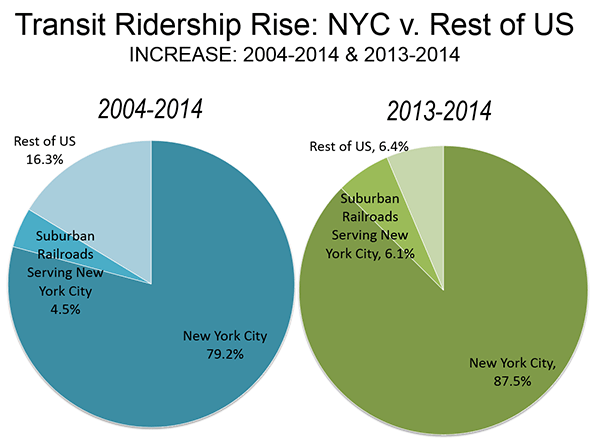
    Overall, the enormous system of buses and subways of New York City alone accounted for 88 percent of the national ridership increase from 2013 to 2014. If the ridership on the four large suburban rail systems that serve New York City (the Long Island Railroad, the Metro-North Railroad, New Jersey transit commuter rail, and the PATH trains) is added, City related transit accounts for 94 percent of the increase. A great achievement for the City, but not one that is being repeated in the rest of the nation.

    This is nothing new. National transit ridership has increased about 10 percent over the decade since 2004. Much of the increase — 79 percent — has been on New York City’s buses and subways. The suburban rail systems raise that total to 84 percent. This does not include the many commuter buses that enter the city especially from New Jersey and other suburbs, which cannot extracted from the data because it is not separately reported (Figure).

    New York’s transit turnaround has been nothing short of impressive. Nearly all of the nation’s progress in transit has been on a bus and subway system that carries one third of the national rides.

    The results have not been nearly so positive in the rest of urban America, where 30 times as many people live. While New York City related transit services experienced a ridership increase of 33% in the last decade, in the rest of the nation, the increase was less than three percent. Even huge ridership increases in New York City cannot make much of a difference nationally. In 2004, transit accounted for approximately 1.6% of urban travel. By 2014, it had risen to only 1.7%. Without taking anything from New York City’s impressive transit record, these results are not likely to be replicated elsewhere. New York City is a very unique place. It is home to the world’s second largest business district, after Tokyo, the area south of Central Park in Manhattan. Approximately 2 million peoplework in this small area, a number approximately four times the next largest central business districts, in Chicago and Washington.

    Approximately three quarters of Manhattan employees reach work by transit. This is 15 times the national average, New York City’s population density (excluding Staten Island, with its postwar suburbanization) is by far the highest and most extensive in the nation. The city of San Francisco comes the closest to New York City, with little more than half the population density and only 1/10 the total population.

    Transit is often suggested as a substitute for the car. The reality is that transit can compete with the car only to the largest downtowns. Destinations within the six transit "legacy cities," (not metropolitan areas) of New York, Chicago, Philadelphia, San Francisco, Boston, and Washington account for most of the nation’s transit work trips. And, 60% of these trips are to downtown.

    Transit cannot compete elsewhere, because travel times tend to be double those of the automobile (according to the American Community Survey) and it provides little practical access to most jobs.  University of Minnesota research indicates the average employee can reach fewer than 10 percent of jobs in less than one hour by transit in 46 major metropolitan areas. By contrast, approximately 65% of people who drive reach their jobs in less than 30 minutesby car in the major metropolitan areas. Building new rail systems doesn’t change the equation. At least 20 new urban rail systems have been built in the last four decades, though transit’s percentage of work trips has generally not improved, despite representations about reducing traffic congestion to the contrary. For example, in Portland, Washington, Los Angeles, Dallas-Fort Worth, and Atlanta, which have among the most extensive new rail systems, a smaller percentage of commuters use transit than before rail opened, when there were only buses.

    Even low income workers, who are often portrayed as "transit dependent," use cars much more than transit, and at a rate nearly equal to that of others in the labor force.

    Yet, transit funding advocates continue to seek even more money, claiming that transit can attract drivers from their cars and reduce traffic congestion. That may be true in New York City’s uniquely transit-friendly environment, but not elsewhere.

    Wendell Cox was a three-term member of the Los Angeles County Transportation Commission and chaired two APTA national committees. He is a public policy consultant in St. Louis and is a senior fellow at the Center for Opportunity Urbanism.

    Photo: Bart A car Oakland Coliseum Station

  • Is Suburbia Crashing? Suburban Traffic Myths Refuted

    Traffic crashes are a cause of ill health, impaired living or curtailed lifespan. Does city growth, in its sprawl-type outward expansion, increase the incidence of fatal and injurious crashes? This factor is the latest addition to numerous attempts to pin a correlation or causality linking traffic accidents with any number of causes.

    The twentieth century is not the only time in city evolution at which traffic accidents became a concern. Around the end of nineteenth century, when all in-city transportation was hoof and foot-dependent, accidents in cities were common.

    In New York, for example, 200 persons died in accidents in the year 1900, which, when transposed, means a 75 percent higher per capita rate than today. In Chicago the rate per horse-drawn vehicle in 1916 would be almost seven times the per auto rate in 1997.

    These are surprising, counter-intuitive statistics: the two cities, as all others at the time, were not just walkable, they were predominantly foot-based cities; exemplars of urbanism. No person had to cross six-lane arterials or dodge high-speed vehicles. Distances were short, city blocks small, densities high, and personal daily routine took place mostly on foot. It seems paradoxical that a walkable, dense, mixed-use city would generate high fatality rates; and more so because the speed of traffic ranged between 3 and 9 m/hr : half or less the 20 m/hr threshold beyond which fatalities increase. Without sidetracking for explanations, we can draw at least one simple idea from this past: a dense, foot-based city can generate high rates of fatalities.

    Soon after motorized transport entered city streets, fatal crashes rose. In the face of appalling and rising death figures, many adjustments occurred over a 30-year period. None of these changes involved urban form; they were inevitably operational and regulatory (e.g. lane markers, stop signs, driving rules, etc).

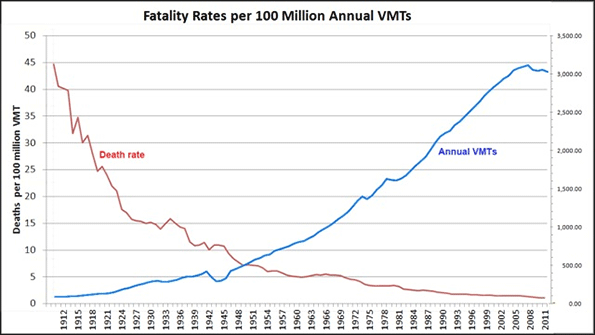
    In the U.S. during the first decades of the automobile’s presence on city streets, car accident rates fell rapidly even though car travel tripled between 1920 and 1955.

    During the same period the urban form characteristics remained fairly stable. The modest suburban expansion of cities at that time was light-rail dependent; “motopia” had yet to emerge . Most urban form of the ’30s and ’40s was generally similar to the early twentieth century prototypes: medium to high density compact development around a rail line or station with a core of amenities and services. It is nearly impossible to determine whether or not this form played a role in the drop in fatalities, due to the absence of concurrent alternative forms. When new “motopia” forms emerged, trends in fatalities did not bear out their influence.

    When automobile dominance was firmly established and new highways opened vast tracts of land for city growth, urban form at the city periphery changed decisively from compact, mixed use, walkable and transit-centered to typical “motopia” or “sprawl.”

    Despite a Smart Growth America recent claim of a correlation between sprawl and an increase in fatal accidents and a small decrease in injuries, the traffic fatality rate actually decreased as U.S. cities sprawled and total VMTs increased.

    The current level of traffic fatalities stands at about one third of the 1955 level and less than 1/20 of the 1925 rate. Intriguingly, sprawl at the national scale did not produce an increase in fatal or total crashes as analysts predicted. If the sprawl paradigm did play its negative role, then other countervailing factors must have had a greater influence that overshadowed its effect.

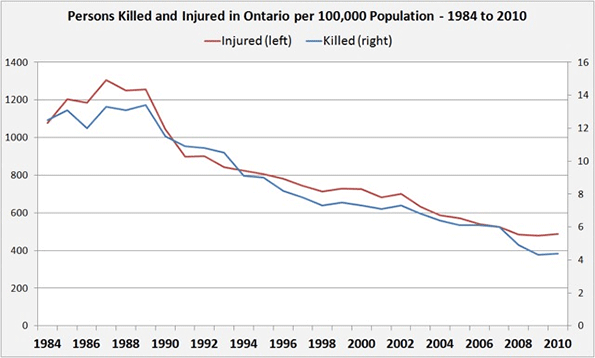
    The national trends in Canada mirror those of the U.S. Notably, fatal crashes fell at a faster rate than injuries, increasing the uncertainty about the correlation that links a substantial rise in fatalities with a rise in “sprawl-ness”. Provincial statistics show similar trends. The chart below shows the trends in Ontario, the most populous Canadian province:

    During a quarter century of more suburban expansion, fatalities and injuries followed a similar decline for a respective drop of around 70 percent in fatalities and about 60 percent in injuries; a substantial change. Like the national level statistics, provincial ones reinforce the uncertainty about a correlation between urban form and traffic fatality rates; instead of upward climb, we see an unmistakable decline.

    But what do statistics show at the finer, city scale?

    We turn to two – Toronto and Calgary – of six Canadian cities whose sprawl has been documented in detail. In spite of their anti-sprawl policies, in most the movement was retrograde, toward more sprawl.

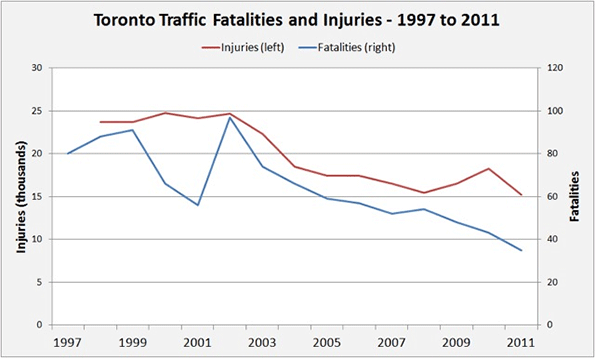
    The graph above shows Toronto’s trend in fatal crashes and injuries for the period of 1997 to 2011. Toronto during these 15 years can be characterized as a suburbanized region (with a few exurban appendices) that continues to expand using the conventional development model.

    In addition, Calgary, Alberta, the “car capital of Canada”, according to a Smart Growth report, has Canada’s lowest overall density; it remains a sprawled city. As with the national and provincial trends, the two cities’ traffic safety trends show a persistent overall drop in fatal and injurious accidents. Once more, the city-level fatalities and injuries trends contradict the correlation that links sprawl-type urban form with an increase in fatal accidents and a decrease in injuries. Whatever the countervailing factors are, they mask and overwhelm an expected rise in fatalities. As for the decrease in injuries, the actual drop is far greater than what the postulated correlation would predict and cannot be explained by it alone.

    If at the national, provincial and city levels the trends are positive in spite of the negative direction of urban form, the health concerns that would justify planning interventions appear to have been alleviated on this front, at least for the first century of automobility and for the half century of uninterrupted sprawl.

    One might speculate that had growth been in a compact, walkable, diverse use, transit-centered form, fatalities could have declined even faster. This could well be true but cannot be deduced from the above statistics. Regardless, the current trends could not be seen as a cause for concern and urgent action on the urban form front. On strictly health grounds, cities and provinces are progressing in the right direction. There is no apparent imminent or growing threat.

    So far we have seen the difficulty of explaining the persistent drop in traffic fatalities via a correlation with “sprawl-ness” and we hypothesized that other factors may be at work. Indeed they are. We find several in overlapping lists of international, national, provincial and city documents: some linked to the causes of fatal crashes, others as government directives. Here is a collection in no particular order of importance:

    Speed limit range/control
    Drinking and driving laws
    Young driver restrictions
    Intersection geometry
    Car crash-worthiness rating
    Car fitness regulations
    Road condition care
    Driving fitness/age
    Speeding penalties
    Vulnerable user protection
    Motorcycle helmets
    Seat belt use/air-bags
    Child restraints usage
    Pre-hospital, on-spot care
    Distraction prohibitions

    As one example of the potential effect of safety measures, NHTSA in 2005 estimated that 5,839 lives would have been saved in 2004 (or 14 percent of total car-related fatalities) if all passengers wore seat belts.

    Planning interventions can have multiple beneficial effects. On at least one front there is no cause for alarm or a rationale for a call to arms; the battle against traffic fatalities is being won, without urban form change. This does not suggest that a correlation between sprawl and the reduction in fatal and injurious crashes exists, or imply that sprawl is a desirable urban form. It simply means that the effect of urban form on crashes cannot be established unequivocally and therefore cannot be a lead driver for action.

    Fanis Grammenos heads Urban Pattern Associates (UPA), a planning consultancy. UPA researches and promotes sustainable planning practices including the implementation of the Fused Grid, a new urban network model. He is a regular columnist for the Canadian Home Builder magazine, and author of Remaking the City Street Grid: A model for urban and suburban development. Reach him at fanis.grammenos@gmail.com.

    After twenty-four years at Canada Mortgage and Housing Corporation, Tom Kerwin now leads an active volunteer life, including being the Science and Environment Coordinator for the Calgary Association of Lifelong Learners. He holds a Master’s degree in Environmental Studies from York University.

    A different version of this article appeared at SustainableCitiesCollective.

    Flickr photo by 7mary3: a car accident due to an unsafe lane change.

  • Calling Out the High-Tech Hypocrites

    The recent brouhaha over Indiana’s religious freedom law revealed two basic things: the utter stupidity of the Republican Party and the rising power of the emerging tech oligarchy. As the Republicans were once again demonstrating their incomprehension of new social dynamics, the tech elite showed a fine hand by leading the opposition to the Indiana law.

    This positioning gained the tech industry an embarrassingly laudatory piece in the   New York Times, portraying its support for gay rights as symbolic of a “new social activism” that proves their commitment to progressive ideals.

    “So many tech companies have embraced a mission that they say is larger than profits,” Glenn Kelman, chief executive of Redfin, the online real estate firm, told the Times. “Once you wrap yourself up in a moral flag, you have to carry it to the top of other hills.”

    Yet beneath the veneer of good intentions, the world being created by the tech oligarchs   both within and outside of Silicon Valley fails in virtually every area dear to traditional liberals. On a host of issues—from the right to privacy to ethnic and feminine empowerment and social justice—the effects of the tech industry are increasingly regressive.

    The valley elite may have won its gender discrimination lawsuit against Ellen Pao, but this does not dispel the notion that it runs largely on testosterone. The share of women in the tech industry is barely half of their 47 percent share in the total workforce.  Stanford researcher Vivek Wadhwa describes Silicon Valley as still “a boys’ club that regarded women as less capable than men and subjected them to negative stereotypes and abuse.”

    Race is another hot spot for progressives, but outside of Asians, the valley’s record is nothing short of miserable. Some of this reflects the rapid de-industrialization of the industry—the valley has lost 80,000 manufacturing jobs alone since 2000—as companies shift their industrial facilities either to China or to states like Utah and Texas, where they can escape the tax and regulatory regime that they so avidly support back in California.

    So good blue-collar jobs go elsewhere, and the valley’s  own  African-Americans and Hispanics (who  make up roughly one-third of the population) now occupy  barely 5 percent of jobs in the top Silicon Valley firms.  They have not done well in the current tech “boom”: Between  2009 and 2011,  earnings dropped  18 percent for blacks and 5 percent for Latinos, according to a 2013 Joint Venture Silicon Valley eport. 

    Nor can we expect tech firms to go out of their way to train or develop too many American-born workers, of whatever race, for their jobs. Instead the industry’s elites seek to get their employees through H-1B immigrants, largely from Asia. These workers are likely to be more docile, and more limited in their job options than native born or naturalized citizens. Given that there is a surplus of American IT workers, this brings to mind not global consciousness but instead the importation of the original coolie labor force brought to California to build the railroads.

    Similarly, despite claims of a commitment to personal freedom, valley firms like Google are  renowned for their calculated violations of privacy. Support the free movement of labor? Others, notably Apple, are also leaders in seeking to restrain employees  from changing jobs.

    And what about the sensible liberal idea that the rich and corporations should pay their “fair share” of taxes?  That’s a progressive ideal paid for by your Main Street businessman or your local dentists, but don’t expect your tech oligarchs to play by the same rules.  True, Bill Gates has voiced public support for higher taxes on the rich but tech companies, including Microsoft, have bargained to evade paying their own taxes. Facebook paid no taxes in 2012, despite profits in excess of $1 billion.  Apple, which even the New York Times described as “a pioneer in tactics to avoid taxes,” has kept much of its cash hoard abroad to keep away from Uncle Sam.

    If these actions were taken by oil companies or suburban developers, the mainstream media would be up in arms. Yet by embracing “progressive” values on issues like gay rights, the tech oligarchs are trying to secure a politically correct “get out of jail free” card. Monopolistic behavior, tax avoidance, misogyny, and privacy violations are OK, as long as you mouth the right words about gay rights and climate change—and have the money and  the channels to broadcast your message.

    Like other plutocrats, the tech oligarchs seek to buy political protection, usually from the Democrats. In 2012, tech firms gave Democrats roughly twice as much  campaign money to Democrats than to Republicans.

    If anything, grassroots techies are even more left-oriented, with 91 percent  of the contributions of Apple employees in the 2012 presidential race going to President Obama.

    Yet despite these leanings, the tech oligarchs manage to get a pass from conservatives. Perhaps some have over-imbibed Ayn Rand, becoming prisoners of an ideology that suggests the valley elites reflect a  “meritocratic” ideal driven by profits. That’s an interesting take since so many leading tech firms, from Amazon to Twitter, actually earn little or no profit. They benefit instead from easy access to capital markets, from which they can extract enormous earnings through stock inflation.

    Other conservatives also seem to share the views of the most prominent tech libertarian, Paypal co-founder Peter Thiel, who claims that non-conformist business is now “increasingly rare outside of Silicon Valley.” Yet given the “me too” nature of much of what passes for tech today, and the huge advantages to those who can access venture capital,  perhaps American farmers, wildcat oil drillers and even cutting edge restaurateurs take bigger risks, and provide better bigger social rewards to the overall economy.

    Commentators on the right and much of the left  seem to have forgotten that the valley is no longer dominated by scraggly outsiders creating amazing innovative products. In most cases now they are essentially extending the power of the Internet—developed by the U.S. military and paid for by American taxpayers—into a host of fields from transportation to renting out rooms. In many cases they are simply redistributing to themselves money that once went to publishing companies, taxi drivers and hotels. That’s capitalism, but not inherently moral, or compassionate.

    In reality the valley elite is increasingly nothing more than the latest iteration of   oligopolistic crony capitalism. Firms like Google, Apple and Microsoft hold market shares in their fields upwards of 80 percent. In some cases, they do it without improving their products, as anyone using Microsoft products can certainly attest. Their control of their markets is far greater than those of  the  largest oil, automobile or home-building firms.  Tech firms, particularly in California, have also been primary beneficiaries of crony capitalism, particularly in terms of “green energy” schemes that are far from market-worthy. Despite this, Google and their ilk get subsidies to reap profits while forcing California’s middle and working classes to pay higher bills.

    As a country, it is time to understand that the tech oligarchs are not much different from, and no better than, previous business elites. Like oil companies under the Bushes, they relish their ties to the powerful, as evidenced by Google’s weekly confabs with Obama administration officials. No surprise that a host of former top  Obama aides—including former campaign manager David Plouffe (Uber) and White House press secretary Jay Carney (Amazon)—have signed up to work for tech giants.  

    None of this is to say that the tech elites need to be broken up like Standard Oil or stigmatized like the tobacco industry. But it’s certainly well past the time for people both left and right to understand that this oligarchy’s rise similarly poses a danger to our society’s future. By their very financial power, plutocratic elites — whether their names are Rockefeller, Carnegie, Page, Bezos or Zuckerberg —  need  to be closely watched for potential abuses instead of being the subjects of mindless celebration from both ends of the political spectrum.

    This piece first appeared at Real Clear Politics.

    Joel Kotkin is executive editor of NewGeography.com and Roger Hobbs Distinguished Fellow in Urban Studies at Chapman University, and a member of the editorial board of the Orange County Register. He is also executive director of the Houston-based Center for Opportunity Urbanism. His newest book, The New Class Conflict is now available at Amazon and Telos Press. He is also author of The City: A Global History and The Next Hundred Million: America in 2050.  He lives in Los Angeles, CA.

    Official White House Photo by Pete Souza.

  • Affordable Housing Maui Style

    I was recently at a friend’s wedding on Maui. It was a beautiful ceremony in a magnificent location. The wedding was a week-long affair and the other guests were thrilled to enjoy the beach and sip drinks along the cascade of infinity pools at the resort. But I’m weird. I can’t sit still that long so I started to explore how the place works – not just the one resort, but the whole Maui tourist economy. First, I checked out real estate prices in the area. The cost of even the most modest homes and apartments are off the charts expensive. Property is pegged to what wealthy outsiders from the mainland and abroad are willing and able to pay rather than what the local population can afford.

    Screen Shot 2015-03-29 at 2.01.11 AM Screen Shot 2015-03-29 at 2.00.58 AM

    I was recently at a friend’s wedding on Maui. It was a beautiful ceremony in a magnificent location. The wedding was a week-long affair and the other guests were thrilled to enjoy the beach and sip drinks along the cascade of infinity pools at the resort. But I’m weird. I can’t sit still that long so I started to explore how the place works – not just the one resort, but the whole Maui tourist economy. First, I checked out real estate prices in the area. The cost of even the most modest homes and apartments are off the charts expensive. Property is pegged to what wealthy outsiders from the mainland and abroad are willing and able to pay rather than what the local population can afford. That got me thinking about where the hotel staff lived. So I asked the people I encountered how they manage under the circumstances. There were a few standard answers.

    Screen Shot 2015-03-29 at 2.42.19 AM Screen Shot 2015-03-29 at 2.31.29 AM Screen Shot 2015-03-29 at 3.11.24 AM Screen Shot 2015-03-29 at 2.32.05 AM Screen Shot 2015-03-29 at 2.15.56 AM

    First, there was upper management who were highly trained and well educated professionals who earned tolerable salaries and, with a spouse’s professional income and a little help from family, were able to own a modest property within a reasonable commute from work. Next, were the clerks, waiters, bartenders, and such. They were generally young and spending a bit of post-college pre-marriage time in a gorgeous place doing work that was either pleasant or at least bearable given the location. The largest proportion of these folks lived in nearby properties owned by older relatives. If dad or grandma is providing free or heavily subsidized accommodations it really doesn’t matter what the place costs on the open market. A good percentage of these homes are seasonal second or third homes and would sit empty or rented to strangers anyway. Having young family members occupy these vacation and retirement properties while they work at the hotels makes perfect sense. The third most common housing arrangement involved a few people pooling their resources and sharing a single apartment to cover the rent. There was a general lack of space and privacy in these situations, but everyone understood it was temporary for a season or two. The Hawaiian adventure was worth any inconvenience.

    Screen Shot 2015-03-29 at 2.52.24 AM Screen Shot 2015-03-29 at 4.50.01 AM Google
     Screen Shot 2015-03-29 at 2.53.09 AM Screen Shot 2015-03-29 at 4.44.48 AM Google
     Screen Shot 2015-03-29 at 2.48.10 AM Screen Shot 2015-03-29 at 5.04.34 AM Google
     Screen Shot 2015-03-29 at 2.48.34 AM Screen Shot 2015-03-29 at 4.56.41 AM Google
     Screen Shot 2015-03-29 at 2.49.27 AM Screen Shot 2015-03-29 at 5.11.31 AM Google

    Within a fifteen minute drive of the beachfront resorts I discovered a variety of housing types ranging from multi-million dollar single family homes to three hundred square foot studio apartments. None of these were what anyone with a normal budget or a family to support would ever call “affordable”. But one way or another the young front-end staff at the hotels find ways to make things work.

    As I explored I was fascinated by the market segmentation of each product type. The subdivisions were sealed off from each other. It would be inconceivable for the people in a $5,000,000 home on a half acre lot to exist in the same pod as a complex of $900,000 two bedroom condos. The condos would be far too trashy for them. And the folks who owned $900,000 condos would be scandalized if someone tried to build $1,800 a month studio rental apartments inside their pod. That would attract “the wrong element”. The pods could all exist next to each other across the shrubbery and landscaped berms so long as they each had their own home owners associations and the roads in and out were completely segregated – preferably with a gate. Endless rules and restrictions, both private and municipal, control each pod to ensure property values are maintained at the appropriate level. This is the default suburban arrangement all over North America – give or take a few zeros and a comma.

    Screen Shot 2015-03-29 at 2.11.29 AM Screen Shot 2015-03-29 at 2.14.52 AM Screen Shot 2015-03-29 at 2.59.00 AM Screen Shot 2015-03-29 at 3.24.54 AM

    It was a little trickier to discover where the maids and gardeners lived. The majority were older than the kids waiting tables and working the front desk and they were overwhelmingly immigrants from the Philippines. Unlike bartenders they were not generally inclined to chat with hotel guests in a casual manner. My inquiries about affordable workforce housing were met with confusion or slight suspicion. But I was eventually able to identify a few neighborhoods and the general living arrangements.

    Screen Shot 2015-03-29 at 2.04.03 AM Screen Shot 2015-03-29 at 2.03.23 AM Screen Shot 2015-03-29 at 2.05.48 AM Screen Shot 2015-03-29 at 2.04.55 AM

    There’s simply no economic or political force on Maui that can provide sufficient affordable housing for the number of low wage workers required to run the tourist economy. Land is too expensive. Government and philanthropic funds are entirely inadequate. And political will to construct subsidized housing absolutely anywhere is a non starter at every level of the approval and community engagement process. The minimum wage in Hawaii is $7.25 per hour. The best paid housekeepers on Maui earn no more than $14.50 per hour. The median home price on Maui is $527,500 although that half million dollar number is actually misleading due to the geography of the island. Jobs are concentrated in a handful of locations where housing is significantly more expensive. Lower cost housing is in remote areas that are outside a reasonable commuting distance. HOA restrictions and a host of municipal regulations prevent too many people from sharing a rented apartment in the more expensive regions. Landlords in prime locations can pick and choose who to rent to and they tend toward Canadian tourists rather than immigrant cleaning ladies. So the sweet spot for these workers involves ordinary tract homes in specific older subdivisions that lack HOAs, are far enough from wealthy neighborhoods to escape regulatory push back, yet are close enough for a tolerable commute.

    Screen Shot 2015-03-29 at 2.31.42 PM Zillow
    Screen Shot 2015-03-29 at 2.30.47 PM Zillow
    Screen Shot 2015-03-29 at 2.30.59 PM Zillow
    Screen Shot 2015-03-29 at 2.31.19 PM Zillow
    Screen Shot 2015-03-29 at 2.31.32 PM Zillow

    Here’s an example I pulled from a real estate site. This 1962 three bedroom one bath tract home is among the least expensive properties on the island. It’s listed for $449,000. It doesn’t get any more affordable than this. It’s been on the market for a year and the price was recently cut by $100,000. If someone were to buy this place with a standard 20% down payment of $90,000 the monthly mortgage would be $1,642. At either $7.25 or $14.50 per hour for low wage workers the numbers don’t add up unless many people occupy the space to get the per person rent or mortgage down to a manageable level. So each bedroom gets multiple sets of bunk beds. The living room is a bedroom. The dining room is a bedroom. The garage is a bedroom. People work day, night, and swing shifts so the same beds and parking spots are used at different times by different people. They call these homes “hot beds” since the mattresses are always occupied and never have a chance to cool. (This is exactly how my Sicilian grandparents grew up in Brooklyn during the Great Depression and war years. This kind of arrangement isn’t really new or different.)

    Screen Shot 2015-03-29 at 5.03.45 PM Screen Shot 2015-03-29 at 5.44.53 PM Screen Shot 2015-03-29 at 5.45.43 PM

    This particular subdivision is protected from gentrification and redevelopment since it’s sandwiched between the airport runway and the oil tank farm of the industrial seaport. Most of these homes are owned and occupied by extended multigenerational families. Cousins arrive, work and save, send money back to their home country, or prioritize their children’s advancement. They scrub things clean and give the walls fresh paint. They make due with the resources they have. The arrangement might not be ideal, but it gets the job done in the absence of any other option. Neighbors tend to live and let live since they’re all in the same position. Local authorities are disinclined to engage in too much code enforcement since the county would simply create a homeless problem they know they can’t resolve. Employers at the resorts wouldn’t like it too much either if members of their cleaning and gardening staff suddenly stopped showing up for work. So there you have it. Affordable housing – Maui style.

    John Sanphillippo lives in San Francisco and blogs about urbanism, adaptation, and resilience at granolashotgun.com. He’s a member of the Congress for New Urbanism, films videos for faircompanies.com, and is a regular contributor to Strongtowns.org. He earns his living by buying, renovating, and renting undervalued properties in places that have good long term prospects. He is a graduate of Rutgers University.

  • Shades of Red and Blue Across Counties Show Surprising Balance

    We cannot escape the reality of a polarized America, given the current level of rhetorical and real political gridlock. And maps are frequently invoked to illustrate that this polarization is also geographic, with clear-cut Red and Blue territories.

    Clearly there are large areas of extreme polarization, and we will show them. But there are also more balanced kinds of counties which vote not consistently with one side. These contested areas are more extensive than people likely believe or the media proclaim. This is healthy for the nation.

    I employed a cluster analysis of US counties with selected variables that do best at distinguish voting Democratic or Republican.  This produced a useful 10 cluster solution, based most critically on voting Red or Blue, but also taking into account kinds of settlement, i.e metropolitan, small city, and rural, and a cultural gradation from traditional religious conservative to socially progressive. The historic scale on economic distinctions between Democrat and Republican is virtually extinct.    

    Five clusters exhibit extreme spatial polarization—three highly Republican, two strongly Democratic. Two are solid Republican but not extreme. Three are balanced, so much so that counties in each voted Republican and Democratic, so we divided each of these into Democratic and Republican sub-groups.

    Category Republican Democrat
    True Believers R1, R2, R3 D1, D2
    Moderate Republican R4, R5
    Balanced RD, DRD D3, D3R, D4, RD4

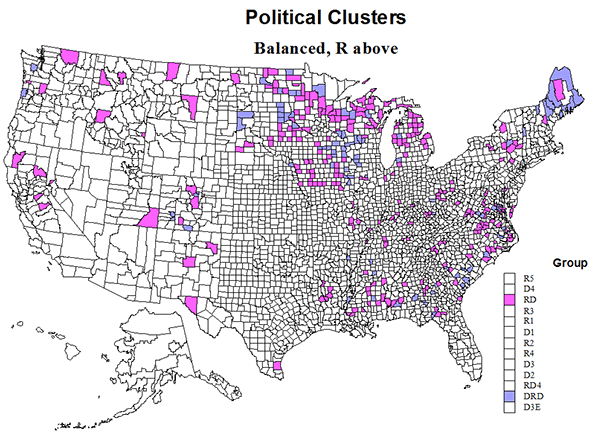
    We locate these groups on four maps, one for True Believer counties of extreme polarization, two not extreme  but Republican leaning counties, two (with 4 sub-groups) that are majority Democratic, and one (with two subgroups) that is majority Republican. 

    Population, votes for Obama and Romney, and values for political character are summarized in Table 1.  The table numbers should surprise many readers. True believer America is hugely important to the parties, especially the Democrats, (and symbolically for Republicans?), but contain just 103 million people and 41 million voters, about one-third of the total.

    Clusters of US Counties on Presidential Politics, 2008-2012
    Group # of Counties % Obama 2012 Settlement Pattern Culture Race Obama vote Romney D Margin Population (Thousands)
    D1 104 72 Lg met Prog + 47           19,600           7,077          12,523                68,307
    D2 112 70 non-met moderate 56                 820               353                467                   2,776
    D extreme 216 70 mixed high min           20,420           7,430          12,990                71,083
    R3 506 32 rural Cons+ 13             1,342           2,791          (1,449)                10,034
    R2 454 25 non-met Cons  21             1,737           5,297          (3,560)                17,920
    R1 340 18 rural Cons + 25                 323           1,587          (1,264)                   4,164
    R extreme 1300 26 rural, non-met Cons  low             3,402           9,675          (6,273)                32,118
    All True Bel 1516 58 all           23,827         17,105            6,722              103,201
    R5 528 40 Non-met moderate 19             3,944           5,777          (1,833)                23,231
    R4 278 36 Larg met moderate 21             6,774         11,581          (4,867)                44,727
    R not extreme 806 37 mix moderate 20           10,718         17,358          (6,640)                67,958
    D3 194 56.5 non-metro mod to pro 21             2,227           1,727                500                   8,723
    RD3 38 49 non-metro mod to pro 28                 415               435                (20)                   2,033
    D3 total 232 55 non-metro 22             2,642           2,162                480                10,756
    D4 194 56 large  met Prog+ 30           22,573         17,792            4,780                95,835
    RD4 68 47.3 Prog+ 24             4,677           5,358             (681)                24,865
    RD total 262 54 Prog+ 29           27,250         23,150            4,100              120,700
    R>D 244 45.2 rural Mod to cons 19                 946           1,486             (540)                   4,574
    DR>D 92 53.6 rural Mod to cons 21                 454               396                  58                   1,814
    R>D total 344 rural Mod to cons 19             1,400           1,882             (482)                   6,388
    All balanced 830 54           31,262         26,194            5,068              137,844
    All D 62.5 metro dominated           45,674         27,335          18,379              177,455
    All R 37 nonmet dominated           20,155         34,312       (14,157)              131,548
    All groups 51.6           65,832         61,647            4,185              309,003


    Another 68 million people and 28 million voters are in strong Republican areas, which, together with the true believer Republican areas, give the GOP dominance in counties with 100 million people and 41 million voters—about one-third of the total. This is higher than the strongly Democratic core areas with 71 million people and 28 million voters.

    But the really interesting story is about the remainder of the country, which we argue is somewhat balanced, with 137 million people (44%) and 57 million voters (45%). These are significant and meaningful battleground territories, and a warning to both parties to be more careful in proclaiming long term dominance. But it is true that the total population in Democratic majority groups totals 177 million, compared to 132 million for the Republican clusters, and thus the basis for a Democratic net margin in 2012.   

    We will discuss the variable settlement and cultural characteristics of the clusters through an analysis of the four maps.

    True Believers

    OK here is the quintessential polarization! Between areas of concentrated blue. Group D1 is mainly in large metropolitan cores, especially on the two coasts – the northeastern Megalopolis, and Los Angeles, San Francisco, Portland and Seattle, but also Chicago, Detroit, Minneapolis, plus a few ethnic minority areas, as along the border with Mexico, and noted in the table as metropolitan, high in minorities, and culturally progressive. Cluster D2 is smaller, non-metropolitan, majority minority, culturally moderate, and primarily with black, Hispanic or Native American settlement, but with a different sub-set of counties in Vermont, upstate New York, and in environmental recreation areas in the west. These tilt more progressive.
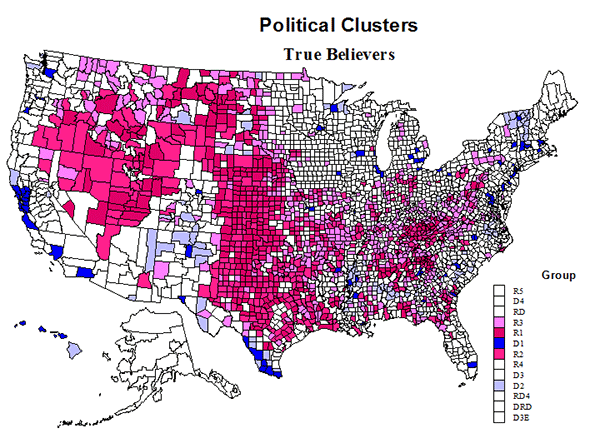
    The contrast with the true believer Republican clusters is profound. R1 and R2 are the most conservative, mainly rural and non-metropolitan respectively, and tend to occupy the same areas, dominating huge portions of two realms: the western high plains from Texas to North Dakota, and the extended Mormon region, centered on Utah but stretching to neighboring states. In addition, there are  some added counties in Appalachia and into the south.  R3 counties are as conservative and also rural, and are found mainly in Appalachia, Missouri (Ozarks) and in a far north belt from the Dakotas to eastern Washington. These true believer red counties constitute over half of US counties, and almost half the territory, but have only 11 percent of the population.

    The strongly Republican , yet less extreme counties have a very different geography. They do tend to occur together, embracing many smaller metropolitan areas, together with adjoining non-metro counties. They tend to be culturally moderate, and much more populous than the extreme R1 to R3 groups, with 68 million people, and as important to Republican margins. They are most prevalent across the west and “the north of Appalachian north —  OH, IL, MI, IN, WI, MO, and MN — than in metropolitan and suburban areas in the south, notably FL, NC, SC, LA, and TX, and then in the less or smaller metropolitan west.
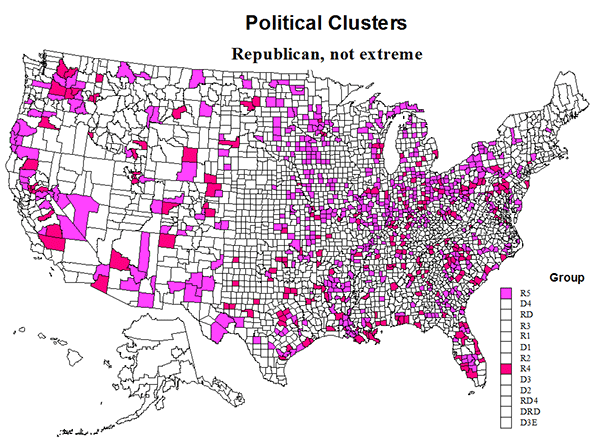
    The more balanced counties have 138 million people, and provided a small but critical margin for Obama in 2012, with 106 million in the D majority groups, and 32 million in the R majority groups.

    The Republican majority balance group RD is rural and moderately conservative. They are most prevalent across the northern edge of the country from Maine to MI, WI, MN, and IA  to the Dakotas, a historically moderate area, with scattered exurban and rural areas in the west (mainly R carried) and scattered across the south from LA to VA (also mainly R carried)
    The Democratic majority balanced groups D4 and D3 are quite varied, almost a prototype of the US average! The D3 counties are mainly non-metropolitan, and moderate to progressive. The D and R carried counties tend to be intermingled. These counties are most prevalent in the “old” north from MN and IA to northern New England, but also fairly common in the Rockies and along the Pacific coast. Many of these counties were and even still are resource-oriented, and many have become exurban professional and/or environmental amenity dependent (CO, CA, WA, ID, NM, ME, NH).  
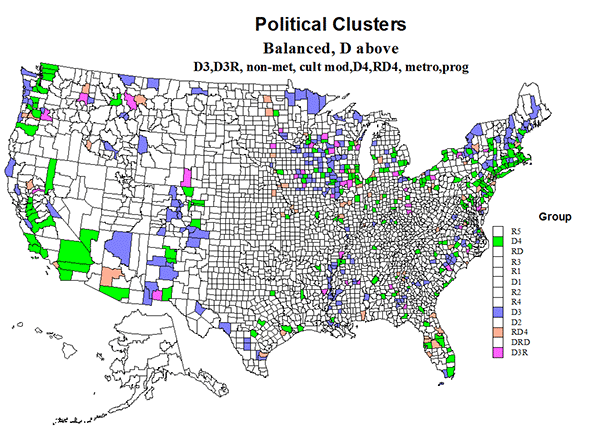
    The D4 group is larger and less dominantly Democrat carried. It is mainly larger metropolitan and culturally progressive, but not as strongly Democratic as the D1 counties. The difference is that many are smaller, often “satellite” metropolitan areas, or suburban-exurban counties, as along the Pacific coast, in Florida and Megalapolis. Many were counties that were historically Republican but have become increasingly socially liberal,   experiencing declines in the Republican margins. Notable are big areas like San Diego, Riverside-San Bernardino, Phoenix, Dallas, Houston, suburban Denver, and suburban-exurban NJ, NY, and CT.

    The balanced counties would seem difficult for a very conservative “Tea party” candidate, and good for Hilary Clinton, but could possibly revert to Republican with a more mainstream candidate. Thus it is premature to write off the long term Republican prospects. Both parties have a long history of decline and resurgence.  If mainstream Republican leaders can restrain the extreme conservatives, then there is at least some prospect of a serious realignment, with perhaps four parties for a transition period, the Tea Party, a Business party, a Green party (progressive environmentalists), historically liberal Republican, and dare I hope, a (social) Democratic party? Bring back economics and this could happen.

    Richard Morrill is Professor Emeritus of Geography and Environmental Studies, University of Washington. His research interests include: political geography (voting behavior, redistricting, local governance), population/demography/settlement/migration, urban geography and planning, urban transportation (i.e., old fashioned generalist).
  • Asian Augmentation

    California, our beautiful, resource-rich state, has managed to miss both the recent energy boom and the renaissance of American manufacturing. Hollywood is gradually surrendering its dominion in a war of a thousand cuts and subsidies. California’s poverty rate – adjusted for housing costs – is the nation’s worst, and much of the working class and lower middle class is being forced to the exits. Our recent spate of high-tech growth has created individual fortunes, but few jobs, outside the Bay Area. The agricultural heartland is suffering not only from drought, but from green policies that allow a torrent of unused water to flow into the Sacramento Delta and San Francisco Bay while huge parts of the Central Valley go fallow.

    But California retains one powerful trump card that our leaders in Sacramento have not yet found a way to squander: Its link to Asia. True, the state’s growth-restrained ports are increasingly tied up, and, over time, much of our trade with China and other Asian countries might pass, instead, through the Panama Canal en route to Houston and other ports. But geography, culture and family ties have a way of overcoming even the most deluded policy environments.

    In the 19th century, many in California railed against the “Asian invasion,” and led the drive to restrict Asian immigration to America. As early as 1850, Asians accounted for one-tenth of the state’s non-native American population. Early on, Chinese, Indian and Japanese immigrants showed remarkable ingenuity, largely as farmers and merchants, which only made whites more antagonistic. “Indispensable as the Chinese are,” one grower report admitted, “they must go, as gradually as possible.”

    Read the entire piece at the Orange County Register.

    Joel Kotkin is executive editor of NewGeography.com and Roger Hobbs Distinguished Fellow in Urban Studies at Chapman University, and a member of the editorial board of the Orange County Register. He is also executive director of the Houston-based Center for Opportunity Urbanism. His newest book, The New Class Conflict is now available at Amazon and Telos Press. He is also author of The City: A Global History and The Next Hundred Million: America in 2050.  He lives in Los Angeles, CA.

    Wendell Cox is principal of Demographia, an international public policy and demographics firm. He is co-author of the “Demographia International Housing Affordability Survey” and author of “Demographia World Urban Areas” and “War on the Dream: How Anti-Sprawl Policy Threatens the Quality of Life.” He was appointed to three terms on the Los Angeles County Transportation Commission, where he served with the leading city and county leadership as the only non-elected member. He was appointed to the Amtrak Reform Council to fill the unexpired term of Governor Christine Todd Whitman and has served as a visiting professor at the Conservatoire National des Arts et Metiers, a national university in Paris.

    Map courtesy of U.S. Census.

  • Can Hipsters Save Providence?

    Providence regularly lands on the lists of top hipster cities and top hipster colleges for its cool factor, having earned plaudits from Travel and Leisure to Buzzfeed for live music, coffee shops, and hip culture.  

    But can hipsters save Providence?

    In 2013, when Providence took the number four slot on Travel and Leisure’s list of America’s Top Cities for Hipsters, the publication stated of Rhode Island’s capital city, “On the west side, you can order vegan cuisine at The Grange, hear concerts at the Columbus Theatre (with a clever 1492 seats), or browse the vintage fashions, ceramic poodles, and kitschy kitchenware at Rocket to Mars.”

    Aaron Renn, urban analyst and senior fellow at the Manhattan Institute, offered his perspective on the “hipster impact” in Providence — and nationally.  

    “There are not enough “hipsters” to plausibly resurrect the urban economies of America,” said Renn. “If you’re in downtown Providence, in the proximity to its center, you can live an eminently hipster lifestyle, and ask yourself, ‘Where would Providence be without it?’ And it would probably not be as great.”

    “Is that the solution to the jobs issue on the south side of Providence?  No.  [The hipster economy] has its positives, but it’s something that’s happening more now everywhere,” said Renn.  “I was just in Indianapolis.  There were plenty of beards, plaid shirts, and locally sourced food there.”

    Part of Economy

    “It’s a great thing to be considered a livable city with a vibrant nightlife and art scene,” said Providence City Council President Luis Aponte.  “Our goal is to have a city that draws interest and investment at all levels.  The artists and designers need to be part of the city — but so do blue collar and white collar workers as well.”

    Renn noted that in his view, Providence’s relatively rooted hipster culture put it in a different position than newer hipster destinations.  

    “People are going to come and go, that’s the nature of a college town, but the people that I know that decided to stay in Providence did so for relatively concrete reasons,” said Renn. “They’re ‘sticky’– they didn’t seem like the people to flee to Detroit because it’s the next hip city. Many people have reasons that they picked Providence that aren’t applicable to a Detroit. Having New England roots, for instance, or wanting to be close to New York, Boston, but having a lower cost of living.”

    “I’m not anticipating there’s going to be any mass exodus of the creative class, that’s a positive note — the people that are in Providence are loyal, but if you don’t have a job, that’s a big problem,” added Renn.  

    Renn noted some advantages that emerging hipster markets have that Providence does not.  

    “Take Detroit and its collapse,” said Renn.  “The ability for the government to function is barely coming around. That’s allowed people to take chances, to know the building inspector isn’t necessarily going to bother you.  New England is so heavily regulated, it’s a daunting process to come in and do something.  I think the people who move to Providence have a reason, they didn’t just up and move because they heard it was cool.”

    Urban Growth Factor

    “I think Providence has fallen flat compared to hipster cities such as Portland [Oregon],” said Renn.  “There’s more of an economy build in say Portland [Oregon] for small business. For a lot of people, to go to Providence, you have to bring money from somewhere else, there’s not a ton of jobs.  For the most part, if you’re a younger, creative person, there’s simply a limited number of positions in Providence right now.  You’ve got to figure out how to make money, and that’s namely exporting services and goods, and that brings some wealth in.”

    City Council President Aponte noted that the firm that the City Council recently hired to do cluster analysis identified that at least a fifth of Providence’s workforce are contract workers. 

    “What they found is that 21% of folks earning in Providence are 1099 workers,” said Aponte of the classification of contract workers.  “That’s high as compared to other parts of the region and the country as a whole.  If people are disconnected to an employer, and selling their services as consultants, how much spin off does that create?  We have an older housing stock, which is attractive to hipster types, and having them here means something for our tax base.  We need to see where the jobs are though, and enable growth there.”

    Renn spoke to where he saw Providence could succeed.  

    “Rhode Island has had some wins in the past, we just need a lot more.  On a whole, if I were Providence, I’d feel pretty good about the number of people in that creative class who have an affinity for the city and aren’t likely to leave,” said Renn.  “The industries that are booming, however, are ones where Rhode Island isn’t necessarily well placed.  Everybody and their brother is chasing biotech.  Boston is booming, and Rhode Island just doesn’t have the assets. There are only so many coders — if you’re that good, you’re going to another city.”

    “Where Providence and Rhode Island has the skills is in design,” said Renn.  “The question is how do you parlay that beyond a boutique firm.  You can argue Alex and Ani did it, that it’s effectively a design firm that leverages the state’s jewelry expertise.  That’s just one example.  Providence needs lots of people starting businesses.  Very few will become successful, and usually it takes on average 7 to 10 years to make it.  But to do so you have to build it.”

    This piece first appeared at GoLocalProv.com.

    Kate Nagle is a writer and editor at GolocalProv. Find her on Twitter @naglekate78.

  • Piketty’s Wealth Driven Inequality: Virtually All in Housing?

    The Economist headline reads: "Through the roof: Rising house prices may be chiefly responsible for rising inequality"

    This is no surprise to those of us who have been chronicling the loss of destruction of middle income housing affordability where urban containment policy has been implemented from Australia to Canada, Ireland, New Zealand, the United Kingdom and the United States.

    Matthew Rognlie, a graduate student at the Massachusetts Institute of Technology, has critiqued the highly publicized work of Thomas Piketty (Capital in the 21st Century) to suggest that rising inequality is largely due to the accumulation of wealth in housing.

    House prices have doubled, tripled or more relative to incomes, as regulators have banned or seriously limited new housing on the urban periphery. Younger households have been unable to afford houses as older households have watched their wealth increase.

    The "writing" has long been on the wall. Legendary urbanist Sir Peter Hall lamented the potential abandonment of the "ideal of a property owning democracy" (see The Costs of Smart Growth Revisited: A 40 Year Perspective) under urban containment policy.

    Rognlie suggests that a better title for Piketty’s book would have been Housing in the Twenty-First Century. According to Rognlie: "the literature studying markets with high housing costs finds that these costs are driven in large part by artificial scarcity through land use regulation …. A natural first step to combat the increasing role of housing wealth would be to reexamine these regulations and expand the housing supply."

  • Big Box Urbanism

    I’m ambivalent about big box stores. I occasionally shop at places like Walmart, Costco, and Target just like most people. I buy various packaged goods in bulk from these mega retailers to take advantage of a volume discount. I don’t moralize over these things. But when it comes to meat, dairy, and fresh produce I walk around the corner or down the street to my local mom and pop stores, farmers market, or Community Supported Agriculture plan. I’m fine with buying a pallet of inexpensive toilet paper that was manufactured on an industrial scale. Chicken? Not so much.

     Screen Shot 2015-03-08 at 3.23.46 AM

    But I’m really interested in the giant retail buildings themselves. A large proportion of the North American landscape is dominated by big box stores and the associated land use pattern that we’ve all come to recognize. They’re so ubiquitous that we tend not to question how they came into being. This blog post will explore the retail development in the Antelope Valley in California, but I use this example because it’s typical rather than unique. Whether you live in Florida, Texas, or Nebraska the same dynamics are at work.

    Screen Shot 2015-03-08 at 4.55.37 PM Google

    Screen Shot 2015-03-10 at 1.38.12 AM Google Screen Shot 2015-03-10 at 1.37.40 AM Google

    The story begins with a rivalry between the two contiguous municipalities of Lancaster and Palmdale. If you were to drive through the Antelope Valley you would have no way of knowing when you had passed through one town and into the other. Not only are they composed of identical building types, but their borders are incredibly intertwined and gerrymandered after decades of annexation in an arms race to see who could grow the fastest. The big prize is always sales tax revenue from high volume retailers: car dealerships, big box stores, department stores, chain restaurants… Anything with a cash register will do. Like most towns the property tax revenue from residential development isn’t nearly enough to cover the costs of city services such as schools, road maintenance, and police and fire protection. Sales tax receipts are desperately needed to fill the gap. The construction and service jobs associated with new retail are also welcomed by city authorities. New growth is paramount at the economic development agencies.

    Screen Shot 2015-03-09 at 1.19.09 AM Google

    With this in mind the City of Lancaster prepared a site for a regional shopping mall in the late 1980’s. The land next to the freeway was set aside, it was properly zoned, expensive infrastructure was installed, a “business friendly” package of heavy subsidies and sweeteners was put in place, and an extensive lobbying campaign was launched. Basically, Lancaster hiked up its skirt, put on a Wonder Bra and a lot of rouge and hoped a big strong regional shopping mall would come calling.

    Screen Shot 2015-03-09 at 1.22.39 AM Google

    Unfortunately for Lancaster it was Palmdale that successfully wooed the mall developer with a $20,000,000 incentive package back in 1990. The customer traffic heading to and from the new mall spawned a dozen adjacent retail sites that sprouted big box stores and a penumbra of chain restaurants and strip malls. It was a city planner’s dream for almost eighteen years.

    But then Palmdale was hammered by the economic crash of 2008. The mall lost its Gottschalk’s and Mervyn’s anchor stores. Palmdale’s economic development team felt it had no choice but to entice Macy’s and others to fill the void with multi million dollar tax deferments and business “incentives”. Remember, a big mall with no anchor stores rapidly fails as foot traffic declines. In fact, no developer can even secure bank financing to build or improve a retail complex unless they already have signed contracts with a couple of big stores. That’s why the largest stores in any mall pay the lowest proportional rent. The real cost of the mall is carried by the smaller shops and very often the tax payers. A Cinnabon pays a great deal more per square foot in rent than a big anchor like Macy’s. The Cinnabon is also far more productive and pays more tax and employs more people pound for pound. The anchors effectively take up a lot of space, negotiate with veiled threats, pay as little rent as possible, and virtually no tax. That’s standard business practice across the country.

    The idea that a town can repeatedly offer tax abatements to the same property in the short term in order to create tax revenue and prosperity over the long haul is a bad economic model. In fact, having neighboring towns race to see who can repeatedly impoverish themselves the most in an attempt to grow rich on new business is also a bad plan. Both towns know private corporations actively game the system, yet they can’t seem to help themselves. They still wet their pants at the thought that the next town over might get the new Applebee’s or Jiffy Lube instead of them. It’s a form of institutional insanity.

    Screen Shot 2015-03-09 at 1.37.09 AM Google

    Since Lancaster couldn’t have the regional mall it needed to find a new use for the land it had set aside. There aren’t that many things that can fill that kind of space. Like the mall in Palmdale it needed to be something that would serve as a catalyst for growth all around it. And it had to be something that Palmdale didn’t already have. So Lancaster built what was intended to be a regional entertainment center with a baseball stadium, hotel, multiplex movie theater, and a premium outlet mall. “Build it and they will come.”

    Screen Shot 2015-03-10 at 5.34.22 PM Screen Shot 2015-03-10 at 5.33.38 PM

    In 1995 the city of Lancaster spent $14,500,000 to build the baseball stadium in the hope that economic growth and development would spring up all around it. So a decade on what does the area look like?

    Screen Shot 2015-03-10 at 1.54.34 AM Screen Shot 2015-03-10 at 1.53.31 AM Screen Shot 2015-03-10 at 1.53.06 AM Screen Shot 2015-03-10 at 2.34.17 AM

    Near the ball park is the Lancaster Marketplace – an outlet mall. I checked the official management website and the leasing agent lists half the stores as “available”. The spaces that are occupied include a dialysis clinic, a dentist, various nail solons, a recycling center, an evangelical church, and a few outlet stores that sell sneakers and jeans. This clearly isn’t the economic engine or tax base that the city had originally envisioned. It wasn’t simply the economic crash of 2008 that brought this place down. It was the institutional over supply of retail space across the entire region. No town needs the insane number of shops that were induced into being by overly optimistic developers and tax starved municipal authorities.

    Screen Shot 2015-03-10 at 5.36.08 PM Screen Shot 2015-03-10 at 5.36.52 PM

    Here’s the movie theater with all the modern bells and whistles: 22 screens, IMAX, 3D, stadium seating, all digital, a sound system that can pull the gold fillings out of your teeth… you name it. It’s a massive stand alone building with an even bigger parking lot. In fact, the collection of reserved handicapped parking spots close to the front door is as large as many ordinary parking lots at lesser movie theaters. But here’s the problem.

    Screen Shot 2015-03-10 at 1.49.18 AM Screen Shot 2015-03-10 at 1.48.52 AM

    This is the old 12 screen movie theater half a mile away. It’s now a “second run” theater catering to the discount matinee crowd because it can’t possibly compete on anything other than price with the new super deluxe theater down the road.

    Screen Shot 2015-03-09 at 2.28.27 AM Screen Shot 2015-03-09 at 2.28.54 AM

    And here’s the old, old movie theater that used to play second run shows when the 12 screen opened up. It was eventually driven out of business. The building sat empty for a long while until someone attempted to operate a hairdressing school at the location. That business failed and now the place sits empty again. The new growth isn’t adding to the town’s economy. New bigger buildings simply replace old buildings that never get repurposed.

    Screen Shot 2015-03-08 at 3.06.38 AM Screen Shot 2015-03-10 at 1.49.40 AM 

    Across the street from the struggling outlet mall and old 12 screen movie theater is a Walmart. In fact, there are two Walmarts right next to each other. The older “small” Walmart was built in 1990. In 2006 Walmart decided it was time for a new larger super store and there was still plenty of land available in the same retail complex. Even as I stood on the far edge of the enormous parking lot with a special wide angle camera lens I still couldn’t get the two side-by-side buildings into view in a single frame. These buildings are massive.

    Screen Shot 2015-03-10 at 3.58.09 AM deccabuilders.com

    Screen Shot 2015-03-10 at 3.57.58 AM deccabuilders.comScreen Shot 2015-03-10 at 3.58.44 AM deccabuilders.com

    I found photos of the old Walmart on the building contractor’s website. They were proud of the fact that this was the very first Walmart built in the state of California and they delivered the project on time and on budget.

    Screen Shot 2015-03-09 at 4.57.04 PM Screen Shot 2015-03-09 at 4.57.31 PM Screen Shot 2015-03-09 at 4.57.54 PM Screen Shot 2015-03-10 at 1.27.47 PM

    Here’s what that same Walmart looks like today – just twenty five years later. In theory a new big box retailer would have opened up in the old Walmart building, but instead it has remained empty since 2006. There’s simply no market demand for these hulking ruins.

    Screen Shot 2015-03-09 at 2.22.47 AM

    Across the street from the two Walmarts is another strip of big and medium sized retail buildings. When the regional shopping mall fell through the idea was that the new Super Walmart would draw enough traffic to the area to support additional shops. “With thousands of folks driving to Walmart everyday the new Circuit City will thrive!” The building pictured above was once a Circuit City. Past tense. Not only was there too much retail space built in the Antelope Valley, but many of these chain stores have gone out of business entirely due to competition from on-line retailers who deliver goods directly to customers via UPS and FedEx.

    Screen Shot 2015-03-11 at 10.58.00 PM Screen Shot 2015-03-11 at 10.59.39 PM Screen Shot 2015-03-11 at 11.00.17 PM

    One of the popular urban planning strategies in vogue these days is to reuse dead retail buildings by converting them to “meds and eds”. Junior colleges and medical centers are of a suitable size that they can fill old big box stores and help reactivate the surrounding space. The above photos are of the newest medical center in Lancaster. It’s solar powered and hyper energy efficient. The native draught tolerant landscaping is irrigated with recycled gray water. High quality regionally appropriate public art is in abundance. And it’s almost exactly the same size as the old Walmart that’s been sitting empty for the last decade. But where is it?

    Screen Shot 2015-03-11 at 11.03.44 PM Screen Shot 2015-03-11 at 11.15.31 PM

    If you were to search out the least developed patch of this already sprawling hopscotch part of Lancaster… that’s where. Why? I’m sure there were all sorts of reasons having to do with the medical people, the developers, the city planners, the banks… Maybe the medical center is expected to be the engine of economic development in this patch of the desert and they want loads of extra room so they can spread out in the future. Or maybe that’s where the really cheap land was near a freeway cloverleaf. Or perhaps the medical center was too prestigious to be located in a low rent shopping plaza. Who knows?

    Screen Shot 2015-03-10 at 5.31.42 PM Screen Shot 2015-03-10 at 5.32.24 PM Screen Shot 2015-03-12 at 12.03.48 AM Google

    There was still a big chunk of the old mall site that couldn’t be filled with much of anything. Reluctantly the city rezoned it for single family residential subdivisions. Housing wouldn’t bring in tax revenue the way retail development would, but it was better than nothing. Growth was growth and Lancaster needed it badly. From Google Earth view you can see the cul-de-sacs carved into the desert. So far… no takers.

    Screen Shot 2015-03-10 at 5.32.57 PM Screen Shot 2015-03-10 at 5.34.47 PM Screen Shot 2015-03-10 at 5.36.37 PMScreen Shot 2015-03-10 at 5.35.05 PM Screen Shot 2015-03-10 at 5.34.05 PM

    Here are a few views of that old regional shopping mall site: the back of the 22 screen movie theater, the back of the outlet mall, the back of the baseball stadium, and the back of the hotel. Notice the roads that were built to accommodate all the anticipated growth.

    But they built it and they didn’t come.

    Again, this isn’t unique to the Antelope Valley. These same patterns of development play out all over the country. Some of you may dismiss this particular part of the world and assume your town is much better at managing its affairs. You may have more employers pumping money into your local economy. Or perhaps you live in a more sensible state with a pro business legislature, unlike the folks who run California. The truth is that California just did everything earlier and faster and on a grander scale than other places. Your turn is coming.

    John Sanphillippo lives in San Francisco and blogs about urbanism, adaptation, and resilience at granolashotgun.com. He’s a member of the Congress for New Urbanism, films videos for faircompanies.com, and is a regular contributor to Strongtowns.org. He earns his living by buying, renovating, and renting undervalued properties in places that have good long term prospects. He is a graduate of Rutgers University.