Blog

  • North By Midwest: Minneapolis-St. Paul as the Capital of the North

    In November, I joined an overflow crowd at the Walker Arts Center to hear a panel discussion entitled Midwest? The Past, Present, and Future of Minnesota’s Identity. The discussion stemmed from common questions of identity, and proposed that Minnesota and the Twin Cities secede from the “Midwest” and claim ownership of a new region: the North. You might have heard about this, perhaps from the Star Tribune’s original write-up. There are some powerful people behind the movement. It’s the brainchild of Eric Dayton, son of the governor and owner of The Bachelor Farmer restaurant and the Askov Finlayson clothing store.

    Recently, the idea has experienced another surge of media interest. Brian Martucci, The Line‘s Innovation and Jobs News Editor, wrote an article that catalogs piecemeal some of the projects and movements that are transforming the Minneapolis-Saint Paul cityscape. A day later, The Wall Street Journal (of all newspapers), published a different take by Christina Brinkley, their fashion and style columnist.

    It’s a fascinating experience to read these two commentaries side by side. Martucci writes from the perspective of someone who lives here, and his focus is firmly on the built environment. As is evident to any resident, Minneapolis and Saint Paul are undergoing a breakneck physical transformation, with further changes hurtling down the pipeline. Meanwhile from New York, Brinkley is interested in goods. Red Wing shoes, Faribault wool, Duluth packs, and other ‘Made in Minnesota’ products are reportedly—this writer wouldn’t know, he cannot afford them—in vogue, thanks in part to their decades-old, blue collar, lumberjack bona fides. At the confluence of both of these trends, both writers found Eric Dayton and his determination that we live in the ‘North’, and that Minneapolis-Saint Paul should assert its place as the capital of this new region.

    The Idea of North

    I love the idea of “North.” I am a New York native. I came to Minnesota for college, studied geography and have lived here in the short period since. I have flown over Minnesota and I have also called it home. I have an unshakable certainty that Minnesota is deeply underrated, especially among people like myself. After the event at the Walker in November, I convened a Facebook focus group of high school friends and asked them what came to mind when they imagined Minnesota. I heard back—

    The Vikings—

    Adrian Peterson—

    Outdoorsy stuff when it’s not cold—

    You can go to the movies or marry your high school sweetheart or get cold in Minnesota—

    We’ve all heard something to the same effect. Minnesota is a frozen tundra populated by mostly second rate football players and provincial people. No theater. No bikes. No beer. We barely get credit for being an objectively incredible sports town. I wholeheartedly blame our association with the Midwest for this. We are shoehorned into a familiar “flyover state” template and the thermostat is turned down. At least Ohio gets to choose the president.

    Why yoke our region to images of yokels? There’s hardly a consensus that we’re part of the Midwest anyway. Meanwhile, the commonly used “Upper Midwest” is the unsweetened oatmeal of place names, hardly worth insisting on.

    In “North,” we would own an identity that is simple, evocative, and accurate. It is miles beyond what we have now.

    mayday2

    Keep Minnesota weird

    Yet is this reason enough? It may be that most Minnesotans feel the same way and that the roots are already laid for a reinvention. The capacity crowd at the Walker indicated that many are ready to jump on board. But the success of the North movement relies on both broad and fervent support. To harness both, advocates need to make a compelling argument that embracing our Northern identity is not just a good idea because it feels better than before, but because there is an economic and cultural imperative toward doing so.

    Do we Really Have a Place-Branding Problem?

    It’s not clear that the Twin Cities and our hinterland are struggling because of our attachment to the boring Midwest and our reputation as the American manifestation of Hoth.

    Minneapolis-Saint Paul is punching well above its weight economically. The metro unemployment rate is the lowest of any large American city, we have high wages, and a modest cost of living. We have the fifth most Fortune 500 companies and the most per capita of American metropolitan areas. We’re not bad for small businesses either. As a result of the MSP economic engine, the state of Minnesota is also doing relatively well. Our state’s unemployment rate is the nation’s fifth lowest and our economy is growing at a reasonably strong rate.

    Of course, the problem here is that we’re dealing with a counterfactual. If Minneapolis-Saint Paul had a stronger identity, would we see the results in a better economy?

    It’s nearly impossible to prove, but with basic data we can make a few back-of-the-envelope observations that may bolster that claim. We know that cities and regions with more human capital have a strong correlation with economic strength. There is some evidence that suggests we could do better at attracting that talent. Data from City Observatory‘s ‘Young and Restless’ Report shows that the Twin Cities boasts one of the better educated cohorts of young people in the country. Given our strong economic position and wealth of colleges and universities this is not surprising. But despite an increase in the number of young and educated in the city and the metro area, we lag behind some of our national rivals in growing these numbers in a way that seems at odds with what our economic and educational attractiveness would predict.

    Minneapolis-Saint Paul ranks tenth in young and educated adults who live in the city, but fourteenth in terms of real growth, and twenty ninth in percentage terms. Denver is an easy comparison. The Mile High City (that’s their tourist slogan too—straight, to the point, and in sync with how outsiders think of the city) had just over 2000 more young and educated adults than MSP in the year 2000. Now the gap is over 6000. That’s why Denver got the star treatment from the New York Times in this article that Facebook’s algorithm has been advertising to me for the past three months.

    Baltimore is the nation’s biggest turnaround story, having doubled the young and educated population of the city from 2000 to 2010, surpassing MSP in the meantime. Baltimore doesn’t have a brilliant identity (The Charm City), but it offers a relatively low cost of living,dramatic cityscape improvements, powerful educational institutions, and an enviable position in the undoubtedly cool Northeast megalopolis (with the ability to commute to DC). MSP can boast three of the four, but not the East Coast brand.

    It’s plausible to infer that Baltimore’s low cost, urban and high ed assets, and unique position have helped it draw in a young, educated crowd, but that its lack of a compelling identity has contributed to the lack of attachment to it that residents feel.

    The Branding Theory

    So the theory as a whole goes like this:

    We are mired in a classic economic morass of having a product that people cannot distinguish from other substitutes. Those substitutes are regional railroad and rust-belt towns like Indianapolis, Cleveland, and Milwaukee. The image of these cities is cold, boring, and downtrodden. If we want Minneapolis-Saint Paul to attract people, especially people who have the agency to move to a place of their choosing, what outsiders think of us matters. It is not enough to simply have a superior product. We want to be competing globally as a region and nationally with places like Baltimore and Denver, cities near our size that are buoyed by capturing a greater share of the flood of young human capital. To better compete, we need to celebrate our strengths, turn our weaknesses into opportunities, and emphasize what makes us unique.

    guthrie

    Minneapolis at its most dramatic

    The third rail to this argument is the (in)famous University of Toronto geographer and public intellectual Richard Florida. His work, first laid out in his astonishingly influential 2002 book, The Rise of the Creative Class, is referenced in the original Star Tribune article, and was also brought up at the Walker discussion. Florida essentially takes the human capital economic theory and identifies certain groups—like scientists, engineers, gays, and bohemians—who are “creatives”, and thus (more) important to urban economic vitality. Creative class theory offers policy prescriptions that are extremely appealing to many urbanites, and a beguiling foundation for the Northern argument. There are two problems with it. The first is that Florida’s work, while popular with policy makers and media, is extremely controversial among academics, and has been thoroughly criticized. Second, the creative class is a deeply exclusionary group. While I enjoy belonging to the demographic being fêted by city officials, the identity of our cities and our region must belong to all, not just people like me.

    This perspective is biased in another way, too. When I ran this article past a friend of mine who is originally from Wisconsin, he called me out on my own coastal bias. In writing extensively on how to make Minnesota attractive to outsiders, I had left unsaid what championing the North might say to those who already live here. This was an embarrassing omission. 29,000 young adults leave Minnesota to attend schools out of state (21,000 come in) and far fewer return. Overall, Minnesota suffers a net loss of residents to domestic migration. Even to those who live here, the North’s image could use burnishing.

    Culture is the Key

    That’s why the Northerners must make a cultural argument as well.

    There’s a lot of low hanging fruit here. Minnesota is the state of hockey (despite thedisappointments wrought by our local professional team). We supply the US Olympic Team’s curlers. We host the Loppet, a pond hockey championship, and the best attended Red Bull Crashed Ice event. Snowmobile manufactures Polaris and Arctic Cat are Minnesota-based. We’re avid ice anglers, an activity that is the subject of ridicule in most of America. (Full disclosure: I don’t really get it either.) There is no state in the union that so thoroughly embraces the full spectrum of winter activity. Meanwhile, in the summer, Saint Paul hosts the Minnesota State Fair, which can claim the highest daily attendance in the nation. If any event celebrates the spectrum of what it means to be a Northerner, it’s this.

    That’s what you put in a 30 second tourism television spot. But being from the North can mean more than just winter activities. Cabin culture is something that seems a uniquely Northern phenomenon. Minnesota has one of the highest rates of second homes among US states (5.1% of the total dwellings); fifth if you remove sparsely populated states. Wisconsin and Michigan have similarly high rates of vacation homes, while Maine, New Hampshire, and Vermont have the highest percentages nationwide. Northern forests are a transcendent cultural asset.

    Historically, the North was settled by Germans and Scandinavians, and their legacy is evident in a way that is easy to spot. Perhaps as a result, our region differs linguistically, which is a powerful source of identity. The Minnesota accent is distinct and a cultural hallmark of the region, just as the drawl defines the American south. Some of our words are different too. Northerners play Duck, Duck, Grey Duck and eat hot dish. (NOT grape salad, remember that now.) And if we’re talking about the legacies of the past, the new North could properly recognize the American Indian history of the region, something that only the Southwest and Pacific Northwest seem to do in any measure.

    Our region is also different politically, especially given recent elections in which our neighbors have become Republican territory while Minnesota has remained steadfastly progressive. But this is an element of Northern identity that is problematic, not least because it threatens to excommunicate about half of those whom we would welcome into our tent. Another concern is that political winds are mercurial. Not long ago Minnesota was governed by a Republican and represented by a Republican senator, while Wisconsin was more proudly liberal. Any Northern identity must be durable enough to withstand political shifts.

    The Economic Argument

    But what do we get from affirming these cultural quirks as the bedrock of an identity distinct from the Midwest? I think a few things.

    One, we bolster the value of Minnesotan goods. The ‘North’ movement has been criticized as an elaborate branding campaign by Dayton on behalf of his businesses. Obviously I believe it is and ought to be much more than that. But that does not mean that spreading and supporting Minnesota brands cannot be one of the goals of the campaign. If Minnesota-made boots, sweaters, blankets, and more become fashionable, than Minnesota itself benefits. In the Star Tribune article, Thomas Fischer, dean of the College of Design at the U of M, admits that the region has a “slightly hick” reputation. Northern goods can pave the way for greater respect for Minnesota, the Twin Cities, and this region’s lifestyle.

    Second, we better control our own narrative. Fargo is a wonderful movie, but the impact it has had on Minnesota’s image is hard to understate. At Macalester (where I went to college), the movie is one of the few reference points many new students have when relating to their new home. It’s a wonder anyone actually attends. Prairie Home Companion is another revered Minnesotan cultural export that does the state few favors in the population at large. I love it too, but it benefits substantially from context (and repeated listening). ‘North’ can be that context. ‘North’ can trigger the connections between not just Fargo and PHC, but on to other strengths as well. There’s a reason that no amount of Hollywood violence set in New York can diminish that city’s glamour. The context is too strong. Yet Minnesota is best known by just a few cultural touchstones.

    Third and finally, emphasizing a Northern culture also includes our rural hinterland. I live in the Twin Cities, as do those who have launched this campaign. At the discussion at the Walker, there was a tension in defining the North; who is a part of it, and who is not? This does not need to be centrally planned; as with all of our nation’s regions, membership islargely down to self-identification. But the North’s borders will not extend beyond I-494 if Minneapolis-Saint Paul dictates the entire platform. There is no dispute that MSP is the economic and cultural capital of the region. There is no dispute that becoming more attractive to young, college educated, creative professionals (near and far) is primarily an urban concern. But rural areas demand respect and deserve it, given that much of the Northern identity we’re peddling is derived from and preserved by them.

    minnesotawsj

    The Wall Street Journal’s map of Minnesota’s offerings

    A Northern Agenda

    In one sense, there’s not a lot that really needs changing. The North already exists; it’s not something we need to invent, only identify. This is already well-covered ground. Look no further than The Line or the WSJ articles for a detailed survey of how Minnesota and Minneapolis-Saint Paul are distinct from other Midwestern places, better than other Midwestern places (would we be here if we didn’t believe that on some level?), and uniquely represent what it means to be a Northern region and city. At the Walker, one point of discussion was how to turn our biting winter into a positive. That’s something that Northerners already do. From the Winter Carnival, to the Holidazzle Parade/Village, to Crashed Ice there is plenty to do in wintertime. What’s left for us to do is to be proud of our region’s characteristics (in this case, the climate) and to sell them.

    But in another sense, it would be a missed opportunity to think of North as simply a marketing campaign. North could (should) be as much about placemaking as place branding. This may be a chance to set the course of the region in a deliberate way. The recent media coverage illustrates these dual objectives, because both Brinkley and Martucci capture important parts of what North is about. The aim is to reinvent the image of our cities and our region—and reinvent the cities and the region themselves.

    If we want it to be—this could be a big undertaking.

    Marketing Ourselves 

    One thing we could get right immediately is the marketing. We should learn from Denver, whose municipal logo and tourism logo both emphasize the skyline of a major metropolis, the rocky mountain backdrop, and the same evocative nickname: ‘The Mile High City’. On the other hand, Minneapolis, our region’s most dynamic hub and economic powerhousehas an awful logo that comes in ballpoint-pen-blue and says absolutely nothing meaningful about the city. Meet Minneapolis has a nice logo, but the tagline; “City By Nature” falls flat. It’s certainly not wrong, our parks are one of the absolute highlights of the cities, but it doesn’t play any of the chords that outsiders have when it comes to Minneapolis. “The Capital of the North” is a bold statement of the city’s prominence, and one that also embraces the region’s climate and culture. It would serve well as both the city’s nickname and tourist slogan, or in a parallel universe, the slogan of a combined MSP tourism agency. As for a logo, there are a number of possible starting points. But my vote is for the North Stars’ iconic mark, which could easily be converted from an “N” to an “M”. The Minnesota/Northern state/region motto and team namesake L‘Etoile du Nord is referenced brilliantly here, and I love the dual meaning that comes from the mapping convention of using a star to represent a capital city.

    There’s also a conversation to be had about Minneapolis-Saint Paul’s symbols. Seattle has the Space Needle, St. Louis has the Gateway Arch, Chicago has the Willis Tower, and so on. It’s certainly not necessary to have a single monolith somewhere, but it’s hard to think of an iconic image of MSP that outsiders might have. Unless MSP hosts the Olympics (which we might want to consider, we wouldn’t have to build much) or the World’s Fair, we’re unlikely to throw a ridiculous amounts of money at a massive landmark project in the future. Plus,we’re already doing it. The new Downtown East stadium will soon be the most well-known building in the cities, beating out four important Minneapolis works by Pritzker Prize winning architects, two classical marvels in Saint Paul, and a sculpture of a utensil that will soon be usurped on all the postcards. That’s not the end of the world. The stadium may well look pretty tremendous. It might also change the default-picture-taking-place fromthat pedestrian bridge over 35W to the Cedar Avenue bridge that crosses over the light rail, which would put the green line in the foreground.

    The renewed focus on Downtown East offers some unique chances to create a unique, iconic place. One interesting urban feature that will come from the downtown east redevelopment is Wells Fargo’s rooftop signage that will shine down on the Commons park. Here’s to hoping that Wells Fargo does something interesting with their branding. The Twin Cities already have a plethora of memorable advertising signs, but none that really stand out as a regional symbol. If the city asked to be able to take over a rooftop space, they could do something much more interesting. As placemaking ideas go, signs are ridiculouslycheap.

    There are other major projects going on that will be local landmarks. The Water Works park would be a tremendous addition to the river, which remains our best (and not entirely fully realized) asset. The reconstruction of Nicollet Mall is another large scale project, and one that’s much further along in the planning and funding. The city has repeatedly indicated their desire to see the mall become the region’s “main street”. On February 3rd, the city issued a call for artists for four large scale projects along the street. Among the projects, the city would like to see an artist “create a large-scale iconic artwork” on the mall. Whatever shape this takes will probably come down to the mind of a mad genius, but the selection process ought to consider work that is derivative our our city and region.

    The key date for this marketing push is February 4th, 2018. That’s the day when over 100 million Americans will tune in to watch two teams—neither of whom is likely to be the Vikings—contest Super Bowl LII. For the week leading up to this event, the nation’s sports media will be in the cities, making jokes about the weather. During the game, NBC will be leading into the play with blimp shots and stock footage. It’s easy to overstate the effect of events like these; politicians do it repeatedly. But the Super Bowl’s visibility and timing make it a natural checkpoint in any branding initiative. The bid committee reportedly won the NFL owners over with their plans to embrace winter. Hopefully that does not just mean hanging out in the MoA. If the organizers are true to their word, the Super Bowl will be the perfect opportunity to show the largest possible audience what living in the North is all about.

    redbullcrashedice

    A new image of Northern cool

    Growing the Region Through Tolerance

    Altering the image of the region is one project. Altering the region itself is another. The North is worth distinguishing and promoting. But it is certainly worth working to change and improve. It seems as though every month brings new construction projects that will transform the Twin Cities into a more dense, livable, and remarkable place. Yet there is still a parking lot across from the Warehouse District light rail station and the downtown Saint Paul Macy’s still casts a pall over the surrounding sidewalks. The real estate market is strong, but not yet strong enough to fill all of the available holes. Growth is still an imperative. Meanwhile the battles over transportation investments, which could bind the cities, state, and region closer together, instead divide them along political lines.

    Is there an apolitical, Northern resolution to these issues? Perhaps not, but in building a Northern identity, we could make choices about our culture that would help us navigate these storms. In particular, I’d urge a reflection on what ‘Minnesota Northern Nice’ could mean.

    All sides of every issue do not need to agree on the particulars, but what they should do instead is make a commitment to a process of compromise and conciliation. Many Minnesotans are descended from Scandinavians, who have a long political tradition of seeking consensus. In an increasingly polarized America, politicians and those promoting the idea of a Northern identity should all agree to work to make Minnesota an exception that can serve as a model. We already can count on voter turnout and civic engagement that rank among the highest in the nation. All sides should at minimum find common ground in bolstering the ownership that all Northerners feel in their society through a political process that takes inspiration from our Nordic cousins. Initiatives like solving the achievement gap and reducing our pernicious residential segregation (linked issues that have been addressed by both parties) would be a powerful start.

    Northern identity should also influence our perspective of who becomes a Minnesotan. The state loses more people each year to other states than it takes in. However, Minnesota is still adding newcomers, thanks to international immigration. Again, Scandinavian nations should provide a Northern model. While these nations are more restrictive towards immigration than the United States, they accept high numbers of refugees. This tradition already exists in the state, and it should become a point of policy emphasis. As Minnesota ages, it will become increasingly crucial to bring people to the state from wherever we can; not just the educated 20-somethings covered above. Other regions will have a similar idea, but the North can gain an advantage by creating resettlement policy in the Scandinavian image that would attract those seeking to start a new life in this country. Meanwhile, the North would set in stone a welcoming and helpful culture that eases the transition for international migrants. We have the affluence, the space, and the culture to adopt such a policy.

    Assessing how Minnesota markets itself, inside and out, is easy. Building and shaping our landscape and culture in this new image is profoundly difficult. But small steps count too, and we should be bold in setting far reaching goals for the city and the region. If there’s a thread that runs through the North campaign, it’s about taking charge of our own story. As the Midwest, we’re on the fringe of a large, flat, and forgettable mass. As North, we’re at the center of a region with its own story to tell and our own story to write.

    minneapolis sunset

     Keep Minnesota awesome

    Yes, I Know This Is Long…

    At one point, this article was conceived as a personal reaction to an issue that struck a chord. It ballooned, in part because everywhere I looked, I found more to discuss. The prospect of changing an entire geographic identity is a daunting one. I believe it can be done, and moreover, I believe there’s a compelling case to be made that it should be done.

    That said, I have just one perspective. This article attempts to approach from multiple angles, but there is only one that this writer can truthfully inhabit. I expect to hear about those I shortchanged in the comments.

    I have some reservations about the Northern idea. Would it be possible to maintain MSP’s exceptional gap between wages and cost of living if the cities became more popular? New York City Mayor Mike Bloomberg once referred to Manhattan as a luxury product, and luxury goods behave differently in economic theory. While comparisons between the Twin Cities and Manhattan are ludicrous, it’s possible to envision the Twin Cities as losing their budget option appeal if the market properly valued (or overestimated) our assets. There’s surely a benefit for those of us who are here now in living in a place that is underrated.

    Or might the concept of North simply divide, instead of unite? Would we end up with Team Midwest vs. Team North?

    And of course, there’s the real possibility that the idea just never gains momentum. This is the eventuality I can do the most about, and this article’s main contribution may simply be to keep the idea of North in the spotlight. But beyond that, I’d love to add to the debate about the idea. There is not necessarily a right or a wrong answer, nor may there be disagreement as to whether there’s a solution at all. But I think in this time of change, the discussion is worth having.

    This piece first appeared on the non-profit and volunteer run Streets.mn. Support Streets.mn by becoming a member.

    Alex Schieferdecker is a New York City native. He graduated from Macalester College with a major in Geography and an Urban Studies concentration. He’s currently stationed on the border between Minneapolis and Saint Paul, living the Green Line life. He also writes about Minnesota soccer for The Loon Call. His twitter handle is @theschief.
  • Rise of the Nation-States

    In this highly polarized political environment, states and localities, are ever more taking on the character of separate countries. Washington’s gridlock is increasingly matched by decisive, often “go it alone” polices from local authorities. Rather than create a brave, increasingly federalized second New Deal, the Obama years, particularly since the Republicans took control of the House in 2010, have seen discord rise to a level more akin to that left by James Buchanan, the last president before the Civil War, than Franklin Roosevelt.

    This makes understanding the sometimes-divergent economic and demographic trends of various states ever more important. With no compelling national vision, not only are politics more “local” but are increasingly distinct by region.

    The Main Event: Texas vs. California

    Today’s two leading economic models come, not surprisingly, from our two megastates, California and Texas. For its part, the Lone Star State follows a traditional American growth model, spread among a wide array of industries, notably energy, and prodded by population growth.

    Read the entire piece at The Orange County Register.

    Joel Kotkin is executive editor of NewGeography.com and Roger Hobbs Distinguished Fellow in Urban Studies at Chapman University, and a member of the editorial board of the Orange County Register. He is also executive director of the Houston-based Center for Opportunity Urbanism. His newest book, The New Class Conflict is now available at Amazon and Telos Press. He is also author of The City: A Global History and The Next Hundred Million: America in 2050.  He lives in Los Angeles, CA.

    Wendell Cox is principal of Demographia, an international public policy and demographics firm. He is co-author of the “Demographia International Housing Affordability Survey” and author of “Demographia World Urban Areas” and “War on the Dream: How Anti-Sprawl Policy Threatens the Quality of Life.” He was appointed to three terms on the Los Angeles County Transportation Commission, where he served with the leading city and county leadership as the only non-elected member. He was appointed to the Amtrak Reform Council to fill the unexpired term of Governor Christine Todd Whitman and has served as a visiting professor at the Conservatoire National des Arts et Metiers, a national university in Paris.

    USA map image by BigStockPhoto.

  • High Density Housing’s Biggest Myth

    Advocates of higher density housing development in Australia’s major cities – inner city areas in particular – are fond of pointing to a range of statistics as evidence of rising demand. Dwelling approvals, dwelling commencements, tower crane counts and various other sources, both reputable and dodgy, are referenced and then highly leveraged to support claims that our housing preferences have fundamentally changed in favour of high density apartments. But what’s the one inescapable fact that these advocates are missing?

    “Higher density living on the rise” is typical of the light weight PR puffery that passes for market analysis these days.  This piece is typical of the boosterism: 

    “Since 2008/09 multi-unit housings’ share of dwelling approvals in Queensland has jumped from 31% to 46%. Much of the increase can be attributed to an increase in approvals for high-rise apartments, with the sector’s share of dwelling approvals doubling between 2008/09 and 2013/14, from about 12% to approximately 24%.” So far, correct.

    But it goes on to draw this unjustified but widely supported conclusion: “the popularity of apartment living in the larger capital cities had been driven by a number of factors including decreasing housing affordability and the changing lifestyle of baby boomers and young professionals.”

    Or how about this piece of PR chasing nonsense pumped out by a bank no less: “Australians are favouring smaller, more affordable homes, with approvals for the construction of flats, townhouses and semi-detached houses nearing their highest level in 20 years.”

    What’s wrong with these conclusions? Simply this: rising dwelling starts for apartments in inner city areas do not necessarily reflect ‘changing lifestyles’ or any ‘popularity’ for this product by home buyers. What it does reflect is a (so far) ravenous investor appetite for the product. This is entirely different to an owner occupier appetite. If owner occupiers were buying these apartments in large numbers, you could then conclude that inner city apartment living was becoming more and more popular. But speculative investors have no intention of living in the product they’re buying.

    Owner occupiers in the main aren’t looking for tiny one or two bedroom units. Some developers have targeted the owner occupier unit market, and their designs feature more three and even four bedroom units, spacious in design and with features designed for living in as adults or families. The price points are vastly different. This is so far a niche market which is performing strongly, but it’s completely different to the cookie-cutter apartment stock which is driving the stats.

    What is happening in Australia now, and which is being reflected in the dwelling stats for apartment construction, is a nation-wide frenzy of speculative investment in inner city apartments, fuelled by negative gearing, SMSFs, foreign buyers and the search for returns in a very low yielding market. For many apartment projects, more than 80% or 90% of the stock is sold to investors, not to people with the intention of living there. This includes a significant proportion of first home buyers as investors, as Michael Pascoe recently pointed out. 

    To meet the investor market, apartments are getting smaller and smaller – to meet the price points demanded by investors. Typically, most projects offer a mix of one and two bedroom units only – and these are designed to squeeze every square inch of efficiency out of them. Construction economics and pricing is all about size, features and finishes and every dynamic is put under the microscope and cut from the project if it means the unit offering can be sold for less without sacrificing margin. Many continue to be offered through project selling agencies or “investment channels” in order to achieve a certain level of pre-sales. ‘Rental guarantees’ from developers provide investors with some certainty that their investment will perform predictably for the first year or two. A successful project is one that is sold out, preferably pre-sold. Actually being occupied is another thing altogether.

    What this is doing is creating a large pool of rental units of similar size and design and in similar locations. And contrary to the sort of froth and bubble many commentators attach to the ‘rising popularity’ of apartments, many are vacant: simply locked up and not used by their owners (often overseas buyers). Others are looking for tenants, but can’t rent for what investors need to get. Inner city apartment vacancy rates are rising, and rents are starting to fall: a sure sign of market where supply is beginning to exceed demand. 

    ‘Official’ vacancy stats produced by Real Estate Institutes only count the properties actively being marketed for rent. The ones that are simply unoccupied and not available for rent don’t form part of the figures. A recent study in Melbourne reviewed water consumption in a number of Docklands Towers and concluded that those apartments with next to no water consumption were effectively empty. They put the vacancy at nearly one in four. Or you can simply look at these towers at night, and count the lights that are on, and draw your own conclusion. Or maybe ask some restaurant or shop owners who took leases in new projects on the promise of “a bustling inner city café society” what the trade is really like.

    Increasingly, smart developers are selling sites with approvals in place but before a sod has been turned. In some cases they’re selling even before the approval has been obtained. Why go through the grief of developing something when someone else is happy to pay you a premium many times what the site cost you? 

    I don’t actually see anything wrong with any of this. Property markets going through booms and busts are not a new thing. Just ask industry people on the Gold Coast. Or have a look at CBD office markets. Plus, if it weren’t for the frenzy of activity we’re seeing in the apartment market now, there’d be precious little else going on. So it’s keeping an industry alive, and all those whose jobs depend on it. Investors are entitled to take risks and they are just as entitled to lose money as make it. There are no guarantees. 

    But please, stop suggesting that what we’re seeing is anything but a case of investor-fueled activity. Investors are buying a financial product, not a lifestyle choice. To suggest it means Australian society is surrendering a three or four bedroom home in favour of a one bedroom apartment is stretching the conclusions that can be drawn from the stats way way way too far.

    Ross Elliott has more than 20 years experience in property and public policy. His past roles have included stints in urban economics, national and state roles with the Property Council, and in destination marketing. He has written extensively on a range of public policy issues centering around urban issues, and continues to maintain his recreational interest in public policy through ongoing contributions such as this or via his monthly blog The Pulse.

  • Urban Core Millennials? A Matter of Perspective

    Yes, millennials are moving to the urban cores but not in significant numbers when view from the context of larger city (metropolitan area) trends. That’s the updated story, based on new small area data that approximates the year 2011 (Note: ACS 5-Year Data).

    Small area trends are important to understanding developments in metropolitan areas, because conventional municipal jurisdiction based analysis obscures the extent of large suburban areas within the boundaries of most core municipalities. In 2010, approximately 58% of the population in core municipalities lived in small areas that were essentially suburban, with much lower population densities than areas that developed before World War II, and where nearly all motorized travel is by car.

    Even worse, "principal cities," have been equated to core municipalities in some analyses, despite their overwhelming suburban, single family nature, such as Staten Island in New York to the broad expanses of Phoenix, Denver, and Portland. Excepting the core municipalities, the principal cities designated since 2000 are polycentric business centers, the metropolitan area criteria adopted by the Office of Management and Budget (OMB). Marking the transition of American cities from being monocentric to polycentric, principal cities are 92% suburban and exurban.

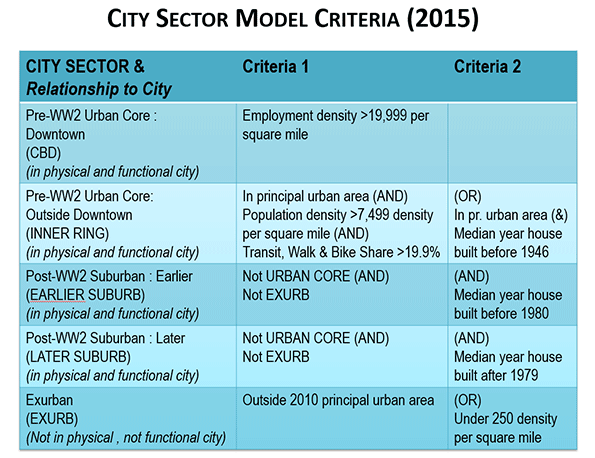
    This analysis uses my City Sector Model, which classifies small areas (ZIP codes, more formally, ZIP Code Tabulation Areas, or ZCTAs) in metropolitan areas in the nation based upon their function as urban cores, suburbs, or exurbs. The criteria used are generally employment and population densities and the extent of transit use versus car use. The purpose of the urban core sectors is to replicate, to the best extent possible, the urban form as it existed before World War II, when urban densities were much higher and a far larger percentage of urban travel was on transit. The suburban and exurban sectors replicate automobile-oriented suburbanization that began in the 1920s and escalated strongly following World War II.

    A recent revision to the model divided the urban core into two classifications, the downtown or central business district ("CBD") and the "inner ring." The CBD is the locus of the most important urban revitalization in the core municipalities, while the inner ring includes the remaining part of the urban core that resembles the outlying parts of the pre-World War II city in its travel patterns and population densities (the City Sector Model criteria are described in the note below).

    The Anecdotal Evidence

    Seemingly endless stories are covered in both the print and electronic media describing how younger adults have been attracted to the urban core. Press organs like The New York Times and the Los Angeles Times can readily send their reporters to nearby cafes, bars, and restaurants. Much rarer are the anecdotes from the suburban strip malls and even a "Starbucks" on Long Island, Sugarland, outside Houston, or in the San Fernando Valley. But data, not anecdotes, are the most reliable indicators of actual trends.  

    From Anecdotes to Data

    The new data reinforces the reality that the story of millennials in the urban core is more nuanced than often suggested. This analysis compares population data for younger adults in the age range of 20 to 29 years old.

    Data: The Urban Core

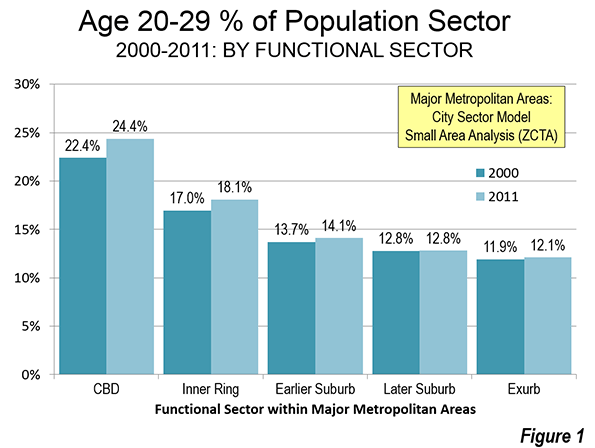
    The "good news" relates to part of the city, the urban core. Millennials are concentrating to a greater degree than before in the urban core. Millennials have a larger share of the total population in the CBD then in any of the other for city sectors. In 2011, millennials represented 24.4% of the CBD population. By comparison, millennials are a much smaller 14.1% of the overall metropolitan population and the share in the exurbs is only 12.1%, less than one half that in the CBD. The associated inner ring has the second highest millennial component, at 18.1%, well above the shares in the outer sectors. Further, the millennial composition of the CBD increased between 2000 and 2011 from 22.4% to 24.4%. The inner ring millennial composition also increased, from 17.0% to 18.1% (Figure 1).

    So there is no question that the urban core millennial population is increasing beyond the general population increase.

    Data: City-Wide

    The other, often neglected, reality is that the gains in the urban cores are small compared to overall city (urban area or metropolitan area) trends. And millennial urban core gains may well have reached a peak, as has been suggested by Trulia’s Jed Kolko. Over the last year the millennial population in the CBDs has dropped a modest 25,000 (an amount that is probably within the margin of error, since all of these data are from surveys).

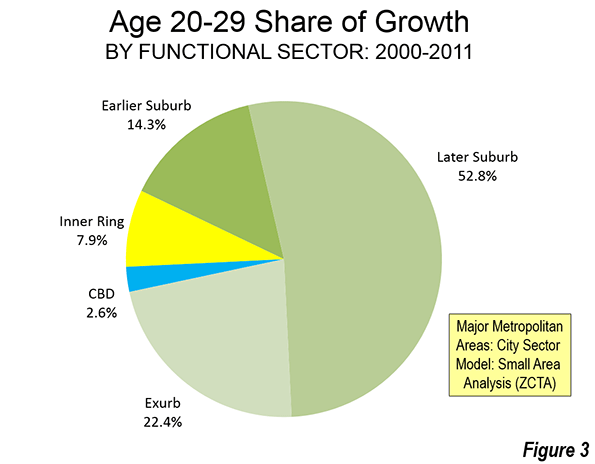
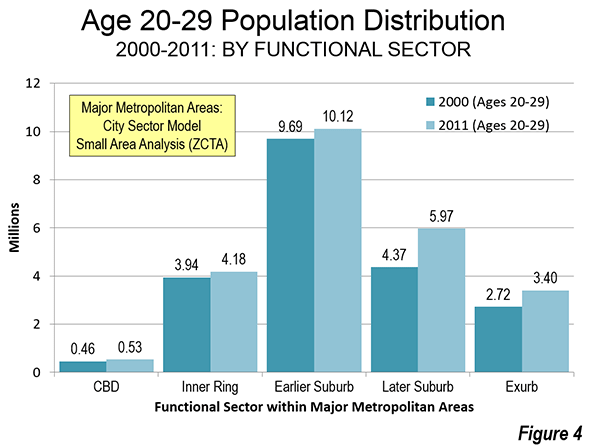
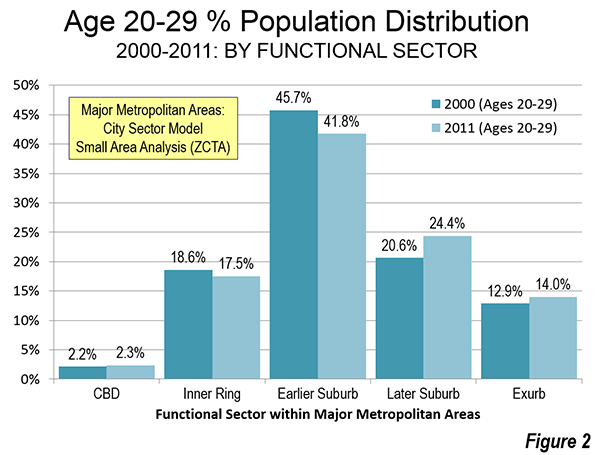
    Only 2.3% of millennials lived in the CBDs in the most recent year for which there is data (2011). This is up, but only from 2.2% in 2000. That gain was offset by a troubling loss in the inner core from 18.6% to 17.5%. The millennial share increases were all in the suburbs and exurbs (Figure 2).

    In numbers, the population aged 20 to 29 increased in the suburbs 20 times that of the CBD and the increase in the exurbs was nearly 9 times as high. Altogether, more than 90% of this cohort’s growth took place outside the urban core in the major metropolitan areas (Figure 3). Overall, the millennial gains in the CBD were approximately 80,000, while the gains in the inner ring were approximately 240,000. By contrast, the millennial gains in the suburbs and exurbs amounted to more than 2.75 million (Figure 4).  

    A Matter of Perspective

    The story on millennials is simply a matter of perspective. Those most interested in the small but influential urban core, depict a rising tide of millennials, with some justification. Those most interested in all the entire metropolitan area, are compelled by the overwhelming numbers to recognize that the story of millennials in the urban core is less significant in the larger context. But we are far from, and may well never achieve, a return to the imminent "Nirvana" of restoring pre-World War II cities or even a substantially smaller role for cars, which continue to drive the urban form in much of the world.

    Continued progress in the urban cores does not depend upon the "death" or decline of the suburbs. If cities are to best perform their crucial role of providing better standards of living and enabling lower poverty rates, they could boost prosperity throughout the city from the urban core through the suburbs to the exurbs.

    Note: ACS 5 Year Data: The data were collected by the American Community Survey of the US Census Bureau from 2009 to 2013. One fifth of the survey is completed each year, and therefore the data most closely approximates the middle of the period,  2011.

    Note: City Sector Model Criteria: This article continues a series examining the 52 major metropolitan areas (those with more than 1,000,000 residents) using the City Sector Model, which allows a more representative functional analysis of urban core, suburban, and exurban areas, by using smaller areas, rather than using municipal boundaries. The City Sector Model thus eliminates the over-statement of urban core data that occurs in conventional analyses, which rely on historical core municipalities, most of which encompass considerable suburbanization.

    The City Sector Model classifies 9,000 major metropolitan area zip code tabulation areas using urban form, density, and travel behavior characteristics. There are five functional classifications: the CBD, the inner ring, all will earlier suburbs, later suburbs, and exurban areas.

    The general criteria is as follows: The CBDs include any small area with an employment density of 20,000 or more per square mile. The inner ring has lower employment density, with high residential densities, older housing and substantially greater reliance on transit. The CBD and inner ring together form the urban core, which resembles the population density and travel patterns of the pre-World War II city. The suburbs constitute the balance of the built-up urban areas and the exurbs are beyond the built-up urban areas.

    The revised City Sector Model criteria are illustrated in the Figure: "City Sector Model Criteria: 2015," below.

    Wendell Cox is principal of Demographia, an international public policy and demographics firm. He is co-author of the "Demographia International Housing Affordability Survey" and author of "Demographia World Urban Areas" and "War on the Dream: How Anti-Sprawl Policy Threatens the Quality of Life." He was appointed to three terms on the Los Angeles County Transportation Commission, where he served with the leading city and county leadership as the only non-elected member. He was appointed to the Amtrak Reform Council to fill the unexpired term of Governor Christine Todd Whitman and has served as a visiting professor at the Conservatoire National des Arts et Metiers, a national university in Paris.

    Photo:  The revitalizing CBD of St. Louis (by author)

  • The Changing Geography Of Education, Income Growth And Poverty In America

    In this column, we often rate metropolitan areas for their performance over one year, five or at most 10. But measuring economic and social progress often requires a longer lens, spanning decades.

    Nowhere is this clearer than in education, which many claim is the key to higher-wage economic growth. Yet there are two sets of numbers that need to be distinguished: those states with the highest percentage of educated workers and the states that have increased their numbers most rapidly.

    On one side, the share of the population that is educated, states’ relative standings remain fairly similar to the way they were in 1970. Colorado, California, Connecticut, New Hampshire, New Jersey, Maryland and Virginia are all still above the national average for the percentage of the population over 25 with a bachelor’s degree, which has risen from 10.7% in 1970 to 29.6% in 2013. Massachusetts leads the nation with a remarkable 40.3% of its adult population having graduated from a four-year college. Overall, the “brainiest states” remain well ahead of their competitors in percentage terms.

    But in terms of growth in the raw numbers of educated people, most of these states have lagged. Indeed their high concentrations of college graduates may reflect their slow population growth, or the lack of opportunities for people without a bachelor’s degree.

    Educating The Sun Belt

    The states whose populations of college grads have grown the most are almost all in the South and the Sun Belt, led by Nevada with a 1,292% increase from 1970 to 2012 in the number of residents with four years of college or more, followed by Arizona (861%), Florida (743%) and Georgia (699%).

    Although they mostly still lag the best educated states, their large additions of educated workers appears to be transforming these former backwaters into centers of advanced industry and commerce. Since 1970, Texas has increased its population of college graduates by 555% while North Carolina’s surged 659%; in contrast, New York’s educated workforce expanded by 247% and Massachusetts’ by 341%, lagging the national average of 397% growth. California, whose economy grew rapidly through this period, was a shade above that with a 402% expansion in its population of college grads.

    The dichotomy is also pronounced when looking at the growth in the population of those with three years of college or more, including community college and certificate programs. Since 1970, for example, South Carolina expanded its population of such people by 746% and Texas by 592%; in contrast Massachusetts’ ranks of “some college” grew by 213% and California’s by 304%. Much of the growth among the leading states was tied to rapid overall population growth due to in-migration, particularly in states like Arizona and Nevada, which was accompanied by relatively rapid job growth.

    Brain Centers And Slower Growth

    The most educated states by percentage of college graduates are on the East Coast — Massachusetts, Connecticut, Maryland, Virginia, New Jersey — with the exception of Colorado. Many of these states also boasted among of the highest concentrations of college grads in 1970 (Colorado ranked first then with a 14.9% concentration). But with the exception of Virginia, since then the growth in the raw number of educated workers in these states has come at a slower rate than the Sun Belt states, amid their rapid population expansion. For example, since 1970 Connecticut’s population of college grads grew 282%, the fourth lowest rate in the nation and roughly half that of Texas’.

    Some might think that states with a higher proportion of educated workers would do better at creating new jobs. But since 1991, according to the Bureau of Labor Statistics, employment in both Massachusetts and New York has grown at 0.4% annual rate, and 0.8% in California. In contrast, Arizona’s annual job growth averaged 2.4% and Texas 2%.

    This suggests that having a high percentage of educated people is not enough to grow a jobs-rich economy, particularly if, as Robert Reich suggests, the demand for educated workers in the U.S. has dropped since 2000. It might seem tautological, but expanding economies  attract new educated workers.

    The Changing Face Of Poverty

    In 1959, the South was the poorest region in the country, with a poverty rate of 35.6%. By 1979, in the wake of the federal War on Poverty and strong economic growth, the poverty rate in the South had fallen by more than half, to 15.3%; by then, New York and Texas had roughly comparable poverty rates. (Note that I am not suggesting a linkage to the education trends discussed above, which mostly cover a later period.)

    The shift in the geography of poverty was underlined a few years ago when the Census released a new estimation of how to track it, the Supplemental Poverty Measure. (It takes into account the cost of a broader range of necessities than the standard measure, which is limited to food. It factors in geographic differences in housing costs, adds noncash benefits like nutrition assistance and housing subsidies to families’ incomes and subtracts taxes, child support payments and out of pocket medical expenses). The SPM placed 2 million more Americans below the poverty line as of 2012 than the standard measure; it dropped the poverty rate for those living in rural areas and raised it for those in metro areas and heavily urbanized states like California and New York. For the years 2010-12, California’s poverty rate jumps from slightly above average by the standard measure (16.5%) to the highest in the nation under the SPM (23.8%), followed by the District of Columbia (22.7%). Longtime laggard Mississippi, which ranks second worst in the country under the standard measure at 20.7%, falls back to the national average of 16% under the SPM, better than New York at 18.1%.

    Long-term income growth statistics over the same timespan as our education data also tell an interesting story. U.S. per capita incomes have risen 77% in inflation adjusted dollars from 1970 to 2013, according to the U.S. Bureau of Economic Analysis. The leader has been North Dakota, with a 160.4% jump to $53,182. Much of it seems tied to the energy boom – incomes have jumped 51% alone since 2000 — but it’s more than that. Its neighbor South Dakota, where oil production is much less important, ranks third in per capita growth over that span at 125.9%, as it built up a powerhouse financial services industry by loosening regulations

    Many of the regions where growth exceeded the national average have historically had low incomes. The former Confederacy accounts for eight of the top 20: Louisiana, Arkansas, Mississippi, Tennessee, Alabama, Virginia, Texas and North Carolina. (All still lag the national average income of $44,765, though, with the exception of Virginia). The Plains and Intermountain states account for another six (North Dakota, South Dakota, Wyoming, Minnesota, Oklahoma). The other big regional winner has been New England, with five of the top 20: New Hampshire, Vermont, Connecticut, Massachussetts and Maine. Washington, D.C., ranks 2nd, with growth of 129.4% to a nation-leading $75,329, showing us once again that our rulers treat themselves well.

    Among the laggards is California, where per capita income grew 62.4%, well below the national average. Several other Sun Belt “boom states” that rank highly on our list of states that have expanded their educated populations the fastest have done poorly in terms of income growth, including, Florida (41st), Arizona (48th), and in last place, Nevada. One complicating factor is that these states have a large proportion of people who earned their income in other, colder parts of the country. Not surprisingly, several of the laggards are in the Rust Belt, including Indiana (40th), Ohio (42nd), and Michigan (47th).

    The Future

    Clearly the economic and educational map of America is changing. There’s a movement of educated people — critical to many industries — to formerly backwater states. Over time jobs, too, are following this path.

    In the years ahead we can expect these trends to continue, or even accelerate. There is little reason to believe that states like California or New York are going to re-industrialize or reform their planning systems to help reduce housing prices. They will remain increasingly bifurcated between a very well-educated, affluent population clustered around the most elite industries and an underclass of poor, undereducated people. California, for example, ranks 14th in percentage of college graduates, down from 7th in 1970 but in terms of high school non-graduates it has soared from 44th to 2nd.

    This bifurcation doesn’t bode well for these places. People will continue to move to those places where young educated people are now going, notably in the South, the Great Plains, the Intermountain West, and, to some extent, parts of the Pacific Northwest.

    Forty years from now America will have many more centers of educational and economic excellence spread across the continent. This may involve a decline in the relative power of some regions, notably California, the Rust Belt and the Middle Atlantic States, but the rise of educated workers and employment elsewhere could help the country retain its competitiveness on an increasingly continental scale.

    The Biggest Brain Gain States Since 1970

    No. 1: Nevada

    Increase In Population Of College Grads, 1970-2013: 1,292%
    Pct. Of Adult Population With College Degree, 1970: 10.8%
    Pct. Of Adult Population With College Degree, 2013: 22.5%

    No. 2: Arizona

    Increase In Population Of College Grads: 861% 
    Pct. Of Population With College Degree, 1970: 12.6% 
    Pct. Of Population With College Degree, 2013: 27.4%

    No. 3: Florida

    Increase In Population Of College Grads: 743% 
    Pct. Of Population With College Degree, 1970: 10.3% 
    Pct. Of Population With College Degree, 2013: 27.2%

    No. 4: Georgia

    Increase In Population Of College Grads: 699%
    Pct. Of Population With College Degree, 1970: 9.2%
    Pct. Of Population With College Degree, 2013: 28.3%

    No. 5: North Carolina

    Increase In Population Of College Grads: 659% 
    Pct. Of Population With College Degree, 1970: 8.5% 
    Pct. Of Population With College Degree, 2013: 28.4%

    No. 6: Colorado

    Increase In Population Of College Grads: 617% 
    Pct. Of Population With College Degree, 1970: 14.9% 
    Pct. Of Population With College Degree, 2013: 37.8%

    No. 7: New Hampshire

    Increase In Population Of College Grads: 603% 
    Pct. Of Population With College Degree, 1970: 10.9% 
    Pct. Of Population With College Degree, 2013: 34.6%

    No. 8: Utah

    Increase In Population Of College Grads: 585% 
    Pct. Of Population With College Degree, 1970: 31.3% 
    Pct. Of Population With College Degree, 2013: 14.0%

    No. 9: Idaho

    Increase In Population Of College Grads: 563% 
    Pct. Of Population With College Degree, 1970: 10.0% 
    Pct. Of Population With College Degree, 2013: 26.2%

    No. 10: South Carolina

    Increase In Population Of College Grads: 556% 
    Pct. Of Population With College Degree, 1970: 9.0%
    Pct. Of Population With College Degree, 2013: 26.1%

    No. 11: Texas

    Increase In Population Of College Grads: 555% 
    Pct. Of Population With College Degree, 1970: 10.9%
    Pct. Of Population With College Degree, 2013: 27.5%

    No. 12: Alaska

    Increase In Population Of College Grads: 544% 
    Pct. Of Population With College Degree, 1970: 14.1%
    Pct. Of Population With College Degree, 2013: 28.0%

    No. 13: Virgina

    Increase In Population Of College Grads: 517% 
    Pct. Of Population With College Degree, 1970: 12.3%
    Pct. Of Population With College Degree, 2013: 36.1%

    No. 14: Washington

    Increase In Population Of College Grads: 513% 
    Pct. Of Population With College Degree, 1970: 12.7%
    Pct. Of Population With College Degree, 2013: 32.7%

    No. 15: Tennessee

    Increase In Population Of College Grads: 495%
    Pct. Of Population With College Degree, 1970: 7.9%
    Pct. Of Population With College Degree, 2013: 24.8%

    Joel Kotkin is executive editor of NewGeography.com and Roger Hobbs Distinguished Fellow in Urban Studies at Chapman University, and a member of the editorial board of the Orange County Register. He is also executive director of the Houston-based Center for Opportunity Urbanism. His newest book, The New Class Conflict is now available at Amazon and Telos Press. He is also author of The City: A Global History and The Next Hundred Million: America in 2050.  He lives in Los Angeles, CA.

    Photo: 1980s-era Reno, Nevada. Public domain.

  • Misunderstanding the Millennials

    The millennial generation has had much to endure – a still-poor job market, high housing prices and a generally sour political atmosphere. But perhaps the final indignity has been the tendency for millennials to be spoken for by older generations, notably, well-placed boomers, who often seem to impose their own ideological fantasies, without actually finding out what the younger cohort really wants. The reality, in this case, turns out far different than what is bespoken by others.

    Nowhere is this tendency clearer than in the perception of what kind of life – and what places – will millennials find attractive. Generally, the narrative goes like this: Millennials are different, they don’t care about owning homes, detest the suburbs and would prefer to spend their lives in dense apartment blocks, riding the rails or buses to whatever work they might be able to find.

    Urban theorists, such as Peter Katz, insist that millennials (the generation born after 1983) have little interest in “returning to the cul-de-sacs of their teenage years.” Manhattanite Leigh Gallagher, author of “The Death of Suburbs,” asserts with certitude that “millennials hate the suburbs” and prefer more eco-friendly, singleton-dominated urban environments.

    Such assessments thrill the likes of real estate speculators, such as Sam Zell, who welcomes “reurbanization” as an opportunity to cash in by housing a generation of Peter Pans in high-cost, tiny spaces unfit for couples and unthinkable for families. Others of a less-capitalistic mindset see in millennials a post-material generation, not buying homes and cars and, perhaps, not establishing families. Millennials, for example, are portrayed by the green magazine Gris as “a hero generation” – one that will march, willingly, even enthusiastically, to a downscaled and, theoretically, greener future.

    Read the entire piece at The Orange County Register.

    Joel Kotkin is executive editor of NewGeography.com and Roger Hobbs Distinguished Fellow in Urban Studies at Chapman University, and a member of the editorial board of the Orange County Register. He is also executive director of the Houston-based Center for Opportunity Urbanism. His newest book, The New Class Conflict is now available at Amazon and Telos Press. He is also author of The City: A Global History and The Next Hundred Million: America in 2050.  He lives in Los Angeles, CA.

    New home photo by BigStockPhoto.com.

  • What’s This Place For?

    I was recently asked by Gracen Johnson (check out her site here) to elaborate on the possible future of suburbia. How are the suburbs likely to fare over time? This coincided with a city planner friend of mine who asked a more poignant question about the suburban community he helps manage. “What’s this place for?” If we can answer that question we might be able to get a handle on the possible trajectories of various suburbs.

    unnamed-2 unnamed-1 unnamed-5 unnamed-3

    For example, we all understand what a farm town is for. Small rural towns produce food. The people who live in the countryside are actively engaged in the business of feeding society. They take soil, water, plants and animals and convert it all into breakfast, lunch and dinner. For the people who want to live this way there are tremendous benefits: fresh air, open space, privacy, independence, a direct connection to nature, strong family bonds, tradition, and so on. Whatever else we might say about farm country we can be certain that it will carry on one way or another or else civilization will grind to a halt pretty quickly.

    IMG_0126 (800x533) IMG_0085 (800x533) IMG_0093 (800x533)

    We also know what industrial cities are for. They take the raw materials from the surrounding countryside and transform them into finished goods. Grain becomes flour and bread. Timber becomes lumber, then homes and furniture. Iron ore and coal become machinery and power. Crude oil becomes gasoline, petrochemicals, and plastics. There are obvious trade offs for industrial workers, but for many people it’s a pretty good arrangement. If we expect to have manufactured goods in the future these cities will have to continue somehow.

    Screen Shot 2015-01-31 at 6.49.37 AM Screen Shot 2015-01-31 at 6.54.26 AM Screen Shot 2015-01-31 at 6.56.05 AM Screen Shot 2015-01-31 at 6.55.40 AM

    The new post-industrial locus is a bit trickier to pin down. The service economy doesn’t actually produce any “thing” so the workforce is liberated to live just about anywhere in a way that farmers and factory workers can’t. Oddly, well educated highly paid people don’t actually spread out and inhabit a million cabins in the woods as you might expect. Instead they clump up in a handful of regions that provide abundant cultural amenities. At the same time the post-industrial economy exists in a physical world and all those people and electronic components rely on the underlaying farms, factories, and raw resources that support them. The so-called dematerialization of the economy still requires a serious amount of real “stuff” to function.

    Screen Shot 2015-01-29 at 6.18.31 AM Screen Shot 2015-01-29 at 6.05.55 AM Screen Shot 2015-01-29 at 6.06.18 AM

    So what does this all mean for the suburbs? The nature of suburbia has always been consumptive rather than productive. People move to the suburbs in order to purchase and enjoy things: a spacious home, a good school district, security, a clean environment, more respectable neighbors, and so on. The majority of the commercial activity is actually in service to suburbia itself. The mortgage brokers, insurers, real estate agents, landscapers, school teachers, firefighters, orthodontists, pancake houses, and auto body shops are all there to help keep the suburbs humming along. But they’re all consumptive in nature. No one is making the tennis shoes sold at the mall or growing the oranges at the supermarket. This is compounded by the fact that the suburbs are maintained largely through debt. Private debt is required for all the mortgages, car loans, credit cards, student loans, and business loans while municipal bonds prop up many essential suburban government functions. The fact that many people don’t understand the difference between production and consumption is one of the big problems the suburbs are going to have to sort out in the future.


    Screen Shot 2015-01-28 at 9.22.31 PM Screen Shot 2015-02-03 at 2.12.50 AM

    I’m going to get a lot of push back on this concept. I’m sure many of you think that your suburb is full of productive enterprises: the Krispy Kreme, the Jiffy Lube, the dozen Shell and Exxon stations, the Applebee’s, the Foot Locker, the Honda dealership, and the Kroger’s. But these are merely outlets for things that were produced elsewhere. Let me offer another example from my own life. I spent a chunk of my childhood in the San Fernando Valley in Los Angeles. Back in the 1960’s and 1970’s nearly everyone had some connection to companies like Rocketdyne, Litton, and General Dynamics. Those were the engines of the local economy for decades. And they did in fact produce real physical things. But they were all funded entirely by the federal government. Tax money was skimmed off the national productive economy (all those farms and factories) and then spent on missile guidance systems, satellites, and fighter jets. The same was true in Huntsville, Alabama and Marietta, Georgia. Remember what happened to all those places when the feds turn off the spigot during budget cuts? Money flowed in, not out. There’s a reason Peru doesn’t have a space program. The underlying national economy isn’t productive enough to support such extravagant government spending.

    As the material abundance we enjoyed in the Twentieth Century tightens up suburbs will have to become much more efficient places that provide things the outside world needs and is willing to pay for. At the same time internal consumption and debt are going to have to be pulled back. That doesn’t necessarily mean a lower quality of life, but it does demand that suburbs retool and ask themselves, “What’s this place for?”

    John Sanphillippo lives in San Francisco and blogs about urbanism, adaptation, and resilience at granolashotgun.com. He’s a member of the Congress for New Urbanism, films videos for faircompanies.com, and is a regular contributor to Strongtowns.org. He earns his living by buying, renovating, and renting undervalued properties in places that have good long term prospects. He is a graduate of Rutgers University.

  • Corrupt Illinois: Not A Few Bad Apples

    Despite a huge advantage in name recognition, massively more money, and a lift from President Obama, Rahm Emanuel failed to avoid a run-off Tuesday. It seems many Chicago residents are beginning to realize that our present system – and leaders – are leading us off a precipice.

    In the adopted home of a President and the most fabled political machine in the country, the issue here is the factors that drive political decisions. It is increasingly clear that the old political science sense that politicians are less self-interested than regular people – suckers, taxpayers – is dead wrong.  Many American political scientists will claim with enormous conviction that those engaged in the marketplace are more self-interested than those involved in the political process. Liberal scholars and the mainstream media constantly complain about market failure; much less attention is paid to political failure.

    Not all academics studying politics have been so naïve about the political process. Over 100 year ago FDR’s influential progressive advisor Frederic C. Howe, in his long forgotten book, Confessions of a Monopolist explained the essence of politics:

    This is the story of something for nothing—of making the other fellow pay. This making the other fellow pay, of getting something for nothing, explains the lust for franchises, mining rights, tariff privileges, railway control, tax evasions. All these things mean monopoly, and all monopoly is bottomed on legislation.

    Seeking special privileges, Howe reasoned, leads to corruption. By the 1960s this notion was explored by economists Gordon Tullock and Anne Krueger, who developed the concept of “rent-seeking.” They saw how politics represents often merely an investment towards plundering the taxpayers for private gain.

    Now we have a modern day examination of this phenomena, particularly in the crony capital of the world, Illinois. Political scholars Thomas Gradel and Dick Simpson have written a path breaking  book  from The University of Illinois Press on corruption in the state of Illinois. This book is the most comprehensive survey of corruption in the state of Illinois ever published. The lessons here are useful well beyond Illinois. You’ll never understand, for example, Barack Obama’s political career unless you read this book. Gradel and Simpson also remind us that Chicago isn’t the only corrupt place in Illinois.  The corrupt politicians, judges, police, and government bureaucrats are catalogued here and backed by empirical evidence.

    Illinois’ biggest town was corrupt from the start. Even the incorporation vote to start Chicago was fraudulently conducted. Chicago’s City Council is the epitome of the place’s corruption. Gradel and Simpson present the evidence:

    Thirty-three Chicago aldermen and former aldermen have been convicted and gone to jail since 1973. Two others died before they could be tried. Since 1928 there have been only fifty aldermen serving in the council at any one time. Fewer than two hundred men and women have served in the Chicago city council since the 1970’s, so the federal crime rate in the council chamber is higher than in the most dangerous ghetto in the city.

    Those Chicago Aldermen who went on to commit crimes represent all elements of society. White, black, college graduates, rich, poor, felonies on the job, felonies off the job, and more. But, Chicago’s city council isn’t the only corrupt place. Chicago’s police department has faced its’ share of negative publicity:

    Since 1960, more than three hundred Chicago police officers have been convicted of serious crimes, such as drug dealing, beating civilians, destroying evidence, protecting mobsters, theft, and murder. However, this doesn’t include all the illegal and unethical activities that have gone undetected or were covered up internally by the police department.

    The Emanuel administration still has to deal with police behavior from decades ago. Commander Jon Burge, Chicago’s most infamous police torturer, has already cost the city $120 million in settlements and legal fees with the meter still running.  William Hanhardt, who was elevated to Chief of Detectives after joining the police force in 1953, rose through the ranks to be the Chicago Mob’s most important asset on the force.  He was eventually indicted for running a nationwide jewelry theft ring. This was not any ordinary theft ring. As U.S. Attorney Scott Lassar clearly stated: "Hanhardt’s organization surpasses in duration and sophistication -just about any other jewelry theft ring we’ve seen in federal law enforcement."  Chicago’s City Council never held hearings on who Hanhardt promoted in his long career and the long racketeering enterprise he ran.

    This isn’t the fantasy land Barack Obama of  apologist David Maraness, or Jonathan Alter (whose mother was the first woman to be slated for Cook County office by Mayor Richard J. Daley)  concocts.  

    The big question: Was Barack Obama separate from the ethical swamp of Illinois politics? Obama was a foot soldier of the Daley machine when Congressman Bobby Rush had the nerve to run against Mayor Richard M. Daley in 1999, Daley needed to send Congressman Rush a message.  The Daley operation “encouraged” Illinois State Senator Barack Obama to challenge Congressman Bobby Rush. Obama lost, but won the loyalty of Mayor Daley.  The Chicago machine pushed Obama for the Illinois State Senate, the U.S. Senate, and then the Presidency.  Barack Obama was there when the chips were down.  As one Obama observer explained, he endorsed Daley last time in 2007 despite the corruption and the many civil rights violations. Daley, for his part, backed Obama in his successful run for the white House.

    President Obama previously taught constitutional law classes at one the country’s most prestigious law schools, the University of Chicago. Given President Obama’s civil rights knowledge as a law school professor,  President Obama’s 2007 endorsement of Daley for mayor remains even more perplexing. Recent revelations about a Chicago police “black site” – much along the lines of CIA interrogation centers — seem to have done little to change his embrace of the machine.

    Clearly the cord to the machine has hardly been cut. Just look at who President Obama hired as top staff members. Daley fundraiser Rahm Emanuel served as Chief of Staff. Mayor Daley’s brother William followed him as Chief of Staff.  Another powerful figure is Mayor Daley’s deputy Chief of Staff, Valerie Jarret. The head of the less than successful Chicago Public School system, Arne Duncan, got promoted Secretary of Education. Chicago machine donor and housing fraudster Penny Pritzker got appointed to Secretary of Commerce.  

    But don’t rely just on me. Read Thomas Gradel and Dick Simpson— you may realize the price we all, not just in Chicago or Illinois pay, for not confronting the culture of corruption.

    Steve Bartin is a resident of Cook County and native who blogs regularly about urban affairs. He works in Internet sales.

    Official White House Photo by Pete Souza.

  • A Lifetime of Financial Advice for 2015

    When household savings falls and household debt rises, “most people” are spending more than they make. When people find out I’m an economist, they often ask if I can explain why “most people” can’t figure out how to handle their money. The New York Fed recently reported the end of deleveraging: American households are borrowing again. When you get paid, you can do one of two things with your money: save it or spend it. If you aren’t saving AND you are borrowing, then clearly you are spending more than you make.

    There are a lot of people in America who are young, struggling and without inheritance or some initial endowment to get started in life. The Census Bureau reports a 17.5% rise in the number of 25 to 34 year olds living with their parents (from 2007 to 2010). This increase cuts across all socio-economic lines. Regardless of the demographics that impact the way the economy grows, we all go through life-cycles. I did it, you did it and “most people” will do it, too. If you are smart, you’ll engage the economy throughout the cycles of your life. Here’s how it works. The six cycles correspond roughly to the decades from your 20s to your 70s.

    CYCLE 1 (20s): Without an initial endowment, we all struggle in the first decade after we leave our parents home (or foster care, or whatever situation it was that brought you to adulthood). Your skill set is very low and you may or may not have gotten a college education. You are an unknown quantity in the job market, untried and unproven, so your wages will be quite low. You also have no secondary source of income (no endowment, remember, means no investment income). If you are smart and lucky, you’ll figure out that you have nothing and so you will spend nothing that you don’t have. Focus on keeping a good job, building some skills, try to get a little more education and keep your nose clean. That’s enough for the first decade.

    CYCLE 2 (30s): By now, you’ve got a resume built up so you can expect to be promoted or to look for a better job that pays more, maybe has some benefits like health insurance and some kind of a savings plan. Put something into that employer-matched 401k plan: sure, you probably won’t be able to wait until age 65 to dip into it, but it will be money that you won’t otherwise have. The match means that you earn an instant 100% on your money. Even if the penalty for early withdrawal is about 25%, you will still be ahead by 75% even if you can’t wait for retirement. If you have some financial assistance (from family or a grant of some kind), you’ll probably acquire some sort of property at this point. Maybe it’s a small business or a home but it’s the grown-up thing to do. Stay away from making a big investment in some depreciable asset, like a sports car, at this point. These are the beginning of the years in which you will build capital for the future: financial capital (investments), human capital (skills and education), and social capital (a good network of contacts, both social and business). Focus on moving up in your career a couple of times so that you can begin to put money into savings and investment on a regular basis. Avoid the trap of building up a lot of debt during this stage and be sure to stay within your means.

    CYCLE 3 (40s): These are the real building years. You should be well-established in your field of work and hopefully you have built strong and stable social connections, too. It’s time to start thinking about giving back to the community that supports you. You can volunteer, start making larger cash donations to charities, attend some charity balls or even run for office (or get active in the campaign of a candidate you support). Some of these social and charitable contacts will be helpful to you in business and some will just be the kind that makes living in a community more pleasant. Your focus now is to set achievable life-goals. Whatever your ambition was in your 20s, by now you will have a clear vision of what you can realistically attain. With that idea in mind, set goals for your career, your finances, when you want to retire from work, etc. Make them realistic for now, based on what you know. You’ll get a chance to adjust them only once more in your lifetime.

    CYCLE 4 (50s): Now’s the time to begin planning for the culmination of your work life. It could be another 20 years off, but you need to think through how you will sustain that longer career, or to plan to stop working altogether. If you wait till the next cycle, when you are in your 60’s, it may be too late to make any changes that will be necessary for you to achieve your goal. Your earnings will peak in this decade so if you haven’t saved enough along the way, this is the last chance to start to bring your savings in line with your goals.

    CYCLE 5: (60s): By now, if you’ve followed through with planning and budgeting, you should be able to take it easier. A lot easier (retire from working) or a little easier (work part-time or in your own business). If you’ve been able to get some education, you may be able to support yourself fully as a knowledge-worker. Knowledge workers have longer work lives because they won’t have limitations on endurance or other physical job requirements. Even if your job was physically demanding, it is possible that an employer will need your advice as a manager or consultant on a project that will benefit from your years of experience.

    CYCLE 6 (70s): Average life expectancy in the US is in the low- to mid-80s for both men and women. That means that, on average, this will be the penultimate decade of your life. Depending on your early choices, you may find yourself now at the pinnacle of your profession. Try to pass along as much of your knowledge as you can to the next generation, both what you learned in your career and what you learned from your life experiences.

    If it seems they aren’t listening, keep talking. Maybe something will sink in and when they read in the news that “most people” spend more than they make, they will be able to count themselves among the unusual. Have a safe and prosperous 2015!

  • Voting on Public Art in St. Petersburg Florida

    Public art may soon get a boost in St. Petersburg, Florida when citizens cast ballots for a new design proposal to redevelop the 1971 St. Pete Pier.  After a 4-year process involving two design competitions (citizens roundly rejected the first competition results), this Florida coastal city will, in 2015, implement a design.

    This time around, city officials are taking no chances and building consensus with the public step by step, keeping this $33 million public project at the top of voters’ awareness.  Seven design proposals are being considered, and after presentations in mid February, it appears that the field is narrowed.

    While several schemes radically erase or change the city’s infrastructure, one scheme nicknamed “Discover Bay Life ” by Orlando-based VOA Associates seems to stand out.   All things being equal, this scheme’s monumental-scale transformable art by cutting-edge artist Chuck Hoberman can be had for the least capital investment by the city.  The team chose to keep the modernistic “Inverted Pyramid” at the end of the pier, shoo cars off of the over-water deck, and move restaurants and retail – which always struggled in such a remote location – from the end of the 1,400 foot pier back onto land.

    Hoberman, who designed U2’s “Claw” for their 2011 album tour, is no stranger to moveable structures.  “It’s really very simple,” he stated during the presentation.  “There are a couple of motors, pulleys, and bearings.  We have structures like this in place that have lasted for decades.”  St. Petersburg, home to the world’s largest collection of 20th century surrealist Salvador Dali’s work, seems to have an affinity for cutting edge art, and this commitment could result in a grand, lasting civic space.

    A popular vote will decide the scheme by March 20.  City leaders, anxious to proceed, have stayed neutral about the results and will ratify their decision afterward.  The lesson in urban studies is to proceed with caution when you are considering changes to civic space.  Far from being a lost cause, the public realm is very much alive and emotionally connected to its citizens, at least in St. Petersburg, Florida.