Blog

  • The Emerging New Aspirational Suburb

    Urban form in American cities is in a constant state of evolution. Until recent years, American suburbia was often built without an appreciation for future evolution. This has left many older suburbs in a deteriorated state, and has accelerated claims of a more generalized suburban decline.

    The Indianapolis suburb of Carmel represents a response to this historic pattern. While responding to today’s market demands with a new aspiration level designed to make it nationally competitive, it’s also trying to position itself for success tomorrow and over the longer term.

    This is a critical issue for many suburbs. Like big cities before them, many older suburbs have now aged, and no longer necessarily meet the requirements of the marketplace.  

    There are many reasons for this.  The early, usually small-scale Cape Cod-style housing common to many 50s vintage suburbs is not what today’s market is demanding. It’s the same for older enclosed malls – today “lifestyle centers” and other formats are preferred – many of which are now vacant, their grim remains featured on web sites such as DeadMalls.com. Many suburban areas were also built out with “infrastructure light” without upgraded streets, sidewalks, etc. leaving a big backlog of infrastructure need.

    Across the country many of these older districts have fallen into decay and become increasingly poor, taking on many of the characteristics of the inner city. As the Brookings Institution noted  over a decade ago, they “are experiencing some signs of distress—aging infrastructure, deteriorating schools and commercial corridors, and inadequate housing stock.”1 Today, the public is more aware of the trend, and events in Ferguson, MO recently gave a wakeup call to newer and still-thriving suburbs that they too may be troubled at some point.

    Like other American cities, Indianapolis has many of these older, struggling suburban areas. In its case, many of them are within the core city limits due to a 1970 city-county merger. As regional growth continues to expand outside the central urban county, newer generation suburbs have a chance to learn from the struggles of many of their predecessors.

    Carmel – pronounced like the Biblical Carmel – is the first suburb directly north of the city of Indianapolis. It is an upscale residential and business suburb similar to many others around the country such as Dublin, OH; Naperville, IL; and the Cool Springs, TN area.  Its 2013 population of 83,573 made it the 5th largest municipality in the state. While not monolithically wealthy, its 2013 median household income of $100,358 is the 14th highest in the United States among communities of 65,000 people or more.2 It’s a preferred area for the estate homes of wealthy Indianapolis area residents, such as Indianapolis Colts owner Jim Irsay. But it’s not just a bedroom suburb; real estate brokerage Cassidy Turley reports that the Carmel submarket has over six million square feet of office space.3

    Being located in the center of the favored quarter of the Indianapolis region, Carmel grew as an upscale area. This gives it a leg up in long term sustainability out of the gate.  

    Yet Carmel has not relied just on its wealth to insure against decline. Rather, it has embarked on a transformation program now nearly 20 years old from which three major themes emerge:

    1. Responding to current market forces to build a “state of the art” community that is competitive globally, not just within the Indianapolis region.

    2. Building a full spectrum of amenities and infrastructure to create a “complete city” with a high quality of life and intrinsic appeal that is a) not based solely on newness or low costs, and b) which has broad demographic appeal.

    3. Attempting to create unique cultural and regional attractions  to turn Carmel into a destination in its own right, as much city as suburb.

    The primary driver of this transformation has been Mayor Jim Brainard, a Republican currently in his fifth term.  Carmel long had top performing schools – it’s the top rated district in the state   – houses with generous yards, low taxes, and other standard attractors of suburbia. Previous administrations had put in place key policies such as reserving the Meridian St. corridor for high end office space and banning billboards. But Brainard brought numerous changes in Carmel during his tenure including:

    Annexation. Carmel has undertaken a series of annexations – nearly 20,000 acres since 2001 alone.4 With over 47 square miles of territory, Carmel has now largely achieved its desired geographic scale.

    Parks. Carmel’s park acreage increased from 50 to 1000 acres and it has spent heavily on building out its parks. This includes building a $55 million Central Park, which includes a showplace community and fitness facility called the Monon Center.5 And the popular Monon Trail, a rail-trail through the length of the city that extended a previous project built by the City of Indianapolis.
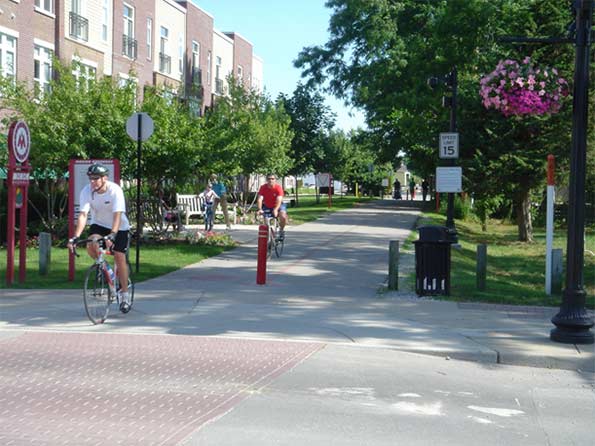

    Monon Trail at Main St.

    Road Infrastructure. Carmel has invested heavily in upgrading the legacy network of county roads that it overgrew. This includes an aggressive deployment of modern roundabouts. Carmel now has over 80 of these, more than any community in the United States.6 It has upgraded miles of collector roads to urban standards with enclosed drainage, curbs, extra-wide travel lanes, landscaped medians, eight foot multi-use side paths on both sides of the street protected by a landscaped buffer zone, and decorative street signs and other detailing.
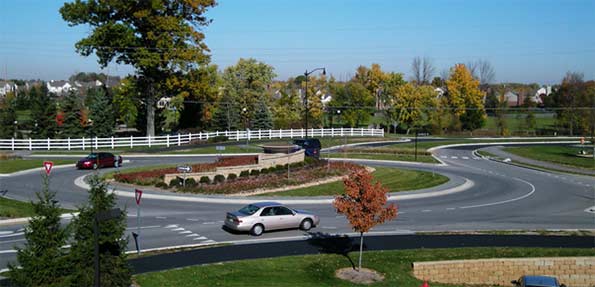
    Roundabout at Main St. and Illinois St. in the fall
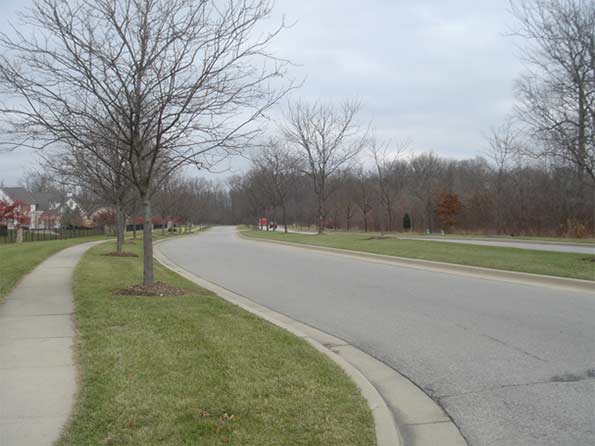

    An upgraded segment of River Rd. in early winter

    Two major state highways passed through the town, Meridian St. (US 31) and Keystone Ave. (SR 431). These were designed as rural style divided surface highways as is common in Indiana. Carmel convinced the state to relinquish Keystone Ave. to the city and give it $90 million for upgrades and future maintenance. Carmel converted this into a mostly free flowing parkway by spending $108 million to replace stoplight intersections with roundabout interchanges. These not only dramatically improved traffic flow, the bridges over the busy highway provided a high quality, safe connection – especially for pedestrians and bicyclists – connecting eastern and central Carmel, which had previously been separated by this “great wall” of a road. The state is currently performing a similar freeway upgrade on Meridian St., the principal office corridor.
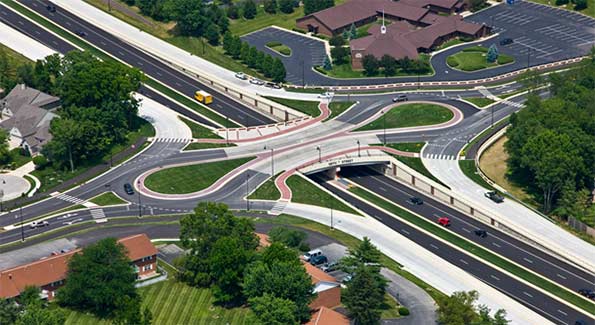

    Roundabout interchange at 126th St. and Keystone Parkway.

    Water and Sewer Upgrades. Part of Carmel previously received water from the Indianapolis water utility. The City of Indianapolis had privatized this utility but sought to repurchase it. Carmel intervened in the process to pressure Indianapolis into selling it the water lines inside Carmel. Carmel has since undertaken significant infrastructure upgrades such as new wells and pumping stations. During a recent summer drought, Carmel, unlike Indianapolis, did not put in place a mandatory restriction on lawn watering.7

    New Urbanism. Beyond core infrastructure, Carmel under Brainard has sought to change its style of development to embrace some of the more positive aspects of New Urbanism such as creating more urban nodes and walkability.

    Unlike some traditional railroad suburbs or county seats, the historic center of Carmel was very tiny, and its Main Street populated mostly with one story buildings and empty lots. This was the first focus area, and started with fixing the physical infrastructure.  

    The city rebranded the area as the “Arts and Design District” and utilized Tax Increment Financing to promote multi-story, mixed use development. The result is a mostly occupied and often well-patronized Main Street district. The surrounding historic residential blocks have seen significant redevelopment activity as well.
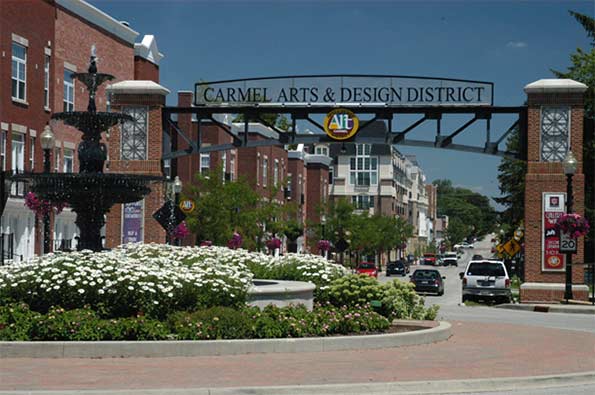

    Main St. at western fountain and gateway arch entryway to rebranded “Arts and Design Distrct.”

    Beyond the historic downtown, Carmel has also implemented multiple New Urbanist style zoning overlays, including on Old Meridian St. and Range Line Rd. (the city’s original suburban commercial strip). These promote mixed use development, buildings that front the street, and multi-story structures. Infrastructure improvements and TIF have been used in these areas as well. There’s also a major New Urbanist type subdivision in western Carmel called the Village of West Clay.
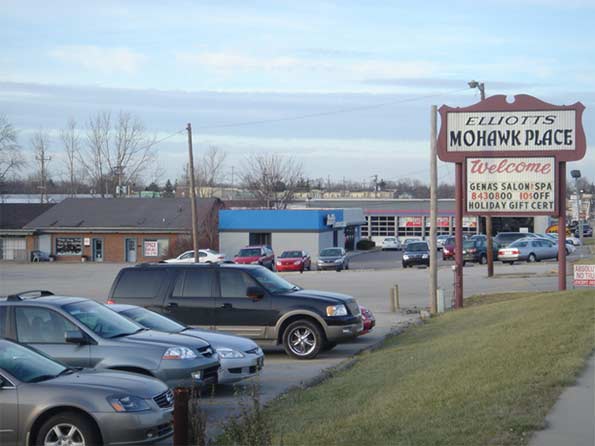
    Strip mall and traditional suburban development along Range Line Rd.
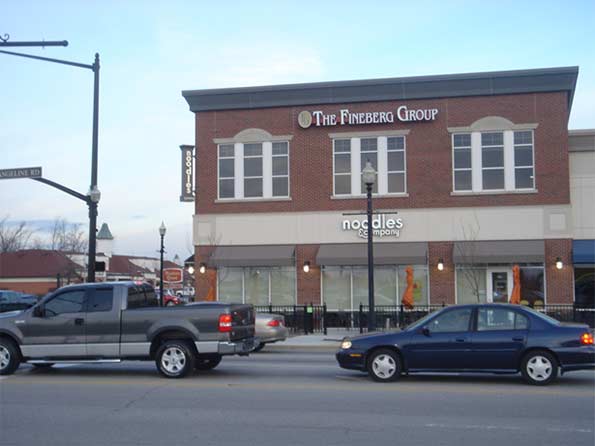

    New Urbanist style development along Range Line Rd.
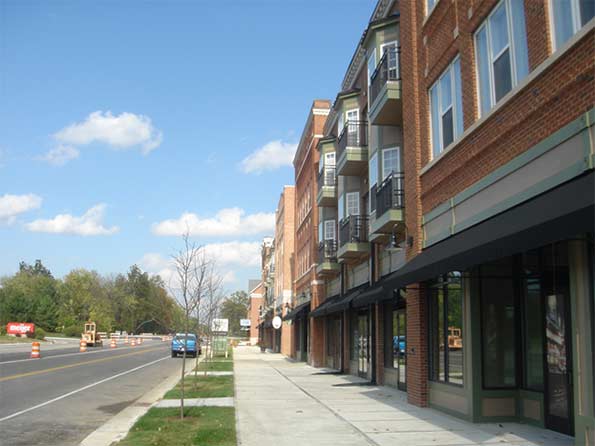

    New Urbanist development and street improvements under construction on Old Meridian St.

    The historic downtown was deemed too small to function effectively as the downtown of a city the size of Carmel today. The city thus decided to create a new downtown area called City Center. The location for this is an area south of the historic downtown area in an older suburban industrial zone that had fallen into a blight pattern. Much of it was vacant and what’s now the principal City Center development was built on the site of a failed strip mall. TIF was aggressively used here as well to redevelop the area.

    The City Center development is only partially complete. A veterans memorial and other civic spaces are complete, as are several small office buildings, apartments, and a large mixed use complex. The anchor is a publicly funded $175 million concert hall called the Palladium and an associated theater complex with three stages.8 While these are complete, significant development remains to complete the City Center vision. The city also wants to redevelop the area between City Center and the old downtown, which they now label Midtown, but very little has been done to date.
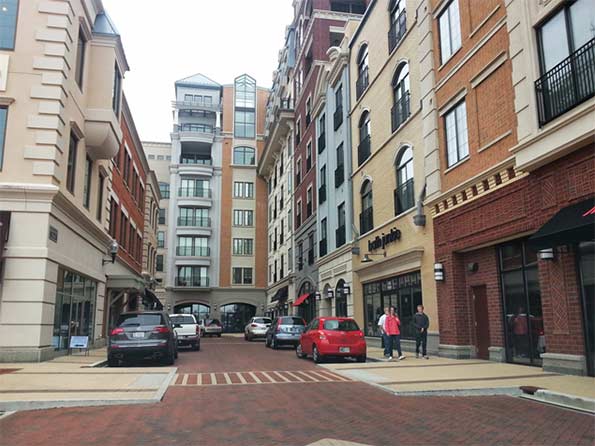

    Interior street of City Center development.

    The goal of all this development is not the full urbanization of Carmel; this city does not aspire to be dense metropolis, or even Indianapolis. It’s rather about creating more town center type districts with the walkable feel that’s increasingly in favor, but without compromising the fundamental suburban character of the city. It’s also designed to create a city with options. Having a diversity of development styles within the city is part of a strategy of appealing to a more diverse demographic base, including singles and retirees, not just the stereotypical younger family with kids. Traffic flow has been improved, but short trips are now easier to undertake by foot or bicycle, not just by car.

    Retro Architecture. Carmel has de facto mandated traditional architectural styles. There’s no one consistent style. Major buildings have been done in Georgian, Second Empire, and Neoclassical type designs. But modernism has been rejected, further differentiating suburban Carmel from urban areas that frequently elect for starchitecture that is unapologetically “of the now.”

    The city has also attempted to prevent large corporations from building their standard architectural templates. Brick is effectively mandated, even for big box retailers like Lowes. Retailers like CVS and Kentucky Fried Chicken were forced to build second stories on their structures to locate in certain areas. Another Carmel CVS has an art deco façade.

    The city wants high quality aesthetics and a unique sense of place. They also want “timeless” design, though like much New Urbanism architecture it can sometimes come across as pastiche.

    Arts and Culture. As part of the attempt to appeal to more arts minded middle aged consumers, as well as members of the  so-called “Creative Class,” Carmel has heavily invested in the arts. The City Center performing arts center was paid for almost entirely with public funds (TIF), an investment in the arts dwarfing even that of Indianapolis. The city has also paid for an extensive public art program, mostly statues by Seward Johnson. And it makes operating grants to local arts organizations such as the Carmel Symphony Orchestra.
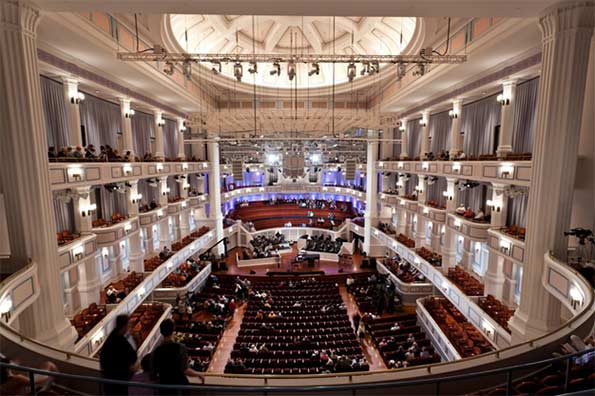

    Interior of the Palladium concert hall. Photo by Zach Dobson.

    Seward Johnson is not a favorite of urban sophisticates. His statutes illustrate the type of play it safe art generally featured by Carmel. More sophisticated or cutting edge fare is not as prevalent. And there have even been some complaints by a limited number of citizens about items such as the classical nudes featured on the door handles of the Evan Lurie Gallery.

    Brainard is thinking about the long term when Carmel is no longer the shiny new thing. As he put it, “Because we are designing a new city that will be in place for hundreds of years, the responsibility of doing it right falls to this generation…Carmel is a young city – we are still building our parks, trails, roads and sanitary sewer and water systems that will be here for centuries.”9

    He’s also keenly aware of global economic competition and the fact that Indiana lacks the type of geographic and weather amenities of other places. He frequently uses slides to illustrate this point. In one talk he said, “Now this picture, guess what, that’s not Carmel; but this picture is the picture of some of our competition. Mountains – that’s San Diego of course, mountains, beautiful weather, you know I think they have sunshine what, 362 days out of the 365…. What we’ve tried to do is to design a city that can compete with the most beautiful places on earth. We’ve tried to do it through the built environment because we don’t have the natural amenities.”10  While the claims to want to equal the most beautiful places in the world may be grandiose, the key is that mayor believes Carmel’s undistinguished natural setting and climate requires a focus on creating aesthetics through the built environment.

    What have the results been to date?  Economically and demographically, the city has performed well. It has managed to create an environment that is proving competitive for business opportunities that might have previously bypassed Indiana. For example, American Specialty Health relocated its headquarters to Carmel from San Diego, with the CEO of the company personally making the move from La Jolla to Carmel.11 Geico also recently expanded. Numerous other corporations are either based in Carmel or have major white collar facilities there. The income levels are very strong, as noted above.

    The city’s demographics have also expanded to become much more diverse. The minority population grew 295% between 2000 and 2010, adding 9,630 people and growing minority population share from 8.7% to 16.3%.12 12% of the city’s households speak a language other than English at home.13 Many of these are highly skilled Chinese and Indian immigrants working for companies like pharmaceutical giant Lilly. Even black professionals are increasingly moving to Carmel, with the black population growing 324% in the 2000s and black population share doubling to 3%.14 Carmel is not a polyglot city today, but it’s far more diverse than in the past.

    Carmel has also attracted both national press and national awards. Money magazine ranked Carmel as the #1 best small city to live in 201215, and it’s scored highly in other surveys as well. Drew Klacik of the Indiana University Public Policy Institute notes that in an echo of the transformation of the city of Indianapolis since the 1970s, “Carmel has transformed itself from a desirable community within Indiana to a desirable and competitive community nationally.”16

    However, it’s hard to argue that Carmel’s results materially outperform peer cities in other regions. Places like Dublin, OH and Cool Springs, TN have significantly more office space, for example. Many of those places are, however, implementing policies similar to those in Carmel . Most Carmel New Urbanist development continues to require TIF subsidies and is not yet sustainable at market rates. The city has obtained better financial terms in some recent deals, however.  And despite major public investment and construction in the central city, many central area census tracts lost population during the 2000s.

    The changes have also attracted significant criticism and opposition in some quarters.  While the public remains largely positive on the results, there have been many critiques of the way they were done, some of them legitimate.  A number of the projects had significant cost overruns. The mayor originally said that the Keystone project could be completed for the $90 million the state gave it. The actual cost was nearly $20 million higher.17 The Palladium was originally sold as an $80 million facility, but ended up costing $175 million. The city also said it planned to pay for ongoing operations by raising a $40 million endowment, but was unable to raise the funds, leaving it on the hook for $2 million in annual operating costs. These are not small misses.

    Critics also pointed to state figures showing Carmel with nearly $900 million in total debt.18 While it is a wealthy community that can afford the payments, in a conservative state like Indiana, a suburb accumulating nearly a billion dollars in debt raises eyebrows. Carmel’s tax rates remain among the lowest the state, however.

    The way the debt was accumulated has been criticized as well. The Palladium was paid for with TIF funds. Rather than bonds, the Carmel Redevelopment Commission – the authority that manages the TIF program and which was controlled by mayoral appointees – structured the Palladium debt as Certificates of Participation to circumvented the need for city council approval, incurring higher interest rates in the process. The city council later refinanced the debt at a lower rate using a general taxing power guarantee in what some called a bailout. In return for the refinancing, the council obtained more oversight over TIF activity.19

    Though some controversy is inevitable and some criticisms are legitimate, ultimately the change program in Carmel has proven popular with the public and the city is booming, a boom that’s lending an increasingly bitter tone to the longstanding hostility Carmel has enjoyed from the region due to its status as the highest profile “rich suburb” in the region.

    Yet for all the controversy, many regional suburbs are copying some aspects of Carmel’s approach, with roundabouts now a regular feature in area communities and major park programs and New Urbanist style town center developments as well. This includes the massive sports-oriented Grand Park in Westfield and the Nickel Plate District in next door Fishers’ town center.20

    It’s also clear that peer type suburbs around the country are adopting similar strategies, such as Dubin, OH’s Bridge Street Corridor proposal21 or Sugar Land, TX’s $84 million performing arts center.22 Imitation, they say, is the sincerest form of flattery. Carmel represents the leading edge of the emergence of a new type of post-Edge City aspirational suburb. It’s something we may be seeing a lot more of in the future.

    Aaron M. Renn is a senior fellow at the Manhattan Institute and a Contributing Editor at City Journal. He writes at The Urbanophile.

    ————————————-

    1 Robert Puentes and Myron Orfield. “Valuing America’s First Suburbs: A Policy Agenda For Older Suburbs in the Midwest,” Brookings Institution, 2002.

    2 U.S. Census Bureau, “American Community Survey 2013 1-yr”, Table B19013.

    3 Cassidy Turley, Indianapolis Office Market Snapshot (Third Quarter 2014), 3.

    4 Ellen Cutter. “Explaining the annexation process,” Greater Fort Wayne Business Weekly, June 12, 2014. Accessed January 8, 2015. http://www.fwbusiness.com/opinions/columnist/businessweekly/article_f42da036-6182-575a-8445-274cd82ca296.html

    5 Matthew VanTryon. “Carmel then and now: World’s Apart,” IndianapolisNewsBeat.com, December 16, 2014. Accessed January 8, 2015. http://blogs.butler.edu/multimedia-journalism/2014/12/16/carmel-worlds/

    6 James Brainard, transcript of speech at 2014 International Making Cities Livable Conference, June 23-27, 2013.

    7 “Why no watering ban in Carmel,” WISH-TV News, July 12, 2012. Accessed January 8, 2015. https://www.youtube.com/watch?v=y51BJYM4Fgc

    8 David Hoppe. “The Palladium’s boffo budget,” Nuvo Newsweekly, June 20, 2011. Accessed on January 8, 2015. http://www.nuvo.net/indianapolis/the-palladiums-boffo-budget/Content?oid=2275080

    9 James Brainard, notes for 2014 State of the City Address.

    10 James Brainard, transcript of speech at 2014 International Making Cities Livable Conference, June 23-27, 2013.

    11 Andrea Muirragui Davis. “Wellness provider beefing up new Carmel office,” Indianapolis Business Journal, October 29, 2014. Accessed on January 8, 2015. http://www.ibj.com/blogs/11-north-of-96th/post/50241-wellness-provider-beefing-up-new-carmel-office?id=11-north-of-96th

    12 U.S. Census Bureau, calculations by author from Census 2000 and Census 2010.

    13 U.S. Census Bureau, “American Community Survey 2013 1-yr”, Table B05007.

    14 U.S. Census Bureau, calculations by author from Census 2000 and Census 2010.

    15 “CNNMoney Ranks Americas Best Places to Live,” Daily Finance, August 20, 2012. Accessed January 8, 2015. http://www.dailyfinance.com/2012/08/20/cnn-money-ranks-americas-20-best-places-to-live/

    16 Drew Klacik, telephone interview with author, December 29, 2014.

    17 “Brainard seeks bonds to finish Keystone,” The Indianapolis Star, October 18, 2009. Accessed January 8, 2015. http://archive.indystar.com/article/20091018/LOCAL/910180409/Brainard-seeks-bond-finish-Keystone

    18 Indiana Department of Local Government Finance. “Local Government Debt Report,” September 21, 2012, 15.

    19 Kathleen McLaughlin. “Brainard seeks deal on maxed-out TIF,” Indianapolis Business Journal, March 31, 2012. Accessed January 8, 2015. http://www.ibj.com/articles/33569-brainard-seeks-deal-on-maxed-out-tif

    20 Cara Anthony. “New look for the Nickel Plate District in Fishers,” The Indianapolis Star, June 28, 2014. Accessed January 16, 2015. http://www.indystar.com/story/news/local/hamilton-county/fishers/2014/06/27/new-look-nickel-plate-district-fishers/11537251/

    21 Brent Warren. “Dublin Moves Ahead With Bridge Street Corridor Plans, Connecting Across River,” Columbus Underground, March 23, 2013. Accessed January 8, 2015. http://www.columbusunderground.com/dublin-moves-ahead-with-bridge-street-corridor-plans-looks-to-connect-across-river-bw1

    22 Rebecca Elliott. “Sugar Land breaks ground on $84 million performing arts center,” Houston Chronicle, December 9, 2014. Accessed January 12, 2015. http://www.houstonchronicle.com/neighborhood/fortbend/news/article/Sugar-Land-breaks-ground-on-84M-performing-arts-5946247.php

  • Go East, Young Southern California Workers

    Do the middle class and working class have a future in the Southland? If they do, that future will be largely determined in the Inland Empire, the one corner of Southern California that seems able to accommodate large-scale growth in population and jobs. If Southern California’s economy is going to grow, it will need a strong Inland Empire.

    The calculation starts with the basics of the labor market. Simply put, Los Angeles and Orange counties mostly have become too expensive for many middle-skilled workers. The Riverside-San Bernardino area has emerged as a key labor supplier to the coastal counties, with upward of 15 percent to 25 percent of workers commuting to the coastal counties.

    In a new report recently released by National Core, a Rancho Cucamonga nonprofit that develops low-income housing, I and my colleagues, demographer Wendell Cox and analyst Mark Schill, explored the challenges facing the region. Although we found many reasons for concern, the region’s overall condition and its long-term prospects may be better than many might suspect.

    Population trends

    The region’s once-explosive growth has slowed considerably. From 1945-2010, the area’s population soared from 265,000 to 4.25 million. Already the nation’s 12th-largest metropolitan area, the I.E. could pass San Francisco and Boston by 2020 (unless faster-growing Phoenix does so first).

    Yet, contrary to expectations (and, perhaps, hope among anti-sprawl campaigners), the area continues to be a beacon for people from the rest of the region. There is a notion, widely expressed in the mainstream media, that Southern California’s growth will now focus more on the urban core around Downtown Los Angeles. Yet, as is often the case, what planners and pundits desire is not widely shared by the vast majority of people.

    People continue to vote for the Inland Empire – and other peripheral areas – with their feet. Census Bureau data indicates that, from 2007-11, nearly 35,000 more residents moved from Los Angeles County to the Inland Empire than moved in the other direction. There was also a net movement of more than 9,000 from Orange County and more than 4,000 net migration from San Diego County.

    Several long-standing demographic trends favor a continued shift to the Inland region, according to Cox and Schill. Immigrants and their offspring may prove the critical factor. Over the past decade, the Inland region dramatically increased its population of foreign-born residents, more than three times the number and at nearly 18 times the rate of the coastal counties.

    The influx of immigrants and their children is largely responsible for the region’s relatively young population, compared with the rest of Southern California. As recently as 2000, the proportion of population ages 5-14 in Los Angeles and Orange counties stood at 16 percent, the sixth-highest level among the nation’s 52 largest metropolitan areas. Thirteen years later, that proportion had dropped to 12.8 percent, 33rd among the 52 largest metropolitan areas. In terms of a dropping share of youngsters, the area experienced a 20 percent reduction, the largest in the nation.

    In contrast, the Inland Empire remains a bastion of familialism, with 15.3 percent of the population aged 5-14, among the highest levels in the nation. This follows a general pattern; according to recent analysis of Census data, high-cost areas tend to repel families. Of the nation’s most expensive areas, such as the Bay Area, New York and Boston, all tend to have well below national norms in terms of families among their populations.

    Perhaps more surprising, younger educated workers also are heading to the region. In fact, from 2011-13, according to American Community Survey data, Riverside-San Bernardino witnessed the 12th-largest increase among the 52 major metro areas in the share of college-educated residents ages 25-34. No major California metro area, including Silicon Valley, could match it. From 2000-13, the Inland region experienced a 91 percent jump in population with bachelor or higher degrees, just less than twice the increase for either Orange or Los Angeles counties.

    Overall, the I.E. has become something of a growth area for millennials – basically, adults ages 20-29. San Bernardino-Riverside ranked second among 52 metro areas, adding 50,000 millennials, an 8.3 percent increase since 2010. Los Angeles and Orange counties – older, settled areas with far lower population growth – together registered 18th.

    Economic Restructuring

    These trends also may reflect improving prospects for the region’s economic recovery. The area remains some 30,000 jobs below its 2007 level, notes California Lutheran University economist Dan Hamilton, but is now growing faster than the rest of the Southland. The region created jobs over the past year at a 2.2 percent rate, well above the 2.0 percent increase in Orange County and almost twice that of L.A.’s 1.3 percent. Foreclosures have diminished to the lowest levels since 2007 and appear back to something resembling normalcy.

    One important source of new employment is grass-roots entrepreneurship. Overall, the Inland Empire accounted for a large proportion of the new businesses created statewide from 2012-13 – despite hosting only 7.4 percent of the total businesses in California. A recent report by Beacon Economics suggested that growth will accelerate over the next five years.

    At the same time, some of the core industries – such as manufacturing and warehousing – have shown signs of recovery. Industrial vacancy rates have fallen from nearly 12 percent in 2009 to roughly half that level today.

    Much of the growth has been for “middle-skilled jobs,” paying $14 to $21 per hour, including positions in medical services, trucking and customer service. Overall, according to one recent survey, the Inland Empire ranked 13th among the nation’s large metropolitan areas in creating such positions. These jobs, notes economist John Husing, are critical to a region where almost half the workforce has a high school education or less.

    Even the housing sector, the driver of the post-crash employment decline, has improved considerably. Today, the Inland Empire is experiencing a far greater increase in construction permits than either Los Angeles or Orange counties. This has also helped boost construction employment, although not to anything like the levels experienced a decade before. Construction employment, although up recently, still totals barely half the people it did in 2006.

    Some, such as University of Redlands economist Johannes Moenius, express concern that important industries, like warehousing and manufacturing, are increasingly using part-time workers. Positions paying $15,000 to $30,000 annually constitute nearly half of all new jobs.

    The ambiguity in the recovery is reflected in a recent survey by Cal State San Bernardino, which found the percentage of those saying the economy was excellent or good had almost doubled since 2010, from 9 percent to 17 percent, but this was considerably below the 40-plus percent seen before the crash.

    The Path Ahead

    The fate of the Inland Empire remains in the balance. The recovery of the region depends largely on continued widespread population growth, largely stimulated by the production of affordable housing. Yet, at the same time, state regulations, spurred on by the environmental lobby, which seeks to slow, or even eliminate, single-family construction, threaten to force up prices and drive young families outside the state.

    Many other core industries of the area – such as warehousing and manufacturing – also face growing regulatory barriers. High taxes and energy costs originating from Sacramento are particularly difficult for industries that require power to operate. Southern California Edison’s rates, for example, are almost twice those found in Salt Lake City, Seattle or Albuquerque.

    Some may celebrate these policies that encourage people to say “good riddance” to a region too sprawling and insufficiently cultured. Yet, it’s hard to see how Southern California can continue to add workers – notably, younger middle-class families – without a vibrant Inland Empire. It remains the one Southern California region with the land, and the housing cost structure, to accommodate much of the hard-pressed middle class. Without growth inland, Southern California will be largely relegated to a torpid economy and rapidly aging demographics, a fate that would compromise the aspirations of future generations.

    This piece originally appeared in The Orange County Register.

    Joel Kotkin is executive editor of NewGeography.com and Roger Hobbs Distinguished Fellow in Urban Studies at Chapman University, and a member of the editorial board of the Orange County Register. He is also executive director of the Houston-based Center for Opportunity Urbanism. His newest book, The New Class Conflict is now available at Amazon and Telos Press. He is also author of The City: A Global History and The Next Hundred Million: America in 2050.  He lives in Los Angeles, CA.

  • Praying in the Streets: Ritual as an Urban Design Problem

    “[T]he city as World icon is being destroyed, not by being secularized (it was always secular at base with some sacral potencies shooting through it from every angle) but by being radically profaned. The city has become the playground not of Wisdom but the battleground of savages, as in Belfast and Beirut. The city’s sacral potentialities have been removed and invested in the sovereign individual. Its central workshop, where radical transactions with reality used to summon a citizenry to meet in peace, was given notice that its lease was up. The center gave way to parking lots and bus stops; discourse fractured, politics increasingly issued from the mouths of ideological gurus, and the sovereign individual was relegated to suburban sprawls focused on the centers of consumption called shopping malls. Here anxiety and frustration mounted as identity waned.”

    – Aidan Kavanagh, o.s.b., On Liturgical Theology, New York: Pueblo Publishing Company, 1984, p. 26.

    The church and the city

    The Benedictine monk Aidan Kavanagh, who straddled two worlds as both a monk and a Yale divinity professor, proposes that we understand the Church as originally and centrally an urban phenomenon. He translates civitas as “workshop” and “playground,” the space in which social, philosophical, and even scientific questions are worked out by humans in contact with their God, “the locale of human endeavor par excellence.”

    By the fifth century A.D., Christian worship in the great cities of Jerusalem, Antioch, Alexandria, Rome, and Constantinople had become not just one service, but an “interlocking series of services” that began at daybreak with laudes and ended at dusk with lamp-lighting and vespers. Only the most pious participated in all the services, but everyone participated in some. The rites “gave form not only to the day itself but to the entire week, the year, and time itself,” says Kavanagh.

    Perhaps just as important as the transformation of time was the transformation of space, for the mid-morning assemblages and processions appropriated the entire neighborhood as space for worship. Participants met in a designated place in some neighborhood or open space, and proceeded to the church designated for the day, picking up more participants as they went, and “pausing here and there for rest, prayer, and more readings from the Bible.” The Eucharist itself was a “rather rowdy affair of considerable proportions,” kinetic and free of stationary pews.

    Kavanagh contrasts this with modern worship, which he characterizes as “a pastel endeavor shrunk to only forty-five minutes and consisting of some organ music, a choral offering, a few lines of scripture, a short talk on religion, a collection, and perhaps a quick consumption of disks or pellets and a beverage.”

    The American urban design pattern

    Kavanagh identifies several influences weakening the urban Church as civitas. The many churches developed many different liturgies, resulting in what he calls “liturgical hypertrophy.” These were flattened and standardized, shrunk to centrally-manageable size and legible doctrinal authority, by the English Act of Uniformity of 1549 and the Council of Trent by 1614. At the same time, printed books ushered in the new literary consciousness, eroding the power of community ritual consciousness for European Christians.

    But ancient religious practices (and their modern elaborations) are still performed in Europe; processions may still be seen winding through the streets of cities and small towns. Except for the occasional Palm Sunday procession, they are all but absent in the United States. The American urban design pattern — increasingly spreading even to small towns — is forbidding to the kind of religious practice that transforms space and time.

    The American urban design pattern is characterized by, first, an orientation toward the automobile above all else; second, toward consumption as the main activity besides work; and third, toward efficient human storage. Human activities other than consumption and “being stored” – as in day cares, schools, prisons, offices, nursing homes, and “housing units” themselves – are made difficult and uncomfortable by the physical built environment itself. Religious activity and social activity, two main components of human flourishing that transform local environments, are increasingly rare and emptied of transformative power.

    A Pattern Language (Christopher Alexander, Sara Ishikawa, and Murray Silverstein, New York: Oxford University Press, 1977) is a humane vision of urban and architectural design, focused on the activities of human flourishing. The authors present 253 interlocking patterns, from macro (Pattern 8, Mosaic of Subcultures) to micro (Pattern 251, Different Chairs — because people come in different sizes!), demonstrating how physical space constrains or facilitates the activities of peopling.

    A secular book, it does not offer any patterns for churches, though it offers Sacred Space and Holy Ground. Alexander et al. hope that merely offering conducive space will allow proper ritual to spontaneously develop. Certainly, the absence of such space precludes such rituals.

    A typical pattern is Pattern 88, the Street Café: “The street café provides a unique setting, special to cities: a place where people can sit lazily, legitimately, be on view, and watch the world go by.” These occur all over Europe, but are rare in the United States. In my old neighborhood in Hollywood, California, there were sidewalk cafés, but people drove from distant neighborhoods, parked their cars, and sat mostly watching automobile traffic. An analogy can be drawn to the city church with a parking lot: its ability to transform space, to claim the city as its own for its own activities, is limited. This kind of café becomes more a place of human storage than for the positive activity of being on view and watching the world go by. Churches, and the religious activity centered on them, may face the same constraint.

    Praying in the streets

    One of Alexander et al.’s patterns is Pattern 63: Dancing in the Street, a poignant pattern given center stage in Barbara Ehrenreich’s book Dancing in the Streets: A History of Collective Joy. When the physical pathways of connection are reserved for driving, they are closed off from normal, healthy human activities. Much fearful (and regulatory) attention has been paid in recent years to the Muslim practice of praying in the streets in European cities such as Paris and Nice; we can respectfully observe, at least, that faith allows them to transform profane space into space for ritual observance. Still, this practice has not been translatable into the United States; it occurs in New York City, only once a year, with proper permits acquired beforehand.

    American streets are not places where ritual, either religious or secular, is easily performed. Only in cloistered communities, set apart from the flows of American life, is this possible, as in the Orthodox Jewish communities of New York and Los Angeles. There, people (importantly) walk to temple, and participate in an “interlocking series” of rituals throughout the Sabbath. During the numerous Great Awakenings in the United States, open space was transformed into religious space through its key ritual, the revival; but this was a temporary transformation, and has not survived in contemporary ritual.

    The reinvigoration of religious and social ritual — allowing people to flourish, rather than merely consume and be stored — is as much an urban design problem as a social problem. But there is another characteristic of American civic life, other than its distinctive urban design pattern, that makes praying in the streets so rare: our studied indifference and polite disattention, our lack of perceptible solidarity, summarized by Randall Collins thus:

    “Public interaction is an equality without much solidarity, an enactment of personal distance mitigated by a tinge of mutual politeness and shared casualness. Goffman calls it the order of civil disattention. As Goffman notes, this is not merely a matter of sheer indifference, since one needs to monitor others at a distance to avoid contact with them when they are close, ranging from little maneuverings of sidewalk traffic to avoid physical collision, to averting eyes and controlling micro-gestures in order not to intrude into the privacy of their personal space.”

    – Randall Collins, Interaction Ritual Chains, Princeton University Press, 2005, at p. 280. Citation removed, emphasis mine.

    Waiting for builders and designers to provide good spaces for social and religious ritual is unlikely to be an effective strategy. What would it take for Americans to simply, impolitely use what space there is for these purposes? Americans flood the streets over sports team victories; I saw a crowd of young people pour into a busy street in Hollywood on the night the Obama victory was announced in 2008, out of pure tribal joy. The sustained occupations of public space in recent years (e.g. Occupy Wall Street) have been ugly and unsustainable, but demonstrate a willingness to break through politeness to use public space in new ways. Rather than permanent squatting, imagine a beautiful, rhythmic occupation, one of weekly repetition, of mass praying in the streets with no political goals at all.

    This piece was first published by Front Porch Republic.

    Sarah Perry studied urban planning at MIT and is a housewife in San Antonio, Texas. She is currently a guest blogger-in-residence at Ribbonfarm.

    Trinity Church in Manhattan photo by Wikimedia Commons user Griffindor.

  • The Argument for Less Infrastructure

    What would our neighborhoods look like if we voluntarily reduced the amount of infrastructure? This isn’t a purely academic question. As municipal, state, and federal budgets get squeezed there’s going to be a point at which we have no choice but to stop building new roads and even reduce the amount of maintenance on the roads we already have. We could approach this situation with dread and a sense of loss, or we could embrace it as an opportunity to get a better quality of life for a whole lot less money.

    I grew up in New Jersey. Like most states the New Jersey Highway Trust Fund is just about bankrupt this year. Unless the gas tax is raised all revenue will go exclusively to debt service. If revenue were to drop below a certain point, due to lower gas prices or lower demand for gas, there won’t be enough money to service the debt either. We’re likely to see triage one way or another.

    Screen Shot 2015-01-23 at 6.13.43 PM
    Google

    Screen Shot 2015-01-23 at 6.11.19 PM
    Google

     Screen Shot 2015-01-23 at 6.01.27 PM
    Google

    Screen Shot 2015-01-23 at 7.02.56 PM
    Google

     Screen Shot 2015-01-23 at 7.05.13 PM
    Google

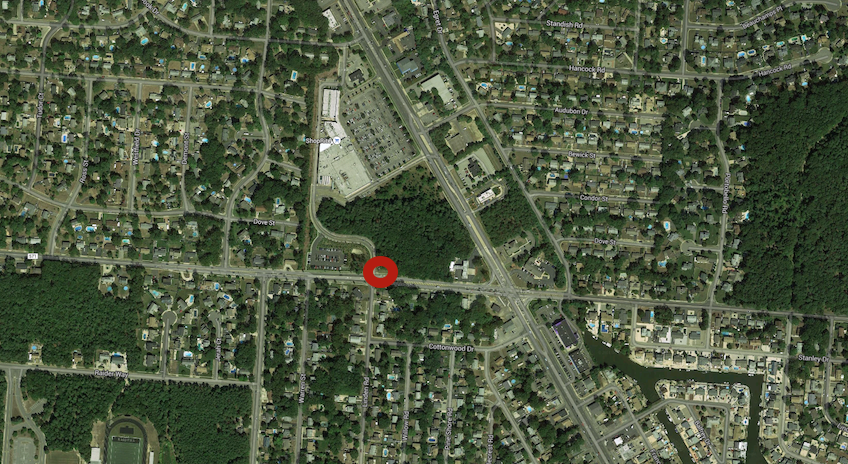
    This is the historic Water Witch subdivision above Sandy Hook that was first built in 1895, not too far from New York City. Twenty five years ago I had friends who bought an old house here when the neighborhood was only beginning to come back after a long period of decline. Back then the houses were old and in varying states of disrepair. My friends saw the potential and started renovating their place and helped spearhead a revitalization of the neighborhood. These days it’s a posh address with rather expensive homes. But notice the narrow gravel roads.

    Screen Shot 2015-01-23 at 6.10.03 PM
    Google

     Screen Shot 2015-01-23 at 6.10.28 PM
    Google 

    Screen Shot 2015-01-23 at 5.59.30 PM
    Google

    Water Witch is a private community, although it isn’t “gated” in the contemporary sense. That means the HOA members pay to maintain the roads not the government. This is a really important distinction. When people believe their property tax money entitles them to certain things they often have high expectations. They tend to have a very different attitude when they know they’re going to be writing a check directly for the level of service they ask for. This difference in who pays for the roads leads to different outcomes. Back in the late 1980’s I was privy to HOA meeting debates where some members demanded that the roads be paved. They were tired of the ruts, mud puddles, and problems of snow removal. The dirt roads were one of the things that had kept property values depressed for decades. So a consulting engineer was brought in and explained exactly what it would cost to pave the roads. It would be many millions of dollars divided by the forty two homes in the community. That conversation came to a halt instantly. So much for paved roads at Water Witch. The compromise was to maintain the gravel roads to a slightly higher standard with annual adjustments that were far more cost effective. The resulting bucolic country lanes twist up the hill and provide a feeling of retreat from both the nearby city as well as the surrounding suburban sprawl. It also ensures that no one will ever be temped to speed since the roads won’t physically allow it. This keeps the neighborhood safe for pedestrians and cyclists. And it also happens to be more ecological as an extra bonus.

    156508764-M-1
    Justin Tinapay Photography 

    156522759-M-1
    Justin Tinapay Photography 

    RachChris-r075-1
    Justin Tinapay Photography

    Now, there were some people in the HOA that didn’t even want to pay for the annual gravel upgrades. These weren’t what you would call poor people, but no one wants to pay for anything if it isn’t absolutely necessary. It was suggested that the community clubhouse could be rented out for special events to generate the needed revenue to pay for road maintenance. Other people objected. Why live in a private community if an army of strangers would come marching in day and night? So the HOA found a sweet spot. The clubhouse would be rented for only twelve events per year between April and October. Valets would be hired at the expense of the renters to manage traffic. Those twelve days would bring in enough money to pay for the road work each summer. It was a reasonable compromise and a good financial deal for everyone. The fact that Water Witch was distinctive and countryfied compared to the unrelenting highways and strip malls of most of New Jersey made it that much more desirable for people looking for a unique event space. People pay extra for charm.

    Screen Shot 2015-01-23 at 7.03.20 PM
    Google 

    Screen Shot 2015-01-23 at 7.01.54 PM
    Google

    By the way, notice how some people have paved their private driveways with asphalt or stone while the HOA roads and the parking lot at the Clubhouse are gravel. It matters who’s responsible for paying for things and how those decisions are made.

    Screen Shot 2015-01-24 at 3.48.13 AM
    Google 

    Screen Shot 2015-01-24 at 3.47.51 AM
    Google

    Screen Shot 2015-01-24 at 3.45.56 AM
    Google 

    Screen Shot 2015-01-24 at 3.43.53 AM
    Google

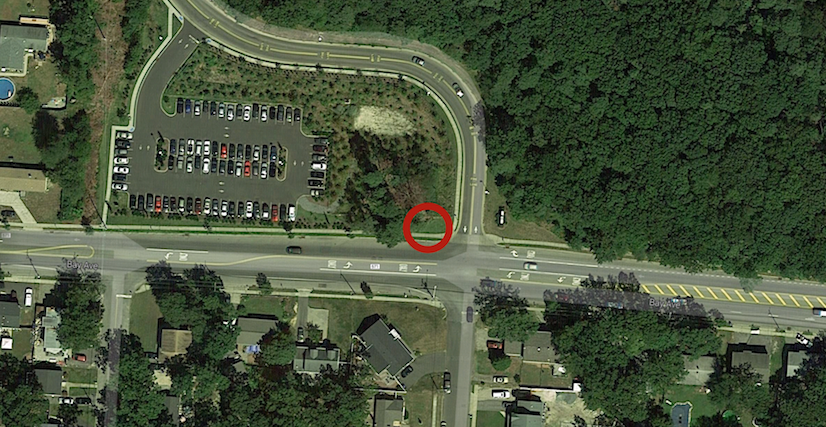
    In contrast, here’s a newer upscale residential subdivision not far from Water Witch. Notice the massively wide paved roads and enormous cul-de-sac. I have to ask… What does all that paving really do for the neighborhood? You could land an Airbus A380 on this much tarmac. But what’s the point? You can be quite sure that when these roads become cracked and potholed the wealthy well-connected residents of these grand homes will mobilize and bang heads at the public works department. Somehow the government will be made to absorb the expense of repave things even if the (very high) property taxes from these specific homes doesn’t come close to covering the real cost of maintenance. Would these home owners accept a different standard if they were directly responsible for maintaining their own road?

    Screen Shot 1 2015-01-22 at 4.19.01 PM copy
    Google

     Screen Shot 2 2015-01-22 at 4.19.01 PM copy
    Google 

    Screen Shot 2015-01-24 at 7.09.20 AM
    Google 

    Screen Shot 2015-01-24 at 7.12.21 AM
    Google

    Now let’s look at a more reasonably priced home in a middle class neighborhood. This is my sister’s house in another part of the state. She and her family live in a respectable 1960’s tract house on a half acre lot. Look at the cul-de-sac in front of her place. It’s nearly a half acre as well. Look how tiny the parked cars are compared to the amount of pavement. Again, what exactly does the neighborhood get out of this arrangement other than a massive heat island effect in summer, a storm water runoff problem, and a lot of high speed traffic that puts children, pedestrians, and cyclists in danger? Think of all the ways that much land could be put to better use to add value to the neighborhood instead of just chipping away at the county budget.

    At a certain point hard choices are going to have to be made. The current political conversation involves questions about how to raise taxes while lowering levels of service. But there is another way. We could spend a whole lot less money both publicly and privately and still get a higher quality of life. I’m not sure we as a society are really ready to have that conversation.

    John Sanphillippo lives in San Francisco and blogs about urbanism, adaptation, and resilience at granolashotgun.com. He’s a member of the Congress for New Urbanism, films videos for faircompanies.com, and is a regular contributor to Strongtowns.org. He earns his living by buying, renovating, and renting undervalued properties in places that have good long term prospects. He is a graduate of Rutgers University.

  • The Gilded Age Makes A Comeback

    The historian Carl Degler, who recently died, studied the rapid urbanization and industrialization of the late 19th century. That period has striking parallels to our country at the beginning of the 21st century. Between 1880 and 1915 the country’s face changed, and today the same phenomenon is occurring. The polarization of society and the divisive politics of that time were resolved, according to Degler, only by the rise of progressivism, which returned America to a sense of balance. The lack of a progressive “third way” today is startling, given that the concentrations of wealth and power are higher than ever existed in the Gilded Age.

    At the time, America was about to leave behind Jefferson’s ideals of an agrarian-based egalitarian society: the principles of free education, democracy, and land ownership. Now, we are urbanizing again, to a new and greater degree. As we evolve from industrialization to digitalization, the same cycle appears to be occurring. Here in Florida, urbanization is nearly complete, with a single archipelago of semi-urbanity having spread its web across nearly the entire peninsula.

    While this may seem like advancement, a gradually disempowered class feels increasingly resentful of the fast-moving cities. Here in Florida, those cities are woven in and around the rural populations. The situation seems dire, but it’s only a shadow of the human toll taken during the industrial revolution. Still, it is easy to see why social issues and moral values are central to those feeling left out of the cosmopolitan, prosperous cities.

    In the 1890s, no amount of handwringing by do-gooders helped reduce the suffering of children in mines, or the shameful exploitation of railroad workers. Populists, labor firebrands, and utopians contributed little to the solution, only sparking more controversy. Strikes increased divisiveness and polarized the country.

    Ultimately, it was through the emergence of progressivism in the reasonable center that true progress was made, and that the balance of the original founding principles was restored. No such movement exists today.

    An iconoclastic thinker, Degler called the progressive movement an essentially conservative one, pointing out that Fred Howe and its other luminaries pressed to conserve the original Jeffersonian goals of American reform. Degler quoted Howe: “The great problem now before the American people is, how can opportunity be kept open; how can industry be saved from privilege; how can our politics be left to the unimpeded action of talent and ability?” The progressives formed the American Creed around the new city and industry which were then rising. Howe’s questions are apt in this era’s uncertain world.

    A progressive center has yet to emerge from today’s highly polarized political climate. We continue to see and hear more divisiveness, and the upcoming presidential campaign promises to be nasty. Neither party has brought the two sides together. Our political campaigns in Florida reflect this same dialectic. Local races, once a bit more genteel, seem to be modeled after the national scene. A vacuum has opened up in the center. And today, just as at the end of the ninteenth century, there is little incentive yet to fill the vacuum.

    Degler saw turn-of-the-century American society as riven into the many poor and the few rich, and viewed the country’s founding democratic ideal as having been permanently subverted. His penetrating analysis of the last Gilded Age, and of an America that was gradual splintering, influenced a generation of scholars and historians. Degler’s essay, “New World A’Comin,’” noted that the rise of progressivism came only after decades of serious abuse and human tragedy at the end of the Industrial revolution.

    Progressives such as Howe and fellow reformer E. A. Ross encouraged the shouldering of a certain moral responsibility from top to bottom. But up until Ross’s treatise, Sin and Society in 1907, forty years of increasingly grisly and dark times for workers passed before things got much better.

    In today’s America, we don’t see dead children carried out of coal mines; no dead strikers, and no labor riots in the streets. ‘Worker abuse’ does not signify starvation or mortal danger. Protest against the privileged wealthy class is also less strident than it was a hundred years ago. Thus, if a progressive movement emerges from our current troubles, it is likely to be comparatively mild, and will need to fight against much more powerful odds to emerge. For one, the news media has no vested interest in settling disputes. And for another, the working class isn’t in peril for its life, and any great settling of accounts between the working class and the elite seems as though it will be put off to the distant future.

    I was a student in Florida in the 1970s when I first studied Carl Degler’s ideas during a unique period. The Vietnam War had just ended, and the national identity was sensitive. In Florida, we were highly conscious of the difficult relationship with Cuba. So, along with American history, the state required a course called “Americanism vs. Communism.” The notion of Americanism— not capitalism, you may notice, or democracy, but “Americanism”—included the terms “melting pot,” “exceptionalism,” and “The American Dream.” In a rural state with wide-open land at the time, this anxiety to present a unified, signature American identity had a powerful effect on those of us coming of age: Americanism was on the defensive.

    In that mix, Degler’s ideas were provocative. “Wherever men have striven to realize their moral visions, they have demonstrated that ideas, as well as economic forces, can change the direction of history,” Degler wrote in Out of Our Past. With Degler’s death, the notion of history’s moral trajectory may finally have died also. He challenged pat concepts: he refuted the notion of “melting pot,” citing the lack of assimilation of many ethnicities, and the stubborn refusal of a few to put racism behind them. Instead, he called America a “salad bowl.” He also rejected the idea of American exceptionalism, and noted that Jeffersonian ideals were only renewed through hard work. Maintaining these ideals today, in America’s new urban face, seems a fading dream as well.

    Here in Florida, the rancor of last autumn’s gubernatorial race seems forgotten. People are back at work, tourists are flowing into the state, and the population is swelling. Construction, thanks to easy credit, is everywhere. Reform is unlikely while the good times are here. Americanism, it seems, has triumphed, and the quaint, Jeffersonian notions of an agrarian, egalitarian society are again collecting dust for the time being.

    Instead, we have a superficial choice between two political parties that seems less and less substantive, and more and more like a marketer’s dream: Coke or Pepsi. Degler’s notion of history as a continual evolution of ideas, and of the rise of a progressive ‘third way’ is, for now, dormant. Many of us who were lucky enough to read Out of Our Past in Florida’s public schools still keep Degler’s provocative ideas with us. Those ideas may be put to good use when today’s soft drinks go out of style, and the public is thirsty for a middle ground once again.

    Richard Reep is an architect with VOA Associates, Inc. who has designed award-winning urban mixed-use and hospitality projects. His work has been featured domestically and internationally for the last thirty years. An Adjunct Professor for the Environmental and Growth Studies Department at Rollins College, he teaches urban design and sustainable development; he is also president of the Orlando Foundation for Architecture. Reep resides in Winter Park, Florida with his family.

    Flickr photo by Cliff: That Other Gilded Age. Edith Wharton, oil on canvas by Edward Harrison May, seen here during her privileged childhood. Wharton’s fiction became acclaimed for its critical view of Gilded Age society.

  • America A House Divided Over Race

    The election of Barack Obama six years ago was hailed as a breakthrough both for minorities, particularly African Americans, and for his being the first “city guy” elected president in recent history. Both blacks and urbanistas got one of their “own” in power, and there were hopes that race relations and urban fortunes would improve at a rapid pace.

    Instead, the recent controversies over police killings of African American men have revealed a shocking deterioration of race relations not seen in a generation. Since the racial euphoria that accompanied the president’s election, views of race relations held by blacks and whites, according to Pew, have become decidedly less optimistic. Nearly half of whites and roughly two in five blacks, according to a recent Politico poll, say race relations have worsened under Obama. Only 4 percent of whites and 13 percent of African Americans thought relations had improved. Another recent survey, this one by Bloomberg, finds 53 percent of Americans opining that race relations have declined under Obama.

    For the most part, the current racial discord has been traced largely to the long, uneasy relationship between minorities, notably African Americans, and the police. The disparity in perceptions between whites and blacks are most notable here, says Pew, with 70 percent of African Americans, but barely 25 percent of whites, disputing that police do a good job treating the races “equally.”

    Here’s the real tragedy: Some 50 years after the passage of sweeping nationwide civil rights legislation, the institutionalization of affirmative action and billions poured into addressing urban poverty, many African American youth remain well outside the mainstream, unmoored to the economy and far too liable to get into confrontations with law enforcement. This is clearly connected with such factors as the preponderance among African Americans of 70 percent single-female-headed households, nearly half of which are poor.

    Then, there are the murder statistics. Columnist Walter Williams has noted that, out of roughly 7,000 blacks murdered last year, 94 percent were killed by another black person. Half of all homicide victims are black, while blacks account for barely 13 percent of the nation’s population. Williams calculates that the black homicide victimization rate is six times that of whites, and in some cities, more than 22 times higher.

    Pervasive poverty

    Not surprisingly, these sad numbers are also reflected in economic statistics. African American unemployment remains twice that of whites. The black middle class, so responsible for, and understandably proud of, Obama’s elevation, according to the Urban League, in the past decade has conceded many of the gains made over the prior 30 years.

    Despite the hoopla about urban revival, a recent study reveals that entrenched urban poverty – places where 30 percent or more of the population lives below the poverty line – actually grew in the first decade of the new millennium, from 1,100 to 3,100 neighborhoods. Meanwhile, the population of these areas doubled, to 4 million. “This growing concentration of poverty,” notes researchers Joe Cortright and Dillon Mahmoudi, “is the biggest problem confronting American cities.”

    These trends dwarf the oft-celebrated movement of young professionals and empty-nesters into the urban core. Indeed, notes demographer Wendell Cox, roughly 80 percent of population growth in cities during 2000-10 was from poor people. Not surprisingly, many African Americans have moved to suburbs, where a majority of them now live, according to the Census Bureau.

    Also not surprising is that poverty and conflicts with law enforcement are now found in some suburban areas, as was clear in the case of Ferguson, Mo. Yet, poverty in the core cities remains considerably worse than in the suburbs. Despite trite talk about “suburban ghettos,” the poverty rate in the suburbs remains roughly half that of urban centers (as of 2010, 20.9 percent in core compared with 11.4 percent in the suburbs).

    Much the same can be said about crime. The overall violent-crime rate in urban cores, although down from 2001, remains almost four times higher than in the suburbs, according to FBI data. Many of the most crime-ravaged cities are heavily African American: Detroit, Oakland, St. Louis, Memphis, Tenn., Cleveland and Atlanta.

    Big-city class chasms

    The fundamental preconditions for increased racial tensions can be seen in the growing class chasm within cities, particularly gentrifying ones. In New York City, the epicenter of the current debate over policing, good times on Wall Street and among the glitterati has not trickled down into the ghetto. The majority of people in hip Brooklyn, notes researcher Daniel Hertz, have seen their incomes drop over the past decade; roughly one in four Brooklynites, a cohort overwhelmingly black and Hispanic, lives in poverty. Over the entire borough, he points out, residential patterns have become more segregated, and Brooklyn now is second, only to Milwaukee, in terms of racial separation.

    In Chicago, like most cities, areas of concentrated poverty have expanded in recent years. Chicago is widely hailed as the progenitor of Alan Ehrenhalt’s “great inversion,” which predicts a continuing shift of rich people into cities while the poor exit to the dreary suburban wasteland. But the reality is far more complicated, as employment in Chicago has dropped below 2001 levels, and middle-class neighborhoods have continually shrunk.

    Essentially, amidst renewal, there is greater bifurcation. Prosperous and greatly hyped “super-global Chicago,” notes urban analyst Pete Saunders, enjoys income and education levels well above those of the suburban areas. Most Chicagoans, however, live in “rust belt Chicago,” with education and income levels well below suburban levels. Rather than simply bifurcated, Saunders suggests, “Chicago may be better understood in thirds – one-third San Francisco, two-thirds Detroit.”

    The tensions exacerbated by this growing divide are widely evident. Violence is slowly shifting from Chicago’s poorest neighborhoods and into some of the city’s nicest redoubts; Mayor Rahm Emanuel’s 17-year-old son was mugged outside his home. Chicago’s violent-crime rate remains far higher than that of New York or Los Angeles; by some estimates, the city is more dangerous now than during the Al Capone era during Prohibition.

    Chicago’s predicament – with a slight increase in murders in 2014 – could prove a harbinger. In some big cities, like Chicago, New York and Atlanta, populations entrenched in poverty will likely remain for the foreseeable future. It’s hard to imagine East New York or the westside of Chicago, much of south Atlanta, or Watts, for that matter, gentrifying anytime soon.

    Indeed, Los Angeles, which also experienced a big drop in violent crime over the past decade, now expects to report a 7 percent increase this past year. Late last month, L.A. also experienced a possible attempted assassination of police officers, although the assailants, thankfully, missed.

    In some cities, usually smaller and whiter to start with, we are seeing a pattern of what amounts to “ethnic cleansing,” as increasingly isolated communities get driven out of their enclaves by relentlessly rising rents and the loss of blue-collar jobs.

    This process is particularly notable in San Francisco, where the black population already is roughly half what it was in 1970. In the nation’s whitest major city – Portland, Ore. – African Americans are being pushed out of the urban core by gentrification, partly supported by city funding. Similar phenomena can be seen in Seattle and Boston where longtime black communities faced near extinction.

    Under these circumstances, a degree of racial animus seems inevitable. Some Brooklyn residents, reports theDaily Beast,even justified the targeting of law enforcement officers. For their part, many NYPD officers feel betrayed by Mayor Bill de Blasio’s sympathetic comments about anti-police demonstrations. Some officers have expressed their distaste, inappropriately, by being rude to the mayor and staging slowdowns in arrests.

    These racial tensions already are seeping into the political realm. African Americans in New York supported de Blasio’s policing strategy, 2-1, while a strong majority of whites opposed his stance.

    The resurgence in racial animus remains arguably the biggest surprise – and one of the greatest failures – not only of Obama, but of our society. In this respect, neither conservative attempts to blame increased racial discord on the president and, now, attempts by his progressive claque to absolve him of any responsibility, really address the more serious issues behind the widening of the racial divide. Cities and communities, divided against themselves by race and class, cannot thrive in the long run, no matter how many publicists and pundits proclaim the battle for urban America already has been won.

    This piece first appeared at The Orange County Register.

    Joel Kotkin is executive editor of NewGeography.com and Roger Hobbs Distinguished Fellow in Urban Studies at Chapman University, and a member of the editorial board of the Orange County Register. He is also executive director of the Houston-based Center for Opportunity Urbanism. His newest book, The New Class Conflict is now available at Amazon and Telos Press. He is also author of The City: A Global History and The Next Hundred Million: America in 2050.  He lives in Los Angeles, CA.

  • Largest 1,000 Cities on Earth: World Urban Areas: 2015 Edition

    According to the just released 11th edition of Demographia World Urban Areas (Built-Up Urban Areas or World Agglomerations), there are now 34 urban areas in the world with more than 10 million residents, the minimum qualification for megacity status. Tokyo-Yokohama continues its 60 year leads the world’s largest urban area. Before Tokyo-Yokohama, New York had been the world’s largest urban area for 30 years. London‘s run, preceding that of New York, was much longer, at more than 100 years. Beijing, which was the first of today’s megacities to reach 1,000,000 population, held the title for 75 years before London, according to census and urban historian Tertius Chandler.

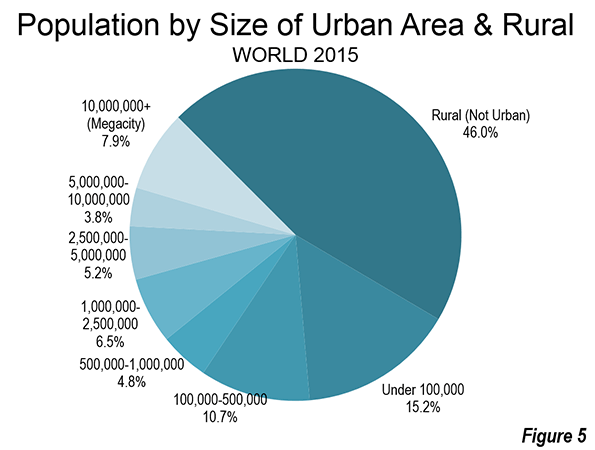
    Demographia World Urban Areas is the only regularly published compendium of urban population, land area and density data of urban areas with 500,000 or more population (defined in the Note below). The 2015 edition provides coordinated population, urban land area and density data for all 1,009 identified urban areas with at least 500,000 population. These urban areas account for approximately 52 percent of the world urban population.

    Largest Cities in 2015

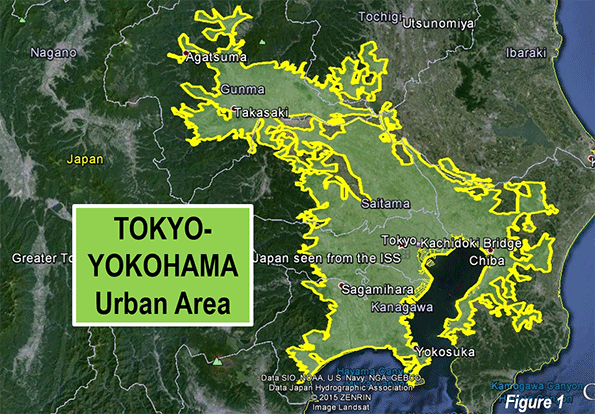
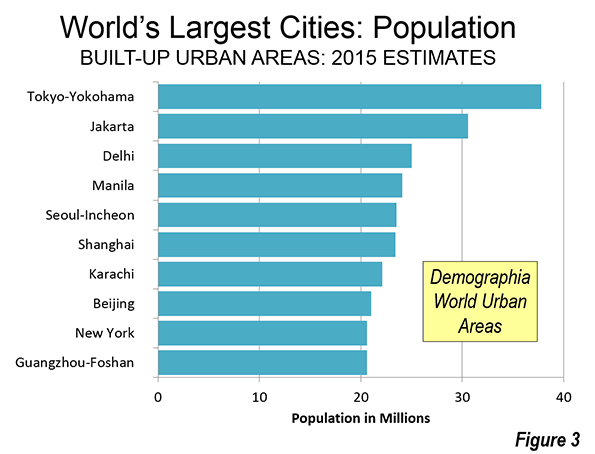
    Tokyo-Yokohama grew to 37.8 million residents, the largest urban area population ever recorded (Figure 1). But second ranking Jakarta is moving up quickly, becoming the second urban area in history to exceed 30 million residents (30.6 million). Regrettably, Jakarta (Figure 2) is often left off world city top ten lists, because the continuous urbanization extending into the regencies (Figure 2) of Tangerang, Bogor, Bekasi and Karawang usually excluded (see The Evolving Urban Form: Jakarta). Regencies are national second level jurisdictions, within the provinces that make up Indonesia.

    Fast growing Delhi retained third position, rising to just under 25 million. Later this year, Delhi will be only the third urban area in history to exceed a population of 25 million. Surprisingly, Delhi is nearly 50 percent larger than Mumbai, which is commonly considered to be India’s largest urban area. The Census of India does not allow its urban areas to cross state boundaries, which has continued to result in an under-reporting of Delhi’s population. Demographia, and the United Nations, have been reporting a higher population level as a result of Delhi’s interstate urban extensions. Many urban areas extend across state, provincial or prefectural boundaries, such as New York, Ottawa, Tokyo-Yokohama, Mexico CityBuenos Aires, Manila, Seoul-Incheon, Cairo, Shanghai among  others.

    The developing world continued its increasing domination of world’s largest cities. This year, Manila passed Seoul-Incheon to become the world’s fourth largest urban area. Like Jakarta, Manila is often left off top ten lists of the world’s cities, because the continuous urbanization extending into the provinces of Cavite, Laguna, Bulacan and Rizal and are excluded (see The Evolving Urban Form: Manila).

    Seoul-Incheon is at risk to falling another position by 2016. At 24.9 million, Seoul-Incheon’s leads sixth ranked Shanghai by less than 70,000. The last four positions in the top ten are occupied by Karachi, Beijing, New York and Guangzhou-Foshan. Karachi’s position, however, is hard to quantify, because it has been nearly two decades since the last census and the current estimates could be unreliable. New York, along with Tokyo-Yokohama and Seoul-Incheon is only one of three high-income world cities in the top 10.

    Beijing and Guangzhou-Foshan are new entries to the top ten, having displaced Mexico City and Sao Paulo. These two Latin American cities have long been among the fastest growing in the world and were headed toward much higher rankings. However, their growth has slowed materially, and they are now ranked in the second 10. Nearby Campinas is now growing faster than Sao Paulo and Toluca is exceeding the percentage growth of Mexico City. There was a time that demographers expected Mexico City to become the largest city in the world. In 2000 and 2005, the United Nations ranked Mexico City as second only to Tokyo-Yokohama.

    As indicated in a recent article (World Megacities: Densities Fall as they Become Larger), the number of megacities rose from 29 to 34 (megacities are urban areas with more than 10 million residents). These include Tianjin and Chengdu in China, Lahore (Pakistan), Kinshasa (Democratic Republic of the Congo) and Lima (Peru). China now leads the world with six (Shanghai, Beijing, Guangzhou-Foshan, Shenzhen, Tianjin and Chengdu). The ten largest urban areas are shown in Figure 3 and detailed population data is in Table 1 of World Urban Areas.

    Urban Footprints and Urban Density

    The title of the world’s largest urban footprint — what some may call “sprawl” —- is held by the New York urban area. Often seen as the epitome of successful dense development (a characterization that applies only in its geographically much smaller core area), the New York urban area itself constitutes the least dense megacity in the world. New York covers nearly 4,500 square miles (11,600 square kilometers) and has a population density of 4,500 per square mile (1,800 per square kilometer). It is a surprise to many that even Los Angeles is more dense, the result of its much denser suburbs.

    Tokyo-Yokohama covers the second largest land area, at 3,300 square miles (8,500 square kilometers). There are now 29 urban areas covering 1,000 square miles or more (2,590 square kilometers). Not surprisingly, approximately one-half (15) of these are in the United States. Another five are elsewhere in the high income world, such as Paris. There are also eight developing world cities of 1,000 or more square miles, such as Jakarta, Bangkok and Sao Paulo. Urban land area data for all 1,009 cities is in Table 3 of World Urban Areas.

    Dhaka, the capital of Bangladesh, remained the most densely populated city, at 113,000 per square mile (4,500 per square kilometer). Detailed population density for the 1,009 cities is in Table 4 of World Urban Areas

    Where Urban Population is Growing

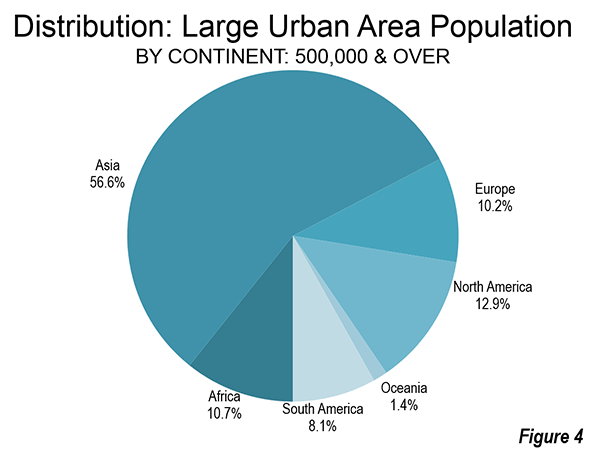
    Asia’s has more than half (57 percent) of the population in cities of 500,000 and more (Figure 4). This is more than four times the population of such cities in North America, five times that of Africa and Europe and approximately six times that of South America. With stagnant population growth in the high income world and declines in some nations, there is every reason to believe that urbanization in North America and Europe will continue to decline relative to that of Asia, Africa and South America.

    ——-

    Note: There are two generic definitions of cities: urban areas and metropolitan areas. Urban areas define the physical expanse of cities, which is the area of continuous urban development. The second definition for cities is economic. The economic city is the metropolitan area, which includes the urban area and economically connected territory outside the urban area. The economic relationship is usually determined by work trip data, the extent of commuting from outside to inside the urban area. Because metropolitan areas are always geographically larger than urban areas, they also always have more residents. The difference in geographical sizes can be substantial. The Paris urban area covers only 20 percent of the Paris metropolitan area, a figure close to that of US major metropolitan areas, where urban areas cover only 19 percent of the land in metropolitan areas. The paradox is that metropolitan areas virtually always have more rural land than urban land.

    Ideally, urban areas are not defined by local or regional government jurisdictional boundaries, since rural areas are often included in such jurisdictions, especially suburban jurisdictions. Urban development is not constrained by jurisdictional boundaries, nor are urban areas. This causes substantial confusion, because of a general lack of familiarity with urban area concepts, even among experts.

    Urban areas are called also called "population centres" (Canada), "built-up urban areas" (United Kingdom, "urbanized areas’ (United States), "unités urbaines" (France) and "urban centres" (Australia). The "urban areas" of New Zealand include rural areas, as do many of the areas designated "urban" in the People’s Republic of China, and, as a result, do not meet the definition of urban areas above.

    Whatever they are called, urban areas are simply the extent of development, which in most cases extends well beyond the boundaries of core municipalities. Demographia World Urban Areas uses the following definition for urban areas.

    An urban area is a continuously built up land mass of urban development that is within a labor market (metropolitan area or metropolitan region). As a part of a labor market, an urban area cannot cross customs controlled boundaries unless the virtually free movement of labor is permitted. An urban area contains no rural land (all land in the world that is not urban is considered rural).

    Photograph: Lujiazui business district (Pudong), Shanghai, with the nearly complete Shanghai Tower, second tallest building in the world (by author).

    Wendell Cox is principal of Demographia, an international public policy and demographics firm. He is co-author of the "Demographia International Housing Affordability Survey" and author of "Demographia World Urban Areas" and "War on the Dream: How Anti-Sprawl Policy Threatens the Quality of Life." He was appointed to three terms on the Los Angeles County Transportation Commission, where he served with the leading city and county leadership as the only non-elected member. He was appointed to the Amtrak Reform Council to fill the unexpired term of Governor Christine Todd Whitman and has served as a visiting professor at the Conservatoire National des Arts et Metiers, a national university in Paris.

  • The U.S. Cities Where Hispanics Are Doing The Best Economically

    Since 1980, the percentage of Americans who claim Hispanic heritage has grown from 6% to 17%. By 2040, Latinos will constitute roughly 24% of the population.

    Many Democrats no doubt see President Obama’s executive actions on immigration as a step not only to address legitimate human needs, but their own political future. But perhaps a more important question is how these new Americans will fare economically.

    We decided to look into which of America’s 52 largest metropolitan areas present Hispanics with the best opportunities. We weighed these metropolitan statistical areas by three factors — homeownership, entrepreneurship, as measured by the self-employment rate, and median household income  — that we believe are indicators of middle-class success. Data for those is from 2013. In addition, we factored in the change in the Hispanic population from 2000 to 2013 in these metro areas, to judge how the community is “voting with its feet.” Each factor was given equal weight. Our findings parallel our recent study of the economic fortunes of African-Americans, but with some important differences.

    Surviving Hard Times

    The recession was particularly tough on Hispanics, who suffered a 44% drop in household wealth from 2007 to 2010, compared to a 31% decline for African-Americans and 11% for whites. Lower home values are to blame for much of this – many young Hispanic families bought homes just before the recession hit, explains the Urban Institute, but because they generally had higher debt-to-asset ratios than other ethnic groups, the steep drop in housing prices resulted in a sharper decline in their wealth. Hispanics’ home equity dropped 49% over those years.

    The recession and the weak recovery have contributed to a change in the demographics of the U.S. Hispanic population – immigration has slowed while the U.S.-born Latino workforce has continued to expand at a brisk clip. In 2013, for the first time in almost two decades, the U.S.-born accounted for the majority of Hispanic workers in the country (50.3%), up from 43.9% in 2007, according to the Pew Foundation.

    During the recovery, U.S.-born Hispanics have made strong job gains, adding 2.3 million to the ranks of the employed from the fourth quarter of 2009 through the fourth quarter of 2013, compared with a loss of 37,000 jobs in the recession. But that has only slightly outpaced growth in the Hispanic working-age population.

    Hispanic unemployment has come down to 6.5%, but wages have been stagnant – Pew reports a slight gain in earnings of full-time Hispanic workers through the end of 2013, but that came as a result of the retreat of lower-paid illegal immigrants from the workforce.

    The Unexpected Place Where Latinos Have Done Best

    The prime U.S. cities for Latinos have long been New York, Miami, Chicago and Los Angeles. The Los Angeles metropolitan area alone has more than 5 million Latinos, including an estimated 1 million undocumented immigrants. Yet it no longer is necessarily the best place for them, ranking only a middling 32nd in our survey. L.A.’s once thriving industrial economy has been in a secular decline, and in the process thousands have lost employment. At the same time, construction work has been slow, another traditional source of employment. High housing costs have also put homeownership out of reach. A 2013 Fannie Mae study found that Latinos place greater emphasis on homeownership than the rest of the population.

    Given the diminished possibilities of buying a home or finding a decent job in the Los Angeles metropolitan area, Latinos have been flocking to the suburban periphery that encompasses much of adjacent Riverside and San Bernardino counties, also known as the Inland Empire, which ranks second in our survey. From 2000 through 2013, the Latino population in the area soared 74%, compared to a 15% population gain for Los Angeles.

    Not surprisingly, given its substantially lower home costs, roughly half those of Los Angeles, the Inland region has a relatively high Latino homeownership rate of 55.3%, compared to 37.7% in Los Angeles. Rates of self-employment are also higher than in L.A. (23.5% to 21.3%) and so too are median household incomes ($47,200 vs. $45,200). The metro area was devastated in the housing bust, but it’s coming back faster than the coastal economy. Although total employment is some 30,000 jobs below its 2007 level, California Lutheran University economist Dan Hamilton notes that Riverside-San Bernardino’s 2.2% job growth over the past year compares well with the 2.0% increase in Orange County and 1.3% in L.A.

    Latinos also fared middling in California’s other high-cost metro areas. San Jose ranks 22nd and San Francisco-Oakland ranks 25th.

    The same factors that make Riverside-San Bernardino a good place for Hispanics — lower housing costs and decent job growth — characterize most of the metropolitan areas that lead our list. That is particularly true of our No. 1 metro area, Jacksonville, Fla., which is just 40 miles north of St. Augustine, founded by the Spanish in 1565, making it the longest continuously settled city in what is now the United States.

    The metro area’s Hispanic homeownership rate of 55% is notably higher than the 43% average in the 52 largest U.S. metropolitan areas.  The median household income of $50,170 is also well above the major metro average of $41,740. Like many Florida cities, Jacksonville was hard-hit by the recession, but over the past year, the region has added close to 22,000 jobs. Jacksonville’s Hispanic population has grown 148% since 2000.

    Other Florida metro areas where Hispanics are prospering are Tampa-St. Petersburg (12th),  Orlando (13th), and Miami (16th).

    Not surprisingly, Latinos are also doing very well in a number of Texas cities. Like Florida, the state has relatively low housing prices, as well as a generally more buoyant economy, with strong growth in blue-collar fields such as construction, manufacturing and energy. The Lone Star State’s four big metro areas all place in the top 10, with Houston ranking fourth, followed by Dallas-Fort Worth (seventh), San Antonio (eighth) and Austin (ninth). They all are above average in terms of homeownership rates, self-employment and median household income.

    Like African-Americans, Latinos have done relatively well in No. 3 Baltimore, where their numbers have increased since 2000 by 175%, with a median household income of $59,940, second highest in the nation behind the adjacent Washington, D.C., area (No. 5), where the median household income for Hispanics is $65,736.

    Shifting Patterns

    In recent years, immigration overall has shifted to the Southeast away from many of the traditional “gateway” cities. Today the largest growth in foreign-born Americans is in the Southeast and Texas; since 2010 the old Confederacy attracted over 1.5 million foreign-born residents, more than the Northeast and Midwest together.

    None of the traditional gateway cities rank in the top 10 on our list. After Miami, the highest ranking of them is Chicago, at 18th, thanks to relatively lower home prices and a high Latino homeownership rate (51.4%).

    In contrast, New York, home to the country’s second largest Latino community after Los Angeles, ranks a poor 42nd. This reflects one of the lowest rates of Hispanic homeownership in the country, 26.5%, and modest population growth of roughly 29% since 2000, compared to an average of 96% for the 52 largest U.S. metro areas. New York Latino households earn a median of $42,980. That’s slightly above the 52 major metro median of $41,740, but given the sky-high housing costs in the Gotham area, it doesn’t go very far. In the Bronx, where the population is 55% Hispanic, roughly 30% of households are below the poverty line, the highest rate of any large urban county.

    As was the case with African-Americans, the metro areas at the bottom of our list are all faded industrial centers. Milwaukee ranks last, preceded by Providence, R.I. ; Hartford, Conn.; and Buffalo and Rochester, N.Y.

    Forging The American Future

    Identifying where Latinos are going, and doing well, is critical not just for them but the future of the country. One out of every four American children are Latino and since 2000 they have accounted for two-thirds of all net job gains made in the country. Latinos are also playing a key role in the recovery from the housing bust, accounting for 56% of all new owner households created between 2010 and 2013.

    What our research and migration trends suggest is that the geography of Latino opportunity is rapidly changing. The Latinization of America is gathering strength in parts of the South that offer a better deal for new Americans and their offspring than New York, Los Angeles or Chicago. You want a little salsa on those grits?

    BEST CITIES FOR HISPANICS/LATINOS
    Metropolitan Area Rank Score Home Ownership Rate Median Household Income Share of Total Self Employment Change in Population: 2000-2013
    Jacksonville, FL       1   80.3 54.9% $50,171 17.1% 148.2%
    Riverside-San Bernardino, CA       2   78.8 55.3% $47,196 23.5% 74.3%
    Baltimore, MD       3   74.0 47.5% $59,939 9.8% 175.3%
    Houston, TX       4   71.6 52.3% $43,020 22.9% 68.4%
    Washington, DC-VA-MD-WV       5   70.7 45.4% $65,736 11.0% 105.0%
    Virginia Beach-Norfolk, VA-NC       6   70.2 47.2% $50,197 9.8% 156.6%
    Dallas-Fort Worth, TX       7   66.8 50.0% $41,622 22.1% 70.3%
    San Antonio, TX       8   66.3 56.9% $42,377 23.3% 43.8%
    Austin, TX       9   65.4 44.6% $43,712 20.9% 83.4%
    St. Louis,, MO-IL       9   65.4 56.5% $50,570 7.8% 92.2%
    Sacramento, CA     11   63.9 43.9% $45,667 21.8% 66.1%
    Tampa-St. Petersburg, FL     12   63.5 49.4% $39,757 17.1% 100.4%
    Orlando, FL     13   61.5 46.7% $38,721 17.1% 128.1%
    Pittsburgh, PA     14   59.1 48.4% $55,108 7.3% 102.4%
    Salt Lake City, UT     14   59.1 49.5% $42,232 10.8% 78.3%
    Miami, FL     16   58.2 52.6% $41,547 17.7% 46.2%
    Las Vegas, NV     17   57.7 40.8% $42,789 16.8% 101.5%
    Chicago, IL-IN-WI     18   55.8 51.4% $45,349 11.1% 36.7%
    Oklahoma City, OK     19   55.3 48.5% $38,054 10.0% 121.4%
    Seattle, WA     20   53.4 35.6% $48,903 9.9% 112.4%
    Richmond, VA     21   52.4 41.8% $38,186 9.8% 196.1%
    San Jose, CA     22   51.9 38.8% $59,150 19.9% 23.7%
    San Diego, CA     23   51.4 38.6% $46,875 21.3% 40.8%
    Charlotte, NC-SC     24   51.0 42.9% $38,843 8.6% 174.6%
    Denver, CO     25   50.5 44.7% $42,071 13.5% 53.7%
    Phoenix, AZ     25   50.5 44.9% $38,704 19.9% 61.1%
    San Francisco-Oakland, CA     25   50.5 38.5% $56,269 19.8% 34.9%
    Cincinnati, OH-KY-IN     28   48.1 41.3% $42,271 6.8% 190.6%
    Atlanta, GA     29   47.6 42.8% $38,919 8.8% 116.9%
    Kansas City, MO-KS     29   47.6 47.1% $40,432 7.8% 90.7%
    New Orleans. LA     29   47.6 41.7% $46,146 8.2% 74.2%
    Los Angeles, CA     32   44.2 37.7% $45,202 21.3% 15.3%
    Raleigh, NC     33   43.8 39.6% $37,572 8.4% 177.7%
    Minneapolis-St. Paul, MN-WI     34   42.3 40.9% $42,764 7.6% 90.0%
    Detroit,  MI     35   41.8 61.5% $41,276 7.5% 39.8%
    Louisville, KY-IN     36   39.4 41.3% $35,571 6.5% 206.8%
    Philadelphia, PA-NJ-DE-MD     37   38.9 43.3% $36,365 8.9% 81.4%
    Memphis, TN-MS-AR     38   37.0 40.5% $32,041 8.1% 156.2%
    Portland, OR-WA     39   36.5 33.3% $40,486 9.6% 83.8%
    Nashville, TN     40   35.6 38.2% $36,458 7.3% 176.5%
    Grand Rapids, MI     41   35.1 47.7% $35,114 8.3% 54.4%
    New York, NY-NJ-PA     42   34.6 26.5% $42,981 13.3% 29.4%
    Birmingham, AL     43   32.7 40.3% $32,165 6.9% 174.1%
    Indianapolis. IN     43   32.7 35.5% $27,293 7.7% 195.5%
    Boston, MA-NH     45   31.7 24.5% $39,080 10.7% 65.6%
    Cleveland, OH     46   30.3 43.9% $38,762 7.6% 45.7%
    Columbus, OH     47   29.3 28.1% $38,520 6.9% 155.6%
    Rochester, NY     48   27.9 37.7% $26,315 12.2% 55.1%
    Buffalo, NY     49   25.0 33.8% $30,489 12.0% 50.8%
    Hartford, CT     50   24.5 29.9% $30,453 11.4% 54.7%
    Providence, RI-MA     51   21.2 23.8% $28,622 10.0% 64.5%
    Milwaukee,WI     52   19.2 34.7% $32,308 7.6% 68.3%
    Calculated from 2013 American Community Survey & EMSI data
    Analsys by Wendell Cox

    This piece first appeared at Forbes.

    Joel Kotkin is executive editor of NewGeography.com and Roger Hobbs Distinguished Fellow in Urban Studies at Chapman University, and a member of the editorial board of the Orange County Register. He is also executive director of the Houston-based Center for Opportunity Urbanism. His newest book, The New Class Conflict is now available at Amazon and Telos Press. He is also author of The City: A Global History and The Next Hundred Million: America in 2050.  He lives in Los Angeles, CA.

    Wendell Cox is principal of Demographia, an international public policy and demographics firm. He is co-author of the “Demographia International Housing Affordability Survey” and author of “Demographia World Urban Areas” and “War on the Dream: How Anti-Sprawl Policy Threatens the Quality of Life.” He was appointed to three terms on the Los Angeles County Transportation Commission, where he served with the leading city and county leadership as the only non-elected member. He was appointed to the Amtrak Reform Council to fill the unexpired term of Governor Christine Todd Whitman and has served as a visiting professor at the Conservatoire National des Arts et Metiers, a national university in Paris.

    Jacksonville photo by Don Dearing (Flickr: Jacksonville, FL) [CC BY-SA 2.0], via Wikimedia Commons

  • Military Memorials: Is This Really the Best We Can Do?

    I was researching material for a blog post about the town I grew up in (Toms River, New Jersey) and accidentally stumbled on something completely unrelated that I find deeply disturbing on multiple levels. It was a roadside memorial dedicated to a fallen soldier. I looked up his name and realized that he had gone to my high school and his family lived very near the house I had once lived in. United States Navy SEAL Denis Miranda was twenty four years old when he perished in Qalat, Afghanistan. He has two surviving brothers on active duty.

    Screen Shot 2015-01-18 at 1.38.54 AM
     Google

    Screen Shot 2015-01-18 at 1.57.25 AM
    Google

    Screen Shot 2015-01-18 at 1.39.40 AM
    Google

    Screen Shot 2015-01-18 at 1.39.13 AM
    Google

    Denis Miranda is currently being “honored” by a cheap metal highway sign at the back of a ShopRite supermarket next to the employee parking lot and a storm water retention ditch. The chain link fence behind the sign is used to pin up banners advertising cold beer on sale. It isn’t dignified enough to commemorate the death of a native son. What exactly is his mom supposed to think as she drives past this sign on the way home from church? Is it comforting? Do his father and brothers meet at the sign to have a solemn moment of prayer and remembrance while summer traffic backs up at the intersection waiting for the light to turn green? Is the placement of the sign meant to inspire passing motorists to think deep thoughts about the nature of war and patriotism? And what does this kind of monument say about the way our society values its fallen? What does it say about the fact that this might actually be the best spot in town to express public gratitude or collective loss?

    Screen Shot 2015-01-18 at 1.57.59 AM
     www.njrunforthefallen.org

    Then I realized there was an entire state wide trail of these memorial signs all along the New Jersey coast, each marker representing a veteran who never returned home. The tragedy of all those lost lives and family sacrifices worked on me and I got angry at the memorials themselves. Is this really the best we can do?

    NJ WAR DEAD
     The Star-Ledger Archive

    Screen Shot 2015-01-18 at 1.15.48 AM
    Google

    Screen Shot 2015-01-18 at 1.16.36 AM
    Google

    Screen Shot 2015-01-18 at 1.17.28 AM
    Google

    This is the sign commemorating the loss of Marine Private First Class Vincent Frassetto who died in Al Anbar Province, Iraq. His memorial is on the side of a cloverleaf intersection near the Ocean County Mall. This same roadside spot is also favored by people placing signs advertising rug sales and warnings about pedophiles who may be lurking in public places. Will anyone ever make a pilgrimage to this sign by parking on the edge of the mall and walking across the grassy cloverleaf with loved ones to ponder the life and death of Vincent Frassetto? Or is the public assumed to be too busy to get out of the car so we better catch them while they’re trapped at a red light? Again, the quality and location of the memorial simply isn’t in keeping with the scale of the sacrifice.

    1866432_orig
     marines.togetherweserved.com

    Screen Shot 2015-01-18 at 4.40.01 AM
    Google

    Screen Shot 2015-01-18 at 4.23.03 AM
    Google

    Major James Weis of the U.S. Marine Corps died in Helmand Province, Afghanistan. Here’s his home town roadside war hero monument. It got me thinking about the people who organized these memorials – all devoted and well intentioned no doubt. Did they truly believe that these arrangements were appropriate? Were the folks on the committee looking around for a sacred place of honor and decide, “Hey, how about we put these cheap highway signs next to the left hand turn lane by the muffler shop and the Krispy Kreme.”?

    So… where exactly should we put memorials to fallen veterans these days? What form should those monuments take? We used to live in the kinds of towns were there were obvious places to erect an obelisk or a bronze statue. Now most of us live in tract home subdivisions, work in office parks on the side of a highway, and shop at strip malls. Could it be that these flimsy sheet metal markers reflect our true values and who we really are? Am I the only one who thinks this is weird and distasteful?

    John Sanphillippo lives in San Francisco and blogs about urbanism, adaptation, and resilience at granolashotgun.com. He’s a member of the Congress for New Urbanism, films videos for faircompanies.com, and is a regular contributor to Strongtowns.org. He earns his living by buying, renovating, and renting undervalued properties in places that have good long term prospects. He is a graduate of Rutgers University.

  • Buses: Ride the Friendly Roads?

    Intercity bus companies have made some surprising moves to win a bigger slice of the business-travel market in the past year. City-to-city express operators like BoltBus, GO Buses, and Megabus are upping their game, and several new luxury services have entered the mix with amenities designed to attract disenchanted frequent flyers who wouldn’t have dreamed of taking an intercity coach a few years ago. Think refreshments, attendants, roomy seating, and even shoe shining services.

    A case in point is Vonlane, a new first-class service between Austin and Dallas that launched in May 2014 and plans to expand to Houston this March. A luxury operator, it seats only sixteen passengers, and an attendant serves snacks and drinks. It also offers a private six-seat “boardroom” for business meetings, and Wi-Fi and outlets, which are now almost standard on all bus lines. The service is also going after travelers that are willing to ride coaches to make connections to long-haul flights: Vonlane operates from the Hyatt Hotel at Dallas Love Field, where riders have access to a free airport shuttle. The fare isn’t cheap—around $100 each way—but it’s far less than flying. Southwest’s walk-up fare is $207.

    Equally noteworthy is Royal Sprinter, launched by D.C.-based restaurateur Andy Seligman about a year ago. First-class bus service isn’t new to the Northeast Corridor. It’s already available from Manhattan to Boston via LimoLiner, to Washington, D.C. on Vamoose Gold, and to northern New England via both C&J and Dartmouth Coach. What differentiates Royal Sprinter is its small coaches with only eight seats on board, and satellite TV that accesses pay movie and sports channels. The company currently operates two trips each day between New York and Washington, D.C., with fares running around $95.

    The powerhouse in express city-to-city service, Megabus, is also expanding from its traditional base of college students and urbanites. Taking aim at the business flyer, it introduced reserved seating in fifty-eight cities last year, with ten seats generally available at a cost of between one and nine dollars on each bus. Groups that reserve seating at a table can conduct business meetings during the trip.

    Bus companies are also growing more sophisticated in “selling flexibility,” to allow passengers to change their departure times at only a modest expense, in sharp contrast to restrictive (and costly) airline policies. BoltBus and Megabus, for example, now allow changes up to a day or two in advance for $5 or less, plus any fare difference—a far cry from the $200 charged by American, Delta, and United.

    Bus travel-booking websites, most notably Wanderu and Busbud, are also becoming more visible. Wanderu, in particular, offers convenient means of comparison-shopping Greyhound, BoltBus, Megabus, and others, much as Expedia, Orbitz, and Travelocity do for air travel.

    What does the resurgence of intercity bus travel mean for U.S. transportation? The growth reminds me of the mid-1980s, when new airline hubs were popping up everywhere. Airlines vied to gain a foothold in markets before their competitors did, fearing that there was enough business for only one carrier, but all the new service led to enormous increases in the number of people flying. Unfortunately, there is a void in official data on what is really happening in the bus business. Schedule information isn’t stored in any public data bases and vanishes from company websites the moment a bus departs, complicating growth analyses of this industry. Air and rail travel data is much more easily available.

    To help fill the void, for the past five years I’ve co-authored a year-in-review summary of what’s happening in this industry. Our study attempts to measure growth by recording schedule activity in published timetables and websites. We focus on branded carriers, including Megabus, Greyhound, and Trailways, because small carriers that intentionally stay below the radar, or only serve specialized niches (such as Chinatown operators and airport shuttles) are too hard to track.

    Last year, we observed a 2.1 percent increase in daily scheduled operations on the 107 carriers that met our criteria. While bus service grew, Amtrak train-miles held constant, and the number of airline flights diminished by 3.5 percent. Although bus companies aren’t expanding their schedules at the frenetic pace of past years, when growth often exceeded 5 percent, the sector is still growing much faster than other modes. Plus, ridership appears to be growing at an even faster rate. In October, Megabus reported that its sales were up 13.5 percent over the past year.

    How quickly senior corporate executives on expense accounts will embrace new luxury bus services remains to be seen. Regardless, travel markets of 350 miles or less are about more than college kids and bargain-hunters looking for the cheapest way to get from Point A to Point B.

    Joseph Schwieterman is professor of public service and director of the Chaddick Institute for Metropolitan Development at DePaul University.

    Photo by the author: Megabus double-decker at the Canal Street loading area in Chicago.