Blog

  • Seven Years Ago, Wall Street was the Villain. Now it Gets to Call the Shots

    The recent passage by Congress of new legislation favourable to loosening controls on risky Wall Street trading is just the most recent example of the consolidation of plutocratic power in Washington. The new rules, written largely by Citibank lobbyists and embraced by the Obama administration, allow large banks to continue using depositors’ money for high-risk investments, the very pattern that helped create the 2008 financial crisis.

    This move was supported largely by the establishment in each party. Opposition came from two very different groups: the Tea Party Republicans, who largely represent the views of Main Street businesses, and a residue of old-line progressive social democrats, led by Massachusetts Senator Elizabeth Warren.

    Support for big finance is no surprise from Republicans, who are used to worshipping at the altar of Wall Street. But the suborning of “progressivism” to Wall Street has been a permanent feature of this administration. From the onset of his presidential run, Barack Obama had strong ties to Wall Street grandees. New York Times Wall Street maven Andrew Ross Sorkin noted in 2008 how Obama had “nailed down the hedge fund vote”.

    The ultra-rich so backed the president that, at his first inaugural, noted one sympathetic chronicler, the biggest problem for donors was finding parking space for their private jets. Since then, despite occasional flights of populist rhetoric, the president has kept close ties with top financial firms, including the well-connected Jamie Dimon, chairman of JP Morgan, often called Obama’s “favourite banker”. He appears to have been instrumental in getting Democrats to support the recent loosening of financial controls on big banks.

    These Wall Street connections have continued to play dividends for the president, in terms of contributions. The financiers benefited from Obama’s choice of financial managers, such as former treasury secretary Tim Geithner, widely known as a reliable ally of the financial sector. (He liked to explain his support by equating its importance to that of the technology and manufacturing industries.) To no sensible person’s surprise, Geithner, when he left the Treasury last winter, found his reward by joining a large private equity firm. (By way of completing the circle, Geithner’s successor, Jacob Lew, used to work for Citibank.)

    The Justice Department has also been cosy with the plutocracy. Attorney general Eric Holder allowed Wall Street a kind of “get out of jail free card” by failing to launch tough prosecutions of the grandees. In contrast to the situation under previous administrations, both Republican and Democratic, the financial plutocrats have not been forced to pay for their numerous depredations. Instead, most prosecutions have been aimed at low-level traders, Ponzi schemers or inside traders.

    So if you still think 2008 and the financial crisis changed everything, still think of it as a progressive triumph, think again. Instead of the brave new world of reformed finance, what’s been created in the US is something close to a perfect world, policy-wise, for the plutocrats. The biggest rewards have come from an economic policy, backed by the Federal Reserve and the administration, that has maintained ultra-low interest rates. This has forced investors into the market, at the expense of middle-class savers, particularly the elderly. The steady supply of bond purchases has essentially given free money to those least in need and most likely to do damage to everyone else.

    The results make a mockery of the Democrats’ attempts to stoke populist sentiments. In this recovery, the top 1% gained 11% in their incomes while the other 99% experienced, at best, stagnant incomes. As one writer at the Huffington Post put it: “The rising tide has lifted fewer boats during the Obama years – and the ones it’s lifted have been mostly yachts.” If this had occurred during a Republican administration, many progressives would have been horrified. But Democrats, led by New York senator Charles Schumer, Wall Street’s consigliere on the Hill, have been as complicit as Republicans in coddling Wall Street. Democrats, for example, despite their rhetoric about inequality and fairness, have refused to challenge the outrageous discount on taxes for capital gains as opposed to income. A successful professional making $300,000 a year is often taxed at rates twice as high as the rate paid by hedge fund investors, venture capitalists, tech entrepreneurs and Wall Street stock jobbers.

    At the same time, the Obama years have been something of a disaster for Main Street, where most Americans work. A 2014 Brookings report revealed that small business “dynamism”, measured by the growth of new firms compared with the closing of older ones, has declined significantly over the past decade, with more firms closing than starting for the first time in a quarter of a century.

    Small banks, long a critical source of funding for small businesses, have also been pummelled by the very regulatory regime that also allows mega-banks to enjoy both “too big to fail” protections as well as their sacred right to indulge their most cherished risk-oriented strategies. In 1995, the assets of the six largest bank holding companies accounted for 15% of gross domestic product; by 2011, aided by the massive bailout of “ big banks”, this percentage had soared to 64%.

    These trends do much to explain what happened in the recent midterm elections, which saw a massive shift of middle- and working-class voters, especially whites, to the Republicans. Increasingly, Americans suspect that the economic system is rigged against them. By a margin of two to one, according to a 2013 Bloomberg poll, adults feel the American Dream is increasingly out of reach. This pessimism is particularly intense among white working-class voters and large sections of the middle class .

    The other major cause for the Democratic demise in November was the low turnout among minority voters. They certainly have ample reason to be indifferent. Both African American and Latino incomes have declined during the current administration, in large part because neither group tends to benefit much from the appreciation of stocks and high-end real estate.

    In caving in to Wall Street and its economic priorities, members of both parties have demonstrated where their primary loyalties lie. Amid the obscene levels of compensation going to the financial grandees, it seems the ideal time for politicians, right or left, to challenge Wall Street’s control of Washington. High finance has so devastatingly rocked the world of the middle and working classes. Voters, it might be thought, now need leaders who will take these grandees down a notch or two.

    This piece first appeared at The Guardian.

    Joel Kotkin is executive editor of NewGeography.com and Roger Hobbs Distinguished Fellow in Urban Studies at Chapman University, and a member of the editorial board of the Orange County Register. His newest book, The New Class Conflict is now available at Amazon and Telos Press. He is author of The City: A Global History and The Next Hundred Million: America in 2050. His most recent study, The Rise of Postfamilialism, has been widely discussed and distributed internationally. He lives in Los Angeles, CA.

    Wall Street bull photo by Bigstockphoto.com.
  • 2014 State Population: Rise of South and West Continues

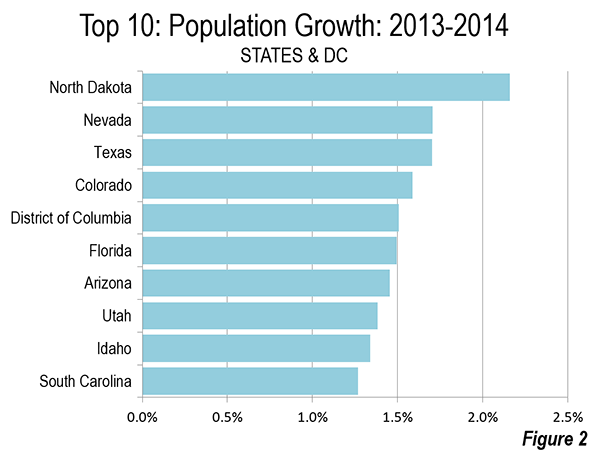
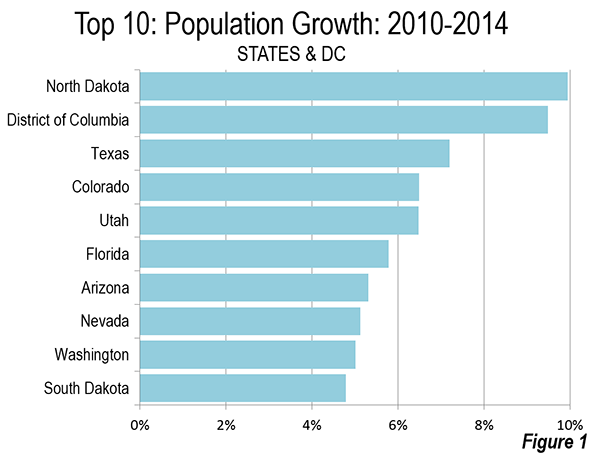
    The new Census Bureau state and District of Columbia population estimates indicate that North Dakota grew at the fastest rate from the 2010 census, displacing the District of Columbia, which had grown the fastest from 2010 to 2013. Seven of the 10 fastest growing areas were in the South and West between 2010 and 2014. Only one state, West Virginia, suffered a population loss between 2010 and 2014 (-0.1 percent).

    Over the year ended July 1, 2014, North Dakota, Nevada, Texas, Colorado, and the District of Columbia had the fastest growth rates (Figure 2), with eight of the fastest growing areas in the South and West (Figure 2). Five states lost population between 2013 and 2014, with the greatest loss in West Virginia (-0.2 percent). Illinois, Alaska, Connecticut and New Mexico also had losses (Table).

    Overall, the US population reached 318.9 million in 2014, an increase of 10.1 million since the 2010 census. The annual growth rate in this decade of 0.81 percent is below the 0.90 percent rate from between 2000 and 2010.

    State & DC Population:2010, 2013 & 2014
      2010 Census 2013: July 1 2014: July 1 % 2000-14 Change
    Alabama 4,779,736 4,833,996 4,849,377 1.5% 69,641
    Alaska 710,231 737,259 736,732 3.7% 26,501
    Arizona 6,392,017 6,634,997 6,731,484 5.3% 339,467
    Arkansas 2,915,918 2,958,765 2,966,369 1.7% 50,451
    California 37,253,956 38,431,393 38,802,500 4.2% 1,548,544
    Colorado 5,029,196 5,272,086 5,355,866 6.5% 326,670
    Connecticut 3,574,097 3,599,341 3,596,677 0.6% 22,580
    Delaware 897,934 925,240 935,614 4.2% 37,680
    District of Columbia 601,723 649,111 658,893 9.5% 57,170
    Florida 18,801,310 19,600,311 19,893,297 5.8% 1,091,987
    Georgia 9,687,653 9,994,759 10,097,343 4.2% 409,690
    Hawaii 1,360,301 1,408,987 1,419,561 4.4% 59,260
    Idaho 1,567,582 1,612,843 1,634,464 4.3% 66,882
    Illinois 12,830,632 12,890,552 12,880,580 0.4% 49,948
    Indiana 6,483,802 6,570,713 6,596,855 1.7% 113,053
    Iowa 3,046,355 3,092,341 3,107,126 2.0% 60,771
    Kansas 2,853,118 2,895,801 2,904,021 1.8% 50,903
    Kentucky 4,339,367 4,399,583 4,413,457 1.7% 74,090
    Louisiana 4,533,372 4,629,284 4,649,676 2.6% 116,304
    Maine 1,328,361 1,328,702 1,330,089 0.1% 1,728
    Maryland 5,773,552 5,938,737 5,976,407 3.5% 202,855
    Massachusetts 6,547,629 6,708,874 6,745,408 3.0% 197,779
    Michigan 9,883,640 9,898,193 9,909,877 0.3% 26,237
    Minnesota 5,303,925 5,422,060 5,457,173 2.9% 153,248
    Mississippi 2,967,297 2,992,206 2,994,079 0.9% 26,782
    Missouri 5,988,927 6,044,917 6,063,589 1.2% 74,662
    Montana 989,415 1,014,864 1,023,579 3.5% 34,164
    Nebraska 1,826,341 1,868,969 1,881,503 3.0% 55,162
    Nevada 2,700,551 2,791,494 2,839,099 5.1% 138,548
    New Hampshire 1,316,470 1,322,616 1,326,813 0.8% 10,343
    New Jersey 8,791,894 8,911,502 8,938,175 1.7% 146,281
    New Mexico 2,059,179 2,086,895 2,085,572 1.3% 26,393
    New York 19,378,102 19,695,680 19,746,227 1.9% 368,125
    North Carolina 9,535,483 9,848,917 9,943,964 4.3% 408,481
    North Dakota 672,591 723,857 739,482 9.9% 66,891
    Ohio 11,536,504 11,572,005 11,594,163 0.5% 57,659
    Oklahoma 3,751,351 3,853,118 3,878,051 3.4% 126,700
    Oregon 3,831,074 3,928,068 3,970,239 3.6% 139,165
    Pennsylvania 12,702,379 12,781,296 12,787,209 0.7% 84,830
    Rhode Island 1,052,567 1,053,354 1,055,173 0.2% 2,606
    South Carolina 4,625,364 4,771,929 4,832,482 4.5% 207,118
    South Dakota 814,180 845,510 853,175 4.8% 38,995
    Tennessee 6,346,105 6,497,269 6,549,352 3.2% 203,247
    Texas 25,145,561 26,505,637 26,956,958 7.2% 1,811,397
    Utah 2,763,885 2,902,787 2,942,902 6.5% 179,017
    Vermont 625,741 626,855 626,562 0.1% 821
    Virginia 8,001,024 8,270,345 8,326,289 4.1% 325,265
    Washington 6,724,540 6,973,742 7,061,530 5.0% 336,990
    West Virginia 1,852,994 1,853,595 1,850,326 -0.1% -2,668
    Wisconsin 5,686,986 5,742,953 5,757,564 1.2% 70,578
    Wyoming 563,626 583,223 584,153 3.6% 20,527
    United States  308,745,538  316,497,531  318,857,056 3.3% 10,111,518
       
    Data from Census Bureau


    Domestic Migration by State

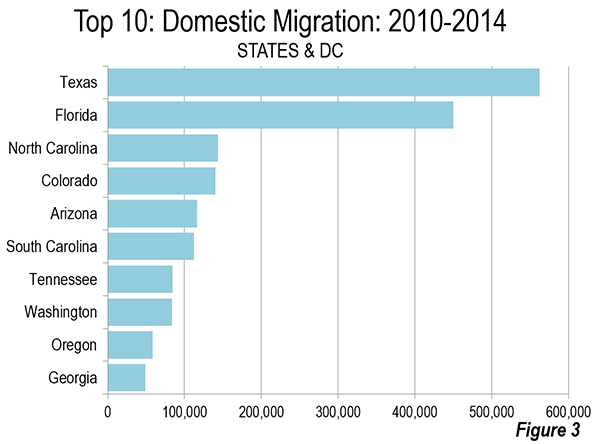
    Texas and Florida dominated net domestic migration between 2010 and 2014. Texas added a net 563,000 interstate migrants and Florida added 450,000. Third place North Carolina (143,000) attracted less than one-third of Florida’s total. Colorado added 140,000 interstate migrants and Arizona 116,000. One other state added more than 100,000 interstate migrants, South Carolina, at 112,000 (Figure 3). All of the top 10 interstate migration states were either in the South (six) and the West (four).

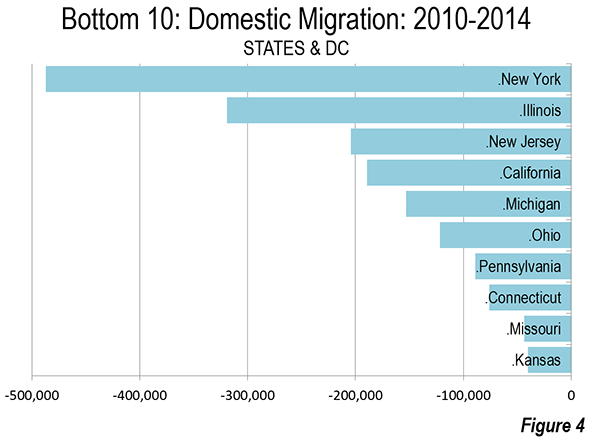
    The largest interstate migration losses were in New York (-487,000), Illinois (-319,000), New Jersey (-204,000), California (-189,000) and Michigan (-153,000). The balance of the bottom ten included Ohio, Pennsylvania, Connecticut, Missouri, and Kansas (Figure 4). All of the largest interstate migration losers were in the East (four) or Midwest (five), except for California (which trailed only New York in this category between 2000 and 2010).

    Migration by Region

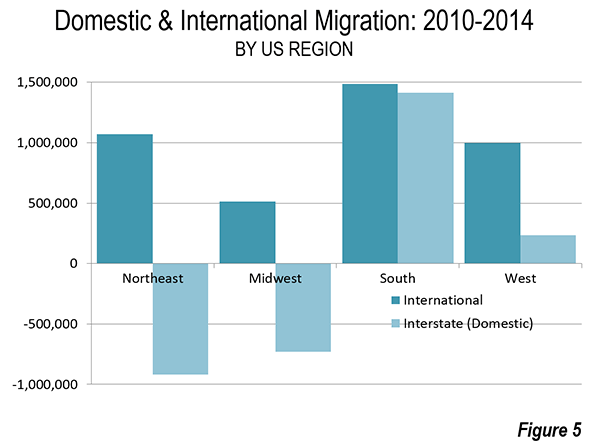
    Much of the net domestic migration was to the South, with a net gain of more than 1.4 million from 2010 to 2014. There was a gain of more than 200,000 domestic migrants in the West. All of these domestic migrants were taken from the East and the Midwest, which loss more than 900,000 and 700,000 respectively.

    Perhaps more surprising, the largest international migration gains were also in the South, which gained nearly 1,500,000. More than 54 percent of these gains occurred in Florida or Texas. International migration to the East was nearly 1,100,000 and to the West nearly 1,000,000. The lowest international migration was to the Midwest, at over 500,000 (Figure 5). The largest international migration gains were in California, New York, Florida and Texas, all with gains over 300,000.

    North Dakota’s Fast Growth

    Fastest growing North Dakota added 9.9 percent to its population between 2010 and 2014. North Dakota also grew the fastest between 2013 and 2014, with an increase of 2.2 percent. This rate of increase, however, may be challenging to sustain because of North Dakota’s reliance on the oil industry for its strong job creation. Sustained low oil prices could reduce growth in the years to come.

    Slower Growth in the District of Columbia

    The District of Columbia (the city of Washington), which had the fastest growth rate compared to any state between 2010 and 2013, fell to an annual growth rate of 1.5 percent, dropping to 5th position in growth over the last year. Even with the strong population increases early in this decade, Washington remains 240,000 below its population peak (estimated at 900,000 in the middle 1940s by the Census Bureau).

    Elsewhere, the early part of the decade has seen important changes in state rankings and population growth rates.

    Recovery in Nevada

    Nevada regained its position as one of the nation’s fastest growing states. Between 1950 and 2010, Nevada experienced by far greatest growth, expanding its population by nearly 16 times. No other state grew remotely as quickly as Nevada. Arizona, which was second fastest growing, had a rate less than half that of Nevada. In 1950, Nevada had only 160,000 residents, fewer people than live in smaller metropolitan areas such as Joplin, Missouri; El Centro, California; and Warner Robbins, Georgia. By 2014, Nevada had grown to 2,839,000 residents.

    Nevada also had the fastest growth between 2000 and 2010. However, its growth slowed substantially from the effects of the housing bust induced Great Recession. By the end of the decade was at a near standstill. Between 2009 and 2011, Nevada’s growth fell to a ranking of 32nd.

    Over the past year, despite claims that the sunbelt boom was over, Nevada has regained its strong growth track, ranking second in growth North Dakota, at 1.7 percent (in a near tie with third ranked Texas). Nevada could recover its leadership in the years to come.

    The past year also witnessed an increase in Arizona’s population growth, perhaps indicating the end of more restrained growth that resulted from the Great Recession.

    Florida Passes New York

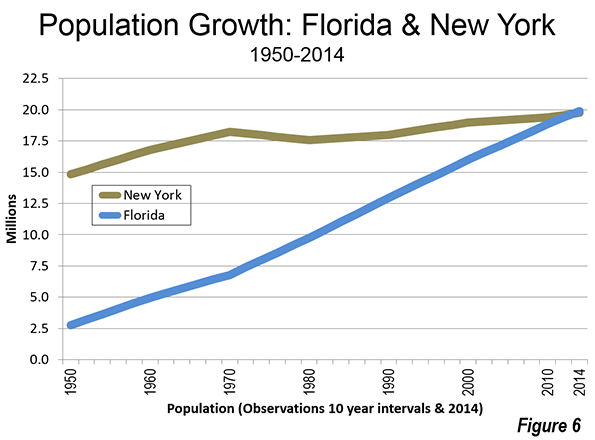
    Florida passed New York to become the nation’s third largest state in 2014 on July 1. Florida added 293,000 residents in 2014, compared to New York’s 51,000.

    Florida reflects the massive population shifts that have occurred in the United States since World War II. Since that time, the South and West have grown far faster than the East and East, which had dominated population statistics. In more recent decades, the South has grown considerably faster that the West, as California’s breakneck growth has slowed considerably.

    In the first post-war census, 1950, Florida had a population of 2.8 million. The nation’s largest state at that time was New York, with a population of 14.8 million, more than five times that of Florida. In 1950, Florida had a population only 33,000 more than Brooklyn, the largest of the New York City boroughs. Since that time Florida has added a population more than double that of New York City. While Florida was increasing its population by more than six times, New York’s population increase in the last 64 years was less than one-third of the national rate (Figure 6).

    New York assumed the top population position in the 1810 census and had maintained its preeminence for more than 150 years. In 1962, New York lost the top position to California in 1963, when both states had approximately 17.5 million residents. New York retained second position for another three decades, until 1994, when Texas assumed the second position; both states had approximately 18.5 million residents. New York’s next drop in rank happened two decades later. There seems to be little prospect of New York dropping another notch in near future. A theoretical exercise applying the 2010-2014 annual growth rates to the future indicates that New York would still hold a 7 million advantage over the next largest state in 2050 (North Carolina). Pennsylvania, Illinois, and Ohio, currently the closest in population to New York, have grown even more slowly than the Empire state since 2010.

    Former Megastate Michigan Tumbles

    Michigan, the only state to reach 10 million residents and then fall back below (2002 through 2007) managed to grow 0.3 percent since 2010. This was insufficient to restore its 10 million status (with megacities defined as 10 million or more population, it seems reasonable to suggest a megastate requires the same population). In 2010, Michigan was the 8th largest state. Georgia passed Michigan in 2012. North Carolina jumped ahead of Michigan in 2012. The growth differences are not as great as in the New York and Florida comparisons. However, Michigan had a much larger 1950 population (6.4 million) in 1950 than North Carolina (4.1 million) and Georgia (3.9 million).

    Southern and Western Rise Continues

    The first four years of the decade show the partial restoration of patterns of growth similar to the 2000s. In both periods, the South has captured 52 percent of national growth and the West, 32 percent. Some states hard hit by the Great Recession seem to be reasserting their growth (Nevada and Arizona), while Southern states are slowly but surely displacing the states in the East and Midwest that formerly dominated the top 10 population rankings.

    Wendell Cox is principal of Demographia, an international public policy and demographics firm. He is co-author of the "Demographia International Housing Affordability Survey" and author of "Demographia World Urban Areas" and "War on the Dream: How Anti-Sprawl Policy Threatens the Quality of Life." He was appointed to three terms on the Los Angeles County Transportation Commission, where he served with the leading city and county leadership as the only non-elected member. He was appointed to the Amtrak Reform Council to fill the unexpired term of Governor Christine Todd Whitman and has served as a visiting professor at the Conservatoire National des Arts et Metiers, a national university in Paris.

    Photo: Florida state capital buildings (Tallahasse) by Jenn Greiving

  • 2014’s Top Stories at New Geography

    We’ve come to the end of another year at New Geography. Here’s a look back at the most popular pieces from 2013. Happy New Year, and thanks for reading.

    12. The Rust Belt Roars Back from the Dead In December, Joel and Richey Piiparinen laid out the case for the rustbelt resurgence based on human capital and a new maker economy. This piece also appeared at The Daily Beast.

    11. Best Cities Rankings Our annual Best Cities for Jobs rankings crunched by Michael Shires are based on an index of short-, medium-, and long-range job growth.

    10. How Segregated is New York City? Daniel Hertz uses a series of maps to show that New York City is more segregated than many people realize. Be sure to check out Daniel’s blog: City Notes.

    9. Affordable Cities are the New Sweet Spots Photographer and keen city observer Johnny Sanphillippo uses a Cincinnati neighborhood to point out that older, affordable urban neighborhoods are great places to be. He concludes that “It’s like moving to the suburbs except you get to live in a great vibrant city instead of a crappy tract house on a cul-de-sac an hour from civilization.” Read more from Johnny at GranolaShotgun.com.

    8. Composite Traffic Congestion Index Shows Richmond Best In June, Wendell Cox combined the results of the three major American traffic congestion indexes to show the best and worst metropolitan areas for traffic.

    7. Special Report: 2013 Metropolitan Area Population Estimates In April Wendell summarized the results of the latest Metropolitan Area population estimates.

    6. Our Father, Who Art in the Apple Store In this Forbes column, Joel ponders the implications of our increasingly techno-centric culture.

    5. The U.S. Middle Class is Turning Proletarian Joel argues that the biggest issue facing American society is the gradual decent of the middle class to proletarian status. What to do about it? Encourage growth of blue-collar industries over those profiting from asset inflation, address the costs of education, promote skills training, and work to ensure the benefits of capitalism inure to all. This piece also appeared in Forbes.

    4. The Metro Areas with the Most Economic Momentum Going into 2014 One year ago, Joel and I created this economic performance index of the nation’s 52 largest metropolitan areas using 8 short-term indicators, covering jobs, unemployment, income growth, migration, birth rates, and education. This piece was also published by Forbes.

    3. America’s Smartest Cities This piece covers our human talent index of all the nation’s metropolitan areas. Places ranking at the top increased their share of residents with a bachelor’s degree the fastest, added the most educated residents, and have the highest current educational attainment rates.

    2. The Demographics that Sank the Democrats in the Midterm Elections Joel’s post-mortem from November’s mid-term elections was this year’s second most read piece on the site. It also appeared at Forbes.

    1. Largest World Cities: 2014 This year’s most read article is Wendell’s intro to his annual World Urban Areas publication, a comprehensive report listing population, land area, and density data for the world’s urban areas. The report is the only annually published inventory of these data for the world’s urban areas of more than 500,000 population.

  • Global City Framework

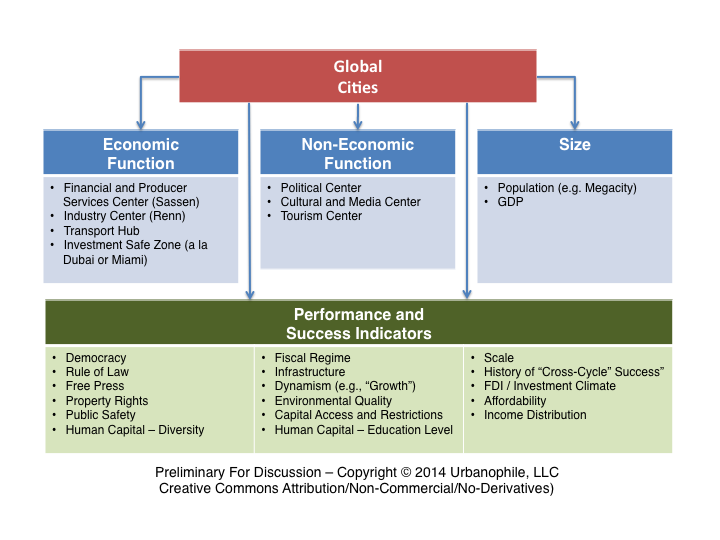
    Global cities are like that famous quip on obscenity: we know one when we see it. But the definitions of global cities are incredibly varied and there doesn’t seem to be a consensus or well-defined way to think about. I looked at the criteria used in various prominent studies back in 2012 and found them highly divergent. Only the Sassen based one appeared to have a robust definition and theoretical basis, but it’s a pretty narrow definition. While it’s very important and useful, I don’t think it fully captures what the average person or urbanist thinks of on the topic.

    In wrestling with the global city idea while working on the global city study I did some research for, I put together this framework to help organize our thinking.

    Global City Framework

    This framework seeks to capture in a structured manner all the ways people talk about global cities that I’m aware of.

    There are three basic categories of criteria people use in defining global cities: economic function, non-economic function, and size.

    Economic Function

    Some, like Sassen, define global cities by economic function. In her case, just being a financial center isn’t enough. You need to be producing financial services products specifically related to the global economy, not just making mortgages domestically. I list “Financial and Producer Services Center” as a shorthand for this. In all of these definitions, when I say a “center” I’m referring to a center of global or regional (e.g., European or Latin American) significance, not simply a domestic center.

    If I have a contribution to the global city definition genre, it’s my contention that places like the Bay Area (tech) or Paris (fashion and luxury) that are important global or regional epicenters of an important 21st century macroindustry are also global cities in a powerful sense by virtue of that.

    The idea of being a transport hub for goods or services is self-explanatory, though I’ll note that simply being a goods distribution hub (such as a global air freight hub like Memphis) doesn’t necessarily imply a high value, high wage economy.

    Lastly, and perhaps this is one I made some contributions to as well, is the idea of a “safe zone” for investing or parking capital. Much of the world is volatile economically and only has a dubious attachment to the rule of law and property rights. Hence wealthy people in those countries like to stash their cash in places where they consider it safe. Where I would distinguish this from a simple offshore account as in the Caymans is that this investment often includes real estate, and the rich folks in question often establish a personal base there. New York and London as the paradigmatic global cities obviously fall into this category, but I’m more thinking of regional hubs like Dubai, Miami, and Singapore. These places have established themselves as premier business (and in some cases cultural) hubs for their regions.

    Non-Economic Functions

    These are other aspects of a city’s function that I see as not directly economic, though obviously there are economic impacts. Most of these perhaps could be subsumed under being in an industry epicenter, but since global city surveys often call them out separately, I will as well.

    The first item is being an important global political capital like Washington, Moscow or Beijing. Enough said.

    Another important dimension is being a cultural and media center. Los Angeles profoundly affects the world because of its entertainment machine and the media that goes along with it. (By contrast, Mumbai may be a huge film center, but serves largely a domestic and Indian ethnic audience). Obviously the English language cities have a big advantage here in terms of media, though cities like Paris have a powerful cultural role.

    Lastly, being a global tourism center is another dimension. Which places draw foreign visitors? You might want to read Nicole Gelinas’ recent taken on international tourism’s affect on New York. NYC attracts a third of all foreign visitors to the United States.

    Size

    Lastly, many surveys include measures that are purely about size, such as total GDP. The rhetoric about megacities (those with more than 10 million people) shows a fascination with size as well.

    Success and Performance Indicators

    Beyond the categories that define what global cities are, I include a horizontal layer talking about how to think about whether they are successful. I think there’s a big debate that can be had about whether these are performance indicators or selection criteria. Obviously more global city surveys want to pick highly performing cities, so these are part of their evaluation matrix. I myself originally included diversity and educational attainment (talent hub) on the non-economic function list.

    I won’t go through these as they are pretty self-explanatory. I’d be interested to see where you all would put these, and what you’d add to or drop from the list.

    By the way, in that global city survey I worked on, we decided to look purely at economic function, though pulling across media hub and treating that as an industry. We felt that taking this sort of view was a gap in the existing inventory of ratings, and also perhaps the most important way to think about global cities.

    This is a concept in development, so please share your thoughts.

    Aaron M. Renn is an independent writer on urban affairs and the founder of Telestrian, a data analysis and mapping tool. He writes at The Urbanophile, where this piece originally appeared.

    Hong Kong photo by BigStockphoto.com

  • Measuring Economic Growth, by Degrees

    In this information age, brains are supposed to be the most valued economic currency. For California, where the regulatory environment is more difficult for companies and people who make things, this is even more the case. Generally speaking, those areas that have the heaviest concentration of educated people generally do better than those who don’t.

    Nothing more illustrates this trend than the supremacy of the Bay Area over Southern California in the past five years. Since the 2007-09 recession, the Bay Area has recovered all of its jobs, as has San Diego, but Los Angeles-Orange and the Inland Empire, although improving, lag behind.

    Overall, the San Jose and San Francisco areas boast shares of college graduates at around 45 percent, compared with a 34 percent average for the 52 largest U.S. metropolitan areas. The San Diego area clocks in at 34.6. In comparison, the Los Angeles-Orange County area has roughly 31 percent college graduates while the San Bernardino-Riverside area has the lowest share of four-year degrees – 20 percent – of any large region in the country – this is worse even than backwaters like Memphis, Tenn., and Birmingham, Ala.

    Dividing this region by counties shows Orange County well in the lead, with 37.6 percent college-educated, well above Los Angeles County’s 30 percent.

    Recent Trends

    To see where these metrics are headed, Mark Schill, an analyst with the Praxis Strategy Group (www.praxissg.com), was asked to identify the share growth of bachelor’s degrees in the country’s largest metropolitan areas during 2000-13. The share of the adult population with college educations rose by 6.8 percent in San Jose and 6.4 points in the San Francisco-Oakland region. Some regions did better, including Boston, Pittsburgh, Grand Rapids, Mich., Baltimore, New York and St. Louis. All these were considerably above the national average increase of 5.2 percent.

    In contrast, most areas of Southern California have shown more meager growth in their educated workforces. Los Angeles, overall, enjoyed a very average increase of 5.2 percent. San Diego, despite its high-tech reputation, notched a 5 point jump while the Inland Empire increased by 3.8 points, one of the lowest performances in the country. The biggest gainer in the Southland was Orange County, where the share of educated workers grew by a healthy 6.3 percent.

    Whither young, educated workers?

    The picture, particularly for the Inland Empire, is not totally bleak. In a recent survey conducted by Cleveland State University, there have been some promising developments in the growth of younger educated workers. This key cohort, notes researcher Richey Piiparinen, appears to follow a very different path than do older educated workers, with many seeking out careers in less-expensive locales.

    Indeed, looking at educated growth among 25-34-year-olds from 2010-13 finds that the most rapid expansion is taking place in unlikely places, such as the areas around Nashville, Tenn., Orlando, Fla., and Cleveland, all which experienced increases of roughly 20 percent or more. This is better than twice the growth rate in such noted “brain centers” as San Jose and San Francisco, which were around 10 percent, and New York at 9 percent. The Los Angeles-Orange County area saw a similar increase.

    The reasons for these surprising, and somewhat encouraging results, particularly for the Inland Empire, may vary. One thing, of course, is the low base from which the area starts. After all, until the past decade, the employment profile of the Inland Empire favored manufacturing, logistics and construction, all fields not dependent on large contingents of highly educated workers.

    Another critical factor may well be price, as we saw in our surprising findings on millennials. Simply put, many of the areas attractive in the past to educated workers have become extraordinarily expensive – as demonstrated by San Francisco-based writer Johnny Sanphillippo – while some more affordable locales have become “sweet spots” for younger educated people, particularly as millennials enter their family formation years.

    County, city breakdowns

    The Southland, of course, is a vast region, and even every county contains hosts of cities that are very different from each other. In terms of counties, the biggest gains – albeit from a smaller base – took place in the Inland Empire, notably Riverside, which saw a 93 percent jump in its educated population since 2000. Orange County saw a 37.6 percent gain, ahead of Los Angeles’ roughly 36 percent gain.

    More intriguing, and revealing, is the distribution of college degrees by city areas. Here, the supremacy of a few areas is very clear. In three Southland communities, more than 60 percent of the adult populations have college degrees: Santa Monica, Newport Beach and Irvine. Yorba Linda, Pasadena and Redondo Beach all boast rates close to, or above, 50 percent.

    Obviously, these towns are something of outliers in the region. Los Angeles, by far the region’s largest city, has roughly 31 percent of its adults with college degrees. Many communities do far worse, most of all, Compton, where less than 6 percent have four-year degrees. Hesperia, Southgate, Lynwood and Victorville have educated percentages under 10 percent.

    Adjacent communities sometimes have radically different rates of education. Santa Ana, for example, abuts Irvine, but has an educated population of barely 12 percent. And while some areas have shown meager growth in their share of educated residents, several areas have seen double-digit percentage increases, including Burbank, Yorba Linda, Rancho Cucamonga and Santa Monica.

    Implications

    As the Southland economy evolves, it makes sense to look at those areas most likely to have more of the educated workers that high-end industries need. These increasingly are clustered in a few places, such as Irvine, Newport Beach, Rancho Cucamonga and Costa Mesa, that are both suburban in form but tend to have better schools than much of the region. These areas also tend to have lower-than-average unemployment rates. Educated people tend to migrate, for the most part, to areas where others of their ilk are concentrated, and often where their children have the best chance at a decent education.

    These statistics and trends suggest that our leaders, in education and politics, need to focus on reality. It is dubious that many communities throughout the Southland will develop large shares of educated people in the immediate future. Indeed, given the quality of public education throughout most of the region, it seems almost inevitable that much of the region will lag in terms of skills well into the next decade.

    This means that local leaders cannot expect to duplicate in the near future the success of places like Boston, the Bay Area, or even Pittsburgh. Instead, there needs to be a two-pronged attempt to address this issue. One is to boost preparatory and higher education throughout the region, which will allow for Southern California to better compete at the highest-end of employment.

    But the other strategy, not to be discounted, is a full-scale commitment to skills training for those unlikely to earn bachelor’s degrees. This also means taking measures allowing the industries that would employ such workers – largely manufacturing, logistics, medical and business services – to flourish, so this training will have rewards. The Southland’s already large educated population is one key to its future, but finding a decent work environment for those without a four-year degree merits equal, if not greater, emphasis.

    This piece first appeared at the Orange County Register.

    Joel Kotkin is executive editor of NewGeography.com and Roger Hobbs Distinguished Fellow in Urban Studies at Chapman University, and a member of the editorial board of the Orange County Register. His newest book, The New Class Conflict is now available at Amazon and Telos Press. He is author of The City: A Global History and The Next Hundred Million: America in 2050. His most recent study, The Rise of Postfamilialism, has been widely discussed and distributed internationally. He lives in Los Angeles, CA.

    Graduation image by BigStockPhoto.com.

  • Exodus of the School Children

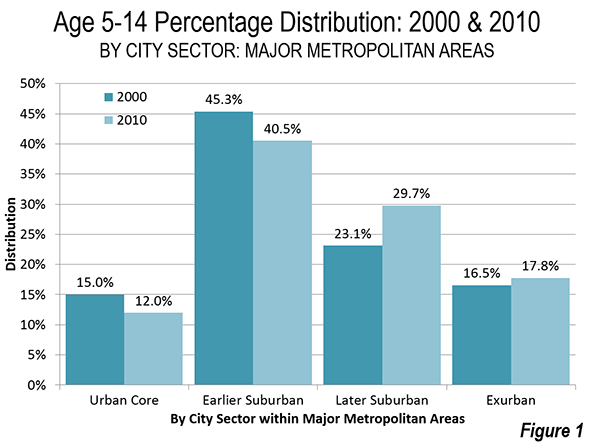
    The urban cores of the nation’s 52 major metropolitan areas (over 1 million population) lost nearly one-fifth of their school age population between 2000 and 2010. This is according an analysis of small area age group data for children aged 5 to 14 from Census Bureau data, using the City Sector Model. Over the period, the share of 5 to 14 age residents living in the functional urban cores declined from 15.0 percent to 12.0 percent (Figure 1).

    The City Sector Model

    The City Sector Model analysis avoids the exaggeration of urban core data that necessarily occurs from reliance on the municipal boundaries of core cities (which are themselves nearly 60 percent suburban or exurban, ranging from as little as three percent to virtually 100 percent). It also avoids the use of the newer "principal cities" designation of larger employment centers within metropolitan areas, nearly all of which are suburbs, but are inappropriately joined with core municipalities in some analyses. The City Sector Model" small area analysis method is described in greater detail in Note 1 below (previous articles are listed in Note 2). The approach is similar to the groundbreaking work of David Gordon, et al at Queen’s University for Canadian metropolitan areas.

    School Age Losses

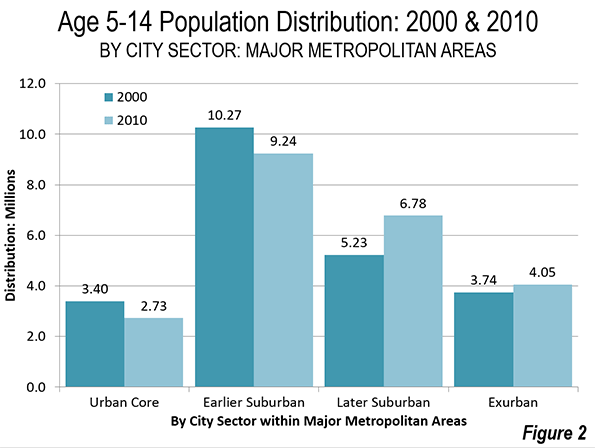
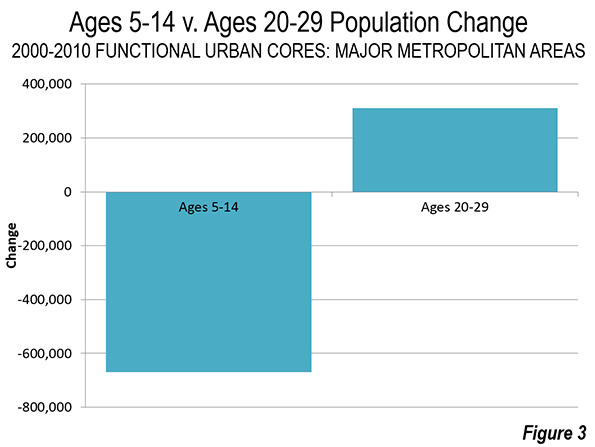
    The urban core school-age population dropped from approximately 3.40 million in 2000 to 2.73 million in 2010, for a loss of 670,000 (Figure 2). Much has been made about the affinity of the Millennial generation for the urban cores. Despite this, our small area analysis indicated that the percentage of 20 to 29 year olds living in the functional urban cores declined between 2000 and 2010, with 88 percent of the growth in suburbs and exurbs (see Dispersing Millennials). Coincidentally, over the period, there was a reduction of two school age children in the urban cores for every additional resident aged 20 to 29 (Figure 3).

    A loss was also sustained in the earlier suburbs (with median house construction dates between 1946 and 1979). The school-age population declined slightly more than 1 million in the earlier suburban areas. In 2000, 45.3 percent of school age children lived in the earlier suburbs, a figure that declined to 40.5 percent in 2010.

    Virtually all of the gain in 5 to 14 age residents was in the later suburban areas (a median house construction dates of 1980 or later) and exurban areas. Overall, these two city sectors added 1.9 million school-age children, while the urban cores and the earlier suburban areas experienced a reduction of 1.7 million, for a reduction of approximately 10 percent.

    The largest increase was in the newer suburban areas (median house construction dates of 1980 or later), where 1.47 more school-age children lived in 2010 than in 2000. This represented an increase of approximately 30 percent. Exurban areas have a more modest increase of 310,000 school-age children, up 8.3 percent from 2000.

    Losses in the Largest Urban Cores

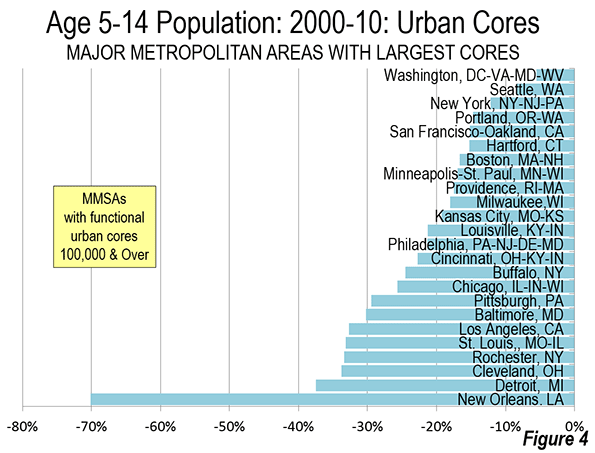
    All of the large urban cores in the metropolitan areas experienced losses in school aged children from 2000 to 2010. Among the 24 urban cores with more than 100,000 residents, Washington (-5.5 percent) and Seattle (-8.4 percent) came the closest to retaining their 2000 school age numbers in 2010.  Seven large urban cores experienced losses of at least 30 percent. Baltimore’s loss was approximately 30 percent. Los Angeles joined rust belt cities St. Louis, Rochester and Cleveland at 33 percent to 34 percent and Detroit at 38 percent. New Orleans had the largest loss (-70.2 percent), owing in part to population loss from the disastrous hurricanes (Figure 4).

    Finally, in all of the 52 metropolitan areas, the later suburban and exurban areas (combined) retained more of their school age children than the urban cores and earlier suburbs. There were gains in 45 of the later suburban and exurban areas.

    Better Schools: The Necessary (But Maybe Not Sufficient) Condition

    One of the issues of most interest among urban analysts has been whether urban cores will be able to retain the share of Millennials that they have attracted. The functional urban cores seem likely to maintain their attraction for younger adults, so long as the cores sustain their improved living environment (such as much lower crime rates than before and continued investment by retailers and other commercial business to support the new populations).

    However, the continuing exodus of people with school-age children described seems to indicate that young adults tend to move to the suburbs and exurbs around the time their children enroll in school. Suburban and exurban schools often provide better educations than urban core schools. The Editorial Projects in Education found that high school graduation rates were 77.3 percent in suburban school districts, compared to 59.3 percent in "urban" school districts (Note 3). There are other difficulties as well, such as having sufficient defensible outdoor space for children to play and for parents to feel secure. But education seems likely to be the most important consideration.

    Of course, in urban areas the highly affluent can enroll their children in private schools. The alternative of private schools can be overly expensive, inducing households to relocate to school districts with higher quality education. According to research by Chief Economist Jed Kolko of Trulia: “Private school enrollment in the lowest-rated school districts is more than four times as high as private school enrollment in the highest-rated school districts after adjusting for neighborhood demographic differences."

    A balanced broad age distribution of households, including those with children of school age, is not likely to be achieved in urban cores unless Millennials are retained in substantial numbers. Once having moved, the chances of their returning are slim, because households move less frequently as they move up the age scale.

    Note 1: The City Sector Model allows a more representative functional analysis of urban core, suburban and exurban areas, by the use of smaller areas, rather than municipal boundaries. The more than 30,000 zip code tabulation areas (ZCTA) of major metropolitan areas and the rest of the nation are categorized by functional characteristics, including urban form, density and travel behavior. There are four functional classifications, the urban core, earlier suburban areas, later suburban areas and exurban areas. The urban cores have higher densities, older housing and substantially greater reliance on transit, similar to the urban cores that preceded the great automobile oriented suburbanization that followed World War II. Exurban areas are beyond the built up urban areas. The suburban areas constitute the balance of the major metropolitan areas. Earlier suburbs include areas with a median house construction date before 1980. Later suburban areas have later median house construction dates. 

    Urban cores are defined as areas (ZCTAs) that have high population densities (7,500 or more per square mile or 2,900 per square kilometer or more) and high transit, walking and cycling work trip market shares (20 percent or more). Urban cores also include non-exurban sectors with median house construction dates of 1945 or before. All of these areas are defined at the zip code tabulation area (ZCTA) level.

    Note 2: The City Sector Model articles are:
    From Jurisdictional to Functional Analyses of Urban Cores & Suburbs
    The Long Term: Metro American Goes from 82 percent to 86 percent Suburban Since 1990
    Beyond Polycentricity: 2000s Job Growth (Continues to) Follow Population
    Urban Cores, Core Cities and Principal Cities
    Large Urban Cores: Products of History
    New York, Legacy Cities Dominate Transit Urban Core Gains
    Boomers: Moving Farther Out and Away
    Seniors Dispersing Away from Urban Cores
    Metropolitan Housing: More Space, Large Lots
    City Sector Model Small Area Criteria

    Note 3: This report (which was prepared with support from the America’s Promise Alliance and the Bill and Melinda Gates Foundation) provides graduation rates using the US Department of Education "local codes." This typology generally defines "urban" school districts as those in core cities as well as other principal cities (such as Arlington, Texas and Mesa, Arizona). Most of the population of core cities and principal cities is classified as functionally suburban (see: Urban Cores, Core Cities and Principal Cities). Further, the typology classifies some districts as suburban that have large urban components (such as Las Vegas, Miami, Louisville and Honolulu), which is necessary because of county level school districts that include both urban cores and suburban areas. As a result the functionally suburban component of urban districts is overstated and the functionally suburban component of suburban districts is understated. Because urban graduation rates tend to be less than suburban rates, both of these factors seem likely to overstate the "urban" graduation rates and understate the "suburban" graduation rates.

    Wendell Cox is principal of Demographia, an international public policy and demographics firm. He is co-author of the "Demographia International Housing Affordability Survey" and author of "Demographia World Urban Areas" and "War on the Dream: How Anti-Sprawl Policy Threatens the Quality of Life." He was appointed to three terms on the Los Angeles County Transportation Commission, where he served with the leading city and county leadership as the only non-elected member. He was appointed to the Amtrak Reform Council to fill the unexpired term of Governor Christine Todd Whitman and has served as a visiting professor at the Conservatoire National des Arts et Metiers, a national university in Paris.

    Photo: School buses in suburban Atlanta (by author)

  • Russian Rublette

    Is the demise of the ruble, together with falling crude oil prices, comeuppance for President Vladimir Putin’s expansionist dreams? That’s certainly the storyline of those holding faith in economic sanctions. In their eyes, he foolishly land grabbed eastern Ukraine and Crimea, and in exchange got back a cratered Russian economy, with a debased currency and little access to Western financial markets. Heck of a job, Vlad.

    The victors, presumably, are the sanction wizards of Washington and London who stared down the barrels of Putin’s tanks and fifth columnists. Under the theory that the Russian economy is a kleptocracy that sustains Putin in power, the sanctions were targeted at presidential cronies and their “sectoral” holdings, such as those in the oil business (the rallying cry should have been “Don’t fire until you see the whites of their proxy statements”).

    Amazingly, even the dysfunctional US Congress found time in its lame-duck session to vote additional sanctions against the Russian oil sector, although hidden in the fine print of the midnight legislation were goodie bags for Washington lobbyists, who are in line for a $60 million windfall to, as the New York Times reported, “promote democracy, independent news media, uncensored Internet access and anticorruption efforts in Russia.”

    For the moment, despite the free fall of his currency, President Putin remains defiant. Tired of getting finger-waggled for the benefit of western TV audiences, he ghosted from the G-20 summit in Brisbane. Heading early to the airport, Putin must have made a mental note to repay his Western confessors, someday, with the same currency that they fetched from Russian coffers.

    The irony of the allied attacks on the ruble, Russia, and President Putin is that the biggest losers may end up being the high-minded Western countries that would consign Russia and her Kremlin leadership to the dustbin of history.

    The Russian ruble—or should I say the new ruble—was reissued after the 1998 credit collapse in Russia. The previous currency was holdover Soviet bitcoin, issued on the full faith and credit of defunct tractor communes, and convertible, at best, into assets that the oligarchs had already claimed for themselves.

    In free fall as I write, the ruble is best understood as an oil junk bond, for which par is about $117 a barrel (the break-even point for Russia’s budget). Below that price, the ruble falls; above it, the currency strengthens. The reason it remains tied to oil is because the Russian economy has yet to stimulate a large enough middle class to free its markets from petroleum dependence.

    Sadly, Russia’s economy is like that of a Gulf state: it has oil revenues and anointed princes who share in the state’s wealth. Everyone else is a variation on guest workers from the Philippines.

    Despite the structural imbalance of Russia’s economy, the nation’s fundamentals are stronger than you might think. Its foreign currency reserves are $418 billion, placing it sixth in world rankings, way ahead of the US with $132 billion and even ahead of South Korea, which has $364 billion.

    Nor has Russia engaged in the same reckless deficit spending that defined the United States during the feel-good years. Despite the chimes of death, the projected budget deficit for Russia in 2014 is still only about 389 billion rubles (roughly $7 billion, depending on the ruble-dollar exchange rate), while the deficit for the US could reach $500 billion.

    Gross government debt, as a percentage of gross domestic product (GDP), in Russia remains a relatively healthy 10 percent, unlike that of the United States, which has maxed out its borrowings at more than 100 percent of GDP.

    Russia’s external or foreign debt is a manageable $715 billion compared to that of the U.S., which is on the hook for $17 trillion. It might not have a CVS drugstore on every corner or iPhones in every hand, but since emerging from communism in the early 1990s it has, reasonably, lived within its means.

    Even in the most solvent nations, circulating national currencies are best understood as company scrip; bonds drawn on faceless central banks that allow citizens to transact their daily business. As storehouses of wealth, national currencies make about as much sense as holding baseball cards or those Raleigh coupons that used to be included with packs of cigarettes.

    Not for a long time has any world currency been convertible to gold, silver, or any other commodity. At best they are unsecured loans undertaken by citizens in favor of their central banks. All that backs them is political confidence, something ebbing right now in Russia.

    Fortunately for the Russians, their economy is better able to withstand economic isolation than many others. The country can be self-sufficient in food and energy, and one of the few advantages learned in the hothouse years of Soviet communism is how to live apart from Western markets and malls.

    One reason the West decided to fight Russian expansion with sanctions as opposed to bayonets is that the encroachments into Ukraine came at a time of oversupply in Western energy markets.

    By turning down the taps of Russian oil companies — or by at least limiting their access to Western financial markets — the Obama administration was throwing a subsidy bone to domestic energy producers, which were already choking on glutted markets and depressed stocks.

    Nor do the Western allies fear much from Russian retaliation. Moscow laughably imposed travel bans on Obama administration and congressional figures, to keep them from vacationing in Omsk, but it has left open the pipelines that supply Western Europe with natural gas.

    In the same vein, while it may have been aggressive in protecting the rights of Russians living in Ukraine, it refrained from imposing its own sanctions when the US launched similar wars of national liberation in Afghanistan, Iraq, Libya, Serbia, and Somalia.

    The unspoken risk in the great game of economic sanctions and currency strangulation is that the United States has a lot more to lose should, say, China join Russia someday in playing pin-the-tail-on-the-dollar, or if Russia decides to lash back at the Americans by, for example, stirring the cauldron in the Middle East.

    Already Putin’s push-back in favor of Syria’s president Assad turned a civil uprising into a regional war. Russia might also decide to damn the $60 million in press-release torpedoes and take more, if not all, of Ukraine.

    Watching the takedown of another country’s currency — I am assuming that the West is gloating over Putin’s misfortunes — has the air of harmless fun. The assumption is that only a few banks, rogue states, or crony capitalists will suffer.

    Worth further consideration, however, is that currency collapses and hyperinflation have often ushered in civil war and continental instability. Rarely have the effects been contained to the country of origin and its discontents.

    The dissolution of its legal tender, Assignats, in part turned the French Revolution away from the rights of man and into a counting house for disembodied heads. Weimar’s wheelbarrow currencies had disastrous effects beyond Germany’s market squares.

    The last Russian tsar abdicated in 1917, at a moment when his currency had collapsed, and the West lived with the consequences of what followed for almost a century.

    Matthew Stevenson, a contributing editor of Harper’s Magazine, is the author, most recently, of Remembering the Twentieth Century Limited, a collection of historical travel essays, and Whistle-Stopping America. His next book, Reading the Rails, will be published in 2015. He lives in Switzerland.
    Flickr photo by James Malone. The “old” ruble: Russian note for 100 Rubles; 1993.

  • Our Father, Who Art In The Apple Store: The Decline Of Christmas And The Looming Tech Nightmare

    In the past, this season was marked by a greater interest in divinity, the family hearth and the joy of children. Increasingly our society has been turning away from such simple human pleasures, replacing them with those of technology.

    Despite the annual holiday pageantry, in the West religion is on the decline, along with our society’s emphasis on human relationships. Atheism seems to be getting stronger, estimated at around 13 percent worldwide but much higher in such countries as Japan, Germany and China. “The world is going secular,” claims author Nigel Barber. “Nothing short of an ice age can stop it.”

    In contrast, the religion of technology is gaining adherents. In a poll in the U.K., about as many said they believe Google to have their best interests at heart as God. Religious disbelief has been rising particularly among U.S. millennials, a group that, according to Pew, largely eschews traditional religion and embraces technology as a primary value. Some 26 percent profess no religious affiliation, twice the level of their boomer parents; they are twice as irreligious at their age as any previous generation.

    For millennials, religion is increasingly a matter of personalized “self knowledge” that need not be pursued in church, or as part of their community. Computer scientist Allen Downey has done interesting research that shows that Internet use is a primary driver of declining interest in religion.

    Not surprisingly, religious organizations are in a digital panic. In recent months, some have bemoaned how companies like Google or Apple have replaced churches as creators of the ultimate values. Apple, in particular, notes Brett Robinson, author of “Appletopia,” has adherents who back their products with “fanatical fervor.” Tech products feed into “a celebration of the self” that contradicts most religious teachings, he argues. Even the protocols for using our phones or computers emulate those found in religious services, writes Robinson.

    Our growing digital fixation has also impacted human relationships. Social media has some great positives, particularly for helping potentially isolated groups such as the mentally ill  and seniors. And it is an effective way to keep in touch with far-flung friends and relatives. However, as social media consultant Jay Baer notes, avid users of social media tend to have lots of “friends” but the fewest personal ties.

    As a people, we are becoming digitally detached, argues De Paul professor Paul Booth. Many particularly millennials, increasingly prefer “mediated communication” over face-to-face interaction, also preferring to text than talk on the phone. “Friends,” as defined by Facebook, has little to do with friendship as understood down the centuries: people to talk to and spend time with in a social setting.

    Perhaps most disturbing, reliance on social media tends to work against forming intimate ties, which rest on such real-world factors as proximity and shared experiences, says Rachna Jain, a psychologist who specializes in marriage and divorce. Many millennials have delayed marriage and family formation, in part due to the economy, but it’s possible that technology-enabled distancing is also playing a role.

    Technology As Religion

    Technology’s emergence as a secular religion has been with us since the 19th century. Saint Simon and later Marx identified it as capable of replacing God in creating an earthly paradise. Industrial entrepreneurs like Thomas Edison also believed they were laying the foundation for a new millennium; he prophesied electricity would reduce the need for sleep, help improve the senses and promote the equality of women.

    This notion grew after World War II, which launched a period of rapid technological changes — jet aircraft, missile technology and nuclear power. The growing interest in technology, predicted Daniel Bell in his landmark 1973 The Coming of Post-Industrial Society, would foster the “preeminence of the professional and technical class.” This emergent new “priesthood of power” would eventually overturn the traditional hierarchies and industries and, in process, create the rational “ordering of mass society.”

    Despite the threat of thermonuclear war, the 1950s and 1960s were suffused with a spirit of technological optimism. In his classic 1967 book “The Technological Society,” French philosopher Jacques Ellul drew a contemporary picture of the world of 2000, complete with regular shuttle service to the moon, synthetic foods and an end to hunger and poverty.

    Tech Dreams, Tech Nightmares

    Today technological change may be slower, but its effects on society are more profound, and threatening basic social institutions. Like Marx or Saint Simon, the new tech “gods,” epitomized by Steve Jobs, have pointedly dismissed religion and held themselves as the ultimate “disrupters” of the existing civilization. Techno-evangelist Nicholas Negroponte has even suggested that “digital technology” could turn into “a natural force drawing people into greater world harmony.”

    So we continue to make the mistake of conflating technology, which does bring many blessings, with the improvement of society. As computer industry pioneer Willis Ware warned almost four decades ago, new communication technology, rather than simply making information more universally available, could also increase the “intensive and personal surveillance” of individuals. This has resulted not so much in the creation of a surveillance state” as whatDavid Lyons has referred to as a “surveillance society,” where those who control information include not only state players but certain well-positioned private ones.

    Far from being liberating and diffusing wealth, the emerging information economy serves “a new tiny class of people,” the tech visionary Jaron Lanier argues, particularly at companies like Google, Facebook and Apple that are repeatedly accused of abusing private information. As Google’s Eric Schmidt put it: “We know where you are. We know where you’ve been. We can more or less know what you’re thinking about.”

    In the coming years Google and other digital heavyweights hope to involve themselves ever more in our most mundane activities, whether by monitoring our physical functions or figuring out ways to profit from our inner-most thoughts. Yet the vision at places like Google goes well beyond the mundane, aspiring to powers once believed to be the province of divinities.

    Entrepreneur and inventor Ray Kurzweil, now the director of engineering at Google, sees information technology developing to the point that our biological intelligence will be merged, even subsumed, into that of intelligent machines. Freed from the constraints of life and death by imprinting our brain patterns on software, he predicts, “the entire universe will become saturated by our intelligence.”

    This “transhumanist” vision reflects Kurzweil’s almost obsessive concern with aging – he takes around 150 vitamin supplements a day in hopes of delaying his own demise. This cannot be dismissed as the whimsies of a lone inventor – Kurzweil is an enormously influential figure at the pinnacle of one of the world’s most important technology and media companies, one that is exploring “biological computing,” which seeks to duplicate the brain’s functions in machine language.

    Such research could have powerful and positive impacts, but the insistence on seeing information technology as the solution to basic human problems rests on a new vision that we are machines that can be infinitely improved. This suggests the growth of an ever greater chasm, according to Kurzweil, between those who refuse or are incapable of cybernetically augmenting themselves — what he labels MOSHs or Mostly Original Substrate Humans — and those who do. “Humans who do not utilize such implants are unable to meaningfully participate in dialogues with those who do,” writes Kurzweil.

    Bill Joy, a founder of Sun Microsystems, warns that some in Silicon Valley envision a society where human labor is largely replaced by automatons operated by Bell’s “ priests of the machine.” The current decline in labor force participation, particularly among the young, could just be the beginning. All one can hope, Joy suggests, is that they serve as “good shepherds to the rest of the human race.” But under any circumstance, he predicts, the mass of humanity “will have been reduced to the status of domestic animals.”

    Whatever the advantages that we can derive from technology, this vision of the future violates the basic moral principles of both civil society and religious faith. Before we plug ourselves in for eternity, we might consider, this holiday season, to take a non-digital path to reviving our soils, whether by reading your bible, enjoying Shakespeare, tossing a football with your kids, or simply taking a walk in the woods. Technology might help shape what humanity can do, but it cannot make us any more human. That’s up to us.

    This piece first appeared at Forbes.

    Joel Kotkin is executive editor of NewGeography.com and Roger Hobbs Distinguished Fellow in Urban Studies at Chapman University, and a member of the editorial board of the Orange County Register. His newest book, The New Class Conflict is now available at Amazon and Telos Press. He is author of The City: A Global History and The Next Hundred Million: America in 2050. His most recent study, The Rise of Postfamilialism, has been widely discussed and distributed internationally. He lives in Los Angeles, CA.

    Steve Jobs photo by Justdoit709 (Own work) [CC BY-SA 3.0], via Wikimedia Commons

  • States Taxes on Internet Commerce

    The Internet Tax Freedom Act (ITFA), signed into law by President Clinton in 1998 and extended three times since, was scheduled to expire on November 1, 2014 if Congress did nothing – which they are very good at. ITFA placed a moratorium on new taxes either for Internet access services or for products and services not already taxed in local commerce. A more definitive action, the Marketplace Fairness Act (MFA), has been attached to various versions of the ITFA renewals. The MFA would force all remote vendors (regardless of physical presence) to collect and remit sales taxes for every state where buyers take delivery of goods (and services, if subject to sales taxes).

    About seven states had charges on Internet access fees prior to the first ITFA, which included a grandfather clause for them. Eight states passed “Amazon Laws” since 2008. New York was first. Big retailers like Amazon and Overstock terminated agreements with small in-state e-tailers who earned revenue by linking their websites with the big companies’. Amazon sued the state of California over being forced to collect sales tax because they had related businesses in the state. The Direct Marketing Association got a U.S. District court to stop the state of Colorado from requiring remote vendors to notify residents that they are responsible for paying sales taxes and to provide information to the state for them to enforce collections.

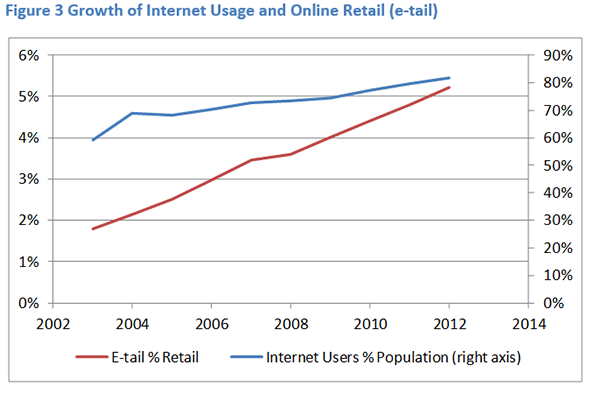
    I ran a statistical analysis to test whether enacting Internet sales tax laws (“Amazon Laws”) had an impact on total retail sales in the state. When we control for the share of the population that are Internet users – something not taken into account by other data analysts – we found no statistically significant impact on retail trade from enacting Amazon Laws. A sample of our results are presented visually in the chart. Note, especially, that even states with no sales tax saw a decline in retail trade around 2008-2009, the time of the first Amazon Laws. The drop is likely due to the global economic recession.

    After sixteen years and four extensions of ITFA, plus numerous lawsuits, Amazon is collecting sales taxes on purchases made by customers from 23 states with one more slated to be added in 2016. Including the five states without sales tax, that covers about 69% of Americans, according to the Wall Street Journal (October 1, 2014). Amazon has a physical presence in just 21 states and only 8 states have “Amazon Laws.”

    Most news reports on the subject of Internet sales taxes present only a partial rhetoric, similar to this:
    “At issue is a bill that would allow states to collect sales tax revenue from online retailers outside their borders. Right now, states can only collect sales taxes from a business with a physical location in that state.”

    But the real point “at issue” is the inability of states to enforce existing tax laws. Forcing e-tailers to collect the tax means they will incur costs well-beyond that of terrestrial retailers because they must collect and remit for 49 more states than local retailers. To be completely fair, local retailers would have to check the identification of buyers and collect and remit state sales taxes to the states where the buyers reside. Imagine the burden on retailers in states with high visitor traffic – like Nevada, California, New York, or Florida.

    Every state wants to know the potential income from extending sales tax to out-of-state Internet retailers. Recently, we completed an analysis of this potential in Nevada for the Las Vegas Global Economic Alliance. We found that the increased tax revenue would be quite small and likely to remain so for several more years. At the same time, the cost to the states could be quite high. These costs may diminish in the future as retailers and states with Amazon Laws are forced to work out operational solutions. Given that many states already have working arrangements with Amazon and other large national retailers (including through multi-state agreements), there appears to be little benefit from new state tax legislation on this issue.

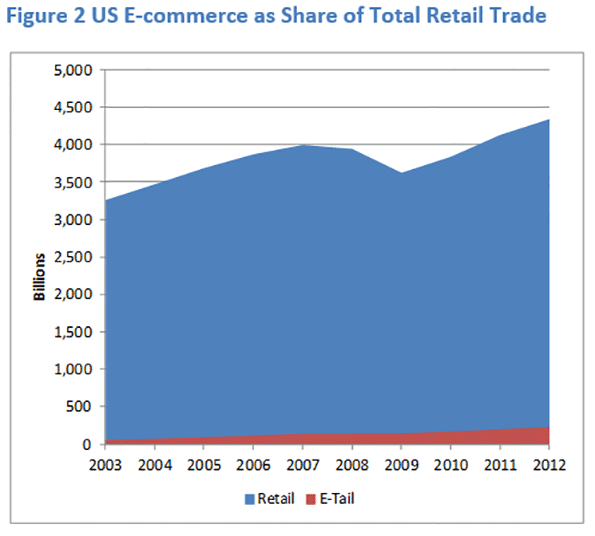
    In reality, only a small part of internet commerce is taxable. Manufacturers’ e-commerce shipments were more than one-half of all online sales in 2012. Much of these sales are not subject to state sales tax regardless of the location of the buyer or the seller because they are purchased for re-sale. In most of the US, total retail trade is a declining share of private industry. The part of e-commerce that matters from a sales tax perspective is retail consumer sales: just $227 billion in 2012, or about 5.2% of total retail trade in the United States.

    Business-to-business (B2B) sales are about 90% of all e-commerce, of which only about 13% is taxable. Of retail sales provided through e-commerce, more than 10% of the value is in motor vehicles where taxes are easily collected because most states require proof that taxes have been paid to register a vehicle. There is wide variation in the estimates of uncollected sales tax. One study from 2014 found significantly smaller estimates than an earlier study because they surveyed the states about compliance and then checked the online order platforms of several large e-tailers for compliance. The earlier study (2010) simply assumed an extremely small tax compliance rate among sellers.

    Many online retailers are remote geographically and/or economically from their buyers. This connection of the e-tailer to the state is referred to as “nexus”.  An important difficulty for e-tailers has to do with identifying the state entitled to the sales tax. A simple example illustrates this problem. If a resident of Nevada purchases a bar-b-que grill to be delivered and used at his vacation home in Utah from a retailer in California, who gets the tax? And who bears the cost of compliance which court decisions place on the taxing state?

    Some e-commerce businesses claim state taxes on e-commerce are detrimental the states’ ability to compete with surrounding states. This attitude belies some lack of understanding about the issues. If these businesses are selling to residents in the same state, they should already be collecting sales tax. It is only the population of the other states that should be of concern. In fact, Amazon founder Jeff Bezos is reported to have selected Washington as home for his Internet retailer, at least in part, because of the small state population from which he would be obligated to collect sales taxes. Washington’s population ranks 13th among states – that leaves 37 states with fewer people for internet retailers to choose from, including many that have a lower share of internet usage in the population (see the table at the end of this article for a complete list).

    More than 10% of e-commerce retail sales are conducted over Ebay, where many small retailers make up most of the sellers’ market. Legislative proposals generally include an exception for small sellers – usually those with between $500,000 and $1,000,000 sales annually delivered to the state. There is some evidence that buyers prefer to purchase from local sellers even when making online purchases: Ebay shoppers are 7% more likely to buy from an in-state vendor. But, research also indicates that states with no sales tax are no more likely than other states to generate in-state purchase preferences among online shoppers. 

    E-tail is growing but it has yet to reach the levels predicted in early research. For example, in 1999 the National Governors Association forecast e-commerce would reach $300 billion by 2002. Even ten years further into the future, e-commerce in the US was just $192 billion.

    Forcing e-tailers to collect sales taxes for every states is wrought with technical and legal pitfalls and unproven financial payoffs. Many states are finding a fast and reliable way to increase collections without creating new sales tax schemes. States with income taxes provide a space on the form for reporting it and states without an income tax provide convenient online filing – a process already familiar to consumers of e-commerce a. Several states provide look-up tables based on income (compared to saving and calculating actual purchase receipts) to make paying your sales tax on out-of-state purchases more convenient.

    One of the main reasons for low compliance with consumer sales tax payments is lack of knowledge: Ask a random person on the street if they know they are liable for sales taxes on out-of-state purchases and chances are they will say “no.” Oklahoma aired a television ad that included a list of the projects that sales tax collections could fund (e.g., education, police, and fire). As a result, the number of income tax returns with sales tax payments leaped by 20%. These options will produce faster results at a lower cost than defending new tax legislation at the state or federal level.

    Susanne Trimbath, Ph.D. is CEO and Chief Economist of STP Advisory Services. Dr. Trimbath’s credits include appearances on national television and radio programs and the Emmy® Award nominated Bloomberg report Phantom Shares. She appears in four documentaries on the financial crisis, including Stock Shock: the Rise of Sirius XM and Collapse of Wall Street Ethicsand the newly released Wall Street Conspiracy. Dr. Trimbath was formerly Senior Research Economist at the Milken Institute. She served as Senior Advisor on United States Agency for International Development capital markets projects in Russia, Romania and Ukraine. Dr. Trimbath teaches graduate and undergraduate finance and economics.


    State Sales Tax and Internet Usage

    State

    Sales Tax Rate (%)

    Retail (% Private Industries GDP)

    Internet Users (% population)

    Private Industries GDP ($mil)

    Alabama

    4.0

    8%

    65.0

    156,917

    Alaska

    0

    4%

    84.0

    49,414

    Arizona

    5.6

    9%

    78.5

    233,547

    Arkansas

    6.5

    7%

    66.8

    103,810

    California

    7.5

    6%

    79.7

    1,851,147

    Colorado

    2.9

    6%

    79.9

    243,303

    Connecticut

    6.35

    6%

    86.5

    218,141

    Delaware

    0.0

    5%

    80.4

    54,193

    Florida

    6.0

    9%

    78.8

    668,823

    Georgia

    4.0

    7%

    76.5

    378,343

    Hawaii

    4.0

    9%

    82.6

    55,818

    Idaho

    6.0

    9%

    82.2

    49,840

    Illinois

    6.25

    6%

    78.5

    630,775

    Indiana

    7.0

    6%

    73.5

    277,853

    Iowa

    6.0

    6%

    77.5

    138,367

    Kansas

    6.15

    7%

    78.9

    118,833

    Kentucky

    6.0

    7%

    68.8

    151,035

    Louisiana

    4.0

    6%

    67.7

    223,985

    Maine

    5.5

    10%

    82.8

    45,636

    Maryland

    6.0

    7%

    82.3

    265,329

    Massachusetts

    6.25

    5%

    86.2

    381,249

    Michigan

    6.0

    7%

    78.4

    367,147

    Minnesota

    6.875

    6%

    82.1

    267,937

    Mississippi

    7.0

    10%

    53.3

    83,605

    Missouri

    4.225

    7%

    72.4

    235,769

    Montana

    0.0

    7%

    73.6

    35,665

    Nebraska

    5.5

    6%

    80.2

    89,736

    Nevada

    6.85

    8%

    80.0

    113,774

    New Hampshire

    0.0

    8%

    90.1

    57,963

    New Jersey

    7.0

    6%

    87.8

    470,251

    New Mexico

    5.125

    8%

    68.0

    68,052

    New York

    4.0

    6%

    81.5

    1,130,320

    North Carolina

    4.75

    6%

    71.8

    387,032

    North Dakota

    5.0

    6%

    75.9

    44,281

    Ohio

    5.75

    7%

    76.7

    484,156

    Oklahoma

    4.5

    7%

    67.9

    144,100

    Oregon

    0.0

    5%

    86.1

    186,325

    Pennsylvania

    6.0

    6%

    77.8

    563,086

    Rhode Island

    7.0

    6%

    81.0

    44,003

    South Carolina

    6.0

    9%

    67.0

    147,884

    South Dakota

    4.0

    7%

    72.9

    38,572

    Tennessee

    7.0

    8%

    72.9

    246,840

    Texas

    6.25

    6%

    68.6

    1,313,557

    Utah

    5.95

    7%

    87.6

    116,212

    Vermont

    6.0

    9%

    81.7

    24,170

    Virginia

    5.3

    6%

    77.8

    359,664

    Washington

    6.5

    8%

    85.7

    333,994

    West Virginia

    6.0

    8%

    70.5

    58,325

    Wisconsin

    5.0

    6%

    83.0

    240,059

    Wyoming

    4.0

    5%

    79.4

    36,357

    US Total

    7%

    84.2

    14,058,314

    Sources: State sales tax rates 2014 from Federal of Tax Administrators (does not include any municipal or special district sales tax); Internet Usage 2010 from InternetWorldStats.com; GDP 2012 from Bureau of Economic Analysis

  • What will our Latino Future Look Like?

    President Obama’s amnesty edict, likely to be the first of other such measures, all but guarantees California’s increasingly Latino future. But, sadly, for all the celebration among progressives, the media, Democratic politicans and in the Latino political community, there has been precious little consideration about the future of the newly legalized immigrants, as well as future generations of Latinos, in the state.

    Although some publications, notably the New York Times, regard California as something of a model for the integration of the undocumented, the reality on the ground is far less attractive. Even as Latinos, now the state’s largest ethnic group, gain greater influence culturally and politically, many are falling into a kind of racial caste system.

    California has roughly one-third of the country’s undocumented immigrants and, in some locales – notably, Los Angeles – they constitute roughly one in 10 residents – or some 1 million people – 85 percent of them from either Mexico or Central America. As of now, these residents, longtimers and recent arrivals, pose, among other things, a potential challenge to local governments trying to serve a new base of largely poor, and generally poorly educated, migrants.

    Today, public agencies in Los Angeles County, notes former county supervisor Pete Schabarum, are facing a “an already impossible fiscal dilemma” and now will need to spend an additional $190 million, without hope of federal compensation, on the newly legalized population. The stress on other key institutions, such as schools and hospitals, will also grow, particularly if more foreign nationals, suspecting the likelihood of amnesty, are encouraged to come here.

    In the past, we could have looked with confidence at this new population as a net plus. But that may no longer be so much the case, given the current economic direction of California. It has become increasingly difficult in the state for many industries – such as agriculture, manufacturing, construction and logistics – that traditionally have employed Latino immigrants. In contrast, the one industry favored by Sacramento’s political class – the technology firms synonymous with Silicon Valley – has not engendered much progress for Latinos, whose incomes there have dropped while those of whites and Asians have grown.

    Perhaps most alarming, few among California’s Latino politicians have a strategy to reverse these trends. Rising Latino figures, such as newly elected Senate President Pro Tem Kevin de Leon, have chosen to link themselves with gentry liberals, such as billionaire environmentalist Tom Steyer. They have embraced the gentry’s regulatory and energy agenda – cap and trade, subsidies for “renewable” energy and hostility toward suburban housing – which conflicts directly with the economic interests of Latino voters, particularly those benefiting from President Obama’s immigration directives.

    This stance may make de Leon the toast of the town in San Francisco, Marin County, Malibu and other white gentry havens. He recently celebrated his elevation to the Senate’s top post with an opulent party at the Disney Concert Hall in Downtown Los Angeles, an event derided by the liberal Sacramento Beeas an “ostentatious display” and a “special interests ball.” Not so worthy of celebration are the economic conditions facing many of his constituents. Large swaths of his district, such as East Los Angeles, suffer high rates of unemployment.

    One key here has been the decline of manufacturing – down 34 percent statewide the past 15 years – as Latino politicians seem to barely shrug as employers flee ever-higher taxes, regulatory constraints and higher electricity prices. Manufacturing, which accounts for a larger share than any other sector of the region’s economic output, has lost more than 300,000 jobs in the Los Angeles area since 2001.

    Another key blue-collar sector, construction, is up 12 percent, but is far from recovering the 40 percent of jobs it lost statewide during the recession.

    These losses have taken away many of the traditional avenues for upward mobility. As a result, some predominately Latino communities, from the Central Valley to Compton, suffer double-digit unemployment. Overall, the Latino unemployment in California is above 10 percent while the rate in pro-industry Texas is under 7 percent. Latinos in California are also considerably less likely to own their own business than their Lone Star State counterparts.

    Long-term California Latinos’ prospects are most undermined by the ailing state education system, whose reform is generally opposed by the Latino political class. The new state Senate leader, like many other Latino politicians, spent much of their careers working for, and then reaping rich support from, public-sector unions, notably the all-powerful California Teachers Association. Not surprising, de Leon proudly backed the successful CTA candidate in the recent race for state superintendent of schools.

    The unions and politicians may have gained by this association, but not so a great many Latino youngsters. A recent article in the National Journalnoted Latinos in the same San Jose neighborhood that produced Cesar Chavez still suffer terrible schools, with one-third of third-graders unable even to read. Amazingly, California’s Latinos are even underperforming their Texas counterparts, despite lower school funding in the Lone Star State.

    This belies the common assumption among progressives, here and elsewhere, that the Golden State is an exemplar of social progress while the Lone Star State is a reactionary backwater that is toxic for both immigrants covered by President Obama’s decrees and legal Latino residents. Compared with the Los Angeles Unified School District, the Houston Independent School District, faced with similar demographics, has twice won the Broad Education Prize and, in relative terms, seems a model of flexibility and innovation.

    Equally important, the newcomers face daunting challenges entering the property-owning middle class. Due in part to regulatory restraints, less than two in five Latinos in Los Angeles or San Francisco own their home, compared with large majorities of Latino homeowners in places like Phoenix and Houston.

    It now takes more than 12 times the median Latino household income to buy a home in the Bay Area and more than nine times in the Los Angeles-Orange County area. In contrast, the multiple is roughly three in metropolitan areas such as Dallas-Fort Worth, Houston, Phoenix and Atlanta.

    The rise of housing prices in the state, as well as meager income gains, have managed to reduce the percentage of Latinos getting new mortgages from almost half in 2006 to 22 percent today.

    Given these trends, one would assume that politicians representing California Latinos would favor policies that would spur growth in housing as well as other blue-collar industries. Yet, as these industries have faded, identity politics, instead, have ascended, particularly since the passage of Proposition 187 in 1994, which aimed to limit access to public services by illegal immigrants. Stanford political scientist Gary Segura suggests that upwardly California Latino voters were shifting toward the GOP until Republican Gov. Pete Wilson’s immigrant-bashing Prop. 187 campaign all but obliterated this trajectory.

    This explains how California increasingly diverges both from the experience of other immigrants over the past century, and what is occurring today in some other states. In Georgia, Kansas and Nevada, as well as Texas, upward of 40 percent of Latino voters this year supported GOP candidates, compared with more than 70 percent lockstep support for Democrats in California.

    The problem here is not party per se – traditional Democrats historically combined liberal views with a strong pro-growth economic orientation. But we now see a shift within California Latino politicians away from support for broad-based growth and toward a greater reliance on redistribution and increased dependence on government. This approach may hurt their constituents but conveniently aligns with the preferences of wealthy white liberals in Marin County, San Francisco and other gentry locales, whose interest is to restrain economic growth.

    One has to wonder, in my case as a non-Latino Californian here for over four decades, where this will all lead. One consequence could be to increase the state’s already large population living in poverty and boost California’s share of welfare recipients, roughly a third of the national total. The potential long term for a dangerous cocktail of racial and class resentment is not hard to envision.

    Latino voters, and all Californians, must demand something better. A good start would be a greater emphasis on broad-based economic growth, which could provide a ladder to the middle class for more Latinos, including the undocumented. But this requires political leaders who are focused less on appealing to San Francisco billionaires and more on the interests of ordinary Californians, many of them Latino. This could turn the presidential directive on immigration into something that builds a better future rather than becoming just another measure to institutionalize further poverty and patterns of dependence.

    This piece first appeared at the Orange County Register.

    Joel Kotkin is executive editor of NewGeography.com and Roger Hobbs Distinguished Fellow in Urban Studies at Chapman University, and a member of the editorial board of the Orange County Register. His newest book, The New Class Conflict is now available at Amazon and Telos Press. He is author of The City: A Global History and The Next Hundred Million: America in 2050. His most recent study, The Rise of Postfamilialism, has been widely discussed and distributed internationally. He lives in Los Angeles, CA.

    Photo by chadlewis76