Blog

  • Time to Bring Back the Truman Democrats

    Once giants walked this earth, and some of them were Democrats. In sharp contrast to the thin gruel that passes for leadership today, the old party of the people, with all its flaws, shaped much of the modern world, and usually for the better. Think of Franklin Roosevelt or Harry Truman, John Kennedy, or California’s Pat Brown, politicians who believed in American greatness, economic growth, and upward mobility.

    For more than 40 years, the Democratic Party has drifted far from this tradition, its policies increasingly a blend of racial and gender politics combined with a fashionable brand of environmental fanaticism. No longer does it constitute a reliable, middle class-based alternative to the corporatist mindset of the Republicans. “Today’s Democrats have no more in common with Franklin Roosevelt, Harry Truman, John F. Kennedy and Lyndon Johnson ,” notes author Michael Lind, “than today’s Republicans have in common with Abraham Lincoln or Dwight Eisenhower. “

    To regain their relevancy, Democrats need to go back to their evolutionary roots. Their clear priorities: faster economic growth and promoting upward mobility for the middle and working classes. All other issues—racial, feminine, even environmental—need to fit around this central objective. In survey after survey, economic issues such as unemployment, the economy, and the federal budget top the list of concerns while affirmative action, gay rights, and climate change barely register.

    From Obama Back to Jackson

    Democrats do not need to become Republican lite, as was true among some New Democrats (I was a fellow with the Progressive Policy Institute, the New Democrats think tank). Democrats need to respond aggressively to the crony capitalism practiced by many Republicans, particularly regarding Wall Street. But they can’t do that if all they offer in its place are policies that service instead their own cronies not only in finance, but technology and media as well.

    Right now it’s hard to make the case that the Democrats have a strategy to improve the economic prospects of the middle class. The New York Times’s Tom Edsall notes notes that after six years of Obama, voters stubbornly hold unto pessimistic views about the future. Of course, declining or stagnant wage growth started well before this president took office. Nevetheless, Democratic rule has not only failed to halt the trend, but appears to have accelerated it.

    Not surprisingly, many middle and working class voters, particularly whites, have deserted the Democrats in increasing numbers. This November, notes Gallup, support for Obama among white college graduates dropped to 41 percent while his support among those without degrees fell to a pathetic 27 percent.

    Critically, in 2014 this erosion began to extend to millennials; white millennials, particularly those without BAs (the vast majority), went Republican. This is a generation that, according to the Census, is both somewhat more educated than previous ones but far more likely to live in poverty.

    Although likely to reject Republican views on social issues, such as gay marriage, millennials may not become “permanently blue,” as imagined by some boomer progressives. Faced with the consequences of slow, and poorly distributed growth, they are already less likely to see themselves as environmentalists than the national average and particularly the generally better off boomers.

    Some progressives suggest that working class voters, particularly whites, can be lured back to the party by expanding the welfare state even further. But such an approach works against the traditional pride in self-sufficiency espoused by many in the American middle class. The old Jacksonians challenged financial power—then the Bank of the United States—but also worked to expand the economy, opening new lands to settlement, and encouraging home ownership and grassroots entrepreneurship.

    The Key Issue: Energy and Climate Change

    It would be difficult to find an issue with less resonance with the vast majority of voters than climate change. Concern over the environment has dropped since the Recession, notes Gallup, with climate change ranking near the bottom in voter concerns. In this sense, the emergence of Tom Steyer and other gentry yokes the party to a message with limited appeal once you get a few miles inland from either coast.

    This does not reflect lack of interest in a better environment. Instead, it is a rejection of the Clerisy’s “solutions” to environmental challenges—such as banning suburbs, hiking electricity rates, and opposing new pipelines. These policies don’t hurt the super-rich; they hurt middle and working class voters. Lower oil prices, a product of fracking and other new drilling technologies, represents a boon to the dispersed, largely suburban electorate. But at the same time cheap gas offends progressive writers like the New Yorker’s Michael Specter, who argues that lower oil prices simply reinforces our addiction to an “industrial form of crack.”

    In the next decade, the Obama administration’s bizarrely naïve “agreement” with China threatens to further weaken middle class interests. The South China Morning Post suggests westerners should be skeptical about prospects that China will sacrifice economic growth and, even more important, political stability in favor of planetary salvation. As one Canadian commentator put it, the Chinese deal constituted “a promise in a rented tuxedo” by a country that will cross “its coal fired heart” while the U.S. and the E.U. essentially disarm their economies with ever more draconian regulation.

    Sadly, this choice between growth and climate change may not be necessary. The development of new drilling techniques has sparked a shift from coal fired power to natural gas that has allowed the U.S. to reduce its emissions faster than any major country, far more, indeed, than the self-righteous Europeans whose expensive and inefficient green policies have left them burning more coal.

    Expanding, Not Constraining Geography

    The rapid shrinking of the party’s geographic base is one clear legacy of the Obama years. Energy policy has been key here. Democratic losses have been heavy in those parts of the country that either produce fossil fuels, such as Louisiana, Texas, Colorado, Utah, and Montana, or those, notably in the upper Midwest, that depend on cheap fossil fuels to drive their still critical manufacturing sectors.

    The losses of Democrats in states like Ohio, Michigan, and Wisconsin are arguably the most critical since these are traditionally swing states. The Steyer strategy of wiping out fossil fuels and raising energy costs might appeal to the denizens of climatically mild and highly affluent San Francisco. But people in a hardscrabble factory town in less temperate central Ohio or in greater Detroit , or even interior California, are less well-positioned to indulge green purity.

    And how about the South? As recently as 2008, Democrats held one-third of the South’s Senate seats. Now it’s down to three, two in Virginia and the other in Florida. Convinced the region is lost permanently, some suggest suggest that Democrats “dump Dixie” so as not to have to appeal to voters in what one progressive writer denounced as a “fetid place.”

    But the South accounts for almost 40 percent of the nation’s population, an impossibly large region to simply write off. But even progressives who want to take back the South, such as the New Republic’s Michael Cooper seek to build a coalition of poor whites and minorities in alliance with the growing numbers of graduate-educated professionals. This does not really address the aspirational reasons why so many Americans have been migrating to this region.

    In many ways these attitudes reflect the increasingly urban-centric focus of the party. It diverges dramatically from the approach of traditional Democrats, from Roosevelt and Truman to Clinton, himself the former governor of a poor Southern state, who looked favorably on dispersing growth, particularly to the traditionally poor South, intermountain West and Great Plains, as well to the suburban interior.

    Hostility to the non-urban regions includes a detestation of suburbia. Progressive theorists, like Salon’s Benjamin Ross, like to pin the detested “suburban sprawl” on Ronald Reagan, ignoring the basic fact that suburban growth was fostered for a half century by a Democratic controlled Congress, and was also favored by Democrats from Truman through Clinton. No surprise then that aside from wealthy coastal suburbs, the Democratic base has shrunk to the urban cores and college towns.

    Infrastructure for Growth

    Senator Charles Schumer’s retro perspective about the folly of enacting Obamacare in 2009 revealed much. Schumer rightly pointed out that Obamacare, for all the positives associated with expanding health care coverage, helped a relatively small part of the electorate, as well as the insurance companies.

    A far better move in the early years of Obama’s first term would have been to implement a updated version of the New Deal’s Works Progress Administration. A new WPA would have helped create jobs and provided some training to underemployed or unemployed youth. It could have left a legacy of improved roads, bridges, expanding port facilities, and affordable (usually bus) mass transit options that would appeal to many Americans.

    In contrast to Obamacare, a neo-WPA would have been a difficult target for the GOP. It likely would have appealed to many business people on Main Street, few of whom are free-market fundamentalists. But moves to push such a program elicited opposition from critical parts of the party base, including feminists, who feared that public works would disproportionately help “burly men.”

    Greens also were less than enthusiastic about new massive public works. Environmentalists today generally prefer to limit roads and block new water projects, even in parched California. So the Obama stimulus will be forever linked to insider deals with green energy epitomized by the Solyndra fiasco and massive loans to politically allied venture capitalists.

    Class Not Race

    The growing opposition towards Hillary Clinton’s ascension has one thing right: Democrats should not be seen as the second party of Wall Street. Obama’s recovery and Fed policy have, as Democrats like Elizabeth Warren like to point out, often favored the financial oligarchs, although their support for Democrats makes them far less keen on taking on the Silicon Valley Venture Capitalists, who have also profited under Obama. High valuations—even absurd ones—enrich the insiders who found companies, underwriters, and merger mavens, but those valuations have done precious little for the vast majority of Americans.

    Faced with the loss of middle class voters, the administration seems determined to double down on its current coalition. So to whom do they turn to determine their future political direction? Not to a successful elected official from a swing district or a Main Street businessperson but to Google’s Eric Schmidt, an oligopolist of the first order from the party’s new heartland around the San Francisco Bay Area.

    Given their cozy ties to Wall Street and oligarchs like Schmidt, the Democrats have failed to push class warfare as an issue, preferring instead to play the racial trump card. They allow issues to be dominated by such flawed emissaries as the detestable Al Sharpton, whose job seems to be the stoking of African-American ire. Similarly, the president’s executive order on undocumented residents follows this approach, by trying to appeal to Latino racial interests.

    Yet race politics has limited appeal to whites, and ultimately may not guarantee keeping many minority voters in check. After all, minorities have fared poorly under Obama: a recent Pew study found minority incomes dropped 9 percent between 2010 and 2013, while only 1 percent among whites. Hispanics, notes a recent Pew survey economic issues easily trump immigration. Texas Republicans, for example, got close to half the vote among Latinos in that state, and similar results were found in Kansas. Even in places as blue-leaning as Colorado, Latino support for pro-growth Republicans has been growing. And Asians also showed a shift toward the GOP in the mid-terms.

    Embrace Exceptionalism

    Historically Democrats, like Republicans, believed in American Exceptionalism. This sometimes spills over into messianic overkill—for example, under Woodrow Wilson and George W. Bush—but overall the ideal of a uniquely American national profile has been embraced by Democrats from Jefferson and Jackson to Roosevelt, Truman and, arguably the last of the breed, Bill Clinton.

    President Obama, in contrast, has openly rejected this notion, perhaps reflecting the world view of academics and much of the financial world that sees American Exceptionalism as some sort of patriotic nonsense. In the past the old Democrats saw the country’s broad resources and continental scale as primary sources of national greatness. Early conservationists did not oppose the expansion of industry, mining, or growth as inimical to progressive ideals; instead, they sought to restrain the abuses of the capitalist classes in order to prevent gouging as well as to preserve resources and open space for future generations.

    In sharp contrast to their modern “heirs,” both Progressives and New Dealers were builders of dams, roads, and electrical power systems. They embraced the notion of a growing America, whose economy could be expanded for the benefit of the majority.

    Is There a Messenger For Dino-Democrats?

    Hillary of the many houses, $200,000 speaking gigs, Wall Street linkages, and her aging, wealthy glitterati backers does not exactly appear the ideal messenger for a neo-Jacksonian revival. Rather than the “shot and a beer” Hillary who came back to almost save her 2008 effort, she now reflects gentry views on both economics and climate change in ways that do not significantly diverge from President Obama.

    With dissatisfaction with the economic status quo strong among many traditional Democrats, it’s likely populist candidates could emerge. Some imagine Senator Elizabeth Warren as the charismatic leader of a progressive version of the “tea party.” She has been a strong and vocal critic of Wall Street, which is to her credit, but her base lies not in middle class voters but among academia and wealthy Boston suburbs. On environmental issues, she seeks to out-green Hillary, something that might not appeal to voters in Ohio, Indiana, and a host of other key states.

    Bernie Sanders, the self-described socialist, represents an emotionally appealing alternative to the endlessly grifting Clintons and the law professor Warren. But Sanders, a representative of the Northeastern vacation state of Vermont, also opposes fossil fuel development. This approach would greatly limit his appeal beyond the Northeast and the west coast. It’s hard to envision him campaigning for votes at Great Lakes factories that depend on coal power, or appealing to construction workers who would love to see the Keystone and other pipelines built.

    Right now, former Virginia Senator James Webb may prove the best vehicle for dino-Democratic ideas. A self-conscious inheritor of the Jacksonian tradition, Webb epitomizes the individualist and populist values of his Scotch-Irish forebears. With a strong military background, he also appeals to nationalists who inhabit the South, Appalachia, and the non-coastal parts of the West. Whether his candidacy takes off is still an open question, but the ideas and spirit he embodies could revive a Democratic tradition that, although now submerged, might provide the party with a way out of its current morass. 

    This piece first appeared at The Daily Beast.

    Joel Kotkin is executive editor of NewGeography.com and Roger Hobbs Distinguished Fellow in Urban Studies at Chapman University, and a member of the editorial board of the Orange County Register. His newest book, The New Class Conflict is now available at Amazon and Telos Press. He is author of The City: A Global History and The Next Hundred Million: America in 2050. His most recent study, The Rise of Postfamilialism, has been widely discussed and distributed internationally. He lives in Los Angeles, CA.

  • Towns With a Past, Towns With a Future

    Over the last fifty or sixty years most towns have been dedicated to accommodated cars in order to cultivate business and permit people to live better more convenient lives. For new developments out in a former corn field this was effortless since everything was custom built with the automobile in mind. But older towns that had been built prior to mass motoring were at a distinct disadvantage.

      Screen Shot 2014-12-04 at 12.57.53 AM Screen Shot 2014-12-05 at 1.15.13 AM Screen Shot 2014-12-05 at 1.16.43 AM

    In order to keep up with changing times older neighborhoods, particularly older Main Street business districts, did whatever possible to retrofit themselves. The roads were widened, sidewalks were narrowed, street trees were removed, obsolete buildings were torn down to make way for parking lots, new zoning regulations and building codes were introduced to ease traffic and ensure abundant free parking. Unfortunately for many historic towns there simply was no contest. New strip malls and office parks could provide endless free parking and massively wide roads. If you add in the competition from big box national chains and the politics of race and class driving people across municipal borders for lower taxes and segregated school districts… Main Street never had a chance. The irony is that the more towns tried to accommodate cars the less pleasant they became.

    Screen Shot 2014-12-03 at 10.31.41 PM Screen Shot 2014-12-03 at 7.00.56 PM Screen Shot 2014-12-05 at 1.06.03 AM
    Screen Shot 2014-12-03 at 10.33.08 PM Screen Shot 2014-12-05 at 12.31.52 AM
    Screen Shot 2014-12-05 at 12.32.11 AM
    Screen Shot 2014-12-03 at 11.14.20 PM Google Earth

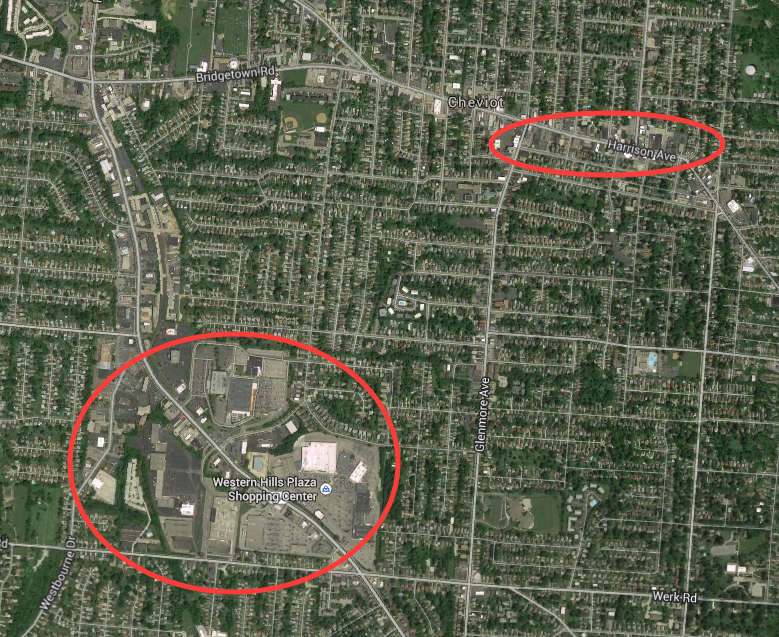
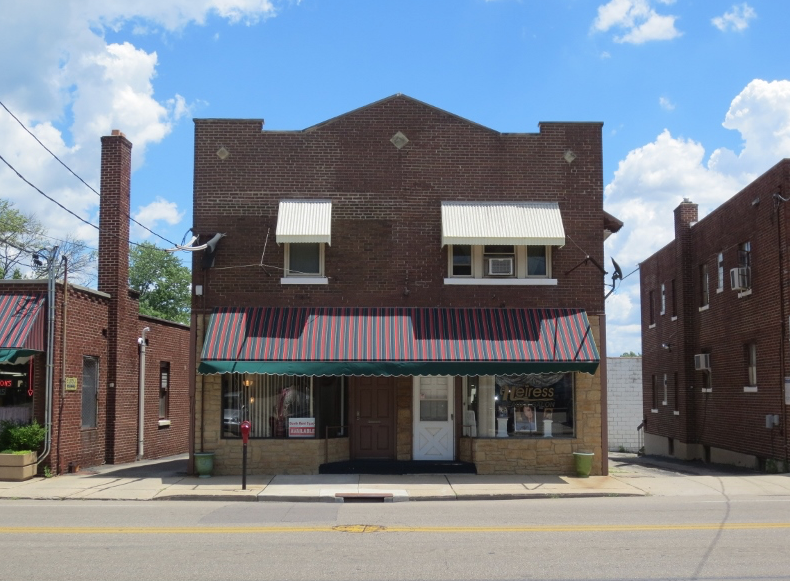
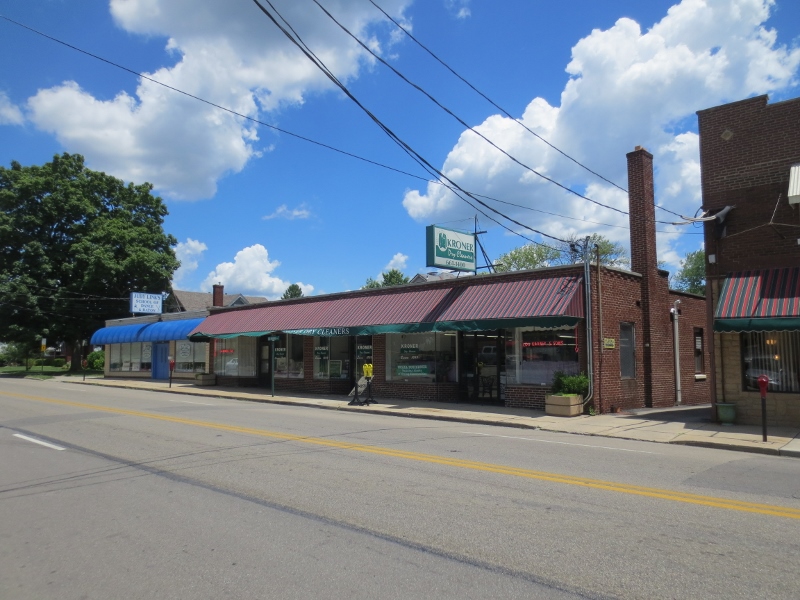
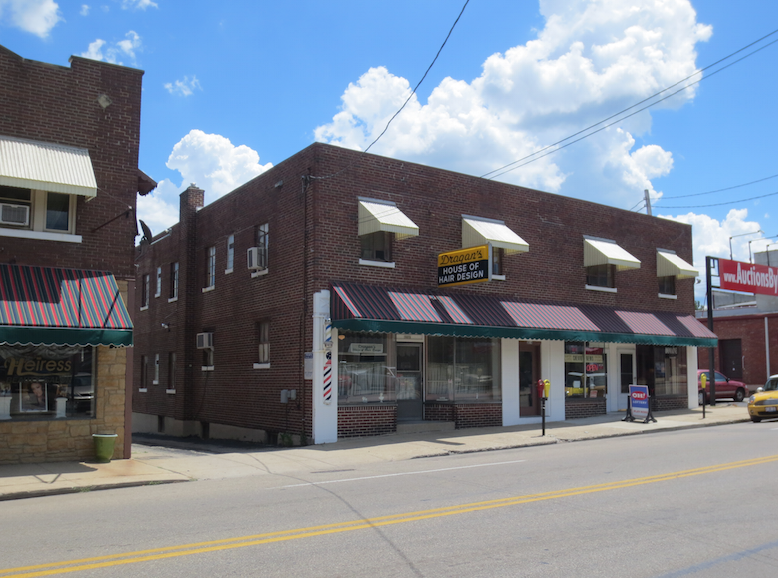
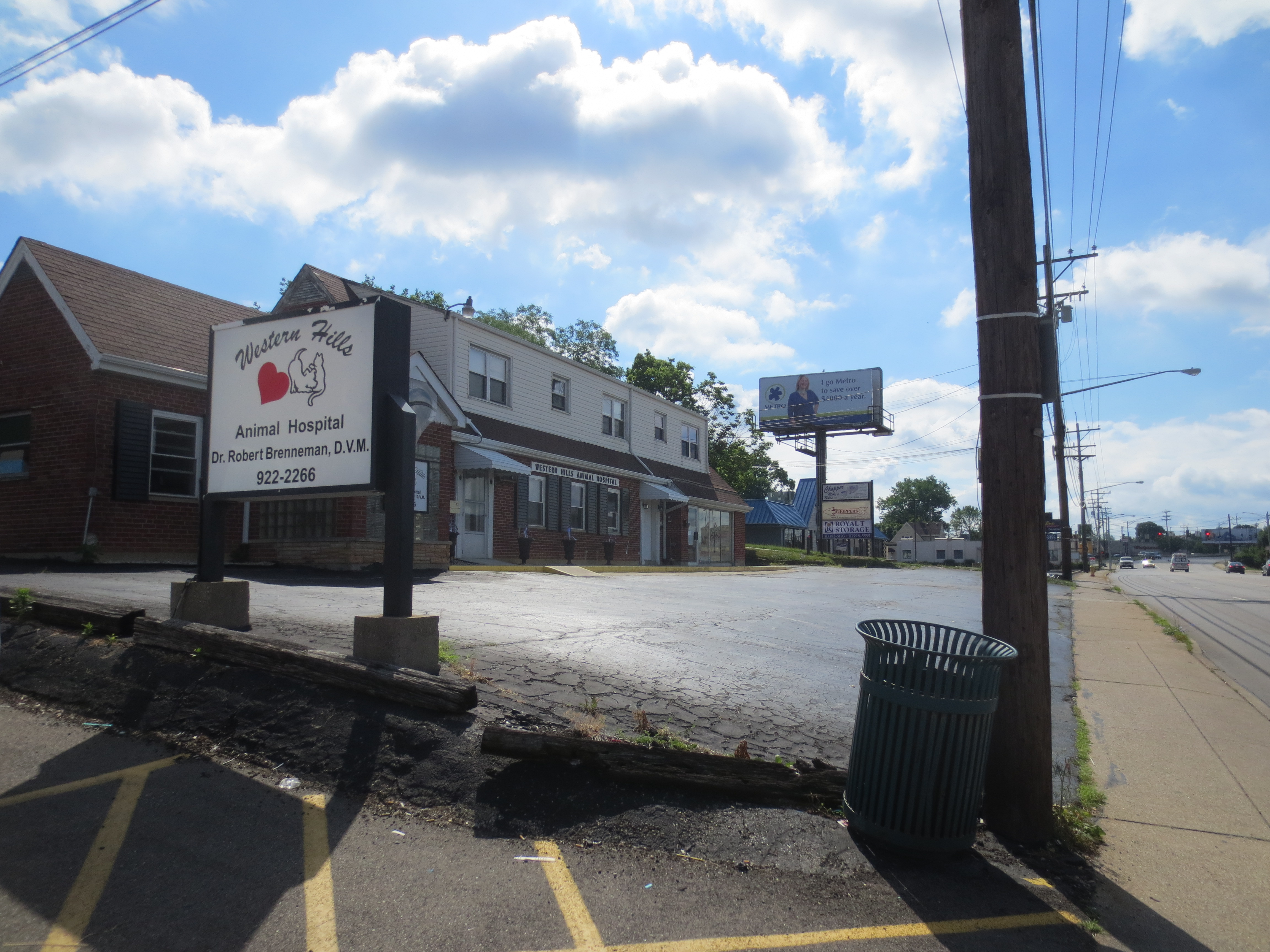
    This is a Google Earth image of the area around Cheviot, Ohio. The people of Cheviot self-identify with the fictional 1950’s TV town of Mayberry made famous by The Andy Griffith Show. It really is a lovely place, but it effectively has no business district anymore thanks to the Western Hills Plaza Shopping Center half a mile away which straddles Green Township and the Westwood district of suburban Cincinnati. Harrison Avenue, Cheviot’s century old Main Street, is circled at top right. Western Hills Plaza is circled at bottom left. The Home Depot, Target, Kroger, and Dillard’s make it impossible for mom and pop shops on Harrison Avenue in Cheviot to sustain themselves. Half the shops are empty and the others limp along. It’s a shame, because Cheviot is a charming town full of great old commercial buildings and solid housing stock. It’s a good town full of good people. The German Catholics who settled and built this part of Ohio have managed to hold on to a fair-to-middling set of arrangements through the worst years of decline, but the town is a shadow of its former self. It has excellent bones, but the flesh is sagging through no fault of its own.

    Screen Shot 2014-12-03 at 11.22.36 PM Screen Shot 2014-12-03 at 6.47.29 PM IMG_9387 (800x600) Screen Shot 2014-12-05 at 1.12.50 AM

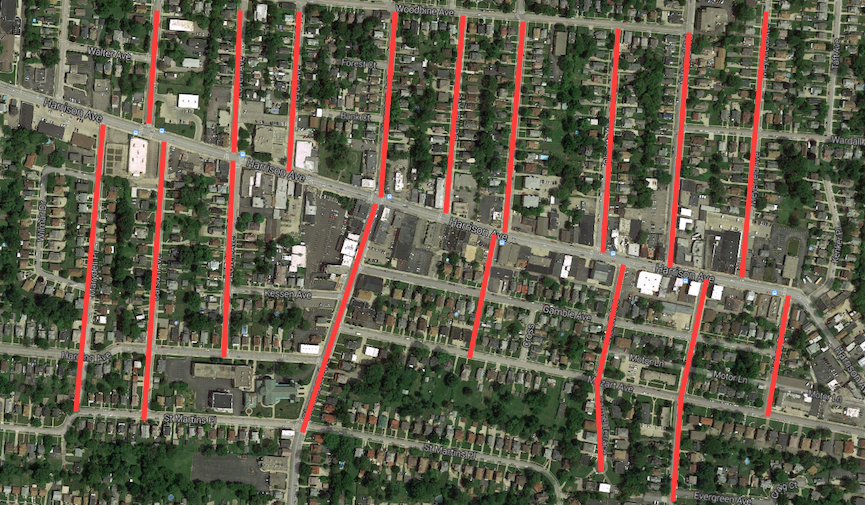
    However, Cheviot has one thing that Western Hills Plaza doesn’t – a walkable, bikable, fine-grained pleasant neighborhood. That may not sound like much, but it’s more than nearly anyplace built after 1950 anywhere in North America can boast. Cheviot is an actual town, not just mindless suburban sprawl. That’s a rare commodity these days and a lot of people are hungry for it. Just about every home in Cheviot is within a five or ten minute walk of the old business district, local public schools, library, churches, and parks. It has become unusual in America for people to live in this kind of environment and it’s coming back in fashion with increasing demand and limited supply. There’s an opportunity here for people with the right attitude.

    Screen Shot 2014-12-04 at 1.09.07 AM Screen Shot 2014-12-04 at 1.08.19 AMGoogle Earth

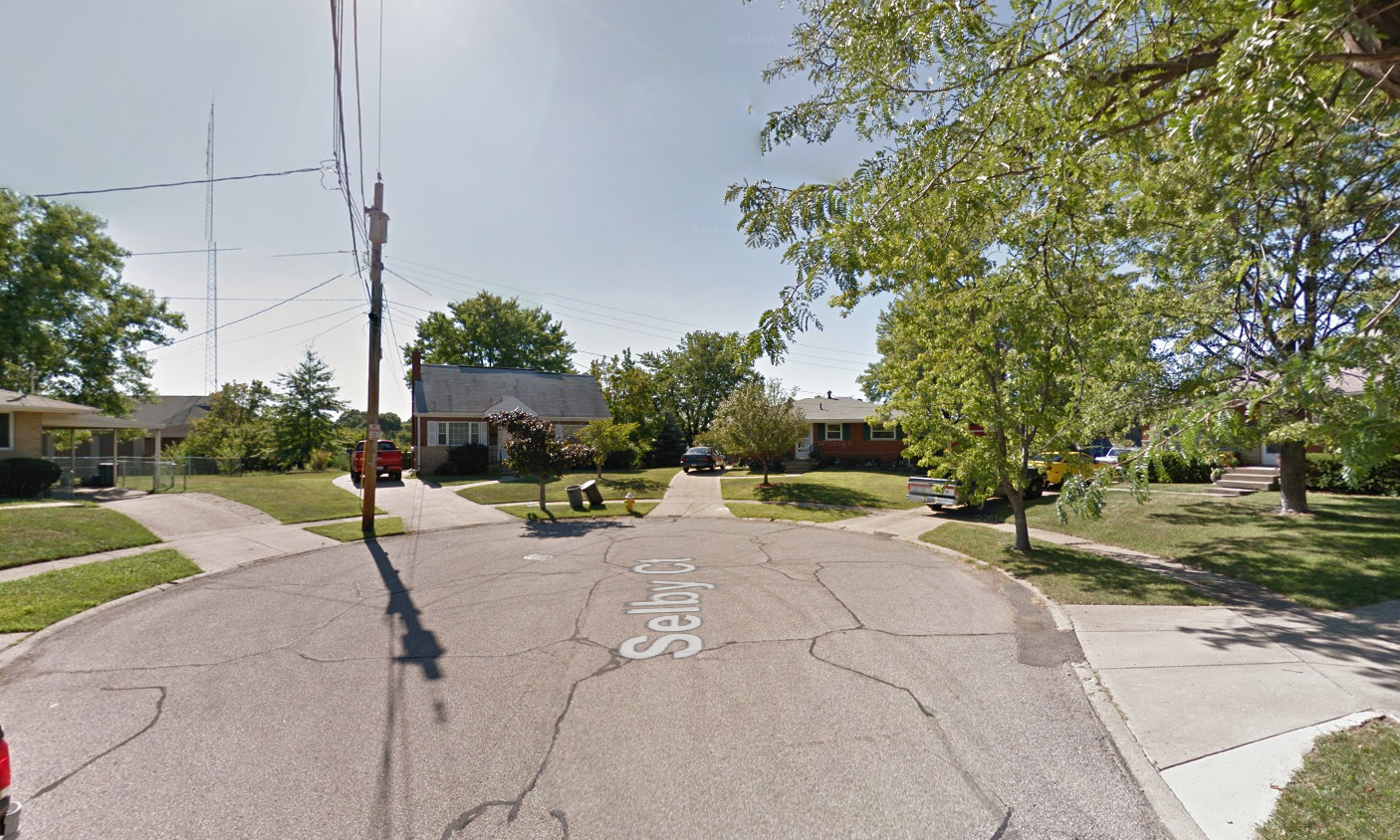
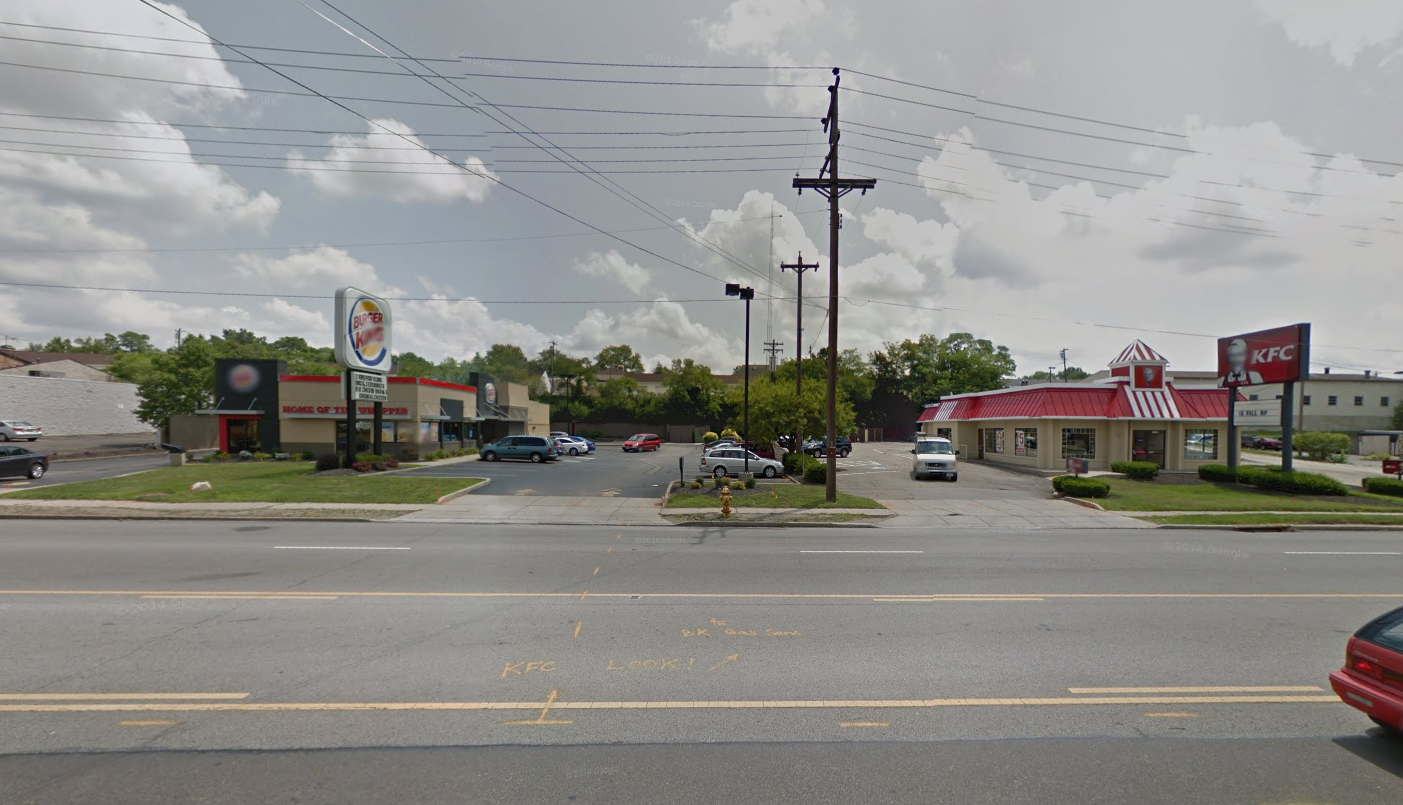
    In contrast let’s say that you lived here on this cul-de-sac in Green Township and you wanted to go to one of the fast food places directly behind your back fence. This is the route you’d need to take.

    Screen Shot 2014-12-04 at 1.10.14 AM Google Earth

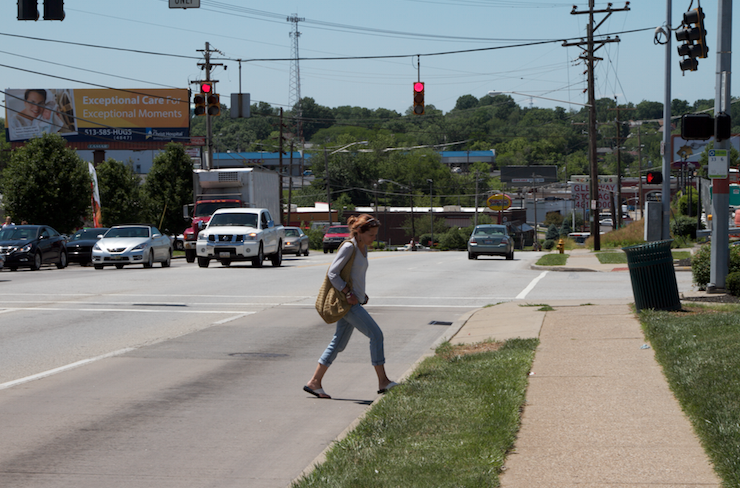
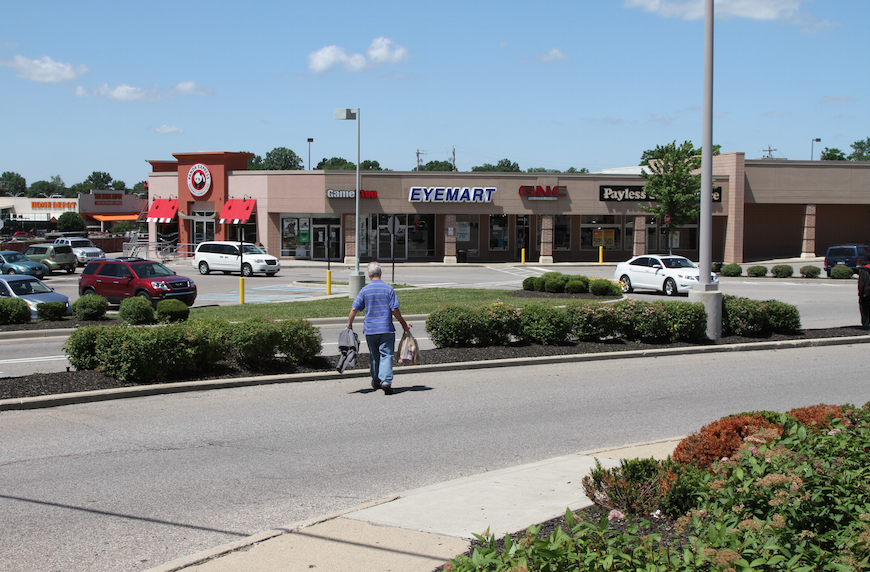
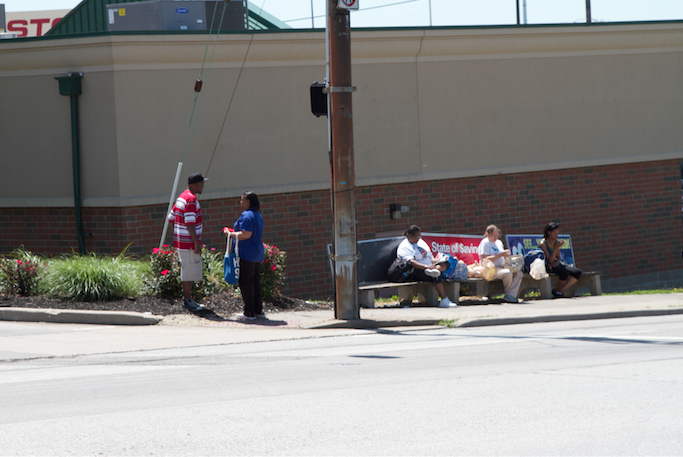
    If you’re used to driving everywhere everyday you might not think twice about hopping in the car. In fact, you might not even realize that the Burger King and KFC are so close. But if you were somehow forced to walk one day you might be surprised at how hard it would be given all the walls, fences, and drainage ditches that stand between you and your fast food. And the walk would be a miserable and potentially dangerous experience. The highway and its cavalcade of concrete and plastic bunkers is so wretched when you aren’t in a car that developers and city planners go out of their way to keep homes as isolated and buffered as possible. This radical separation of uses makes perfect sense in a car-oriented environment. Who wants to look out at a highway strip mall from the back yard? But it’s Hell on foot. And don’t even think of riding a bike. You’ll either get hit by a speeding car or attract the attention of the local police who will immediately identify you as a deviant. Being a pedestrian or cyclist in this environment constitutes “probable cause”. You must be unsavory if you lower yourself to such desperation here. Sitting at a bus stop in this setting is no joy either.

    Screen Shot 2014-12-04 at 12.51.28 AM Screen Shot 2014-12-04 at 12.53.48 AM Screen Shot 2014-12-04 at 12.23.18 AM Screen Shot 2014-12-04 at 12.55.51 AM IMG_9626 Screen Shot 2014-12-05 at 1.14.48 AM

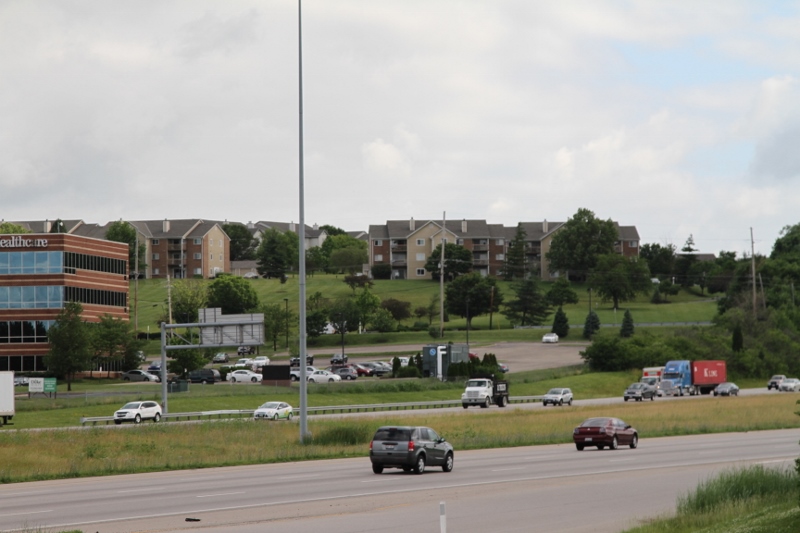
    So here’s the challenge of the next few decades. The aging sprawl in Green Township and similar nearby post war suburbs like White Oak, Sharonville, and Deer Park on the edge of Cincinnati aren’t aging well. Their roads and sewer systems are right at the point where they need complete overhauls and there’s no money for any of it. Don’t expect Columbus or Washington to send big checks because they’re broke too. The housing stock in these places is neither charming in a Norman Rockwell sort of way, nor sufficiently Mad Men modern. Their roofs, windows, kitchens, baths and furnaces all need replacing right about now and there isn’t a lick of insulation in most of them. Fifty years ago these suburbs were white middle class havens with their backs to inner city decay and race riots.

    IMG_6149 (800x533) IMG_6126 (800x533) IMG_6164 (800x533) IMG_6155 (800x533) IMG_6128 (800x533)

    Now newer more prosperous suburbs Like Mason and Beavercreek farther out attract wealthier residents looking for larger homes with all the latest bells and whistles along with premium public schools and lower taxes. Green Township has less than half the average family income of Mason. Homes in Green Township and other similar areas sell for $75,000 although many homes can be found for considerably less. Mason homes sell for north of $250,000 with many at much higher price points. Meanwhile downtown Cincinnati and Over-the-Rhine are rapidly gentrifying as people who prefer an urban environment reinvigorate long abandoned neighborhoods. The poor are being displaced in the process and they’re going to have to live somewhere. Given the trajectory of these shifts it isn’t looking good for the so-so suburbs in the middle distance. We can expect more “Fergusons” on the horizon although the particulars are unknowable at this time. This economically induced migration won’t be good for the poor either. They just spent the last few generations sucking up the desiccated crumbs of 19th Century industrialism and now they’re being shunted off to the stale left overs of 20th Century sprawl just in time for it to die.

    Screen Shot 2014-12-05 at 1.06.38 AM Screen Shot 2014-12-05 at 1.07.09 AM Screen Shot 2014-12-05 at 1.13.14 AM Screen Shot 2014-12-05 at 1.08.55 AM  IMG_9203 (800x600) IMG_9191 (800x600) IMG_9197 (1024x768) (800x600) Screen Shot 2014-12-05 at 1.14.02 AM Screen Shot 2014-12-05 at 1.11.41 AM Screen Shot 2014-12-05 at 1.05.23 AM Screen Shot 2014-12-05 at 1.09.52 AM Screen Shot 2014-12-05 at 1.11.59 AM Screen Shot 2014-12-05 at 1.11.18 AM

    But there’s hope for some of these places. Pressed up against both Cheviot and Green Township is Westwood, a former streetcar suburb that also uses Harrison Avenue (the old streetcar route) as its long-lost Main Street. Westwood was once an independent town, but was annexed by Cincinnati a hundred years ago. It fell out of favor beginning in the 1950’s when the streetcar was ripped up and shiny new subdivisions and shopping centers were built-in places like Green Township. Moving children out of Cincinnati public schools to another jurisdiction a mile away was one of the primary motivations as racial tensions in the city grew. Taxes were also lower in the new suburbs. (Is any of this ringing a bell?) Cincinnati has recently figured out that it can’t compete with Mason or Beavercreek for that particular share of the upscale suburban real estate market, but it’s looking at the success of Over-the-Rhine and wondering what the family friendly conservative Republican Catholic version of revitalization might look like in Westwood. In other words, what can parts of Cincinnati provide in the way of a value-added “product” or “experience” in their century old neighborhoods of single family homes that Mason can’t. There’s a chance that Westwood’s competitive advantage might just be walkability and historic charm. The city adopted a form based code for this part of Westwood and has been investing money in the schools and parks with plans to create a town square in what is now an awkward triangular intersection next to the Carnegie library. There are also existing businesses and subtle interdependent institutions that simply don’t exist out in new suburban locations. If you want your cello or violin repaired you’re not going to find that sort of thing at the mall between the food court and the Sunglass Hut. A more pedestrian oriented Westwood with unique family oriented destinations and activities could be an engine that pulls the area in a better direction. Sooner or later all those Hipsters downtown are going to start getting married and having kids and their going to want a house with a patch of garden. There could be an advantage to having that life three miles from downtown instead of twenty-two miles out in Mason. On the other hand, Westwood could simply languish and be dragged down by the failing sprawl that surrounds it. It could go either way. Time will tell.

    John Sanphillippo lives in San Francisco and blogs about urbanism, adaptation, and resilience at granolashotgun.com. He’s a member of the Congress for New Urbanism, films videos for faircompanies.com, and is a regular contributor to Strongtowns.org. He earns his living by buying, renovating, and renting undervalued properties in places that have good long term prospects. He is a graduate of Rutgers University.

  • School Buses: America’s Largest Transit System

    Reminiscent of the late Rodney Dangerfield’s lament, America’s network of school buses get "no respect." The thousands "yellow buses" are buried without a mention in the most important tables of the US Department of Transportation’s National Transportation Statistics. Neither the terms "school" nor "school bus" appear in tables summarizing the number of vehicles (Table 1-11), vehicle travel (Table 1-35), passenger travel (Table 1-40) and others. At the same time, there is far more complete information on virtually every other transportation mode.

    School Buses: A Large Transportation System

    This would not be surprising if the school bus system was small or insignificant. It is anything but.  This point was made in a National Association for Pupil Transportation (NAPT) white paper:

    "School bus carriers operate the largest mass transportation fleet in the country. Each day, 480,000 yellow school buses travel the nation’s roads. Compare that to transit, with 140,000 total vehicles, 96,000 of which are buses; to the motor coach industry, with 35,000 buses; to commercial airlines, with 7,400 airplanes; and to rail, with 1,200 passenger cars. In fact, our school bus fleet is 2.5 times the size of all other forms of mass transportation combined."

    By at least that measure, the school bus system is the largest mass transportation system in the nation.

    Comparing School Bus and Transit

    The NAPT white paper (above) indicates that there are many more school buses than transit vehicles. School buses compare favorably to transit in other measures as well.

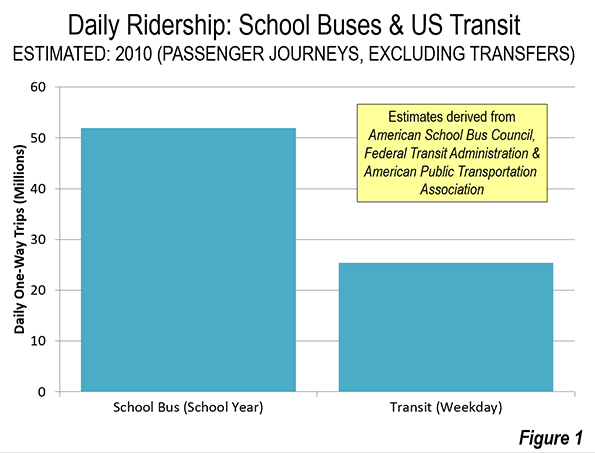
    According to the American School Bus Council (ASBC), school buses transported an average of 26 million elementary and secondary students daily in 2010 (see the ASBC summary of environmental benefits). This is 52 million one way trips. Approximately 55 percent of the nation’s enrollment travels to and from school on school buses.

    By comparison, our analysis of Federal Transit Administration data for 2010 indicates that all transit services (subway, commuter rail, light rail, bus, paratransit, etc.) carried approximately 25 million one-way trips on the average weekday in 2010 (adjusted to eliminate transfers between vehicles on the same passenger trip, using an American Public Transportation Association estimate). On school days, it turns out that school buses carry more than twice as many passengers as transit passengers (Figure 1).

    ASBC estimates the average one-way school bus trip at five miles. This means that every day, pupils travel approximately 260 million miles. The school bus advantage over transit is somewhat less in passenger miles than passengers, because transit trips are longer. School bus passengers travel approximately 50 percent more miles than transit weekday passengers travel (approximately 170 million miles).

    The annual differences in school bus and transit use are much less. This is because school bus service is provided only an average of 180 days annually, approximately one-half the 365 days that transit service operates. Based on the American School Bus Council estimate, the annual number of one-way school bus trips by students is estimated at 9.4 billion in 2010. By comparison, annual transit passenger journeys (excluding transfers) were an estimated at under eight billion in 2010.

    Transit, however, carries passengers farther than school buses each year. With its 365 day per year operation, transit carried 52 billion transit passenger miles in 2010, approximately 10 percent more than the 47 billion passenger miles traveled on school buses.

    School Bus Data

    Without a centralized digital data collection system, there is no readily available school bus data below the state level. Thus, unlike transit (with its National Transit Database), development of school bus information on a metropolitan area level would be time consuming and expensive and is not regularly done. Industry publications, such as School Bus Fleet and School Transportation Newsprovide detailed information but only at the state level.

    State and Local School Bus Ridership

    School bus services are provided nearly everywhere in the United States, in both urban and rural areas. Most school bus service is provided by local school authorities (school districts). According to NAPT, about two-thirds of the service is provided directly by school transportation departments, while the other one-third is provided by private contractors ("outsourced").

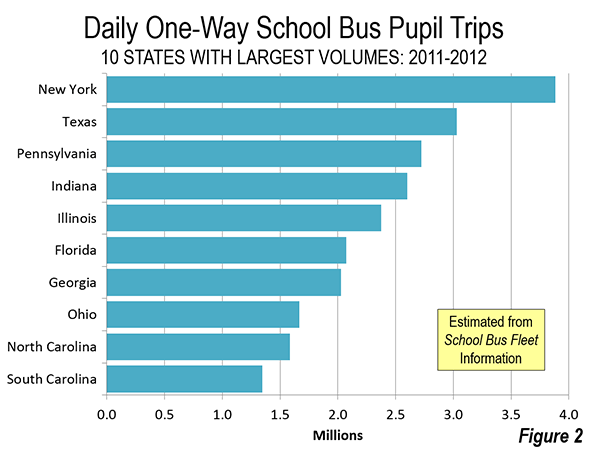
    Based on information in School Bus Fleet, all the top 10 states have school bus ridership of more than 1,000,000 one-way pupils every school day. New York has the highest ridership, at nearly 4,000,000. Texas has more than 3,000,000 daily riders, followed by Pennsylvania, Indiana, Illinois, Georgia and Florida, all with more than 2 million daily riders (Figure 2).

    The school districts with the highest pupil ridership are concentrated in the Northeast and South, which include nine of the 10 most patronized systems. The strong southern representation is largely due to the county level school districts, which are larger than the more local school districts typical in the rest of the nation.

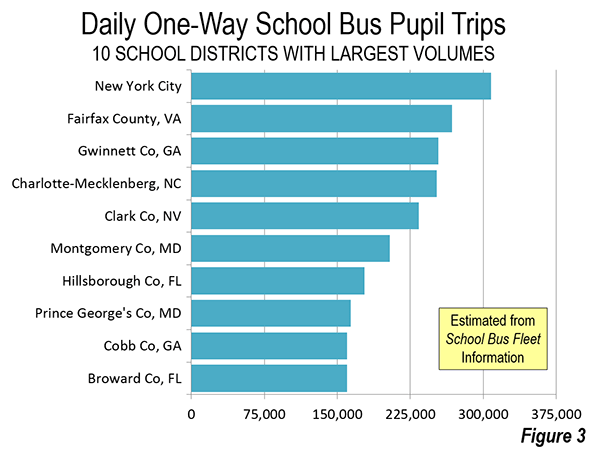
    Based on School Bus Fleet data, the New York City school district carries more passengers than any other, with nearly 310,000 daily trips. Fairfax County (Virginia), Gwinnett County (Georgia), Charlotte Mecklenburg (North Carolina), Clark County (Nevada) and Montgomery County (Maryland) also carry more than 200,000 daily passengers (Figure 3).

    The Largest Transit System

    With the national school bus fleet nearing 500,000 vehicles, the state of New York has the largest number, at nearly 45,000, according to School Bus Fleet. Texas ranks second with 40,000 school buses, while Illinois, California and Pennsylvania have between 20,000 and 30,000 buses. The combination of just a few states can exceed the national total of transit buses (60,000).

    On any given school day, school buses are the largest transit system in the nation.

    Wendell Cox is principal of Demographia, an international public policy and demographics firm. He is co-author of the "Demographia International Housing Affordability Survey" and author of "Demographia World Urban Areas" and "War on the Dream: How Anti-Sprawl Policy Threatens the Quality of Life." He was appointed to three terms on the Los Angeles County Transportation Commission, where he served with the leading city and county leadership as the only non-elected member. He was appointed to the Amtrak Reform Council to fill the unexpired term of Governor Christine Todd Whitman and has served as a visiting professor at the Conservatoire National des Arts et Metiers, a national university in Paris.

    Photo: School buses in suburban Atlanta (by author)

  • Raise the Gas Tax!

    Driving just got a lot cheaper in America. The timing is great not only for American consumers, but also for America’s infrastructure. The Highway Trust Fund simply can’t keep up current spending levels without more revenue. Significant declines in pump prices have presented an excellent opportunity to raise the federal gas tax, while keeping pump prices lower than initially anticipated. Though a gas tax hike may not be the ideal approach, it is infinitely preferable to bailing out the Trust Fund with general revenue, or to putting the brakes on much needed infrastructure spending. This is a rare opportunity to improve America’s infrastructure without putting an additional burden on American taxpayers. It would be a shame to miss it.

    No one enjoys paying taxes, though they are much easier to swallow when the revenue produces visible results. Since the gas tax is deposited into the Highway Trust Fund, it is somewhat like a user fee, albeit, an imperfect one. From the standpoint of fairness, it makes sense that drivers should pay for using the roads. Aside from fairness, the virtue of the ‘user pays’ principle is that it helps to ration roadway use. If movie theatres were paid for through tax revenue and tickets were free at the point of consumption, everyone would be stuck waiting in line. The same principle generally applies to roadways, although tolls have a more direct impact on traffic congestion than gas taxes. There is some legitimate debate over the optimal mix of revenue tools to fund roads, but if it comes down to raising the gas tax or using general government revenue, raising the gas tax is the obvious choice.

    Congress has allowed the Highway Trust Fund to gradually lurch towards insolvency. Expenditures have risen while gas tax rates haven’t. America’s aging infrastructure is in desperate need of repair, so holding out for the ideal solution no longer seems tenable. The Congressional Budget Office estimates that spending is poised to exceed revenue by $167 billion over the 2015-2024 period. The Trust Fund has already received $54 billion in transfers from the treasury since 2008.

    One of the proposed solutions to the shortfall is to restore the Highway Trust Fund’s original mandate: use gas taxes exclusively to pay for highways. In other words, get rid of what’s known as the Transit Account. That would go some way towards alleviating pressure on the Trust Fund, but it still wouldn’t bring the fund into balance. Regardless of whether or not the Trust Fund continues to pay for mass transit expansions, Congress will need to find more revenue.

    There has never been a better time to increase the gas tax. Consumers and firms have budgeted for much higher gas prices than they’re paying at the pumps. The bi-partisan proposal to increase the gas tax by 12 cents per gallon would leave gas prices below $3 per gallon, which is still a substantial overall decline. Indexing the gas tax to inflation would help to ensure that the Trust Fund doesn’t end up in this bind every few years.

    Given the state of the American economy, now is a particularly bad time to defer highway construction and maintenance. Public spending can’t be expected to fix all that ails it, but this is a good time to support the construction industry.

    While 30 cents per gallon might seem high, American drivers would still pay among the lowest gas taxes on earth, and less than Canadians pay. That America has managed thus far to maintain an enviable national highway system for a fraction of Canadian federal fuel taxes is a testament to the efficiency of the Highway Trust Fund model.

    Given the enormous windfall that drivers will receive from lower gas prices, clawing back some of it to ensure that American still have roads fit for driving is a reasonable proposition. Just because the federal government owns the national highway system doesn’t mean that it’s free. Someone has to pay to maintain the system. Drivers should be first in line to do so.

    Steve Lafleur is the Assistant Director of Research for the Frontier Centre for Public Policy– www.fcpp.org — a Canadian think tank based in Winnipeg, Manitoba.

    Flickr photo by Curtis Perry: Another perfect day for highway drivers in LA.

  • Overselling America’s Infrastructure Crisis

    60 Minutes ran a segment recently called “Falling Apart” that was another alarmist take on the state of American infrastructure. I’ll embed here but if it doesn’t display for you, click to CBS News to watch (autoplay link).

    We’ve seen this story before. America’s infrastructure is falling apart and we need to spend many billions on upgrades, but politicians won’t agree because they are too craven.


    There’s some truth to this point of view. The problem is that it’s oversold using the worst examples. It also gives short shrift to the many infrastructure upgrades that we have been making. And it ignores how people and businesses make capital purchase decisions in the real world.

    First, I’m not surprised to see that 60 Minutes spent a lot of time in Pennsylvania. In my experience, Pennsylvania is in a class by itself when it comes to infrastructure. Drive something like I-70 from Washington to the Ohio state line and prepare to be appalled. Pittsburgh legitimately has a massive infrastructure maintenance overhang. Philly too. And much of the infrastructure there was under built to begin with. The Schuylkill Expressway goes down to two lanes each way, for example. Similarly, 60 Minutes is right about some of the obsolete bridges on Amtrak’s Northeast Corridor. They may have easily included other high profile embarrassments like LaGuardia Airport or Penn Station. Or they might have taken a look at state of decay of Rhode Island’s bridges.

    There are clearly some high profile legacy items that need to be addressed. But that neglects the other side of the coin, namely that there’s a ton of major infrastructure that has been upgraded.

    60 Minutes includes some footage of Chicago. Clearly there’s a need for bigtime investment there. But in the last 20 years or so IDOT reconstructed completely many of the major freeways in the area like the Kennedy and Dan Ryan. The Tollway Authority widened virtually the entire system and implemented open road tolling, vastly reducing congestion. Similarly the CTA opened the brand new Orange Line, did major work to renovate the Green and Pink Lines, just did major infrastructure upgrades on the south branch of the Red Line, and expanded capacity on the Ravenswood. They’ve also gone from tokens and cash to electronic fare collection. At least one new commuter rail line was opened (the North Central line). The O’Hare Modernization program is underway with new runways already online and a significant reduction in congestion there. A new terminal was also built and the existing terminals given some refreshes.

    Is there a lot to do in Chicago? Undoubtedly. But let’s give credit for what has already been done.

    It’s the same elsewhere. Nicole Gelinas notes that New York has invested $123 billion in the transit system in the last 30 years. That’s not chump change. The third water tunnel is now online there as well. Indianapolis built an ultra-modern airport terminal complex that’s up to international standards. Many other airports like DTW, SJC, SFO, etc. have built major new terminals or seriously upgraded their acts. There have actually been a lot of investments in port infrastructure to get ready for post-Panamax ships.

    I’m told even Pennsylvania has done a good job of starting to address its infrastructure problems. The Philadelphia airport is actually quite nice these days, for example.

    So we’ve actually done a lot already that 60 Minutes doesn’t give us credit for.

    But what’s more, the presence of infrastructure that’s at or near the end of its useful life isn’t necessarily a bad thing anyway. Would it make sense for every single car on the road to be brand new? Of course not. Most cars ultimately end up getting driven till the wheels fall off. And that makes perfect sense. Why would you junk an asset that still has lots of service life left? We reallocate ownership of a lot of those cars during their lifespan, but we try to get the max out of their useful life.

    It’s similar in our homes. How many of us replace a furnace at the first sign of rust? Yes, sometimes we do a complete upgrade or refresh of a kitchen or bathroom, but most of the time we don’t replace major household systems like furnaces or roofs until they appear to be at a point where paying for repairs when they break appears to be futile in light of the asset age. It makes sense to pay $400 to replace a starter that fails when the car has 125,000 miles. It’s more questionable when the transmission goes out at 175.

    The fact that some issues or incidents with infrastructure can cause temporary closure or disruption is exactly how most personal capital assets work. A part goes out on our car. It needs to be towed and fixed. And it’s out of commission during that period. That’s annoying, disruptive, and costly. But does it mean that we should all go out and buy a brand new car? I don’t think so. And that’s certainly not how people behave in the real world. Obviously you have to build in a margin of safety on items like bridges where a failure would be catastrophic, but the same general principle applies. We shouldn’t wait for them to fail before replacement, but we do and should get the full useful life out of them.

    Why would we expect our government to spend our money on its capital assets in a manner differently from how we spend our money on our own personal possessions? This explains why the public is much more skeptical of spending on infrastructure than the infrastructure lobby would like. It’s to be expected that some percentage of our infrastructure will perpetually be at or near end of life, as that’s the nature of the capital asset life cycle.

    What’s more, when we replace a furnace or car, most of us don’t go out and buy Cadillacs. We buy something that fits the budget. Unfortunately, this mindset doesn’t seem to penetrate the public sector, where a significant amount of infrastructure is gold plated and priced at a level far out of line with international comparisons. The big problem in New York isn’t a lack of investment in transit. It’s the fact that the region has just about the highest transit capital costs in the world. Wonder why Madrid and Calgary have nice train systems? Among other reasons, they were very cost-efficient in their design and construction. Rather than more money, maybe we should first try some reform in our broken system of building stuff that results in lengthy project timelines and out of control costs.

    So there are some things that need to be taken care of and we need to do that. But scaremongering about dangerous bridges isn’t the right answer. And where I see the biggest infrastructure needs are on local streets and bridges, where federal and state dollars are least likely to be applicable. It’s no surprise to me that most of the pothole ridden, bombed out streets we drive on are local city streets, where they are the maintenance responsibility of an entity that lacks the large, dedicated infrastructure revenue streams available to the state and federal governments. But that’s a topic I’ll have to explore in a future post.

    Aaron M. Renn is an independent writer on urban affairs and the founder of Telestrian, a data analysis and mapping tool. He writes at The Urbanophile, where this piece originally appeared.

  • Can Abe Tackle The Real Reason For Japan’s Decline? (Procreation)

    Much has been made of Japan’s latest relapse into recession. For the most part, economists have focused on the efficacy of the once much-ballyhooed “Abenomics,” the stimulus and structural reform program that was seen as the key to turning around the island nation’s torpid economy.

    While Prime Minister Shinzo Abe’s ruling coalition won a sweeping electoral victory this weekend, giving him a mandate to continue his economic policies, it is increasingly clear that the epicenter of Japan’s crisis is not its Parliament, or the factory floor, but in the bedroom. Japan has been on a procreation holiday for almost a generation now, with one of the lowest fertility rates on the planet. The damage may prove impossible to overcome.

    Japan’s working-age population (15-64) peaked in 1995, while the United States’ has grown 21% since then. The projections for Japan are alarming: its working-age population will drop from 79 million today to less than 52 million in 2050, according to the Stanford Institute on Longevity.

    Since hitting a peak of 128 million in 2010, Japan’s overall population has dropped three years in a row.

    These trends all but guarantee the long-term decline of the Japanese economy and its society. In comparison, competitors such as the United States and India are projected to continue to grow their workforces over the long term. China’s workforce, which grew rapidly over the last couple of decades, recently began to decline, as early as 2010 by one estimate, due to its one-child policy.

    Some countries, like Germany or Singapore, have tried to make up for low fertility through immigration, something that remains all but unthinkable in congenitally insular Japan. Short-term importation of workers has occurred through a “foreign trainee” program, but it has stirred controversy, with some immigrant workers claiming they are being cheated and abused.

    Aging is becoming a bigger issue, particularly due to the country’s average lifespan of 83 years, which is among the longest in the world. Perhaps if everyone would have the good sense, as one Japanese official put it, to “hurry up and die,” the shrinkage would be manageable.

    But old Japanese don’t seem to be lining up to commit suicide. So by 2020, adult diapers are projected to outsell the infant kind. By 2040, the country will have more people over 80 than under 15, according to U.N. projections. By 2060, the number of Japanese is expected to fall from 127 million today to about 87 million, of whom almost 40% will be 65 or older.

    The fiscal costs are obvious. Over the past few decades, aging has helped transform once thrifty Japan into the country with the high-income world’s highest level of government debt. The demands for more help for the elderly, notably medical care, combined with a shrinking, increasingly occasional workforce, is one reason why Abe was forced to push for a sales tax increase, one of the things that retarded Japan’s recovery.

    These trends have been developing for decades. Sociologist Muriel Jolivet noted in her 1997 work Japan: The Childless Society that many Japanese women had taken a break from motherhood, in part due to male reluctance to take responsibility for raising children. This trend accelerated in the next decade. By 2010, a third of Japanese women entering their 30s were single, as were roughly one in five of those entering their 40s. That’s roughly eight times the percentage in 1960, and twice that of 2000. By 2030, according to sociologist Mika Toyota, almost one in three Japanese males may be unmarried by age 50.

    Many young Japanese are not only eschewing marriage but a highly publicized sliver now show little sexual interest in each other. The percentage of sexually active female university students, according to the Japanese Association for Sex Education, has fallen from a high of 60% in 2005 to 47% in 2012.

    Much has been made of a subset of young Japanese men labeled as “herbivores,” who appear more interested in comics, computer games and socializing through the Internet than in seeking out the opposite sex.  And since many only work part-time, they tend to stay longer with their parents, further slowing economic growth.

    No society can thrive under such an environment, certainly not in the long run. If “animal spirits” drive entrepreneurial growth — as it did unmistakably in Japan both before and after the Second World War — those are clearly dissipating now. As prices have dropped and opportunities shriveled, fewer Japanese are interested in starting or growing families.

    In the longer run, one has to wonder what kind of country Japan may become over time, something hardly irrelevant not only due to the country’s importance, but also since other key Asian countries appear to be following the demographic path it is blazing, including including South Korea, Taiwan, Singapore and China. In China, the U.S. Census Bureau estimates, the population will peak in 2026, and will then age faster than any country in the world besides Japan.

    Of course, projecting population and fertility rates over the long run is difficult, and there remains a large margin for error. For example, the U.N. projects Japan’s 2100 population at 91 million, while Japan’s National Institute of Population and Social Security Research projects a population of 48 million, nearly one-half lower.

    Japan’s grim demography is also leading to tragic ends for some elderly. With fewer children to take care of elderly parents, there has been a rising incidence of what the Japanese call kodokushi, or “lonely deaths” among the aged, unmarried, and childless. Given the current trends, this can only become more commonplace over time.

    The Japanese “model” of low fertility still has its defenders, including those in the U.S. who point out that it allows, in the short term, for greater per capita wealth and lower carbon emissions. But most Japanese recognize that the profound morbidity of the demographic trends; 87% see an aging population as a major problem, according to a recent Pew study, compared to 57% in China and only 26% in the U.S.

    And to be sure, Japan remains a supremely civilized country, with low crime rates, a brilliant artisanal tradition, and exemplary infrastructure.But none of this can likely survive under these demographic conditions. Not surprisingly, the  Japanese government, like its counterparts in western Europe and Singapore, has attempted tomake child-rearing easier by providing cash payments for families and expanding child care.

    Yet to date, such compensation has been unable to make up for high housing costs and weaker familial bonds. As Toru Suzuki, senior researcher at the National Institute of Population and Society Security Research, put it in The Japan Times, “Under the social and economic systems of developed countries, the cost of a child outweighs the child’s usefulness.”

    Although the United States has not embarked on such a dismal course, in large part due to a greater land mass, lower housing prices and immigration, for us, too, the twin forces of lower fertility and the retirement of baby boomers is slowing our labor force growth rate.

    Ideally American fertility rates will recover with the economy, allowing us to get back to a more sustainable demography that would at least replace older people with a steady supply of young adults. What we don’t want to do is emulate Japan. There’s a price to pay for avoiding the bedroom in favor of video games, not only for individuals but societies as well.

    This piece first appeared at Forbes.com.

    Joel Kotkin is executive editor of NewGeography.com and Roger Hobbs Distinguished Fellow in Urban Studies at Chapman University, and a member of the editorial board of the Orange County Register. His newest book, The New Class Conflict is now available at Amazon and Telos Press. He is author of The City: A Global History and The Next Hundred Million: America in 2050. His most recent study, The Rise of Postfamilialism, has been widely discussed and distributed internationally. He lives in Los Angeles, CA.
    Photo by Kevin Poh: Night Life @ Shinjuku, Tokyo

  • California Business Needs to Go Small or Go Home

    Here’s the bitter reality for business in much of California: there’s no cavalry riding to rescue you from the state’s regulatory and tax vise. The voters in California have spoken, and with a definitive, distinctive twist, turned against any suggestion of reform and confirmed the continued domination of the state by public employee unions, environmental activists and their crony capitalist allies.

    You are on your own, Southern California businesses, and can count on very little help, and, likely, much mischief, from Sacramento and various lower orders of government. To find a way out of stubbornly high unemployment and anemic income growth, the Southland will need to find a novel way to restart its economic engine based almost entirely on its grass-roots business, its creative savvy and entrepreneurial culture.

    This shift poses a great challenge, both for California’s interior counties and parts of the coastal region. Unlike Silicon Valley and its hip twin, San Francisco, no one is investing much in the Southland. Among the nation’s largest metropolitan areas, the Los Angeles region has become a corporate stepchild, trailing in new office construction not only to world-beaters like Houston, but also New York, the Bay Area and even slower-growing Philadelphia or Chicago. In fact, although the second largest metro area in the country, L.A.-Orange County does not even make the top 10 regions for new building.

    Nor can we expect much in the way of residential housing growth, particularly single-family homes, as the state’s planners continue their jihad against anything smacking of suburban expansion. Traditional industries like aerospace, manufacturing and logistics face enormous regulatory barriers, ruinous taxation levels and huge energy price increases that will slow any potential growth, and could lead to yet more departures by existing large firms. Virtually all the region’s former major established aerospace companies have relocated their headquarters elsewhere, which hurts efforts to get them to expand or maintain facilities here.

    Despite all this, the Southland is not without considerable assets. Perhaps most promising is the region’s status as the nation’s No. 1 producer of engineers – almost 3,000 annually. This raw material is now being somewhat squandered, with as many as 70 percent of graduates leaving the area to find work.

    But there’s no reason for unmitigated despair; overall, Los Angeles-Orange has increased its ranks of new educated workers ages 25-34 since 2011 as much as ballyhooed New York, San Francisco and much more than Portland, Ore. For its part, the Inland Empire ranked fourth among 52 large metropolitan areas in terms of increased presence of bachelor’s degree-holders in this age group, adding almost 19,000 college-educated people since 2011.

    There’s also a case to be made for Southern California as an emerging tech hub. As venture capitalist Mark Shuster points out, the region ranks third, just behind the Bay Area and New York, for its percentage of the nation’s tech startups, and is now the fastest-growing. The overall tech base, which includes aerospace, is still the largest in the country, with more than 360,000 employees. As tech moves from basic infrastructure to application, Shuster argues, the Southland’s time may come.

    Despite producing MySpace, the region may have lost out in the social media wars, but shifts in tech trends could turn out to be far more advantageous. This relative optimism is remarkable given the losses in so many key engineering-driven industries over recent decades, from electronics and energy to aerospace.

    Southern California’s technology community could well benefit from such things as growing demand for content among tech firms, as well as attempts to reboot space exploration. Indeed, investor Peter Thiel recently suggested that the region’s technology industry is the most “underestimated” in the nation.

    “I’d definitely be short New York and long L.A.,” Thiel told the Los Angeles Times, citing both commercial space pioneer SpaceX and Oculus, the Irvine-based maker of virtual-reality headsets.

    The case for a grass-roots rebound of tech in Southern California depends heavily on one key asset – the presence of the nation’s largest community of people in the arts. Roughly half of these workers are self-employed, according to the economic forecasting firm EMSI.

    The Silicon Valley may be ideal as a place to nurture digitial technologies, but “nerds” as a whole are not cultural mavens or trend-seekers. They are better at transmitting messages than putting something worthwhile in them. In contrast, Southern California excels in filling messages with product.

    The large existing base of television, movie and commercial producers has nurtured skills that are sought worldwide. Yet at the same time, with the studio system clearly in decline, as large productions go elsewhere, digital players such as Netflix, Amazon, Apple, as well as Los Angeles-based Hulu, have become more important. Indeed, when my Chapman students, many of them film majors, discuss their futures, it is increasingly these intermediaries, not the studios, that they identify as critical to a successful career.

    This suggests a very different picture of the Southland’s industry than the one normally associated with large companies, studios and deep concentrations of talent. In the future, more production will be done by individuals, sometimes working out of their homes, scattered across the region. According to Kauffman Foundation research, the L.A. area already has the second-most entrepreneurs per 100 people in the U.S., just slightly behind the Bay Area. By necessity, Southern California’s economy will become more entrepreneurial and grass-roots; even as we have been losing large companies, our percentage growth in self-employed is among the highest in the country.

    Not surprisingly, this activity appears concentrated not in the traditional bailiwicks in the San Fernando Valley, or in the hyped Downtown-adjacent areas, but along the coastal strip from Santa Monica to Irvine that some promoters have christened “the tech coast.” This epitomizes the growing role of young individuals and startups – as opposed to veteran engineers – in shaping the Southland’s emerging tech economy.

    This pattern, however, is not just restrictive to digital entertainment. Southern California’s network of tested aerospace engineers – which, at 5,000 people, is second only to Seattle’s – is one reason why companies like SpaceX have located here. In an economy that relies more and more on individual expertise, this is a critical advantage.

    One powerful caveat: We are not likely to see much blue-collar spinoffs of tech here, due largely to high land, regulatory and energy costs. Space X, for example, may have its key brain power in Southern California, but has chosen to construct its spaceport in lower-cost, business-friendly Texas. Another aerospace firm, Firefly Systems, this year decamped entirely for Texas, moving its headquarters to the Austin area and rocket engine facilities to rural Burnett County.

    This pattern suggests that many of our emerging firms may remain somewhat limited in scope and largely focused on high-end functions, which reduces the positive impact for the region’s struggling local middle class and working class.

    But the new grass-roots economy does not apply only to tech. Los Angeles has seen a huge rise in the number of people working from home, a percentage that since 1980 has more than tripled even as transit’s ridership share has dropped. Small, home-based businesses are common not only in such fields as real estate, but also in business consulting and even trade.

    These home-based businesses, and small ones tucked into strip malls or small industrial centers – for example, in food processing – represent the last, best hope for a revived Southland economy. Our corporate community seems destined to continue shrinking, but this does not necessarily mean that the overall economy has to follow suit. Unable to rely on local officials to make things better, our best chance lies with relying on the entrepreneurial spirit and creativity of our people – the very thing that made us such an economic beacon in decades past.

    This piece first appeared at the Orange County Register.

    Joel Kotkin is executive editor of NewGeography.com and Roger Hobbs Distinguished Fellow in Urban Studies at Chapman University, and a member of the editorial board of the Orange County Register. His newest book, The New Class Conflict is now available at Amazon and Telos Press. He is author of The City: A Global History and The Next Hundred Million: America in 2050. His most recent study, The Rise of Postfamilialism, has been widely discussed and distributed internationally. He lives in Los Angeles, CA.

    Self employment photo by BigStockPhoto.com.
  • Good Enough Urbanism: Faster, Cheaper, Smarter

    There’s plenty of blight out there. Inner city blight, failing suburban blight, long lost rural small town blight… empty storefronts, boarded up buildings, dead streets. There’s simply no government program that’s going to bring these places back to life. No Wall Street investment scheme is likely to revive these places. Developers have no economic incentive to do anything with these buildings. Banks are risk averse and will not fund investments here. However, many of these forlorn spots exist within otherwise populated and potentially healthy neighborhoods. They may have been passed over when a nearby highway was extended or bled dry by big box stores and chain restaurants. But they could be pressed into service once again if enough people colonize them in creative ways – assuming the local authorities hold back on the usual mindless code enforcement.

    Screen Shot 2014-12-02 at 2.33.40 AM Screen Shot 2014-12-02 at 2.17.26 AM Screen Shot 2014-12-02 at 2.17.11 AM

    I’ve heard many local economic development people and city planners tell me they can’t force people to do anything they don’t want to do. True enough. But, man can they shut people down in a hurry for a whole lot of ridiculous minutiae for no good reason. So towns need to ask themselves if they want to continue to deteriorate for the sake of adhering to all the accumulated and often archaic rules that may not even make sense anymore, or if they want reinvestment and vitality. Keep in mind, this sort of reinvention may not exactly look like a Gap, a Starbucks, or a Nordstrom, but that doesn’t mean it isn’t employing people and creating an environment that can start turning a neighborhood around.

    unnamed-14 unnamed-12 5 2

    Wherever I go I seek out examples of people who carve out a little business or useful community space in the midst of an otherwise uninspiring environment. Here are a few examples. Have you ever dreamed of opening up a shop of some kind? Many people do. But then you start to think about the high rent in a good part of town, and the regulations… The need for a handicap accessible public bathroom, a federally inspected commercial kitchen, insurance, a dozen pieces of paper covered in stamps from who-knows-what bureaucracies: permits, licensing fees, certifications, public notifications… Just thinking about the process stops most people cold. And then they find themselves working as an assistant manager at a chain for slightly above minimum wage.

    Screen Shot 2014-12-02 at 2.15.08 AM Screen Shot 2014-12-02 at 2.16.14 AM
    Screen Shot 2014-12-02 at 2.15.35 AM Screen Shot 2014-12-02 at 2.15.24 AM

    These folks just skipped the whole asking-for-permission part and started working on a shoestring budget. They gave the garage a fresh coat of pain, got some inexpensive second hand furniture, flung open the doors, put out a sign, and started selling flowers. If the business fails they haven’t lost much – and at least the garage is finally clean and organized. If the shop is successful they can eventually work their way up to the full ADA, OSHA, and DOT gold standard with minimum parking ratios and energy efficiency compliance. But that can come later. Towns have to choose. Do they want to tolerate this sort of thing or shut it down immediately? It tends to come down to the “property values” folks objecting to the “trashy” nature of such establishments. In the end it’s all a matter of self-selecting populations agreeing on what is acceptable in their neighborhood and what isn’t. Some places will roll with it and others won’t. Fair enough.

    Screen Shot 2014-12-02 at 2.31.03 AM Screen Shot 2014-12-02 at 2.28.41 AM Screen Shot 2014-12-02 at 2.29.41 AM 
    Screen Shot 2014-12-02 at 2.30.12 AM

    Screen Shot 2014-12-02 at 2.28.58 AM Screen Shot 2014-12-02 at 2.29.20 AM Screen Shot 2014-12-02 at 2.28.33 AM Screen Shot 2014-12-02 at 2.28.13 AM Screen Shot 2014-12-02 at 2.28.03 AM Screen Shot 2014-12-02 at 2.29.34 AM

    Here’s a small town coffee shop with a big mostly vacant gravel parking lot that’s been set up as a family gathering place. People can come here, get a sandwich, something to drink, a pastry, and linger with other people from the neighborhood. The shipping containers are both secure storage for the cafe’s supplies, as well as the walls of an outdoor play area for kids. The picnic tables, shade structures, bicycle racks… none of it is expensive. A liability lawyer and insurance adjuster could have a field day with this place. But so far there have been no deaths or mutilations – except for out on the highway in front. But those folks were in cars and had nothing to do with the coffee shop or playground. (I don’t see the county shutting down the highway.)

    Screen Shot 2014-12-07 at 3.03.59 AM Screen Shot 2014-12-07 at 3.03.12 AM Screen Shot 2014-12-07 at 2.59.01 AM Screen Shot 2014-12-07 at 2.59.31 AM Screen Shot 2014-12-07 at 3.00.52 AM

    Screen Shot 2014-12-07 at 3.01.32 AM
     Screen Shot 2014-12-07 at 2.59.11 AM

    Around the corner from my apartment there’s a German Lutheran church that puts on a beer garden in their parking lot at Christmas. There’s a mix of expatriate Germans (in jeans and T-shirts) and local German-Americans (in lederhosen and fedoras) along with the usual San Francisco Hindus, Buddhists, and seriously lapsed Catholics (that would be me), but all are welcome. The beer, bratwurst and kitsch oompah band are all pretty good.

    Screen Shot 2014-12-03 at 7.22.42 PM Screen Shot 2014-12-07 at 3.44.27 AM
     Screen Shot 2014-12-07 at 3.43.32 AM Screen Shot 2014-12-03 at 7.22.28 PM Screen Shot 2014-12-07 at 3.45.10 AM

    This is Alfonso’s Cafe. It’s basically a shed in an old parking lot in a not-so-great suburban location. He set out some patio furniture, potted plants, and a shade structure and he manages to earn a respectable living. No one will ever confuse Alfonso’s place with a Parisian cafe, but it gets the job done and truly makes his neighborhood a better place compared to a dead parking lot. It’s Good Enough Urbanism. If all goes well Alfonso may eventually graduate to something bigger and more substantial. If he had to start with the entire armature of a full scale restaurant he may never have been able to pull together the money to get started. Alfonso’s Cafe is actually an in-between step, one level above a push cart or food truck, but one step down from something bigger and fancier.

    My point is that many of the just-scraping-by locations are ripe for reinvention as incubators for small family owned mom and pop businesses if the local authorities cut folks some slack. Not everything will work, but there isn’t much to lose in trying.

    John Sanphillippo lives in San Francisco and blogs about urbanism, adaptation, and resilience at granolashotgun.com. He’s a member of the Congress for New Urbanism, films videos for faircompanies.com, and is a regular contributor to Strongtowns.org. He earns his living by buying, renovating, and renting undervalued properties in places that have good long term prospects. He is a graduate of Rutgers University.

  • Two Chicagos, Defined

    Years ago, when I first started working as a planner for the City of Chicago, my primary responsibility was working with community organizations that received Community Development Block Grant (CDBG) funding for commercial revitalization activities.  This being CDBG funding, our work was constrained to areas of the city where 51% or more of households earned less than the median household income for the Chicago metro area.  In the early 1990’s, this hardly interfered with our work — outside of the Gold Coast, the Near North Side, Lincoln Park, Lakeview and a few parts of the Northwest and Southwest sides, we were able to grant CDBG funding to virtually the entire city.

    Fast forward twenty years.  Chicago’s transition from Rust Belt Capital to Global City has been unparalleled.  Where there once had been large swaths of middle-class, working-class and impoverished neighborhoods, with high-income enclaves, there are now nearly as many high-income neighborhoods as there are of the other three.  Perhaps someone who moved to Chicago post-1995 and lives in one of the up-and-coming areas is vaguely aware of this, but anyone who was here before then is quite right to be astounded.

    Despite Chicago’s transformation, it’s been pretty well-documented that not all parts of the city have benefited.  The battle over the closing of nearly 50 schools, mostly located in the city’s poorer South and West side neighborhoods, brought this to light, as did Chicago’s high-profile murder and violent crime rates through 2013 (which, to date in 2014, have gone down dramatically).  Inequalities and disparities became evident in both areas; University of Chicago graduate student and blogger Daniel Kay Hertz brought the disparities to light with his analysis of violent crime in Chicago.  As he said in his piece:

    Over the last twenty years, at the same time as overall crime has declined, the inequality of violence in Chicago has skyrocketed. There have always been safer and more dangerous areas here, as there are everywhere; but the gap between them is way, way bigger now than it used to be.

    Over the last two decades a new but undefined paradigm has emerged, the one of “Two Chicagos”.  This is probably best explained once again by Dan Hertz, who recounted an overheard conversation on the L:

    I was on the train earlier this week, and two white men got on and asked their neighbors, who were two black women, how to get to a hotel. The women told them. And then began a sort of stock conversation that Chicagoans have with tourists: How do you like the weather, ha ha? The men, who were from Atlanta, did not like it. Have you been on a subway before? Yes, but not often. Would you come back? Oh, yes. We love Chicago, the men said.

    The men reached their station, and left.

    One woman said to the other: I hate it when people say that – I love Chicago. No, you don’t. You love downtown and the North Side. The other woman said, Uh huh. 

    That is a frequent sentiment of those who live on the other side of the invisible divide in Chicago.  But what, exactly, is that divide?  Where are the boundaries?  Exactly how deep are the difference?

    I took a stab at trying to figure this out.

    I compared some socio-economic statistics for the 56 zip codes in Chicago against medians and averages for the entire Chicago metro area (Indiana and Wisconsin excluded).  The differences are stark.

    Let’s start by looking at maps of the areas of examination.  Here is the seven-county Illinois portion of Chicago’s metro area, with Chicago etched in:

    I gathered data for all suburban municipalities and all City of Chicago zip codes within this area, for five variables — population, non-white population percentage, median household income, and median home value, and bachelor’s degree or more for persons 25+.  The data comes from the 2011 U.S. Census American Community Survey.  After collecting that data, I established an “average of medians” or “average of averages” to get a baseline for the metro area, and an understanding of how jurisdictions or zip codes would compare to one another.  One fairly big caveat — an average of medians or average of averages weighs all jurisdictions equally, skewing the numbers higher due to the number of small but well-to-do suburban municipalities.  So while the 2011 actual median household income for the seven-county area overall was $61,491, the average of medians was $74,731.  But since all data is expressed this way, differences are negated.

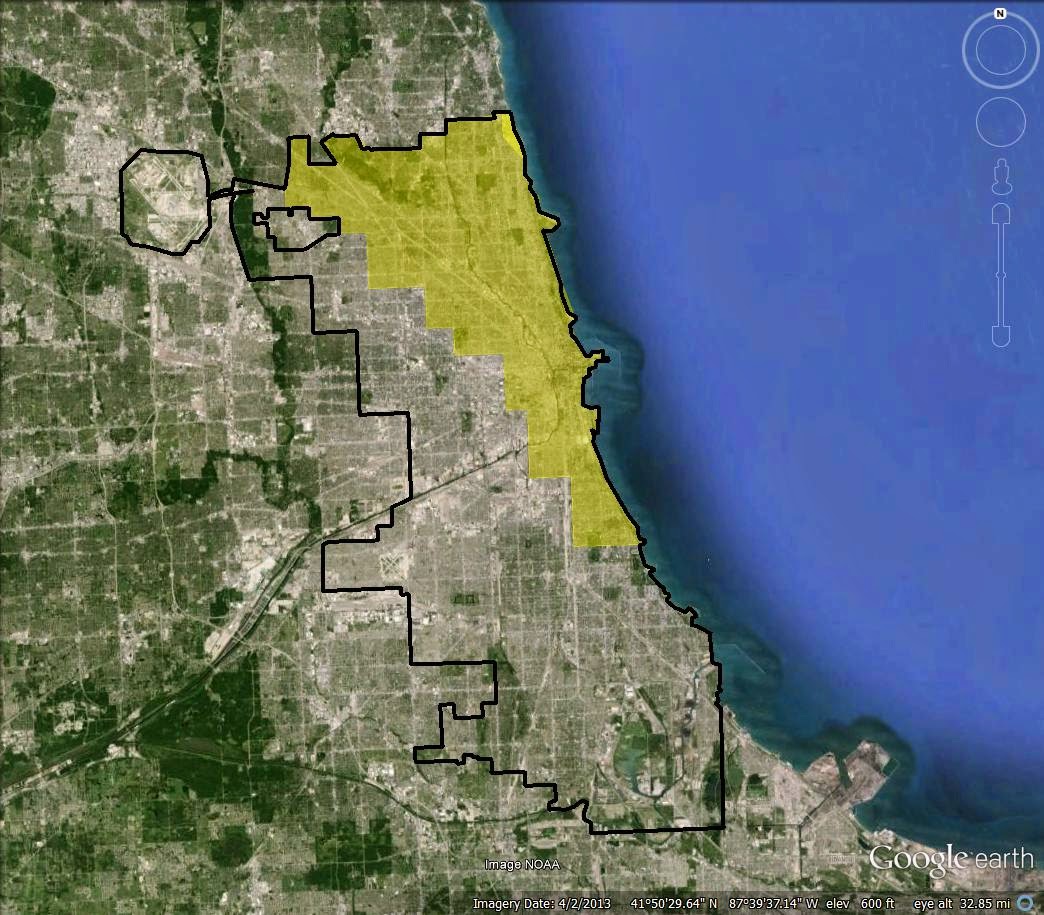
    Next, I looked for Chicago zip codes that were above the metro area average in at least one of three categories — median household income, median home value, and bachelor’s degree or more for persons 25+.  These are the higher income neighborhoods that can be called “Global Chicago”.  Within the city, they look like this, in yellow:

    Most Chicagoans would recognize this as the wealthier parts of the city.  It stretches from the far Northwest Side eastward to the lake, south to downtown and continuing south before ending in the Hyde Park neighborhood on the South Side.  Again, I included all zip codes that were above the metro average for at least one of the three categories I examined, so not all communities are the same.  Hyde Park, for example, is here because it has high educational attainment, but is below the average for income and home value.  The same applies to Rogers Park and Edgewater on the city’s northern border with Evanston.  Jefferson Park, Norwood Park and Sauganash, on the other hand, located on the Northwest Side, rank highly in home value but lower for income and educational attainment.

    Taken together, you can see how “Global Chicago” compares with the Illinois portion of the metro area, the metro area excluding Chicago to give you Suburban Chicago, and the balance of the city beyond “Global Chicago” that I’ve called “Rust Belt Chicago”:

    The differences are indeed stark.  “Global Chicago” is on par with the Chicago suburbs and the metro area overall in terms of income, and has a lower percentage of minority residents compared to the metro area.  Interestingly, “Global Chicago” has a much higher home value and educational attainment when compared to the metro area overall or the ‘burbs.  Meanwhile, “Rust Belt Chicago” lags far behind.  “Rust Belt Chicago” has a large majority-minority population, has an income nearly one-half as much as the suburban households, and has only one-third as many college graduates as “Global Chicago”.

    I decided to take this analysis a little further and determine if there is a core to “Global Chicago”, and how it would compare to the rest of the city.  I collected data for zip codes that exceeded the metro average in two or more of the three categories.  That produced this map:

    And this table:

    Here, a “Super Global Chicago” compares favorably with the ‘burbs in terms of income, but far exceeds it in terms of home value and educational attainment.  Including some of the peripheral areas of the previous “Global Chicago” with the previous “Rust Belt Chicago” to produce an “Average Chicago” leads to some gains, but it still lags far behind the other slices of the metro area.

    Right now, the CNN series “Chicagoland” is doing its best to illustrate the “Two Chicagos” meme, highlighting blues festivals and Stanley Cup championship celebrations on one end of town and school closures and endless crime on another.  However, these maps and tables may do a far better job of demonstrating the impact of past and current practices and policies on the city’s landscape.  In fact, I think Chicago’s example is one that will serve as a model, for better or worse, for other cities across the nation.

    In reality I see the “Two Chicagos” meme as overplayed.  Chicago may be better understood in thirds — one-third San Francisco, two-thirds Detroit.

    This post originally appeared at Corner Side Yard on March 18, 2014.

    Pete Saunders is a Detroit native who has worked as a public and private sector urban planner in the Chicago area for more than twenty years.  He is also the author of “The Corner Side Yard,” an urban planning blog that focuses on the redevelopment and revitalization of Rust Belt cities.

    Chicago photo by Bigstock.

  • Cities: Better for the Great Suburbanization

    Where Cities Grow: The Suburbs

    The massive exodus of people from rural areas to urban areas over the past 200 years has been called the "great urbanization." For more than two centuries, people have been leaving rural areas to live in cities (urban areas). The principal incentive has been economic. But most of this growth has not taken place close to city centers, but rather on or beyond the urban fringe in the suburbs (and exurbs). Appropriately, The Economist magazine refers to the urbanization trend as the "great suburbanization," in its December 6, 2014 issue (PLACES APART: The world is becoming ever more suburban, and the better for it).

    The preponderance of suburban growth is evident in high income world metropolitan areas. For decades, nearly all growth in nearly all cities has been in the suburbs. Some notable examples are London, Toronto, San Francisco, Portland, Tokyo, Zürich, and Seoul. The dominance of suburban growth is also evident in the major cities of the less developed world, from Sao Paulo and Mexico City, to Cairo, Manila, Jakarta, Beijing, and Kolkata (see the Evolving Urban Form series). The Economist describes the substantial spatial expansion of residences and jobs in Chennai (formerly Madras), a soon-to-be megacity in India.

    Growing Cities Become Less Dense

    The Economist quotes New York University geographer Shlomo Angel, whose groundbreaking work (such as in Planet of Cities) indicates that "almost every city is becoming  less dense." Angel also shows that, contrary to the popular perception of increasing densities, cities become less dense as they add more population. This extends even to the lowest income cities, such as Addis Abeba (Ethiopia), where the population has increased more than 250 percent since the middle 1970s, while the urban population density has declined more than 70 percent. The rapidly growing cities of China exhibit the same tendency, where, according to The Economist: "Mr. Angel finds that population densities tend to drop when Chinese cities knock down cheaply built walk-up apartments and replace them with high towers."

    Suburbs in the United States

    In the United States, The Economist says that more than half of Americans live in suburbs. In fact, this is an understatement, owing to the common error of classifying "principal cities" as urban core, when many are, in fact, suburban. The Office of Management and Budget established the "principal cities" designation to replace the former "central city" versus suburb classification. This was in recognition of the fact that employment patterns in US metropolitan areas had become polycentric, with suburban employment centers, which along with central cities were designated as "principal cities."

    The absurdity of using "principal cities" as a synonym for central cities is illustrated by the broad expanses of post-1950 suburbanization now classified, with genuine core cities like New York or Chicago, as principal cities such like Lakewood, New Jersey (New York metropolitan area), Hoffman Estates (Chicago), Mesa (Phoenix), Arlington (Dallas-Fort Worth), Reston (Washington) and Hillsboro (Portland). In fact more than 85 percent of major metropolitan area (over 1 million population) residents live areas that are functionally suburban or exurban according to our small area analysis ("City Sector Model").

    Urban core growth rates have improved since 2010, which is an encouraging sign. Yet, core city jurisdictions account for less than 30 percent of metropolitan area growth, as Richard Morrill has shown. The Economist points out factors that could prevent this long overdue improvement from being sustained in the future.

    • Schools are "still often dire in the middles of cities," according to The Economist. Any hope of keeping most young families as they raise children seems impossible until core cities take on the politically challenging task of school reform.
    • The Economist also notes the huge government employee pension obligations of some large core cities, suggesting the necessity of cutting services or raising taxes. "Both answers were likely to drive residents to nearby suburbs, making the problem worse. No number of trams, coffee shops or urban hipsters will save cities that slip into this whirlpool." The Economist specifically cites Chicago and New York, but could have added many more examples both in this country and outside.

    Limiting Sprawl and Limiting Opportunity

    The Economist is refreshingly direct in its characterization of attempts to stop urban spatial expansion ("urban sprawl"). "Suburbs rarely cease growing of their own accord. The only reliable way to stop them, it turns out, is to stop them forcefully. But the consequences of doing that are severe."  The Economist: chronicles the experience of London, with its "greenbelt" ("urban growth boundary"): "Because of the green belt London has almost no modern suburban houses and very high property prices."

    The social consequences have been massive. "The freezing of London’s suburbs has probably aided the revival of inner-London neighbourhoods like Brixton. It has also forced many people into undignified homes, widened the wealth gap between property owners and everyone else, and enriched rentiers." Housing is typically the largest share of household expenditures and raising its price reduces discretionary incomes, while increasing poverty. In London, The Economist says that "To provide desperately needed cheap housing, garages and sheds there are being converted into tiny houses," quoting historian John Hickman who calls them “shanty towns”.

    Higher house prices and lower discretionary incomes are not limited to London. Among the 85 major metropolitan areas covered in the 10th Annual Demographia International Housing Affordability Survey, all 24 of those with "severely unaffordable" housing have London-style land-use regulation or similar land use restrictions. These financial reverses are not limited to suburban households, since urban containment policies are associated with substantial house price increases in urban cores as much as in suburbs.

    "Doom Mongering" About the Suburbs

    Oblivious to this revealed preference for residential and often commercial suburban location, many retro – urbanists, including many well placed, have viewed the suburbs with "concern and disdain," according to The Economist. Since the Great Financial Crisis, The Economist notes that this has turned to "doom-mongering."

    The Economist summarily dismisses suburban doom doctrine: "Those who argue that suburbia is dying are wrong on the facts; those who say it is doomed by the superiority of higher-density life make a far from convincing case."

    The Future

    In the editorial leader, The Economist, suggests: A wiser policy would be to plan for huge expansion. Acquire strips of land for roads and railways, and chunks for parks, before the city sprawls into them.

    The Economist adds: This is not the dirigisme (government planning) of the new-town planner—that confident soul who believes he knows where people will want to live and work, and how they will get from one to the other. It is the realism needed to manage the inevitable.

    The Economist continues that the suburbs have worked well in the West and are spreading, concluding that: We should all look forward to the time when Chinese and Indian teenagers write sulky songs about the appalling dullness of suburbia.

    Wendell Cox is principal of Demographia, an international public policy and demographics firm. He is co-author of the "Demographia International Housing Affordability Survey" and author of "Demographia World Urban Areas" and "War on the Dream: How Anti-Sprawl Policy Threatens the Quality of Life." He was appointed to three terms on the Los Angeles County Transportation Commission, where he served with the leading city and county leadership as the only non-elected member. He was appointed to the Amtrak Reform Council to fill the unexpired term of Governor Christine Todd Whitman and has served as a visiting professor at the Conservatoire National des Arts et Metiers, a national university in Paris.

    Photo: Suburban Ho Chi Minh (Saigon), by author