Blog

  • Planning a Trip to China

    Recently concluded agreements between the United States and China have led to easing of visa restrictions, which is expected to lead to tourist volume increases in both directions. As a frequent traveler to China, I have found that organized groups – the simplest way to travel in China – far too confining and have avoided their use with the exception of travel to a Great Wall site in the Beijing area.

    It is easy to obtain a visa by mail or express to visit China by applying through a Chinese consulate or visa service. These are readily found on the internet. It may be surprising that obtaining a visa to visit China is easier than obtaining a visa for a US visit by Chinese citizens, which requires a face-to-face interview with a US consular official.

    Purpose of My Travel

    My principal professional interest is cities. I have toured all of the urban areas with more than 1,000,000 residents in Western Europe, Japan, Australia, New Zealand, Canada, and the United States and nearly all of the world’s megacities (over 10 million people). My purpose has been to examine the geography, urban form and transport system of world cities

    China has become a particular interest, not only because of its unprecedented economic trajectory and its poverty reduction, but also because of its strong rate of urbanization. According to the United Nations, in 1975, China was 17 percent urban, and will reach 56 percent in 2015, three times the level of 40 years ago. I have traveled extensively in China over the past 15 years and toured each of the 27 largest urban areas and a number of smaller urban areas.

    Getting There

    Chances are that the individual tourist will enter China through one of its two largest international airports in Beijing and Shanghai.

    Beijing’s Capital International Airport was rebuilt for the Olympics and is an architectural masterpiece. Capital International Airport now trails only Atlanta’s Hartsfield-Jackson International Airport in passenger volume. As late as 2002, Capital International did not rank among the world’s top 25 airports. There is a limited stop Metro line to the core of Beijing, costing about $4.

    Shanghai’s Pudong International Airport has been substantially expanded in recent years, and unlike many airports, has maintained a consistent architectural design, despite its additions. Pudong International is unique is being served by the world’s only Magnetic Levitation train ("maglev") which takes passengers part way to central Shanghai, at speeds up to 270 miles per hour (430 kilometers per hour). The Mag Lev is the fastest train in the world in commercial operation. The one-way fare is approximately $8 (Note 1). The core of Shanghai can be reached from Pudong by Metro for slightly more than $1.00 (29 miles or 47 kilometers).

    One option the tourist will not find at Chinese airports is the self-drive rental car counter. Generally, rental cars are available only to drivers with a Chinese driving license.

    Not Getting Lost

    Some in China speak English, but the vast majority do not. As is noted below, the principal means of travel within the cities is by taxi and most taxi drivers do not speak English. Therefore it is very important to always take an "address card," which will have the hotel name and address printed in both Chinese characters and English, so the taxi driver can return you to the hotel. Hotel personnel will also write destinations in Chinese characters to give to taxi drivers for trips from the hotel.

    Getting Around in Urban Areas

    Even so, the urban transportation system meets the needs of most tourists. China’s cities are by no means walkable, though some attractions will be available on foot. For example, many central Beijing hotels are within walking distance of Forbidden City. In Shanghai, the Bund and the Nanjing Road shopping district (Note 2) are also near central area hotels.

    Generally you can get around on plentiful and inexpensive taxis or transit systems. China is building metros (subways) in many cities. Shanghai has the longest Metro system in the world, while Beijing ranks second. Distances between stations are often quite great and it is advisable to use taxis from the station for destinations that are beyond comfortable walking distance.

    Getting Around Between Cities

    Airlines: China also has an effective intercity transportation network. China’s domestic airline passenger volume is nearly equal to that of the European Union and trails the United States by 40 percent. Generally, the Chinese airline system is very "English friendly," with onboard staff generally bilingual and English speakers easily found within airports. Meals are provided on most flights.

    Air tickets may be readily purchased using credit cards through Internet sites such as Orbitz.com, Expedia.com, Travelocity.com, and C–Trip.com. My favorite is C-Trip, a Chinese travel agency which has an English language toll free number in China.

    Trains: China has the longest high-speed rail system in the world, with similar quality to those of Japanese and Europe or Amtrak’s Acela Express. The high-speed trains have train number prefixes of "C", "D" or "G" (such as G-1234). Other trains could be less comfortable for Westerner. They can be much slower and often do not have Western style toilets.

    Announcements and electronic signs in carriages are in English and Mandarin. Staff is generally less English proficient than on the airlines, however. There is limited food service (as on the French trains) and travelers may want to take along snacks. Drinks are readily available.

    Tickets may be purchased online from sites such as Travel China and C-Trip with credit cards. However, credit cards cannot be used for tickets at railway stations. I purchase tickets in China, at major stations, where there are special English windows.

    Buses: Buses, which operate on the world’s largest motorway (freeway) network, go many places that cannot be reached by the higher quality train services. Often hotels will be able to obtain bus tickets. My most notable bus trip was from Ningbo to Shanghai, to cross the Hangzhou Bay Bridge, one of the longest in the world.

    Hotels

    China has its share of five star and other "high- end" hotels. I tend to avoid these hotels, because I am interested in stretching my dollar to see more, and stay longer. There are good options for lower cost hotels in China. My own favorite is Ibis, part of the French owned Accor chain. While the guest can expect to pay €100 or more in Europe, Ibis hotels tend to cost between $25 and $50 per night for double occupancy. The advantage, is that Ibis provides a consistent standard that is little different between Paris and Shanghai or Qingdao. Generally, Ibis staff communicates adequately in English. Ibis also has restaurants with limited fare, though I prefer the small entrepreneurial neighborhood establishments.

    A good second choice is the locally owned Jin Jiang Inns, which have similar costs, but where staff English proficiency is less predictable. Even so, Jin Jiang Inn staff will often provide assistance using "on-call" English speakers by mobile phone.

    The travel site Kayak.com aggregates hotel rates (including Ibis and Jin Jiang) and is a good shortcut for finding the best deals.

    Eating

    There is significant variation in the cuisine between the provinces and regions of China. Eating is one of the great pleasures of China. This too can be inexpensive. There are small independently owned restaurants throughout Chinese cities. Meals can be purchased at from $1 to $3 in these establishments. Of course, you can pay much more.

    My favorite is Lanzhou noodles, which are served in a large bowl with beef, vegetables and hot Sichuan pepper sauce. Servers will routinely ask Westerners whether they want the hot sauce (and it is hot), but I order it. The noodle dish is named after the city of Lanzhou, capital of Gansu province.

    However, some tourists may prefer Western food, which can be found at some higher cost restaurants and the many fast food restaurants such as McDonald’s, Burger King, Kentucky Fried Chicken, and Pizza Hut.

    Convenience Stores

    Chinese cities are dotted with many small entrepreneurial as well as franchised convenience stores (or small grocery stores). Usually within walking distance, these stores carry a good selection of soft drinks, including both western and Chinese.

    Currency

    The Chinese currency is the "Yuan" or "RMB." The current exchange rate is about six to the dollar or 600 per $100. Money may be exchanged on entry at the airports and generally at the large national banks, such as the Bank of China, the Agricultural Bank of China, the China Construction Bank, the China Merchants Bank, the Bank of Communications, China CITIC Bank, and ICBC (Industrial and Commercial Bank of China). Usually, there will be English proficient staff available. These banks have branches throughout the nation. Further, these banks usually have Automatic Teller Machines linked to international networks, such as Visa.

    Other Cautions

    Water: As in many developing countries, tap water may be insufficiently safe for drinking. Hotels routinely provide bottled water.

    Food: I recommend eating only hot food. It is advisable take along an antibiotic prescription in case of serious stomach upset. On 11 trips, I have had only one occurrence and have seen the problem cleared up overnight.

    Taxis: The great majority of Chinese taxis operate legitimately, charging metered fares (with drop charges ranging from near $1 to just over $2). My fare from Pudong International Airport to the Jing’an District of Shanghai (beyond the core) was $32 in terrible traffic.

    However, there can be difficulties with taxis, especially at train stations and airports. It is always best to obtain a taxi from the organized taxi rank, where metered fares will be available. Often western travelers are approached by drivers at terminal exits offering absurdly high rates. For example, this trip, at Longyang Road Station in Shanghai (terminus of the Mag Lev), I was offered fares ranging from more than three to 15 times the meter fare to nearby hotels.

    The First Trip

    A good way for the novice traveler to China to start is a trip to the Shanghai or Beijing areas.

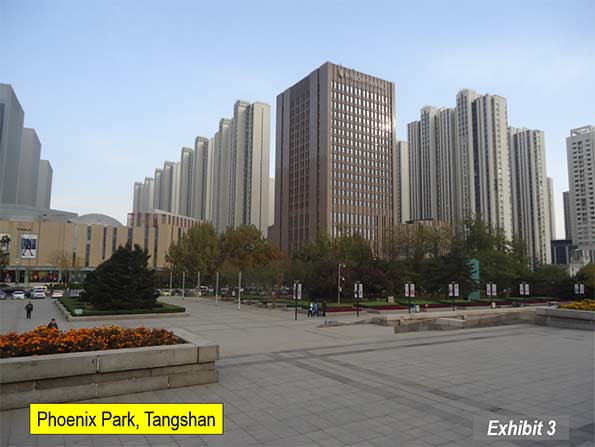
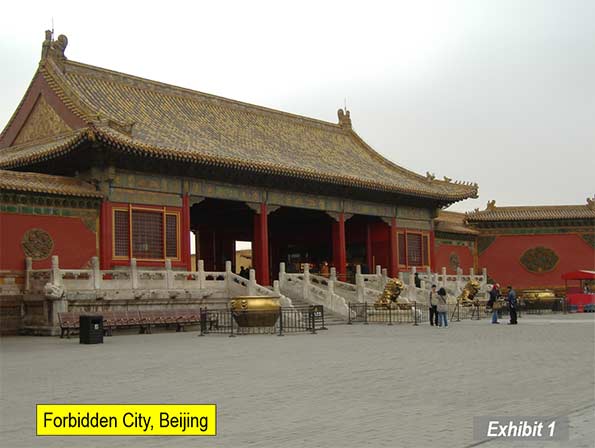
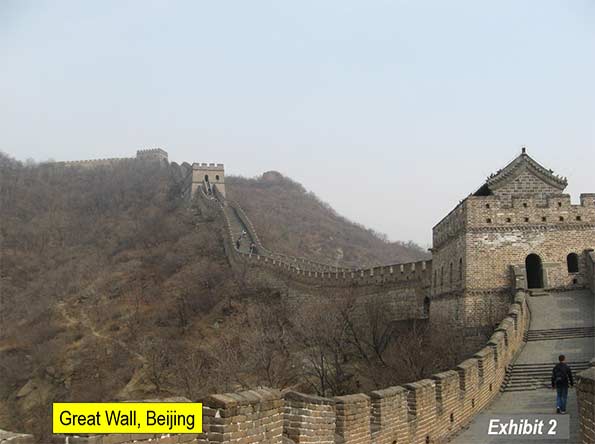
    In Beijing, there are sites such as the Great Wall of China (Exhibit 1), the Forbidden City (Exhibit 2), the Ming Tombs. The Lama Buddhist Temple and the Confucius Temple (only a 3 minute walk away) and the Summer Palace. The former treaty port of Tianjin, with its extensive pre-War western housing and spectacular new architecture is little more than a half hour away by train. Tangshan, site of one of the world’s most deadly earthquakes (1976), is another 45 minutes away (Exhibit 3).
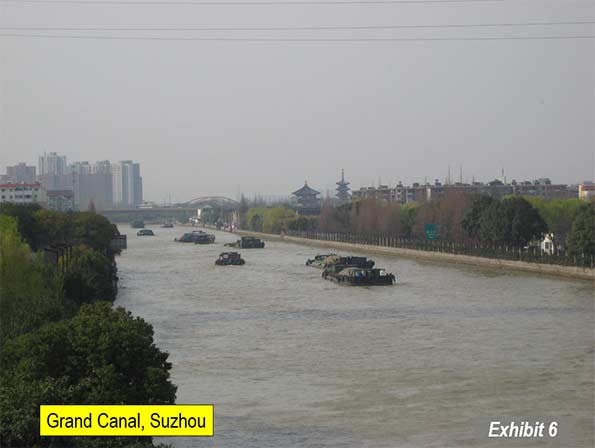
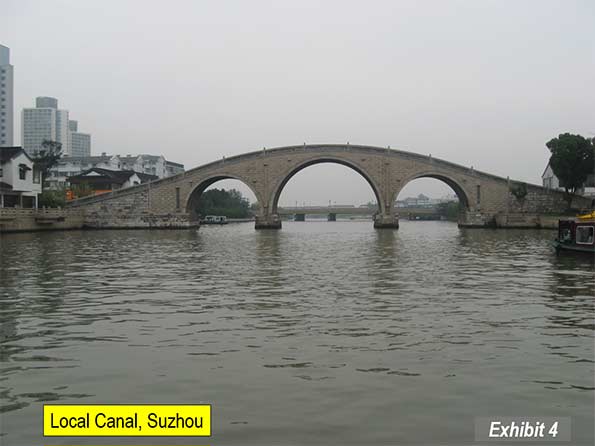
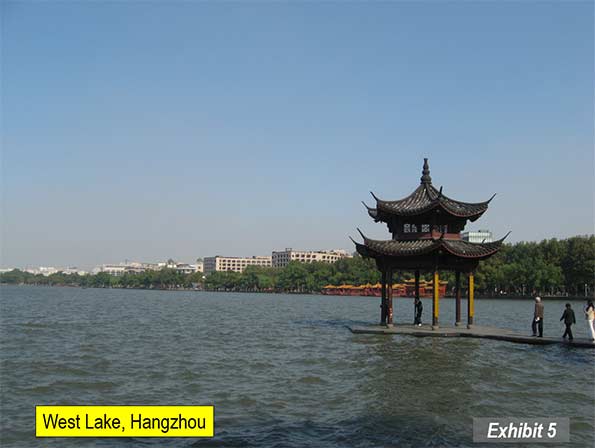
    Shanghai has the "Bund," along the Huang Pu (river), with its Western style commercial buildings from the pre-World War II era. From the walkway on the Bund, there is a stunning view of the new Lujiazui business district in Pudong, which includes the second tallest building in the world (top picture). Only 30 minutes away by train is Suzhou, the "Venice of China," with its canals (Exhibit 4) and the leaning pagoda on Tiger Hill. Hangzhou, with its scenic West Lake is just an hour’s train ride away (Exhibit 5). The historic Grand Canal, which provided access between the Yangtze Delta and the Beijing area, can be seen at both Suzhou (Exhibit 6) and Hangzhou.
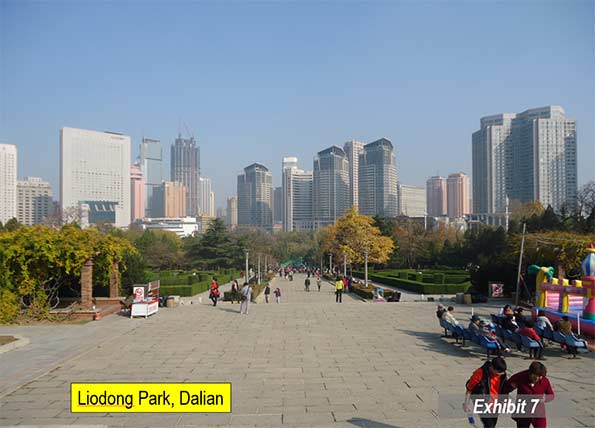
    There are many other cities of great interest for subsequent trips, especially Chongqing, Qingdao, Xi’an, Dalian (Exhibit 7), Harbin, Chengdu, Shenzhen and Wuhan.
    The bottom line is that traveling in China is more complicated than traveling in Wisconsin or Ontario. But it is not that difficult and getting better.

    Note 1: The Mag Lev line was intended as a demonstration line that would encourage China to use that technology for its high speed rail network. Further, the line was to be expanded through central Shanghai and then southwest to Hangzhou (180 miles or 110 kilometers). Citizen opposition led to cancellation of the extension and China opted to use conventional technology, rather than Mag Lev for its high speed rail network.

    Note 2: On Nanjing Road, Western tourists are often solicited by students to attend a tea drinking ceremony. This experience should be avoided. The tourist will have to pay the bill and the costs will likely be far above expectation.

    Top photo: Lujiazui business center in Pudong, across the Huang Pu from the Bund (November 3 by author)

    Wendell Cox is principal of Demographia, an international public policy and demographics firm. He is co-author of the “Demographia International Housing Affordability Survey” and author of “Demographia World Urban Areas” and “War on the Dream: How Anti-Sprawl Policy Threatens the Quality of Life.” He was appointed to three terms on the Los Angeles County Transportation Commission, where he served with the leading city and county leadership as the only non-elected member. He was appointed to the Amtrak Reform Council to fill the unexpired term of Governor Christine Todd Whitman and has served as a visiting professor at the Conservatoire National des Arts et Metiers, a national university in Paris.
  • New Class Order

    In this predictably difficult year for the Democrats, the party of the people is turning, of all people, to its plutocrats. However much the party stigmatizes right-wing billionaires like the Koch brothers, a growing proportion of America’s ultra-rich have become devoted Democrats, giving them an edge in fund-raising. Indeed, an analysis of billionaire contributors this year by Politifact found that 13 supported liberals while only nine backed Republicans.

    The left plutocracy helps explain how Harry Reid’s Democratic Senatorial Campaign Committee has greatly outraised their Republican rivals. Overall, Democratic-aligned committees have achieved a lopsided edge in fundraising – $453 million opposed to $289 million, according to Politico. Overall, the top three donors to the political Super PACs this year all lean to the left.

    Democrats counter that many Republican groups, notably the Koch-funded Americans for Prosperity, generally don’t reveal their finances. But as the New York Times’ Tom Edsall notes, “Liberals do the same, and the press in large part gives them a pass.” He points particularly to the “Democracy Alliance,” a conglomerate of some 100 very rich donors who contribute some $30 million annually to progressive organizations and causes.

    All this reflects a changing class system far more nuanced than the overworked meme about the “1 percent” arrayed against the toiling masses. Instead, we have a plutocracy increasingly divided, mostly along regional and industry lines, among themselves. It’s no surprise voters, notes columnist John Kass, are confused by this recent headline in the Chicago Tribune: “Obama decries income inequality in speech after $50,000-a-person fundraiser for Quinn.”

    The Democrats’ Plutocrats

    The Democratic plutocracy is largely rooted in such industries as telecommunications, entertainment, software, legal services and, surprisingly, a large section of Wall Street. Financial firms, such as Goldman Sachs, supported the president even before his first election. Although the firm did shift towards Mitt Romney in 2012, it maintains close, even intimate, ties to the president, as spelled out in the left-leaning Huffington Post. Wall Street has been the big winner in the Obama economy due to the Federal Reserve’s policy of ultra-low interest rates, which work to force investors into stocks.

    Others sectors also have good reasons to embrace the Democrats. Lawyers often benefit from increased regulation, although that does not apply to most businesses. Overall, legal firms have contributed more than twice as much to Democrats than they have to Republicans.

    Another powerful force for the Democrats lies in the high-tech sector. The same Fed policy that helps Wall Street asset managers also boosts venture capitalists by making investment in even dodgy start-ups irresistible. Once a minor force in campaigns, the tech firms, including software, have greatly expanded their campaign spending, up three-fold since 2000, with a tilt that, in 2012, saw Democrats harvest roughly twice as much high- tech cash as their GOP rivals.

    Most of the leading tech industry figures – Yahoo’s Melissa Mayer, Google’s Sergei Brin, venture capitalist Reid Hoffman as well as Facebook’s Mark Zuckerberg and Sheryl Sandberg – strongly tilt toward the Democrats. The grassroots nerdistan may be even more bluish; 91 percent of the contributions of Apple employees in the 2012 presidential race went to President Obama.

    Concerns over climate change are a big plus for the Democrats with Silicon Valley. Mega-figures like Google’s Eric Schmidt and Tom Steyer, a former big time investor in fossil fuels, oppose all fossil fuels, including natural gas. Apple’s CEO Tim Cook, who has Al Gore on his board, has even asked that what he considers climate change “deniers” not invest in his company.

    Silicon Valley is not just content to proselytize the masses. Firms like Google and investors have been quick to exploit the Democrats’ green politics, investing heavily in highly subsidized renewable fuels. Being green has become yet another business opportunity for some of America’s wealthiest investors and companies.

    Then there’s always geography. Most of the major Democratic plutocrats live in solidly blue states such as Washington, California, Illinois and New York, where political influence means, for the most part, appealing to Democrats.

    In contrast, being a conservative Republican in Silicon Valley avails one little; you are pretty much excluded from the biggest political events and any ideological misstep, as the former head of Mozilla learned the hard way, can lead to virtual banishment.

    The Republican Residue

    None of this suggests that the Republicans have become the new de facto populist party. The GOP still gathers in millions of dollars from big businesses, but these tend to be very different industries than those of the Democrats. Particularly prominent are fossil fuel companies, caught in the crosshairs of the White House and its regulatory apparatus. In 2012, oil and gas executives doubled their federal contributions to $70 million, with some 90 percent going to Republicans.

    This year, energy firms are again making big bets on the GOP, hoping to block environmentalist-backed regulations by helping Republicans gain a majority in the Senate.

    Republicans also do well with old-line oligarchs in agribusiness firms, home builders, casino owners, commercial banks and insurance companies. Once more divided in their loyalties, these appear to becoming increasingly GOP oriented in recent years. The party’s embattled governors have been raising millions from energy moguls like the Kochs, casino magnate Sheldon Adelson and tobacco firm Reynolds American.

    There’s also a strong regional tilt here. Most strong energy, home-building and agribusiness firms are concentrated in the middle of the country, most prominently in Texas, Oklahoma, and the Dakotas. Voters in these states, particularly Republicans, tend to be more favorable, according to Gallup, to expanding natural gas and oil production than their Democratic counterparts who are generally more partial to wind and solar.

    Other players tip the scales to the Democrats.

    Traditionally, Democrats have balanced the disproportionate business support for Republicans with strong backing from unions.

    Since 1989, six of the largest political donors have come from labor. Today, business may be effectively divided, but organized labor remains rock solid in its backing for President Obama and his party.

    Some private sector unions are upset by presidential policies on such things as Keystone XL pipeline.

    But increasingly, the dominant union force behind the Democrats is not hard-hats but public employee unions, whose power in many blue states is all but incontestable.

    Looking forward: The Gentry Liberal Ascendancy

    Despite the fund-raising shortfall, Republicans could do well this November.

    Even brilliantly targeted get-out-the-vote efforts, or effective use of social media, may not be enough to save Harry Reid’s Senate majority, and certainly will not be enough to break the GOP stranglehold on the House. But this may prove only a temporary triumph, as most long-term trends in political fund-raising favor the Democrats.

    The most profound is the movement of money away from the tangible economy – oil and gas, manufacturing, home-building, logistics – to such activities as financial transactions, digital technology, media and entertainment.

    Unless the Democratic Party rediscovers its populist soul, these sectors, and those who derive their fortunes from it, will enjoy friendly treatment from Democrats, whether in mergers, as in the case of Comcast, or in evading privacy controls, which impacts much of the social media sector.

    More important will be the progressive orientation of the trustifarians, the inheritor generation, which is just emerging from Hollywood, Silicon Valley and Wall Street.

    Already the bulk of nonprofits are now solidly liberal, with roughly 70 percent of their funds going to left-of-center causes. This trend will likely increase in the future. The new gentry – like the inheritors of the fortunes of the once-reactionary Ford, MacArthur and Rockefeller families – is likely to ignore basic business concerns and instead adopt the generally leftist culture in their favored locales.

    Ultimately, the American oligarchy is transforming in ways injurious to Republicans and favorable to the Democrats. The Supreme Court has dropped restrictions on fundraising and the economy has boosted the incomes of the super-rich, but not much for anyone else.

    That may upset Democrats in principle, but, in the long run, they are likely to be the biggest beneficiaries.

    This piece originally appeared at The Orange County Register.

    Joel Kotkin is executive editor of NewGeography.com and Distinguished Presidential Fellow in Urban Futures at Chapman University, and a member of the editorial board of the Orange County Register. His newest book, The New Class Conflict is now available at Amazon and Telos Press. He is author of The City: A Global History and The Next Hundred Million: America in 2050. His most recent study, The Rise of Postfamilialism, has been widely discussed and distributed internationally. He lives in Los Angeles, CA.

  • Urbanists Need to Face the Full Implications of Peak Car

    As traffic levels decline nationally in defiance of the usual state DOT forecasts projecting major increases, a number of commentators have claimed that we’ve reached “peak car” – the point at which the seemingly inexorable rise in vehicle miles traveled in America finally comes to an end.   But while this has been celebrated, with some justification in the urbanist world as vitiating plans for more roads, the implications for public policy haven’t been fully faced up to.

    Indeed, the “peak car” is antithetical to the reigning urbanist paradigm of highways known as “induced demand.”  Induced demand is Say’s Law for roads: supply of lanes creates its own demand by drivers to fill them. Hence building more roads to reduce congestion is pointless. But if we’ve really reached peak car, maybe we really can build our way out of congestion after all.

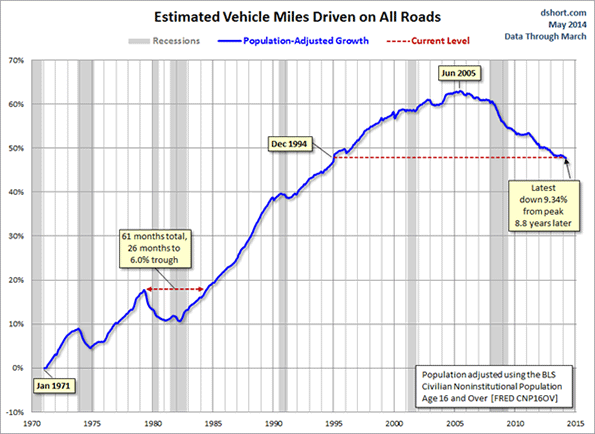
    Traffic levels have stabilized or even fallen in recent years. According to analysis by economist Doug Short featured in Streetsblog, aggregate auto travel peaked on a per capita basis in 2005 and has fallen since. Per capita traffic levels are now back to 1994 levels, a two decade rollback in traffic increases.


    Population adjusted traffic growth. Image via Doug Short
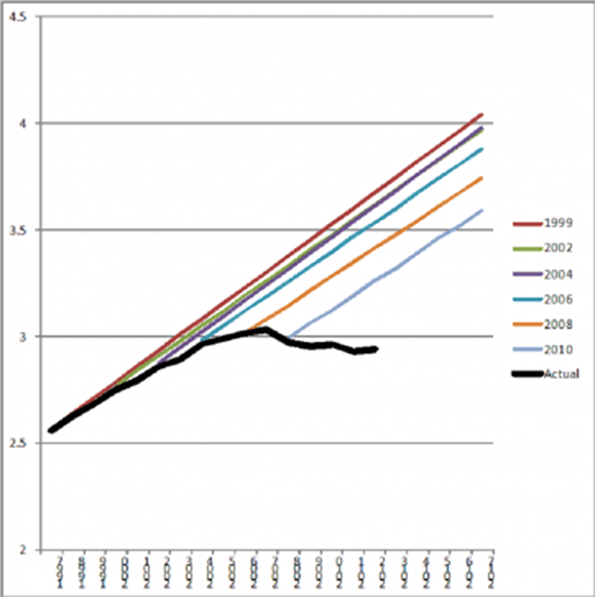
    Even looking at total, not per capita travel shows a marked reversal.  The State Smart Transportation Initiative, a pro-environmental research center, put together a graph showing how high the US DOT’s traffic projections have turned out to be:

    VMT forecasts vs. actual. Source: SSTI

    This data is complemented by a slew of recent stories about the poor financial performance of toll roads, resulting in part from traffic falling far below projections.  For example, the concessionaire operating the Indiana Toll Road recently went bankrupt. Streetsblog reported that while projections forecasted traffic level increase of 22% in the first seven years, traffic actually fell 11% in the first eight.

    Recent traffic declines are a reversal of a long running trend of Vehicle Miles Traveled (VMT) increases at above growth in population. Some of this is no doubt due to the poor macro-economy. But there are reasons to believe we may be in a new era of traffic growth or lack thereof.  Many of the trends that drove high growth have largely been played out: household size declines, suburbanization, the entry of women into the workforce, one car per driver, etc. That’s not to say these will necessarily reverse. But we’ve reached the point of diminishing returns in terms of how many more women, for example, will join the labor force given that there’s already 57% female participation and their labor force participation rate is projected to decline in the future.

    This is potentially very good fiscal news, especially given tight budgets. Clearly many of the freeway expansion projects on the books that have been driven by speculative demand should be revisited.  For example, the state of Wisconsin has massive investments planned in Milwaukee area freeway system even though the metro area is very slow growth in population.  Are these really necessary?  Projects in more rapidly growing boomtown regions in places like Dallas, Houston or Charlotte may well continue to make sense. From top to bottom, engineers need to recalibrate their forecasting models to better correspond to reality. And to revisit highway plans accordingly.

    So the idea that we need to build fewer roads than we thought is sound. But less attention has been paid to the flip side implications of this.  To repeat, the induced demand theory says that there is a more or less infinite supply of traffic, thus any new roadway capacity will be used up shortly, leaving congestion as bad as the status quo ante.  Despite peak car, articles touting induced demand as a reason not to build roads continue unabated, including recent ones in Wired (“What’s Up With That: Building Bigger Roads Actually Makes Traffic Worse”) and Vox (“The ‘fundamental rule’ of traffic: building new roads just makes people drive more”).  In a world of peak car, where traffic levels are flat to declining on a per capita basis, induced demand no longer holds court, certainly not to the level claimed by those who believe it’s pointless to build roads.

    In fact, what peak car means is that while speculative projects may be dubious, there many be good reasons now to build projects designed to alleviate already exiting congestion.  Places like Los Angeles remain chronically congested, which has great economic and social consequences, not the least of which is the value of untold hours lost sitting in traffic.  While individual projects there might indeed be boondoggles, maybe it’s worth building some of the planned freeway expansions there in light of peak car. In short, in some cases peak car strengthens the argument for building or expanding roads.

    On the other hands, many of the regional development plans designed to promote compact central city development and transit may be predicated on an analysis that assumes large future traffic increases in a “business as usual” scenario.  Not just highways but all aspects of regional planning are dependent on traffic forecasts.  That’s not to say that such plans are necessarily wrong, but clearly revised traffic reality needs to be reflected in all plans, not just highway building ones.

    It’s not clear how this will all play out, but urbanists and policy makers of all stripes need to think about the full implications of peak car. At a minimum, the traditional “you can’t build your way out of congestion” rhetoric should be  supplanted, at least in most areas, by a more nuanced approach that neither overestimates demand, nor ignores the problems caused by rapid growth in some regions and pockets of congestion in others.

    Aaron M. Renn is an independent writer on urban affairs and the founder of Telestrian, a data analysis and mapping tool. He writes at The Urbanophile.

  • Legal but Still Poor: The Economic Consequences of Amnesty

    With his questionably Constitutional move to protect America’s vast undocumented population, President Obama has provided at least five million immigrants, and likely many more, with new hope for the future. But at the same time, his economic policies, and those of the progressive wing of the Democratic Party, may guarantee that many of these newly legalized Americans will face huge obstacles trying to move up in a society creating too few opportunities already for its own citizens, much less millions of the largely ill-educated and unskilled newcomers.

    Democratic Party operatives, and their media allies, no doubt see in the legalization move a step not only to address legitimate human needs, but their own political future. With the bulk of the country’s white population migrating rapidly to the GOP, arguably the best insurance for the Democrats is to accelerate the racial polarization of the electorate. It might be good politics but we need to ask: what is the fate awaiting these new, and prospective, Americans?

    In previous waves of immigration, particularly during the early 20th Century, there were clear benefits for both newcomers and the economy. A nation rapidly industrializing needed labor, including the relatively unskilled, and, with the help of the New Deal and the growth of unions, many of these newcomers (including my own maternal grandparents) achieved a standard of living, which, if hardly affluent, was at least comfortable and moderately secure.

    Demand for labor remained strong during the big immigrant wave of the 1980s until the Great Recession. The country was building houses at a rapid clip, which required a large amount of immigrant labor. Service industries, particularly before the onset of digital systems, such as ipads for ordering, that replace human staff in fast-food restaurants, tend to hotels and provide personal services, although often at low wages.

    More recently, this wave of undocumented migration has diminished, as economic prospects, particularly for the low-skilled, have weakened. Yet the undocumented population remains upwards eleven million. Largely unskilled and undereducated, roughly half of adults 25 to 64 in this population have less than a high-school education compared to only 8 percent of the native born. Barely ten percent have any college, one third the national rate.

    This workforce is being legalized at a time of unusual economic distress for the working class. Well into the post-2008 recovery, the country suffers from rates of labor participation at a 36 year low. Many jobs that were once full-time are, in part due to the Affordable Care Act, now part-time, and thus unable to support families. Finally there are increasingly few well-paying positions—including in industry—that don’t require some sort of post-college accreditation.

    Sadly, the legalization of millions of new immigrants could make all these problems worse, particularly for Latinos already here and millions of African-Americans.

    African-American unemployment is now twice that of whites. The black middle class, understandably proud of Obama’s elevation, has been losing the economic gains made over the past thirty years.

    Latino-Americans have made huge strides in previous decades, but now are also falling behind, with a gradual loss of income relative to whites. Poverty among Latino children in America has risen from 27.5 percent in 2007 to 33.7 percent in 2012, an increase of 1.7 million minors.

    Logically, many Latinos and African-Americans might suspect that amnesty won’t be a great deal for them. There are occasional signs of disquiet. A recent Pew survey found that not only half of all whites, but nearly two-fifths of African Americans and roughly even a third of Hispanics approved of increased deportations of the undocumented. A Wall Street Journal-NBC poll found that well less than half of Latinos supported the President’s action.

    This ambivalence may reflect the reality that legalization of the undocumented may be felt hardest in those places, such as California, that have attracted the most newcomers, and also have highly developed welfare states. Today public agencies in Los Angeles, with an estimated one million undocumented immigrants, are bracing from large increases in the demand for state provided services.

    One LA Supervisor estimates the County, facing “an already impossible fiscal dilemma,” will need to spend an additional $190 million, without hope of federal compensation, on the newly legalized population. Ultimately, the newest migrants will be competing with existing residents—particularly poorer ones—not only for jobs but also social services.

    The President’s action on immigration requires a profound shift in economic policy, particularly in the large urban centers where most undocumented are clustered, to avoid creating a squeeze on scarce jobs and services. But Obama’s other big agenda—addressing climate change—has slowed the expansion of fossil fuel development. Meanwhile, it’s the energy sector that creates precisely the kinds of high-paying blue collar jobs, averaging upwards of $100,000 annually, that immigrants might be eager to fill and could give low unskilled workers a foothold into the middle class.

    Similarly, efforts by Obama’s allies at Federal agencies like HUD to encourage dense housing and discourage suburban growth means far less construction employment, one of the largest generators of good blue collar jobs and opportunities.

    Ironically, the places where the cry for amnesty has been the loudest—New York, San Francisco, Los Angeles, and Chicago—also tend to be those places that have created the least opportunity for the urban poor. This is in part due to the fact that these areas have tended to de-industrialize the most rapidly, discourage fledgling grassroots businesses through high taxes, environmental and housing, regulations.

    Whatever their noble intentions, these cities generally suffer the largest degree of income inequality, notes a recent Brookings study. In fact, according to an analysis by Mark Schill at the Praxis Strategy Group, African-American incomes in New York are barely half those of whites and, in San Francisco somewhat below half. In contrast, cities with broader economies like Dallas and Houston, have black populations earning sixty five percent of white incomes. Similarly, Latinos in Boston, New York, Philadelphia and San Francisco do far worse, relative to incomes, than their Sunbelt counterparts, compared to whites.

    These trends could worsen in precisely those areas with the biggest concentrations of undocumented immigrants covered by Obama’s executive order.

    Take, for example, the borough of the Bronx in New York City. The most Latino of all New York’s counties, in the Bronx, roughly one in three households live in poverty, the highest rate of any large urban county.

    In the country. It’s doubtful that legalization absent job growth will improve conditions , as it adds more potential claimants for local benefits without creating new income sources.

    For reasons that can’t be purely economic, most Latino political leaders, and much of the group’s electorate, are in favor of policies that, over time, could doom prospects for Those who receive amnesty. Of course, there are other factors that play into support for these policies, like the emotional pull to reunite families, but whatever their appeal such measures could leave the very people they are meant to help as legal paupers.

    My adopted home region of Southern California has seen an almost 14% drop in high-wage blue-collar jobs since 2007. Deindustrialization has continued, and construction employment lagged, even while the country as a whole, sparked by more secure and now cheaper energy supplies, has seen industrial production improve since 2010.

    Herein lies the great dilemma then for the advocates of amnesty. In much of the country, and particularly the blue regions, they will find very few decent jobs but often a host of programs designed to ease their poverty. The temptation to increase the rolls of the dependent—and perhaps boost Democratic turnouts—may prove irresistible for the local political class.

    So what should we do under these circumstances? Constitutional arguments aside, there do seem to be some better ways to create conditions for upward mobility among newcomers.

    Higher minimum wages may help some of the legal residents, but arguably at the cost of new jobs for others including the newly amnestied. However popular with most voters, such redistributive measures will not address the fundamental economic challenge posed by amnesty.

    Perhaps a sounder strategy would be to adopt policies that encourage broad-based economic growth, including energy, manufacturing, logistics and home construction. This would, of course, require some moderation of regulatory standards, particularly in reference to climate change.

    The President’s recent deal with China, which essentially allows the Chinese to keep boosting emissions until 2030 while we reduce ours steeply, could make things worse. In some states like California, where the global warming consensus is beheld with theological rigidity, “green,” anti-suburban policies largely guarantee that most of the urban poor will never enter the middle class. In San Francisco, Boston and New York, the percentage of Latino and black homeowners is roughly one-third to one-half that seen in redder regions like Houston, Dallas, Phoenix and Atlanta.

    In essence, the deepest blue states have created the worst of all conditions for the urban poor, and will be particularly tough on undocumented residents granted amnesty.

    All this suggests that, if we are to make new Americans economically successful, we need to concentrate not on racial redress but find ways to spark broad based economic growth. Increasing use of inexpensive natural gas, for example, would not only help continue to reduce emissions but would spark an industrial expansion that would create more blue collar jobs. Similarly, policies that allowed for affordable, energy efficient new homes could create not only more blue collar employment possibilities, but a brighter future for young families, many of whom are themselves immigrants or their children.

    The current amnesty could benefit both the country overall as well as recent immigrants if it is tacked to a broad based economic growth strategy. But that doesn’t seem to be in the cards. Instead, continuing policies that inhibit broad-based economic growth are increasing the numbers of Americans who must depend on government, not the economy, to take care of themselves and their families.

    This piece originally appeared at The Daily Beast.

    Joel Kotkin is executive editor of NewGeography.com and Distinguished Presidential Fellow in Urban Futures at Chapman University, and a member of the editorial board of the Orange County Register. His newest book, The New Class Conflict is now available at Amazon and Telos Press. He is author of The City: A Global History and The Next Hundred Million: America in 2050. His most recent study, The Rise of Postfamilialism, has been widely discussed and distributed internationally. He lives in Los Angeles, CA.

    Photo by telwink

  • The Other Side of the Tracks

    I tend to fixate on certain places – sometimes because I love them, other times because I can’t help but stare at twisted wreckage. Lancaster, California has always been 30/70 leaning toward wreckage, although it does show signs of ongoing reinvention so I keep going back. Lancaster is highly representative of most places in suburban America. If Lancaster can successfully adapt to changing circumstances then there’s hope for the rest of the country. I’ve already written several blog posts about the place hereherehere, and here.

    Screen Shot 2014-11-04 at 6.47.50 PM unnamed

    OLYMPUS DIGITAL CAMERA Screen Shot 2014-11-05 at 12.38.35 PMScreen Shot 2014-11-05 at 12.35.09 PM

    Recently Mayor Rex Parris has been in the news suggesting that the MetroLink commuter rail station should either be shut down or moved to the far edge of the city limits. Why? Well… Lancaster is a typical suburb. In fact it’s a far flung exurb with a self-selecting population who left the city in order to escape certain things and particular kinds of people. You know where I’m going with this right? The proverbial “wrong element” whispered by terrified white people who are nervous about their property values and crime. I have no idea what Mr. Parris himself believes one way or another, but he’s genuinely good at representing the concerns of his constituency. In this instance the electorate felt that the wrong kinds of folks were taking the train from downtown Los Angeles and showing up in Lancaster where they proceed to loiter in a disagreeable manner. These weren’t “our kind of people”. After a period of review between the mayor and various agencies it was announced that the MetroLink station would remain, although there were hints at new procedures and assurances of an unspecified nature.

    Screen Shot 2014-11-03 at 11.54.57 AM Photo Credit: Google Earth

    This got me thinking about the neighborhoods immediately around the train station. To the west of the tracks is an eight block commercial strip referred to as The BLVD. It was once a floundering half dead Main Street that was completely revamped by the local planning department in 2010 and has enjoyed remarkable success on multiple levels. The adjacent streets of single family homes have gotten a boost in popularity and higher property value while the rest of the Antelope Valley is still struggling unsuccessfully to recover from the 2008 crash.

    Screen Shot 2014-11-03 at 12.15.35 PM Screen Shot 2014-11-03 at 12.32.29 PM Screen Shot 2014-11-03 at 12.15.50 PM Screen Shot 2014-11-03 at 12.30.11 PMScreen Shot 2014-11-03 at 12.28.30 PM Screen Shot 2014-11-03 at 12.26.14 PM   Screen Shot 2014-11-03 at 12.27.32 PM

    But then there’s the east side of the tracks… These photos look like an Edward Hopper retrospective: bleak, empty, soulless, and unloved. No one has spent ten cents on this part of town in decades and it shows, yet it’s only a block from the beginning of The BLVD. and it’s pressed up against the back side of the train station. In another kind of town this might constitute prime real estate, or at least a place that had a little something going on. After all, the commuter train gives you direct convenient access to everything greater Los Angeles has to offer from jobs to culture. But in Lancaster it’s mostly vacant land, underutilized parking lots, semi-occupied warehouses, and marginal low value businesses. That’s not to say that people don’t live, work, attend church, and go to school in the nearby blocks. They’re just doing so without the benefit of any viable civic infrastructure.

    There may be good reasons why extending The BLVD east to the other side of the tracks won’t work. Aside from any physical or political limitations Lancaster may not be able to absorb much more in the way of upscale dining and discretionary shopping. I’ve had conversations with locals who say they can’t afford a $25 Italian dinner or a $6 beer at a trendy brew pub. Maybe eight blocks of good quality brick and mortar establishments is all Lancaster can handle at the moment. I’ve also heard that developers think the local real estate market might be able to absorb another fifty urban style condo/apartments near The BLVD. But five hundred? They just don’t know since this is terra incognita for them and their traditional business model. But the east side of the tracks might be the perfect place to establish an entirely different kind of environment at a lower price point that actually works for the people who already live nearby. Yucca Ave. runs parallel to the railroad tracks rather than perpendicular like The BLVD. More importantly, it’s an area the theater and chardonnay crowd never sees and doesn’t care about so it’s a great place to do some low cost, low risk, potentially high return experimenting to see what works and what doesn’t.

    Screen Shot 2014-11-03 at 12.32.12 PM Screen Shot 2014-11-05 at 12.36.41 PM 

    The city of Lancaster spent $10.5 million on the redevelopment of The BLVD, plus some state and federal funds. Personally, I can’t see the city mustering the political will to scrape together that kind of money to transform Yucca Ave. in a similar fashion. Instead, I see the back alleys and vacant parking lots as incubators for local micro-entrepreneurs who will interact with the people who live next door and down the street. It’s less about making everything “pretty” and more about making the place vibrant and productive at a scale that works on a tight budget. Yucca is just too big and wide and needs too much major help to be saved at the moment. But the backs and sides of these commercial buildings actually have a human scale and can be connected to the smaller more domestic streets and buildings they face across the alley.

    Screen Shot 2014-11-04 at 11.20.38 PM Screen Shot 2014-11-04 at 11.21.53 PMScreen Shot 2014-11-04 at 11.22.41 PMScreen Shot 2014-11-04 at 11.20.48 PMScreen Shot 2014-11-04 at 11.21.37 PM 

    Here’s one possible model that Lancaster might try along Yucca. This is a crappy triangular parking lot in San Francisco sandwiched between a double decker freeway and a Costco. I can’t imagine a worse location for anything. But a clever entrepreneur decided to rent the parking lot, install a few port-a-potties and hand washing stations, set up some inexpensive outdoor furniture, and then charge a modest rent for parking spaces to a rotating cast of local food trucks. It’s been fantastically successful and unlike The BLVD it costs almost nothing to install. This kind of operation does best in a marginal location with no NIMBYs or brick and mortar competition. Food trucks are infinitely less expensive to buy and operate than a traditional restaurant so the bar to entry is much lower for small business people. If the bank says no to a modest loan it’s possible to get start up capital from an aunt or cousin. In fact, these are most likely to be collaborative family businesses. The food these trucks serve is radically more affordable and can represent the specific tastes of the community in a way that McDonald’s or Domino’s may not – and the profits stay local rather than being sucked out to corporate headquarters. All the city of Lancaster would need to do is keep out of the way and let small business people do their thing without an endless amount of code enforcement to gum up the works.

    Screen Shot 2014-11-05 at 10.09.50 AM Screen Shot 2014-11-05 at 10.10.46 AM Screen Shot 2014-11-05 at 10.11.14 AM

    Here’s a different approach that might work even better since I’ve never actually seen a food truck anywhere in the Antelope Valley. My guess is that they’re illegal and/or can’t find a hospitable spot to park given the relentless and pervasive “mall security” guarding the Taco Bells and Applebees. This is the Underground Food Market in Oakland. This is a pop up market that appears quickly and then melts away in a single day. Both the vendors and the customers are told the date of the next event, but only alerted to the exact location at the last moment in order to keep code enforcement people unaware long enough to actually conduct business for an afternoon. None of these people use anything more elaborate than folding tables and barbecue equipment and it all fits in the trunk of a car or a pick up truck. Does this sort of thing violate a dozen health, safety, and zoning regulations? Yep. Has anyone ever gotten sick or died? Nope. If Lancaster could find a way to legitimize this sort of activity they might discover a ready supply of people in the neighborhood who would bring their talents to bear.

    Screen Shot 2014-11-03 at 12.30.23 PM  Screen Shot 2014-11-05 at 10.19.51 AM Screen Shot 2014-11-05 at 10.22.38 AM  Screen Shot 2014-11-05 at 10.20.45 AM pontocho_night  2662771

    I want to get back to the idea of human scale and how the best parts of Yucca are the little spaces between and around the buildings instead of the big parking lots and super wide street frontage. Everywhere I go in the world I find some of the best streets are barely wide enough for a car to pass through – and that’s part of the magic. I could see stretching some sun shades over the top of these alleys in Lancaster and lining the blank walls with shallow market stalls. This is an economic incubator that costs pennies and could lead to bigger and more permanent local businesses. The trick is to get the entry cost for experimentation down low enough to engage people without much capital or credit. Will this sort of thing terrify suburban homeowners out in the gated communities? Yep. Will they care if it happens in the “bad” part of town that they never visit? Maybe not…

    Screen Shot 2014-11-05 at 12.36.33 PM Screen Shot 2014-11-05 at 3.33.00 PM Screen Shot 2014-11-03 at 10.53.21 AM Screen Shot 2014-11-03 at 10.53.35 AM Screen Shot 2014-11-03 at 11.51.43 AM Screen Shot 2014-11-03 at 11.52.16 AM

    Here’s another example of a reuse of an existing space with very little actual construction. Property values are so high and vacancies are so low in places like San Francisco that every crappy building in every marginal location is being pressed into service for things that no one would have envisioned twenty years ago. Lancaster could do exactly the same thing at a much lower price point. I don’t imagine the wine and cheese crowd being interested in Yucca anytime soon, but there are all sorts of other subcultures that would love this much space to tinker with for their legitimate enterprises so long as the local authorities cut them some slack. What most of these empty warehouses in Lancaster need is fresh paint and the right people to colonize them. The trouble with lone mom and pop operations in this sort of desolate location is that without community and other active participants they tend to wither. Lancaster desperately needs a well organized group to adopt this place. Koreans, Mormons, Armenians, Hasidic Jews, Guatemalans… it needs a La Raza, a Chinatown, or a respectable gay population – any cohesive subculture that can reimagine the place and add vitality in a focussed and concentrated manner. Would it kill city officials to hang out the welcome mat instead of freaking out when “They” appear at the train station?

    Screen Shot 2014-11-05 at 12.34.20 PM Screen Shot 2014-11-05 at 12.33.29 PM unnamed unnamed-1 unnamed-2 unnamed-3 Screen Shot 2014-11-03 at 11.23.59 AM Screen Shot 2014-11-03 at 11.26.16 AM Screen Shot 2014-11-03 at 11.27.26 AM unnamed-4 unnamed-5 unnamed-6 unnamed-7

    Here’s one last example of a seriously bad location that is starting to be transformed in a way that cost the city almost nothing. Flora Grubb was a successful business woman who rented a vacant lot in San Francisco’s Mission District back when The Mission was cheap and considered a bad neighborhood. Renting a vacant lot was one of the few affordable options back when she was younger and just starting out. She didn’t need a building or much infrastructure since she sold plants, garden supplies, and outdoor furniture. As The Mission gradually became fashionable (largely due to lots of cool people like Flora doing their thing) property values rose so high that she was asked to leave so her landlord could put up luxury condos on the site. But the landlord was a clever guy. He had another vacant lot in a different miserable part of town half a block from the sewage treatment plant. He arranged for Flora to set up shop there. She had enough of a loyal following by then that people were willing to follow her to the new location. Her current shop is an open air industrial shed and a former parking lot. The landlord owns other nearby properties and is leveraging Flora’s activities to boost those values. Flora is the catalyst for the transformation of an entire block.

    Don’t get me wrong. I’m not saying Lancaster needs to become a mini San Francisco. That isn’t going to happen. But there are cost-effective techniques for jumpstarting a revival that Lancaster might consider in one of its least loved neighborhoods.

    John Sanphillippo lives in San Francisco and blogs about urbanism, adaptation, and resilience at granolashotgun.com. He’s a member of the Congress for New Urbanism, films videos for faircompanies.com, and is a regular contributor to Strongtowns.org. He earns his living by buying, renovating, and renting undervalued properties in places that have good long term prospects. He is a graduate of Rutgers University.

  • Would the Twin Cities Survive New Urbanism?

    In December, the Metropolitan Council of Minneapolis and St. Paul is scheduled to vote on a vision for the region’s housing and transportation future. “Thrive MSP 2040” is the council’s comprehensive development plan for the seven-county Twin Cities metro area for the next 30 years. It’s a regional growth plan that will result not in a cure for the area’s ills, though, but in a virus that will kill its vitality.

    The Minneapolis/ St. Paul area is one of the most livable regions in the nation. That’s not because residents were forced onto transit and into high density housing, as ‘Thrive’ will do. Growth occurred in a natural manner, in an area with great schools, because people here had the freedom to choose the size of yard for their kids, and the ability to embrace the natural openness of the region. The vigorous suburban growth that resulted has helped our vitality, despite past decisions from the Met Council to neutralize it.

    The Metropolitan Council isn’t alone in adopting New Urbanist plans on a wholesale basis. Their approach, and the problems that go with it, are being repeated by many planning boards nationwide. The 350-page ‘Detroit Future City’ plan is a tunnel-vision strategy based on the same New Urbanist thought. With the best of intentions — goals of avoiding pre-fabricated monotony and sprawl, and creating affordable, livable communities — municipalities are actually writing prescriptions that will do just the opposite.

    I speak with the perspective of a locally-based development consultant, and as an observer and resident of the region for 31 years. I’ve witnessed what has actually helped make this area succeed. At my company, we’ve designed hundreds of sustainable neighborhoods that don’t adhere to the New Urbanist principles of high density and only public transit.

    Two decades ago, the Met Council placed its faith in an urban growth boundary, limiting sewer development in the metro area to inoculate itself against “sprawl”. The result was an increase in the very sprawl the council sought to avoid, as development leap-frogged outside the seven-county area to escape the high land prices created by the artificial land limitation.

    The Met Council hired Peter Calthorpe, founder of Congress for the New Urbanism, for several million in tax dollars, to provide a vision for our region’s future growth. The ‘one size fits all’ approach resulted in projects like Clover Ridge in Chaska, Ramsey Town Center, and indirectly, others like St. Michaels ‘Town Center’, none of which delivered the promises that had been made.

    Calthorpe’s attempt to create a ‘sense of place’ failed to sufficiently attract home buyers. For example, the ‘conventionally planned’ sections of Clover Ridge sold well. But, with their sardine-like density, the housing along alleys remained vacant. Because the development did not attract as many homebuyers as anticipated, among other reasons, local shopping and restaurants did not materialize as the Met Council had promised.

    More recently, ‘Smart Growth’ planners of projects such as ‘Excelsior and Grand’ in St. Louis Park failed to acknowledge why retailers were abandoning their spaces. A spokeswoman for Panera Bread cited poor location and lack of convenience for customers. Yet ‘Excelsior and Grand’ is a model New Urbanist plan, complete with the obligatory central ‘traffic circle’ with a ‘sense of place’ sculpture.

    These smart-growth projects are examples of architects preaching a singular growth model that does not work for all people, in all climates. Those who assume that working class residents will appreciate waiting outside in 20 below zero weather at an architecturally designed “sense of place” bus stop, and then coming home to the 14th floor of a high rise, are clueless. And the dense projects being built in this region have the same sort of repetition of design that smart-growth planners criticize in suburbia.

    Today in the Twin Cities, sales of new, single-family homes are rebounding, creating a catalyst for economic stability. Despite this market reality, some developers are still submitting new multifamily housing proposals. That’s due to Met Council density mandates, not because of market demand. The Council’s assumption is that the population will migrate to the urban core for its (expensive) restaurants and its 19th century rail technology, abandoning spacious suburbs and cars. But sales suggest otherwise.

    The Met Council’s ‘Thrive 2040′ vision will undermine the American Dream of obtaining an affordable single-family home in an area where one desires to live, with the freedom of travel (and protection from our harsh winters) that only personal vehicles currently provide. Under the ‘Thrive’ mandates, more workers will need to live in ‘affordable housing’ (mid- or high rises) and take mass transit to their jobs. Yet ‘affordable housing’ remains elusive in ‘Smart Growth’ projects, unless it is heavily subsidized with tax dollars.

    Calthorpe’s Congress for the New Urbanism actually boasts of the gentrification it produces. But when home prices go up, what happens to the living standard for displaced low-income families? The working class, regardless of race, should be outraged by ‘Thrive’.

    Density does not guarantee affordability. We cannot forever throw tax dollars at high-density development solutions in an effort to make them economically feasible. A successful, balanced housing market drives the economy. At their December meeting, let’s hope the Met Council recognizes that the ‘Thrive’ vision is anything but balanced.

    Rick Harrison is President of Rick Harrison Site Design Studio and Neighborhood Innovations, LLC. He is author of Prefurbia: Reinventing The Suburbs From Disdainable To Sustainable and creator of Performance Planning System. His websites are rhsdplanning.com and pps-vr.com.

    Flickr photo by Adelie Freyja Annabel: Edina, a suburb of Minneapolis. “This is the original Caribou Coffee, which opened in 1992 on France Avenue between Sunnyside and 44th Street.”

  • 10 Steps to Financial System Stability: Lessons Not Learned

    Recently, BloombergView writer Michael Lewis called attention to tape recordings made by a Federal Reserve Bank of New York bank examiner who was stationed inside Goldman Sachs’ offices for several months during 2011-2012. She released the tapes to This American Life who aired her story on September 26, 2014. Every media article I’ve seen on this begins with a prelude warning how complicated and hard to follow the story will be. Regular readers of New Geography are several steps ahead in their understanding of these causes and consequences of the financial crisis. If you are new here, you can follow the links in this piece to earlier NG articles.

    Central to the theme of the story is the release of a 2009 report by Columbia University professor David Beim on why the Federal Reserve – especially the New York office which was supposed to be watching the banks – failed to act to prevent the crisis. Beim listed about a dozen “Lessons Learned” by bank supervisors after the financial crisis. In this article, we list the Lessons not Learned before the financial crisis. These lessons come from decades-old studies of financial regulation from around the world. If any US policy makers had paid attention in school, we would have avoided the global financial collapse of 2008. The United States – which was at the center of that storm – had been preaching these steps to emerging market nations for decades. Unfortunately, they just were not following them for us. In the fall of 1998, those emerging market economies seriously threatened the financial stability of the West. In the fall of 2008, it was the West that brought the threat upon itself and the rest of the world.

    Four Policies, Five Tasks and One Idea

    Policies not implemented

    1. Have private, independent rating agencies: US rating agencies were technically independent because they were not owned by the government. However, with the creation by the Securities and Exchange Commission (SEC) of the “Nationally Recognized Statistical Rating Organization” or NRSRO designation, three big credit rating agencies were the only ones accepted for use to meet regulatory requirements – they were issuing 98% of all credit ratings. This gave a government imprimatur to selected businesses, creating undue reliance by financial markets globally. By 2008, the “NRSRO” term appeared in more than 15 SEC rules and forms (not including those directly used for NRSROs), plus rules in all 50 states. NRSROs are also referenced in 46 Federal Reserve rules and regulations. Even though the SEC sanctioned and required the use of the NRSROs they had no say in the process used to establish the ratings.

    Despite even pseudo-independence from the government, the NRSROs were not independent of the financial institutions that paid them to issue credit ratings. The government sanction gave them more power to wield against – or in favor of – the banks and companies they rated. They made money consulting for the same firms, resulting in pressure to rate bonds higher than they should have been rated.

    2. Provide some government safety net but not so much that banks are not held accountable:  Many banks – and all of the New York Feds “primary dealers” – achieved “too big to fail” status through the Wall Street Bailout Act. A few were allowed to fail in the months leading up to the passage of the Bailout – most notably Lehman Brothers – in what amounted to the federal government picking winners and losers without accountability. The Federal Deposit Insurance Corporation was nearly bankrupted in late 2009, removing the safety net that protected depositors. The FDIC was so depleted by the epidemic of collapsing banks, they eased the rules on buyers of failing banks, opening the door for hedge funds and private investors to gain access to “bank” status – and the protections that go with it. At the end of September 2009, the FDIC’s fund was already negative by $8.2 billion, a decrease of 180% in just three months. FDIC is projected to remain negative over the next several years as they absorb some $75 billion in failure costs just through the end of last year.

    At the same time, bailed-out banks, brokers and private corporations received additional financial support from the Federal Reserve in a move unprecedented in US history. Billions of dollars in loans were made to the banks without proper documentation. The lack of transparency in the process used by the Treasury to decide who would receive bailout funds and what the recipients have done with the hundreds of billions of dollars was the subject of a GAO audit we wrote about in 2011.

    3. Allow very little government ownership and control of national financial assets: Four years after the crisis, the U.S. Treasury still owned more than half of American International Group, Inc., (AIG). AIG was the world’s largest insurance company – giving the government ownership in international financial assets, too. The U.S. government took ownership positions in virtually every major financial institution during the bailout, plus some non-banks that had lending arms (like General Motors Acceptance Corporation). The GAO audit of the Fed shows we loaned money to and took ownership stakes in a slew of non-regulated businesses like Target and Harley Davidson. The lack of transparency in these transactions is dangerous. Austrian Economist Ludwig von Mises warned decades earlier that market data could be “falsified by the interference of the government,” with misleading results for businesses and consumers.

    4. Allow banks to reduce the volatility of returns by offering a wide-range of services: Until the passage of the Dodd-Frank Wall Street Reform and Consumer Protection Act in 2010, banks were restricted to buying securities defined as investment grade by the NRSROs. Given what we now know about these ratings and the actual riskiness of some AAA-rated investments, the requirement actually made bank investments more dangerous. The process followed in the years (even decades) leading up to the collapse of credit markets was not one that would meet the definition of “unrestricted.” Although there appeared to be a wide range of activities available to US banks, the restriction on credit ratings would eventually increase volatility by concentrating risk instead of dispersing it. Just because a bank can deal in a particular investment does not mean that they should.

    The steps outlined here are a comprehensive program, not a menu of options.  There is no sense allowing banks wide latitude to make risky investments if proper supervision and enforcement is not in place. That leads us to the next steps: the necessary tasks for prudent regulation.

    Tasks Not Taken

    Ten years before the most recent financial crisis (1998), the international financial system had already entered a new era. Speaking at the Western Economics International Association in 2001, Lord John Eatwell said, “The potential economy-wide inefficiency of liberalised financial markets was indisputable.” Eatwell had been writing about these problems for decades.

    5. Require financial market players to register and be authorized: US regulators failed to act on establishing registration for hedge funds, failed to establish requirements for registering who can issue collateralized mortgage obligations (mortgage-backed securities), and failed to act on loopholes in regulations prohibiting insurance companies like AIG from issuing credit default swaps through subsidiaries – the list goes on. Dodd-Frank established the Financial Stability Oversight Council to designate “Systemically Important Nonbank” – yet another government imprimatur for unregulated entities. Instead of making sure only authorized businesses perform financial activity they are only making sure those big financial firms are bailed-out faster in the future.

    6. Provide information, including setting standards, to enhance market transparency: There were no standards for issuing derivatives. Nor for collateralized debt like the mortgage-backed bonds where there was no link from homes/real estate. Because the financial issuers had no standard for reporting changes in ownership to land offices who keep track of liens on homes (usually county-level property office), probably one-third of the bonds the Fed is buying in their monthly “quantitative easing” purchases are truly worthless.

    7. Routinely examine financial institutions to ensure that the regulatory code is obeyed: Without registration and standards, of course, they can be no surveillance by any regulator. Congress admitted that while “most of the largest, most interconnected, and most highly leveraged financial firms in the country were subject to some form of supervision” it proved to be “inadequate and inconsistent.” The story described to This American Life by Carmen Segarra is not news – it is only one more in a long history of problems.

    8. Enforce the code and discipline transgressors: Despite existing rules allowing regulators to prohibit offenders from engaging in future financial activity, only minimal fines have been issued.  “Too big to fail” practices allow regulators to “look the other way” on money laundering and other issues that put our national security at risk. According to the Special Inspector General’s Quarterly Report (September 2012), the “Treasury [is] selling its investment in banks at a loss, sometimes back to the bank itself” allowing even banks who have the ability to pay to get out of the program for less than they owe. Those responsible for creating the situation that required the Bailout have not been called to discipline. Quite the contrary, many were paid elaborate bonuses at the same time their financial institutions were receiving bailout funds.

    9. Develop policies that keep the regulatory code up to date: More than a decade before the crisis, Brooksley Born raised enormous concerns over derivatives in the US – including credit default swaps – during her tenure as chair of the Commodity Futures Trading Commission (1996-1999).  Both the SEC and the Federal Reserve Board objected to her ideas.  On June 1, 1999, Congress passed legislation prohibiting such regulation, ushering in a long period of growth in the unregulated market. Five years after the financial crisis began, rules are still not implemented. AIG became subject to Federal Reserve supervision only in September 2012 when they bought a savings and loan holding company. By October 2, 2012, AIG had been notified that it is being considered for the “systemically important” designation – the “too big to fail” stamp of approval for everything they do.

    One Way Out

    Which leads us to one old idea that every student who ever took economics 101 should remember:

    10. Create specialized financial institutions: In the context of what we know about the policies and tasks that support financial stability, only one additional factor needs to be considered, and that is an old theory on the economic gains from specialization. In The Wealth of Nations, Adam Smith told us that the bigger the market the greater the potential gains from specialization. With equity markets alone reaching a global value of $46 trillion, the potential gains are enormous.

    Peter Drucker made this point on specialization in 1993 in his prophetic book “Post-Capitalist Society.” While diversification is good for a portfolio of financial investments, in large systems it means “splintering.” In a system as large as financial markets, diversification “destroys the performance capacity.” If financial institutions are tools to be used in furthering the efforts of the broad economy, then as Drucker writes “the more specialized its given task, the greater its performance capacity” and therefore the greater the need for specialization.

    The rise of the financial sector has been tied to economic expansion throughout our modern business history. The more robust the flow of finance, the more robust is the potential for economic activity. Greater efficiency in capital markets can lead directly to greater efficiency in industry. Our economy, our livelihood and our well-being are inextricably related to finance at home and around the world. It is now necessary to return to the basics and recognize the long run value of economically efficient specialization. We are living in the post-capitalist society described by Drucker. US regulators have been overly focused on the financial theory of portfolio diversification, ignoring the economic importance of gains through specialization. Drucker’s forecast was accurate: “Organizations can only do damage to themselves and to society if they tackle tasks that are beyond their specialized competence.”

    None of this is to say that our long-term failure is guaranteed. What happens next will be an experiment on a grand scale. The Financial Crisis Inquiry Commission concluded: “The captains of finance and the public stewards of our financial system ignored warnings and failed to question, understand, and manage evolving risks within a system essential to the well-being of the American public.” Carmen Segarra did not tell us anything new: hopefully what she told us – and what ProPublica and others are writing about it – will help a wider public to understand the problem.

    Susanne Trimbath, Ph.D. is CEO and Chief Economist of STP Advisory Services. Dr. Trimbath’s credits include appearances on national television and radio programs and the Emmy® Award nominated Bloomberg report Phantom Shares. She appears in four documentaries on the financial crisis, including Stock Shock: the Rise of Sirius XM and Collapse of Wall Street Ethicsand the newly released Wall Street Conspiracy. Dr. Trimbath was formerly Senior Research Economist at the Milken Institute. She served as Senior Advisor on United States Agency for International Development capital markets projects in Russia, Romania and Ukraine. Dr. Trimbath teaches graduate and undergraduate finance and economics.

    Wall Street bull photo by Bigstockphoto.com.

  • The Evolving Urban Form: Tianjin

    Tianjin is located on Bohai Gulf, approximately 75 miles (120 kilometers) from Beijing. It was the imperial port of China, by virtue of that proximity. Tianjin also served as one of the most important "treaty ports" occupied and/or controlled by western nations and Japan for various years before 1950.

    Tianjin is pivotally located along the East coast corridor between "Dongbei" – the northeast (the provinces of Heilongjiang, Jilin and Liaoning, which are also referred to as Manchuria) and Jinan, Nanjing, Shanghai and points south. Both the most direct expressway route (interstate standard) and high speed rail line from Shanghai to Dongbei cross through Tianjin rather than larger Beijing.

    Tianjin is one of four centrally administered provincial level municipalities, along with Shanghai, Beijing, and Chongqing. While Tianjin has grown strongly in recent years, it has been one of China’s largest cities for decades. According to the United Nations, the 1950 Tianjin urban area was the second largest in China, with 2.5 million residents, trailing only Shanghai which had 4.3 million. Beijing trailed Tianjin by a third, at 1.7 million.

    Population and Growth

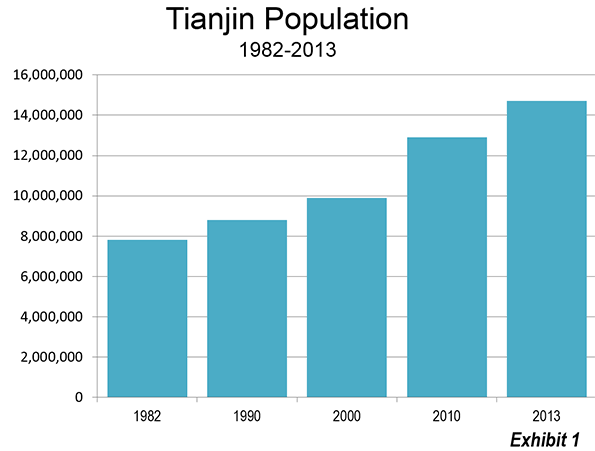
    Since 1982, the total population of Tianjin has expanded by nearly 90 percent, from 7.9 million to 14.7 million in 2013 (Exhibit 1).  Population growth has accelerated over that time. Between 2000 and 2010, the population rose 2.7 percent annually, more than double 1.2 percent rate of the 1990s. The rate of increase was even higher between 2010 and 2013, at 4.5 percent.

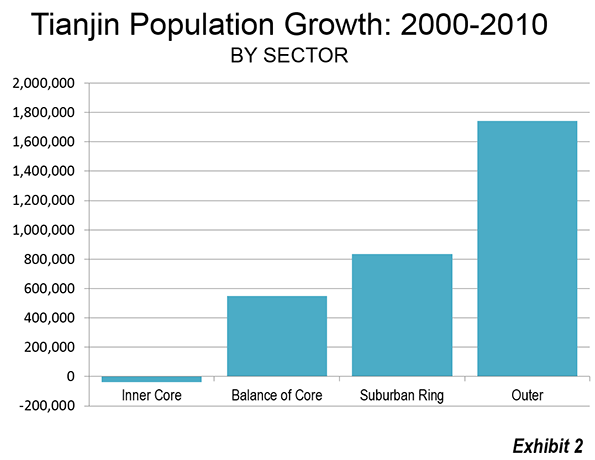
    Between the 2000 and 2010 censuses, the inner core district (Heping qu), experienced a population loss of 12 percent. But the rest of the municipality increased, accounting for 101 percent of the growth. The balance of the core captured 18 percent of the growth, while the suburban ring attracted 27 percent. By far the greatest growth was in the outer districts, which accounted for a solid majority of the growth (Exhibit 2). This peripheral domination of growth mirrors the experience of other large Chinese cities, such as Shanghai, Beijing, and Chongqing, which have seen their core areas decline in population, with most growth occurring in the outer sectors.

    A New Megacity

    Tianjin is one of the world’s newest megacities (urban area over 10 million population). This has occurred because of the strong post-2010 population growth. In the next Demographia World Urban Areas (early 2015), Tianjin will have an estimated built up urban area population of 10.9 million. With an urban expanse covering 775 square miles (2,007 square kilometers), Tianjin has an urban population density of 14,100 per square mile (5,400 per square kilometer).

    With the urban area expanding geographically, Tianjin fits the international trend of cities, in growing strongly, yet experiencing declining overall urban densities. Chinese urban planners have told me that it has been an intended objective of policy to reduce population densities, to give people more living space. This is despite the preachments of US and European urban planners for whom higher densities often are embraced as an "Article of Faith."

    Tianjin’s Urban Form

    Despite their comparatively high density, Chinese cities are anything but compact. Most are polycentric in urban form, with central districts have widely spaced commercial buildings (the most notable exceptions may be Shanghai, Chongqing, and Dalian, but even these are somewhat polycentric). Tianjin, along with "in situ" urbanization Quanzhou, may be the least compact of the major cities.

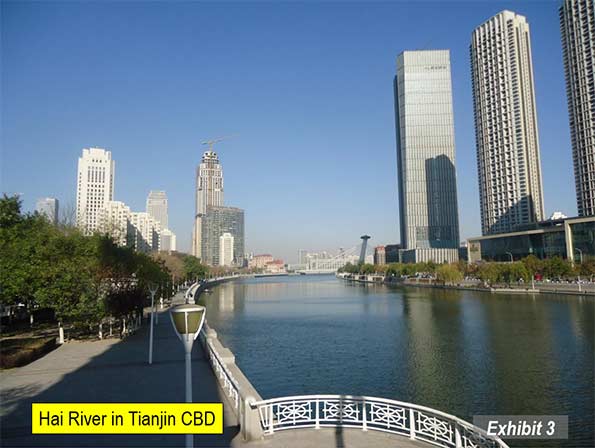
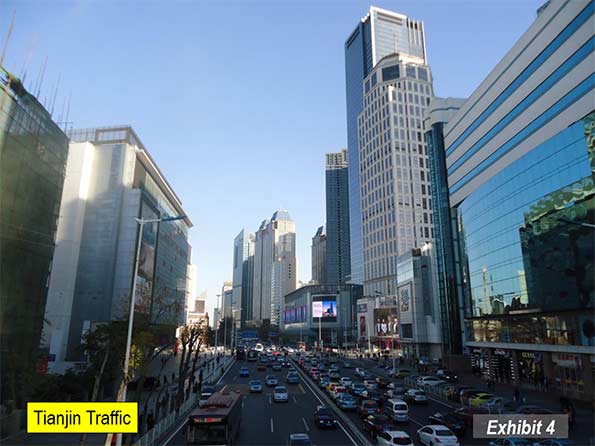
    Tianjin has a broad central business district (CBD), populated with tall, commercial buildings and residential structures (Exhibits 3 & 4). As is the case in many Asian cities (such as Bangkok, Guanzhou-Foshan, Xi’an and Beijing, the tall commercial buildings tend to be highly dispersed, rather than close together as is the custom in Canadian and American cities. In between the dispersed tall buildings are lower rise buildings, both commercial and residential.

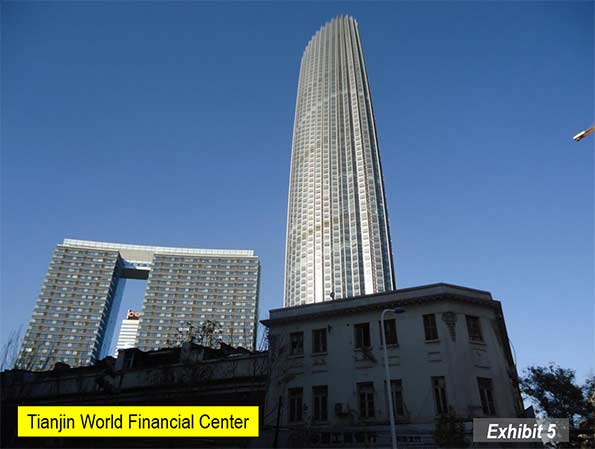
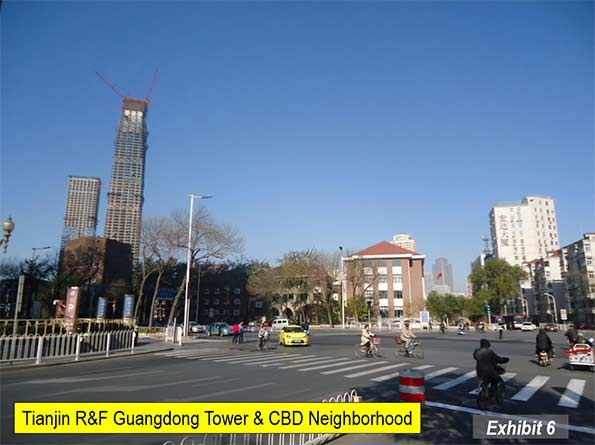
    Currently the tallest building in the CBD is the Tianjin World Financial Center (Exhibit 5), at 76 stories (1,105 feet or 337 meters). This is somewhat taller than New York’s Chrysler Building, which was the second tallest in Gotham for years. However, another taller building is near completion, the Tianjin R&F Guangdong Tower (Exhibit 6), which is well on the way to its 91 floors (1,535 feet or 468 meters). However,even this building is not as tall as three others under construction in other Tianjin centers.

    A second central business district is developing in the Binhai new area, near the port and 30 miles (50 kilometers) south of the Tianjin CBD. The Rose Rock International Financial Center will reach 100 floors (1,929 feet or 538 meters). This, however, is only the second tallest under construction. The CTF Tower is also under construction and will reach 96 floors (1,740 feet or 530 meters), nearly as tall as the new World Trade Center in New York (1,776 feet or 541 meters).

    Finally, the tallest building in Tianjin, Goldin Finance 117 is under construction approximately 9 miles (15 kilometers) west of the Tianjin CBD in a virtually new business center. This building will exceed the heights of all but three of the completed skyscrapers in the world (Lead Photo).

    Altogether, Tianjin will soon have five buildings of more than 90 floors, a record few if any cities will soon equal.

    Architecture

    Tianjin has more than its share of modern Chinese high rise commercial structures and residential buildings. But, perhaps to a greater extent than any other Chinese city, Tianjin exhibits the architecture of the foreign powers to a greater degree than some other treaty ports (such as Fuzhou, Dalian, and Wuhan). The city of Tianjin has meticulously preserved many of these structures, not only commercial and residential buildings, but also churches.

    The Tianjin CBD has a number of low rise streets with European architecture. Some of the most impressive are across the Hai River from the Tianjin Railway Station. There is also a long pedestrian street beyond with considerable western architecture. Virtually throughout the urban core there are examples of classic western architecture, some as ornate as in central Buenos Aires (Exhibit 7).

    Perhaps the most unique feature is a large area of western residences just to the south of the Tianjin CBD (Exhibits 8 & 9).

    In the Beijing Orbit: An Advantage

    Tianjin is clearly in the orbit of larger Beijing, which has recently announced plans for a 7th ring road and other infrastructure to tie not only the city but adjacent provincial level jurisdictions together (Tianjin and Hebei). With a strong policy interest in limiting Beijing’s population growth, and with plenty of rural land available, Tianjin could receive a substantial share of growth that otherwise would go to Beijing.

    Top photo: Goldin 117 Financial Building under construction at November 6, 2014 (by author).

    Wendell Cox is principal of Demographia, an international public policy and demographics firm. He is co-author of the "Demographia International Housing Affordability Survey" and author of "Demographia World Urban Areas" and "War on the Dream: How Anti-Sprawl Policy Threatens the Quality of Life." He was appointed to three terms on the Los Angeles County Transportation Commission, where he served with the leading city and county leadership as the only non-elected member. He was appointed to the Amtrak Reform Council to fill the unexpired term of Governor Christine Todd Whitman and has served as a visiting professor at the Conservatoire National des Arts et Metiers, a national university in Paris.

  • America’s Smartest Cities

    In this difficult recovery, many of the strongest local economies have been those with a high share of educated people in their workforce, particularly areas where technology companies and other knowledge-based industries are growing most rapidly.

    To determine the metro areas that are gaining brainpower in the 21stCentury, we scored the nation’s 380 metropolitan statistical areas based on three criteria. We started with the growth rate in the number of residents with at least a bachelor’s degree from 2000 through 2013 (25% weighting in final score). But since the places that post the highest growth rates tend to be those starting with low levels of educational attainment, we gave greater weight to the percentage point increase in the share of the population that is college-educated over that span (50%), and we factored in the share of educated people in the population in 2013 (25%). We also separated out results for the 51 MSAs with over a million residents.

    For the most part, the top 10 on our list of the 51 largest metro areas is dominated by places with large concentrations of colleges, and those that long ago made the transition from industrial to information-based economies.

    In the Boston-Cambridge-Newton metro area, 44.8% of the population has bachelor’s degrees or above, the fourth-highest concentration of brainpower in the nation, up 7.8 percentage points since 2000 on the strength of a 32.2% jump in its college-educated population. That places Boston No. 1 on our large cities list.

    It’s followed in second place by Pittsburgh, which logged the largest percentage point increase since 2000 in the proportion of its population that is college-educated, 8.8 points, to 32.2%, on the strength of 37.3% growth in raw numbers.

    Perhaps the biggest driver in increasing the concentration of educated people in a population lies in the composition of local industry. Silicon Valley has done very well, making heavy additions to an already high concentration of educated residents. The San Jose-Sunnyvale-Santa Clara metro area places third on our list with a population in which 46.7% hold a bachelor’s degree or above, the second highest share in the nation, a 6.8 percentage point jump over 2000. Its urban annex, San Francisco-Oakland-Hayward, places eighth, with a population that is 45.2% college-educated, an increase of 6.4 percentage points. To some extent, this reflects the area’s deindustrialization and high price structure; you do not want to come to the Bay Area today without a high-paying job requiring a good college degree if you expect to live a middle-class lifestyle.

    Another big employer of educated people is government, and with Washington in expansion mode over the past decade, it’s no surprise that our nation’s capital features in the top 10 — twice. The proportion of the population of Washington-Alexandria-Arlington that is college-educated has risen 6.2 points to 48.7%, the highest concentration in the nation, on the back of a 45% increase in the raw numbers. It ranks fifth on our list, followed in sixth place by neighboring Baltimore-Columbia-Towson, Md.

    The Small Smart Set

    Looking at the full set of the nation’s 380 metropolitan areas, the 51 biggest added far more people to their college-educated populations than the other 329 — a net 12 million since 2000, compared to 4.8 million for the smaller metro areas. But the growth rates were actually fairly similar, 43% vs. 41%, which highlights that the largest cities are no longer the only places attracting educated workers.

    Some of the most dramatic growth is taking place in two kinds of small-scale geographies: college towns and what might be best described as amenity regions. At the turn of the millennium, college towns already had a decent base of educated people; now they seem able to attract and nurture tech companies as well. This is the case for the second-ranked metro area on our overall list of all 380: Bloomington, Indiana. Home to Indiana University, the metro area has logged a dramatic 11.7 percentage point increase in the proportion of its population that is college educated since 2000. The share of its population with BAs is now 40.6%, putting it in range of places like Boston and the Bay Area.

    Much the same pattern can be seen in several college towns, including No. 4 Auburn-Opelika, Ala.; Hattiesburg, Miss. (sixth); Lawrence, Kan. (seventh), and Burlington, Vt. (10th). The other big growth areas are attractive small towns that have lured many down-shifting, but often well educated, boomers. Placing first on our overall list is St. George, Utah — its college-educated population increased by 167% from 2000 through 2013, making for a hefty 11.1 percentage point jump in the proportion of its population that’s college educated to 32.0%. Other areas with similar patterns of growth include Ocean City, N.J. (third), Wilmington, N.C. (fifth), Asheville, N.C. (eighth), and Redmond-Bend, Ore. (ninth).

    Looking Forward

    The rapid growth in the concentration of residents with bachelor’s degrees in these smaller cities suggests that the geography of brainpower is likely to change in the years ahead. For decades the Southeast and Midwest have lagged behind the Northeast and the West Coast in education, but this gap is closing somewhat, at least in the smaller cities. Save Burlington, Vt., not one small metro area in the Northeast or California ranked within the top 65 of our overall list.

    A plethora of places in the Southeast dot the top part of our overall list: in addition to the previously mentioned Wilmington and Asheville, Durham-Chapel Hill (15th); Charleston-North Charleston, S.C. (17th); and Savannah, Ga. (20th). The Intermountain West is well represented as well in addition to St. George, with Boulder, Colo., in 13th place, and Provo-Orem, Utah, in 22nd. These areas are all likely to emerge as top tech and professional centers as their ranks of educated workers swell.

    An equally compelling view of the future would be to concentrate on the locations of relatively recent college graduates. A recent study by Richey Piiparinen and Jim Russell for Cleveland State University looked at college-educated people between the ages of 25 and 34 in 2011-13. It found that many of the metro areas with the most rapid growth of this population were in the South, led by Nashville, Tenn., Orlando-Kissimmee-Sanford, Fla.; and Austin, Texas, all of which experienced growth in this cohort of between 15% and 25%.

    More surprising, however, was the strong growth in some Rust Belt cities, including Cleveland-Elyria (+20%), and Pittsburgh (12%). Piiparinen and Russell suggest this is, in part, due to the lower costs in these regions, which allow young people to live far better than they would in a pricier city on either coast. Clearly high costs could shift the nature of future educated migration. It already has caused millennial populations to stagnate in some traditional magnet cities for the educated, such as New York and San Francisco, and actually drop in the core areas of Chicago and Portland. Another factor could be the availability of high-paying jobs; Portland, for example, has an inordinate proportion of college-educated young residents working at lower wages than the national average. In contrast Houston, where high-paying jobs are being created at a healthy clip, the young educated cohort grew five times as fast.

    Of course many factors could shift this geography of education in the years ahead. An extended slide in oil prices, for example, could slow growth in places like Houston and Dallas, while a shift in the terrain of social media could have a devastating effect on the Bay Area. Yet looking ahead, it’s clear that the map of America’s brainpower is likely to continue changing. The leaders, particularly talent-producers such as Boston, should remain at the top for years to come, but other regions — notably the South, the Intermountain West and perhaps also the Rust Belt — could be making bigger gains in the years ahead.

    Educated Metropolitan Area Rankings
    Rank Rank in Size Group Region (MSA) Size Score 2013 share 2000-2013 Growth 2000-2013 point change
    1 1 St. George, UT S 72.0 32.0% 167.3% 11.1%
    2 2 Bloomington, IN S 69.7 40.6% 27.6% 11.7%
    3 3 Ocean City, NJ S 67.6 33.7% 48.7% 11.7%
    4 4 Auburn-Opelika, AL S 65.6 37.9% 90.0% 10.0%
    5 1 Wilmington, NC M 62.5 34.6% 37.6% 10.4%
    6 5 Hattiesburg, MS S 62.1 32.6% 77.7% 10.0%
    7 6 Lawrence, KS S 60.6 50.4% 50.4% 7.7%
    8 2 Asheville, NC M 60.2 32.7% 71.8% 9.6%
    9 7 Bend-Redmond, OR S 60.1 33.8% 104.6% 8.9%
    10 8 Burlington-South Burlington, VT S 59.2 43.3% 39.8% 8.4%
    11 9 Bloomington, IL S 58.1 41.8% 48.0% 8.2%
    12 1 Boston-Cambridge-Newton, MA-NH L 57.1 44.8% 32.2% 7.8%
    13 3 Boulder, CO M 56.8 58.5% 20.1% 6.1%
    14 10 Iowa City, IA S 55.2 48.6% 45.2% 6.6%
    15 4 Durham-Chapel Hill, NC M 54.7 45.5% 53.1% 6.8%
    16 2 Pittsburgh, PA L 54.7 32.2% 37.3% 8.8%
    17 5 Charleston-North Charleston, SC M 54.7 33.0% 81.5% 8.0%
    18 3 San Jose-Sunnyvale-Santa Clara, CA L 54.2 46.7% 32.9% 6.8%
    19 4 Grand Rapids-Wyoming, MI L 54.0 30.6% 92.7% 7.9%
    20 6 Savannah, GA M 53.9 31.3% 73.2% 8.1%
    21 5 Washington-Arlington-Alexandria, DC-VA-MD-WV L 53.3 48.7% 44.9% 6.2%
    22 7 Provo-Orem, UT M 52.9 37.7% 94.5% 6.7%
    23 11 Hilton Head Island-Bluffton-Beaufort, SC S 52.6 36.7% 83.4% 6.9%
    24 6 Baltimore-Columbia-Towson, MD L 52.6 36.8% 40.8% 7.6%
    25 7 Raleigh, NC L 52.6 43.7% 78.7% 6.1%
    26 12 Missoula, MT S 52.5 39.8% 48.8% 7.0%
    27 8 Des Moines-West Des Moines, IA M 52.4 35.4% 59.8% 7.4%
    28 9 Ann Arbor, MI M 51.4 53.5% 23.7% 5.4%
    29 8 San Francisco-Oakland-Hayward, CA L 51.3 45.2% 30.8% 6.4%
    30 9 Seattle-Tacoma-Bellevue, WA L 50.9 39.4% 47.9% 6.7%
    31 10 New York-Newark-Jersey City, NY-NJ-PA L 50.9 37.4% 37.9% 7.1%
    32 11 St. Louis, MO-IL L 50.8 32.5% 41.9% 7.7%
    33 13 Sioux Falls, SD S 50.6 32.3% 73.0% 7.2%
    34 10 Fayetteville-Springdale-Rogers, AR-MO M 50.4 28.2% 92.3% 7.4%
    35 14 Manhattan, KS S 50.3 37.8% 13.0% 7.4%
    36 15 Great Falls, MT S 50.2 29.4% 45.5% 7.9%
    37 12 Denver-Aurora-Lakewood, CO L 49.4 40.3% 52.2% 6.1%
    38 11 Trenton, NJ M 49.0 40.4% 27.7% 6.4%
    39 16 Logan, UT-ID S 48.8 35.9% 66.6% 6.3%
    40 17 Corvallis, OR S 48.7 52.2% 26.1% 4.8%
    41 18 Hinesville, GA S 48.4 20.9% 101.1% 7.7%
    42 13 Nashville-Davidson–Murfreesboro–Franklin, TN L 48.4 32.3% 71.9% 6.6%
    43 14 Philadelphia-Camden-Wilmington, PA-NJ-DE-MD L 48.2 34.6% 36.3% 6.9%
    44 19 California-Lexington Park, MD S 48.1 29.5% 69.3% 7.0%
    45 15 Minneapolis-St. Paul-Bloomington, MN-WI L 48.1 39.3% 43.7% 6.1%
    46 12 Bridgeport-Stamford-Norwalk, CT M 48.0 45.5% 21.5% 5.6%
    47 13 Portland-South Portland, ME M 47.9 35.8% 37.2% 6.6%
    48 20 Columbia, MO S 47.7 45.3% 35.0% 5.3%
    49 14 Madison, WI M 47.6 42.4% 48.5% 5.5%
    50 16 Portland-Vancouver-Hillsboro, OR-WA L 47.4 35.1% 53.9% 6.3%
    51 15 Salisbury, MD-DE M 46.9 22.5% 344.7% 3.0%
    52 21 Morgantown, WV S 46.7 32.5% 55.5% 6.4%
    53 17 Austin-Round Rock, TX L 46.3 41.5% 79.8% 4.8%
    54 16 Omaha-Council Bluffs, NE-IA M 46.3 33.4% 48.0% 6.4%
    55 22 Fargo, ND-MN S 46.3 35.3% 56.7% 5.9%
    56 23 Sumter, SC S 46.2 23.3% 58.9% 7.5%
    57 24 State College, PA S 46.1 41.7% 36.0% 5.4%
    58 25 Elizabethtown-Fort Knox, KY S 46.1 21.6% 113.7% 6.8%
    59 17 Green Bay, WI M 45.9 27.0% 54.7% 7.0%
    60 18 Lexington-Fayette, KY M 45.6 35.7% 45.7% 5.9%
    61 19 Huntsville, AL M 45.6 36.5% 54.5% 5.6%
    62 18 Buffalo-Cheektowaga-Niagara Falls, NY L 45.4 30.1% 29.4% 6.9%
    63 19 Chicago-Naperville-Elgin, IL-IN-WI L 45.4 35.1% 32.5% 6.2%
    64 20 Hartford-West Hartford-East Hartford, CT L 45.2 36.5% 28.5% 6.0%
    65 20 Worcester, MA-CT M 44.9 32.9% 55.0% 6.0%
    66 21 Milwaukee-Waukesha-West Allis, WI L 44.8 33.2% 33.4% 6.3%
    67 21 Clarksville, TN-KY M 44.8 23.2% 70.1% 7.0%
    68 26 Pittsfield, MA S 44.5 32.4% 24.4% 6.4%
    69 22 Cincinnati, OH-KY-IN L 44.4 31.2% 37.7% 6.4%
    70 27 Gettysburg, PA S 44.3 23.6% 63.8% 6.9%
    71 22 Greeley, CO M 44.3 27.4% 101.2% 5.8%
    72 23 Peoria, IL M 44.0 27.4% 41.3% 6.7%
    73 28 Daphne-Fairhope-Foley, AL S 44.0 29.0% 76.5% 5.9%
    74 24 North Port-Sarasota-Bradenton, FL M 43.9 30.6% 53.3% 6.0%
    75 29 Springfield, IL S 43.9 34.0% 30.0% 6.0%
    76 30 Santa Fe, NM S 43.7 41.7% 37.1% 4.8%
    77 25 New Haven-Milford, CT M 43.4 33.5% 30.1% 5.9%
    78 26 Davenport-Moline-Rock Island, IA-IL M 43.3 26.5% 41.2% 6.6%
    79 27 Evansville, IN-KY M 43.3 24.5% 32.3% 7.0%
    80 31 Napa, CA S 43.1 32.2% 39.8% 5.8%
    81 32 Fairbanks, AK S 43.1 32.6% 52.5% 5.6%
    82 23 Kansas City, MO-KS L 43.1 33.7% 37.7% 5.7%
    83 28 Hagerstown-Martinsburg, MD-WV M 43.0 21.3% 71.5% 6.7%
    84 24 Columbus, OH L 42.7 33.7% 50.0% 5.4%
    85 33 Champaign-Urbana, IL S 42.4 39.4% 30.3% 4.9%
    86 29 Urban Honolulu, HI M 42.2 33.4% 37.5% 5.5%
    87 30 Norwich-New London, CT M 42.2 32.0% 32.7% 5.8%
    88 34 Ithaca, NY S 42.2 50.9% 21.3% 3.4%
    89 35 Johnson City, TN S 42.0 24.8% 50.2% 6.4%
    90 25 Tampa-St. Petersburg-Clearwater, FL L 42.0 27.6% 53.1% 5.9%
    91 31 Boise City, ID M 41.9 30.7% 74.5% 5.2%
    92 26 Jacksonville, FL L 41.9 28.3% 62.5% 5.7%
    93 36 Ames, IA S 41.8 48.2% 22.0% 3.7%
    94 27 Virginia Beach-Norfolk-Newport News, VA-NC L 41.8 29.6% 41.2% 5.8%
    95 28 Providence-Warwick, RI-MA L 41.7 29.6% 30.9% 6.0%
    96 37 Rochester, MN S 41.7 35.3% 56.9% 4.8%
    97 38 Grand Junction, CO S 41.6 27.6% 63.7% 5.7%
    98 32 Bremerton-Silverdale, WA M 41.6 30.9% 42.2% 5.6%
    99 33 Roanoke, VA M 41.6 27.1% 40.7% 6.1%
    100 29 Birmingham-Hoover, AL L 41.5 28.6% 39.9% 5.9%
    101 39 Charlottesville, VA S 41.4 42.2% 48.2% 3.9%
    102 34 Allentown-Bethlehem-Easton, PA-NJ M 41.4 27.6% 44.3% 5.9%
    103 40 Las Cruces, NM S 41.3 27.9% 59.3% 5.6%
    104 30 Los Angeles-Long Beach-Anaheim, CA L 41.3 31.7% 36.6% 5.5%
    105 41 Winchester, VA-WV S 41.2 24.2% 71.3% 5.9%
    106 31 San Diego-Carlsbad, CA L 41.2 34.6% 39.9% 5.0%
    107 35 Fort Collins, CO M 41.2 43.3% 43.6% 3.8%
    108 32 Cleveland-Elyria, OH L 41.0 29.8% 23.8% 5.9%
    109 36 Albany-Schenectady-Troy, NY M 40.8 34.3% 28.0% 5.2%
    110 37 Santa Cruz-Watsonville, CA M 40.6 38.9% 18.6% 4.7%
    111 42 Bellingham, WA S 40.4 32.2% 51.9% 5.0%
    112 33 Louisville/Jefferson County, KY-IN L 40.4 27.0% 42.5% 5.8%
    113 43 Bismarck, ND S 40.3 30.5% 65.3% 4.9%
    114 34 Detroit-Warren-Dearborn, MI L 40.0 29.0% 24.6% 5.7%
    115 38 Lynchburg, VA M 39.8 24.6% 46.9% 5.9%
    116 35 Miami-Fort Lauderdale-West Palm Beach, FL L 39.8 29.3% 45.2% 5.3%
    117 39 Cape Coral-Fort Myers, FL M 39.7 26.2% 84.1% 5.1%
    118 44 Appleton, WI S 39.7 27.6% 48.8% 5.4%
    119 36 Charlotte-Concord-Gastonia, NC-SC L 39.7 32.0% 102.3% 4.0%
    120 40 Lancaster, PA M 39.6 26.1% 47.7% 5.6%
    121 41 Akron, OH M 39.4 29.7% 27.7% 5.4%
    122 42 Lincoln, NE M 39.4 36.3% 37.0% 4.4%
    123 43 Scranton–Wilkes-Barre–Hazleton, PA M 39.3 23.6% 35.7% 6.1%
    124 45 Jonesboro, AR S 39.2 23.1% 58.5% 5.8%
    125 37 Richmond, VA L 39.2 32.5% 37.0% 4.9%
    126 44 Erie, PA M 39.2 26.6% 32.9% 5.7%
    127 46 Sierra Vista-Douglas, AZ S 39.1 24.5% 52.4% 5.7%
    128 38 Orlando-Kissimmee-Sanford, FL L 39.0 29.5% 66.5% 4.7%
    129 47 Dover, DE S 39.0 23.9% 79.0% 5.3%
    130 45 Myrtle Beach-Conway-North Myrtle Beach, SC-NC M 39.0 22.7% 163.1% 4.0%
    131 46 Naples-Immokalee-Marco Island, FL M 39.0 32.4% 58.2% 4.5%
    132 39 Rochester, NY L 38.8 32.6% 27.6% 4.9%
    133 40 Houston-The Woodlands-Sugar Land, TX L 38.7 30.9% 61.7% 4.5%
    134 48 Kahului-Wailuku-Lahaina, HI S 38.7 27.4% 60.0% 5.0%
    135 49 Walla Walla, WA S 38.5 28.1% 37.8% 5.2%
    136 50 Flagstaff, AZ S 38.4 34.3% 40.1% 4.4%
    137 47 Ogden-Clearfield, UT M 38.4 29.0% 79.0% 4.4%
    138 48 San Luis Obispo-Paso Robles-Arroyo Grande, CA M 38.3 31.5% 35.4% 4.8%
    139 51 Bloomsburg-Berwick, PA S 38.2 23.0% 40.8% 5.8%
    140 52 Fond du Lac, WI S 38.2 22.6% 48.7% 5.7%
    141 49 Harrisburg-Carlisle, PA M 38.2 29.4% 34.8% 5.0%
    142 53 Dubuque, IA S 38.0 26.6% 38.2% 5.3%
    143 54 Homosassa Springs, FL S 38.0 18.9% 70.8% 5.8%
    144 50 Manchester-Nashua, NH M 37.9 34.5% 27.0% 4.4%
    145 51 Reno, NV M 37.8 28.4% 58.5% 4.7%
    146 55 La Crosse-Onalaska, WI-MN S 37.5 29.5% 34.1% 4.9%
    147 41 Dallas-Fort Worth-Arlington, TX L 37.4 32.6% 54.6% 4.1%
    148 42 San Antonio-New Braunfels, TX L 37.4 26.7% 66.2% 4.7%
    149 56 Cheyenne, WY S 37.2 28.2% 45.2% 4.8%
    150 43 Atlanta-Sandy Springs-Roswell, GA L 37.1 35.2% 47.7% 3.8%
    151 52 Wichita, KS M 37.0 29.0% 36.9% 4.8%
    152 57 Kingston, NY S 37.0 29.8% 25.9% 4.8%
    153 53 Ocala, FL M 36.9 19.0% 84.4% 5.3%
    154 44 Las Vegas-Henderson-Paradise, NV L 36.9 22.1% 91.4% 4.7%
    155 45 Indianapolis-Carmel-Anderson, IN L 36.8 30.8% 51.4% 4.3%
    156 54 Shreveport-Bossier City, LA M 36.8 24.2% 56.8% 5.0%
    157 58 Columbus, IN S 36.6 27.0% 36.8% 4.9%
    158 46 Sacramento–Roseville–Arden-Arcade, CA L 36.6 30.8% 48.4% 4.2%
    159 59 Altoona, PA S 36.5 19.7% 41.8% 5.8%
    160 47 Phoenix-Mesa-Scottsdale, AZ L 36.4 29.2% 62.5% 4.2%
    161 55 Syracuse, NY M 36.4 29.9% 25.6% 4.7%
    162 56 Oxnard-Thousand Oaks-Ventura, CA M 36.1 31.2% 34.8% 4.3%
    163 60 Niles-Benton Harbor, MI S 36.1 24.9% 26.5% 5.3%
    164 61 Elmira, NY S 36.1 23.9% 29.0% 5.3%
    165 57 Colorado Springs, CO M 36.0 35.3% 43.7% 3.6%
    166 62 Chico, CA S 35.9 26.6% 36.7% 4.8%
    167 58 Columbia, SC M 35.9 30.7% 44.3% 4.1%
    168 59 Baton Rouge, LA M 35.8 27.3% 46.7% 4.5%
    169 63 Cape Girardeau, MO-IL S 35.3 24.9% 31.3% 5.0%
    170 60 Springfield, MO M 35.2 25.8% 51.2% 4.5%
    171 64 Greenville, NC S 35.1 28.4% 33.3% 4.4%
    172 61 Lansing-East Lansing, MI M 34.9 32.4% 23.8% 4.0%
    173 65 Staunton-Waynesboro, VA S 34.9 22.4% 41.7% 5.0%
    174 66 Pocatello, ID S 34.9 28.4% 28.0% 4.5%
    175 48 New Orleans-Metairie, LA L 34.9 27.4% 21.8% 4.7%
    176 62 Greenville-Anderson-Mauldin, SC M 34.8 26.8% 81.5% 3.8%
    177 67 Midland, MI S 34.7 33.2% 21.8% 3.9%
    178 63 Kalamazoo-Portage, MI M 34.6 31.0% 25.3% 4.1%
    179 68 Barnstable Town, MA S 34.5 37.1% 10.2% 3.5%
    180 64 Atlantic City-Hammonton, NJ M 34.5 23.5% 40.0% 4.8%
    181 65 Duluth, MN-WI M 34.3 25.2% 28.9% 4.7%
    182 69 Wheeling, WV-OH S 34.3 20.0% 34.1% 5.3%
    183 49 Memphis, TN-MS-AR L 34.1 26.4% 38.1% 4.4%
    184 70 Glens Falls, NY S 34.1 23.6% 37.2% 4.7%
    185 50 Salt Lake City, UT L 34.1 31.2% 43.8% 3.6%
    186 71 Monroe, MI S 34.0 19.4% 47.7% 5.1%
    187 72 Harrisonburg, VA S 33.7 25.6% 47.1% 4.2%
    188 73 Albany, OR S 33.7 18.3% 62.1% 4.9%
    189 66 Spartanburg, SC M 33.6 22.6% 56.1% 4.4%
    190 67 Greensboro-High Point, NC M 33.5 27.5% 36.6% 4.1%
    191 74 Binghamton, NY S 33.1 26.4% 19.9% 4.4%
    192 75 Lafayette-West Lafayette, IN S 32.9 32.5% 32.6% 3.3%
    193 76 Lebanon, PA S 32.9 20.1% 47.8% 4.7%
    194 77 Bay City, MI S 32.8 19.2% 35.4% 5.0%
    195 68 Eugene, OR M 32.6 29.2% 30.9% 3.7%
    196 78 Coeur d’Alene, ID S 32.6 23.0% 68.6% 3.9%
    197 79 Blacksburg-Christiansburg-Radford, VA S 32.6 29.3% 38.0% 3.6%
    198 80 Battle Creek, MI S 32.6 20.8% 31.1% 4.8%
    199 51 Oklahoma City, OK L 32.5 27.9% 41.8% 3.7%
    200 69 Chattanooga, TN-GA M 32.4 23.7% 42.1% 4.2%
    201 81 College Station-Bryan, TX S 32.3 34.2% 49.9% 2.7%
    202 70 Augusta-Richmond County, GA-SC M 32.2 24.5% 45.2% 4.0%
    203 71 Springfield, MA M 32.2 29.2% 7.8% 4.0%
    204 82 Carbondale-Marion, IL S 32.0 27.5% 27.3% 3.9%
    205 83 Johnstown, PA S 32.0 18.7% 28.4% 5.0%
    206 84 Saginaw, MI S 31.9 20.7% 26.3% 4.8%
    207 72 El Paso, TX M 31.8 20.8% 57.7% 4.2%
    208 73 Tucson, AZ M 31.8 30.1% 35.0% 3.3%
    209 74 Pensacola-Ferry Pass-Brent, FL M 31.7 25.4% 37.7% 3.9%
    210 85 Bowling Green, KY S 31.5 25.3% 86.0% 3.1%
    211 86 Charleston, WV S 31.5 22.8% -4.8% 4.9%
    212 87 Medford, OR S 31.4 26.0% 40.9% 3.7%
    213 75 Santa Rosa, CA M 31.4 31.7% 25.4% 3.2%
    214 88 Chambersburg-Waynesboro, PA S 31.3 19.1% 54.2% 4.3%
    215 76 Tallahassee, FL M 31.2 36.6% 26.8% 2.5%
    216 89 Jackson, TN S 31.2 23.8% 50.4% 3.8%
    217 90 Brunswick, GA S 31.0 23.4% 50.2% 3.8%
    218 77 Fayetteville, NC M 31.0 22.3% 43.0% 4.0%
    219 52 Riverside-San Bernardino-Ontario, CA L 31.0 20.1% 73.9% 3.8%
    220 78 Anchorage, AK M 30.9 30.0% 41.4% 3.0%
    221 91 Oshkosh-Neenah, WI S 30.8 26.4% 30.1% 3.6%
    222 79 Dayton, OH M 30.7 26.6% 14.1% 3.9%
    223 92 Decatur, IL S 30.5 21.3% 24.9% 4.3%
    224 80 Deltona-Daytona Beach-Ormond Beach, FL M 30.5 21.3% 66.9% 3.6%
    225 81 Killeen-Temple, TX M 30.5 21.6% 61.5% 3.7%
    226 82 Tulsa, OK M 30.5 26.0% 33.0% 3.6%
    227 83 Reading, PA M 30.4 22.5% 35.3% 4.0%
    228 84 Jackson, MS M 30.4 29.3% 35.6% 3.1%
    229 85 Little Rock-North Little Rock-Conway, AR M 30.3 27.4% 37.6% 3.3%
    230 86 Huntington-Ashland, WV-KY-OH M 30.1 18.8% 63.5% 3.9%
    231 93 Wausau, WI S 30.0 22.2% 37.5% 3.9%
    232 87 Port St. Lucie, FL M 30.0 23.1% 60.6% 3.4%
    233 94 Grants Pass, OR S 30.0 18.3% 48.6% 4.2%
    234 88 Utica-Rome, NY M 30.0 21.9% 24.6% 4.1%
    235 95 Casper, WY S 29.9 23.5% 47.8% 3.5%
    236 89 Canton-Massillon, OH M 29.7 21.4% 26.3% 4.1%
    237 90 Albuquerque, NM M 29.6 30.7% 40.7% 2.6%
    238 96 Sebastian-Vero Beach, FL S 29.4 26.2% 42.3% 3.1%
    239 91 Santa Maria-Santa Barbara, CA M 29.4 32.2% 18.4% 2.7%
    240 97 Prescott, AZ S 29.3 24.3% 55.2% 3.2%
    241 98 Muncie, IN S 29.0 24.1% 16.1% 3.7%
    242 99 Lake Charles, LA S 28.9 20.3% 35.5% 3.9%
    243 92 Lubbock, TX M 28.9 26.9% 37.6% 3.0%
    244 93 York-Hanover, PA M 28.6 21.9% 39.1% 3.5%
    245 94 Mobile, AL M 28.5 22.3% 30.4% 3.6%
    246 100 Grand Forks, ND-MN S 28.5 27.4% 17.3% 3.2%
    247 95 Brownsville-Harlingen, TX M 28.4 17.1% 63.6% 3.7%
    248 101 Yuba City, CA S 28.4 17.0% 61.7% 3.8%
    249 96 Olympia-Tumwater, WA M 28.4 32.0% 41.8% 2.1%
    250 97 Youngstown-Warren-Boardman, OH-PA M 28.4 20.3% 19.3% 4.0%
    251 102 Lewiston, ID-WA S 28.3 22.1% 32.5% 3.5%
    252 98 Palm Bay-Melbourne-Titusville, FL M 28.2 26.5% 33.4% 2.9%
    253 99 Toledo, OH M 28.2 24.8% 10.5% 3.5%
    254 100 Knoxville, TN M 28.1 27.1% 55.2% 2.5%
    255 101 Lakeland-Winter Haven, FL M 28.0 18.4% 60.9% 3.5%
    256 103 Lewiston-Auburn, ME S 28.0 18.3% 35.8% 3.9%
    257 104 Bangor, ME S 27.9 23.6% 30.0% 3.3%
    258 105 Midland, TX S 27.9 27.3% 49.9% 2.5%
    259 102 Vallejo-Fairfield, CA M 27.9 24.5% 31.8% 3.1%
    260 106 Florence, SC S 27.9 20.5% 33.9% 3.6%
    261 107 Springfield, OH S 27.8 18.9% 23.5% 4.0%
    262 103 Hickory-Lenoir-Morganton, NC M 27.8 17.5% 40.5% 3.9%
    263 108 Punta Gorda, FL S 27.8 21.0% 40.3% 3.4%
    264 104 McAllen-Edinburg-Mission, TX M 27.8 16.2% 84.9% 3.3%
    265 109 Gainesville, GA S 27.7 21.7% 59.6% 3.0%
    266 110 Joplin, MO S 27.6 19.9% 38.3% 3.6%
    267 111 St. Cloud, MN S 27.6 24.0% 37.9% 3.0%
    268 112 Williamsport, PA S 27.6 19.0% 26.1% 3.9%
    269 105 Cedar Rapids, IA M 27.5 27.6% 26.3% 2.7%
    270 113 Tuscaloosa, AL S 27.4 24.7% 37.1% 2.9%
    271 114 Eau Claire, WI S 27.3 25.0% 31.8% 2.9%
    272 115 Mount Vernon-Anacortes, WA S 27.1 23.7% 39.5% 2.9%
    273 116 Tyler, TX S 27.1 25.3% 40.7% 2.7%
    274 106 Fort Wayne, IN M 27.0 24.3% 27.2% 3.0%
    275 117 Racine, WI S 26.9 23.4% 25.4% 3.2%
    276 118 Beckley, WV S 26.9 15.9% 33.9% 4.0%
    277 119 Hammond, LA S 26.4 19.3% 58.0% 3.0%
    278 107 Salem, OR M 26.3 23.6% 34.3% 2.8%
    279 120 Topeka, KS S 26.2 26.3% 18.4% 2.7%
    280 121 Hot Springs, AR S 26.1 21.1% 31.4% 3.1%
    281 122 Pueblo, CO S 26.0 21.3% 37.2% 3.0%
    282 123 Lima, OH S 25.8 17.1% 27.2% 3.7%
    283 124 Sheboygan, WI S 25.8 21.1% 26.0% 3.2%
    284 125 Jefferson City, MO S 25.7 24.0% 23.0% 2.8%
    285 126 Burlington, NC S 25.6 22.0% 36.8% 2.8%
    286 127 Waterloo-Cedar Falls, IA S 25.5 25.0% 18.1% 2.7%
    287 128 Michigan City-La Porte, IN S 25.3 17.4% 31.5% 3.4%
    288 108 Laredo, TX M 25.3 16.8% 70.4% 2.9%
    289 129 Jacksonville, NC S 25.3 17.8% 56.3% 3.0%
    290 130 Muskegon, MI S 25.3 17.3% 31.5% 3.4%
    291 109 South Bend-Mishawaka, IN-MI M 25.3 24.4% 17.3% 2.7%
    292 110 Fort Smith, AR-OK M 25.2 16.7% 33.0% 3.5%
    293 111 Gainesville, FL M 25.0 37.5% 24.2% 0.8%
    294 112 Winston-Salem, NC M 25.0 25.7% 66.2% 1.7%
    295 113 Amarillo, TX M 24.9 23.4% 31.9% 2.5%
    296 114 Columbus, GA-AL M 24.9 21.1% 32.3% 2.8%
    297 131 San Angelo, TX S 24.9 22.2% 30.8% 2.7%
    298 132 Decatur, AL S 24.8 18.9% 30.2% 3.1%
    299 133 Cleveland, TN S 24.8 17.6% 44.1% 3.1%
    300 134 Janesville-Beloit, WI S 24.8 19.7% 29.8% 3.0%
    301 135 Weirton-Steubenville, WV-OH S 24.3 15.7% 20.6% 3.6%
    302 115 Kingsport-Bristol-Bristol, TN-VA M 24.1 18.6% 26.2% 3.1%
    303 136 Valdosta, GA S 24.0 20.1% 35.4% 2.7%
    304 116 Flint, MI M 23.9 19.3% 18.8% 3.0%
    305 117 Stockton-Lodi, CA M 23.5 17.2% 53.0% 2.6%
    306 118 Crestview-Fort Walton Beach-Destin, FL M 23.4 25.6% 63.8% 1.3%
    307 137 Jackson, MI S 23.4 19.1% 22.4% 2.9%
    308 138 Abilene, TX S 23.4 22.1% 21.1% 2.5%
    309 139 Watertown-Fort Drum, NY S 23.4 18.9% 26.2% 2.8%
    310 119 Kennewick-Richland, WA M 23.1 24.8% 54.4% 1.5%
    311 140 East Stroudsburg, PA S 23.1 22.6% 36.9% 2.1%
    312 141 Cumberland, MD-WV S 23.0 16.5% 24.2% 3.1%
    313 142 Sioux City, IA-NE-SD S 22.9 20.8% 34.5% 2.3%
    314 120 Fresno, CA M 22.6 19.8% 41.1% 2.3%
    315 121 Beaumont-Port Arthur, TX M 22.4 17.4% 28.9% 2.7%
    316 122 Rockford, IL M 22.1 21.0% 23.0% 2.3%
    317 143 Mankato-North Mankato, MN S 22.0 28.8% 27.1% 1.2%
    318 123 Montgomery, AL M 21.9 25.9% 19.1% 1.7%
    319 144 Dothan, AL S 21.8 18.3% 33.2% 2.4%
    320 145 Gadsden, AL S 21.7 16.2% 24.2% 2.8%
    321 124 Gulfport-Biloxi-Pascagoula, MS M 21.2 19.3% 73.8% 1.4%
    322 125 Merced, CA M 21.2 13.5% 59.1% 2.4%
    323 146 Rome, GA S 20.9 18.2% 22.4% 2.4%
    324 147 Elkhart-Goshen, IN S 20.9 17.8% 29.2% 2.3%
    325 148 Goldsboro, NC S 20.8 17.4% 28.4% 2.4%
    326 149 Rapid City, SD S 20.8 24.5% 42.0% 1.2%
    327 150 Mansfield, OH S 20.7 15.3% 19.3% 2.7%
    328 151 Rocky Mount, NC S 20.5 16.3% 28.6% 2.4%
    329 152 Hanford-Corcoran, CA S 20.5 12.9% 48.8% 2.5%
    330 153 Grand Island, NE S 20.5 18.2% 25.6% 2.2%
    331 154 Longview, WA S 20.1 15.6% 36.7% 2.3%
    332 126 Spokane-Spokane Valley, WA M 20.1 25.9% 39.5% 0.9%
    333 155 El Centro, CA S 20.1 12.7% 55.8% 2.3%
    334 156 Kokomo, IN S 20.1 19.5% -2.9% 2.4%
    335 157 Terre Haute, IN S 19.8 19.4% 14.6% 2.1%
    336 158 Alexandria, LA S 19.6 17.7% 25.6% 2.0%
    337 127 Modesto, CA M 19.5 16.0% 40.5% 2.0%
    338 159 Yuma, AZ S 19.3 13.9% 48.8% 2.1%
    339 160 Billings, MT S 19.2 26.8% 28.2% 0.7%
    340 161 St. Joseph, MO-KS S 19.0 18.3% 21.9% 1.9%
    341 162 Macon, GA S 19.0 20.4% 15.9% 1.7%
    342 163 Lawton, OK S 18.8 20.5% 28.1% 1.4%
    343 164 Texarkana, TX-AR S 18.6 16.8% 33.8% 1.8%
    344 165 Owensboro, KY S 18.3 17.4% 23.0% 1.8%
    345 166 Panama City, FL S 17.8 18.8% 43.4% 1.1%
    346 167 Morristown, TN S 17.7 14.4% 13.3% 2.2%
    347 128 Visalia-Porterville, CA M 17.7 13.3% 47.1% 1.8%
    348 168 Odessa, TX S 17.7 13.8% 42.1% 1.8%
    349 169 Idaho Falls, ID S 17.4 24.5% 41.4% 0.3%
    350 170 Sherman-Denison, TX S 17.3 18.6% 23.3% 1.4%
    351 171 Vineland-Bridgeton, NJ S 17.3 13.7% 27.0% 2.0%
    352 172 Warner Robins, GA S 17.2 20.1% 74.6% 0.3%
    353 129 Lafayette, LA M 17.1 21.6% 107.4% -0.5%
    354 173 Wichita Falls, TX S 17.0 20.5% 10.5% 1.3%
    355 174 Kankakee, IL S 17.0 16.6% 23.1% 1.6%
    356 175 New Bern, NC S 16.6 18.9% 23.6% 1.2%
    357 176 Sebring, FL S 15.9 15.1% 23.8% 1.5%
    358 177 Parkersburg-Vienna, WV S 15.6 16.9% -33.6% 2.1%
    359 178 Lake Havasu City-Kingman, AZ S 15.5 11.3% 56.0% 1.4%
    360 130 Waco, TX M 15.3 19.7% 27.9% 0.6%
    361 179 Athens-Clarke County, GA S 15.2 31.6% 20.3% -0.8%
    362 180 Monroe, LA S 15.1 21.7% 13.8% 0.6%
    363 181 Danville, IL S 14.3 13.9% 8.7% 1.5%
    364 131 Bakersfield, CA M 14.2 14.4% 41.6% 0.9%
    365 182 Redding, CA S 13.9 17.3% 20.3% 0.7%
    366 183 Madera, CA S 13.6 13.0% 36.4% 1.0%
    367 184 Dalton, GA S 13.4 12.2% 30.4% 1.1%
    368 185 Wenatchee, WA S 13.0 20.2% 21.0% 0.1%
    369 186 Houma-Thibodaux, LA S 12.6 13.2% 23.6% 0.9%
    370 187 Carson City, NV S 12.5 18.8% 8.5% 0.4%
    371 188 Albany, GA S 12.4 16.4% 7.9% 0.7%
    372 132 Salinas, CA M 11.6 22.2% 8.6% -0.3%
    373 189 Florence-Muscle Shoals, AL S 10.9 17.0% 5.9% 0.3%
    374 190 Yakima, WA S 10.6 15.5% 14.9% 0.2%
    375 191 Victoria, TX S 10.1 15.7% -6.8% 0.5%
    376 133 Corpus Christi, TX M 10.0 17.5% 14.5% -0.2%
    377 192 Longview, TX S 9.3 16.1% 12.3% -0.1%
    378 193 Anniston-Oxford-Jacksonville, AL S 8.0 15.0% 4.6% -0.2%
    379 194 Pine Bluff, AR S 6.0 13.8% -6.3% -0.3%
    380 195 Farmington, NM S 5.8 12.9% 15.7% -0.6%


    Analysis by Mark Schill, mark@praxissg.com. Measures are normalized and weighted 50% to point change in educational attainment rate, 25% growth in educated population, and 25% in 2013 educational attainment rate. Point change is the difference between the 2000 and the 2013 educational attainment rate. The Villages, FL, an extreme outlier, was excluded from the analysis. Data source: U.S. Census and American Community Survey.

    This piece originally appeared at Forbes..

    Joel Kotkin is executive editor of NewGeography.com and Distinguished Presidential Fellow in Urban Futures at Chapman University, and a member of the editorial board of the Orange County Register. His newest book, The New Class Conflict is now available at Amazon and Telos Press. He is author of The City: A Global History and The Next Hundred Million: America in 2050. His most recent study, The Rise of Postfamilialism, has been widely discussed and distributed internationally. He lives in Los Angeles, CA.

    Mark Schill is a community process consultant, economic strategist, and public policy researcher with Praxis Strategy Group.

    Boston photo by 2nified (Own work) [CC-BY-SA-3.0], via Wikimedia Commons

  • The Progressives’ War on Suburbia

    You are a political party, and you want to secure the electoral majority. But what happens, as is occurring to the Democrats, when the damned electorate that just won’t live the way—in dense cities and apartments—that  you have deemed is best for them?   

    This gap between party ideology and demographic reality has led to a disconnect that not only devastated the Democrats this year, but could hurt them in the decades to come. University of Washington demographer Richard Morrill notes that the vast majority of the 153 million Americans who live in  metropolitan areas with populations of more than 500,000  live in the lower-density suburban places Democrats think they should not. Only 60 million live in core cities.      

    Despite these realities, the Democratic Party under Barack Obama has increasingly allied itself with its relatively small core urban base. Simply put, the party cannot win—certainly not in off-year elections—if it doesn’t score well with suburbanites. Indeed, Democrats, as they retreat to their coastal redoubts, have become ever more aggressively anti-suburban, particularly in deep blue states such as California.  “To minimize sprawl” has become a bedrock catchphrase of the core political ideology.   

    As will become even more obvious in the lame duck years, the political obsessions of the Obama Democrats largely mirror those of the cities: climate change, gay marriage, feminism, amnesty for the undocumented, and racial redress. These may sometimes be worthy causes, but they don’t address basic issues that effect suburbanites, such as stagnant middle class wages, poor roads, high housing prices, or underperforming schools. None of these concerns elicit much passion among the party’s true believers.

    The miscalculation is deep-rooted, and has already cost the Democrats numerous House and Senate seats and at least two governorships. Nationwide, in areas as disparate as east Texas and Maine or Colorado and Maryland, suburban voters deserted the Democrats in droves. The Democrats held on mostly to those peripheral areas that are very wealthy—such as Marin County, California or some D.C. suburban counties—or have large minority populations, particularly African-American.

    This is not surprising since the policies and predilections of President Obama and his team are based on a largely exaggerated urban mythology. Former HUD Secretary Shaun Donovan, for example, has declared the move to the suburbs is “over.” People are, he has claimed, “moving back into central cities and inner ring suburbs.” To help foster this trend, administration policies at HUD and other agencies have been designed to fulfill Donahue’s vision of getting Americans out of their suburban homes and cars and into apartments and trains. These policy initiatives include large “smart city” grants for dense development, restrictions on new building, the promotion of high-speed rail links that would supposedly reconcentrate economic activity in the urban core. The administration’s strong support for regional governments, and its attempts to force suburbs to diversify their populations (even though they are already where minorities increasingly move) are thinly disguised efforts to promote densification and put the squeeze on suburban growth.

    Yet, as census data and electoral returns demonstrate, the demographic realities are nothing like what Donahue and the administration insist. The last decennial census showed, if anything, that suburban growth accounted for something close to 90 percent of all metropolitan population increases, a number considerably higher than in the ’90s. Although core cities (urban areas within two miles of downtown) did gain more than 250,000 net residents during the first decade of the new century, surrounding inner ring suburbs actually lost 272,000 residents across the country. In contrast, areas 10 to 20 miles away from city hall gained roughly 15 million net residents.

    Since 2010, suburban growth has slowed as young people, hampered by a weak economy and tougher mortgage standards, have not been able to buy houses. But while population growth in the same time period has been roughly even between the suburbs and core cities,  the suburban population, which is so much larger to start with, has continued to expand at a faster rate . According to demographer Morrill, since 2010 the suburbs have added 4.4 million people compared to fewer than 2 million in core cities.

    The big problem here is this: the progressives’ war on suburbia is essentially an assault on the preferences of the middle class. Despite the hopes at HUD, the vast majority of Americans—even in most cities and particularly away from the coasts—actually live in single-family homes in low- to mid-density neighborhoods, and overwhelmingly commute by car. If we measure people by how they actually live, notes demographer Wendell Cox, more than 80 percent of those in metropolitan areas have what most would consider a suburban life style.

    Contrary to the conventional wisdom, there is nothing intrinsically “progressive” about hating suburbs. It was, after all, President Franklin Roosevelt who believed that dispersion and homeownership would make the country much stronger. “A nation of homeowners, of people who own a real share in their land, is unconquerable,” he maintained. This notion of favoring policies that allowed for middle-class and eventually working-class people to own their own homes and a patch of grass was shared by Harry Truman, John Kennedy, and Bill Clinton, all of whom were fairly successful in winning over suburban voters.

    Suburbanites are not intrinsically Republican. Clinton, noted political analyst Bill Schneider, shared suburban voters’ skeptical view of government’s ability to address problems, and won 47 percent of the suburban vote in 1996. Barack Obama, running as a conciliatory pragmatist in 2008, did even better with some 50 percent. This performance was aided by the growing proportion of racial minorities, including African Americans, who had moved to the suburbs.

    But as Obama’s administration took shape, suburban support began to ebb. In 2012, Obama lost the suburbs to Romney  by a two-point margin. In this year’scongressional elections the GOP edge grew to 12 points in the suburbs, which accounted for a majority of the electorate. The  Democrats won by 14 percent in the more urban areas, but these accounted for barely one-third of the total vote. The result was a thorough shellacking of the Democratic party from top to bottom.

    Yet even these numbers do not express how critical suburban voters were this year. Much of urban America, particularly in places like Phoenix, Houston, and Las Vegas, is primarily suburban. They have multiple employment centers and the vast majority of commuters take to the roads. Democrats did not do so well in these cities this year, although the party continues to dominate more traditional inner cities dominated by apartment dwellers and mass transit riders. Some hopeful conservative commentators have noted a slight increase in GOP votes in some inner cities, but the percentages are still laughably pathetic.

    This can be seen in GOP wins in the governor’s races. Michigan’s Republican Governor Rick Snyder got 6.8 percent of the vote in Detroit. Successful Illinois challenger Bruce Rauner won only 20 percent of Chicago’s take, even in the face of gross mismanagement by his Democratic opponent. And Maryland’s Larry Hogan won about 22 percent in Baltimore. In all these elections, it was the suburbs—not paltry gains in the cities—that made the difference. Rauner’s election, for example, was based largely on a 60 percent margin in Chicago’s swing “collar counties.” Boston’s suburbs, particularly in the more working class south, helped assure the gubernatorial election of GOP candidate Charles Baker in this bluest of blue states. Suburban voters also played a huge role in the Republicans’ biggest win—the Texas governorship—giving GOP candidate Greg  Abbott almost two-thirds of their votes.

     Much the same suburban swing can be seen in the critical senatorial races races where the Democrats lost seats. Iowa Republican Joni Ernst lost the city vote but won 58 percent of suburban electorate, almost equaling her show in the rural areas. In Colorado, Corey Gardner also secured a large majority among suburban voters, who accounted for roughly half the total electorate. Finally, in the upset of Senator Kay Hagan in North Carolina, successful GOP candidate Thom Tillis ran even better in the suburbs—with some 57 percent of the vote—than he did in the supposedly hardcore conservative countryside.

    But the best way to see the suburban impact is to look at the House races. Among the 12 seats that Republicans took from the Democrats, half were located in solidly suburban areas. These included districts surrounding such cities as Raleigh, N.C.; Salt Lake City, which elected black Republican Mia Love; Miami, in a predominately Latino area; Las Vegas, in a suburban district that went for Obama in 2012; and eastern Long Island. The powerful shift in suburban voting also appears to have cost the Democrats two seats in the president’s home state—one in the northern suburbs of Chicago and the other in southern Illinois communities adjacent to St. Louis, a district that has been in Democratic hands for three decades.

    So what does this mean for 2016 and beyond? To be sure, the key Democratic urban-centric constituencies—millennials, single women, minorities—likely will turn out in bigger numbers in the next election. But ultimately their numbers will be somewhat balanced by rural and small town voters, who will continue to support conservatives overwhelmingly. Ultimately there is only one truly contested piece of political turf in this country—the suburbs—and who wins there takes the whole enchilada.

    There are those, even slightly deluded Republicans, who believe the country is becoming “more urban” and that therefore the suburban edge will mean less in the years ahead. Yet since 2011 the most rapid growth in country, as noted by Trulia’s Jed Kolko, continues to be in the suburbs and exurbs. Some urban cores have recovered nicely, but most often the surrounding city areas have continued to see slow or negative growth.

    Nor is this trend likely to reverse in the near future. As Millennials head into their thirties, survey data suggests that most are looking for single family houses and most favor suburban locations where increasingly they will be joined by   immigrants and minorities. And virtually all the fastest growth urban regions—Houston, Dallas-Ft. Worth, Phoenix, Charlotte—remain largely suburban in form and character, while growth is much slower in the more traditional legacy cities such as San Francisco, New York, or Boston.

    None of this suggests that that Republicans can take suburban votes for granted. The suburbs are changing in ways that could help progressives, notably by becoming more heavily minority and Millennial. The preferences of these new arrivals will differ from those of previous suburban generations—particularly their views on immigration, the need for open space and cultural liberalism. That said, how likely is it that these new suburbanites will embrace progressive ideologues who continually diss the very places they have chosen to live?

    The  progressive “clerisy” and their developer allies may wish to destroy the suburban dream, but they will not be able to stay in office for long with such attitudes. America remains, and likely will remain, a predominately suburban nation for decades to come. This demographic reality means that whoever wins the suburban vote in 2016 and beyond will inherit the political future.

    This piece originally appeared at The Daily Beast.

    Joel Kotkin is executive editor of NewGeography.com and Roger Hobbs Distinguished Fellow in Urban Studies at Chapman University, and a member of the editorial board of the Orange County Register. His newest book, The New Class Conflict is now available at Amazon and Telos Press. He is author of The City: A Global History and The Next Hundred Million: America in 2050. His most recent study, The Rise of Postfamilialism, has been widely discussed and distributed internationally. He lives in Los Angeles, CA.

    Suburbs photo by Bigstock.