Tag: Africa

  • The Decline and Fall of the French Language?

    It’s been indisputable for some time that English is becoming the ‘universal language’. As the number of living languages has steadily decreased, the use of English has expanded on every continent. And though English has not — despite predictions — crushed all other languages (German, Russian, and Spanish, to cite the prime examples, all remain strong), one language does seem to be undergoing the predicted cataclysmic collapse. English may not yet have won the globe, but French has definitely lost it.

    The reasons for the decline of French are many, including geography. Francophone regions are spread out: think of France, Vietnam, Quebec, and Guadeloupe, to start. Many of these regions are without direct connections to other French-speaking countries. The result is that many of the people choose to abandon French for more useful languages within the region. In contrast, German, Russian and Spanish speakers are based in numerous adjacent countries, each supporting the others.

    French has been most visibly hurt in the last few decades in Africa. In North Africa, French has had to compete with Arabic, a language which Arabs are now clinging to as proudly as the French have traditionally clung to French. South of the Sahara, countries which formerly had large French-speaking populations are making the switch to English due to its relevance in Southern Africa, as well as internationally.

    In Algeria, after the Algerian War, French was mostly expunged. Its decline has continued, including the recent closure of French schools, as Arabic and English become the standard.

    More dramatically, in Zaire, in 1997, fueled by anti-French sentiment, the French language was replaced with native languages. And in nearby Rwanda the president has pushed for the abandonment of French in favor of English. It is questionable whether any Africans will be speaking French in a few decades.

    English, meanwhile, is becoming the most important Western language in Africa, replacing both French and Portuguese. An English derivative is the majority language of Sierra Leone, and remains an important language in South Africa, of course, as well as Nigeria, and various other smaller countries.

    Former French-speaking colonies beyond Africa have been hostile to the French language. French has been collapsing even faster in Asia than it is in Africa, due to the isolation of French-speaking populations. In Vietnam, students have protested having to learn French, stressing the need to learn English instead. And in the Middle East, the Lebanese have been shucking off French in favor of English.

    French has also seen a drastic decline in North America. In the U.S., between 1990 and 1995, college applicants for French class declined by twenty-four percent. In Canada, the number of French students enrolling in English classes is rising rapidly, while the overall percentage of French speakers across Canada is falling.

    Across Europe, French has gradually declined from being the lingua franca to falling behind German and English. English is spoken by 41% of Europeans, while only 19% speak French. English is now the language of business in Europe, a fact which even French ambassador for international investment Clara Gaymard was forced to admit. And French has fallen so far behind in Eastern Europe, in particular, that it is the third-most studied language, behind English and Spanish.

    While once the language of culture, French has been pushed off the global stage. Perhaps the most symbolic example of this was in 2008 when Sebastian Tiller, the French representative at the Eurovision contest, planned to sing ‘Divine’ almost exclusively in English. That the French singer did not choose to represent the jealously guarded language of his country internationally came as a shock to many. This cultural decline was mirrored when New York’s Metropolitan Opera decided to reject the libretto of the musical star Rufus Wainwright (who was raised in Canada), because he chose not to translate his opera into English.

    The calamitous decline in French seems irreversible, even to the French. In 2008, the budget of La Francophonie, the governing body of the French language, was six million euros; in contrast, the British Council announced it would spend 150 million euros in efforts to advance English.

    In any Darwinian model, a characteristic can become prominent, or it can be driven out of existence. Use of the French language has been globally dispersed, and French culture is without historical significance in many of its colonies. These are not the characteristics that increase a language’s chances of survival.

    Photo by funtik.cat (Dasha Bondareva).

    Gary Girod graduated Cum Laude from Chapman University in Spring, 2011 with a dual major in European History and French. His work includes creating historical collections for Chapman’s Leatherby Libraries. He is also analyzing unpublished primary materials which will be turned into a narrative-driven history of one business magnate’s life during the Industrial Revolution, for Paragon Publishing.
  • UN Celebrates Seven Billion People a Year Too Early

    The UN has decided to announce that on October 31, 2011 the Earth’s human population will pass the seven billion mark, up from the six billion that was designated on December 5, 1998. The United Nations Population Division Agency is the main organization that estimates global population. Every two years, their report attempts to piece together surprisingly fragmentary national census data and demographic surveys to arrive at a global estimate. As a geographer, I have long been interested in these reports, and in all aspects of population change and distribution on the earth.

    The UN report is subject to a variety of interpretations, but the main news story has been that a revised methodology projects a global population of 10.1 billion in the year 2100, driven most notably by continued rapid population growth in Africa. This will be a call to arms for population planning programs to increase funding targeted in Africa, along with a new round of debate over the long term sustainability of seven billion people.

    The numbers reveal mostly positive news for those concerned about population growth and hoping for a leveling off of population (achievement of zero population growth). First, the aggregate global estimates from 1950 to 2010 show that the rate of global population growth peaked in 1969 at 2.12% per year, and has now declined to 1.15% per year. This means that population growth has been slowing down for the past 42 years.

    In addition, the absolute annual increase in population peaked in 1988 at 89.63 million and has declined to 78.152 million in 2010. The overall dynamic is a deceleration toward a leveled-off population this century, with some uncertainty as to whether the peak will be eight, nine or ten billion persons.

    We are going from a preindustrial world of a half billion people to a post industrial, urbanized one of seven to ten billion with a global economy hundreds of times larger than the one in the year 1800. Seven to ten— is it too casual to give or take three billion? The difference is not as large as it sounds, since most human activity is concentrated on ten percent of the surface.

    That’s because three quarters of the Earth’s surface area is covered in ocean and ice, and of the dry land, sixty percent of that consists of tundra, deserts, boreal forests and other lands that have very low population densities. As a result, the difference between a world of 7 billion and one of 10 billion is 350 persons per square mile compared to 500 per square mile of settled land. To put the difference in perspective, look at the densities of France, at 296 per square mile, compared to that of Italy, at 521 per square mile. Passing the seven billion mark, or hitting 10 billion, doesn’t call for some fundamental reckoning, or indicate that we’ve reached a carrying capacity ceiling.

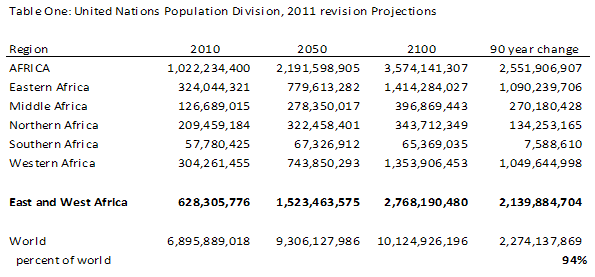
    Still, given that UN numbers are estimates, how accurate are the projections for Africa? Table #1 shows the 2010 estimates for the five regions of Africa, and the 2050 and 2010 projections. While East and West Africa combined represent 9 percent of global population and land area, this last frontier of population growth is interesting. The estimates indicate dramatic growth from 1950 to 2010. Population in North, South and Middle Africa as a group have peaked, while East and West Africa are still accelerating. (The other 91 percent of the globe is 80 percent of the way to the UN’s population peak in 2058 and is basically done with population growth.)

    The dynamics of global population change are becoming focused on East Africa and West Africa, the two regions which together comprise about forty percent of the land area of Africa. With the rest of the world experiencing a mix of modest population growth and decline, East and West Africa are projected to experience 94 percent of future global population growth. Even with a more likely scenario of a leveling off at 1.523 billion rather than going on to a very large 2.14 billion, East and West Africa will still represent the largest demographic change story of the 21st century.

    Do East and West Africa have some demographic similarities with China and Latin America back in 1960? If so, as has been seen around the world, fertility declines from 6 to 2 children per mother will happen much more quickly than the UN 2011 projections suggest. Given that African real economic growth of 57% has been robust in the last ten years, including a 29% gain in real per capita income, there is evidence that the continent is slowly emerging out of a poverty trap. Africa is also rapidly urbanizing, and demographic surveys conclusively show a big difference in the fertility rates of women living in urban areas as opposed to rural ones. East and West Africa represent a very interesting final chapter in modern population growth, with the challenge to use land and fresh water efficiently and protect significant wildlife resources, while potentially becoming an economic powerhouse later into the century.

    The story will be interesting and important to follow. In the next forty years, East and West Africa, along with South Asia, will be the big population growth centers, while the rest of the world will increase very slowly. Even with dramatic economic growth, urbanization, and a doubling of population in East and West Africa in the next few decades, the global population could very well level off at 8.8 billion rather than 10.1 billion.

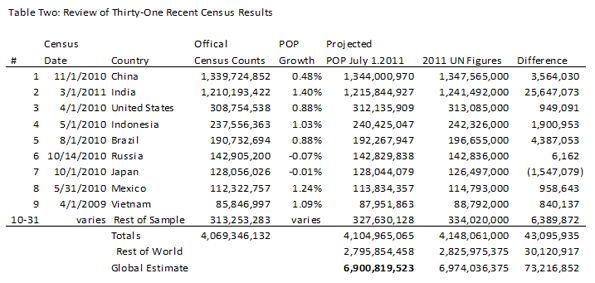
    Back to the estimates themselves: The UN pieces together a global story from a set of data and estimates from countries with infrequent censuses. Table Two shows official national census estimates for 31 countries, which represent about 60% of the global population. Most of the census results are coming in below UN projections.

    Assuming that the rest of the world’s nations that have not conducted recent censuses have similar overall projection problems, one could infer that the actual population is at least one percent lower than the UN 2011 estimates. If we just assume the UN population growth rates for 2010-11 are accurate, and project these 31 country census results forward to July 1, 2011, we get a population of 6.9 billion people. We would then estimate that the world population would hit 7 billion in October, 2012.

    So why is the UN declaring October 31, 2011 as the day of 7 billion? While nobody knows what the true world population is, perhaps the UN should err on the side of accuracy… and put off this announcement until 2012. A delay would increase the probability that we actually have crossed that symbolic threshold, something for all people on earth to reflect upon.

    Ron McChesney is a Geographer who founded a research firm called Three Scale Strategy and a related non-profit called Three Scale Research. The company studies and reports on the economy of the state of Ohio and how Ohio interacts with the rest of the world. His research interests include the study of patterns and changes in population, land use, economics, energy production and transportation.

    Data Sources: UN Population Division, International Monetary Fund, Geohive.com

    Photo by etrenard, “Niger Portrait”

  • The Poverty Of Ambition: Why The West Is Losing To China And India – The New World Order

    The last 10 years have been the worst for Western civilization since the 1930s. At the onset of the new millennium North America, Europe and Oceania stood at the cutting edge of the future, with new technologies and a lion’s share of the world’s GDP.  At its end, most of these economies limped, while economic power – and all the influence it can buy politically – had shifted to China, India and other developing countries.

    This past decade China’s economic growth rate, at 10% per annum, grew to five times that U.S.; the gap was even more disparate between China and the slower-growing  E.U.,  Yet periods of slow economic growth occur throughout history — recall the 1970s — and economies recover. The bigger problem facing Western countries, then, is a metaphysical one — a malady that the British writer Austin Williams has dubbed “the poverty of ambition.”

    This lack of ambition plagues virtually every Western country. The ability to act has become shackled by a profound pessimism that according to a recent Gallup survey contrasts with the optimism found not only in rising states like China, India and Brazil, but also deeply impoverished places like Bangladesh.

    Attitudes have consequences. The rising stars of the non-Western world — from the United Arab Emirates to Singapore and China — are building cities with startling new architecture and bold infrastructure. Their entrepreneurs are expanding their operations across the planet.

    Of course, you can chortle at the outrageous overbuilding in places like Dubai, but the Western world might do better to appreciate the scope of their ambition. Indeed, for years New York’s Empire State building, erected  during the Depression, was derided as  ”the empty state building.” Today it’s visionary developers like Iraqi-born Istabraq Janabi who are planning unlikely  new structures even  in  troubled places like Ramadi, Iraq.

    The difference in ambition can be seen clearly at airports, which now serve as the entry halls of the global economy. A traveler to John F. Kennedy Airport, Heathrow, Charles De Gualle LAX or Dulles passes through decayed remnants of fading late 20th century buildings and technology. In contrast, airports in Dubai, Hong Kong and Singapore offer clean, ultra-modern facilities with often impressive design.

    The West’s retreat from space exploration further underscores its metaphysical poverty. Today, Europe and the U.S., the world’s historic leader in the field, are cutting back on plans to explore the cosmos, which has included a manned operation to the moon. President Obama wants NASA to focus more on issues regarding climate change instead. In contrast, the rising countries of Asia, notably China and India, have begun plans for manned flights to the moon and beyond.

    This divergence is not about resources; it is about the growing conviction in the West that moving forward is an illusion or, as the British academic John Gray’s puts it, “progress is a myth.”  Victorian empire-makers and intellectuals, like their republican American successors, believed perhaps naively in the potential of humanity, economic and technological progress. Today our intellectual and political classes have gone to the other extreme.

    The West’s politics are in the grips of two profoundly retrograde mentalities. One, a small-minded conservatism, harks back to the “golden” age of the 1950s when Western power faced only a flawed Soviet challenge. The idealistic but flawed commitment to imposing democracy by force of the Bush years has faded; it has been replaced by an obsession with taming a bloated public sector. While this focus may be justified, it is fundamentally more reactive than proscriptive.

    The Left, which once portrayed itself as the bastion of scientific rationalism, increasingly embraces neo-druidism, a secular form of nature worship. This tendency’s roots can be traced back to the “Limits to Growth” ideology of the early 1970s which projected, mostly mistakenly, that the planet was about to run out of everything from food to oil. Concerns over climate change have transformed this dismal sentiment into a theology, with carbon emissions treated as a form of original sin.

    The anti-progress nature of the new Left is unmistakable. Rather than seek ways to control climate change, suggests The Guardian’s George Monbiot, environmentalism is engaged in “a battle to redefine humanity.” Monbiot believes the era of economic growth needs to come to an inevitable denouement; that “the age of heroism” will be followed by the decline of the “expanders” and the rise of the “restrainers.”

    Europe, particularly the U.K., suffers acutely from metaphysical angst.  Once touted as the new great power by its leaders and their American claque, the E.U. is quickly dissolving along cultural and historical lines; this is especially evident in the division between the  resilient countries of the north (something like the Hansa trading states of the late Middle Ages) and the weaker countries along the periphery. For the most part, Europe no longer seems capable of doing much more than finding ways to control an unaffordable welfare state without tearing about its social net. The once cherished notion of a multi-racial “new” Europe largely has dissolved as immigration has devolved from a source of demographic and cultural salvation to a widely perceived threat to the E.U.’s economic and social health as well as security.

    Such defeatism usually has less success in the United States. But America’s “progressive” left increasingly resembles its European cousins.  Obama’s science advisor, John Holdren, has been a long-time advocate of the idea of “de-development,” the purposeful slowing of growth in advanced countries in order to protect the environment. The critical infrastructure needed to accommodate upward of another  100 million Americans — new dams in the west, intelligent development of our vast natural gas reserves and building new cities, airports and ports  – are not at the center of either party’s platforms. These could be financed largely with private sources, given the right incentives.

    Fortunately the West’s decline is not at inevitable. China, India, Vietnam, Brazil, South Africa all deserve their day in the sun, but this does not mean that Americans or Europeans should cower in the shadows. Western countries still possess much of the world’s cutting-edge technology and leading companies; the combined GDP for the E.U., North America and Oceania stands at over $33 trillion, almost five times that of India and China together.

    More important still, the political and cultural institutions of the West — with their liberal values — represent the best hope for a stable world of self-governing peoples. Does anyone in the West, particularly the progressives in the media and academia, really want a world run by Chinese despotism?

    The current financial crisis should serve as both a warning and a spur for a new focus on economic expansion. But this can only occur if the West can restore its belief in its future. This does not necessitate a return to the colonial attitudes of the past, but rather a keener appreciation of our unique human, physical and political advantages.

    Only the United States – by far the richest, largest and most populous Western nation — can lead such a revival. For one thing, the U.S. remains the world’s leading immigrant magnet and most diverse large country, all of which makes it the natural center of an evolving global society. Although immigrants pose some serious issues, University of Chicago scholar Tito Sananji notes that the U.S., along with Canada and Australia, seems to be doing a better job educating their newcomers than the continental European states.

    The U.S., Canada and Australia also possess resources, most critically food, that could benefit from growing demand in developing countries. Both North America and some European nations — notably the new Hansa of the Netherlands, Germany and Scandinavia – remain world leaders in scores of industrial endeavors, as well as technology- and culture-based industries.

    Together these Western countries can do much more to shape the global future than is commonly understood. But to do so this century they will need how to recover the animal spirits that drove their remarkable rise in the last.

    Joel Kotkin is executive editor of NewGeography.com and is a distinguished presidential fellow in urban futures at Chapman University, and an adjunct fellow of the Legatum Institute in London. He is author of The City: A Global History. His newest book is The Next Hundred Million: America in 2050, released in February, 2010.

    Photo by Wally Gobetz

  • West Africa – Key to Feeding the Next 3 Billion?

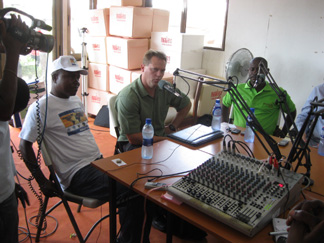
    Saturday October 16 marked my third day in Accra, Ghana representing AdFarm and Praxis Strategy Group at the National Food and Agriculture (FAGRO) show. We began the day with a deep dive into grower issues as panelist guests on an agriculture-focused radio program hosted by 90.1 Rite FM.

    The panel included John Dziwornu, National Secretary of the National Association of Farmers and Fishermen; Myself (Colin Clarke of AdFarm); Tony Mensah-Abrampah of Praxis Africa;  Jaques Magnee, commercial director for Raanan Fish Feed; and Andy, a farmer member of a Ghanaian Mango Cooperative.

    As a panelist on the 2+hour radio program it served as a great opportunity to learn about the challenges faced by farmers. I was pleasantly surprised to find much common ground among North American and Ghanaian farmers. The similarities were stark:

    • Farmers feel misunderstood and taken for granted. People do not understand the risks they bear to produce food. As long as there is food at the market people are unconcerned about farming.
    • Farmers may only get one paycheck per year. There are no monthly paychecks like off-farm careers.
    • Farmers take great pride in the job they do and often work under difficult conditions. There are no “days off” and farmers bear great risks.

    When asked if farmers are difficult to work with, Andy of the Mango Cooperative answered, “Farming is a difficult job – we want to complain, so let us complain!” I loved Andy’s candor. He was brutally honest and very animated. Tremendous passion for his work as a farmer.

    There was much discussion about lack of access to financing for Ghanaian farmers and the expense of finance options today. Farmers are commonly required to pay up to 22% interest on operating loans… if loans can be secured at all. Another farmer who joined the discussion stated the need for an insurance program that will protect farmers in case of crop loss so loans can be repaid. He stated instances where he has bore the entire expense of bringing a crop to harvest, then having NO market for his crop or losing his crop to a weather issue. There are many variables working against the farmer and very little assurances outside of some subsidies on crop inputs (fertilizer for example).

    My observation is the entire agricultural structure in Ghana is in its infancy. There is need for farm safety nets (insurance programs), there is need for grower education programs on production, there is need for market access expansion, there is need for improved import laws, and there is incredible need for ag infrastructure that will allow farmers to expand production and deliver their crop to market.

    An interview with Davies Korboe, Chairman of farmerdavies inc. and 2010 National Farmer of the Year reinforced many of these points. Davies is a highly diversified farmer raising a mix of crops and livestock. He would be considered a large farmer in Ghana, but even as a large farmer he is facing the same issues with financing, insurance, market access and infrastructure. He sees great opportunity for Ghanaian agriculture, but many issues to overcome.

    Our final meeting of the day was with Philip Abayori, a farmer and President of a prominent Farm and Fisherman Association. A brilliant man, he has an amazing outlook for Ghanaian agriculture. He states there are 12 MILLION hectares of productive land in Ghana and less than 2% in active production today. He describes the different growing regions suitable for different ag industries: forestry, aquaculture, production agriculture and livestock. He envisons programs where farmers and industry professionals from each track can work together towards sustainable, well-managed production. He has great faith in the capabilities Ghanaian farmers.

    My outlook towards agriculture in Ghana is one of opportunity. As we hear the “experts” tell us there is no more land available to feed the next 3 billion people I am encouraged to see places like Ghana with 12 million hectares waiting for production. Are these areas of the world forgotten? Places like Ghana can do their part to feed the world while strengthening the country’s agrarian economy at the same time. There is so much good to be done.

    So where do you want to start?

    Dr. Colin N. Clarke is a senior strategist for AdFarm. Follow him on Twitter @colinnclarke or on Facebook at Facebook.com/cnclarke

  • African Farmers Hungry for Markets

    The 30th World Food Day finds more hungry people on the planet than ever before. According to the Food and Agriculture Organization (FAO) of the United Nations 1 billion people live in chronic hunger. UN Secretary General Ban Ki-moon’s official message on this year’s theme “United against Hunger” reflects today’s global reality. “For many people, today is not World Food Day. It is another No Food Day.”

    The future holds a seemingly unceasing series of challenges as food production will have to increase 70 percent by 2050 to feed a looming population of nine billion people. Here in Accra, Ghana, however, the mood is hopeful. The Honourable Kwesi Ahwoi, Minister of Food and Agriculture proclaimed that “a lot is happening here. The country is moving forward and we are not going back.”

    Ghana is considered the gateway to Africa based on its strong agrarian roots and stable political environment. Agriculture is the dominant sector in Ghana’s economy. The sector plays a critical role in reducing poverty and achieving economic growth employing about 60% of the labor force and contributing about 40% to the Gross Domestic Product (GDP). It also accounts for over 57% of the country’s foreign exchange earnings.

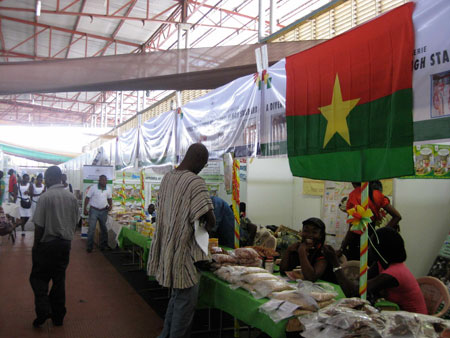
    This week at the 2nd National Farm and Agric Show in Accra (FAGRO) the suggestion that some parts of Africa might be turning the corner seems at least conceivable. At the show farmers, associations of farmers and fisherman, agribusinesses from all sectors, and NGO and governmental agricultural development organizations have come together to share Ideas, showcase and promote agriculture products and learn about improved modern and innovative methods of farming.

    Farmers at the World Food Day ceremonies and the farm and agric show are confident they are up to the task. A placard carried by a farmer in the audience said as much – Aid Cannot Feed Us For Life. Rather fair prices and ready markets for what we also produce. Talking with farmers and processors who produce everything from nutmeg and tilapia to pineapple juice and dehydrated oyster mushrooms confirmed the prevailing sentiment that farmers are eager to access new technologies and reach new markets.

    Linking African producers to markets is not exactly a new idea. International aid and finance organizations have invested significant resources to provide technical assistance to help farmers use good agricultural practices and to shore up supply chains. ACDI/VOCA, for example, is improving Ghana’s agricultural sector by increasing competitiveness in domestic, regional and international markets through the USAID-funded Ghana Agricultural Development and Value Chain Enhancement (ADVANCE) program. Policies and programs like the USA’s African Growth and Opportunity Act (AGOA) offer incentives for Ghana and other African countries to continue their efforts to open their economies and build free markets.

    Significant challenges remain of course if Ghana and other African countries are going to truly turn the corner on combating hunger and malnutrition at home while penetrating new markets on the continent and elsewhere on the globe.

    Philip Abayori, Chairman of the FAGRO Advisory Board, explains that irrigation systems are vastly underutilized for production while post-harvest storage and distribution systems are entirely inadequate. So much that, in some cases, up to 40 percent of the harvest is lost to spoilage.

    At the other end of the market, particularly in foreign markets, there is a lack of information and the necessary infrastructure according to John Dziwurnu, National Secretary for the Ghana National Association of Farmers and Fishermen. Producers need to know what consumers want before they can grow to their requirements; then they must be able to ship them to points of distribution where adequate storage and quality control is in place that will enable products to reach consumers in top condition.

    Find out more about Delore’s and Colin Clark’s visit to Ghana at the AdFarm Blog.

    Delore Zimmerman is publisher of NewGeography.com and President of Praxis Strategy Group.

  • Bill Gates is Right On – We Can Feed a Growing, Hungry World

    The world’s richest man recently sent a shockwave through the world food community by calling for another green revolution built upon n sustainability paired with genetic modification. Gates, one of the preeminent global philanthropists, made the case for empowering Africa’s small landholder farmers to be more productive in drought-ridden and other harsh environments.

    “Poor farmers are not a problem to be solved; they are the solution—the best answer for a world that is fighting hunger and poverty, and trying to feed a growing population,” Gates said.

    Next week in Ghana the first National Farm and Agriculture Show (FAGRO) will be held to take steps that will add value to agriculture and move it from it peasant stage to a commercial stage. According to the Coordinator of FAGRO ’09, Ms. Alberta Nana Akyaa Akosa , “agriculture is a highly ignored discipline and this is not good for the growth of the economy. A lot of corporate institutions do not place high priority on Agriculture and we at FAGRO aim to bring a new revolution in the Agriculture sector. This revolution will increase Private Partnership Approach; where Agriculture will not be politically but privately driven; a revolution where most of our young ones will come out of school and yearn to go into Agriculture” she noted. “It is the only way we can free ourselves from the high import rate of all consumables”, she added.

    During this Thanksgiving holiday we should be mindful that meeting the food needs of a growing, global population – estimated to be around 9 billion by 2050 – will require harnessing the tremendous productive power of North American agriculture, as well as in producing countries in Oceania and Europe, as well as improving the ability of small farmers around the world to produce more for indigenous and export markets alike.

    Precision agriculture can be used to scale up sustainable agricultural practices, reducing energy usage and other environmental ill effects often associated with large-scale production agriculture. Providing small farmers with access to agricultural technologies adaptable to local circumstances and market access should be given highest priority.

    Bill Gates knows this. So do developing world visionaries like Alberta Nana Akyaa Akosa.