Tag: agriculture

  • West Africa – Key to Feeding the Next 3 Billion?

    Saturday October 16 marked my third day in Accra, Ghana representing AdFarm and Praxis Strategy Group at the National Food and Agriculture (FAGRO) show. We began the day with a deep dive into grower issues as panelist guests on an agriculture-focused radio program hosted by 90.1 Rite FM.

    The panel included John Dziwornu, National Secretary of the National Association of Farmers and Fishermen; Myself (Colin Clarke of AdFarm); Tony Mensah-Abrampah of Praxis Africa;  Jaques Magnee, commercial director for Raanan Fish Feed; and Andy, a farmer member of a Ghanaian Mango Cooperative.

    As a panelist on the 2+hour radio program it served as a great opportunity to learn about the challenges faced by farmers. I was pleasantly surprised to find much common ground among North American and Ghanaian farmers. The similarities were stark:

    • Farmers feel misunderstood and taken for granted. People do not understand the risks they bear to produce food. As long as there is food at the market people are unconcerned about farming.
    • Farmers may only get one paycheck per year. There are no monthly paychecks like off-farm careers.
    • Farmers take great pride in the job they do and often work under difficult conditions. There are no “days off” and farmers bear great risks.

    When asked if farmers are difficult to work with, Andy of the Mango Cooperative answered, “Farming is a difficult job – we want to complain, so let us complain!” I loved Andy’s candor. He was brutally honest and very animated. Tremendous passion for his work as a farmer.

    There was much discussion about lack of access to financing for Ghanaian farmers and the expense of finance options today. Farmers are commonly required to pay up to 22% interest on operating loans… if loans can be secured at all. Another farmer who joined the discussion stated the need for an insurance program that will protect farmers in case of crop loss so loans can be repaid. He stated instances where he has bore the entire expense of bringing a crop to harvest, then having NO market for his crop or losing his crop to a weather issue. There are many variables working against the farmer and very little assurances outside of some subsidies on crop inputs (fertilizer for example).

    My observation is the entire agricultural structure in Ghana is in its infancy. There is need for farm safety nets (insurance programs), there is need for grower education programs on production, there is need for market access expansion, there is need for improved import laws, and there is incredible need for ag infrastructure that will allow farmers to expand production and deliver their crop to market.

    An interview with Davies Korboe, Chairman of farmerdavies inc. and 2010 National Farmer of the Year reinforced many of these points. Davies is a highly diversified farmer raising a mix of crops and livestock. He would be considered a large farmer in Ghana, but even as a large farmer he is facing the same issues with financing, insurance, market access and infrastructure. He sees great opportunity for Ghanaian agriculture, but many issues to overcome.

    Our final meeting of the day was with Philip Abayori, a farmer and President of a prominent Farm and Fisherman Association. A brilliant man, he has an amazing outlook for Ghanaian agriculture. He states there are 12 MILLION hectares of productive land in Ghana and less than 2% in active production today. He describes the different growing regions suitable for different ag industries: forestry, aquaculture, production agriculture and livestock. He envisons programs where farmers and industry professionals from each track can work together towards sustainable, well-managed production. He has great faith in the capabilities Ghanaian farmers.

    My outlook towards agriculture in Ghana is one of opportunity. As we hear the “experts” tell us there is no more land available to feed the next 3 billion people I am encouraged to see places like Ghana with 12 million hectares waiting for production. Are these areas of the world forgotten? Places like Ghana can do their part to feed the world while strengthening the country’s agrarian economy at the same time. There is so much good to be done.

    So where do you want to start?

    Dr. Colin N. Clarke is a senior strategist for AdFarm. Follow him on Twitter @colinnclarke or on Facebook at Facebook.com/cnclarke
  • African Farmers Hungry for Markets

    The 30th World Food Day finds more hungry people on the planet than ever before. According to the Food and Agriculture Organization (FAO) of the United Nations 1 billion people live in chronic hunger. UN Secretary General Ban Ki-moon’s official message on this year’s theme “United against Hunger” reflects today’s global reality. “For many people, today is not World Food Day. It is another No Food Day.”

    The future holds a seemingly unceasing series of challenges as food production will have to increase 70 percent by 2050 to feed a looming population of nine billion people. Here in Accra, Ghana, however, the mood is hopeful. The Honourable Kwesi Ahwoi, Minister of Food and Agriculture proclaimed that “a lot is happening here. The country is moving forward and we are not going back.”

    Ghana is considered the gateway to Africa based on its strong agrarian roots and stable political environment. Agriculture is the dominant sector in Ghana’s economy. The sector plays a critical role in reducing poverty and achieving economic growth employing about 60% of the labor force and contributing about 40% to the Gross Domestic Product (GDP). It also accounts for over 57% of the country’s foreign exchange earnings.

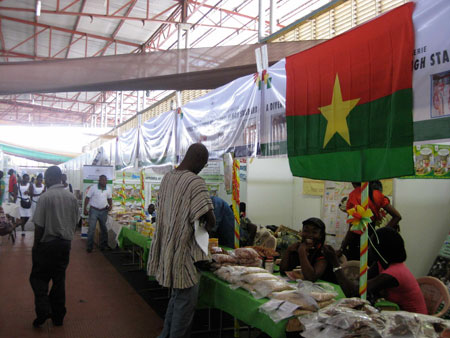
    This week at the 2nd National Farm and Agric Show in Accra (FAGRO) the suggestion that some parts of Africa might be turning the corner seems at least conceivable. At the show farmers, associations of farmers and fisherman, agribusinesses from all sectors, and NGO and governmental agricultural development organizations have come together to share Ideas, showcase and promote agriculture products and learn about improved modern and innovative methods of farming.

    Farmers at the World Food Day ceremonies and the farm and agric show are confident they are up to the task. A placard carried by a farmer in the audience said as much – Aid Cannot Feed Us For Life. Rather fair prices and ready markets for what we also produce. Talking with farmers and processors who produce everything from nutmeg and tilapia to pineapple juice and dehydrated oyster mushrooms confirmed the prevailing sentiment that farmers are eager to access new technologies and reach new markets.

    Linking African producers to markets is not exactly a new idea. International aid and finance organizations have invested significant resources to provide technical assistance to help farmers use good agricultural practices and to shore up supply chains. ACDI/VOCA, for example, is improving Ghana’s agricultural sector by increasing competitiveness in domestic, regional and international markets through the USAID-funded Ghana Agricultural Development and Value Chain Enhancement (ADVANCE) program. Policies and programs like the USA’s African Growth and Opportunity Act (AGOA) offer incentives for Ghana and other African countries to continue their efforts to open their economies and build free markets.

    Significant challenges remain of course if Ghana and other African countries are going to truly turn the corner on combating hunger and malnutrition at home while penetrating new markets on the continent and elsewhere on the globe.

    Philip Abayori, Chairman of the FAGRO Advisory Board, explains that irrigation systems are vastly underutilized for production while post-harvest storage and distribution systems are entirely inadequate. So much that, in some cases, up to 40 percent of the harvest is lost to spoilage.

    At the other end of the market, particularly in foreign markets, there is a lack of information and the necessary infrastructure according to John Dziwurnu, National Secretary for the Ghana National Association of Farmers and Fishermen. Producers need to know what consumers want before they can grow to their requirements; then they must be able to ship them to points of distribution where adequate storage and quality control is in place that will enable products to reach consumers in top condition.

    Find out more about Delore’s and Colin Clark’s visit to Ghana at the AdFarm Blog.

    Delore Zimmerman is publisher of NewGeography.com and President of Praxis Strategy Group.

  • Bill Gates is Right On – We Can Feed a Growing, Hungry World

    The world’s richest man recently sent a shockwave through the world food community by calling for another green revolution built upon n sustainability paired with genetic modification. Gates, one of the preeminent global philanthropists, made the case for empowering Africa’s small landholder farmers to be more productive in drought-ridden and other harsh environments.

    “Poor farmers are not a problem to be solved; they are the solution—the best answer for a world that is fighting hunger and poverty, and trying to feed a growing population,” Gates said.

    Next week in Ghana the first National Farm and Agriculture Show (FAGRO) will be held to take steps that will add value to agriculture and move it from it peasant stage to a commercial stage. According to the Coordinator of FAGRO ’09, Ms. Alberta Nana Akyaa Akosa , “agriculture is a highly ignored discipline and this is not good for the growth of the economy. A lot of corporate institutions do not place high priority on Agriculture and we at FAGRO aim to bring a new revolution in the Agriculture sector. This revolution will increase Private Partnership Approach; where Agriculture will not be politically but privately driven; a revolution where most of our young ones will come out of school and yearn to go into Agriculture” she noted. “It is the only way we can free ourselves from the high import rate of all consumables”, she added.

    During this Thanksgiving holiday we should be mindful that meeting the food needs of a growing, global population – estimated to be around 9 billion by 2050 – will require harnessing the tremendous productive power of North American agriculture, as well as in producing countries in Oceania and Europe, as well as improving the ability of small farmers around the world to produce more for indigenous and export markets alike.

    Precision agriculture can be used to scale up sustainable agricultural practices, reducing energy usage and other environmental ill effects often associated with large-scale production agriculture. Providing small farmers with access to agricultural technologies adaptable to local circumstances and market access should be given highest priority.

    Bill Gates knows this. So do developing world visionaries like Alberta Nana Akyaa Akosa.

  • Economic Resilience in Rural America?

    This week Reuters is hosting a Food and Agriculture Summit in Chicago. On Tuesday presenters, including leading agribusiness executives and business economists, reported that despite the challenging global economic climate, the U.S. rural economy has weathered the recession better than most sectors due to steady demand for agricultural products, stable land prices and healthy credit lines for farmers”.

    Jim Borel, a VP at DuPont Co stated that “fundamentally, food demand is there,” as “people need to eat,” which “helps to stabilize things.” According to Reuters such claims were echoed by other participants, including Mark Palmquist, CEO of CHS Inc, who noted that the world keeps “adding mouths to feed,” and that “food demand… tends to be pretty insensitive to what the global economy is doing.”

    While there appears to be some anticipation of stability at large agribusiness corporations, such optimism may be tempered among farmers, who have seen commodity prices drop by 50% or more over the past year. Such drops will create a more difficult business environment for producers. However, there is some hope that the strong prices received by farmers over the past couple of years will make them better able to, as one agricultural official in Wisconsin stated recently, “ride it out for somewhat longer than otherwise would have been the case”.

  • Down on the Farm

    2007 was a good year for rural America. Driven by “bumper crops, strong demand, and high prices” in commodity markets, farmers across the United States enjoyed an “exceptional year”. Strong conditions continued into the first half of 2008, spurring farmers to increase “purchases of capital equipment and household consumption,” and fueling “double-digit percentage gains in cropland values,” in many areas of the nation.

    Unfortunately for rural America, these boom times appear to be drawing to a close. Over the past few months, prices for wheat, soybeans, corn, and other commodities have come back to earth, while input costs have soared. According to the Fargo Forum, the USDA calculates that expenses faced by farmers “increased half as much in just the past year as they rose in the previous 15 years combined,” leaving farmers “hard-pressed to make money next year even if they enjoy good yields”. This has left many farmers concerned that farm country may be facing a repeat of the lean times faced during the farm crisis of the late 70’s and early 80’s. One long-time farmer, Harlan Meyer of Davenport, Iowa, expressed his reservations about the situation to the AP, stating that,

    “I guess you could say there’s an awful lot of concern in the rural communities and with some of the city people… I would think there would be a lot of cautiousness among farmers because most of the people can remember the ’80s and I would think there’s probably a lot of cautious people now on spending a lot of money.”

    While rural communities may be facing tougher economic times in the face of a bursting commodity bubble, it appears that their banks will be able to meet such challenges from a position of relative strength. According to Reuters, banks throughout rural America “are not freezing credit to customers like large money center banks, offering a bright spot in an otherwise gloomy economy”. Such banks have “largely steered clear of the subprime housing loans,” have “low to no exposure,” to credit derivative instruments, and are able to draw on a strong base of deposits to continue to provide loans. Those loans will also be made at far better terms than those seen during the farm crisis, with banks today offering farmers “interest rates that are one-third or one-half of what they were in the late 1970s.”

    While conditions may have some ways to go to match the bleak days of the farm crisis, some legislators are already expressing concern about access to credit in farm country. This week, Sen. John Thune of South Dakota called for a hearing to explore the impact of the credit crisis on rural America. While rural banks may be in relatively sound health, it appears that those same banks are, according to the AP, requiring “more collateral and higher interest rates,” for loans, and are, in the words of a Texas A&M economist, “turning conservative”. However, the AP also notes that even in the face of such tightening, lending will continue, as “the industry’s traditional lenders — independent commercial banks — are on more solid financial footing than the country’s largest investment banks and commercial banks”.