Tag: airports

  • Beijing on Track to Be World’s Busiest Airport

    For years, the world’s busiest airports in passenger volume have been Atlanta’s Hartfield-Jackson International and Chicago’s O’Hare. However, there are indications that this long dominance may be about to end. According to Airport Council International data for 2009, Chicago O’Hare had fallen to 4th position, following Atlanta, London-Heathrow and Beijing Capital International Airport.

    Beijing’s Capital International increased its passenger volume by 17% in 2009, while European and American airports were experiencing slight declines due to the recession. Beijing’s increase is more significant, because growth might have been expected to level off after the 2008 Olympics, which were held in Beijing. Between 2008 and 2009, Beijing rose from 8th in the world to 3rd, and from 20th place in 2004, when its volumes were approximately one-half the present level.

    Early 2010 data (first quarter) indicates that Beijing Capital International has become the second busiest airport in the world, trailing only Atlanta. Passenger volumes were up 10.5% from a year earlier. If the current rate of growth continues, Beijing should pass Atlanta in two to three years, even if the American economy improves.

    London’s 130 million annual passenger traffic was the greatest of any metropolitan area in the world in 2009 (distributed among five airports). The new Conservative-Liberal Democrat government seems determined, however, to forfeit this ranking, having banned further London airport expansions to combat what it calls “binge flying.”

    New York was second with passenger traffic of 105 million at its three major airports, while Tokyo was third at 95 million. “Binge flying” does not seem to be a concern in Japan, where Tokyo’s Haneda Airport is adding a fourth runway and will soon serve international flights again, providing competition to more distant Narita. Atlanta’s single airport handles an annual passenger volume of 88 million.

    Other airports in China are also growing. In the Pearl River Delta (the world’s largest “mega-region,” an area of adjacent urban areas), the four large airports, Hong Kong, Guangzhou and Shenzhen accommodated passenger traffic of more than 105 million in 2009. Traffic at Shanghai’s Pudong and Hongqiao grew 14% and 10% respectively.

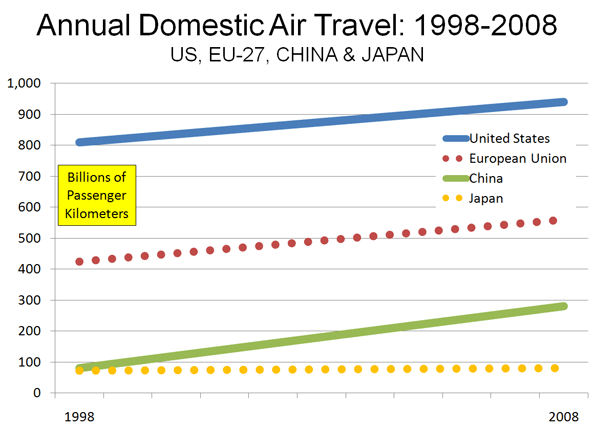
    Overall Chinese air traffic is also growing rapidly. Over the past 10 years, annual passenger volumes have risen an average of more than 25%. This compares to an average annual growth rate of 3.2% in the European Union (EU-27), 1.6% in the United States and 1.1% in Japan (Figure). The US continues to be dominant in passenger volumes, at 940 billion annual passenger kilometers, compared to 560 billion in the European Union, 280 billion in China and 80 billion in Japan (data calculated from US, Europe, China and Japan national sources).
  • Debates on Airport Rail

    Running a little behind this week, so I just wanted to pass along this story from USA Today on domestic airports adding rail service. People love the service, of course, and many airports are doing it, but later in the article they get to the economic irrationality of it in America’s decentralized car-centric cities (as opposed to Europe and Asia).

    Still, airport-rail ridership in the USA is woefully low compared with other countries, says Andrew Sharp, director general of the U.K.-based International Air Rail Organisation. In many European and Asian airports, 20% to 30% of travelers get to and from the airport using rail. In the USA, ridership typically ranges from 2% to 5%, he says.

    Ongoing debates

    Like most large construction projects, airport rail proposals face stiff headwinds. Opponents challenge funding sources and new taxes and cite preferences for cars and buses. But the central argument in most debates has centered around ridership, specifically whether airports have enough demand to justify millions in cost.

    BART’s connection to SFO, completed in 2003, has yet to reach BART’s initial ridership forecast and is still not profitable. Prior to construction, BART projected there would be 17,800 average daily boardings to and from the airport by the year 2010. As of this month, SFO ridership was at about 11,000.

    Frank Sterling and Juliet Ellis, activists in the Bay Area, also questioned BART’s plans to spend $500 million for Oakland International’s people-mover and its decision to charge $6 for the service vs. $3 for the current shuttle bus.

    “The proposal to charge double that for the new connector might drive away customers, unless it delivers twice the value,” they wrote in a recent newspaper commentary, “Can East Bay residents afford this?”

    Then they use some of my favorite arguments from past posts:

    These are appropriate debates, Coogan says. Some cities are better off sticking to buses, he says. For example, LAX’s FlyAway Bus, which provides non-stop rides to various neighborhoods in Southern California, is more convenient for many travelers than the metro.

    For some cities, it’d be wiser to spend scarce funds for extending metro to public transportation-friendly suburbs before considering airports, Coogan adds.

    How often does a person go to work? And how often does a person go to Paris in a year?” he says.

    More on these arguments here, here, and here (near the bottom). As I said in one of those posts: I agree, and I’ve said before that the market here is a niche one plenty well served by buses: young singles who can’t get a ride to/from the airport. Business travelers will almost always rent a car or take a taxi. Families won’t schlep their luggage on transit. Most others will have friends or family pick them up or drop them off. And our off-site airport parking is dirt cheap. The ridership drivers just aren’t there.