Tag: architecture

  • Big things that were never built in Los Angeles

    One of my lesser historical obsessions has been the grandiose stuff that’s been proposed for the Los Angeles area and never built. Things like the amusement park that Walt Disney proposed for Burbank before he put Anaheim on the map with Disneyland, or the assorted hotels, parks, monorails and highways that were given ink in the newspapers but either fell through or were never that real to begin with. I’ve written before about the sketch on my office wall from a 1913 Los Angeles Times front page envisioning a future downtown of skyscrapers, high-altitude auto bridges and curiously a waterfront. Imagine how different the city would be if, for instance, Valley promoters had gotten their way to plant the original LAX due west of the corner of Balboa and Roscoe. Or if the 1930 plan from Olmsted and Bartholomew for a chain of parks and playgrounds across the city had been accomplished.

    Sam Lubell, the West Coast Editor of the Architect’s Newspaper, and Greg Goldin, the architecture critic at Los Angeles Magazine, have mined the landscape and found some real gems. Lloyd Wright’s incredibly grand 1925 Civic Center for downtown (above.) Or the 1952 master plan for LAX by architects Pereira and Luckman. The plan is to use the research to mount an ambitious exhibition next spring at the A+D Architecture and Design Museum on Wilshire. They have launched a Kickstarter campaign to make it happen, and of course you can help.

    Check out their cool video:

    This piece first appeared at LA Observed.

  • Architecture Critic Paul Goldberger on Silicon Valley, San Jose, and Apple

    Last week Paul Goldberger, Pulitzer Prize winning architecture critic for the New Yorker and Vanity Fair, sat down with Allison Arief of the San Francisco Planning and Urban Research Association (SPUR) in downtown San Jose to discuss the state of 21st Century urbanism with a focus on Silicon Valley. Though admired the world over as the preeminent center for technological innovation, Silicon Valley has never been known for its great architecture. Goldberger suggested that this reputation could’ve improved had Apple not missed the mark with the design of their proposed Apple Campus 2 building in Cupertino.

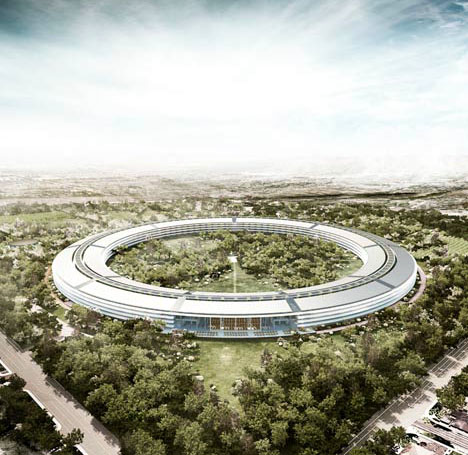
    While acknowledging that Apple is probably the best design company at the moment, Goldberger asserted that the company’s design abilities end with small consumer gadgets and fail spectacularly at the urban level. Calling the Norman Foster designed building for the new Apple Campus a ‘beautifully designed donut or spaceship’, he lamented the lack of context and connection to anything around it. Speaking to an audience that included members of San Jose’s city government, Goldberger suggested that Apple missed the opportunity to take the reins to help transform San Jose by relocating at least some of its operations to help its long struggling (and subsidized) downtown.

    The reality is that most of the big tech companies in the Valley, not just Apple, have an extreme indifference to place-choosing to locate operations in suburban office parks. This has much to do with the history of Silicon Valley planning as it does with the nature of tech companies, which tend to employ legions of introverted computer engineering types and go to great lengths to remain insular and secretive (Apple taking this to the extreme). Perhaps it also makes perfect sense that rather than even acknowledging the true urban environment, companies whose primary business is creating the virtual world in which we increasingly experience public life take an active stance on turning their backs on the city.

    Yet for those still interested in experiencing the delights of pre-Information Era, pre-21 Century urbanism, there is always San Francisco not far up the road.  Goldberger made the point that the handful of tech companies who do choose to locate their operations in the city probably have a different mindset than those that stay in the Valley. Twitter being the prime example of the moment- the micro blogging site just leased 400,000 square feet of space on a long-maligned section of Market Street. Up in Seattle, Amazon recently announced its plan to build three new 37-story towers in the downtown area, which the proposal’s architect said is “not about building a corporate campus, it’s about building a neighborhood.”

    So even though not every tech company is averse to the city, the Richard Florida argument that high urban density is a prerequisite for innovation and creativity is a bit of a stretch, as the economic success of suburban Silicon Valley continually disproves. Near the end of the discussion, Goldberger suggested that deliberately designing space for innovation might be a bit too self-conscious. This implies that rather than design, factors such as human resources, access to capital and a culture with openness to trial-and-error matter more than the traditional urban hardware of cities.

    Adam Nathaniel Mayer is an American architectural design professional currently based in China and California. In addition to his job designing buildings he writes the China Urban Development Blog. Follow him on Twitter: @AdamNMayer.

  • The House Home Savings Built

    After doing his duty for the Navy in Washington D.C. during World War II, my father returned to Los Angeles, and my parents moved into the Talmadge Apartments between Western and Vermont. They’d been married for 17 years without having any children. So my father informally adopted his two nephews.

    Around 1949, those nephews, who were students at UCLA, threw a party at the apartment. It was apparently a night to remember. The management decided to not renew my father’s lease. Shortly after that, my father’s wife announced, after nearly two decades of a childless marriage, that she was with child. (Full disclosure: that child was none other than this writer.)

    So my dad leased a house facing the Wilshire Country Club in Hancock Park. Then, in 1959, he formed a corporation to buy a nearby Tudor house, hire domestics, and rent the house back to him with domestic services. This was the man who founded the largest savings and loan in America, who in those years probably enabled more Californians to become homeowners than anyone else. But he was technically a renter all his life. Those were the days of the 70-percent and 90-percent top tax brackets, and byzantine legal structures were common.

    In mid-century Los Angeles, anything on Wilshire Boulevard was considered more prestigious than anything on the side streets. On the eastern end near Lafayette Park was the Bullocks Wilshire department store. Several miles west were the Miracle Mile department stores, which had beautiful shop windows facing the boulevard, even though most people entered the stores through portes-cochères in the rear. Many of the major liberal establishment churches—the PCUSA, the United Methodists, St. Basil’s Cathedral, and the Wilshire Boulevard Temple, Rabbi Magnin’s huge reform synagogue—lined the street. The Ambassador Hotel was one of the great hotels of the city. And then there was The Brown Derby Restaurant, which gave us the Cobb Salad.

    My father was originally from Omaha, Nebraska, but he moved west, graduating from the University of Southern California in 1927 and emerging from the Great Depression as a successful insurance underwriter. During the war, he heard talk among the military that Southern California was going to take off, so he bought a one-branch thrift downtown called Home Savings and Loan. Soon, it grew to be a multi-branched empire in four counties: Los Angeles, Orange, San Bernardino, and Riverside.

    Partly to get involved in philanthropy and partly to set up an estate plan, my father set up The Ahmanson Foundation. The idea was that The Ahmanson Foundation, after my father’s death, would inherit and control the for-profit companies. This was a common legal arrangement at the time, offering a way for wealthy families to preserve more of the family fortune. (I recommend the novel God Bless You, Mr. Rosewater, by Kurt Vonnegut, for a sense of how it worked.)

    Apparently, my father wasn’t a full member of the downtown establishment, for he chose to base his business several miles west of the establishment thoroughfares of Flower and Figueroa. He recruited the artist Millard Sheets to design for him a corporate headquarters on the north side of Wilshire Boulevard, between Serrano and Oxford Streets, in the early 1950s. Then he conceived of a fancier project for that site and hired Edward Durell Stone to design it. A model of it was in our house during my later high school years. It featured two buildings next to each other, with concave faces toward a courtyard. A third, taller building was to stand in back. But that part was never built.

    My father died suddenly on June 17, 1968, before ground was broken on the project. Fifteen months later, the U. S. Congress passed, and President Nixon signed, a bill called the Tax Reform Act of 1969. It rendered my father’s estate plan obsolete, for a non-profit foundation could no longer own a controlling interest in a for-profit corporation. Instead of remaining under the control of the The Ahmanson Foundation, Home Savings of America would have to go public. In the meantime, my father’s nephew Robert Ahmanson wound up overseeing construction on the pair of buildings. They were finished in 1973.

    The interest rate spike of the early ’80s was hard on Home Savings of America, and they sold off the Ahmanson Center on Wilshire at that time. Still, Home Savings coasted through the savings and loan crisis of the end of the ’80s, thanks to maintaining the conservative policies that my father had instituted.

    The area changed a lot in these years. After the Watts Riots of 1965, and in the 10 or 15 years after that, the upper and upper-middle classes of Pasadena, San Marino, Arcadia, and Hancock Park relocated en masse to the Newport Beach area in what I call the secessio patriciorum, or the secession of the patricians. Los Angeles Magazine featured an article in 1977 called “The Ripening of Orange County: Is It Stealing the L.A. Dream?” Indeed, a lot of the life seemed to get sucked out of Los Angeles at that time. One consequence of the secessio was that finance and retail and new construction tended to concentrate either downtown or west of central Beverly Hills. That left the Wilshire corridor in between down at the heels.

    Later, that part of Wilshire recovered and reinvented itself. New immigrants from Korea and Latin American countries moved in, and, for many years, such gentrification as took place in the area was done by these immigrants and not so much by white Anglos. After 1990, previously uncool areas like Pasadena, Santa Monica, and parts of downtown began to recover, and the Wilshire district became the heart of Koreatown. I now think of Los Angeles as being similar to San Francisco and Oakland. The West Side up to Hancock Park is like San Francisco, while the parts east of it are like Oakland and the East Bay. London and Berlin have the same sort of east-west-ness.

    Koreatown is a wonderful neighborhood, and the Ahmanson Center is still beautiful. But I can’t help feeling a touch of melancholy that my dad’s vision was never fulfilled. He’d hoped to make that part of Wilshire Boulevard one of the great financial and retail corridors of America. Today, the big players are concentrated downtown or in Beverly Hills and westward.

    If you walk up the Oxford Street side of the Ahmanson Center, you can see a travertine block with a Latin inscription. Translated, it says, “Robertus and Mauritius, two virtuous men, dedicate this stone to themselves.” Robertus is Robert Ahmanson, who supervised the construction of the center. Mauritius is Maurizio Bufalini, owner of a marble quarry in Carrara, Italy. Bufalini was a good friend of our family, and he provided the Italian and Greek marble that decorates the center. Both these men are “late,” as they say in Botswana English, meaning dead. The stone is dusty now, but the words can still be read. I wonder if anybody notices it, or wonders what it means.

    This piece first appeared at Zocalo Public Square.
  • Information Technology and the Irrelevance of Architecture

    Throughout history, architecture served as the primary communication device of common cultural values. Whether inspiring religious awe or displaying the power of an empire, great works of architecture went beyond mere utility to reflect the shared expression of time and place.  Modern architecture, with its right angles and smooth surfaces devoid of ornamentation expressed the early 20th Century zeitgeist of efficiency and mass production. In many ways, the Modern architectural language also conveyed common cultural values of the time as it became the model for socialist utopia.

    The information technology revolution of the late twentieth century changed the role of architecture forever. With digital information readily available at our fingertips, buildings are no longer needed as a communication device. This new paradigm has largely gone unnoticed by the architectural establishment, which itself has been through a series of futile stylistic phases in recent decades ranging from the campy Postmodernism to the cynical Deconstructivism. The soul-searching continues today, as leading architects promote the use of technology to justify the creation of wild, superfluous forms that are for the most part nothing more than self-referential, sculptural contortions.

    Function still matters, but building design often no longer serves the higher aim of communicating a shared culture to a civic audience. Rather, it is the mobile IT products created by companies like Apple that do a superior job of communicating and transferring information while at the same time filling a human desire for great design.

    The implications for urbanism are enormous. Cities, as they are thought of in the traditional sense of high-density concentrations of people and buildings, are no longer required for a productive economy. No other place represents this new reality better than Silicon Valley. Rather than being an exalted futuristic urban landscape as one might expect given the amount of innovation that goes on there, Silicon Valley is a non-descript amalgam of low-density suburban villages. The headquarters of internet giants like Google, Yahoo! and Facebook are just as anonymous—bland office parks that turn inwards and are indifferent to the street.

    Los Angeles Times architecture critic Christopher Hawthorne blasts this reality in a critique of the proposal for the new Apple headquarters, which he calls a ‘retrograde cocoon.’ The proposal is a huge four-story concentric ring set among a park-like setting in the Silicon Valley town of Cupertino which Hawthorne laments as what he sees as the continuation of an unfortunate land-use pattern of low-density sprawl.


    Urbanists cannot afford to ignore the fact that technology is unsympathetic to architecture. Computer programmers and IT innovators, people who require countless hours of focused concentration, might actually prefer the pastoral landscape and low-key nature of Silicon Valley to the noisy and bustling urbanism that define what we traditionally think of as a ‘city’. Taking this into consideration, the new Apple HQ is an appropriate design for its purpose and also serves as reminder of the irrelevance of architecture in the twenty-first Century.

    This essay originally appeared in the architecture journal CLOG: APPLE

    Adam Nathaniel Mayer is an American architectural design professional currently living in China. In addition to his job designing buildings he writes the China Urban Development Blog.