Tag: Asia

  • Peak People in Japan

    Japan reached "peak people" in 2011, when its population reached 127.4 million residents. From that point, all trends point to significant population losses. But, there is by no means unanimity on the extent of those population losses. Population projection is anything but an exact science, and Japan provides perhaps the ultimate example.

    Dueling National Population Projections

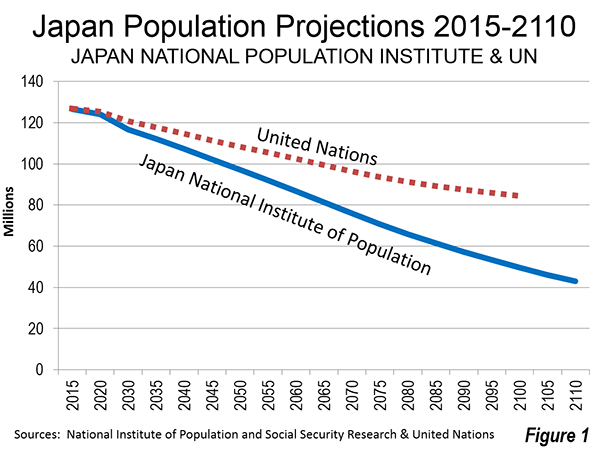
    Japan’s agency responsible for projecting population, the National Institute of Population and Social Security Research forecasts a stunning reduction of population to only 42.9 million residents in 2110. For every three Japanese residents today, there will be one in 2110 according to the National Institute of Population. If this projection is realized, Japan’s population would drop to a level not seen since the middle 1890s.

    The National Institute of Population projects a population loss to 97.0 million residents by 2050, for an annual population loss rate of 0.7 percent from 2015. By 2100, the population would fall to 49.6 million, for an annual loss rate of 1.3 percent. Over the 95 years from 2015, the annual population loss rate would accelerate from 0.4 percent annually to nearly 1.5 percent.

    The United Nations is considerably more optimistic about Japan’s future population than the National Institute of Population. The UN forecasts a population of 108.3 million residents by 2050, or 11 million more residents than expected by the National Institute of Population. The annual loss rate is 0.4 percent, one half the rate projected by the National Institute of Population. By 2100, the last year of the UN series, the population would be 84.5 million, 35 million more than the National Institute of Population figure. The UN’s annual population loss rate would be 0.8 percent (Figure 1).
    Major Metropolitan Areas

    Much of Japan’s urban population is in the dense corridor from Tokyo-Yokohama to Osaka-Kobe-Kyoto, a distance of approximately 300 miles (500 kilometers). The four metropolitan areas of this corridor (Tokyo-Yokohama, Shizuoka-Hamamatsu, Nagoya, and Osaka-Kobe-Kyoto) contain approximately 75 million residents. By comparison, the US Northeast Corridor is about 1.5 times as long and has under 50 million residents.

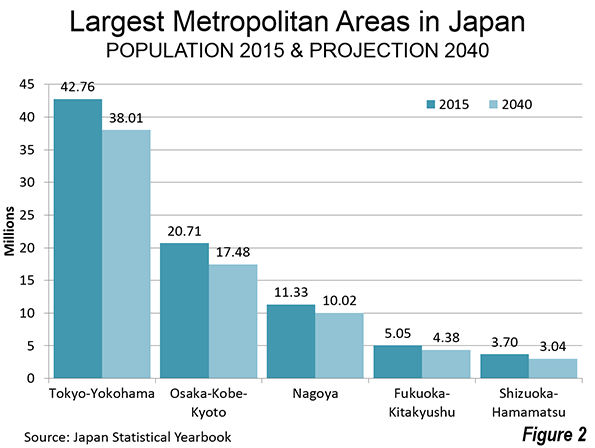
    According to National Institute of Population data, each of the 10 largest metropolitan has reached its population peak. The most populous, Tokyo-Yokohama is the only major metropolitan area to have gained population between 2010 and 2015. Each of the others had already reached their population peaks, according to the forecasts that end in 2040 (Figure 2).

    Tokyo-Yokohama:Tokyo-Yokohama is the world’s largest metropolitan area (labor market area). Much of it is located on the Kanto plain that stretches in three directions from Tokyo Bay. Between 2010 and 2015, Tokyo-Yokohama grew from a population of 42.6 million to 42.8 million. However a strong turnaround is anticipated. By 2020, the population is expected to fall to 42.4 million. Tokyo-Yokohama is expected to decline to 38.0 million residents in 2040, a reduction approximately equal to the population of metropolitan areas such as Phoenix, Montréal, and Melbourne. The 2040 population would represent a loss of approximately 11 percent from 2015.

    Osaka-Kobe-Kyoto: Osaka-Kobe-Kyoto has been Japan’s second largest metropolitan area for decades. Osaka-Kobe-Kyoto is a true conurbation, with three separate core cities and their suburbs that have grown together to form a single urban area, which now also encompasses smaller Nara, the country’s ancient capital. Some of Japan’s most important historical sites are in Kyoto and Nara. Despite having less than one half the population of Tokyo-Yokohama, Osaka-Kobe-Kyoto has been one of the world’s largest metropolitan areas for at least the last half of the century. Osaka-Kobe-Kyoto’s population fell from 20.9 million in 2010 to 20.7 million in 2015. By 2040, this large urban agglomeration is forecast to have a population of 17.5 million, down 16 percent from its 2015 level.

    Nagoya: Nagoya is Japan’s third largest metropolitan area and is located about two thirds of the way between Tokyo-Yokohama and Osaka-Kobe-Kyoto. Nagoya is renowned as the headquarters of Toyota. Nagoya is expected to fall from its 11.3 million residents in 2015 to 11.2 million in 2020 and 10.0 million in 2040. This population loss rate would be similar to that of Tokyo-Yokohama, at approximately 11 percent.

    Fukuoka-Kitakyushu: The Fukuoka-Kitakyushu metropolitan area is comprised of two large and separate urban areas. It is the only metropolitan area of the largest five that is not in the Tokyo to Osaka corridor. Further, Fukuoka-Kitakyushu is on the island of Kyushu, to the south of the main island of   Honshu. Fukuoka-Kitakyushu had a population of 5.0 million in 2015 and is expected to fall to 4.4 million in 2040. This is an approximately 12 percent population loss rate, somewhat worse than Tokyo-Yokohama and Nagoya.

    Shizuoka-Hamamatsu:The Shizuoka-Hamamatsu metropolitan area is located between the Tokyo-Yokohama and Nagoya metropolitan areas. In 2015, the population was 3.7 million, which is expected to drop to 3.0 million in 2040. This area, long a critical part of Japan’s industrial complex, would suffer the largest loss among the five largest metropolitan areas, at 18 percent.

    The Rest of Japan: The balance of Japan would experience an even greater loss, dropping from 43 million in 2015 to 34 million in 2040. This would represent a decline of 20 percent.
    Japan: Leading the Way?

    Japan is just the first of a wave of nations that are expected to experience population declines. The challenges are likely to be great as the nation is forced to downsize its considerable infrastructure to accommodate a smaller population. With a growing imbalance of senior citizens relative to working age adults, there are likely to be significant difficulties in financing social services. Japan’s strategies and successes or failures will be watched closely by national leaders from Berlin to Beijing and Brasilia whose nations  are likely to experience reductions in population and demographic imbalances starting mid-century or sooner.

    Wendell Cox is Chair, Housing Affordability and Municipal Policy for the Frontier Centre for Public Policy (Canada), is a Senior Fellow of the Center for Opportunity Urbanism (US), a member of the Board of Advisors of the Center for Demographics and Policy at Chapman University (California) and principal of Demographia, an international public policy and demographics firm.
    He is co-author of the "Demographia International Housing Affordability Survey" and author of "Demographia World Urban Areas" and "War on the Dream: How Anti-Sprawl Policy Threatens the Quality of Life." He was appointed to three terms on the Los Angeles County Transportation Commission, where he served with the leading city and county leadership as the only non-elected member. He served as a visiting professor at the Conservatoire National des Arts et Metiers, a national university in Paris.

    Photo: Fukuoka (by author)
  • Poorer Nations Set for 99% of Population Growth

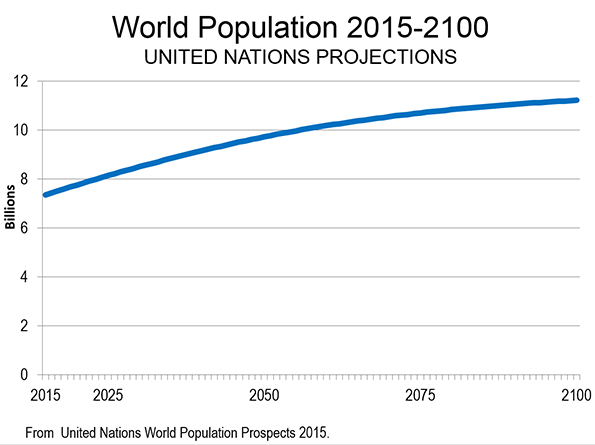
    According to the new United Nations World Population Prospects: The 2015 Revision, the population of the world is projected to rise from 7.3 billion in 2015 to 11.2 billion in 2100. This represents a 53 percent increase. However, over the period, population growth will moderate substantially. This is indicated by the annual growth rate the first year (2015 to 2016), at 1.1 percent, compared to the last year (2099 to 2100) at 0.1 percent. Annual population growth is projected to decline 90 percent from the beginning of the period to the end (Figure 1).

    Growth by Continent

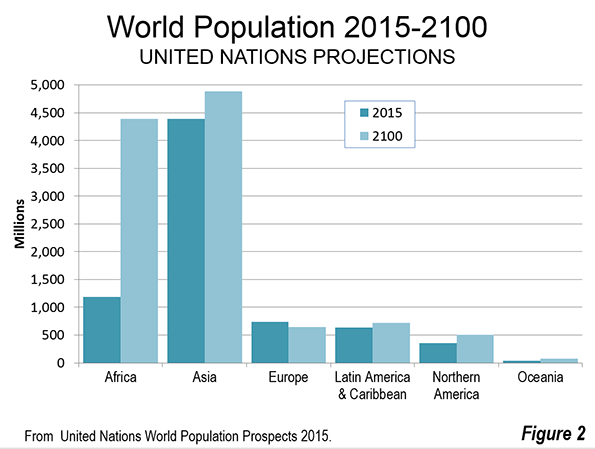
    The distribution of growth among the continents will be anything but even. Approximately 83 percent of the growth is projected to be in Africa, which is to grow approximately 270 percent. Asia is expected to account for 13 percent of the world’s growth and add 11 percent to its population. Northern America (Note), while growing 40 percent is expected to account for four percent of the world’s population growth. Latin America and the Caribbean are expected to account for 2.2 percent of the world’s growth, and add 14 percent to their population. Europe (including all of Russia) is expected to decline in population by 13 percent (Figure 2).

    Population Growth by Income Status

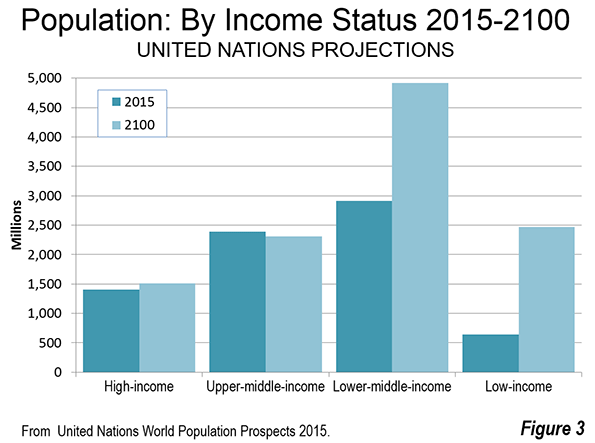
    World population growth is expected to vary widely by current income status (Figure 3). Income status is indicated on page 137 of this United Nations publication.

    The world’s high income nations are expected to add only eight percent (111 million) to their population and will represent only three percent of the population growth. These nations are principally in North America and Europe, but also include Japan, South Korea, Saudi Arabia and others.

    The world’s upper middle income nations are expected to experience a population decline of three percent, which amounts to a loss of 82 million residents. China, Russia, Mexico, South Africa, Iran and Brazil are examples of upper-middle income nations. When combined with the high income gain noted above the more affluent half of the world’s nations would add 29 million residents, or just 0.7 percent of the world’s growth. This is fewer people than live in the Tokyo metropolitan area.

    This means that more than 99 percent of world growth from 2015 to 2100 is expected to be among the lower income nations. The lower middle income nations would gain 2 billion people, representing 52 percent of the population growth.  The lower-middle income nations include India, Indonesia, Nigeria, the Philippines, Vietnam, Guatemala and others.

    The lower income nations would gain 1.8 billion people, capturing 47 percent of the world’s growth. The lower income nations include Bangladesh, Tanzania, Myanmar, the Democratic Republic of the Congo and others.

    In the high income and upper middle income regions, population growth will be also anything but consistent. Nations such as the United States, the United Kingdom, France, Canada and Australia are expected to grow far faster. The United States is expected to add 40 percent to its population and more than four times the population growth of all of the upper half of nations. Canada (up 39 percent) and Australia (up 77 percent), combined, are expected to add more population than the total upper income half of nations.  These gains will be largely offset by losses in Japan, Germany, South Korea, Italy and others.

    Largest Population by Nation

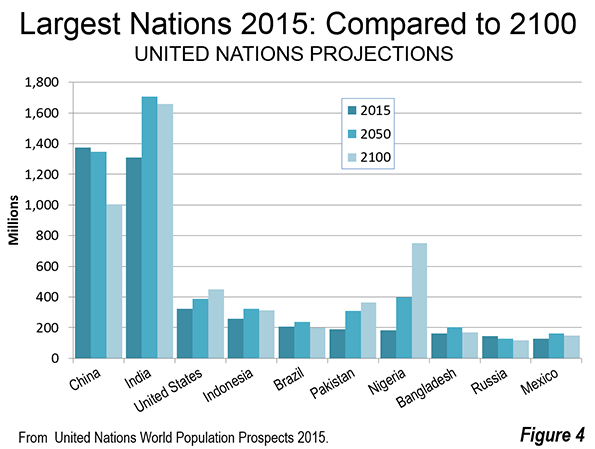
    China, with the largest population in 2015, is expected to fall behind India in 2050 and remain in second place by 2100. India is expected to be the largest nation in both 2050 and 2100. However, India’s population will be less in 2100 than it was in 2050.

    Eight of the 10 most populated nations, including India and China are expected to have a lower population in 2100 than in 2050 (Figure 4). Pakistan is expected to reach its population peak in 2095 and start declining in 2096. This leaves only the United States among today’s today’s 10 largest nations that is expected to be adding population in 2100. The growth rate between 2099 and 2100 (0.2 percent) is expected to be considerably below the growth rate at the beginning of the period (2015-2016), which was 0.7 percent.

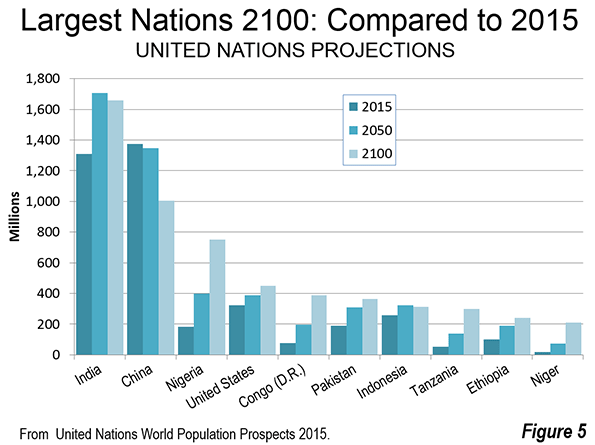
    By 2100, there are expected to be substantial changes to the top 10 nations in population. Five of the 10 largest nations in the world are expected to be in Africa. This is an increase from one in 2015 (Figure 5). Nigeria will have replaced the United States as the third largest nation, with approximately 750 million people, having more than quadrupled in size. The Democratic Republic of the Congo (Congo – Kinshasa) would rank fifth, and is expected to reach 390 million people, quintupling in size. Tanzania would rank eighth, reaching 300 million residents, nearly 6 times its 2015 population. Ethiopia would have more than 240 million residents, 2.5 times its current population and would rank ninth. The 10th largest nation would be Niger, with 210 million residents, a figure 10 times its 2015 level. Among the African nations in the top 10, only Ethiopia would be declining by 2100, having reached its population peak in 2097.

    Pakistan would retain its current sixth position, while Indonesia would fall from 4th to 7th. As noted above, India would be the largest nation in China would be second largest in 2100. By that date India would have an overall gain of approximately 350 million people from 2015, while China would lose 370 million people. The United States would add more than 125 million people. Brazil, which is currently ranked 5th, would lose approximately 10 million people and fall to 13th position. Eighth ranked Bangladesh, which was long among the fastest growing nations in the world, would gain only 10 million people and fall to 14th position. Russia, ranked 9th, would fall to 23rd, losing 25 million residents. Mexico, ranked 10th, would gain 20 million residents, and would be ranked 18th in 2100.

    The Uncertainty of Projections

    Of course projections of any kind are subject to wide error ranges. Economic growth, the extent of poverty, wars, social trends, medical advances and other factors can interfere. The simple fact is that none of us and no organization knows the future for sure. One study of UN population trends in six Southeast Asian nations found that 1980 projections from 1950 were 13.9 percent off by nation, with a range from minus 20 percent to plus 27 percent. There had been some improvement in comparing 1975 projections to 2000 actual populations, with an average error of 8.2 percent. The range was little improved, from minus 23 percent to plus 25 percent. Obviously projections are likely to be much more accurate in early years and the chances for greater accuracy are improved in larger nations or regions.

    A World of Challenges

    Regardless of the extent of accuracy, which cannot be known at this point, the projections indicate a continuation of trends that cause concern. A world that is experiencing virtually 100 percent of its growth in its poorest areas cannot help but face a tougher future. This makes it clear that the principal priority of governments around the world should be to improve affluence and reduce poverty. The challenges are gargantuan, but focusing on these issues is likely to result in a better, though less than ideal, world.

    Note:  Northern America includes Canada, the United States, Greenland, Bermuda and the French territory of Saint Pierre and Miquelon.

    Photograph: Western Railway Headquarters (Churchgate), Mumbai, India (by author)

    Wendell Cox is Chair, Housing Affordability and Municipal Policy for the Frontier Centre for Public Policy (Canada), is a Senior Fellow of the Center for Opportunity Urbanism (US), a member of the Board of Advisors of the Center for Demographics and Policy at Chapman University (California) and principal of Demographia, an international public policy and demographics firm.

    He is co-author of the "Demographia International Housing Affordability Survey" and author of "Demographia World Urban Areas" and "War on the Dream: How Anti-Sprawl Policy Threatens the Quality of Life." He was appointed to three terms on the Los Angeles County Transportation Commission, where he served with the leading city and county leadership as the only non-elected member. He served as a visiting professor at the Conservatoire National des Arts et Metiers, a national university in Paris.

  • Asian Augmentation

    California, our beautiful, resource-rich state, has managed to miss both the recent energy boom and the renaissance of American manufacturing. Hollywood is gradually surrendering its dominion in a war of a thousand cuts and subsidies. California’s poverty rate – adjusted for housing costs – is the nation’s worst, and much of the working class and lower middle class is being forced to the exits. Our recent spate of high-tech growth has created individual fortunes, but few jobs, outside the Bay Area. The agricultural heartland is suffering not only from drought, but from green policies that allow a torrent of unused water to flow into the Sacramento Delta and San Francisco Bay while huge parts of the Central Valley go fallow.

    But California retains one powerful trump card that our leaders in Sacramento have not yet found a way to squander: Its link to Asia. True, the state’s growth-restrained ports are increasingly tied up, and, over time, much of our trade with China and other Asian countries might pass, instead, through the Panama Canal en route to Houston and other ports. But geography, culture and family ties have a way of overcoming even the most deluded policy environments.

    In the 19th century, many in California railed against the “Asian invasion,” and led the drive to restrict Asian immigration to America. As early as 1850, Asians accounted for one-tenth of the state’s non-native American population. Early on, Chinese, Indian and Japanese immigrants showed remarkable ingenuity, largely as farmers and merchants, which only made whites more antagonistic. “Indispensable as the Chinese are,” one grower report admitted, “they must go, as gradually as possible.”

    Read the entire piece at the Orange County Register.

    Joel Kotkin is executive editor of NewGeography.com and Roger Hobbs Distinguished Fellow in Urban Studies at Chapman University, and a member of the editorial board of the Orange County Register. He is also executive director of the Houston-based Center for Opportunity Urbanism. His newest book, The New Class Conflict is now available at Amazon and Telos Press. He is also author of The City: A Global History and The Next Hundred Million: America in 2050.  He lives in Los Angeles, CA.

    Wendell Cox is principal of Demographia, an international public policy and demographics firm. He is co-author of the “Demographia International Housing Affordability Survey” and author of “Demographia World Urban Areas” and “War on the Dream: How Anti-Sprawl Policy Threatens the Quality of Life.” He was appointed to three terms on the Los Angeles County Transportation Commission, where he served with the leading city and county leadership as the only non-elected member. He was appointed to the Amtrak Reform Council to fill the unexpired term of Governor Christine Todd Whitman and has served as a visiting professor at the Conservatoire National des Arts et Metiers, a national university in Paris.

    Map courtesy of U.S. Census.

  • Largest 1,000 Cities on Earth: World Urban Areas: 2015 Edition

    According to the just released 11th edition of Demographia World Urban Areas (Built-Up Urban Areas or World Agglomerations), there are now 34 urban areas in the world with more than 10 million residents, the minimum qualification for megacity status. Tokyo-Yokohama continues its 60 year leads the world’s largest urban area. Before Tokyo-Yokohama, New York had been the world’s largest urban area for 30 years. London‘s run, preceding that of New York, was much longer, at more than 100 years. Beijing, which was the first of today’s megacities to reach 1,000,000 population, held the title for 75 years before London, according to census and urban historian Tertius Chandler.

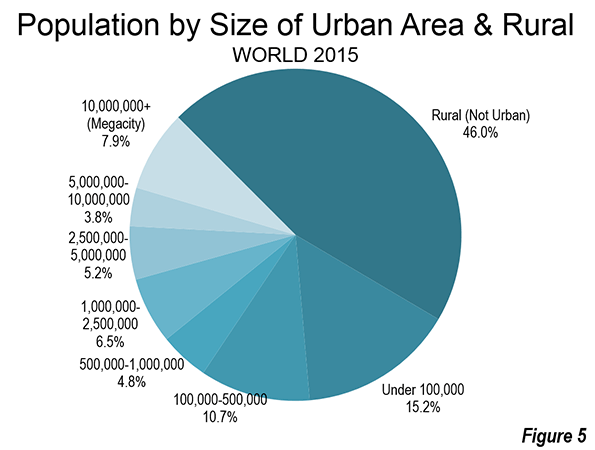
    Demographia World Urban Areas is the only regularly published compendium of urban population, land area and density data of urban areas with 500,000 or more population (defined in the Note below). The 2015 edition provides coordinated population, urban land area and density data for all 1,009 identified urban areas with at least 500,000 population. These urban areas account for approximately 52 percent of the world urban population.

    Largest Cities in 2015

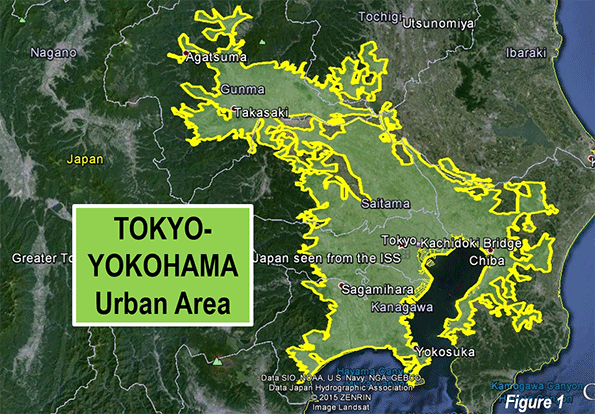
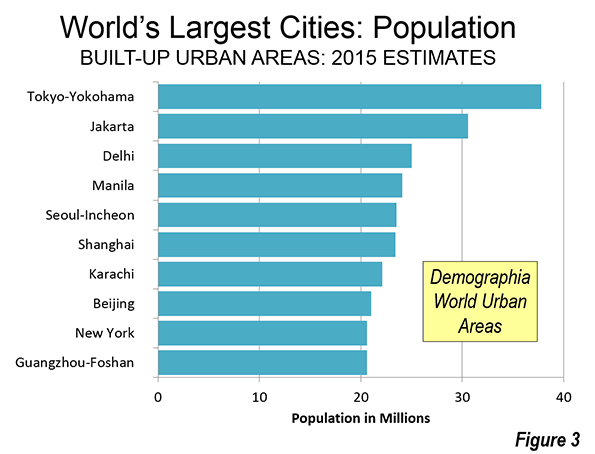
    Tokyo-Yokohama grew to 37.8 million residents, the largest urban area population ever recorded (Figure 1). But second ranking Jakarta is moving up quickly, becoming the second urban area in history to exceed 30 million residents (30.6 million). Regrettably, Jakarta (Figure 2) is often left off world city top ten lists, because the continuous urbanization extending into the regencies (Figure 2) of Tangerang, Bogor, Bekasi and Karawang usually excluded (see The Evolving Urban Form: Jakarta). Regencies are national second level jurisdictions, within the provinces that make up Indonesia.

    Fast growing Delhi retained third position, rising to just under 25 million. Later this year, Delhi will be only the third urban area in history to exceed a population of 25 million. Surprisingly, Delhi is nearly 50 percent larger than Mumbai, which is commonly considered to be India’s largest urban area. The Census of India does not allow its urban areas to cross state boundaries, which has continued to result in an under-reporting of Delhi’s population. Demographia, and the United Nations, have been reporting a higher population level as a result of Delhi’s interstate urban extensions. Many urban areas extend across state, provincial or prefectural boundaries, such as New York, Ottawa, Tokyo-Yokohama, Mexico CityBuenos Aires, Manila, Seoul-Incheon, Cairo, Shanghai among  others.

    The developing world continued its increasing domination of world’s largest cities. This year, Manila passed Seoul-Incheon to become the world’s fourth largest urban area. Like Jakarta, Manila is often left off top ten lists of the world’s cities, because the continuous urbanization extending into the provinces of Cavite, Laguna, Bulacan and Rizal and are excluded (see The Evolving Urban Form: Manila).

    Seoul-Incheon is at risk to falling another position by 2016. At 24.9 million, Seoul-Incheon’s leads sixth ranked Shanghai by less than 70,000. The last four positions in the top ten are occupied by Karachi, Beijing, New York and Guangzhou-Foshan. Karachi’s position, however, is hard to quantify, because it has been nearly two decades since the last census and the current estimates could be unreliable. New York, along with Tokyo-Yokohama and Seoul-Incheon is only one of three high-income world cities in the top 10.

    Beijing and Guangzhou-Foshan are new entries to the top ten, having displaced Mexico City and Sao Paulo. These two Latin American cities have long been among the fastest growing in the world and were headed toward much higher rankings. However, their growth has slowed materially, and they are now ranked in the second 10. Nearby Campinas is now growing faster than Sao Paulo and Toluca is exceeding the percentage growth of Mexico City. There was a time that demographers expected Mexico City to become the largest city in the world. In 2000 and 2005, the United Nations ranked Mexico City as second only to Tokyo-Yokohama.

    As indicated in a recent article (World Megacities: Densities Fall as they Become Larger), the number of megacities rose from 29 to 34 (megacities are urban areas with more than 10 million residents). These include Tianjin and Chengdu in China, Lahore (Pakistan), Kinshasa (Democratic Republic of the Congo) and Lima (Peru). China now leads the world with six (Shanghai, Beijing, Guangzhou-Foshan, Shenzhen, Tianjin and Chengdu). The ten largest urban areas are shown in Figure 3 and detailed population data is in Table 1 of World Urban Areas.

    Urban Footprints and Urban Density

    The title of the world’s largest urban footprint — what some may call “sprawl” —- is held by the New York urban area. Often seen as the epitome of successful dense development (a characterization that applies only in its geographically much smaller core area), the New York urban area itself constitutes the least dense megacity in the world. New York covers nearly 4,500 square miles (11,600 square kilometers) and has a population density of 4,500 per square mile (1,800 per square kilometer). It is a surprise to many that even Los Angeles is more dense, the result of its much denser suburbs.

    Tokyo-Yokohama covers the second largest land area, at 3,300 square miles (8,500 square kilometers). There are now 29 urban areas covering 1,000 square miles or more (2,590 square kilometers). Not surprisingly, approximately one-half (15) of these are in the United States. Another five are elsewhere in the high income world, such as Paris. There are also eight developing world cities of 1,000 or more square miles, such as Jakarta, Bangkok and Sao Paulo. Urban land area data for all 1,009 cities is in Table 3 of World Urban Areas.

    Dhaka, the capital of Bangladesh, remained the most densely populated city, at 113,000 per square mile (4,500 per square kilometer). Detailed population density for the 1,009 cities is in Table 4 of World Urban Areas

    Where Urban Population is Growing

    Asia’s has more than half (57 percent) of the population in cities of 500,000 and more (Figure 4). This is more than four times the population of such cities in North America, five times that of Africa and Europe and approximately six times that of South America. With stagnant population growth in the high income world and declines in some nations, there is every reason to believe that urbanization in North America and Europe will continue to decline relative to that of Asia, Africa and South America.

    ——-

    Note: There are two generic definitions of cities: urban areas and metropolitan areas. Urban areas define the physical expanse of cities, which is the area of continuous urban development. The second definition for cities is economic. The economic city is the metropolitan area, which includes the urban area and economically connected territory outside the urban area. The economic relationship is usually determined by work trip data, the extent of commuting from outside to inside the urban area. Because metropolitan areas are always geographically larger than urban areas, they also always have more residents. The difference in geographical sizes can be substantial. The Paris urban area covers only 20 percent of the Paris metropolitan area, a figure close to that of US major metropolitan areas, where urban areas cover only 19 percent of the land in metropolitan areas. The paradox is that metropolitan areas virtually always have more rural land than urban land.

    Ideally, urban areas are not defined by local or regional government jurisdictional boundaries, since rural areas are often included in such jurisdictions, especially suburban jurisdictions. Urban development is not constrained by jurisdictional boundaries, nor are urban areas. This causes substantial confusion, because of a general lack of familiarity with urban area concepts, even among experts.

    Urban areas are called also called "population centres" (Canada), "built-up urban areas" (United Kingdom, "urbanized areas’ (United States), "unités urbaines" (France) and "urban centres" (Australia). The "urban areas" of New Zealand include rural areas, as do many of the areas designated "urban" in the People’s Republic of China, and, as a result, do not meet the definition of urban areas above.

    Whatever they are called, urban areas are simply the extent of development, which in most cases extends well beyond the boundaries of core municipalities. Demographia World Urban Areas uses the following definition for urban areas.

    An urban area is a continuously built up land mass of urban development that is within a labor market (metropolitan area or metropolitan region). As a part of a labor market, an urban area cannot cross customs controlled boundaries unless the virtually free movement of labor is permitted. An urban area contains no rural land (all land in the world that is not urban is considered rural).

    Photograph: Lujiazui business district (Pudong), Shanghai, with the nearly complete Shanghai Tower, second tallest building in the world (by author).

    Wendell Cox is principal of Demographia, an international public policy and demographics firm. He is co-author of the "Demographia International Housing Affordability Survey" and author of "Demographia World Urban Areas" and "War on the Dream: How Anti-Sprawl Policy Threatens the Quality of Life." He was appointed to three terms on the Los Angeles County Transportation Commission, where he served with the leading city and county leadership as the only non-elected member. He was appointed to the Amtrak Reform Council to fill the unexpired term of Governor Christine Todd Whitman and has served as a visiting professor at the Conservatoire National des Arts et Metiers, a national university in Paris.

  • Size is not the Answer: The Changing Face of the Global City

    This is an exerpt from a new report published by Civil Service College of Singapore, authored by Joel Kotkin with contributions from Wendell Cox, Ali Modarres, and Aaron M. Renn.
    Download the full report.

    As the world urbanises and more megacities are created, some smaller, focused urban regions are becoming truly critical global hubs, unlike most larger cities, which are simply tied to their national economies. In a new ranking of global cities, CSC Senior Visiting Fellow Joel Kotkin argues that the truly global city is one that is uniquely situated to navigate the global transition to an information-based economy since the influence of industries such as media, culture or technology are the ones that will determine economic power in future. Kotkin also examines the fundamental challenge faced by cities as they achieve global status: the need to balance two identities, a global and a local one. "The world beckons, and must be accommodated, but a city must be more than a fancy theme park, or a collection of elite headquarters and expensive residential towers", he asserts.

    In this urban age, much has been written and discussed about global cities.1 Yet, as the world urbanises and with more megacities (with populations of ten million or more) created, there is a growing need to re-evaluate which are truly significant global players and which are simply large places that are more tied to their national economies than critical global hubs. Similarly, it becomes more critical to consider the unique challenges faced by cities as they achieve world-wide status.

    The term “world city” has been in use since the time of Patrick Geddes in 1915. In 1966, Peter Hall published his seminal work “The World Cities”. Hall’s world cities were all predominant cities in existing key nation-states. Later, the concept of “global cities”, based largely on concentrations of business service firms, emerged as the primary terminology describing such international centres.

    Be it “world” or “global” cities, such cities have long based their pre-eminence on things such as cultural power, housing the world’s great universities, research laboratories, financial institutions, corporate headquarters, and existence of vast empires and their extended legacy. They also disproportionately attracted the rich, and served as centres of luxury shopping, dining, and entertainment. These world cities have exercised outsized global influence in a system dominated by nation-states.2

    As a result, the discussion of global cities has focused primarily on megacities such as New York, Paris, Los Angeles, and Tokyo. This is not surprising, since the population of the world’s largest city has grown nearly six-fold since 1900 (London, in 1900, compared to Tokyo, in 2014). Smaller cities, such as Dubai, Houston, or the San Francisco Bay Area, have not been ranked as highly as they may have deserved.

    Rethinking the Urban Hierarchy

    We believe the traditional approach has underestimated the overarching importance of a region’s role in technology, media or its dominance over a key global industry.

    This new appraisal also stems from the declining power of nation-states in a globalised economy. In 1900, the capitals of empire—London, Paris, Tokyo, Berlin and St. Petersburg—were also the largest cities, the predominant centres of world trade and the exchange of ideas. The exception was non-government anomaly, New York, which has remained North America’s premier city; in contrast, at least until recently, Washington was a relatively minor city.

    Today, we are in a period like that of the Renaissance and early modern Europe, where global activity gravitates towards small, more trade-oriented cities, for example, Tyre, early Carthage, Athens, Venice, Antwerp, and Amsterdam and the cities of the Hanseatic League (each home to less than 175,000 people). These cities, for which trade was a necessity, were tiny compared not only to Constantinople (700,000 people), but also London and Paris (more than twice as the trading cities). Similarly, the early trade hubs of Asia were often not larger imperial capitals—such as Kaifeng and later Beijing in China— but smaller cities such as Cambay (India), Melaka (Malaysia) and Zaitun (now Quanzhou in China).

    We are seeing smaller, focused urban regions that are achieving more than most larger cities. Compared to many of their larger counterparts, new and dynamic global cities, such as Singapore, Dubai, Houston and the San Francisco Bay Area, have become more influential in the world economy, as measured by critical factors like technology, media, culture, diversity, transportation access and degree of economic integration in the world economy. This “archipelago of technologically high developed city regions”, notes urban geographer Paul Knox, are replacing nation-states as emerging avenues of economic power and influence.

    These new global hubs thrive not primarily due to their size, but as a result of their greater efficiencies. This can be seen in the location of foreign subsidiaries. For example, compared to Tokyo, Singapore now has more than twice as many regional headquarters; Singapore and Hong Kong also perform far better in this respect than Asia’s numerous, much larger but less affluent megacities. Global hubs are helped by their facility with English—the world’s primary language of finance, culture, and, most critically, technology. English dominates the global economic system from New York and London to Hong Kong, Singapore and Dubai. This linguistic, digital and cultural2 congruence poses concerns for major competing cities, including those Russia and mainland China.

    Download the full report.

    Joel Kotkin is executive editor of NewGeography.com and Distinguished Presidential Fellow in Urban Futures at Chapman University, and a member of the editorial board of the Orange County Register. He is author of The City: A Global History and The Next Hundred Million: America in 2050. His most recent study, The Rise of Postfamilialism, has been widely discussed and distributed internationally. He lives in Los Angeles, CA.

  • Largest World Cities: 2014

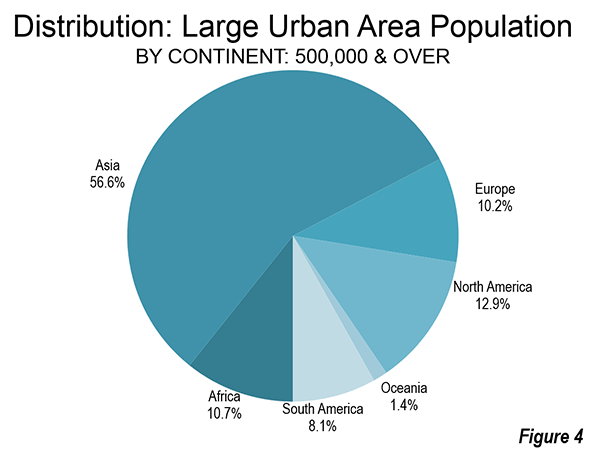
    The recently released 10th edition of Demographia World Urban Areas provides estimated population, land area and population density for the 922 identified urban areas with more than 500,000 population. With a total population of 1.92 billion residents, these cities comprise approximately 51 percent of the world urban population. The world’s largest cities are increasingly concentrated in Asia, where 56 percent are located. North America ranks second to Asia, with only 14 percent of the largest cities (Figure 1). Only three high income world cities are ranked in the top ten (Tokyo, Seoul and New York) and with present growth rates, Tokyo will be the lone high-income representative by the middle 2020s.

    Demographia World Urban Areas is the only regularly published compendium of urban population, land area and density data for cities of more than 500,000 population. Moreover, the populations are matched to the urban land areas where sufficient data is available from national census authorities.

    The City

    The term "city" has two principal meanings. One is the "built-up urban area," which is the city in its physical form, encompassing virtually all of the land area encircled by rural land or bodies of water. Demographia World Urban Areas reports on cities as built-up urban areas, using the following definition (Note 1).

    An urban area is a continuously built up land mass of urban development that is within a labor market (metropolitan area or metropolitan region). As a part of a labor market, an urban area cannot cross customs controlled boundaries unless the virtually free movement of labor is permitted. An urban area contains no rural land (all land in the world is either urban or rural).

    The other principal definition is the labor market, or metropolitan area, which is the city as the functional (economic) entity. The metropolitan area includes economically connected rural land to the outside of the built-up up urban area (and may include smaller urban areas). The third use, to denote a municipal corporation (such as the city of New York or the city of Toronto) does not correspond to the city as a built-up urban area or metropolitan area. This can – all too often does –   cause confusion among analysts and reporters who sometimes compare municipalities to metropolitan areas or to built-up urban areas.

    A Not Particularly Dense Urban World

    Much has been made of the fact that more than one-half of humanity lives in urban areas, for the first time in history. Yet much of that urbanization is not of the high densities associated with cities like Dhaka, New York, or even Atlanta.

    The half of the world’s urban population not included in Demographia World Areas lives in cities ranging in population from the hundreds to the hundreds of thousands (see: What is a Half-Urban World). In the high income world, residents of large urban areas principally live at relatively low densities, with automobile oriented suburbanization accounting for much of the urbanization in Western Europe, North America, Japan and Australasia. This point was well illustrated in research by David L. A. Gordon et al at Queen’s University (Kingston, Ontario), released last year which concluded that the metropolitan areas of Canada are approximately 80 percent suburban.

    Population

    There are now 29 megacities, with the addition in the last year of London. London might be thought of as having been a megacity for decades, however the imposition of its greenbelt forced virtually all growth since 1939 to exurban areas that are not a part of the urban area, keeping its population below the 10 million threshold until this year (Demographia World Urban Areas Table 1).

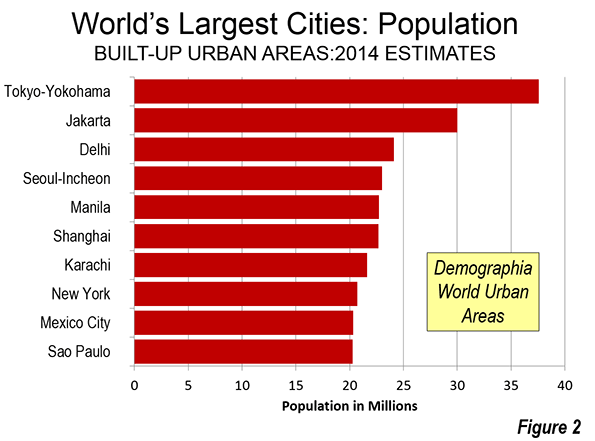
    The largest 10 contain the same cities as last year, though there have been ranking changes. Tokyo, with 37.6 million residents, continues its half century domination, though its margin over growing developing world cities is narrowing, especially Jakarta. Manila became the fifth largest urban area in the world, displacing Shanghai, while Mexico City moved up to 9th, displacing Sao Paulo (Figure 2).

    Land Area

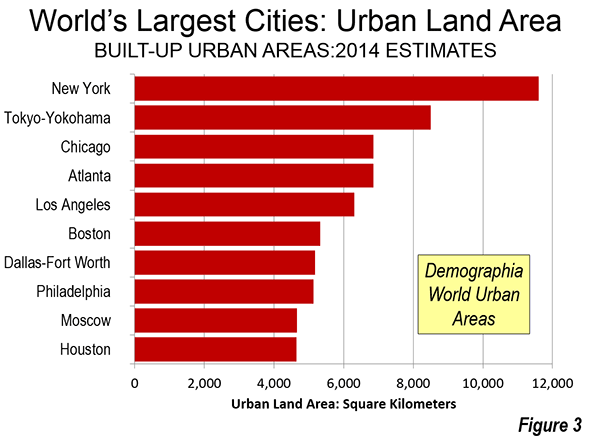
    Often seen as the epitome of urban density, the urban area of New York continues to cover, by far, the most land area of any city in the world. Its land area of nearly 4,500 square miles (11,600 square kilometers) is one-third higher than Tokyo’s 3,300 (8,500 square kilometers). Los Angeles, which is often thought of as defining low-density territorial expansion ranks only fifth, following Chicago and Atlanta, with their substantially smaller populations (Figure 3). Perhaps more surprisingly is the fact that Boston has the sixth largest land area of any city in the world. Boston’s strong downtown (central business district) and relatively dense core can result in a misleading perception of high urban density. In fact, Boston’s post-World War II suburbanization is at urban densities little different than that of Atlanta, which is the world’s least dense built-up urban area with more than 3 million population. Now, 29 cities cover land areas of more than 1,000 square miles or 2,500 square kilometers (Demographia World Urban Areas Table 3).

    Urban Density

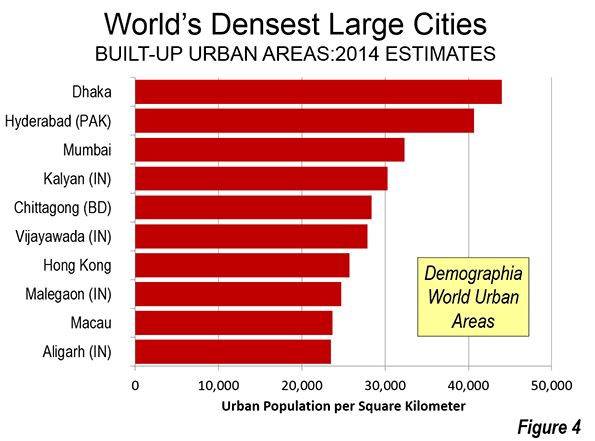
    All but two of the 10 densest cities are on the Indian subcontinent. Dhaka continues to lead in density, with 114,000 residents per square mile (44,000 per square kilometer).  Hyderabad (Pakistan, not India) ranks a close second. Mumbai and nearby Kalyan (Maharashtra) are the third and fourth densest cities. Hong Kong and Macau are the only cities ranking in the densest ten outside the subcontinent (Figure 4). Despite its reputation for high urban densities, the highest ranking city in China (Henyang, Hunan) is only 39th (Demographia World Urban Areas Table 4).

    Smaller Urban Areas

    Demographia World Urban Areas Table 2 includes more than 700 additional cities with fewer than 500,000 residents, mainly in the high income world. Unlike the main listing of urban areas over 500,000 population, the smaller cities do not represent a representative sample, and are shown only for information.

    Density by Geography

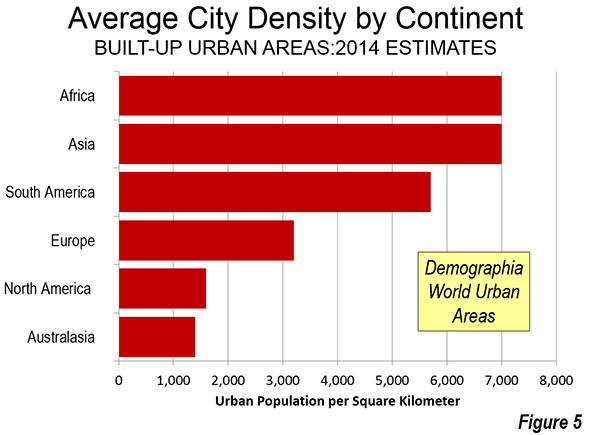
    Demographia World Urban Areas also provides an average built-up urban area density for a number of the geographical areas. Africa and Asia had the highest average city densities, at 18,000 per square mile (7,000 per square kilometer), followed by South America. Europe was in the middle, while North America and Oceania have the lowest average city densities (Figure 5).

    Some geographies, however, had much higher average urban densities. Bangladesh was highest, at 86,800 per square mile (33,000 per square kilometer), nearly five times the Asian average. Other geographies above 30,000 per square mile (11,500 per square kilometer) included Pakistan, the Democratic Republic of the Congo, the Philippines, India and Colombia, the only representative from the Western Hemisphere (Demographia World Urban Areas Table 5).

    Wendell Cox is principal of Demographia, an international public policy and demographics firm. He is co-author of the "Demographia International Housing Affordability Survey" and author of "Demographia World Urban Areas" and "War on the Dream: How Anti-Sprawl Policy Threatens the Quality of Life." He was appointed to three terms on the Los Angeles County Transportation Commission, where he served with the leading city and county leadership as the only non-elected member. He was appointed to the Amtrak Reform Council to fill the unexpired term of Governor Christine Todd Whitman and has served as a visiting professor at the Conservatoire National des Arts et Metiers, a national university in Paris.

    ———————-

    Note 1: Urban areas are called also called "population centres" (Canada), "built-up urban areas" (United Kingdom, "urbanized areas’ (United States), "unités urbaines" (France)  and "urban centres" (Australia). The "urban areas" of New Zealand include rural areas, as do many of the areas designated "urban" in the People’s Republic of China, and, as a result, do not meet the definition of urban areas above.

    Note 2: Demographia World Urban Areas is a continuing project. Revisions are made as more accurate satellite photographs and population estimates become available. As a result, the data in Demographia World Urban Areas is not intended for comparison to prior years, but is intended to be the latest data based upon the best data sources available at publication.

    Photograph: Slum, Valenzuela City, Manila (by Author)

  • The Sea of Japan: Wading Into the Name-Game Waters

    Call it ‘Nomenclature Nationalism’, or ‘The Tyranny of Also Known As’. The Virginia state legislature ventured into unfamiliar foreign policy waters earlier this month when it passed a law that requires school text book publishers to add six little words in reference to the body of water usually known as the Sea of Japan: “also known as the East Sea”. New York and New Jersey have now also placed the item on their state agendas. The moves reflect a trend: Geographic nomenclature is becoming a frontline in nationalism, particularly in Asia.

    The legislation in Virginia would seem to be a rather small bore triumph of South Korean sentiments and organization by Korean voters in local U.S. elections. But it is being treated as a major victory in Seoul, and as a defeat for Japan, which went out of its way to try to forestall the legislation, even hinting that the language might jeopardize Japanese investment in the state.

    For the past twenty years, South Korea has been laboring mightily to persuade the rest of the world to use its designation for the body of water that separates it from Japan, or, if not, to at least acknowledge an alternative designation.

    Until recently, those efforts have not met with much success. In 2012, South Korea officially asked the International Hydrographic Organization to use the term ‘East Sea’ for the Sea of Japan. It turned down the request after Washington officially advised the organization against it.

    The U.S. Board of Geographic Names, which guides the government on nomenclature issues, also uses Sea of Japan alone, and China and Russia, two countries contiguous to the waters, use variations of the words Sea of Japan in their own languages. The Google Maps search bar brings up ‘also known as the East Sea’ in Sea of Japan searches, but designates the waters as Sea of Japan on its map.

    The number of “also known as…” constructions are proliferating in Asia, clogging up prose and imposing a kind of political correctness on international publications. When writing about Asian issues, journalists and other writers now routinely struggle to appear even-handed.

    It has become, of course, common place to now refer to the uninhabited rocks in the East China Sea — the area that is bringing China and Japan closer to war — as ‘Senkaku, also known as Diaoyu’. Never mind that the English language publications in China, such as South China Morning Post, don’t bother with such even-handedness, simply calling them ‘the Diaoyu’.

    Similarly, the disputed islands in the Sea of Japan are usually described as ‘Dokdo, also known as Takeshima’, though there is, in this case, a third neutral term. The U.S. officially calls them the Lioncourt Rocks, after the French vessel that “discovered” them.

    How far down this road must we travel? A half a dozen countries border on the body of water commonly known in English as the South China Sea, each one with its own geographic name for it. So must we, in total neutrality, of course, write ‘South China Sea – also known as Nan Hai (Chinese), Bien Dong (Vietnamese) or the West Philippine Sea’?

    Manila was perfectly content to refer to the waters in question as the South Sea, until several atolls became objects of disputed ownership. Beginning in 2012, it decided to call the waters ‘the West Philippine Sea,’ to reinforce its claims to these atolls and islands. The ocean to the east of the Philippines is still known simply as the Philippine Sea.

    Issues on dry land include ‘Myanmar, also known as Burma’, as many publications now refer to the Southeast Asian country. Both words approximate what Burmese call their country, but Myanmar has an unsavory pedigree. In 1989 the military junta known as the State Law and Order Council (SLORC) decreed that Burma was a colonial-era name, and that henceforth it would like to be called Myanmar.

    Coming only a year after the bloody suppression of pro-democracy protests in Rangoon (Yangon), there were grounds to question the legitimacy of the name change. The SLORC has passed into history, and Myanmar has gained acceptance almost everywhere except, significantly, the U.S. State Department and among some dissident publications based in Thailand.

    A similar situation arose in India when the Shiv Sena, an unsavory, right-wing nationalist party, won control of Maharashita State and declared that the name of its capital, Bombay, was also a colonial relic and would henceforth be known as Mumbai. The Shiv Sena are long out of power, but Mumbai has out-grown its origins and gained international acceptance — along with Chennia (Madras) and Kolkata (Calcutta).

    One should probably be grateful that other Asian countries haven’t yet joined the nationalist nomenclature bandwagon to dump “colonial era” names. The Thais don’t insist that we call their capital city Krungthep instead of Bangkok. Beijing doesn’t insist that we exchange ‘China’ for the tongue twister Zhonggou, and Tokyo doesn’t insist we use Nippon – also known as Japan.

    Todd Crowell is author of the forthcoming The Dictionary of the Asian Language. He is based in Tokyo.

    Flickr photo by paukrus: Sea of Japan near Nahodka

  • What is a City For?

    The attached report is derived from a speech given last spring in Singapore at the Singapore University of Technology and Design. The notion here is to lay out a new, more humanistic urban future, not one shaped primarily by large developers, speculators and transient global workers. Singapore was a particularly difficult case to look at since it has no room to spread out, something we still have in much of the rest of the world. Yet the city has been very innovative in the development of open space, and its public housing agency, the Housing Development Board, has worked hard to accommodate the needs of families. I have been struck by how people in different countries want the same things: safety, space, privacy, convenience, and affordable housing. The speech is a call to reconsider our urban priorities and make the city responsive to its denizens.

    Download the full .pdf document.

    Introduction

    What is a city for? In this urban age, it’s a question of crucial importance but one not often asked. Long ago, Aristotle reminded us that the city was a place where people came to live, and they remained there in order to live better, “a city comes into being for the sake of life, but exists for the sake of living well” (Mawr, 2013).

    However, what does “living well” mean? Is it about working 24/7? Is it about consuming amenities and collecting the most unique experiences? Is the city a way to reduce the impact of human beings on the environment? Is it to position the polis — the city — as an engine in the world economy, even if at the expense of the quality of life, most particularly for families?

    I start at a different place. I view “living well” as addressing the needs of future generations, as sustainability advocates rightfully state. This starts with focusing on those areas where new generations are likely to be raised rather than the current almost exclusive fixation on the individual. We must not forget that without families, children, and the neighbourhoods that sustain them, it would be impossible to imagine how we, as a society, would “live well.” This is the essence of what my colleague, Ali Modarres and I call the ‘Human City’.

    Living well should not be about where one lives, but how one lives, and for whom. Families can thrive in many places, but these bearers of the next generation are not the primary focus of much of the urbanist community. I am referring here to urban neighbourhoods like in Singapore or in the great American cities, as well as the country’s vast suburbs. These are not necessarily the abodes of the glittering rich, or the transitory urban nomadic class, who dominate our urban dialogue, but a vast swath of aspiring middle- and working- class people. They are not necessarily the places that hipsters gravitate to, or lure people thinking of a second or third house.

    Download the full .pdf document.

    Published by the Lee Kuan Yew Centre For Innovative Cities

    Joel Kotkin is executive editor of NewGeography.com and Distinguished Presidential Fellow in Urban Futures at Chapman University, and a member of the editorial board of the Orange County Register. He is author of The City: A Global History and The Next Hundred Million: America in 2050. His most recent study, The Rise of Postfamilialism, has been widely discussed and distributed internationally. He lives in Los Angeles, CA.

  • Taking Flight from Asia

    Viewed from a 50-year perspective, the rise of East Asia has been the most significant economic achievement of the past half century. But in many ways, this upward trajectory is slowing, and could even reverse. Simply put, affluence has led many Asians to question its cost, in terms of family and personal life, and is sparking a largely high-end hegira to slower-growing but, perhaps, more pleasant, locales.

    The Asian Century may have arrived, but many Asians – disproportionately entrepreneurial, well-educated and familial – are heading elsewhere. In the United States, they have surged past Hispanics as the largest source of immigrants and now account for well over a third of all newcomers. But that’s just the tip of this wave: Recent Gallup surveys reveal that tens of millions more – 40 million from the Indian subcontinent and China alone – would come if they could. This is far more than the 5 million in Mexico who would still like to move here.

    For the most part, these highly urbanized Asians are headed to places that may not be exactly pastoral, but are decidedly less-crowded places, either in the suburbs of great cities or, increasing, to sprawling low-density regions such as Houston, Dallas, Charlotte and Phoenix. In large swaths of Los Angeles County’s San Gabriel Valley, parts of the southeastern Orange County as well as the Santa Clara Valley, six cities, including tony San Marino, already are majority Asian, and many, including several in Orange County, are either there or well on the way.

    For the most part, these primarily suburban places, widely disdained by the dominant media and academic classes, appear to seem awfully nice to Asian immigrants. Nationwide over the past decade, the Asian population in suburbs grew by almost 2.8 million, or 53 percent, while their numbers expanded in core cities by 770,000, or 28 percent. In Southern California, the shift is even more pronounced: In Los Angeles and Orange counties – the nation’s largest Asian region, the suburbs added roughly five times as many Asians as did the core city. There are now roughly three Asian suburbanites for every core city dweller in our region.

    This is not just an American phenomenon. Asians, by far the fastest-growing large ethnic group in Canada, constitute a majority in many Toronto suburbs, like Markham, Brampton, Mississauga and Richmond Hill. The same pattern is seen in areas around Vancouver, such as Richmond, Greater Vancouver, Burnaby and Surrey. Asians, who, following New Zealanders, constitute a majority of newcomers in Australia, also tend to settle in suburbs, particularly newer ones.

    It’s most important to understand the reasons these people leave their homelands. Historically, people immigrate from places where there is a perceived lack of opportunity. Yet, many of the Asian countries seeing people leave – places like Singapore, Taiwan and China – have enjoyed consistently higher economic growth rates than any of the destination countries. What these immigrants increasingly understand is that, as their country’s GDP has surged, their quality of life has not and, in many ways, has deteriorated.

    These are the sometimes subtle but important things that tend to be ignored by geopoliticians and urban ideologues, attracted by the density and transit-richness of the Asian cities. “Everyday life,” observed the great French historian Fernand Braudel, “consists of the little things one hardly notices in time and space.” And, by these measurements, life in the United States, Canada or Australia is simply better than that in most Asian countries.

    In contrast, urban Asia, although rich and often colorful, has become an increasingly difficult place both for everyday life and for families. A nice salary might be satisfying, but is unlikely to be large enough to buy a house or apartment in places like Taipei or Hong Kong, where the cost of even a tiny apartment equals more than twice – adjusted for income – what would be sufficient to purchase a house in Irvine, and four times as much as an even larger residence in Houston, Dallas or Phoenix. Not surprisingly, most Asians in America feel they are living better than their parents, compared with their counterparts at home. Only 12 percent would choose to move back to their home country.

    Beyond housing, life in hyperurbanized Asia does not buy much happiness. Prosperous Singapore, for example, is one of the most pessimistic places on the planet, while ultradense South Korea has been ranked as among the least-happy nations in the Organization for Economic Cooperation and Development, ranking 32nd of 34 members. The country also suffers from among the highest suicide rates in the higher-income world.

    This reflects the often-ignored impacts of dense urbanization, including rising obesity, particularly among the young, who get less exercise and spend more time desk-bound. The air is foul, particularly in Beijing, no matter how much money you have. A healthy bank account does not exempt one from emphysema.

    Others complain about the dangers of a political system where wealth can always be confiscated by the state; no surprise, then, that a new survey shows roughly half of China’s millionaires are looking to move, primarily to the U.S. or Canada. During 2010-11, the number of Chinese applying for a U.S. investor visa, which requires a $1 million investment in the country, more than tripled, to more than 3,000. Repression of political thought and, particularly, against religion, also ranks as a major cause for leaving the homeland.

    The family – the historic centerpiece of cultures from India to Korea – may constitute the biggest victim of the hypercompetitive, ultradense Asian lifestyle. Hong Kong, Singapore and Seoul suffer among the world’s lowest fertility rates, with rates around 1. Meanwhile, Shanghai’s fertility rate has fallen to 0.7, among the lowest ever reported, well below China’s “one child” mandate and barely one-third the rate required simply to replace the current population. Due largely to crowding and high housing prices, 45 percent of couples in Hong Kong say they have given up having children.

    For those who do want to start a family, it increasingly makes sense to immigrate. This is evident in rising emigration from China’s cities, Hong Kong and Singapore, where roughly one in 10 citizens now lives abroad, often in lower-density communities in Australia, Canada and the United States.

    The nature of those immigrating is critically important. We are long past the days when the average Asian migrant is a physical laborer or a small-scale merchant. Now, the more typical newcomer is a student or a highly qualified professional. In Australia, Asians, notably from India, China and Taiwan, make up the vast majority of immigrants who qualify for entry under skills-oriented criteria.

    This pattern also can be seen in the United States. Asians now constitute a majority of workers in Silicon Valley. They also tend to concentrate in what may be best described as the country’s largely suburban nerdistans – magnets for high-tech workers – places like Plano, Texas, Bellevue, Wash., Irvine and large swaths of Santa Clara County.

    Does all this mean Asia is about to experience a precipitous decline? Not at all. But it is also increasingly clear that the dense model of development adopted on much of that continent – exacerbated by a mass movement to cities – is not, in a larger social sense, truly sustainable. Societies that become difficult for families, and exact too much stress on their residents, are destined to suffer maladies from ultrarapid aging, shrinking workforces and a host of psychological maladies.

    These strains will become more evident over time. Already, most Asian societies, from Japan and China to Singapore and Taiwan, are experiencing less growth, linked in part to financial pressures from a rapidly aging society. The economic motivations for staying in Asia will likely decline, accelerating the flight both of financial and, more importantly, human capital.

    Every society relies on the resourcefulness of its people, particularly the young. The loss of skilled individuals and, especially, families suggests we may have already witnessed the peak of the half-century-long Asian ascendency, well before the American era has even come to its oft-predicted demise.

    Joel Kotkin is executive editor of NewGeography.com and Distinguished Presidential Fellow in Urban Futures at Chapman University, and a member of the editorial board of the Orange County Register. He is author of The City: A Global History and The Next Hundred Million: America in 2050. His most recent study, The Rise of Postfamilialism, has been widely discussed and distributed internationally. He lives in Los Angeles, CA.

    This piece originally appeared at The Orange County Register.

    Singapore skyline photo by Bigstockphoto.com.

  • South Korea, What Will Limit the World’s Global Underdog?

    South Korea is a small country with grit. The shrimp sized peninsula is a national success story that transformed itself from impoverished conditions to industrial riches in a remarkable 68-year postwar period. The country experienced the fastest growth in per-capita GDP since the 1960. According to the World Bank, South Korea’s GDP per capita in 1960 was $155 and has risen to $22,424 today, which is greater than the national wealth of their Chinese neighbors.

    Korea’s rise to world prominence did not come easily. The country rose to its ranks after being destroyed by a half-century of Japanese colonization and from the ashes of the divisive Korean War, which left its cities, including the capital, Seoul, in ruins. At war’s end GDP stood at less than $200 per capita, no natural resources, and a third of the population was homeless.  Today it is home to a number of Fortune Global 500 conglomerates, most notably, Samsung at no. 14, SK Holdings no. 57, POSCO no. 167, and Hyundai no. 206.

    The country also took a tortuous path towards democracy, living under authoritarian and military-dominated regimes until 1945. Now it is not only a thriving, and often contentious democracy, but now boasts its first female president.   

    But the question is: will South Korea’s miraculous rise to power give enough reason to believe that Korea is capable of global influence and expansion? For the most part, the answer – at least for the near future – is yes.

    This trajectory will continue even though the country – known as the “shrimp among the whales” – lives next door not only to its unpredictable northern rival, but also in the same neighborhood as three world powers. Yet in qualitative terms it is increasingly out-performing their rivals and is one of the top tech capitals in the world. This place is literally wired for success: Number one in e-government and top five in the global gaming market, with the fastest and cheapest broadband connection on earth.

    Due to the smallness of the domestic market – the country is home to only 48,955,203 people – Korean businesses need to operate on a global scale. Heavily dependent on international trade, the country, in 2011, ranked as the world’s eighth largest exporter and ninth largest importer. An example of this is Samsung, the world’s largest smartphone maker. This will lead Korean firms to continue to invest heavily on a global basis.   

    Perhaps the most impressive accomplishment can be seen in smart phones, an area that long-time electronics leader – and former colonial overlord – Japan has stumbled in. According to the Wall Street Journal, Strategy Analytics reported Samsung’s smartphone shipments grew to 69.4 million units in the quarter, giving it a market share of 33% – almost twice that of Apple.

    Samsung’s growing cash reserves evidence its strength as a fierce competitor to Apple and questions Apple’s ability to return to its market leadership. Some commentators predict Apple will need to make price reductions or find an unforeseen market that does not compete. But its most recent blow in the American markets came after the ITC ban on the import and sale of some Samsung products into the U.S. This moment can be the saving grace for Apple but Samsung continues to gain market share and, unlike its Silicon Valley competitor, it is highly diversified as one of the world’s most sophisticated maker for processors, memory, and high-resolution screens.

    But these accomplishments have had their downside. The hyper-connectivity has engendered a “digital addiction” among young children. Concerned of this has become so pronounced that Korea’s science and education ministries announced its policy package in June to “wean students off of their dependency” through boot camps.

    Yet for now, the country’s positive trajectory seems assured. This is not just a matter of technology and manufacturing. The Korean entertainment industry  now ranks seventh in the world according to consulting firm PwC and is home to global stars like Psy of “Gangnam Style” and singer, Rain, whose influence in the music industry is unprecedented ranking him the most influential artist in TIME’s 100 list three years in a row. In the world of pop culture Korea tops the list among the Asian country competitors.  

    Besides entertainment, Korea’s global footprint has been growing exponentially.  Korea’s direct foreign investment history in the U.S. increased steadily ever since the onset of South Korea’s financial crisis in 1997.   Korean investment in the U.S. has jumped from $15.7 billion in 2010 to $24.5 billion in 2012. In particular, Korea has been investing heavily in its East Asian neighbors. South Korean companies were the biggest investors in Indonesia with POSCO, the country’s leading steelmaker, topping it off with a $6 billion joint venture deal with Indonesian steelmaker Kraktau Steel.

    Korean corporations also have been establishing new homes in the U.S. over the years. For example, Hyundai Motors has built its U.S. Headquarters in Fountain Valley in Orange County to “secure its long-term future in California,” as stated in its press release. The two-year and 500,000 square feet development has cost $200 million and is located visibly alongside the I-405 freeway. The project symbolizes economic growth in California and projects a positive outlook for the future of Hyundai as a rising automotive leader in the world. Hyundai’s move also makes Samsung’s plans to build its North American headquarters in San Jose no surprise. Another example is SK Planet, a South Korean Internet services giant, that is planning to invest anywhere from $500 million to $1 billion in the U.S. over the next few years.

    South Korea also has been one of the top three Asian countries to participate in the “East looks West” trend in foreign property investments. In hunt for safe and affordable places to invest, South Korean firms and individual investment in U.S. real estate have surged in the past year. South Korea takes the second-lead after Singapore in investing the U.S. market. According to Real Capital Analytics, Singapore invested $1.87 billion, South Korea $1.83 billion, and China $1.52 billion for a combined total of $5.2 billion in commercial real estate in 2013 alone.  South Korea’s Mirae Asset Global Investments recently acquired Chicago’s West Wacker Drive building for $218 million. A group of South Korean investors also bought the Washington Harbour complex at the U.S. capital for $373 million in July.

    Another noteworthy venture is the Korean Air’s plan to develop the tallest hotel skyscraper in the West at the site of the 1950s Wilshire Grand Hotel in downtown Los Angeles. Expected to be completed in 2017, the 73-story hotel is estimated to cost $1 billion. The skyscraper reinforces Korea’s determination to build its image as an aggressive, forward thinking investor.  

    The leaders of the country have typically been supportive of their conglomerates but also recognize the downfalls in investing too much in a single business. South Korea’s Iron Lady, President Park Geun-hye, has promised to address the country’s major issues starting with the “economy’s excessive reliance on a small number of huge conglomerates”.  For instance, Seoul has offered $1 billion to small and mid-sized exporters in order to reach its targeted export growth of 4.1% in 2013. The South Korean government has also garnered free trade agreements in Europe, India, and reportedly help boost the U.S. auto industry.  

    Yet like other Asian countries, Korea faces some large long-term challenges. It lacks the girth of China, or the EU, not to mention the resources and entrepreneurial system for the United States. Perhaps even more serious, the country now suffers among the lowest birthrates in the world. Although this may not yet be a critical problem, lack of production in this area could threaten the country’s long-term economic position.

    Equally important, research has found that couples that do have children are born with health risks due to the extreme dense way of living. Since the 1970s, the population ballooned and the limited land for residential use led to the mass construction of high-rise apartments. The high density and aesthetically displeasing public spaces in the largest cities makes Korea an unattractive place for foreigners to live undermining it as a global country. For example, Seoul, the country’s capital, ranks highest in population density among OECD countries, a problem in terms of future fertility.

    Development in the services industry will also become critical overtime because of the country’s heavy reliance in manufacturing. Korea does not outsource like its competitors, which has largely contributed to its wealth. But in order to be ranked as a premier nation, services will have to become a higher priority, meaning growth in its skilled work force. Korea lacks the managerial, administrative, and professional social capital that give U.S., Japan, U.K., and Germany their world status. According to Global Insight, 30% of the nation’s economy comes from manufacturing where as the U.S. and Japan have only 13% and 20% in manufacturing jobs, respectively, with a majority of their jobs in services.  

    Despite its massive economy derived mainly from conglomerates and the wealthy few, Korea faces challenges in a number of areas: the diversity of its labor pool, new diplomatic strategies, declining demographics, lack of natural energy resources, and environmental sustainability. As they are keys to Korea’s continued success, the country’s long-term prominence falls into question.

    Grace Kim is an undergraduate at Chapman University majoring in Business Administration and Communication Studies who is also the President of the Chapman Real Estate Association and Editor in Chief of Meta-communicate, the Communication department’s undergraduate research journal.

    Photo from Wiki Commons by user tylerdurden1.