Skyscrapers have always intrigued me. Perhaps it began with selling almanacs to subscribers on my Oregon Journalpaper route in Corvallis. I have continued to purchase almanacs each year and until recently, the first thing I would do is look in the index for "Buildings, tall” in the old Pulitzer The World Almanac, the best source until the Internet.
My 1940 edition is the first in which “Buildings, tall” appears. The world of skyscrapers has changed radically through the years. This article provides a historical perspective on the world’s tallest buildings, using information from almanacs and the Internet (See Table Below). Extensive hyperlinking is also used, principally to articles on particular buildings.
The Rise of Commercial and Residential Buildings
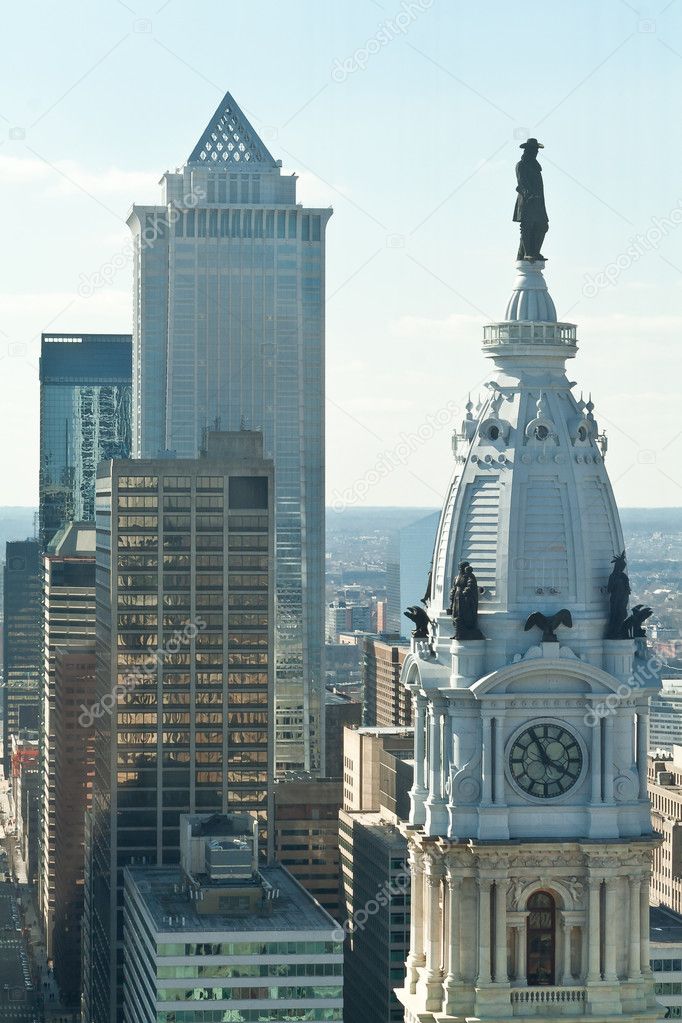
Throughout most of history, the tallest habitable buildings have been religious edifices, or mausoleums, such as the great pyramids of Egypt. But in the middle to late 19th century, taller commercial and residential buildings were erected in the United States. For four years, from 1890 to 1894, the New York World Building, itself was the tallest in the world, at 309 feet (95 meters) and 20 floors. But it was not until the turn of the 20th century that a commercial or residential building exceeded the tallest religious building, Ulm Cathedral in Germany. This was Philadelphia’s City Hall. In its wisdom, however, Philadelphia outlawed any building higher than William Penn’s head at the top of City Hall. It was not until the late 1980s that a taller building appeared in Philadelphia (One Liberty Place).
Tallest Buildings in 1940
Despite Chicago’s claim as birthplace of the skyscraper, by 1940, nine of the 10 tallest buildings in the world were in New York. Manhattan was so dominant that the World Almanac listed the city at the top of the list, out of alphabetical order. The five tallest buildings, the Empire State Building, the Chrysler Building, 60 Wall Tower (now 70 Pine), 40 Wall Tower (now the Trump Building) and the RCA Building (now the GE Building) all opened in the 1930s and represent Art Deco at its zenith. The sixth tallest, the Woolworth Building, had been the world’s tallest from 1913 to 1930 and is neo-Gothic.
Cleveland’s Terminal Tower was 7th tallest, and the tallest building in the world outside New York. Cleveland’s Union Terminal was in the building and served the legendary New York Central Railroad’spremier New York to Chicago 20th Century Limited.
Tallest Buildings in 1962
Things changed little by 1962. The five Art Deco skyscrapers that where the tallest in 1940 remained so in 1962. There were two newcomers to the top 10 list, both modernist monoliths, the Chase Manhattan Bank Building in lower Manhattan and the Pan Am Building (later the Met-Life Building). The Pan Am Building is despised by many New Yorkers as Parisians despise the Tour Montparnasse. This led to banning similar behemoths in the ville de Paris (most of the skyscrapers in the Paris urban area are in La Defense, a nearby suburban “edge city”). But all of the 10 tallest buildings in the world were in the United States.
Tallest Buildings in 1981
Just two decades later, New York’s dominance eroded. By now, The World Almanac listed New York in alphabetical order, between New Orleans and Oakland. For the first time since before 1908 when the Singer Building opened, New York was not the home of the world’s tallest building. That title had gone to Chicago’s, Sears Tower (later Willis Tower), which opened in 1974. Chicago gained even more respect with two other buildings appearing in the top 10, the Standard Oil Building (nowAon Center) and the John Hancock Center, which was the tallest mixed use (residential and commercial) building in the world. The twin towers of the former New York World Trade Center were tied for second tallest in the world.
For the first time, a non-American skyscraper was in the top 10. Toronto’s First Canadian Place was the eighth tallest in the world. Only three of the former five New York Art Deco buildings remained in the top 10, with 40 Wall Tower and the RCA Building no longer on the list.
Tallest Building in 2000
By 2000, Kuala Lumpur, which is not among the largest cities in the world, emerged with both of the tallest buildings, in the Petronas Towers. The Petronas Towers ended America’s long history of having the tallest building. These distinctive postmodern towers were just two of six Asian entries in the top 10, including another postmodern structure, the Jin Mao Tower in Shanghai’s Pudong, which is probably the world’s largest edge city.
I recall my surprise at exiting the Guangzhou East Railway station in 1999 to see the CITIC Tower, the 7th tallest building in the world. There could have been no better indication of that nation’s modernization. The Pearl River Delta had two other of the tallest buildings, one in Shenzhen (Shun Hing Square), the special economic zone that became the economic model for the rest of China, and the second in Hong Kong (Central Plaza).
Tallest Building in 2013
By 2013, the world of skyscrapers had nearly completely overturned. Dubai, with a population little more than Minneapolis-St. Paul, is now home to the world’s tallest building, the Burj Khalifa. The Burj Khalifa is not just another building. Never in history has a new tallest building exceeded the height of the previous tallest building by so much. Even the long dominant Empire State Building had exceeded the Chrysler building by only 200 feet (64 meters). The Burj Khalifa was nearly 1050 feet higher (320 meters) than the then tallest building, Taipei 101, and reaches to more than 1/2 mile (0.8 kilometers) into the sky. The world’s second tallest building (the Mecca Royal Hotel Clock Tower) is also on the Arabian Peninsula.
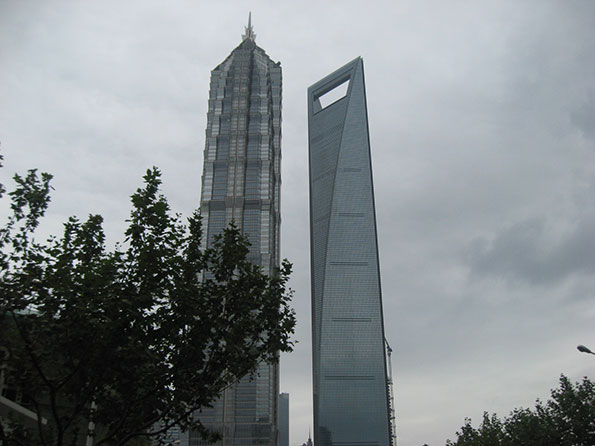
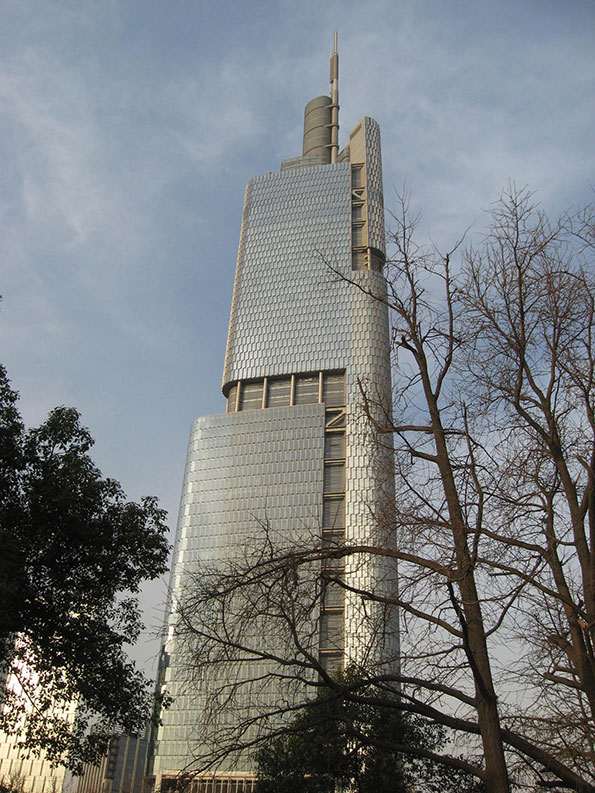
The Shanghai World Financial Center is now the fourth tallest in the world, and when it opened had the highest habitable floor and the highest observation deck in the world. Its unusual design has earned it the nickname "bottle opener" among residents (Photo 1). Hong Kong has a new entry in the list, the International Commerce Center, across the harbor in Kowloon. Nanjing’s Greenland Financial Complex (Photo 2) ranks 8th, and Shenzhen’s Kinkey 100 ranks 10th.
Nine of the 10 tallest buildings in the world are now in Asia. The last American entry is the Sears Tower (Willis Tower), in Chicago, which ranks 9th. Skyscraperpage.com maintains a graphic of the world’s tallest buildings (Note 1).
Under Construction: A number of super-tall buildings (Note 2) will soon open. Earlier this month, the Shanghai Tower was “topped out.” This structure is across the street from the Jin Mao Tower and the Shanghai World Financial Center, forming by far the greatest concentration of super-tall skyscrapers in the world (Photo 1). The Ping An Finance Center in Shenzhen and the Wuhan Greenland Center in Wuhan are also under construction, and will rank, at least temporarily, second and third tallest in the world when completed. The Goldin Finance Building in Tianjin and the Lotte World Tower in Seoul will be somewhat shorter. One World Trade Center in New York will be completed before most of these, which will allow it brief entry into the top ten.

Another entry, Sky City in Changsha (Hunan) could be on the list, slightly taller than the Burj Khalifa. This building is to be constructed in 210 days, following site preparation and work began last month. It was, however, halted by municipal officials and there are conflicting reports as to the building’s status.
Skyscraperpage.com also maintains a graphic of the world’s tallest under-construction buildings.
Tallest Buildings in 2020?
None of the tallest buildings in the world are predicted to be in the United States by 2020, according to a graphic of current plans posted on the Council on Tall Buildings and Urban Habitat website. The Burj Khalifa is expected to be replaced as tallest by another Arabian Peninsula entry, the Kingdom Tower in Jeddah, which will be 0.6 miles high (3.3 kilometers). The torch has been passed to Asia.
| WORLD’S TALLEST COMPLETED BUILDINGS: 1940-2013 | |||||
| 1940 | Building | City | Feet | Meters | Stories |
| 1 | Empire State | New York | 1,250 | 381 | 102 |
| 2 | Chrysler | New York | 1,046 | 319 | 77 |
| 3 | 60 Wall Tower (70 Pine Street) | New York | 950 | 290 | 66 |
| 4 | 40 Wall Tower (Trump) | New York | 927 | 283 | 90 |
| 5 | RCA | New York | 850 | 259 | 70 |
| 6 | Woolworth | New York | 792 | 241 | 60 |
| 7 | Terminal Tower | Cleveland | 708 | 216 | 52 |
| 8 | Metropolitan Life | New York | 700 | 213 | 50 |
| 9 | 500 5th Avenue | New York | 697 | 212 | 60 |
| 10 | 20 Exchange Place | New York | 685 | 209 | 54 |
| 1962 | Building | City | Feet | Meters | Stories |
| 1 | Empire State | New York | 1,250 | 381 | 102 |
| 2 | Chrysler | New York | 1,046 | 319 | 77 |
| 3 | 60 Wall Tower (70 Pine Street) | New York | 950 | 290 | 66 |
| 4 | 40 Wall Tower (Trump) | New York | 927 | 283 | 71 |
| 5 | RCA | New York | 850 | 259 | 70 |
| 6 | Pan Am (Met-Life) | New York | 830 | 253 | 59 |
| 7 | Chase Manhattan | New York | 813 | 248 | 60 |
| 8 | Woolworth | New York | 792 | 241 | 60 |
| 9 | 20 Exchange Place | New York | 741 | 226 | 57 |
| 10 | Terminal Tower | Cleveland | 708 | 216 | 52 |
| 1981 | Building | City | Feet | Meters | Stories |
| 1 | Sears Tower (Willis Tower) | Chicago | 1,454 | 443 | 110 |
| 2 | World Trade Center-North Tower | New York | 1,350 | 411 | 110 |
| 2 | World Trade Center-South Tower | New York | 1,350 | 411 | 110 |
| 4 | Empire State | New York | 1,250 | 381 | 102 |
| 5 | Standard Oil (Amoco) | Chicago | 1,136 | 346 | 80 |
| 6 | John Hancock Center | Chicago | 1,127 | 344 | 100 |
| 7 | Chrysler | New York | 1,046 | 319 | 77 |
| 8 | Texas Commerce Tower | Houston | 1,002 | 305 | 75 |
| 9 | First Canadian Place | Toronto | 952 | 290 | 72 |
| 10 | 60 Wall Tower (70 Pine Street) | New York | 950 | 290 | 66 |
| 2000 | Building | City | Feet | Meters | Stories |
| 1 | Petronas Tower 1 | Kuala Lumpur | 1,483 | 452 | 88 |
| 1 | Petronas Tower 2 | Kuala Lumpur | 1,483 | 452 | 88 |
| 3 | Sears Tower (Willis Tower) | Chicago | 1,454 | 443 | 110 |
| 4 | Jin Mao Tower | Shanghai | 1,381 | 421 | 88 |
| 5 | World Trade Center-North Tower | New York | 1,350 | 411 | 110 |
| 5 | World Trade Center-South Tower | New York | 1,350 | 411 | 110 |
| 7 | Citic Plaza | Guangzhou | 1,283 | 391 | 80 |
| 8 | Shun Hing Center | Shenzhen | 1,260 | 384 | 69 |
| 9 | Empire State | New York | 1,250 | 381 | 102 |
| 10 | Central Plaza | Hong Kong | 1,227 | 374 | 78 |
| 2013 | Building | City | Feet | Meters | Stories |
| 1 | Burj Khalifa | Dubai | 2,717 | 828 | 163 |
| 1 | Mecca Royal Hotel Clock Tower | Mecca | 1,971 | 601 | 120 |
| 3 | Taipei | Taipei 101 | 1,670 | 508 | 101 |
| 4 | Shanghai World Financial Center | Shanghai | 1,614 | 592 | 101 |
| 5 | International Commerce Center | Hong Kong | 1,588 | 484 | 118 |
| 6 | Petronas Tower 1 | Kuala Lumpur | 1,483 | 452 | 88 |
| 6 | Petronas Tower 2 | Kuala Lumpur | 1,483 | 452 | 88 |
| 8 | Greenland Financial Complex | Nanjing | 1,476 | 450 | 89 |
| 9 | Sears Tower (Willis Tower) | Chicago | 1,454 | 443 | 110 |
| 10 | Kinkey 100 | Shenzhen | 1,450 | 442 | 100 |
| Outside United States | |||||
| United States, Outside New York | |||||
| New York | |||||
Wendell Cox is a Visiting Professor, Conservatoire National des Arts et Metiers, Paris and the author of “War on the Dream: How Anti-Sprawl Policy Threatens the Quality of Life.
———————
Note 1: There are a number of sources for information on tall buildings, such as the Council on Tall Buildings and Urban Habitat, Skyscraperpage.com, Emporis.comand Wikipedia.com. Of course, my favorite will always be The World Almanac, even if the Internet provides faster access. Wikipedia also has fascinating articles on individual buildings (Wikipedia’sutility is limited to recreational research for identifying original sources, and should never be used in serious research, or God forbid, used in a footnote).
Note 2: The Council on Tall Buildings and Urban Habitats defines a super-tall building as being over 980 feet (300 meters) high.
——————————
Photo 1: Jin Mao Tower (left) and Shanghai World Financial Center (right), Shanghai. Construction began later on the recently topped out Shanghai Tower to the right of the Shanghai World Financial Center.
Photo 2: Greenland Financial Center, Nanjing
—————————-
Photograph: The New York World Building (1890-1955).