Tag: Atlanta

  • Why Rail Transit Doesn’t Work in Atlanta

    One of the more interesting presentations at the 2017 American Dream conference was by Alain Bertaud, a French demographer currently working at New York University. He has compared urban areas all over the world to see how transportation has influenced the layout of those areas.

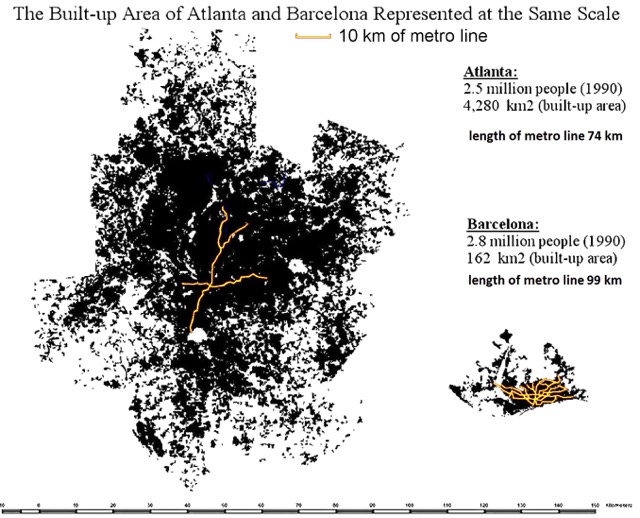
    He started by comparing Atlanta with Barcelona, Spain. Although both have about the same number of people, Barcelona occupies about 63 square miles while Atlanta covers 1,650 square miles. Barcelona has about 62 miles of rail lines, while Atlanta had about 46 when Bertaud was making his comparison (it’s up to 52 today). In order for Atlanta’s rail system to provide the same level of service to its residents as Barcelona’s, the region would need to build another 2,350 miles of rail lines. At current construction prices, that would cost at least $700 billion.

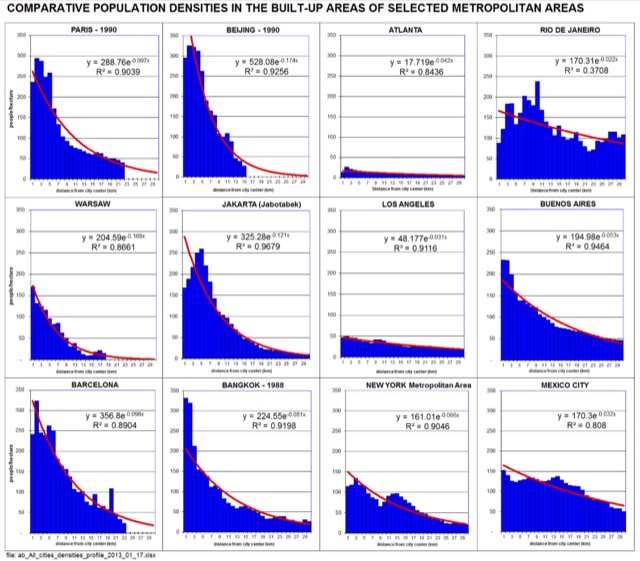
    The above charts show population densities within 30 kilometers of urban centers, with the first kilometer on the left and the 30th kilometer on the right. The European cities, including Paris, Warsaw, and Barcelona, shown in the first column, are very dense in the center with densities falling to nothing after 22 miles from the center. Asian cities in the second column–Beijing, Jakarta, and Bangkok–are similar. But American cities in the third column–Atlanta, Los Angeles, and New York–look very different. Densities do taper off but the centers, even of New York, are nowhere near as dense as in Europe and Asia.

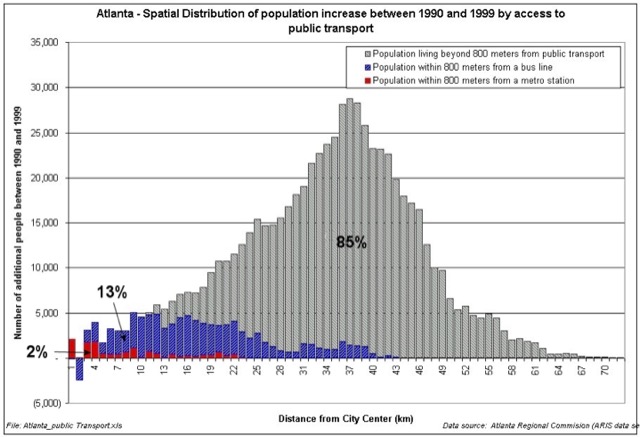
    Moreover, Atlanta’s population growth in the 1990s was mostly in the outlying areas. Only 2 percent of new Atlanta residents located within a half mile of a rail station and only 13 percent located within a half mile of a bus stop, while 85 percent located more than half mile from either.

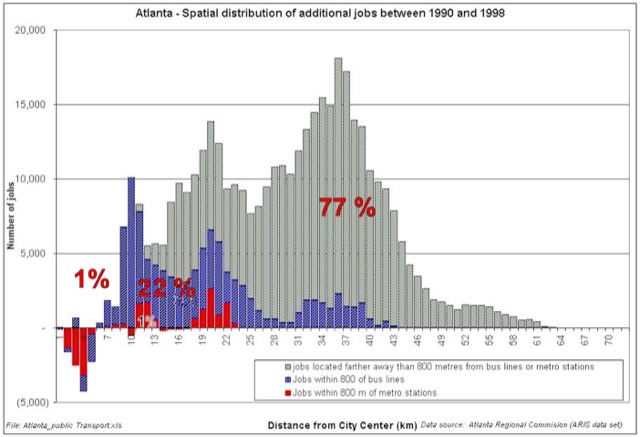
    New job locations are even worse for transit, with jobs in four of the first five miles from the center actually declining. Only 1 percent of new jobs located within a half mile of a rail station, and 22 percent within a half mile of a bus stop, meaning 77 percent were not reached by transit. (The original chart said 32 percent, but that made the total add up to 110 percent. Dr. Bertaud updated and corrected the chart to read 22 percent.)

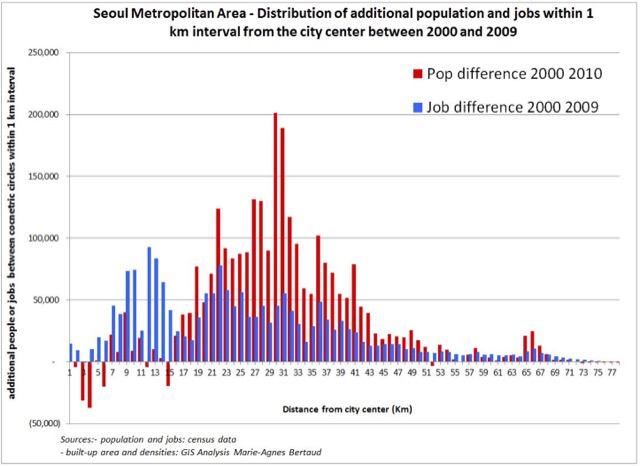
    Even as American urban planners, particularly on the West Coast, try to make our cities more like European ones, European and Asian cities are becoming more like American ones. In Seoul, for example, most population growth was in the bands between 20 and 40 kilometers from the center, while most job growth was in the bands between 9 and 35 kilometers from the center.

    The same is true for European cities. While the second chart shown above makes it appear that Paris and other cities are monocentric, in fact they have large numbers of suburban jobs. As Bertaud noted, “Even in metropolitan area like Paris, with an elaborate transit system, the majority of trips are made by cars from suburb to suburb.” Transit ridership in many European cities is flat or declining, while driving is rapidly growing.

    When new technologies like automobiles change the shape of cities, there is no going back. Cities can build rail lines, subsidize dense housing projects, and try to discourage driving, but driving will continue to grow even as transit ridership stagnates, at best, and per capita ridership falls.

    This piece first appeared on The Antiplanner.

    Randal O’Toole is a senior fellow with the Cato Institute specializing in land use and transportation policy. He has written several books demonstrating the futility of government planning. Prior to working for Cato, he taught environmental economics at Yale, UC Berkeley, and Utah State University.

    Photo by Nicolas Henderson, via Flickr, using CC License.

  • New Year, Same Old Streetcar Named Disaster

    On December 30 the city of Atlanta began Year 3 of operating its much-ballyhooed Atlanta Streetcar System, and so far, all that can be discerned is a lot of bally hooey.

    This month, the Atlanta City Council approved the final payment to URS for the design-build of the 2.7-mile Atlanta Streetcar project, making the total payment $61,630,655. That was, according to Public Works Commissioner Richard Mendoza, “$6 million less than URS originally submitted.”

    Not exactly. The 2014 URS contract authorized by MARTA (the transit authority designated to receive the $47.6 million federal grant for the Streetcar), was $59 million; the original URS contract, based on the preliminary design, was $52.2 million.

    Asked about the project’s full cost, Mendoza told councilmembers, “The entire project came in a tad under $97 million, which was within the original budget.” 

    Not really. The original budget for the project, as listed in the TIGER federal grant application in 2010, was a capital cost of about $72 million. Annual operation and maintenance (O&M) costs in 2013, when it was originally slated to start running, would be about $1.7 million.

    Later, the city projected a cost of about $3.2 million a year to operate the system. Then in February 2016, the city revised that cost to $4.8 million – a 52 percent increase. The city’s FY2017 budget includes nearly $5.3 million for the Streetcar O&M.

    As for revenues: The grant application projected $420,000 in farebox revenue for the expected first year of operation (2013), making up 20 percent of O&M costs. In fact, the farebox recovery ratio is just 5.2 percent, as Mendoza told councilmembers on December 14 during his quarterly update on the system.

    From January through November 2016, tickets brought in $177,580; by extrapolation, the 2016 farebox will bring in less than $195,000. That’s less than half (46 percent) of the grant application projection.

    There were 809,000 passengers in 2015. From January through November 2016, there were just 348,043. The grant application listed projected average weekday ridership at 2,600; but this year (without breaking out weekend ridership) it is 1,462, just 56 percent of that original estimate.

    The Streetcar had a late and spotty start, too. After construction and testing delays, operations began on December 30, 2014. It was supposed to offer free rides for three months; in March 2015, the mayor declared it would be free for the entire first year.

    Ridership plunged after the $1 fare was implemented on January 1, although it did help reduce the number of homeless riding the vehicles. Fare evasion is a problem: The city reports 53 just percent of riders are paying the fare; hopes are better policing and a newly launched app will improve revenues.

    State and federal audits found safety and management problems; in May, the Georgia Department of Transportation threatened to shut down the Streetcar unless corrective action was taken. This month, Mendoza told the Transportation Committee that nine (14 percent) items of 66 on the “Corrective Action Plan” had been completed.

    This week, the city announced reduced Streetcar hours for the holiday weekend, “a modified schedule for New Year’s Eve to accommodate large crowds expected to attend holiday events in the downtown area. On Dec. 31 the streetcar will operate from 8:30 a.m. to 4:30 p.m., and then will resume normal operating hours on Jan. 1, running from 9 a.m. to 11 p.m.”

    Reducing hours when tourists are most likely downtown is a far cry from the hype in the grant application: “[I]t will provide connectivity and circulation for the core of the Downtown area of Atlanta, improving accessibility and making it possible to conveniently travel from key destinations and event venues without a car and connecting tourists, residents, students and workers to attractions, jobs and public amenities.”

    Unfazed by the dismal results so far, the city has another 22-mile phase under environmental review, planning to leverage November’s transit sales tax proposals that won 72 percent voter approval. Apparently, the project is nowhere near big enough to fail yet. The biggest tragedy, however, is that in an era of rapidly changing technology, Atlanta residents will be stuck with this transit from a bygone era for another 40 years.

    This piece was originally published by the Georgia Public Policy Foundation on their blog, The Forum.


    Benita Dodd is vice president of the Georgia Public Policy Foundation, an independent think tank that proposes market-oriented approaches to public policy to improve the lives of Georgians. Nothing written here is to be construed as necessarily reflecting the view of the Georgia Public Policy Foundation or as an attempt to aid or hinder the passage of any bill before the U.S. Congress or the Georgia Legislature.

    © Georgia Public Policy Foundation (December 30, 2016). Permission to reprint in whole or in part is hereby granted, provided the author and her affiliations are cited.

    Photo by Spmarshall42Own work, CC BY-SA 4.0, Link

  • What Price Urban Density?

    We regularly hear the argument that living in a compact city is more affordable than living in one that is more spread out. But what does the data actually show about the cost of housing in compact cities, and the cost of transport in these dense places? The relationship between those two expenses and the compactness of a city could tell us much about which kinds of places are most affordable, since those two costs together dominate household budgets.

    Advocates of denser urban environments have developed an index to measure the effects of a range of aspects of city living, such as vehicle miles traveled, traffic safety, congestion, the cost of housing, the cost of transportation, and health outcomes, among many other issues. The index takes into account several metrics, such as density, street accessibility and the mix of land uses.

    The index was conceived with the intent to study presumed negatives of city growth, and to make such growth “smarter.” Since the impulse to create it was advocacy-driven, it may lack objectivity. Notwithstanding this potential bias, and lacking alternative data, we used it as the default measure for our analyses, and consider our work a chance to test the validity and reliability of the index.

    First, we looked at housing costs. Casual and investigative observers seem to agree that housing costs do rise with city compactness. A recent report on the effects of compactness determined that housing costs increased by 1.1% for every 10-point increase in the compactness index. Other researchers have come to similar conclusions, using only population density as an indicator.

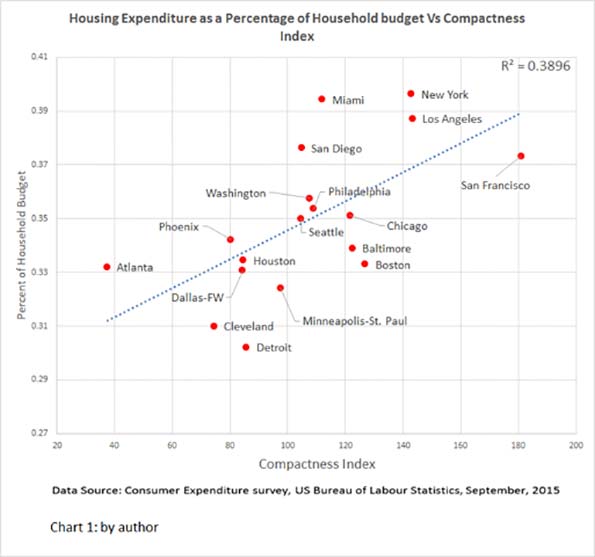
    Chart 1, which plots data from the 2015 Consumer Expenditure Survey, confirms this general agreement on the correlation between compactness and housing costs. But questions arise from the sharp differences between pairs of cities.

    For example, Boston and Atlanta residents use the same percentage of their budgets — 33% — for housing. Yet Boston’s compactness index is at least 90 points higher: 37.4 for Atlanta, vs 126.9 for Boston. According to Smart Growth theory, that difference should bring housing expenditures for Bostonians to 43%, about the same level that is experienced by New Yorkers.

    In another comparison, Boston and Miami differ little in compactness: 126.9 vs 112. Yet these two cities differ substantially in the percentage of household budget residents devote to housing costs – 33% vs 39%.

    Clearly, in both these examples and in the chart above, compactness is but one of many factors and, perhaps, not the dominant one in the relationship between a city’s housing costs and its compactness. Others need to be identified, quantified and incorporated. The trend, however, is indisputable: Greater compactness increases housing costs.

    Do transportation costs follow the same trend?

    According to theory, cities that are more compact offer more transport options, particularly public transit systems, some of which, like subways, outperform all other modes for time — especially work commute time — and provide travel options that are more affordable. Walking and biking may also be alternate means of mobility that help hold down household transport expenditures in compact cities. The association between density and high non-auto share of trips has already been demonstrated.

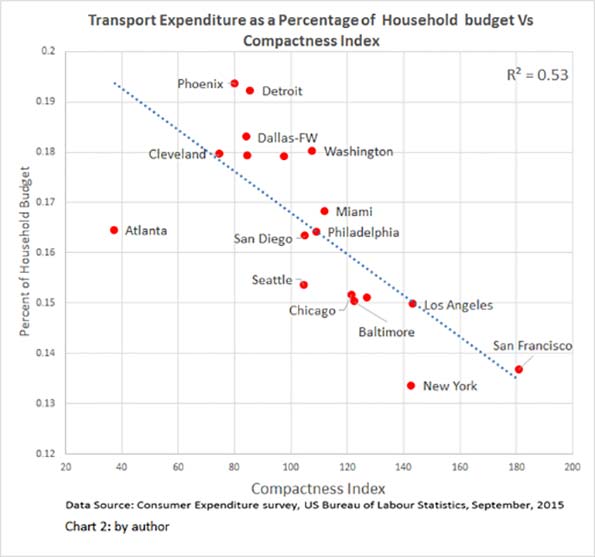
    Consumer Expenditure Survey data from 2015, when plotted, confirms this assumption. Chart 2 shows a decreasing proportion of the household budget being used for transportation as a city’s compactness index increases.

    However, as with housing costs, a close look at the differences between paired cities raises questions. Atlanta and Philadelphia share the same percentage of household budget expenditure on transport, 16%. Yet they differ by 70 points on the compactness index, 37.4 vs 109.05. Meanwhile, Washington and Seattle register an almost identical compactness index — 107.6 vs 104.6 — but the latter, contradicting theory, has transportation costs that are 3 percentage points lower, even though it lacks a subway. Both these cases demonstrate that the current model for measuring the impact of compactness needs fundamental refinements to improve its predictive value.

    So far, the data show two countervailing trends: Housing costs rise with compactness, while transportation costs fall. This finding leaves the question of whether more compact cities are more affordable to live in, at least with respect to these two expenditures that consume about half of a household’s budget.

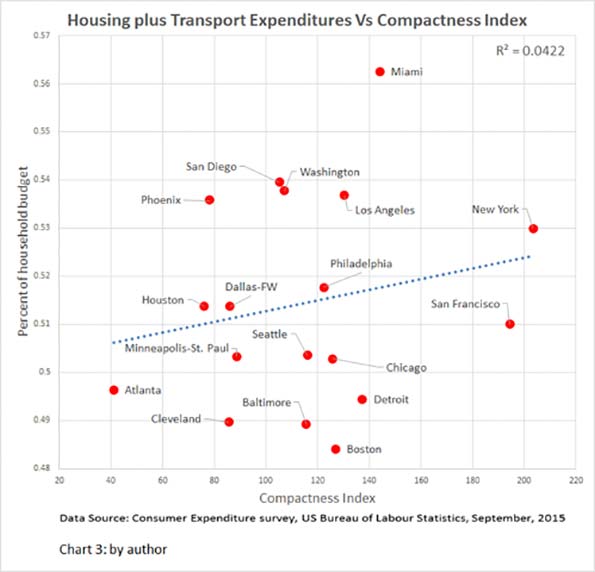
    Using the same data from the CES for the 18 cities, we plotted the results of combining the two expenditures, as a percentage of the household budget.

    Chart 3 shows an inverse, albeit weak, association of compactness with combined household expenditures of housing and transportation. It clearly does not indicate that more compact cities are more affordable for the average household. Upon a closer look the chart reveals some instructive surprises.

    First, Atlanta appears among a group of five most affordable cities, even though it has by far the lowest compactness index (40.9) of all eighteen cities in the CES survey. According to traded wisdom, its transport costs, being almost entirely based on automobile travel, should overwhelm its housing expenditures.

    Contradicting theory, Atlanta posts next to lowest average housing cost ($16,316/year), and also one but lowest transportation costs ($8,086/year). When considering that average income in Atlanta is on a par with that in Los Angeles ($69,821 vs $69,118), and that its compactness index is 80 points lower than LA’s, its comparative affordability challenges current thinking about compactness and its effects.

    Second, four cities hover around the same point of the index (#110), yet they cover almost the entire gamut of budget percentage expenditure (49% to 54%) for combined housing-plus-transport costs. The same is true for five cities aligning around the #130 of the index.

    It’s apparent that current theory falls short of adequately explaining field data. A city planner would find little comfort in knowing that a fourfold range of compactness can be equated with the same level of affordability, or that the same level of compactness can be associated with a wide range of combined transportation and housing expenditures. If anything, these results suggest that, because average housing expenses are double those of transportation, a yet-to-be-determined density ceiling might be an effective means of increasing a city’s affordability.

    The CES data is only a snapshot in time that may reflect transient conditions, such as gasoline prices, local inflated real estate markets, congestion levels that affect gas consumption, effectiveness and reach of public transit and so on. Variability in these factors will always affect the average transport and housing expenditures. A predictive model should be robust enough to handle such fluctuations, if it is to have practical value.

    Yes, greater compactness is associated with higher housing costs and lower transportation costs. But, contrary to unsubstantiated assertions, when these are combined, the result is less — not more — overall affordability.

    Fanis Grammenos heads Urban Pattern Associates (UPA), a planning consultancy. UPA researches and promotes sustainable planning practices including the implementation of the Fused Grid, a new urban network model. He is a regular columnist for the Canadian Home Builder magazine, and author of Remaking the City Street Grid: A model for urban and suburban development. Reach him at fanis.grammenos at gmail.com.

    Flickr photo by Tim Bartel of a San Francisco neighborhood

  • Cities That Locate Art In Odd Places

    The city sidewalk today is pretty empty, with online shopping and social media having replaced shoe leather on pavement. Restrictions in the name of safety have also become more common since 9/11. One result of these trends is a movement called Art in Odd Places : the work of artists that use public space itself as a huge, blank canvas. Orlando is the most recent city to experiment in this fashion. This month, more than fifty artists there reasserted the right to an unfettered exchange of ideas in public space, reinventing the sidewalk. It was an interesting experiment that led to some bigger questions about the relationship between public space and civic involvement.

    Art in Odd Places was started by New York artist Ed Woodham in 1996 during the Cultural Olympiad in Atlanta, which coincided with the Olympics. With the media focused on sports, few recall that the Olympics is a celebration of mind and spirit, as well as of the body. Olympic cities host poets on the street reciting verses, and painters and sculptors exhibiting their pieces. Woodham struggled with officials to bring performance art to the event, and went home determined to keep the town square in its rightful place as the unfettered medium of exchange for art and ideas.

    All the way through the nineties, movies and television documented sidewalks thronging with people, parks full of activity, and public plazas alive with protests or festivals. Despite popular rhetoric that accuses the car of killing public space, something different was happening. Sidewalks and plazas have continued as the arena for public encounters in our cities. They reached capacity, but as cities spread out the car had little effect on, for example, Times Square, or on any other city’s sidewalk.

    Something funny started happening however; something only a few like Ed Woodham noticed. “In Atlanta, we were placed in a designated ‘free speech zone,’ which I found odd,” he commented to me while preparing for Orlando’s event. “I wondered when the city was no longer a free speech zone in its entirety.” Woodham noted, in particular, the clampdown after 9/11. Any sort of organized activity on the sidewalk was more and more regulated, in part due to a heightened sense of security.

    Today the value of public space is open to debate. Nicolett Mall, a pedestrian zone in downtown Minneapolis, is hardwired into the city’s soul and is being rejuvenated. Meanwhile, New York Mayor Bill de Blasio is considering removal of the plazas in Times Square that have attracted a lively crowd and the presence of costumed characters and street performers, many of them seeking tips.

    In 2013, Greensboro, North Carolina hosted Art in Odd Places, and the director of downtown Orlando’s Gallery at Avalon Island art curator Pat Greene visited. Two years later, Greene successfully co-curated the Orlando show, along with Voci Dance Director Genevieve Bernard. Between September 17th and 20th this year, Orlando became a host to dozens of artists on the street. The theme in Orlando is “Tone,” which is interpreted by each artist individually; pieces have been created around audio tones, color tones or other meanings of this word (I reviewed the work in a recent critique for the Orlando Weekly).

    For example, Forrest MacDonald’s subtle water pipes, inserted next to actual storm water pipes, were sprinkled down Magnolia Avenue, with hands reaching out of the pipes to stroke tufts of grass. Nathan Selikoff fed a microphone into a computer, and then onto a giant screen, projecting an “Audiograph” that mapped the soundwaves of the city like a huge EEG.

    On the more ethereal side, performance artist Masami Koshikawa created “Self Portrait as Butterfly Woman,” posing in white while an assistant invited passersby to place gold origami butterflies on her body suit. This gesture broke the barriers between strangers and the taboo of touch, and represented a sublime moment in the festival. Koshikawa eventually collected hundreds of butterflies.

    Arvid Tomayko paraded up and down Magnolia Street in his “Wearable Tentacle Horn,” a suit with trumpets coming out the ends of various sleeves. And Chris Scala pulled a wire mesh camper into a parking lot and slept in it, LED lights washing over his sleeping form, in a piece entitled “X-Ray Camper”. These are only a few examples of artists using public space to make a spectacle in a traditional manner.

    I visited Art in Odd Places at the height of the lunch rush on one day. A few scattered pedestrians wandered in and out of restaurants, and a preschool teacher led her little ones back to school from a library trip. The artists and their supporters comprised the largest single population group. (More people came by in the evening, according to Greene.)

    In the last ten years, the number of people living in downtown Orlando has actually increased, with more and more residential housing available in and around the city’s core. What has sucked the life out of sidewalks, it turns out, isn’t the suburbs; instead, it’s the tiny screen and the big screen that have occupied more and more of our lives, taking over the social space that was once reserved for the street. Casual shopping encounters, mixing social and economic activity, walking to business appointments, encounters on the once-active courthouse steps: all of this has become the archaic activity of yesteryear.

    Art in Odd Places did interrupt the tiny screen focus of the average pedestrian who braved the sunny weather that day. Some of the artists deliberately sought to enter the cell phones of bystanders: Sound artist Jeff Knowlton created an app called “Sonify: Orlando” which, when downloaded, provided an acoustic narrative with sounds triggered by the immediate location. A new art form, which Knowlton describes as “locative media,” is born. And overall, Woodham, in an optimistic manner, has aroused artists in city after city to reinvent the sidewalk. In Orlando, the event was a success.

    The darker issue of the regulation of the sidewalk, has, however, remained unaddressed. Woodham feels that well-meaning but overly stiff regulation has turned people out of their public space, and is working hard to reinvigorate the streets with art. Where a vacuum exists, artists often rush in, and the result reflects our contemporary culture. This type of activist art is not seeking to right a gross injustice or advocate a cause, except for that of free speech. It is spurred by open conjecture about the future use of the sidewalk, and asks pedestrians to re-invent the nature of our public space in the twenty-first century.

    Richard Reep is an architect with VOA Associates, Inc. who has designed award-winning urban mixed-use and hospitality projects. His work has been featured domestically and internationally for the last thirty years. An Adjunct Professor for the Environmental and Growth Studies Department at Rollins College, he teaches urban design and sustainable development; he is also president of the Orlando Foundation for Architecture. Reep resides in Winter Park, Florida with his family.

    Photos by the author: Anna McCambridge interacting with a piece of “Storm Water;” Koshikawa, right, with butterfly assistant.

  • Homebuyers Confront China Syndrome

    China has hacked our government, devastated or severely challenged our industries and enjoyed one of the greatest wealth transfers in history – from our households to its. China also benefits from by far the largest trade surplus with the United States and also owns 11 percent of our national debt.

    Sometimes it seems to be increasingly China’s world, and we just happen to live in it. Some, such as columnist Thomas Friedman and Daniel A. Bell, author of the newly published “The China Model,” even suggest we adjust our political system to more closely resemble that of the Chinese.

    Yet, a funny thing has happened on the way to global domination – the Chinese are coming here with their money, and, often, with their families. Rather than seeing China as the land of opportunity, more Chinese have been establishing homes in America, particularly in California, where they account for roughly one-third of foreign homebuyers, with upward of 70 percent paying cash. Overall Chinese investment in U.S. real estate has grown from $50 million in 2000 to $14 billion in 2013, surpassing all other foreign investors.

    Read the entire piece at The Orange County Register.

    Joel Kotkin is executive editor of NewGeography.com and Roger Hobbs Distinguished Fellow in Urban Studies at Chapman University, and a member of the editorial board of the Orange County Register. He is also executive director of the Houston-based Center for Opportunity Urbanism. His newest book, The New Class Conflict is now available at Amazon and Telos Press. He is also author of The City: A Global History and The Next Hundred Million: America in 2050. He lives in Orange County, CA.

  • Aging America: The U.S. Cities Going Gray The Fastest

    For years we have been warned about the looming, profound impacts that the aging of the U.S. population will have on the country. Well, the gray wave has arrived. Since 2000, the senior population has increased 29% compared to overall population growth of 12%. The percentage of Americans in the senior set has risen from 12.4% to 14.1%, and their share of the population is projected to climb to 19.3% by 2030. There are two principal causes for this: the baby boom generation is reaching 65 years old, while the U.S. fertility rate has fallen markedly in recent decades, despite immigration, and now hovers around the replacement rate.

    To find the cities that are going gray the fastest, we looked at the change from 2000 through 2013 in the share of seniors in the populations of the nation’s largest metropolitan areas, the 52 metropolitan statistical areas that have more than a million residents. Some 13.2% of the residents of these 52 MSAs are seniors, a lower proportion than nationwide.

    Before we look at where the biggest changes have occurred, let’s take a look at where the highest overall concentrations of seniors are: no big surprise, in Florida, and in the slow-growing Northeast and Midwest. Among the 52 biggest metropolitan areas, Tampa-St. Petersburg has the highest share of seniors in its population at 18.2%. The retirement mecca of Miami, where 16.7% of its population is over 65, ranks third in the nation, and Jacksonville is 18th, at 13.7%.

    Outside of Florida almost all the retirement capitals are in the Northeast and Midwest. The second most senior region, for example, is Pittsburgh, where 18.0% of the population is over 65. The old Steel City is followed by a host of Rust Belt metro areas: Cleveland, Rochester, Providence, Hartford, St. Louis and Detroit, all of which have a senior set that makes up 14% or more of the overall population.

    Austin, Texas, has the smallest proportion of seniors, at 9.2%, but its senior share is rising — more on Austin later on. Salt Lake City, Houston and Dallas-Fort Worth are also below 10%, while Raleigh has the fifth-lowest proportion of seniors, at 10.2%. Not surprisingly, all of these relatively young cities are experiencing strong domestic in-migration.

    Cities That Are Aging The Most

    The metropolitan areas that have seen the biggest jumps in the senior proportion of their populations, have, for the most part, been the same ones that have drawn strong net domestic in-migration of millennials, families and working adults. The rise in the share of seniors in these cities isn’t because seniors are moving to them in overwhelming numbers — Census data shows they make major moves less than all other age groups. (In 2011-12, seniors moved to another state five times less frequently than those between the ages of 25-34, according to Current Population Survey figures.) Rather, many of those who have reached 65 since 2000 in the cities that top our list moved to them when they were younger, generally in search of economic opportunities or better lives, and have aged there.

    However, when seniors do decide to move, they can have a disproportionate impact on metropolitan economies because of their relative affluence. Over-65 households have a net worth 2.5 times the national average, according to Census Bureau data. Seniors (over 62) were far less damaged in the housing bust than younger households, and their incomes increased more with the tepid economic recovery, according to St. Louis Federal Reserve studies.

    In first place on our list is Atlanta, where the share of seniors in the population rose from 7.7% in 2000 to 10.4% in 2013, the biggest increase in the nation. In raw numbers, the over-65 population of the metro area rose to 572,534, an increase of  73.5% since 2000.

    The percentage of the population in fast-growing Raleigh, N.C., that is over 65 grew from 8.0% to 10.2% in 2013, putting it in second place.

    Austin may have a reputation as a youthful place, but it’s also getting older rapidly. The senior population has surged 91.7% since 2000 to 172,476, amid a general population boom – the share of seniors in the metro area has expanded from 7.2% to 9.2%, placing it third on our list. The metro area may be unprepared for a mounting “silver tsunami” of impoverished elderly, according to the Austin American-Statesman.

    Two of the cities that posted the biggest increases in the share of seniors in their populations also were among the largest overall domestic migration losers, San Jose, Calif., and Los Angeles. Since 2000, 1.7 million more U.S. residents moved away from the two metro areas than to them. Only Hurricane Katrina-ravaged New Orleans lost a larger share of its total population to domestic out-migration than San Jose, which ranks 4th in the increase of its senior population, going from 9.4% to 11.9%. Los Angeles, which trailed only New Orleans, San Jose and New York in the percentage of its population that it lost to domestic migration, went from 9.8% over-65 to 12.1%, the ninth biggest increase among the 52 largest metro areas. The combination of older households moving less and younger households leaving to take advantage of better job opportunities elsewhere may explain this.

    The balance of the top 10 all experienced net domestic migration gains since 2000.

    Meanwhile, the Rust Belt and Florida cities that already were among the oldest didn’t get much older. Tampa-St. Petersburg actually got younger, at least in part due to strong overall in-migration by younger people.

    Are Seniors Headed To Big Cities?

    One favorite meme of urban boosters is the assertion that seniors are heading to the inner city. The preponderance of evidence shows the opposite. Within the 52 largest metropolitan areas, the urban cores, measured at the small area level (zip codes) have lost seniors to the periphery. Between 2000 and 2010, the urban core senior population declined by  1.5 million, dropping from nearly 15% of the total population to 13%.The losses were pervasive, extending to all the 52 biggest MSAs except for San Diego (and there the urban core gain was miniscule, with 97% of the senior growth occurring in the suburbs and exurbs).

    In contrast, suburbs and exurbs together gained over 2.82 million seniors. But the largest increases were farthest from core, in the newer, outer suburbs and exurbs. Together these areas gained 2.4 million seniors. Rather than headed into the core, the prevailing trend has been quite the opposite.

    A similar pattern has been identified in Canada. A recent study of that country’s six largest cities found similar patterns, with older Canadians, if they move, tending to end up the suburban rings.

    Just The Beginning

    Over the next 15 years, cities are likely to age even faster. Those cities that attract the most among relatively few senior domestic migrants and which have seen their over-50 cohorts swelled by previous domestic migration should see the largest increases. At the same time, other cities with modest senior population gains could also age more quickly if more of the rest of the population moves away.

    Seniors in America’s Largest Metropolitan Areas, 2000-2013
    Ranked by change in share of seniors, 2000-2013
    Rank MMSA Seniors Share 2000 Seniors Share 2013 Seniors Share Change 2000-13% Number of Seniors 2013 Change in Total Seniors 2000-13%
    1 Atlanta, GA 7.7% 10.4% 34.0% 572,534 73.5%
    2 Raleigh, NC 8.0% 10.2% 28.6% 124,285 96.0%
    3 Austin, TX 7.2% 9.2% 27.2% 172,476 91.7%
    4 San Jose, CA 9.4% 11.9% 26.7% 229,062 40.1%
    5 Denver, CO 9.0% 11.3% 25.7% 304,698 57.1%
    6 Dallas-Fort Worth, TX 7.9% 9.9% 25.6% 676,537 64.4%
    7 Jacksonville, FL 11.0% 13.7% 24.2% 191,000 54.2%
    8 Houston, TX 7.7% 9.5% 24.0% 601,800 66.9%
    9 Los Angeles, CA 9.8% 12.1% 23.7% 1,584,236 31.4%
    10 Portland, OR-WA 10.4% 12.8% 23.5% 296,365 48.3%
    11 Minneapolis-St. Paul, MN-WI 9.7% 11.9% 23.1% 412,713 40.4%
    12 Washington, DC-VA-MD-WV 9.0% 11.0% 23.0% 656,678 51.3%
    13 Virginia Beach-Norfolk, VA-NC 10.3% 12.7% 22.7% 215,992 32.6%
    14 Grand Rapids, MI 10.5% 12.7% 20.5% 128,805 31.6%
    15 Las Vegas, NV 10.7% 12.8% 20.4% 260,156 77.5%
    16 Rochester, NY 12.9% 15.5% 20.0% 167,497 22.3%
    17 Detroit, MI 12.0% 14.3% 19.7% 616,033 15.5%
    18 Sacramento, CA 11.3% 13.5% 19.1% 298,327 46.8%
    19 Seattle, WA 10.1% 11.9% 17.9% 431,378 39.8%
    20 Richmond, VA 11.4% 13.3% 17.1% 166,173 38.2%
    21 San Francisco-Oakland, CA 11.7% 13.7% 16.8% 617,996 27.9%
    22 New Orleans. LA 11.4% 13.2% 16.4% 164,372 8.0%
    23 Memphis, TN-MS-AR 10.0% 11.7% 16.3% 156,792 28.7%
    24 Salt Lake City, UT 8.0% 9.3% 15.6% 105,993 40.3%
    25 Columbus, OH 10.1% 11.7% 15.5% 230,044 35.6%
    26 Charlotte, NC-SC 10.5% 12.0% 15.2% 281,202 56.7%
    27 Phoenix, AZ 11.9% 13.7% 15.1% 604,442 55.8%
    28 Nashville, TN 10.3% 11.8% 14.9% 208,133 46.3%
    29 Chicago, IL-IN-WI 10.9% 12.4% 14.3% 1,184,871 19.8%
    30 Baltimore, MD 12.0% 13.7% 14.1% 379,722 23.8%
    31 Cincinnati, OH-KY-IN 11.7% 13.3% 13.4% 283,518 21.5%
    32 Kansas City, MO-KS 11.5% 13.0% 12.8% 266,749 27.9%
    33 Louisville, KY-IN 12.4% 14.0% 12.4% 176,229 26.6%
    34 Cleveland, OH 14.5% 16.2% 11.8% 335,054 7.5%
    35 Boston, MA-NH 12.6% 14.1% 11.6% 658,710 19.0%
    36 St. Louis,, MO-IL 13.0% 14.4% 11.1% 404,297 16.3%
    37 San Diego, CA 11.1% 12.3% 10.8% 396,543 26.4%
    38 Hartford, CT 13.9% 15.4% 10.5% 187,183 16.9%
    39 New York, NY-NJ-PA 12.6% 13.9% 10.4% 2,768,694 16.3%
    40 Birmingham, AL 12.8% 14.1% 10.1% 160,686 19.3%
    41 San Antonio, TX 10.8% 11.9% 10.1% 270,480 46.5%
    42 Riverside-San Bernardino, CA 10.5% 11.5% 9.8% 502,846 47.8%
    43 Oklahoma City, OK 11.4% 12.5% 9.7% 164,481 32.2%
    44 Indianapolis. IN 11.0% 12.0% 9.5% 234,973 29.0%
    45 Orlando, FL 12.4% 13.4% 8.5% 304,660 49.7%
    46 Milwaukee,WI 12.6% 13.5% 7.4% 211,527 12.3%
    47 Providence, RI-MA 14.4% 15.4% 7.0% 247,689 8.4%
    48 Philadelphia, PA-NJ-DE-MD 13.4% 14.2% 6.5% 858,313 13.0%
    49 Buffalo, NY 15.9% 16.5% 3.7% 186,693 0.5%
    50 Miami, FL 16.4% 16.7% 1.8% 975,529 18.5%
    51 Pittsburgh, PA 17.7% 18.0% 1.6% 425,102 -1.3%
    52 Tampa-St. Petersburg, FL 19.2% 18.4% -4.3% 527,861 14.6%
    52 Major Metropolitan Areas 11.4% 12.9% 13.2% 22,588,129 29.2%
    Outside MMSAs 13.6% 15.7% 14.8% 22,115,945 26.4%
    United States 12.4% 14.1% 13.8% 44,704,074 27.8%

    This piece first appeared at the Orange County Register.

    Joel Kotkin is executive editor of NewGeography.com and Roger Hobbs Distinguished Fellow in Urban Studies at Chapman University, and a member of the editorial board of the Orange County Register. His newest book, The New Class Conflict is now available at Amazon and Telos Press. He is author of The City: A Global History and The Next Hundred Million: America in 2050. His most recent study, The Rise of Postfamilialism, has been widely discussed and distributed internationally. He lives in Los Angeles, CA.

    Wendell Cox is principal of Demographia, an international public policy and demographics firm. He is co-author of the “Demographia International Housing Affordability Survey” and author of “Demographia World Urban Areas” and “War on the Dream: How Anti-Sprawl Policy Threatens the Quality of Life.” He was appointed to three terms on the Los Angeles County Transportation Commission, where he served with the leading city and county leadership as the only non-elected member. He was appointed to the Amtrak Reform Council to fill the unexpired term of Governor Christine Todd Whitman and has served as a visiting professor at the Conservatoire National des Arts et Metiers, a national university in Paris.

    “Senior Citizens Crossing” photo by Flickr user auntjojo.

  • Is the Census Bureau On Track For Another Estimating Fiasco?

    When the 2010 Census results were released, a number of big cities had populations that were very off from what would have been expected based on the Census Bureau’s previous annual estimates of the population – sometimes grossly so.  Some of these were related to cities that had challenged the estimates and had adjustments made in their favor, such as Cincinnati and St. Louis. Given that the Census Bureau seems to have approved every challenge, bogus challenges were all but encouraged.  Still, there were significant variances in cities that didn’t challenge the Census, such as Chicago and Phoenix. 

    Had the estimates been correct, Atlanta would have gained over 125,000 people in the last decade – a stunning gain of 30%. But Atlanta’s actual population was nearly flat, growing less than 1%. Other cities experiencing huge swings due to misestimates were places like New York City (projected to gain 417,000, actually gained less than half that at 167,000) and Chicago (projected to lose 29,000 people, actually lost over 200,000).  I myself ended up with some egg on my face for drawing unwarranted inferences from what appear to be badly botched estimates.

    Urban advocates were quick to cry foul, alleging undercounts (though taking the strong growth counted for downtowns as gospel).  Given the much more rigorous Census standards for challenges to decennial counts, it was virtually impossible for these to succeed, but some have continued to maintain systematic undercounting in the decennial census as a matter of course.

    When the first round of new post-2010 Census estimates were released for cities, the media started crowing again about a supposed resurgence in city populations. However, this wasn’t real growth. Instead, the Census Bureau had created a new, temporary methodology to get the estimates out the door. Rather than producing real numbers, they simply took the estimates for growth at the county level and assumed every municipality in the country grew at the exact same percentage as the county as a whole.  The media missed the story because they relied on the headline data, and were attracted to the “back to the city” meme. They would have had to dig into the methodology document – something ordinarily no one would need to do for this sort of routine release – to figure this out.  This release was embarrassment number two for the municipal estimates program.

    You would think that after these two fiascos, the Census Bureau would be highly attuned to getting the municipal estimates right. Indeed, for the recently released 2012 vintage municipal estimates, they went back to using a real estimating methodology instead of the simple allocation approach from 2011. However, as with the 2000s, these are showing strong municipal population growth in places where that would represent a major discontinuity with the actual decennial Census results from the 2000-2010, and from economic conditions.

    How is it that cities, after a disappointing 2000s where some places actually underperformed versus the 1990s, in an economy that has been recessionary to sluggish the entire post-2010 person and in which the housing market that triggered the crash has also yet to recover, that these growth rates are possible? It’s certainly eyebrow-raising at a minimum.

    Consider Chicago. After losing over 200,000 people in the 2000s, Chicago supposedly gained 17,000 people between 2010 and 2012. With a highly publicized murder problem in many of the neighborhoods that saw the severest depopulation in the previous decade, where housing was whacked leaving any number of uncompleted building shells, and with a budget crunch that is squeezing service provision, this would certainly represent a remarkable accomplishment.

    Or look at Indianapolis. In its urban core area, Center Township (township data is reported in a similar manner to municipal estimates in some areas), the population declined by almost 25,000 people during the 2000s, a steep 14.5% loss that was worse than Buffalo and St. Louis and nearly as bad as Cleveland.  Center Township has lost population every decade since 1950. Yet the Census Bureau has estimated that it gained 2,300 people since the census. Though a lower total percentage due to the base, this is more physical people than was estimated to be added by all but three of Indy’s suburbs, many of which posted huge gains in the 2000s (such as Westfield, which added 20,800 during the 2000s but was only estimated to have added 1,800 since the census despite building permit issuances at all time record highs).  This sort of radical turnaround in fortunes would certainly be nearly miraculous if true.

    Amazingly, the Census Bureau actually even went back to the estimating status quo ante in Atlanta by claiming very high population growth, despite missing by a country mile last time around. Atlanta is projected to have gained almost 24,000 people since the census, even though it was nearly flat the previous decade. This is a rate very close to what the Census Bureau estimated it had in the last decade.

    You can go right down the line and find similar effects at work in other places. It raises serious questions about these estimates. Places like San Francisco, DC, and even Pittsburgh have had economic growth that might seem to underpin more robust core population growth, it’s hard to credit many of these other places with such turnaround.  Some of the analysts focused on an inability of people to move outwards because of the economy, but it’s hard to believe this alone grew the population of Atlanta by 24,000 people.

    There are red flags all over these numbers. Perhaps the urban advocates claiming dramatic undercounting in the census were right – or maybe not. Regardless, something very odd appears to have been going on with the Census Bureau’s municipal estimates and counts over the last decade or so. Until there’s reason to believe they’ve finally started getting it right, I would treat any number that comes out before the decennial census with extreme skepticism. After having fooled us not once, but twice before, smart money should apply a steep discount to any annual municipal estimates coming out of the Census Bureau.

    Aaron M. Renn is an independent writer on urban affairs and the founder of Telestrian, a data analysis and mapping tool. He writes at The Urbanophile.

    Photo: Travelin’ Librarian

  • Distortions and Reality about Income Mobility

    A ground-breaking study of intergenerational income mobility has the enemies of suburbia falling all over themselves to distort the findings. The study, The Spatial Impacts of Tax Expenditures: Evidence from Spatial Variation Across the U.S. (by economists Raj Chetty and Nathaniel Hendren of Harvard University and Patrick Kline and Emmanuel Saez of the University of California, Berkeley). Chetty, et al. examined income mobility by comparing the income quintiles (20 percent) of households with children (between 1996 and 2000) compared to their own household income quintiles as adults in 2010/1. The children were all born in 1980 or 1981. The authors summarize their research as follows:

    “We measure intergenerational mobility at the local (census commuting zone) level based on the correlation between parents’ and children’s earnings. We show that the level of local tax expenditures (as a percentage of AGI) is positively correlated with intergenerational mobility.”

    The Over-Reach

    One of their findings was that children born in the Atlanta area had less upward income mobility than in most other metropolitan areas (Note 1). This provided all that was needed for a spin by others that distorted the findings into a completely different story than supported by the data.

    New York Times reporter David Leonhart started it, sprucing up the conclusions to produce anti-sprawl tome. He accomplishes this by unearthing anecdotes about the difficulty low income workers face getting to work in Atlanta, and blaming that urban area’s lower density suburbanization. However, the same anecdotes could have been woven from every metropolitan area in the nation (Note 2), regardless of their extent of suburbanization. More importantly, the research is not about sprawl.

    Nonetheless, Nobel Laureate Paul Krugman then piled on, writing in The New York Times that Leonhart’s article had shown “how sprawl seems to hurt social mobility.” Krugman continued the next day with his “sprawl-caused-Detroit’s bankruptcy” thesis, which relied on an apples-to-oranges comparison (See: Detroit Bankruptcy: Missing the Point). Then on July 28, Krugman wrote: “…in one important respect booming Atlanta looks just like Detroit gone bust: both are places where the American dream seems to be dying” (Note 3).  Krugman calls Atlanta the “Sultan of Sprawl.”

    Professor Steven Conn of Ohio State University took it a bit further in the Huffington Post, saying that: “One of their findings is that mobility is more restricted in places defined by suburban sprawl — like Atlanta and Columbus, Ohio — than in denser, more urban places like San Francisco and Boston. Far from being good for the nation, our love affair with the car, and the sprawl it has produced, keeps people from moving up the economic ladder.”

    The Research

    The authors of the report reached their conclusions using regression analyses and controlling for demographic factors, with the objective of identifying associations between upward income mobility and tax expenditures, not suburbanization. In fact, the very issue of transportation and density was simply not a factor.

    The authors provided additional information with 25 separate, simple correlation analyses between 25 individual variables and economic mobility (demographic factors were not controlled). Co-Author Raj Chetty described this supplemental research in a PBS interview, citing income segregation, school quality, two-parent families and measures, civic engagement, religiosity and community cohesiveness. The authors urged caution in interpreting these correlations: “For instance, areas with high rates of segregation may also have other differences that could be the root cause driving the differences in children’s outcomes.”

    Rational Responses

    The overreach was challenged by Columbia University urban planning professor David King, who pointed out that the best ranked cities in the upward mobility analysis were all “sprawling,” including Salt Lake City, Santa Barbara and Bakersfield, which he referred to as a “poster child for sprawl.” He further noted that: “…snapshot correlations really don’t mean anything and will provide evidence for whatever point of view is desired.”

    Randal O’Toole of the Cato Institute similarly questions the unfounded interpretations of the study and notes that Atlanta has invested billions in new transit systems over recent decades, but with no appreciable impact on how the poorest citizens did there.

    University of Southern California economics professor Peter Gordon suggested that: “In the fast-and-loose manner that some have digested the Chetty et al. study, we could conclude that sprawl causes upward mobility.”

    Pinnacles of Prosperity

    Interestingly, if, as Krugman alleges, Atlanta is the Sultan of Sprawl, then similarly sprawling Hartford is the “Pinnacle of Prosperity.” Hartford has the highest per capita gross domestic product of any metropolitan area in the world. Yet, the urban area density of Hartford is 1,791 per square mile (692 per square kilometer), little above Atlanta (1,707 and 659), but two-thirds less than less affluent New York (5,319 and 2,054) and three-quarters less than less affluent Los Angeles (6,999 and 2,702), according to the 2010 census (Note 4).

    The reality is that the US has the world’s most sprawling cities, yet the 50 most affluent metropolitan areas per capita in the world include 38 in the United States. This includes the top eight, such as lower density Bridgeport (urban density 1,660 per square mile/641 per square kilometer), Boston (2,232/862) and Durham (1,913/739), as well as metropolitan areas with higher urban densities, San Francisco (6,266/2,419) and San Jose (5,820/2,247). Neither high-density New York nor Los Angeles makes the top 10. America’s greater dispersal is associated with the shortest commute times in the high income world, the least intense traffic congestion and some of the most affordable housing, if metropolitan areas subject to urban containment (smart growth) policies are excluded.

    Moreover, the Chetty, et al data gives little comfort to any whose conception of good and evil depends on sprawl. The research aggregates upward mobility data for all counties within each commuting zone. Among major metropolitan areas, that includes counties from the most dense (New York County at 71,000 per square mile or 27,000 per square kilometer) to Skamania County in the Portland area, with a density of 7 per square mile or 3 per square kilometer. County level analysis could make a difference.

    This is illustrated by the New York metropolitan area, which Chetty, et al divide into multiple commuting zones. The Tom’s River commuting zone, made up of outer suburban Monmouth and Ocean counties in New Jersey showed better upward income mobility (10.4 percent) than the New York commuting zone (9.7 percent) which included the city of New York, Nassau, Suffolk and Westchester counties. It might be interesting, for example, to compare the data, say for highly urban The Bronx to suburban Suffolk County, but the data does not permit that. This is not to criticize the Chetty, et al work; it is rather to suggest caution in inventing conclusions.

    Smaller May be Better

    Further, commuting zones with smaller populations have generally better upward income mobility.  Rather than an ode to bigness, the study found that commuting zones with less than 100,000 population average have higher than average upward income mobility. Virtually all of the smaller areas are low density and have little or no transit. Indeed, the best performers were in the Great Plains, in a swath from West Texas, through Oklahoma, Kansas, Nebraska and reaching a zenith in South Dakota and North Dakota, which is about as far from dense urbanization as it is possible to get. Further, a large majority of the highest scoring commuting zones with larger populations, like Bakersfield and Des Moines, are highly dispersed (Table below). This could be an area for further research.

    Geographical Income Mobility
    Population of Commuting Zone Upward Mobility Cases
    Over 1,000,000 7.5% 62
    500,000 to 1,000,000 7.6% 60
    250,000 – 500,000 8.6% 89
    100,000-250,000 9.0% 167
    50,000-100,000 10.4% 129
    25,000-50,000 13.0% 88
    Under 25,000 13.9% 146
    Average/Total 9.5% 741
    Upward mobility: 30/31 year olds reaching top income quintile by 2010/1, from households in the bottom quintile in 1996-2000
    Commuting zones are similar to metropolitan areas


    Additional Caveats

    There is no question but that this is ground-breaking research. The authors deserve considerable credit for the unprecedented scale of their analysis, which included over 6.2 million observations. However, the available data had an important limitation. The IRS data set they used does not go back far enough to make similarly robust findings about peak adult earnings. Age 30 or 31 may premature for predicting longer run income mobility. At that age, many who will eventually earn much more are not far into their careers. This would include people who have spent longer in higher education, such as those who have earned professional degrees. Finally, the median income of households in the 30 to 31 age category is barely 1/2 of their parents in the same, which, again, is not likely to be representative of their eventual income and quintile ranking over their adult lives.

    The findings would be appropriately characterized as relating to young adult income upward mobility. Conclusions about lifetime upward mobility or peak earnings upward mobility will need to wait a decade or more.

    The Second Half of the Story: Where People Moved

    The authors use the childhood residence in the study, both for the child and the adult. This means, for example, that if a child lived in the New York metropolitan area and moved to Atlanta by 2010 or 2011, he or she would be counted in the New York data. Where people lived as children is the first half of the story. The second half is where they moved.

    This is important, because so many people moved away from places like New York, San Francisco, Los Angeles, Boston, and San Jose during the period the study covers. Approximately 10 percent of the residents of New York and Los Angeles moved elsewhere between 2000 and 2010. Approximately 8 percent left San Francisco, 13 percent left San Jose and 5 percent left Boston. These are not small numbers and indicate that more people left than moved in. A net 1.9 million left New York, 1.3 million left Los Angeles, 340,000 left San Francisco, while 230,000 left San Jose and Boston.

    Some of the metropolitan areas that have gained the most domestic migrants scored below average on upward income mobility. For example, migration from other parts of the nation added 24 percent to Raleigh’s population in the 2000s, 17 percent to Charlotte, 11 percent to Tampa-St. Petersburg, and 10 percent to Atlanta (Note 5).

    None of this contradicts the Chetty, et al findings, which did not address the question of why some many people have moved. It can be assumed that people who are doing well economically will probably stay where they are. On the other hand, most who leave might be thought of as seeking better opportunities that might elude them in the richer, slower growing, far more expensive metropolitan areas of their childhood. The idea that people left New York, Boston or Los Angeles for a less rewarding life in Atlanta, Charlotte, or Raleigh violates everything we know about human nature.

    Seeking Prosperity

    Throughout history, and especially over the last 200 years, cities have drawn people from elsewhere by facilitating opportunity. It is no different today. People move to satisfy their aspirations. This was the point of our recent "Aspirational Cities" report in The Daily Beast.

    Chetty et al conclude: “What is clear from this research is that there is substantial variation in the United States in the prospects for escaping poverty.” True. It is also clear from actual behavior that, for many, the best prospect for escaping poverty may be the better opportunities that attract them to an aspirational city.

    Wendell Cox is a Visiting Professor, Conservatoire National des Arts et Metiers, Paris and the author of “War on the Dream: How Anti-Sprawl Policy Threatens the Quality of Life.

    —-

    Note 1: Chetty, et al use “commuting zone” as their unit of geographical analysis. These areas are generally similar to metropolitan areas, but there are some important differences. For example, the New York metropolitan area is divided into three parts (New York Newark and Tom’s River). The Dallas-Fort Worth metropolitan area is divided into two. Los Angeles, Riverside-San Bernardino and Oxnard are combined as are Rochester and Buffalo. All of Connecticut, which has four metropolitan areas, is a single commuting zone. Areas outside metropolitan areas are also divided into commuting zones.

    Note 2: The overwhelming share of low income workers drive to work (see How Lower Income Citizens Commute). Even, in metropolitan Boston, with its better than average transit system, few of the city’s low income residents can reach suburban job locations in less than one hour (the average commute time for all residents is less than one-half that). Despite popular impressions to the contrary, most jobs cannot be reached in a reasonable period of time by transit in any metropolitan area, nor is there any practical (affordable) way to change that.  

    Note 3: To the contrary, the American Dream is alive and well in Atlanta. Atlanta’s housing affordability is unrivaled by nearly all major metropolitan areas. Housing is four times as expensive relative to incomes in San Francisco and San Jose as in Atlanta (measured by the “median multiple”) three times as high in New York and Los Angeles and twice as costly in Portland. This makes housing more affordable for low income households. Not surprisingly, Atlanta households with less than $20,000 in annual income (approximately the lowest quintile) have a higher home ownership rate than in New York, Los Angeles, San Francisco, San Jose, Boston and Portland. Further, the gap with respect to African-American home-ownership is substantial. Atlanta’s African-American home ownership rate is approximately 40 percent above those of San Jose and Los Angeles, approximately 50 percent higher than Boston, San Francisco and Portland and nearly 60 percent higher than New York (American Community Survey, 2011).

    Note 4: These are US Bureau of the Census urban area density figures, based upon continuous urban areas (“built-up” areas). Urban area densities are calculated using census blocks, and contain no rural land. As a result, their population densities are not distorted by jurisdictional borders. This is to be distinguished from any metropolitan area based measure. All metropolitan areas include urban areas as well as rural areas that are economically connected to the urban area. The extent of rural areas within a metropolitan area is driven by the geographical size of counties and thus varies widely. The largest major metropolitan area county, San Bernardino (California) is nearly 1,000 times as large as the smallest, New York County. If metropolitan area criteria were applied at the census block level, as is the case in urban areas, large swaths rural swaths would be removed from metropolitan areas, changing the density distribution. However, even if metropolitan areas were more appropriately defined, any measure of metropolitan density would remain a mixed urban-rural metric, not a measure of urban density. Here are the 2010 criteria for defining urban areas and metropolitan areas.

    Note 5: There is less black-white racial segregation in Atlanta than in New York, Los Angeles, San Francisco, Boston, and most other major metropolitan areas, according to 2010 data compiled by William Frey of the Brookings Institution.
  • As the North Rests on Its Laurels, the South Is Rising Fast

    One hundred and fifty years after twin defeats at Gettysburg and Vicksburg destroyed the South’s quest for independence, the region is again on the rise. People and jobs are flowing there, and Northerners are perplexed by the resurgence of America’s home of the ignorant, the obese, the prejudiced and exploited, the religious and the undereducated. Responding to new census data showing the Lone Star State is now home to eight of America’s 15 fastest-growing cities, Gawker asked: “What is it that makes Texas so attractive? Is it the prisons? The racism? The deadly weather? The deadly animals? The deadly crime? The deadly political leadership? The costumed sex fetish conventions? The cannibal necromancers?” 

    The North and South have come to resemble a couple who, although married, dream very different dreams. The South, along with the Plains, is focused on growing its economy, getting rich, and catching up with the North’s cultural and financial hegemons. The Yankee nation, by contrast, is largely concerned with preserving its privileged economic and cultural position—with its elites pulling up the ladder behind themselves.

    This schism between the old Confederacy and the Northeastern elites is far more relevant and historically grounded than the glib idea of “red” and “blue” Americas. The base of today’s Republican Party—once the party of the North—now lies in the former secessionist states, along with adjacent and culturally allied areas, such as Appalachia, the southern Great Plains, and parts of the Southwest, notably Arizona, largely settled by former Southerners.

    “In almost every species of conceivable statistics having to do with wealth,” John Gunther wrote in 1946, “the South is at the bottom.” But even as Gunther was writing, the region had begun a gradual ascendancy, now in its seventh decade. That began with a belated post-WWII push to promote industrialization, much of it in relatively low-wage industries such as textiles. “Southerners don’t have any rich relatives. God was a Northerner,” the head of the pro-development Southern Regional Council told author Joel Garreau in 1980. “Without a heritage of anything except denial, Southerners, given a chance to improve their standard of living, are doing so.”

    While the Northeast and Midwest have become increasingly expensive places for businesses to locate, and cool to most new businesses outside of high-tech, entertainment, and high-end financial services, the South tends to want it all—and is willing to sacrifice tax revenue and regulations to get it. A review of state business climates by CEO Magazine found that eight of the top 10 most business-friendly states, led by Texas, were from the former Confederacy; Unionist strongholds California, New York, Illinois, and Massachusetts sat at the bottom.

    The South’s advantages come in no small part from decisions that many Northern liberals detest—lack of unions, lower wages, and less stringent environment laws. But for many Southerners, particularly in rural areas, a job at the Toyota plant with a $15-an-hour starting salary, and full medical benefits, is a vast improvement over a minimum-wage job at Wal-Mart, much less your father’s fate chopping cotton on a tenant farm.

    And the business-friendly policies that keep costs down appeal to investors. Ten of the top 12 states for locating new plants are in the former confederacy, according to a recent study by Site Selection magazine. In 2011 the two largest capital investments in North America (PDF)—both tied to natural-gas production—were in Louisiana.

    More recently, the region—led by Texas—has moved up the value-added chain, seizing a fast-growing share of the jobs in higher-wage fields such as auto and aircraft manufacturing, aerospace, technology, and energy. Southern economic growth has now outpaced the rest of the country for a generation and it now constitutes by far the largest economic region in the country. A recent analysis by Trulia projects the edge will widen over the rest of this decade, owing to factors including the region’s lower costs and warmer weather.

    These developments are slowly reversing the increasingly outdated image of the South as hopelessly backward in high-value-added industries. Alabama and Kentucky are now among the top-five auto-producing states, while the Third Coast corridor between Louisiana and Florida ranks as the world’s fourth-largest aerospace hub, behind Toulouse, France; Seattle; and California.

    Southern growth can also be seen in financial and other business services. The new owners of the New York Stock Exchange are based in Atlanta.

    While the recession was tough on many Southern states, the area’s recovery generally has been stronger than that of Yankeedom: the unemployment rate in the region is now lower than in the West or the Northeast. The Confederacy no longer dominates the list of states with the highest share of people living in poverty; new census measurements (PDF), adjusted for regional cost of living, place the District of Columbia and California first and second. New York now has a higher real poverty rate than Mississippi.

    Over the past five decades, the South has also gained in terms of population as Northern states, and more recently California, have lost momentum. Once a major exporter of people to the Union states, today the migration tide flows the other way. The hegira to the sunbelt continues, as last year the region accounted for six of the top eight states attracting domestic migrants—Texas, Florida, North Carolina, Tennessee, South Carolina, and Georgia. Texas and Florida each gained 250,000 net migrants. The top four losers were New York, Illinois, New Jersey, and California.

    These trends suggest that the South will expand its dominance as the nation’s most populous region. In the 1950s, the Confederacy, the Northeast, and the Midwest all had about the same populations. Today the South is nearly as populous as the Northeast and the Midwest combined, and the Census projects the region will grow far more rapidly (PDF) in the years to come than its costlier Northern counterparts.

    Yankees tend to shrug off such numbers as largely the chaff drifting down. “The Feet are moving south and west,” The Atlantic’s Derek Thompson wrote in 2010, “while the Brains are moving toward coastal cities.”

    To be sure, some Yankee bastions, such as Massachusetts and Connecticut, enjoy much higher percentages of educated people than the South. Every state in the Southeast falls below the national average of percentage of residents 25 and over with at least a bachelor’s degree—but virtually every major Southern metropolitan region has been gaining educated workers faster than their Northeastern counterparts. Over the past decade, greater Atlanta added over 300,000 residents with B.A.s, more than the larger Philadelphia region and almost 70,000 more than Boston.

    The region—as recently as the 1970s defined by its often ugly biracial politics—has become increasingly diverse, as newly arrived Hispanics and Asians have shifted the racial dynamics. While the vast majority of 19th-century immigrants to America settled in the Northeast and Midwest, today the fastest-growing immigration destinations—including Nashville, Atlanta, and Charlotte—are in the old Confederacy. Houston ranked second in gaining new foreign-born residents in the past decade, just behind New York City, with nearly three times its size. And Houston and Dallas both now attract a higher rate of immigration than Boston, Chicago, Seattle, or Philadelphia.

    These immigrants are drawn to the South for the same reasons as other Americans—more jobs, a more affordable cost of living and better entrepreneurial opportunities. A 2011 Forbes ranking of best cities for immigrant entrepreneurs—measuring rates of migration, business ownership, and income—found several Southeastern cities at the top of the list, with Atlanta in the top slot, and Nashville coming in third.

    Then there’s the most critical determinant of future power: family formation. The South easily outstrips the Yankee states in growth in its 10-and-under population. Texas and North Carolina expanded their kiddie population by over 15 percent; and every Southern state gained kids except for Katrina-ravaged Louisiana. In contrast New York, Rhode Island, and Michigan lost children by a double-digit margin while every state in the Northeast as well as California suffered net losses.

    The differences are most striking when looking at child-population growth among the nation’s 51 largest metropolitan areas. Eight of the top ten cities for growth in children under 15 were located in the old Confederacy—Raleigh-Cary, Austin, Charlotte, Dallas, Houston, Orlando, Atlanta, and Nashville. New York, Los Angeles, and Boston, along with several predictable rust-belt locals, ranked in the bottom 10.

    Historically, regions with demographic and economic momentum tend to overwhelm those who lack it. Numbers mean more congressional seats and more electoral votes, and governors who command a large state budget and the national stage. Unless there is a major political change, the South’s demographic elevation will do little to help Democrats there, who, like Northern Republicans, appear to be an endangered species.

    Pundits including the National Journal’s perceptive Ron Brownstein suggest that the GOP’s Southern dominance has “masked” the party’s decline in much of the rest of the country. Other, more partisan voices, like the New Yorker’s George Packer simply dismiss Southern conservatives as overmatched by the Obama coalition of minorities, the young, and the highly educated. The even more partisan Robert Shrum correctly points out that the Southern-dominated GOP is increasingly out of step with the rest of the country on a host of social and economic issues, from income inequality to support for gay marriage.

    “A lot of sociologists have projected that the South will cease to exist because of things like the Internet and technology,” Jonathan Wells told Charlotte Magazine. An associate professor of history at UNCC and author of Entering the Fray: Gender, Culture, and Politics in the New South, Wells predicts the region “will lose its distinctive identity that it had in the past.”

    It’s unlikely, though, that the South will emulate the North’s social model of an ever-expanding welfare state and ever more stringent “green” restrictions on business—which hardly constitutes a strong recipe for success for a developing economy. It’s difficult to argue, for example, that President Obama’s Chicago, broke and with 10 percent unemployment, represents the beacon of the economic future compared to faster-growing Houston, Dallas, Raleigh, or even Atlanta. People or businesses moving from Los Angeles, New York, or Chicago to these cities will no doubt carry their views on social issues with them, but it’s doubtful they will look north for economic role models.

    Instead, you might see some political leaders, even Democrats, in states such as Pennsylvania, Ohio (a Civil War hotspot for pro-Southern Copperheads), and Michigan come to realize that pro-development policies, such as fracking, offer broader benefits than the head-in-the-sand “green” energy policy that slow growth in places like New York and California. The surviving Southern Democrats (by definition, a tough breed) like Houston Mayor Anise Parker have shown that you can blend social liberalism with “good old boy” pro-business policies.

    Politicians like Parker, along with Republicans such as former Florida governor Jeb Bush, represent the real future of the states that once made up the Confederacy. As they look to compete with the Northeast and California for the culture, and high-test and financial-service firms that are forced to endure the high cost of the coasts, Southerners are likely to at least begin shrugging off their regressive—and costly—social views on issues like gay marriage.

    Bluntly put, if the South can finally shake off the worst parts of its cultural baggage, the region’s eventual ascendancy over the North seems more than likely. High-tech entrepreneurs, movie-makers, and bankers appreciate lower taxes and more sensible regulation, just like manufacturers and energy companies. And people generally prefer affordable homes and family-friendly cities. Throwing in a little Southern hospitality, friendliness, and courtesy can’t hurt either.

    Joel Kotkin is executive editor of NewGeography.com and a distinguished presidential fellow in urban futures at Chapman University, and a member of the editorial board of the Orange County Register . He is author of The City: A Global History and The Next Hundred Million: America in 2050. His most recent study, The Rise of Postfamilialism, has been widely discussed and distributed internationally. He lives in Los Angeles, CA.

    This piece originally appeared at The Daily Beast.

    Photo by Belle of Louisville.

  • Atlanta Resoundingly Rejects Transit Tax

    Atlanta area voters said "no" to a proposed $7 billion transportation tax that was promoted as a solution to the metropolitan area’s legendary traffic congestion, despite a campaign in which supporters outspent opponents by more than 500 to one.

    With 99 percent of the precincts reporting, the Atlanta Journal Constitution reported that the measure lost 63% to 37%. This 26% margin of loss was nearly three times the margin shown in most recent poll by the Journal-Constitution. Proponents had claimed on the weekend that the measure was "dead even" three days before the election.

    Proponents spent heavily on the campaign, with reports ranging up to $8.5 million in campaign donations, indicating a cost to contributors of more than $30 per vote. Opponents raised less than $15,000.

    The tax issue failed in all 10 counties. The defeats were modest in Fulton County (the core county, which includes most of the city of Atlanta) and DeKalb County (which contains the rest of Atlanta). Huge "no" vote margins were recorded in the largest suburban counties. In Gwinnett County, the no votes prevailed by a margin of 71% to 29%. In adjacent Cobb County, the margin was 69% to 31%.

    On election morning, the Atlanta-Journal Constitution featured opposing commentaries by regional planning agency (Atlanta Regional Commission) Chairman Tad Leithead and me. Chairman Leithead stressed the view that the tax would lead to reduced traffic congestion, job creation and economic development. My column stressed the view that the disproportionate spending on transit (53 percent of the money for one percent of the travel market) would not reduce traffic congestion.